Tag Archives: Easter 7 Year A

Acts 1:6-14 – Look! Up in the air! It’s a bird, a plane, a …?

This reading is the selection to be read on the Seventh Sunday of Easter. It will next be read aloud in catholic-based churches on Sunday, May 24, 2020.

This reading from the first chapter of Acts begins at verse six. Prior to that, Theophilus (a.k.a Luke) wrote of Jesus staying with the disciples for forty days, proving he was alive, not dead or a ghost, using the Greek word “zōnta,” which is the present active participle masculine nominative plural for of “zaó.” While Jesus appeared suddenly, without opening the door to the upper room on Pentecost evening and allowed Thomas to place his fingers in the nail wounds, proving it was him and he was alive, breathing air and eating broiled fish, the forty days with his disciples does not mean Jesus did tricks for his disciples to prove to him he was alive.

The use of “living” is opposed to “being dead,” which is what a soul trapped in a mortal body of flesh is. It is a guarantee that the body will die, releasing the soul to a recycling back to the realm of dead matter, not being able to become “alive” in God’s kingdom. Thus, Jesus spent forty days “and  spoke about the kingdom of God,” with “and” being the Greek word “kai” that signals “speaking about the kingdom of God” is most important.

Because Jesus proved “life” could come to a body of flesh that had died, it certainly could join with a body still functioning.  As such, Theophilus wrote that Jesus gave “instructions through the Holy Spirit.” This means that the Holy Spirit was within Jesus, giving him life that meant he could not die (even in a body that had died); but more importantly, Jesus spent forty days teaching his chosen disciples how to live as condemned mortals so God would give them the same everlasting life within bodies of dead matter, via the Holy Spirit.

In verses four and five, Luke wrote: “On one occasion, while he was eating with them, he gave them this command: “Do not leave Jerusalem, but wait for the gift my Father promised, which you have heard me speak about. For John baptized with water, but in a few days you will be baptized with the Holy Spirit.” That instruction was not stated to have been given at a specific time, but the Greek word “synalizomenos” is translated as if stating “while he was eating with them.”  A better translations means, “being assembled together.” This means the instruction was given once, at a time when all were together (and that might have been during the time of a meal). It says the whole group was in Jerusalem, which was where the Pentecost festival would take place; but, Jesus gave no indication when baptism by the Holy Spirit would take place.

Here, it is important to recall how Matthew ended his Gospel, where he wrote a synopsis of the time Jesus spent with the disciples after his resurrection. Matthew wrote, “[Jesus said to them]: Therefore go and make disciples of all nations, baptizing them in the name of the Father and of the Son and of the Holy Spirit, and teaching them to obey everything I have commanded you. And surely I am with you always, to the very end of the age.” (Matthew 28:19-20) This is important, based on this reading in Acts.

Also important to remember is the beginning of Matthew’s twenty-fourth chapter, which recalled the day when Jesus told them about the eventual destruction of Herod’s Temple. This event happened the week prior to the Passover Festival, after Jesus had found no inspectors as to his worthiness to be deemed an unflawed Paschal lamb. Jesus and his disciples went to the Mount of Olives, when Matthew wrote this conversation took place:

“Jesus left the temple and was walking away when his disciples came up to him to call his attention to its buildings. “Do you see all these things?” he asked. “Truly I tell you, not one stone here will be left on another; every one will be thrown down.” (Matthew 24:1-2)

“As Jesus was sitting on the Mount of Olives, the disciples came to him privately. “Tell us,” they said, “when will this happen, and what will be the sign of your coming and of the end of the age?” (Matthew 24:1-3)

In Matthew 28:20 and in Matthew 24:3 is the use of terminology that is “the end of the age.” The Greek word “aiōnos” is translated as “age,” but this is a term that can simply mean “a space of time.” (Strong’s definition) The way most people read that and understand it is as “a cycle (of time), especially of the present age as contrasted with the future age, and of one of a series of ages stretching to infinity.” An “age” is actually an astronomical reference, which equates to roughly 2,200 years, based on a wobble in the earth’s axial rotation, which slightly changes the zodiac backdrop on the first day of spring. A complete rotation takes roughly 36,000 years, or twelve ages.

It is important to know that in the minds of the disciples of Jesus, their questions, “when will this happen: your coming and the end of the age?” is not relative to anything more than one about a “space in time” that simple minds could grasp. To the disciples, “the end of the age” meant the end of Judaism ruling the lives of the children of Israel. To them, that end would be symbolized by the destruction of their magnificent building of worship in Jerusalem. Therefore, when Matthew concluded his last chapter in his Gospel with Jesus giving his disciples comforting words, “I am with you always, to the very end of the age,” it was a statement of the disciples being chosen to begin Christianity (in the truest sense).
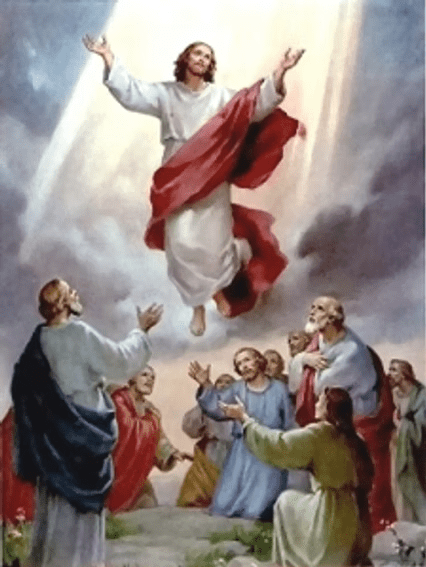
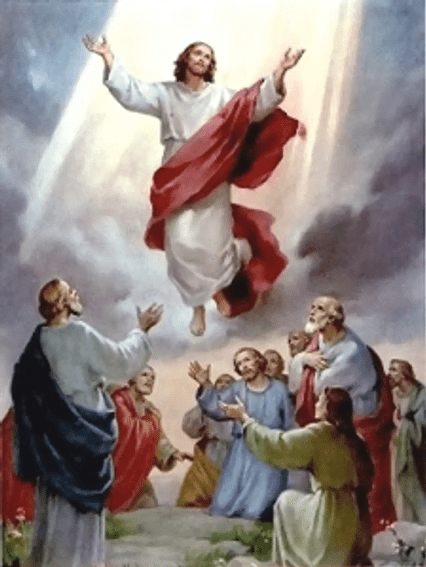
Now, in this (in verse 9), we are told two things: 1.) “Jesus was lifted up,” from the one-word statement “epērthē”; and, 2.) “a cloud hid him from the eyes of them” [a literal translation]. It is important to grasp that Christians recognize this as the Ascension, whereby the word “ascension” is defined generally as “the act of rising to an important position or a higher level.”

This event took place in two stages, the first of which simply says that Jesus became elevated. To better see what happened, one can jump forward in the Book of the Acts of the Apostles, to chapter two and see how Theopilus wrote, “Then Peter stood up with the Eleven, raised his voice and addressed the crowd.” There the word written is “epēren,” which comes from the same root infinitive verb “epairó,” meaning “to raise, lift up.” Certainly, when reading chapter two, most Christians think Peter yelled or made his voice louder, by raising it. Instead, Peter’s voice was “raised,” in the same sense that “Jesus was raised” before his disciples.

Then, once Jesus was lifted up Spiritually [not going in any direction marked by human compasses], his form then “was hidden from their eyes by a cloud.” Here, the Greek word “nephelē” is read in the same way the one-word statement “epērthē” is, as literal, rather that spiritually. This means our brains are trained to hear the word “cloud” and automatically think of a cloud in the sky, just like we read Peter’s voice was raised and think that means he talked loudly. The deeper way of understanding this second phase is as meaning “Jesus disappeared from their view as if a cloud surrounded him.”  This means “a cloud” is a way of saying “a fog” or “a mist that prevented vision.”

To grasp this best, return to the day the Passover had ended and Jesus suddenly appeared in the room where the disciples hid, behind a locked door. John wrote, “ēlthen ho Iēsous,” which says “came he Jesus.” John did not write that Jesus slowly appeared from a cloud, as if he drifted down or walked through a wall like a ghost. Jesus was not there, but then Jesus was there. This means Jesus was in the upper room, where he “came” or “arrived” or “appeared,” based on viable translations of the Greek. It means his body of flesh had been “hid from the eyes of them,” just like his body of flesh then was again “hid from their eyes.” This means the “cloud” is not material or worldly (like molecules of water vapor, as form in the sky) but ethereal, as in Spiritual.

This becomes exactly how Jesus explained [as read last week in John 14], “The world cannot accept him [the Spirit of truth], because it neither sees him nor knows him. But you know him, for he lives with you and will be in you.” (John 14:17) It is no different than when a strange pilgrim walked with Mary and Cleopas to Emmaus, or when Mary Magdalene saw Jesus and though he was a gardener. Jesus was there both times, but unseen and unrecognized.  Thus, the world (of those still without God’s help) “neither sees him nor knows him.” Knowledge of Jesus as the Christ means “he lives with you  and  (from “kai”) will be in you.”

By grasping that Jesus did not float away into the sky as the disciples watched [like we believe Elijah left and Elisha watched], we then can understand how “suddenly two men in white robes stood by them.” This can now be seen as “two men in white robes” were already there, but the eyes of the disciples could not see them either.

This is no different than when Peter, James, and John [the brothers of Zebedee] saw Jesus standing with two ghostly white figures, somehow known to be Moses and Elijah. (Matthew 17:3)  It is also just like when the shepherds in the field had a frightening appearance before them.  We are told, “Suddenly a great company of the heavenly host appeared with the angel, praising God.” (Luke 2:13) That angel and the host of heaven just “appeared to them.”

This, in my mind, makes realizing that this event took place on the forty-ninth day after the Passover counting of the omer began. The count begins on 16 Nisan, so forty-nine days after would make the known date be 5 Sivan. The Festival of Weeks is called Shavuot in Hebrew, and (according to Wikipedia) Shavuot is always going to be “between May 15 and June 14.” During that time span (astrologically speaking) is when (yearly) the sun’s placement in the sign Gemini (between May 20 and June 20, generally). The stars that make up that constellation are part of “the host of heaven.” That zodiac sign represents two men: Castor and Pollux.

Two men in white robes appeared just as Jesus had disappeared; but they came suddenly “while [Jesus] was going and [the disciples] were gazing up toward heaven.” The translation of the Greek word “atenizontes” as “gazing,” when the word also means “looking intently” or “directing [their eyes] steadily” “into the heaven” (from the Greek word “ouranos”) says the disciples were “star gazing.”

The Magi were stargazers and the Jews knew astrology as a tool of divining Yahweh.

While giving the impression that Jesus disappeared as he slowly rose in the sky in a cloud, verse [10] comes after Jesus disappeared from view, with it introduced by a capitalized “Kai,” showing the importance of this statement that literally says, “as intently looking they were into the visible stars as his departure made.”  One can get the impression that some use of astrology might have been employed by the disciples, in an attempt to figure out the “signs” and get an idea when Jesus might reappear.

It should be recalled that in Luke’s Gospel, relative to the Sunday morning after Passover ended, the women went to the tomb when Jesus was buried.  When they arrived and found the tomb opened and no corpse in it, Luke wrote, “While [the women] were wondering about this, suddenly two men in clothes that gleamed like lightning stood beside them.”
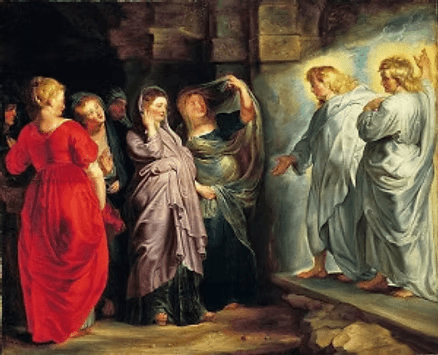
That certainly gives the impression of angels, which could also describe Castor and Pollux (had it been them), but the words spoken to the women, “Why do you look for the living among the dead?” are similar to those spoken to the disciples, “Why do you stand here looking into the sky?” The symbolism of Gemini is “dualism,” where one was mortal and one was immortal.  It then makes sense that they would present their questions in a dualistic manner: Why look for life in death?; and, Why look to the sky when on earth?

By seeing this appearance of angels in this way, the two men in white robes said (in a question), “Jesus never left, so don’t waste your time trying to figure out where he can be seen.” The two men in white then said, “This Jesus, who has been taken up from you into heaven, will come in the same way as you saw him go into heaven.”  That needs to be broken down for best understanding.

There are three segments of words stated. The first places focus on “this Jesus.” Without any other words to interfere with one’s though processes, the angels were actually saying “We speak for this Jesus.” After having asked why they look up in the sky for answers as to when Jesus will return,” they said “this is how easily Jesus can return.” “This Jesus” who you look for is here now, just unseen.

The next segment of words, following the name “Jesus,” says separately, “the one having been taken up from you into the spiritual heaven,” which can mean Jesus was in Spiritual form, where “having been taken up”(from the Greek “analēmphtheis”) is not a statement about being elevated, as was “epērthē.”  The effectual meaning is Jesus did not command himself to disappear, he was “picked up” or “carried off” by God the ruler of “heaven.”

Still, relative to the myth of the Gemini twins, the death of Castor so saddening Pollux that he begged Zeus to intervene, such that both were immortalized in the stars together. They both were “carried off” and placed in the “heaven.”

They are holding hands!

This means the angels spoke of this disappearance as an act of God, which is beyond the comprehension of mortal human beings.

The third segment of words then says, “thus will come back in the same way you have seen [Jesus] go into heaven.” Again, that says what Jesus had said before he left: “Wait for the gift my Father promised, which you have heard me speak about. For John baptized with water, but not after many days you will be baptized with the Holy Spirit.” The angels said it was not up to Jesus when he would return.  God took him from their view and God would place him back when the time was right.

When this reading from Acts ends by saying, “All these [male disciples] were constantly devoting themselves to prayer, together with certain women, including Mary the mother of Jesus, as well as his brothers,” the important thing to grasp is not only men and not only lead disciples would be “baptized with the Holy Spirit.” All who are “constantly devoting themselves to prayer” and obeying the Laws [maintaining only “a sabbath day’s journey” on a Shabbat and staying in Jerusalem as told] would receive the Holy Spirit from God and be reborn as His Son.

This is the reading that takes the natural place in the lectionary of an Old Testament reading. It should be noted that it is during the Easter season that the Acts of the Apostles are read as a substitute for the Old Testament readings, because the Old Testament reading support the prophecies of Jesus to come, as stated in the Gospels and Epistles. The Acts are read because the Easter seasons (A, B, and C) are when disciples should be preparing themselves to be filled with the Holy Spirit and be reborn as Jesus Christ. Christianity depends on this renewal of the good fruit of the vine. Easter represents when all the prophecies of Jesus’ coming have been reached, with the next step being new ministries of Jesus, as his “witnesses in Jerusalem, in all Judea and Samaria, and to the ends of the earth.”

Most Christians shutter when someone speaks of astrology. They fear a tool when they should only fear God, love Him with all their hearts, souls, and minds. They cannot fathom that God set the stars to guide men by and is therefore the “inventor” of astrology. As a tool, its use is where danger can come, with that use is in the hands of people who fear living only to serve God.  Evil users seek some external ‘inside skinny’ rather than letting God speak to them within.

The concept of the “elohim” leads some Christians to hate all who see many gods as having to have been created by God, or they would not exist. Castor and Pollux are not myth when we understand their essence as well as we understand the essence of such words as “love” and “faith.”  The fallen angels are the “elohim” who take delight in leading mankind away from God, rather than to Him. The angels dressed in white robes  are the “elohim” that are messengers of God, who answer our prayers.  The mere mention of Castor and Pollux, from pagan mythologies, seem to those not “baptized with the Holy Spirit” as an evil statement, while they welcome the concept of angels in white robes. Why cannot the two be the same, at least in principle?

All arguments against acceptance of Scripture as meaningful, with logical supporting evidence, while pandering some mambo jambo [gibberish] of meaningless catch phrases, where explanations of meaning leave one asking for explanations of the explanations, only serves the purpose of keeping disciples ignorant and wanting. The point of the Easter season is to have new disciples stand up [be raised spiritually] and let God flow through them as He did on Pentecost. Any priest, pastor, minister or preacher who gives a two-bit sermon about Pollyanna needs to be confronted with their lack of Apostlehood, for not spreading the Holy Spirit so others can rise and become ministers of the Word.

Please, if you have a church that you go to and this reading is not addressed properly, print this out and schedule a conference with that leader and ask him or her to explain to you where this analysis is wrong. Let the leaders know that they have become as meaningless as Pharisees, Sadducees, and scribes, who are blind as bats as to the meaning of God’s Word when Jesus lived.  The same conditions have returned, with mortal men and women pretending to be Saints.  This needs to end.

Do that and get back with me, please.
Psalm 68 – A song of praise God’s angels sing

This is the selected Psalm to be sung or read aloud in catholic-churches [universal Christian churches] on the Seventh Sunday of Easter. This will next be Sunday, May 24, 2020.

I printed out the Lectionary page versions of the readings for this next-to-last Sunday of the Easter season and after analyzing the Acts reading (Acts 1:6-14) I was not getting the connection to the Ascension theme from any of the other readings. Often, there is a clear thread that connects all the readings, which is what ALL sermons or homilies should be addressing [not just one of the readings; because if one is too lazy to address more than one, then one needs to make reservations for the next life on earth, which might be called hell]. If you only attend church for the wafers and wine [realizing none of that is happening during this End of the World period we are in, due to a pandemic], not going to have your heart burn to know God and His Son PERSONALLY, then you don’t want to know anything that is truly worth knowing.

I looked up the Interlinear version of Psalm 68 and the theme jumped out at me. I had to focus my eyes a little, but once it was in focus it was clear. It goes back to a realization I had just last week. That realization is based on the mistranslation in the psalms of elohim.

I have long known that elohim is “gods” [plural] in Hebrew and not the singular God we worship, which is stated as “Yahweh” [YHWH]. However, just last week the inner voice led me to see how Apostles and Saints are elohim, because they are the union of a body-soul combination [a mortal entity] with God’s Holy Spirit [an immortal entity], being reborn as “gods.” More specifically, Apostles and Saints are reborn Sons of God, the elohim that are all Jesus Christ.

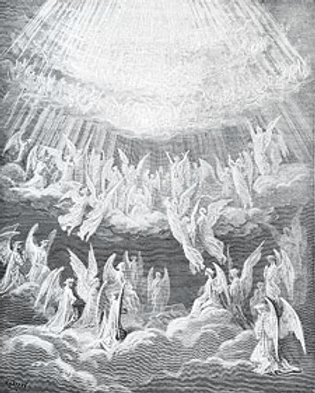
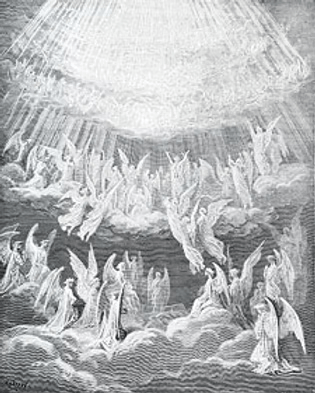
The heavenly host – the arms of God.

In the fourteen verses chosen from Psalm 68 to be sung [skipping over verses 11 to 32], there are fifteen references to “elohim,” one to “yah” [short for Yahweh] and one to “el” [as “the god of Israel”]. All of that is in fourteen verses sung aloud.  When each and every one of the mistranslations of “God” are erased and “elohim” sang instead, then the reading from Acts has perfectly set up Psalm 68, by ending with the following:

“Peter, and John, and James, and Andrew, Philip and Thomas, Bartholomew and Matthew, James son of Alphaeus, and Simon the Zealot, and Judas son of James. All these were constantly devoting themselves to prayer, together with certain women, including Mary the mother of Jesus, as well as his brothers.”

Those names and general identifications are stating those who would become Jesus Christ returning to earth in the flesh, the union of body and soul with the Divine. They are the elohim of Christianity, and they ALL express the divine duality of the Gemini twins (Castor and Pollux).

When this is seen, then Psalm 68 is ‘Transfigured” like this:

1 Let Jesus Christ reborn arise, and let his enemies be scattered; * let those who hate him flee before him.
2 Let them vanish like smoke when the wind drives it away; * as the wax melts at the fire, so let the wicked perish at the presence of Saints.
3 But let the righteous be glad and rejoice before those reborn as Jesus Christ; * let them also be merry and joyful.
4 Sing Saints, sing praises in his Name; exalt him who rides upon the clouds; * YAHWEH is his Name, rejoice before him!
5 Father of orphans, defender of widows, * Apostles in his holy habitation!
6 Apostles give the solitary a home and brings forth prisoners into freedom; * but the rebels shall live in dry places.
7 Saints, when you went forth before your people, * when you marched through the wilderness,
8 The earth shook, and the skies poured down rain, at the presence of Saints, the Apostles of Sinai, * at the presence of those reborn as Jesus Christ, the Saints of Israel.
9 You sent a gracious rain, Apostles, upon your inheritance; * you refreshed the land when it was weary.
10 Your people found their home in it; * in your goodness, Saints, you have made provision for the poor.
33 Sing Christians, O kingdoms of the earth; * sing praises to the Lord.
34 He rides in the heavens, the ancient heavens; * he sends forth his voice, his mighty voice.
35 Ascribe power to the Son of God; * his majesty is over Israel; his strength is in the clouds.
36 How wonderful are Saints in his holy places! * the Apostles of Israel giving strength and power to his people!


Blessed be those reborn as Jesus Christ!

In a couple of places the translations of the transliterated Hebrew words “bā·‘ă·rā·ḇō·wṯ” [“בָּ֭עֲרָבוֹת”] and “baš·šə·ḥā·qîm” [“בַּשְּׁחָקִֽים”] state “heavens” or “skies,” but the translations shown by Bible Hub are “on the clouds” and “in the clouds.” The italics are then pointing out those changes, as the Acts reading tells of Jesus ascending via a cloud.

Interestingly, the root word that leads to the translation “extol him who rides upon the clouds by Yahweh” [the literal Bible Hub translation], “arabah” has a defined translation as “a steppe or desert plain.” When this is then translated as “upon the clouds,” one can get an idea how being “hid from the eyes of them” has little to do with actual clouds up in the sky, but the heat that rises from the earth and makes things difficult to see. Additionally, the root word translated as “in the skies” is “shachaq,” which can also mean “dust,” as the wind sweeps dust from the earth and makes visibility impossible.

This is the meaning of Christ the King, which (as Jesus said), “My kingdom is not of this world. If it were, my servants would fight to prevent my arrest by the Jewish leaders. But now my kingdom is from another place.”  Jesus Christ is the Spiritual king of God’s chosen people.  His realm not of this world is over the elohim.

As a selection during the Easter season, when the symbolism is for disciples to commit themselves fully to service to God – become His wives, bound by the wedding band of the Holy Spirit – as elohim in the name of Jesus Christ, this song of praise needs little explanation, beyond the changes I have made. It should naturally be a song felt in one’s heart. It should be a song that will be sung in heaven, long after one’s flesh has returned to the dust.

1 Peter 4:12-14; 5:6-11 – The suffering of commitment

This is the reading chosen from the first epistle of Saint Peter, read on the Seventh Sunday of Easter. It is scheduled to next be read on Sunday, May 24, 2020.

If you notice, this reading is a cut and paste, where three verses from Peter’s fourth chapter (12-14) are cut out of the middle of that chapter and pasted to six verses cut out of the middle of Peter’s fifth (and final) chapter (6-11). The verses selected speak of the pains of being truly Christian. Peter wrote of the “fiery ordeal,” the “sufferings,” the “anxiety,” and the “discipline” that become the set expectations for one who gives up his or hers self-ego, so God can take up residence in a new Holy Tabernacle of flesh and His Son can be reborn as the king over that individual’s actions.

Since we have been placed in the ‘cut and paste’ mode with this reading, I thought it would be good to add some ‘cut and paste’ context to this setting of suffering. To better establish each of the sets of verses from the middle of chapters, I thought it would be good to show the verses that begin each chapter, from which the middle verses fall in support.

The first three verses in chapter four state this:

“Therefore, since Christ suffered in his body, arm yourselves also with the same attitude, because whoever suffers in the body is done with sin. As a result, they do not live the rest of their earthly lives for evil human desires, but rather for the will of God.  For you have spent enough time in the past doing what pagans choose to do—living in debauchery, lust, drunkenness, orgies, carousing and detestable idolatry.” (1 Peter 4:1-3, NIV)

This clarifies that the sufferings of Apostles and Saints is a natural extension of being reborn as Jesus Christ. In the above translation, where the second segment of verse one says “arm yourselves also with the same attitude,” the Greek word translated as “attitude” is “ennoian.” That word better translates as “mind,” but Strong’s states its definition as being “thinking, thoughtfulness, moral understanding.” This means an Apostles or Saint has “the same understanding” as did Christ, which is taking on the Christ Mind.

When Peter then went on to say suffering as Jesus Christ reborn means being “done with sin” and able to reject “evil human desires” (generalized as: living in debauchery, lust, drunkenness, orgies, carousing and detestable idolatry). This says being reborn with the “same mind” as Jesus had means leading one’s own flesh is enabled to reach the only way one can be and live righteously, denying the lures of the world. ALL human beings are addicted to sin, because they have all lived in a world of sin, without knowing God personally as their Father, not knowing Jesus Christ personally as their king. The result of changing from sinner to saint is the ‘heebie jeebies’ or withdrawal sufferings.

Examples of withdrawal symptoms for alcohol addicts.

In this regard, Peter wrote “do not be surprised at the fiery ordeal that is taking place among you to test you, as though something strange were happening to you.” The “strange things happening” means one is walking the path of righteousness, which is a road seldom traveled and leads to a destination unknown.

For all the Bible Stories learned as a child, and for all the ‘visions of sugar plums dancing’ in that child’s head, life as an adult brings a cold hard reality that needs fresh bottles of excuses to wash down and plenty of pity pills to make all the normal pains and suffering of life in a sinful world seem bearable. Walking the path of righteousness requires a guide, but that road is so untraveled it is overgrown with the brush and brambles of suffering that must be cleared … as a test of faith.

As the reading from the first chapter of Acts ended with Jesus having disappeared from view and angels told the disciples (of whom Peter was one) to go about their business, as they had nothing to find from looking up in the sky.  The resurrected Jesus (Jesus reborn into a dead body) had taught them for forty days, preparing them for an unknown return.  We then read, “They all joined together constantly devoting themselves to prayer.”

The Greek word “proseuché,” which translates as “prayer,” means a dialogue between the faithful and God was part of their new normal. Jesus had promised them, “what you ask for in my name the Father will do.”  That line of communication must be maintained at all times (“constantly”). What is completely overlook in that translation from Acts is how the word translated as “joined together” (“homothymadon”) actually means the disciples and friends of Jesus became “with one mind.” Therefore, that meaning says the named followers of Jesus did not simply all go pray in the same room, as they all had instilled within them the mindset of prayer.

It was from that unified mindset of prayer that the names listed and generalized – the devoted followers of Jesus of Nazareth – became willing and prepared brides of God. They did not know that just the next day, at nine in the morning of Pentecost Sunday, the Holy Spirit would enter them and they would give birth to the Son of God many times over. They all would become Saints or Apostles that day, because they were married to God in their hearts and the voice of His Son burst out of their mouths immediately. For as fearful as they had been of the dangers of being known as followers of a man executed by the Romans, at the behest of the Temple elite, they all stood up and began speaking in foreign languages, fluently speaking the truth of God’s Word (the Torah, Psalms, and Prophets).

The immediate reaction was, “Oh, there is a group of people still drunk on new wine.”  It was not, “Oh look!  There are the people with all the answers we have long been seeking!”

This is why Peter wrote, “If you are reviled for the name of Christ, you are blessed, because the spirit of glory, which is the Spirit of God, is resting on you.” Those who immediately rejected those new bodies of flesh that had the Christ Mind and spoke the truth of God as Jesus Christ, experienced how fast the world is to turn on someone not ‘toeing the party line’ or keeping the standard of bad shepherd-run religion.  Rejection of truth being told is always the way a sinful world strikes out, in fear of being discovered as evil. However, because ALL Apostles (including the women of Jesus) have the Holy Spirit of God as part of their being, the truth was heard and souls were saved that day.

We read not too long ago about three thousand receiving the Holy Spirit that day.  Three thousand became Jesus Christ reborn.  Three thousand went out into ministry because of the preaching of just a few followers of Jesus of Nazareth.  They all went and found the same rejection that they had to face, as their test of faith.

The problem we experience today, where the same standards of bad shepherd-run religion are just as prevalent, is people who profess to be Christians are just as apt to grab rocks to stone to death prophets and very easily prone to speak insults (to their faces or behind their backs) to those who tell them something they did not read in some book, sold in hardback copies at the Christian book store or preached about by their hired hand leader.  The reason people are so prone to strike out in anger first is this: Nobody wants to do what is necessary to walk a path of righteousness, simply because Lent proved (just like failed New Year’s resolutions) that living up to a child’s dream is impossible, when all their friends are not of the same mind.

6. Kill my ego and be Jesus Christ.

Rather than change, according to the Word, it is so much easier to crucify Jesus, over and over again.

To ease the pain and suffering of that failure to serve God as His Priests, people go to churches and listen to an Epistle and think, “Aaaahh. That nice Apostle told me everything I am doing is okay.”

The pewples cannot understand that Peter and Paul and all the other Saints wrote letters of encouragement to the ones like them – to other Saints and Apostles – who were struggling to find Jews and Gentiles who wanted to marry God and give birth to His Son Jesus. Thus, when they hear a reader in church say the words: “If you are reviled for the name of Christ, you are blessed, because the spirit of glory, which is the Spirit of God, is resting on you.” They think, Peter just told me everything is okay.

It is easy to make that mistake in logic when the verses from Peter’ fifth chapter omit the introduction (verses one through three, which clearly are addressed “To the elders among you.”

Peter wrote: “I appeal as a fellow elder and a witness of Christ’s sufferings who also will share in the glory to be revealed: Be shepherds of God’s flock that is under your care, watching over them—not because you must, but because you are willing, as God wants you to be; not pursuing dishonest gain, but eager to serve; not lording it over those entrusted to you, but being examples to the flock.”

Christianity became a separate gathering of Apostles and Saints, with their devoted followers-in-training (mostly the ‘have nots’).  “Churches” began (versus synagogues) because of the sufferings of being outcast from Jewish houses of assembly. The Apostles did not write to formal institutions in places around the Middle East (such as the Church of Ephesus), but to the Apostles of a place where the Holy Spirit had been spread to humans.  The Apostles did not write to people who were not reborn as Jesus Christ, as if the Epistles were some influence to ‘buy into Christianity if outcast’ promotion. The Apostles wrote letters of support and encouragement to other Apostles, all of whom knew the challenges of trying to save a world of sinners. 

The “elders” to whom Peter addressed were then also Apostles and Saints, who led gatherings of others seeking to be reborn as Jesus Christ.

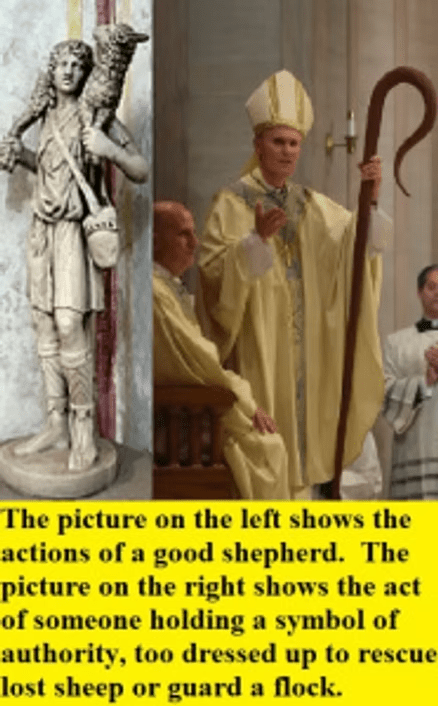
In our present aborted return to bad shepherd-run religion, the tendency is to see a priest, minister, or pastor as an “elder.” The problem with that is there are no such people dressed up in robes, crosses and collars these days. Christian churches for years have been pumping out young, inexperienced priests, with not enough life experience to be termed an “elder,” much less know the Holy Bible and what it means.  They are all hired hands who get paychecks from some institution or organization.  It is that business (not God or Christ) who tells those hired hands what to do and what to believe.

Thus, when Peter wrote, “Humble yourselves therefore under the mighty hand of God, so that he may exalt you in due time,” priests, ministers and pastors embolden themselves as the spokesmen and spokeswomen of Jesus Christ, saying [I paraphrase from experience hearing them]: “I speak for Jesus when I say you should contribute to and take part in my political and philosophical mindset.”

An “elder” is not some political hack, nor a socialist partisan.  Karl Marx was not Jesus Christ reborn.

Today’s religious leaders ignore the dangers of pretending to be spokespeople for Jesus, by ignoring how Peter wrote, “Like a roaring lion your adversary the devil prowls around, looking for someone to devour.” Those false leaders do not read that and learn to teach that message to the paying customers.  Young priests and pastors today do not preach, “Anyone who is not Jesus Christ reborn, the Son of God resurrected in the flesh by the glory of God Almighty IS GOING TO BE DEVOURED BY EVIL.”

They do not teach followers how to become what they know nothing of (although they might occasionally support a youngster’s attempt to find work in that religion, as a seminarian applicant).

They set the expectation that doing nothing is why God sent His Son into the world of sin, which was not made better by the presence of Jews revering Mosaic Law … doing nothing.

This means people misunderstand Peter and Paul (et al) as Apostles. They are not seen as rebirths of Jesus Christ, but as devoted Christians who went out to spread Christianity around the world. They paint them as ‘do-gooders’ who had a desire to be well-known.  Now, when everyone older than twenty knows about Jesus Christ, it is time to lay back and do nothing, because others before us did all the work. Just sit back; sin all you want (within legal limits, but advocate extending those limits), and wait to die and go to Heaven.

Christians are blind today that the same failure occurred long ago. The lesson is repeating the same failure does not work out well. Here is the lesson that should be remembered on this seventh Sunday of Easter:

Being Israelites in their new Promised Land was a lot of hard work – always praying and always living according to the Laws of Moses. Work, work, work. And then, on top of all that work, the people who lived there and were not Israelites were always causing pain and suffering. The Israelites would get tired of fighting and let their enemies get their way; and, the next thing they knew was their enemies were persecuting them terribly. That brought about the yo-yo effect of working hard to win God’s grace, then relaxing and doing nothing, which only brought on more persecution. All that hard work led to the “elders” going to the prophet Samuel, who they told, “Tell God we want a king, to be like all the other sinful nations of the world. What the king says to do, we will do, and let that be our agreement with God (now that we have our Promised Land).”

The end of that story did not work out well.

Constantine somehow told the movement of Apostles, “What you guys need is an emperor, instead of something as simple as a king.  Therefore, I will rule all of Christendom as a pope!”  Just as Israel split in two after Solomon died, so too did the Christian churches.  And it has been going downhill (split after split) thereafter.  The repeating of the same story, second verse.  It also does not end well.

The end of the world as we know it will be because of hatred.  American and English Christians allowed the Zionist Jews (a political organization) to steal Palestine and rename it Israel. There can be no support from Yahweh for theft of anything.  Western Christians have played God and promised land that was not theirs to promise to anyone.  The Church of Rome has collapsed in disgrace.  The royal blood of Jesus (the man) has been reduced to a series of impure families with closets full of evil secrets.  In a repeat of the past, the Jews will let someone else condemn Jesus and nail him on a tree once again.  The whole world has now become the Promised Land that needs voices crying out in prayer, “Save us from ourselves, Lord!”

Mistaking philosophies with God’s Will is not an act led by the Christ Mind.

When the Jesus of John’s Apocalypse comes, it will not be to save the world anymore.  The letters to the seven churches are statements of judgment that waits Christian churches’ approval.  The new covenant says, “Yeah, you did some good, but you best receive the Spirit.”

Unfortunately, Christians today bow down and pay homage to kings of nations, bishops of religious organizations, and idols of entertainment. Very few have allowed their bodies of mortal flesh to become nations unto God, whose king given in rule is His Son, Jesus Christ. Very few see Jesus Christ as the right hand of God who rules over their bodies, as they do God’s Will. Very few today are true Apostles and Saints trying to get the attention of people calling themselves ‘Christians’.

Many are living evil lives and pretending that Jesus says it is okay. Anyone who speaks messages that are contrary to that newfound sense of redemption is persecuted. This is not a new development. Peter wrote to the “elders” who were “shepherds of God’s flock,” saying, “know that your brothers and sisters in all the world are undergoing the same kinds of suffering.” Wherever Jesus Christ stands reborn, evil will attack that body of mortal flesh just like the Jews of Herod’s Temple did two thousand years ago.

There is no easy way to heaven. The path of righteousness cannot be walked alone. A mortal needs immortal assistance. An Apostle needs the support of other Apostles.

Easter is not about doing nothing. It is all about the suffering of death – one’s self-ego being laid to rest. It is about resurrection through marriage to God – when Jesus said “Receive the Spirit.” The Easter season is about the wedding plans – a mindset joined with God through prayer. Next week it is all about the graduation day experience.

Unfortunately, when one looks around churches today (after fear of coronavirus has eased and churches reopen) you see old congregations.  In the pews are ‘veteran’ Christians, all claiming thirty, forty, fifty years of ‘service’ to a Church, an institution, having never once gone out in ministry for the Lord. Not once have any of them ‘graduated’ as Jesus Christ resurrected.

Christians see that as normal; but go to any college and university campus and ask, “Where are the fifty year students hanging out these days?”

The normal answer there would be, “Get out of here! No one goes to school that long. They either graduate or drop out.”

John 17:1-11 – Shown how to pray

This is the Gospel reading that is the selection for the Seventh Sunday of Easter. It is next scheduled to be read aloud in churches that will be empty because of pandemic fears on Sunday, May 24, 2020.

This is the Sunday known as Ascension Sunday. Many churches recognize the Ascension as being on Thursday (May 20, 2020 this year) because they calculate Thursday is forty days from Easter Sunday (including Easter, I guess, meaning Jesus rose on the Sabbath [Saturday]). It is such flawed reasoning that gives Christianity a bad name (“Liars” being one), which goes hand-in-hand with their thoughts that generated the Easter Bunny and Santa Claus, because Thursday has nothing to do with Acts 1.

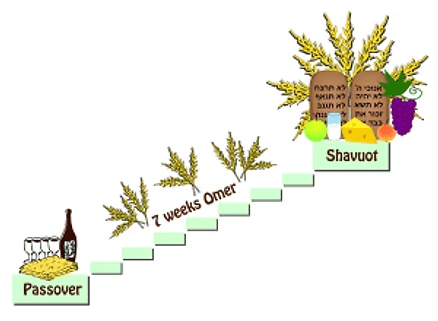
To understand the Ascension, one first needs to understand the Counting of the Omer, which is a God-commanded ritual count (found in Leviticus 23:15–16, and Deuteronomy 16:9-12). That count is for seven weeks (49 days), with the Fiftieth (“Pentecoste”) day beginning the Festival of Weeks, known as Shavuot. This explains to Christians why the Easter season is seven Sundays long.

Now, it is very plain in the Holy Bible that a.) Jesus was taken down from the cross and prepared for burial in the tomb of Joseph of Arimathea on Friday; and, b.) Jesus was discovered not in that tomb on Sunday (the first day of the week), very early on that day. What is not clear at all to Christians is the Counting of the Omer.

Passover is an eight-day event (still in today some places, but it certainly was back in Jesus’ day). That Passover began on 15 Nisan, a Friday evening that officially became a Sabbath [God’s day] and ended on a Sabbath [God’s day], eight days later. The counting of forty-nine days (seven weeks) always begins on 16 Nisan, which is the first full day of the eight-day festival. That week, because the festival began on a Friday at 6:00 PM, the sixteenth was a Sabbath (yom shabbat). The day Jesus was discovered not in the tomb was a week later, when that evening it was the eighth day of the count.

While Jesus did spend forty days preparing his disciples, the forty-day count did not begin on Easter Sunday, but Easter Monday. Forty days later – Guess what? – the forty-ninth day was another Sabbath; and Acts 1:12 confirms that by stating, “Then the apostles returned to Jerusalem from the hill called the Mount of Olives, a Sabbath day’s walk from the city.”

If one has one iota of faith, perhaps one can realize that God is the one setting the timing here. God knew (as did Jesus) that a Passover begun and ended on God’s day would be when His Son would be sacrificed. Jesus’ final Passover Seder [his second that Passover] was on a Sunday (officially) that began at 6:00 PM on the Sabbath [the Jews have two Seder meals during each Passover, the first two nights]. Jesus was arrested early on a Sunday morning. Jesus was raised from death on a Sabbath, another God’s day. Jesus was discovered out of the tomb early on a Sunday morning. Seven weeks after the Counting of the Omer began on 16 Nisan, it was again a Sabbath, meaning Jesus Ascended on a Sabbath that was God’s day. PLEASE GIVE GOD CREDIT for everything about His Son being planned from the beginning of time and not something that hap hazardously happened, requiring a Roman church to figure out myths for its followers to believe.

Now that the matter of when Jesus disappeared from the sight of his disciples, we can realize he did not “ascend.” Acts 1:11 tells how two men dressed in white said, “Why do you stand here looking into the sky? This same Jesus, who has been taken from you into heaven, will come back in the same way you have seen him go into heaven.” That says, “Jesus did not go up in the air. Jesus disappeared from your view and just like he disappeared from your view, he will return so you will see as him.”

It is the translation from the Greek that mislead (us reading English) us that “epērthē” (translated as “he was taken up”) means Jesus floated up into the sky. It is our concept of “a cloud” (the Greek word “nephelē”) that makes us picture in our mind’s eye a fluffy cloud in the sky. However, it is the reason angels came to talk that we realize it did not happen that way: There was no “Ascension.”

Peter, as one who Jesus taught for forty days, leading him (with the others) to pray constantly, heavily implies his words of encouragement to other Apostles to know their sufferings are known by God and Christ. In this way, all Epistles by the Saints are written prayers shared with those who were “joined together” in one mindset, a Mind that demands prayer. Then, John’s seventeenth chapter is all about the prayers of Jesus, prior to his arrest.

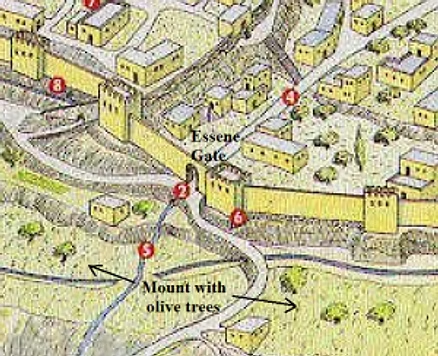
The context of John 17 needs to be understood. John 14 ended with Jesus telling his disciples, “Let’s leave from here,” which was an indication to the men to leave the upper room, allowing the women and young children to remain and discuss the Torah together, while drinking wine. John 15 and John 16 tell of Jesus preaching to his disciples, preparing them for a future they knew nothing about. Only John wrote about that teaching, as the disciples were still drinking wine and none were hanging onto the words Jesus spoke [saying John was not an adult or an official disciple]. John 18, which tells of Jesus’ arrest at Gethsemane, begins with John stating, “When he had finished praying, Jesus left with his disciples and crossed the Kidron Valley. On the other side there was a garden, and he and his disciples went into it.” (John 18:1)  Thus, John 17 is about Jesus praying somewhere just outside the Essene Gate, near the place of the upper room.

In that, John wrote the word “eparas,” which is rooted in “epairó,” the same root word written in Acts 1:9, as “epērthē.” Certainly, one can see how the physical definition imagery of “lifting up” and “looking up” pales in comparison to one such as Jesus, the Son of God, thinking he needed to look anywhere other than within to “talk” (from the Greek “eipen”) with the “Father” (the next word of the text written). This is then John stating that Jesus prayed in a spiritual way, not in some demonstrative way designed to draw attention.

After all, Jesus said of the Pharisee who “stood by himself and prayed” loud praises to God for all he had reaped for being a Pharisee, the Pharisee was not closer to God than the tax collector who “stood by himself and prayed,” beating his breast and repenting. In that set of verses (Luke 18:9-14) Jesus said, “For all those who exalt themselves will be humbled, and those who humble themselves will be exalted.”

In that guiding statement, the words “hypsōn” and “hypsōthēsetai” are written, pulling from the same root “hupsoó,” meaning “to lift or raise up, to exalt, uplift.” Thus praying demands the humbling position that does not “look up,” but bows a head in submission and “exalts oneself by being humble.”

When we read in Luke 11:2-4 (a short version of the Lord’s Prayer), this was after Jesus had sent out seventy-two in ministry and they had returned. After one of those disciples witnessed Jesus praying, the disciple said, “Lord, teach us to pray, just as John taught his disciples.” Because this it told by Jesus on two occasions, it points out how such a basic element of faith is not taught, so the typical followers of Judaism had never been taught in their synagogues how to pray.

This makes understanding Matthew 6:5-8 important to recall, in order to fully grasp the prayer of Jesus, found in John 17. Matthew wrote the following:

“And when you pray, do not be like the hypocrites, for they love to pray standing in the synagogues and on the street corners to be seen by others. Truly I tell you, they have received their reward in full.  But when you pray, go into your room, close the door and pray to your Father, who is unseen. Then your Father, who sees what is done in secret, will reward you.  And when you pray, do not keep on babbling like pagans, for they think they will be heard because of their many words.  Do not be like them, for your Father knows what you need before you ask him.” (NIV)

This led to the full version of Jesus’ prayer to the Lord, with the words “as yours is the kingdom, the power and the glory forever and ever. Amen” being added by churchmen after the fact. Rather than see the meaning behind what Jesus taught, what have the churchmen done?

          They stand in the churches as priest, ministers, and pastors saying, “See me as I lead you to say the Lord’s Prayer.”

          They tell the congregations to recite in unison aloud, rather than telling them to go into their place of privacy and speak silently to God.

          They produce a book of prayers and recitals that they offer to the people as what God likes to hear His people say.

          They pretend that God needs to hear the Lord’s Prayer recited, and they insinuate by saying those words nothing more needs be said.

The Lord’s Prayer is something that should be taught to children. Jesus taught that prayer to infants who did not know how to pray. Jesus referred to his disciples as his “little children.” A prayer memorized by a child has more meaning than a prayer memorized by a child being the prayed aloud as an adult.

The Greek word written by Matthew, “hēmōn,” best translates as “of us,” but “us” is then a statement of one with Jesus. The inclusion of Jesus, spiritually as the Son of the Father, is the only way truth can be spoken through a private prayer that begins by saying, “Our Father” or “Father of us.” Rather than Jesus telling a group of Jews, in a mountainside setting of followers, to address God as “the Father of ours” or “Our Father,” the implication seems to make one think God is the Father of everyone everywhere. For as kumbaya as that sounds, Yahweh was not the father of the children of Israel [hint: Jacob was – a.k.a. Israel].

This is where John’s verse nine becomes more important to realize, as Jesus said, “I am not praying for the world, but for those you have given me, for they are yours.” Jesus was not praying for anyone other than those who were to be married to the Father, stated as “they are yours.” Those would then become wives, and as such ‘mothers’ of God’s Son. As wives who consummate their marriage to God in a Spiritual manner (via the Holy Spirit), Jesus Christ is then reborn within the wives-mothers. Once a disciple has been reborn as Jesus Christ, this spiritual union of a soul of God’s life-breath and the Holy Spirit of the Son of God justifies a private prayer that begins with the truth “we are two in one, so our Father is the Father of us two.”

The “world” (or Greek “kosmou”) means all the “inhabitants of the world” (Strong’s usage) are not the brides of Yahweh. The majority of the “world” does not follow or believe in Yahweh, including all Asian religions and philosophies, with Communists not believing in any god at all. The Muslims do not believe in Yahweh as the same God of Israel, but the god of Abraham that they call Allah. While the two might have similarities, neither the Muslims nor the Jews believe Jesus was the Messiah or the Son of God. As such, they have become divorced wives that have no brother relationship whatsoever with Jesus. Finally, the mistake of the vast majority of Christians today is they have not married God and have not borne him a Son, which would justify themselves addressing Yahweh as Father. Therefore, verse nine in John’s seventeenth chapter is a disclaimer for all who do not meet these requirements of lineage.

That is why Jesus then said, “All I have is yours, and all you have is mine. And glory has come to me through them.” To better realize what the Greek of that verse says, read this literal English translation, where one is able to see the importance of the repeated word “and” (“kai“).

10. and  these of mine all  ,
yours are  ;
and  these yours  ,
mine  ;
and  it has been exalted within them.

The three important segments of words begins by saying “and  these disciples of mine all” are those who are still with Jesus. It refers to those waiting not far from where he prayed. Judas Iscariot had left the group earlier, so he was a disciple of Jesus but his willing departure deleted him from the group. He was returned to being part of the world.

The next use of “kai” then leads to the important identification that all the disciples who were given to Jesus by his Father were the brides-to-be of God. God was in possession of their souls, as they had believed God sent Jesus as the Messiah. They had proved their hearts were set to serve God.

The final use of “kai” makes the important statement of that the disciples, under the guidance of Jesus, have been raised to the level of purity that makes them worthy of God’s presence. The double entendre of this statement is that it fits the prior “mine-yours” exchanges, the glorifying of the disciples for God’s presence also foretells of the rebirth of Jesus with them.

Jesus then can be seen to state in verse eleven the following (in the same literal presentation as before):

11. and  no longer I am in the world  ,
and  they in the world are  ,
and I (“kago“)  to you am coming to you  .
Father holy  ,
keep them in the name of you  ,
which you have given me  ,
so that they may be one just as us  .

This says that Jesus had finished his role on earth for God. With his mission accomplished, the disciples would be the next phase of God’s plan. The combination word “kago” is “kai + ego,” importantly states Jesus was an extension of God, so his ego was that of God. With his time on earth about to be transformed, the soul of Jesus the man (Son of Man) would be returning to be one with God. His soul had maintained its purity, as the Father had kept the Son holy.

When Jesus said, “keep them in the name of God,” that is a statement of marriage, where the wife takes on the name of the husband. It says the disciples would marry God. From that marriage, the wives of God would become the rebirth place of Jesus the Christ. When the Christ is reborn into the disciple-wives, each will become a Trinity – Father, Son, and Holy Spirit – in the name of Jesus Christ.

Let me add that the Greek words “Pater hagie” might syntactically translate as “holy Father,” but the lack of capitalization in “hagie” does not translate to Holy Father. The word is defined as translating as “sacred, holy,” with the usage including “set apart by (God).” (Strong’s) The title Holy Father is something bestowed upon popes, as a man to whom other men bow before.  A pope claims to have the authority of God on earth. No one has that authority, as God only works through his Son reborn in Apostles, who are Saints. While the Church of Rome backfilled slots of historic “popes,” all who were deemed Saints by some papal test, Saints rarely served in such a limiting capacity as head of a church in Rome. If God wanted that, He would have made Jesus the Pope of Jerusalem and given him immortality.

The ordering of the words, “Pater hagie,” addresses the Father in the relationship with Jesus the Son. The lower-case says Jesus, who was a subservient wife of God in the flesh, was God-incarnate spiritually. There can be no question that God the Father is holy or sacred, as it is God who makes humans be so endowed. Thus, Jesus’ soul was said to be returning to the “Father” in a “sacred” state.

As the Gospel reading in the Seventh Sunday of Easter, when Christians are called upon to be those who are chosen to be wives of God and reborn as Jesus Christ, the decision has to be made: Does one serve self and be like Judas Iscariot and rejoin the world, divorcing oneself from a relationship with Jesus? Or, does one have one’s heart cleared of self-ego and make room for God as one’s husband (regardless of human gender)?

Next Sunday represents the wedding day, when one graduates from being a student of Jesus and becomes the teacher reborn.