Tag Archives: Easter 7 Year B

Acts 1:15-17, 21-26 – Casting lots for leaders Anointed as Jesus reborn

In those days Peter stood up among the believers (together the crowd numbered about one hundred twenty persons) and said, “Friends, the scripture had to be fulfilled, which the Holy Spirit through David foretold concerning Judas, who became a guide for those who arrested Jesus– for he was numbered among us and was allotted his share in this ministry. So one of the men who have accompanied us during all the time that the Lord Jesus went in and out among us, beginning from the baptism of John until the day when he was taken up from us– one of these must become a witness with us to his resurrection.” So they proposed two, Joseph called Barsabbas, who was also known as Justus, and Matthias. Then they prayed and said, “Lord, you know everyone’s heart. Show us which one of these two you have chosen to take the place in this ministry and apostleship from which Judas turned aside to go to his own place.” And they cast lots for them, and the lot fell on Matthias; and he was added to the eleven apostles.

——————————————————————————–

This is the reading selection from the Episcopal Lectionary, from the Acts of the Apostles, for the Seventh Sunday of Easter, Year B 2018. It will next be read aloud in church by a reader on Sunday, May 13, 2018. This reading is important as it addresses the replacement of Judas Iscariot among the Apostles of Christ.

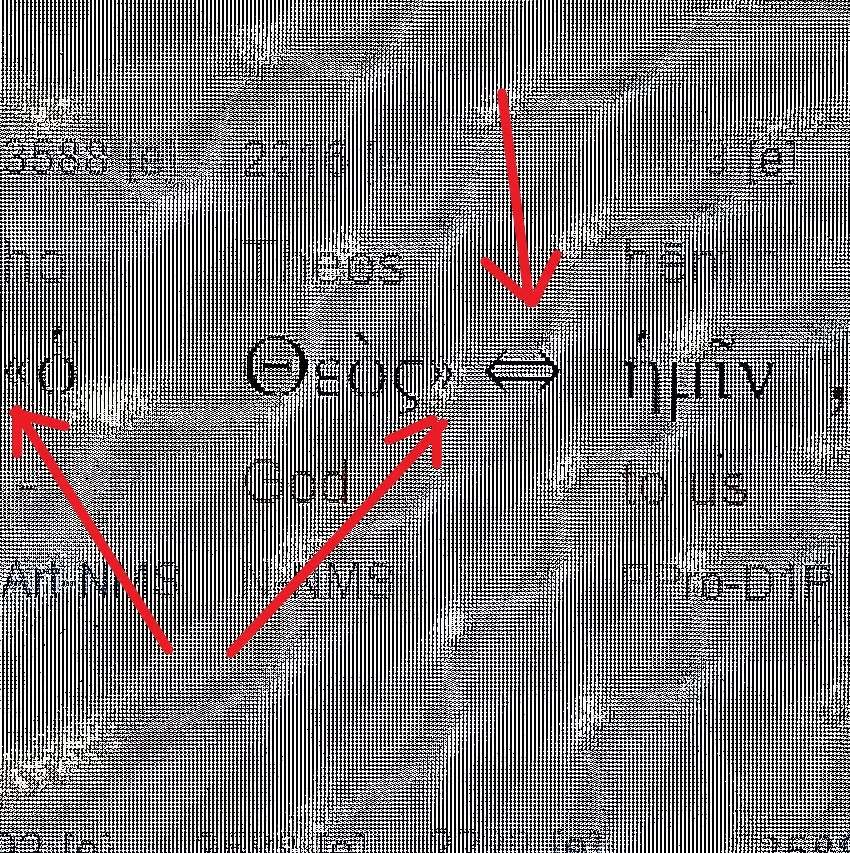
In this selected passage, it is worthwhile to look at the first verse (Acts 1:15), based on the Greek and pause points (punctuation). The Greek states, “Kai en tais hēmerais tautais  ,  anastas Petros en mesō tōn adelphōn  ,  eipen , ēn te echlos onomatōn epi to auto  ,  hōsei hekaton eikosi  ,” which is broken into five segments, not two (where one segment is set apart by rounded brackets – parenthesis). This means the literal English translation states, “And in the days these  having stood up Peter in midst of the brothers  said  ,  was moreover number of names the same  ,  about a hundred twenty  ,” which is more profound than the translation read aloud in church.

In the first segment’s statement, the plural pronoun “these” refers back to the verses prior, where the disciples had watched Jesus ascend into Heaven from the Mount of Olives and then returned to the upstairs room. There they rejoined the larger group of followers of Jesus, who were his family and friends, including “Mary the mother of Jesus, and … his brothers.” (Acts 1:14) This took place on the Sabbath, which was the “Sixth Shabbat” after Jesus was found risen (Easter Sunday). It was the Seventh Sabbath, counting his Resurrection on a Sabbath and his Ascension also on a Sabbath.  Thus “the days” had numbered 41 since Jesus appeared to his disciples – in resurrected body.  It was also the 49th of “the days” in the Counting of the Omer.  That means “these” can be seen as a plural pronoun referencing the times since the relationship between Jesus and his followers had forever changed.

In the second segment, which names Peter, it is vital to see how the word “anastas” (a variation of the verb “anistémi” – as “having stood up”) is a name in Greek, as “Anastas,” that means “Resurrection.” This should not be overlooked, as the use of this word is intended for the reader to realize how Peter did more than just stand up from a seated position and begin to talk to a room full of people.  It says that Peter became elevated by the Holy Spirit while among the others who followed Jesus.
Notice how priests stand to present a sermon?

This uplifting of Peter can then be seen as the Resurrection of Jesus within him.  Whereas Jesus had previously been “in the middle” of “these” people who were in the upstairs room, as their leader and the “center” of their attention and devotion, Peter then took that position. It is then also vital to grasp that this was on the Sabbath, and the day before Pentecost (the “Fiftieth Day”), when the Holy Spirit came upon all of the disciples.  Peter then spoke as a rabbi, before his synagogue family.

The separation of the Greek word “eipen” (the past tense of “legó”), which translates as “said,” is then placing important emphasis on the act of speaking that Peter commenced doing. This acts then as a precursor to the writing in chapter 2, when on the day of Pentecost we read, “Then Peter stood up with the Eleven, raised his voice and addressed the crowd.” (Acts 2:14) The same elevation of Peter’s spirit took place then, so that he spoke the Word of God (as “uplifted voice”), rather than simply standing up and yelling at a crowd of people. While it can also be assumed his voice was loudly heard, the greatest importance is intended to be on the message that came forth. Thus, the segregation of this one word in chapter 1 places the same focus on the Word being “said” by Peter.

When a separate segment of words translates to say, “Was moreover number of names the same,” this raises the intent of “auto,” being at the end of a “number of names,” to a higher level.  The translation of “te” as “moreover” can be misleading, as it makes this segment clearer when translated as “both.” This then is saying that “both” Peter and the “number” (or “crowd” of “people in common,” from “ochlos”) of those he stood in the middle of were “the same” in “having stood up,” where (again) that means they had all become resurrected in spirit. It says they understood what Peter “said,” because all of them then shared the “same name,” as their “names” had become one (“the same”) with Christ.

That is significant to grasp, because in this scene Peter acts like a priest in a church, amid a congregation. Because he spoke, it is easy for modern Christians to see Peter as special or more filled with the Holy Spirit than the others. However, that is not the case and should not be taken as such, then or now.

Because “the number of names was the same,” Peter “said” what everyone else would have “said,” as it was also “said” within “them” (alternate translation of “auto”). Those to who Peter spoke were just like Peter, “both” (“auto”) human and divine, because Jesus Christ had entered “them.”  Regardless of what “names” their parents had given them, they were all resurrections of Jesus Christ. That is why those (or “these”) Jews were also Christians (“both” and “the same”). Therefore, none of them were lost intellectually as Peter spoke; and none left the upstairs room saying, “I had no clue what Peter was talking about.”

Not on the same mental wavelength?

When the final segment of verse 15 says, “about a hundred twenty,” this can be misleading too.  It can seem as if the number was not clear, as an estimate, where the number could be more or less. That is not the way to read the meaning of the Greek word “hōsei.”

The “number of names” totaled exactly one hundred twenty – no more, no less. This means the word “hōsei” is better translated as “like” or “as it were.” This then makes the word become a direct link to the previous segment, where being “the same” is then being “alike.”  As such, it conveys the message: “the number of names [of those] like” Jesus Christ was “one hundred twenty.”

This number is then a factor of ten, which yields twelve. According to Wikipedia, under the heading “Tithe,” Mosaic Law established ten percent as the amount of one’s produce reaped at harvest, which is owed to the Levites (who owned no land and grew nothing to harvest.  Thus, the Israelites were required to supply their priests with the bounty of the land (the Counting of the Omer is a ritual associated with that first harvest).

The article states: “The first tithe is giving of one tenth of agricultural produce (after the giving of the standard terumah) to the Levite (or Aaronic priests).”

Since Jesus was of Levitical descent and himself a Temple of the LORD, he too would set aside ten percent of his fruit harvested, as that dedicated to doing God’s work. This would now be reflected in those numbering one hundred twenty, who served God through Jesus.  That would have been a number fixed during Jesus’ ministry – after he had gathered together his own. He chose twelve disciples as a ten percent tithing to God.  Therefore, the speech given by Peter, which was well understood by the others, was saying that Jesus Christ required ten percent of his followers to become dedicated leaders of his Church. Without Judas, that number was unfulfilled and in need of replenishment.

In addition, this made the selection of twelve also be symbolic as the “elders” of the Twelve Tribes of Israel, where each leader was like the father (patriarch) of a family (women and children), while being brothers to the other elders. Because Judas Iscariot had been selected to represent one group of Jesus’ disciples, he acted as the father to that group of followers (a priestly term).  Judas’ death meant it was necessary to elevate a new follower of devotion into his vacated slot.

While not stated (just as Matthias and Joseph called Barsabbas, known as Justus were unheard of prior, and never mentioned directly again in Scripture), it may be that those two names were selected from those who were of the “family group” headed by Judas Iscariot. The meaning of the name Joseph implies an “Addition,” where “Barsabba” is not of Hebrew origin, believed to mean “Son of War.”  Because Justus means “Just,” it implies a Roman name, which could be stating that Judas Iscariot recruited a former Roman soldier (a Jew) to follow Jesus.  As for Matthias, his name meaning is “Gift of Yah[weh],” which could indicate one who was a financial contributor the Jesus’ needs.  If so, Matthais would have been introduced to Judas because he was the holder of the money for the family of Jesus.  That could mean that Judas Iscariot, in all sincerity, opened Matthias to becoming a devotee to Jesus, in the group fathered by Judas.  This analysis makes these lone appearances of the names here have hidden meaning be exposed, which adds to the depth of the meaning that is otherwise missed.

By seeing the death of Judas as a need to promote one of his own recruits to the position of respect that Judas once had (as one of the twelve), that makes the words of Peter speak the truth.  When he said that Judas was, “one of the men who [had] accompanied us during all the time that the Lord Jesus went in and out among us, beginning from the baptism of John until the day when he was taken up from us,” Peter pronounced that Judas was a good disciple until he fell from grace.  Even then, he fell from grace with purpose, as a necessary sacrificial lamb, one who fulfilled the prophecies of David (in psalms).  Therefore, the selection of Matthias (by casting lots) would then mean that the guilt of one evil disciple would not transfer to others (guilt by association), as the devotion to Jesus, by those who had liked Judas and come to Jesus because of him, had not wavered by Judas’ betrayal of Jesus.

To further this possibility, one should look to the Psalms quoted by Peter (omitted from this reading). The first quote comes from Psalm 69, verse 25, where David wrote, “May their place be deserted; let there be no one to dwell in their tents.”  That says the traitor Judas had no blood family that followed Jesus. Thus, there was no one who would stand by Judas, in support of his betrayal.  While it would have been natural (possibly even a requirement) that the disciples of Jesus would have previously fulfilled their roles as married fathers (respectful Jews in the eyes of God), it was not a requirement that the families of the disciples also follow Jesus. For example, James and John of Zebedee left their father behind, so those two would be replaced by hired hands. This means Judas had led other people to follow Jesus, not his own blood relatives.

As such, Psalm 109, verses 8 through 10 states:

May his days be few; may another take his place of leadership.

May his children be fatherless and his wife a widow.

May his children be wandering beggars; may they be driven from their ruined homes.

That says Judas’ time as a disciple was limited, but another would rise from his ashes to take his place. Instead of a blood relative, it would be a spiritual brother who was devoted to Jesus, one who was in the church of his followers, due to Judas. The implication (in my view) is that Matthias and Justus were nominated by the family group that was in Christ because of Judas Iscariot.  That group chose two men from among their group of ten people, with those choices then approved by the whole church (all 120). After that process was concluded, the two chosen “cast lots,” which could mean they chose from straws cut to various lengths [or maybe they tossed smoothed stones at a wall].  The one who pulled the straw of the desired length [or tossed the stone closest to the wall] was then selected the leader of a family group, as the twelfth disciple.  While Matthias was chosen, Justus would have remained a devoted disciple.

This is how the selection of any church leader should be, from vestry members to bishops to popes.  The selection process demands that the whole body be: A.) Capable of being chosen as a representative for a family group; B.) Filled with the Holy Spirit, as a true resurrection of Jesus Christ; and C.) Led by the Mind of Christ, thus in access of full knowledge of God’s Word.  If all in the Church meet these requirements, then all votes to place a member at the table of twelve should be unanimous.

As a lesson set forth in the final week of the Easter season, the grasping of a personal  need to have the Resurrection of Jesus Christ be within is realizing one’s need to “stand up within the midst” of oneself.  In one’s own heart one must be Anastas, a name meaning Resurrection.  One must be reborn of “brother” Jesus, whether one is a male or a female human being.. One needs to be added to the long list that is the “number of names” that have all shared “the same” Holy Spirit as Jesus Anointed in those reborn.

It is important to see how oneself must speak in the name of Jesus Christ, led by the Holy Spirit to speak of Scripture powerfully, so others can feel drawn to know the same truth. A Christian is then defined as a “friend” in a church of family, where all are “allotted [each] his [and her] share in this ministry” of God’s Word. To stand up and speak is to be true to Jesus Christ; but to sit silently (or to speak against Scripture, literally and figuratively) is to betray the Lord, as did Judas Iscariot.

It is a valid point to see Gentile converts to Christianity (Americans who are not Jewish by birth) as the family gathered by Judas, led to the truth by the truth.  Regardless of the flaws within he who initially showed that light of truth to others, true Christians are devoted to God, not His servants. The stigma of being Christian comes when one has been told there is nothing more to do, once one professes belief that Jesus was the Son of God.  People who preach that message are only looking for their own thirty pieces of silver, betraying God and Christ by misleading souls.

The Temple leaders knew their payment to Judas was blood money, once he threw it back at them.  The money was cursed to them, so they used it to purchase Potter’s Field, where the earth was red clay.  That name has become synonymous with graveyard for paupers and wayward souls.
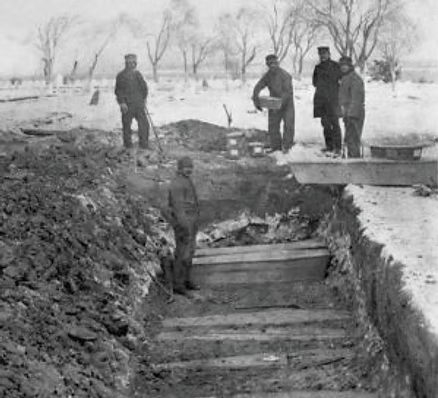
Mass graves with no last rites?

One who follows the lead of a Judas then find his same end, which leaves one standing on the “field of blood,” like the one where Judas was destroyed.  The omitted verses in the middle of this reading has Peter telling the story of that tragedy, which comes when one cannot stand and speak the Word:

“With the payment he received for his wickedness, Judas bought a field; there he fell headlong, his body burst open and all his intestines spilled out. Everyone in Jerusalem heard about this, so they called that field in their language Akeldama, that is, Field of Blood.” (Acts 1:18-19).

The Easter message is to be filled with the blood of Christ. One needs to be Resurrected in his name for that relationship to commence.  The sacrifice of ego, for a higher self, brings that about, while the sacrifice of servitude to God brings about the weakness of Judas.


1 John 5:9-13 – Human testimony demands the testing of truth

If we receive human testimony, the testimony of God is greater; for this is the testimony of God that he has testified to his Son. Those who believe in the Son of God have the testimony in their hearts. Those who do not believe in God have made him a liar by not believing in the testimony that God has given concerning his Son. And this is the testimony: God gave us eternal life, and this life is in his Son. Whoever has the Son has life; whoever does not have the Son of God does not have life.

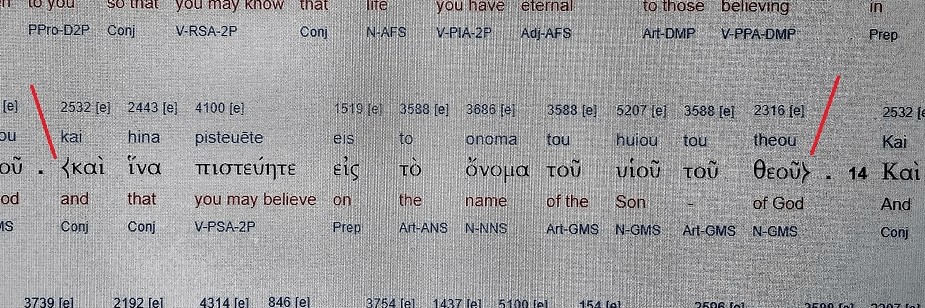
I write these things to you who believe in the name of the Son of God, so that you may know that you have eternal life.

——————————————————————————–

This is the Epistle reading selection from the Episcopal Lectionary for the Seventh Sunday of Easter, Year B 2018. It will next be read aloud in church by a reader on Sunday, May 13, 2018. This reading is important as John clearly says eternal life requires one be a reproduction of God’s Son, more than taking a position that believes the words of those who lived alongside Jesus of Nazareth.

There are five verses in this reading.   All are taking what is stated in the first verse (verse 9) and supporting that on deeper levels. The translation of verse 9, as shown above, is acceptable as stated, other than verse nine is two complete sentences.  Each sentence is then broken into two segments by commas, which the above translation does not show. When one reads verse 9 slowly and contemplates the meaning of each segment, through two segmented sentences, a profound message comes clear, which is easy to miss otherwise.

It says first, “If we receive human testimony.” That sets forth a conditional situation, based on faith and belief. It applies not only to religions (of all kinds) but to all philosophies of mankind. It is stating the confusion that is pervasive in American society today, where “human testimony” is constantly in all forms of media … all of which is sent out for the masses to receive.  This first segment of words is then saying that hearing people’s claims of what is belief-worthy, reading books written by the latest craze authors, or simply making life decisions based on personal experiences, can become what “we accept” as the truth.

As such, Christians read these words and automatically hear John talking about the divinity of Jesus (as the Christ). John was a human being and the author of this letter. As Christians, we identify with John, because we are human beings that also say we believe in Jesus as the Christ. We go to church to hear these words read aloud and we read them at home in our Holy Bibles. Still, the conditional word – “IF” – is asking us if we believe and have faith because we believe what what our brains hear, and not what we can personally testify to.

This beginning segment of words is then stating the condition that faith and belief requires instruction, given by someone who knows, as the proverbial person who has – “Been there, done that.” We can sense the conviction in someone’s words, so that someone’s words have a mesmerizing effect on us, coming from charisma that can be projected from human testimony. The Greek word “martyrian” means, “witnessing, evidence, testimony, or reputation,” so public words about Jesus Christ is called “witnessing.” Thus, the acceptance (or “receipt”) of testimony acts as one’s confirmation of the truth being spoken; and the power of someone else’s witnessing publicly should motivate us to seek more truth, through a teacher-student arrangement that fills us with the same conviction found in another.

That was the state of Judaism when God sent Jesus into the world. There were many who spoke of God and His promises to obedient servants.   So, there were many who believed it was the truth they heard. As such, many followed what they heard said in human testimony.  This is following the leader, more than following the Will of God.

The prophets of Israel and Judah had promised the people a Messiah; and the people of Israel believed that human testimony. The ruling elite of the Temple in Jerusalem preached the Law of Moses to the Jews, and the Jews of Galilee and Judea believed in the Law. Still, the teacher-student relationships that were established could not extend beyond the written words of Scripture, so no one was receiving the meaning of them. Much less, neither teacher or student understood how to apply the laws of Moses in a changing world that more often than not forced them to go against the Law for survival.

When Jesus came, he offered more human testimony, as he was born of a woman.  Some received his words as truth, but some rejected them (mainly for selfish reasons). Rather than heed what Jesus the rabbi said, even though he only spoke the truth of God, it was the truth no other rabbis knew.  To silence him and the questioning he aroused in the people, it was easier to kill him than listen and learn from him. Death, they hoped, would return the world to its former status quo.  No more human testimony from Jesus of Nazareth.

After Jesus rose from death, he taught his disciples for another forty days, in human form.  That body then ascended to Heaven before his witnesses. Ever since then (more fittingly, ever since the Apostles began telling the story of Jesus Christ in texts), the world has had access to “human testimony,” from which a new faith arose.

The state of Christianity today is largely belief in the four Gospels and the Epistles of the New Testament. Belief from that alone is blind faith, based on humanity having lost touch with the human teacher that Jesus of Nazareth was, whom the Jews of Galilee and Judea personally experienced. Instead of Jesus in the flesh, Christians today love their “rock star” church idols (which come in all denominations, in all forms), who use their charismatic ways of preaching to make human testimony feel like the truth. They tell the world that Jesus will come again … someday … soon … when the end of the world is nigh.

Many preachers learn to act sincere at seminaries, which are schools that teach the theatrics of charisma. Many human beings who want to increase their faith and beliefs go to schools that teach them the written words, the opinions about those words, and the history of changing opinions. Still, some schools focus on teaching students the tricks of a trade that intends to draw people in, without leading anyone to obtaining the true Holy Spirit. They preach enthusiasm, by doing little more than putting on a good show of faith.

Priests, pastors, ministers, and preachers all believe the Word is truth. Those listening to them do too.  By standing in front of other human beings of faith and beliefs, many believe all they have to do it use those words of truth and others will absorb holiness. It is easier to give the impression that one actually knows the truth, than it is to pass that torch of insight and knowledge onto others.

Keep in mind the warning given by Jesus of “false prophets.” He said, “Beware of the false prophets, who come to you in sheep’s clothing, but inwardly are ravenous wolves.” (Matthew 7:15) When Jesus said a false prophet comes wearing “sheep’s clothing,” that means they put on an act that makes them appear to be preachers of the truth. This does not mean all false prophets intend to mislead, but that is the result.  Still, if false prophets all wore red devil suits, carrying pitchforks, then who would fall for their tricks?

No one would.

If you go online, there is some site that advertises “7 Traits of False Teachers.” That is itself a “ravenous wolf in sheep’s clothing,” simply because that title presumes to know that all false prophets are limited to seven warning signs that are stated in Scripture. I presume (having not read the article) that they have stitched together a frightful image of the Big Bad Wolf that waits for innocent little lambs. Their purpose seems to be: Memorize these seven “traits” and you will be safe.

I imagine there is the potential for that page to add: Please, don’t forget to send money so we can help others be afraid.

Maybe they added that, maybe not. Regardless, my interest to see what human testimony they have to offer would depend on if I am willing to accept or receive their human testimony as the gospel. Human testimony is what it is – an opinion about what one believes is true; but that should always be tested first, before believing hook. line and sinker.

We realize that need for deeper examination of human testimony when John then wrote his second segment of verse 9, where he said “the testimony of God is greater.” That statement says how one does not need to memorize the seven characteristics of wolves trying to steal lambs. Looking at a list of traits, scribbled on a piece of paper, will not save one from the attacks of such wolves. Ravenous prophets steal innocent lambs by sweet talking them to come closer, telling them things the lambs want to hear, such as, “Believe in Jesus.” They say, “Come closer dearie and I’ll tell you the story of baby Jesus in a manger.”

Chomp!

Once you have heard human testimony that feeds you the truth, the next step is not “Repeat step one,” but listen to God. God is invisible and cannot be seen. God is Spiritual, not human.  God speaks in mental whispers that become the voice of one’s personal teacher within. God speaks so one will hear a lesson. God speaks to answer the questions we ask. God speaks so that we – as individuals – go as far towards faith and belief as our individual hearts’ desire. God is the inner voice that exposes false prophets and approves all Apostles.

When John then began a new sentence in verse 9 (following a period mark), he said, “For this is the testimony of God.” That is where another pause of a comma gets inserted, making one reflect on the meaning of that statement.

The word “this” means the epistle that John wrote. It means “this” verse in that letter, the next verses, and all others verses and letters that John had and would write. “This” means the words he, John the Beloved, had just written was the Word of God. That says “this” is the “testimony of God” because John gave God the credit for leading his hand to write a letter. It says, indirectly, “I, John, am a prophet of God.” Therefore, “If you receive (or accept as truth) this human testimony as being from God,” then you should know that this testimony of God is greater than someone who says or writes testimony, supposedly of God, while claiming he or she as the author.

Prophets of the LORD are not meant to be celebrities elevated onto pedestal status. Prophets of the LORD make it clear that God filled their lips with human testimony. Prophets of the LORD make it clear that other human beings should not do as I say, but listen to God; then stand beside me and prophesy.

To clarify that concept, John then finished his second sentence in verse 9 by stating, “That he has testified to his Son.” The word “that” referred to John’s claim (prior to the comma) that “this letter is the testimony of God.” John then said the truth of that statement can be realized by understanding that God did not tell the human being John what to write (as that would be mere human testimony), but that God told “his Son” Jesus Christ to write it.

That means Jesus Christ heard the whispers from the Father while he was one with the human being named John. That means the presence of Jesus Christ was within John, which is the proof (the truth of testimony) that John was a prophet who wrote the testimony of God. To be a prophet of God (not a false prophet), John had to have the Mind of Christ within him; and that made John the Beloved be reborn as Jesus Christ, the Son of God.

As you can see, one verse says a mouthful. From that verse, the other four following verses then hang.

The translation of verse 10 – “Those who believe in the Son of God have the testimony in their hearts” – is true, while the actual Greek says, “The one believing,” which places belief on an individual level of responsibility, which then is multiplied in all who likewise are perpetually believing in union with (the Greek word “eis” means “into,” more than “in,” but infers a result, as “union,” as “upon”) the Son of God. “Those” are then all who are like John the Beloved, as true prophets that speak what God tells them to speak, speaking as Jesus Christ having been reborn.

The translation that says, “in their hearts” is also a paraphrase of truth, where John wrote in the first-person singular, rather than the plural. The verse does not refer to “hearts,” but “himself” (Greek “hautō“). It can then be assumed that “believing” is relative to the proof within one’s being, as one’s personal experience of the Holy Spirit, by its having brought about the resurrection of Jesus the Aointed.

The use of “hearts” can then be justified as the Spiritual core of “those believing,” as the heart is the throne of God, to be set aside for His presence by each individual of true faith. God then sits upon that throne after one has become married to God, as His subservient wife [regardless of human gender], leading to the Holy Spirit giving rebirth to His Son into a human form.  The Son of God is then he who sits at the Father’s right hand as the Mind of Christ, leading one’s soul within one’s human body.

Now, verse 10 is divided by a semi-colon, which makes it read similar to the two sentences in verse 9. Following the semi-colon (which is implied, as has been passed on by the divine testimony of subsequent translators), John wrote a segment of words that says, “the [one] not believing the [one] God,” with the words that follow separated by a comma. This makes this segment of words be complimentary to the previous statement (which began verse 10), with the difference being the first segment focused on “one believing in union with the Son of God.”  Now, the reference is simply to “not believing the [one] God.” The comma forces one to pick up on that difference.

John had then just said that there are two kinds of people. The first is he or she who is believing by the presence of the Son of God upon him or herself. If one has been reborn as Jesus Christ, then one has to believe in God, as one cannot believe in the Son without believing in the Father. The other type of person is anyone who does not believe in the Son of God, because he or she does not believe in God. Therefore, all the Jews of Galilee and Judea who said they believed in God did not live up to that lip-service.

Following the comma, John then explained, “A liar has made them.” This means God is considered a liar by anyone who says God promised a Messiah – the prophecy received by the human testimony of Israel’s and Judah’s Prophets – but then deny that Jesus of Nazareth was the fulfillment of that promise. The Jews denied that even when they later heard the Apostles give holy testimony of the resurrection of Jesus Christ, as Jesus Christ resurrected in them. Indirectly, the Jews in general were led to disbelief by false prophets, who did not believe in God – the Temple leaders.  The influence that “a liar made them” was Satan, not God.

The Jews who clung to their position of favor, rather than welcome a position of servitude, where God would have them sent to preach amid Gentiles, they fervently refused to receive that human testimony. They had no connection to the God they used for their benefit, as a name that made them special in the world.  To this day, people say Jews and Muslims pray to the same God (called either Yahweh or Allah), but no one can be truthful in a profession to believe in the true One God, when one does not believe in Jesus Christ. By calling God a liar, they become liars.  Only Christians truly believe in God, because they are in union with His Son.

That is the meaning of the remainder of verse 10, where the translation above is fair in saying the reason this backfires is because Jews were still, “not believing in the testimony that God has given concerning his Son.” The prophets foretold of the Messiah coming, just as Jesus of Nazareth came. The Scriptures of the Torah had been fulfilled by the known history of Jesus of Nazareth. To say none of that is true means to say God lied through His Prophets. One cannot have any love in one’s heart for God if one calls God a liar.

It is like God (through John) using the children’s taunt: “I am rubber, you are glue.  What comes from your lips bounces off Me and sticks on you.”  Or, “Liar, liar pants on fire nose is long as a telephone wire.”  The denouncers of Jesus “a liar has made them.”  In reality, they denounce themselves from God’s love.

In verse 11, John begins by stating, “And this is the testimony.” That refers back to verse 9, where one needs to receive human testimony with a grain of salt, especially when someone says, “My testimony comes from God.” Rather than believing the human, one has to make one’s own contact with God and verify that the testimony being spoken is indeed the truth. That comes by God being in one’s heart, because one loves God. Thus, John is now restating, “This is the testimony of God” … in case you still think God is a liar.

Through John, a human Prophet of God, God then said (and I paraphrase a little), “God gives eternal life to those believing in my Son.” (And I add further …) “I do not give land as gifts anymore. I do not give worldly riches that are to be wasted on ornate temples, where the elite-minded can rule as oppressors over My people. And I certainly do not give My blessings to anyone who calls Me a liar.” The literal Greek-to-English translation here states: “That life eternal has given the [one] God,” with me adding a little extra to that.

As an extra added by John, he then wrote (literal translation), “To us and this the life in the Son his is.” That means, to John and all other Saints (Apostles), eternal life (“this”) comes in the form of Jesus Christ (“the Son”) in each of them. In the Son of God IS eternal life, which IS the being of ALL Saints. The part of one’s being that is unquestionably eternal is one’s soul, but for the soul to maintain eternal life outside of Jesus Christ, it must reincarnate into a new body over and over again.  Eternal life is then always starting over, always repeating, always failing to return to God.  It is eternal life interrupted.

It means that IF one likes to imagine life in Heaven, such that we think it is where granddaddy, mom, old dog Spot and our long lost friends are all running around having a good ole time, then that is not quite grasping the big picture. Heaven is set aside for one type of people – those believing in the Son of God. It is for those who believe because the Son of God is in union with them, so they believe knowing the truth as Jesus Christ born into new souls. Therefore, Heaven is for God and a whole bunch of Saints whose souls were saved by Jesus Christ. Rather than running around aimlessly, they sing songs of praise to God eternally.

Just in case someone misunderstands my interpretation here, John then wrote, “Whoever has the Son has life; whoever does not have the Son of God does not have life.” The key verb here is “echo” (root to “echōn”), which is translated as “has,” as a possessive form of the infinitive verb “to have.”  It also means “holds” or “possesses.” One cannot “have, hold, or possess” the Son by human testimony. One cannot “have, hold, or possess” Jesus Christ by not being “in union with” that divinity of the Holy Spirit, thus not knowing Scripture has been fulfilled by knowledge coming from the Mind of Christ.

Eternal life is the reward of complete servitude to God, through love.

Take these Gospels and make them grow. Then climb the vine to the top, learn the truth, and come back down!

John then began concluding his epistle by writing, “I write these things to you who believe in the name of the Son of God, so that you may know that you have eternal life.” A long time ago, when the ink was still wet on the parchment upon which John wrote this letter, it was to be sent to Saints John knew. All of them had assumed the title “Christ,” because they had been awarded the presence of the Son, by the Father.  Today, we read this letter roughly two millennia later, with our eyes intended to ponder these words. We can be the Saint unto whom John wrote. Or, we can deny that God sent this prophecy to us, for us to fulfill it by making a full commitment to God, so we can come to personally know Jesus Christ as Jesus Christ reborn.

As a lesson in the Easter season, those who love God, but have still not yet said “Yes” to His proposal of marriage, the call is to make that commitment now. That union is what brings about the Resurrection of Jesus Christ within one who is subservient to God’s love. One has to move beyond receipt of human testimony and know the truth that is God’s testimony, which comes from the Mind of Christ overseeing one’s human brain. This commitment was made by John and all the many others who have spread true Christianity to the world. Thus, the call is to join that lineage of Saints, who serve the LORD as His Prophets – the lights of truth that shine in the darkness of the world.

The message here is there are only two types of Christians, as Christianity has not remained true to its origin in only Saints. It has been diluted, just as the Israelites lost their way after Moses delivered them to the Promised Land and their faith slipped. Their failures to God were due to them wanting to be like the people of other nations, who praised leaders instead of God. Christians today are just as distracted by the things the world offers, which makes them moan and groan about having to be personally devoted to God’s Will.  Like a child who has been told “No” by the father, the next step is to go ask mom and have her change that edict.

This childish behavior is repeated in human adults, as the influence that leads humans to follow leaders that will become surrogates to our selfish desires.  The leaders we choose to lead us will always be liars – false prophets – who will tell the people what they want to hear.  They always say God wants his children to be special, as wealthier, smarter, and healthier than other mere mortals. To gain those benefits, all one has to do is say, “I believe in Jesus Christ as the Son of God.”

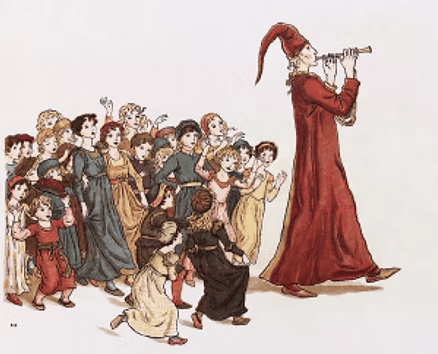
The Pied Piper of Hamlin leading the children to their ruin, all over again.

Your playing my song!

The message here is God only offers eternal life as a reward of faith and belief.  That only comes by one’s soul being one with the Holy Spirit of Jesus Christ. The rewards of a mortal life are hard, honest work, and the persecution for one’s true beliefs, as Satan surrounds believers with evil and difficulty.  He tempts them first with material gifts that are mirages, compared to eternity.

To say one is Christian and then not know Jesus Christ personally … to not speak the Word of God so that others can be led to the truth … is to call God a liar. Satan loves to have souls call God that.  Rejecting that holy presence says one believes Jesus Christ will not be sent by God again until the world is ended … after I have grabbed as many comfortable things as I can … regardless of who suffers so I can find favor.

This Easter lesson poses the question: From where did your beliefs come? Did you receive human testimony and place total belief in the words of another human being, without asking God to prove those words were true and worthy of belief?

All Easter season we have been asked to discern the difference from “believing” (in the present tense) and “belief,” where so many lambs follow the leader, too frightened to test what they believe as truth. This lesson wants you to know all about that which you profess as belief.

John 17:6-19 – Jesus prayed for his disciples

Jesus prayed for his disciples, “I have made your name known to those whom you gave me from the world. They were yours, and you gave them to me, and they have kept your word. Now they know that everything you have given me is from you; for the words that you gave to me I have given to them, and they have received them and know in truth that I came from you; and they have believed that you sent me. I am asking on their behalf; I am not asking on behalf of the world, but on behalf of those whom you gave me, because they are yours. All mine are yours, and yours are mine; and I have been glorified in them. And now I am no longer in the world, but they are in the world, and I am coming to you. Holy Father, protect them in your name that you have given me, so that they may be one, as we are one. While I was with them, I protected them in your name that you have given me. I guarded them, and not one of them was lost except the one destined to be lost, so that the scripture might be fulfilled. But now I am coming to you, and I speak these things in the world so that they may have my joy made complete in themselves. I have given them your word, and the world has hated them because they do not belong to the world, just as I do not belong to the world. I am not asking you to take them out of the world, but I ask you to protect them from the evil one. They do not belong to the world, just as I do not belong to the world. Sanctify them in the truth; your word is truth. As you have sent me into the world, so I have sent them into the world. And for their sakes I sanctify myself, so that they also may be sanctified in truth.”

——————————————————————————–

This is the Gospel reading selection from the Episcopal Lectionary for the Seventh Sunday of Easter, Year B 2018. It will next be read aloud in church by a priest on Sunday, May 13, 2018. This is important as it is a prayer submitted to the Father, by the Son, for his children to be accepted as his fruit of the vine. This not only applied to the disciples close to Jesus of Nazareth, who would become Saints as Apostles, but to all who would be born of the true vine afterwards.

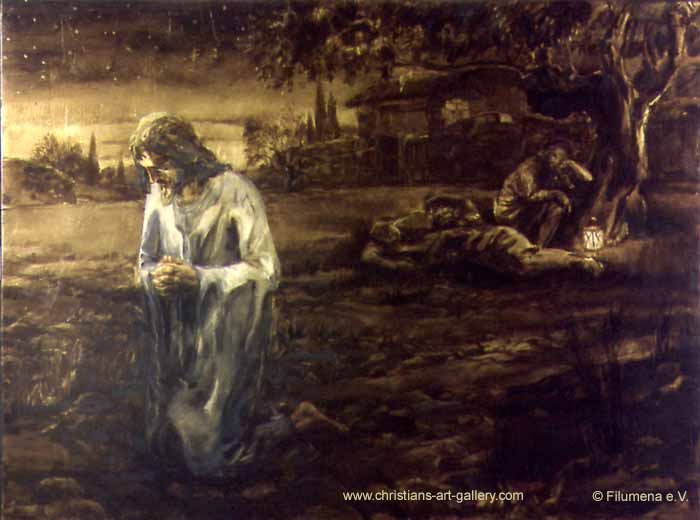
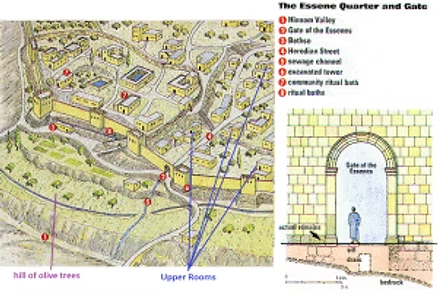
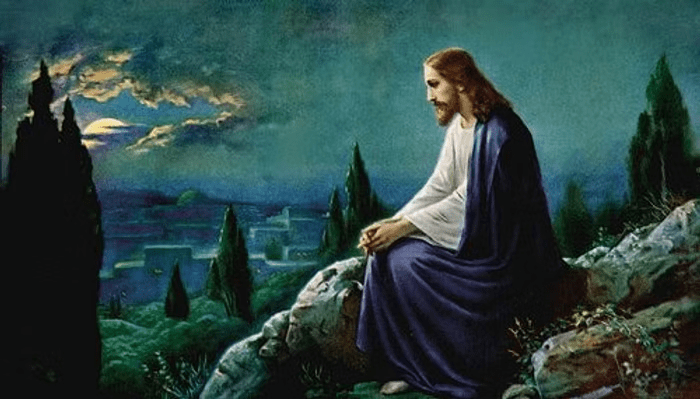
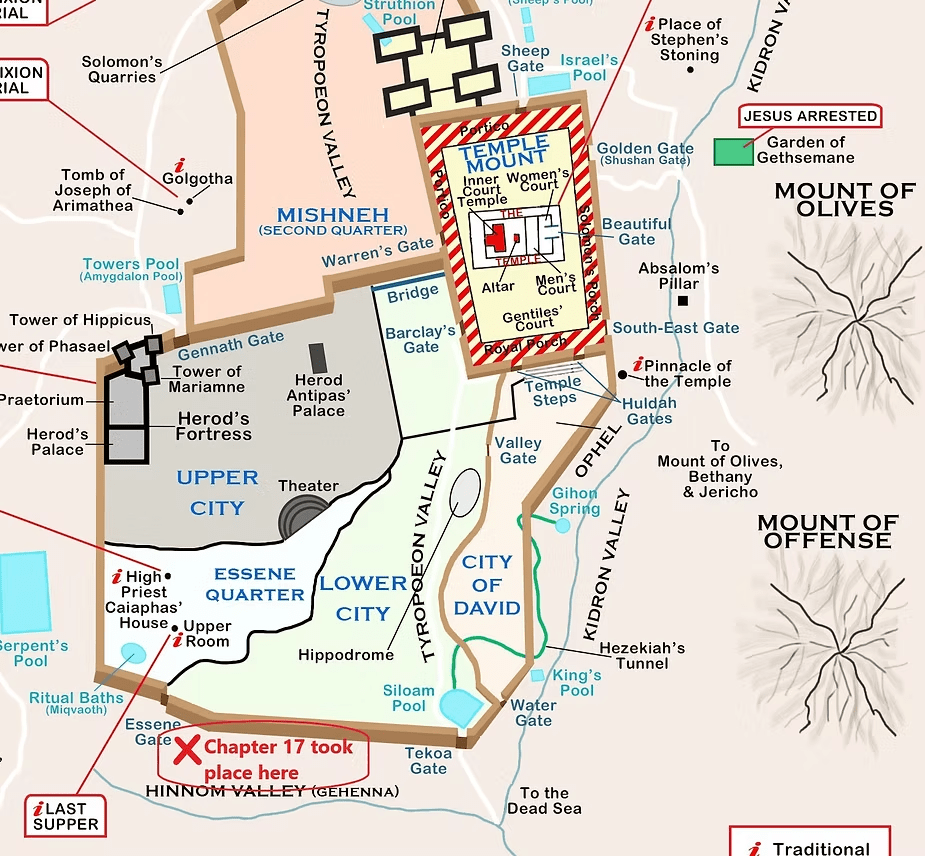
Let me first state that this reading led me to write a companion piece that details the last hours of Jesus’ ministry, prior to his arrest. This prayer that sometimes has the title applied, “Jesus Prayed for His Disciples,” is not stated by John as to where it occurred, although it was after Jesus led his followers out from the upper room, after the Passover Seder meal and ritual was completed. This prayer took place on a hill that had olive trees on it, just outside the Essenes Gate of Jerusalem.

The above graphic has been modified (by me) to show how the known general area of the Upper Room and the easiest exit point from the city of Jerusalem.  The graphic is part of an article on Jerusalem’s Essenes Gate, written by Bargil Pixner and published by Century One Foundation.  With little question about the Upper Room being in the Essenes Quarter, and with the Essenes known to be a sect of devout Jews (along with the Pharisees and Sadducees), it is easy to see how some believe that Jesus was a member of that sect.  The only point I wish to make here, relative to the place where Jesus prayed for his disciples, is Luke, Matthew, and Mark all agree that Jesus left the upstairs room and went to the Mount of Olives (more literally a “hill of Olives”).

This prayer for his disciples was amid prayers for his glorification and for all believers (all of John 17).  Following this, John wrote that Jesus took his disciples to the garden across the Sidron Valley, which was Gethsemane.  This would indicate that John’s account of Jesus praying preceded the prayers of pain and agony that Jesus was witnessed to have prayed in the garden at Gethsemane (by the other three Gospel writers). To get an in-depth perspective of the flow of movement, after the disciples were led away from the Upper Room, please read my account of The last four or five hours that preceded the betrayal and arrest of Jesus of Nazareth if you want to know more about this topic.

Let me also add that John wrote of conversations Jesus had with his disciples, prior to John recording the prayers of Jesus.  From the perspective of the map above, get a mind’s eye view of Jesus and his male followers (including John) leaving the Upper Room and meandering their way through the Essenes Quarter, before exiting at the Essenes Gate.  Because it is not clearly stated, it becomes natural to see the disciples carrying a jug of wine with them (the Seder tradition to drink until you pass out) and drinking as Jesus talked to them (drinking being why they did not recall to write about those lessons).  As the Seder ritual would have been celebrated in the same way, throughout all of Jerusalem, it would seem logical that Jesus and his followers met and shared wine with other Essene Jews who were likewise outside on a spring evening.  After an hour or so milling about, Jesus and John excused themselves to go among the olive trees on the hill that overlooked the Hinnom Valley, so Jesus could offer the prayers John of which John wrote.

It is important to realize that the entirety of chapter 17 in John’s Gospel tells of Jesus praying. Verses six through nineteen are of Jesus praying for his disciples. The verses prior are for Jesus to be glorified by God, and the verses following are of Jesus praying for all believers. The fact that John dedicated an entire chapter to the prayers of Jesus, whereas the other Gospel writers make mention of Jesus praying on a lesser degree, sets John apart from the other Gospel writers … in more ways than one. I address that in the other article.

In the same way, John wrote chapter 14, which told of lessons given to the disciples that no other Gospel writer wrote of.  It was in that chapter that Jesus said there were many rooms in the Father’s house, and he was going there to reserve one for them.  Philip said (basically), “You never told us where your father lived.”  That was a sign of drunkenness.  At the end of chapter 14, John indicated Jesus said to the disciples, “Come now, let us leave,” (John 14:31d) which meant they either left the Upper Room then, or they left the Essenes Quarter, going outside the Wall of Jerusalem.

Once outside, John wrote chapters 15 and 16 that was Jesus telling his disciples that their future was bright, with nothing to worry about.  Still, because none of the others recorded those pep talks in the other Gospels, the disciples were struggling to think clearly, plus the later it got the sleepier they became.  Outside the Essenes Gate, Jesus could have broken away from the group with ease, leaving them to talk amongst themselves and also relieve themselves of their wine at the sewage channel just off the path.

Here, in chapter 17, John recalled prayers said by Jesus, with none here duplicated in another Gospel.  This omission should not be seen as if John was making things up or remembering things out of sequence.  Rather, John has to be seen as the one follower that was not drunk.  He was not drunk because he was not an adult.  He followed Jesus as a close family relation, who carefully listened to everything Jesus said.  John was excited to be walking with the adults, as part of the Seder late evening experience, while the disciples were falling asleep from drunkenness (or still drinking Seder wine).

In this scope of John’s chapter 17, looking only at his prayer for his disciples, the character that was John is totally removed. The reader has become the one overhearing this prayer, as if one has become John. We are allowed to be close to Jesus at an intimate time of prayer with God.  The reader of this prayer should consider him or herself one of “his disciples,” for whom Jesus prayed, while also seeing oneself as a child of Jesus that thirsts for the knowledge of God that comes from Jesus.

With that in mind, it is important to grasp the first verse. When Jesus said, “I have made your name known to those whom you gave me from the world,” this does not mean Jesus told a group of heathens who the One God is.  When Jesus then stated, “They were yours, and you gave them to me, and they have kept your word,” he clarified that his disciples were ALL Jews (Israelites in good standing), who sought to serve the LORD faithfully, and they had adhered to the laws set forth by Moses.

The disciples were ALL looking for the promised Messiah to serve the LORD through, as the followers of God’s Christ.  God had led Jesus to find those men of devotion. Therefore, the “name” that was God’s “name known” IS the Messiah of God – the Christ.  As the Messiah, Jesus proclaimed the title Son of Man and that was made known to his disciples.  Jesus was the Son of the Father, thus the Son of God, a name made known.  All that Jesus made known to his disciples was through words and deeds – lessons and miracles – assignments given and real encounters witnessed.

At that point in time, as Jesus knew his time of ministry was concluded and he would soon be taken from his disciples, Jesus told God, “Now they know that everything you have given me is from you.” Jesus had repeatedly said that he did not speak for Jesus of Nazareth, but for the Father. The ego of Jesus had been subjected to the Will of God.  Jesus had explained that the Father was in him, just as his human body was the seat of the LORD. The disciples had been told that everything from the Son comes from the Father. This was confirmed by Jesus praying, “For the words that you gave to me I have given to them, and they have received them and know in truth that I came from you; and they have believed that you sent me.”

When Jesus next said, “I am asking on their behalf,” this is the true power of prayer – for specific others. Jesus said he was not praying for the whole world to find benefit from God’s Son sending forth a prayer on such a broad scope. Jesus clearly stated that his prayer was for the disciples “whom God gave Jesus,” because they too were God’s, as the children of Jesus. For Christians today, a prayer of this nature is the cement that bonds the parts of the Church of Christ to that one cornerstone that is Jesus Christ. A child of Jesus Christ’s – as a Son or Daughter of the One God – should pray specifically for others who are also in the name of Jesus Christ.

Selfishness prays for those the ego deems politically correct, just as the Pharisee proudly prayed aloud in the Temple – “Thank you God for making me me and not that loser over there!”  Think about how that applies to priest who pray for the equal rights of everyone in the world – those other than Christians, Christians who need someone praying for them, whose “equal rights” are ignored.  When in the name of Jesus Christ one’s prayers are specifically directed, for specific purposes that fit the Will of God, not the philosophical brains of mankind.

To be able to see the future implications of this prayer (where we today are the focus), Jesus then told God, “All mine are yours, and yours are mine; and I have been glorified in them.” That statement goes far beyond eleven drunken disciples who were most probably sitting on the ground or leaning against the Wall of Jerusalem, arguing about who was more important to Jesus or dozing off from being tired. The Holy Spirit had not yet come upon those who were to be of Jesus, as he was of God. Still, those buds of fruit on the most holy vine (what John remembered Jesus saying in John 15:1-8) would become the glorification of Jesus Christ … as him born again, again and again, to this day onward.

Jesus had told his disciples about the seed (a kernel of wheat) that must die so that its fruit could come forth (John 12:24). Now he confessed to his Father, “I am no longer in the world, but they are in the world, and I am coming to you.” That was an admission that the words given to Jesus, by the Father, were soon to be fulfilled. There was no further ministry on earth for Jesus to command, in the human form that was his body. The disciples would fill that need in the future.

Rather than the world missing one Jesus of Nazareth, there would soon be many Christs following him.  This is as Jesus said, “Holy Father, protect them in your name that you have given me, so that they may be one, as we are one.” That protection would be their duplication – the Resurrection – of Apostles in the name Christ. Just as Jesus of Nazareth had been in the name of Christ, the name given to him by God, so too would God give the Saints of Jesus Christ the same oneness. Their souls would be filled with God’s Holy Spirit and their brains with the Mind of Christ, and true Christians would spread across the face of the world.

Jesus then prayed, “While I was with them, I protected them in your name that you have given me. I guarded them, and not one of them was lost except the one destined to be lost, so that the scripture might be fulfilled.” That says that Jesus in the flesh, as the Son of God incarnate among men, was the protection of the Christ for the disciples and followers of Jesus of Nazareth. That presence guarded the children of Anointment, as would wild beasts protect her young from external threats. Protection comes from love.

Jesus had just earlier said (after they had left the Upper Room) that there was no greater love than could be shown for a friend, such that he would lay down his life for his friends (John 15:13).  That was his commitment to protecting his followers. Jesus would then continue to provide his protection through the love of God and the transformation of disciples into Apostles, all surrounded by the Spirit of Anointment.

The one he had lost was Judas, who was necessary to lose; and the betrayal by Judas was prophesied (Psalm 41:9). Jesus would repeat this statement made in prayer – that the prophets might be fulfilled – upon his arrest that would come.  Recorded by Matthew and Mark … Jesus said, “This has all taken place that the writings of the prophets might be fulfilled.” (Matthew 26:56a)

Jesus then said, “Now I am coming to you, and I speak these things in the world so that they may have my joy made complete in themselves.” This conforms that Jesus is asking the Father to enter the hearts of those who wanted so hard to please God, but had never had someone to show them the way to God’s love. The words “my joy made complete in themselves” means Jesus Christ will be the reborn as a result of the disciples’ marriage to God.

Just as Jesus was married to God, with God’s love filling his heart, Jesus was assured eternal life. God’s gift of complete Salvation was the joy of Christ in the disciples’ souls. That was the promise made to the disciples of Jesus, where not long before he told them, “In My Father’s house are many dwelling places; if it were not so, I would have told you; for I go to prepare a place for you. If I go and prepare a place for you, I will come again and receive you to myself, that where I am, there you may be also.” (John 14:2-3) The promise made, in words in this world, was to be rewarded in Heaven.

When Jesus said, “I have given them your word, and the world has hated them because they do not belong to the world, just as I do not belong to the world,” he was making reference to the training ministry the disciples had been sent out to experience. The “great commission” was an exercise of one’s commitment, to go and tell other Jews (Israelites), “The kingdom of God has come near.” (Matthew 10:7) That meant the disciples were bearing the presence of the Holy Spirit in a world of faithless doubt. Those who proclaimed to know the word and be close to God were hated by those who were stubbornly lost. That natural response was due to a Saint belonging in Heaven, not on earth. It was why Jesus was rejected and soon would be killed (with the Apostles all to face the same fate).

Jesus knew that his disciples would have similar futures. Therefore, he prayed, “I am not asking you to take them out of the world, but I ask you to protect them from the evil one.” That meant there would be no Greek tragedy theatrics, where a angel of god would rush in and save a hero from a terrible end. Likewise, Jesus would not be swept away by his Father, to prevent the Son from crucifixion. That escape would mean no resurrection could be possible, with Heaven not a greater reward than life on earth. The only thing Jesus sought for his disciples (Judas excluded) was for none of them to fall to the temptations of Satan. That test would come in their futures, and God would answer this prayer by having the disciples all become graduates to Sainthood.

When Jesus said, “They do not belong to the world, just as I do not belong to the world,” the reason is their hearts and souls had been purified and glorified by God. They all belonged in Heaven, through eternal salvation. Their souls had been baptized by the Holy Spirit that was Jesus the Anointed one.  They were in the world to bring others to that same state of not belonging in the world. One stops belonging to Satan, when one starts belonging to God, as Jesus reborn.

To belong in Heaven is to be pure of soul, with no tarnishing of sin remaining. Jesus prayed to God, “Sanctify them in the truth; your word is truth.” The truth is the Word of God, which is only partially spoken in the Holy Bible. The truth goes beyond the words that can be written, spoken, or thought by human brains. The truth comes from the Godhead, accessed by the Mind of Christ. To reach that state where the truth is available to one, one has to be completely pure. The only human being to have such perfection is Jesus of Nazareth, because he was the Messiah. Thus, all subsequent servants of the LORD must have their souls purified by the Resurrection of Jesus Christ within those souls. It means only souls in the name of Jesus Christ go to Heaven to be with God.

Jesus then ended his prayer for his disciples by saying, “As you have sent me into the world, so I have sent them into the world. And for their sakes I sanctify myself, so that they also may be sanctified in truth.” This states that the model of perfection will forevermore be that of Jesus Christ, whose life would be written of in a New Testament. All true Christians are to become just like Jesus of Nazareth, in the sense that they abide by the Will of God (His Law).

It is impossible to reach that level of perfection when one fails to sacrifice self and ego in a marriage to the LORD that calls for absolute subservience. Anything other than that would equate to “too many chiefs and not any Indians.” This prays that all subsequent disciples of Jesus Christ will understand the soul’s need to be baptized by the Holy Spirit, which brings about sanctification. Sanctification does not mean “a pretty good dude,” “a fine statesman,” or “a big benefactor to a religious organization.” It means obedience to God’s Will … totally and completely.

As one can see, this prayer is in no way spoken by a troubled spirit. There was no worry in Jesus when he prayed to the Father to bless those who would be reborn as Jesus Christ. John wrote this in a sequence of events that preceded Jesus leading the disciples to Gethsemane, the garden across the Kidron Valley. It fits the other Gospels that say Jesus took the disciples to the Mount of Olives, outside the Upper Room.

Jesus would not have made this prayer be overheard by his disciples, as some grandiose public gesture. John witnessed a private moment of prayer.  Jesus’ prayer for his disciples was said in solitude, with only one young boy close enough to hear his words. Unlike this calm and serenity, the prayers coming from Jesus as Gethsemane were troubled and agonizing, for Jesus to be given the strength to withstand his mortal end.  John did not record any troubling prayers from that garden, as he was not close enough to Jesus then to overhear any (unlike John of Zebedee).

As a Gospel reading in the Easter season, when the call is to have Jesus resurrected within oneself, one needs to see oneself as who Jesus was praying for. The call of his prayer asks for you to find God as your protector, such that your heart will open to His love, giving birth to the Christ Spirit within. Without being resurrected as Jesus Christ, one is not sanctified, thus one is still unworthy of Heaven. The call is to become righteous, so one no longer belongs in this world for selfish reasons. The call is to go forth and announce to the world that the kingdom of God has come near … in you.

As the final Sunday in the Easter season, the next step is to be filled with the Holy Spirit. That personal event becomes one’s own Pentecost. Pentecost is the ordination of a priest that serves the One God as Jesus Christ.  Pentecost signals when one’s ministry begins in earnest, just as Moses came down with the Laws that forevermore must be maintained.  Jesus has prayed to God for you. May you be ready to heed the calls.

Acts 1:15-17, 21-26 – Making an even dozen

In those days Peter stood up among the believers (together the crowd numbered about one hundred twenty persons) and said, “Friends, the scripture had to be fulfilled, which the Holy Spirit through David foretold concerning Judas, who became a guide for those who arrested Jesus– for he was numbered among us and was allotted his share in this ministry. So one of the men who have accompanied us during all the time that the Lord Jesus went in and out among us, beginning from the baptism of John until the day when he was taken up from us– one of these must become a witness with us to his resurrection.” So they proposed two, Joseph called Barsabbas, who was also known as Justus, and Matthias. Then they prayed and said, “Lord, you know everyone’s heart. Show us which one of these two you have chosen to take the place in this ministry and apostleship from which Judas turned aside to go to his own place.” And they cast lots for them, and the lot fell on Matthias; and he was added to the eleven apostles.

——————–

This is the mandatory reading from the Acts of the Apostles for the seventh Sunday of Easter, Year B, according to the lectionary for the Episcopal Church. This will be followed by a reading of Psalm 1, which sings, “They are like trees planted by streams of water, bearing fruit in due season, with leaves that do not wither; everything they do shall prosper.” An Epistle reading from First John will then follow, which states: “Whoever has the Son has life; whoever does not have the Son of God does not have life.” Finally, a reading from John’s Gospel will be presented, where Jesus said, “And now I am no longer in the world, but they are in the world, and I am coming to you. Holy Father, protect them in your name that you have given me, so that they may be one, as we are one.”

To begin to understand this reading, one must know the setting. That setting is this: The risen Jesus had appeared to his disciples on the seventh day in the Counting of the Omer, and then again after 6:00 PM when it became the eighth day officially (Monday). Beginning on Tuesday, the ninth day in that count, Jesus entered each of his followers, family, and disciples, where he stayed with them for forty days – the same number of days that Moses stayed with Yahweh on the mountain top. On the forty-ninth day in the Counting of the Omer – a Sabbath – Jesus ascended to heaven and the disciples were left alone to themselves, still not yet filled with the Spirit that would return Jesus’ soul to each of them [a Pentecost happening]. Because “Pentecost” means “Fiftieth, there was only the time between 11:00 AM on the Sabbath and 9:00 AM on Pentecost Sunday for them to hold this election to replace Judas Iscariot. That means the timing of this event told of here took place later on the same day as Jesus’ Ascension.

By realizing this timing, it makes no sense to begin verse 15 [and this reading selection] with the phrase “In those days.” The only “days” possible to consider would be all the forty “days” that Jesus spent within each disciple, because not one day has passed since Jesus appeared to ascend from them. From that realization [and looking at the Greek text], one sees verse 15 begins with a segment of words that leads to a comma mark of separation, with the first word being a capitalized “Kai.” That means it is most important to understand the words that follow.

The beginning segment of verse 15 states this: “Kai en tais hēmerais tautais ,” which importantly states, “in them days these”. The spiritual elevation in meaning cannot possibly be talking about time passed, as the capitalized “Kai” is directly pointing to what has Spiritually occurred “in them,” who are the family, followers, and disciples gathered together after Jesus ascended. What is “in them” is the equivalent of “days,” where “hēmerais” is relative to the plural number of “them,” where within them has come “the period from sunrise to sunset” [Strong’s definition of “hémera”]. That makes “day” be their souls having been given eternal life, as they only are led by the “light of day,” with no darkness again to set within “these.” The word “tautais” then reflects the souls of “them,” who have been promised eternal life after physical death, so “these” souls no longer have doubts or fears, as Yahweh has enlightened “them.”

Following the comma mark that sets that important aspect that must be know is written this: “anastas Petros en mesō tōn adelphōn”. That has been translated above as “Peter stood up among the believers.” In this, “stood up” is a physical statement that takes the liberty to transform a word that means “to raise up, to rise” [Strong’s definition of “anistémi”], with accepted usage implying “I set up; I rise from among (the) dead; I arise, appear” [Strong’s Usage], to give the impression that everyone was lazily sitting about, until Peter decided to stand up and talk. This is not what is being stated.

Whenever such words like “raised” are used, because it is used in holy text describing a character of Yahweh, the meaning must be seen as a statement of Spiritual elevation. As such, Peter’s soul had become “raised,” so if one wants to use the term “stood up,” then that must be seen as secondary in importance. This then leads to this place of “rising” being “in, on, at, by,” and/or “with” [from “en”] all who are present, with all being “in” tune with Peter, “among these” likewise having been with Jesus for forty days. That then leads one to “midst” [from “mesō”], where being “in the middle” of a crowd of people is less important to see than everyone interconnected to the center of Peter’s being [i.e.: his soul].

That makes more sense when the last two words of this segment says “tōn adelphōn” which says “of those brothers.” Here, “of those” [the genitive masculine plural of “ho”] says the souls of all were one “with” Peter’s soul, such that all were equally “raised” like Peter, as he reflected the “midst of those” also. This unity of souls then identifies them as being “brothers,” when that cannot be seen as all having the same father. This is known as a fact, due to verse 13 identifying the male disciples, with James and Judas stated to have been the sons of two different fathers. Therefore, “brothers” needs to be understood.

Last Sunday, in John’s Gospel, Jesus referred to his then calling his disciples “friends.” They were no longer students or pupils and he was no longer the master or rabbi, because the disciples never knew where the next lesson would take them. As “friends,” rooted in the Greek word “philos,” they had become elevated in status. That statement by Jesus has to be seen as a Spiritually uplifted level of being, where Jesus was addressing the souls of his disciples as being where he would return to be joined with them permanently. Because verse 14 mentioned “with women , kai Mary this mother that of Jesus , together with the brothers of him,” this says all were “brothers” Spiritually – men and women. Therefore, verse 15 must be seen as a divinely “raised” soul of Peter becoming the voice for all joined together Spiritually – all as “brothers.”

Following a comma mark separating that “raising” of Peter, the word “eipen” is written, as a one-word statement that leads to a long dash [“—“], which the NRSV has shown as text enclosed in parentheses. The one word says, “brought word.” Following the elevation of Peter’s soul among all who were “brothers” of Jesus [including the women followers], Peter is then clarified as being the voice, as who would “bring word” or “speak” as the leader of the group.

When the NRSV translates the words between two long dashes as saying, “together the crowd numbered about one hundred twenty persons,” this misses some important clues that need more careful observation. The Greek text states, “ēn te ochlos onomatōn epi to auto hōsei hekaton eikosi,” which literally translates to say: “existed also multitude of names on the basis of that same as it were one hundred twenty.”

In this, the verb “ēn” and the personal pronoun “auto” need to be read so this aside has divine importance and is not just unnecessary ‘stuff’ taking up space on paper. The word “ēn” is the “first/third-person singular imperfect indicative of εἰμί (eimí)” [Wiktionary], where “eimí” is a state of being, “I am, I exist.” Whereas the normal translation of this word is as “was,” one gains more depth of meaning by seeing the state of being in the souls of the disciples, now voiced by Peter, is the same state of being that also “existed” in each of the one hundred twenty others. Then, the word “auto,” which translates as “self, he-she-it, the same,” needs to be realized as stating a reflection that these other “selves” [i.e.: souls], saying they were in “the same” state of being as were the disciples. Because of that, they could choose equally from the others, such that the “twelve” number is simply a reflection of one-tenth of the whole that were all “brothers” who had spent forty days with Jesus.

With that understood, following the second long dash is a one-word statement that is the capitalized Greek word “Andres.” That translates as “Men.” The NRSV, in an attempt by the Episcopal Church to show favor that was not written, refuses to define this word as such, preferring to change it completely and state “Friends.” All of that misses the point of capitalization bringing forth divine meaning to the word. Both men and women must be seen as included in Peter’s address, as that includes them in the 120 who were all “the same” in soul state of being. Thus, the divine essence comes when “Andres” is translated as “Human beings,” where the masculine hint says they are all beings of flesh holding a masculine Spirit within.

Following the comma mark, another one-word statement is made, which confirms that needing to be read into “Andres.” That word is “adelphoi,” which means “brothers – a word the Episcopal Church refuses to acknowledge whatsoever. The prior use of “brothers” was translated in verse 15 as “believers.” Again, their intent is to patronize women in the church [they put more into the coffers], rather than understand the truth that “brothers” holds. The term is not meant to reflect upon a male-dominated world of inequality. Instead, “brothers” is meant to be read as all souls [both in male and female bodies of flesh] having a Spiritual bond together, such that all have spent forty days as the home of Jesus’ soul. That makes them all Sons of Yahweh, “brothers” of Jesus, regardless of one’s human gender. Therefore, Peter speaking for the whole group of men and women has just identified they are Spiritual homes for Yahweh, as “Human beings” with saved souls, so they were all [males and females] “brothers” in relationship to Jesus.

Peter then announced: “the scripture had to be fulfilled, which the Holy Spirit through David foretold concerning Judas.” Just the mention of the words “Spirit” and “Holy” says this is not Peter speaking, but the Father speaking through him. Yahweh knows why prophecy was written and which needed to be fulfilled, not Peter the man. Thus, the soul of Peter was “raised” to speak the Word of Yahweh, as it pertained to the group. As such, the whole group knew the truth of what was said.

The literal translation of the Greek text has this spoken: “it was inevitable to have completed that scripture which foretold this Spirit this Holy through eloquence of speech of David concerning Judas.” That is less a remarkable insight Peter had, because he was so smart, and more a common knowledge address that was brought upon them all. It came through the Spirit that made them all be “Set apart by God” [“Hagion”].

The part where David’s psalms were quoted have been skipped over in this reading selection. That means it is not important for the seventh Sunday of Easter to delve deeply into specific prophecy that was fulfilled by Judas’ acts. What is more important is the necessity to replace Judas, after he had removed himself from the group by his actions that had Jesus arrested and then his own self-punishment that kept him from ever returning to the group, forgiven. Thus, Yahweh spoke through Peter’s flesh, telling the group that it was important to maintain a 1:10 ratio, of leaders who served the needs of the whole and the whole who had been “allotted a share in this ministry.”

Verse 21 is then translated by the NRSV as saying, “So one of the men who have accompanied us during all the time that the Lord Jesus went in and out among us”. This translation seems to have been modified to make up for missing verses, as it misses the truth of what is written. Verse 21 begins with the capitalized word “Dei,” which gives it divine elevation in meaning. The lower case definition is “it is necessary,” but a less frequent acceptable use is: “it is a duty, what is proper.” Thus, realizing Yahweh is speaking through Peter to all who are likewise in tune with Him, the reminder about prophecy matching recent events says “Duty calls.”

The Greek text of verse 21 then fully states: “Dia oun tōn synelthontōn hemin andrōn , en panti chrono hō eisēlthen kai exēlthen eph’ hēmas ho Kyrios Iēsous”. That literally translates to state [in two segments of words]: “Duty therefore of this having accompanied us men , among all time that came in kai went out on the basis of us that Lord Jesus”. This says the divine sense of “Duty” has always been the driving force within those following Jesus [including Judas], as over “time” disciples were added that “came in” their ranks, one of which was Judas Iscariot. However, the important point to remember is those who “went out” in internship, through the commissions that served the Lord Yahweh, as trainees that were the embodiment of Jesus’ soul in other flesh, sent into ministry. This is then so much more than simply needing to replace a traitor, as it is the “Duty” to maintain the same balance Jesus had orchestrated, through the Mind of Yahweh within him.

Verse 22 then is translated by the NRSV to state: “beginning from the baptism of John until the day when he was taken up from us– one of these must become a witness with us to his resurrection.” This is an accurate translation, other than the fact there is not a long dash, but a comma mark separating the last segment of words. In that, it is important to see the word translated as “witness” as coming from the Greek word “martyra.” Because this is still Yahweh speaking through Peter, one needs to see how the “Duty” does not require one who has seen Jesus resurrected with physical eyes, but one who has seen as Jesus resurrected within one’s being. Thus, the requirement that must be met in order to be on the ‘board of disciples’ is one has to have sacrificed self-will and self-ego, so one has been reborn as Jesus.

That is most important to grasp, because there could never be another true bishop [if that is the term to use] in all of Christianity, because no one has seen the resurrected Jesus with physical eyes. Paul would see someone and hear a voice that called his name, who identified himself as Jesus; but if having laid eyes on the resurrected Jesus was a requirement to serve a true Church of Christians [all reborn in the name of Jesus Christ], Christianity would have died a long, long time ago. Being a “witness,” therefore, means being reborn as Jesus; and, that is the definition of a Saint. Christianity was built by Saints, not people who wanted to be in a club or social group.

Verse 23 then says, “So they proposed two, Joseph called Barsabbas, who was also known as Justus, and Matthias.” This translation is lacking, as it does not show this verse beginning with the capitalized word “Kai,” showing great importance in the two-word statement “estēsan dyo.” The word “estēsan” simply means “they appointed,” but the root word [“histémi”] means, “to make to stand, to stand,” with implied usage meaning “trans: (a) I make to stand, place, set up, establish, appoint; mid: I place myself, stand, (b) I set in balance, weigh; intrans: (c) I stand, stand by, stand still; met: I stand ready, stand firm, am steadfast.” (Strong’s Definition & Usage) This needs to then be read in the same way “raised” did not means Peter “stood up.” It needs to be seen with the great importance that those “two” nominated to replace Judas “stood out” as the ones to consider.

Since the voice of Yahweh mentioned “from the baptism of John,” that must be understood as the official beginning of Jesus’ ministry. When he met Simon bar Jonah, Jesus told him his name would be “Cephas,” which was Aramaic for “Petros” or “Peter.” This renaming by Jesus must be seen as Yahweh speaking through Jesus, so Simon bar Jonah [Simon son of John] would be known within the group as “the Sone” or “the Rock.” That history needs to be recalled before addressing a similar potential in the naming of “two” who quite importantly “stood out.”

Because we read the first name stated as “Joseph called Barsabbas,” the “Barsabbas” name means “son of Sabbas.” The meaning of that name is “Son Of An Oath.” It is a masculine opposite of the female name Bathsheba, which means “Daughter Of An Oath.” The name “Joseph” means “Increaser” or “He May Add,” but all of those names are stating the disciple before he became a student of Jesus. Most likely, Jesus told him, “You will be called Justus,” a name that means “Just.”

There is no such development of the other name that “stood out,” which was Matthias. That name means “Gift of Yah[weh].” It might be assumed that the lack of name changes says Matthias came with the name his father gave him; and, he was known by Jesus to live up to that name given. In any case, both men must be seen as exemplary in their nominations, with either worthy of a position of responsibility. There was no other meaning behind naming such leaders, as no one of the whole had greater or lesser abilities, as all were souls married to Yahweh.

Verse 24 and 25 becomes a NRSV run-on, where the verse 24 part says, “Then they prayed and said, “Lord, you know everyone’s heart. Show us which one of these two.” In this, the verse actually begins with the word “kai,” showing the importance of the one word that states, “having prayed.” That makes this not some procedural matter, where it did not matter who was chosen. The “kai” points out the value they placed on one taking on a position of responsibility.

Following that one-word statement, a comma mark leads one to read another one-word statement that says, “they said.” Here, again, is use of the Greek word “eipan,” which was seen before Peter began to speak. This is again a statement of Yahweh coming to them, as a result of prayer, such that just as Peter spoke what they all heard from within, the same “word brought” or divine “command” spoke.

This spoken first is two capitalized words, “Sy Kyrie,” which translates as “You Lord.” This gives the impression of the disciples praying those words, but the capitalization of “Sy” gives a divine elevation to the pronoun “You” that needs to be seen as Yahweh speaking to those who “having prayed” are now “brought word” that identifies them in the second person, a recognition that says the disciples were known by Yahweh. The capitalization of “Kyrie” then says they all have Jesus as their “Lord.”

This then leads to the word “kardiognōsta,” which is a statement of one who knows hearts. In modern terms, we would call this a “cardiologist,” but the symbolism must make a “heart” be relative to a soul. With this word following “Lord,” which means Jesus as the soul who then led their souls and their bodies of flesh, Jesus knew their hearts by coexisting with their souls. The word “pantōn” following says “all,” who were there and were those able to make that claim.

After a comma, the next segment of words states, “proclaim which you have chosen from out of these those two”. This says Yahweh has put it in their hands to decide correctly which of two should take the twelfth position of leadership. Because they [“You”] are all led by Jesus [their “Lord”], they will make the right choice. That is then the final one-word statement, following a comma mark, which says “one.”

The continuation of the NRSV run-on then says, “you have chosen to take the place in this ministry and apostleship from which Judas turned aside to go to his own place.” In this, the use of “kai” needs to be placed before the one-word statement that is “apostleship.” The Greek word “apostolēs” is written, which becomes a statement of importance that is above being a simple disciple.

Again, last Sunday the Gospel reading had Jesus calling his “disciples” his “friends.” In Acts the term “disciples” disappears, as they had all changed into “apostles.” The truth of the word written is less about a title and more about the truth of the word, which states “one sent on a mission” or “one dispatched.” This word then relates one back to the “kai’ introducing the “time” during Jesus’ ministry when the “disciples” were “sent out.” Thus, Judas was one “sent out” with Jesus-given talents; but he chose a selfish end [“go to his own place”] rather than a selfless end that becomes the truth of “apostleship.”

Verse 26 then says, “And they cast lots for them, and the lot fell on Matthias; and he was added to the eleven apostles.” While this translation catches the intent of what Luke wrote, it gives the impression that some sort of tool was used tot make this decision, such as rolling dice, bones, or even using a deck of Tarot cards [or some other mystical system].

What should be seen is 120 strips of papyrus given to each person in the upper room; and, then with each having in essence a ballot, a marker of some kind could be passed around, where each one wrote a “I” or a “II” [possibly an “X”] on the ballot, and then folded it an “cast” that into a bowl of some kind. The Greek word “klērous” translates as “lots,” does not need to mean more than saying, “each was allotted an equal vote of one.” In this sense, the response of Yahweh said he was not going to control who the twelfth apostle would be, as any one of the 120 would serve God well, as His Son resurrected. So, a popular vote would suffice.

As a mandatory reading from the Acts of the Apostles during the seventh Sunday of Easter, the message that should be found here is twofold. First, being married to Yahweh and being reborn as His Son, being oneself elevated into Yahweh’s family as an Anointed one, is something that must be seen as a privilege and not something to misuse or mistreat. To be entrusted with a mission from Jesus and sent out with the tools of divinity at one’s use, to betray that trust [faith] means self-ruin. Second, to be married to Yahweh and being reborn as His Son means equality, such that all “Christians” are one church, where all members are equally Jesus reborn and all Sons of Yahweh [regardless of human gender].

In the Easter season, when one has been determined to be married to Yahweh and proved to be His Son reborn, the forty days spent with Jesus – one with one’s soul – is the time to feel comfortable letting Jesus lead your body to do God’s Will. When one ‘comes down from the mountain’ after forty days with Yahweh, it is time to be sent on a mission that does not come to an end. There is no ‘retirement’ from this ministry; and one will love doing the work of Yahweh as long as one has breath left in one’s flesh.

1 John 5:9-13 – A class in how to read Scripture

If we receive human testimony, the testimony of God is greater; for this is the testimony of God that he has testified to his Son. Those who believe in the Son of God have the testimony in their hearts. Those who do not believe in God have made him a liar by not believing in the testimony that God has given concerning his Son. And this is the testimony: God gave us eternal life, and this life is in his Son. Whoever has the Son has life; whoever does not have the Son of God does not have life.

I write these things to you who believe in the name of the Son of God, so that you may know that you have eternal life.

——————–

This is the Epistle reading selection for the seventh Sunday of Easter, Year B, according to the lectionary for the Episcopal Church. It will follow a mandatory reading from the Acts of the Apostles (this week from chapter 1), where it states: “Then they prayed and said, “Lord, you know everyone’s heart.”’ Prior to this reading, Psalm 1 will be read aloud, which sings: “For the Lord knows the way of the righteous, but the way of the wicked is doomed.” This reading will precede the selection from John’s Gospel, where Jesus prayed: “While I was with them, I protected them in your name that you have given me.”

This reading selection begins with the translation that says, “If we receive human testimony.” In that, the first word in Greek is a capitalized “Ei,” where “If” or “Forasmuch as” is divinely elevated to the level of ‘free will’ and a soul’s allowance to follow the influences it chooses. For anyone reading John’s first epistle, the chances are good that one is seeking to know Yahweh. Reading Scripture is good, in the sense that it is the Word of God. However, the ‘big IF’ proposed here says “testimony” [“martyrian”] comes first from “humans” [“anthrōpōn,” which says “man”]. In the translation above, one must recognize that John did not write his first epistle in English; so, “If we receive human testimony” says one accepts an English translation as the truth, the whole truth and nothing but the truth – when it is not.

All translations of Holy Scripture are “human testimony,” whether or not those translations accurately restate what was stated by a prophet of Yahweh.

What John then followed with says, “the testimony of God is greater.” This is what I have been promoting for quite a long time … without many believing what I offer is of any value.

When John referred to “testimony,” the word used implies Scripture – from all Biblical books – is direct “witnessing, evidence, and the reputation” of prophets of Yahweh. We are not writing personal opinions when we read the Holy Bible. The words written – including these written by John in his letter – is “the testimony of Yahweh” [“Theou”], not the one whose name who the document is attributed to have been written by. Thus, the actual text written is written at the direction of Yahweh, making it Holy, so the written text is “greater” than the paraphrases that come from English translations.

Even to those Greeks, who are fluent in reading Greek text, what they see with human eyes and process with human brains is less than what will come to them through the “testimony of Yahweh” speaking to them as insight.

This means, when John then wrote: “for this is the testimony of God that he has testified to his Son,” he was saying, “This letter under the name of John is the testimony of God, being testified to His Son.” That says John is a Son of God; and, that says John has been reborn as Jesus.

The truth that is contained in these written words demands one also be reborn as Jesus, so one is also a Son of God, so one can see that is what God testified through His Son named John. This is greater than thinking this segment of words mean John is writing a letter to praise Jesus as the only Son of God. To make God not be able to have His Son reborn into the souls of many, many people is to take this Word of God and reduce it to fit one’s brain and one’s preconceptions.

That is why verse 10 then says, “Those who believe in the Son of God have the testimony in their hearts.” This leads many readers to the preconception that “belief” is a heartfelt emotion, like a “love” of God that makes one feel special. In reality, John did not write the word “heart.”

The word John wrote that has been reduced to simple “belief” has “greater” meaning when read as “faith.” What John literally wrote is this: “this having faith in is the result him Son that of God holds this testimony in his soul.” There, the word “hautō” was written, but then changed to say “heart.” The word means “-self” [as himself, herself, yourself, or myself, etc.], where a “self” must be seen as a “soul.” It can only be from that understanding that “heart” can replace “self,” as the soul is the center of one’s being. By that recognition, John was saying a soul married to Yahweh then has oneself led by Yahweh, as His Son reborn, coming with testimony that is divine.

The second half of verse 10 has John then adding: “Those who do not believe in God have made him a liar by not believing in the testimony that God has given concerning his Son.” Here, again, the word that has greater meaning as “faith” has been reduced to “belief.” The truth of what John wrote is this: “this” [in the singular – not “those”] not having faith thereupon God , deceiver has caused self , because not he has faith in purpose this testimony which has testified this God concerning of who Son self.”

Notice how this is broken into three segments of words, first addressing “this not having faith as God within.” That does not make one “a liar,” but one has been misled by the “deceiver,” who is Satan. Because of paraphrases and nobody explaining the truth, Satan has overrun the churches of Christianity, so few have faith that he or she can write and/or understand Scripture, because God is within one’s soul, operating as His Son. John is then translated and taught to mean “believing John saying Jesus is the only Son of God,” when John did not intend that meaning. The “lie” is not explaining the truth or exposing the truth for others to see.

With that realized, verse 11 then says [NRSV]: “And this is the testimony: God gave us eternal life, and this life is in his Son.” The capitalized “And” does not bring fourth the great importance that knowing a “Kai” represents, as it is a marker, not a simple conjunction. The great importance is John once again stating, “here [his writing in “this” letter] exists this testimony”. There is no colon punctuation, as that segment of words leads to a comma mark, separating it from that which follows. The truth John wrote is clear: All Scripture is the testimony of Yahweh.

Following the comma mark, John then wrote, “because spiritual existence eternal has offered”. The words “zōēn aiōnion” have been translated by me as “spiritual existence eternal,” but they can equally state “life eternal.” One has to grasp that a soul is eternal, but when it is born into a body of flesh it is condemned to die, making an unsaved soul be hopping from body to body [reincarnation] for an eternity, unless it is condemned to suffer the outer darkness and have no ability to return to the material plane. Thus, the “gift of life eternal” is an “offering” by God, to a soul, which means Salvation; and, that means marriage of one’s soul to Yahweh, which in turn brings about the resurrection of the Jesus soul in one’s body, when the Christ Mind brings forth the knowledge of faith.

It is from this statement that John [known to use mathematical symbols that cannot translate into text] wrote the following, in Greek: “« ho Theos » hemin ,” where double left brackets and double right brackets enclose the words that state, “this God.”

That says the “offer” of “life eternal” can only come from Yahweh, as “this God” means “life eternal.” The double left bracket makes an important statement that the “offer” is to humans, which means souls trapped in the death of the physical realm. When one’s soul has married Yahweh, then one becomes “this God,” when one’s soul submits totally to His Will. That then leads to a double right bracket, which projects Salvation of a soul.

The left right arrow is a mathematical symbol that states: If that prior is true, then that next is also true. Conversely, if that prior is false, so too will be false that which follows. The symbol says: If “this God” is true, then “us,” “we,” or “ours” is also true, meaning God possesses one’s soul. Conversely, if “this God” is not true [false], then “we” retain our souls, without Salvation.

Relative to the assumption that John wrote the truth, that is then followed by a comma mark that separates that statement from the next; and, he began the next with the marker word “kai,” which denotes importance that must be realized. That is stated by the NRSV as “this life is in his Son,” but the importance returns one to what John was writing, as “here [this document written] this spiritual existence [“zōē”] in thereupon Son self existence.” There, “zōē” is “life,” which is a “soul.” The Greek word “estin” means “is,” but must be seen as a statement that one’s “being” or one’s “existence” [what “is”], which has importantly [“kai”] become “spiritually” elevated, such that John was the “Son within.”

That then led John to write [NRSV]: “Whoever has the Son has life; whoever does not have the Son of God does not have life.” This translation is valid enough to use, as it makes it clear that possession of one’s soul by Yahweh makes one become the “Son,” and from that possession of one’s soul, that soul has earned Salvation, which means “life eternal.” What needs to be seen is the semi-colon that connects two opposing views: one with the Son; and, one without the Son. That reflects back on the mathematical symbol “ ,” where the truth states the first, and the lie states the second. That returns one to the original premise that offers the choice of “human testimony” or that which is “greater,” coming from God.

Verse 13 then begins with the capitalized word “Tauta,” which places divine essence of “These.” Rather than reduce the Word of God to “things,” the importance intended through capitalization is John stating [like he repeated as “here”] “These” words are a reflection of what had just been stated. That is missed when the NRSV translates this simply as: “I write these things to you who believe in the name of the Son of God, so that you may know that you have eternal life.”

That paraphrase reduces what John wrote, as the first segment of words is where a focus is placed on “life eternal,” not at the end. The first segment of words translates literally to say, “These have I written to you in order that you may perceive because spiritual existence [“zōēn”] you hold eternal”. That places importance on realizing each reader has an eternal soul, but the manner in which Yahweh has John write [the truth clouded] is not clear to human brains. This leads to the subjunctive aspect of “you may perceive” or “you might realize,” which means one has to be guided to see the truth herein contained. One’s soul must seek the truth, in order to gain eternal release from the bondage of the physical realm.

Following a comma mark separating that first segment from the following, John then wrote: ”to those having faith in purpose this name of this Son of this of God.” This says that the truth is not overtly made clear, as the difference between “belief” [a “human testimony”] and ”faith” [“testimony of God within”] is one’s desire to seek the truth and look deeper into that written. Faith is then the expectation that the truth will be exposed, as long as one seeks – then one will find. All who seek the truth will then marry Yahweh and be led by the “Son” within, which is “of God,” so one assumes the “name” that is Jesus.

Not translated by the NRSV, due to it being in brackets, acting as if an optional aside, is the following: “⧼ kai hina pisteuēte eis to onoma tou huiou tou theou.

This states importantly “in order that you may believe in result that name of this son of this of god.” Here, it is most important to realize the brackets statement acts as an inverse of that stated prior, where “pisteuēte” is reduced to “belief” and “onoma tou Huiou tou Theou” [“name of this Son of this of God”] has been reduced to “onoma tou huiou tou theou,” all written in the lower case. This says a “believer” is of human testimony, as a “descendant” that is a follower “of god,” where the lower case spelling of “god” means the “soul” leads the flesh, not having been married to Yahweh. Thus, the brackets are again a reflection of the ““symbol.

As a selected Epistle reading for the seventh Sunday of Easter, one must see how preparation for ministry demands one be able to see the truth of Scripture, as that becomes the mission one is sent out to explain. One needs to be practicing seeing the truth of Scripture, because one has taken on the name of Jesus, as the Son of God resurrected. Jesus was risen on Easter Sunday. The Easter season reflects the time he spent within the souls of his disciples, preparing them to become apostles. John is telling one to see that written in the holy texts, so one can elevate the souls who wallow in human testimony, which denies them eternal life.

John 17:6-19 – Jesus talking to his Father about you?

Jesus prayed for his disciples, “I have made your name known to those whom you gave me from the world. They were yours, and you gave them to me, and they have kept your word. Now they know that everything you have given me is from you; for the words that you gave to me I have given to them, and they have received them and know in truth that I came from you; and they have believed that you sent me. I am asking on their behalf; I am not asking on behalf of the world, but on behalf of those whom you gave me, because they are yours. All mine are yours, and yours are mine; and I have been glorified in them. And now I am no longer in the world, but they are in the world, and I am coming to you. Holy Father, protect them in your name that you have given me, so that they may be one, as we are one. While I was with them, I protected them in your name that you have given me. I guarded them, and not one of them was lost except the one destined to be lost, so that the scripture might be fulfilled. But now I am coming to you, and I speak these things in the world so that they may have my joy made complete in themselves. I have given them your word, and the world has hated them because they do not belong to the world, just as I do not belong to the world. I am not asking you to take them out of the world, but I ask you to protect them from the evil one. They do not belong to the world, just as I do not belong to the world. Sanctify them in the truth; your word is truth. As you have sent me into the world, so I have sent them into the world. And for their sakes I sanctify myself, so that they also may be sanctified in truth.”

——————–

This is the Gospel selection for the seventh Sunday of Easter, Year B, according to the lectionary for the Episcopal Church. This reading will accompany the mandatory reading from the Acts of the Apostles (this Sunday from chapter 1), where it is written, “In those days Peter stood up among the believers (together the crowd numbered about one hundred twenty persons).” That will be followed by a Psalm 1 reading, which sings: “Their delight is in the law of the Lord, and they meditate on his law day and night.” Last, the Epistle reading will come from First John, where he wrote, “God gave us eternal life, and this life is in his Son. Whoever has the Son has life.”

In all of John’s seventeenth chapter there are zero times the word “disciples” was written. John recorded Jesus saying, “I concerning them pray,” adding, “not concerning this world pray.” So, Jesus talked to Yahweh, such that “prayer” implies asking for special considerations. However, John began chapter seventeen by saying, “These spoke Jesus,” saying his vision had become elevated to the heavenly realm of the Father; and, talking with Yahweh is prayer.

While translators of Scripture place headings over sections of verses to help guide the readers as to what will be presented next, those headings are human testimony and are not part of the text. Such a heading appears over this section of verses, which announces: “Prayer for the disciples” [BibleHub Interlinear]. The NRSV lists the whole chapter as “Jesus prays for his disciples,” when verses 1-5 are called “Prayer for the Son” and verses 20-26 are called “Prayer for all believers” by BibleHub Interlinear. One can assume that young John followed his father to his place of prayer and listened to his father pray aloud to Yahweh; but the essence of what Jesus said is not a plea, as much as it is a statement that summarizes Jesus’ ministry.

While the assumption is that Jesus privately prayed for his disciples, that word [“disciples”] not being used allows for Jesus to also be praying for his followers, both male and female adults, which the accompanying reading from Acts says numbered one hundred twenty. That would have included family members and those outside the family, all of whom were also included in this summary by Jesus. Most importantly, these prayers can include others from distant times, including today. When one reads these words John recorded, one needs to hear Jesus praying to his Father for us too; as Scripture is a living text that never dies or gets old.

It is again important to understand the context of the chapter John presents. These prayers are offered late into the night [Sunday], after Jesus has led his disciples out of the upper room, into the streets of the Essene Quarter of Jerusalem. From there they then go outside the Essene Gate, to the hillside that overlooked the Hinnom Valley. It was in that area that Jesus did a ‘walk and talk,’ while his disciples continued to get drunk on Seder wine. As such, Jesus and John were the only two who were sober then.

Most likely, Jesus led John to a secluded place amid some olive trees, while the disciples were boisterously acting like drunken Jews on a feast night, one that sought that state of being as a sign of faith. As Jerusalem was teeming with Passover pilgrims at that time, all of whom were also doing the Seder ritual, it is likely Jesus’ disciples had plenty of company that kept them distracted, while Jesus went to pray privately. We know this most likely happened not far from the Essene Gate, because John’s eighteenth chapter begins by stating: “After Jesus had spoken these words [the prayers of chapter 17], he went out with his disciples across the Kidron valley to a place where there was a garden, which he and his disciples entered.”

In the Ascension of Jesus, which took place on a Sabbath, the Jews were limited to walking barely further than half a mile beyond the synagogue. Because Gethsemane is beyond that distance and because the Mount of Olives [Mount Olivet] was further, it is important to realize this area outside the Essene Gate, on the ridge overlooking the valley of Hinnom, it too was called a mount of olive trees. This means the place where John recorded Jesus praying would later be the place where he would ascend, not the actual Mount of Olives.

In these selected fourteen verses, there are only five capitalized words. They are:

1. “Ephanerōsa” – I have revealed, made visible, made clear, manifest, made known.

2. “Egō” – I

3. “Pater” – Father

4. “Nyn” – Now, the Present

5. “Ouk” – Not, No

Simply by realizing a capitalized word takes on divine meaning and even though these five words are spread out in fourteen verses [6, 9, 11, 13, and 15], they connect divinely to make the statement, “I have made known I Father Now Not.” That says these prayers are based on Jesus having been made aware that he was about to be arrested, never again to have physical contact with his family, followers, and disciples. Even while he was still free and alive, Jesus knew his time on earth, in a physical body that was his alone, was finished. For readers today, and through all times since John’s Gospel was first published and made commonly available to be read, the same statement [in essence] stands true still. There will be no other physical manifestation of Jesus that will again teach followers how to serve Yahweh, because Jesus would become the Spiritual seed that falls and dies, so that it can grow and spread spiritually through others produced.

In these fourteen verses are found fifteen uses of the word “kai,” which is a marker word that denotes important statements to follow that marker [usually a segment of words]. I will now present each of those segments that are introduced by the word “kai.”

1. [6c] “kai ton logon sou tetērēkan ,

2. [8c] “kai autoi elabon

3. “ kai egnōsan alēthōs hoti para sou exēlthon ;

4. [8d] “kai episteusan hoti sy me apesteilas .

5. [10a] “kai ta ema panta ,

6. [10c] “kai ta sa ,

7. [10e] “kai dedoxasmai en autois .

8. [11a] “kai ouketi eimi en tō kosmō ,

9. [11b] “kai autoi en tō kosmō estin ,

10.[12d] “kai ephylaxa ,

11.[12e] “kai oudeis ex autōn apōleto ,

12.[13b] “kai tauta lalō en tōkosmō ,

13.[14b] “kai ho kosmos emisēsen autous ,

14.[19a] “kai hyper autōn egō hagiazō emauton ,

15.[19c] “kai autoi hēgiasmenoi en alētheia .

Those important statements literally translate as:

1. [6c] “kai that word yours they have watched over ,

2. [8c] “kai they have taken

3. “ kai have understood truly because alongside of yours I have come ;

4. [8d] “kai they had faith because you me sent .

5. [10a] “kai who mine always ,

6. [10c] “kai who yours ,

7. [10e] “kai I have been valued in them .

8. [11a] “kai no further exist in this world ,

9. [11b] “kai they in this world exist ,

10.[12d] “kai I have kept ,

11.[12e] “kai no one from out of them is lost ,

12.[13b] “kai these speak in this world ,

13.[14b] “kai this world has esteemed less them ,

14.[19a] “kai on behalf of them self-identity sanctify myself ,

15.[19c] “kai they sanctified in truth .

Before going over these important statement, I want to point out a couple of ‘contractions’ that incorporate “kai.” One is “kamoi” and the other is “kagō.” The word “kagō” is a contraction of “kai egō,” and “kamoi” is rooted in the word “kagō,” where “moi” is the enclitic dative form of “egō.” There are three of these in these fourteen verses, one presentation of “kamoi” and two of “kagō.” All should be read as equally important verses being marked along with the “I” of Jesus. Those three are as follows:

1. [6b] “kamoi autous edōkas ,

2. [11c] “kagō pros se erchomai ,

3. [18b] “kagō apesteila autous eis ton kosmon ;

Those important statements literally translate as:

1. [6b] “kai myself themselves you gave ,

2. [11c] “kai I with you come ,

3. [18b] “kai I sent them into this world ;

When one looks closely at these important statement, one should be able to see Jesus was not specific to just twelve [eleven without Judas] “disciples. His words are certainly references to them, but globally applicable to all who could forever be deemed as his “disciples.” When the two sets I pointed out above are dovetailed in their order of presentation, the first one [6b] importantly states, “myself themselves.” That has to be seen as statements about “souls,” where a “self” is the life animating a body of flesh. Thus, everything falls from the union that merges the soul of Jesus with each of the souls of the faithful. When Jesus added to that segment, “you [Yahweh] gave,” this means God made it possible for that presence of Jesus’ soul to be within another human being. For that to happen [then, now, forevermore] Yahweh must grant that presence; and, that comes after one’s soul marries Him.

To see all of this [and that not delineated] as being the power of Yahweh, where the Son is sent for this purpose, it should become evident that there would be absolutely no reason or cause for Jesus to “pray for his disciples.” This whole chapter of John tells of a conversation held between the Father and the Son. In that conversation others were mentioned and had focus placed on “them,” but to think that Jesus did not have the complete trust, confidence and faith that God’s plan was playing out … as planned … Jesus was not begging Yahweh for help. He was simply acknowledging the time had come for him to cease being alongside others in the flesh, because his soul was soon to be released, so many others could be filled. The conversation Jesus had with his Father says what Jesus knew what was about to take place.

There is so much that could be written about what John wrote here, about what Jesus said to God. It is written for your benefit, by John, directed by Yahweh. If you would like to see yourself as one with God and Christ, then it is time to put down your handheld play toys and try to see what you need to do to fulfill these traits and characteristics outlined by Jesus. See how Jesus is praying for you.

Psalm 1 – Either righteous and happy or wicked and condemned

1 Happy are they who have not walked in the counsel of the wicked, *

nor lingered in the way of sinners,

nor sat in the seats of the scornful!

2 Their delight is in the law of the Lord, *

and they meditate on his law day and night.

3 They are like trees planted by streams of water,

bearing fruit in due season, with leaves that do not wither; *

everything they do shall prosper.

4 It is not so with the wicked; *

they are like chaff which the wind blows away.

5 Therefore the wicked shall not stand upright when judgment comes, *

nor the sinner in the council of the righteous.

6 For the Lord knows the way of the righteous, *

but the way of the wicked is doomed.

——————–

The is the Psalm to be read aloud in unison or sung by a cantor on the seventh Sunday of Easter, Year B, according to the lectionary for the Episcopal Church. This will follow the mandatory reading from the Acts of the Apostles (this Sunday from chapter 1), which states: “Then they prayed and said, “Lord, you know everyone’s heart. Show us which one of these two you have chosen to take the place in this ministry and apostleship from which Judas turned aside to go to his own place.’” After will be the Epistle from First John, which says, “Those who believe in the Son of God have the testimony in their hearts.” Finally, this will accompany the Gospel reading from John, where Jesus is heard to say: “Holy Father, protect them in your name that you have given me, so that they may be one, as we are one.”

Verse 1 begins with the combined Hebrew words “’aš·rê-hā·’îš” [from “esher ish”], where “happiness” is understood as one being “blessed” by Yahweh. These two word are combined and separated from the rest of verse 1 by a comma mark. This means the rest pertains to those of mankind who are not led by Yahweh.

Those not led by Yahweh are then those who “walk in the counsel of the wicked,” tread the “path of the sinners,” and “sit in seats” that display mockery of the righteous. Here, the one who “counsels the wicked” is Satan, who enjoys turning the heads of those not married to Yahweh, so they will not be inclined to live righteously. The righteous travel the road that leads one to marry Yahweh; so, as His servant, one then does only what He leads one to do. Those who veer from that path to marrying Yahweh are left alone to find their own way, assisted by worldly counsel. That invariably leads one to take the easy path to sin. They then place scorn on all who would tell them they are going the wrong way.

Verse 2 then places more focus on what the one “blessed” by Yahweh does, rather than what one does not do. In verse 2, where the NRSV has been to ashamed to translate “Yah-weh” as Yahweh [instead listing Him generically as “the Lord”], it is “his law” that becomes “their delight.” Here it is important to see David as the one who knew this “delight” [“chephets”], because his soul was married to Yahweh. It was Yahweh who Moses stayed with for forty days on top of Mount Sinai [not “a Lord”] and brought down “the Law,” which all the Israelites needed to agree to maintain. That “Law” [as I have stated prior] was the marriage vows that merges one’s soul to Yahweh’s Spirit. Thus, when David said, “they meditate on his law day and night,” this is a statement of soul union, not some conscious state of brain-thinking, twenty-four-seven.

Verse 3 then sings about this marriage of a soul to the source of all “happiness,” where he compared this constant presence to being like “streams of water” [or “rivers”], with one being “planted like a tree.” The metaphor of a “tree” means a fruit-bearing tree [or “vine”], where the fruit produced comes from the source of eternal life, Yahweh. The root system of the “tree” is the soul, which intermingles with the flow of Spirit that is the “stream.” When David said “bearing fruit in due season,” the fact that he added “with leaves that do not wither” is that “season [or “time”] is year-round. The “tree” of Yahweh is always bearing good fruit, where “everything they do shall prosper.”

Verse 4 then returns to the opposite of one married to Yahweh, referring to them as “the wicked” [“hā·rə·šā·‘îm,” from “rasha”]. This returns one to verse 1, where “the wicked” are those counseled by Satan, therefore without Yahweh merged with their souls. Rather than a “tree” firmly “planted” in the ground, always having the flow of the Spirit to keep them alive and righteous, the “wicked” are called “chaff.” The Hebrew word for “chaff” is “mots,” which also implies “squeezer” or “extortioner.” (Strong’s)

As such, the “chaff” is the useless covering that keeps the inner fruit from being readily available and useful [as food or as seed]. However, the “chaff” will fall from the kernel and be blown away by the wind. That says, the soul will outlast the body that surrounds it; and, sins are always the soul pleasing the flesh, not a soul being submissive to Yahweh. Therefore, the “wind” is a reference to “time,” such that the fruits of a “tree” are always relative to the “time” one is married to Yahweh. The “chaff’s” enemy is “time,” which means mortality and death.

That understanding then makes it easy to see why David wrote of death in verse 5, where he wrote: “the wicked shall not stand upright when judgment comes.” That says a soul always has to pay the price for sins; if not before death, then after. The Hebrew word “yā·qu·mū” [rooted in “qum”] has been translated as “stand upright,” but the word means “to arise, stand up, stand.” (Strong’s) This usage then says that when an eternal soul that has sins to pay for has been released from its body of flesh, after death, it cannot remain in the eternal realm with Yahweh. Its judgment will be “I do not know you,” which says that soul never married with Yahweh [for totally selfish reasons]. The judgment then means a return to the soul’s past lover – the mortal-material realm [reincarnation].

The meaning of David singing, “nor the sinner in the council of the righteous” is better understood when one realizes “ba·‘ă·ḏaṯ” [from “edah”] does not say “counsel” but rather “congregation.” In verse 1, where David did write “counsel of the wicked,” the word translated as “counsel” was correct, coming from “ba·‘ă·ṣaṯ” [from “etsah”]. The “congregation” represents the souls of the righteous, all who were married to Yahweh while in the flesh. Only the wives of Yahweh are allowed to remain with Him forever, being those so judged as worthy.

This is why verse 6 says, “For the Lord knows the way of the righteous,” as Yahweh was the source of those righteous ways. While the sinful souls were counseled by Satan and headed down self-pleasing paths of wickedness and wrong-doing, Yahweh was merged with the souls of the righteous, who were constantly in touch with His presence, obeying [delightfully] all His commands. The element of “knowing” [“yō·w·ḏê·a‘,” from “yada”] has Biblical connotations that imply ‘intercourse,’ which comes after marriage. It is Spiritual ‘intercourse,’ not physical. Thus, Yahweh has entered His wives [both human genders] and “knows” them personally, having merged with those souls.

When David ends by saying, “but the way of the wicked is doomed,” this is the judgment of those souls that have received “counsel” from Satan. The translation of “doomed” is somewhat mild, as the word written “tō·ḇêḏ” [from “abad”] means “to perish.” The English word “perish” is defined as: “suffer death, typically in a violent, sudden, or untimely way.” Therefore, the judgment of an eternal soul that has previously died in a sinful body of flesh, rising spiritually for judgment, is “death.” Since the only way an eternal soul can know death [“to perish” or be “doomed”] is reincarnation, where the soul will recycle back into new flesh and have to start all over, the soul cannot ‘graduate’ to the peace of heaven. It has failed to make the grade and must repeat the course. This repetition means a cycle of death that continues eternally; it can only be avoided through submission of self-ego to Yahweh, becoming His wife and obeying His laws.

As the Psalm sung aloud on the seventh Sunday of Easter, it is clear that David sang of two paths in life: one to salvation; and, the other to sin. One path leads to release from bondage. The other leads to perdition, where the payment for self-worship is found to be reincarnation.

During the season of Easter, one should have already found its soul married to Yahweh, such that one knows His Son has been resurrected oneself – twin souls merged. To be reborn as Jesus, also chosen by Yahweh as His wife, Anointed with His presence, the challenge is to learn the delight in following God’s laws. The Law is written upon one’s heart [i.e.: a soul] when one married Yahweh, but like anything new, one needs to practice obeying laws and learning the meaning of what one says “I believe” to.

This means being like David sang. One is either doing the will of Yahweh or one is pleasing oneself, regardless of the consequences of judgment. Yahweh knows the path to righteousness means work serving others, not pleasing self at the expense of others. Therefore, one needs to break a lot of old habits; and, the only way to do that is to stop trying to think what to do and start having faith that Yahweh will lead you properly, as His Son reborn.