Tag Archives: Eighteenth Sunday after Pentecost

Exodus 20:1-4, 7-9, 12-20 – The Ten Commandments are the marriage vows between one’s soul and Yahweh [Eighteenth Sunday after Pentecost]

Exodus 20:1-4, 7-9, 12-20

“Then God spoke all these words:

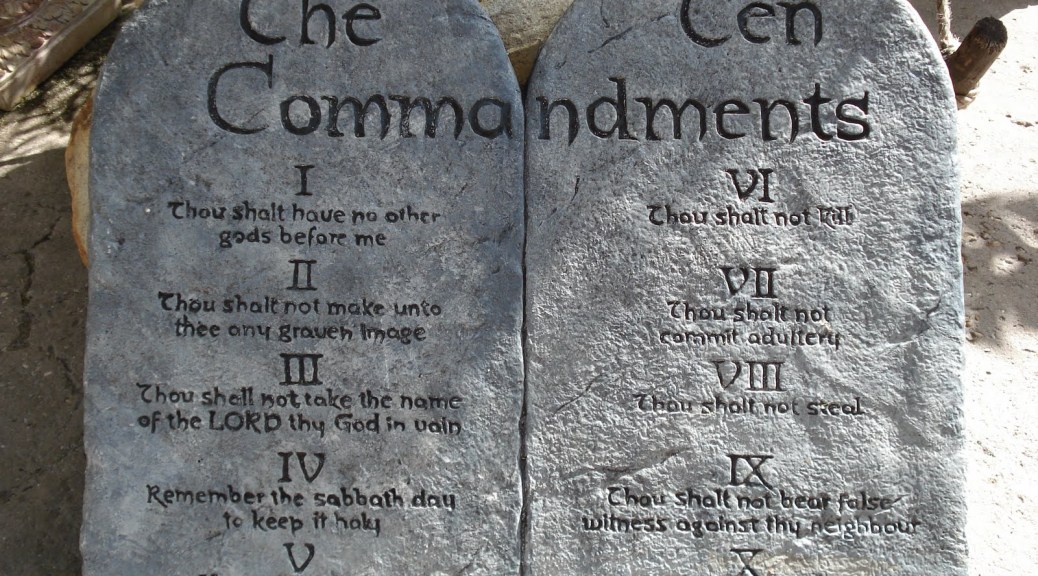
I am the Lord your God, who brought you out of the land of Egypt, out of the house of slavery; you shall have no other gods before me.

You shall not make for yourself an idol, whether in the form of anything that is in heaven above, or that is on the earth beneath, or that is in the water under the earth.

You shall not make wrongful use of the name of the Lord your God, for the Lord will not acquit anyone who misuses his name.

Remember the sabbath day, and keep it holy. For six days you shall labour and do all your work.

Honor your father and your mother, so that your days may be long in the land that the Lord your God is giving you.

You shall not murder.

You shall not commit adultery.

You shall not steal.

You shall not bear false witness against your neighbor.

You shall not covet your neighbor’s house; you shall not covet your neighbor’s wife, or male or female slave, or ox, or donkey, or anything that belongs to your neighbor.

When all the people witnessed the thunder and lightning, the sound of the trumpet, and the mountain smoking, they were afraid and trembled and stood at a distance, and said to Moses, “You speak to us, and we will listen; but do not let God speak to us, or we will die.” Moses said to the people, “Do not be afraid; for God has come only to test you and to put the fear of him upon you so that you do not sin.”’

—————————————————————————————————

This is the Old Testament selection from the Episcopal Lectionary for Year A, Proper 22, the eighteenth Sunday after Pentecost. It will next be read aloud in a church on Sunday, October 8, 2017. It is quite important because this is what Christians call the Ten Commandments.

As a disclaimer: There can be no “pencil-whipped,” Cliff Notes explanation of this reading, as the Ten Commandments stands as the cornerstone of Judaic-Christian beliefs. This article of interpretation is therefore of some length, simply because it addresses each Commandment. Because a standard Episcopalian sermon is between ten and twelve minutes in length, one can expect the totality of time spent on this Old Testament reading selection will be the time the reader puts into reading it. At most, a priest might gloss over one or two laws, to suit the points of a sermon hammered solidly to the Gospel (after all, Christians aren’t Jews, so no need to spend a lot of time on the Law). This posting might be the only time some people will have any of this explained.

With those added words set into the word count, let me begin.

———-

A few things are important to realize before digging deeper into the meaning found in these selected verses (skipping a few between verse 1 and verse 20).

First, the Jews laugh when they hear Christians talk about “the Ten Commandments.” Statues have been removed from courthouse lawns that condense this reading to “10 easy steps to living holy.” The Jews recognize that Moses brought down 613 commandments.

Second, Moses did not come down the mountain and send out messengers to all nations of the world, telling them the news of laws that must be adopted universally. That inaction means ALL of the Laws of Moses (God’s Commandments) are directed at His priests, and only to those who were to be totally freed from the “house of slavery” – life in a world that allures with sin.

This means God was (and is) quite aware that: 1.) There are other gods mankind serves; 2.) Idol worship is normally accepted around the world; 3.) People everywhere play the “god card”; 4.) Some people like to play golf on Friday, some Saturday, and some Sunday, with all calling that their holy day; 5.) Everyone has a mother and father, even if everyone has not personally met them; 6.) Humans love to kill just about anything that moves; 7.) People love sex, in all forms; 8.) People love to have what others have, even if they cannot afford it; 9.) People commonly lie to protect their behinds from punishment; and 10.) People everywhere always think someone else has more than them.

In other words, God knew the world more commonly served Satan (Beelzebub, Baal, Lucifer, etc., etc., by many other names), so the males and females created by God regularly did what displeased YHWH, making Him turn His back to the world in general.   But, to save that world, God was laying down the Law only for those who would serve Him in that effort towards Salvation.

Third, these laws of God, sent down by Moses, were given to the Israelites who had followed Moses to Mt. Sinai, but they always apply to those who wish to enlist their services to the LORD. The Jews (of Jesus days and of today) follow these rules religiously (meaning they know when they have broken one or all). Christians (who have delighted in killing Jews in the name of the Jesus – a sin, as listed above) enjoy the fact that they are not Jews, so they can trim down the 613 laws to just ten (while retaining the holy right to amend and adjust the penalties stated by God, through Moses, as they see fit). Jesus, however, made it clear the Law is fixed and just the first step to being a priest for God, when he said, [After obedience to the Law] “sell your possessions and give to the poor, and you will have treasure in heaven. Then come, follow me.” (Matthew 19:21)  So, if you cannot live up to Ten Commandments, you might as well find another god to openly serve.

With those basic realizations grasped, it is next worth looking at what is actually written, versus the English translations that are posted above and will be read in churches.

For the First Commandment, the Hebrew of verse 3 is: “lō yih·yeh- lə·ḵā ’ĕ·lō·hîm ’ă·ḥê·rîm ‘al- pā·nā·ya.” Literally, this translates to state, “Not (lo) you shall have (yih·yeh-) to you (ḵā) gods (’ĕ·lō·hîm) other (’ă·ḥê·rîm) before me (‘al-) the face of (pā·nā·ya).” (Bible Hub Interlinear) When this is translated into English as saying, “You shall have no other gods before me,” an important element is lost – “the face of” (pā·nā·ya).

Certainly, a priest serving YHWH can have no other gods that he, she, or it holds in higher accord than the One God. In fact, I have met people who (supposedly) educate people for Christian ministry, who vehemently deny there are any other gods. They translate “elohim” as “God” (singular capitalized), when it is the Hebrew plural form of “el,” meaning “gods.” Genesis’s first chapter is filled with references to “gods” (“elohim”) acting during the Creation, but all those references have been lost in translation, so we learn: “God” did this and “God” did that.

True. God WAS … before the Creation. Therefore, “In the beginning [it was God who had] gods created.” YHWH made and then commanded little-g gods to do everything; and, this proves there are many other gods around (angels and Satan being a couple of examples of non-human spiritual entities … gods).

Sure, the First Law says do not worship any other gods; but isn’t that too simple? Doesn’t every Judaic-Christian believer get credit for that one (well, except the 51% of people in the 2010 U. S. Census who claimed their religion to be “Jew”, but then checked the “no” box asking, “Do you believe in God?”)?  Still, doesn’t every believer believe only in God?

The answer lies in “panaya” – “the face of.” That answer says, “It is not that simple.

While the English translators (and probably the Hebrew translators, way back to the time of origin?) see this as something like colloquialism, where “before me the face of” was an ancient way of overstating “before, above, over” God, whom all servant-priests must face. However, “panaya” (according to Brown-Driver-Briggs) “literally [means] [faces] of Man,” as found stated in “Genesis 43:31; 2 Samuel 19:5; 1 Kings 19:13; Leviticus 13:14; Daniel 8:18; Daniel 10:9, 15 +; ׳עוֺר”.

This says, Man thinks of himself or herself as just as important in the worldly scheme of things as is God. Humans can say they have no other God they believe in “above God,” but then they say that wearing that sinful “face” of himself or herself, when they plead “before God.”  Man has proven to be too full of itself to bow down “before God’s face,” so God’s face cannot be then reflected back at God, from the bald scalp of Man having self-sacrificed.

In Jesus message terms, the First Law goes beyond memorization of the words and continues on to giving away everything that keeps you bowing down before self, until you then follow in the ways of Jesus, as Jesus reborn, with the Christ Mind.  We know this because “Jesus said to his disciples, “Whoever wants to be my disciple must deny themselves and take up their cross and follow me.”‘ (Matthew 16:24)

A hint at how this is the correct meaning intended to be honored, I recommend reading the end of Exodus 19, as God told Moses a few things that are relevant here:

“So Moses went up and the Lord said to him, “Go down and warn the people so they do not force their way through to see the Lord and many of them perish. Even the priests, who approach the Lord, must consecrate themselves, or the Lord will break out against them.” Moses said to the Lord, “The people cannot come up Mount Sinai, because you yourself warned us, ‘Put limits around the mountain and set it apart as holy.’” The Lord replied, “Go down and bring Aaron up with you. But the priests and the people must not force their way through to come up to the Lord, or he will break out against them.” So Moses went down to the people and told them.” (Exodus 19:20b-25, NIV)

Moses and Aaron were holy (“consecrated” means that, as “sacred”). The mountain of God is therefore the Law. “Do not force your way through to see the LORD” means do not say you obey the Law, when you really do not understand it as non-consecrated plebes. “Even the priests, who approach the Lord, must consecrate themselves,” which applied to the elders then, the ones in the days of the Pharisees, and the ones who call themselves Rabbis, Pastors, Ministers, and Priests today. Just because you have a following that makes you feel mighty important, do not approach God wearing that face; “or the Lord will break out against you.”

Hint: One can only be sacred when a divine presence has joined with one’s soul. Moses and Aaron were so divinely possessed. Their souls were possessed by the soul of Jesus (a name meaning “YAH Saves“); and, that union is eternal. This means when alive in a body of flesh, one has forever submitted to serve Yahweh; and, Yahweh has sent His Son Jesus to forever keep one from breaking the marriage vows. So, when one dies and one’s soul goes “before” Yahweh, one will always wear the “face” of the Father, through the Son. First Commandment, therefore, demands this self-sacrifice to marry Yahweh and become His bride, as well as the ‘mother’ soul to His Son reborn.

If you have read this far and are thinking, “Wow! So many words on just the First Law! I don’t know if I have the time to read the rest,” then keep in mind how Jesus said, “’Love the Lord your God with all your heart and with all your soul and with all your mind. This is the first and greatest commandment. And the second is like it: ‘Love your neighbor as yourself.’ All the Law and the Prophets hang on these two commandments.” (Matthew 22:37-40, with similar in Luke 10:27; Mark 12:30-31) The following nine Commandments are relative to loving God and loving your neighbor as a God-loving you (consecrated, holy, sacred, and Saintly Apostle).

When you read the Second Commandment, ask yourself, “Have I ever watched American Idol?” We read this and think of the Golden Calf the Israelites made, when we never once think of our worship of idols and heroes, politicians and ministers, as being what God instructed against. America’s knees are flat from bowing down to movie stars, singers, activists and protesters, and even sweet Jesus himself.

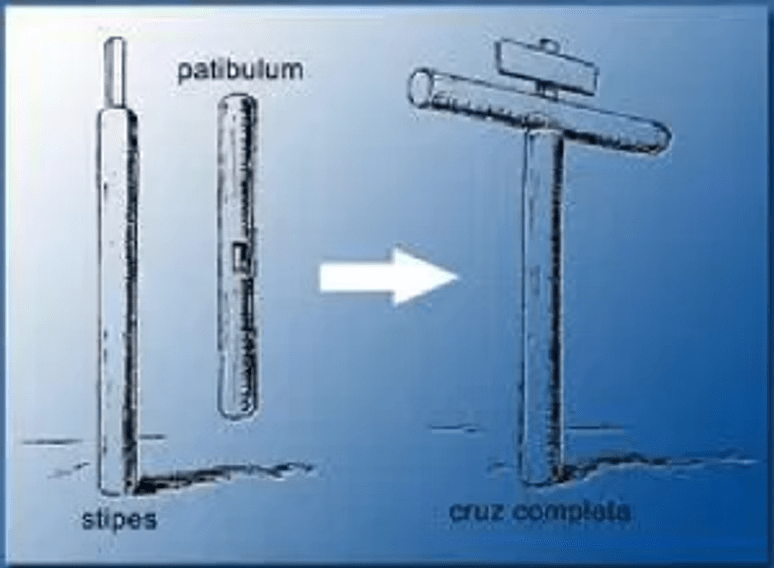
I imagine it was the Holy Roman Emperor who saw the fish symbol (Pisces = sacrifice) and said, “Scrap that! Make the cross the symbol of Roman power and might. Hang a Jesus on it and put it around the necks of every Roman Catholic … and charge a pretty denarii for it!” This too is a graven image that is in the “form of earth,” as the instrument that killed the body of Jesus, even though it became an earthly symbol of his soul’s release to heaven.  In its precious metal presentation, a cross is an idol.

[Aside: The cross, as a symbol of death and destruction, is as pagan as a Roman temple to Pluto.  The holiness of a cross symbol comes through seeing it as representative of the Trinity: Horizontal (God) + Vertical (Son) + Intersection (Holy Spirit).  Each Christian must be that cross of the Trinity.  The presence of that Intersection makes each Christian be Jesus resurrected; but he sure ain’t hanging dead on it.  You are!  You cannot be reborn as Jesus with the Christ Mind while still being a living ego trying to control things in your world.]

The Third Law does not mean “Do not cuss like a sailor, using God as a word in that process.” This is actually why Jesus had such a problem with the Pharisees and Temple scribes and priests. They were using the name of God as a way to get rich and as a way to condemn those who challenged their racket. They used the Lord’s name in vain every time they said, “I condemn you in the name of the LORD!” Today, a whole lotta ministers go around saying, “I rebuke you in the name of Jesus Christ!” It is great theatrics; but God is not pleased when His name is tossed about like that.

The Forth Commandment seems like all a believer has to do is go to church on Sunday (a Christian Sabbath … not). The Jews who returned from exile, self-flagellating themselves for having strayed so far they lost their valuable property, made it a well-monitored rule that no one could do anything on the Sabbath, except walk to the synagogue and walk home. That is more than the Christian view of getting a day off work on Sunday, with attendance in a church optional. My deceased mother turned to watching religion on television, rather than go to church. She was not alone.

What is missed in this Law is the part that says, “For six days you shall labor and do all your work.” As a priest of YHWH, what “work” is that which makes one consecrated? Selling Ponzi scheme stock options, or used cars, or life insurance, or practicing being someone one is not, as an actor in the movie industry does? If one is going to be a priest for the One and Only God, the work required is 24/7 practice being His servant. He might want you to shear a sheep or hammer some nails and sweat a lot in the sun; or, He might want you to raise children right or tend to the elderly and sick.  You just get to stay home on the Seventh Day and eat the manna that God provided the day before and thank God He leads you in your labors.

Intermission: I know this is a long article, but what can be better than spending a whole Sabbath looking at the opinions of others and expanding you own views of the truth. Interpreting Scripture should be fun and uplifting, when one’s mind is seeking to be consecrated. After all, the Law comes from sacred ground, so take off your sandals and let the Holy Spirit guide your thoughts for a few hours. Remember, it is not what I think and write that matters. It is what you think and do that leads to Sainthood. That takes more work than one day a week can satisfy.

———-

When Law number five says, “Honor your father and your mother,” it does not mean draw a picture for the refrigerator for mom, or let mom tell you which tie to pick out for dad, two days a year. It does not even imply that you have parents worthy of any kind of respect. The Hebrew word “kab·bêḏ” means, “to be heavy, weighty, or burdensome.” Thus, you “honor” your parents by taking on the same “burden” they took on when they began cleaning up your messes as a baby. It means to be fruitful and multiply; but the true “honor” is to teach your children to serve the LORD, like you were taught (Charles Manson, et al, excluded).

The Sixth Commandment, “You shall not murder,” is one of those that Americans struggle with, especially those who want to have the government make it illegal for Americans to get their hands on guns and shooting anything that moves (forgetting that humans can kill with their bare hands and anything that fits into them can make killing easier). Cain used a rock, we think. On top of that, Americans think it is murder to execute someone who actually did murder, so there is less effect that law will keep anyone from murdering. Beyond that, Americans argue “murder versus kill,” and try to justify war, if certain criteria are met … none of which has anything to do with loving your neighbor like yourself.

If you are consecrated, you don’t go looking to kill anyone in any way. You do not love a country more than God, so some politician or general cannot order you to, “Go kill in the name of us.” Just don’t kill, unless God blesses you with an Ark and an order to do so. Then be prepared to die for God.

Here lies a true conscientious objector.

With the Seventh Commandment we come up with adultery, which is the human urge to have sex without planning to propagate. “Adultery” is a word used to denote (especially a man) having extramarital sex; still, Ezekiel, Jeremiah, and Isaiah used this same word (“naaph”) as figurative when a priest of YHWH cheats on Him (an indication that a priest is the wife, regardless of human gender). Still, as a word in English, the root word is “adult,” which makes the intent be related to those urges that begin at puberty, which usually results in getting married and making babies. However, adults who are led by their groins and sensuality will rub on anything, kind of like human hands love to grasp powerful instruments of death.

As such, “Do not commit adultery” means do not have sex with anyone and everyone prior to marriage.  It also means do not have sex with anyone other than your spouse after marriage.  It also means do not have sex with yourself.  It also means do not have sex with someone of the same sex (where making babies is impossible).  It also means do not have sex outside your own species.  It also means do not have sex with minors.  It means once you become a mature human being you have uncontrollable physical urges.  Congratulations!  You are normal; but normal and being sacred are two different creatures.

Again, I know this sexual limitation is almost impossible for anyone between the ages of 14 and 84 to comply with; but the point of consecration is why Paul wrote, “”It is good for a man not to have sexual relations with a woman.” (1 Corinthians 7:1). Sex becomes like one of those gods that likes to stand between you and God, when it is Face Time. That is why Jesus said, “And if your right hand causes you to stumble, cut it off and throw it away. It is better for you to lose one part of your body than for your whole body to go into hell.” (Matthew 5:30) The hand causes adults to stumble when it strokes those sensual parts of the body.
For the Eighth Law, “Thou shalt not steal,” the element of adultery implies consent with another adult, and what seems stolen from a spouse is really still there (just missing the heart part). This command is then relative to the material world and innate human lusts for things and gadgets. The people of Israel and Judah who owned land and grew crops were supposed to allow 10% of their crops (the outer fringes) to be for the needy. The needy were going to take what they needed, just to survive; so, one loves a neighbor by allowing one to take freely what one needs, rather than deny them that right. Denial would make them steal for it, because food is a necessity.  That is a way to love your neighbor as yourself.

This means stealing is relative to excess, or taking more than you need. That can mean taking that which is not yours to take; but that can also mean taking that which should be left for someone else. After all, how many billions of dollars does one need to live comfortably within the Law?

The Ninth Commandment then addresses bearing false witness against your neighbor. This is certainly meaning not to badmouth someone behind his or her back, where sowing the seeds of hate, in hopes of personal benefit, are a long way from being consecrated. I see it more as a warning to stay out of court as much as possible. Stay away from the “sue me sue you” mentality, especially as it has become such an easy way to make a profitable living – easy money. If you are called to witness in a trial, tell the truth – and that means no paid experts who are willing to twist the truth into a knot that benefits the highest bidder.

It is not coincidence that the Pharisees were Lawyers.  Their law practices dealt with the Laws of Moses exclusively.  Then, as now, lawyers are very closely related to the eighth No-No, stealing.  Middlemen, like people who charge interest on loans (Usurers), are like lawyers and advertisers who stir up business by promoting people bearing false witness.  (“I’m not a doctor, but I play one on TV.”) These are the people who say, “I’ll get you $100 and all you have to do is nod “yes” when I point to you.”  Then, after you follow those instructions, he gives you $50, saying “$40 goes to me and $10 to the court.”  Then you feel dirty and used … like an adulterer that has been robbed.

Finally, the Tenth Commandment is about coveting, which is all about jealousy and envy. As far as priests for YHWH go, if your mind is on what someone else has, what someone else looks like, or how important someone else seems to be, you are not serving the LORD. As the song sang, “Don’t worry, be happy,” you can only do that when you wear sacred blinders.  God will provide everything you need.  Everything beyond that is not yours for a purpose.  So, deal with it.  It is your test.

In conclusion, The Israelites “said to Moses, “You speak to us, and we will listen; but do not let God speak to us, or we will die.” Moses said to the people, “Do not be afraid; for God has come only to test you and to put the fear of him upon you so that you do not sin.”’ This point means it is so very easy … normal, common, expected … to let someone else be consecrated. Getting close to God is frightening, simply because of all the worldly things you like to do having a damper be put on them. However, that is just a typical fear of those who are addicted to the worldly.  The holy have no fears.  The consecrated can enter hallowed grounds.

Those fears are erased when you start to take the test and realize, “this is easier than I thought.” When the Holy Spirit comes everything is possible. The Holy Spirit is a reachable goal, just like Mount Sinai was. However, as is stated in Exodus 19, Moses set “limits around the mountain [to] set it apart as holy.” (Exodus 19:23b). It is the Law that forms those boundaries.

Philippians 3:4-14 – Confidence in the flesh offers little towards faith from the Spirit [Eighteenth Sunday after Pentecost]

“If anyone else has reason to be confident in the flesh, I have more: circumcised on the eighth day, a member of the people of Israel, of the tribe of Benjamin, a Hebrew born of Hebrews; as to the law, a Pharisee; as to zeal, a persecutor of the church; as to righteousness under the law, blameless.

Yet whatever gains I had, these I have come to regard as loss because of Christ. More than that, I regard everything as loss because of the surpassing value of knowing Christ Jesus my Lord. For his sake I have suffered the loss of all things, and I regard them as rubbish, in order that I may gain Christ and be found in him, not having a righteousness of my own that comes from the law, but one that comes through faith in Christ, the righteousness from God based on faith. I want to know Christ and the power of his resurrection and the sharing of his sufferings by becoming like him in his death, if somehow I may attain the resurrection from the dead.

Not that I have already obtained this or have already reached the goal; but I press on to make it my own, because Christ Jesus has made me his own. Beloved, I do not consider that I have made it my own; but this one thing I do: forgetting what lies behind and straining forward to what lies ahead, I press on toward the goal for the prize of the heavenly call of God in Christ Jesus.”

——————————————————————————————————–

This is the Epistle selection from the Episcopal Lectionary for Year A, Proper 22, the eighteenth Sunday after Pentecost. It will next be read aloud in church on Sunday, October 8, 2017. It is an important message from Paul, an Apostle and Saint, that says nothing of this world is worth sacrificing one’s soul for.

When Paul wrote, “If anyone else has reason to be confident in the flesh, I have more,” he wrote of the false assurances one thinks one has because of following the orders of Man (those in religious robes). When Paul then went on to make statements about his devotion as a Jew – a member in the “God’s Chosen People Club” – this should be taken (in our modern “Christian” times) as though Paul spoke for you.

Imagine Paul knows you as he knew himself. See him writing as if he knows your claims of the flesh.  A generic statement of your accomplishments might go like this:

“I was placed in a silver bowl full of holy water as an infant, sprinkled by a man (or woman) in a robe, and then placed in a cradle in the church nursery. I earned all gold stars at children’s church (Sunday school). Today I am an adult member of the church with the largest membership in the United States of America. I am a devout follower of the most highly recognized televangelist (or syndicated televised minister or local pastor whose Sunday service is telecast). I also graduated from a school with a revered seminary program (gaining a Bachelor of Arts degree, not a Master of Divinity). I am a regular attendee at my church on Sunday mornings (when not vacationing), with a plaque bearing my parent’s names on the sill of a stained glass window and everyone knows which pew my family sits on. I assist in the setting up chairs in the room where adult Sunday School is held (and sometime putting the chairs back). I am a devoted ten-percent tither, who also donates to multiple national charities. To top that off, I have been certified to assist the priest (or preacher) on the altar, as well as read aloud in church on occasion.”

Paul would say about you, as he said about himself: “As to righteousness under the law, [you are] blameless.”

Still, such resumes do nothing to gain entrance into Heaven, because it is lacking the most important qualification – humility. When Paul wrote about all the boxes he had checked off for righteousness, saying, “Yet whatever gains I had, these I have come to regard as loss because of Christ,” he was blind to what really counted.

If you remember, Paul was named Saul, when he was seen by the people who take notice of such things as being a devoted Pharisee in the service of the Temple of Jerusalem. The “I” was all important to Saul.  Thus he implied, “I was “circumcised of the eighth day.” I was “a member of the people of Israel, of the tribe of Benjamin, a Hebrew born of Hebrews.” I was “a Pharisee.” I was “a persecutor of the church” (Christians). I was “blameless,” because I was somebody important.”

Saul lost his I-sight after encountering the Spirit of Jesus Christ and then became Paul. Can you hear his new Paulian voice saying, “I have come to regard [that] loss because of Christ.”

The presence of the Christ Mind changed him forever, as he lost the I that Saul’s ego was.

“I regard everything as loss because of the surpassing value of knowing Christ Jesus my Lord,” is a statement by a reborn Christ Jesus, named Paul.  That new name comes from the Latin adjective “paulus,” meaning “little or small.” That name symbolizes how such a proud, important, big-ego man lost all that he was, becoming most humble … a little man, as far as his self was concerned.

When Paul went on to write that his change meant he “suffered the loss of all things,” this says big egos are attracted to grand examples of God’s favor surrounding them. So many see worldly success as a sign of God’s approval to the way so many are living.  But, as Jesus told the young rich Pharisee in Matthew 19:21, “Go, sell your possessions and give to the poor … and then come, follow me,” big egos walk away sad, with heads hung down.

Their brains think, “Give up all things? I can’t do that.”

When Paul then wrote that righteousness “comes through faith in Christ, the righteousness from God based on faith,” one has to realize that “faith” can never be rewarded with “things.” True “faith” is belief in intangibles. When “things” come to those who check all the boxes that look good on a resume, their reward of “things” negates a heavenly reward.

When the brain is blind to spiritual rewards, it works just as hard as one of true “faith” does, but all the work done goes to reward self, in just one temporal life. Those works are “confidence in the flesh,” rather than confidence in God.

Righteousness is the intangible reward for true faith, because the presence of the Christ Mind supports the soul, as faith motivating the flesh.  The brain stops plotting what the flesh can do to bring even greater reward in “things.”  The Christ Mind uses that flesh to find more souls who need to see the light … they are motivated to fish for men’s souls.

For Paul to write, “I want to know Christ and the power of his resurrection and the sharing of his sufferings by becoming like him in his death, if somehow I may attain the resurrection from the dead,” this is THE desire for righteousness. Paul’s desire should be mirrored by all Christians.

All Christians want to know Christ, where knowledge is the Christ Mind within (not written in some book or on the pages of some sermon). The “power of his resurrection” is when one changes and is born anew as Christ Jesus. To feel one’s self “sharing his suffering,” one is walking in the footsteps of Jesus AS Jesus reborn, attracting souls and opposition. Thus, one has become “like him in his death,” by sacrificing one’s own self, like changing from Saul to Paul.

That says it is a requirement for everyone – Changing from (your name here) to another who is filled with the Holy Spirit of God, gaining a righteous name (“in the name of Christ Jesus”). The desire has to be there first, for you and all who want to gain the right to Heaven, in order “to attain the resurrection from the dead.”

If you look around you, you will find many souls born of death, simply by being in mortal bodies. They are born to die, over and over again, as eternal souls continually trapped in new bodies of flesh, which can only surround them until death returns. To “attain the resurrection from the dead,” your soul has to be released from this material world cycle.

Only righteousness brings that freedom.

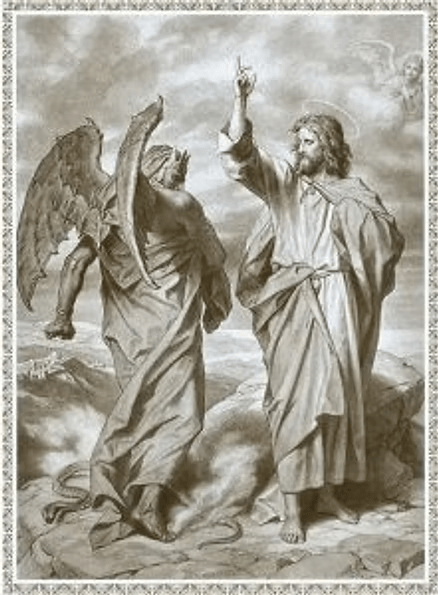
By Paul writing, “Not that I have already obtained this [resurrection from the dead] or have already reached the goal [Heaven]; but I press on to make it my own,” he knew that Apostles are the ones who Satan most tries to lure back into the dead. Satan tempted Jesus in the Wilderness with wealth, fame, and worldly glory; but Jesus told Satan where to go.

The life of a Saint means one of tests and more tests, so one has to press on. The Holy Spirit makes that work be seen as happiness, amid denials of pleasure and the acceptance of suffering.

You cannot make it through the righteousness obstacle course alone. You need Christ Jesus making you his own, just as he made Paul his. That is why the I has to die.  Your ego’s death means God in your heart and Christ leading your thoughts.  Your body becomes another Trinity.  So, although you look alone, you are with good company.

That is why a promising resume cannot be written in the present, as everything in the past has to be forgotten. Straining forward is not the stuff that wins smiles from V.I.P.’s looking for new managers and partners, as suffering means the loss of all one’s old material world references.

The only writing that matters will be a headstone in a pauper’s field that says, “Here lies a fool who gave up everything for others.”

The Fool card symbolizes innocence with faith. Eyes to heaven about to take a leap of faith. He is not concerned about what happens next, as all he knows is, “I can no longer stay here.”

That is the kind of resume God likes. It is the kind that attains “the goal for the prize of the heavenly call of God in Christ Jesus.” And, if you are really good at gaining righteousness, people whose lives crossed your righteous path will write honorable words about the you who you became, when you changed, after you’ve gone to heaven.

Matthew 21:33-46 – Bad tenants give Christianity a bad name [Eighteenth Sunday after Pentecost]

Jesus said, “Listen to another parable. There was a landowner who planted a vineyard, put a fence around it, dug a wine press in it, and built a watchtower. Then he leased it to tenants and went to another country. When the harvest time had come, he sent his slaves to the tenants to collect his produce. But the tenants seized his slaves and beat one, killed another, and stoned another. Again he sent other slaves, more than the first; and they treated them in the same way. Finally he sent his son to them, saying, ‘They will respect my son.’ But when the tenants saw the son, they said to themselves, ‘This is the heir; come, let us kill him and get his inheritance.” So they seized him, threw him out of the vineyard, and killed him. Now when the owner of the vineyard comes, what will he do to those tenants?” They said to him, “He will put those wretches to a miserable death, and lease the vineyard to other tenants who will give him the produce at the harvest time.”

Jesus said to them, “Have you never read in the scriptures:

‘The stone that the builders rejected
has become the cornerstone;
this was the Lord’s doing,
and it is amazing in our eyes’?

Therefore I tell you, the kingdom of God will be taken away from you and given to a people that produces the fruits of the kingdom. The one who falls on this stone will be broken to pieces; and it will crush anyone on whom it falls.”

When the chief priests and the Pharisees heard his parables, they realized that he was speaking about them. They wanted to arrest him, but they feared the crowds, because they regarded him as a prophet.

——————————————————————————————————-

This is the Gospel reading from the Episcopal Lectionary for Year A, Proper 22, the eighteenth Sunday after Pentecost. It will next be read aloud by a priest in church on Sunday, October 8, 2017. It is called “The Parable of the Tenants,” and is important because Christians are the current tenants of the Father’s vineyard.

The context of this parable is it follows the parable of the two sons, which was the Gospel selection for the prior Sunday. When we begin by reading, “Jesus said, “Listen to another parable,” there is no space of time between the two.  Both parables are told to “the chief priests and the elders,” those who questioned Jesus’ authority to teach on the Temple steps.

Additionally, at the beginning of Mathew’s chapter 21, Jesus entered Jerusalem on a donkey with her colt, for his final Passover. So, Jesus was speaking in Jerusalem, prior to his being arrested.  At the beginning of Matthew 26, Jesus said “As you know, the Passover is two days away.” (Matthew 26:2) The day of preparation (Friday) was one of those two days, with Passover Day being on Saturday (Shabbat), the second day away.

The Seder meal (the Last Supper), beginning after 6:00 PM, was thus on the Sabbath eve.  This means Passover (15 Nisan) began on a Shabbat and ended eight-days later on another Sabbath. This means one can deduce how Matthew’s chapters 21 to 25 (and the beginning of 26) were accounts of Jesus’ time in Jerusalem over a four day stretch: Monday through Thursday.

The parables were told to the pilgrims who were gathering in increasing numbers for the week-long festival, and the officials overseeing the festival were also about, checking things out.  Therefore, these stories should be seen as the inspection of the Lamb to be sacrificed.  Jesus made himself publicly available for all to inspect; but Jesus knew the ones who held the slaughter knife would be the ones looking most closely.  The parables told there are how we know Jesus would be found unblemished.

With that understood, look now at the symbolism of a vineyard, one with a fence around it, with a wine press within and a watchtower overlooking. Certainly, that was meant to be seen as metaphor for Jerusalem, which was a beautiful walled city, with a refurbished Temple (credit to Herod) built to the LORD.  Upon its watchtowers, at its gates of entry, were the watchers.  That symbolically meant the watchers of that Temple, who were the high priests, scribes, Sadducees and Pharisees. However, because Holy Scripture is the Living Word, can you see how the same parable is speaking also about modern times and modern places?

Beginning with a focus on the vineyard, this is that of Christianity.  The wine press represents the churches devoted to Jesus Christ.  The fence represents the restrictions (as laws) that mark a nation as obedient to the LORD.  Finally, the watchtowers are manned by those whose job it is to protect the holiness of that vineyard.  We should see them as kings, popes, priests, pastors, ministers, rabbis, and preachers.  Do you see that from this parable?

This means to hear these words as those spoken long ago, about people who have long since died, as a parable to be focused only on a religion that makes it exclusively pertinent to Jews is WRONG. The past is long gone, but Jesus is telling us today, “Listen to another parable” relative to those who say they follow him.  Therefore, it means combing through the wool to find how this parable is always a perfect analogy of now, and not a blemish on Jesus, who spoke as the mouth for an All-Seeing God.

Many a Crusade has been fought to gain possession of THE Holy Land. The Jews and Arabs who farmed the land were always caught in the middle, as the poor folk living there.  Minding their own business, they were being killed by the religions of Roman Catholicism and Islam. Still, was not North America a holy land to Native Americans (tribes of people who saw Mother Earth as sacred and unable to be possessed by Man); and did they not find the religion of the white man meant, “Give us all you’ve got, or we’ll kill you heathens in the name of Christ”?

Think about that history (I know history always put students to sleep, but try to stay focused and do that), and see if any of that recorded past sounds like, “The tenants seized [the] slaves [of the landowner] and beat one, killed another, and stoned another.”

The theft of land, as if legal and proper if an official declaration of war is made so the spoils go to the victor, is still theft.  If the declared “war” results in a greedy adult snatching candy from the little hands of a baby, the declaration was evil and the war was one-sided.  Man cannot declare war for God; but God can wreak justice on all who take His name in vain.

Someone must have felt pangs of guilt over the pretend war that allowed the new United Nations to declare Palestine legal tender to the Jews of the world [new name Israel], didn’t someone?

Beginning way back when the “landowner” (psssst – it is God) “finally sent his son to [the Jews], saying, ‘They will respect my son,’” and the Jews had the Romans kill him (by divine plan), the same story has been repeated time and time again. It is a story that keeps on keeping on, as contemporary as can be.

The Inquisitions in Europe were examples of Christians nailing Jesus back on the cross, killing him again, so someone would be allowed a window of opportunity to kill anyone and everyone who moved that did not have a silver cross around their necks, for personal gain and quests to acquire more lands. The evil that exists in the New World today (way too many corrupt players to name), began long ago.  Still, it kills Jesus Christ Monday through Saturday, before taking the family to church on Sunday (or otherwise relaxing).

Can you hear Jesus asking Donald Trump, Barack Obama, George Bush (x2), William Clinton, et al American Presidents, “What will the Father do to those tenants?”  If only politicians had hearts that loved God more than lobbyists.

The correct answer, which was given by the watchmen to Jesus, still applies today: “The Father will put those wretches to a miserable death, and lease the vineyard to other tenants who will give him the produce at the harvest time.”

One should read the symbolism of “miserable death” as being more than simply being drawn and quartered in the royal field of punishment. If killing was the answer to sin, organizing a storm and siege of Washington D.C., taking over the rule of the land, with the streets then lit by the burning corpses of government officials (and religious ones too) would be the answer.

The French peasants (led by Zionist Jews in Geneva) went there, did that.  After cutting off the heads off every royal figure they could try in a kangaroo court (a period known reflectively as “The Reign of Terror”), they found out that wasn’t the answer. Napoleon slapped some Republican sense into them.  Then, given a hundred years to let all that sink in, Hitler-karma came to even that score once again.

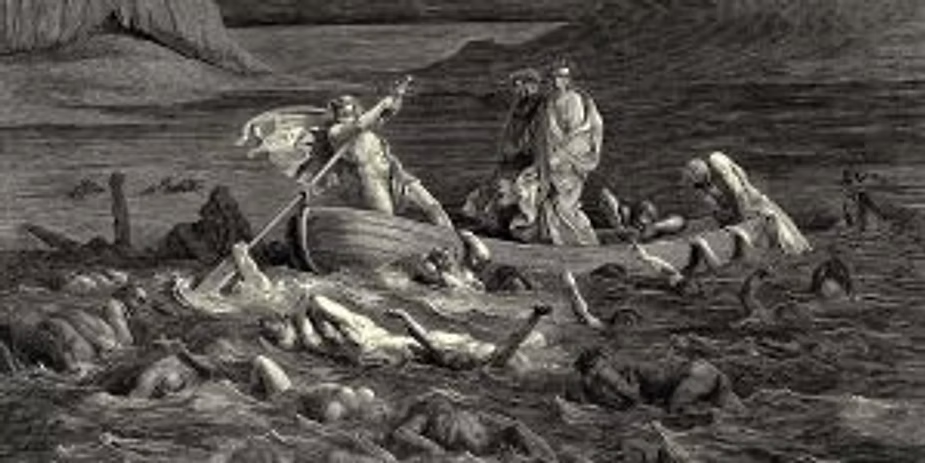
The path to Dante’s Inferno must go through France.

“Miserable death” means a soul sentenced to eternal reincarnation.  It is the misery of mortality.  All humans are born of flesh, to die in flesh that will always be in between – either a bad tenant stealing the land, or a messenger of the Father who is mercifully slaughtered as a sacrificial lamb.  Decisions, decisions.

When Jesus asked the watchmen of Jerusalem “Have you never read in the scriptures,” he quoted Psalm 118:22-23. Jesus quoted the part that focuses on a “stone that the builders rejected.” That “reject” is too simple to be seen as Jesus, because (after all) many Americans cry out “Sweet Jesus, save me” all the time (to no avail).

Needing salvation comes from having “rejected the stone that has become the cornerstone.” The “stone” rejected is the “Tablets of Stone” sent by God to His priests.  It is easy to revere the stone, on the one hand, but then point with the other and say, “Hide it away somewhere, so we don’t feel guilty about not living up to its righteousness.”

In the parable, the tenants had rejected the Law by stealing, killing, bearing false witness, coveting … you name it. The Pharisees and other officials of the Temple could easily see the answer to Jesus’ hypothetical question, because they had memorized those stones.  Still ….

They just did not live by those laws, whole heartedly. They rejected that stone, if it did not mean profit for them.

For the Law to become the “cornerstone,” they needed to cease using a brain that calculated, “This is the heir; come, let us kill him and get his inheritance.”  Instead, they needed to be like Jesus – living by the Law because he was filled with the Holy Spirit, the Mind of Christ, and love of God. With that cornerstone, you stop being the one taking advantage of a landowner and you start taking messages to those who do.

That is what Jesus meant when he said, “Therefore I tell you, the kingdom of God will be taken away from you and given to a people that produces the fruits of the kingdom.” If you are not bearing the fruit of an Apostle, who takes a message from the Father to the world, then you are breaking all the Laws God sent to His priests. Without acting faithfully as a true priest, you are still in the reincarnation “Return to Sender” category. No “kingdom of God” is in the future of the ones who love land (material things) more than heaven (spiritual gifts).

When Jesus told the watchmen, “The one who falls on this stone will be broken to pieces; and it will crush anyone on whom it falls,” those “holy men” had all fallen upon the Law of Moses, like a Crusader hitting the shores of Jaffa, or a Pilgrim on the beaches of Plymouth Rock. Holding a cross in left hand and a sword in the right hand will crush the living life out of a soul’s wish for freedom from a world of sin.

A New Land with a new promise? Or a new opportunity for the New Testament?

When Matthew wrote, “When the chief priests and the Pharisees heard his parables, they realized that he was speaking about them,” the next thing to ask is, “How do I fit into this parable?”

Can you see how Jesus was “speaking about” all Christians alive in the twenty-first century? Can you see yourself as a tenant in a leased vineyard that has an understanding (a Covenant) that you are supposed to tend the garden, pick some grapes, turn the ripe grapes into holy wine, and then stand before the landowner saying, “I not only have fulfilled my obligation, Sir, but I have done more than required. I offer you everything and thank you for allowing me to serve you in such a wonderful place.”

Help Wanted. Apply Within.

Or, are you paying the minimum, or skimming off the top, thinking there is still time to put back that which has been stolen … maybe … one day … we’ll see?

Mark 9:30-37 – Welcoming a child in the name of Jesus

Jesus and his disciples passed through Galilee. He did not want anyone to know it; for he was teaching his disciples, saying to them, “The Son of Man is to be betrayed into human hands, and they will kill him, and three days after being killed, he will rise again.” But they did not understand what he was saying and were afraid to ask him.

Then they came to Capernaum; and when he was in the house he asked them, “What were you arguing about on the way?” But they were silent, for on the way they had argued with one another who was the greatest. He sat down, called the twelve, and said to them, “Whoever wants to be first must be last of all and servant of all.” Then he took a little child and put it among them; and taking it in his arms, he said to them, “Whoever welcomes one such child in my name welcomes me, and whoever welcomes me welcomes not me but the one who sent me.”

———————————————————————————————————-

This is the Gospel selection from the Episcopal Lectionary for the Eighteenth Sunday after Pentecost, Year B 2018. In the numbering system that lists each Sunday in an ordinal fashion, this Sunday is referred to as Proper 20. It will next be read aloud in an Episcopal church by a priest on Sunday September 23, 2018. It is important because Jesus told his disciples of his suffering to come for the second time. Jesus then taught his disciples that they had to give up seeking adult quests and welcome the birth of him in them.

In the sequencing of events, Jesus had first told his disciples about the suffering that would come at the hands of the rulers of Jerusalem (Mark 8). Now, he is remembered saying he would be “betrayed into human hands.”

The Greek text shows “paradidotai eis cheiras anthrōpōn,” which can translated clearly as “delivered into the hands of men.” The word “paradidotai” can mean “betrayed,” but that hint was not taken to mean “There is a traitor among us.” The same word, without a specific context, could mean “handed over, delivered, turned over, or abandoned.”

The difference between Jesus having named specifically “elders, chief priests, and scribes” earlier, but now saying “men” is a statement that people holding titles are still just human beings like everyone else.  It implies the Romans will do the actual deed.  The fact that Jesus said, “They will kill him,” rather than having generally stated before “to be killed,” meant the disciples were confused by the differences in the two stories. That confusion made them again miss the part of “on the third day he will rise, after being killed.”

When we read, “They did not understand [the things spoken] and were afraid to ask him,” the part they thought they understood – Jesus being killed – had drawn the ire of Jesus, after Peter took him aside and tried to sternly tell Jesus he should not talk such nonsense. Here, he repeated that he would be killed, but no one was brave enough to say to Jesus, “Excuse me master, but could you explain more about how you know this and why we cannot stop it from happening?”

No one wanted to be told they were Satan. Therefore, they were blank slates that had been conditioned to watch, listen, learn, and obey, as long as their egos never questioned divine wisdom.

We next hear read aloud by a priest, “Then they came to Capernaum; and when he was in the house he asked them, “What were you arguing about on the way?”’ This question by Jesus could have been asked while the group was “on the way,” so Jesus saved it for a more preferable time to bring up the matter. He asked while they were in the house of Jesus in Capernaum, where the familiar surrounding meant there were no chores to do and there was a period of rest after a long and eventful travel.

To then learn, “They were silent, for on the way they had argued with one another who was the greatest,” this means the disciples did not answer the question.  There is no indication that the disciples spoke and answered Jesus.  That absence says they refused to answer the question because they were still afraid of being called Satan by Jesus.

If Peter could be told to get behind Jesus as an evil demon, simple because he cared enough about Jesus to tell him, “You will not talk of death!” then they all could be seen as more evil than that for arguing about “who was the greatest” among them. As for that superlative written, the Greek word “meizōn” can also mean “most important.”

To then read, “[Jesus] sat down, called the twelve, and said to them, “Whoever wants to be first must be last of all and servant of all,” this implies that Jesus knew what they were arguing about. The question was rhetorical.

Even if they argued away from Jesus, when Jesus was by loudly running water, getting a drink; or when Jesus was sitting amid his family and engaged in conversation with them, Jesus knew what was going on. Jesus knew what his disciples were arguing about because God made him aware. If Jesus could know his future and teach his disciples to be prepared for his death, then he could know what is running through his disciples’ minds and hearts.

It should also be realized that while Jesus was on the high mountain with Peter, James and John of Zebedee, a father with a child who had a demon spirit possessing him, making the boy mute and threatening to kill him by convulsions, had come into the base camp.  He asked the disciples to cure his son. Mark said “they did not have the power,” which presumes they tried to cast out the demon, but failed. The father and son stayed in the camp, drawing a crowd from the nearby village (including the ‘mayor’, called “a scribe”); so many were waiting for Jesus when he returned.

Jesus healed the boy, which left the boy apparently dead when the spirit departed his body. Several people attested that the boy was dead; but Jesus took the boy’s hand and raised him up, where the Greek word denoting that is “ēgeiren,” meaning “made awake.”  That should be seen as metaphor for raised from death.

The disciples asked Jesus why none of them could cast out the unclean spirit. He told them that the demon spirit in the boy was one that required “prayer,” which meant only God could both cast out an evil spirit AND bring the dead boy back to life. In other words, Jesus explained to his disciples (privately) that they still were not full-fledged Apostles, married to Yahweh.  They were still in training.

That event gives more reason for the disciples to be arguing about who was the “greatest” or “most important,” such that they were comparing their works of ministry to each other’s. Undoubtedly, they had each remembered the greatest healings achieved, how many spirits each had cast out, and how many people listened to them preach the meaning of the Torah and were touched spiritually. All had been given the ability to cast out unclean spirits, but the one in the mute boy was more than a mild case of illness by spirit. God undoubtedly assisted the disciples (or His angels) in their commission by Jesus, but the disciples were still unaware.  So, with Peter’s pretense as ‘lead disciple’ now uncertain, they all argued about who could then be considered the best disciple Jesus had.

Jesus knew that divinely, leading him to instruct nicely, “Whoever wants to be first must be last of all and servant of all.” The point was to never let a big head make one think their brain had anything to do with their spiritual acts. The disciples had been taught to release their egos by being obedient to Jesus; but Jesus knew they were getting Big Brain syndrome and that evil spirit needed to be cast out quickly. Jesus did that gently. There was no need to call anyone Satan.

When Jesus used those words about “first” and “last,” or “prótos” and “eschatos,” which also can translate as “most important” and “the end things,” it is important to understand just who and what that meant. For all the arguing about which disciple was “most important” in the eyes of Jesus and Yahweh, one has to wonder what self-proclaimed accolades Judas Iscariot presented. Was his claim for being the “greatest” based on how much money he raised?

After all, wasn’t Jesus referencing Judas when he told the group he would be “betrayed,” “handed over” by someone unstated by name, “to be killed”? That would certainly qualify Judas for being “last” among the Gospel writers.  There were many asides that pointed out beforehand – “Judas was the one who would betray Jesus.”

The point Jesus was making was less specific to one disciple and more applicable to the “men” whose hands Jesus would be turned over to. Judas was not quite in their category of “most important,” although he was [according to the Gospel of Judas] one who took great pride in mental exercises; supposedly Judas was a philosopher that loved debating logic with Jesus. Still, Judas would see thirty pieces of silver as big potatoes, while the Sanhedrin “men” dealt in finances that only the “most important” could fathom.

Those “men” were the ones who would reach their “ends” and be like the rich man who died and went to a hot place; still he expected poor Lazarus to come put a drop of cool water on his tongue. (Luke 16:19-31) Unfortunately, those are the ones who think they are the greatest until their demise, when they realize it would have been better to be the servant of all, rather than the opposite.

From that soft rebuke of rather simple disciples who argued about greatness, when they were already servants – ranking slaves as to how much they submit to the will of the great is pointless – Jesus then “took a little child and put it among them.”

The word translated as “a little child” is “paidion,” which can mean anything from an infant to a seven year old. The word implies, “a little child under training,” but some scholars believe it can mean, “a son or daughter up to 20 years old (the age of “complete adulthood” in Scripture).” [Helps Word-studies] The translation of “it” is from “auto,” such that the neuter gender third-person identification means the child had not yet matured, although “it” was either “boy” (“he”) or “girl” (“she”).

This is worth further analysis.

It was standard protocol in ancient times to ignore women and children in writings. Women were usually referenced generally, as being the wife or daughter of some specific man. Children were referred to generically also, with no names mentioned; unless it was in reference to a man in his childhood (Moses, Samuel, David, Solomon and Jesus, etc.).

In the Gospels of Matthew, Mark, and Luke, Jesus told the disciples to feed the five thousand men who came to hear Jesus preach. None of those writers made mention as to who was carrying the loaves and fish. John, however, said that Andrew spoke, saying “Here is a boy with five small barley loaves and two small fish.” In Mark’s Gospel (remembering Mark wrote the story of Simon-Peter), as Jesus was arrested and being carried away, he (and only he) wrote, “A young man was following [the arrested Jesus], wearing nothing but a linen sheet over his naked body.” (Mark 14:51)  Neither reference identified specifically who those youths were, because of the age and, therefore, lack of importance.

The word written that translates as “young man” is “neaniskos,” meaning a male youth (i.e.: boy), simply because he is unnamed. Still, in the literal Greek of that verse, Mark wrote “neaniskos tis,” which says, “a certain young man,” meaning that boy was known and identifiable, just not old enough to put his name in print.  Because the boy was “certain,” he was known.  After all, what strange child would just happen to be with Jesus and his disciples at Gethsemane, around two in the morning, in his night robe?

Hint: None.

This is where one needs to realize that Jesus was in his home in Capernaum. He was in the house where his family lived with him. It would be completely normal to have children about in a Jewish household. Thus, the child who Jesus took up in his arms – the child under training – was the same child who carried the basket with loaves of bread and two smoked fish. It was the same young man who ran after Jesus when he was arrested, in his night robe, which boys put on before going to bed. He just happened to be under training during the Seder ritual and followed Jesus and the other adults as the disciples stumbled along drunk and fell asleep while Jesus prayed.

The young man – the youth – was John the Gospel writer, who recalled so much about that night.  John was able to recall the teachings of Jesus because he was a boy and not allowed to get drunk with the adults. The adult disciples were busy getting plastered on wine (part of the Seder ritual) and could barely remember waking up to Jesus being arrested. Here, in Mark’s account of the disciples being in Jesus’ house, with John there, we see John is being used as an example about the least who serve all.  John was the example of one who had no bragging rights about greatness; and they should be like him.

Still, one has to grasp the fact that a child in the house of Jesus would be a relative. John referred to himself as “the one Jesus loved,” which is a statement of relationship. John did not write of the excursion to Tyre and Sidon, nor did he write about the trip to Caesarea Philippi, when the Transfiguration took place. During both trips, Jesus was trying not to bring notice to himself by the Pharisees, or the Temple scribes and high priests. Simply from the potential danger involved, a child relative would have been left behind in Capernaum, with his mother and other relatives. Then, after Jesus had returned from a business trip, the child John was delighted at Jesus’ return. He was called by Jesus to sit with him and his disciples. John jumped into Jesus’ arms at the invitation.

This means that when Jesus said to his disciples, “Whoever welcomes one such child in my name welcomes me,” he just said, “Whoever welcomes John bar Jesus, my son, the boy with my name.” That statement is then stating a love relationship on a familial level.

Surely, John was the son of Jesus and thus bore the name of Jesus, as his father. Whoever welcomes that same relationship as that son, welcomes Jesus as their father. A disciple, therefore, is seen as least, in a Jewish society, the same as is a boy who gets no name recognition in writing, even though many people know the boy’s name; certainly they knew the name of that boy’s father. Therefore, if one welcomes being on the level of a child – a youth – an obedient child under training – a young man not yet grown into one of those “men who will kill” Jesus – then you welcome being the son of Jesus, which makes you also the grandsons of God, his Father.

The relationship would make the disciples God’s grandsons.  It means the least have become the greatest, by their service to the Father, as His sons, born anew as Jesus Christ – the Son of God. It is most important to see the love factor, which is centered on family.

Jesus did not just reach out in his own home and grab the first random “it” child that ran by and use “it” as an example that was welcoming ALL children as a lesson (by example) that Jesus taught.  What Jesus did was show his young son as how a disciple must see self-ego.  As adults they must stay in touch with their inner child and love Jesus the same as his son, as a sign of respect for the name of Jesus.

Jesus chose his son as an example for ALL disciples – then and now – to model.  They ALL have to welcome one another as members of the family that is born of Jesus. Just as John was a youth under training, so too were the disciples.  Being obedient to the commands of Jesus means being obedient to the commands of God; just as Jesus was. It is a Master / servant, symbiotic relationship, built on the foundation of love.  No disciple of Jesus should ever strive to be greater than the Master.  The Master will always support His children that are in the name of Jesus … family.

As the Gospel selection for the eighteenth Sunday after Pentecost, when one’s personal ministry for the LORD should be underway – one should have ceased trying to make one’s ego larger – the message here is to enlist into the family of God. The higher one strives to become on earth, the further one falls from a place being secured in Heaven.

In this reading from Mark, the changes in the way Jesus told them a second time of his coming death and resurrection offers a blanket observation of those who would “turn him over,” “betray him,” or “deliver him into the hands of men.” This is pointing to the Gentiles, who were then the Romans, but today this is anyone who wishes to kill Jesus as the leader of a religion. While Judas was a disciple that would make those words come true then, today the pews are filled with unsuspecting Judases who talk a good Christian game, but run when anyone questions their knowledge of the Holy Bible. Those betrayers are the same as was Peter, who three times denied knowing anything about Jesus. He betrayed Jesus by throwing him under the bus, because Peter thought he was too adult to be lessened from his delusions of grandeur.

When Mark then wrote, “They did not understand what he was saying and were afraid to ask him,” I imagine there are a GREAT MANY CHRISTIANS that do not understand who John the Gospel writer was. Some confuse him with John the son of Zebedee because he is the only John named as a disciple of Jesus. Matthew and Mark were disciples and they wrote nearly identical Gospels. Luke wrote the remembrances of Mary the mother of Jesus, who shared some events with the disciples, while also having an exclusive familial view of Jesus and his ministry. John was with Jesus before he had any disciples.  He was there when Nicodemus came to visit at night.  However, John is an enigma that so many have been too afraid to ask, “Was John the child of Jesus?”

On my God! If that is so, then there goes the celibacy theme so many Christian monks have sworn vows to defend.

If John is Jesus’ son, then Jesus had a wife!?!? Oh my God! He was like every other Jewish adult male who followed God’s command to go and be fruitful.

Most of Jesus’ life was not written of.  What is unknown is probably a lot like every other Jewish male that is born of a woman.  Therefore, expectations of normal Jewish males would have been the expectations of Jesus … more so when we know his Father would have it no other way.

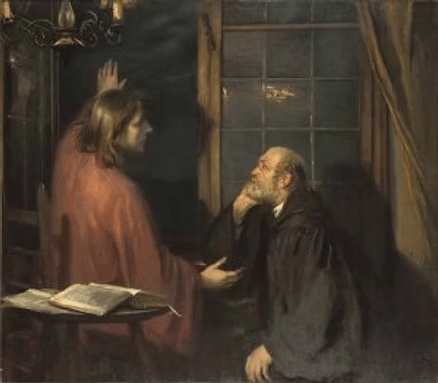
I once had a parishioner come to my house in a Nicodemian way and confide in me, “Robert, there is no way I could ever tell anyone what you say. It is all so crazy.  No one would believe me.” He could not find anything I said was supported by Dietrich Bonhoeffer (I do not know who this was) … and my church friend thought Bonhoeffer rode the edge of religious reasoning.  No one should ever go beyond his views, he seemed to think.

That man was even a lawyer, like Nicodemus. His good name and reputation depended on his ability to make money off Christians, who all had been taught to believe what someone else said to believe. It was okay to go to the library and find other sources that proved a scholar supported things commonly held dear (even, maybe, slightly different from the norm); but anyone unverifiable must be killed for speaking heresy!!!

That was what happened to Jesus, when he said a few things no one else had ever heard said before. He was turned over into the hands of men who had no relationship with God.

That is still a danger surrounding Jesus today. Too many arguing about who has the greatest Christian mind, based on book sales and television revenues raised (always needing a new private jet to zoom around the world in).

It is important that no one goes around saying, “Robert Tippett said ….” What I see and what I believe is not to be followed, because I see it or I believe it. I tell what I see and believe because I feel a strong need to share that with others. If others cannot see the same things and feel the same way as I do, then I accept that.

The purpose of the Pentecost season is ministry for those who have become servants for God. God speaks and servants do as told, happily … like little children. This is done out of a love relationship.

It is a marriage to God that gives birth to baby Jesus, within an old soul that has been cleansed by the Holy Spirit.  The sinner (the least of humanity) has sought a higher reward than anything found on earth.  The love of God is the repayment plan.  Servitude is the earthly parole from the worldly prison.

The child one welcomes in that marriage to God is Jesus Christ. Jesus tells a minister what to look for and what to find; and that ignites the heart in belief that is personal and solid. It is the meaning of faith, which is beyond standard belief. True Faith is the “Get out of human sinner’s jail” card.   A minister offers that to the world, in service to the Master.

It is just like the commissions of the seventy-two and the twelve. Go out and preach to all who will listen. If anyone tells you, “There is no way I can sacrifice my good reputation by repeating what you say,” then Jesus orders those ministers to kick the dust off their sandals and say as you walk away, “The kingdom of God has come near.”

Jesus Christ is the king of the earthly division of that kingdom; but nary a particle of dust can escape the kingdoms of earth.

#Mark93037 #Luke161931 #Mark1451 #GospelofJudas #Jesuscalledalittlechild #Theboyholdingtheloavesandfish

Wisdom of Solomon 1:16-2:1, 12-22 – Lying in wait for the righteous man

[1:16] The ungodly by their words and deeds summoned death;

considering him a friend, they pined away

and made a covenant with him,

because they are fit to belong to his company.

—–

[2:1] For they reasoned unsoundly, saying to themselves,

“Short and sorrowful is our life,

and there is no remedy when a life comes to its end,

and no one has been known to return from Hades.

—–

[2:12] Let us lie in wait for the righteous man,

because he is inconvenient to us and opposes our actions;

he reproaches us for sins against the law,

and accuses us of sins against our training.

[2:13] He professes to have knowledge of יְיָ [HaShem],

and calls himself a child ha-elohim.

[2:14] He became to us a reproof of our thoughts;

[2:15] the very sight of him is a burden to us,

because his manner of life is unlike that of others,

and his ways are strange.

[2:16] We are considered by him as something base,

and he avoids our ways as unclean;

he calls the last end of the righteous happy,

and boasts that יְיָ [HaShem] is his father.

[2:17] Let us see if his words are true,

and let us test what will happen at the end of his life;

[2:18] for if the righteous man is elohim child, he will help him,

and will deliver him from the hand of his adversaries.

[2:19] Let us test him with insult and torture,

so that we may find out how gentle he is,

and make trial of his forbearance.

[2:20] Let us condemn him to a shameful death,

for, according to what he says, he will be protected.”

[2:21] Thus they reasoned, but they were led astray,

for their wickedness blinded them,

[2:22] and they did not know the secret purposes of יְיָ [HaShem],

nor hoped for the wages of holiness,

nor discerned the prize for blameless souls.

——————–

This is the “The First Lesson” that can be chosen over Psalm 1, as the companion reading for the Track 1 Old Testament reading from Proverbs 31 to be read aloud on the eighteenth Sunday after Pentecost [Proper 20], Year B (2018), according to the lectionary for the Episcopal Church.  It will be a companion for Solomon writing, “[A capable wife’s] children rise up and call her happy; her husband too, and he praises her: “Many women have done excellently, but you surpass them all.”’  That pair will be presented before the Epistle from James, where the Apostle wrote, “You do not have, because you do not ask. You ask and do not receive, because you ask wrongly, in order to spend what you get on your pleasures.”  All will accompany the Gospel reading from Mark, where is written: “Then [Jesus] took a little child and put it among them; and taking it in his arms, he said to them, “Whoever welcomes one such child in my name welcomes me, and whoever welcomes me welcomes not me but the one who sent me.”’

To repeat my prior disclaimer about the Wisdom of Solomon being Apocryphal and thus not in my standard reference for the Hebrew text, it is too difficult for me to do any more than a rudimentary translation, which is quite taxing and time consuming.  What I have done is number the verses, based on a Bible.com English publication of this reading, confirmed by the NRSV translation, which the Episcopal Church has deemed unnecessary to number.  In this you will also find three more uses of “יְיָ” or what one Hebrew source stated as “HASHEM,” which means a proper name for “God,” like “adonay,” but not.  It also is not a standard abbreviation for “YHWH,” but is thought to be from the Hebrew word meaning “to be” [“haya”].  I also point out where one translation as “God” is actually the word “ha-elohim,” meaning “of elohim.”

In verse sixteen of chapter one, Solomon concluded a train of thought that dealt with soul marriage, although not one married to Yahweh.  The words “ungodly,” “death,” and “covenant” all speak of a soul falling in love with the material plane and marrying that which disappears when “death” comes.  Human being are mortals because “death” is the ‘god’ of the physical world.  Satan is the “lord” that sways souls away from divine marriage to Yahweh, so their “covenant” can be seen as a ‘pact with the devil.’  Being “fit to belong to his company” means a soul denied eternal life in heaven; so, those souls get to rejoin the worldly plane they sold their souls for,

The transition from chapter one to chapter two should be seen as a change of theme [not running out of space on parchment].  Thus, verse one is stating the theme that changed from one of ‘righteous versus ungodly’ to one of knowledge, where Solomon begins by saying “poor thinking” [“For they reasoned unsoundly”] is the difference between having a happy, rewarding life on earth and going to Hell [“no one has been known to return from Hades”].  While chapter one [entitled “Exhortation to Uprightness,” with verse sixteen entitled “Life as the Ungodly See It”] is focused on the duality of good and evil [the wisdom Solomon prayed to receive], chapter two is no advancing the notion that wicked people are those who just don’t have good brains on their shoulders.

From one bad brain is another sown.
The limitations that must be seen in Solomon’s worship of his own big brain is seen when he conject there is no return from “Hades,” which is actually written “sheól” [“שְׁאוֹל”]. For Solomon to think he could tell whether the guy standing next to him was not the reincarnated soul of some past king [or queen] of a foreign nation, one that crashed and burned, or even the reincarnated soul of one of the wicked Israelites who died in the wilderness, due to not obeying the Commandments, shows how little he knew in reality.  To even conject such an idea as wisdom is the same as science saying it is the only way to good judgment, when it is proved to be wrong many times, after declaring it was right.

The concept of Sheol was all souls went there.  The thinkers that returned from Babylon captivity divided into two sects: One believe there was nothing after death; and, the other thought death was a ticket to something akin to Purgatory.  Simply by being born a Jew [formerly Israelites], death mean that soul would be taken to heaven after the Messiah came.  Of course, that mindset figured all Gentiles were like dogs and cats, with death meaning they went and roasted in Hell.  That should be seen as who the wicked people Solomon was talking about, because (certainly) any right-minded Israelite of Solomon’s reign would see him as a god worthy of worship [smart as he was].

Skipping down from verse one of chapter two, to verse twelve, this is where Solomon is making himself out to be “a righteous dude,” as if Israel still had Gentile enemies they were worried about.  Of course, David’s Israel was always at war with those who refused to accept their God Yahweh had giving them that place to live, with the Philistines being those who still retained land that was not Israel’s.  They, however, were not an issue, since Solomon had married an Egyptian princess and had an ally that could put the squeeze on the Philistines.  Still, verse twelve is Solomon’s self-worth as a hero of the righteous, he equates all who would challenge his authority as being wicked.

So many wives and concubines to please.

It is in verse thirteen that the truth of Solomon’s wickedness is exposed.  In this verse there are two references to [NRSV translator] “God” and “the Lord.”  The reality of what is written (as best as I can look up the Hebrew) is this [using the NRSV otherwise]: “He professes to have knowledge of יְיָ [HaShem], and calls himself a child ha-elohim.”  In Solomon’s reign, the prophet Nathan was still actively advising the king.  Others like Nathan were those who claimed “to have knowledge of” Yahweh.  For Solomon to not write that name, but to instead write marks that are confusing, as to whom or what is being referenced [some say the letters are an abbreviated form of the verb translating as “to be”], says Solomon was not like his father David, nor the divine prophets who advised as the conduits of Yahweh.  Solomon saw himself as a god, who was married to the goddess Wisdom, with Yahweh believed to be the servant god who served him: יְיָ [HaShem].

In the NRSV translation, the world “child” is footnoted, with the footnote saying the word written can equally translate as “servant.”  For one to say he was “a servant of elohim,” that describes a prophet like Nathan to a T.  The point of the Hebrew word “elohim” is not to state “God” [the error of all translators], but to state the reality of “gods” [in the plural number], which are those soul married to Yahweh and thus given His powers on earth, as His “servants” [His “children”].  Thus, in verse thirteen, Solomon is placing himself above that of true prophets, because of his big brain.  This then equates his soul to a state of wickedness.

Verse fourteen then has Solomon scoff at the condemnations of the prophets, who say worldly wisdom is what condones evil ways.  Verse fifteen is Solomon belittling the true holy priests of Israel as the ones who take all the fun out of life, reminding everyone of the laws that keep souls from infidelity to their marriage vows with Yahweh.  Solomon is calling the restrictions placed on being a true priest of Yahweh as unnatural.  That is true, when a nation of people are being led away from adherence to their Covenant and finding normalcy in the ways of other nations.

In verse sixteen, Solomon again references the “HaShem” that is almost used as if he knew he would bring some physical condemnation upon his flesh [leprosy maybe?] by using the name “Yahweh,” as his father David had done frequently in his songs.  Here, Solomon belittles one who claims to be an “elohim” of Yahweh, because they make the claim that Yahweh is their “Father,” while also their Holy Husband.  This becomes Solomon cursing Jesus, who routinely told his disciples [not the whole world, not all of Judaism] to address Yahweh as their “Father.”  To call Yahweh “Father” means one must be His Son [all souls are masculine essence, especially when married to Yahweh’s Spirit … males and females in the flesh].

In verse seventeen, Solomon is beginning a series of verse that become the standard punishment governmentally set upon any who claim to be divine Sons of Yahweh.  To make such claims means to be put to death.  This concept would be viewed as holy wisdom, as Yahweh’s gift to Solomon, when in reality it was Satan’s serpent whispers [a marriage that made Solomon’s soul the demonic elohim of his demonic spiritual husband] that influenced all who would follow Solomon.  The routine would be marry foreign wives, import foreign priests, and kill any priest who spoke out against that process.  The culmination of this mindset of ‘wisdom’ was the execution of Jesus, the promised Messiah; but to believe in a promised Messiah, one has to first believe in Yahweh.  Solomon taught them not to believe in being “He [Who] Retains God” [the meaning of “Israel”].

We are here to tell you all you need to know about God and Jesus (for a price).

 In verse eighteen is a second use of “elohim,” which again must be seen as “gods,” specifically those whose souls have married Yahweh and become His hands on earth.  At the time of Solomon’s reign, all true divine “elohim” were priests of the Ark of the Covenant [transferred from the Tabernacle of Zion to the Temple of Solomon] and the holy prophets [such as Nathan].  In this verse, Solomon laughs at those who make claims to be divine Sons of man, such that Solomon’s mindset was cast into the future at Golgotha, when someone yelled out, “If he is the Messiah, let him save himself.”  Here, Solomon scoffs that the test of death will bring out the truth of being a “servant” [same use of “child”], by having Yahweh rescue that person.

Verses nineteen and twenty are Solomon giving the go ahead from that point in time onward to torture and insult the prophets of Yahweh.  To claim to be “peaceful” means Solomon’s plan was to beat hatred and anger into those who make such claims.  In today’s world, the destroyers of Christianity love to promote that Jesus is the Prince of Peace and would bend over and take it all day long, rather than strike anyone down in wrathful anger.  They persecute the believers to the point of forcing them away from Yahweh, by punishing their will to serve.  What those do not realize is the truth that every hateful strike they put forth against one of Yahweh’s children, the same return blows will come upon their souls, a hundred-fold. 

The NRSV then places one of its titles or headers before verse twenty-on, saying the rest of chapter two focuses on “Error of the Wicked.”  This is an assumption that “the wicked” are false prophets and not the true prophets of Yahweh.  Solomon was the intellect of humanity, as one who worshiped ‘Sherlock Holmes-like’ abilities to discern physical clues and make logical deduction that result in the truth.  None of that worldly wisdom is divine, thus far from all-knowing, as that given to Yahweh elohim.  Thus the title would be better stated as “Error of the Intelligent.”

Verse twenty-one is then a perfect summation of Solomon’s views that have been written on parchment.  By saying, “Thus they reasoned, but they were led astray, for their wickedness blinded them,” it is only the priests of logic and reason that deduce wrongly and are blinded by the science of the visible world.  No true priest of Yahweh is reading the Law [the Torah] and coming away with clear-cut, black and white knowledge.  Divine Scripture is written [according to Jesus] so the truth is hidden from the wise and intelligent, but exposed to the children [insert “servants” here].  The truth known by Yahweh elohim does not come from carefully crafted thought processes.  However, once the truth has been shown, all those arts and crafts can find a truth fully justified and true.  Thus, a simpleton [one of those Solomon belittled, when he prayed to his god “wisdom”] can be shown the truth of God, while all the big brains could not see the truth before their eyes.

Chance the simple gardener

In verse twenty-two [not the last verse, as chapter two has twenty-four verses], Solomon returned once again to displaying his fear of naming “Yahweh,” using his code-word called “HaShem” [יְיָ].  In this verse, Solomon sings that his lost soul never once considered self-sacrifice for the unseen rewards that are postmortem.  The wise and intelligent cannot possibly see that which is “secret” and thus spiritual.  They seek the material rewards that are the “wages” of being the elite, not the commoners.  They never seek to restrict themselves from that which can be freely taken, for the seeming bargain of one’s soul [everything material for nothing spiritual].  They have no desires for holiness.  They do not believe anything exists beyond death.  Therefore, they have no need for thinking blamelessness is a virtue.

As the optional “First Lesson” to accompany Proverbs 31 on the seventeenth Sunday after Pentecost, when one’s own personal ministry for Yahweh should already be well underway, the lesson here is to see the trap of intellectualism.  Solomon could not see how his words were condemning his own soul, all the while thinking he was making light of those who said they served Yahweh.  Solomon did not believe Yahweh was anything more than a stepping stone to a mastery of life on earth.  He did not believe in an afterlife; as there was no proof that anyone had ever returned from the depth of the ground.  The lesson that must be taken from this is being a “child of elohim,” which means having one’s soul be married to Yahweh, with His Son Jesus resurrected within one’s soul-flesh.  Having a big brain keeps one from having access to All Knowledge, readily available when needed.  No planning necessary.

Jeremiah 11:18-20 – Like a gentle lamb led to the slaughter

It was the Lord who made it known to me, and I knew;

then you showed me their evil deeds.

But I was like a gentle lamb

led to the slaughter.

And I did not know it was against me

that they devised schemes, saying,

“Let us destroy the tree with its fruit,

let us cut him off from the land of the living,

so that his name will no longer be remembered!”

But you, O Lord of hosts, who judge righteously,

who try the heart and the mind,

let me see your retribution upon them,

for to you I have committed my cause.

———————————————————————————————————-

This is an optional Old Testament selection from the Episcopal Lectionary for the Eighteenth Sunday after Pentecost, Year B 2018. In the numbering system that lists each Sunday in an ordinal fashion, this Sunday is referred to as Proper 20. If chosen, it will next be read aloud in an Episcopal church by a reader on Sunday September 23, 2018. It is important because Jeremiah spoke from the depths of prophecy, seeing through the eyes of Jesus Christ, as one totally in a committed relationship with God.

Verse eighteen is better translated by stating, “And the LORD gave me knowledge [of it], and I knew [it]; then thou showest me their doings.” The inclusion of “of it” and “it” are additions through assumption, based on the prior verses that are unknown here. The “it” is made part of the translation as “evil deeds.” “It” is “evil.”

Evil was described by Jeremiah as “found among the men of Judah, and among the inhabitants of Jerusalem.” (Jeremiah 11:9) “They are turned back to the iniquities of their forefathers, who refused to hear My words … [having] broken My covenant.” (Jeremiah 11:10) They will have brought the evil of the world upon themselves, building altars to Baal. The “evil deeds” are then the sacrifice of the innocents to the gods of evil.

Moloch was a child sacrifice god, as Baal Hamon in Carthage.

When this is understood, we then read Jeremiah say, “But I was like a gentle lamb led to the slaughter.” This is a statement of willing sacrifice for a higher purpose. Jeremiah was channeling Jesus Christ, who would be the sacrificial lamb later in history, who had to die in order to release his soul so “it” could fill countless others. Still, Jeremiah was like all who would become Saints, as there can be no fear of evil deed doers; persecution is to be expected.

The literal Hebrew states, “I was like a lamb docile brought to the slaughter.” The word “I” is the word of the ego, stating “Myself.” This is then Jeremiah saying he was a lamb of God, who was brought to the point of self-slaughter willingly. It is the inner peace that one feels while in prayer with the Lord and the glory of God’s presence around one at other times that is most gentle. It is the comfort that keeps one from fearing anything, other than losing that closeness that God brings. This is then Jeremiah telling how the sacrifice of self-ego is an act of love for God.

Jeremiah then continued to tell of his prophetic sacrifice at the hands of priests serving Baal, saying, “And I did not know it was against me that they devised schemes, saying, “Let us destroy the tree with its fruit, let us cut him off from the land of the living, so that his name will no longer be remembered!”

This is illuminating the deception used by those who practice evil deeds. For Jeremiah to say “I did not know,” this is not a statement of his being unaware of plots against him. Instead, it says he did not live deceptively, by plotting against others.

When Jeremiah quoted the killers of righteousness as saying, “Let us destroy the tree with its fruit,” the Hebrew word translated as “tree” (“ets”) can also mean “wood, timbers, and logs,” with the implication of a “carpenters” handiwork, including a “gallows.”

Required for assembly: Two trees, large manual drill, wooden mallet and wood chisel.

Thus, the statement can also be seen as the use of a cross to destroy the fruit, rather than support the fruit of a grapevine.

Long before the Romans would dominate the lands of Israel and Judah, the planned destruction of the “tree with its fruit” was then to turn the pure grapes of Yahweh, through the Israelites delivered into “the land of the living,” by letting them turn to wild grapes, to be eaten by scavenger birds. The corruption of the religion that was based on Mosaic Law was to be degraded until no one remembered the name Moses. Jeremiah was a prophet of Judah who saw the evil deeds of its kings and the evil deeds of impure priests, leading to the fall of Judah and Jerusalem, with the Temple destroyed. This is the lament of this song; and it is the constant danger that surrounds all who serve the Lord.

When verse twenty says, “O Lord of hosts,” the Hebrew says “Yahweh tsaba.” This states who the true LORD is – Yahweh – and the “hosts” are the angels of Heaven, not a worldly army of believers. Thus, the judgment of Yahweh is said to be based on how the people of earth live their lives. The righteous are awarded Heaven, to dwell among the hosts; but the wicked will find nothing waits for their souls beyond the world they love so dearly.

The translation that says, “who try the heart and the mind,” can be better grasped as those who “test” the LORD and are “tested” for righteousness. When Jeremiah was inspired to write, “the heart and the mind,” this is the sequence that will determine the results of the tests. The righteous have found the Lord through their hearts, so their minds are led by the Will of God. Those whose lives are led by the brain they will harden their hearts to the Lord, instead loving the illusions of the earthly realm. Thus, as goes the heart, so goes the soul.

When Jeremiah sings, “let me see your retribution upon them,” the word translated as “your retribution” (“niq·mā·ṯə·ḵā”) is better understood as “your vengeance.” This seems to be Jeremiah taking delight in the punishment that God will set onto others, but that misses the duality of “’er·’eh (“let me see”).

Jeremiah is actually praying to the Lord to “see” the path of righteousness, because without the insight of Yahweh guiding one, one will become lost. Those who refuse to seek God’s guidance are then the ones who will use “great violence or force” (definition of “vengeance”) towards those who are devoted to God. All the vengeance of God’s judgment is then of their own making, not that of a vengeful God.

When Jeremiah then ends this stanza by singing, “for to you I have committed my cause,” he was stating his love of God. A servant of God can only act out of love for the Lord. That love is a commitment to serve Him completely.

The Hebrew word translated as “I have committed” is “gil·lî·ṯî,” equally says, “I have revealed,” “I have set forth,” and “I have opened.” This is the intimacy of a heart for a lover, where all defenses are removed and the oneness of union is the natural result. It is then the marriage of one to God, as a wife surrendering the self-ego so his or her (human gender is meaningless) cause is that of the Lord.

As an optional Old Testament reading selection for the eighteenth Sunday after Pentecost, when one’s personal ministry for the LORD should be underway – one has seen through the schemes of the world and found them lacking – the message here is to allow one’s soul to enter into marriage to God. It is the commitment to His cause that should be sought.

As an alternative to Proverbs 31, where Solomon listed the characteristics of a good wife and the truest intent means a “good wife” is a soul married to God, cleansed of sin by His Holy Spirit (a true sacrament of Baptism), one should not be shocked that Jeremiah was singing praises to the same commitment. Since these readings are brought up every three years in the Episcopal Lectionary cycle, Christians have long had access to these words, with Jews even longer. The problem is then how no one seems to know, or most people have huge misconceptions about, what “commitment” means.

Can all Christians since the Roman Emperor Constantine, leader of a failing empire, claimed he saw a vision in battle (a cross formation of clouds in the sky) and suddenly began to believe in a Jew named Jesus, beginning a devised plan to subject other believers of Jesus Christ in a new Kingdom of Rome, not see themselves as part of this plan? Does the verse that says, “And I did not know it was against me that they devised schemes” not explain the ignorance of lambs led to the slaughter?

Has not the system of Christianity that was devised by the Roman Catholics, to strip all believers of any concept of marriage to God, through His Holy Spirit, thus begetting a myriad of baby Jesus Christs (i.e.: Saints) in the world – to Save it – not been a fulfillment of Jeremiah’s words: “Let us destroy the tree with its fruit, let us cut him off from the land of the living, so that his name will no longer be remembered!”? Did they not sacrifice Saint Peter, who was in the name of Jesus Christ, so no more would Saints and Apostles proliferate?

Lots of Saints called “pope” between 32 AD and 537 AD, but then a sputtering began, turning the papal seat over to corporate heads.

American Christians have been born into splinter groups of that false premise, making all conclusions based on that also false. We do not know anything about being married to GOD, because His name has been sacrificed when the corpse of Jesus of Nazareth was never allowed to rise from death and be reborn in true Christians. Women like the idea of marrying Jesus, while menfolk (gruff, gruff) have to keep a hard heart so they can bring home the bacon each month.  Jeremiah’s songs of lamentation were echoing the loss of a true religion by both men and women born into the religion created by God’s hand; given over into the hands of men who loved an icon name Baal, more than the true God. It is a story that keeps on keeping on because believers love to be subservient to a human leader, simply because they can physically sense that presence.

The message is there to be known – marry God.  Love God with ALL your heart. It is just clouded, such that to see through the mist one needs to be led inwardly, by the All-Seeing Eye of God (not a Masonic promotion).

So many have turned away from God because of the schemes of deception, revealed as false.  They ones wanting to believe in the unseen have mentally discerned Church deceptions as equating Christianity to the flaws of men. Ears have turned deaf to the truth, simply because so many lies have been told and foolishly believed.

In the Gospel message for the same Sunday this optional Old Testament reading might be chosen, Jesus foretold of his being killed by men. That prophecy fits this song of Jeremiah. It was the plot of pretending holy men then, and it has been the same since Moses took a bunch of slaves from Egypt into the wilderness. From pretending an idol of a golden calf could rescue the people, to pretending to breathe new life into a land lost, by rebuilding a Temple destroyed, believers have married to concepts and icons, but rarely God.  Only when Jesus died and his soul was freed by God to be reborn in Apostles has that marriage been known.  Men (and women now) do not like believers who have their own relationship with God and Christ.

It is the message of the Gospel that the greatest will be the least. That is a prophecy that says one cannot depend on another human being who says he or she is the greatest disciple of Jesus, because braggarts only have one soul’s interests at heart – their own; not anyone else’s.

Sunday after Sunday the message says, “God is the way to redemption and an eternity in Heaven.” For that way to be one’s own, one has to be more than human. For that to happen, one must surrender the human soul to God, which means become one with God. That is the truth of marriage. Once one has become one with God, then one stops knowing anything that would get in the way of complete servitude to God. In return, God allows one to know everything necessary, to be given to those seeking a good husband, possessing good wife potential.

Maybe one day all human souls will have the epiphany and their eyes will see that some spell has been cast over them, keeping them from accepting God’s proposal of marriage. As they wake up to divine understanding, maybe they will walk away from the human schemes and look at the true offer from God.

Maybe one day the world will be filled with only Saints. Maybe that day all souls will be in Heaven, not on earth.

Proverbs 31:10-31 – The good wife

A capable wife who can find?

She is far more precious than jewels.

The heart of her husband trusts in her,

and he will have no lack of gain.

She does him good, and not harm,

all the days of her life.

She seeks wool and flax,

and works with willing hands.

She is like the ships of the merchant,

she brings her food from far away.

She rises while it is still night

and provides food for her household

and tasks for her servant-girls.

She considers a field and buys it;

with the fruit of her hands she plants a vineyard.

She girds herself with strength,

and makes her arms strong.

She perceives that her merchandise is profitable.

Her lamp does not go out at night.

She puts her hands to the distaff,

and her hands hold the spindle.

She opens her hand to the poor,

and reaches out her hands to the needy.

She is not afraid for her household when it snows,

for all her household are clothed in crimson.

She makes herself coverings;

her clothing is fine linen and purple.

Her husband is known in the city gates,

taking his seat among the elders of the land.

She makes linen garments and sells them;

she supplies the merchant with sashes.

Strength and dignity are her clothing,

and she laughs at the time to come.

She opens her mouth with wisdom,

and the teaching of kindness is on her tongue.

She looks well to the ways of her household,

and does not eat the bread of idleness.

Her children rise up and call her happy;

her husband too, and he praises her:

“Many women have done excellently,

but you surpass them all.”

Charm is deceitful, and beauty is vain,

but a woman who fears the Lord is to be praised.

Give her a share in the fruit of her hands,

and let her works praise her in the city gates.

———————————————————————————————————-

This is an optional Old Testament selection from the Episcopal Lectionary for the Eighteenth Sunday after Pentecost, Year B 2018. In the numbering system that lists each Sunday in an ordinal fashion, this Sunday is referred to as Proper 20. If chosen, it will next be read aloud in an Episcopal church by a reader on Sunday September 23, 2018. It is important because it uses the feminine pronoun “she” and “her” as metaphor for devout human beings (of both genders) being in a committed relationship with God.

There are twenty-two verses in this selection from Proverbs. There are twenty-two letters in the Hebrew alphabet; each verse is marked by a separate letter, from aleph to tav. As such, this Proverb that has some versions of the Holy Bible identify it as “The Virtues of Noble Woman” or “The Wife of Noble Character” can be seen (somewhat) as the ‘A to Z’ of those virtuous character traits. Still, the letters bear the symbolism of their numerical numbering, from 1 to 22; and in Hebrew each number has its own symbolic meaning, which cannot be overlooked.

I welcome the reader to search the Internet for this symbolic meaning for oneself. Here is a link to one site that offers such opinion on this (Spiritual Meanings of the Hebrew Alphabet Letters). I will not be going into this aspect of this Proverb of Solomon; but it has to be recognized as present and that presence has intended meaning.

As to the summation that Solomon wrote about the qualities possessed by the perfect wife, it is easy to be misled, knowing the attraction that Solomon had to women. Having become known as having had seven hundred wives and princesses, plus three hundred concubines, one could then assume that this Proverb is based on Solomon having gotten to know many wives, concluding these are the best traits. Still, after getting to know one thousand ladies up close and personal, Solomon coming up with only twenty virtues of wives would seem to be based on the most repetitious traits he liked. However, that opinion of the noble character of a wife, or even of the concept of “woman” in general, is not the point of this writing.

One has to see that wise ole Solomon wrote this Proverb, even though he might have been smiling about all the women he knew while writing it, as a vehicle of Yahweh.  The true source of this wisdom was from God, flowing through Solomon’s hands as he wrote. These words of Proverbs 31 have a divine origin, with a spiritual meaning intended to be found.  There is nothing to be found in the Holy Bible that is mundane human opinion.

In the modern times, when human gender became a matter to protest publicly, there will certainly be women sitting in the pews who scoff at such male chauvinistic views as had Solomon. I doubt female priests will write lengthy sermons about this reading selection, unless driven by personal agendas that would misuse it to promote same-sex marriage between two women.  Such views as promoted wives being subservient to their husbands, as is still prevalent in Muslim culture, is now seen in the West as having set womanhood back thousands of years.  Still, that is the human opinion of divine writings misunderstood. The true meaning has to do with this writing being about the perfect servant to the Lord, where all the feminine pronoun usage points to Man (which includes woman).

I have written about this repeatedly, where those who want to achieve Heaven must submit to God and become His wife. This has absolutely nothing to do with human gender. No human being is going to know God through his or her sexual organs. God did not care what type of women floated Solomon’s boat; but He made it be known what a true servant of the Lord will do.

This translation is not completely accurate, throughout this long song; so I will not be spending thousands of words correcting those mistakes.  To give one example, the translation of “jewels” comes from “mip·pə·nî·nîm,” which could be shown to state “rubies, corals, or pearls.” To read “jewels” then leaves it up to the women who look for their value in huge diamonds placed into fine gold engagement rings. From that speculation, a verse focused on “capability” (from “ḥa·yil,” also read as “virtue”) is reduced to a value that crawls along the material plane, missing the spirituality of this wisdom.

From one example, I am not about to correct all the errors of a translation that begins with a premise (a preconception) that Solomon was giving guys advice on how to find the right girl, and in the process putting the seed of thought into the minds of girls that a good wife dotes on her husband … for trinkets.  Everything that leans in that direction is wrong.

I wonder which ones have the Holy Spirit talents in them? No shaking before opening!

This song must be read as God speaking to YOU, whoever YOU are – male, female, or child [neuter gender]. YOU have to know what God requires in His wives, regardless of what sex organs God gave you, and regardless of what other human beings make your sex organ tingle with delight. As such, YOU are “She” and “her.” YOU have to see that.

We call God the Father, despite how many women’s rights freaks try to twist that masculine principle into a misconception that promotes people should think, “God can also be a Mother.” That is false.

“God” means Masculine. “Goddess” means feminine. God is not a goddess, just as man is not a woman. There can still be equality in inequality.  Equality is complimentary.  As such, the Earth is the goddess who received God as her husband and gave birth to bags of dirt that were filled with souls. God, therefore, is the Father of life on Earth, with all life (as we know it) having Earth as its Mother.*

So it is written:

“I also said to myself, “As for humans, God tests them so that they may see that they are like the animals. Surely the fate of human beings is like that of the animals; the same fate awaits them both: As one dies, so dies the other. All have the same breath; humans have no advantage over animals. Everything is meaningless. All go to the same place; all come from dust, and to dust all return. Who knows if the human spirit rises upward and if the spirit of the animal goes down into the earth?’” (Ecclesiastes 3:18-21)

Nope. Just a bag of dust struck by lightning.

When one realizes how Jesus said, “So they are no longer two, but one flesh. Therefore what God has joined together, let no one separate,” (Matthew 19:6) this means the feminine of the Earth Mother is the flesh of a human body that has become one with God the Father via a soul of life being present in that flesh. It is the human equivalent of DNA, where a child is the combination of two parents that cannot be separated. Simply because of this reasoning, ALL human being bodies of flesh are feminine. Since that means we human beings are all ‘girls’ here, we are all potential “wives” to God.

That is all I have to say. I recommend each reader to go to the Bible Hub Interlinear website (here) and slowly read what was written, and investigate the full breadth of meaning each word contains. See if YOU can see yourself as meeting all these noble characteristics.

Take note that the second verse (the Beith letter verse) speaks of a husband’s heart having full trust in his wife. This is the love one has to have, in order to have a proposal of marriage made and be accepted. Love is the attraction that is essential. Therefore, the beith symbolism is: “The beginning of duality, with the One Creator bringing forth a created world.”

Two have cleaved together to make one, through love.

This is the result.

If one does not have a true love of God in one’s heart, one is not good wife material for Him. If YOU can feel this love, then take the time to see how the wisdom of Solomon used the next twenty verses to spell out what “She” (YOU) does for God.

With love, the work that comes from being in love with God becomes a joy.  It is the works of an Apostle.

———-

* Footnote: God – Yahweh – did not create mankind – male and female in His image.  God’s elohim created those ‘ordinary’ human beings.  Therefore Yahweh is not the Father of all humanity.  Yahweh is the source of all souls.  Yahweh is the one who orders souls to control bodies and join egg and sperm and split cells for growth of life-to-be.  Souls are elohim.  Yahweh is only the Father of holy human beings that are filled with the Holy Spirit of Yahweh and with each transformed from ‘ordinary’ human being into His Son reborn.  Only Sons, again, as human gender is meaningless.  Sons means the Spiritual association of gender, opposite the material association of gender.  Call it positive-negative or external-internal, if you like – opposites.  A man and a woman can each be reborn as Jesus Christ (a “Christian”), becoming “brothers and sisters” in the name of Jesus Christ – Sons of God.

James 3:13-4:3, 7-8a – Submit yourselves to God

Who is wise and understanding among you? Show by your good life that your works are done with gentleness born of wisdom. But if you have bitter envy and selfish ambition in your hearts, do not be boastful and false to the truth. Such wisdom does not come down from above, but is earthly, unspiritual, devilish. For where there is envy and selfish ambition, there will also be disorder and wickedness of every kind. But the wisdom from above is first pure, then peaceable, gentle, willing to yield, full of mercy and good fruits, without a trace of partiality or hypocrisy. And a harvest of righteousness is sown in peace for those who make peace.

Those conflicts and disputes among you, where do they come from? Do they not come from your cravings that are at war within you? You want something and do not have it; so you commit murder. And you covet something and cannot obtain it; so you engage in disputes and conflicts. You do not have, because you do not ask. You ask and do not receive, because you ask wrongly, in order to spend what you get on your pleasures.

Submit yourselves therefore to God. Resist the devil, and he will flee from you. Draw near to God, and he will draw near to you.

———————————————————————————————————-

This is the Epistle selection from the Episcopal Lectionary for the Eighteenth Sunday after Pentecost, Year B 2018. In the numbering system that lists each Sunday in an ordinal fashion, this Sunday is referred to as Proper 20. It will next be read aloud in an Episcopal church by a reader on Sunday September 23, 2018. It is important because James wrote of wisdom being divinely born, but also manifesting in “unspiritual” and “devilish” ways. In the change of chapters, James then wrote that the solution of selfish disputes calls for the sacrifice of the self-ego, to be replaced by the submission to God (i.e.: marriage to God).

In verse thirteen, where the translation above states, “Show by your good life that your works are done,” the literal translation shows a separate segment that states: “let him show out of the good conduct the works of him.” This means the acts of one “demonstrate” (from “deiknumi”) one’s “honorable behavior” or “noble manner of life (from “kalēs anastrophēs”). It implies people will display bad character.  The difference is the source of goodness.

When the literal translation from the Greek shows “him” repeated, this is a word for presented in the third person masculine, as a singular personal pronoun.  The dual references to the third person, as “him,” can be mistaken as the same person who acts “good” as being generated by “himself.”  This misses the duality of two that are combined as one.  As such, the implication is exposing two elements of the same one: the one exhibiting such “good life” (“him”) and Him as God within, the inspiration of those righteous acts.

When God is read into that segment, then “gentleness born of wisdom” is from a divine source. This is then contrary to the next verse, where “jealousy” (“bitter envy”) with a “bitter” spirit is the outward acts of inner distress. To have “selfish ambitions” (from “eritheian”) is James way of saying the absence of God within is due to the self-ego pushing Him away, preferring to worship one’s Big Brain. That dependency on intelligence then hardens the heart – the love center. Without the heart leading the mind, one becomes prone to “boast and lie against the truth” (“be boastful and false to the truth”).

The Big Brain is thus the god of self and generates a weaker form of “wisdom,” which “does not come down from above,” as it is not from God. This is the feminine goddess “Wisdom,” which Solomon referenced, such that the femininity is a reflection of the “earthly” (from “epigeios”).

Wisdom is ruled by elohim.
Aliens are assumed to have godlike powers of intelligence, by fools who think the Mind of God can fit into a bony box filled with gray matter.

Because it is of the earth (like science, dependent on observable data) it is “unspiritual” (from “psychikē”).  That root word implies “animal, natural, and sensuous,” as anything “of the earth,” not of the spiritual heaven.  This then leads to a conclusion that earthly wisdom is “devilish.”  However, the word translated as that is “daimoniōdēs,” which implies an “evil spirit.” That translation requires deeper insight.

The Greek word “daimónion” comes from Ancient Greek, meaning most basically “spirit.” This “spirit” can then be said to be divine, as miraculous and extraordinary manifestations on earth. This is rooted in the Greek word “daímōn,” which can mean anything from “a god or goddess, a guardian spirit, or a departed soul.” Their importance is only found in the worldly plane.

The etymology has it rooted in “daíomai,” which means “divide.” As such, Satan is a god that has divided from God (Yahweh) and has been cast into the earth (a goddess’ realm – the feminine), where Satan became an influence for evil, attempting to steal souls that have divided from God (life breath spirit – soul). In a sense, the division is symbolic of divorce, such that Lucifer cheated on his Husband, was caught and banished.  Thus, in humans, an “earthly spirit” is one led by the soul, which is more inclined to be misled by Satan’s evil influences (i.e.: loving sin), acting “devilish.”

From this insight, the translation of “devilish” means being under the influence that keeps one divided from God.  It is designed to lead one away from the reunification of a soul with God.  It is the influences of the world that trick one into turning away from a commitment to one, desiring to try as many delights as possible.

James then repeated the traits of an evil spirit as possessing “envy and selfish ambition,” such that following the thoughts of a brain will one’s life be scattered and ever-changing, lacking order. The Greek word written by James is “akatastasia,” where “disorder” means: “disturbance, upheaval, revolution, almost anarchy, first in the political, and thence in the moral sphere.” It implies a difficulty standing up for what is right, because everything has become unsettled, confused, and in tumult. All this comes from depending on a Big Brain to lead one properly, when the result is always to be deeper into the complexities of a sinful existence.

What have I done this time?!?!

The only escape from this madness is then God, by coming to rely on His “wisdom from above” (where “the from above” comes from “anōthen,” meaning “anew”). This implies being reborn, where the old self dies and God’s divine ego replaces the old. This new wisdom then comes from the Holy Spirit as Jesus Christ being resurrected in a human form.  With this new presence comes the Christ Mind, which leads the human brain to understand all acts that are motivated by the heart first.

To say this new self “is first pure” means one has to first and foremost be cleansed of all past sins that the soul has accumulated, through lives on the earthly realm. This cleansing becomes a baptism by the Holy Spirit, when means the soul has been immersed into a state of spiritual purity. This union with God’s Holy Spirit is then the marriage of one’s soul with God. It is a cleansing brought on by love, meaning the deep desires of one’s heart; the brain have submitted to the Will of God and having no say in this subjection and submersion.

To then have James write, “then peaceable,” this is like when John the Baptist lifted Jesus from the waters of the Jordan and (as Luke wrote) “the Holy Spirit descended in bodily form like a dove upon Him, and a voice came from heaven which said, “You are My beloved Son; in You I am well pleased.”’ (Luke 3:22)

The dove is symbolic of peace, and this is stated in the Greek word “eirēnikē.” That word says “peaceable,” but implies: “God’s gift of wholeness which results from knowing (discerning) the Lord’s will and obeying it.” [HELPS Word-studies]  This says “peace” is the state of one’s being, after marriage to God.

The descriptive terms then written by James, translated as “gentle, willing to yield, full of mercy and good fruits, without a trace of partiality or hypocrisy,” are the new way one is led to act, after being renewed by God. This is the resurrection of Jesus Christ within one’s being.  One being reborn as Jesus Christ then duplicates the lifestyle of Jesus of Nazareth, effortlessly, willingly, and delightfully.  It is not self-willed, but a natural way of being.

These ways, if deemed good by a Big Brain, would be impossible to maintain through self-will. God has to be in love with one’s soul, make it pure for His presence, and then the union of God and soul in a human form will reproduce the Son of God. Only Jesus Christ being reborn into one’s flesh can one achieve a righteous life, as stated by James; as James then stated this as, “A harvest of righteousness is sown in peace for those who make peace.”

The end of chapter three then means a freedom to start new thoughts of divine wisdom, prompting James to question those who are not in a divine state of peace in his fourth chapter. He asked, “Those conflicts and disputes among you, where do they come from? Do they not come from your cravings that are at war within you?”

It should be realized that “you” is less a focus on the collective or a group of people (Jews, to whom James ministered), and more designed to be personal, to all who would read this letter.

The Greek word “hymin” is a form of “su,” which is the second person singular personal pronoun, “you.” The use of “hymōn” twice then repeats this as “of you,” with the word “epithymeite” then pointing out the second person singular form of “to desire, covet, lust, and to set the heart upon.” It is “you” who leads oneself to sin, not anyone else.

The personal pronoun in the singular number says James is now speaking directly to “you” (the reader), asking, What are the causes of your inner disputes?” and “Why are you always at war with the call to find inner peace?”

All of the sins of the world are committed because of these inner conflicts and disputes. The most egregious sins are committed because one does not want to give up self-control and the love of intellect and the sweet nothing it seems to bring. Such selfishness, demonstrated in self-destructive acts, is why James then pointed out the obvious: “You do not have, because you do not ask. You ask and do not receive, because you ask wrongly, in order to spend what you get on your pleasures.”

This cycle of always doing the wrong things and being self-defeating can be summed up by the idiom: “Fool me one, shame of you. Fool me twice, shame on me.” Of course, for every number greater than two times fooled, the same shame still falls on “me,” the one fooled. But, then, some struggle remembering this phrase.

Geo. W. Bush Shame video

After skipping over several verses in this epistle reading, the answer to being fooled is then stated by James as, “Submit yourselves therefore to God.” In that, the plural number of “yourselves” is explained as applicable to all individuals whose self-ego has wrought the weight of pain and suffering on the soul. The answer to all who feel the guilt of worldly sins is to “subject themselves to God.”

The same Greek word written (“Hypotagēte”) means to make a major life change (due to the word being capitalized), from selfishness to submissiveness. Such a change means the death of the ego and the marriage of one’s soul to God.  This demands one take a completely submissive stance, as His wife (where human gender is meaningless).

To “resist the devil” is then a reference back to chapter three, when James wrote that earthly wisdom made one “devilish.” This is then an instruction that subjection to the Lord will mean to take a stance against the influence of worldly sins. In this, one should realize that James is not the source of this instruction, as he has surrendered his self-ego to be married to God.  James, like all other Apostles, is speaking as the voice of God, Jesus Christ. As such, becoming submissive to God’s influence will make it assured that Satan will be resisted.

This means that James writing, “He will flee from you,” means “He” is the influence of the “evil demon” Satan. It is then just as Jesus commanded Satan, who tempted him, saying “Away from me, Satan!” From that command we then read, “Then the devil left [Jesus], and angels came and attended him.” (Matthew 4:10-11)

When Jesus Christ has been resurrected in one whose soul is married to God, then the urges to do wicked deeds will vanish.

It is then vital to understand the meaning of James writing, “Draw near to God, and he will draw near to you.” The repetition of the Greek word “eggizó” (as “engisate” and “engiei”) doubles the meaning of “extreme closeness, immediate imminence” [HELPS Word-studies], as “to join.” This is a way of stating to become one with God. It means marriage to God is recommended; but because God is the Most Holy Spirit, God does not join directly with human flesh.  So, God will not say “I do” on a physical altar.

God breathes the life of a soul into flesh, which is a soul spirit. That breath is the dividing of God into Him and you.  The marriage that draws near to God, and vice versa, is God’s Holy Spirit becoming one with one’s soul. It is the rejoining of a soul to its source.

This is the first step to a soul rejoining God in Heaven, after the death of physical flesh. Marriage to God means eternal life in Heaven, without the filthiness and guilt of a material body imprisoning a soul divided from God, which is repetition through reincarnation.

As the Epistle selection for the eighteenth Sunday after Pentecost, when one’s personal ministry for the LORD should be underway – one has found wisdom from above through one’s soul being reunited with God – the message here is to stop being fooled by earthly wisdom. Confusion, doubt, guilt and all the self-defeating sins of lust, greed, adultery and murder are erased when the heart is set on fire for Yahweh.

This Epistle reading selection is presented along with other readings that are calling one’s soul to the spiritual altar.  As I looked for pictures that would be symbolic of the title “Submit yourselves to God,” I came upon diagram produced by church organizations that used a series of umbrellas to show this message.  The largest umbrella was either depicted to be “God” or “Jesus Christ.”  Under it were two smaller umbrellas, depicting a “Husband” and a “Wife.”

The message of marriage that is assumed from reading the books of the Holy Bible is human, not Spiritual.  The leaders of churches, synagogues, mosques, and temples around the world, common in all religions, see females as commanded to be subservient to their male husbands.  While this human arrangement is resisted in modern Western societies, it is a reflection of the animal kingdom, which is “devilish.”  Not all animals on earth (humans included) adhere to the principles of marriage being a family, where husband, wife, and children all live happily together.

Just as all animals are naturally led to procreate and raise their young in variations of the family theme, humans also have variations that can be deemed “natural,” even though they differ from the norm.  This is not the point of marriage that comes from the words of Scripture.  God does not demand any life form on earth to submit to His Will.  God allows His breath to be divisions of Himself onto a plane where life forms were free to live according to self.

When animals express self, it is a natural program of survival.  Animals do not possess Big Brains that plot evil deeds.  Still, being predator and being prey is the natural order of that game of life.  Humans, however, do not have the same excuse as lower animals, because God gave them a large piece of flesh that reasons, while finding pleasures sought unnaturally.

To see a human rite of reason become the lone expression of most holy matrimony, where Man gets to pretend itself as god, while the feminine half of the species has to play the role of submissive animal, this is wrong.  It completely misses the point of one’s soul being rejoined with God, on a voluntary basis.  Males and females are expected to choose a marriage to God, in order to be freed from the prison in which their souls have been cast – the human form.  Humans are in the likeness of God because they have all been divided from God.  God is the pure Spirit.  Humans are the impure form.

For church organization to preach a need for good marriage values as the salvation of mankind, where a husband and wife together under God will live happily ever after is missing the most important point.  The institution of human marriage is in shambles because it has been corrupted by Satan.  The youth of today are turning away from traditional marriages and turning to alternative ways of co-existence and co-habitation, with children seen as an unwanted burden upon the world.

The human institution of marriage (as an official Sacrament of a Church is a relatively modern concept) is good, when it is a mutually willing commitment. It is good when it mirrors the oneness of two individual committed to God.  This sacred act is not always upheld, which makes it human, divided from God.  The answer is not to preach the wrongness of marriage born on the physical plane, where God gave souls a vacation from submission to only doing right.  Instead, it is important to preach the reminder: This is only a vacation.  Remember you are expected to go back to Heaven.  Renew your vows to God soon.

What Americans would think of taking a honeymoon in France and not make sure the Passport was in order?

Who says everyone can use a camera?

The eighteenth Sunday after Pentecost is when some wisdom came down from above and some wise men chose “marriage to God” lessons for priests in the name of Jesus Christ to explain to those still under training as disciples.  The heart needs to be softened and the brain needs to be lowered.  God is always offering His hand in marriage; but He will only join with those who prove a desire for Him.  A minister for the LORD will have accepted that proposal, so Jesus Christ can preach, “Let the little children come to me, and do not hinder them, for the kingdom of heaven belongs to such as these.”

That means marriage to God.  Rather than a lustful heart and a ritzy honeymoon, marriage means the love of a child for the Father, in the purest way.

Esther 7:1-6, 9-10; 9:20-22 – Queen for a day

The king and Haman went in to feast with Queen Esther. On the second day, as they were drinking wine, the king again said to Esther, “What is your petition, Queen Esther? It shall be granted you. And what is your request? Even to the half of my kingdom, it shall be fulfilled.” Then Queen Esther answered, “If I have won your favor, O king, and if it pleases the king, let my life be given me– that is my petition– and the lives of my people– that is my request. For we have been sold, I and my people, to be destroyed, to be killed, and to be annihilated. If we had been sold merely as slaves, men and women, I would have held my peace; but no enemy can compensate for this damage to the king.” Then King Ahasuerus said to Queen Esther, “Who is he, and where is he, who has presumed to do this?” Esther said, “A foe and enemy, this wicked Haman!” Then Haman was terrified before the king and the queen.

Then Harbona, one of the eunuchs in attendance on the king, said, “Look, the very gallows that Haman has prepared for Mordecai, whose word saved the king, stands at Haman’s house, fifty cubits high.” And the king said, “Hang him on that.” So they hanged Haman on the gallows that he had prepared for Mordecai. Then the anger of the king abated.

Mordecai recorded these things, and sent letters to all the Jews who were in all the provinces of King Ahasuerus, both near and far, enjoining them that they should keep the fourteenth day of the month Adar and also the fifteenth day of the same month, year by year, as the days on which the Jews gained relief from their enemies, and as the month that had been turned for them from sorrow into gladness and from mourning into a holiday; that they should make them days of feasting and gladness, days for sending gifts of food to one another and presents to the poor.

——————–

This is the Track 1 “First Reading” selection that might be selected to be read aloud on the eighteenth Sunday after Pentecost [Proper 21], Year B, according to the lectionary for the Episcopal Church. If this reading is chosen, it will be paired with one from Psalm 124, which sings, “If Yahweh had not been on our side, when enemies rose up against us; Then would they have swallowed us up alive in their fierce anger toward us.” That pair will precede the Epistle selection from James, where the Apostle wrote, “The prayer of faith will save the sick, and the Lord will raise them up; and anyone who has committed sins will be forgiven.” All will accompany the Gospel reading from Mark, where Jesus said, “No one who does a deed of power in my name will be able soon afterward to speak evil of me. Whoever is not against us is for us.”

I wrote about this reading and posted my views on my website, the last time it came up in the lectionary cycle [2018]. That commentary can be read by searching this site. I believe that assessment is thorough and still worthy of being read. In it I addressed the links to this reading with Solomon’s writing of the past Sunday and also to the James reading for this Sunday. Thus, I welcome all to read my prior observations and offer comments, suggestions, questions and corrections, as always. I will now be brief in adding additional thoughts.

In my homily that I recently constructed, based on the Proper 20 readings, I placed focus on divine motherhood. In my 2018 commentary about this reading from Esther, I mentioned that she was a queen of King Ahasuerus, not because she was of princess origin; but because she was young and sensuous, thereby a sexual partner of the king, for the sole purpose of giving him a child. Relative to the Proverbs 31:10 verse of Solomon, Esther became “a capable wife.” Such capabilities mean (as Jesus said to his disciples) becoming a mother meant being a servant of all: the king, her people, her child and her God.

In this regard, where motherhood means being all-in, as all things to all others, with self coming in last, my thoughts are now set upon the whole history of the children of Israel, which by this point in time had stretched out over thousands of years [3,403 in the Hebrew calendar, with the event of Purim taking place in 357 B.C.E.]. Judah and Jerusalem had fallen 240 years prior; so, the time the baby was in the womb of the motherland was roughly 2,900-3,000 years. The final collapse of Israel and Judah meant the purpose of that land promised was the equivalent of Esther promising King Ahasuerus her womb, as the sacrifice of herself for him and his child.

The captivity of the Jews in Babylon was only sixty years or so, so the time from that fall to Esther being a queen to Ahasuerus was roughly sixty or seventy years. That was about the length of time the Jews had returned to Jerusalem; but, many Jews remained where they were. While Susa was the ‘capital’ of Persia [one of their main cities], it is probable that Babylon was still occupied and it was there that Ahasuerus was “king.” It would be about 450 years later that Herod would be remodeling the Second Temple and Jesus would be sent by Yahweh to be born. All of this might seem like a long time, but in the grand scheme of Yahweh time the history says a divine seed was planted, it developed and grew, until it was born into the world, forced from its mother’s womb as a necessary act to give life upon the earth.

From this perspective, Esther becomes a reflection of all souls who are of this holy lineage. We are all called to be servants of Yahweh, which means we are all called to be His queens through divine marriage and giving birth to His Son. It is from this story that a true Christian should be seen as an individual servant in ministry, who served Yahweh above all. In that service, we also serve within a legal framework that is whatever laws of whatever nation, under whatever kings and authorities that exist. Esther told her king-husband, “If we had been sold merely as slaves, men and women, I would have held my peace.” That says the world is not meant for us to change to suit our needs, because we are to be servants of all and least of importance, in order to be first in the eyes of Yahweh; but in the name of our Father and all who are our brothers in Christ [this included all human genders] that family brings about a responsibility to speak out for all who are like us, when injustice is done to Christians.

What if Ahasuerus were reincarnated and hosted a ‘game show’ in the Fifties?

By seeing the fall of Israel and Judah as the physical body’s natural expulsion of the placenta and baby, because it could no longer grow in that environment of “the mother’s womb,” the return to Jerusalem must be seen as a newborn being placed to the mother’s breast to suckle and be nourished. Still, the Jews were not given anything by the Persians that they had not been given by the Babylonians, or even the Greeks and Romans that would follow. The “freedom” they experienced was still slavery to the will of higher powers. No deeds to property were given or returned. This is the flaw of philosophies such as “democracy,” as “freedom” is an illusion, such that one cannot ever be free until one accepts life in the material world as being a necessary slavery, in the same way that being bound inside a mother’s womb is no different. Freedom comes when one’s soul marries Yahweh and experiences the inner peace that knows the future means an eternal love of servitude to the King.

The character named “Haman” must be seen as metaphor for what the name means in Hebrew. According to Strong’s, the name means “to rage, be turbulent.” According to Abarim Publications, they say the name was probably Persian and the true meaning has been lost. However, the Hebrew leads one to conject it meaning “Unique, Magnificent, Illustrious; Certainty, Trustworthy; and/or Noisy Bunch.” Seeing how Haman is identified as “Haman the Agagite or Haman the Evil,” who was a high-ranking advisor or minister to Ahasuerus, this makes him be a parallel to the wisdom loved by Solomon. As such, his character reflects the flaws of a ‘big brain,’ especially when it is making deductions based on external stimuli and historical data, not being divinely led by Yahweh. It is this form of knowledge that gains the ears of high dignitaries, often leading them to approve evil agendas, because of misplaced trusts.

It is not coincidence that the method of execution in this story of Esther is by hanging. That typically causes the neck to snap, severing all nerve connection to the brain. For the gallows to be “fifty cubits high” [75 feet], it would be the equivalent of five stories high. The symbolism of “five” [the numerology of “50” is: 5 + 0 = 5] must be seen as relative to the “five” books of the Torah. Thus, the ‘big brain’ of Haman planned to execute the Jews for their belief in their God; but the turn about that is fair play says it was the God of the Jews that destroyed Haman, gaining them freedom from oppression in Persia. Just as they had been freed from the oppression of Egypt, when the plagues of Moses could not be matched by the priests [advisor ‘big brains’] of Pharaoh, they were free to live outside the womb from where they were born.

The character named “Mordechai” is said by Abarim Publications to mean “Of Marduk, Of Bitter Oppression,” where “Marduk” was the “Bull Calf Of Utu (the solar deity).” He was also an advisor to the king, along with Haman, but he refused to prostrate himself before Haman. That caused Haman to plot to kill Mordechai and all Jews like him. Mordechai was a cousin of Esther, but he raised her like a father; and, it was his knowledge of the king wanting to find virgins to dance for him that he brought Esther to that event. She was chosen by Ahasuerus, becoming a queen, which led to her being offered her wish to be granted. As such, Mordechai reflects the opposite of the ‘big brain,’ as his wisdom was from divine sources; so, he was led by Yahweh.

The failure of modern Christianity is seen when female characters in the Holy Bible [Old Testament] become some form of goddess worship, such that special classes are offered but “Women Only” are allowed to attend. This is the essence of female subservience to men, allowing men to be the dominators and controllers of women. All Biblical characters are reflections on oneself, regardless of human gender, because all reflect on souls, which are all sexless. Because these Biblical characters are studied separately by sex, not seen as reflections of all Christians, regardless of their human gender, women characters [which are fewer] seem to be nuggets of wisdom only for the ladies of Christianity. In the same way that women cannot feel their role is to be seen reflected in David and Jesus as wives of Yahweh [through their souls being Anointed by His Spirit], men do not dwell on how someone like Esther projects a need within them. Thus, the ‘big brain’ continues to try and destroy the faith of those seeking the truth, forcing all to be reduced from souls seeking salvation, to being bodies of flesh that identify by their reproductive organs.

As an optional “First Reading” to be read aloud on the eighteenth Sunday after Pentecost, when one’s own personal ministry for Yahweh should already be well underway, the lesson here is to be led by the Spirit of Yahweh. Esther was not seeking to become a queen; and, she did not see that title as anything more than “wife” of a king. She did not try to act ‘like a man’ and step up onto a soapbox and proclaim how there is injustice in the world. She never let the ‘big brain’ lead her, just as Mordechai did not. She spoke the truth, led by Yahweh – her divine Husband – and Ahasuerus responded for right, because he was a king that valued wise advice.

So many in Christian ministry today try to position themselves as high and mighty, based on how many diplomas from universities and seminaries they possess. They build themselves up fifty cubits in height, planning to hang anyone who dares challenge their knowledge of the Holy Bible. Then, a simple wife of Yahweh can have them hanging by their own words of error. Therefore, it is much better to offer one’s soul to Yahweh, give birth to His Son, and let Jesus Christ do all one’s talking. Yahweh has All-Knowing abilities, greater than any school on earth.

Numbers 11:4-6, 10-16, 24-29 – No more frat parties!

The rabble among them had a strong craving; and the Israelites also wept again, and said, “If only we had meat to eat! We remember the fish we used to eat in Egypt for nothing, the cucumbers, the melons, the leeks, the onions, and the garlic; but now our strength is dried up, and there is nothing at all but this manna to look at.”

Moses heard the people weeping throughout their families, all at the entrances of their tents. Then Yahweh became very angry, and Moses was displeased. So Moses said to Yahweh, “Why have you treated your servant so badly? Why have I not found favor in your sight, that you lay the burden of all this people on me? Did I conceive all this people? Did I give birth to them, that you should say to me, ‘Carry them in your bosom, as a nurse carries a sucking child,’ to the land that you promised on oath to their ancestors? Where am I to get meat to give to all this people? For they come weeping to me and say, ‘Give us meat to eat!’ I am not able to carry all this people alone, for they are too heavy for me. If this is the way you are going to treat me, put me to death at once—if I have found favor in your sight—and do not let me see my misery.”

So Yahweh said to Moses, “Gather for me seventy of the elders of Israel, whom you know to be the elders of the people and officers over them; bring them to the tent of meeting, and have them take their place there with you.

So Moses went out and told the people the words of Yahweh; and he gathered seventy elders of the people, and placed them all around the tent. Then Yahweh came down in the cloud and spoke to him, and took some of the spirit that was on him and put it on the seventy elders; and when the spirit rested upon them, they prophesied. But they did not do so again.

Two men remained in the camp, one named Eldad, and the other named Medad, and the spirit rested on them; they were among those registered, but they had not gone out to the tent, and so they prophesied in the camp. And a young man ran and told Moses, “Eldad and Medad are prophesying in the camp.” And Joshua son of Nun, the assistant of Moses, one of his chosen men, said, “adoni Moses, stop them!” But Moses said to him, “Are you jealous for my sake? Would that all Yahweh people were prophets, and that Yahweh would put his spirit on them!”

——————–

This is the Track 2 optional “Old Testament” reading that can be chosen over a reading from Esther 7 & 9, on the eighteenth Sunday after Pentecost [Proper 21], Year B, according to the lectionary for the Episcopal Church. If this option is chosen, then it will be paired with a partial reading from Psalm 14, which sings, “The law of Yahweh is perfect and revives the soul; the testimony of Yahweh is sure and gives wisdom to the innocent.” Those will precede an Epistle reading from James, where the Apostle wrote, “Are any cheerful? They should sing songs of praise.” All will accompany the Gospel reading from Mark, where Jesus told his disciples, “If any of you put a stumbling block before one of these little ones who believe in me, it would be better for you if a great millstone were hung around your neck and you were thrown into the sea.”

I published my views on the whole reading the last time it came up in the lectionary cycle [2018]. That commentary can be read by searching this site. The last five verses were also read on Pentecost Sunday [2020], with those views [plus those on an Epistle reading] also can be read by searching this site. As my prior observations still hold merit, I invite readers to read those offerings and compare them to what I offer here today. I welcome comments, questions, suggestions and correction, at all times.

First of all, in 2018 I was not pointing out how Moses had written “Yahweh” every time he referred to what the translators like to call “Lord.” I now see how such an address must be seen as like some early American Christian immigrants, when a married couple would address one another as “Husband” or “Wife,” never by their actual names. If one were to be comfortable doing that in today’s society, where marriage simply means ‘sex object that one is willing to take a gamble on,’ calling a spouse by a generic title would be smooth. One would never have to learn a name, as “Husband” or “Wife” would be a ‘fill-in-the-blank’ generic for ‘spouse of the year.’ In the case of “Yahweh” versus “Lord,” there are many “lords” who run the lives of human souls: Money, Sex, Drugs, and Rock-n-roll [a.k.a. Idolatry of Entertainers]. To reduce “Yahweh” to a generic name means that can raise the question, “Which “lord” are we talking about?” Such a question shows just how lame one’s faith is, based on a soul worshiping “self” as “Lord,” not ever considering any need to marry one’s soul to “Yahweh,” in order to earn eternal salvation Therefore, in the above translation, one will see that I have placed in bold type the reality of what was written in the Hebrew text.

[Logic point: If you are going to call Yahweh “Lord,” why not call Moses “the man”?]

In verses 4-6, the concept of how long the Israelites had been wandering with Moses and Aaron [and the Tabernacle with the Ark and the Covenant, thereby Yahweh] needs to be realized. To spend forty years away from the hustle and bustle of the ‘big city’ has to be seen as the children of Israel needing two generations to pass, simply to rid their minds of their addictions to worldly lusts, and become strengthened by Spiritual marriage. These verses say those brains were still resistant to a divine marriage between their souls and Yahweh’s Spirit. This is even when Moses was so Anointed by that Spirit that his face glowed so brightly it scared the people. This means these verses should be read [as all between Exodus and Joshua] as though the first true seminary had been created, with Moses the Head Master, Aaron the Head Priest, the Tabernacle the place of worship on campus. All the Israelites must be seen as the students [who signed up, were admitted, and who paid the fees of admission]. The elders can then be seen as the ‘senior class.’

Boohoo. We remember when we were young and stupid and we want to be that again! Boohoo.

The Torah is not to be read simply as a history book. The Holy Bible is a living text that has to be seen more as a reflection on all history; so, the waywardness of the Israelites reflects upon the waywardness of human beings always. In the comparison to a seminary, many are placed purposefully away from metropolis environments, where students are then forced to apply their study skills to the mastery of whatever degree program they have entered. The students of seminaries might be older in years on earth (many with prior degrees from colleges or universities), so they are re-entering the educational environment to be retrained in how to work for a religious organization. When they graduate and take jobs as hired hands in those religious organizations, they then apply the same education they learned onto their flocks. Still, the return to a university setting immediately brings back the child that wants to play, more than work and study. Because most students do as little as possible and see a learning environment as a playground to escape and party wildly, the complaints found in verse 4-6 must be read as an age-old statement of the students always saying, “When will this school life be over, so we can go back to being like we were before!?!?”

One must want to be there voluntarily; and even when there seriously, the presence of one crying baby in the nursery makes all the babies begin to cry.

When one realizes the truth of becoming a child of Yahweh, where “Israelite” means “One Who Retains God,” where “el” is less about naming Yahweh and more about saying one is an “elohim,” this is always the point of religion. A religion is not meant to be a place to go sit and learn some stuff, then party hardy when not in a desk or pew, because it is meant to be a lifestyle that one never strays from. That commitment is why marriage is the only way one’s soul can lead a body of flesh to not always want the fun things, never wanting to do the sacrificial things. Marriage of a soul to Yahweh brings inner rejoicing; and, ministry in pairs means two will share plenty of good times together. Those good times come from helping others see that light of truth, which is not found in the things the world loves to flash before our eyes.

This is why everyone who claims to be a Christian must see himself or herself as Moses, who regularly is in communication with Yahweh [not some generic lord]. Aaron is one’s partner in ministry. Thus, when we read, “Then Yahweh became very angry, and Moses was displeased,” that should say YOU are displeased when people claiming to be Christians are bellyaching: “Woe is me. I am a homosexual and if I engage in same sex with another, I am judged as bad. I call myself Christian, so I should be forgiven all my sins because I believe that is why Jesus died.” Such arguments are why it is hard to be truly religious today, when there still is as “weeping throughout their families, all at the entrances of their tents,” because poor babies missed “the cucumbers, the melons, the leeks, the onions, and the garlic” that used to make sinful life so much fun.

The children of Israel [remember, that is a name that means “He Retains God”] were in Moses’ seminary by choice. All the rest of the world was not there. The rest of the world was allowed by Yahweh to remain where it was; so, anyone who wants to sin and feel okay with sin needs to rejoin the rest of the world and stop pretending to be something chosen by God. The meaning of “He Retains God” says one’s soul has married Yahweh and taken on His name. Whatever one did before that sacred union [when all human beings know sin up close and personal] ceases to be, from then on, for eternity [souls never die]. Heaven is not divided into sections, where the gays are over there and the murderers in that place, with Saints getting the preferred housing. Heaven is the presence of Yahweh, and sin is not allowed where Yahweh is.

A true Christian, as one whose soul is just as Anointed as was Moses’ [a true Christ], should hear himself or herself saying to Yahweh, “They [the souls failing Yahweh] come weeping to me and say, ‘Give us meat to eat!’ [meaning, “Allow us to sin as before!] I am not able to carry all this people alone, for they are too heavy for me.” That says Moses knew all he could do was be Jesus reborn [thousands of years before Jesus was born] and demonstrate true faith before others, so they too could be like Moses [Jesus reborn]. Other than that, there is nothing more one can do. Each soul has to save itself; and “Jesus” means “Yah[weh] Will Save.” It is up to each individual to marry Yahweh, become His wife, and let Him impregnate one’s soul [“Receive the Spirit”], so one’s soul gives rise to the soul of Jesus resurrected [regardless of where on history’s timeline one is].

Now, this reading is an optional selection because the Gospel reading from Mark tells of disciples coming to Jesus, saying they saw someone they did not know casting out demons in the name of Jesus. Here, Joshua son of Nun came to Moses saying basically the same thing: “adoni Moses, stop them!” In that, I have restored the Hebrew text that has erroneously translated as if Joshua said, “My lord Moses.” The word “adoni” is like the world “elohim,” in the sense it says Moses was married with Yahweh, so he was one of His “lords” on earth, possessed divinely by Yahweh’s Spirit. Joshua was a strong guy, who easily could have killed Eldad and Medad, keeping them from prophesying in the camp as freewheelers, not part of the secluded party of prophesying that was going on by Moses. That says others can be touched – they were seniors in the seminary after all, so they had learned a few things – without having to be standing by Moses [or Jesus] for Yahweh’s hand to touch them. That says, if one wants to know Yahweh through marriage, one does not need to be blessed by some university professor. One needs to apply to the school of Divine Marriage and pay the tuition that opens one’s heart to receiving His Spirit. It is more rewarding than a sheepskin to hang on the wall in an office, afforded one by an employer.

As an optional Track 2 reading chosen over the Esther 7 reading, one needs to see how the grumbling that angered Yahweh in ‘Moses’ school for freed Israelites’ is the same as Yahweh being angered at the thoughts of Haman, who prepared a gallows to hang Mordechai and all the other Jews in Susa. Moses could have easily killed enough Israelites, so that those left alive would have said, “Okay. We get your point! We believe!” However, that does little to lean souls towards saying, “Yes,” to Yahweh’s marriage proposal. On the other hand, give them a taste of the Spirit, so they run amok in divine ministry [a real frat party at a seminary], frightening others like Moses without his veil on, that sends a stronger message to others. To have King Ahasuerus kill Haman and establish a day of recognition for that event says, “Evil was defeated today.” That is like Yahweh’s Spirit falling on the two who did not attend the meeting as instructed; so, Eldad and Medad learned just how wrong their souls had been, in the same way Haman’s did when hung to death on his own device built.

As a reading to be read aloud on the eighteenth Sunday after Pentecost, when one’s own personal ministry for Yahweh should already be well underway, the lesson to receive is the realization that complaining about the way the world is does nothing of value. The material universe is the only place that sin can exist; so, sin cannot be stopped here. The only world that matters is the fleshy body that surrounds a soul – yourself [a “self” equals a “soul”]. One must sacrifice one’s own soul, so all the delights of a world that can only offer sins and death [then reincarnation or hell, for the losers] are willingly denied. One needs to be cut loose from one’s addictions of the past and let Jesus be reborn within.

With Jesus living within one’s fleshy body, he will then become the “Lord” of that tabernacle, who reads all applications from the world that want to pollute a true seminary. Jesus reborn will reject all outside influences from admission, if they have no value being in one’s life. Having never known what past addictions had called, one’s soul is no longer lusting for what was, therefore no longer complaining. That is what true ministry for Yahweh means. You live like Jesus reborn, not worrying about what used to be. Everything is then rejoicing about what has come and will always remain.