
Tag Archives: Ephesians 2:11-22

Ephesians 2:11-22 – Alive in Christ

Remember that at one time you Gentiles by birth, called “the uncircumcision” by those who are called “the circumcision” —a physical circumcision made in the flesh by human hands— remember that you were at that time without Christ, being aliens from the commonwealth of Israel, and strangers to the covenants of promise, having no hope and without God in the world. But now in Christ Jesus you who once were far off have been brought near by the blood of Christ. For he is our peace; in his flesh he has made both groups into one and has broken down the dividing wall, that is, the hostility between us. He has abolished the law with its commandments and ordinances, that he might create in himself one new humanity in place of the two, thus making peace, and might reconcile both groups to God in one body through the cross, thus putting to death that hostility through it. So he came and proclaimed peace to you who were far off and peace to those who were near; for through him both of us have access in one Spirit to the Father. So then you are no longer strangers and aliens, but you are citizens with the saints and also members of the household of God, built upon the foundation of the apostles and prophets, with Christ Jesus himself as the cornerstone. In him the whole structure is joined together and grows into a holy temple in the Lord; in whom you also are built together spiritually into a dwelling place for God.

——————————————————————————–

This is the Epistle selection from the Episcopal Lectionary for the ninth Sunday after Pentecost, Year B 2018. In the numbering system that lists each Sunday in an ordinal fashion, this Sunday is referred to as Proper 11. It will next be read aloud in a church by a reader on Sunday July 22, 2018. It is important because it is the Apostle Paul speaking in tongues – the divine word of God – telling the Christians of Ephesus they, like Paul and the other Christians that were filled with the Holy Spirit, were all one church, with each the resurrection of Jesus Christ – the cornerstone.

In the New International Version of Paul’s second chapter of his epistle to the Ephesians, they list most of these verses above under the heading: “Jew and Gentile Reconciled Through Christ.” The New Revised Standard Version simply says, “One in Christ,” which matches the heading shown on the BibleHub website’s Interlinear Greek-English translation. The New American Standard Bible simply lists everything in chapter two as “Made Alive in Christ.” Certainly, some versions (such as King James) do not attempt to separate verses into any sub-groups and then add interpretive titles. That is good because translating Paul into English, in any and all of this letters, is so weakly done that only the essence of the depth shines through. That summary can certainly be applied here.

It should be noted that Paul does not state the name of or type of people that are known as “Gentiles.” He makes it clear that there are two groups of “people, race, nation” (“ethnē”) that are “in flesh” (“en sarki”), which can then be named as Gentiles and Jews. As such, any “reconciliation” between these two groups is misconstrued if one sees how both Gentiles and Jews were equally holy by believing in Jesus as the Christ [Hebrew Messiah]. The point of this reading, from a letter sent by Jewish heritage Paul to Gentile heritage Ephesians is twofold: A.) Gentiles and Jews once were equal in their ignorance and failure to serve the One God Yahweh; and B.) As Christians, equality with Jews comes in the equal sacrifice of one’s physical nature for spiritual blessing, as Jesus Christ reborn.

In chapter two of Paul’s epistle to the Ephesians, the first ten verses are headed (some versions) “Alive in Christ.” There, Paul compared one’s life without Christ to death, which is the metaphor of a mortal existence that meets a final end with the death of the body and the eternal soul’s reincarnation back into a body of flesh or eternal condemnation (depending on how great one’s sins were). In these verses, which are the remainder of chapter two, Paul is basically telling the Ephesians that they have become alive in Christ, explaining how that life comes from being one with God, such that the result of that union is being reborn as Jesus Christ. Still, reading Paul’s words are beyond the comprehension of those who are still dead men walking, as the length of apparent sentences make it impossible for a human brain to follow.

In my interpretations of Paul, I have repeatedly pointed out how Paul’s words must be read slowly, pausing where the punctuation places a sign of direction. In the highways of life there are signs along the road to let a traveler know where one is and what lies ahead. Failure to follow those signs means it is much easier to get lost. The punctuation shown in the above reading (as usual) does not match that which the Interlinear Greek (of BibleHub.com) shows. This means the translation read aloud in an Episcopal church is a paraphrase of the truth, which is denying the signs and making up the directions. The essence of truth cannot be completely covered over, but the paraphrasing makes it easier to get lost.

This time I will present the segments from above in quotation marks, followed by an underlined literal translation, and assisted by some Greek words that may have been improperly translated. Not all words will be transposed from above, if they are irrelevant (such as “and”) or paraphrase additions. All of this will be bullet pointed and a synopsis of the meaning will be made in reference to each bullet point. Hopefully, one can see the depth of meaning emerge.

• “at one time you Gentiles by birth” = Gentiles = ethnē – people, race, nation, heathen + by birth = en sarki – in flesh – formerly you those race in flesh – Before your transformation to spiritual people you were of a nation that had faith only in the physical.

• ‘“called “the uncircumcision” by those who are called “the circumcision”’ – the ones being called uncircumcision by that being called circumcision – Those “people in flesh” are identified as Gentiles by Jews, when both Gentiles and Jews are “people in flesh.”

• “a physical circumcision made in the flesh by human hands” – in the flesh made by hand – Jews make Jews be marked in the flesh by circumcision, as God does not make Jews be born circumcised. Thus, faith in God does not demand circumcision, although circumcision is a requirement that separates the priests of Israel (all Israelites) from those who worshiped lesser gods.

• “that you were” (good translation) – The word “that” refers to flesh made by hand, so the reference means how all spiritual Apostles come from the flesh first, regardless of what hands have done to a male’s foreskin. The means Jews who are circumcised (at a bris, when a male child is eight days old) have no spiritual transformation that comes from that handiwork.

• “at that time without Christ” – at the time that separate from Christ – Again, this also refers to the “that” state of the flesh, which is always absent of the Holy Spirit and the Christ Mind. That separation makes one’s flesh incapable of becoming Jesus Christ reborn.

• “being aliens from the commonwealth of Israel” – alienated from the commonwealth of the one Israel – This refers to the alienation or estrangement that those in the flesh, who are not in the name of Jesus Christ. They then suffer from not having citizenship to the franchise (= “politeias” -commonwealth, citizen body, citizen-rights, franchise) that is a child of Israel, where Israel is the name representing the spiritual elevation God gave to Jacob. In this spiritual sense, this means being more than a follower of Moses, such that God’s chosen people were chosen to be each a priest of Yahweh. In that way a “citizen of Israel” means being a devotee to God as “He Will Be Prince With God” [the meaning of Is-ra-el].

• “strangers to the covenants of promise” (good translation) – Regardless whether one is a Gentile or a non-compliant Jew, who denies the laws of God through Moses, the promise a heavenly reward is impossible for all “strangers” to those laws. While many memorize all the statues and laws, their failures show that few are ever able to live up the moral standards set. Even the ones who followed Moses directly (and all those after him) were such a stubborn lot (eventually demanding a king so individual responsibilities of priesthood could be shunned) that all since freed from Egyptian bondage have been foreigners to God’s nation (just like Gentiles), who broke their promise (and lost their land).

• “having no hope” – hope not having – All human beings who fail to live up to the covenants of promise have no hope of ever reaching Heaven; and as foreigners, strangers, and aliens to that covenant, none really expect the promise to ever be fulfilled, with no personal experience of God in their hearts.

• “without God in the world” (good translation) – This means those who alienate themselves from the covenant of promise are human beings not led by God (YHWH), regardless of whether they profess belief in a God whose covenant they cannot uphold. Without God leading them through the world’s distractions to sin, one cannot live up to those beliefs that are founded on misunderstood words.

• “But now in Christ Jesus” – now however in Christ Jesus – Paul was stating the present situation, where Apostles had changed. The timing of “now,” where “nuni” says “immediately” and “instantly,” the advent of the Christ of God has come over them, so they have become Jesus Christ reborn.

• “have been brought near by the blood of Christ” – have become near by the blood this of Christ – Literally, the blood in one’s veins flows the same as the blood that flowed in the veins of Jesus of Nazareth, where one’s physical blood is infused with the Holy Spirit that brings about Jesus Christ in another human form. Figuratively, the blood is the Holy Spirit the same as surrounded Jesus of Nazareth. This is the fermented wine of the Passover Seder being consumed, so the spirits of alcohol reflect the pumping of blood through one’s heart yielding the feeling that Christ is near. This reflects the “immediacy” of this closeness.

• “he is our peace” = eiréné – peace of mind, one’s sense of personal welfare – he himself is indeed the peace of us – Being Jesus Christ reborn is how an Apostle has peace of mind as the result of having sacrificed self-ego.

• “he has made both groups into one” – having made condition (“ta” = cause, circumstance, condition, experience) of two one – The becoming of Jesus Christ reborn is on the condition of self-sacrifice, as Jesus said it is impossible to serve two masters. (Matthew 6:24, Luke 16:13)

• “has broken down the dividing wall” – and the dividing wall of the partition having broken down – The wall separating the spiritually divine and the worldly human has disappeared when the ego dies and is replaced by Jesus Christ.

• “the hostility between us” – the hostility in the flesh of him = echthra – enmity, alienation, hostility – The hostility between Jews and Gentiles, where Jesus was a Jew, sent by God only to the Jews, is also the hostility of the Jews who denied Jesus as the Son of God – the Messiah – which means the dividing wall of the hostility in the flesh (ego) must be broken so one can live as him (Jesus Christ).

• “He has abolished the law with its commandments and ordinances” = katargeó – made idle, made of no effect, separate from – The law of the commandments in ordinances (“dogma” – decrees, edicts, ordinances) having annulled – The Christ Mind means God’s Laws are written on one’s heart, not on paper or parchment, where externally written words can be wrongly interpreted or made to suit one’s self (egotistic) needs.

• “he might create in himself one new humanity in place of the two, thus making peace” = [segmented by punctuation] that the two  ,  he might create in himself  ,  into one new man  ,  making peace of mind – The Holy Spirit of God, joined with a man, is so the man will be led to know what is within the Law by insight having come from being reborn anew as Jesus Christ. The oneness brings about the peace of the Christ Mind, when one is made a new Jesus Christ on earth.

• “through the cross” – because of the upright stake – This is the stake (“stauros”) that one must bear (holding upright the true vine) in order to follow Christ. This means sacrifice of self to be made righteous (upright); and it is the cross of Jesus’ sacrifice, by crucifixion, that freed his Spirit to return to God and thereby be sent to join with Apostles.

• “putting to death that hostility through it” – having slain the hostility by it – The two (body and Spirit of Christ) are joined when oneself is put to death so the enmity that self-ego creates is out of the way for Christ to emerge.

• “he came and proclaimed” = “euaggelizó” – Gospel – having come he proclaimed the good news– Once one’s self-ego has been replaced by Jesus Christ and the Holy Spirit, then one can preach salvation to others.

• “peace to you who were far off and peace to those who were near” = [two segments of statements with a comma before “and”] – peace to you who afar off  ,  and peace to those near – The message of salvation is spread far where the scattered flock has gone into foreign lands , and it is spread near in the areas that were once Israel (under David). The promise of salvation is given to those who have a long way to go to make the sacrifices necessary to become Jesus Christ reborn. Additionally, once one has become an Apostle in the name of Jesus Christ, then the peace of mind continues through the brotherhood (including sisters) of Christ’s church.

• “for through him both of us have access” – for through him we have the approach (= “prosagógé” – approach, access, admission) of two – Each Apostle in Jesus Christ reborn, so traveling in pairs (two) gave two who preach of salvation near and far (two) to Gentiles and Jews (two).

• “in one Spirit” – by one Spirit – The approach and access in all ways was from the same truth and wisdom coming from God.

• “to the Father” – with the Father – The words they spoke came from the Father because the Father was in them as they were in him, the same as was the relationship between the Father and Jesus Christ. This is because the Apostles/Saints were Jesus Christ reborn of the Father.

• “So then you are no longer strangers and aliens” (good translation) – The Ephesians were no longer strangers to God and Jesus Christ, having been filled with God’s love the Holy Spirit and risen as Jesus Christ. So, they were no longer wanderers as God’s lost sheep.

• “but you are citizens with the saints and also members of the household of God” – but are fellow-citizens of the saints and of the household of God – This says all Apostles/Saints become members of the one body of Christ, All are fellow saints who are assured a place in heaven with the Father.

• “built upon the foundation of the apostles and prophets” – having been built up on the foundation of the apostles and prophets – Each Apostle is the resurrection of Jesus Christ who is the cornerstone they have been raised from like all apostles and prophets have the same Christ Mind from God.

• “with Christ Jesus himself as the cornerstone” – being the cornerstone same Jesus Christ – Each Apostle/Saint is the same cornerstone as himself has been resurrected as the cornerstone that the builders rejected, Jesus Christ.

• “In him the whole structure” – in whom all are building – Every one of the Apostles/Saints are in his name as the edification of Jesus Christ incarnate.
As the selected epistle reading for the ninth Sunday after Pentecost, when one’s personal ministry should be underway, the message is from Paul to each newly anointed Apostle in Christ. In most cases today, being Christian is more akin to be Gentile, simply because few “Christians” practice their religion as closely as do many Jews. Paul’s letter points out how both “religions” are failing, as neither teaches how one is filled with the Holy Spirit. Neither promotes individuals kill their egos and become a reborn Jesus Christ. Therefore, as educated or uneducated as Jews and Christians may be, the sad result is a tremendous lack in righteous people being in the world today.

Paul wrote to ministers of the LORD, as a minister of the LORD. He wrote in words that anyone can read, but only Saints can understand. It requires a secret decoder ring to understand; and that is being Jesus Christ reborn.

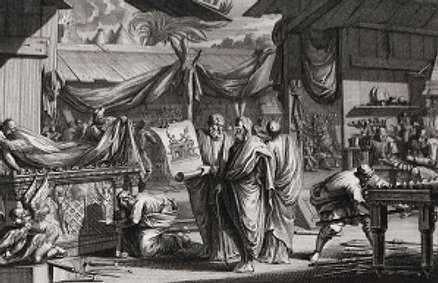
Paul spoke of the achievement that comes from building oneself into an Ark upon which God can rest. Just as God gave instructions for taking common parts and joining them together in the right way, so a whole of holiness could come into being, so too must people in flesh be joined with God to become the holy of holies. This requires work, that of a craftsman, but the reward comes instantly when completed.

The lesson here is to see the divinity in Paul’s words, so one can see how the human flesh that was Paul, whose body had a physical brain, did not … could not possibly … write this way, so that he intended people who were fluent in Greek to mistranslate his words, confusing many and giving quite a few headaches reading his words. One needs to see the presence of God’s hand in Paul’s writings.

That requires work, that of the Christ Mind. And, the reward comes immediately when one can see the meaning and its source.


Ephesians 2:11-22 – Giving your soul a circumcision

Remember that at one time you Gentiles by birth, called “the uncircumcision” by those who are called “the circumcision” —a physical circumcision made in the flesh by human hands— remember that you were at that time without Christ, being aliens from the commonwealth of Israel, and strangers to the covenants of promise, having no hope and without God in the world. But now in Christ Jesus you who once were far off have been brought near by the blood of Christ. For he is our peace; in his flesh he has made both groups into one and has broken down the dividing wall, that is, the hostility between us. He has abolished the law with its commandments and ordinances, that he might create in himself one new humanity in place of the two, thus making peace, and might reconcile both groups to God in one body through the cross, thus putting to death that hostility through it. So he came and proclaimed peace to you who were far off and peace to those who were near; for through him both of us have access in one Spirit to the Father. So then you are no longer strangers and aliens, but you are citizens with the saints and also members of the household of God, built upon the foundation of the apostles and prophets, with Christ Jesus himself as the cornerstone. In him the whole structure is joined together and grows into a holy temple in the Lord; in whom you also are built together spiritually into a dwelling place for God.

——————–

This is the Epistle reading for the eighth Sunday after Pentecost [Proper 11], Year B, according to the lectionary for the Episcopal Church. It will follow one of two optional tracks that pair Old Testament readings with Psalms. The first tells of David telling Nathan his plan to build a house for the Ark, only to have Yahweh tell Nathan He wants no house of cedar. The second tells of Jeremiah being told by Yahweh that bad shepherds who destroy and scatter His flock will be punished. All will precede the Gospel reading from Mark, when Jesus told his disciples, “Come away to a deserted place all by yourselves and rest a while.”

I posted about this reading in 2018. I went into great detail about each verse, based on the written Greek text. I welcome everyone to read that commentary by searching this site. I wrote that because Paul’s writings can be very difficult to follow; and, this is one that can be seen as confusing. For that reason, with a deep explanation of everything written already done [looking each word up becomes painstaking work that must be done], I will leave what I wrote before to speak for the whole meaning. Now, I will only address a few things in a different light.

On the broad view, verse eleven must be seen as Paul reminding the true Christians of Ephesus that before they married their souls to Yahweh they had been different in a physical sense. They were considered natural people of the world, as “races” and “nations” of people, or “ethnos,” where the males were uncircumcised. That differed from those who had been marked as Yahweh’s children, soon after birth, by “a physical circumcision made in the flesh by human hands.” This ritualistic act, which would be known through nakedness, but otherwise concealed by clothing, physically marked one as believing in Yahweh, while all others were free to follow the gods of the world. That remembrance must be seen stating the importance of physical change being required in order to serve Yahweh.

Verse twelve then transitions from the physical changes that mark one as a bride of Yahweh and places focus on the spiritual changes. The translation that says, “remember that you were at that time without Christ” must be seen as containing one capitalized word “Christ.” That word means “Anointed One,” but in the form written – “Christou” – that is the genitive case, which states possession, as “of the Anointed.” The word “Christ” is not a statement about Jesus, as if his last name was “Christ.” Jesus was the “Anointed One” of Yahweh. This must be grasped firmly, as Paul writing “you were at that time without Christ” says “you were at that time without an Anointment from Yahweh.”

In that statement in Greek is the little word “ēte,” which is a past tense form of “I am, I exist,” translated as “were.” That is a statement of being that is elevated from the physical body of flesh, as the soul. When that is seen as the intent, the past state of one’s soul [“you were”] was like the past state of the flesh when it was identified as “ethne,” or “of the world” – “Gentile.” In this way being “without Christ” is now compared to being “uncircumcised,” but on a soul level of being, beyond the physical.

When the NRSV translation then shows Paul writing, “being aliens from the commonwealth of Israel,” this gives the impression that being “without Christ” was because the Greeks of Ephesus did not live in the land of Jesus. That is not what Paul meant by this; and, this needs to be fully understood. First of all, the word “being” is transferred to this segment of words, as directly referencing the state of being that was – “ēte” – “you were.” That state of “being” is now said to be “alienated from” [“apēllotriōmenoi”] “of this” [“tēs” is the genitive form of “the”], where “commonwealth” is actually meant as “citizen body” [from “politeias”] that relates to a spiritual level, not being a “race” or nation” of people, as is the physical body of flesh.

A better way of translating “apēllotriōmenoi” would be as “estranged,” which is less inducive of making one think being “foreign” to “Christ,” as if living in another country made one such an “alien.” When “estranged” is read, the meaning implies “having lost former closeness and affection,” such that the realization that the “Christ” is a Spiritual Anointment from Yahweh, it says a soul in a body of flesh [symbolically “uncircumcised”] was once close to Yahweh, but after birth into a body of flesh lost that closeness. As “estranged,” there is a psychic sense of longing to return to that relationship, which is then viewed in the sense of “citizenship” of heaven, as having rights, through “franchise,” to be a “Christ” once more.

That sense of disenfranchisement is then relative to “tou Israēl” or “of Israel,” where the genitive case is once again stated. Those two Greek words become reflective of “Christou,” “of Israel” is a synonym of “of Christ.” This is where Paul’s writing “Israēl” is not a statement about a place, because the Northern Kingdom that was named “Israel” had been lost around eight hundred years before. When Jesus walked the face of the earth, he traveled in lands known as Galilee, Judea, Perea, Gaulanitis, Decapolis, and Phoenicia. Jesus traveled and ministered to Jews – the circumcised – and even though he said he came for Israelites; he was never about being in a land named “Israel.”

This is where one’s mind needs to see the truth of the use by Paul. The meaning behind the name, which was given divinely to Jacob, in his spiritual conversion to being a wife of Yahweh, says: “He Retains God” or “God Is Upright.” That name was never given to be applied to anything physical, as it can only be applied to souls. Therefore, the “alienation” or “disenfranchisement” or “estrangement” felt was by souls that have not returned to a “Christ” state of being, because they have not married Yahweh and in turn had their souls named “Israel.”

When this is understood, Paul then emphasized by his writing the word “kai” and followed that with: “strangers to the covenants of promise.” Here, again, is a reference to the “alienation” factor, where “strangers” [from “xenoi”] is relative to souls who are “foreign” to Yahweh. The “covenants” are those personal agreements made between two – in this case a soul and Yahweh – which are the Commandment Moses brought down from Mount Sinai as the marriage agreement that was demanded of the Israelites, which made their souls become His wives. Thus, the agreements become those “of promise” [the genitive “tēs” applied to “epangelias”], where both soul and Spirit are sworn to uphold their ends of the agreement. This becomes an important statement [led by “kai”] of marriage vows. This says all who are “estranged” souls [symbolically “uncircumcised”] are so because they have not agreed to submit to Yahweh and serve Him as His wives in marriage.

It is the failure to come to the altar of spiritual marriage that then led Paul to write, “having no hope and without God in the world.” The Greek word translated as saying “without God” [“atheoi”] is better stated as “godless.” This means one’s soul is “pagan,” in the sense that those people of the world that have not been brought to know Yahweh will invariably worship multiple “gods” of nature, which makes all those “gods” [the truth of the word “elohim,” which can be laws, angels, or those who have become Saints, like Paul and the Ephesians] the same as Yahweh – external to their state of being. To set Yahweh up as an idol of worship means to reduce Him to a “god,” such that the truth of the word “atheoi” is it says a soul stands separate from Yahweh, thereby being “without Yahweh” married to it.

Because Paul was writing to souls who had been brought to the altar of marriage and all had come to now Yahweh as their Husband, he wrote: “But now in Christ Jesus you who once were far off have been brought near by the blood of Christ.” In that he wrote “Jesus” for the first time in this series of verses, while repeating the word “Christ” twice. All there words are capitalized, which means they are all raised to a divine level of meaning, higher than simply stating a name or catchphrase.

The first segment of this verse states, “But now in Christ Jesus,” which states a transformation has taken place, due to souls having married Yahweh. By “now in Christ,” the spiritual state of being “uncircumcised” has changed. Being “in Christ” [“en Christō”] states a singular state of being for each soul married to Yahweh. For as many Ephesians as Paul led to divine marriage, each individual soul reached a state where “in” means “with, among, at, and by,” where this is stating there is no longer an externalization that made a soul “godless” or “without God.” It says each has become an “Anointed One, individually, so each has become a “Christ.” This changed state of being is then the spiritual act of circumcision, where instead of paring away the foreskin of a male penis, all souls [in both bodies of males and females] are joined with the soul of Jesus, so his name is resurrected within all souls married to Yahweh. In this sense, the meaning of the name “Jesus” must be realized as a statement like “Israel,” which says “Yah[weh] Will Save” or “Yah[weh] Saves.” Being a soul reborn in the name of “Jesus” says that soul has been saved, through marriage to Yahweh.

By seeing this change as the spiritual reality that is opposite to the pretense of physical difference, the issue of “alienation, estrangement, and exclusion” has been removed. Paul writing “you who once were far off have been brought near by the blood of Christ,” says the externalization of Yahweh has been removed. In this case, “near” [“engys”] means “at hand.” [NAS Exhaustive Concordance] It is so “near” that Yahweh’s Spirit flows within one’s body of flesh, like does one’s physical “blood.” Here, again, the Greek word “en” is written, but the NRSV has chosen to translate it as “by,” giving the false impression that one’s physical “blood” has been changed, as if a transfusion took place. That is as impossible as would be a spiritual hand come out of the sky and snip off a foreskin. The “blood” musts be seen as a statement of sacrifice.

Christians go to great lengths to distance themselves [a “self” equals a “soul”] from Yahweh. They see that name as the God of the Jews, and Christians like to be different from Jews [they caused Jesus to be crucified, after all]. In that desire to “estrange” themselves [self again] from the Jews, they do nothing that has them recognize the rituals handed down from Moses to the Israelites, the foremost of which was the Passover. The Passover is a remembrance of the sacrifice of special lambs, whose blood was spread over the doorposts, which notified Yahweh [coming as the angel of death] He should pass over all houses painted in the “blood” of the sacrificial lamb. Christians love to pretend the coming of Jesus made belief in him as the Son of God [they do not dare say “Yahweh”], so they pretend the “blood of Jesus” is his spilled in crucifixion, changing everything the Jews ritually maintained so new rituals could be invented. The problem is the Jews who crucified Jesus then were as corrupt a dogmatic religion as has Christianity become today.

By Paul saying “in the blood of Christ,” this must be seen as the act of self-sacrifice that slaughters oneself on the altar, releasing one’s soul to Yahweh. That sacrifice means one has become an equal sacrificial lamb of purity, so the figurative “blood” that flows in one’s body of flesh has been spread over the doorposts of one’s soul, so that soul is spared death, through the receipt of eternal life. This makes the “blood of the Anointed One” make one a saved soul in a body of flesh, as a model of Jesus reborn.

Seeing the truth in what Paul wrote, the following four verses relate to this change. For the specifics of what Paul wrote in those verses, I return you to my offer of reading what I wrote in 2018. As a quick summary, those verses place a focus on two, as “both groups into one” [actually “both one,” from “amphotera hen”] and “one new humanity in place of the two” [actually “two he might create in his own towards one new man”] and “both groups to God in one body” [actually “both in one body”]. From that, I will jump forward in the text to verse eighteen, which the NRSV translates as saying, “for through him both of us have access in one Spirit to the Father.” In that, the literal Greek states: “because on account of his we possess this admission these both in one Spirit with this Father.” This translation requires closer inspection.

In that series of Greek words, the word “autou” has been translated by the NRSV as “him.” The word can actually be used as an adverb, as “here” or “there,” but “him” denies the genitive case and the possessive of “autós,” which would be more appropriately translated as “his.” The root word [“autós”] emphatically means “self.” While it would ordinarily refer to the third person singular as “he,” that would be in the physical sense; and, Paul has been writing in the spiritual since, beginning with verse thirteen. Thus, knowing a “self” means a “soul,” the duality that has become the focus is now stated as “because on account of his,” which means the marriage of a “self” [“soul”] to Yahweh, where one’s soul has submitted unto “him.”

This brings about a state of possession, where the Greek word “echomen” is the plural number of “echo,” which states “we” as a couple who each agree “to have and to hold,” where one becomes the possession of the other. As a collective of true Christian souls making the same commitment of a couple in wedlock, all are then “his” as a shared relationship that “we have.” It is that bond between two – a oul and Yahweh’s Spirit – that then allows a soul “access,” where the better word is “admission,” such that two are “brought together” in an intimate face-to-face relationship. [HELPS Word-studies] This is then strongly suggestive of marriage, on a spiritual level.

This then states “both in one Spirit,” where “both in one” [“amphoteroi en heni”] is a statement of union, as two together as one entity. This is where the past reference to Jesus becomes two souls merged as one being, which is a divine possession, It is this divine possession that occurs through the sacrifice of self-will and self-ego that the “Spirit” of Yahweh allows His wife to be reborn as His Son. The emergence of the Jesus soul as the dominant soul in one’s life allows the “Spirit” to be expressed through one’s flesh, as being reborn in the name of Jesus. It is this change – like going from uncircumcised to circumcised – that makes oneself [self equals soul] not only a wife of Yahweh, but also His Son reborn in one’s flesh; and, that becomes a dual relationship with Yahweh as the “Father.”

The remaining verse further state this marriage and rebirth, which I again refer one to my assessment written and published in 2018. The point I want to make here, which was not so much the focus in 2018, is the clear verbiage that says one must change spiritually in order to be saved and given eternal life. One’s soul must relinquish self-control and let Yahweh lead one through His Spirit. That Spirit will make one’s flesh become Sacred, as His new Saints in ministry, all being sent out anew as Jesus walking the earth in a body of flesh.

As the Epistle selection for the eighth Sunday after Pentecost, when one’s own personal ministry to Yahweh should be well underway, the difficult to see, but vividly clear when the time is taken to look deeply as what Paul wrote, says a spiritual marriage to Yahweh is mandatory. The world is full of two types of souls – those unsaved and those saved. This cannot be determined by the shape of one’s penis, as there is nothing physical that marks one for salvation. The only marker is the presence of Yahweh’s Spirit within one’s soul. That makes one become Jesus reborn; and, the only reason Yahweh will return the soul of His Son to the worldly plane is for it to take a body of flesh out to the world, in order to save more lost souls.

When the them for this Sunday places focus on shepherding, especially the warnings given to false shepherds, marriage of one’s soul to Yahweh is how one knows oneself is truly a good shepherd. Anything less is false; and, being a false shepherd places one’s soul in greater danger of punishment, more than simply being one of the sea of lost souls, commonly called Gentiles. Rather than physical mutilation of the flesh being the determining factor of a servant to Yahweh, it is the mutation of the soul from self-absorbed to self-sacrificing for a higher goal.