Tag Archives: Ephesians 6:10-20

Ephesians 6:10-20 – Praying for the armor of God

Be strong in the Lord and in the strength of his power. Put on the whole armor of God, so that you may be able to stand against the wiles of the devil. For our struggle is not against enemies of blood and flesh, but against the rulers, against the authorities, against the cosmic powers of this present darkness, against the spiritual forces of evil in the heavenly places. Therefore take up the whole armor of God, so that you may be able to withstand on that evil day, and having done everything, to stand firm. Stand therefore, and fasten the belt of truth around your waist, and put on the breastplate of righteousness. As shoes for your feet put on whatever will make you ready to proclaim the gospel of peace. With all of these, take the shield of faith, with which you will be able to quench all the flaming arrows of the evil one. Take the helmet of salvation, and the sword of the Spirit, which is the word of God.

Pray in the Spirit at all times in every prayer and supplication. To that end keep alert and always persevere in supplication for all the saints. Pray also for me, so that when I speak, a message may be given to me to make known with boldness the mystery of the gospel, for which I am an ambassador in chains. Pray that I may declare it boldly, as I must speak.

———————————————————————————————————-

This is the Epistle selection from the Episcopal Lectionary for the Fourteenth Sunday after Pentecost, Year B 2018. In the numbering system that lists each Sunday in an ordinal fashion, this Sunday is referred to as Proper 16. It will next be read aloud in an Episcopal church by a reader on Sunday August 26, 2018. It is important because Paul states that the forces of evil are too much for human souls that are not protected by the armor of God.

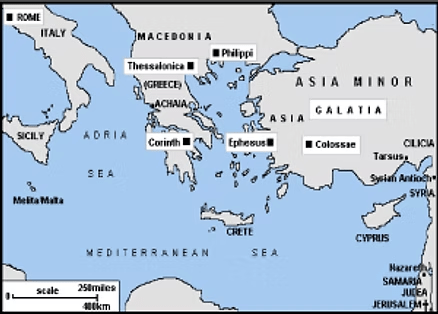
It is important to remember that the places Paul’s journeys took him were all technically Greek. There he sought out the Israelite descendants and in the process of spreading the “Good News” of their Messiah having come, he welcomed the Gentiles there. They were mostly Greeks of pagan religious roots. This map shows Ephesus as one of the places where Greek culture had hold in Asia Minor, then called Galatia.
With that Greek heritage, it can be assumed that Greek mythology was still widely known and there were temples still standing, as well as monuments and statues of the many gods of importance that the Greek people worshiped. With Greece under the Roman Empire’s control, there might have been active temples to the gods who were the Roman equivalents of the Greek gods.

In this part of Paul’s epistle to the Christians of Ephesus, it seems he might be using Greek mythology as a way of making a point about God’s protection, where he wrote, “Put on the whole armor of God.” Besides the Greek word “Theou” not having the full effect of the Hebrew name for God – “YHWH” – or even “El, El Shaddai, Elohai, or Adonay – it is drawn from the implication of “a god,” implying one of the many gods known.  Even capitalized, “Theou” could mean Zeus to some and Yahweh to others.  This helps any implication that the armor was mythological metaphor.

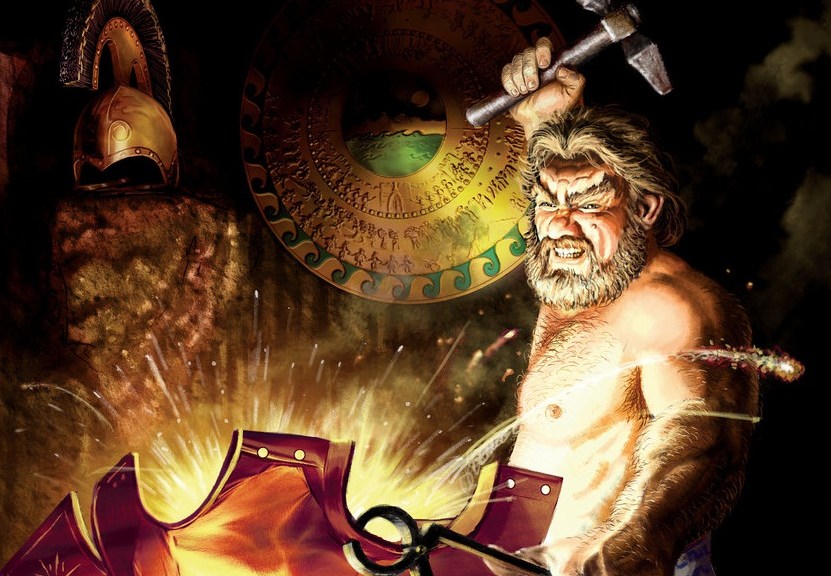
For instance, the Greek theos Hephaestus (Roman equivalent Vulcan) was the maker of special armor.  He was considered the blacksmith of the gods.  Special devices would be ordered by the Greek theoîn,  who would have pieces of heavenly armor be worn by themselves or their chosen Greek heroes.

The mythological story that first comes to mind is that of Perseus, who needed help from the gods to kill the Gorgon Medusa. Athena asked Perseus to kill Medusa. In order to achieve that monumental task, multiple gods helped Perseus.  He was given by Zeus a gemstone-metal curved sword and by Hades a cap of invisibility (the helm of darkness). A polished shield (that acted like a mirror) was given to Perseus by Athena and winged sandals, which allowed Perseus to fly, were lent to him by Hermes. The Hesperides (nymphs of the evening) gave him a special sack to safely put Medusa’s severed head in.
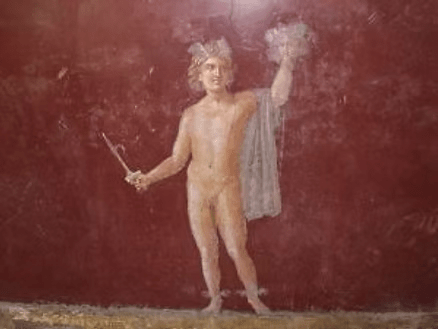
Knowing that detail of divine gifts of armor, look now at what Paul says God gives to His “hero” Apostles-Saints:

• The belt of truth,

• The breastplate of righteousness,

• The shoes to proclaim the gospel of peace,

• The shield of faith,

• The helmet of salvation, and

• The sword of the Spirit.

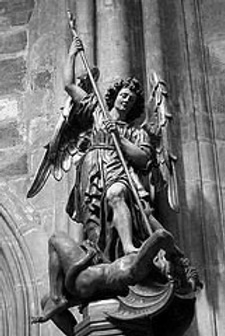
With all of this armor on, one looks like this:
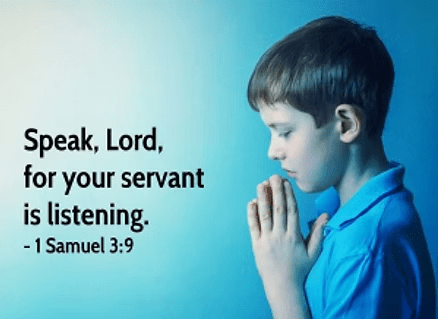
Physical armor weighs one down to the material realm, so that one is unable to fight from spiritual purity. To stand on even ground “against the spiritual forces of evil in the heavenly places,” one has to be elevated to a force of righteousness by the forces of good in the heavenly places. Innocence defeats evil in the battles between God and the gods of Satan.
With heads bowed, eyes closed, and hands palm to palm, one is armored by the presence of Yahweh, the LORD. Prayer is how one is “strong in the Lord and in the strength of his power.” Prayer is one’s submission to the One God, so one cannot hear “the wiles of the devil.” God hears them and speaks through His servants, putting Satan in his place.  Like Jesus, the strong say, “You shall not tempt the Lord your God” and “You shall worship the Lord your God, and Him only you shall serve.” (Matthew 4:7 & 10)

Prayer leads one to see through the lies of “the rulers,” the cunning of “the authorities,” and prayer shines the light of truth upon all the worldly ploys (“the cosmic powers” – “kosmokratoras”) that hide in “this present darkness,” which is ever-present in the material realm. Prayer leads one to seek humble positions, rather than be like those who seek prideful roles of leadership and authority.  Prayer brings one the light of “day,” so all “evil” is exposed, stripping it of its power to confuse and mislead.
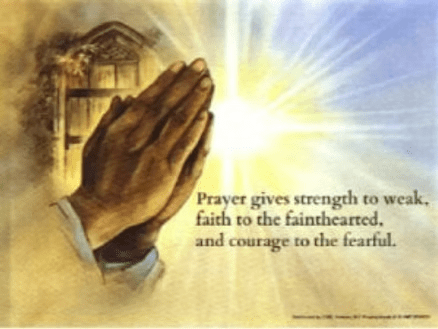
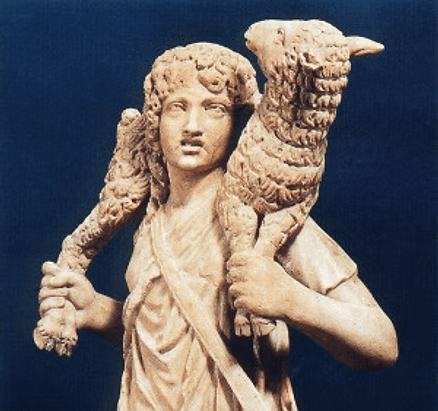
Paul wrote these words of encouragement to the Christians of Ephesus so they would pray for all the “heroes” of God who wore the armor that comes with being reborn as Jesus Christ. An Apostle-Saint is never alone in this battle between good and evil, as Father, Son and the Holy Spirit are always surrounding the soul of life. Still, Apostles and Saints are related to their brothers and sisters in Christ, who gain strength and courage from the prayers that unite all members of the same body, all fighting for the same purpose … in different ways … determined by God.

The belt of truth is the insight of the Christ Mind, which “girders one’s loins” and makes one’s back capable of shouldering any heavy load.

The breastplate of righteousness is one’s heart being protected from external attempts to upset one and cause one to acts irrationally, due to unstable emotions.

The shoes that allow one to spread the truth contained in Scripture means one is always walking towards someone seeking peace in their lives. Comfortable feet says one will never hesitate going wherever the LORD leads one, because one is always feeling good to go.

The shield of faith means that whatever flaming arrows of condemnation are cast at one, in attempts to silence the truth unwanted to be told, nothing will bring harm to the one speaking God’s Word.

The helmet of salvation is an Apostle-Saint’s promise of eternal life in heaven, washed clean of sin by the baptism of the Holy Spirit; and the sword of the Spirit is “the word of God,” which cuts through all twists, turns, and spins of Scripture done by false shepherds.
As the Epistle selection for the fourteenth Sunday after Pentecost, when one’s personal ministry for the LORD should already be underway – one is wearing the armor of prayer constantly – the message here is to trust in “the strength of [God’s] power” and “be strong in the LORD” by removing all doubt that keeps one from picking up the shield of faith.

A minister of the LORD knows the difference between belief and faith. Believing in something is a mental exercise, where study and listening to lectures makes sense. It is like learning to do math problems on paper and making good grades on math tests, but never actually applying the principles of math in the real world. One believes math can solve any problem; but knowing how to break the world down into mathematical equations requires faith.

It is the difference between compliance and ownership. Complying with ideals, principles, and concepts means sometimes we are told to go against personal wants, desires and reasons. Against one’s will, one finds a force that makes one comply or be punished. These external forces are often laws written by rulers and authorities. We often have to choose what is right and wrong, based on the wiles of the devil. Too often we are told to project one’s personal problems on those far away, pitting us against them – as “enemies of blood and flesh.” When government and religion bleed together and clear boundaries are changed or erased, one complies with regret; and that bring about doubts of one system of rule or the other.

Religious compliance is like being a fence-sitter. On one side of the fence is faith in God and on the other side of the fence is faith in self. For all the recommendations to jump off the fence and join with God there are many more suggestions to forget all that promise of eternal salvation stuff and come back and play with the pleasurable sins one knows all about.
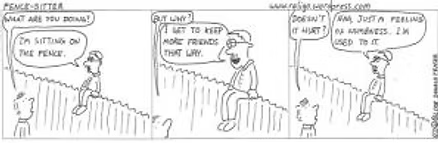
One can have faith that sin exists, because one knows sin. Because one has yet to actually KNOW God, it is common to fear taking a leap of faith into the unknown.

Faith takes hold when one takes ownership of Jesus Christ. It happens after one has come to KNOW God as His wife (regardless of human gender), so two have become united as one, with the result of that union being the resurrection of the Father’s Son, Jesus Christ. When one is reborn as Jesus Christ, one has put on the full armor of God, just as that which Jesus of Nazareth wore. At that time, all of the metaphor of Paul’s words is known as the truth of God’s Word, spoken through a Saint. One KNOWS God because one experiences God personally, not secondhand.

Ownership is seen through the words of Jesus, when he said to his disciples:

“Don’t you believe that I am in the Father, and that the Father is in me? The words I say to you I do not speak on my own authority. Rather, it is the Father, living in me, who is doing his work. Believe me when I say that I am in the Father and the Father is in me; or at least believe on the evidence of the works themselves. Very truly I tell you, whoever believes in me will do the works I have been doing, and they will do even greater things than these, because I am going to the Father. And I will do whatever you ask in my name, so that the Father may be glorified in the Son. You may ask me for anything in my name, and I will do it.” (John 14:10-14)

Jesus experienced God the Father personally.  They were united as two in one.

The words spoken by Jesus to his disciples not only asked eleven disciples (Judas had already left to betray Jesus) to believe his words and his prior acts – that he was one with God the Father – and that they should believe they will be reborn “in [Jesus] name” (as Jesus Christ), doing more acts of faith than Jesus had done, Jesus’ words speak to everyone who has ever read them. They speak to all reading this today.

The disciples were committed to complying with the commands of Jesus, because they believed he was the Messiah; but those words had no effect on their faith at that time.  This is known because after Jesus was arrested they ran and hid in fear. They were filled with doubts, not faith … and they lived in the presence of a real flesh and blood Jesus, having personally witnessed his miraculous acts.  That luxury of personally knowing Jesus of Nazareth is not possible today.  If those disciples ran and hid in fear, then the same natural fear of the unknown is expected by all disciples of Christ today (those calling themselves Christian, based on belief of words written and spoken).

It is natural to doubt because one KNOWS fear. One has been there and done that, so often that one has ownership of that automatic response to frightening external stimuli. Doubt comes so easily one does not have to think, “What did the professor say to do when scared stiff?” This natural reaction is how one needs to KNOW God, so one’s automatic reaction to “the wiles of the devil” is to say what Jesus said, “Get outta my face, Satan.”

No fear.

That emotional absence can only come from KNOWING God and having the ownership of “I am in the Father and the Father is in me.” This is when one wears the full armor of the LORD and knows “the strength of his power.” Otherwise, one is walking behind the memory of Jesus of Nazareth, afraid to be Jesus Christ reborn.

Prayer is how one calls upon God to enter one’s heart. Prayer is how God comes to give His armor to Saints. Prayer is how one leads others to come to KNOW God too.
Ephesians 6:10-20 – Wearing the robes of the High Priest

Be strong in the Lord and in the strength of his power. Put on the whole armor of God, so that you may be able to stand against the wiles of the devil. For our struggle is not against enemies of blood and flesh, but against the rulers, against the authorities, against the cosmic powers of this present darkness, against the spiritual forces of evil in the heavenly places. Therefore take up the whole armor of God, so that you may be able to withstand on that evil day, and having done everything, to stand firm. Stand therefore, and fasten the belt of truth around your waist, and put on the breastplate of righteousness. As shoes for your feet put on whatever will make you ready to proclaim the gospel of peace. With all of these, take the shield of faith, with which you will be able to quench all the flaming arrows of the evil one. Take the helmet of salvation, and the sword of the Spirit, which is the word of God.

Pray in the Spirit at all times in every prayer and supplication. To that end keep alert and always persevere in supplication for all the saints. Pray also for me, so that when I speak, a message may be given to me to make known with boldness the mystery of the gospel, for which I am an ambassador in chains. Pray that I may declare it boldly, as I must speak.

——————–

This is the Epistle reading selection for the thirteenth Sunday after Pentecost [Proper 16], Year B, according to the lectionary for the Episcopal Church. Its reading will follow either a Track 1 or a Track 2 pairing of Old Testament and Psalm readings. The first places focus on Solomon dedicating his new temple and the second places focus on Joshua telling the Israelites it was up to each individual to choose what gods they would serve, from that point onward. Both Psalms are songs of praise, with Psalm 84 singing about the happiness of Yahweh’s dwelling and Psalm 34 sings about the abilities of the righteous. All will accompany the Gospel reading from John, where Jesus told his disciples, “For this reason I have told you that no one can come to me unless it is granted by the Father.”

The last time this reading came up in the lectionary cycle (2018), I wrote my opinions and published them on my website. That commentary can be read by searching this site. I welcome all to read those views and compare them to the views I will now add. I also welcome comments and suggestions, questions and correction via the website’s contact format.

In 2018 I was focused on interpreting this reading as the intent behind Paul’s words to true Christians of Ephesus. Certainly, that meaning still fully applies to all Christians today. Therefore, the views I expressed in 2018 are still quite applicable today; but I now want to address this reading in the context of the Old Testament readings, which both took place well before the advent of Christianity.

This reading begins with the appearance that Paul just blurted out, “Be strong in the Lord and in the strength of his power.” As this reading begins at verse ten, it should be realized that there is context written before, which led to this statement. In actuality, the first word in verse ten is a capitalized “Tou,” which takes on a divine level of importance that has been erased in the presentation of this reading. That capitalized word means “of This,” which is the genitive case [possessive form “of”], meaning “That” previously said. The segment of words that finished verse nine said [I summarize] there was “no partiality” given by Yahweh to those “masters” that have become His “Anointed ones” [i.e.: “Christs”] and allowed His Son Jesus to become the “Lord” [“Kyriō”] of their flesh. It is then “of This” that prompted Paul to add, “be empowered by the Lord , kai in this strength of this power oneself”.

That becomes the theme statement for this set of verses. The focus taken by Paul, in a letter written to people who had done just as he had done and understood what he meant, is the empowerment [from “endynamousthe”] that comes within one’s body of flesh after a soul has divinely wed Yahweh’s Spirit and given birth within one’s soul to the merger with the soul of Jesus, as a most divine possession that becomes the “Lord” over one’s flesh. The placement of the word “kai” [following a comma mark] says it is most important to grasp that it is one’s “soul” [from “autou” meaning “of self,” with “self” equating to a “soul”] that has become “in this strength of this power.” It is vital to understand that everything Paul followed this theme statement with – the armor of God – is metaphor for the power and strength that comes from the Spirit and the Christ being one with one’s soul.

When Paul then wrote “put on the whole armor of God,” the Greek word “endysasthe” is better translated as saying “be clothed” [rather than “put on”]. This means the clothing that can be called “the full armor of God” is the priestly garb of the High Priest of the Tabernacle. According to Exodus 28, these garments were the ephod, a breastpiece, tassels with bells, a turban with a seal, and linen undergarments worn from the waist to the thighs. All of this was to be worn “whenever they enter the tent of meeting or approach the altar to minister in the Holy Place, so that they will not incur guilt and die.” (Exodus 28:43)

All of this elaborate priestly clothing is only physically required for Aaron and his Levite descendants, which were those who physically attended to the tabernacle and the Ark and altar, et al, that was moved with the children of Israel. In the Old Testament readings that accompany this reading from Ephesians, the Tabernacle had been set in a central place (Shechem) and that place was given over to the Levites as their property to possess. In Solomon’s dedication of his Temple in Jerusalem, the Ark and alter, et al, was moved into that fixed place. However, the point of Paul’s words say the presence of the resurrected soul of Jesus, within one’s soul-body, his soul comes garbed with everything necessary for a High Priest. His presence within means one’s body of flesh has become the Tabernacle, where Yahweh resides between the Cherubim atop the Ark, which has been placed in one’s heart [where the word for “heart” means “soul” or “inner man”].

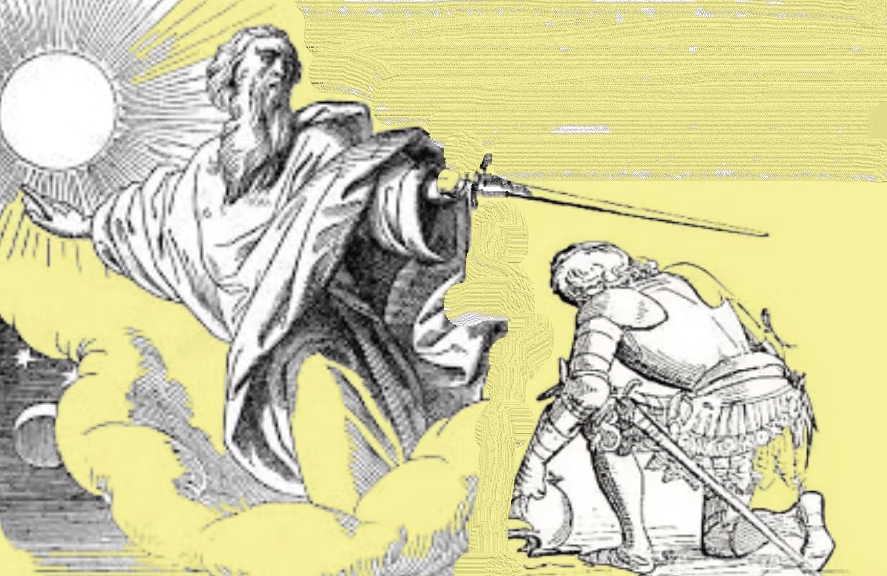
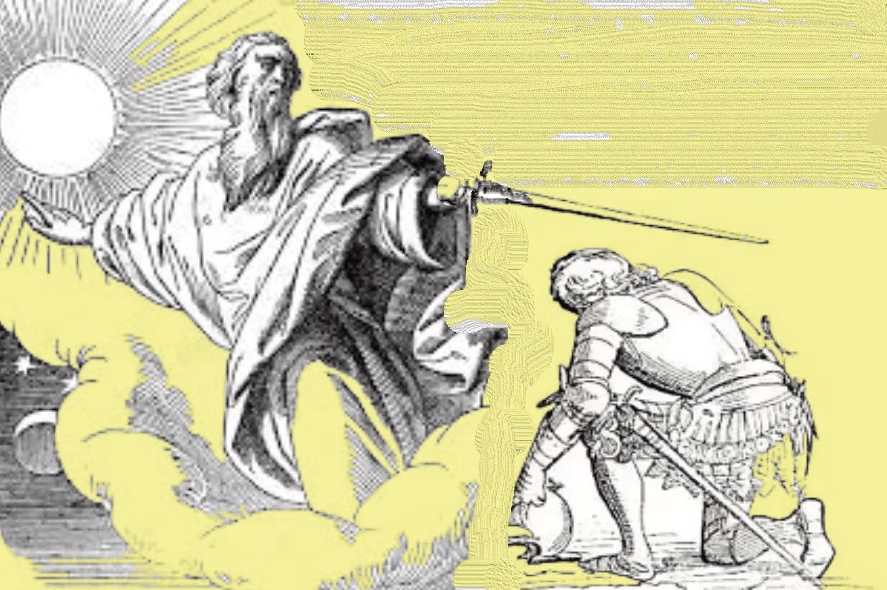
This means the “full armor of God” is His Son reborn within one’s being. This must then be seen as a divine possession of one’s soul-body, such that one’s soul has lowered its ‘head’ in submission to a higher power. The metaphor of “armor” then means oneself [self always means soul] has knelt before the King and been ‘knighted’ as a fully devoted servant that will fight all enemies to the throne. Paul then stated that enemy when he said, “so that you may be able to stand against the wiles of the devil.”

In 2018, I had not come to the realization of possession, although I was aware of the need for divine marriage, so a soul became one with Yahweh’s Spirit. The aspect of Jesus’ soul becoming a twin soul merged with one’s physical life soul was still beyond my mental conceptions. Since then, I have come to realize that possession of a soul is least common as divine, where the soul of Jesus comes in to control one’s bodily actions. What is most common is demonic possession, which are less the extremes of Hollywood movies and horror books and more the commonality of drug addiction, sex addictions, and any other worldly lust that can and will overtake a soul-body entity. It is this demonic possession that becomes the reason a soul needs to “be clothed in the whole armor of God.” One needs divine possession to fight [“take a stand”] against the schemes [“methodeias” means “crafts, deceits”] of Satan [“diabolou,” “slanderer, false accuser”].

The point that I have been making for quite some time now is the mistranslation of the Hebrew word “elohim” as “God.” The Hebrew word “el” is the singular form of “god,” but there is no reason to capitalize that into English. The plural form, “elohim,” means “gods,” again with no need to capitalize that into English. The mistranslation, such that Genesis 1 has been mistranslated to say “God created this” and “God created that” is truly a series of statements about Creation, from which the first creation was Yahweh creating “elohim,” who were the “gods” He assigned to make everything. Yahweh is the architect of the Creation, who drew up the plans, but never got his hands dirty building his designs. That was left up to the lower “g” gods. In Genesis 2 we find Yahweh busy creating His Son and then Adam’s mate. In that there is no mention of “elohim” alone, after verse four. Still, because Yahweh created Adam [not the males and females of Genesis 1], Adam must be seen as the first divine “elohim” (a “Yahweh elohim“) who would be sent [along with wifey] to be the first High Priests on earth [outside Eden].

From that story in Genesis 2, by the time we reach Genesis 4, we find that the “elohim” are not limited to being only divine possessions, where the descendants of Adam and Eve were not always possessed by Yahweh’s Spirit. Cain becomes the first example of a demonic possession. Cain would become a reflection of the powers of the earth, which will quickly take possession of a soul, if the soul is not careful and seeking Yahweh in marriage. The books of the Old Testament tell of the lineage of divinely possessed souls, who become opposed by the demonically possessed souls of king, queens, and false prophets and priests. This is a common problem that Paul warned the true Christians of Ephesus about.

Paul said the stance that must be taken by those ‘knights’ wearing the armor of Christ Jesus is “against the rulers, against the authorities, against the cosmic powers of this present darkness, against the spiritual forces of evil in the heavenly places.” This says Satan has less need for possessing the minions of the world, because he knows possessing the leaders of the minions will force them to do their will. This then states the purpose of Yahweh marrying souls and having His Son resurrected into divine elohim is ministry. Those knights do not hide at home, only venturing out to a church pew for others to marvel at their piety [like the hired hands and false shepherds do]. Knights of Yahweh challenge the liars and cheats of the world with the truth. The true Christians Paul was writing to were the front lines in a war of exposure, where the point was to transform the many who sought redemption into divine elohim, who served Yahweh as Jesus reborn. Paul was at the forefront of a major movement back then; a movement that has since been reduced to a slow drip.

The paradox of the First Kings reading, with all the pomp and circumstance of Solomon’s self-aggrandizement, must be seen as his soul having become a demonic elohim, promised the world by the serpent offering him more wisdom than anyone ever, before or after. Solomon was then an agent of Satan, who had a mausoleum built, in which to entomb Yahweh and His Ark. The servants of that temple would slowly cease to attend to the needs of the people; and, with the king no longer an agent of Yahweh [as was David], they would stop being divinely possessed and fall prey to the “schemes of the devil.”

When that reading is set up with Joshua 24 being the counter-reading, it must be realized how often Joshua spoke the word “elohim” to the Israelites he summoned to gather at Shechem, where the Tabernacle and Ark were to be set permanently [although still mobile, when needed]. Because the presence of Yahweh was no longer going to be visible [as a cloud outside the tent of meeting], Joshua told all those who were committed as “Yahweh elohim” to make the decision what “gods” their souls would merge with next. Joshua mentioned the options of the “elohim” of Egypt and the “elohim” of the Amorites, who were those “gods” from which Abraham came, himself believing in Yahweh alone. The lesson of Joshua, verses the lesson of Solomon, says it is up to the individual to become the “god” of their choice. That means there will never be a demand by Yahweh to follow any of His Commandments. Those are the marriage vows that can only be taken by a soul in love with Yahweh, who is willing to submit fully to His Will. All who choose to retain some of himself or herself as a “god” [the demonic elohim], they will be made promises by the devil, all of which will end when the soul is separated from its body of flesh at death.

This choice must be realized from this reading from Ephesians. To make this choice – to become a ‘knight’ in service of the King and fight for truth and justice against the leaders who corrupt souls – Paul said what all true Christians must also say and know. Paul wrote, “Pray that I may declare it boldly, as I must speak.” In that, the Greek word translated as “must” is better translated as “it is necessary.” This is “necessary” because the soul of Paul seeks redemption for his own past sins, and speaking the truth will bring his soul what it seeks. Still, it is “necessary” because the truth has to be heard, so other souls can be freed of their slavery to demonic spirits.

In the Gospels and in Acts are stories of those souls who have been divinely possessed [Jesus and his Apostles] going and touching the souls of others, healing them from deformities, illness, and even death; but many others were found to be possessed by demonic spirits, which were cast out by the words spoken by the Apostles. Only those who had become the elohim of Yahweh, with Jesus resurrected within their soul-flesh, could cast out the Satanic spirits possessing very evil people. It must be realized that “elohim” can be both good and bad. It must be understood that it is much easier to be possessed by a demonic spirit than it is to be married to Yahweh and give birth to His Son once more.

For more on this concept, called Eudaimonia, I recommend reading the Wikipedia article under that name. This is a concept that has been recognized for many centuries. It is not something I have made up. Modern psychology addresses people with “Multiple Personality Disorder,” as some scientific way or renaming an age-old phenomena. The Roman Catholic Church still employs exorcists, because they firmly believe in demonic possession. It is a topic worth becoming familiar with, because it is the root meaning of “elohim,” which scholars will quickly mislead one away from understanding [including the Jews who assist the translators of Hebrew, also seeing the plural as the singular, pronounced].

As the Epistle selection for the thirteenth Sunday after Pentecost, when one’s own personal ministry for Yahweh should already be well underway, the lesson here is to realize the need to become one with Yahweh and be truly reborn as His Son. No ministry will have any lasting positive effects that promote self-worth and act as a minister only to bring one the riches of the world. The organizations of religions must be seen today in the same light they were seen by Paul, as corrupted by evil influences. The Jews of Jerusalem – those of Herod’s Temple – were the ruined remnants of the Israelites of Solomon – those of his temple – all of whom were “the rulers, the authorities, the cosmic powers of an ever-present darkness, as the spiritual forces of evil in the heavenly places.” The “heavenly places” are souls possessed by Satanic promises. The ministry of a true Christian is necessary, so the truth is spoken by Yahweh, as Jesus resurrected in new flesh.