Tag Archives: Epiphany 1 Year B

Acts 19:1-7 – Did you receive the Holy Spirit when you became believers? [First Sunday after the Epiphany]

While Apollos was in Corinth, Paul passed through the interior regions and came to Ephesus, where he found some disciples. He said to them, “Did you receive the Holy Spirit when you became believers?” They replied, “No, we have not even heard that there is a Holy Spirit.” Then he said, “Into what then were you baptized?” They answered, “Into John’s baptism.” Paul said, “John baptized with the baptism of repentance, telling the people to believe in the one who was to come after him, that is, in Jesus.” On hearing this, they were baptized in the name of the Lord Jesus. When Paul had laid his hands on them, the Holy Spirit came upon them, and they spoke in tongues and prophesied— altogether there were about twelve of them.

—————————————————————————————————–

This is the Epistle selection for the first Sunday after the Epiphany, Year B. It will next be read aloud in church on Sunday, January 7, 2018. It is important because it clearly restates that baptism by the Holy Spirit (not water) is what makes one truly Christian.

The first Sunday after the day recognized as the Epiphany (January 6) always deals with Jesus being baptized by John the baptizer (Matthew 3:13-17 Year A; Mark 1:4-11 Year B; and Luke 3:15-22 Year C) and the Holy Spirit descending like a dove on Jesus. Therefore, this reading from Acts 19 is selected to accompany the Gospel reading from Mark because it deals with Paul addressing this issue of baptism by the Holy Spirit.

This short reading should be printed out on business cards and made freely available for all church-goers, to take and hold in their wallets and purses, just so they will all know the difference between being a devoted believer and a committed servant of the LORD.
It is my estimation that the vast majority of those claiming to be Christians today are very much like those Paul encountered way back when in Ephesus. They admitted they were baptized by water, but those Ephesians had “not even heard that there is a Holy Spirit.” While people today have heard of the Holy Spirit, Christians nowadays are just as ignorant as were those Ephesians.

When I say “ignorant,” I mean they are “lacking education or knowledge” about what the Holy Spirit means. That learning experience can only come by knowing God.

It cannot be imitated physically: through song (uplifting feelings of joy due to the vibrations of vocal chords) or dance (near ecstatic loss of bodily control through wildly moving, so fast, for so long, that sweat pours out of bodily pores and the depletion of salt makes one’s head spin). One cannot make unintelligible sounds (clucking, clicking, or otherwise making noises with one’s tongue) and allow others to think one is speaking what the Holy Spirit tells one to speak. Neither can one pretend to interpret the nonsensical noises made by someone uttering wild guttural noises, as if the gift of interpretation has been allowed by the Holy Spirit.

That does happen.  Unfortunately, all that proves is there are people who want badly to be filled with the Holy Spirit; but no one like Paul has ever wandered into their midst to pass it onto them.  Jesus has not whispered to them, “Receive the Spirit.”

For the most part, Christians today are gross pretenders (never do anything beyond filling out a government form that asks them to check their religious affiliation) and those who do follow Christian tenets are like the tax collector Jews of old, who hid their guilt while deeply regretting the sins the world forced upon them. Modern day Christians tend to do “odd jobs” for their church and faith, such that they openly proclaim God and Christ, they regularly attend a church service, and they pray.  All of that is a good step in the right direction; but it has not reached the ultimate goal.

Like the Christians in Ephesus, they lean heavily on their baptism by water as proof. In some way this event took place at a point in their lives (sprinkled as a baby or dunked in a baptismal pool as a youth or adult), and since they have spent some time listening to sermons, maybe attended a Bible study class a few times, and maybe have actually opened a Holy Bible and read a few passages from time to time (without being commanded to do so by a pastor, during a Bible-pounding sermon).  Still, none of them have ever been touched by someone with the Holy Spirit within. None of them have become transformed to the point of touching others and passing on the Holy Spirit.

Christians gather in sects because they fear the rejection of others.  Those who force their young to go door-to-door are actually welcoming persecution, in order to feel holy.  Still, for the majority of Christians that display their righteousness openly, it is done within the safety of the group.  Organizers might point evangelists to places to go for practicing their faith; but few open the eyes of their fellow church-goers with explanations of what Scripture means, while welcoming the opinions and questions of those they know and strangers.

Paul asked “certain disciples” of Ephesus – which implies someone had told them to believe in Jesus as the Christ – “Did you receive the Holy Spirit when you became believers?” That question is a translation paraphrase of the actual Greek, such that it is broken into two segments. The first poses a scenario statement, beginning with a capitalized “If.” Thus, Paul said, “If Holy Spirit did you receive” was a question relative to the truth of their claim to be Christian. The second segment implies “then” (without stating that word) before concluding simply with, “having believed?”  That means the conditional requirement of belief is having received the Holy Spirit.

Belief without personal experience is simply saying what someone else told you to believe.

Try to project that faith into ordinary beliefs human beings have. There once was a time when scholarly people believed the earth was flat. Prior to that, ancient cultures seemed to have full faith that the earth was a globe suspended in space, with other spherical planets and stars; but for some reason scholars had a change of faith, which was probably based on fears and illogical conclusions based on observations. If one was to wander up to some 14th century peasants in Europe and ask, “Is the earth flat or round?” the answer probably would have been “Flat.”

“Did you float above the earth to see for yourselves to believe this?” would be a logical question to ask in return. Of course, their answer would be an honest one, “Well no. We were told that by scholars, so we believe what we are told to believe.”

The same can be said of the people Paul encountered. Someone had dunked them in a water source (probably a river), in the “name of Jesus Christ,” by someone who had enough charisma to believe he knew what he was saying and doing. As a Jew (splinter disciple of John the Baptist) washing other Jews and some Gentiles, it was probably the blind leading the blind, all with good intentions in mind. Thus, Paul informed them, “John baptized with the baptism of repentance, telling the people to believe in the one who was to come after him, that is, in Jesus.”

That means the Christian Jews and Gentiles of Ephesus were sincerely repentant of their sins. As “certain disciples,” they were trying to do everything they could to not have to be baptized with water again (living separate from the unclean as much as possible). Probably, that meant they spent a lot of time discussing the Scriptures (the New Testament had not been written at that time), which included the oral stories of Jesus Christ.  However, without the Holy Spirit to direct their understanding of holy words and stories, they were left to scratch their heads and make some stuff up … that made sense to them.

Still, that “Big Brain” approach did not fill them with the Holy Spirit, even though there were probably some events where the Holy Spirit manifested itself in a member every once in a while (like when Peter and Nathaniel spoke of things about Jesus that was beyond their normal mental capabilities).  It is how God tests faith and gives gifts of reward for working towards understanding His needs.  That was why they were “certain disciples” and not already full-bore Apostles.

You could say that their efforts had not gone unnoticed by God, which is why Paul “found some disciples” (“certain” was written, which means the ones Paul found were not just anyone’s followers, but those of Jesus as Christ). By Paul being filled with the Holy Spirit, he was led by God to go where he was needed, to advance the disciples from wantabe Christians to true Saints.

This is why “they were baptized in the name of the Lord Jesus,” through Paul laying hands upon them.  That does not mean Paul shouted, “In the name of the Lord Jesus,” as much as it means the baptism of those certain Ephesians gave them the right to become Jesus.  They were reborn from ordinary Joes to Christ Jesus.

In that verse that is translated above to say, “Paul had laid his hands on them,” the literal Greek states, “And having placed upon them the [One] Paul the hands.”  While that does translate to the physical act of touching, the physical touching by hands is not necessarily the mode of Spiritual transfer. There are some physical tricks that can be accomplished by transferring natural electrical energy from one person to another.  Evangelists like Oral Roberts know how to “lay hands on people” and cause them to mimic miraculous changes.  Unfortunately, those physical changes are only temporary.

The Greek word “cheiras” (as the plural for of “cheir”) does mean “hands,” but the “figurative” use means, “the instruments a person uses to accomplish their purpose (intention, plan).” Therefore, the same verse can say that the presence of the LORD within Paul was then “placed upon” the Ephesian Christians, which was “the [One]” same in “Paul.” Thus, the Christians of Ephesus became “the hands” of God, just as was Paul.  A Spiritual transfer does not require physical touching, as it does not really require hands.  God cannot be limited in that way.

Here is what makes “believers” that have simply been made aware of sins, washed clean by the waters (symbolic of emotions) of repentance, be different from “believers” who have had “the Holy Spirit come upon them.” One group does nothing towards passing the Holy Spirit onto others, because they cannot.  They wish they could, but one cannot give to others what one does not have to give.  The other group does so by “speaking in tongues and prophesying.” That means telling others the truth that has been missed.  That is a “laying on of words” that can clearly be understood.  This means no gibberish and no false understanding of Scripture.

In Acts 2, when the eleven were filled with the Holy Spirit and began speaking in foreign tongues (aka languages), their newfound talent was utterances that were understandable by those who were fluent in known languages – those native to Jewish pilgrims who were present in Jerusalem and outside the upstairs room the Apostles exited. The topic of their divine utterances was the meaning of Scripture – meaning that all Jews sought, but none knew. Because Scripture is written prophecy, they spoke meaning to those words. This was astounding because the Hebrew text that had been memorized had been read in an Aramaic syntax, which missed the language (tongue) of God that was underlying it all. The meaning of prophecy was explained because they could then see (with their Christ Mind’s eye) what was always there, but never seen before.

The greatest value of this reading, during the season when individuals should seek a personal Christian Epiphany, where there is a sudden appearance of divine understanding of the Word, is to realize that there is so much more in the words of the Holy Bible than initially meets the eye. The “Big Brain” actually forbids one from seeing through to the underlying truth. If one has received the Holy Spirit, and then having believed” in God, Christ, and the Holy Spirit, then what is one doing to bring others to that same enlightenment?

The element of baptism by the Holy Spirit is the epiphany of seeing for oneself the truth that has always been there, but invisible to the physical eyes.  It is the dawning of God’s love in one’s heart giving birth to the Mind of Christ that allows one to stand back and watch one’s body become the reincarnation of Jesus Christ.  That is a huge “aha moment,” which cannot be kept to oneself.

Being a Saint is very rewarding work, but it is not rewarded by simply getting wet (taking a public bath) and saying, “I’m sorry for not knowing how to stop sinning forever.” Being a Saint means a 24/7/365 commitment to God, where one goes to where God sends His servants. It means finding certain disciples of faith and asking them, “What makes you think baptism by water means you are Christian?”

Apostles of Christ are looking for those who will hear that question and have a true Epiphany.

#Johnsbaptismofrepentance #baptismbywater #PaulmeetsEphesians #prophesyingbytheHolySpirit #Acts1917 #speakingintongues #Christianbelievers #Paullaidhandsuponthem

Mark 1:4-11 – Carrier Pigeons of Faith [First Sunday after the Epiphany]

John the baptizer appeared in the wilderness, proclaiming a baptism of repentance for the forgiveness of sins. And people from the whole Judean countryside and all the people of Jerusalem were going out to him, and were baptized by him in the river Jordan, confessing their sins. Now John was clothed with camel’s hair, with a leather belt around his waist, and he ate locusts and wild honey. He proclaimed, “The one who is more powerful than I is coming after me; I am not worthy to stoop down and untie the thong of his sandals. I have baptized you with water; but he will baptize you with the Holy Spirit.”

In those days Jesus came from Nazareth of Galilee and was baptized by John in the Jordan. And just as he was coming up out of the water, he saw the heavens torn apart and the Spirit descending like a dove on him. And a voice came from heaven, “You are my Son, the Beloved; with you I am well pleased.”

—————————————————————————————————–

This is the Gospel selection for the first Sunday after the Epiphany, Year B 2018. It will next be read aloud in church by a priest on Sunday, January 7, 2018. It is important because it tells of John the Baptist foretelling of one greater than he, who would baptize with the Holy Spirit. It then tells of Jesus seeing the sky open and the Spirit descend upon him like a dove.

Mark 1:4-8 was read during the second Sunday of Advent, where the wilderness setting and the dress of John was compared to that history recorded Biblically of Elijah. The point of restating that here is to re-establish the background that sets up Jesus going to be baptized by John. The baptism of Jesus is what I will address here in this interpretation.

The focus needs to be understood as on the season of Epiphany, which is manufactured by the Church, with good reason (albeit reason that has been forgotten). The season (weeks) of Epiphany is based on the coming of Easter, with forty days of Lent and Holy Week backing up to determine when Epiphany ends (the Tuesday before Ash Wednesday). In the 2018 Epiphany season there will be six Sundays after the Epiphany. Thus, this reading from Mark is the first that is designed to highlight the manifestation of Christ within a newborn Saint.

Jesus was holy, is holy, and will always be holy, so he did not need someone to bring about his baptism of the Holy Spirit, nor did he need to have an epiphany about his righteousness.  Everything presented in Scripture is not meant to be externalized, onto people past, other people in powerful positions, or hopes placed upon future persons.  Instead, all the lessons of Scripture are intended to be internalized in the present self.  “How do I fit into this reading?” is always the question to ask.

In this particular Gospel reading, the questions should be, “How am I John?”  “How am I Jesus?” “How am I seen by God?”  And, “Has the Holy Spirit lit upon me?” to list a few.

By realizing this personalization of the Church seasons, with Christmas being the birth of baby Jesus within a believer, baptism by water becomes the automatic first step towards a marriage to God, where that union will result in the “virgin birth” of the Son of God. That baptism is then symbolized by the water of emotions, where the believer becomes like John, living in a wilderness that denies self all the sinful luxuries the world has to offer.  Like John, one seeks to help others recognize the importance of repentance, where flowing emotions purify one’s sinful guilt.  However, beyond repentance and sacrifice, there is a greater presence still to come: the appearance of Jesus Christ.

This is one’s personal Epiphany.

This reading, specifically verses 9 – 11, is often referred to as “The baptism of Jesus.” Let me repeat: When an archangel comes and tells a sixteen year old virgin girl she will give birth to a son, who is to be named Jesus (meaning Yah Will Save) and that Jesus “will be great and will be called the Son of the Most High; and the Lord God will give Him the throne of His father David” (Luke 1:32), then Jesus was born with the Holy Spirit within him.  He did not require a baptism, although the event in the Jordan signaled the time had come for his official ministry to begin.

Still, because the same archangel visited Elizabeth and foretold the coming of John (name meaning Yahweh Is Gracious), telling her, “he will be great in the sight of the Lord; and he will drink no wine or liquor, and he will be filled with the Holy Spirit while yet in his mother’s womb” (Luke 1:15), John the baptizer was filled with the Holy Spirit too. However, John just was not allowed by God to give the Holy Spirit to others, as his ministry was to wash clean (symbolically with water) those who willingly repented their sins.

It is important to realize that the Jews had strict rules about purification, where water was used to clean physical impurities.

Women routinely needed to stay away from the synagogue during their mensural cycle and following delivery of a child, as they were deemed unclean.  Ritual scheduling demanded the impure to bathe in water when discharges of bodily fluids had ceased. It was water stored in jugs for that purpose that Jesus turned into wine at the wedding party in Cana. Still, men who had rashes and other skin lesions were forbidden from entering the synagogues until after such visible signs of impurity had cleared, when they too were required to wash in purifying waters. Thus, water washed off the outward reflections of sin; but some sins were invisible, and it was those John symbolically cleansed.

By understanding that routine use of water to purify the Jews, one can see Jesus entering the Jordan for baptism by water as a Roman Catholic would routinely enter a confessional and repent to an unseen priest.  Knowing his ministry was close to beginning, Jesus needed public absolution more as a ceremonial purification, prior to his ordination as a rabbi – a teacher of disciples.

Not a water closet, but emotions should swirl within.

Mark did not detail the exchange between John and Jesus, as did Matthew (Matthew 3:13-15). John the Beloved wrote in his Gospel, however, that it was John the Baptist who testified about the Spirit descending like a dove onto Jesus (John 1:32-34). Thus, the masculine pronoun “he,” found in the above translation (NASB verses 10 and 11), refers not only to Jesus but to John the Baptist as well; so both confessors were affected by the voice of God.

As a Gospel reading that has been predetermined by insightful servants of God, one ordered to be read during the first Sunday of the Epiphany season, it must be reasoned that the intent is for all servants of God who hear this Gospel reading read aloud and understand that God’s voice speaks to them, saying, “You are my Son, the Beloved; with you I am well pleased.” Regardless whether a servant is a male or a female believer, simply due to a devoted human being having given birth to Jesus in oneself, meaning one then was in possession of the Mind of Christ, all have become God’s Son reborn.

To have that experience, one must have proven a relationship with God, as His “beloved.”

To hear the voice of God saying, “With you I am well pleased,” then one has repented and acted as a devoted servant of God and Christ.  Such devotion will have gone on for some extended time.

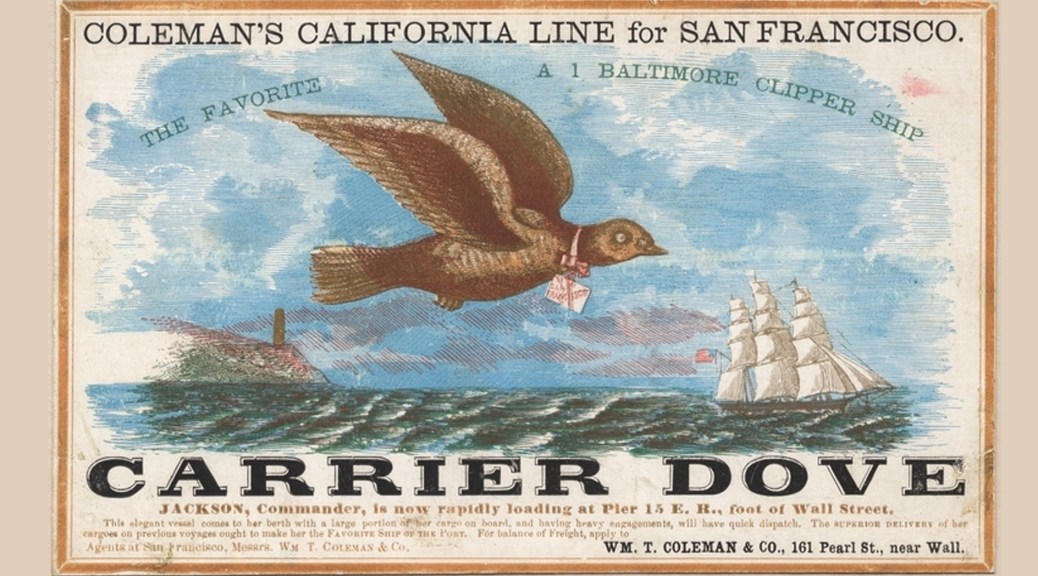
The metaphor of the Holy Spirit “descending like a dove” (or equally “a pigeon,” from “peristeran“), it is easy to make the analogy of a “dove of peace,” which is a Christian adaptation of meaning to the bird released by Noah. According to the Wikipedia article “Doves as symbols,” under “Judaism,” that report says: “The Talmud compares the spirit of God to a dove that hovers over the face of the waters.”  Jesus and John were in the waters of the Jordan.  As Jesus was leaned back and underwater, “just as he was coming up out of the water” the “spirit of God was hovering.”

When the aspect of the dove (or pigeon) is being sent by Noah as a messenger (carrier pigeon), which flew over the flood waters in search of dry land, it first returned as a messenger that land had not yet come out of the water, and a second time it returned as a messenger that land had indeed come out of the water.  The dove witnessed by John the Baptist says that Jesus was the Messiah, as THE Messenger of God. Therefore, any who have subsequently been filled with the same “dove that hovers over the face of the waters” are all Saints used in service to the LORD.

Of course, being filled with the Holy Spirit will bring with it serenity and a sense of calm, regardless of how much persecution is thrown at a Saint.  The dove cannot be seen foremost as a messenger of peace being offered to the world, as the world is not the realm where peace is welcomed.  Jesus was the messenger of an inner peace, which all are invited to enjoy.  However, peace comes at a most high price – total commitment to God.

Genesis 1:1-5 – In the beginning?

In the beginning when God [elohim] created the heavens and the earth, the earth was a formless void and darkness covered the face of the deep, while a wind from God [elohim] swept over the face of the waters. Then God [elohim] said, “Let there be light”; and there was light. And God [elohim] saw that the light was good; and God [elohim] separated the light from the darkness. God [elohim] called the light Day, and the darkness he called Night. And there was evening and there was morning, the first day.

———-

First of all, Genesis 1 lists the word elohim 32 times. It lists elohim four more times in the first verses of Genesis 2, before Genesis 2 states Yahweh elohim eleven times. This says Moses knew the difference between the pluran number elohim (“gods”) and the singular Yahweh, who created Man (adam) with a soul (el) and Yahweh Spirit (El), making Yahweh elohim. Thus, Genesis 1:1 says (via inference) Yahweh created “in the beginning gods” … to do His work of Creation in the physical.

The problem everyone has with this series of verses (and everything that follows them) is too much focus is placed on looking backwards in time, to some event that only half of educated adults these days (or less) believe happened the way this event is stated to have happened. After all, Moses told someone, “Memorize this and pass it along. Later we’ll plan to write it all down, when we find a place that has an office supply store selling papyrus, ink and quills.”

The doubters all say: “Moses was not there! How did he know anything?”

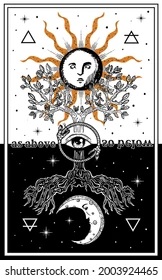
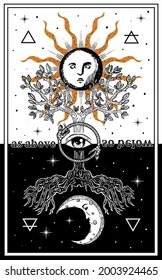
There is a saying that goes: As above, so below.

Memorize that. Write it down later and keep it in your purse or wallet.

That is the axiom for studies of the celestial bodies, as being metaphor for life on earth. Astrology was an art created by Yahweh, which Enoch was led to discover (Enoch did not die, like a Melchizedek). Still, the deeper truth is the voice of Yahweh (from above) manifests in saints in the physical realm (the below).

The reason Moses told Israelites what to memorize is this: everything he told them was a reflection of themselves. That makes everything he told them be a reflection of you and me. Of course, very few of them then, just like very few of us today, know how to see ourselves reflected in Scripture.

Can you see yourself as “a formless void,” with “darkness” covering your face?

As above, so below. As on paper, so inside your mind. As on the surface, so within unseen. As is visible human, so it invisible soul.

You are a creation that had a beginning when yo momma and yo daddy played adults together, before you were born. In that dark, moist void was millions of tiny sperms targeting one egg, as formless as you were at that time. Then it was God who allowed one particular sperm to penetrate the one egg and that became the moment: “Let there be light.”

And “there was light.” It was the first spark of union, one of many that would follow.

God called your formation “Good.” It was good because you had not yet learned how to fail God. You had not yet grown a brain, which would give you the power to extinguish your light and kill your goodness.

God put you into a sac that separated you from everything else that surrounded you. God then called your environment “Day,” and that outside the womb “Night.” God created you to be a light that would shine His truth upon the world. The world is where darkness abounds. That outside of your womb is in need to light shining upon it.

“Day” is where life exists, the wake state of being. “Night” is where death exists, the sleep state that reflects the absence of God. The place where there is an absence of God is where Satan reigns. Satan rules over the “Night.”

The “evening” of your first day of your creation was when one cell had been formed that would become you. The “morning” represents that one cell knowing (without a brain) it had been formed by the hand of God, for a purpose.

Now, it is easier to go history hunting and join a think tank that can maybe agree when your parents first did the dirty deed that would become you … the miserable wretch that you have become today. Many will argue the details, but there you sit. You are the evidence that it did happen, regardless of when the first step was taken. You cannot deny you had a big bang; but was there something before the big bang?

Was there you before there was you?

Questions, questions, and more questions.

All the answers can be known, if you remember what I taught you:

As above, so below.

Does “Reincarnation” ring any bells?

Maybe creation has been going on for an eternity!!!

Somebody turn on a light, for God’s sake!

———

Acts 19:1-7 – You call yourselves disciples?

While Apollos was in Corinth, Paul passed through the interior regions and came to Ephesus, where he found some disciples. He said to them, “Did you receive the Holy Spirit when you became believers?” They replied, “No, we have not even heard that there is a Holy Spirit.” Then he said, “Into what then were you baptized?” They answered, “Into John’s baptism.” Paul said, “John baptized with the baptism of repentance, telling the people to believe in the one who was to come after him, that is, in Jesus.” On hearing this, they were baptized in the name of the Lord Jesus. When Paul had laid his hands on them, the Holy Spirit came upon them, and they spoke in tongues and prophesied— altogether there were about twelve of them.

———-

Re-phrased, maybe this will ring a bell:

And a true Christian [Saint] asked, “Did you receive the Holy Spirit when you became believers?”

Those who call themselves Christians (of many different denominations) replied, “No, we have never been told there is a Holy Spirit that can be received or how to do that.”

Then the true Christian [Saint] said, “Into what then were you baptized? I ask simply because it is impossible to be a true Christian without receiving the Christ Spirit.”

They all answered, “Into a water baptism performed by someone wearing a robe that looked official.” [Some meaning they were received sprinkles on their foreheads as an infant, while others meant they had been dunked in an industrial-sized baptismal pool, with a heating element to make the water comfy.]

The true Christian [Saint] said, “Preachers, priests, pastors, and ministers of organizations that pay them to be employees of theirs baptize with water, in the pretense that water washes dirty bodies clean; and, that becomes symbolic of a baptism of repentance. Although an infant is pure and has never sinned, and most children under the age of twelve have committed no serious sins [nothing like filthy adults!], the symbolism of baptism tells people to believe in the one has to come after the preacher, priest, pastor or minister, that is, when one is reborn in the name of Jesus, as the Christ.”

———-

Where the story falls apart today is when it has to be re-phrased to state:

On hearing this from a true Saint of God, one who was reborn truly in the name of Jesus Christ and thus the physical embodiment of the resurrected Jesus, people calling themselves Christians were baptized in the name of the Lord Jesus.

When a true Saint lays his or her hands on such people professing to love God with all their hearts, all their minds, and all their souls, then the Holy Spirit will come upon them also; and, those newly risen reproductions of the Son of God (regardless of their human genders) will speak in the divine language of Scripture and explain what it means freely, as true preachers, priests, pastors and ministers of the true Church of Christ.

———-

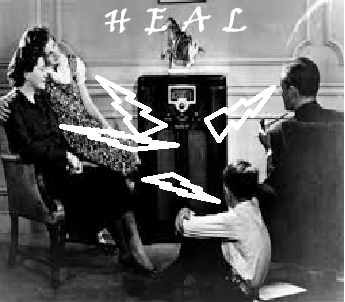
Unfortunately, that does not happen. Certainly not in churches, especially when the Holy Spirit [contrary to what Oral Roberts would have one believe] is not transferred by people laying their hands on a radio, television, or computer monitor … where many church services are held in the Coronavirus era. A Saint does not actually have to lay hands on one, as much as a Saint has to demonstrate how being Jesus reborn is not only possible, but a requirement, as stated in Scripture.

Sadly, as of today’s true count, the whole number of true Saints in the world, who have the power to lay hands on fakers and make the Holy Spirit available to them is “altogether there about twelve of them.” No change it appears, in two thousand years [although the reality is the number went way up high, before guillotines and the love of gods like science, politics and philosophy made the number become rarer than bigfoot and UFO sightings.

And, on top of that, when one of the twelve opens his or her mouth to someone calling himself or herself a Christian, Christians these days act like Romans and Temple Jews, as they start preparing a cross onto which they will crucify Jesus once again, forever trying to reduce the number to eleven, calling a true Saint a Judas Iscariot.

And that is the moral of this story never yielding a new, true Christian today, like ot did so long ago.

Mark 1:4-11 – Washing the sin off yourself

John the baptizer appeared in the wilderness, proclaiming a baptism of repentance for the forgiveness of sins. And people from the whole Judean countryside and all the people of Jerusalem were going out to him, and were baptized by him in the river Jordan, confessing their sins. Now John was clothed with camel’s hair, with a leather belt around his waist, and he ate locusts and wild honey. He proclaimed, “The one who is more powerful than I is coming after me; I am not worthy to stoop down and untie the thong of his sandals. I have baptized you with water; but he will baptize you with the Holy Spirit.”

In those days Jesus came from Nazareth of Galilee and was baptized by John in the Jordan. And just as he was coming up out of the water, he saw the heavens torn apart and the Spirit descending like a dove on him. And a voice came from heaven, “You are my Son, the Beloved; with you I am well pleased.”

———-

Some important things to realize, when this reading is compared to the way things are today:

John the baptizer appeared in the wilderness says John was a performer, as such, who made appearances in places that were not official institutions of religious belief. His performances were designed to bitch-slap the religious institution that was Judaism [today this includes all branches of Christianity, thus is Judeo-Christian], because any religion that calls itself a holy extension of God, but then has nothing but sinners as members is a farce and an insult to God Almighty. Thus, John the baptizer was putting on a show that made fun of the pretense of all religions.

When we read, “Now John was clothed with camel’s hair, with a leather belt around his waist, and he ate locusts and wild honey,” ask yourself when the last time was you went to a church or synagogue and saw some preacher, priest, rabbi, pastor, or minister dress in such a comedic manner? NEVER!!! Then ask yourself, “When was the last time I knelt at some ‘to-go’ rail and held my hands out like a cup, for somebody to drop a locust into them, to be washed down with some wild honey?” NEVER!!!

The Jews had all kinds of cleansing rituals involving water. They weekly baked showbread and placed loaves in the Temple, in case God got hungry; but they always replaced the old loaves with fresh ones and then the Temple priests ate the leftover bread, because God never had an appetite for the bread the Temple priests placed before Him. A locust, on the other hand, is a destroyer of grain. John the baptizer destroyed the destroyers of physical bread as his means of survival. [Does that make you think of a priest as a locust?]

The use of wine or grape juice by the Jews was a symbol of redemption [Seder cups], whereas Christians see it as the blood of Jesus [Communion cups]. You cannot get redeemed by getting drunk on wine, nor can you get a transfusion of grape juice when your body has lost blood. John the baptizer ate the waste product of bees, symbolic of the sustenance produced for a hive of new life, which has a lingering flavor in the mouth, gives a sugar rush in the blood, and makes one act, rather than want to lie down or pass out drunk. Honey symbolizes the fertility shown by the fruit of the land, as does milk, as do GRAPES: the good fruit of the vine [not grapes stomped on by dirty feet and left to ferment]. John drank honey to receive the good fruit (not the juice) of the vine of God’s truth. John the baptizer consumed that which made him holy, not that which pretended to give him a right to claim superiority.

John the baptizer “proclaimed, ‘The one who is more powerful than I is coming after me; I am not worthy to stoop down and untie the thong of his sandals.'” Jews then had to understand, just as Christians today must be able to see, the “I” in what John said applies to each and every Tom, Dick, and Harriet that claims “I am a believer!” The state of being that is “after me” is that most divine state of being that “is more powerful than I.” That one who is a great elevation to oneself is Jesus Christ.

Jesus Christ is not some mythical figure who sits on a throne next to God, in heaven, as an ethereal being external to oneself, because if that were the case there would never be a more powerful I for John the baptizer to tell people was coming. Jesus was the divine extension of God, as THE SOUL that would become merged with every Tom, Dick, and Harriet soul-flesh, which would make them each and all become the resurrection of Jesus in the flesh. When that transformation takes place afterwards, then rather than go by the name on one’s drivers’ license, one realizes one is “in the name of Jesus Christ.” “I” just got demeaned in value, thus “I is not worthy to stoop down and untie the thong of the sandals of the Son of God.” Without “I” getting in the way [self-ego], one’s flesh just became the Son of God (regardless of human gender).

When John the baptizer said “he will baptize you with the Holy Spirit,” it is a mistake to think the human flesh that was Jesus walked around with a magic wand that he could wave [like some Pope], saying, “Domini, Domini, You’re all baptized with the holy spirit now. Pay the clerk.” The ONLY ONE WHO CAN BAPTIZE WITH THE HOLY SPIRIT is GOD. God baptized Jesus so he was the Christ on earth. Belief in that possibility means you too can be touched by God and be made His Son (regardless of human gender). If you are not so touched, you are still just a worthless “I,” which everybody thinks is important, until death comes a calling.

To read, “In those days Jesus came from Nazareth of Galilee and was baptized by John in the Jordan,” says Jesus the human being in the flesh found a need to go to the wilderness and let John baptize him with the water that redeems sin, since the Temple and synagogues [aka churches these days] did nothing towards that end. Jesus might have thought of some Temple priests being boiled in oil for their sins against God, so he wanted to wash those thoughts away [maybe]. Jesus was not going to his cousin John for the Holy Spirit.

When the translation above say, “just as he was coming up out of the water, he saw the heavens torn apart and the Spirit descending like a dove on him,” the Greek text needs a closer look. That text states (in Greek): “kai euthys anabainōn ek tou hydatos , eiden schizomenous tous ouranous , kai to Pneuma hōs peristeran katabainon eis auton .

Notice how I have placed the word “kai” in bold text. That is because God does not stutter when He talks to Saints and Prophets, so a meaningless conjunction like “and” is not the divine meaning. The word “kai” puts emphasis on what is said next, such that the reader sits up and pays special attention to the words that follow. That said, those word in Greek should be translated as such:

TAKE NOTICE: immediately rising up [or, ascending; or, becoming elevated] from this water [“this” = Jesus baptized by John in the Jordan] ,

he experienced [the third person masculine singular must be seen as meaning both Jesus and John] opening that spiritual heaven ,

TAKE NOTICE: this [“this” = “spiritual heaven opening”] Spirit like a dove descending [a statement of “fluttering” in one’s heart] upon them [“auton” viable as “them”] .

This says the presence of both John and Jesus in the Jordan River, for the purpose of cleaning the flesh from sin meant both had truly become sacrifices before God, as servants of the Lord, such that the Holy Spirit overwhelmed both John and Jesus, with an inner feeling that dropped their souls to their proverbial knees, in submission to God, enabling them to both receive the blessings of God the Father. Because John was a true Apostle, also filled with God’s Holy Spirit, both felt the power of being Sons of God. Therefore, when Mark wrote of God saying: “You are my Son, the Beloved; with you I am well pleased,” God was pleased with both John and Jesus. Both were Sons of God.

That statement is another than needs language inspection, as it too begins with that special word “kai.” The Greek text states, “kai phōnē egeneto ek tōn ouranōn : Si ei ho Huios mou ho agapētos , en soi eudokēsa .” This properly states:

TAKE NOTICE: a voice came out from within [both Jesus and John] the heaven [which had opened in them] : You [both Jesus and John, individually] are the Son of me , this [“this” = “the relationship as God’s Son”] the love of the Christ I give , in you [both Jesus and John] I am pleased to be .

If you can get your brain around that translation, you will see that both Jesus and John had God’s love within the core of their beings – as total love of God from their hearts, minds, and souls – which was what allowed God to take up residence within both of them. The voice of God emanated from each of their lips at the same time, as heaven had opened within their bodies of flesh, from their hearts, minds, and souls. The two were together in water (the element symbolizing floods of emotions), as two becoming united as one, both married to the Father.

If you can see that, then you can become just like both Jesus and John, where you [not some Temple, synagogue, church, or organization] take it upon yourself to wash your sins clean [as John was doing, while also washing others as he washed himself clean]. Then Jesus will come get in the same baptismal pool you use and together both you and Jesus will feel the joy of your souls opening and feeling the flutter of God’s Holy Spirit taking up residence, telling you both “I love being in you,” … because you love God unconditionally.

The reason this is read during the day of Epiphany is you need to have this flutter land upon you. It must be an emotional experience that remains within you for a lifetime … not some temporary rush once a week, on Sunday.

That state of union becomes impossible if you think only Jesus could ever have that experience. It is impossible if you deny you must leave the crowd of know-nothings and go to the river to wash yourself clean, so you must become John. It is impossible if you look to a church for baptism by water, never once thinking Jesus will come to you to be submerged into your soul, so God can become your Father and you His Son reborn (regardless of your human gender).