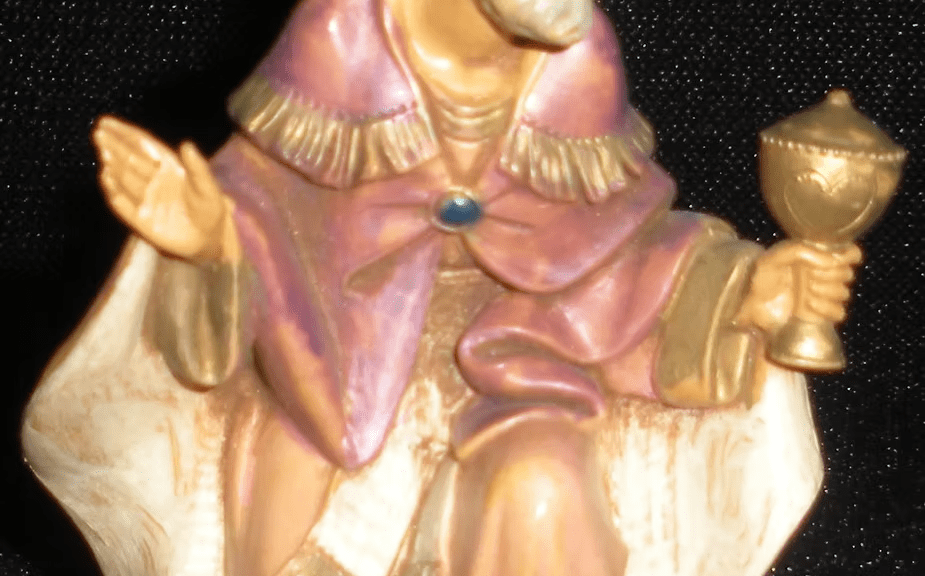
Tag Archives: Epiphany 1 Year C

Matthew 2:13-15,19-23 – One of three ‘wise readings’ after Christmas

After the wise men had left, an angel of the Lord appeared to Joseph in a dream and said, “Get up, take the child and his mother, and flee to Egypt, and remain there until I tell you; for Herod is about to search for the child, to destroy him.” Then Joseph got up, took the child and his mother by night, and went to Egypt, and remained there until the death of Herod. This was to fulfill what had been spoken by the Lord through the prophet, “Out of Egypt I have called my son.”

When Herod died, an angel of the Lord suddenly appeared in a dream to Joseph in Egypt and said, “Get up, take the child and his mother, and go to the land of Israel, for those who were seeking the child’s life are dead.” Then Joseph got up, took the child and his mother, and went to the land of Israel. But when he heard that Archelaus was ruling over Judea in place of his father Herod, he was afraid to go there. And after being warned in a dream, he went away to the district of Galilee. There he made his home in a town called Nazareth, so that what had been spoken through the prophets might be fulfilled, “He will be called a Nazorean.”

——————–

This is one of three Gospel choices that can be read aloud by a priest on the second Sunday after Christmas. If chosen, this reading will follow a reading from Jeremiah, where the prophet wrote: “among them the blind and the lame, those with child and those in labor, together; a great company, they shall return here. With weeping they shall come, and with consolations I will lead them back”. A singing of Psalm 84 will follow, where David sang: “Those who go through the desolate valley will find it a place of springs, for the early rains have covered it with pools of water.” Those will be followed by a reading from Paul’s letter to the Ephesians, where he wrote: “May [Yahweh] give you a spirit of wisdom and revelation as you come to know him, so that, with the eyes of your heart enlightened, you may know what is the hope to which he has called you.”
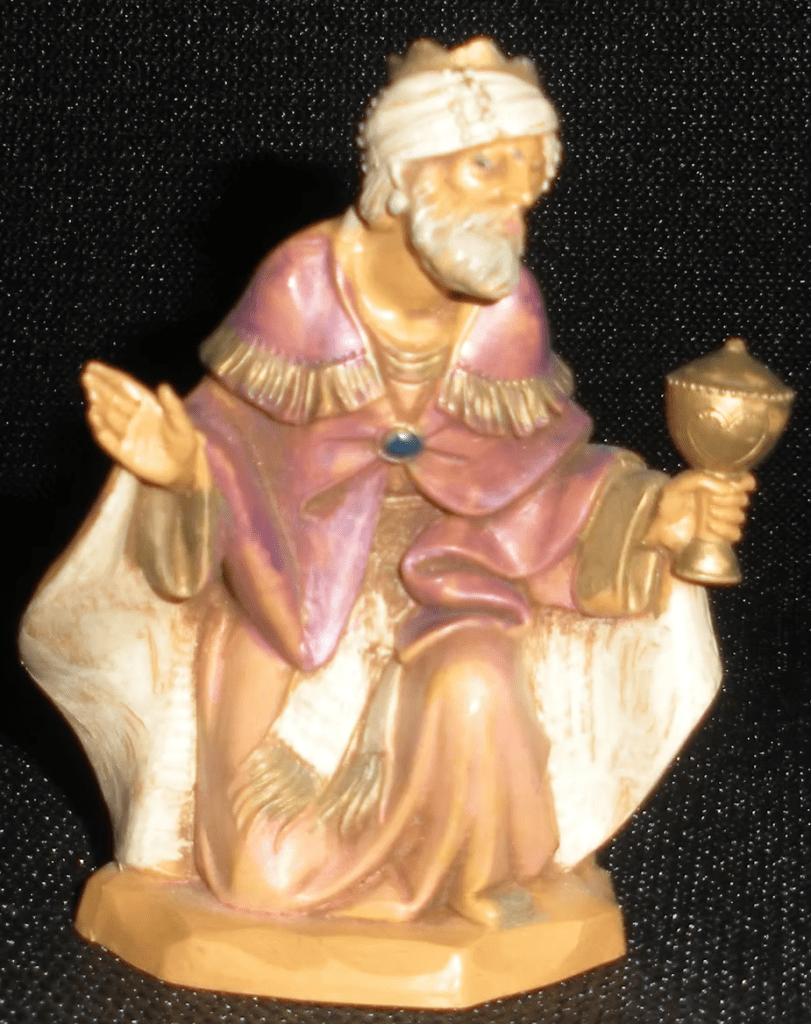
This seems to be a fairly clear-cut story that says Yahweh sent an angel to warn Joseph to take Mary and infant Jesus to Egypt. This is because Yahweh knew of the Magi visiting Herod and asking to see the “King of the Jews.” That story is read in Matthew 2:1-12, prior to this; and, that is one of the three optional readings for this Sunday after Christmas. The verses skipped over tell of the slaughter of the innocents by Herod. After that took place, another angel message told Joseph it was clear to bring Mary and Jesus back to Galilee, to Nazareth. That simple story is true; but there is deeper information contained in this reading. It is that deeper information that is why this reading is an option for reading on the second Sunday after Christmas.

Verse thirteen states this (in Greek): “Anachōrēsantōn de autōn , idou , angelos kyriou phainetai kat’ onar tō Iōsēph , legōn , Egertheis , paralabe to paidion kai tēn mētera autou , kai pheuge eis Aigypton , kai isthi ekei heōs eipō soi”. Without knowing any Greek, one should be able to see that there are four capitalized words: Anachōrēsantōn, Iōsēph, Egertheis, and Aigypton. All capitalized words must be read as divinely elevated, so the intent is to show a connection to Yahweh. Then, because I have placed the word “kai” in bold type, one should take note that the word is a marker – like a symbol of punctuation – that need not be read as “and,” but instead be seen as denoting that written to follow “kai” is of significant importance. Thus, verse thirteen contains three important statements that must be heeded.

The word Anachōrēsantōn [in Greek: Ἀναχωρησάντων] is the Aorist Active Participle, Genitive Plural Masculine, which is adding “-ing” to a past event that took place, controlled by several [implying men]. The root verb is “anachóreó” [“ἀναχωρέω”], which means “to go back, withdraw,” implying “I return, retire, withdraw, depart (underlying idea perhaps of taking refuge from danger or of going into retirement).” The word can also imply a release of tension from an event, such that the after effect is “to relax.” This means the basic word means, “them having departed,” but the capitalization makes this less about the departure of Magi from the house in which Joseph, Mary and Jesus were resting, so the meaning is elevated to the divine level of meaning, where “to return” or “to go back” is relative to the “souls” [Masculine] “of all them” [Genitive plural] “having returned” [Aorist Active Participle] to Yahweh, as His. This means the element of “Having relaxed” is a statement that a great Peace came over the Magi, Joseph and Mary, having witnessed an event so holy that the radiance of Yahweh penetrated everyone present.

The name “Joseph” means “Increaser, May He Add.” When we read that an “angel of the Lord appeared in a dream,” the Greek words “angelos kyriou phainetai kat’ onar” need to be examined more closely. First of all, the word “kyriou” is not capitalized, so to make it read as if saying “the Lord,” gives the impression that the angel was sent by Yahweh, such as when Yahweh sent Gabriel as His messenger before. In fact, “angelos” can be translated as “a messenger.” Next, the word “phainetai” is present tense, not past, so in the third-person is translates as “appears” or “seems.” Then, the word “kat’” (short for “kata”) means “down, against, according to, by way of,” but not “in.” The “in” can only be added to the translation of “onar,” as “in a dream,” but that means “kat’” is left untranslated; and, Holy Scripture has no superfluous words in it.

This means that written, leading up to “Joseph,” says, “a messenger of guidance appears against a dream.” This needs to be seen as following a divine state of Relaxation replacing a most holy ceremony that took place (with the Magi and Jesus), with the Magi “having departed” the room, the tendency for a normal human being would be to wonder, “Was that real or a dream?” This is where the timing of the Magi’s appearance in the room needs to be realized.

The Magi were foreigners. Nobody in Galilee or Judea recognized them, as they had come from the east – Persia. Strangers do not arrive anywhere at night and expect doors to open to them. The saw Herod in the morning, when normal business would be conducted. When they left Herod’s palace it was still morning. When they “saw the star above them” that was the sun. The sun is a star that is easily visible in the day time, even if cloudy. This means they travelled the short distance to Bethlehem, arrived there and did a search to find where a birth just occurred. They were led to the room with Joseph, Mary and Jesus while it was broad daylight outside. They performed a holy ritual that anointed Jesus as king [the gifts they bore], and then they left. Mission accomplished. That means Joseph is standing in the room, wide awake, thinking to himself, “Am I dreaming? Or, did what I think just happened just happen?”

Because he was no longer in a mesmerized state of reverence, due to Yahweh and His servants being present in a most holy Anointing of His Son as the promised Messiah, in an act similar to Samuel anointing David with oil from a horn, all kinds of strange things happened during that ceremony. The Muslims read in the Koran that Jesus – as a newborn – had the ability to speak. The Magi might have asked Jesus questions, to which he responded. Joseph would have been placed in an almost catatonic state, due to this holy presence. When the Magi left, it would have been as if restraints had been removed, so everything returned to a normal state of relaxation. It was in this state that a voice then “appears” in Joseph’s mind, which is a “message” that tells him nothing is “a dream.”

This is where the name “Joseph” needs to be seen as meaning “Increaser, May He Add.” Rather than an “angel appeared in a dream to Joseph,” we must see the divine elevation of how an “Additional instruction” came to Joseph. The words now say, “a messenger of guidance appears by way of a dream thereupon Increaser.” This means after the Magi departed, Joseph received divine insight that told him what to do next; but more importantly, Joseph’s soul became “Increased,” such that his soul “Added” an “angel” that became the “lord” over his flesh, “Adding to” his thoughts.

This means there was no “dream” that took place in the middle of the night. It means hours had not passed after the Magi left. It means that immediately once “Having relaxed,” Joseph’s abilities as a Yahweh elohim [an “angel” in the flesh] came to him. Thus, what is written next also needs to be more deeply examined.

The NRSV shows a dream conversation, where an angel appeared and told Joseph, “Get up, take the child and his mother, and flee to Egypt, and remain there until I tell you.” Besides the first-person “I” in “until I tell you” [“eipō”] making it sound like the “angel” is running the show now, it also furthers the notion that the “dream” took place in the middle of sleep, where “Get up” is a command to get out of bed and put your clothes on. That is not what is written.

The Greek text written is this: “Egertheis , paralabe to paidion kai tēn mētera autou , kai pheuge eis Aigypton , kai isthi ekei heōs eipō soi”. This literally translates to state, “Having been raised , you receive this infant kai this mother of same , kai you get away into Temple of Ptah , kai you exist there until when I shall have said to you”. Here, the first word is capitalized, such that “Egertheis” is presented in a similar form as is “Anachōrēsantōn,” only now the form is Aorist Passive Participle, Nominative Singular Masculine. This is a statement only relative to Joseph [Singular Masculine], as “Having been raised.” The capitalization divinely elevates this meaning to the soul of Joseph, not a statement about his physical body “getting up.” In the Participle form, the voice inside Joseph’s mind was telling him “You have been raised” Spiritually. This now acts as confirmation that Joseph was indeed a Yahweh elohim.

In the words that appear to be an angel telling Joseph to take baby Jesus and mother Mary to Egypt, what is said on a much deeper level, which is more aligned with a divine insight coming into one’s mind. The words say that Joseph had “received this infant,” where this becomes a Christmas statement that is relative to Joseph, who in no way was directly involved in the creation of a baby with Mary. The Greek word “paralabe” not only translates as “you take,” but also as “you receive, you accept.” The deep meaning is the second soul born into Joseph’s soul was also “an infant” like baby Jesus in him. Following that realization is the word “kai,” which signals it is more important to see Joseph as “this mother of the same,” or “this mother of the self,” where “autou” is possessive and is viable in those translations. While this says Mary was likewise with a second soul that was from the same source as the soul of Jesus, it says more importantly that Joseph is “the mother” that gave birth to this new infant soul within his soul, because he was the wife of Yahweh – the Father of the Son – physically in baby Jesus, but Spiritually in the souls of all (including the Magi who had recently departed).

In the capitalization of Egypt, the meaning of the name needs to be known. Scholars say the name originated as words that denoted where the Temple of Ptah was, with Ptah being the “creator-god who had created the world via his thought and his word, and he also became patron of craftsmen.” This is then divinely elevated to be a place of security where Joseph and his family could go and be protected by Yahweh. The same word (Egypt) can also translate as “Married To Tragedy,” depending on how one pronounced the word. Thus, because of this duality of meaning, when the voice inside Joseph’s mind said to “exist there until I shall have said to you,” the time to leave when Herod’s and Judea’s “tragic marriage” ended with his death (and then Herod Archelaus being disposed).

As to the prophecy, “Out of Egypt I have called my son,” this relates to Hosea 11:1, where the word translated as “Egypt” is “mitsrayim.” The whole of that verse by Hosea says, “when a child Israel and I loved him and out of Egypt I called my son,” this can equally be applied to all then, afterwards and forever whose souls have received the soul of Jesus – the child Yahweh loves – and has become “in the name of Yahweh” – “Israel,” a name that means “Who Retains Yahweh as His elohim”. Thus, Hosea can be seen as prophesying of Joseph (et al), “when a child who retains Yahweh as His elohim and out of marriage to tragedy [a soul led to sin by Satan] I called his soul my son.”

This is important to realize as the truth intended, as to read this “dream” as an “angel of the Lord” coming to Joseph and crying out, “Hurry! Leave now to save your lives. Herod is going on a rampage!” is to see Yahweh as some lesser god that fears anything and everything. Jesus escaped many attempts of death and punishment, without any harm allowed. Joseph and family could have gone about their lives in Nazareth with no threats against them. The truth says Yahweh wanted Joseph to go to Egypt to develop skills as a carpenter, working as an apprentice to a master carpenter. The call would avoid being distracted by the ways of a wicked world, where tyrants like Herod routinely kill innocents without any guilt (until death comes). Thus, this reading should be seen as Joseph being able to hear the voice of Yahweh lead his every move, knowing everything would be okay. After all, he had been returned to Yahweh by the promise of eternal life – redeemed as a Yahweh elohim.

At this point, it is imperative to realize that there was absolutely no urgency to leave Galilee (or Jerusalem-Bethlehem) for Egypt at that moment. Joseph and Mary were in Bethlehem to register for the census; and, they had not planned to stay there for a few days. They had other family that would have come looking for them and would have taken them back to their home after leaving Bethlehem. In Luke, it has to be recalled that the bris and naming of Jesus would have been when he was eight days old, and that would not have been done in Bethlehem. Also, the dedication in the Temple would be when Jesus was forty days of age, when Mary had passed the time after giving birth to a son and would be allowed to enter a sacred place. There would have been time to return to Nazareth and make arrangements for Joseph’s house there to be maintained (if not still a place for his children from a prior marriage, all adults). With this recalled, it is easier to see the intent of verses thirteen through fifteen was far from panic-driven fear, in the light I have presented.

After skipping over the verses telling of Herod’s acts against the innocent in Bethlehem, verse nineteen needs to be seen to repeat, “an angel of the Lord suddenly appeared in a dream to Joseph.” In that “suddenly” is added, which is not written by Luke. The Greek text shows this: “angelos Kyriou phainetai kat’ onar tō Iōsēph,” which is exactly as stated in verse thirteen, with the only exception being “Kyriou” is now capitalized. This capitalization elevates the word divinely to that of Yahweh speaking through Joseph. It can now be a dream at night, as years have passed since Joseph moved his family to Egypt. This one change then signifies the next repetitious command can be read differently than that prior.

Again, we read the Greek written as exactly the same as that found in verse thirteen: “legōn , Egertheis , paralabe to paidion kai tēn mētera autou , kai ,” where the exception now adds, “poreuou eis gēn Israēl” or “you make to go [or journey] into land of Israel”. Now, “paidion” can be translated as “little child,” referring to Jesus, with “this mother of same” being reference to Mary, who bore him. The same capitalized word begins this – “Egertheis” – meaning “Having been raised.” Again, the capitalization divinely elevates the word to mean Spiritual “raising,” not simply waking up and getting out of bed. The voice of Yahweh (from “saying”) is now recognized by Joseph, so his soul was “raised” to hear a command.

It should also be realized that Joseph was not told to go back to Judea, the land of Herod the Great. The name “Israel” is stated in the Genitive case, meaning “of Israel.” This would be both Joseph and Mary, as both would be “little children who retained Yahweh as His elohim,” with Jesus born that way. This means the word “gēn” needs to be expanded to say “the inhabitants of,” more than a generic “country” or “land,” as no place on earth can truly be Yahweh elohim. The capitalization divinely elevates that name to the meaning behind the name, which was the name given to Jacob after he defeated his evil possessing souls and freed his soul to only be possessed by Yahweh. Seeing this says the voice of Yahweh did not tell Joseph to return to a land of pagan rulers, as he was told to go back in the name of Yahweh.

Relative to this, where the NRSV translates the voice of God saying, “for those who were seeking the child’s life are dead,” this promotes the notion of fear. It makes one think Yahweh is scared for Jesus’ life, when he sent His Son to die – at the appointed time, not before. Thus, the Greek here needs to also be closely scrutinized.

The Greek says, “tethnēkasin gar hoi zētountes tēn psychēn tou paidiou”, which translates literally to say, “they are dead indeed those them seeking this soul [life, breath, spirit] of this little child”. Because only Herod had died, with his son Archelaus taking over where daddy left off, that was limited to the Roman vassal known as Judea, not that truly “of Israel.” Thus, the same words should be read as saying the souls of all who linger in Judea and Galilee (et al) were dead, from not having the “life” of Jesus in their souls. To say “dead” is to say “mortal.” Those who were truly “seeking this life” had no one making it available. Jesus had to return to make “soul of this little child” available to them.

In verse twenty-two, where the NRSV translates, “he was afraid to go there,” relative to Judea being where Archelaus had the most power, the translation of “ephobēthē” – “he was afraid” – becomes yet another attempt to show a servant possessed by Yahweh as being possessed by fear. The root word phobeó does usually mean “I fear, I am afraid, or I am terrified,” but the same word can indicate “I revere,” which means Joseph only “feared” losing Yahweh’s Spirit, so he dared not go to Judea because he had been warned by Yahweh not to go there. He “revered” that “divine warning,” so he “feared” to go there, against the Will of Yahweh.

It must be understood that the story of Joseph says he lived in Nazareth, but the census demanded by Rome required all citizens to register in their birthplace. That is the only reason Joseph and Mary were in Bethlehem. So, a return to where their home had been would mean a return to Nazareth. When verse twenty-three says, “There he made his home in a town called Nazareth, so that what had been spoken through the prophets might be fulfilled, “He will be called a Nazorean,” this needs to be fully understood.

In the Gospels, Jesus is routinely referred to as a Nazarene, which means he was an inhabitant of Nazareth. Nobody called him a “Nazorean.” Here, again, one must realize this is a capitalized word, which means it’s intent is divinely elevated in meaning to be the meaning behind the name. Here, “Nazareth” means “Consecrated, Place Of Nazirites,” although other meanings can also be read. A “Nazarite” is found defined in Numbers 6, where an Internet definition is: “an Israelite consecrated to the service of God, under vows to abstain from alcohol, let the hair grow, and avoid defilement by contact with corpses (Num. 6).” This means Jesus was clearly seen as a “servant of God,” whose philosophical alignment was as an Essene [not a Pharisee, not a Sadducee]. Thus, a “Nazorean” is actually a statement about Jesus being a high priest of the Essenes, making his lifestyle (like that of John the Baptist) be as a Nazarite.

When this association with the Essenes is realized [the upper room was in the Essene quarter of Jerusalem], one can learn that the Essenes held a separate place as sacred, which was a temple on Mount Carmel. Nazareth is only ten miles from that site. When we read that Zechariah was doing his Levitical duties burning incense in the temple when the angel Gabriel appeared before him and told him Elizabeth was pregnant with John (the Baptist), that temple was not in Jerusalem. It was in the one on Mount Carmel. When we read that Mary found out both she and Elizabeth were divinely pregnant (again by Gabriel), she ran with haste to Zechariah and Elizabeth’s house, which was in the “hill country of Judah.” That “hill country” is the mountain range that leads to the base of Mount Carmel, just outside of Galilee [just into Samaria]. It was not in Jerusalem. All this means that Jesus’ family were devout Essenes, with John and Jesus being Nazarites. Just by their appearance, they would have been disliked by the Pharisees and Sadducees.

As one of the Gospel readings that can be read aloud by a priest on the second Sunday after Christmas, the reason is again to see the hidden meaning of one being reborn as Jesus, becoming both “of the child” and “of the mother,” where the soul has married Yahweh and let His Spirit bring about the changes that are revered on Christmas Day. The point is to take that reverence well beyond one day a year and make it every day. Otherwise, all souls are like those Joseph took his family back to – dead and no longer seeking to be filled with the life of the child Jesus.

Luke 2:41-52 – The second of three ‘wise readings’ after Christmas

The parents of Jesus went to Jerusalem every year for the festival of the Passover. And when he was twelve years old, they went up as usual for the festival. When the festival was ended and they started to return, the boy Jesus stayed behind in Jerusalem, but his parents did not know it. Assuming that he was in the group of travelers, they went a day’s journey. Then they started to look for him among their relatives and friends. When they did not find him, they returned to Jerusalem to search for him. After three days they found him in the temple, sitting among the teachers, listening to them and asking them questions. And all who heard him were amazed at his understanding and his answers. When his parents saw him they were astonished; and his mother said to him, “Child, why have you treated us like this? Look, your father and I have been searching for you in great anxiety.” He said to them, “Why were you searching for me? Did you not know that I must be in my Father’s house?” But they did not understand what he said to them. Then he went down with them and came to Nazareth, and was obedient to them. His mother treasured all these things in her heart.

And Jesus increased in wisdom and in years, and in divine and human favor.

——————–

This is the second of three optional Gospel readings that might be read aloud by a priest on the second Sunday after Christmas, Year C, according to the lectionary for the Episcopal Church. If chosen, it will follow an Old Testament reading from Jeremiah, where the prophet wrote: “With weeping they shall come, and with consolations I will lead them back, I will let them walk by brooks of water, in a straight path in which they shall not stumble.” Following that will come a singing of Psalm 84, where David wrote, “Happy are they who dwell in your house! they will always be praising you. Happy are the people whose strength is in you! those hearts are set on the pilgrims’ way.” That set will precede a reading from Paul’s letter to the Ephesians, where he wrote: “I have heard of your faith in the Lord Jesus and your love toward all the saints, and for this reason I do not cease to give thanks for you as I remember you in my prayers.

This optional reading might be confusing, as far as figuring out why it is selected for the second Sunday after Christmas. This reading is always an option on this particular Sunday in the Church lectionary, in all three years (A, B, C). However, if overlooked every year, due to the theme being well after his birth (twelve years), this one reading will be the only Gospel reading read aloud by a priest on the Feast of Saint Joseph (the husband of Mary), which is every March 19th, next coming in the second week of Lent in 2022.

As far as I am concerned, this reading seems fairly straightforward, telling of Joseph and Mary always going to Jerusalem for the Passover festival, with this one time they left Jesus behind. Having to come back to look for him, they found him in the Temple of Jerusalem, where he was showing his divine wisdom to great astonishment by the elders. The parents did not seem his divine powers were needed to be on display, while they were worried a twelve-year old boy was alone, without his parents, in a big city. Jesus took a scolding and then went home with his parents.

Good luck finding a priest willing to preach about that historic event, in these days when children get the run of the house and their parents, able to do as they please (usually that taught to them by elders in schools). This is why it would be overlooked on a day designated as ‘Christmassy.’ However, much is conveyed in this reading that is overlooked, simply because everyone sees young Jesus too old to be baby Jesus just born in Bethlehem.

What is deleted from the NRSV translation presented in church bulletins is the significance of the presence of the marker word “kai.” Because translators read the word as a useless stutter, which (to them) is overused, they disregard it altogether. They toss it out with the dirty bath water, having no belief that every word of divine Scripture is written with purpose. Yahweh tells His prophets what to write; and, they write it, without complaining, “Isn’t that too many kais?”

In this reading there are twelve verses. In those are found twenty-three uses of the word “kai,” with seven capitalized, beginning a verse. Three of the other lower-case “kais” lead three other verses; so, of twelve verses, ten begin with the word “kai.” That signifies much importance comes from these twelve verses.

If this were the Book of Elizabeth Warren, the word of choice would be “so,” which is such a useless way to begin a statement that everyone who listens to her politicize simply ignores her stuttering use of “so,” simply because their lips are so firmly kissing her every word [fortunately, there are not many of those around]. It is a word she so overuses that listeners find it irritating and tune her out. In that way, translators of Scripture also see the word “kai” as a useless irritation, so they tune it out of translation.

The word “kai” is a marker word that denotes: “importance to follow.” In the same way a period mark does not speak, but says, “Stop here,” and a comma mark does not speak, but says, “Pause here,” the word “kai” should not be translated as “and” [or thrown away as overuse by a ‘stuttering’ author – “you know”]. When the word is capitalized the marker word is elevated divinely to a higher level of importance. That high importance has been disregarded in the above translation.

Here is how to read these twelve verses (always reading slowly, so meaning can come to one through inspiration, not intellect):

41. Kai were going these parents of him down from year into Jerusalem this feast of this of Passover .

42. Kai when he was years twelve , having ascended they according to the custom of this feast .

43. kai having brought to an end these days , among this returning of them , stayed behind Jesus this boy in Jerusalem .

44. having thought now him existed him in their traveling company ¸ they went a day’s journey , kai began searching for him among these kinsmen kai these acquaintances .

45. kai not having found (in the search) , they turned back to Jerusalem , seeking him .

46. Kai it happened after days three , they found him in the temple , sitting among in the middle of these teachers kai listening with comprehension to them kai interrogating them .

47. were amazed now all them hearing him on the basis of this understanding kai these answers of him .

48. Kai having attended to him , they were astonished , kai said to him this mother of him , Child why have you done to us in this manner ? behold! , this father of you , and I , suffering in pain were searching for you .

49. Kai he said to them , Why because you seeking for me ? not remembered you that into these of this Father of me it is necessary they exist me ?

50. kai they not understood this word this he spoke to them .

51. Kai he descended with them kai went to Nazareth , kai he existed obedient to them . kai this mother of him was keeping carefully all these things spoken < here > in this inner self of her .

52. Kai Jesus progressed in this wisdom kai maturity , kai in grace alongside of God kai a man .

When these selected verses are read in this manner, where every segment is shown separated from the others (by punctuation, use of kai, or verse transition), there are forty segments. Each segment must be seen as a separate statement coming from the Mind of Yahweh, written through His prophet Luke. Of those forty, twenty-three are found important to understand, with everything found in ten of the twelve verses most important information being passed on in words.

Here is a breakdown of what is written:

Importantly: Joseph and Mary yearly went from Nazareth to Jerusalem for the Passover festival, which was eight days every year. This is an important statement of devotion to Yahweh, as Jews who knew their vows to Yahweh included always recognizing the festivals He deemed necessary to maintain. Still, this has an important subplot.

Nazareth was a town established by Essenes as a place for their priests who maintained their temple on Mount Carmel. Zechariah was one who lived in a town across the valley, where Galilee changed to Samaria. With the verses in Luke 1 telling this story of Zachariah and Elizabeth, the temple where Zechariah was burning incense was the one on Mount Carmel. Then, when Luke 1 tells of Mary knowing of her being pregnant – the birth of Jesus – and Elizabeth is also pregnant (6 months) – Mary runs down the valley, into Samaria to Zechariah’s house. This says the families in Nazareth were leaned towards being Essenes.

In the subsequent move into Egypt, told to Joseph in a divine dream, the family left Nazareth until it was safe to come back. While in Egypt, Joseph learned a trade (carpentry). In Matthew 1:19 we are told that Joseph was “a righteous man,” or one who “existed righteously.” This means he most likely was also an Essene priest, whose move from Bethlehem to Nazareth was to be close to the temple on Mount Carmel. However, as part of the move to Egypt being to learn a craft, his return to Nazareth was to appear more ‘mainstream,’ as one who recognized the Passover in Jerusalem. The Essenes did not pilgrimage to Jerusalem for the Passover. That little known fact being known in Luke 2:41 is then stating the importance of Joseph and Mary traveling each year to Jerusalem. That becomes a statement of their hiding the depth of their devotion to Yahweh, so they did not stand out more to their neighbors as zealots, drawing ire from the influx of priests to Nazareth that were devoted more to the Temple in Jerusalem than to Yahweh.

Importantly: Jesus is now twelve years of age, which means he is on the verge of being deemed a man. On his thirteenth birthday, as is the custom for all Jewish males, his bar mitzva would be recognized. Because we are told that Mary was visited by Gabriel in the sixth month [Elul in the Hebrew calendar], with Elul the equivalent of the timing when the sun has entered the astrological sign of Virgo [Latin for “Virgin”], nine months later would mean Jesus’ birthday would be when the sun had entered into the astrological sign “Gemini,” equivalent to the Hebrew month Sivan, when the festival of Shavuot is on the 6th each year. With the inns all full when Jesus was born, but empty after (so his mother could be moved into a house in Bethlehem), it makes sense he was born around 5 Sivan. With Passover always between 14 and 21 Nisan, this statement of age says Jesus’ thirteenth birthday was less than two months away.

importantly: The “having brought to an end those days” is less about the end of an eight-day period recognizing the feast of Passover. The greater importance is the Jews in Jerusalem, including all the pilgrims who also attended yearly because of devotion to a Commandment, none of the people coming (Jewish by race and religion) had a clue as to why they did what they did, other than it marked a historical event of their ancestors in Egypt having been freed and led out by Moses. This must be seen as relative to why Jesus “stayed behind in Jerusalem.”

The journey to Nazareth from Jerusalem took two days. No one traveled alone, as a “caravan” of family and neighbors, gaining more along the way, would have ‘safety in numbers’ by everyone being together. As far as pilgrims from more distant lands going to Jerusalem for the Passover festival, it would not make sense for them to travel back to their homes after eight days there, only to have to return for a short Shavuot festival – after a counting of fifty days. The long-distance travelers would remain in the places where they would lodge, not returning home. This says the only ones traveling north to Nazareth were those Jews who only had to travel two days to be home. They could then return for the obligatory Shavuot festival, after being home a month or so. It was then in the large “caravan” of Nazareth Jews that it would be normal for a twelve-year old son to not stay close to his parents, as he would find others his own age to walk with and do youngster things together with. It was then when the caravan stopped and set up camp for the night that Jesus was found missing, leading them to search all the tents put up by their family and friends.

importantly: Jesus not being found in the large gathering camped a day outside of Jerusalem, then led Joseph and Mary to return to Jerusalem alone. Here, it should be understood that Joseph had children from his prior marriage before Mary, with those children now grown men and women, with families of their own. It could be possible that a couple of adult males returned with Joseph and Mary, to keep them safe and help them search a big city, which would still be crowded with pilgrims from afar. They would have searched for Jesus all along the way, retracing all their steps. In that, it should be assumed that Joseph’s brother lived in Emmaus, which was about seven miles west of Jerusalem; so, they would have returned there, most likely to spend the night.

Importantly: That would be a day’s travel north, followed by a day’s travel south, so on the “third day” they would reenter Jerusalem, which would have led them up the mountain to the Temple. Again, the city would be abuzz with activity; but Joseph and Mary would find Jesus in the Temple with a gathering of priests-teachers of the law surrounding him. Jesus, as “a child,” as “a boy,” would importantly be listening to their questions and importantly asking them questions in return. Jesus knew full well what the Pharisees, Sadducees and scribes were saying and asking; but his returning questions with questions to them was the Jesus style we read of in his ministry, where giving the answers never has the greater effect of making one see for himself (or herself) what the answers to their own questions are.

The question led the “teachers” to understand their own lack of understanding, so they were amazed by his asking them questions in return. importantly: they hear themselves answering their questions about the meaning of Scripture – words they had long memorized but always questioned what the words meant. The thoughts entering their brains were coming Spiritually form this “boy” Jesus.

Importantly: We cannot assume that only Joseph and Mary were “astonished” by “seeing” Jesus in the Temple. The reality is Jesus had been in the Temple of Jerusalem for over two days, where he was deemed so important a presence that the “teachers” were the ones “having attended to him,” making his time there be comfortable and safe. This was because the “teachers” were “astonished” and “amazed” by his presence among them. Still, it was in that presence of priests-teachers that Joseph and Mary were likewise “amazed.” Thus, importantly, Mary spoke to Jesus, asking him “why he had done this to his parents”? The looks on their faces were pained from having not known where their “Child” (capitalized as knowing Jesus was the “Son of Yahweh”). The separation of Joseph as “the father of you” was said as an “adopted son” of an earthly “father,” but to separate “and I” as Mary making it known she was the true mother of Yahweh’s Son, she begged Jesus to look at the pain a mother felt from not knowing where her baby boy was.

Importantly: Jesus answered his mother as he had answered the “teachers,” by asking her a question in return. When he asked, “Why because you seeking for me?” the word “Ti,” which is a divinely elevated meaning applied to a word that questions, “Why, What, Who, Which,” or “How,” while adding to explain the reason” [from “because”] for “seeking.” This becomes Yahweh speaking through the Son, asking ”Why” anyone would “seek” Jesus. Jesus then asked Mary to recall her having been given his Spirit, when she was divinely made pregnant with the Son of Yahweh. The answer to her question is then relative to “What brought her the right to call herself the mother of the Son of Yahweh?” Jesus had stayed behind in Jerusalem “because” there were no “teachers” who understood Scripture. For them to understand that which they taught, like Mary and Joseph, it was “necessary they [other souls] exist in him.” This is Jesus explaining the meaning of true Christmas, when a soul-flesh has become one with the soul of Jesus.

importantly: The “teachers” did not understand the “word” spoken by the prophets, which was everything that existed in the Torah and the Psalms and the Prophets. Likewise, Mary and Joseph still did not understand either, as their lives were still focused on meeting all the needs and expectations of family and friends. Everyone who encountered Jesus struggled to grasp the meaning of what he said, because none of them were wholly fused with his soul, one with theirs. That would not come until Jesus had died and released his soul to the Father, so it could then be returned in that manner to His soul-wives.

Importantly: Jesus then left the Temple of Jerusalem and “descended” down the mountain to the road that importantly led to Nazareth. He would become identified as Jesus of Nazareth; but that would be twenty years into the future. importantly: Jesus would remain “obedient” to his parents, until the time came when he would be led by the Father to enter an educational ministry that began his vast travels of learning how others understood divine texts. importantly: Mother Mary would carefully keep up with what Jesus needed to do, so she could accept his calling was not to do her will. The connection between Mary and Jesus was internal [the word “here” is placed within brackets, indicating a silent, unseen ability to communicate], on a psychic level. This means Mary knew Jesus would not remain close to Nazareth for long, as he was destined for greater things. Still, she was always linked to Jesus by her soul being in tune to his.

Importantly: The segment that says, “Jesus progressed in his wisdom” is a prophecy of his travels east, to India and Persia, before returning to his homeland. As the Son of Yahweh, Jesus would not make these travels to become smarter. He would go to learn the ways of people are similar, almost the same everywhere. His personal experiences would importantly lead him to “maturity,” as the Messiah. importantly: wherever Jesus went he was a soul possessed by the Spirit of Yahweh, as His Son, therefore side-by-side with “God.” This is a reflection of how all who will be reborn as Jesus must also be – soul within soul of Jesus, so two souls walk “beside God” anew. This is importantly why Jesus was born as “a man” of a human mother. Jesus was a projection of what all true Christians must be – “a man” or “of mankind” reborn as Jesus.

As a reading choice that can be read aloud by a priest on the second Sunday after Christmas, the point to see here is why the after Christmas is important. It is when one “matures” as Jesus reborn and takes understanding of Scripture to the world. Yahweh is not looking to make megastars out of ordinary human beings, placing them on pedestals like popes, bishops, and grand poohbahs of political parties or heads of state. Yahweh sent his Son so his soul would be released to bring divine insight into the truth; and, then to lead others to the same understandings, all while suffering the pains of seeking to find the inner Jesus.

Isaiah 43:1-7 – The Appearance of Jesus within

[1] Thus says Yahweh,

he who created you, O Jacob,

he who formed you, O Israel:

Do not fear, for I have redeemed you;

I have called you by name, you are mine.

[2] When you pass through the waters, I will be with you;

and through the rivers, they shall not overwhelm you;

when you walk through fire you shall not be burned,

and the flame shall not consume you.

[3] For I am Yahweh eloheka,

the Holy One of Israel, your Savior.

I give Egypt as your ransom,

Ethiopia and Seba in exchange for you.

[4] Because you are precious in my sight,

and honored, and I love you,

I give people in return for you,

nations in exchange for your life.

[5] Do not fear, for I am with you;

I will bring your offspring from the east,

and from the west I will gather you;

[6] I will say to the north, “Give them up,”

and to the south, “Do not withhold;

bring my sons from far away

and my daughters from the end of the earth–

[7] everyone who is called by my name,

whom I created for my glory,

whom I formed and made.”

——————–

This is the Old Testament selection to be read aloud on the first Sunday after the Epiphany. It will be followed by a singing of Psalm 29, which says in part, “Ascribe to Yahweh the glory due his Name; worship the Yahweh in the beauty of holiness.” That will precede a reading from the Book of Acts, where it is written: “Peter and John … went [to Samaria] and prayed for them that they might receive the Holy Spirit (for as yet the Spirit had not come upon any of them; they had only been baptized in the name of the Lord Jesus).” All will accompany the Gospel reading from Luke, where it is said, “As the people were filled with expectation, and all were questioning in their hearts concerning John.”

The forty-third chapter of Isaiah is twenty-eight verses in all. These seven verses are only read on this one Sunday in the whole of the three-year lectionary cycle. You will note how the Episcopal Church does not number the verses. I have supplied the appropriate verse numbers in bold type, within brackets. Also, at two places you will take note that I have restored the proper name of “Yahweh” (also in bold type), which was written by Isaiah but incorrectly translated as “the Lord” by the NRSV [et al]. In all, Isaiah wrote “Yahweh” [“יְהוָ֔ה”] eight times in this chapter, all coming in the first sixteen verses; but only two of those references are in these first seven. Additionally, in verse three is written “Yahweh eloheka,” which the NRSV [et al] translate as “the Lord our God.” Because “our God” is incorrect and misleading, as if any human being could possess Yahweh and call Him ”our God” [like owning a monkey on a string and an organ to beg with], the reality is Yahweh uses souls He has married as His “angels in the flesh,” which are called “Yahweh elohim.” Thus, I have restored the Hebrew written, in italics.

On January 6th each year the Episcopal Church [basically all Catholic Churches] recognizes the fabricated event called “Epiphany.” In reality, “Epiphany” is one day only. The Sundays deemed or marked as “after the Epiphany” are not a ‘season,’ but the ‘leftovers.’ The number of Sundays after the Epiphany can range each year from four to eight, with everything dependent on when Easter is scheduled in that year. From Easter Sunday, forty days are marked off prior, which is the season called Lent. From the time Lent begins, backwards to the Epiphany (January 6th) is the non-season simply called “after the Epiphany.” It is this ‘no-man’s land’ that has been entered with this reading. Still, one needs to grasp the intent of the Epiphany, as that ‘hue’ colors all the Sundays “after the Epiphany.”

When the word “epiphany” is seen to be derived in Scripture from the Greek word “epiphaneia,” which means “appearance,” implying in usage “appearing, manifestation, glorious display” (Strong’s) and/or “epiphanés,” meaning “notable, manifest, glorious, illustrious” (Strong’s), to take that word and then apply it to the event that tells of the Magi arriving in Bethlehem, where they found the infant “king of the Jews” they sought and “worshipped him,” this implies “the Epiphany” is relative to all who: 1.) purposefully seek Jesus; 2.) worship him when found; and most importantly 3.) retain Jesus in their souls after having sought and met him.

Of course, that is a weak understanding of the Magi story, which is an optional reading on the second Sunday after Christmas and a mandatory reading on the Epiphany recognition on January 6th. The Magi were sent by Yahweh (divinely inspired and most likely guided by Gabriel) to perform a ritual anointment that recognized the holiness of a baby whose name had not yet been officially pronounced (an act done on the eighth day after birth, meaning thirteen days after birth is an impossibility, thus a manufactured piece of timing). The attendance of the Magi must be seen as Yahweh’s official statement that His Son was the promised High Priest of the Tabernacle, sent by Yahweh for the purpose of saving lost souls [the name “Jesus” means “Yah[weh] Will Save” or “Yah[weh] Saves”]. Thus, “the Epiphany” means “the Appearance” of Yahweh’s Son on the earth, whose soul is destined to become released [upon his death] so it can merge with the souls of Yahweh’s devoted.

When Jesus first “Appeared” it was as a soul in flesh that was perfect. Other than eat an apple once [in Eden, lured to do so by his wife at the time], the soul of Jesus was without sin. It also was a soul that spread beyond that little baby’s flesh, touching the souls of seekers. Thus, the “Epiphany” is an “Appearance” that never ceased. It is then the dawning of eternal light [Salvation] in the world, which is soul-borne and constant.

This understanding makes one then able to see the prophesied beauty of that “Appearance” in the words of Isaiah. Verse one sings loudly, “Thus says Yahweh, he who created you, O Jacob, he who formed you, O Israel: Do not fear, for I have redeemed you; I have called you by name, you are mine.” This sums up all the Sundays after the Epiphany nicely. The name “Jacob” means “Supplanter,” which was the soul given to his flesh at birth [Yahweh created a soul’s life in a body]. That soul was wayward, so the soul of Jacob was “formed” or “fashioned” by modification, so it became one “Who Retained Yahweh as one of His elohim” [“Israel”]. The name “Israel” is what “Yahweh has called Jacob’s soul by name.” The “name Israel” means the soul of Jacob was then possessed by Yahweh [“you are mine”]. This transformation is singing about the Epiphany of Jesus “Appearing” in Jacob.

In verse two, the metaphor of “water” and “fire” must be seen as Spiritual. The “rivers” are the outpouring of Yahweh’s Spirit, which is the “Anointment” that is the equivalent of having been made a Christ. One’s soul can then “walk through fire” and not be “burned by the flames or scorched.” This is the test of Satan in a physical body, where one will be capable of resisting all temptations to lose one’s soul, enabled by the divine possession of His Son within one’s soul.

When verse one begins by saying, “Thus says Yahweh,” one can see Him speaking through the prophet Isaiah. Still, the voice of Yahweh comes from Isaiah, because Isaiah’s soul has married Yahweh and His Spirit has become one with Isaiah. This is what took place when the Magi visited Jesus, as everyone in the room of that house then became possessed by Yahweh’s Spirit and spoke what Yahweh commanded them to say, in a most divine ceremony to Anoint His Son as the true Messiah. Thus, when Isaiah wrote in verse three, “For I am Yahweh eloheka,” this is Yahweh saying Isaiah was His angel in the flesh, who served Him as His wife-soul AND His Son resurrected within his soul. Isaiah, like all whose souls marry Yahweh, became a Yahweh elohim.

When verse three continues to say, “the Holy One of Israel, your Savior,” “Israel” must be known to mean “Who Retains Yahweh as His elohim,” with the “Holy One” [from “qə·ḏō·wōš,” meaning “sacred one”] who “Saves” being the “sacred soul” of “Jesus.” In the “ransoming” or “redeeming” that then has “Egypt Ethiopia and Seba” stated. Those three words can then transform to be meaning, “marriage to tragedy [Egypt] appearing as fire [Ethiopia] drunkard [Seba].” That is then Yahweh speaking through His prophet, saying the ability to “walk through fire” is relative to no longer being a sinner, who is “married to a body of flesh that will die” [the tragedy of mortality], while all the sins of the world are “appearing as fire” that comes in Judgment [the guilt a soul knows, leading to its purification from repentance], with the inability to marry one’s soul to Yahweh being solely due to a “drunken state” that lusts for carnal desires [temptations to sin]. This says the “Savior” is the promise of eternal life beyond the grave, when the soul is released.

Verse four then speaks of the divine marriage of a soul to Yahweh. For Yahweh to say, “Because you are precious in my sight,” this means one’s soul has done things to attract Yahweh. Those things are not sinful, but desires to do right, which come with earnest prayers for help and forgiveness. This says a soul expresses “love” for Yahweh, which brings His “love” in return. The power of “love” is it brings two together, with the promise of foreverness vowed.

When Isaiah then sang, “I give people in return for you, nations in exchange for your life,” this is Yahweh speaking of the gift of “Adam” (from “’ā·ḏām” written, but translated as “people”) to one’s soul, Yahweh’s firstborn – His Son. This gift is then the promise to return a soul to Yahweh [eternal life or salvation]. The word translated as “nations” [“ū·lə·’um·mîm,” from “leom“] is where “people” is the truth stated. The word means the promise of eternal life is for a soul saved in the flesh [a Yahweh elohim] to minister the truth to others [the “people”]. The acts of ministry then spread this “life” to those who likewise were lost in the world of flesh, thus dead.

When verse five then appears to sing, “Do not fear, for I am with you; I will bring your offspring from the east, and from the west I will gather you,” the reality says different. Still, one needs to remember the Magi came fro the “east,” to the “west,” for the purpose of anointing Yahweh’s Son. The literal Hebrew text translates to say, “no fear for with you I , from the east I will bring your sowing , and from the west gather you .” Here, it becomes clearer that Yahweh’s presence within a soul brings about the “you I” state of being [“it·tə·ḵā ’ā·nî,” from “eth ani – “with I”], where the only “fear” is in losing that state of being – a fear of losing Yahweh. Next, Yahweh then stated the Son [metaphor of the rising Sun] will become the seed planted within one’s soul. Therefore, once that seed has brought forth its intended fruit, then Yahweh will “collect” the souls redeemed.

Verse six is then shown to sing: “I will say to the north, “Give them up,” and to the south, “Do not withhold; bring my sons from far away and my daughters from the end of the earth—“. In this, the “north” should be read as those who are “upright.” The command to those producing good fruit is thus: “give” [“tê·nî,” from “nathan“]. Contrarily, the “south” should be read as those who lie down and impede the good fruit, as the weeds attempting to choke out the good wheat. Those are told, “do not restrain them.” The metaphor of “sons and daughters” must be seen as those who have been implanted with the seed that is the Son, as all will produce many “sons.” All who receive that seed are then those souls in the flesh that are metaphysically “the daughters,” who will each become the mothers of Jesus, as the brides of Yahweh.

This element of marriage, becoming the wives of Yahweh (soul to Spirit), is then confirmed when Isaiah wrote, “everyone who is called by my name, whom I created for my glory, whom I formed and made.” The “name of Yahweh” [“my name”] is the “name” taken in marriage by a bride-wife. This returns the focus back to verse one, where Jacob became a “daughter not held back” from divine marriage; so, when he took on the “name of Yahweh,” he took on the name “Israel.” This is the same name all “daughters” take in divine marriage of their souls to Yahweh’s Spirit. The birth of His Son within one’s soul means they then take on that “name” as well, which is the truth of being “in the name of Jesus Christ.”

As can be seen from the symbolism presented in this song of praise, Isaiah was letting Yahweh speak through him, because he was a daughter soul married to Him. He became the “glory” of Yahweh, in the same way that the Magi recognized that in baby Jesus; so, all within the house had the “Epiphany” that was their own “Appearance” of salvation in their souls. This is what all Christians should be experiencing, after having given birth to a new Spirit within, from having married Yahweh divinely.

Psalm 29 – Revisited after the Epiphany

1 Ascribe to Yahweh, bene elim, *

ascribe to the Yahweh glory and strength.

2 Ascribe to Yahweh the glory due his Name; *

worship Yahweh in the beauty of holiness.

3 The voice of Yahweh is upon the waters;

el of glory thunders; *

Yahweh is upon the mighty waters.

4 The voice of Yahweh is a powerful voice; *

the voice of Yahweh is a voice of splendor.

5 The voice of Yahweh breaks the cedar trees; *

Yahweh breaks the cedars of Lebanon;

6 He makes Lebanon skip like a calf, *

and Mount Hermon like a young wild ox.

7 The voice of Yahweh splits the flames of fire;

[8] the voice of Yahweh shakes the wilderness; *

Yahweh shakes the wilderness of Kadesh.

8 [9] The voice of Yahweh makes the oak trees writhe *

and strips the forests bare.

9 [9] And in the [his] temple of the Lord *

all are crying, “Glory!”

10 Yahweh sits enthroned above the flood; *

Yahweh sits enthroned as King for evermore.

11 Yahweh shall give strength to his people; *

Yahweh shall give his people the blessing of peace.

——————–

This is the Psalm that will be read aloud in unison or sung by a cantor on the first Sunday after the Epiphany, Year C, according to the lectionary for the Episcopal Church. It will be in response to the Old Testament reading from Isaiah, where Yahweh spoke through the prophet, singing “Do not fear, for I have redeemed you; I have called you by name, you are mine.” This Old Testament pair will precede a reading from Acts, where it is written: “Peter and John laid their hands on [seekers in Samaria], and they received the Holy Spirit.” All will accompany the Gospel reading from Luke, where the saint wrote: “John answered all of [the Jewish seekers] by saying, “I baptize you with water; but one who is more powerful than I is coming; I am not worthy to untie the thong of his sandals.”

I wrote a commentary about this song of praise when it last came up in the lectionary cycle: Trinity Sunday, Year B (May 30, 2021). That commentary can be read by searching this site. In that writing, I had not yet begun making necessary changes to the text presented by the Episcopal Church, in bulletins made available at their churches, passed out before a service. In the above presentation, it should be clear how many times David wrote “Yahweh,” when the translations say for all “the Lord.” I addressed that in my prior observations; so, there is no need to repeat that again now. I will point out how the verses are numbered (not a consistent feature of the Church’s style), but misnumbered, as I point out between verses seven and nine. In verse nine, the Episcopal Church had inferred “of him” (“autou”) to be “of the Lord,” so I struck out that assumption and restored the truth.

Because Trinity Sunday is when the ‘trifecta’ occurs and Father, Son, and Holy Spirit join as one, where the Father is Yahweh, the Son is the soul married to Yahweh, having given rebirth to His Son Jesus, this means the glue for those two becoming One is Yahweh’s Spirit, that date recognizing that most holy union is no different than the “Epiphany” when Magi officially recognized baby Jesus as the promised Messiah. The same interpretations can be found befitting both Trinity Sunday and the first Sunday after the Epiphany [this song of praise is sung every 1st Sunday after the Epiphany]. Therefore, I will not re-interpret this son.

I will point out a few nuisances that are befitting one’s soul having absorbed the soul of Jesus, after having witnessed his “Appearance” [the essence of ”Epiphany”]. This can be seen in verse one, where David sang, “Ascribe to Yahweh bene elim.” The two words in italics are the truth of the Hebrew written, which translate to say, “sons gods.” This says Yahweh is unquestionably greatest, the Creator, therefore the highest, so high that labeling Him a “God” (different from the “gods,” when “elohim” is the plural number of “gods”) diminished Him. This means Yahweh created “elohim,” which were thirty-two times said to be the “ones” (plural number) who did the Creation of Genesis 1. After three more references in the first three verses of Genesis 2, Moses switched to saying “Yahweh elohim,” which was focused on Adam (Man). That is the meaning of “bene elim,” as it means a soul merged with the soul of Adam (aka Jesus), so those souls become “sons” (including female bodies alive via a soul), who are then elevated soul, as “elim” (short for “elohim”). Verse one is the transference of the soul of the Son of Yahweh into an ordinary soul, making it be a hand of Yahweh on the earth (in the flesh). This is “the Epiphany.”

When verse two says to “give” (the word “hā·ḇū,” from “yahab,” means “ascribe, give”) “the glory due his name,” this must be seen as a statement of divine marriage. Idiots who run around saying “the Lord,” rather than “give the glory due Yahweh,” are obviously missing the point here. “Giving the glory due” means to allow the “glory” of Yahweh’s presence within one’s soul to shine forth. When Yahwehe’s presence is within one’s soul, then one’s soul has married Yahweh and taken on His name. That name is “Israel,” which means “Who Retains Yahweh as His elohim.” However, when the soul of Jesus [a name meaning “Yahweh Saves”] has been resurrected within that soul [the purpose of all marriage is “giving” birth to offspring], then “the glory due Yahweh” is being “in the name of Jesus.” This is “the Epiphany.”

The truth of verse nine (where the strike-out is shown) is “his temple” is one’s body of flesh, in which the soul of Jesus has been reborn, as the High Priest. When Jesus has been “given” the reign over one’s body of flesh – as “his temple” or tabernacle – then one’s soul becomes like a Levite, who has no ownership of property (i.e.: flesh), but it is assigned the duties of maintaining the “temple.” That means one’s soul, in thanks being to Yahweh that it has become Saved, it does all the ordinary stuff that keeps the body of flesh fit and clean. Meanwhile, Jesus – the High Priest – is making the body of flesh cy out, “Glory!” because that is what “temples” are for. That exemplifies “the Epiphany.”

Again, I welcome all readers to see the full commentary I posted for Trinity Sunday, Year B. What I wrote then should be seen as still applicable for the first Sunday after the Epiphany. As a reading chosen for that date (Year B) and this (all years), it should be seen how many times David wrote “Yahweh” in this song of praise. Yahweh must be known as the name of your soul’s Holy Husband. Yahweh must be understood to be the Father of one Son only, although that Son has two names: Adam and Jesus. One must also realize that the resurrection of Jesus IN ONE’S SOUL (not some icon on a wall or car bumper) makes one an “elohim” of Yahweh, so one’s soul has been given angelic powers. One of those is to walk the face of the earth in ministry, looking like you (male or female), while being the rebirth of Jesus. You become “Israel” and “Jesus,” both “in the name of Yahweh; and, Yahweh becomes both your soul’s Husband and Father.

Acts 8:14-17 – Scene 1: Acting like Jesus reborn

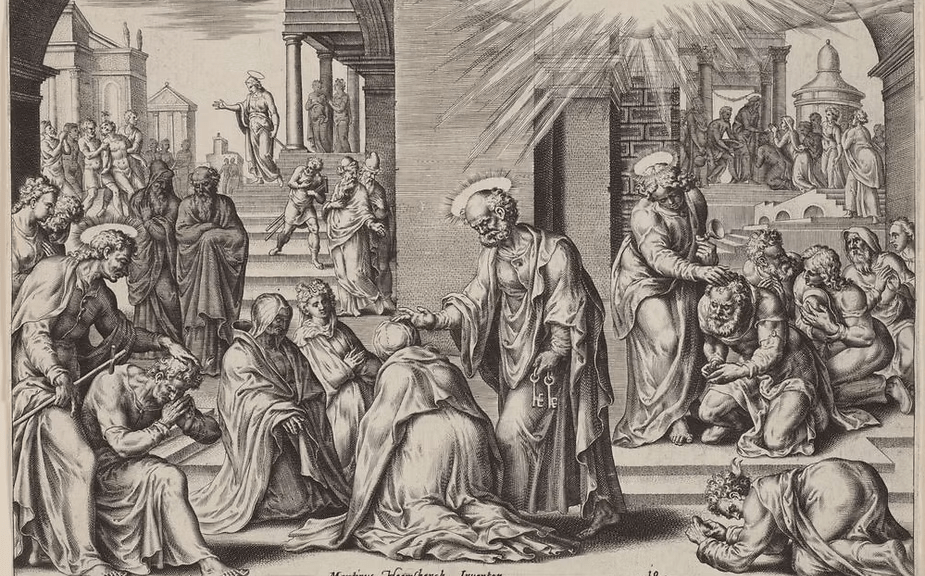
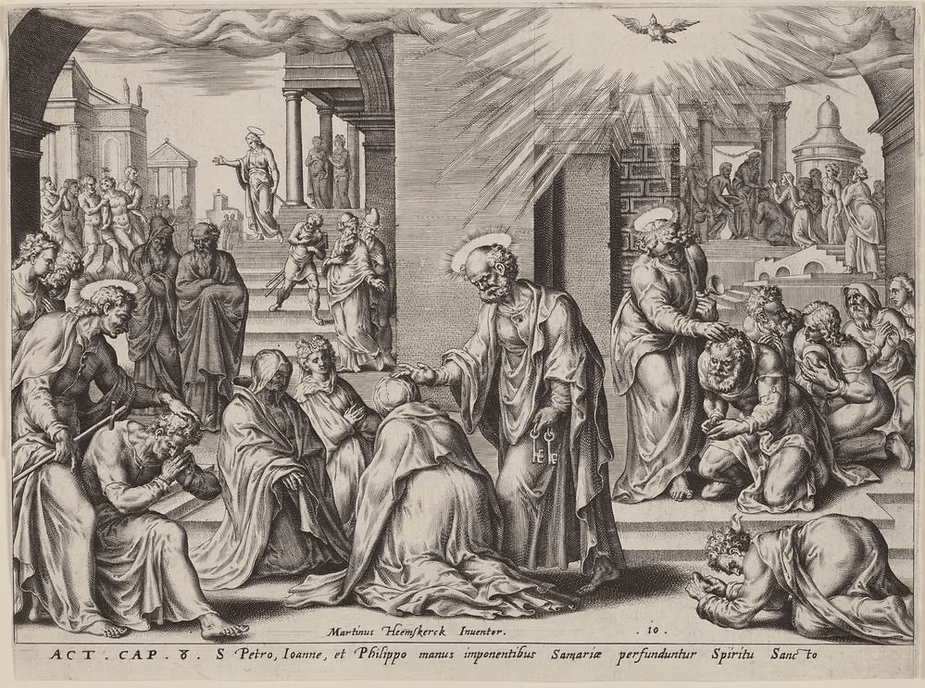
When the apostles at Jerusalem heard that Samaria had accepted the word of God, they sent Peter and John to them. The two went down and prayed for them that they might receive the Holy Spirit (for as yet the Spirit had not come upon any of them; they had only been baptized in the name of the Lord Jesus). Then Peter and John laid their hands on them, and they received the Holy Spirit.

——————–

This is the Epistle selection to be read aloud on the first Sunday after the Epiphany, Year C, according to the lectionary for the Episcopal Church. It will follow an Old Testament reading from Isaiah 43, where the prophet wrote: “I will say to the north, “Give them up,” and to the south, “Do not withhold; bring my sons from far away and my daughters from the end of the earth — everyone who is called by my name, whom I created for my glory, whom I formed and made.’” A singing of Psalm 29 will follow that, where David wrote: “The voice of Yahweh is a powerful voice; the voice of Yahweh is a voice of splendor” and “Yahweh shall give strength to his people; Yahweh shall give his people the blessing of peace.” All will accompany the Gospel reading from Luke, where the saint wrote: “When all the people were baptized, and when Jesus also had been baptized and was praying, the heaven was opened, and the Holy Spirit descended upon him in bodily form like a dove.”

In this short reading, it must first be pointed out that readings from the Acts of the Apostles are typically reserved for the Easter season [seven Sundays following Easter Sunday, including Pentecost]. Here, the realization is the first Sunday after the Epiphany is also designated as when readings from Acts are always found. This particular reading is only found read aloud on this Sunday, in Year C. Simply from this realization that connects the Acts of the Apostles to the ‘afterglow’ of Epiphany, one should see ministry as being the point of focus. As a reading from Acts is always read only on the first Sunday after the Epiphany, the motivation to begin ministry comes from that divine presence having been absorbed into one’s soul.

For regular Christians (those who put any time and effort into going to church and reading things Biblical on their own), their ears are trained to hear all the words of this reading and immediately assume they understand what is said. Overall, there is little impact – no epiphany of dawning – that comes from this very short and sweet reading. It is seemingly so void of minute details that listening to it read has the effect of a soft, warm breeze on the beach. Because it is so short, the impulse is to drift off to sleep, but then that quickly fades away. Still, the use of “apostles” [“apostoloi”] needs to be understood.

It is easy to hear the words “disciples” and “apostles” and imagine in one’s mind the same characters – the usual suspects. In one sense this is true, because nothing physically has changed. The all still look the same; and, they all are still seen as country rubes, with none having been afforded the finest education, best clothing possible, or given names that announce to Hebrew-speaking others, “Here walks God’s gift to the earth.” In fact, the word “apostoloi” means “messengers, those sent on a mission” [in the plural number]. That means “pupils” or “learners” [“mathētōn”] received permission to take a note down the hall for someone else to read. No one stops and brings attention to a “messenger,” because they are little more than ‘middlemen’ [and women].

This means the lack of capitalization, by Luke when he wrote “apostoloi,” says there is no divine elevation that needs to be read into that title. When one looks at the header for this reading, it only says “Acts,” with “the apostles” being so unimportant that we are left to assume it is their “Acts.” That lack means there is no need to waste space in print. It is the “Acts” that are important; and, those “Acts” are done because of the motivation to ministry. As such, ministry means being “messengers” for Yahweh, as the bodies of flesh that carry the soul of Jesus to where Jesus must be heard to speak. Jesus is the message, and the “messenger” simply passes that on.

Now, in the Greek written for verse fourteen, leading up to the word “apostoloi,” the NRSV has felt the capitalized word “Akousantes” need not be given the attention of divine importance [indicated through capitalization]. That word is the Aorist Participle, in the Nominative Masculine Plural, rooted in “akouó,” meaning “to hear, listen.” This is then a divinely elevated statement that says, “Having heard,” with “Heard” being relative to things not ordinarily heard [sounds processed through ears in a brain], much like they say a dog whistle works on dogs.

This word must be seen as a direct link to “the Epiphany,” as the presence of Jesus’ soul on earth, in human flesh, was not about one little baby keeping all that presence of Yahweh to himself. From the time Jesus was born, especially when the Magi arrived and Anointed him as the Messiah, his soul radiated out and connected to everyone who came in close contact with him. So, even when Jesus was a newborn, his soul was fully developed [made in heaven] AND the soul of Jesus spoke. Therefore, like the old E. F. Hutton commercials said, “When Jesus speaks people listen;” and, “Having listened, the messengers” took off.

By jumping into Acts 8 at verse fourteen, the casual listener has no divine elevation that leads him or her to realize what “the apostles Heard,” which was news that Philip was out being “a messenger” in Samaria, “proclaiming the Gospel concerning the power of God.” In that passing of the Jesus message, there was “a sorcerer” named Simon, who delighted the Samarians with his ‘magic tricks.’ Philip was so convincing (as Jesus reborn doing the talking) that the message passed onto those who heard him speaking, including Simon; so, all went down to the creek and Philip ceremoniously baptized them (as Jesus reborn). He acted like John the Baptist, paving the way for Jesus’ soul to enter their souls, by leading them to desire that presence. That meant first washing the sin off, through sincere repentance [the kind Jesus knew was sincere].

Meanwhile, back in Jerusalem, one need to realize this was well in advance of cell phones or even land lines with wires. We do not know how far away Philip was from Jerusalem, as the region known as Samaria can be as close as thirty miles; but the town Samaria (along a winding road) was over ninety miles away. Since that is too far for smoke signals to be seen, “Having heard” must be realized as Yahweh speaking to His wife-souls, the mothers of His Son Jesus, telling them, “Philip needs some help in Samaria. Go now!”

The thing about “messengers” is they don’t waste time arguing with the “message.” They are on stand-by; and, once the “message” (Jesus) is given, off they go.

When we read, “they sent Peter and John to them,” this needs to be realized in two ways.

First, “John” is the brother of James, a son of Zebedee. He should not be thought to be John (aka “the Beloved”), because that John was not old enough to grow a beard. Because Peter and the Zebedee brothers went way back, to their days as fishermen on the Sea of Galilee (all living in Capernaum and blood related), that John was much closer to Peter’s age. ‘Little John’ lived with his mother Mary (the Magdalene) in Bethany, the ‘man of the house’ after Jesus died on the cross. While that John and Mary (like all the “beloveds” of Jesus’ family) were also “apostles” [male and female He makes them], I recommend reading John 21:20-25 for a better understanding here.

Second, one needs to see the practice begun in ‘seminary,’ when Jesus was living and the disciples were still a rag-tag group of students. Then, he sent the twelve and then seventy out in pairs. While Matthew 10 does not say anything about pairing up the twelve, Mark 6 does. The numbering of “two two” [“dyo dyo”] means each disciple was paired with the soul of Jesus [“dyo”] and then paired with another likewise assisting disciple [“dyo”], so they were practicing being “apostles,” with each holding the “message” within their souls. To be sent in pairs of human flesh meant companionship [or brotherhood]. Most likely, Peter and John of Zebedee first teamed up when Jesus sent out the twelve; and, this pairing would have become natural for them to continue.

This is where everyone needs to realize that Philip was one of the twelve disciples sent out in practice ministry by Jesus; and, Philip was transformed into apostlehood (a divine messenger), just like Peter and John. One cannot begin to see hierarchy being developed in this short story, like that found in religious organizations, where the hired hands are compensated by how little each one “Acts” (the highest paid do the least work, while the grunts at the bottom do all the work and get little reward). Instead, this is where everyone should recall what I wrote about John (not too long ago, on the first Sunday after Christmas, when John wrote about “the Word” and John the Baptist). Then, I wrote that it dawned on me (for the first time ever) that what John said in his ministry was not so relative to him saying, “I am not worthy! There is one better than me that I have to wait for!” but relative to him saying, “First comes love, then comes marriage, and then come baby in the baby carriage.”

[That means John the Baptist was talking to single souls [unmarried to Yahweh] about the “dyo” part of “dyo dyo.” The one greater than John’s soul would be the Spirit of Yahweh AND THEN the soul of Yahweh’s Son [“dyo“]. John (at the time) did not know that soul was in the flesh and named cousin Jesus. Thus, when he said, “I cannot untie his sandal strap,” he actually said the “strap” or “binding” of John’s soul being joined by divine marriage could never be undone. The sandal was implied from John saying “sole,” which was metaphor about John’s soul was under the celestial ‘foot’ of Yahweh – powerless, but so in love he wanted it that way.]

This means Philip was the essence of John the Baptist in ministry, drawing all the sinners [the Samaritans were seen as sinners by the Jews] to “the Word” within him. That was so the sinners would first realize how in danger they were of sending their souls to punishment. The Gospel has a way of doing that, if told truthfully. Thus, Philip led seekers in their first step of repentance – that step symbolized at all times by John the Baptist – THE EPIPHANY – and Philip ceremoniously washed the bodies of the sinners – which is akin to a bridesmaid being given a lamp to keep lit until the bridegroom arrives.

When Yahweh called for a couple of messengers to, “Quick, bring some lamp oil!,” He did not specify Peter and John (like any messenger is faster or better, bigger or stronger). They were the ‘first team up.’ Thus they went.

Okay, now it is time to see the meanings of the names Peter and John. The name “Peter” means “Stone” or “Rock.” Here, it is important to realize Peter’s real name was “Simon,” the name of the guy in Samaria that was doing magic tricks. Peter was named because “Simon,” which means “He Who Hears.” Guess what, “Peter” was one “Having heard,” back when Jesus was calling disciples. Thus, Simon in Samaria was one who likewise “Heard” what Philip had to say, just like Simon-Peter “Heard” Jesus. Simon-Peter was most likely a follower of John the Baptist, because his brother Andrew was; so, both those experienced John the Baptist disciples, before they became disciples of Jesus. That fits the prophecy of John the Baptist; and, so does Philip spreading the Gospel in Samaria fit that in the same way. All the Samarians had become “disciples” of Jesus, because Philip was reborn as Jesus – just the messenger carrying the message. The name “John” means “Yah Is Gracious,” which was the name of the one accompanying Peter to meet Philip in Samaria. They were going to make the “Rock” of “Yahweh” be “Graciously” extended to new “disciples,” whose lamps were burning brightly for Yahweh. All they needed at that point was to be reborn as Jesus themselves.

When we read, “The two went down and prayed for them that they might receive the Holy Spirit,” this is the first of two mistranslations that mislead. The second comes when we read, “they received the Holy Spirit.” This is how translations into English lead ‘sheeples’ to hear two capitalized words be spoken together, so the ‘sheeples’ go away baaaing, “Jesus Christ” is the first and last name of the one I pray to;” and, “Rather than say Holy Father, Holy Son, Holy Spirit, I am just going to say Father, Son, Holy Spirit.” If anyone were to take the time to READ the Greek, they would realize that “Christou Iēsou” and “Pneuma Hagion” say, “of Christ of Jesus” and “Spirit Sacred.” Each capitalized word has its own divine elevation in meaning, which is why a saint wrote them for Yahweh that way [saints are, after all, just “messengers”].

To think Peter and John were necessary – as specific humans in the flesh – to rush and hand off something that is only capable to be given by Yahweh – is as stupid as thinking only Jesus in the flesh can save a soul. It is as stupid as thinking John the Baptist – a divinely born child of a barren women, informed of his coming by the angel Gabriel [angel means messenger also] – has to return in the flesh to you! Before Jesus can come in the flesh and save you. That is nonsense!

Just as Philip represents John the Baptist Spiritually, as Jesus resurrected (his soul in all), the Samaritan sinners are reflections of your souls in flesh, so you need somebody like Philip to tell you the truth of salvation; and, you need someone to pray that your soul receives the “Spirit,” so you can stop being a lost soul-sinner and become “Holy” or “Sacred” [in short, a “Saint”]. The missing link is marriage to Yahweh, which brings about His ”Spirit.” So, Peter and John are the ministers who read you the wedding vows that you commit your soul to doing FOREVERMORE. “Having heard” the Covenant, with you saying, “I do,” they conclude, “You are now a Saint. You may kiss Yahweh.”

It takes one to pronounce one.

Still, the key here is “prayer.” When Luke wrote, “[they] prayed for them,” the reality is he first wrote, “those whoever having gone down,” which was relative to the names “Peter kai John.” That says neither Peter nor John were entities called divinely to go assist the cleansed prepared by Philip. The meaning of that written [“hoitines katabantes”] says after the egos of Peter and John had descended to total submission to Yahweh, they were both Jesus, in different bodies of flesh than his pictures show. Thus, it was Jesus in two bodies of flesh, along with Philip being a third involved, who “prayed for them that they might receive Spirit.” This is no difference in that than reading Jesus metaphysically entering a room, where his disciples shook with fear, “breathing on them to, “Receive the Spirit.”’ The ”prayer” was not something that can be done by some bozo answering an Oral Roberts or Billy Graham prayer-line, nor anything of value gained by idiots making their fears be read on an Episcopal Facebook page, asking for help through “prayer.” This says ONLY JESUS’ PRAYERS ARE HEARD BY YAHWEH. Prayer then works when you personally want to marry Yahweh [life’s going downhill FAST]; and, then prayer works when one’s “dyo” is the resurrection of Jesus’ soul in yours.

If you don’t believe me, go pray for godlike abilities. Then call someone or post something online, asking others to pray for you to have godlike abilities. Then show you true faith in prayers, by jumping off a cliff, knowing your prayers will save you.

Do not do that!!!

Christianity began by the ACTS of Saints, who all became Jesus, who led to more ACTS that kept that Saint ball growing. However, we live now in times when Saints are an ‘endangered species.’ Organized religions have played a huge role in this decline [like buffalo hunters], which revolves around bad translations into English and few souls giving a damn about spreading the Gospel.

When we read as an aside (in parentheses), “for as yet the Spirit had not come upon any of them; they had only been baptized in the name of the Lord Jesus,” this was not set apart (by parentheses) by Luke. The word “Pneuma” was not repeated. The truth stated says Philip had only baptized the Samaritans with water, in the same ceremonial cleaning that John the Baptist had done when he was alive in the flesh. They had not yet “fallen” [“epipeptōkos”], meaning they still retained their egos as the lords over their bodies of flesh; although, those soul-lords sought marriage to Yahweh, as they all held the lamps of His brides-to-be.” What they lacked was divine marriage [union with the “Spirit”] and the subsequent resurrection of His Son in their souls.

That would mean their egos would fully submit to Yahweh, so Yahweh would become the property owner. Their bodies and souls would become possessed “of” their new “lord” and “master” [a non-capitalized “kyriou,” in the genitive case]. Once their souls fully submitted to Him in divine union, then the purpose of marriage would be to give Him a Son, which would be the soul resurrected within one’s soul, named “Jesus.” This would make them then be “of Jesus” [the genitive case of “Iēsou”], at which time “Jesus” would be the “Lord” of their flesh and souls.

In verse seventeen, there is no renaming of Peter and John. The Greek word “epetithesan” is the third-person plural imperfect, so it simply stated “they began laying upon” or “they began placing upon.” This third-person usage says “they” are whoever lowers his or her ego and allows Yahweh to send His Son in their bodies of flesh, as His messengers bearing His message. This is where the faith healer shysters of the world pretend all they have to do to transform people is touch them – to “lay hands upon them.” The souls of Peter and John had submitted to letting Jesus be their Lord (each), so they laid the soul of Jesus upon the Samaritans. The element of “hands” is separate. Another name for a “messenger” is God’s “hands.”

The Greek words written here are “tas cheiras ep’ autous,” which literally translates to say, “these hands on the basis of of themselves.” Here, the possessive pronoun “autous” says “of themselves,” where a “self” must be seen as a “soul.” Therefore, “they began laying upon [the Samaritans]” as “these hands” of Yahweh, who were under the power of their “Lord,” which made them be “of Jesus.” They were then – as human beings in the flesh – his “hands” [different from ‘hired hands’], because “their souls” had submitted to his control.

In terms of the Epiphany, when the Muslims say baby Jesus could talk, just days old, this need not mean his lips were moving and his little throat box was able to made adult sounds. His voice was heard because he had the powers of Yahweh, as a divine soul that did not need to speak audibly, as he talked ‘telepathically.’ In the same way, people named Peter and John do not need to place their hands on anyone to let Yahweh become their Husband and bring within their souls His Son. All they needed to do was be in the same room with the Samaritans; then, Jesus would do the rest.

Hopefully, it is clear that modern Christianity has fallen to the depths of being tricked by magicians like Simon of Samaria, whose use of hand gestures probably allowed him to do all kinds of tricks. The invisibility of Spiritual matters, such as angels, souls, and Spirits, of Yahweh and Jesus, makes it so easy to pretend to have powers, when all one has is the gall to lie about Spiritual matters. There might be some money to make from pretending to be something one is not; but money is as invisible in the Spiritual realm as are souls in the material realm. However, if one becomes like the repentant Samaritans (including the trickster Simon), then Yahweh will call for a couple of Saints to find your soul and let Jesus enter it.

As a reading selected for the first Sunday after the Epiphany, one needs to realize this is when a reading from Acts becomes important. One has to Act after “Having heard” the truth of the Gospel. One has to repent sincerely and keep one’s lamp filled with holy oil [not found in the market called a church] and keep the ‘midnight oil’ burning, lighting up the pages of Greek Scripture, showing Yahweh your soul really cares to find the truth – and will with His help. Sitting in a pew and gaining nothing from some watered down sermon that always says, “Aren’t I smart? Listen to me talk like I know something, without ever teaching a lick of truth” will not keep the lamp from burning out and running dry. The Epiphany means the “Appearance” of Jesus in one’s life. When that happens, it is not time to go home and do nothing. The time has come to Act.

Luke 3:15-17, 21-22 – Wait! Where did Jesus go?

As the people were filled with expectation, and all were questioning in their hearts concerning John, whether he might be the Messiah Christ [“Christos”]. John answered all of them by saying, “I baptize you with water; but one who is more powerful than I is coming; I am not worthy to untie the thong of his sandals. He will baptize you with the Holy Spirit Spirit Sacred and fire. His winnowing fork is in his hand, to clear his threshing floor and to gather the wheat into his granary; but the chaff he will burn with unquenchable fire.”

Now when all the people were baptized, and when Jesus also had been baptized and was praying, the heaven was opened, and the Holy Spirit Spirit this Sacred descended upon him in bodily form like a dove. And a voice came from heaven, “You are my Son, the Beloved; with you I am well pleased.”

——————–

This is the Gospel selection to be read aloud by a priest on the first Sunday after the Epiphany, Year C, according to the lectionary for the Episcopal Church. This reading will follow an Old Testament selection from Isaiah, where the prophet spoke as Yahweh, saying “Do not fear, for I have redeemed you; I have called you by name, you are mine.” That will precede a singing of Psalm 29, where David wrote, “And in the temple of Yahweh all are crying, “Glory!” Those two will be followed by a short reading from the Acts of the Apostles, where the author Luke wrote, “Two [apostles] went down and prayed for [new Samaritan Christians] that they might receive the Holy Spirit.”

This reading was posted not long ago, with the third Sunday of Advent Gospel choice being partially this, including verses fifteen through seventeen in it. The whole of that reading is Luke 3:7-18. To see what I wrote about these three verses, relative to that pre-Christmas lesson, that analysis can be reviewed by searching this site. For this commentary, I will address these verses in depth, as relative to the timing known as “after the Epiphany.”

One element that I did not address prior is verse fifteen beginning with a capitalized word: “Prosdokōntos.” The translation services do not realize capitalization is used to denote divinely selected words, where the prophet writing a New Testament book was told to purposefully use capitalization, in order to let readers [those filled with the Spirit] know to discern such words with a divinely elevated meaning. Thus, this word [written in the Present Participle Active – Genitive Masculine Singular] states, “Being of expectation.” While the NRSV translates this in the lower-case, as “were expecting,” the capitalization is going beyond simple anticipation, becoming a statement about divine pregnancy. When this verse is seen to be read on an Advent Sunday, this now can be seen to state the presence of John and his words “Impregnated” the souls of sinners; so, they were “Expecting.” More than dunking their heads underwater, the soul of John mingled with the souls of the seekers, making them await the birth of their promised salvation.

This intermingling can then be found explained by Luke, after he wrote the marker word “kai,” denoting importance to be found following, relative to this “Expectation.” The NRSV translates this simply as: “and all were questioning in their hearts concerning John.” The truth of the Greek written is this: “dialogizomenōn pantōn en tas kardians autōn peri tou Iōannou”. Those words literally translate as saying, “of themselves considering of each within them inner selves of same encompassing John”. When one reads these words as the souls of each Samaritan having been made “Expecting,” then “of each” were they [importantly] “considering their souls were the same as John’s, with the same Spirit that encompassed him [making him be special] then encompassing them.” Here, the naming of “John” has to also be read as a capitalized word, with divine elevation intended to be read, which leads to the meaning behind the name. With the name “John” meaning “Yah[weh] Is Gracious,” then “each” Samaritan felt the same love of Yahweh within their souls, as God’s Grace had come to them too.

This then leads to the final segment of words in verse fifteen, where I have stricken through the translation “Messiah” [a Hebrew word that means “Anointed one” – “mashiach” (not capitalized)], as the Greek word written by Luke is “Christos,” which bears the same meaning [“Anointed one”]. While the same effect can be read into this usage, the capitalization of a Greek word [impossible in Hebrew] becomes a divine elevation in meaning that says physical “anointment” is not the focus here. Instead, a Spiritual “Anointment,” which can only be done by Yahweh [as He Anointed David Spiritually, after Samuel did so physically], has to be seen as the intent to grasp.

In that usage, the Greek written by Luke is this: “mē pote autos eiē ho Christos”, where the literal translation says, “not how long self might exist this Anointed one”. In this, the negative “not” refers to the specific person “John,” who the Samaritans knew was impossible to be making them feel an “Expectation in their souls,” such that they knew it was “not John,” but something greater. They knew John had only spoken to them and dunked them in water, but their “Expectation” was now looking to “when” or “how long” their “souls” [the “self” of “autos” is a “soul”] had to wait, until each “might exist” or “might be” themselves – like John – “this Anointed one.” This becomes a statement about the time it would take to deliver themselves as new beings, Anointed by Yahweh, truly forgiven of all sins and promised eternal salvation.

When verse sixteen is then translated by the NRSV to present: “John answered all of them,” this is misleading. There really is nothing that indicates “John” addressed a crowd of people, who had not specifically asked John anything. The verb “dialogizomenōn” [“of themselves considering,” as the Present Participle – Genitive Masculine Plural form of “dialogizomai,” meaning “I reason (with), debate (with), consider”] is not a direct demand for an answer, especially when the feelings experienced were “heart” felt, as within their souls. Therefore, verse sixteen begins with the Greek word “apekrinato” [Aorist – Third-Person Singular], which says a conversation was taken up with those whose “hearts” wanted to know “how long” before they became like John – “Anointed.” This can then be seen as Yahweh leading John to speak aloud, saying that which is next written; but it is wrong to think anyone yelled out to John, “Hey dude! Are you the Messiah? We were just wondering among ourselves.”

This says Yahweh knew the hearts of the seekers whom John washed with words and ceremonies. His baptism was more than simply immersing their bodies in water. John’s attraction was more than his ability to perform water dunkings in a creek. John was possessed Spiritually by Yahweh, which means John’s soul also was joined with the soul of His Son, even though Jesus was that soul in flesh (unbeknownst to John). Here, it is vital to realize Yahweh cannot be limited in who can have the soul of Salvation risen in their sinner-repented souls.

Now, in my homily that was for the third Sunday of Advent, I explained how I read what John next said in an entirely new light. I saw John not speaking about Jesus the man, but Jesus the soul. All of the Samaritans had been sinners, just as John’s soul had been in flesh that sinned, quite some lives before. I mentioned that the soul of Elijah could have been the soul of John reincarnated, sent back to earth for the sole purpose being to be the precursor to Jesus (without his flesh knowing about that other person). What John did know was his sinner soul had been saved by his soul being joined with a much more divine soul [Jesus]. So, John began speaking (without a direct question from a Samaritan] about that soul. John spoke to the “hearts” of the Samaritans who were just ‘officially engaged’ to marry their souls to Yahweh’s Spirit, while “Expecting” a great new birth.

In the above translation of what John said, the ears and eyes need to be refocused, so the truth shines through. When John said, “I baptize you with water; but one who is more powerful than I is coming; I am not worthy to untie the thong of his sandals,” the reality missed is the English translation of “I” is actually the Greek capitalized word “Egō.” The capitalization divinely elevates this meaning to Yahweh [“I AM”], such that the “hearts” [“souls”] of the Samaritans heard Yahweh speaking. The reality of the Greek written here is this: “Egō men hydati baptize hymas ; erchetai de ho ischyroteros mou , hou ouk eimi hykanos lysai ton himanta tōn hypodēmatōn autou”. This literally can translate to say this: “I AM truly water submerge yourselves ; comes now this mightier of me , of whom not I exist sufficient to release this binding of these soles bound under of self”. This needs close inspection, as I wrote about this deeply in my prior commentary.

This says, in essence, Yahweh is the spiritual water [living water] that submerges one’s soul, like the physical water symbolically used by John. The immersion into Yahweh’s Spirit means there will come another soul to join one’s soul, which is stronger than the soul being saved [which could not resist sinning]. This immersion into Yahweh’s Spirit is marriage, bringing one’s soul into divine union with Him; and, there is no soul capable of breaking that bond, which is known to make one’s flesh become the feet of Yahweh on the earth [His ministers or apostles]. While the double-edge of Yahweh’s Word makes this perfectly fit the known history of the Gospels, John the Baptist did not know Jesus was the one [he questioned that via his messengers]. It is the truth of divine marriage, which is two souls in one body of flesh, possessed by Yahweh and controlled by the Son.

In the last segment of words in verse sixteen, the NRSV shows this: “He will baptize you with the Spirit Sacred and fire.” There, I have stricken out the order of words and shown an alternative translation, maintaining the order of words written by Luke. In this, rather than translating “autos hymas” as “he … you” [inserting a word between two written], those two better translate as “same yourselves,” where the word before a semi-colon is “autou” [“of yourself” or “of same”]. This makes the beginning of the following statement begin in the plural, saying “same [for oneself] for you all.” This is again talking about the one “mightier” that will “come,” such that the presence of the ‘twin’ soul will also “submerge” one’s soul [each individually the “same”] under that power. All of this will be from the same “Spirit” [“Pneumati”], with the difference being that presence will use the “Spirit” to transform a sinner into a “Saint.” To call the “Spirit” the “Holy Spirit” is to ignore the separate capitalization of both words – Pneumati and Hagiō.”

The “Spirit” is Yahweh’s reach unto the material realm. “Holiness” or “Righteousness” is only a state of being for a soul in a body of flesh [the opposite of waywardness], as it is foolishness to think an inferior human-soul has any right to judge Yahweh, in any way, even if it is a human opinion of goodness. As Jesus corrected the young rich man, “Only God is good,” we do not have any right to judge Yahweh in any way. He judges our souls.

The aspect of “fire” has to be seen as following the placement of the word “kai,” denoting “fire” is important to grasp. The word written is “pyri,” which is the Dative Singular form of “pur,” meaning “fire,” while implying: “the heat of the sun, lightning; fig: strife, trials; the eternal fire.” (Strong’s) The word’s use also can be seen as “funerary” or “sacrificial,” as well as indicating “a fever.” Its least likely intent is physical “fire,” meaning it is Yahweh speaking through John (recorded by Luke) saying how being “Sacred” is importantly “lightning” fast. One’s mind is no longer filled with doubt and hesitation [the tricks of temptations]. There is an “illumination” of insight that is instant; and, there is a strong desire to please Yahweh [a “fever” to serve Him]. That comes when one’s body is symbolically sacrificed – death of self [ego and will] – in the “fire” of the altar, releasing one’s soul to Yahweh [while physically still being in the flesh].

I refer you to my prior commentary to see what I wrote about verse seventeen, because today’s reading does not include verse eighteen. That prior verse is relative to the harvesting of good fruits, and the discarding of useless chaff. Here, one only needs to see that the difference between becoming “Sacred” or “Holy” [a “Saint”], compared to a soul in flesh that does not, is eternal salvation. That reward for becoming a sacrificial lamb is then compared to reincarnation or eternal damnation [depending on the soul and the sins], when the old, blemished sheep keep recycling.

When the story leaps forward to say in verse twenty-one, “Now when all the people were baptized,” this ignores the divine elevation in meaning written into the capitalization of the Greek word “Egeneto.” This is the Aorist Middle Indicative – Third-Person form of the word “ginomai,” which means “to come into being, to happen, to become” (Strong’s Definition), with the implication being “I come into being, am born, become, come about, happen.” (Strong’s Usage, my underline) To take this divinely elevated word written by Luke, led by Yahweh, and translate it as “Now when,” that is making this become some ho-hum passing of time, as if the translator got tired of waiting for all the little people to be dunked in the creek, just waiting until the big guy arrived. This leads readers to think it was then that Jesus, wandered down the bank, into the water. “Next!”

That is wrong.

Verse twenty-one actually is written as this: “Egeneto de en tō baptisthēnai hapanta ton laon,” which literally translates to say, “Born now within thereupon having been submerged altogether this [God’s chosen] people.” This can now be seen as a divinely elevated second “Birth” that has taken place, which [as Jesus explained to Nicodemus] is not physical, but Spiritual. It is not an outer cleansing, but one “within,” where the “submersion” is not physical water, but the living “water” Yahweh spoke of earlier. It is the outpouring of His “Spirit” upon the souls of His “people” [the word “laon” means “laity,” implying being chosen by God (hand-picked)]. There is no section set aside for an artificial hierarchy that ranks one “baptized” divinely by Yahweh as higher or lower than the rest. “Altogether” the “people” [chosen by God] received the same state of being, meaning all became “Saints” because of having been “Born” of Yahweh’s Spirit.

When verse twenty-one mentions “Jesus,” it is as if he stood at the back of the line, waiting his turn for John to dunk him in the creek. Again, due to the double-edged meaning Yahweh’s language accommodates, that is probably true; but it is not the point that needs to be seen. When the NRSV shows written: “and when Jesus also had been baptized and was praying, the heaven was opened,” the reality is this is written in Greek: “kai Iēsou baptisthentos , kai proseuchomenou , aneōchthēnai ton ouranon”. That includes two uses of “kai,” the word that marks importance to follow [no need to translate it]. So, the reality of the translation says, “[importantly] of Jesus having been submerged , [importantly] praying of him , was opened this heaven.” This says nothing about Jesus being baptized by John. This needs to be seen clearly.

By seeing the word used that is very similar to the word used just prior – “baptisthentos” following “baptisthēnai” – this is now saying those “Born … having been submerged,” are now “of Jesus having been submerged.” This says those who came to John were all transformed by Yahweh into ‘twin’ souls – theirs merged with that of Jesus. The one soul which is “mightier” than their ‘sinner soul’ is the one that has “come” into them. Their “Birth” is actually a “Rebirth” Spiritually [like Jesus explained to Nicodemus]. This is important to understand.

Following another marker word of importance to follow, the Present Participle – Genitive Masculine Singular form of “prayer-pray” is used, which then can be read as “praying [participle] of [Genitive] him [masculine].” Those who had received the soul “of Jesus” were then “praying of him,” which is an important statement about giving thanks to Yahweh [which usually is seen as very joyous]. Those prayers were led by a newborn soul of Jesus then within them.

This then leads to the after effect of them giving thanks to God that “was opened this heaven,” where “heaven” should be read as the Spiritual abilities that come to Saints from Yahweh, to “all” who have been Reborn as His Son. Normal human beings walk around and only see the physical and material, with the “heaven” invisible. When “heaven has opened” that means one’s soul in a physical body sees, hears, and speaks divinely. While everything is seen by others as just ‘ordinary world’ stuff, Saints write divine texts and translation services cannot see the truth in their words. Those services have not had the “heaven opened” to them.

When verse twenty-two is then shown by the NRSV to state: “and the Spirit this Sacred descended upon him in bodily form like a dove,” here I have stricken out the translation that says “Holy Spirit.” The reason is more than the first time, where the words were reversed, as now the words are again reversed, but now with a word in between. That word has been tossed away like excess garbage. There is nothing written in Holy Scripture that has no meaning and can be discarded at will. The Greek written here is: “Pneuma to Hagion,” where the literal translation says, “Spirit this Sacred.” Wholly, the Greek word “to” also precedes “Pneuma,” so it says, “this Spirit this Sacred.”

In the Greek written, the truth says, “kai katabēnai to Pneuma to Hagios sōmatikō eidei hōs peristeran epi’ auton ,” which can be seen to be an important statement to grasp. This says, “descended this Spirit this Sacred corporeally shape like a pigeon upon self”. In this, “descended” can be read as both the souls of those “praying thanks” and “having opened this heaven.” The prayers come from having bowed down before Yahweh, thus self-egos “descended” when their prayers were heard divinely. This is then also seen as Yahweh sending down His Son’s soul, when the soul of Jesus had already “descended” when he was “Born” in Bethlehem. From that awareness, it is not physical Jesus, but “this Spirit,” which is his soul. It is the soul of Jesus within another soul that is the only way to become “a Saint.”

The designation as a “Saint” is not Spiritual, but “corporal,” such that Jesus is not external as a Spirit that tags along, but one with one’s soul [every soul Yahweh sends his Soul into]. A “Spirit” has no limitations. Like Yahweh it IS … everywhere. A soul is also a “spirit;” and, a soul must conform to the shape of its corporeal body of flesh. Thus, the “Spirit” is sent in the same way, as a divine presence that is fitting the scope of the soul within a body of flesh.

The element of “a dove” (which I believe “pigeon” makes the imagery better seen) is it is not a graceful bird, either taking flight or landing. The motion of its wings should be seen (when it “descends”) as “fluttering.” Thus, when the soul of Jesus enters one’s soul, it comes with some “fluttering,” so one feels the presence and can even physically shake.

The next segment of words is another introduced by the word “kai.” The importance here comes from the word “phōnēn,” which means “a voice.” This needs to be seen as important because this landing of the “Spirit” within one’s soul (causing one’s heart to flutter) makes the one divinely possessed become “a voice” for Yahweh, as his Son reborn. This is more than one’s ordinary “voice” (although one still sounds the same), but the ability to speak in holy tongues, which is the language of Yahweh. Luke was such “a voice” for Yahweh; and, his writing style is not his own. It was holy tongues being recorded on a scroll. All words said by such “a voice” come from “heaven.”

This then leads to what Yahweh is saying to all souls who become His voice. It begins with the capitalized word “Sy,” which says “You.” The mistake is reading this as a simple “you,” which everyone thinks is Jesus. Instead, the “You” is divinely elevated to be everyone whose soul has been where Jesus’ soul has resurrected [well before he died … Yahweh has that ability]. This means “You” should be the one whose eyes are reading this Scripture. It equally applies to all souls in flesh that have become divinely elevated as Yahweh’s Son.

From there, Luke reported that Yahweh called all as those who “exist this Son of me”. After a comma mark, Yahweh then spoke through all fitting the “You” description, saying “this beloved.” In that, the word “beloved” should be read as a statement of marriage, as “love” is the glue that binds two together as one. Out of marriage, Yahweh has sired His “Son,” with “love” abounding in all who share that relationship with Yahweh.

The final segment of words in this verse and this reading selection then say [Yahweh speaking], “in of you I am well pleased.” Here, “in of you” [from a lower-case “soi” being written for “you,” in the possessive Genitive case] says the Genitive case form of “you” shows Yahweh in possession “of you.” This possession then puts Yahweh “in” one’s whole being [not close by or near, but in]; and, this then includes the soul of His Son, Jesus. That is the soul that always “pleases” Yahweh; so, being Reborn as Jesus means Yahweh has been “well pleased” in the signs of love shown by one’s soul. Jesus has then become one with “You,” leading the actions “of you,” so you too will make Yahweh “well pleased.”

Wait a minute. I thought I was dunking Jesus; but he is a beam of Spirit.

In this selection of five verses from Luke’s third chapter, the name “Jesus” is only written twice: once in verse twenty-one and once in verse twenty-three, with the later not read today. That reference instead begins where Luke was telling of the genealogy “of Jesus.” Those are the only references in all of this chapter; and, the one use here says “of Jesus” [“Ἰησοῦ,” “Iēsou”]. Verses twenty-one and twenty-two are called “The Baptism of Jesus,” which is true; but the truth says the baptism was in others, who received the soul “of Jesus.

This means this close inspection of the text written makes a divine “Appearance” come, which is the meaning of “Epiphany.” We are called to receive “the baptism of Jesus,” which means John the Baptist was himself a soul saved, which was possessed by the soul “of Jesus,” becoming his Lord. The name “Jesus” [a capitalized word of divine elevation] means “Yah[weh] Will Save.” Thus, John’s soul had been born Saved, to show others they too can be like him.

These five verses then need to be seen as purposefully selected to be read again, following a partial reading during Advent. Now, after becoming Jesus “Reborn,” it is possible to see these verses revealing what “the Epiphany” expects – the “Expectation” of a divine pregnancy and the “Rebirth” of Yahweh’s Son in human flesh.

As a reading for the first Sunday after the Epiphany, one needs to look closely at what I wrote about the accompanying short reading from Acts. There Luke wrote words that speak of a similar mass transfer of the “Spirit,” then in the Samarians. That reading also opens up to reveal similar hidden elements that translation services cannot see. It is much like this reading. Therefore, “the Epiphany” and the Sundays after that event need to be seen as the time when the truth becomes visible, like it was not prior. What was once inside has now come about. This is the stuff that makes Saints.