Tag Archives: Epiphany 3 Year C

Nehemiah 8:1-3, 5-6, 8-10 – A new day dawning from the Book of Law

All the people of Israel gathered together into the square before the Water Gate. They told the scribe Ezra to bring the book of the law of Moses, which Yahweh had given to Israel. Accordingly, the priest Ezra brought the law before the assembly, both men and women and all who could hear with understanding. This was on the first day of the seventh month. He read from it facing the square before the Water Gate from early morning until midday, in the presence of the men and the women and those who could understand; and the ears of all the people were attentive to the book of the law. And Ezra opened the book in the sight of all the people, for he was standing above all the people; and when he opened it, all the people stood up. Then Ezra blessed Yahweh haelohim the great, and all the people answered, “Amen, Amen,” lifting up their hands. Then they bowed their heads and worshiped Yahweh with their faces to the ground. So they read from the book, from the law haelohim, with interpretation. They gave the sense, so that the people understood the reading.

And Nehemiah, who was the governor, and Ezra the priest and scribe, and the Levites who taught the people said to all the people, “This day is holy to Yahweh elohekem; do not mourn or weep.” For all the people wept when they heard the words of the law. Then he said to them, “Go your way, eat the fat and drink sweet wine and send portions of them to those for whom nothing is prepared, for this day is holy laadonenu; and do not be grieved, for the joy of Yahweh is your strength.”

——————–

This is the Old Testament selection to be read aloud on the third Sunday after the Epiphany. It will precede a singing of Psalm 19, which includes the verse: “The law of Yahweh is perfect and revives the soul; the testimony of Yahweh is sure and gives wisdom to the innocent.” That pair will be followed by a reading from Paul’s first letter to the true Christians of Corinth, where he wrote: “Just as the body is one and has many members, and all the members of the body, though many, are one body, so it is with Christ.” All will accompany the Gospel reading from Luke, where the Saint wrote of Jesus returning to Nazareth, where he read from the scroll of Isaiah, saying, “And [Jesus] rolled up the scroll, gave it back to the attendant, and sat down. The eyes of all in the synagogue were fixed on him. Then he began to say to them, “Today this scripture has been fulfilled in your hearing.”’

This one reading from Nehemiah is the only time in the entire three-year lectionary cycle that anything will be read from the Book of Nehemiah. This means the rarity of reading something he wrote makes the person be equally obscure. This means it becomes important to know who Nehemiah was and where he fits into the history of Israel.

Basically, Nehemiah was an exilic Jew in Persia, who is believed to have been castrated and then allowed to serve the King of Persia, including attending to the queen. He is called by some a “cupbearer,” which means he was trusted to serve wine at the king’s table, even tasting it for poison. That role would not be relevant as to why Nehemiah would be selected by the king to go to Jerusalem and begin a project that would first rebuild the walls of the city and then restore Judaism in that place, where much corruption had set in. One must assume Nehemiah had some abilities with architecture and building projects management. Above all, Nehemiah must be seen as a devout Israelite, based on the truth of that title. All of the history Nehemiah became involved in unfolds in thirteen chapters, with chapter eight being a public reading of the Book of Law, which (due to the collapse and ruin of Judah and Jerusalem) had been absent for some time (including well before that fall).

Nehemiah would be joined by Ezra, where together they would lead the resurrection of Judaism in a lost land, with exiled, scattered and mixed peoples of religious values. Both men were of Judaic histories or ancestry, which is why they petitioned the king as to their desire to rebuild Jerusalem. The king agreed this was right, as the Jews had been destroyed by the Babylonians; and, it was King Artaxerxes that sent Nehemiah with approval and financing, with Ezra sent later by the same king, who is named Cyrus I [or Xerxes I], with the specificity of which king(s) irrelevant for the understanding of this reading.

In the above translation presented by the Episcopal Church (sourced as from the NRSV), you will note how I restored five specific namings of “Yahweh,” in bold type. Each was erroneously shows as “the Lord.” A “Lord” is unknown. “Yahweh” is a supreme deity that is personally known … otherwise one is a pagan and should go play in the street, while reading fiction.

Additionally, in four places I took mistranslations and returned the Hebrew written, shown in italics. In three of those, some form of “God” is translated (of, your, the), when the plural root is “elohim,” meaning “gods,” in the lower case. Yahweh is MUCH MORE than a “god” or even “God.” Yahweh IS; and, anything spiritual and eternal is “a god,” where any demonic spirit that possesses a weak body of human flesh (dominating the soul giving that dirt-bag the animation of life) can become a “Lord” over that flesh. In the one other word mistranslated, it is shown as “Yahweh,” when the reality is the plural form of “lords” is written – “adonay”. That is a statement of those who are divinely possessed by Yahweh, so His Son [Jesus] then “lords” over their souls-flesh. Because the translation is wrong, I have corrected it in italics.

In the third Sunday of Advent reading choices, the Old Testament reading came from Zephaniah, who is another who gets little ‘air time.’ In my commentary for that reading, I wrote that Zephaniah was a prophet during the reign of King Josiah; and, I told how Josiah ‘discovered’ the Book of the Law, after he ordered a restoration of the Temple in Jerusalem. The Book of the Law had become hidden (there are a vast array of underground tunnels under where the Temple stood) and the people had not been told anything about Moses and the Law for a long time prior. They just sang the Psalms of David (I suppose). This reading from Nehemiah needs to be seen in that same light, as the people (Jews) living in and returning to Jerusalem (all Gentiles having been cast out) are who Ezra is reading the Book of Law to in these words of Nehemiah.

In verse one, the NRSV does not translate so it says, “All the people of Israel gathered together into the square.” Nothing whatsoever is written that says “Israel.” The Episcopal Church has thrown that in to mislead the people, because the NRSV does not show that. The whole of “Israel,” under David, included Judah and Jerusalem. After Solomon died, the nation split in two, with the Northern Kingdom retaining the name “Israel.” Thus, the rebuilding of Jerusalem, in what was a land under Persian rule, with Nehemiah an appointed Persian governor, had nothing to do with a place called “Israel.”

The truth written says, “and together gathered all the people as man one , in the open square”. The Hebrew that says “as man one” [from “kə·’îš ’e·ḥāḏ,” rooted in “ish echad”] needs to be seen as saying “all were as one,” where all shared a like mind that was relative to their religious beliefs, as devotion to Judaism. In that sense, they were the truth behind the word “Israel,” which means “all were those Who Retained Yahweh as His elohim.”

In verse two, the translation is somewhat correct in stating, “the assembly, both men and women and all who could hear with understanding.” The truth written says: “the assembly of men and women , and all with understanding.” This says two things of importance. First, “an assembly” or a “synagogue” or a “congregation” of people are known to always contain “men and women.” This must be always understood, so any references only to “men” needs to be understood, before adding in “women,” when that is not the point of that written. Women were never excluded from Judaism, so they can be assumed to be included in everything written that is relative to Judaism lessons [with that spreading to Christianity and its women].

Second, it says everyone (men and women alike) were able to understand Hebrew, so when Ezra read aloud they understood what was read aloud. However, the deeper understanding must be seen as the meaning contained in the words read aloud was also understood. That becomes a statement of a divine presence entering each soul, opening the minds of all so true understanding of the Book of Law could be understood.

When we read “This was on the first day of the seventh month,” this is the month of Tishri, with the first day of that month recognized as the Jewish New Year or Head of the Year – Rosh Hashanah. Tishri is the first month of the Hebrew civil year, as the ecclesiastical calendar begins in Nisan. The old Roman calendar matched the ecclesiastical calendar, because the ‘new year’ began on the first day of spring. However, the Romans adjusted their calendar to begin on January first, meaning Jews can celebrate a new year three times a year.

This must be realized as not being one of the three festivals commanded by Yahweh for the Israelites to observe. It is near Sukkot, which is in the same month, between 15 and 21 Tishri. This means Rosh Hasanah is a festival deemed most sacred by the Jews who returned from exile, which means it is self-recognition, more than Yahweh devotion. The event known as Yom Kippur is on the tenth of Tishri, which is the Jewish observance of a Day of Atonement. This, again, is a Jewish day of fasting that originated in the post-exilic period. Any day designated as a day to recognize Yahweh, not commanded by Him is thus a voluntary recognition; and, voluntary recognitions – like the Book of Law being read – is only as good as each individual’s commitment is to Yahweh (soul married to Spirit), otherwise it becomes the reason this reading is important. People forget and get self-involved. So, a religion saying, “Recognize this day” is meaningless. Each soul must recognize Yahweh at all times. Thus, “This was on the first day of the seventh month” must be seen as every day, like the old saying, “Today is the first day of the rest of your life.”

When we read, “He read from it facing the square before the Water Gate from early morning until midday,” it is important to realize where the “Water Gate” is.
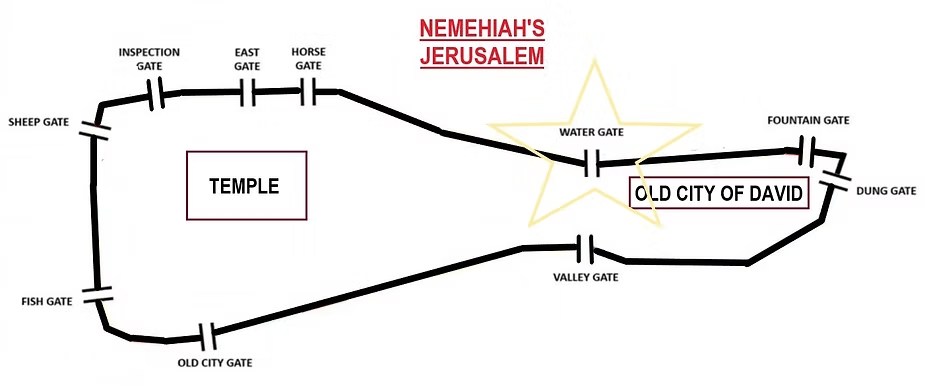
From this diagram, one can see that Ezra read from a position that was near where the Tabernacle had been placed by David, when he moved it, along with the Ark of the Covenant [which contained the Book of Law] into the city named after him. Zion, or the City of David, had previously been known as Jebus, the stronghold of the Jebusites. This should be seen as not being where Solomon built his temple, which was where he ordered the tabernacle and the Ark of the Covenant be moved, into a stone building [where things found a way of getting lost]. This position must be seen as high over shear drops of elevation, into valleys below, making this scene be reminiscent of Jesus speaking from the mount alongside the sea, where the people below could hear him clearly. This needs to be seen as a place of acoustics (aided by Yahweh’s presence) that made it easy to hear the words read (while also understanding the meaning of those words).

Verse six is shown to state, “Then Ezra blessed Yahweh haelohim the great, and all the people answered, “Amen, Amen,” lifting up their hands. Then they bowed their heads and worshiped Yahweh with their faces to the ground.” This is not correct and dangerously misleading. It is misleading because it clearly gives the impression that Ezra was such a high and might priest [akin to a pope, an archbishop, a presiding bishop, or any other kind of ‘grand pooh-bah’] that he was in any position to bless Yahweh. That is an impossibility. No human can ever judge Yahweh, in any way, good or bad. Yahweh is the Judge of everything spiritual [and souls are spirits animating otherwise dead flesh], with Yahweh being the Creator of everything material [the physical universe].

The reality of that written is it translates literally to state this: “and blessed Ezra , did Yahweh his elohim in great magnitude ; and answered all the people truly truly while lifting up their hands , and they bowed down bowed down Yahweh with faces in the ground .” This makes it clear that Ezra was the one who was “blessed,” with that also meaning Ezra “knelt” before reading, in honor of Yahweh, as the Hebrew word “barak” means “to kneel, bless.” Ezra postured himself before Yahweh ceremoniously as fully subservient to Yahweh. With that statement made sincerely and symbolically, Yahweh not only gave His approval to Ezra, but He filled Ezra with His divine Spirit, making Ezra have the power of an angel in his soul and flesh – an “elohim” of Yahweh [“hā·’ĕ·lō·hîm”]. This divine presence then spread out among the people, so they felt the presence of Yahweh in Ezra, so they knew Ezra was a Saint and spoke the truth. All then were spiritually uplifted as also the “hands” of Yahweh on earth. They held their hands upward to signal they knew the heavens had descended upon them; so, they then turned their faces to the earth, wearing the face of Yahweh on each of themselves. [This is what the First Commandment says to do.]

When verse eight (jumping over verse seven) is shown to say, “So they read from the book, from the law haelohim, with interpretation,” the literal translation states more clearly, “so they read from the book in the law of the elohim distinctly ; and they had laid upon them insight , and helped to understand .” Here, again, the presence of “hā·’ĕ·lō·hîm” is a statement of those who are filled with the Spirit of Yahweh, becoming one of His elohim, so Yahweh is within their souls communicating with them. This is where it should be seen that the “Book of Law” is the Covenant, which becomes the marriage agreement committed to by ALL souls that marry Yahweh. ALL must agree to be His elohim [“hā·’ĕ·lō·hîm”], so the agreements found in the Book of Law are ONLY relative to “hā·’ĕ·lō·hîm,” not Joe Schmoe Jew or Henrietta Dogooder Christian, who equally like the ‘idea’ of special favors from a God they call “the Lord,” but have no intent of ever agreeing to ALL that is in the Book of Law [way too much for them]. Those who were filled with Yahweh’s Spirit and “intently” listened to Ezra read [for quite some length of time] all the terms of divine marriage, the divine Spirit within them made it clear what each term of marriage meant. They ALL had divine insight laid upon them; so, they were each led by the Spirit to understand.

When verse nine than has all the ‘elders’ [Nehemiah, Ezra, and the Levites] tell the people, “This day is holy to Yahweh elohekem; do not mourn or weep,” the word “hay·yō·wm” [from “yom”] needs to be fully understood. That use of “this day” is less about the particular “day” of the month, as if the ‘elders’ were all saying, “Mark this one day on your calendars at home!” It is more about the light of truth that is symbolized by the word “day.” This means the announcement spoken by several ‘elders’ was saying, “This truth and light of illumination is divine, sacred and holy.” That means they said the Book of Law [not 1 Tishri] is not made up crap served to you by someone in a robe, wearing a high hat, and holding some fancy stick. They said, “This light of day comes to you from you being Yahweh elohim – the Saints of Yahweh. The purpose of this enlightenment is so you fully understand that divine marriage of your souls to Yahweh will forevermore keep your bodies of flesh from weeping and mourning.” Weeping and mourning is what all the lazy pretenders end up doing, when their souls part ways with the dead flesh hanging from them and those souls then go to be judged by Yahweh. [They also gnash their soul-teeth at that time.]

The last verse of this reading is then shown to say, “for this day is holy laadonenu; and do not be grieved, for the joy of Yahweh is your strength.” In this is found the Hebrew transliterated word “la·’ă·ḏō·nê·nū,” which literally translates to say, “to our lords” [plural number]. This should then be realized to be a statement of possession, where “our” can be turned to face the other way, where “our” becomes “his,” to accommodate the plural number of “lords” [“adonay”]. This means that stated is “us who Yahweh makes lords.” This is then a statement of ministry, where Yahweh’s elohim go forth and lead others to also marry their souls to Him. This is then one becoming like the ‘elders’ Nehemiah, Ezra, the Levites, et al. All the Apostles and Saints become the leaders of others, therefore they become “lords of Yahweh.” All are filled with His Son, who guides this ability to be “lords,” as Jesus is the “Lord” over each soul-body of Yahweh. When Nehemiah wrote that “the joy of Yahweh is your strength,” His “joy” is His Son; so, His Son reborn in His elohim is the “strength” those need to be “lords” over others.

As a reading selection for the third Sunday after the Epiphany, the importance is to see the purpose behind a soul-body having married Yahweh and been allowed to give rebirth to His Son. Without a constant presence on earth that teaches the Book of the Law to others, so the marriage proposal is not lost and people do not become ignorantly wayward, Yahweh sends out His shepherds … like Nehemiah, Ezra, the Levites, Apostles and Saints. The go to teach others to know this agreement to divine marriage is the difference between the joy of eternal salvation and the weeping that comes with mourning cries that say, “Nobody told me I should take all this seriously!” This is then the gift of the after the Epiphany – ministry. One Epiphany demands another, or else the short attention spans of American Christians will lead them all to ruin and exile once more.


Psalm 19 – Testing the new gifts

1 The heavens declare the glory of el, *

and the firmament shows his handiwork.

2 One day tells its tale to another, *

and one night imparts knowledge to another.

3 Although they have no words or language, *

and their voices are not heard,

4 Their sound has gone out into all lands, *

and their message to the ends of the world.

5 In the deep has he set a pavilion for the sun; *

it comes forth like a bridegroom out of his chamber;

it rejoices like a champion to run its course.

6 It goes forth from the uttermost edge of the heavens

and runs about to the end of it again; *

nothing is hidden from its burning heat.

7 The law of Yahweh is perfect

and revives the soul; *

the testimony of Yahweh is sure

and gives wisdom to the innocent.

8 The statutes of Yahweh are just

and rejoice the heart; *

the commandment of Yahweh is clear

and gives light to the eyes.

9 The fear of Yahweh is clean

and endures forever; *

the judgments of Yahweh are true

and righteous altogether.

10 More to be desired are they than gold,

more than much fine gold, *

sweeter far than honey,

than honey in the comb.

11 By them also is your servant enlightened, *

and in keeping them there is great reward.

12 Who can tell how often he offends? *

cleanse me from my secret faults.

13 Above all, keep your servant from presumptuous sins;

let them not get dominion over me; *

then shall I be whole and sound,

and innocent of a great offense.

14 Let the words of my mouth and the meditation of my

heart be acceptable in your sight, *

Yahweh, my strength and my redeemer.

——————–

This is the Psalm that will be read aloud in unison or sung by a cantor on the third Sunday after the Epiphany, Year C, according to the lectionary for the Episcopal Church. It will follow a reading from the Book of Nehemiah, where was read the Book of Law to the people in Jerusalem. There we read, “And Nehemiah, who was the governor, and Ezra the priest and scribe, and the Levites who taught the people said to all the people, “This day is holy to the Lord your God; do not mourn or weep.” Those two will be read before that coming from Paul’s first letter to the Corinthians, where he wrote: “Now you are the body of Christ and individually members of it. And God has appointed in the church first apostles, second prophets, third teachers; then deeds of power, then gifts of healing, forms of assistance, forms of leadership, various kinds of tongues.” All will accompany the Gospel selection from Luke, where Jesus read in the synagogue in Nazareth from the scroll of Isaiah, who prophesied: “The Spirit of the Lord is upon me, because he has anointed me to bring good news to the poor.”

I wrote about this prior, as it is a song of praise possible to be sung on the sixteenth Sunday after Pentecost, Year B. I wrote deeply about all these verses then; and, that commentary can be reviewed by clicking on this link. Because the meaning is still the same, I will not reinterpret the whole of this song of praise. Instead, I will address a few ideas that spring from this song, which makes it relative to the lessons of this third Sunday after the Epiphany.

Following Christmas, which should be a time when one reflects on a personal experience that says the soul of Jesus has resurrected within one’s own soul-body, becoming its ‘High Priest’ or “Lord,” the “Epiphany” becomes the “Appearance” of someone or something that divinely manifests before one, letting one know, “The Son of God is within you.” It is not just an “aha moment,” but a Spiritual Awakening that speaks strongly to one’s soul, saying, “You cannot return to what you were before.” The gifts of true Christmas never get old or wear out. The Spirit within, including the presence of Jesus reborn, means putting oneself to work for Yahweh, willingly, gleefully, and thankfully.

The first verse in this psalm of praise sings of that Amazement: “The heavens declare the glory of el.” The “heavens” is written in a plural number, not a singular “heaven.” The plural number says there are more than one “heaven.” This means the concept of “heaven” is not ‘outer space’ or the ‘sky above,’ as “the heavens” is reference to all ‘things’ spiritual. The constant ‘sprit’ in all human beings is their soul. So, one “heaven” equals one soul. That which now makes one soul gloriously recount is the presence of multiple “heavens” or spirits having been added to one’s single soul. Thus, “the heavens” are the Spirit of Yahweh and the soul of His Son Jesus all intermingling – all as one – with one’s soul. This is then the definition of an “el.”

The singularity of one “el” [the Hebrew word for “god,” not stating Yahweh] can now be seen as speaking of one “soul.” A soul alone is not an “el,” but a single soul that has become filled with the Spirit of Yahweh and reborn as His Son. Since this is in no way a limitation that can be placed on Yahweh, one “el” is the singularity of one soul who has become one of the many, which are collectively deemed Yahweh elohim. Thus, the use of “el” is singing of the “glory” one knows when one’s soul has been divinely elevated, so it has become a hand or extension of Yahweh.

This is the stuff that comes from an Epiphany.

In verses seven, eight, and nine, the bold type above makes it easy to see how twice in each verse David wrote of “Yahweh” having become one with his soul. In verse seven he sang: “The law of Yahweh is perfect and revives the soul; the testimony of Yahweh is sure and gives wisdom to the innocent.” In that, the “law of Yahweh” is His Covenant. That is the divine agreement made for a soul to marry Yahweh, bringing in His Spirit to one’s soul. It is the Spirit that brings “perfection,” when the law is written on the walls of one’s heart … “soul.” The eternal “soul” – a spirit of one – becomes “revived” by having become washed clean of all past sins. The “testimony of Yahweh” is then the way a soul’s flesh now speaks the Word of Yahweh. This ability comes from the soul of Jesus, which is the gift that brings “wisdom” supernaturally. The once filthy with sin soul-flesh has now been washed in the blood of the Lamb of God, made “innocent” by his presence.

Verse eight then reaffirm this presence, where the “statutes of Yahweh and the “commandments of Yahweh” are welcomed and cherished. Verse nine then sings praise to the cleansing being relative to eternal salvation, where the only fear possible is one’s soul losing Yahweh and Jesus within it. True faith brings a lack of that fear, which then welcomes the peace and comfort of knowing Yahweh’s “judgment” has determined one as “righteous.” That state of being can only be led by His Son’s presence and guidance over a soul.

This is the stuff that comes from an Epiphany.

Verses ten through fourteen then sing praise about one’s ministry for Yahweh, as Jesus reborn. For the gift of eternal salvation, a soul made an “el” is ready to go forth and tell others of the beauty that comes from divine marriage between a soul to Yahweh. One is a willing “servant,” where serving Yahweh is the “reward.” Others become attracted to such an “el,” leading them to ask and receive questions to and from others, about sins and the removal of guilts. While an “el” will find itself amid the temptations and lures of an evil world, the protection of Jesus keeps one forever clean and calm. One speaks of the value of self-sacrifice, even if the world is ready to accommodate such an attitude, bringing forth slanders and persecutions. Nothing sways an “el” from its commitment in marriage.

This is the stuff that comes from an Epiphany.

As a song of praise to be sung aloud on the third Sunday after the Epiphany, it is important to see how this song also has applications in the ministry period recognized by the Church – the Ordinary after Pentecost ‘season.’ The after the Epiphany time period becomes now a reflection of when Jesus sent out the twelve, then the seventy, in internship. At all times the disciples walked as “Yahweh elohim,” each being in the name of Jesus, each being protected by the Spirit of divine marriage. Thus, this period after the Epiphany is when ministry is new and the delights of touching others positively is so fresh, it manifests as a youthful exuberance from wanting to please Yahweh. Still, some ‘powers’ might not be within one’s experience level, while just an ‘intern.’ In time, the exuberance will even out, while always remaining is an inner glow that never ceases. This period is when a soul is learning ‘all the buttons on a new toy’; a time for experimentation. Still, it is a prophecy of that to come, once one learns to sit back and let Jesus run all the controls Spiritually.

1 Corinthians 12:12-31a – Can you handle the truth?

Just as the body is one and has many members, and all the members of the body, though many, are one body, so it is with Christ. For in the one Spirit we were all baptized into one body–Jews or Greeks, slaves or free–and we were all made to drink of one Spirit.

Indeed, the body does not consist of one member but of many. If the foot would say, “Because I am not a hand, I do not belong to the body,” that would not make it any less a part of the body. And if the ear would say, “Because I am not an eye, I do not belong to the body,” that would not make it any less a part of the body. If the whole body were an eye, where would the hearing be? If the whole body were hearing, where would the sense of smell be? But as it is, God arranged the members in the body, each one of them, as he chose. If all were a single member, where would the body be? As it is, there are many members, yet one body. The eye cannot say to the hand, “I have no need of you,” nor again the head to the feet, “I have no need of you.” On the contrary, the members of the body that seem to be weaker are indispensable, and those members of the body that we think less honorable we clothe with greater honor, and our less respectable members are treated with greater respect; whereas our more respectable members do not need this. But God has so arranged the body, giving the greater honor to the inferior member, that there may be no dissension within the body, but the members may have the same care for one another. If one member suffers, all suffer together with it; if one member is honored, all rejoice together with it.

Now you are the body of Christ and individually members of it. And God has appointed in the church first apostles, second prophets, third teachers; then deeds of power, then gifts of healing, forms of assistance, forms of leadership, various kinds of tongues. Are all apostles? Are all prophets? Are all teachers? Do all work miracles? Do all possess gifts of healing? Do all speak in tongues? Do all interpret? But strive for the greater gifts.

——————–

This is the Epistle selection to be read aloud on the third Sunday after the Epiphany, Year C, according to the lectionary for the Episcopal Church. It will follow a tandem of Old Testament and Psalm readings, where Nehemiah will tell of a reading of the Book of Law by Ezra, where we read, “Then Ezra blessed Yahweh, the great elohim, and all the people answered, “Amen, Amen,” lifting up their hands. Then they bowed their heads and worshiped Yahweh with their faces to the ground.” Psalm 19 then has David singing, “Above all, keep your servant from presumptuous sins; let them not get dominion over me; then shall I be whole and sound, and innocent of a great offense.” All will then accompany a reading from Luke, where Jesus read from Isaiah in the synagogue in Nazareth, where we are told: “And [Jesus] rolled up the scroll, gave it back to the attendant, and sat down. The eyes of all in the synagogue were fixed on him. Then he began to say to them, “Today this scripture has been fulfilled in your hearing.”’

The above reading is twenty verses in length. It will most likely be read aloud by some volunteer, one who thinks he or she can win ‘Brownie points’ with God, especially for taking on the task of reading four hundred words [Word Count] publicly. It has been my personal experience to listen to people with nasally, whiny voices, or those who speak so softly a pin dropping disturbs all ability to hear what is said, so anything over a few verses become torture on the ears. While it is doubtful the reader understands anything more than thinking “I hope I don’t mispronounce anything,” it is almost a certainty that no one in the pews will hear anything more than the noise made by adults in a Charley Brown cartoon [“wah, wah, wah”]. This reading is most important to grasp; but no Episcopal priest will ever begin to address the truth contained in these words, if they address this reading at all. Therefore, I will give a full bore breakdown of that which should be known.

The weak of heart should not attempt this discernment.

These twenty verses must be seen as segments of statements, each of which should be pondered slowly and with prayer, in order to grasp what one is being told by Paul – a Saint. I will present each segment written, with a closer-to-the-truth translation into English, than the one above. I have placed all uses of “kai” in bold type, denoting where importance should be found. Additionally, all capitalized words have been highlighted in yellow. The reason for this will be addressed afterwards. Please ponder these segments as I have produced.

12. Exactly as indeed this body one exists ,

kai organs-limbs many possesses ,

all now those members-organs of the body ,

many existing ,

one exists body ;

in this manner kai this Christ .

13. kai indeed within one Spirit ,

ourselves all in one body were baptized ,

whether Jews whether Greeks ,

whether slaves whether free ;

kai all one Spirit we were given to drink .

14. Kai indeed body not exists one member-organ ,

except many .

15. if should say this foot ,

Because not I exist a hand ,

not I exist from out of this body ,

not alongside this ,

not exists from out of the body .

16. kai if should say this ear ,

Saying not I exist an eye ,

not exists from out of this body ,

not alongside of this ,

not exists from out of this body .

17. if all this body an eye

where this hearing ?

if all hearing

where this sense of smell ?

18. At this moment now this God has arranged these members-organs ,

one every one of themselves in this body ,

just as he desired .

19, if now existed those all one member-organ ,

in what place this body ?

20. just at hand now ,

many indeed members-organs ,

one now body .

21. Not is able now this eye to say this hand ,

Necessary of you not I possess .

or further this head these feet ,

Need of you not I possess .

22. except many more ,

those supposed members-organs of the body without strength being in possession ,

necessary to exist ;

23. kai those they seem less honorable to exist of the body ,

these value greater we place around ;

kai those shapeless of ourselves ,

embellishment abundant it possesses ;

24. those now influences of ourselves ,

not necessary possess .

However this god has united this body

this coming up short more abundant having been given value ,

25. so that not should exist dissension in the body ,

except this same for the sake of each other should care for ,

those members-organs .

26. kai if suffers one member-organ ,

suffers together with whole those members-organs ;

if is glorified [one] member-organ ,

rejoice with all those members-organs .

27. Yourselves now exist body of Christ ,

members-organs from share .

28. Kai some indeed have been accustomed this God in this assembly ,

in the beginning messengers [apostles] ,

second prophets ,

third rabbis [teachers] ,

thereafter abilities to perform ,

thereafter freely given of grace of healing ,

those helping ,

those governing ,

offspring of tongues .

29. not all are messengers [apostles] ?

not all are prophets ?

not all are rabbis [teachers] ?

not all having abilities to perform ?

30. not all freely given of grace of healing ?

not all in tongues do speak ?

not all translate to interpret ?

31. be jealous now those gifts those in the widest sense .

Kai now ,

according to a surpassing excellence path ,

to yourselves I point out .

As I have done in the past, as a ‘shortcut’ to discerning such long passages from an Epistle, I have taken only the capitalized words and presented them as a ‘hidden message’ contained within the whole. After having read these selected verses in a slow and methodical manner (not some rush ‘to get it over with!’), the capitalized word are [in Greek]: “Kathaper Christos – Pneumati Ioudaioi Hellēnes – Kai Hoti – Hoti – Nyni Theos – Ou Chreian Chreian – Alla – Hymeis Christou – Kai Theos – Kai”. Here, the dashes reflect verses separating words.

The literal English translation (from above) is then: “Exactly as of Christ – Spirit Jews Greeks – Kai – Because – Saying – At this moment God – Not Necessary Need – However – Yourselves of Christ – Kai God – Kai”. It should not take much to see how Yahweh led the pen of Paul to write a message that the brain of Paul could not have figured out. This is the amazing power of the “divine tongues,” which is listed in the traits of Saints. Notice how there is no mention of “Jesus,” while “of Christ” and “God” is written twice, each. This says, in order to be Jesus reborn and act in his name as a Saint, one must be Anointed by God, being “of Christ” in His name [Yahweh].

Because this reading selection is more than simply twenty verses [that’s a lot!!!], being seventy-nine segments (with each segment a complete sentence or statement to analyze), the test of a true Christian is a willingness [out of deep love!] to discern the truth for oneself [a “self” equals a “soul”]. The lazy pewples that snore while someone actually does the reading aloud [often quite poorly] are unfit to call themselves [ibid on the self-soul ref.] “Christians.” This reading is actually calling them out. Therefore, I will simply address the grand scope of this whole reading [after showing you the capitalized words focus].

In this selection, the “church” is assumed to be the “body” of which Paul wrote. The word “ekklēsia” only appears once in this reading. That word is translated by the NRSV as “church,” but you will note how I translated it to say “assembly” [in verse 28a]. The Greek word translates as “ an assembly, a (religious) congregation,” where “church” takes on the connotation of a Christian religion. The Hebrew word “sunagógé” means, “a bringing together, an assembling, a synagogue.” So, knowing Paul was a Jews and he named “Jews” in this chapter, there is no reason to place some denominational “Christian” value on the word “ekklēsia.” Therefore, the “body” that is “of Christ kai God” is Paul only making reference to those who are truly Christian; and those then included both Jews and Greeks.

To ponder these words of Paul, knowing they are all inspired by Yahweh – the Mind of Christ [not the ‘last name’ of Jesus] – the truth of what Jesus defined a “church” to be [again, “ekklēsia”] is wherever two or more “assemble in my name.” That means two or more souls have been reborn as Jesus. It does not mean people who know how to say the name Jesus. Thus, when Jesus said, “there I exist in the midst of them,” the “exist in the midst” means being one with their souls. This that Paul says confirms that.

This reading is SO IMPORTANT to understand, because it makes clear why the world is going to hell in a handbasket. There are multitudes of ‘do-nothings’ parading around as Christians, when everything they do is a sin. They condemn their souls by lying, when they claim to be “in the name of Christ.” Evil souls have risen to overtake all the institutions that claim to be denominations of Christianity, with all of those leaders playing the role of Pied Piper, leading lost souls to damnation … and they gleefully dance along behind those pipers.

In these twenty verses are fifteen references that translate as “all, whole, complete” : “panta, pantes, and holon.” This is not a “We welcome everyone because Jesus dined with sinners” bull crap. Certainly, every soul is welcomed to marry Yahweh and receive His Spirit, being thereby cleaned of sins, so His Son can resurrect in a non-sinner’s soul. When Jesus is there in one’s midst, it is because the Father has wiped all the sinners who would ‘dine with him’ clean of sins. Only Yahweh can clean, because it is done via baptism of His Spirit. There is no pope, archbishop, presiding bishop, or grand pooh-bah that can baptize a faggot, murderer, or corrupt politician, making them able to receive the soul of Jesus, able to truly call themselves [that self-soul thing again] “Christians.”

Being cleaned of sin so Jesus can be one with one’s soul means: NO MORE SINNING! Jesus does not make little visits, forgive all the sins and then leave. Jesus does not leave with a kiss and a, “See you next time” goodbye wish. Jesus is NOT like your grandma or aunt!!! Being married to Yahweh and bearing His Son in one’s soul is a FOREVER event, meaning a true CHRISTian does not sit in pews week after week [or on special occasions], never going into ministry [saying, “That’s what we pay the priests to do”].

I highly recommend studying this reading; and, when time comes for some hired hand to pander to sinners with this reading selection, stand in the middle of the sermon and demand the truth be known. The sinners wearing robes will make themselves [their souls] known; and, they should be shamed publicly. A public shaming is much better on the soul than is eternal damnation at judgment.

As a very deep reading that no Episcopal priest will ever have time to explain truthfully [within a ten minute limit on public orations], the elders of the Church knew the truth and chose this reading as an after the Epiphany exercise in learning. A sermon is NOTHING if it does not TEACH THE TRUTH to those seeking to know the truth. Christianly is not a club, like membership to a gym, where actual exercise is wholly optional [just keep paying the dues to enjoy that association with fitness]. Being truly Christian is the Epiphany of being reborn as Jesus, Anointed by the Father as His Son – a true Christ complete with the Spirit. This reading says what those after Christmas gifts will be found to do. If one cannot do ALL the things listed, then one is a liar; and, liars do not end up in a good place.

Luke 4:14-21 – This scripture has been fulfilled in your hearing

Jesus, filled with the power of the Spirit, returned to Galilee, and a report about him spread through all the surrounding country. He began to teach in their synagogues and was praised by everyone.

When he came to Nazareth, where he had been brought up, he went to the synagogue on the sabbath day, as was his custom. He stood up to read, and the scroll of the prophet Isaiah was given to him. He unrolled the scroll and found the place where it was written:

“The Spirit of the Lord is upon me, because he has anointed me to bring good news to the poor. He has sent me to proclaim release to the captives and recovery of sight to the blind, to let the oppressed go free, to proclaim the year of the Lord’s favor.”

And he rolled up the scroll, gave it back to the attendant, and sat down. The eyes of all in the synagogue were fixed on him. Then he began to say to them, “Today this scripture has been fulfilled in your hearing.”

——————–

This is the Gospel selection to be read aloud by a priest on the third Sunday after the Epiphany, Year C, according to the lectionary for the Episcopal Church. This will follow a reading from the Book of Nehemiah, where it is written: “the priest Ezra brought the law before the assembly, both men and women and all who could hear with understanding” and “He read from it facing the square before the Water Gate from early morning until midday”. That will be followed by a singing of Psalm 19, where David wrote, “One day tells its tale to another, and one night imparts knowledge to another. Although they have no words or language, and their voices are not heard, Their sound has gone out into all lands, and their message to the ends of the world.” Those two will precede a reading from Paul’s first letter to the true Christians of Corinth, where he wrote: “Now you are the body of Christ and individually members of it. And God has appointed in the church first apostles, second prophets, third teachers; then deeds of power, then gifts of healing, forms of assistance, forms of leadership, various kinds of tongues.”

Once again we are presented with a translation that is empty of divine insight, led merely by the rules of human syntax, which means license is given to paraphrase Greek into English. The translation services do not know there is a divine syntax in play – in all divine Scripture – which says first and foremost, “This is the Word of Yahweh! Do not alter the text in any way!” That means such things as the order of words, punctuation, uses of “kai” and capitalized words are written by divine prophets, to be read divinely by future prophets. Paraphrase is like heaping dung on that which is holy, attempting to keep seekers away from the truth.

Context is important. The first thirteen verses of Luke’s fourth chapter tell of Jesus in the wilderness, where he was tempted by Satan. After Jesus successfully completed that ‘test before ministry,’ verses fourteen and fifteen are deemed by the translation services as “Jesus Begins His Ministry” [BibleHub] or “The Beginning of the Galilean Ministry” [NRSV]. Thus, the NRSV delightfully declares, “Jesus, filled with the power of the Spirit, returned to Galilee,” as if Jesus was somewhere outside Galilee when tested in the wilderness by Satan. They make it seem like the ‘field trip’ was over, so Jesus “returned to Galilee.” That is not written.

The Greek text written by Luke is this: “Kai hypestrepsen ho Iēsous en tē dynamei tou Pneumatos eis tēn Galilaian”. As I have made it plain to see [with bold type applied], this verse is begun by a capitalized “Kai.” The basic meaning of all uses of “kai” indicates a need to pay close attention to that stated after the word “kai.” That which follows is always important to grasp. When that word is then capitalized, that importance is then divinely elevated, so the segment following must be read as heavenly meaning, not the mundane. To then translate a paraphrase that mundanely says, “Jesus, filled with the power of the Spirit, returned to Galilee” is thus missing the very important marker word “Kai.”

By recognizing that divine importance indicated, the word “hypestrepsen” needs special attention applied to it. The word is written in the Aorist Indicative, Third-person singular form of “hupostrephó,” which means “to turn back, return.” This means the proper translation implies “he having turned back” or “it having returned.” When one realizes that the wilderness experience was forty days and this period was when Jesus “ate nothing” [Luke 4:2b] – requiring a most clear “Do not try this at home” warning – it is important that the set-up to that testing daily by the devil [Luke 4:2a] is said in Luke 4:1: “Jesus now , full of the Spirit Sacred , having had returned from the Jordan” [where John baptized Jesus]. In that, the exact same “hypestrepsen” is written.

This word must then be seen as more than Jesus walking from one place to another; and, be seen as the soul of Jesus having left his body of flesh, in a divinely esoteric manner, as if Jesus sat down in a lotus position and went into a very deep trance state, where his flesh could maintain life without physical sustenance. A better way to understand this is the soul of Jesus leaving his body, while his body continued to function daily, as a normal human being. His soul was then tested for the symbolic time of “forty days,” which is relative to establishing a strong foundation of some kind. Going without food is more in line with having no external spiritual food supplied to him [manna from heaven spiritual strength], so the basic soul of Jesus [an elohim] is pitted against Satan [or the devil]. Therefore, the divinely elevated meaning of “he having returned” in verse fourteen says the soul of Jesus was then back in his body of flesh, so his body of flesh “returned” to an active state of being Jesus, with his test in the spiritual wilderness successfully completed.

The great importance of this “return” is then “this Jesus,” where the capitalization of “Jesus” means more than his name, becoming a statement of the meaning behind the name. Because “Jesus” means “Yah[weh] Will Save,” the divine importance says Jesus had his soul “returned” to his flesh for the purpose of his ministry beginning, where he was made so “Yahweh Will Save” other souls.

With the soul created by Yahweh [a Yahweh elohim that was Man or Adam] now back in a body of flesh, living up to the promise that began the Seventh Day of Creation [we are still in that ‘day’ now], Jesus [as Adam] was made for the purpose of Yahweh Saving souls. Now, we see that Jesus has “within” his being the “power, ability, strength” – all the amazing miraculous wonders of the Son of God – brought upon his flesh by the “Spirit” that was his being born THE Yahweh elohim of the Savior. It was then this most divine soul, encased in the hull [seed covering] that was the body of Jesus, that entered “into this” physical world.

To then add “Galilee,” as if Jesus walked into the place named “Galilee,” that is one dimension of meaning that is true; but that meaning is miniscule to the true intent of that capitalized word having been written. The name “Galilee” means “Rolling” or “Region.” It is derived from a Hebrew word that means “Encircle” or “Roll.” Accepted meanings are “Circle, Circuit, and Revolving.” When this word is used with a known countryside, it becomes a “Region” or a “District.” Those last two meaning are not divinely elevated (being of the world), so the truth stated by Luke is that once the soul of Jesus had returned to his flesh for the purpose of saving souls in ministry for his Father, he began “Rolling” in ministry, so his soul could “Encircle” the souls of seekers desiring to be saved. This is the truth of this first segment of words written in verse fourteen.

[Aside: In the Easter story, where the stone sealing the tomb is rolled away, this needs to be seen as the cornerstone that is Jesus being rounded for the purpose of being rolled away at death, so the soul is released to Yahweh. To make Jesus into a squared-edged stone that cannot be moved locks one’s soul inside the tomb, reflecting reincarnation. I wrote and posted about this last Easter.]

When one then realizes that the second segment of words in verse fourteen follows a semicolon, or a mark that denotes a separate statement, but one still related to this divine “return” of Jesus’ soul in his flesh, full of the “Spirit” and “Rolling” into ministry, one then sees another “kai” beginning this segment. That means more importance must be noted, although now it is ordinary – of the world – importance, not divinely elevated importance. The first word needing to be understood is “phēmē,” which means “a report, fame, saying.” In other words, the talk about Jesus becomes important to grasp.

At this time, it is important to realize the author of this Gospel is Luke, who wrote purely after the fact, as one who listened to the story told to him by Mother Mary, while also being divinely inspired to know the truth he was shown by Yahweh. The testing of Jesus, prior to his ministry, must be seen as a spiritual testing, not one of physical endurance, as would be the military training of ‘boot camp.’ This means the soul of Jesus was tested in the wilderness that is the realm of Satan or the devil. This could have been while Jesus was still doing mundane things, prior to his official beginning of service to the Father. Thus, his presence at the wedding at Cana and his first trip to Jerusalem for the Passover [written of in John’s Gospel] could have bridged over forty days, when people saw Jesus and interacted with him normally, all while his soul was confronting Satan about that demonic elohim not getting in Jesus’ way. Thus, the “Rolling” or “Encircling” would have been the time after his first Passover appearance in Jerusalem, as Jesus was ‘taking the long way’ home, making the “Rounds” in all the places where Jews lived, between here and there.

This means the “buzz” about Jesus, which began when he made himself be known in Jerusalem, became louder. Wherever Jesus went, he left behind those who not only said, “I saw Jesus,” but more importantly [“kai”] the souls of Jews were “Encircled” by the soul of Jesus that he left with them [compliments of the Father]. Those souls were the beginnings of a revival of commitment to what the truth of Judaism had fallen from. This was not some news bulletin that was circulated among the Jews, but a newness of faith that spread wherever Jesus went. It was not spread into “regions” or “neighboring places,” but into the souls of Jews who sought the truth of Yahweh and received the soul of Jesus to encourage their souls.

This is then confirmed when verse fifteen also begins with the word “kai,” saying it is important to realize this spread came from Jesus “teaching” in their “synagogues” or places to “assemble” as Jews. The Greek word “edidasken” is the Third-person Indicative of “didaskó,” where the root word means “to teach, direct, admonish.” This means the importance coming from knowing Jesus “was teaching” is he was not only telling the Jews things about Scripture that went beyond what they had been told before; but he was touching their souls with an awareness that they were all playing with fire by memorizing quotes, while doing none of what the quotes said to do. The soul of Jesus enlightened their souls to a point of seeing the truth for the first time – an Epiphany in their lives. That Epiphany is then said, “being glorified under all,” where “hypo” denotes the Jews Jesus encountered had come “under the authority” of the Spirit that Jesus possessed.

Those two verses have now set up the remainder, as it is easy to see how Jesus had arrived in Nazareth, where he grew up. So, he was then about to do the same thing he had done prior in the “Surrounding Region.” However, this is missing some good details.

Verse sixteen begins by stating in Greek: “Kai ēlthen eis Nazara”, which should be noted begins with another capitalized “Kai,” denoting a divinely elevated importance that must be known. The first word following is then “ēlthen,” which is the Aorist Indicative, Third-person Singular [the same as found in “hypestrepsen”], with the root word being “erchomai,” meaning “to come, go.” Just like reading of a simple “returning” was wrong before [because of “Kai”], a simple “coming” is wrong here. The divinely elevated statement that must be realized here is Jesus “has entered.” This is not as an ordinary man, but as the soul of Yahweh’s Son in flesh. This is then stating that Yahweh “has come,” as the Son.

The word “eis” means “into, in, unto, to, upon, towards, for, among,” but the word becomes elevated in meaning as “in union with.” When the capitalized word “Nazara” is then read, this must be seen as the divine meaning behind the name, which is “Place of Nazarites.” This means it is vital to understand what a “Nazarite” is.

A “Nazarite” is a priest defined by Numbers 6, where Moses was told by Yahweh, “Speak to the Israelites and say to them: When either men or women make a special vow, the vow of a nazirite, to separate themselves to Yahweh” [NRSV, with my adjustment to say “Yahweh”]. In that, the Hebrew word written that translates as “nazarite” is “nā·zîr,” meaning “one consecrated, devoted.” A “Nazarite” is then a wife of Yahweh [soul married to Spirit], based on vows taken. Those “vows” are the Covenant.

The town of Nazareth is roughly ten miles from the Essene temple that was built on Mount Carmel, with the priests of that temple deemed “consecrated ones” or “Nazarites.” Jesus was said to be known as “Nazōraios” [“Nazorean” – NRSV], where that means more than being a “Nazorean,” as it means being a “Nazarite from Nazareth.” Thus, the presence of Jesus in the place where his father Joseph owned a house and some land [as an Essene priest, along with in-law Zechariah], Jesus “appeared in” the spirit of a “Nazarite” … of High Priest distinction [most “Consecrated”]

This divinely elevated statement of the presence in Nazareth by Jesus needs to be known by the reader, as the Jews who sat in the synagogue there, with Jesus, were just like the employees pushing the translation buttons at the NRSV [et al]. Just like they know nothing of capitalized “Kai”s and divine language rules of syntax, the Jews of Nazareth knew nothing of Jesus “appearing before them as a Nazarite.” This then ties back into the reason why Yahweh sent a messenger to tell Joseph to go to Egypt.

It was not to hide baby Jesus from a mad king’s wrath [that was easily within Yahweh’s power to prevent], but to let Joseph spend time learning a trade [carpentry], so when he returned to Nazareth he would no longer act like an Essene priest, but like a blend-in-ordinary Jew. The Essenes were know to be zealots, who did not go to Jerusalem for the Passover, because they went instead to Mount Carmel’s temple. So, by Joseph being seen as a convert to ordinary Judaism, Jesus had the protection of not being known as a “Nazarite from Nazareth,” but simply “Jesus the Nazarene.” And, that is how all the Jews in the synagogue of Nazareth saw Jesus … to them he was just a local boy grown up.

When we read, “He stood up to read, and the scroll of the prophet Isaiah was given to him,” the truth of those words come from two verses: 16 and 17. That written at the end of verse sixteen is this: “kai anestē anagnōnai .” The period mark says “stop here, complete end.” The words literally translate to say, “importance: [him being] raised up [him having been] recognized”. This says Jesus was seen as one who visited synagogues and spoke with great authority [his “reports”]. His stature was raised as one who spoke Hebraic words with authority [he did not mumble, whine, or speak softly, like Episcopal readers do these days – and most like the Jews ordinarily reading in the synagogue then]. The period mark says Jesus came to Nazareth as a noted authority on Scripture, thereby he was invited to read for their “assembly” on the “Sabbath,” with that invitation based on him being seen as an “upright” and “upstanding” Jew of note.

Then, in verse seventeen is said, “the scroll of the prophet Isaiah was given to him.” This needs to be better understood.

Being an Episcopalian does not always give one the right to do certain things in an Episcopal church. Washing the cups, trays, and linen requires one be trained how to do that. Holding a cup during a service demands even more training, with papers signed and documented. Being a reader is perhaps the one thing requiring the least training; but one does not show up at an Episcopal church saying, “I picked a really good reading I like, so I’ll read that.” Even though most priests will never prepare a sermon based on what the volunteers will read aloud [often quite poorly], the reading selections are preset and fairly fixed, based on the Episcopal lectionary and the individual church’s path for each lectionary year. The Jews have something similar, where the readings are set long beforehand. Thus, when some “attendant” took out the scroll for Isaiah’s sixty-first chapter and handed it to Jesus, it was the scheduled reading for that Sabbath.

Now, just as I know what the readings scheduled will be beforehand, I could be prepared to read a lesson and then speak about it, if I was some ‘rock star’ traveling evangelist for some off-denominational church [that followed the Episcopal lectionary]. In the same way, Jesus would have divinely known what the readings would be for each and every Sabbath, without having to go to a file drawer [there was no Internet back then] and pull out some notes from old sermons past. Jesus had the power to read Hebrew written on scrolls and then speak about the meaning of those words, because he was the Son of Yahweh “returned” to the flesh.

When the NRSV translates, “[Jesus] unrolled the scroll and found the place where it was written,” that can give the false impression that Jesus paused, while everyone watched, perhaps muttering, “Now where is it? I know it is here somewhere … oh there it is!” The reading Jesus spoke from Isaiah are verses one through two-a. If Jesus had to unroll the scroll to the first verse, then there was some standard ‘Jewish copyrights’ or ‘disclaimers’ that he had to scroll past, in order to reach the first verse of Isaiah 61. [Otherwise there was one quite large scroll that had all of Isaiah’s chapters on it, meaning Jesus had to go to the end of the scroll to find chapter sixty-one.]

In the Hebrew that has been translated from Greek to English, it should be noted that Jesus read the words “adonay, Yahweh, Yahweh,” and then “Yahweh” again, in the twenty-four Hebrew words he read [actually written by Isaiah]. In a Jewish synagogue in Nazareth, Jesus would not have read Greek from any scrolls. In the first words read, “ruach adonay Yahweh alay” these words say, “the spirit of the lords of Yahweh are upon me.” The plural number of “adonay” – meaning “lords” [not “lord” and certainly not “Lord”] – says Isaiah announced in his writing how his soul was led by the presence of Yahweh’s “Spirit” to be one who “stands up” or “has risen” in soul-state, so he too could speak for the Father [as the Son reborn]. By Isaiah saying his soul was one of many who were all leaders of other souls [“lords,” or “elohim” teachers] to marry Yahweh, those words spoke of the presence of Jesus in that synagogue.

After Isaiah wrote of his own divine self having married Yahweh and having become one with His Spirit, to then say, “because he has anointed me to bring good news to the poor,” that was what made the “reports” of Jesus lead to his being approved to read from the scrolls on the Sabbath in Nazareth. The “good news” [from “lə·ḇaś·śêr,” meaning “bearing good tidings”] was Isaiah explaining how to marry Yahweh, which came from Scripture being correctly discerned.

When Isaiah wrote next, “He has sent me to proclaim release to the captives and recovery of sight to the blind, to let the oppressed go free,” that spoke of his leading the lost sheep back into the fold. That allowed their souls to marry Yahweh, serve Him faithfully as His priests, and thereby have their souls saved eternally. A free soul is a saved soul An imprisoned soul is one trapped in human bondage, enslaved to a body of flesh and the trappings of sin. All the Jews had been blinded by their sitting in wooden seats one day a week, listening to blind as bats teachers tell them nothing of value [if the shoe still fits ….].

Thus, when Jesus ended his reading with the beginning of verse two, which the NRSV translates as saying, “to proclaim the year of the Lord’s favor,” Jesus would has said [literally translating], “to proclaim the year of goodwill from Yahweh.” The meaning of “the year” is the time awaited. The time awaited by the Jews was the coming of the promised Messiah. That was the “goodwill of Yahweh,” as promised to the Jews. By stopping there and not reading the rest of verse two, Jesus’ ‘sermon’ was what he read. He ended with a statement that said, “the time of goodwill awaited is now.” So, he returned the scroll to the attendant and then sat down.

Here is where the information in verses fourteen and fifteen need to be recalled. Most likely, Jesus did similar in other synagogues. This means when Jesus rolled open the scroll of Isaiah and found where the scroll spoke of him, he found ALL scrolls unrolled to speak of him; so, he was always reading about himself and then sitting down. In every place other than Nazareth, the Jews hearts were so opened by the Spirit that was with the soul of Jesus, which “Encircled” their hearts, those seekers were reading the scrolls as Jesus, knowing “Oh My God, this is Him!” The fools of Nazareth were not seekers, so their hearts were as hard as the stones Satan had told Jesus to turn into loaves of bread. For Jesus to have to explain to the Jews of Nazareth, “Today this scripture has been fulfilled in your hearing,” says they were divinely deaf to his words spoken.

And, this is what is then leading to the story of “Jesus Rejected at Nazareth,” although the rejection part is not read today [next Sunday]. The reason that is not read today is this is the after the Epiphany time period, when our souls have to hear the truth and rejoice. It is so easy to reject anyone who would be so bold to say, “Scripture speaks of me,” but for those whose souls have actually be reborn as Jesus on Christmas and confirmed as truly Christian on the Epiphany, all we need to hear is Scripture speaks of ALL who will be the resurrection of Jesus, just as Isaiah was, well before Jesus the Nazarene walked around Galilee. We get the message – the Good News – because we are seekers of truth and our hearts have been opened to receive the Spirit. Just bring it close and our hearts are filled with the glory of Scripture being revealed. We believe because our eyes have been opened.

As a Gospel reading to be read aloud on the third Sunday after the Epiphany, it is important to be willing to let Yahweh and Jesus lead us to discern the truth. That means moving aside all the bad paraphrases and incorrect translations to see the truth. We have to stop letting some volunteer read the Word to us; and we need to become Jesus reading the Word with us, so we can come to understanding divinely. The after the Epiphany time is for intern ministry. We have to be Jesus newbies, where we can’t just open our mouths and expect the truth to flow forth. We have to examine and ponder the meaning. Jesus is our teacher; and, good teachers don’t tell us all the answers. Good teachers lead us to come to the answers on our own, so the truth is long lasting. That is what this reading selection today is pointing out.