Tag Archives: Epiphany 6 Year C

Jeremiah 17:5-10 – According to the fruit of their doings

[5] Thus says Yahweh:

Cursed are those who trust in mere mortals

and make mere flesh their strength,

whose hearts turn away from Yahweh.

[6] They shall be like a shrub in the desert,

and shall not see when relief comes.

They shall live in the parched places of the wilderness,

in an uninhabited salt land. [ס]

[7] Blessed are those who trust in Yahweh,

whose trust is Yahweh.

[8] They shall be like a tree planted by water,

sending out its roots by the stream.

It shall not fear when heat comes,

and its leaves shall stay green;

in the year of drought it is not anxious,

and it does not cease to bear fruit.

[9] The heart is devious above all else;

it is perverse–

who can understand it?

[10] I Yahweh test the mind

and search the heart,

to give to all according to their ways,

according to the fruit of their doings. [ס]

——————–

This is the Old Testament selection to be read aloud on the sixth Sunday after the Epiphany, Year C, according to the lectionary for the Episcopal Church. It will precede a singing of Psalm 1, where David wrote: “Happy are they who have not walked in the counsel of the wicked, nor lingered in the way of sinners, nor sat in the seats of the scornful!” That pair will be followed by a reading from Paul’s first letter to the Corinthian Christians, where he wrote: “We are even found to be misrepresenting God, because we testified of God that he raised Christ–whom he did not raise if it is true that the dead are not raised.” All will accompany the Gospel reading from Luke, where Jesus told the crowd that which is called “the Beatitudes,” one of which is this: “Blessed are you when people hate you, and when they exclude you, revile you, and defame you on account of the Son of Man.”

There seems to be no reasoning behind the Episcopal Church’s decisions to either number verses or remove the numbers. This song of Jeremiah is one where they have been removed. While this prevents them from changing the numbers to suit their needs [not advisable in divine texts], it becomes confusing to those interpreting the original language [in this case Hebrew] into English for the purpose of study and reflection. For that reason, I have added the numbers in bold type, surrounded by brackets, so no one will think the Episcopal Church did that. I will then refer to the verses by number in my following observations.

In these six verses, five times Jeremiah wrote the name “Yahweh” and five time the NRSV [et al English translation services] has mutated that proper name to a generic “the Lord.” One can only assume that the great fear that keeps Christian owners of Holy Bibles from uttering the proper name of the God they profess to worship is this is the name only allowed to Jewish folk. This is what would be found in the Holy scrolls of the Torah, Psalms, and Prophets. That reasoning must be from demonic possession, because Yahweh did not create clubs of humans to cheer for Him. Yahweh chose souls in human flesh to submit their souls to Him in marriage, so those souls would each and all take on the name of Yahweh, which can be seen as “Israel.” One does not take on the name of “That place in the Mid-East” when one worships “the Lord” one’s soul is afraid to say aloud in a Christian church service.

As a little touch of detail, at the end of verses six and ten are found the mark known as a “semekh.” That is the fifteenth letter in the Hebrew alphabet, but it is used as a mark that denotes completion of a “setumah,” which is: “A closed parashah (a section of a book in the Hebrew text of the Tanakh), set apart by a space in the middle of the line of text, with the previous portion ending before the space, and the next portion starting after it.” [Wiktionary] I have added them to show a need for pause, to reflect on that presented as separate.

The NRSV gives the first thirteen verses of Jeremiah 17 the title “Judah’s Sin and Punishment.” My Hebrew reference – BibleHub Interlinear – gives them the title “The Sin and Punishment of Judah.” The first two-plus verses set up this song by stating, “The sin of Judah is written with an iron pen; with a diamond point it is engraved on the tablet of their hearts, and on the horns of their altars, while their children remember their altars and their sacred poles, beside every green tree, and on the high hills, on the mountains in the open country.” This needs to be seen as turning the attention of the after the Epiphany time period to the alternative to a soul having married Yahweh, given birth to His Son Jesus, and entered ministry as one Anointed by Yahweh. Those who do not make this life change are sinners; and, sinners will always pay the price for their rejection of Yahweh in their souls.

Verse three [not read aloud] completes this thought, where Jeremiah spoke as Yahweh, telling all those who had faith they could do no wrong, as the beloved chosen children of Israel, the one’s Moses freed from bondage in Egypt, “Your wealth and all your treasures I will give for spoil as the price of your sin throughout all your territory.” He then condemned them as having any rights to claim favor from Yahweh, by writing, “By your own act you shall lose the heritage that I gave you, and I will make you serve your enemies in a land that you do not know, for in my anger a fire is kindled that shall burn forever.” That “forever fire” is eternal damnation of their souls. Only Yahweh is a forever gift of favor. Wealth in the material realm only lasts until death separates a soul from its dead matter.

In these six verses there is no mention of Judah. That name only appears once in the entire chapter of Jeremiah’s book. The name Jerusalem appears three times, all well beyond the scope of the verses read today. When “Judah” is seen to mean “Praised” or “Let Him Be Praised” [meaning Yahweh] and “Jerusalem” is seen to mean “Teaching Peace” or “In Awe Of Peace,” then everything written in this chapter applies to all people, at all times, as the punishment for sins [those rejecting Yahweh and His Covenant] applies to all people, not just the Jews of Judah. This is why this reading is read during the after the Epiphany time period.

This reading selection from Jeremiah is only scheduled to be read on the sixth Sunday after the Epiphany, Year C, with one other possibility being Proper 1, Year C. The problem with that is the sixth Sunday after the Epiphany only occurs when Easter is later in the year [allowing for more than five Sundays after the Epiphany], but there is only a Proper 1 set of readings, when Easter comes early in the year, reducing the period after the Epiphany to less than six. So, the plan is an either or, not a both. So, addressing the punishment of sins is an issue rarely put forth, through this reading from Jeremiah.

Verse five states the proper name “Yahweh” twice. Jeremiah begins by saying, “Thus says Yahweh,” which only a true prophet of Yahweh can state truthfully. Simply by seeing that presence within Jeremiah can the assumption be made that Jeremiah was not a sinner, because Yahweh spoke through him. To then follow up that statement of divine possession by saying, “cursed the man who trusts in mankind [“ha-adam”], this says “a man cursed” is not possessed by Yahweh. Instead, those souls have put their faith in themselves or others like them. For Jeremiah then speak as Yahweh, saying “flesh is the strength [that mankind counts on, which] puts Yahweh out of their heart,” the aspect of “heart” [“lib·bōw,” from “leb”] is the love that marries a soul [“leb” means “inner self”] to Yahweh. It is thus divine marriage to Yahweh’s Spirit that possesses the non-sinners, allowing Yahweh to speak through them. The “curse” placed on “man” is the same self-inflicted “curse” that Cain took, when he rejected Yahweh and killed his brother Abel.

Verse six then has Jeremiah speaking still as Yahweh, when he compares the souls of those who place their faith in the abilities of the flesh to bring them great rewards [rejecting the promise of salvation from marriage to Yahweh]. That is said to be like a shrub that grows from the soil [earth, ergo the dust and clay of “flesh”], which is dependent on rainfall to grow [another natural element of the earth – water]. This dependence on self or other selves will always lead to a “wilderness” environment, where the lack of inner emotions [the dew of heaven] will “parch” one’s soul, making life on earth become a “desert” condition. The use of “salt” [from “mə·lê·ḥāh”] means the “land” [more metaphor for “flesh”] will be “barren” and the lack of “inhabitants” [from “ṯê·šêḇ”] means the material realm is the only place one can “dwell.” There will be no giving birth to the Son of Yahweh; thus, there will be no promise of eternal salvation, when a soul can count of “dwelling” in heaven after the death of the flesh [an inevitable occurrence].

Verse six ends with the semekh, so one can see that Yahweh’s comments through Jeremiah are completed at that point. This mark then denotes that the voice of Jeremiah has returned to the text, still with the understanding that Yahweh leads his words at all times. The mark lets the reader know that Yahweh’s direct quote is ended.

Verse seven is then a short statement, but it too states the proper name “Yahweh” twice. In the NRSV translation, which says [“Yahweh” corrections made], “Blessed are those who trust in Yahweh, whose trust is Yahweh,” the word translated as “blessed” is “bā·rūḵ,” from “barak.” While the translation as “blessed” is certainly true, the deeper meaning says “kneeling are those .” The act of “kneeling” is found at altars, in rites where two are joined in holy matrimony. The word translated as “those” is actually “hag·ge·ḇer,” which was written in verse five, stating “the man” [used prior as “the man cursed”]. Here, instead of being curse for rejecting Yahweh in marriage, “the man kneels” in a sign of submission to Yahweh, which means that soul has become the possession of Yahweh, as His spiritual wife. The element of “trust” can then be seen as the true “faith” that comes from a personal experience of Yahweh – one knows His power and glory. Through absolute submission of self, “Yahweh is” [from “wə·hā·yāh Yah-weh”] in the man’s soul, becoming the “hope” that is the promise of salvation.

In verse eight, Jeremiah then says the soul in a body of flesh that marries Yahweh and receives His Spirit will be like a “tree” [not a shrub] that is planted near a plentiful source of “water” [“mayim”], such as a “river” or “stream” [“yū·ḇal”]. This addition of the “water” element then symbolizes the inner emotions that relates to the love bond of marriage. The “flesh” that is a “tree” is given the ability to grow tall, due to the inner flow of living “waters,” which symbolizes the inner presence of Jesus’ soul. Whereas the “shrub” was “barren,” the tree is able to take the heat and drought and produce “leaves” and “fruit,” which becomes that which helps others to survive. The “tree” can then be seen as the “vine” that produces “good fruit.”

The NRSV turns verse nine into a question, which is not posed by Jeremiah. Verse nine is a statement, which is relative to the “fruit” produced by the “tree,” nourished by the flows of “water.” The literal translation of this verse is this: “tracked by footprints the heart above all and desperately sick it ; who can know it .” While the Hebrew word “” can translate as a question asking “who?” the fact that Jeremiah did not make this be stated as a question says “who” is Yahweh, as the one knowing one’s “heart” – meaning one’s soul. By reading “‘ā·qōḇ” as being relative to the “footprints” one leaves in one’s history, it is then the path taken by the sinners of the world – those who reject marriage to Yahweh – that invariably leads one from the “sickness” [from “wə·’ā·nuš,” form of “anash”] that is the near death lack of “water” and spiritual food. It is the pains of their souls, from having been driven by the soul’s own poor life choices to a state of despair, that they seek the “fruit” of Yahweh’s wives – His ministers – who feed those confessing their sins, realizing that Yahweh is “who knows” what is best for a soul.

In verse ten, Jeremiah turns the pen over to Yahweh, who again speak through the prophet, beginning verse ten by saying, “I Yahweh.” In this, the Hebrew word “ani” is a statement that says “I,” which is the first-person singular pronoun that states “self.” While it can be read as Yahweh speaking of Himself, the deeper value of this word’s usage says all whose personal self-identification is “Yahweh,” and their “I” has been willingly and lovingly placed in His “trust, so Jeremiah becomes an example of one whose “I” is “Yahweh,” making it possible for Yahweh to speak through Jeremiah.

Following the end of verse nine, where the seeming question was asked [as a statement of truth], “who can know it,” where “it” is one’s “heart” or “inner self,” the answer now becomes all who submit to Yahweh in marriage, so their souls can allow Yahweh to speak through them, saying, “I Yahweh.” Yahweh then said through Jeremiah that this presence as divine possession comes from a “search of hearts,” or Yahweh knowing what secrets are hidden within one’s soul. Not only is a soul “tested” for sincerity, as expressed in sincere confession, but Yahweh also wants the “mind,” where the influences of worldly desires linger, purged. It is the “mind” [from “kə·lā·yō·wṯ,” meaning “kidney,” implying “heart, inward parts, and mind”] that demonic spirits begin ‘live-in relationships’ that sway souls to follow the desires of the flesh. Yahweh knows what demon spirits try to hide deep within the convolutions of ‘big brains.’ A soul cannot fully submit to Yahweh, when it retains love of self, in any form, fashion, or shape.

This must be purged in confession, because without a soul coming to terms with why it is in great despair in the first place, the seeds of sinful thoughts will again take root and grow. Thus, Yahweh said He knew “the ways” and “the doings,” which is “the fruit” of the “shrubs” of the earth. While some berries might well feed the evil birds [dark angels] that enjoy the taste of a soul’s production of sins, those berries can be poisonous and useless to others of mankind. As the saying goes, “A tiger cannot change its stripes,” the same can be said of human souls in marriages [possessions] with demonic spirits [unclean spirits]. Those souls must absolutely divorce themselves from those unfruitful relationship; and, such a legal proceeding can only come with the help of Yahweh. This is how Jesus was able to cast out demons who possessed human souls.

Because this was Yahweh again directly speaking through Jeremiah, this verse ends with a semekh. Yahweh will speak at other times in this chapter, but those are not part of today’s reading selection.

As a reading for the sixth Sunday after the Epiphany, the point is to see even more the reason why one has been allowed to marry a soul to Yahweh. It is to give birth to His Son and enter ministry. One is expected to produce the good fruits of spiritual food, which will draw the true seekers to one. This is the ministry of a Christ, where Jesus speaks through one, just as Yahweh spoke through Jeremiah. The truth must be heard, so a lost soul can be found and come to the altar of marriage with Yahweh.


Psalm 1 – A comparison of two views of two paths in life

1 Happy are they who have not walked in the counsel of the wicked, *

nor lingered in the way of sinners,

nor sat in the seats of the scornful!

2 Their delight is in the law of Yahweh, *

and they meditate on his law day and night.

3 They are like trees planted by streams of water,

bearing fruit in due season, with leaves that do not wither; *

everything they do shall prosper.

4 It is not so with the wicked; *

they are like chaff which the wind blows away.

5 Therefore the wicked shall not stand upright when judgment comes, *

nor the sinner in the council of the righteous.

6 For Yahweh knows the way of the righteous, *

but the way of the wicked is doomed.

——————–

This is the Psalm that will be read aloud in unison or sung by a cantor on the sixth Sunday after the Epiphany, Year C, according to the lectionary for the Episcopal Church. This follows the Old Testament reading from Jeremiah, which begins with Yahweh saying, “Cursed are those who trust in mere mortals and make mere flesh their strength, whose hearts turn away from Yahweh.” This pair will be followed by the Epistle reading from First Corinthians, where Paul wrote: “How can some of you say there is no resurrection of the dead? If there is no resurrection of the dead, then Christ has not been raised; and if Christ has not been raised, then our proclamation has been in vain and your faith has been in vain.” All will accompany the Gospel reading from Luke, where it is written: “Jesus came down with the twelve apostles and stood on a level place, with a great crowd of his disciples and a great multitude of people from all Judea, Jerusalem, and the coast of Tyre and Sidon. They had come to hear him and to be healed of their diseases; and those who were troubled with unclean spirits were cured.”

Psalm 1 is a song that is read on six occasions in the lectionary cycle, with is connected to the Jeremiah reading for the sixth Sunday after the Epiphany, as well as when the pair will be read on the rare Proper 1 Sundays in Year C. In the Jeremiah reading, we see the prophet saying, “Thus said Yahweh,” with the selected verses then spoken by Yahweh a close parallel to these words spoken by David. The two are so similar, it is easy to see Yahweh spoke through David also; so, this message equally applies to everyone, at all times. One is either a prophet whose soul is married to Yahweh, through which He speaks; or, one is the wicked sinners to whom Yahweh speaks through His prophets.

I wrote my views on this song of David when it was a reading selection for the seventeenth Sunday after Pentecost (Proper 20, Year B). At that time Psalm 1 was one of five possible readings, from which two would be chosen. That makes this song be applicable to a wide range of lessons; and, part of that is the “two paths” this song points out: wicked or righteous. When it holds more of a ‘stand-alone’ position, it can be read for its own merits. My commentary posted in August 2021 can be read by searching this site. The same values still apply, at all times. So, I welcome all to read those views now. However, with this paired with the Jeremiah 17 reading, when Yahweh spoke through the prophet, I want to do a comparison of these two readings now.

The literal translation of verse one begins by saying either “blessed” or “happy,” as a form of the Hebrew word “esher” is written [“’aš·rê-”]. This word is hyphenated, as this state of being cannot stand alone. It needs to connect to “the man” [from “hā·’îš”]. Thus the combination word written – “’aš·rê-hā·’îš” – is the focus of this song, because that leads to a comma that separates this state of being from that written that follows. Thus, “the man who is blessed” is “the man who finds happiness,” with that “delight” explained in verse two as coming from Yahweh.

The remainder of verse one then literally says, “who not does walk in the counsel of the criminal and in the manner of the sinful not does stand ; and in the seat of the mocker not sits .” The repeating of the word “not” three times then makes this first verse be what being “blessed” and “happy” is measured by. The use of “not” says being “blessed” and being “happy” is a state of self that is “not criminal, not sinful, and not a mockery” of the purpose of Judaic religious “Law.”

Now, in verse five of the Jeremiah 17 reading, the literal translation of the Hebrew says this: “thus says Yahweh cursed the man who puts trust in mankind , and makes flesh his strength , and from Yahweh turns aside whose heart .” This verse finds the word “not” absent, thus making this reflect the opposite that Yahweh spoke through David, where being “happy” and “blessed” can now be seen to “not” be “cursed.” To be “cursed” means to be “criminal,” relative to the Law of Moses, to willingly break the laws [be “sinful”] and “mock” those who try to maintain their Agreement with Yahweh. To “not” be “happy” and “blessed” means to put one’s “trust in mankind,” where the “strength” of a “man” of wealth, position and influence is seen as greater than faith in Yahweh. Here, the prosperity of Israel under David was much closer to “happiness” and “blessedness” than was any of the lands that had later split in two, following a series of leaders who led their peoples to ruin.

With that said, David’s second verse then literally translates to say, “that if in the direction of Yahweh his pleasure and in his law he speaks , day and night .” This then is David explaining the source of the “blessing” and the “happiness” that keeps one [“not”] from being “cursed” [as Yahweh stated through Jeremiah]. In this verse the same root word is repeated: “torah.” The transliterations “bə·ṯō·w·raṯ” [“in the direction of”] and “ū·ḇə·ṯō·w·rā·ṯōw” [“and in his law”] takes the same root word and applies equal meaning, from different perspectives. First, the Law is an agreement, which “directs” one’s way of living, so to be a wife of Yahweh. The Covenant is a vow of marriage, where a soul in flesh submits itself to Yahweh as His bride, His wife in holy matrimony. This is not a forced enslavement, but a mutual promise to go in the “direction” the Husband leads. Then, the second focus on the Law is as statement of “love,” where it is a “pleasure” to be “directed” in how to act, which includes how to “speak.” The focus then placed on “day and night” says the Law gives “light” that leads one,” especially when “darkness” comes. The “night” (as always) is metaphor for “death,” so the “light” will continue beyond one’s end of human flesh.

From that, verse seven in Jeremiah’s song of Yahweh sings [literally]: “has knelt the man who trusts Yahweh ; and becomes Yahweh as one’s hope .” This has the Hebrew word “bā·rūḵ,” where the root word “barak” can equally mean “to kneel” or “to bless,” used as a statement of marriage, when one submits to Yahweh while “kneeling” at the altar of marriage. That submission does not come from defeat, as a forced commitment, but as a willing sacrifice of self to a higher power, out of true love and devotion. It is that “trust” that becomes the faith of person experience of Yahweh within that becomes the “hope” and “confidence” [from “miḇ·ṭa·ḥōw”] that is a parallel to David’s use of “day and night.” It is “trust” in the “direction” the Law provides – leading one to be righteous – that is the “pleasure” of “hope.”

In David’s third verse, the literal translation says: “and he shall be , like a tree planted by rivers of water where its fruit brings forth in its season , and whose leaf not shall wither ; and all that he does shall prosper .” The first and last segment of verse three connect to say, “and he shall be … and all that he does shall prosper.” This is a statement of those souls in human flesh who submit to Yahweh in marriage and experience the “pleasure” of His Law and the promise of salvation. In between is the same metaphor of this wife of Yahweh [souls coming in both male and female bodies of flesh], who is “like a tree planted by rivers of water,” which is the “living waters” Jesus spoke of, to the Samaritan woman at the well. It is that eternal presence of Yahweh merged with one’s soul that “brings forth fruit,” which is ministry, in willing service to Yahweh. When David said “whose leaf shall not whither,” the meaning is a soul married to Yahweh’s Spirit is never going to be uprooted from that marriage.

This has to clearly be seen repeated in Jeremiah’s eighth verse, which literally translates to say: “for he shall be like a tree planted by the waters , and by the stream that spreads forth its roots , and not will fear when comes heat , but will be its leaf green ; and in the time of drought not will be fearful , nor will cease from yielding fruit .” This says basically the same thing as David. That does not prove Jeremiah had memorized Psalm 1 and forgot where he heard the words. Jeremiah wrote, thus said Yahweh, which is the truth; so, that says Yahweh spoke through David, saying the same about His wives-servants-prophets.

In David’s fourth verse, where he returns focus to the “criminal, wicked” [from “hā·rə·šā·‘îm”], he again uses the negative “not” [combined as “not so” – “lō-kên”], pointing out the difference between the Law-breakers and Yahweh’s devoted wives-saints-prophets. Here they are said to be like the “chaff” [“kam·mōṣ”], which when compared to “fruit” is that living only to protect the inner fruit that is edible. Once picked, the “chaff” is separated from grain, becoming like a dead branch that has no leaves, thus no fruit. When David sang the “chaff” is blow away in the wind, the deeper meaning sees the transliteration “rū·aḥ” as the “breath” of life. Thus, those who are like “chaff” are souls [“ruach”] that are headed towards the reincarnation of death, “not” eternal life.

This vision of David is then parallel to that spoken by Yahweh through Jeremiah, in his sixth verse, where those souls that will not be like “trees planted by waters,” as they will be [literally translated]: “for it shall become like a shrub in the desert , and not shall see when comes good , but shall dwell in parched places in the mouth , land barren and not inhabited .” In this, the Hebrew word “midbar” is often translated as “wilderness,” when the reality is it means “mouth.” While being a “parched mouth” says Yahweh was referring to those souls who would not speak well of the Law, it says their inability to speak the truth of Scripture has also left their souls wandering aimlessly in “barren land” that cannot support plant life that bears good fruit. This makes one who claims to be a child of Yahweh, as a member of the Twelve Tribes of Israel the equivalent of a Gentile, none of who know Yahweh through a marriage Agreement.

This is where David sang of judgment in verse five. That verse literally says, “above thus not shall arise the criminal” [or “wicked”] in the judgment ; not the sinners in the congregation of the righteous .” The use of “qum” [as “yā·qu·mū”] is commonly translated as “to stand,” but when “judgment” is understood to be of a spiritual [soul] nature, not physical, the meaning should be read as “arise,” which means an elevated soul that receives the ‘Promised Land’ that is heaven or eternal life away from reincarnation. Those who have not committed to the Law, never marrying their souls to Yahweh’s Spirit, will be “judged” as “criminals,” thus “wicked.” Because those souls will “not” be part of the “congregation of the righteous,” deemed “sinners,” those souls will be turned away from eternal life, forced [by their own actions and inactions] to reap the emptiness that they have sown. This says marriage to Yahweh is a soul’s only course towards “righteous” living.

This correlates to Jeremiah writing, in verse six, that Yahweh said those souls who would “not see when comes good” are blind to the presence of Yahweh. Jesus told the young, rich ruler that only “God is good,” which now can be see as Yahweh speaking of Himself as that unseen that is the presence of “goodness,” which is “righteousness.” By one “not seeing good,” one is a “sinner” and thereby one that will be “judged” as “chaff.” The “land of salt [or barrenness] that is uninhabited” is the realm of death, which is where judgment sends a “criminal” soul.

In David’s last verse [verse six], he literally stated: “that knows Yahweh the way of the righteous ; but the way of the criminal shall perish .” This might seem to be a statement about what Yahweh “know,” but Yahweh is omniscient, so He knows all. The aspect of knowledge is what a soul in the flesh has welcomed within. When it has married Yahweh, then is “knows Yahweh” and is led by that knowledge to a “path of righteousness.” On the other hand, those who take a “path” that is away from the commitment of the Covenant [marriage to Yahweh], those “criminals” will lead themselves to an end [“to perish”] that lacks the inner insight of divine wisdom. Thus, those souls will be lost and count on grasping straws to save them from judgment; but those efforts will not help.

This also relates to Jeremiah’s last statement by Yahweh, which said the “wicked” will find a “land barren,” which is metaphor for a “soul in a body of flesh without Yahweh.” Being “barren,” with a “parched mouth,” says one’s soul has no knowledge to speak of. By leading oneself to a place that is uninhabited, this is the departure of a soul from a body of flesh at death. When death means judgment, “to perish” means condemnation” of a soul. Therefore, the only way to be saved from such a self-induced fate is to marry one’s soul to Yahweh and let His Law lead one to a life of righteousness and eternal salvation.

As a song of David that is connected to the Jeremiah reading on both the sixth Sunday after the Epiphany and Proper 1, Year C, the reason must be seen as making it clear that there are only two paths to take in life. One path comes from a soul that chooses to marry itself with Yahweh, by doing everything humanly possible to show Yahweh one sincerely loves Him. This can be a life that devotes itself to learning the Law and studying Scripture. Such actions will become a profession of love and elicit a proposal of divine marriage; at which time divine insight will begin to flow, making one’s love grow stronger. A life in service to Yahweh makes one turn away from all the bells and whistles that life throws around as distraction. On the other hand, those souls who do not act to show Yahweh one’s love for Him, they will be distracted and live lives of sin. Over time, when the guilt of one’s “criminal” behavior seem insurmountable, one’s soul will either collapse in guilt and beg Yahweh for forgiveness, which can bring redemption and the promise of salvation. However, many souls will refuse to beg for forgiveness, leading them to further acts as sinners; and, those souls shall perish.

1 Corinthians 15:12-20 – Raising the dead in Christ

Now if Christ is proclaimed as raised from the dead, how can some of you say there is no resurrection of the dead? If there is no resurrection of the dead, then Christ has not been raised; and if Christ has not been raised, then our proclamation has been in vain and your faith has been in vain. We are even found to be misrepresenting God, because we testified of God that he raised Christ–whom he did not raise if it is true that the dead are not raised. For if the dead are not raised, then Christ has not been raised. If Christ has not been raised, your faith is futile and you are still in your sins. Then those also who have died in Christ have perished. If for this life only we have hoped in Christ, we are of all people most to be pitied.

But in fact Christ has been raised from the dead, the first fruits of those who have died.

——————–

This is the Epistle selection for the sixth Sunday after the Epiphany, Year C, according to the lectionary for the Episcopal Church. Before this will be read aloud, a reading from Jeremiah, where he quoted Yahweh as saying, “Cursed are those who trust in mere mortals and make mere flesh their strength, whose hearts turn away from Yahweh. They shall be like a shrub in the desert, and shall not see when relief comes. They shall live in the parched places of the wilderness, in an uninhabited salt land.” That will be followed by a singing of Psalm 1, where David wrote, “It is not so with the wicked; they are like chaff which the wind blows away. Therefore the wicked shall not stand upright when judgment comes, nor the sinner in the council of the righteous.” All readings will accompany the Gospel selection from Luke, where it is written: “And all in the crowd were trying to touch [Jesus], for power came out from him and healed all of them. Then [Jesus] looked up at his disciples and said” what is called The Beatitudes.

These selected verses from Paul’s first letter to the true Christians he left behind in Corinth is given the ‘title’ “The Resurrection of the Dead.” This is based on Paul having written the words “nekrōn” and “egēgertai,” meaning “dead” and “has been raised” [six times and eight times respectively]. The word “ēgeiren” [meaning “it has been raised”] is written twice more. What seems to have been totally missed from these selected verses is the name “Jesus,” which only appears twice in this whole chapter [once in verse 31 and once in verse 57], none of which comes in these nine verses selected for reading. Therefore, any assumptions made that connect “Jesus” to the one “dead,” who “has been raised,” is incorrectly putting words in Paul’s mouth [pen on paper].

What Paul did write in these verses [nine times] is “Christ,” written as “Christos” [six times], “Christon” [once], and “Christō” [twice], all of which are statements about the divine “Anointment” by Yahweh. The capitalized word “Christ” is NOT the last name of Jesus, as if Paul was saying, “Mr. Christ.” This is a major stumbling block that modern Christians [not Jesusians] need to learn to get over. It is vital to understand the meaning of the word “Christ,” to begin to understand what Paul wrote in this reading selection.

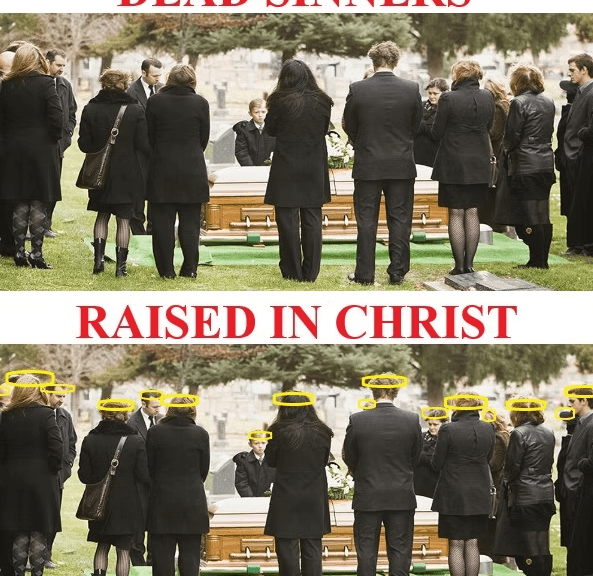
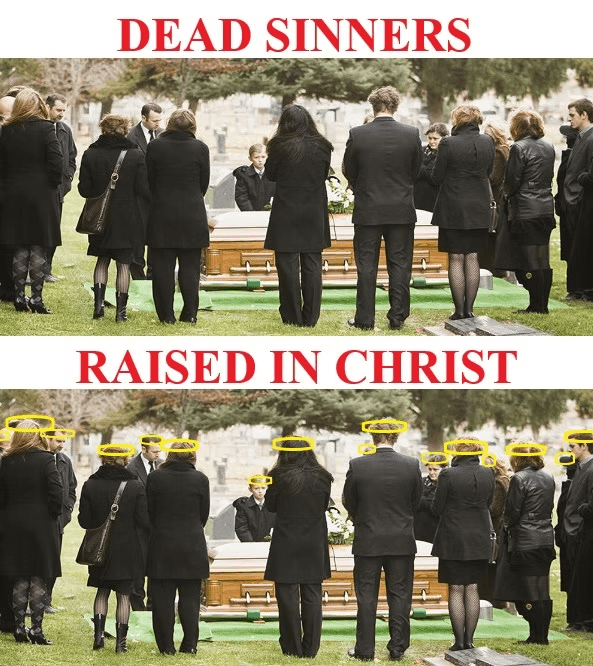
In the Epistle selection for the fifth Sunday after the Epiphany, the selection was from this same chapter of First Corinthians; and, in that Paul is shown [in English translations] to say, “Christ died.” In my commentary about that reading, I pointed out how impossible it is for an “Anointment” by Yahweh to “die.” The word translated as “died” actually means to separate away from at death, such that the physical body of Jesus was enabled by Yahweh to die, because Yahweh separated His “Anointment” from His Son. This says Paul was explaining how the “Christ” is Yahweh’s blessing placed on all souls who submit their self-egos and self-wills to serve Him. Jesus is THE Christ that was created by Yahweh for the purpose of saving souls [the name “Jesus” means “Yah[weh] Will Save” or “Yah[weh] Saves”]; so, just as a servant kneels before a king and is touched by the sword of power, “rising a knight,” so too does a disciple kneel before Yahweh, being touched by the “Christ” of Yahweh, “rising as Jesus reborn.” The death in this picture is what Paul was writing about here; and, that is the death of self-ego, so one can be “raised” as Jesus – Christ again in the flesh.

Carefully observe these two seemingly identical pictures and see if you can tell how one shows dead bodies [“nekrōn“], while the other shows dead bodies that have been “raised in Christ.” [Hint: Don’t let the funeral setting give you the wrong impression.]

A key element of divine Scripture that so often is obliterated by English translations is capitalization. A capitalized word written is more often than not diminished to the obscurity of meaningless dribble, when some words purposefully written in the lower-case are capitalized by the lower-g gods of translation. One such erasure of a divinely elevated word is seen here, when verse twelve is show to begin by stating, “Now if.” That is not what is written, as the first word written by Paul in this verse is “Ei,” meaning “If,” which is an important ‘big If’ to contemplate.

To see this word in the light of purposeful divine elevation, Paul is using it to set the conditions of Sainthood. “If” one’s soul has been saved by Yahweh, such that the soul in question “has been raised” to a divine state of being [a Saint, versus a sinner], then one must meet the requirements of that divine condition – “If.” With that understood, Paul then wrote [literally translated], “If now Christ is proclaimed that [is because] out from of a dead body it has been raised , by what means says within any that [is because] a resurrection of a dead body not it exists ?

The “If” of great importance is then relative to belief that Jesus was the Son of Yahweh [the soul of Adam recreated in the womb of Mary], who as that soul reborn was “Anointed” by Yahweh when created, thereby always a “Christ.” It is the “Christ” state of being that granted Jesus [the man in the flesh] eternal life, meaning he was born a ‘hero’ or a ‘demigod,’ so he could not die. It was an impossibility. However, the question that must meet the conditional hypothesis is this: If the “Anointment” of Yahweh were to come out of his body of flesh, allowing Jesus the man to die, then the Spirit of “Anointment” had to be “raised” from that body of flesh, making death be possible.”

The second half of this conditional then is Paul referring to himself, the Corinthian Christians and all Apostles [before and after, forever], as they were born without any divine Spirit from Yahweh possessing their souls, so all of their bodies of flesh were death waiting to happen. Thus, the “If – then” scenario is this: If is impossible for a dead body to be able to resurrect as a “Christ,” if the “Christ” of Jesus had not been raised from his body of flesh. The Christ of Jesus’ flesh had to separate away from him [at death], so his soul could then be resurrected in the dead flesh animated by lost souls, transferring eternal life to that which was dead. That is the If that associates with resurrection of the dead.

With that condition set, Paul then stated another “if” scenario, which is not divinely elevated. It is a mundane “if,” because this condition is based on the first conditional “If” not being true. Here, Paul literally said: “if now a resurrection of a dead body not exists , not Christ has been raised .

This says the opposite of a Saint having received the “Anointment” of Yahweh, granting his or her soul eternal life [resurrection], such that “if not” so exists a “Christ,” then that dead flesh has not been raised as a “Christ.” This clearly says that the presence of “the Christ” – Yahweh’s “Anointment” of Holiness – is the only way to escape the guaranteed death that comes to a soul animating a body of flesh. There can be no eternal life promise to a soul-body that has not received this “Anointment” from Yahweh.

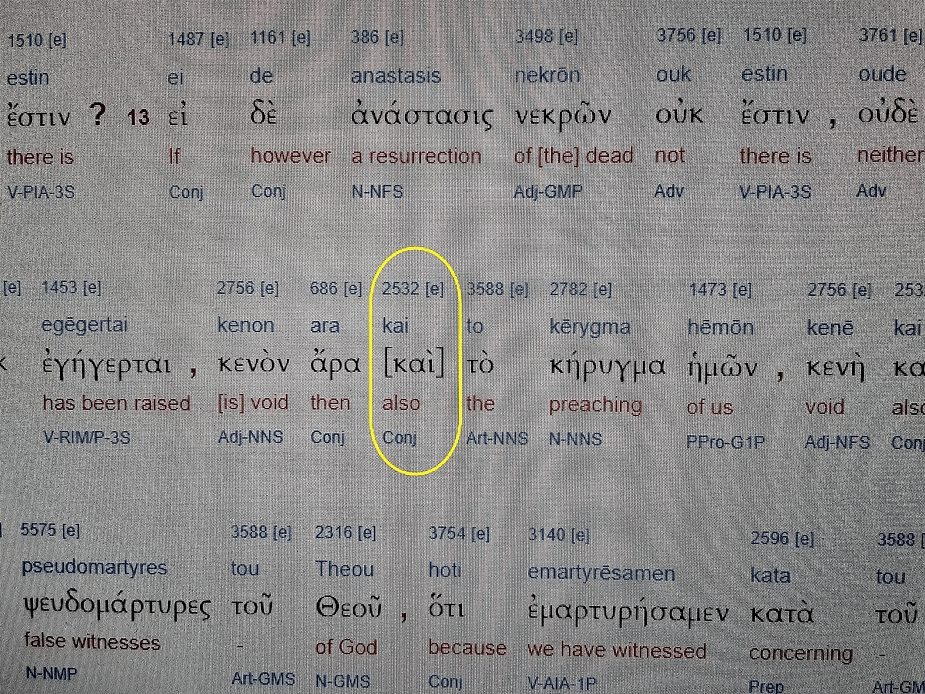
Paul then added another mundane condition, stating: “if now Christ not has been raised , empty therefore [kai] this preaching of us , empty kai this faith of you .” This says that “if their dead bodies made alive by souls alone have not been “Anointed” by Yahweh, they everything about them is empty of meaning. This importantly says their preaching the truth is empty words; and, importantly, that emptiness means they have no faith to pass onto others.” In that, the word “kai” is placed within brackets by Paul, which is a symbolic way of stating the conditional that says, “if one’s soul is empty of the Christ, then preaching about it cannot be added.” The brackets surrounding “kai” becomes symbolic of multiplication by zero, were zero is what is possible to be preached.

This says that without all of them having become “Christs,” there is absolutely zero way Christianity is true. That mundane conditional is only based on the assumption that there has been no “Christ raised” from Jesus’s dead body of flesh, so Jesus could be reborn in others – dead bodies of flesh – making them all become “Christs.” It is being “Anointed” by Yahweh that means eternal life “has been raised” in them.

Following that last scenario, where there is no “Christ” at all, Paul then wrote of a false ministry. His words written literally translate into English, saying “we have learned now kai false witnesses of this of God , since we have born witness according to of this of God , because he raised up this Christ , whom not he has raised if therefore a dead body not [it] raised .

In the last segment of words, Paul reconfirmed the first segments of words, by restating the negative “if” scenario as that which must be given as true, for the rest to also be true. If not having become a “Christ” of Yahweh [“raised” to know the promise of eternal life beyond death], then everything Paul and the Corinthian Christians said was “false witness.” Being a “witness” means having personal experience. Thus, if having been “raised as a Christ” is not personal experience witnessed, then everything they say is a lie against God. This is because everything they say is based on having the premise be that they are all led by God to speak His truth. If that is false, then they condemn their souls by speaking lies about a “Christ having been raised in dead bodies.”

In the sixteenth verse, Paul then wrote another ‘big IF,’ where the capitalization of “Ei” again divinely elevates the word to place focus on the condition of truth being met, relative to “Christ having been raised in a dead body” of flesh. Here, he wrote [literally]: “If indeed [those] dead bodies not [those] raised , not Christ has been raised .” In this, the truth says a dead body [a soul trapped within a body, giving it the appearance of life] cannot be “raised” to a state of eternal life [where death is impossible for a soul – i.e.: no more reincarnations into dead matter]. That transformation is impossible without the addition of the “Christ” in a soul, as Yahweh’s “Anointment” [which He does for all His wives].

In the seventeenth verse, Paul again returned to a mundane scenario – a condition of “if” – where he expounded on that condition of truth. Here, Paul literally wrote: “if now Christ not has been raised , useless this belief of you (exists) ; still you exist within these sins of you .” This says the truth is the “Christ has been raised in dead bodies,” but “if” this state is “not” to be the truth for one individual [a simple soul in a dead body], then there is no true faith, only “useless belief.” All “beliefs” based on religious principles [or anything else] can do and will do nothing to eliminate one’s existence within and the existence of “sins,” which surround “you” at all times. If not surrounded by the true “Christ,” then one is surrounded by the truth of “sins.”

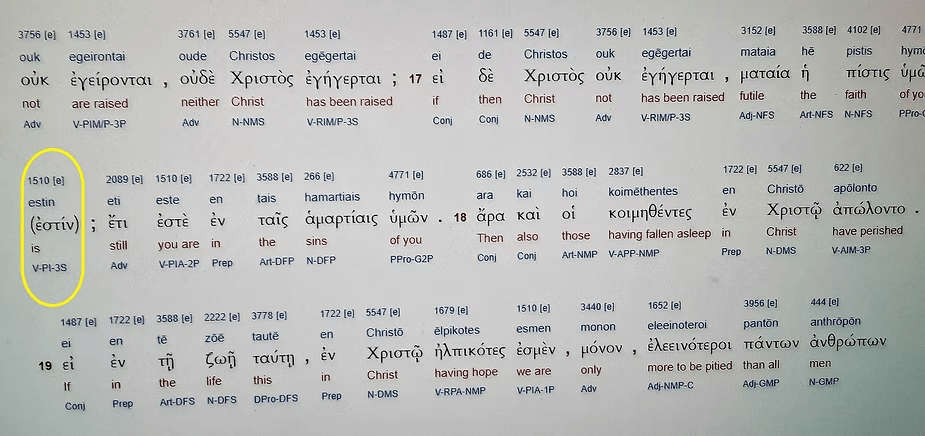
In verse seventeen, Paul set the Greek word “estin” between parentheses. The word translates as “I am, exist.” The parentheses take the existence of life and makes it unseen – the symbolism of parentheses identifying an aside. Thus, from saying “of you” [“autou“], a possessive state “of being,” the true “existence” of life that is unseen is one’s soul. A “Christ raised” is like a soul – invisible – but whereas a body shows signs of life, indicating a soul’s presence, the Christ becomes an inward part “of you,” as that invisible possessing Spirit that gains control over a soul.

From that set of truths, Paul then wrote in verse eighteen: “therefore kai those having died within Christ have been destroyed .” In this, the presence of “kai” [as always] announces the important conclusion that can be drawn from the truth of Christ having “been raised in dead bodies.” The important truth that follows having been raided by Yahweh’s “Anointment” says all death [a “nekron”] “has been destroyed” by that power that “raises” a soul from the sins of the flesh. All sins have “perished,” as far as having any further influence over a soul that Yahweh has “Anointed.” It says that a soul has to relinquish control over its body of flesh to receive the Christ presence; and, that means a self-ego must “die,” in order to be reborn as the Son.

Thus, in verse nineteen, Paul was led to write, “if within this life here , within Christ having expectations [we] exist , merely , more to be desperate of all humanity we exist .” In the first segment of words, the word “life” [“zōē”] becomes a statement of one’s soul having been raised through the resurrection of Jesus’ soul, making one be reborn a “Christ.” The condition is now a statement that “if Christ, then expectations come” to one so “raised.” The “expectations” [from “ēlpikotes”] is ministry, as Jesus reborn, as a “Christ” of Yahweh.

The separation of one word between comma marks – “merely,” from “monon” – states one soul’s self-worth is no longer any motivating factor to consider, as “alone” or as “only” self is not why a dead body will have been “raised.” The “expectations,” with none other to be considered, is to seek out “more to be desperate of all humanity,” who are those others still souls in dead bodies of flesh. Saints are “raised” as Jesus reborn to make others also be “raised” as “Christs.”

The twentieth verse is separated from the prior verses, because it is seen as the transitional verse that leads to the next section of the letter. The BibleHub calls this next section “The Order of Resurrection,” following these verses prior being named “The Resurrection of the Dead.” The NRSV uses that same initial heading, but does not name the verses after verse nineteen as anything new. Still, because BibleHub denotes a transition point of focus, the separation provided by the NRSV says they too recognize verse twenty as when Paul takes a new slant. The verse then says, “Now on top of this Christ has been raised out from dead bodies , first-fruits of those having death .

Here, this verse is begun by a capitalized “Nyni,” which means “Now” must be read as a divinely elevated statement of the truth having been determined that “dead bodies have been raised from being dead bodies, due to the truth of Yahweh’s Anointment.” This makes the word “Now” be a statement about the truth that Paul and the true Christians of Corinth knew personally at that time. That knowledge was they all were possessed by Yahweh, becoming His Christs, with each existing as a resurrection of the Jesus soul within them. The “Now” is still “Now,” as Christianity read it today. The divine elevation means “Now” is all times present when a soul existing in the world with the Christ raised within, such that “Now” is when the purpose ministry takes hold, representing the fruit of the vine of Christ has matured.

The last word in verse twenty is “kekoimēmenōn,” which was used similarly in verse eighteen, written as “koimēthentes.” These words are rooted in “koimaó,” which speaks metaphorically of “death,” as “sleep, fall asleep.” When Jesus was told of Lazarus being ill and near death, Jesus said he was “only sleeping,” when Jesus knew his flesh had died; but Jesus knew the soul awaited to be “raised” and returned to a body revived from death. Thus, Paul is saying the purpose of ministry is for those who “had fallen asleep within Christ” to awaken and go in ministry to others who have their souls “having death” to be “raised.” In this regard for ministry, Paul used the term “aparchē,” which translates as “first-fruits.”

The use of “first-fruits” is a reference to the unripe grains, fruits and vegetables gathers in omer measures [like a bushel], which were placed in the Temple of Jerusalem and held there for fifty days, at which time a high priest would then deem them fit to eat [on Shavuot, the Fiftieth Day or Pentecost]. It was on Pentecost Sunday that the disciples suddenly became Apostles and began spreading the message of truth, so souls in bodies of dead flesh could ‘awaken’ and be “raised” Spiritually. Thus, all of the first true Christians were likewise “first-fruits” that needed to preach the truth of the “Christ” to lost Jews [and Gentiles]. Thus, Paul would go on to use of the word “tagmata,” or “order” that was “of Christ,” meaning Christianity.

The problem people have with reading these verses and understanding what the heck Paul was writing about comes from people reading or hearing “Christ” and thinking that is the last name of Jesus. Thinking that makes everyone imagine Paul was demanding one believe that Jesus did die and resurrect; and, those who believe that become like Paul [et al]. That misses the point of each soul in a dead body of flesh needing to become Jesus reborn, because of marriage of a soul to Yahweh and becoming “raised in Christ” to be His Son Anointed again.

When Christianity today looks at itself seriously, then it has to conclude as Paul wrote mundanely, “There can be no resurrection of the dead, because Christ has not been raised.” That is the truth, because nobody is preaching as Christ raised [no Saints, no Apostles] the lesson that to be saved and gain eternal life with Yahweh. That lesson says one must be a Christ resurrected. Instead of teaching that truth, people laze about in pews, committing every sin under the sun, waiting for Jesus to come down on a cloud, with a fiery sword and destroy sin, while taking do-nothings to heaven. That was the state of failed religion that had Yahweh send His Son to save. That led to true Christianity; but then religious organizations cut the heads off true Saints; and, acts of that nature began the decline we so much enjoy today.

As a reading selected to be read aloud on the sixth Sunday after the Epiphany, the point made by Paul has to be seen by all who were indeed souls married to Yahweh, presented with His Son Jesus [on Christmas] and approved for intern ministry [the Epiphany], which now sees that ministry in need of being to preach to others how to do the same thing. Few people are doing that; so, fewer are thinking that is possible. It is time to get Christianity back on track and rolling towards the goal of true ministry.

Luke 6:17-26 – The poor man’s Beatitudes

Jesus came down with the twelve apostles and stood on a level place, with a great crowd of his disciples and a great multitude of people from all Judea, Jerusalem, and the coast of Tyre and Sidon. They had come to hear him and to be healed of their diseases; and those who were troubled with unclean spirits were cured. And all in the crowd were trying to touch him, for power came out from him and healed all of them.

Then he looked up at his disciples and said:

“Blessed are you who are poor, for yours is the kingdom of God.

“Blessed are you who are hungry now, for you will be filled.

“Blessed are you who weep now, for you will laugh.

“Blessed are you when people hate you, and when they exclude you, revile you, and defame you on account of the Son of Man.

Rejoice in that day and leap for joy, for surely your reward is great in heaven; for that is what their ancestors did to the prophets.”

“But woe to you who are rich, for you have received your consolation.

“Woe to you who are full now, for you will be hungry.

“Woe to you who are laughing now, for you will mourn and weep.

“Woe to you when all speak well of you, for that is what their ancestors did to the false prophets.”

——————–

This is the Gospel selection to be read aloud by a priest on the sixth Sunday after the Epiphany, Year C, according to the lectionary for the Episcopal Church. It will follow a reading from Jeremiah, where the prophet wrote, “Blessed are those who trust in Yahweh, whose trust is Yahweh.” That will be followed by a singing of Psalm 1, where David wrote: “For Yahweh knows the way of the righteous, but the way of the wicked is doomed.” That pair will precede an Epistle reading from First Corinthians, where Paul wrote, “But in fact Christ has been raised from the dead, the first fruits of those who have died.”

This reading from Luke needs to be read as two readings connected together. Verses seventeen through nineteen need to be seen as a set-up, similar to that told in Matthew’s fourth chapter, at the end (verses twenty-three to twenty-five). When Matthew changed chapters, telling of Jesus speaking from the mount [erroneously called “The Sermon on the Mount,” because Matthew’s fifth, sixth, and seventh chapters tell of many sermons spoken from the same location]. That location is established here in the first three verses (as well as Matthews last three verses in his fourth chapter).

Relative to what Luke wrote in verses twenty through twenty-six, this equates to that told by Matthew in the first ‘sermon on the mount,’ which has generally been termed “The Beatitudes.” The Beatitudes are found in Matthew 5:3-12, where they all begin with the Greek word “Makarioi,” all capitalized, meaning this is a divine level of “Blessing,” not some ‘run of the mill’ speaking of words at a grocery store checkout [“Have a blessed day!”]. I have written a quite in-depth analysis of Matthew’ account of ‘the Beatitudes,’ which can be found at this link. I recommend reading that to get a deeper perspective of what I will assume is common knowledge in this observation I am about to make. However, this view of Luke’s recall of ‘the Beatitudes’ is not as long as that written of by Matthew, and Luke wrote also of the “Woes” (which Matthew did not).

Because the “Woes” make a connection to a reading in Amos, Jesus would have spoken of that on a Sabbath when the lesson for the people [normally read in a synagogue, from scrolls] was from that prophet’s scroll. Here, one should see that Jesus addressed a reading lesson on one Sabbath, which would have been a separate ‘sermon’ from his ‘church’ on the mount-by-the-sea. One should also see that the mount did not afford Jesus a secure place to store ancient scrolls, from which he could ceremoniously have an attendant pull one from each Sabbath and hand it to him. Because Jesus was the Son of Yahweh and had the Mind of Christ, Jesus spoke as the scrolls had all been written in his heart [i.e.: soul]. Finally, the “Woes” can be seen as a prophecy of condemnation given to the self-righteous; and, that can be an explanation for why Jesus moved to a hillside that overlooked a flat plain by the sea, rather than go to a synagogue in a nearby town. When Jesus took to the mount it was for two reasons: First, it could accommodate a larger crowd; and, Second, Jesus had been rejected from entering the synagogues, because he spoke words explaining Scripture that no one had ever heard spoken before.

One of the elements of divine Scripture – that of the New Testament, written in Greek – is the marker word “kai.” This word simply translates as “and” and is sometimes translated as that, or as “also,” or totally ignored and tossed out like Yahweh’s leftover garbage. In Man’s self-imposed god-like state, where Man gets to tell Yahweh what Yahweh meant, the ‘low priests’ of translation slither up to the church leaders [who are not literate in Greek or Hebrew, or Latin, wishing English to be the one language of God], hissing, “God stutters a lot through His prophets, so we struck out the stutters and made up some stuff. Believe it.”

The reality is “kai” comes in two forms: capitalized as “Kai,” and in the lower-case “kai.” The first means “Great importance to follow,” with the second meaning “importance to follow.” This means that every use of the word “kai” denotes key elements of any dogmatic rule of canon law that needs to be followed. If those markers of importance are not followed, then one will end up lost on the path to religious belief. Being lost on that path means one can only be found when some saint wanders along and says, “You need to learn how to read the roadmap to heaven” [divine Scripture]

In the three verses above, which is the set-up to the ‘divided-in-two sermon’ that follows, Luke wrote the word “kai” ten times – the first capitalized and the rest in the lower-case. This says the capitalized “Kai,” which begins these three verses, is what sets those verses apart from the verses that follow. The nine internal uses of “kai” are then fully supporting that capitalization that begins these verses. In the above NRSV translation, there are eight translations of “and,” with one of them capitalized (not the one capitalized by Luke). The only thing all those uses of “and” tell a reader or listener is only this: Luke sure wrote “and” a lot. No importance is noted. However, when the remaining seven verses are read [in Greek], there are only five uses of the same word (a decrease in usage), with the word beginning the ‘Beatitudes’ also being a capitalized “Kai,” followed then by four internal uses in the lower-case. At all times the word “kai” should be read more like punctuation to follow and not like some poorly educated lad has fallen in love with saying, “You know,” in between the limited thoughts that come into his mind.

In the three verses of Matthew’s Greek, at the end of chapter four [the equivalent of Luke 6:17-19] those verses begin with a capitalized “Kai,” with another capitalized “Kai” beginning the last verse [25]. There are then fourteen other uses of the lower-case “kai.” In Matthew’s listing of “the Beatitudes,” he used the word “kai” only four times, all in the lower-case. This quite obvious ability to not say “and” proves every word of Scripture is written with purpose, from divine insight, with all coming from Yahweh through a prophet. When Jesus said he did not come to change one iota of Scripture [that written prior to the New Testament], one should keep that in mind when getting on one’s knees and praying to English memorizations (that are little more than paraphrases that have thrown the baby of truth out with the dirty bath water of translation) is a profession of ignorance, refusing to take any responsibility to understand the truth.

Here is verses seventeen through nineteen properly translated into English – literally:

17 Kai having descended in company with of themselves , he made a stand on the basis of an area flat , kai the common people many of learners of the same [as him] , kai an assemblage often of this people [laity] away from all this Judea [Place Of Jews] , kai Jerusalem [Teaching Peace] , kai this by the sea of Tyre [Rock] , kai Sidon [Fishery] ,

18 who came to have heard of himself kai to have healed from of those maladies of themselves . kai those disturbed away from spirits impure were served .

19 kai all this the common people were desiring to lay hold of of the same [of him] , because might [or strength] in the presence of of himself was going out [or coming out] kai healing everyone .

———-

When one realizes the use of “kai” is as a marker of importance, One can then see that the four capitalized words found in segments four, five, six and seven – which appear simply as names of places – are all marked as importance to be realized in that which follows. That marker says it is important to look at the meaning behind the names. Thus, one can see how Luke told: 1.) The assemblage was for Jews only; 2.) The purpose for the assemblage was the truth of what a synagogue should do for Jews, which is Teach the Peace of Scripture; 3.) The assemblage of Jews being taught by Jesus was by the Mount [a Rock] beside the Sea of Galilee; and, 4.) The purpose of the assemblage of Jews by the mount by the sea was to fish for the souls that were lost and seeking to be found by Yahweh [thus not a synagogue, but a Fishery].

In all of this three-verse selection, the words “autou” [“of him”] “autōn” [“of them”] are found, written three times and once respectively. The root word “autos” can equally mean: “self, the same, or he-she-it-they.” When one realizes Jesus spoke more to souls than brains, the aspect of “self” is more intended to be seen from those uses, because a “self” is a “soul.” Thus, the use says the common people (who were all Jews) were drawn to Jesus so they could be “the same” as his soul [himself]. This simple pronoun is completely unseen as such, when the truth is right before one’s eyes to see … when one is led to see it and one’s soul has divine assistance to see.

In verse seventeen, where the aspect of illness is seen, it is important to realize that Jews with physical maladies – those visible to others – were kept out of synagogues. A large open area that was flat, with excellent acoustics, where hearing did not require shouting [a wind-aided phenomena], all could gather without punishment from the rabbis and leaders of Jewish worship rules. Still, many “maladies” were unseen, as spiritual famine was the cause. The two marks of importance in verse seventeen combine to say the “maladies” of sin were due to demonic possession [unclean spirits], which (by coming close to Jesus and hearing his word) were chased away. Thus, simply from having access to Jesus on a Sabbath, seeing and hearing Jesus speak cleansed the souls of those impure.

Verse nineteen then states the importance of this healing’s lasting effect. The souls of the seekers were not only touching the essence of Jesus once for cleansing [like a baptism], but in addition, the soul of Jesus replaced the demon spirits with his own spirit [a divine possession]. Thus, those who were cleaned by him “took hold of his spirit-soul,” which was “going out” from Jesus and “coming into” those who sought salvation. This was a “healing” that was not just for a few who were sick, lame, or infirm. It was for “all” who sought spiritual “healing.” Jesus was indeed the food of heaven that starving souls needed to feast upon.

———-

Now, in verse seventeen, in the third segment of words, Luke wrote the word “mathētōn,” which has the same root word meaning as does the word written in verse twenty: “mathētas.” That meaning is this: “a disciple,” implying “a learner, a pupil.” When verse seventeen attaches that word to “many common people” or “a large crowd,” this is different than verse twenty, where the implication is more quaint. Verse twenty states Jesus spoke to “the disciples of him” [again finding that pronoun “autou,” meaning the spirit of Jesus was permanently attached to their souls … “the same of him”]. While what Jesus then spoke, relative to the ‘Beatitudes,’ is a truth for all “students” of Jesus and would have been heard by all within the acoustics of the mount, the reality is many are called, but few respond when called. One must seek to be found and one must knock for a door to be opened. Therefore, verse twenty’s address to “the disciples” is more associated to the twelve then; although it applies equally to all who ever become Saints.

In my linked commentary about Matthew’s account of ‘the Beatitudes,’ I made it be clearly stated that “Blessed” means one who has been “Blessed” by Yahweh, therefore one filled with His Spirit and made a Saint. The Latin word “beatitudo” means “happiness, blessedness,” which is the Roman Church’s way of translating the capitalized word written by both Luke and Matthew: “Makarioi.” That Greek word (commonly in the lower-case) means, “blessed, happy,” implying “to be envied.” The capitalization divinely elevates the usage by Luke and Matthew to a state of being that can only be brought on by Yahweh. Thus, ‘the Beatitudes’ are Jesus stating the ways to determine who are Saints [and thereby who are not].

Because all of the “disciples” (other than Judas Iscariot) became Apostles, therefore Saints, it is easy to see Jesus talking to them directly. However, any number of Saints walked the earth after having come in touch with the voice of Yahweh, spoken as Jesus in a Saint. A Saint, like Jesus, is a soul married to Yahweh, having been Anointed by His Spirit [baptized], so His Son is then reborn in countless bodies of flesh. Many Saints have spread Christianity around the globe, most of whom were never recognized by that title, awarded by the religious organization established in Rome [et al].

To understand what Luke wrote about the “Blessed” Saints, I refer the reader to the commentary on Matthew. I will now more closely examine the “Woes” recalled by Mother Mary, which Luke recorded in Scripture.

The Greek word written by Luke that is translated as “Woe” is “Ouai.” That word is written in the capitalized form three times, with the first time written being in the lower-case. The lower-case usage follows the capitalized first word of verse twenty-four, which is “Plēn,” meaning “Yet, Except,” implying in usage “However, Nevertheless, But, Except that, Yet.” The capitalization of a conjunction means the divine elevation is an “Exception” to the divinely elevated meaning of “Blessed.” Thus, “ouai” meaning, “alas! woe!” becomes elevated divinely as an explanation of what transpires when a soul is not “Blessed” [by “Exception”]. The “Exception” is “woe!,” which Luke then later capitalized, to show a divinely elevated state of “Woe.”

Here, it is again worthwhile to dissect the three verses telling of “Except woe!” and “Woe,” as I did to the first three verses of this reading. In this, one will find the presence of “kai” is diminished greatly (only once appearing); but there is a shift in focus placed on the presence of capitalized words, which can easily be ‘lost in translation.’ That dissection is as follows:

24 Except woe! yourselves they wealthy , Because you are holding back this calling to aid one of yourselves .

25 Woe to yourselves those having been satisfied in the present , you will desire earnestly . Woe those smiling in the present , Because you will feel guilt kai lament .

26 Woe whenever well-perceived of yourselves command all these human , According to these of them indeed they made those false prophets them fathers of themselves .

I believe when these verses are read this way, it is easy to see verse twenty-four pointing to those who find their souls in bodies of flesh that are surrounded by plenty (not severe shortage of necessities). That comfort then keeps those souls from seeing a need to marry their souls to Yahweh and help their own souls [“one of yourselves” who are “wealthy” materially].

In verse twenty-five, it is easy to see the repetition of “now” or “in the present” being the inability to see the future. When wealth has brought one comforts that seem secure, they are hindered by not knowing the need to desire spiritual food, seeing its lack as important to seek it to become plentiful. When those are finding comfort in Scripture allowing them to cheat others for their own personal gains [“God wants you to be successful” bullshit, which Jews worship in the god Mammon], the time will come when Judgment will be the time for balancing the scales. At death a soul who neglected other souls, through self-worship, will feel immense “guilt,” with it important to see how their “lament” will not be temporary, but long-lasting.

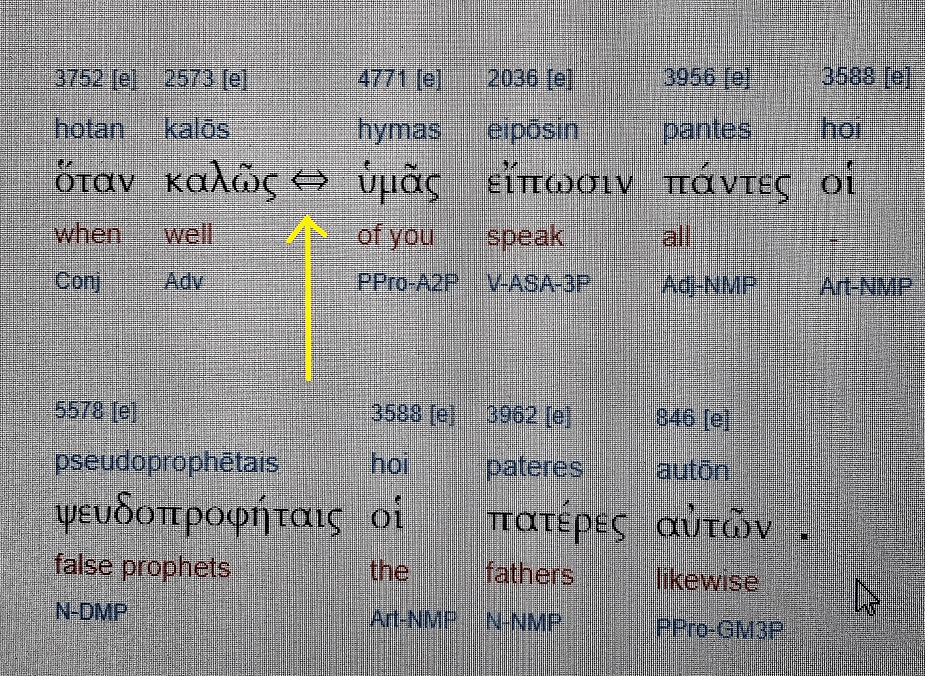
In verse twenty-six, it is easy to see the “” symbol of Greek text, which is completely erased in the NRSV English translation. That is a mathematical symbol that is called a “left right arrow.” The symbol is placed in divine Scripture [New Testament] when the words written can be either true or not true. The symbol means that stated before [left arrow] is true if that written to follow [right arrow] is also true. If the two are not equally true [the equal mark in between the arrows], then that written is false. In the text above, the statement of truth says, “If one is well-perceived and speaks highly of oneself among other humans,” then the truth speaks of one who is self-centered. One who is “self-centered” can never submit one’s soul [a soul is a self] to Yahweh; so, one’s fate will be based on how well others of the human race accept one’s commands as a god of the world.

When this is seen, it becomes a statement of truth that follows, where Jesus said the judgment of humanity can be swayed by people of importance on earth. Their desire to have their egos stroked will lead translators of Scripture to say everything good is deserved by the great human beings on earth. They, of course [and unfortunately], will need to live forever (as do the true gods), so a higher Judgment will never come to them. As the “father” of their own self-worth, the true Father will deny having ever married that soul; so, Judgment will be harsh.

When all of this is tied together, so Jesus created a place with no ups and downs of religious rules and by-laws to contend with are present [a “flat area”], and with no expectations to learn Scripture without explanations made possible [seekers receiving the Spirit], the Scriptures in four Gospels become the “assemblages” of Jesus’ lessons. The lesson today is one that teaches a soul is either a Saint [those “Blessed” by Yahweh] or one that ain’t [those who mope around on Judgment Day saying, “Woe! is me.”].

As a reading selection to be read aloud by a priest on the sixth Sunday after the Epiphany, the danger is not laying back in your pew [the one marked by your ever-present scent, with pillows and tissues kept in a pew to ward off anyone else from daring to ever sit there] and thinking, “Thank you God for making me be beatified.” True Saints rarely sit in pews, because they are either standing in front of them [a true priest of Yahweh, reborn as Jesus] or one is trying to teach the truth of Scripture in the real world; all while being stoned to death by the rocks thrown by those Woe! people. Even while being stoned to death, the Saints look up to Yahweh and Jesus, saying, “Forgive them Yahweh, because they do not know what they are doing.”