oseph said to his brothers, “I am Joseph. Is my father still alive?” But his brothers could not answer him, so dismayed were they at his presence.
Then Joseph said to his brothers, “Come closer to me.” And they came closer. He said, “I am your brother, Joseph, whom you sold into Egypt. And now do not be distressed, or angry with yourselves, because you sold me here; for elohim sent me before you to preserve life. For the famine has been in the land these two years; and there are five more years in which there will be neither plowing nor harvest. elohim sent me before you to preserve for you a remnant on earth, and to keep alive for you many survivors. So it was not you who sent me here, but ha-elohim; he has made me a father to Pharaoh, and lord of all his house and ruler over all the land of Egypt. Hurry and go up to my father and say to him, ‘Thus says your son Joseph, elohim has made me lord of all Egypt; come down to me, do not delay. You shall settle in the land of Goshen, and you shall be near me, you and your children and your children’s children, as well as your flocks, your herds, and all that you have. I will provide for you there–since there are five more years of famine to come–so that you and your household, and all that you have, will not come to poverty.'”
And he kissed all his brothers and wept upon them; and after that his brothers talked with him.
——————–
This is the Old Testament selection to be read aloud on the seventh Sunday after the Epiphany, Year C, according to the lectionary for the Episcopal Church. It will precede a singing of selected verses from Psalm 37, where David wrote: “Refrain from anger, leave rage alone; do not fret yourself; it leads only to evil.” That pair will then be followed by the Epistle selection from First Corinthians, where Paul wrote, “What is sown is perishable, what is raised is imperishable. It is sown in dishonor, it is raised in glory. It is sown in weakness, it is raised in power. It is sown a physical body, it is raised a spiritual body.” All will accompany the Gospel reading from Luke, where it is written: “If you love those who love you, what credit is that to you? For even sinners love those who love them.”
In this selection of verses, four times the NRSV translated a form of “elohim” as “God.” In all of the forty-fifth chapter of Genesis those are the only four such references. In this, it highlights the fact that the name Yahweh was not yet known, as that name was told to Moses at the burning bush. While it has to be grasped that Jacob was taught his ‘religious beliefs’ by his father Isaac, with his taught to him by Abraham, those Patriarchs knew the voice of Yahweh, but not by name. The Hebrew word “elohim” is clearly the plural form of “el,” which states “gods.” To say someone wrote the word for “gods,” while meaning the singular is a lie and is man playing a god [be that man a Jewish rabbinical scholar or a master of the Hebrew language], so to say “gods” means “God” is flat out wrong.
The ”elohim” must be understood as being the “angels” created by Yahweh to serve Him on earth. Some of those “elohim” refuse to help mankind, whom they made in their likeness for Yahweh [day six of the Creation]. That means there are fallen “elohim” and there are guardian “elohim,” which watch over souls in human flesh. In this regard, one needs to know the history of Joseph.
Joseph was born in Genesis 30. Jacob wrestled with his demon “elohim” [or “el”] in Genesis 32. It was at that time that Jacob became a Yahweh elohim, because that was when he received the title “Israel.” That presence in Jacob did not pass on to his children. In Genesis 37 we are told of Joseph’s dreams, which he told his family. Joseph was then seventeen years old; and, we are told he was Jacob’s favorite son. That led his brothers to sell him into slavery, after an attempt to kill him failed. Here, one must realize that Joseph is not wrestling with his demon, because he has received the guardianship of Yahweh’s elohim, knowing the heart and soul of Joseph, so Joseph becomes an extension of Yahweh to a son of Jacob’s [Israel’s]. So, Joseph sees visions as a prophet, which are brought to him via “elohim.” Thus, Joseph was taught by his father Jacob [then a Yahweh elohim as Israel] about the “gods” that watch over souls in flesh on earth.
This makes the important elements to grasp from this reading be the concepts of “brothers” and “father,” as being relative to “elohim.” This story, other than being something that becomes ‘ho-hum history’ to souls in human flesh walking the earth in the year 2022, be pointless. One has to ask oneself, “Why does this history lesson matter to me?”
Brothers by another mother.
The name “Joseph” means “Increaser” or “May He Add.” This means that is the importance that has to come from this lesson, because the name Joseph is stated five times. The verses skipped over in today’s selection [12-14] all state the name Benjamin; so, that name is avoided in the meaning of this lesson. None of the other brothers of Joseph are named. Only “Joseph” becomes important to grasp. This means the story is about “brothers” being “increased” to the level of being that state of “Israel” that was the “father” [Israel, elevated from Jacob] needs to be caught. This means the “addition” to the “brothers” is the presence of guardianship by the “elohim.”
This reading then makes Joseph be metaphor for Jesus. Sinful brothers have had a ‘come to Jesus meeting.’ Their sins are known; and, they feel deep, inner guilt.
When the reason the brothers have come to Joseph is realized to be famine, which is said to be still “five more years of famine to come,” that can only be something a prophet can forecast accurately, because he is led by the “elohim.” Ordinary humans cannot be fully accurate in predicting the weather the next day, much less five years from today. By seeing this as more than a story telling one to believe in something that happened a long time ago, to people modern Christians have no real relationship with (physically, via blood), the higher element of famine needs to be seen on a spiritual level. More than a scarcity of physical food, Biblical famine means souls are starved and very thin.
The “father” [Jacob] of the “brothers” [the twelve sons, with Joseph and Benjamin] has had no effect on anyone else’s spiritual transformation, meaning he only led Joseph to seek spiritual nourishment from his own encounter with “elohim.” This means that Joseph is more of a spiritual influence on his family, in the same way Mary’s husband Joseph was not how the soul of Jesus became an “elohim.” Each soul must be starved or famished spiritually to seek the help of Yahweh [which comes in the name of Jesus]; and, this is the deeper implication of this story: the lost souls were led by desperation to find their redemption, and through realizing their guilts they were saved.
As an Old Testament reading for the seventh Sunday after the Epiphany, the point to see here is the theme that runs through all the selections for this day. It is we who … all of us … are from sinful pasts, so we all have been blessed by Yahweh when our souls have become His elohim on earth. The “brothers” of Joseph were the past that had to be and then it had to be released, so the past no longer had any holds on the present and future. The future always holds spiritual famine; and, the only way to be saved from spiritual death is change. A soul must move to “Goshen,” where an inundation of Spirit makes one’s soul fertile and well-nourished. The “brothers” of Joseph reflect the brotherhood of mankind, where that which connects us all is sin. The call to stand before Jesus is then a call to become divinely elevated “brothers,” where a soul has wrestled with its demons and freed itself to be possessed by Yahweh and His Son Jesus. This theme needs to be seen as the test or one’s merit as a potential bride to Yahweh, when one can be guarded by an inner elohim.
Someone will ask, “How are the dead raised? With what kind of body do they come?” Fool! What you sow does not come to life unless it dies. And as for what you sow, you do not sow the body that is to be, but a bare seed, perhaps of wheat or of some other grain. But God gives it a body as he has chosen, and to each kind of seed its own body.
So it is with the resurrection of the dead. What is sown is perishable, what is raised is imperishable. It is sown in dishonor, it is raised in glory. It is sown in weakness, it is raised in power. It is sown a physical body, it is raised a spiritual body. If there is a physical body, there is also a spiritual body. Thus it is written, “The first man, Adam, became a living being”; the last Adam became a life-giving spirit. But it is not the spiritual that is first, but the physical, and then the spiritual. The first man was from the earth, a man of dust; the second man is from heaven. As was the man of dust, so are those who are of the dust; and as is the man of heaven, so are those who are of heaven. Just as we have borne the image of the man of dust, we will also bear the image of the man of heaven.
What I am saying, brothers and sisters, is this: flesh and blood cannot inherit the kingdom of God, nor does the perishable inherit the imperishable.
——————–
This is the Epistle selection to be read aloud on the seventh Sunday after the Epiphany, Year C, according to the lectionary for the Episcopal Church. It will follow a reading from Genesis, where the brothers of Joseph have come before him, seeking help during a famine, unknowing that he was the brother they attempted to kill, whom they sold into slavery into Egypt. We read Joseph tell his brothers, “So it was not you who sent me here, but ha-elohim having made me a father to Pharaoh, and ule-adown of all his house and ruler over all the land of Egypt.” That is then followed by a singing of parts of Psalm 37, which includes: “Be still before Yahweh and wait patiently for him; do not fret yourself over the one who prospers, the one who succeeds in evil schemes.” All will accompany the Gospel reading from Luke, where Jesus said, “A good measure, pressed down, shaken together, running over, will be put into your lap; for the measure you give will be the measure you get back.”
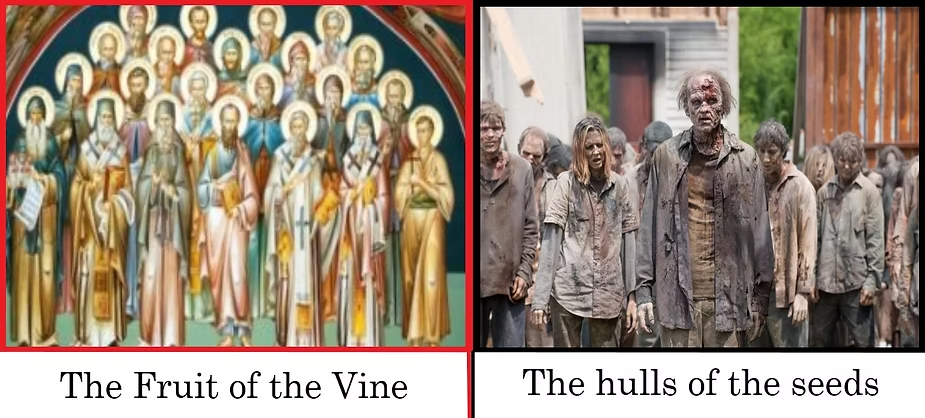
In this time period after the Epiphany, this makes the third Sunday in a row that has lessons coming from chapter fifteen of Paul’s first letter to the true Christians of Corinth. The first lesson hinged on understanding his writing “Christ died,” where an “Anointment” from Yahweh cannot “die.” Instead, that “Anointment” of Jesus had to be separated from his body. That separation allowed death of the body of Jesus, but made the soul [a.k.a. “the Christ”] available to become the vine that merged with the fruit of that “Anointment.” That then led to Paul writing, “Christ has been raised from the dead.” The separation of the “Christ” from Jesus made it possible for the souls inhabiting dead bodies of flesh [as far as eternal life is concerned] to be “raised” by having the “Christ” Spirit be “raised” in them. All of this is now leading to Paul placing focus on how bodies of flesh are death awaiting, but the souls and the “Anointment” by Yahweh are the truth of eternal life. Everything fits together, so all supports each other as the truth being told.
Because this is thirteen verses of text, which skips over three other verses in between, this is far too much written that a casual reader would care to find me writing about in deep discernment. The test of a true Christian can be found in all the Epistles, most of which were written by Paul. The lazy soul – a true non-Christian – will never care to read much that delves deeply into explaining divine text. Most will let someone else tell them what it means and think little about that opinion afterwards. An industrious soul – one of a true Christian, possessed by Yahweh and His Son Jesus – will be exactly like Paul and those Saints he wrote to in Corinth. Each word of the written text would be seen as a powerful statement sent to them by Yahweh, which they would ponder deeply, with divine assistance.
That means the Corinthians were just like all whose souls have married Yahweh, becoming His “Anointed” [His “Christs”], and had become the Mother of Jesus, just like Mary. When it is written that “Mary treasured up all these things and pondered them in her heart” (Luke 2:19, after listening to the shepherds tell her what the angel spoke), it was the deep meaning that Mary treasured, which came from the Word of Yahweh, told through His messengers [a.k.a. “angels” in shepherd’s clothing].
To do as I have done in the past (for longer sections of Paul’s writings), I will now cut the wheat (so to speak, using Paul’s analogy) and thresh the grains for your consumption. That means I will now be presenting only the capitalized words that come from these verses, shown as a reflection of what these verses place divine focus on. Those capitalized words are as follows:
“Alla” – “But, Otherwise, On the other hand, Except, However” ………………………….. Verse 35
“Pōs” – “How?, In what manner, By what means” ……………………………………………….. Verse 35
To then take these and line them up in one statement, that capitalized statement says:
“Except By what means God, In this way Forasmuch as Was born Adam [the Only Son of Yahweh, therefore the soul of Jesus], Adam [the Only Son of Yahweh, therefore the soul of Jesus] On the other hand This [divine resurrection of Jesus’ soul] of God.”
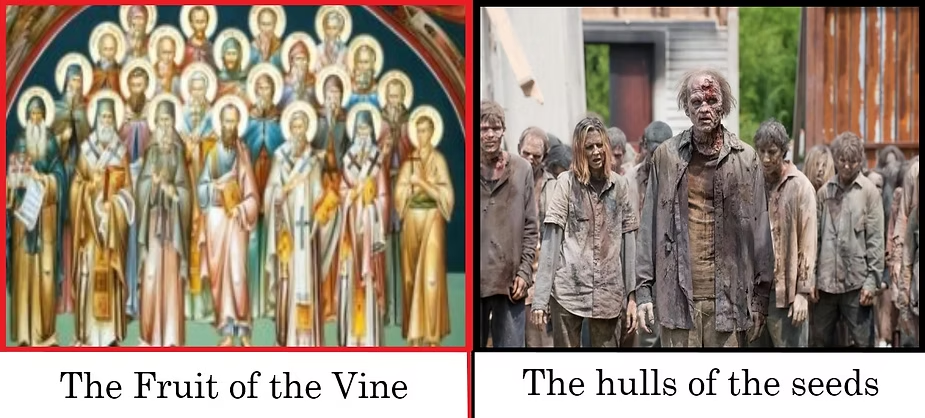
That says everything about being raised from the dead is dependent on “God.” It has nothing to do with bodies of flesh being “raised,” as bodies of flesh are like the hull covering a seed within – a body covering a soul. The hull does not grow anything, so the hull dies. It does not get raised. Only the soul becomes raised. Thus, the soul of Paul and the Corinthians [and all the Saints] are raised by God implanting their souls with the soul of His Son Adam. The name “Jesus” means “Yah[weh] Saves,” so Adam was made by Yahweh for the purpose of holding the soul of Jesus. Therefore, the body that was Adam died, so the soul named Jesus could be raised. Everything divinely come about “of God.”
In verse thirty-six, after Paul calls those who question how dead bodies can be raised, he used the analogy of a seed. Seeds are sown for the purpose of growing grains. Paul surmised that nothing can grow [thus be raised] if death does not occur first. That which must die, as far as seeds of grain are concerned, is the hull, or seed coat (testa). When the analogy is applied to human beings, this means the death of the body of flesh must come first, so the soul can be released. However, there is a caveat to this which must be seen as reflecting Paul and all the Saints.
The seed analogy is a human being (soul in body) that has been placed on earth by Yahweh, as purposeful seeds to be planted and grown into Saints. As such, it makes no sense for the body of flesh to die, as that would raise the question asked by fools: How does a dead body get up and walk around again? While Jesus raised Lazarus to prove that is possible by Yahweh [all things are possible by Yahweh], the point of death must be seen as figurative [although the raising of Lazarus becomes metaphor for what all Saints must go through]. As such the hull or seed coat is that of worldly sins. The death of a sinful way of living must be shed, so the soul can be raised to become Jesus reborn. That is the point of verse thirty-eight (and thirty-nine).
In verse forty-two, it begins by stating: “kai this resurrection of this of dead , it is sown in decay , it is raised in immortality .” This importantly says Jesus’ soul is resurrected, but not in his body of flesh that died. His body of flesh was his “seed coat,” which released his soul as a plant that grows – the vine of Christ [where Christ is not the last name of Jesus, but the name of the vine of Yahweh]. That divine soul resurrects in the dead bodies that have souls leading sinful lives. That “resurrection of this of dead” is the transformative presence that is “sown into decay,” which is sinful flesh. With the soul of Jesus resurrected within the soul of one who was before dead to sin, the result is Jesus reborn, with a soul of a sinner then cleansed and thereby raised by being granted eternal life [“immortality”].
The paradoxes stated in verses forty-one and forty-two – “sown in dishonor, raised in glory; sown in weakness, raised in power; sown in body natural, raised in body spiritual” – says the death of the old brings on the birth of the new. The new is a Saint in the name of Jesus Christ.
The conditional stated as a thought of reality says, “If there is a body natural , there exists kai spiritual.” This says ALL human beings that are thought to be living [a big If] are so thought because they have souls giving animation to dead bodies of flesh [the natural]. The importance that marks one as being alive is the “spiritual,” which is the soul. When Paul wrote, “there exists,” the word “estin” is a statement saying, “I am, I exist,” which can only be by the presence of a soul bringing life to dead flesh [waiting to return to that state of death – dust]. The soul is the “spiritual” that is within the “body natural” [the seed covering].
Verse forty-three then quotes Scripture [Genesis two], where Paul said, “Was Born this first human Adam into the soul living ; this till the end Adam into a soul life-giving.” This is Paul understanding the meaning of Genesis 2, which is misunderstood by those who are not Saints. It is Paul saying that Yahweh created Adam, so Adam would be the metaphorical seed that would die of outer shell, releasing the soul of life so a vine could eternally grow, producing “life-giving” fruit.
In verse forty-four, Paul explained this creation of Adam was not so his death would initially lead to the soul of Jesus. Adam would be sent into the world, descended from demigod (or hero) to “natural” human being (which lived naturally nine hundred thirty years). That “first” birth and death would lead to the soul of Adam becoming the “spiritual” presence that would be reborn in others afterwards. This is a story of reincarnation, which is the history of the Patriarchs of the Holy Bible (the Torah). Still, the soul of Adam would return, sown into Mary, to be named “Jesus” – “Yahweh Will Save.” Yahweh will save through the resurrection of His Son Adam’s soul in the souls that are His seeds sown on earth.
Verses forty-five through forty-nine then expand on this history that led to Jesus. Verse forty-six and forty-seven speak of the first man and the second man, where this is a statement of the “doubly fruitful” presence of the soul of Jesus resurrected in the soul of one who has married Yahweh, becoming cleansed of past sins. Verse forty-eight is then saying, in essence, the dust of a Saint is made so by the spirit of Jesus [Adam raised spiritually as the eternal life of the true vine]. Verse forty-nine says the image of Saul will become the image of Paul, where Jacob transformed into Israel, by wrestling with one’s demons and coming out victorious – through Yahweh’s help.
In verse fifty, Paul referenced the “brothers’ [not ‘and sisters’], because the true Christians of Corinth had all be reborn as Jesus, the Son of Yahweh. They were all spiritually raised brothers(males and females alike). Paul said the kingdom of heaven is not something that is an “inheritance,” which means being born a Jew (and thereby that applies equally to those calling themselves Christians today) was no justification to claim a right to gain heaven after death. No body of flesh will ever enter the spiritual realm of Yahweh, as that is a realm only for souls. This means only souls who have gained the right to truthfully say at Judgment, “I have been reborn as Jesus!” get to enter. That means only Saints go to heaven. That says only those in the name of Jesus get eternal Salvation.
As a reading selected to be read on the seventh Sunday after the Epiphany, the lesson to be gained is the death of the old self, in order to be reborn anew as a Saint. Paul’s explanation here of resurrection is clearly saying a Spiritual transformation must take place, His naming Adam gives depth to the uses of Ephraim being the firstborn, where that name means “Doubly Fruitful.” The dual “man” – the first man of dust and the second man of spirit or soul – is explaining the resurrection of Jesus, as the Christ, so two ‘men’ exist as one [males and females equally of humanity]. That resurrection make all souls likewise reborn be related, as “brothers.” When one enters ministry as Jesus reborn, one must be like Paul and understand these things. It was Paul’s personal experience that allowed him to testify to what the resurrection meant [the seed analogy], which allowed him to let others see the truth for themselves. Without that personal experience, one is (in the words of Paul) a “fool.”
Jesus said, “I say to you that listen, Love your enemies, do good to those who hate you, bless those who curse you, pray for those who abuse you. If anyone strikes you on the cheek, offer the other also; and from anyone who takes away your coat do not withhold even your shirt. Give to everyone who begs from you; and if anyone takes away your goods, do not ask for them again. Do to others as you would have them do to you.
“If you love those who love you, what credit is that to you? For even sinners love those who love them. If you do good to those who do good to you, what credit is that to you? For even sinners do the same. If you lend to those from whom you hope to receive, what credit is that to you? Even sinners lend to sinners, to receive as much again. But love your enemies, do good, and lend, expecting nothing in return. Your reward will be great, and you will be children of the Most High; for he is kind to the ungrateful and the wicked. Be merciful, just as your Father is merciful.
“Do not judge, and you will not be judged; do not condemn, and you will not be condemned. Forgive, and you will be forgiven; give, and it will be given to you. A good measure, pressed down, shaken together, running over, will be put into your lap; for the measure you give will be the measure you get back.”
——————–
This is the Gospel selection that will be read aloud by a priest on the seventh Sunday after the Epiphany, Year C, according to the lectionary for the Episcopal Church. It will be preceded by a reading from Genesis, where Joseph told his brothers, “Come down to me, do not delay. You shall settle in the land of Goshen, and you shall be near me, you and your children and your children’s children, as well as your flocks, your herds, and all that you have.” That will be followed by a singing of Psalm 37, where David wrote, “The lowly shall possess the land; they will delight in abundance of peace. But the deliverance of the righteous comes from Yahweh; he is their stronghold in time of trouble. Yahweh will help them and rescue them; he will rescue them from the wicked and deliver them, because they seek refuge in him.” That pair will be followed by a reading from Frist Corinthians, where Paul wrote: “So it is with the resurrection of the dead. What is sown is perishable, what is raised is imperishable. It is sown in dishonor, it is raised in glory. It is sown in weakness, it is raised in power. It is sown a physical body, it is raised a spiritual body.”
Here is where one can see that Jesus is not just talking aimlessly about things that should be done, as some, “Oh, by the way, do this” kind of rant on the mount [calling Matthew’s three chapters – 5, 6, & 7 – one ‘sermon on the mount’]. The “Woes” of last Sunday’s Gospel lesson referred to Amos 6:1-7 and the ‘Beatitudes before that referred to Psalm 1:1-6. Today’s references that are headed ‘Love Your Enemies’ address the teachings of Leviticus 24:17-23 [‘An Eye For An Eye’]. This means all of the teachings from the mount by the sea were spread out over time. However, the lessons taught in the synagogues on the Sabbath were what Jesus reviewed, but not on the Sabbath; instead he taught on Sundays, the day after, letting the Jews know the truth that went untold in the synagogues.
When one sees the lesson of Leviticus saying “kill one who kills; and, maim one who maims,” one needs to realize that law was passed on to the Israelites by Moses, as the messenger of Yahweh. When Jesus said, “I have not come to change one iota of the law, but to fulfill it,” this says the Law saying, “kill those who kill unjustly and equally punish physically those who permanently injure others” is Yahweh’s Word. The caveat of the Law that is important to grasp is this: It only applied to the Israelites in the wilderness with Moses. This means anyone else in the world that was not chosen by Yahweh to be His children – PRIESTS OF HIM – need not bother learning these laws, because they only apply to those agreeing to the Covenant [the Law] of Yahweh, which means marrying their souls to Him. The permanence of the Leviticus Law says it shall always be: If a priest of Yahweh kills another priest of Yahweh, then the Law calls for an automatic rejection of the killer [sinner-lawbreaker] from the ‘God’s chosen people’ club.
[Aside: For all the people who pander to criminals, crapping all over the families of victims of crime, who think “Give criminals another chance [perpetually] and avoid cruel and unusual punishment,” they should try living for forty years in an exclusive environment, where you have no prisons and no people being trained to watch criminals. Imagine letting the rapist murderer you say should go free lives next door to you [or in your basement]. See how well that works out for you. To outcast those from that exclusive Israelite group would mean a cruel and unusual death by starvation, or being ripped apart by wild animals, or being bitten by poisonous snakes. The just thing to do was kill or maim the criminal and it is done. Besides, no dust will have been harmed in the killing of a criminal. Dust returns to dust; and, a soul cannot be harmed by slamming heavy rocks against the skull and brain of a criminal that soul possessed. Still, the world is no longer an exclusive arrangement for saints married to Yahweh; and, crime can only exist in the physical world, alongside the panderers of crime.]
When one realizes that Jesus was not telling the whole world to love one another – the Socialist mantra that uses religious beliefs to destroy religious people from within – that is because that would change more than an iota of the law; and, then one can begin to understand what Jesus was saying. First of all, he was teaching this because it was the reading publicly read on the Sabbath; and, second of all he was explaining it, because no one knew why Yahweh told Moses to tell the Israelites to use killing as a means of restoring order in a selective group, where that group would not work if everyone did not comply with the marriage vows. Thus, no one had taught how the heck you do that. After all, they all had stone piles for killing lawbreakers; and, that was really kind of a fun thing for the Israelites to do, ridding the Judaic club of wrongdoers, with Yahweh’s consent … as explained by some hired hand or false shepherd.
The key term in verse twenty-seven is “enemy,” from “echthrous,” transliterated as “echthros.” According to Strong’s, this word means, “hostile,” implying in usage, “hated, hostile; substitute for: an enemy.” This says the primary translation should be “Love your haters,” or “Love those hostile to you.” The root of all – enemies, haters, hostiles – is anger and rage. Guess what? Anger and rage can be known to be the motivations for killing and harming others unjustly.
This then leads to the solution, where Luke wrote the capitalized word “Agapate,” which divinely elevates “love” to a Spiritual Love that can only come from a soul being truly married to Yahweh. When one knows the whole world is not filled with the Holy Spirit of Yahweh’s “Love” – having not agreed to His Laws – then it is moronic to go around preaching, “love, love, love … love is all you need” Beatles crap. That crap was taught on the Sabbath in the synagogues, making it necessary for Jesus to go to the mount on Sundays and clear things up.
The people today are miserable when told to “love” anyone who hates them. They all ask, “How the heck do I love a criminal?” Nobody has been giving them the “How to” sermons. They just play a Beatles’ record and hope the bliss of a 3-minute song gets the bigger bills out of the billfold. The “How to” of Jesus is not to love [in the lower-case], but to “Love” because Yahweh is within a priest of His.
In the accepted substitution of “haters” as “enemies,” one needs to realize that an “enemy” is an enemy for a reason. Muslims are taught to hate Christians. Communists are taught to hate Capitalists. When one knows someone hates him or her, the feeling becomes mutual. Hate spawns hate. Human love does nothing to remove hate. Both “love” and “hate” are human emotions; and, the world is the only place where hate can exist, which means hate is a natural phenomena that will never be eliminated from the world.
When Stephen was being stoned to death, hate motivated his killers. When Stephen cried out, “Forgive them Yahweh because they do not know what they are doing” [to their souls … from misinterpreting the Law], he spoke out from having been filled with the divine “Love” of Yahweh. None of those who murdered Stephen [and Saul was holding all the cloaks of the murderers] felt remorse, just because Stephen expressed “Love” to his “haters.” Haters “love” to hate; so, killing a criminal satiated their desires to bash in someone’s head; and, who better than one who makes it easy to hate him or her? Stoning Stephen was like an orgasmic moment to the self-righteous Jews. So, Jesus was not suggesting that an ordinary human feeling – the kind that is more associated with putting the ole peepee in the oohlala “love”, a run of the mill, degenerate human “love” – would do anything towards eliminating hatred.
[Ref: Notice how the French always hate the Germans and the British, but will always show their “love” by surrendering to the German’s hatred of the French, thereby letting the Brits hate the Germans, exacting revenge punishment for them [with the Brits always calling for backup from their colonies]. That is how bastardization of Law takes place in the real world, when there are no French, Germans, or English who have their souls married to Yahweh. That is too Jewish; and, they all hate Jews.]
The way to “Love” your “haters” is to let them hate you, without your presence to make their rage and anger become elevated. Prancing before your “enemies,” like some sixties ‘love child’ … tossing daisies about from a basket, singing Beatles’ tunes … will only make the haters hate more. Jesus was saying, “Accept that those married to Yahweh will always have haters; so, the “Love” of Yahweh means leave them alone, staying calm in separate [exclusive] environments, where “Love” can govern all. Being where the haters cannot see you means their hate will naturally abate.
Where the translation appears to say, “do good to those who hate you,” the correct translation says [literally in English]: “honorably act to these hating you”. Here, it becomes vital to see how Jesus would constantly be confronted by those Jews who wanted Jesus to join their side and do what they say, or be killed as their enemy. Jesus always “acted honorably” to their tricks and traps, plots and ploys. Jesus “acted honorably” because his soul was in “Love” with Yahweh the Father, and Jesus spoke to their trick questions with truth; and, “The truth shall shut up thy enemies.”
Because we know this lesson now has little to do with the hate that comes to Jews from Gentiles, we can see that the lesson of Leviticus had nothing to do with outside hate, that which is brought on by not understanding the exclusive environment Moses had led the Israelites into. Jesus was addressing the Jews that hated other Jews. When all Jews were supposed to [the theory of Judaism] “Love” one another – neighbors exclusively in relationship – they forgot to understand that “Love” of Yahweh erased all hate from their hearts. That becomes the lesson that hate is a natural emotion of Gentiles, which included misguided human loves; but the truth of being a wife of Yahweh [His chosen souls in human flesh] means to only “Love.” This lesson then readily applies to Christians who hate other Christians; so, “Love your haters” applies to all the different fans of teams in the sport that has arisen from denominational religion.
When verse twenty-eight is shown to say, “bless those who curse you, pray for those who abuse you,” this is where Baptists become so good at making enemies of other Christians. This is because they teach their women who run cash registers at supermarkets to say, “Have a blessed day!”, as if anyone other than Yahweh can “bless” anything. The word written by Luke is “eulogeite,” which means “to speak well of, praise.” That means one has been “blessed” with that ability to “Love” Yahweh; but it does not say that having been blessed means one has a bucket of “blessings” to carry and then freely hand out to others. Being “blessed” by Yahweh is how one can “Love.” It is that inner source blessing that leads one to “speak” the truth; so, those who “curse you” need to know the truth, because “cursing” one who “Loves” Yahweh curses Yahweh and condemns their souls. So, one “speaks the truth to those cursing,” in order to save them from ruin. Tell them the truth they did not know; and, only those who “Love” will know the truth, so it can be told.
The element of “prayer” says what Stephen did, as he was being stoned to death. Here, it is vital to realize that “prayer” is one’s soul talking to Yahweh, in the same way a child naturally talks to its parents. This means to “pray for those who abuse you” means to ask the Father for the strength to withstand abuse: insults, wrongful treatment, and threats. This is done privately, as Jesus taught, not publicly, as Billy Graham orating a pre-planned “prayer” that asked loudly for God to eliminate all abuse in the world [says Billy, or else]. That does nothing but make people think, “Who does he think he is that he can act higher and mightier than me?” Such public displays [mixed audiences] only leads to more abuse, and more hatred.
Verse twenty-nine then is shown to state: “If anyone strikes you on the cheek, offer the other also; and from anyone who takes away your coat do not withhold even your shirt.” In this, there is no conditional stated [no “if”]. The literal translation into English says, “this punishing you on the basis of this jawbone , present kai this other .” Here, the Greek word “siagona” only implies a “cheek,” because it truly means a “jawbone.” This becomes a word synonymous with Sampson’s physical use of the “jawbone” of a donkey [an ass], so he made asses out of a thousand Philistines who were his enemies. By seeing that, Jesus was pointing out how one does not slap the cheeks of enemies, because striking out always means another strike in retribution is coming back.
When the enemy is one who shares the same religious views, to speak so strongly the truth that it slaps the donkey into one, such talk makes one become enraged into a hater enemy. In that case, one must realize the harm caused by one’s speech [the ‘jawbone of an ass’]. This means one must willingly offer the one ‘hurt by the truth’ to slap back verbally, realizing they have earned that right [without further words spoken]. In other words, Jesus said, “Say your peace, based on “Love,” but then allow the other to strike back [with words or a slap on the face].
As for the element of a cloak and a tunic, this has nothing to do with those who break the Law and speak backtalk. It was not Jesus speaking of granting the poor the right to be criminals [thieves], because they are poor. That is an iota of legal change. Here, it is important to remember that Saul was standing there when the angered Jews had made up their minds to stone Stephen to death. Saul held the cloaks of those using the stones to murder Stephen. This should be seen as symbolic, not simply Jews saying, “Here, hold my cloak. I don’t want to get any blood splatter on it.”
Because Jews are supposed to be the priests of Yahweh [unlike the rest of the world], they wear a cloak [an outer garment] that says, “I am a righteous and upright Jew.” To then kill someone for breaking the Law, that outer declaration must be removed. Priests do not murder. Taking off one’s cloak acts to de-priest a Jew. Still, on the other hand to the cheek, when someone has physically removed the outer garment of another Jew, that denotes a priestly Jew has refused to accept that other Jew as a priest of Yahweh. When a Jew has been unjustly striped of his outer garment of priesthood, then one should give up his undergarment as well as a statement of illegal punishment being administered. The undergarment is then symbolic of the hidden truth that lies covered by outer pretense. To offer to remove the undergarment then says, “I have nothing to hide.” That is why Stephen asked Yahweh to forgive the pretenders, who exposed their inner beings when they removed their cloaks for Saul to hold.
Verse thirty is then shown to say [NRSV]: “Give to everyone who begs from you; and if anyone takes away your goods, do not ask for them again.” Here, the literal translation into English says, “to all requesting you , give , kai from of this of raising this yours , not ask it back .” There is absolutely nothing written that makes this about things [as “goods”]. The key verb that begins this is “aitounti,” which is the Present Participle of “aiteó,” meaning “to ask, request,” implying “to petition, demand.” In the mildest sense, where “beg” is used as in “I beg your pardon,” this is not some dire plea being made. Remembering all this began with Jesus speaking of “Love,” which is the presence of Yahweh within one’s soul [the only way a capitalized “Love” is possible], the “asking of you” is a “request” for the same “Love” one knows [“of you”].
As Jesus stood on the mount teaching, he was doing what he said to do: “giving of himself” to others who sought him, wanting him to “give.” A saint is Jesus reborn, so they too are being told to “give” the truth to others freely, so they too can have the same presence that is within “you” be “raised away from you” and settled upon them. Once the Spirit of divine marriage has been “given” by Yahweh, through Jesus’ rebirth in “you,” then this cannot be asked for in return. A Saint cannot pass on the Holy Spirit [the Spirit that makes one be Holy] and then say, “Whoa! That was just a loaner that has to be given back.” Once saved, always saved; so, there is no need to ask for a return salvation.
Verse thirty-one is then somewhat enigmatic, when it is translated to say, “Do to others as you would have them do to you.” When such a translation is taught and memorized, to put the shoe on the other foot makes it a terrible thing to wish upon anyone. All the haters of the world [there are many more than those who “Love” divinely] are routinely “doing unto others” as they see fit. To read this as Jesus saying, “It is alright to kill one who kills, because they asked for it by killing – I did unto others by killing, so I secretly desire someone to kill me” is the error of this translation.
The truth literally has Jesus saying, “kai according as you desire that they should do to you these humans , do this of them in like manner .” This importantly says one should act from one’s heart-center [a soul in Love with Yahweh], so one is led by Jesus within to teach the truth, to all people at all times. When this projection of the Spirit shines upon others, they will react in kind. Thus, the NRSV translation is true when one sees that a heart filled with hate will then make one act in hateful ways, returning hate from others, who are then one’s enemies; so, the key to a positive return is to marry one’s soul to Yahweh and be reborn as His Son. When one’s soul is in “Love,” then one acts according to the way Yahweh wants you to act, as His minister of truth. Being truthful to others means one expects the truth in return; and, Yahweh always knows the hearts of others, thus the truth will be known.
In verses thirty-two through thirty-four, Jesus asked a series of questions, in which he gave clear answers. All are stated as conditional, beginning with the word “if.” What is missed in the NRSV translation is these three verses begin with a capitalized “Kai,” which divinely elevates these verses to a separate focus that needs to be seen, relative to the understanding of divine “Love.” The NRSV poses these three verses as:
“If you love those who love you, what credit is that to you? For even sinners love those who love them. If you do good to those who do good to you, what credit is that to you? For even sinners do the same. If you lend to those from whom you hope to receive, what credit is that to you? Even sinners lend to sinners, to receive as much again.”
The reality of that written is this:
“Kai i f you love those loving you , of what sort of to yourself favor exists ?kai indeed these sinning those loving themselves , they love .” “kai indeed if you should do good those doing good of you , of what sort of to yourself favor exists ? kai those sinners this of same do .” “kai if you all should lend beside of whom you expect to have received back , of what sort of to yourself favor exists ?kai sinners to sinners they borrow [and lend] , in order that they might have received this equally .”
Beginning with a capitalized “Kai,” which raises these verses to a divine level of importance, with five subsequent [rhetorical] questions and answers shown to have importance, the divine level of understanding says these verses only apply to the righteous, who are those souls married to Yahweh. With the importance focusing on “sinners,” this says all the “love” the Beatles sang of is a physical understanding of “love,” which ALL humans know. ALL humans are also sinners, until they find the “Love” that comes from a soul sacrificing itself to Yahweh in divine marriage.
In these three verses the words “hymin charis estin” are stated three time. The word “hymin” needs to be read as “yourself,” where a “self” is a “soul.” The word “estin” needs to be seen as “I am, I exist,” where that “existence” is relative to one’s “soul” being in a body of flesh. The word “charis” says “grace, favor, thanks, or kindness,” which must be seen as the “favor” that comes upon a “soul’s existence” by Yahweh. Therefore, all questions ask, “what sort of favor from Yahweh is placed on one’s soul for doing as sinners do?” That is a rhetorical question that knows the answer: There can be no favor from Yahweh, no grace from God above, by sinning in the name of human “love.”
Verse thirty-five then plays off these questions that are obviously answered, where the NRSV shows Jesus saying, “But love your enemies, do good, and lend, expecting nothing in return. Your reward will be great, and you will be children of the Most High; for he is kind to the ungrateful and the wicked.”
Unfortunately, because the translation services do not understand divine text, in particular the importance of capitalization and “kai” usage, the capitalized “But” has little effect in directing one’s eyes to the divinely elevated state of exception being made. A capitalized “Plēn” is not expressed as the “Exception” being made that is relative to the difference between human “love” and divine “Love.”
Verse thirty-five literally translates as follows:
“Except that love those haters of yourselves , kai do that which is good , kai lend , nothing them hoping to receive from , kai will exist this recompense of yourself much ,kai you will exists sons of the Most High ; because of him good exists on the basis of those ungrateful kai wicked .”
Here, the first word and the last word are capitalized. The “Except that” is a divinely elevated position that rejects the limits of human “love,” which is the “love those haters” possess. That is different than the “Love” possessed “of yourselves,” where again the use of “self” must be read as a “soul.” This becomes a statement that says the divinely elevated “Except that love” is “Love.” To possess Yahweh’s “Love” importantly means one can ‘do good” – which Jesus told the young, rich man, “Only God is good.” Doing “good” is only possible through marriage to Yahweh. Then, when in possession of Yahweh, as His saints, those souls “lend” the truth of Yahweh, so others can receive that gift. Since that gift is Yahweh’s to give, one’s soul should “expect nothing in return. “ They “should hope” lost souls will “receive from” one’s soul the Spirit of Yahweh and His Son’s soul. Because one’s soul is already possessed by Yahweh and led by Jesus, the “reward” is eternal life, where “yourself” is one’s soul to be receiving the “much” of heaven. Finally, the importance is one’s soul in the flesh becomes [“exists”] as one of the “sons” of Yahweh – the “Most High” – which means all have become Jesus resurrected within them.
Following a semicolon mark, which makes a new statement relative to the prior, Jesus is then found stating that the presence of Yahweh in souls in human flesh is necessary “because His good” needs to “exist” in a world that is filled with “ungrateful” souls in human flesh. Because of those, who are importantly identified as the “wicked” or “evil” presence in the world, saints are necessary. This says saints are needed to combat the demonic possession of souls, which leads to a world of haters, only knowing human “love.”
Verse thirty-six then identifies the “Most High” as “the Father,” when Jesus said, “Be merciful, just as your Father is merciful.” The capitalization of “Pater” becomes a divinely elevated meaning as Yahweh, but now the “Most High” is related to one’s soul. This NRSV translation over simplifies the capitalization that says, “Be merciful.”
The truth here is the capitalized word “Ginesthe” is written, which states the second person plural form of “ginomai,” meaning “to come into being, to happen, to become,” but implying “you all be Born merciful.” In that divinely elevated word, it becomes presumptuous to think a human has any innate qualities that allow it to naturally be “merciful.” Just as it is beyond a human’s ability to “bless” anyone, as only Yahweh can do that, the same acts of “mercy” are now divinely “Born” from above, so one’s “mercy” is given by Jesus being within. This is one’s own “mercy given,” thus it is “according as [importantly] this Father of yourself merciful exists”.
There, the word “kai” is enclosed in brackets, which means the importance is internal and unseen. The presence of one’s “mercy” is not readily seen as that of the “Father,” because His “existence” in one is Spiritual. Therefore, the “mercy” one receives does not mean physical benefit; so, the “mercy” given by Jesus to others is a likewise invisible gift of Spirit. This says “mercy” to a soul that has never known “Love” erases all the sins of hatred, so Yahweh has given “mercy” to one who seeks to marry Yahweh, confessing one’s sins. This “mercy” is projected to others as the truth being told, so lost souls can see the errors of their ways, as having been limited by human definitions.
In the NRSV translation of verse thirty-seven, many people toss this about with little thought given that which is written. As read above, people learn to quote: “ Do not judge, and you will not be judged; do not condemn, and you will not be condemned.”
I remember, back when the War on Terror was new and all the talk-radio was abuzz with revenge, some radio host quoted this verse on judging. In response to that a woman called in and identified herself as a Catholic nun, who had been taught the meaning of these words differently. She said they meant (in effect), “You will be judged by Yahweh, based on the way you judge.” To not judge, when one knows the Law, means to accept sin. To accept sin means one’s soul will be judged as a sinner. In other words, to “not judge” according to the Law, because one misreads the Law and thinks it is okay to sin, says one will be judged as a sinner, even if one thought one was following the Law. Judgement is not based on self-saving through memorizing a document; it is based on one knowing the truth and then judging the lack of that truth in others, so one teaches the truth in judgment. This twist on meaning means the literal needs to be understood.
That written literally translates into English as saying this:
“Kai not judge , kai not lest you shall be judged ; kai not pass sentence on , kai not lest you shall be sentenced , set free , kai you will be released .”
The double negatives written twice – “ou mē” or “no not” – better translate as “not lest,” where “lest” is defined as “with the intention of preventing (something undesirable); to avoid the risk of.” The negative before that then says, in effect, “to not judge and to not condemn” means [like the Catholic nun was taught] one’s soul will itself be “not judged” favorably by Yahweh, so the judgment of condemnation of sinners will be the same one gets. The meaning must be seen as Jesus instructing one filled with “Love” to judge and condemn sins as a wife of Yahweh, reborn as His Son, so one does not coddle sin by pandering. That is a complete misunderstanding of “Love.”
When the final segment of verse thirty-seven is seen as “set free,” rather than “forgive,” the Greek word written is “apolyete,” the second person plural, present imperative active form of “apoluó,” which means: “to set free, release,” implying in usage, “release, let go, send away, divorce, am rid.” In that, the use of “divorce” needs to be realized, when one is speaking of a divine engagement-marriage to Yahweh. If that connection has not been made – by one professing to be a child of Yahweh [a Jew] or a child of Jesus [a Christian] – then one’s soul will have “set itself free” or “released itself” from Yahweh’s judgment and guidance. Therefore, there is no “forgiveness” that can be – with “forgiveness” in the same category of “blessings” and being “merciful” – especially if one’s soul has “divorced” Yahweh.
Verse thirty-eight then says [NRSV], “give, and it will be given to you. A good measure, pressed down, shaken together, running over, will be put into your lap; for the measure you give will be the measure you get back.” In this, it is true that a period mark comes after “give, and it will be given to you.” That mark creates a new complete thought that follows; but divine language does not follow the syntaxial rules of normal Greek-English. There is no capitalized word that follows the period mark. This is because capitalization is not happenstance, it is divinely thought and written.
The truth of verse thirty-eight is this:
“give , kai it will be given of to yourself . measure as the outward sign of the inner good , pressed together , shaken together , overflowing , they will be given into this bosom of yourself , which indeed to measure the measure of you , they will be measured in return of yourself .”
Here, again, the mistake is seeing a word like “give” and wetting your panties about thinking in terms of things. One then askes, “Oh my! How much can I give? A hundred dollars a week? A million dollars a year? How much do I need to give to the church to get into heaven?”
That which matters to Yahweh is spiritual. He has no need for money of any kind. Thus, the only possible meaning for “give” is one’s soul. It is one’s only possession one has that Yahweh values. It was given to each human being alive by Yahweh at birth, when He breathed all souls into all living bodies of flesh. The choice now, to which Jesus spoke, is to “give” one’s soul back, or die a sinner [and repeat the same mistakes in the next life].
Seeing “yourself” as “your soul” says to “give” your soul to Yahweh. That then means your soul will be given Yahweh’s Spirit in return, which means a divine marriage takes place. The purpose of all marriage is to bring forth children; so, giving of oneself in the self-sacrifice of Holy Matrimony means the birth of His Son Jesus. With Jesus resurrected in one’s soul, then the promise of eternal life is the gift given in return.
That promise is “measured” in Judgment. The Greek word “kalon” is written and translated simply as “good,” as in “A good measure.” In reality, the word’s use implies, “beautiful, as an outward sign of the inward good, noble, honorable character; good, worthy, honorable, noble, and seen to be so.” Knowing that only God can be “good,” this states the presence of Yahweh is one’s “measure” for salvation. This then says Yahweh and His Son Jesus become “pressed together” with one’s soul in one’s body of flesh. It says all is “shaken together” in the blood of Christ. This is so the mixture of body and blood, soul and spirit, Father and Son is “overflowing” with the rivers of living waters that will save others. This will be placed “into the bosom” of one’s being [body-soul]; and this mixture will become what one’s soul will be measured by at the time of Judgment. This is then “the return of your soul” to be one with Yahweh in His Spiritual realm.
As a reading selection for the seventh Sunday after the Epiphany, this needs to be seen as Jesus speaking to one from the mount by the sea, so one knows the only way to follow the Law of Moses is to marry one’s soul to Yahweh. Because the marriage vows are written in the Covenant, the only way to understand that written is to have it be written on the walls of one’s heart [i.e.: soul]; and, that comes when Jesus is resurrected within one’s soul. Jesus knows all the Law; and, his teaching today shows how little one whose soul is not married to Yahweh knows about “Love.” The meaning is purely Spiritual, which is impossible to grasp merely on human terms. To know “Love” means to know Yahweh in marriage – a personal experience, not hearsay. One needs to be guided by the divine being within; and, that is the point of internship during the after the Epiphany time period. One needs to practice testing the meaning of Scripture and being amazed at what one has revealed to one’s soul.




 Explaining the Readings