
The whole congregation of the Israelites complained against Moses and Aaron in the wilderness. The Israelites said to them, “If only we had died by the hand of the Lord in the land of Egypt, when we sat by the fleshpots and ate our fill of bread; for you have brought us out into this wilderness to kill this whole assembly with hunger.”
Then the Lord said to Moses, “I am going to rain bread from heaven for you, and each day the people shall go out and gather enough for that day. In that way I will test them, whether they will follow my instruction or not.
Then Moses said to Aaron, “Say to the whole congregation of the Israelites, ‘Draw near to the Lord, for he has heard your complaining.’“ And as Aaron spoke to the whole congregation of the Israelites, they looked toward the wilderness, and the glory of the Lord appeared in the cloud. The Lord spoke to Moses and said, “I have heard the complaining of the Israelites; say to them, ‘At twilight you shall eat meat, and in the morning you shall have your fill of bread; then you shall know that I am the Lord your God.’“
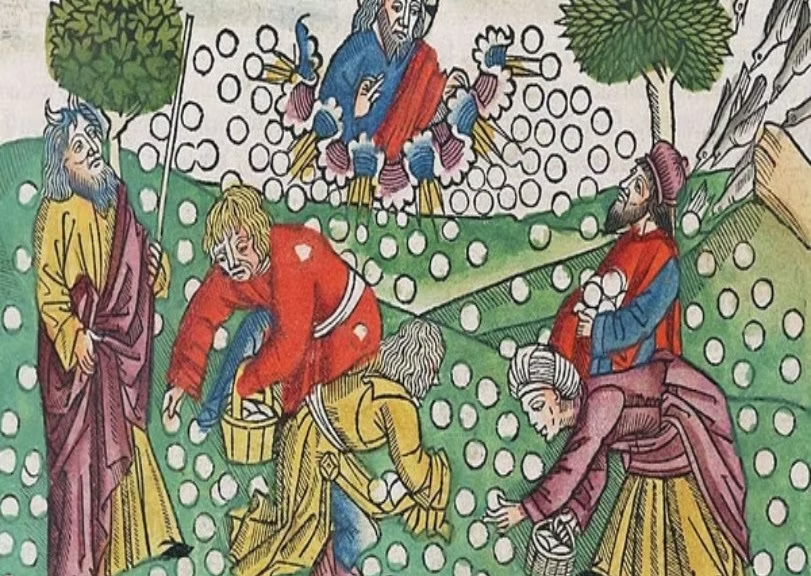
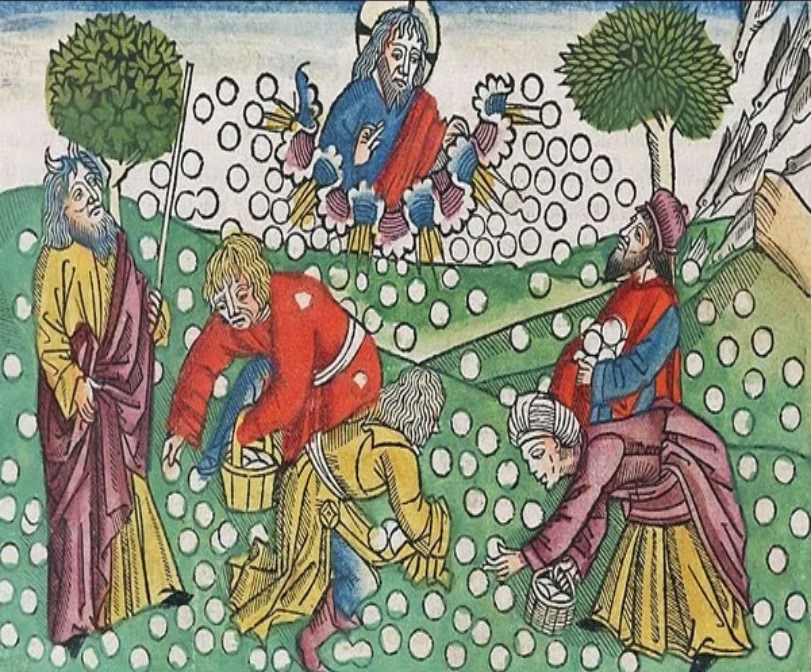
In the evening quails came up and covered the camp; and in the morning there was a layer of dew around the camp. When the layer of dew lifted, there on the surface of the wilderness was a fine flaky substance, as fine as frost on the ground. When the Israelites saw it, they said to one another, “What is it?” For they did not know what it was. Moses said to them, “It is the bread that the Lord has given you to eat.”
——————————————————————————–
This is an optional Old Testament selection from the Episcopal Lectionary for the Eleventh Sunday after Pentecost, Year B 2018. In the numbering system that lists each Sunday in an ordinal fashion, this Sunday is referred to as Proper 13. It will next be read aloud in an Episcopal church by a reader on Sunday August 5, 2018. It is important because it tells how God will sustain His people in a world (an environment) that is barren of God’s guidance.
In the interpretations that I presented for the tenth Sunday after Pentecost, where Elisha and his company of prophets ate from the first fruits and Jesus fed the multitude, I referenced this reading from Exodus, where God fed the Israelites with manna. My same conclusion that “spiritual food” is unlimited in how many it can feed, with manna being “spiritual food” still applies here. Forty years of living on the same foodstuff, day and night, would seem tiresome and boring; but the spiritual aspect of food from heaven makes manna become the inner drive to thrive on minimal external needs. Therefore, this reading selection tells how spiritual food feeds the mind, so the soul opens and God is able to reside in one’s heart. This view is above and beyond what the filling of a stomach with physical bread and meat can do.

As a stand-alone reading selection, which is without linkage to all subsequent history, I believe it is important to grasp how the exit of the Israelites from Egypt mirrors their initial entrance there, some two hundred fifteen years prior (430 since their entrance into Canaan). Their sojourn began from hunger and is now beginning a new phase in their journey with the threat of death from lack of food. A widespread seven-year famine was in its second year when Jacob took his family from the hills of Gilead to Egypt, where his son Joseph had advised Pharaoh to stockpile grain in years of plenty, and in preparation for a foreseen drought and famine coming.
Egypt then offered the illusion of being a land of plenty; but had it not been for God, working through His servant Joseph, Egypt would have been suffering equally from lack of food. We read here today of that Egyptian mirage of plenty was making a return to slavery seem like a good idea. However, God would again bring nourishment to the children of Israel.
If the Israelites were a group of educated adults then, possessing excellent memories, they would easily recall what had recently happened to them. Most recently, they had visited an oasis named Elim, where they had fresh spring water and a variety of fruits from palm trees (“seventy palm trees” means a variety of fruit offerings). Prior to that, the sea had opened and closed, so the Israelites could safely cross, while angry Egyptian soldiers would no longer be chasing them. Prior to that, an angel of death had not cause the first born males in any of their families to die, which was when they were last close by a “flesh pot” in Egypt. Prior to that, there had been a series of plagues that befell Egypt, which meant not many people sat around flesh pots and had bread that wasn’t swarmed by flies, amid the stench of death from rotting fish and frogs. Don’t forget, also, the locust had come destructively on Egypt, making good meal for bread difficult to find. So, the grumbling Israelites were not speaking as adults in this reading, ones that remembered God was leading them in a pillar of smoke.
This shows that human beings, at heart, are all complainers, bellyachers, crybabies, and whiners when things do not go their way.

The Israelites were chosen by God, because of an agreement made with Abraham; but they were called “children” because they were just like babies taking their first screaming breath into a new world. Babies do not have brains that function like adults, so they cannot understand languages, nor can they talk. All the miracles they lived through were like shadows passing before a baby’s still developing eyes.
When it is feeding time, a baby cries to let its keepers know it is hungry. A baby can only know selfishness, because without that instinctual demand for attention a baby’s life is at risk. Therefore, this story is setting up Moses, Aaron and God as if they were all first-time parents and the Israelites were their baby needing food.
Seeing the Israelites as an infant that was born after Moses pulled them through the birth canal that was the parting of the Red (or reed) Sea, their entire history can be seen (on a grand symbolic scale) as the growth of a child, from infant to teens, to young adulthood. By seeing them in this light, one is able to see that every human being on earth is just as flawed as the Israelites were then; such that the Jews as a people reflect the young son that squandered his inheritance, obtained in advance. Christianity then represents the prodigal son’s return to the Father, all grown up and ready to receive the Holy Spirit.
By having this broader view of what the stories coming from the books of the Holy Bible, one is then more enabled to see those stories become personally relative. Rather than think the Old and New Testaments are showing two peoples and two sides of God, it is best to see God as the Father that had two sons. God is the constant that never changes; but His sons reflect the duality of humanity on earth, where some stay selfish babies all their lives, and others sacrifice everything to serve the Father.
We all come into this world as babies that only know that crying states a personal need and expectation, and every time those needs and expectations are met, we all learn to perfect the arts of complaining and selfishness. The more one’s cries bear fruit, the more one learns to fake crying when all else fails. Still, when hunger is the reason for complaint, it does not matter where it comes from.
The bread of all nations is fleeting. This is because satiated hunger only means the next day brings another need for more bread. While just beginning their trek into the wilderness, the worry was all those future days ahead was being addressed. We know from hindsight that need would stretch forty years. This means the manna from heaven (and quail on occasion) would last as long as the Israelites accepted God as the Father.
In my interpretation of Jesus feeding the five thousand, along with Elisha and his company of one hundred prophets making an omer of first fruits easily feed everyone, I compared it to the manna in the wilderness. One would think that Moses and the Israelites came across many travelers over their forty year trek, simply because of trade routes. I wrote before about hos Jewish scholars said manna would slip from the hands of Gentiles, because it was not food that could be consumed by other peoples. One would think that opinion comes from the ancient texts indicating the Israelites encountered nomadic tribesmen and attempted to trade manna for more exotic foods, only to have the Gentiles unable to gather it.
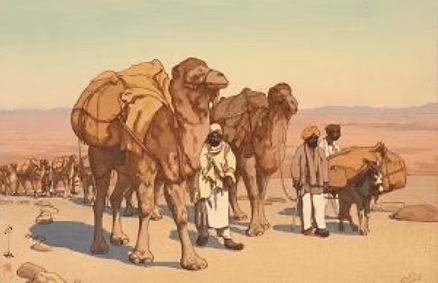
Such a possibility, given forty years of wandering, shows how manna was not for anyone. The bread of other nations, made from grains that grow abundantly in fertile regions of the Middle East, was limited in the way it only met physical wants and needs. This says the Israelites were not in need for bread of that kind, as normal bread could do nothing to satisfy spiritual needs. Therefore, God was not feeding the Israelites quail and manna as food for physical sustenance. He would not have freed them from Egypt without physical food being covered.
One thing that seems contradictory in the Exodus story, which I have touched on in previous writings, is the Israelites took livestock with them. Goats can give milk and goat milk can yield cheese. Certainly livestock, especially chickens, could provide meat and eggs. Thus, the physical needs of the Israelites were not in danger at this point in their journey.
This means the grumbling is less about being starved for food and wishing they were back in Egypt and more about them crying out for another feeding of inspiration and desire to be alone in the wilderness, with Moses and Aaron leading them. Again, they were crying like babies; but their cries came from their souls, not their stomachs.
The Israelites (according to verse 8 – unread in this selection) were not actually complaining about Moses and Aaron, even though Moses and Aaron heard all the complaints in a personal sense. God told Moses that the grumbling was not against them, but against Him. Simply by that statement, one can see that the complaints were about not having any way of knowing God was there and leading them. God set Moses straight, by telling him the Israelites were calling out to God, while standing before a guy with one mighty staff.

The grumbling of the Israelites is not exclusive to them (or their later descendants, the Jews). This is exactly how Christians complain against God, when they are forced into being responsible for their souls, being told they have to act on faith. The bellyaching meant they were so starved of the nutrients that feed faith (learning what the words of the Holy Bible truly mean) that they were too weak to do anything but grumble. While it is always a human being that is put into a position of authority, where Moses and Aaron were like prophet and high priest, just like the denominations of Christianity place priests, ministers, and pastors so they are available to the followers of God, the people always beat their chests in anguish when they hunger for spiritual knowledge and no one is giving it to them. They complain to human beings, but they blame God for not hearing their cries.
God answers those cries with spiritual food, not packages of surplus cheese or peanut butter mailed by governments (or stamps that can be redeemed for food, alcohol, and/or tobacco). Still, when figurative babies are the ones crying for spiritual direction, one needs to see manna as baby food falling from the sky. It is tasty, spiritually fulfilling, and stores easily for a day or two. This means manna is easy to swallow and easy to digest food that keeps the baby content and cooing for forty years, when the time for solid food would come around.
The quail were not a daily fare, which makes their appearance at twilight symbolize that time when the sun has dropped below the horizon, but there is still light. This timing is that link between day and night, or the symbolic link between life and death. All that is physical has life due to the presence of the soul, and death from the absence thereof. Thus, the quail were food for the soul (according to several metaphysical sites I explored); and in that line of thought, there are those who say quails symbolize spiritual needs for the soul. Because quails stay close together, protecting one another by their closeness, the element of family is also a symbolic aspect of quails. Therefore, God sent a migrating flock of quails to fill the souls of the children of Israel, to protect the oneness of their soul, through the solitude in the wilderness that would stretch over forty years.
When God was talking to Moses, He said, “I am going to rain bread from heaven for you, and each day the people shall go out and gather enough for that day. In that way I will test them, whether they will follow my instruction or not.” This says that God does test his servants, in the same way that parents test their children.

All good Fathers and mothers test their children to see if they follow instructions. It is irresponsible for a parent not to prepare their children to know why they have been told to do certain things, after they have proven they have listened and obeyed, because they have complete trust in their parents. The growth of a child is in steps and stages; and parents learn to test a child to go beyond one point of growth to the next. Therefore, God tested the children of Israel to prepare them for the next phase of their saga.
Finally, the word “manna” is not a noun, but a question. It says, “What?!?!” According to the etymology of “manna” (from “man”), it is written: “Most probably [it means] ‘What is it?’ the question being intended as a popular etymology of מָן ‘manna,’ based upon the late Aramaic word meaning What?” (Brown – Driver – Briggs)

This means the food that appeared covering the ground each morning (after the dew lifted) was not something the Israelites had ever seen before, as they had no word for it. That says the “fine flaky substance, as fine as frost on the ground” was not of this world. It was of heavenly origin, although with physical properties. It fell like the rain falls to the earth, which has the effect of springing the earth to life. As such, God rained life sustaining essence onto the Israelites.
As the optional Old Testament selection for the eleventh Sunday after Pentecost, when one’s personal ministry for the LORD should be underway – willingly being tested by God – the message should be seen as the infancy required to reach the full state of Apostle. The Israelites were descended from Abraham, Isaac and Jacob, but none of them had ever talked to God. The had as much chance of becoming a priest for Yahweh as any Egyptian (any and all Gentiles), without Moses and Aaron knowing God personally and being instructed so they could teach them how to grow into priests.
As far as I have had others in the Episcopal Church explain to me (laypeople and priests), the Sacrament of the Eucharist means to them that physical wafers are transformed into spiritual food (like manna). This is done by a prayer that calls the Holy Spirit of Jesus Christ down to earth (where he falls like rain) onto the wafers that a priest then places on a member’s palm or tongue. Swallowing the wafer is then consuming the Christ Spirit.
Because some of this “host” (a word from Latin, hostia, meaning the sacrificial lamb) is left over until the next service, the leftovers are then placed in a “tabernacle” that is locked. I have been told that the reason one bows before entering a pew is because Jesus is inside the tabernacle, on leftover wafers, which are near the altar. We do not bow to a cross of stained glass window, but to Jesus in the box.

Such little-known tidbits of information are expected to be taught the children of the Episcopal Church, where “cradle-to-grave Episcopalians” might know these details; but anyone converting to the Anglican Church from some other religion (or having no religious schooling prior) is left out in the cold. People do wonder why things are said or done, but newcomers are afraid of rejection if they ask questions. Of course, answering questions can put others on the spot, so silence is a theme when in a church.
While there are certainly classes one can take to get brushed up on all the ins and outs of any denomination of Christianity, no expectations are set and few ask questions. All of this is like God testing His children, to see if they have learned the rules and how well they follow them once known. God wants people to know all the whos, whats, whens, wheres, whys, and hows. Those who know should welcome (if not go offering) those seeking to know.
When one sees manna as the Pablum (trademark name, but from the Latin word pabulum meaning “foodstuff”) of spiritual nourishment, manna is designed for those not yet in possession of teeth and mature digestive systems. Just as children are to be taught what they must believe, just as they must also be taught why belief is more than listening to someone telling them to believe. Children need to how to become one of faith, by learning who they must become reborn in soul. This means learning when they can know everything they have ever been told is the truth … the Gospel.
Being an adult eating a wafer of spiritual food one day a week is like a baby (still) that is starving for spiritual nourishment.

That realization then leads to the question that asks, “Why are such “Christians” not complaining in the wilderness of their lives, because whoever led them to be at retirement age and still eating spiritual baby crackers in pews, “brought [them] out into [their] wilderness to kill [the] whole assembly [of Christianity] with hunger.” When all an adult knows is the details of Bible stories taught in Sunday School, that adult is severely malnourished spiritually.
A minister of the LORD must have the real spiritual food that is needed to feed the congregations. It too comes from heaven, as the insight of the Christ Mind, brought by the Holy Spirit. The real food is the meaning of the Holy Bible. The Holy Bible, as translated and as naturally read by those fluent in Hebrew, Greek, and Latin is nothing more than words that scream out, “What!?!? What is that to me? What does it mean?”
The Word of God is manna.

Beginning with Jesus and continued through every Apostle that has been reborn as Jesus Christ, the Word of God has been explained so it becomes real food – the TRUTH OF GOD. Ever since Jesus began preaching this holy wisdom, people have been so touched by that knowledge that they have begun doing the same. A minister of the LORD carries on this holy lineage, as brothers and sisters of the Son of God the Father. All have given God’s instructions to seekers, and the seekers who passed the test that demands His servants follow His instructions to a T, they have been rewarded with redemption and eternal salvation.
The story of the children of Israel says they were a stubborn lot, often refusing to follow instructions. Many have failed the test and failed God. Ministers of the LORD are like teachers who want all their students to pass all their tests. By speaking God’s TRUTH, the students have the spiritual nourishment to put in the time and effort to learn. A minister of the LORD plants the seeds that grow into a desire to learn and a love of personal discovery.
 Explaining the Readings