
“From the wilderness of Sin the whole congregation of the Israelites journeyed by stages, as the Lord commanded. They camped at Rephidim, but there was no water for the people to drink. The people quarreled with Moses, and said, “Give us water to drink.” Moses said to them, “Why do you quarrel with me? Why do you test the Lord?” But the people thirsted there for water; and the people complained against Moses and said, “Why did you bring us out of Egypt, to kill us and our children and livestock with thirst?” So Moses cried out to the Lord, “What shall I do with this people? They are almost ready to stone me.” The Lord said to Moses, “Go on ahead of the people, and take some of the elders of Israel with you; take in your hand the staff with which you struck the Nile, and go. I will be standing there in front of you on the rock at Horeb. Strike the rock, and water will come out of it, so that the people may drink.” Moses did so, in the sight of the elders of Israel. He called the place Massah and Meribah, because the Israelites quarreled and tested the Lord, saying, “Is the Lord among us or not?”’
———————————————————————————————————-
This is the Old Testament selection from the Episcopal Lectionary for Year A Proper 21, the seventeenth Sunday after Pentecost. It will next be read aloud in church on Sunday, October 1, 2017. It is the story of Moses striking the rock at Mount Horeb and making water flow to quench the thirst of the Israelites.
In Proper 20’s Old Testament reading from Exodus, the Israelites were complaining about being taken out into the wilderness to die of hunger. God responded with manna and quails. Here, they are complaining about having no water. Whereas their complaint for food did not mention the “children and livestock” that were in their numbers, now it does.
As I explained about Exodus 16:2-15, their pleas of hunger were less spoken from their bellies and more from their minds. They needed spiritual food to consume, so they would have reason to live … live in a largely barren land. The fact that they had children and livestock that were not mentioned before says the adults were the ones needing inner motivation, as the babies and beasts would follow them wherever they went. Water, on the other hand, was a need for everyone, women, children, goats, sheep, and cattle; but, similarly, the need expressed here is not meant to be seen solely in a physical way.
To understand this, one needs to grasp how “water” is one of the four basic elements, metaphysically. The four are water, fire, air, and earth. I have repeatedly stated (so I will state again), “Water represents emotions.” Thus, this whole reading is a statement about the emotional needs of all living creatures in an environment that screams, “Get me out of here!” While being mentally motivated by spiritual food will keep one’s determination strong, will power is limited, with those limits eroded away by changing emotional states. Therefore, the Israelites are metaphorically telling Moses, “We need to be confident in our love for God, which means God needs to show us His love so we don’t worry and doubt.”
In the first verse of this reading, beginning chapter 17, the reader is told, “From the wilderness of Sin the whole congregation of the Israelites journeyed by stages, as the Lord commanded.” This is important information that is relative to understanding this theme of “water.” Relative to the “wilderness of Sin,” this is written on a Wikipedia page under that heading:
“The Wilderness of Sin or Desert of Sin (Hebrew: מִדְבַּר סִין, Midbar Sin) is a geographic area mentioned in the Hebrew Bible as lying between Elim and Mount Sinai. Sin does not refer to sinfulness, but is an untranslated word that would translate as the moon; biblical scholars suspect that the name Sin here refers to the semitic moon-deity Sin, who was worshipped widely around the entire periphery of pre-Islamic Arabia, the Levant, and Mesopotamia.”
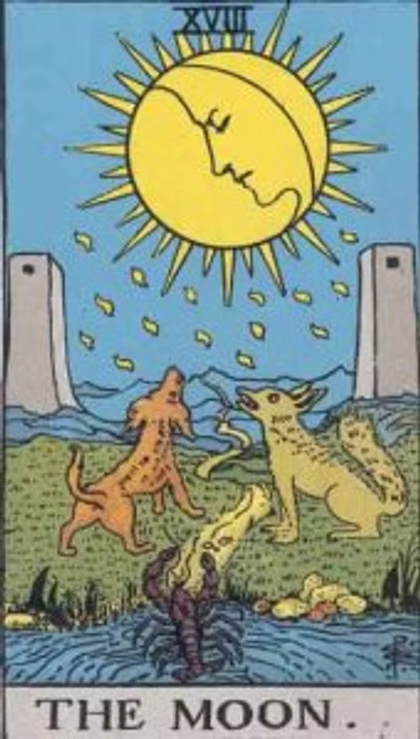
In astrology, the Moon is seen as a symbol of “water.” The Moon is the ruler of the sign Cancer – a water sign. The Moon symbolizes the inner self and its emotional realm. The Moon is associated with water because of its phases, from New Moon, to Full Moon and back to New Moon. That change reflects how emotions change (have fluidity), as they wax and wane, over and over – the thrill of victory and the agony of defeat.
By knowing this (whether or not you believe it), one can read how “From the wilderness of Sin the whole congregation of the Israelites journeyed by stages, as the Lord commanded” is referring to emotional tests. The “stages” of travel means they moved and stopped, picked up and set up camp multiple times, by the directions of God. Those “stages” can be read as changing states of emotion because they are “of the Moon” (“of Sin”).
When one reads, “They camped at Rephidim, but there was no water for the people to drink,” the Hebrew root verb for Rephidim (rapad) means “to spread.” In a desert setting (like the changing Moon), places that once had vegetation and water can be overcome by “desertification,” which is defined as: “The transformation of arable or habitable land to desert, as by a change in climate or destructive land use.”* Thus, the name for that campsite was given because Moses thought there would be water there, but that place had changed (“spread”) to desert.
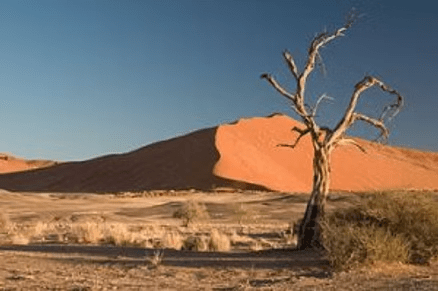
When the Israelites “quarreled with Moses,” he asked them, “Why do you test the Lord?” Moses had knowledge of the area, which came from God, so they had arrived to a place that was no longer an oasis for some unknown reason. Moses, taking offense at the quarreling, gave an emotional response to an emotional confrontation, brought on by fears that everyone (children and animals included) would die of thirst. Therefore, it was with strong emotions that Moses “cried out to the Lord, “What shall I do with this people? They are almost ready to stone me.”’
In the emotional outburst made by the Israelites about food (Exodus 16), we are told “The whole congregation of the Israelites complained against Moses and Aaron in the wilderness.” However, there was no report about crying by Moses, as we then simply are told how the LORD told Moses how that problem would be solved.
Since the transition from chapter 16 to chapter 17 is not clearly timed, the statement of “From the desert of the Moon (Sin)” can be an indication that one complete lunar cycle had passed. If that was the 29 days from full Moon to full Moon, then the Israelite people complained the easiest when that “stage” occurred. The symbolism would then be they complained when everyone’s emotions ran high and it was easy to become angered.
Knowing God told Moses to establish the Hebrew calendar, beginning with 1 Nissan, with the Passover on 15 Nissan, and knowing that calendar is lunar based, the Passover occurred when it was full Moon. In Exodus 16, we read that the setting was “on the fifteenth day of the second month,” so the issue over food was also taking place on a full Moon. One can now assume they reached this place where no water was found, again, when the Moon was full.
Additionally, there are some who say the name Israel is a combination of the Egyptian gods Isis (the Moon), Ra (the Sun), and the Hebrew word El (Saturn). Astrologically, the Sun and the Moon, together, project humanity’s duality of an inner soul (Moon) with a bodily projection (Sun); and Saturn (El) represents God and the Law, while el is the Hebrew word for “god.” So, it is important to realize the role the Moon played in Israelite history, as being chosen by God was not because their bodies looked good. They were chosen because of their inner being (descendants of holy men).
Because we read how Moses became upset and expressing fear that the emotions of the people may be so high they would stone their leader, the one who was God’s emissary, we can see that Moses also was affected emotionally. As it is always best to count to ten during times when emotions are overtaking reasonable thought, God responded to Moses, giving him instructions that would solve the problem.
The solution then becomes an uplifting emotional experience for all of the Israelites to witness. The same staff that Moses used at the Nile, when “in the presence of Pharaoh and his officials [he] struck the water of the Nile, and all the water was changed into blood” (Exodus 7:20b), would symbolize God working through Moses, creating miracles. To have wafers of spiritual food (manna) was good to set the head straight; but to have water flow freely in a desert was an uplifting reinforcement that straightened out their hearts.
In my analysis of Exodus 16:1-15, I offered that the manna and quail represented spiritual food, which equate to the body of Christ. One cannot come to Jesus, from a true faith mindset, without devoted study of the holy documents that prophesied his coming, as he came. That requires a deep level of understanding that is aided by the Mind of Christ.
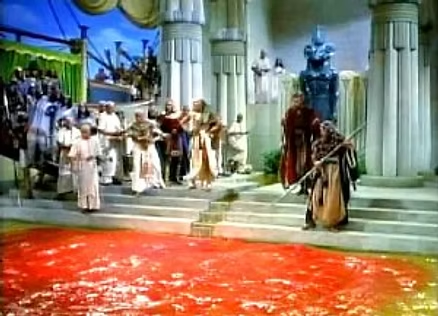
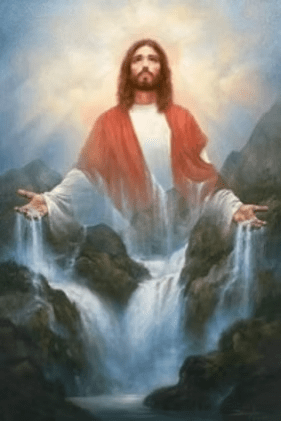
Here, in Exodus 17, the water rushing from the rock, which quenched the thirsts of the Israelites, is then symbolizing the blood of Christ. Because God told Moses to use the staff that turned the Nile waters into blood, rather than the same staff that parted the sea, that specific staff reference is then saying that Moses released the blood of Christ from the rock. That release was to revitalize the Israelites and their children and animals.
The rock (in Greek petra, or in English Peter), symbolizes the cornerstone upon which the blood flows. Therefore, the blood of Christ is the emotional swelling of faith, like that which one feels when fermented wine enters the bloodstream and, from the heart, the body feels high. The Israelites had their faith uplifted by the miracle of Moses and his staff at Horeb, while their emotional distress over lack of water was quelled by flowing water.
This reading can then be seen as a parallel to Jesus speaking with the Samaritan woman at the well, who Jesus told he could provide her with “living water.” In John 4:10 we read, “If you knew the gift of God, and who it is who says to you, ‘Give Me a drink,’ you would have asked Him, and He would have given you living water.” The Israelites were asking Moses, “Give us a drink.” The same lesson can be seen here, as when Jesus said, “Everyone who drinks of this [well] water will thirst again; but whoever drinks of the water that I will give him shall never thirst; but the water that I will give him will become in him a well of water springing up to eternal life.” (John 4:13-14) God was providing, through Moses, this “living water.”
This reading ends with the statement: “He called the place Massah and Meribah, because the Israelites quarreled and tested the Lord, saying, “Is the Lord among us or not?” The name Massah is said to mean “Testing,” as a “test by trial.” The name Meribah means, “Quarrel” or “Place of Strife.” When verse one says, “the whole congregation of the Israelites journeyed by stages, as the Lord commanded,” this means reaching the point of need for spiritual knowledge is one stage of development in one’s faith, while reaching the point of need for becoming emotionally uplifted is another stage in that development.
Faith is a journey in stages, with God’s test of one’s faith requiring emotional outbursts. Without one quarreling, there is no emotional connection at all. This is supported in the New Testament, when God spoke through the Spirit of Christ, saying, “I know your deeds, that you are neither cold nor hot. I wish you were either one or the other! So, because you are lukewarm–neither hot nor cold–I am about to spit you out of my mouth.” (Revelations 3:15-16)
This is why God posed the question at that place, “Is the Lord among us or not?” The question asks, “Is God in your heart? Are you committed to love the LORD? … Or, not?” Caring for God, enough to quarrel over His tests, is a sign of love and commitment, as in a marriage. It is a testing stage all marriages come to, necessarily. “Are we in this thing together or not?”
A marriage built on love and devotion is rock solid, from which flows unconditional love. A marriage built on selfish desires will fail the difficult tests. The aspect of this reading placing focus on the “children and livestock” reflects the symbolism of a marriage extending beyond the realm of two, with those “offspring” not having the mental capacities to understand the reasoning of faith. Every living creature, however, has the capacity for deep-felt emotions.
The metaphor also says human beings are the children of God, with the devoted faithful being his servants, like beasts of burden. Therefore, God will lead us, as David wrote in Psalm 23:
The Lord is my shepherd,
I shall not want.
He makes me lie down in green pastures;
He leads me beside quiet waters.
He restores my soul;
He guides me in the paths of righteousness
For His name’s sake.
* Fair use.
 Explaining the Readings