
Tag Archives: Exodus 20:1-17

John 2:13-22 – Destroying the old temple for one new

The Passover of the Jews was near, and Jesus went up to Jerusalem. In the temple he found people selling cattle, sheep, and doves, and the money changers seated at their tables. Making a whip of cords, he drove all of them out of the temple, both the sheep and the cattle. He also poured out the coins of the money changers and overturned their tables. He told those who were selling the doves, “Take these things out of here! Stop making my Father’s house a marketplace!” His disciples remembered that it was written, “Zeal for your house will consume me.” The Jews then said to him, “What sign can you show us for doing this?” Jesus answered them, “Destroy this temple, and in three days I will raise it up.” The Jews then said, “This temple has been under construction for forty-six years, and will you raise it up in three days?” But he was speaking of the temple of his body. After he was raised from the dead, his disciples remembered that he had said this; and they believed the scripture and the word that Jesus had spoken.

—————————————————————————————–

This is the Gospel selection from the Episcopal Lectionary for the third Sunday in Lent, Year B. It will next be read aloud in church by a priest on Sunday, March 4, 2018. It is important as it is the first account of Jesus displaying anger at the disrespect that had befallen the Second Temple of Jerusalem, which was constructed originally (by Solomon, then rebuilt) to be THE house of God on earth.

In Matthew 21:12-13, Mark 11:15-19, and Luke 19:45-48, less detailed accounts of Jesus becoming upset with the presences of vendors at the Temple are found. Matthew told how Jesus drove out “all those who were buying and selling in the temple, and overturned the tables of the money changers and the seats of those who were selling doves.” Matthew, Mark, and Luke all then quote Jesus as saying, “It is written, ‘My house shall be called a house of prayer’; but you are making it a robbers’ den.” However similar that events seems, it is not the same as the one recounted by John.

I make that statement because I once sat at an Episcopalian Bible study meeting when a retired Methodist minister made the statement that John’s Gospel was the only one of the four Gospels that does not maintain the same order of events in the life of Jesus. I disagree wholeheartedly.  However, if that is some concept that has risen to explain John as a renegade or rebel, due to some (perhaps) thinking John had a scatterbrained memory, which affected the order of his Gospel of Jesus’ life and ministry, the facts do not support such a claim.

This reading is in John’s second chapter, which follows the wedding at Cana event (John 2:1-11). John’s first chapter ended with Jesus gathering Philip and Nathanael as disciples, to go along with Andrew and Simon (called Peter). John was the only Gospel writer not to tell of Jesus spending forty days of fasting in the wilderness, like the other three writers do. However, John said the same as the others, when he wrote, “After [the wedding at Cana Jesus] went down to Capernaum, He and His mother and His brothers and His disciples; and they stayed there a few days” (John 2:12), which spoke of Jesus moving from Nazareth to Capernaum.  The other Gospels have the chronology of events; they simply recorded a second time that Jesus was witnessed being upset over vendors on the Temple steps.

It was in Capernaum that Jesus then called Andrew and Simon from their fishing boat and then called James and his brother John of Zebedee from their father’s boat, leaving him to fish the sea with hired hands. John did not write of this calling (an indication that John was not the same person as the brother of James, not a son of Zebedee); but his statement that Jesus, his mother, brothers and disciples only stayed in Capernaum a few days, that says the calling of disciples from Capernaum was to prepare them to go en masse to Jerusalem, for the Passover Festival.

I have had Bible study leaders instruct the participants that the Passover week’s pilgrimage to Jerusalem was not a yearly requirement of Jews. After the scattering of the tribes of Israel, following the fall of Israel and Judah, the “Jews” who were moved great distances from Jerusalem were only required to make a pilgrimage once a lifetime. The presumption is that Jews who relocated in Galilee after their freedom from Babylon were likewise freed of any obligation to go to the Temple in Jerusalem each year, because it took several days to walk there.

In my mind, this an American Christianization of ancient Judaism, where it becomes important to see the holy people surrounding Jesus as akin to Americans that forego church attendance, if there is some vacation planned [like multi-yearly pilgrimages to fun resorts, where one’s religion gets left at home].  I have watched priests rush to finish a service because it is NFL Sunday, and a local team’s game is soon to begin.  The sad thing I have realized is that American Christians tend to justify their lack of a desire to study their religious texts as if God had blessed them with a birthright as babies, and children’s church taught them everything they need to know personally.  Beyond that, priests and ministers are hired by the adult Christians, with the expectation they will know the details.

If that was the original plan, I wonder why Jesus did not call the hired hands from Zebedee’s boat?

In regard to this lack of religious knowledge, consider this: When one reads in the Gospel of Luke, “Now [Jesus’] parents went to Jerusalem every year at the Feast of the Passover” (Luke 2:41), we are told this as an indication of the piety of Mary, Joseph, Jesus, his brothers. They went every year. Because it was written, “Speak to the Israelites and say to them: ‘These are my appointed festivals, the appointed festivals of the LORD, which you are to proclaim as sacred assemblies” (Leviticus 23:2), devout Jews made a point of attending EVERY FESTIVAL … religiously. Knowing that, if any were to “Come and see” and “follow Jesus,” they were expected to plan their lives around obedience to God’s commandment to the Israelites, through Moses, which called for “sacred assemblies” in the appropriate places, to recognize “the appointed festivals.”

That understood, one can grasp just how swollen Jerusalem would become during those times of festival. In the Christmas story, where Joseph and Mary could not find a room at an inn, it was not due to census registration demands creating floods of people into Bethlehem. The inns were filled with paying guests because it was at a festival time, with pilgrims everywhere. Mary and Joseph went to Bethlehem while they had a place to stay near Jerusalem for festival.  This means that everyone in the Jesus entourage would have to be housed while away from home.  That is a logistical reality.

Because the ministry of Jesus was just getting off the ground then, it makes perfect sense that prior arrangements had not been made for Andrew, Simon-Peter, James of Zebedee and his brother John, nor Philip and Nathanael. While Jesus, his mother, and his brothers had relatives with whom they would stay, who had homes near Jerusalem, the others would be free to find their place to housed. Thus, that first Passover of Jesus’ ministry placed himself and John (the Gospel writer, not of Zebedee) at the Temple together, while the six disciples were securing places to stay.  Thus, none of them wrote about this event.

In the turning over of the vendor’s tables recalled by Matthew, Mark, and Luke, that was after Jesus’ entrance into Jerusalem on a donkey with her colt, when the pilgrims lined his path with palm branches and cried our “Hosanna, the King of the Jews.” For that festival event, an upstairs room had been secured for the Passover week, although there is indication the disciples were invited to visit where Jesus stayed, as they traveled together each day prior to the Passover Seder meal (the Last Supper), in and out of Jerusalem. John did not write of those days when Jesus was surrounded by his disciples, like he did when it was only him and Jesus entering the Temple of Jerusalem, when Jesus cleansed the Temple the first time.

The New American Standard Bible (NASB) heads this reading selection from John as “Frist Passover – Cleansing the Temple,” which indicates there is scholastic recognition for multiple events of this nature. John stated in his sixth chapter, fourth verse, “Now the Passover, the feast of the Jews, was near.” This was when Jesus fed the five thousand at the Sea of Galilee. By the time John began his seventh chapter, writing in the second verse, “Now the feast of the Jews, the Feast of Booths, was near,” that end of summer festival means John wrote nothing specific of Jesus having gone to Jerusalem for the second Passover of his ministry.

None of the other Gospels speak specifically of any Passover Festival, other than the last, which would be more of an indication that Jesus went to the Temple at other times without witnesses, when he could have made similar attacks on the selling of wares on the steps. One would think Jesus regularly confronted such things, rather than only occasionally making “photo ops” appearances.

What should be caught from the verse that states, “He told those who were selling the doves, “Take these things out of here! Stop making my Father’s house a marketplace!” is that Luke 2:22 & 24 state, “And when the days for their purification according to the law of Moses were completed, they brought Him up to Jerusalem to present Him to the Lord … and to offer a sacrifice according to what was said in the Law of the Lord, “A pair of turtledoves or two young pigeons.”

Because the sacrifice of animals was stated in Law (Exodus and Leviticus) as a necessary rite of purification, the people were required to take animals to the Temple priests for the sacrificial rites (not go to the Temple priests and hand them payment for sacrificial animals). The sale of doves was for the poor, but that really meant the poor travelers, who brought no animals with them from home, as home was too far away.

This means Jesus was not angered at the sale of animals for sacrifice. He was angered at the presence of those sellers within the Temple grounds. That presence within sacred boundaries was an indication that the Jews had become less devoted to the Laws and appreciated the marketplace meeting their needs of the commoners.  Common Jews suffered from forgetfulness, so they entered the Temple ground without the animals required.  Rather than their forgetfulness of Law causing them to lose their place in line, during busy Temple times, the Temple leaders allowed the marketplace to come into a place of convenience.

This anger should be seen as also being applicable to Christians and their churches, where I have read of megachurches are similarly desecrated places.  The equivalent can be seen as a ring of concession stands (coffee and pastries sales before service, then paninis after) around an auditorium, which has replaced a traditional nave and separate parish hall. Are not live bands on a stage (not an altar), with follow-the-bouncing-ball big screens (not hymnals), prompting people sitting in stadium seats with cup holders (rather than pews with prayer books) to sing along with dancing choirs, with the preacher reading sermon notes from a smart phone, pacing back and forth while a spotlight follows and lighting technicians change the coloring on stage to set the mood … all putting a “marketplace” in one’s face?

Is that circus atmosphere not selling entertainment as religion, in the same way cattle and sheep were sold back in the day?

Would you think passing a tray for money, rather than giving out free bread and dried fish from a basket, would anger Jesus today?

John writing, “His disciples remembered that it was written, “Zeal for your house will consume me,” says either John or Jesus told this story to the disciples afterwards, causing them to remember Psalm 69, verse 9, which says, “for zeal for your house consumes me, and the insults of those who insult you fall on me.” The acts of Jesus made them recall a song of lament, over shame felt by those who proclaimed faith falsely.

They had all walked right by the same vendors, doing nothing to force the vendors and wares sellers out to where they belonged. The disciples remember that quote from guilt.  Instead of marveling at the acts of Jesus, their hearts felt shame and regret for having done nothing themselves; and that is the kind of believers Satan loves.

John then said “his disciples remembered that he had said this … after he was raised from the dead.”  They remembered because Jesus had been raised from them, who had been dead of eternal life.  They remembered because the Spirit of the man who was there was within them … as them.

When John wrote that the Jews asked Jesus, “What sign can you show us for doing this?” they referred to his acts of disrespect for the merchants, their wares and the money they collected. They wanted to know how Jesus would miraculously (a viable replacement for “sign” in translation) replace a legal demand that devoted Jews had to present animals to priests, since most were pilgrims who did not come prepared to keep sacrificial animals with them outside the Temple grounds, until needed inside.

The double entendre is the Greek word for “sign,” “sēmeion,” also means “mark or token,” which is a form of payment for the sacrifices. Since this was Jesus’ first Passover as a priest of his Father, he was new to the “Jews” who ran Jerusalem. One could have seen the question they posed as rhetorical or tongue in cheek, half laughing at some young rabbi trying to make a name for himself.  Without knowing Jesus, they saw him as trying to change a very set world, which the Temple leaders were quite comfortable with; and that (in their mind) would require a miracle worker.

When Jesus told them, “Destroy this temple, and in three days I will raise it up,” he was in effect saying the brains of the Second Temple (its leaders, who allowed merchants on the steps) were destroying it. By referring to his personal destruction as being the final straw on that camel’s back, such that after being dead for three days a real temple that housed the LORD would be raised in its place, Jesus was saying the only Temple to the LORD is a human body. That would be the resurrected Jesus, but it would also be every Apostle who would be prepared to also be the resurrection of Jesus Christ within them.

As a personal Lenten lesson, as a test of one’s faith, everyone represents the brain trust that had let the Second Temple of Jerusalem become a marketplace for unscrupulous people, in need of being whipped by a cord and overturned. Because John pointed out that Jesus was talking about his body being the new Temple raised, the same can be inverted onto the destroyers of the Temple of Jerusalem, as the destroyers of their own souls, which were housed in cesspools of carelessness and sin.

If one is unprepared to pass the test of faith, then one will ask, “What miracle can you show me for doing this?” It seems easy to be told not to sin; but a serious seeker of Christ wants to be told how not to sin. Most are comfortable with continual sin being absolved by a Temple leader spilling the blood of an innocent animal (aka: priest, minister, pastor, or preacher).

The answer is the same that Jesus gave, as being reborn as Jesus Christ is the only way to survive forty days in the wilderness. One has to happily serve God as His Son to make it that long. The hard part is dying and being dead of ego for three days, so that one’s corrupted carcass can be cleansed, just as Jesus cleansed the Temple in anger. One cannot build a new self before the old self is destroyed.

The test of that readiness can then be seen in how one accepts the current state of buildings called churches and the organizations that run them. In this day and age (mostly out of desperation for survival or the lusts for the profitability of religion), churches have become political arms of the subversives who see the blindly religious as lambs fleeced for value or those who follow their leaders as voter blocs that can be led to worship political figures. The test is then the way one answers the question: How do you display your anger that a church has been or is being destroyed by the will of men and women?

The accompanying Old Testament reading comes from Exodus 20:1-17, which is also the reading for the Proper 22 [Pentecost Ordinary Time], in Year A. It is the first Ten Commandments that God sent Moses down for the Israelites to agree to follow. For any test in the wilderness to be personally passed, those laws (and all others) must be written in one’s heart. A deep love of God and subservience to Him brings that, through the marriage of God and a human as One.  Jesus Christ becomes the love child reborn.

This is a must to achieve, because love of God is not the same as love of Church.  Modern-day churches make Jesus appear as the eraser of Laws, not the enforcer. One must have evolved through the Holy Spirit to live a life centered within the Laws, out of desire, not command.  That devotion survives all tests.

In the accompanying Epistle reading that comes from 1 Corinthians 1:18-25, Paul quoted Isaiah, saying, “The message about the cross is foolishness to those who are perishing, but to us who are being saved it is the power of God. For it is written, “I will destroy the wisdom of the wise, and the discernment of the discerning I will thwart.” That quote comes from Isaiah 29:14. One has to see the parallel of that quote and the “wise” [brain trust] that knows organizational and profitable things, but is incapable of discerning the truth of the words that tell of Jesus being destroyed by a cross, dead for three days.

There are no “signs” or “miracles” or “tokens” that can save a Church from a willful destruction, as the only “miracle” comes when one becomes a reborn Jesus Christ. To pass a personal wilderness test, one has to be resurrected, not perishing, as denial through personal will power (the intelligence of a brain) will fail miserably.

One has to be able to see the anger that Jesus holds for anyone who claims to be the house of the LORD, when one is doing little more than marketing oneself as marked for heaven. One has to be turned upside down and see all of one’s beloved money cast onto the ground, with the voice of God telling one to “get your sacrificial trinkets out of here!”

If one has not felt that fear of God within one’s head, then one is not prepared to pass a personal test of Lent.
Exodus 20:1-17 – The vows that marry souls to Yahweh

Then God spoke all these words:

I am the Lord your God, who brought you out of the land of Egypt, out of the house of slavery; you shall have no other gods before me.

You shall not make for yourself an idol, whether in the form of anything that is in heaven above, or that is on the earth beneath, or that is in the water under the earth. You shall not bow down to them or worship them; for I the Lord your God am a jealous God, punishing children for the iniquity of parents, to the third and the fourth generation of those who reject me, but showing steadfast love to the thousandth generation of those who love me and keep my commandments.

You shall not make wrongful use of the name of the Lord your God, for the Lord will not acquit anyone who misuses his name.

Remember the sabbath day, and keep it holy. For six days you shall labour and do all your work. But the seventh day is a sabbath to the Lord your God; you shall not do any work—you, your son or your daughter, your male or female slave, your livestock, or the alien resident in your towns. For in six days the Lord made heaven and earth, the sea, and all that is in them, but rested the seventh day; therefore the Lord blessed the sabbath day and consecrated it.

Honor your father and your mother, so that your days may be long in the land that the Lord your God is giving you.

You shall not murder.

You shall not commit adultery.

You shall not steal.

You shall not bear false witness against your neighbor.

You shall not covet your neighbor’s house; you shall not covet your neighbor’s wife, or male or female slave, or ox, or donkey, or anything that belongs to your neighbor.

——————–

This is the Old Testament selection for the third Sunday in Lent, Year B, according to the lectionary established by the Episcopal Church. It precedes Psalm 19, which contains the verse that says: “The statutes of the Lord are just and rejoice the heart; the commandment of the Lord is clear and gives light to the eyes..” It also accompanies the Epistle from Paul’s first letter to the Christians of Corinth, which speaks of the “wisdom of God.” It also is united with the Gospel reading from John, where Jesus overthrew the vendors’ tables and said he would rebuilt the temple in three days. Several parts of this reading are also the Old Testament selection for Proper 22-A.

I have done a thorough interpretation of the eighteenth Sunday after Pentecost [2017], which was the Proper 22, Year A choice. It is posted here under the title “The Ten Commandments.” found by a search of this blog. Because that reading selection for Proper 22-A omits verses 5-6 and 10-11, I will focus more closely on the words of those verses here; but please read the other interpretation for a whole view and a more standard view of this special covenant.

As a reading selection for the ordination season after Pentecost, the focus is solely placed on the laws that one should have written on one’s heart, as a standard way of life for one being ordained into ministry for God. The verses omitted are then more focused on the Law being an external document of an agreement between God and the Israelites, which was brokered to them by Moses. Thus, as a reading selection for the third Sunday in Lent, Year B, one should see this as a natural continuation of the theme of covenants between God and holy men: Noah; Abram; and, Moses.

In this reading selection, verse 1 is very easy to skip over and leave alone. To read, “Then God spoke all these words,” it is assumed to be an accurate translation that leads everyone to listen and hear God speaking to Moses. However, in this translation is the scholastic error of ignorance that takes the plural form of “el” [a lower-g “god”], which is “elohim” [the lower-g “gods”], and translates it as the upper-g “God.” That is not what begins this reading.

The Hebrew of verse 1 begins with two words that are separated from the remaining five words [plus the letter samekh, which denotes the end of the verse]. Those two words are [placed from left to right, not as the right to left as is Hebrew]: “וַיְדַבֵּ֣ר אֱלֹהִ֔ים” [“way·ḏab·bêr ’ĕ·lō·hîm”]. Those two words have been translated as if saying, “Then God spoke,” when they say “and will speak gods.” This is an important beginning to grasp.

The Hebrew word “וַיְדַבֵּ֣ר” is conjugated by the website Pealim.com as being “Part of speech: verb – PI’EL – to speak, to talk.” The site continues by stating: “ו־ + יְדַבֵּר = yedaber,” which is the “Future tense, 3rd person, masculine, singular,” which says, “and he / it will speak.” That future tense is obliterated by a translation that becomes “Then God spoke.” The future tense is key to understanding how “elohim” clearly states “gods.”

The scholastic religious view of Christianity says idiots wrote the books that become the library of books considered to be sacred, thus “Holy.” Only an idiot would scribble out extra letters, in order to change “el” (the singular number) into “elohim” (the plural number), and mean the singular number. Rather than think divine authors were idiots, it makes much more sense to me to consider the scholastic religious brains as those who are the idiots. The word “elohim” clearly states “gods,” so it is up to the scholar to understand why “gods” was written.

The mistake of this scholastic view, where they have invented some imaginary “E writer” of Old Testaments texts [“E” for “elohim,” but not “el”] is because Genesis 1 contains many references to “elohim” [none to Yahweh], as they who made this and they who made that, during the first six days of Creation. The scholars see all that as the writings of an idiot, as they translate every use of “elohim” as “God” [which makes them the idiots].

The first three words of Genesis 1 are “בְּרֵאשִׁ֖ית בָּרָ֣א אֱלֹהִ֑ים” [read from right to left, as Hebrew], which presented left to right are transliterated as “bə·rê·šîṯ bā·rā ’ĕ·lō·hîm,” with a semi-colon mark following “elohim,” meaning those three words make a separate statement that begins the who chapter. Those three words state, “In the beginning created gods.” When separated from the following text, that becomes a statement that the first stage in Creation was the creation of lesser gods. That implies, by absence, that YHWH was the creator of lower-g gods; and, it says God let His gods do the work of His Creation, meaning they all worked according to God’s design.

That should not be hard to imagine. After all, God [YHWH] is omnipotent and able to make lesser gods. Simply by realizing that “elohim” fits the model of everything immortal, such as angels and Satan, as well as souls giving life to clay, one should easily be able to see “elohim” doing the word of Creation, just like one can imagine seven dwarfs working in a diamond mine.

In that same vein of intellect, one should see Exodus 20 beginning by having God [YHWH] speak what His “gods will speak.” The implication is God talking to gods, in a covenant that means the “gods” must come to terms with what Yahweh says; so, like a parent speaking to one’s children, to ensure they agree with what they are being told, the parent does not simply say the words to them. The parent says “now you say what I said.” Thus, as a covenant for the future, the “gods will speak” in agreement says the “elohim” must not be silent. They all must speak the words, “I do.” That is simple to understand; so, now one needs to understand how the Israelites are “elohim” all of a sudden.

The answer to that question is the realization that a soul is eternal and (like God) never dies. In understanding that, one must admit that life in a body of dirt (called “flesh”) comes from the breath of life given by God at birth. That breath is like a little bit of God being sent into clay, to make it animated with life. The work of life is then done by a itty bitty bit of God, thus a “god.” By grasping that fairly simple concept (something very difficult for atheists to do), one should be able to see that Exodus 20 begins by saying God will set out a covenant for all the souls of Israelites to agree with. What God spoke to Moses, those “elohim will speak” back to God, as their way of confirming they know what they are expected to do, in order to be claimed as the children of God, His chosen people.

Verse 2 then begins by making this line of thought official, as it says, “’ā·nō·ḵî Yah·weh ’ĕ·lō·he·ḵā,” (again with a separation mark – a comma), so verse 2 begins by saying, “I am Yahweh your god.” The word “’ĕ·lō·he·ḵā” is a pronominal second person singular [either masculine or feminine, depending on the imaginary vowel choice] form of “elohim,” so it says “I YHWH possess your souls, making me your god of life source.”

It is from that realization that verse 2 then says, “who brought you out of the land of Egypt, out of the house of slavery.” This becomes a two-part statement about what God has done to regain the souls [“elohim”] that had become lost. First, they had gone into the land of Ham, called “mizraim,” which is translated as meaning Egypt. Both Canaan and Mizraim were sons of Ham, who were cursed by Noah for getting him drunk on wine and leaving him naked and uncovered in his tent, where Ham saw his nakedness. Noah’s curse then fell upon the children of Ham. The children of Jacob had lived in Canaan as cursed [their father had stolen the birthright of his brother Esau] and then moved to Egypt, where they remained cursed, as the descendants of Israel. Therefore, the first statement by Yahweh says their souls had been redeemed from that curse.

The second part then speaks of those souls having been removed from “the house of slavery.” The “house” is again a reference to the “dwelling place” that was named Egypt. As descendants of Mizarim, the people of the Nile had become examples of the world of power, wealth and influence, such that system of Pharaohs and their religious acceptance of polytheism had enslaved the Israelites, forcing them to accept their system of religion or be shunned as second class citizens. Rather than being free to have the equal rights of normal Egyptians, the Israelites had become slaves to the overseers of the land. Still, for a soul within a body of flesh, it was easy to accept the demands to recognize multiple gods [“elohim”] and be given less punishment as an outcast. By following Moses out of Egypt, the Israelite souls had bee freed from slavery to polytheism and the worldly sacrifices demanded upon a soul.

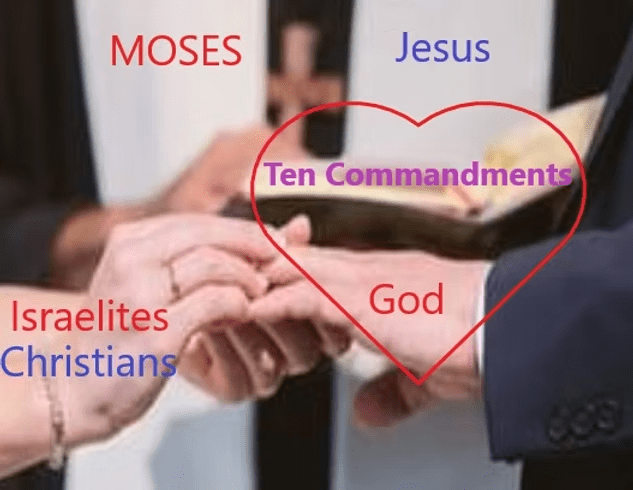
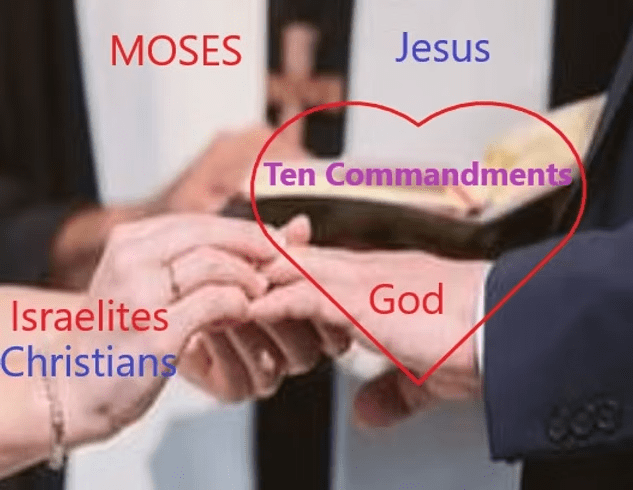
The totality of verse 2 then is God expecting His breaths of life, breathed into those who were the descendants of Abraham, to agree that to be His souls again, redeemed of a curse [to regain the promise of Shem’s line, through Isaac, upon Jacob – the Supplanter] and removed from the world of evil influences. For that offer of salvation, those souls then had to agree to God’s terms thus coming. Egypt must be seen as the limitations placed on a soul, which become those of a body of flesh. Leaving Egypt was the Israelites’ engagement to God, leaving all past lovers behind; reaching the wilderness at Mount Sinai was when they came to the altar of marriage. Therefore, Moses leading them into the wilderness [remember this is the season of Lent] meant those souls were God’s only concern, not the flesh they brought with them.

According to the NRSV translation that is used by the Episcopal Church, verse 2 ends with a semi-colon, with verse 3 following as if a separate statement that is a continuation of verse 2’s idea of God giving freedom to the Israelites. While that is not entirely wrong, verse 2 ends with a period mark, making verse 3 become a free and separate statement that stands alone, although relative to everything stated prior in this chapter of Exodus. Other versions show this the way it was written: the NIV, the KJV, and the NASB for three.

Regardless of the presentation, all versions translate the Hebrew that follows verse 2 as saying, “You shall have no other gods before me.” I have written in-depth on how this is not a translation that states the truth of what is written in the Hebrew text. My interpretation entitled “The Ten Commandments” explains this more detail than I plan to offer here. Rather than repeat that depth, it is still important to again address what the meaning is; simply because the proper translation relates to last week’s [the second Sunday in Lent] Old Testament readings, when God told Abram, “walk before me and be blameless.” (Genesis 17:1c)

The word in that statement by God relates to a similar usage in Exodus 20:3, where “panim,” is written. In Genesis the word appears as “lə·p̄ā·nay” and here in Exodus as “‘al-pā·nā·ya.” Both uses have been translated as “before me,” such that Exodus 20:3 says “no other gods before me.” The word, according to Strong’s, means “face,” as a masculine noun. Only when one mutates it into an adverb does it bear the intent of stating location, implying “before” and also “behind.” As a noun, the word states a “face” – literally of man; a “face” – of relationship with; and, “face” – as when repeated as “face to face.” (Brown-Driver-Briggs)

By presenting a translation here that says “you shall have no other gods before me,” the implication of the adverb is not location, but order. It implies there are multiple “gods,” when the use of “elohim” in verse 1 was changed to state “God,” as a denial that there could ever be any “gods” other than the one “God” Yahweh. Still, “before me” gives the strong impression that Yahweh told Moses to pass it along, “You can have other gods, just none of them seen as more important than me.” That concept, when transferred to the Genesis reading of the exchange between God and Abram, says God approved Abram to “walk before God,” as if God was just tagging along, making Abram be a little-g “god before God.” That is not the way to translate the uses of “panim.”

When one grasps that God began this listing of Commandments by saying, “And spoke gods,” where one must see “gods” as the souls of the Israelites, the Commandments are setting the rules by which a soul will be freed from a curse upon their lineage [by Noah] and the captivity of their bodies of flesh, where urges lean them to sin while cast into the world of many “gods.” This says the Commandments are all about what a body of flesh must accomplish [righteousness] before its soul can stand “before” God and be judged. At that time, the sins of the flesh will become the “face” of one’s worship of other “gods” – those of the world and that of self-ego – which will mean rejection by Yahweh. Only when a soul appears before God wearing the “face of God” [“face of me”] will one be seen as without sin [“blameless”]. Therefore, verse 3 is a stand-alone statement that must be read as saying, “You shall wear the face of no other gods before me.” [Or, “You shall only wear my face before me.”]

This is imperative to hold firmly in one’s mind, as this become the first Commandment; and, that makes this instruction by God (through Moses) be the answer given by Jesus, when the Pharisees attempted to trick Jesus by asking his, “Teacher, which is the greatest commandment in the Law?”

When Jesus responded by saying, “Love the Lord your God with all your heart and with all your soul and with all your mind.’ This is the first and greatest commandment,” (Matthew 22:34-40) that says the only way one can give God absolute love – of heart, soul, and mind – is to be totally committed to wearing the “face of God” as one’s own, having submitted to God in marriage (soul to Holy Spirit), out of a mutual love that is all-encompassing. One cannot tie the first Commandment [which Jesus named in his response to the Pharisees] to absolute love. Simply by seeing the first Commandment as meaning all one’s love – cubed – one can see that means wearing the face of God wholly. If one’s love is shared among many “gods,” although the One God is given over 50% of one’s heart, soul, and mind, then one has broken the first Commandment.

Simply from understanding verse 3 as being the first Commandment that says a soul (an “el” of YHWH) must submit to Yahweh, totally, can one then read verse 4 as a separate Commandment that [as Jesus said] “hangs” from that sacrifice of self-face. As such, reading “You shall not make for yourself an idol, whether in the form of anything that is in heaven above, or that is on the earth beneath, or that is in the water under the earth” with a fresh set of eyes allows one to see this Commandment as how the faces of other gods cannot be worn. From the literal translation of the Hebrew written, verse 4 states (in stages):

“Not you shall make yourself an idol” , [with God’s face worn this cannot happen]

“or any likeness who in heaven rises” , [with God’s face worn one does not appear as Jesus]

“of that on the earth underneath” , [with God’s face worn one one does not appear as Satan]

“of that with the water underneath the earth” . [God’s face is worn as an emotional halo]

The second Commandment is not a demand not to make graven images of some household god, which will be placed on the mantle over the fireplace or the dashboard of one’s car. It is a series of what one’s face must not become, as the flesh covering one’s soul. One cannot think of oneself as some idol of worship [self-worship especially, but not a reflection of someone else, such as a political leader seen as one’s “god”]. One certainly cannot think of oneself as having attained deification, in pretense that one is like a god from heaven, who is expected to make others bow down before oneself. All of this becomes the pretense of being a little-g god of the earth, made of flesh and bones, all of which are mortal and bound to die. Finally, the physical water under the earth become metaphor for the emotions one has within one’s flesh, which becomes the motivation for one’s idolization of self or others.

When one sees how water is the element of Creation that reflects the emotions all humans are made to contain, the water becomes the love of which Jesus spoke. If one’s love is for self or other human beings, including the things offered up in a world of sin as the rewards offered by little-g “gods” – wealth, power, influence – then one’s emotions are not totally for Yahweh.

This then brings us to verses 5 and 6, which are omitted from the Proper 22-A reading, making them important to understand during the season of Lent. According to the NRSV above, they state:

“You shall not bow down to them or worship them; for I the Lord your God am a jealous God, punishing children for the iniquity of parents, to the third and the fourth generation of those who reject me, but showing steadfast love to the thousandth generation of those who love me and keep my commandments.”

It should be rather easy to see how these two verses are erased from the reading during Pentecost, because that reflects a time when the laws are written on the hearts of an Apostle [one Ordained into ministry], meaning that total love of God, in heart, soul and mind, makes these warnings unnecessary. However, when God was speaking through Moses to the souls of the Israelites, they were just beginning to learn what it would take to reach that ultimate goal of ministry, when each would become a true priest of Yahweh.

Again returning to what Jesus told the Pharisees, verse 6 stating “those who love me and keep my commandments” is a statement that prophesies the future time when total love of God will bring about God’s presence in their hearts, where the Law will be written as God in their hearts, with Jesus being reborn as the Christ Mind that will lead their minds, and the Holy Spirit being the divine presence of God that will show love in one’s soul. By God saying, those who will show “steadfast love” will have gained eternal life, that means God’s love will be repaid a thousand time over [infinity].

Conversely, when verse 5 says, “you shall not bow down to them or worship them,” the pronoun “them” [“לָהֶ֖ם֮”] means oneself and any other human or deity [all dead]. To “bow down” means to lower one’s “face” to the ground, so one refuses to wear the “face of God.” Bowing down to them means wearing those other faces as one’s polytheism, so one worships many gods, more often than or in the exclusion of wearing Yahweh’s face. Therefore, when verse 5 says, “those who reject me,” the Hebrew written [“lə·śō·nə·’āy,” from “sane”] says “those who hate me,” meaning the only excuse for refusing to wear only God’s face after marriage to Him says love is not present, but hate. By grasping how “hate” is a flow of emotions [water] that is the opposite of “love,” there can only be two ways a soul can reflect the powers of the flesh over it: “hate” of God, thus love of self; or, “love” of God, meaning hate of self [and the sins self brings].

This meaning that one must reject self, rather than God, then flows into the next Commandment, which says [from the literal Hebrew translation into English], “not you shall take the name Yahweh your god with emptiness.” Here, the words “Yah·weh ’ĕ·lō·he·ḵā” are repeated, as they were presented in verse 2. When the Commandment says not to take the name Yahweh, the use of “your god” seen as meaning “your soul,” says one cannot claim to be married to Yahweh and then produce zero evidence of having taken that name as “your god” in marriage. This does not means uttering the “name God” wrongly, in a way that Muslims will want to kill anyone who draws a picture of Mohammed or Allah, or how the Jews do not even spell the whole word, using “G_d.” The name of Yahweh is a statement of marriage, where a soul is no longer married to its body of flesh, led by lusts and carnal desires, having instead married a soul to the Holy Spirit of Yahweh, taking His holy name as their own, thereby wearing His face as theirs.

When one reads “in the name of Jesus Christ,” this is not speaking of Jesus as the Christ, or as if his last name is Christ. It means one has married God, so one’s soul is merged with His Holy Spirit, taking on the name of God, which is the Christ – His Anointment of one. That marriage then gives rise to the Son of God within one’s flesh, so one becomes [regardless of human gender] Jesus reborn. All of this means wearing the face of God, in His name.

The ultimatum that God “will not acquit anyone who misuses his name,” where the word translated as “acquit” is better stated as “will hold guiltless,” becomes a repeat of what God told Abram. When he said “walk wearing my face and be blameless,” He was saying the soul of Abram has proved to walk in the name of God and was thus without sin. However, to say one is a Christian, when one does not wear the face of God – one has not been reborn as Jesus, as the Christ resurrected anew – then one is taking that name vainly. That is not what God wants; and, God will not excuse those who sin while claiming to wear God’s face.

Verses 8 and 9 then tells the “elohim” to remember the “Sabbath day,” which is in fact the day we still live in today, just as it was the “Sabbath day” when Moses took the Israelites into the wilderness. The “Sabbath day” is not one twenty-four hour period [either Saturday or Sunday], but the time when God made religion come to earth in the form of His Son, the one we call Adam. After six “days” of Creation – over billions of years – Yahweh made a man to bear a soul that was married to Him. Thus, Genesis 2 says, “God blessed the seventh day and hallowed it, because on it God rested from all the work that he had done in creation.” There, the two references to “God” actually are written as “elohim.”

When Genesis 2 is translated so it states the truth, it becomes a statement saying, “The “elohim” blessed the seventh day and hallowed it, because on it the “elohim” rested from all the work that they had done in creation.” That becomes a reflection of Exodus 20 being God speaking to His “elohim,” about what they needed to say in agreement. Thus, the souls of the Israelites were those descended from the “elohim” God created to do the work of Creation. Those souls would have to become married to Yahweh so they would fully comprehend that the “Sabbath day” begins when one’s soul says, “I do” and the “Sabbath day” does not ever end after that.

As such, verse 9 states, “six days you shall labor and do all your work.” That becomes a reflection of that work done, as the descendants of Jacob, enslaved in a foreign land, resisting the influences of evil. The work of those souls had brought them to the altar of marriage to God, as bridesmaids who had kept their lamps full of oil, even in the darkest hours when their lights of faith in God still shined brightly. It was that commitment of love that brought them to the wilderness, to the wedding vows Moses was passing onto them, from God, their bridegroom.

The omitted verses 10 and 11 [omitted from the Proper 22-A reading] are then presented by the NRSV as stating: “But the seventh day is a sabbath to the Lord your God; you shall not do any work—you, your son or your daughter, your male or female slave, your livestock, or the alien resident in your towns. For in six days the Lord made heaven and earth, the sea, and all that is in them, but rested the seventh day; therefore the Lord blessed the sabbath day and consecrated it.”

While this can be seen in support of what I have stated, it is best to look at this according to the BibleHub Interlinear’s literal English translation, complete with the breaks that are based on the placement of punctuation marks. That then shows the following:

10

“but day seventh Sabbath Yahweh your “elohim

“not you shall make any occupation” ,

“you” ,

“nor your son” ,

“nor your daughter” ,

“nor your servants” ,

“nor your handmaids” ,

“nor your livestock” ,

“nor any traveler who within your gate”

11

“for six days did Yahweh the heavens and the earth” ,

“the sea” ,

“and all which they and rested the day seventh” .

“so blessed Yahweh the day Sabbath” ,

“and set it apart sacred” .

Verse 10 has to be read as stating the exception of the Sabbath, as the seventh day.” The first six days were done by the “elohim,” as directed by God. Each of the “gods” had its own specific role to play – its assigned “work” to do or an “occupation.” In that regard, the “elohim” were given the freedom to create for God. However, after the Creation was finished, the powers of the “gods” ceased. This means the Sabbath [which takes place in Genesis 2] was when the “elohim” rested and Yahweh took over. Therefore, none of the “elohim” would be allowed to be recognized as special: not any of the forms listed in verse 10.

This means that verse 11 is stating within the confines of the material realm the only “things” that can be found anything of value are souls within flesh, but only those “blessed by Yahweh.” Being so “blessed” means an “el” has been set apart from the material world – the earth [flesh] and the water [blood] has transformed, making one “sacred” – married to Yahweh via the “Holy” Spirit. Therefore, the marriage between Yahweh and the souls of the Israelites would set them apart, having been blessed through holy matrimony.

With the omitted verses now understood, as necessary additions to the Covenant between God and the Israelites, which state their marriage vows being established, the remaining six verses in this reading selection states what becoming “blessed and set apart as holy” will bring in their lives. That becomes a group of individuals, all equally placed together, thus a list of commitments as wives in common – all married to Yahweh – stating how they would relate with one another, all being wives of God living separately from the civil world, where sin proliferates.

Being filled with God’s Holy Spirit would mean their souls would cause their flesh:

· To honor their father and mother, as souls descended from Abraham with the promise that walking with the face of God will keep them sin free and blameless upon the death of the flesh.

· Not to murder the flesh of another in their midst, whose soul had also been blessed and set apart as holy.

· Not to commit adultery, which would be a reflection in the flesh of one’s soul seeking to cheat on God, causing another soul in the flesh to do the same.

· Not to steal, which would be a lust for material things, when the reward of a blessed soul is greater than anything ever made in the material world.

· Not bear false witness against one’s neighbor, where the element of lying can never arise when one’s face is that of God, and one’s neighbor is a reflection of oneself, as all the souls within the Israelite family would have been married to Yahweh, all becoming Yahweh elohim.

· Not covet anything or anybody related to one’s neighbors, again because everything they possess is the same as one possesses – the love of Yahweh and the blessing of righteousness.

These Commandments are then not external demands [at that time nothing was written on parchment – only stone tablets etched by the finger of God], as much as they were shared vows of marriage, all willingly made out of love. When the elohim had been merged with God’s Holy Spirit, making them all become Holy Spirits within flesh, the Covenant would be written upon their hearts and everything stated as “you shall not” will not be by willful force, but by loving desire, as a soul consecrated.

As a Lenten reading, one should see the self-sacrifice of commitment, made between a soul and God. This is a test in the wilderness that becomes a life without sin, led by the sanctity of God presence within, which is for much more than forty days. It shows the period of Lent as being synonymous with the institution of marriage, where holy matrimony between two partners is sworn to be “until death do us part.” All who are married as human beings joined together know the tests of commitment are known beforehand to include the good with the bad: better or worse; richer or poorer; and, sickness and health. Therefore, Lent must be seen as the first day of forever, and not a honeymoon before divorce.