When the Pharisees heard that Jesus had silenced the Sadducees, they gathered together, and one of them, a lawyer, asked him a question to test him. “Teacher, which commandment in the law is the greatest?” He said to him, “’You shall love the Lord your God with all your heart, and with all your soul, and with all your mind.’ This is the greatest and first commandment. And a second is like it: ‘You shall love your neighbor as yourself.’ On these two commandments hang all the law and the prophets.”
Now while the Pharisees were gathered together, Jesus asked them this question: “What do you think of the Messiah? Whose son is he?” They said to him, “The son of David.” He said to them, “How is it then that David by the Spirit calls him Lord, saying,
‘The Lord said to my Lord,
“Sit at my right hand, until I put your enemies under your feet”’?
If David thus calls him Lord, how can he be his son?” No one was able to give him an answer, nor from that day did anyone dare to ask him any more questions.
——————————————————————————————————
This is the Gospel selection from the Episcopal Lectionary for Year A, Proper 25, the twenty-first Sunday after Pentecost. It will next be read aloud in a church by a priest on Sunday, October 29, 2017. It is important because here Jesus stated the First Commandment as the most important, with loving your fellows that are also devoted to God the next greatest commandment, from which obedience to all other laws follows naturally.
As this reading begins, we read, “When the Pharisees heard that Jesus had silenced the Sadducees.” Matthew’s twenty-second chapter begins with Jesus telling the parable of the wedding banquet, followed by the test by the Pharisees as to whether or not Moses said paying tribute to Rome was legal. Prior to this reading was the approach by the Sadducees, who tested Jesus about seven sons marrying the same woman (repeatedly widowed without child), as to who would claim her as their wife in heaven, after all had died. All of these tests of Jesus are to be seen as the inspection of a sacrificial lamb for imperfections. Because Jesus continually sent his inspectors away humbled, each time he was found without blemish.
Again, these inspections are taking place in the Temple area, as the Jewish Holy Week of the Passover Festival is only days away from beginning. That commanded ritual required eight days of pious recognition of God having saved them, that year beginning at 6:00 PM on Friday – a Jewish Sabbath evening. Thus, four days of inspection becomes Monday through Thursday, with Jesus entering Jerusalem on a donkey and her colt on Sunday – the first day of the week. Sunday was then 9 Nissan, with Monday through Thursday being 10-13 Nissan, and Friday (the day of preparation for the Sabbath) being 14 Nissan. Passover always begins on 15 Nissan.
The multiple inspections of Jesus that were done each day is then a statement that the commandment given by God, through Moses, was important:
“Speak to all the congregation of Israel, saying, ‘On the tenth of this month they are each one to take a lamb for themselves, according to their fathers’ households, a lamb for each household.” (Exodus 12:3) “Y our lamb shall be an unblemished male a year old; you may take it from the sheep or from the goats. You shall keep it until the fourteenth day of the same month, then the whole assembly of the congregation of Israel is to kill it at twilight.” (Exodus 12:5-6) “This is a day you are to commemorate; for the generations to come you shall celebrate it as a festival to the LORD–a lasting ordinance.” (Exodus 12:14)
To put this in perspective, Jesus was not the only guy who had people running around calling him a prophet and possibly the Messiah. People thought the same about John the Baptizer (since killed). There were others as well. In a way of protecting the people from following a false shepherd, the Pharisees, Sadducees, and Temple priests (all the Big Brains of Jerusalem) had taken it upon themselves to inspect all potential Christs for blemishes. In that way, they played a valuable role, just as did the leaders of the Israelite families in Egypt, who could not allow a diseased sheep or goat to have its blood shed to save lives. This was in spite of them being blind to themselves needing to be inspected.
In this reading, the inspection is a question posed to Jesus, about which of the 613 laws of Moses is most important for a Jew to obey. We then read, “[Jesus] said to [the legal beagle inspecting], “’You shall love the Lord your God with all your heart, and with all your soul, and with all your mind.’ This is the greatest and first commandment.”
Before going beyond this point, it is important to grasp how well this statement by Jesus, about the First Commandment, fits that which was written.
The Hebrew of the First Commandment (Exodus 20:3) says: “לֹא יִהְיֶה לְךָ אֱלֹהִים אֲחֵרִים עַל פָּנָי,” as “lo yih’yeh le’kha e’lo’him a’hhey’rim al pa’nai,” literally translated as, “NOT he~will~EXIST to~you(ms) “Elohiym POWER~s” OTHER~s UPON FACE~s~me other “Elohiym Powers” will not exist (for) you upon my face.” (Source: Ancient Hebrew Research Center) This is usually translated for English-speaking Americans as: “You shall have no other gods before me.”
(Notice how the literal translation places focus on the word “panim,” which clearly states “face.”)
Knowing that the question to Jesus was posed by a “lawyer” (“nomikos”), which is not someone versed in Roman laws, but Mosaic Law (all 613 of them), such an authority would know Hebrew and the text stated above (“lo yih’yeh le’kha e’lo’him a’hhey’rim al pa’nai”). Thus, he would not have floating in his legal mind, “You shall have no other gods before me,” as an official inspector hoping to find an ugly blemish on Jesus. Therefore, when Jesus said, “You shall love the Lord your God with all your heart, and with all your soul, and with all your mind,” that lawyer was processing, “Does love of Yahweh, from your heart, soul, and mind, mean you do not wear the face of any other gods?”
When Jesus then went on to state, “And a second is like it: ‘You shall love your neighbor as yourself.’ On these two commandments hang all the law and the prophets” … there was that “love” word (“Agapēseis”) again. Who can argue with the “love” word, especially when Exodus 20:6 says, “but showing love to a thousand generations of those who love me and keep my commandments”?
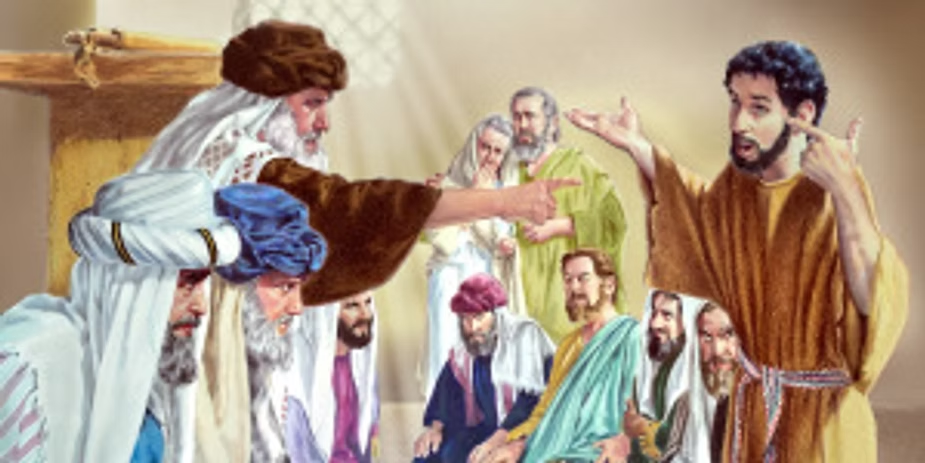
Hmmmmm. “Group think!” the lawyer must have thought, as he motioned to the other Pharisees standing there … speechless.
“Let’s put our heads together guys. Was that a blemish?”
As they were talking amongst themselves, Jesus asked them a legal question:
“What do you think of the Messiah? Whose son is he?”
After having mentioning the prophets, whose prophecies were further amendments to the Law, coming from the LORD, they (Isaiah, Ezekiel, Jeremiah, Zechariah, and Amos, along with some Psalms of David) were the primary ones who foretold of a coming Savior. Still, as a concept of Judaism, rather than a prophecy etched in stone (as was Mosaic Law), the standard answer was that instantly known by the Jews of the Second Temple: “The Messiah was to be a future Jewish king from the Davidic line.”
From that standard teaching that the Pharisees had memorized, they probably said in unison, “The son of David,” as a knee-jerk reaction, uncontrollable when that nerve was struck. Undoubtedly, Jesus asked a question to which he knew what the answer would be, setting up his next follow-up question.
Jesus asked, “How is it then that David by the Spirit calls him Lord, saying, ‘The Lord said to my Lord, “Sit at my right hand, until I put your enemies under your feet”?”
He quoted to them Psalm 110:1, which begins by stating, “Of David a Psalm said.” Jesus used the words of David himself, which the Pharisees regularly belted out in song, while drawing special attention to themselves in the synagogues. So, they knew the words Jesus quoted.
They had just never really pondered what those words meant, until then, when Jesus used that as evidence that challenged their concept of a Messiah.
When David wrote, “Yah-weh la·ḏō·nî,” the “LORD of my lord,” this is similar to the repetitious use of “Yahweh elohim” in Genesis 2 – “LORD of lords” or “God of gods” – and the use of “ĕ·lō·hê hā·’ĕ·lō·hîm , wa·’ă·ḏō·nê hā·’ă·ḏō·nîm hā·’êl” in Deuteronomy 10:17 – “God of gods, the Lord, Lord God.” Because the First Commandment refers to “elohim” – as “god powers upon a face” or “gods before me” – the Pharisees had just stepped into a trap that had them putting a human face (a descendant of David) on the Anointed One – the Son of God.
When David sang, “The Lord said to my Lord,” the Pharisees understood that “The Lord” was God (Yahweh) and “my Lord” was the Messiah, who “sat at the right hand” of God, as God’s Son, the Lord of David. Therefore, it was impossible for the Messiah to be some human to be born as the Messiah, simply from bloodline and heritage. God, and thus His Son, was more than flesh and blood.
When Jesus then asked the Pharisees, “If David thus calls him Lord, how can he be his son?,” they just got real silent and walked away, too afraid to say anything else.
The funny thing is that was a trick question asked by Jesus; but the Pharisees were not filled with any Holy Spirit to answer. They could have said: “The Christ can be any human whom God chooses to be His Son. If the LORD is my Lord, as David said, then David was one in a long line of God’s chosen Messiahs.”
Adam was one. Abraham was one. Moses was one. Samuel was one. Elijah was one. Jesus was one, and so on. The presence of the Christ (Greek for “Messiah“) Mind means the the presence of the LORD within a human kingdom, making the LORD “my Lord.”
Therefore, the trick answer to the trick question becomes a statement of the two most important commandments:
“Anyone who loves God so much that he or she becomes the face of God on earth (a Messiah), and that face of God loves all others who wear the face of God on their faces, then the Messiah will always be a descendant of the Davidic lineage of Spirituality.”
Not many would know that answer then; but by the Fiftieth Day (6 Sivan), in remembrance of when Moses first delivered the Law to the Israelites, an ever growing number of Messiahs were then enabled to see this inference. The question now is: Are we like the Pharisees all over again (blind), or are we like the Apostles (enlightened)?
Jesus said, “Beware of practicing your piety before others in order to be seen by them; for then you have no reward from your Father in heaven.
“So whenever you give alms, do not sound a trumpet before you, as the hypocrites do in the synagogues and in the streets, so that they may be praised by others. Truly I tell you, they have received their reward. But when you give alms, do not let your left hand know what your right hand is doing, so that your alms may be done in secret; and your Father who sees in secret will reward you.
“And whenever you pray, do not be like the hypocrites; for they love to stand and pray in the synagogues and at the street corners, so that they may be seen by others. Truly I tell you, they have received their reward. But whenever you pray, go into your room and shut the door and pray to your Father who is in secret; and your Father who sees in secret will reward you.
“And whenever you fast, do not look dismal, like the hypocrites, for they disfigure their faces so as to show others that they are fasting. Truly I tell you, they have received their reward. But when you fast, put oil on your head and wash your face, so that your fasting may be seen not by others but by your Father who is in secret; and your Father who sees in secret will reward you.
“Do not store up for yourselves treasures on earth, where moth and rust consume and where thieves break in and steal; but store up for yourselves treasures in heaven, where neither moth nor rust consumes and where thieves do not break in and steal. For where your treasure is, there your heart will be also.”
——————————————————————————————————–
This is the Gospel selection from the Episcopal Lectionary for the Ash Wednesday service, Years A, B, and C. It will next be read aloud in church by a priest on Wednesday, February 14, 2018. This is important as a reminder for those entering forty days of personal wilderness testing and fasting for faith because it lists what Jesus had to say about acting Christian, versus putting on Christian airs.
Let me first address the aspect of associating the party-time known as Carnival, which comes to a jolly old end on Shrove Tuesday (aka “Fat Tuesday”), more popularly known by the French term Mardi Gras.
There is nothing in the Scriptures, especially not in the New Testament that instructs Christians or Jews to gorge themselves with either pancakes or sausage links before giving up something trivial for Lent. Nothing about what the media celebrates, like that New Orleans has based its reputation on, has anything whatsoever to do with the transition from a season where one’s personal Epiphany has brought one a step closer to serving the LORD full-time.
Before I met an Episcopalian woman and began to get to know the “catholic” version of Christianity, I had no idea, clue, or concept that Mardi Gras was in any way linked to religion, certainly not the Christian kind. I had never understood what Ash Wednesday was, nor do I remember ever seeing anyone walking around town with an rubbed-on cross of ash on his or her forehead, prior to my involvement with the Episcopalian Church.
When I was told the reasoning behind celebrations that included “King cakes,” parade floats with plastic beads to toss to onlookers, and bars overflowing with drunken people, it all seemed comparative to Halloween. That costumed ritual I had grown up with appeared to be like the Mardi Gras for All Saints Day. As a child, All Saints Day never crossed my mind; and I was still eating the candy collected the evening before. However, the longer I read Scripture and ponder the meanings that come to me (I don’t search libraries or scholars for anything other than confirmation of the ideas that come into my mind), the more I am able to see some sibilance or reason for an origin of respect for holidays like All Saints and Shrove Tuesday, then the more I am able to imagine how no one ever fully passed the meaning that I see onto others.
I deduce that when holy meaning is left solely to the brains of human beings to figure out, then all pure reason becomes lost and everything goes downhill (fast) after that. That is why I write. I want to share my insights, whatever worth they may have. So, bear with me as I offer them here, now.
In John’s Gospel, we read of Jesus at the wedding feast in Cana. There, he made well water taste like fine wine, even though it was well water ladled out of purification jugs. It was perceived to be better wine that that served before, but nowhere does it say Jesus made water become wine. John said the water became wine, but no one knew how that happened. Water became wine when it reached the headwaiter, but the servants knew it was water drawn from purification jugs.
I see that event as stating the actual fermented grape juice that was deemed “fine wine” had already been consumed, but Mother Mary was worried the guests expected more alcohol to keep their spirits high. Mary asked Jesus to do something, which became a spiritual transformation answer, rather than the physical change believed (something impossible, thus a miracle that cannot be reproduced).
Everyone at the wedding banquet was already one sheet to the wind, in celebration from drinking the best wine the bride’s father could afford. What Jesus did (or what God did for His Son) was pass the Holy Spirit onto well water, so the partiers got drunk on holy water. It tasted just as sweet as Manischewitz Concord grape wine and got everyone happy, without a hangover the next morning. Still, it was the wine of living water, not the juice of fermented grapes.
It has become clear to me over the past few years, which may not be clear to other Christian man folk, that God proposes marriage to those whose hearts are inclined towards Him. Women folk (at least historically) have been more open to submission through marriage, where that has become defined as living together (opposite sexes) with all legal rights to sex permitted. Historically, the purpose of marriage has been to produce babies (born of wedlock); and it is God’s intent to produce the birth of His Son in all His wives (male and female He marries them).
To all human beings, where the physical realm equates all matter (beings and things) to the feminine spirituality, a union with God (the masculine spirituality) will make His wives give rebirth to Jesus Christ (a holy male spirit). This is the “charge” assigned to the elements in astrology: earth and water = negative / feminine; fire and air = positive / masculine. The saying, “Opposites attract” is based in this polarity of charge, current, or proton versus electron numbers is the essence that is expressed in faith. Still, for a “spark” to occur, it is just like the child’s song that sings, “First comes love, then comes marriage.” The heart must open and receive (a feminine reaction) the Spirit (to an outward masculine action).
In other words, the revelry of a wedding feast is symbolic of the celebration of the bride (males and females who love God with all their hearts) and God. Everyone at that festive celebration will become drunk with Holy Spirit, rather than distilled spirits. That Biblical meaning (symbolic and sound) has been degraded and devalued over the centuries into the debauchery that is now a practice that revels in gluttonous and shameful (they wear masks to hide the shame during Mardi Gras) behavior.
As the ending touch for a personal Epiphany, ask yourself: Do I want to get high on the Holy Spirit? Or, do I want to get so down and dirty that I should stop calling myself “Christian” altogether and join a coven of witches and warlocks?
Only the individual’s heart can answer that truthfully.
This then takes us from the wanton selfishness of Carnival to the self-inflicted austerity of Lent. One has to realize that neither God nor Christ is looking for reluctant volunteers who think a bachelor party is best reward for opting for the path to eternal commitment (till death do two as one part). When the First Commandment is understood to say, “You shall not stand before God wearing any other god’s face than His,” it has to be understood that successful marriages only wear the face of One.
That prime Law states, “lō -yih·yeh lə·ḵā ’ĕ·lō·hîm ’ă·ḥê·rîm -‘al pā·nā·ya,” or “lo hayah leka elohim acherim al panaya,” or “פָּנָֽ֗יַ עַל־ אֲחֵרִ֖֜ים אֱלֹהִ֥֨ים לְךָ֛֩ יִהְיֶֽה־ לֹֽ֣א” (Hebrew read right to left). Those words literally translate to say, “not you shall have gods other before me the face of.” (Exodus 20:3) That means, IF one is married to God, that union can only wear the face of God.
The problem caused by not fully understanding the implication of “elohim” as meaning every soul is eternal, such that lower case “g” “gods” include all living, breathing souls that inhabit human life forms. Anyone who worships his or her own brain (the almighty self), meaning one who tries to maintain an ego within a marriage union is breaking the most fundamental Law. The Covenant requires one to obey the Law, or that Agreement become null and void. Thus, worshipping self keeps one from ever facing God in the afterlife.
To be a servant or slave to God means one best become a subservient WIFE to the LORD, where the only face one wears is that of the Husband … God. That most holy face is then reflected as a lineage to the Father, the face of Jesus Christ, who resembles God as the Son. Therefore, no human being with a soul can let that soul whisper to it, “Man (or Girl), an eternity of walking the good path! You better get your groove on tonight, before all that “I do” stuff starts tomorrow!” That is the lure of failure and sin.
If that “groove” is like lusting for a “Fat Tuesday,” then that will mean there is no need, rhyme, or reason for any form of sacrifice or penitence. Therefore, forget giving up chocolate for as close to forty days as your will power allows, because God requires more of a sacrifice than that.
This brings me to the Ash Wednesday history that is explained online. Supposedly, Lent is “all about Easter,” when Jesus was raised from the dead. That explanation fits the reason for seasons that I see, where Christmas is the birth of Jesus within a believer – one sees the light – which then leads to the personal Epiphany – the dawning of a need to change. However, if Lent is the “austerity” of penitence, where the ultimate goal is to have the risen Lord rise within another human being (as a new Apostle, a new Saint), then Lent cannot be about pleading for forgiveness.
Instead, Lent is a willing test of one’s commitment in a marriage to God. Forgiveness was written on that folded card in envelope, laid on the silver platter that held the engagement proposal one accepted. Lent is then about proving one’s love of God.
John’s Gospel is the only one that did not write about Jesus willingly leaving the comfort of a common life (albeit a life of devotion to God) and entering a wilderness that tested his faith and commitment to the LORD. Matthew, Mark, and Luke all say that it was the Holy Spirit that led Jesus to the wilderness, for the purpose of being tested by Satan. Lent then has the prerequisite of being Spiritually changed, making it nothing like a New Year’s resolution or promise to change.
The symbolism of ashes at the onset of the Lenten season is that of death (ashes to ashes, dust to dust), not about being forgiven for being bad boys and girls, who go to church on Sunday, but after having partied hard on Saturday night. Ashes on the forehead mark one as dead to this sinful world, BUT still living through the love of God and the Mind of Christ (the presence of the Holy Spirit). One is marked as having totally given up on living for self, and the “X” on the forehead says, “Big Brains stay far away!”
The Lord has risen indeed!
This means the season of Epiphany can be summed up by Jesus telling his Blessed Mother, “My hour has not yet come.” The new birth of Jesus within (Christmas) leads one to meditation and deep thought about what that inner birth means. It is about pondering what God is calling one to do. However, one cannot be forced to do what one is not prepared to do.
An invitation or proposal of marriage demands sincere understanding of what commitment means. The end of the Epiphany season is when one finds deep love of God as the celebration feast of that union. Celebration and drunkenness are not the same.
The test in the wilderness that follows is like taking a red hot ingot of iron alloy and pounding it into shape, so that a hardening takes place in a quench of oil. It is proving the metal, so a blacksmith knows it will not break under pressure. The proved metal can then be refined, honed, polished, and detailed into a splendid work of art that has purpose.
Lent is that test of one’s strength, which proves one is prepared to enter a ministry for God. One must be transformed from a rough, raw material [ your name here ], into the glory that is a reproduction of the Son of Man … Jesus the Nazarene … Christ [ your name here ].
Realizing that is the purpose of Epiphany and the purpose of Lent, look now at what Jesus was quoted by Matthew to say.
“Beware of practicing your piety.”
“Do not sound a trumpet before you.”
“Do not let your left hand know what your right hand is doing.”
“Whenever you pray, do not be like the hypocrites.”
“Whenever you fast, do not look dismal, like the hypocrites.”
“Do not store up for yourselves treasures on earth.”
If one enters into a stage of testing when everything about you or your or yourselves, then the union of fire and iron alloy will break, bend, of not be hardened in a quench of oil. The marriage will prove to be a sham, because the heart is more in love with you than God.
One does not have to give up chocolate to be God’s wife (males and females, remember), because God is not a Husband that sneaks behind one, looking for chocolate wrappers hidden away. “Your Father who is in secret” knows all your secrets. One has to be happily able to give up anything and everything that the world has to offer as lures that have won over the self before … prior to when one found Jesus and fell in love with God.
Lent is all about proving to God you can pass a test of strength, durability, and purpose … to become a tool of the LORD.
Thus, Satan stood with Jesus and tried to fill his brain with ideas that tempt the common human beings: living only on words chiseled into stone; seeing eternal life as present in reincarnation; and thinking worldly rewards are signs of God’s love. When Jesus told Satan, “Go, Satan! For it is written, ‘You shall worship the Lord your God, and serve Him only.’” The judge on Forged in Fire would say about Jesus:
“That, sir, will kill!”
Lent is about killing the self, so the risen Lord can take one’s place. It is about killing the influences of evil and rejoicing in the ways of the LORD. It is about commanding the unclean spirit to depart one’s body.
This means Ash Wednesday is one’s personal recognition that it has become your time. The time has come to stop thinking and start doing. Acts of change forge into one’s life. The symbol of death to worldly desires marks your forehead, whether or not someone rubs holy oil with last Palm Sunday’s leftover palm branch crosses, burnt to ashes.
Ash Wednesday is the “hump day” where the test that comes afterward is all downhill and easy, taking one towards the day of rest, the seventh day, when all is holy. It is easy, simply because one has been prepared for what is coming and one is looking forward to being able to display one’s resolve, to do all that it takes to be in the name of Jesus Christ. It is impossibly hard work alone, without the assistance of angels – the Holy Spirit; but all things are possible when one has submitted to God’s protection.
Would he contend with me in the greatness of his power?
No; but he would give heed to me.
There an upright person could reason with him,
and I should be acquitted forever by my judge.
“If I go forward, he is not there;
or backward, I cannot perceive him;
on the left he hides, and I cannot behold him;
I turn to the right, but I cannot see him.
God has made my heart faint;
the Almighty has terrified me;
If only I could vanish in darkness,
and thick darkness would cover my face!”
———————————————————————————————————-
This is an optional Old Testament selection from the Episcopal Lectionary for the Twenty-first Sunday after Pentecost, Year B 2018. In the numbering system that lists each Sunday in an ordinal fashion, this Sunday is referred to as Proper 23. If chosen, it will next be read aloud in an Episcopal church by a reader on Sunday October 14, 2018. It is important because Job speaks as an upright man who longs for God’s presence, but is unable to hear his voice. The voice of Job is how all Christians must prove their faith in God, without signs that go the way we want them to go.
It helps to know that these verses are part of Job’s response to one of Job’s friends, Eliphaz, who visited him, urging Job to stop trying to make contact with God. The name Eliphaz (while questioned) is believed to mean God Is Agility or God Is Skill (from El – paz), implying Eliphaz believed in a god that blessed humans at birth with innate talents; not a god that helped one realize those talents or guide them to new ones. (Job 22)
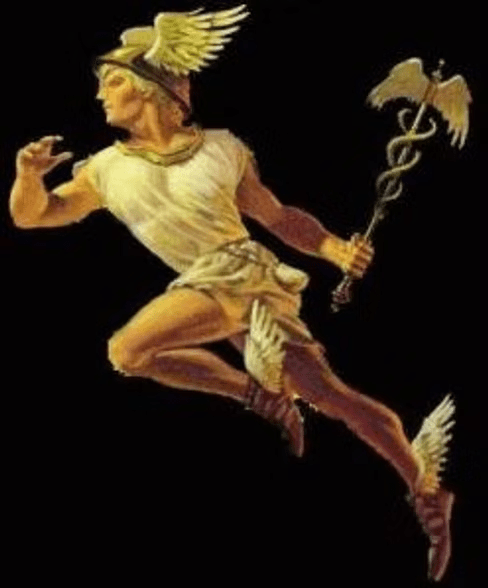
Hermes [or Mercury] was the god of agility. The Hebrew word “paz” means “golden,” as “gilded.” Some believe Eliphaz means “God Is Agile”. That could say he worshipped a god such as Hermes. As such, Eliphaz might have been a doctor friend of Job.
Eliphaz’ philosophy was that God was too great to benefit from any association with human beings, regardless of how wise they were or how righteous they lived their lives. In regard to that religious belief held by a friend of Job’s, one must recognize that Job lived in Uz, when there were multiple gods commonly worshipped. Job, like all lines in the Old Testament, was a believer in the One God of all gods, who cared for His subjects.
In Job’s response, we see the translation shows bitterness. This is somewhat misleading, as the Hebrew word “meri” means “rebellion,” although “bitter” is more found in “marah.” Job is rebellious, which means he was seeking selfish concerns that rebel against the notion that God has brought on his suffering. Job would have been bitter to that conclusion, but not bitter towards God.
When we read the word translated as “complaint,” we find that the Hebrew word “siach” means “talk.” The presentation of Job is as a poem, or a song, so it was a communication between Job and God, being done through “meditation” and “prayer” (acceptable translations here). Rather than voicing his complaints, Job was praying aloud.
The use of “yadi” is clearly reference to a “hand,” but as “his hand” (God’s) this ignores Job being a “hand of God’s.” Rather than Job complaining about God’s weight being pressing hard against him, Job was saying he physically was finding it difficult to serve God, as “his hand,” in his present condition. Rather than feeling the weight of God’s punishment, Job is “listless.” His groaning from his pains makes it difficult to tell others to believe in his God, and have them believe his devotion.
Because Job cries, “Oh, that I knew where I might find him, that I might come even to his dwelling,” this says he wants to be closer to God. The Hebrew word translated as “dwelling” is “tekunah,” which implies a “fixed place,” but also a “seat.” Job thought he was close to God, but his life has become so changed he wanted to tell God how much he still loved him. He wanted to bow down before the throne of God. There, Job would be the greatest defense he could have. He would tell God that his state of being was not because he had turned away from God.
The “arguments” Job would present would actually be “corrections” that Job would promise. The “case” that Job would “lay before” God would be repentance, asking God to forgive whatever he did that brought on his appearance of sinfulness. Job would offer to do more – anything God asked of him – and Job would listen and understand anything God would tell him, especially if Job had done something wrong. Job sought to please God, not challenge him with argument.
The Pharisees loved arguing law, just like they argued their case against the man born blind getting his eyesight back on the Sabbath. That’s not right!
When Job asked rhetorically, “Would he contend with me in the greatness of his power?” the word “contend” means God would be too high to quarrel with Job, who (like Eliphaz’ god) was too great to be understood by mere human beings. Job was not seeking to argue his case before the Lord. Therefore, he answered his own question, saying, “No;” but unlike the god of Eliphaz, the God of Job would listen to what Job (as small and insignificant as he was) had to say, as God’s servant.
When Job then offered the aspect of “reason with him,” that was not about Job using his brain in an attempt to logically point out how God must have missed something about how Job was an “upright man.” Instead, Job was saying that “an upright man” is “upright” (one who does what is right and proper) because the self-ego has been sacrificed, so ALL reason with him was the willingness to follow the insights of the Mind of God. Thus, he was found saying, “I should be acquitted forever by my judge,” as a statement of the promise of eternal life in Heaven he had been given, after death, for having sacrificed to God as one of His Apostles / Saints.
Job then went on to say:
“”If I go forward, he is not there;
or backward, I cannot perceive him;
on the left he hides, and I cannot behold him;
I turn to the right, but I cannot see him.”
That does not mean that God has forsaken Job. Instead, it says that an upright man, one who follows the reason of God as one’s directions in life, does not act because one sees God before him, or beside him, telling him, “Go this way or that.” One who is upright by the reason of the Lord simply acts. One is the hand of God by letting His hand move one where He wants, unbeknownst to His servant beforehand. A servant simply obeys, without question. This is then Job stating his trust that God will not mislead Job in anything he does.
The reading then skips forward to verses sixteen and seventeen. We read, “God has made my heart faint.” This translates the Hebrew word “rakak” as “faint.” The word is better translated as “weak,” but best translated as “soft.” This is then Job alluding to his love of God and his “tender” feelings that have allowed God into Job’s heart. This is then the marriage of Job with God’s Holy Spirit.
When the verse continues [without the interruption of punctuation] with Job saying, “the Almighty has terrified me.” This means the fear of the Lord – the only fear one may be allowed, when filled with the Holy Spirit – was the commitment Job had to God, in that marriage. Job’s heart “trembled” at the thought of losing God. This is then a statement of absolute love in Job’s heart for God.
The final verse appears dark and dreary, as we read, “If only I could vanish in darkness, and thick darkness would cover my face!” The literal translation from the Hebrew first says, “Because not I was cut off from the presence of darkness.” If those words were spoken in a vacuum, perhaps they could project as a wish of vanishing. However, “Because” (from “ki”) is reference to the “terror” at the thought of losing God’s love.
That “fear” has meant that “not was I cut off from the presence of” God. The thought of losing God’s love would mean being “cut off from the presence,” and put into abject “darkness.” It was the fear of God that kept God from allowing darkness to become a source of fear. Symbolically, darkness (as the absence of light) is representative of death, while light is life. Job had been cut off from darkness, by the promise of eternal life.
Then, the literal Hebrew says following that: “and from my face he did hide darkness.” Here, it is important to realize that the First Commandment says (paraphrasing), “You shall wear no other god’s face [on your face] before my face.” In Exodus 20:3 the Hebrew word “panim” is written (as “panaya“), which means “face or faces.” The same root word is written in Job 23:16 (as “ūmipānay“), which links the two verses in intent. While Job existed well before God gave Moses the Commandments, to give to the Israelites as their bond of holy agreement, he knew that sacrifice of self-ego meant “hiding the darkness that comes from one’s face.”
I like the way you favor me, son.
That means wearing the face of God, just as Moses’ face shone brightly after talking with God. A brightly shining face is the opposite of a face hidden in darkness. Therefore, it was the love of God in Job’s heart that kept him from being cut off from God (being in a dark place) and kept him from wearing the face of Job, which would only project the darkness of his bodily plight and the pain of the boils.
As an optional Old Testament reading for the twenty-first Sunday after Pentecost, when one’s own personal ministry for the LORD should be underway – one should be acting as God’s servant with complete faith of His presence – the message here is to be upright in the face of all darkness that can surround one’s body. The patience of Job is a virtue that all Apostles and Saints understand.
This reading from Job gives the impression that Job seemed desperate to plead his innocence before God, and get God to see how Job was unjustly being punished. We get that impression by beginning the reading with Job saying, “My complaint is bitter.” God knows all and Job knew that; so bitterness was not towards God.
Job was praying to God in the presence of his friend Eliphaz, speaking the truth of his faith, despite the groans of pain his body caused him. Eliphaz heard complaints and bitterness. Job meant devotion and faith. This dual meaning is intended, because we are all symbolized by how we react to Job. The way we respond to influences of others – the call to give up on God, because He does not serve us as we would wish to be served – is then how one lacking faith would act, if our lives were as painful as Job’s.
It is one thing to think one knows what it means to be an upright human being. It is another thing, indeed, to be upright. When Job was praying, “If I go forward or backward, to the left or to the right,” it is easy to perceive of ourselves trying to plot our courses, assuming our beliefs in God will catch us if we make a mistake and reward us when we go the right way.
It is more difficult to see how a Saint will be led by God to go against the norm, often finding him or herself standing alone, with those who serve other gods saying, “My god tells me not to sacrifice so much.” This is why being a Saint and Apostle of Christ is difficult. It demands the show of faith through sacrifice.
I am reminded of Saint Stephen, who was not one of the disciples of Jesus. He was a deacon of the early Christian assemblies in Jerusalem. Stephen probably was not his actual name, as the Greek word stéphanosmeans “wreath” or “crown.” That title then became synonymous with the depiction of halos over the heads of Saints.
Saint Stephen had become upright through the Holy Spirit, and, like Job and his covering of boils, Stephen withstood the bashing of stones against his head because his mind’s eye was fixed on Jesus at the right hand of God (“But Stephen, full of the Holy Spirit, looked up to heaven and saw the glory of God, and Jesus standing at the right hand of God. – Acts 7:55”). Stephen said, “Lord, do not hold this sin against them.” (Acts 7:60b)
One has to understand this reading of Job with the same sense of righteousness applied to Job. One has to have a similar affiliation with the Holy Spirit to see that. Eliphaz had the eyes of a believer, much like many Christians have today. He probably heard Job’s prayer and mistook it as the pleas of a man who’s God had forsaken him.
Saul stood by and watched Stephen be stoned to death. (Acts 7:58b) Saul did not think twice about that, having no clue that an upright man had just been murdered by persecution … while he held the coats of murderers. Christians who see Job as a bellyacher are just as complicit with his persecution. Still, when Stephen was arrested, the Sanhedrin was amazed by his face.
We are told, “All who were sitting in the Sanhedrin looked intently at Stephen, and they saw that his face was like the face of an angel.” (Acts 6:15)
That was the look that was on Job’s face when he made his prayer. One has to read this prayer of Job from that perspective.
That has to be the look on the face of all Saints and Apostles. All who truly serve the Lord wear His face, having given theirs up for the grace of eternal life in Heaven.
One of the scribes came near and heard the Sadducees disputing with one another, and seeing that Jesus answered them well, he asked him, “Which commandment is the first of all?” Jesus answered, “The first is, ‘Hear, O Israel: the Lord our God, the Lord is one; you shall love the Lord your God with all your heart, and with all your soul, and with all your mind, and with all your strength.’ The second is this, ‘You shall love your neighbor as yourself.’ There is no other commandment greater than these.” Then the scribe said to him, “You are right, Teacher; you have truly said that ‘he is one, and besides him there is no other’; and ‘to love him with all the heart, and with all the understanding, and with all the strength,’ and ‘to love one’s neighbor as oneself,’ —this is much more important than all whole burnt offerings and sacrifices.” When Jesus saw that he answered wisely, he said to him, “You are not far from the kingdom of God.” After that no one dared to ask him any question.
———————————————————————————————————-
This is the Gospel selection from the Episcopal Lectionary for the Twenty-fourth Sunday after Pentecost, Year B 2018. In the numbering system that lists each Sunday in an ordinal fashion, this Sunday is referred to as Proper 26. It will next be read aloud in an Episcopal church by a priest on Sunday November 4, 2018. It is important because it shows that careful study of Scripture can yield its deeper (divine) intent to those who devote their lives to searching for the truth.
Often in the Gospels we read of “the scribes,” but might not know what that title meant in the days of Herod’s Temple and Jesus. Simply by the word implying a writer, it must be realized that a “scribe” (from the Greek “grammateōn“) is defined as: “In Jerusalem, a scribe, one learned in the Jewish Law, a religious teacher.” [Strong’s Concordance] When this is used in Biblical references, it means: “A man learned in the Mosaic law and in the sacred writings, an interpreter, teacher.” [Thayer’s Greek Lexicon]
According to the Wikipedia article entitled “Scribe,” the report for the title in Judaism states: “Scribes in Ancient Israel, were distinguished professionals who would exercise functions which today could be associated with lawyers, journalists, government ministers, judges, or financiers. Some scribes also copied documents, but this was not necessarily part of their job.”
One of the scribes questioned Jesus.
With those definitions understood, a “scribe” would be similar today to a university professor of religious studies, one whose expertise would be in some field of Judeo-Christian knowledge. In cases of seminaries for various Christian denominations, such professors might even be ordained ministers. However, the world of academia has been found to be more lucrative to them, due to having a captive congregation that is required to purchase the “scribblings” of those professors in the school’s bookstore. [The ‘scribble or be scratched’ principle.]
By seeing that educational aspect – as teachers of Mosaic Law (Rabbis) – “the scribes” were the ones who had memorized the holy scrolls, interpreted their meanings, and taught that knowledge to the Sadducees, Pharisees and High Priests. Their minds were trained to see errors of reasoning and sound logic, which would be observed in the rabbis who would teach on the Temple’s steps. They would watch and listen as if each rabbi were being graded for their schooling, which in most cases was home-taught.
Having that understanding firm in hand, this chapter of Mark has skipped forward from when Jesus was leaving from beyond the Jordan, heading to Jerusalem for the Passover festival. Mark 11 began with the story of Jesus’ triumphal entry [the Palm Sunday lesson], but had Mark also writing of Jesus going out and back into Jerusalem. In those days prior to the Friday day of preparation for a Sabbath Passover [15 Nisan], Jesus taught on the Temple steps for four days. During those four days he was inspected and found without blemish (as are all sacrificial lambs slaughtered for Passover). [Jesus, after his arrest, would be inspected for four more days before being found ‘worthy’ of sacrifice, meaning there was a second inspection.]
When this reading begins by stating, “One of the scribes came near and heard the Sadducees disputing with one another, and seeing that Jesus answered them well,” Jesus had just passed an inspection. The Sadducees were disputing why their trap set for Jesus had failed, in reference to the resurrection. The Sadducees (like atheist Jews today) did not believe there was anything beyond physical life. Jesus left them reasoning among themselves [from the Hebrew “syzētountōn”], for having not realized that God is Lord of the living, not the dead. Jesus had added that souls do not marry nor have sex organs, as they are like angels.
Like angels, souls are also invisible.
Now, “one of the scribes” had given Jesus an A+ for that sermon, so he felt the need to ask Jesus about something that was personal to him. More than a test of knowledge, this scribe wanted to see if Jesus could answer a burning question within him, which meant his deep studies had led him to test himself with this question; in case some student might ask it some day. However, the scribe’s answer had not led him to be bold enough to let others know his inner feelings, largely because it could not be easily defended against biased reason. [Some times it is fear that keeps one from getting ‘outside the box’ of the usual and customary.]
The question the scribe asked to Jesus was, “Which commandment is the first of all?”
According to Exodus 20:3, the first of the Ten Commandments was: “Thou shall have no other gods before me.” [More on that later.] In response, Jesus quoted Deuteronomy 6:4 to the scribe, where Deuteronomy 5 restated the Ten Commandments, with all restated as reminders of the Laws the Israelite had sworn to uphold, once they entered the Promised Land.
On a test at Jewish Rabbi School, a student priest would not have answered the way Jesus did. The scribe would have then marked a red X through that answer, making a note in the margin that said, “You misread the intent of “prōtē” (form of “prótos”),” which in Greek says, “first,” but also means “foremost” and “most important.”
After Jesus answered by quoting Deuteronomy 6:4, he added, “The second is this, ‘You shall love your neighbor as yourself.’” This was like going for extra credit on a test; but this addition was Jesus telling the scribe, “You must know that there is a duality to the most important commandment, such that one assumes the other. It is impossible to obey the love of God with all your heart, and with all your soul, and with all your mind, and with all your strength, when this commandment is demanded of all Israel. When the foremost commandment states, ‘God is one,’ then God is one with oneself and one’s neighbors, so one cannot give absolute total love to God without it also being a given that one must love one’s neighbors as oneself.”
The Greek word “deutera” was translated as “second,” but it also can mean “subsequently.” That means Jesus was staying within the parameters of giving one answer, but that primary commandment had an immediate element that came underlying it. Therefore, the word has the impact of “twice,” where there are two parts to the one answer.
There is nothing in Exodus or Deuteronomy that Jesus quoted when he gave that additional answer. His quote comes from Leviticus 19:18b. It is the second half of a law from an assortment of laws that is the fourth [and last] of a series that refers to “neighbors.” The verse fully says, “Do not seek revenge or bear a grudge against anyone among your people, but love your neighbor as yourself. I am the Lord.”
Take a moment and think about that. What does that say to you?
Jesus was in Jerusalem being inspected as a sacrificial lamb. He would be found blemish free; but “one of the scribes” had just been told [without the use of spoken words], “Do not seek revenge or bear a grudge against anyone among your people.” Because of the scribe’s knowledge of the Torah, the omitted words did not go unnoticed. As one of the Temple insiders, he was aware of the plot to entrap Jesus. I imagine a cold shiver went down the scribe’s spine by Jesus reminding him of the “love thy neighbor as yourself” law.
That law, which is one of many in chapter 19 so the chapter is given a title by the New International Version as “Various Laws,” were those laws restated for all of the Israelites as well as those added specifically to the priests [the Levites] who would serve in the Temple. That would include scribes; that would include those sacrificing lambs for the Passover festival. The foremost commandment for Jews, especially the ruling elite, said love God totally, and love all who also love God totally as an extension of yourself … as God.
I imagine that one scribe had figured that out over the years. He realized that God never told Moses to establish a hierarchy or point system, like being one of His priests was akin to degrees [of knowledge] given to Freemasons or degrees [of physical progress] given to martial arts enthusiasts. A Rabbi was not expected to post his knowledge on the wall of the synagogue, like a restaurant has to let customers know how clean the inspectors found it. All Rabbi are expected to be the same in knowledge, with all connected to the same Godhead.
Being an Israelite was never meant to come with a box of business cards that announced, “I graduated in the lower ten percent of my class, but I did graduate!” Such announcements are worthless for doctors, lawyers, accountants, and college professors.
What job?
All of the Jews (as the ‘second time around’ children trying to reclaim their birthright as God’s chosen people) were expected to totally love God. Having already experienced what failing to follow all the laws of Moses had led their ancestors to experience, there could be no exceptions this time around. That was why the Second Temple was manned with no nonsense scribes and priests. The Pharisees and Sadducees [the Law Police] were supposed to be laying down an ‘all or nothing’ scenario.
Unfortunately, this one scribe had seen many a poor excuses for those claiming to be the children of God in his day, with few living up to expectations. That, undoubtedly, caused him to wonder: “With so many laws routinely broken, which is the foremost commandment that makes one worthy of God’s love?”
Having heard the answer given by Jesus, the scribe was moved to say: “You are right, Teacher; you have truly said that ‘he is one, and besides him there is no other’; and ‘to love him with all the heart, and with all the understanding, and with all the strength,’ and ‘to love one’s neighbor as oneself,’ —this is much more important than all whole burnt offerings and sacrifices.” The emotion of that response needs to be grasped.
The actual Greek begins that response is two one-word statements of importance, as was written in a capitalized “Kalōs” and (following a comma) a capitalized “Didaskale.” This not only made a “You are correct, sir!” statement (where “Kalōs” means “Right”) – as a professor passing a student’s paper – but it also stated the excellence of insight that the scribe knew Jesus possessed, by his ability to give the answer he gave. Because Jesus answered quickly, without hesitation or prayerful meditation, he gave an answer of highest honor, as recognition that Jesus was connected to the Godhead [a.k.a. the Christ Mind]. That inner source of wisdom meant the scribe could declare Jesus truly as a “Teacher” and “Master.”
The scribe recognized that Jesus had spoken the truth (from the Greek word “alētheias”), which according to the rules of Logic is an undefeatable conclusion. A ‘false’ answer is when the words are twisted to fit a biased conclusion, which was how one used Logic to uncover ‘false shepherds’. Without Jesus saying directly to the scribe as he did so often, “Truthfully I say,” the scribe confirmed that Jesus spoke the truth. That implied that Jesus spoke as a vehicle of the Lord.
When the scribe said, “He is one, and besides him there is no other,” he was quoting Scripture as had Jesus, while adding a clarification for the quote of Jesus – “the Lord is one.” The Greek word “heis” can mean “one,” as a cardinal number. This is like the first Commandment, which says, “Thou shall have no other gods before me,” as if that said God was number One. The word in Hebrew that says, “God is one,” is “echad,” where it too has a similar scope of meaning, based on intent of usage.
Both the Hebrew and Greek words can mean “alone” or “singularly,” and this was what the scribe was adding by saying, “besides him there is no other.” God is love, such that to love God means to become one with God. In that way oneself becomes singularly focused on God.
First Commandment that is commonly accepted as stating, you shall have no other gods before me is stated in Hebrew as, “lō -yih·yeh lə·ḵā ’ĕ·lō·hîm ’ă·ḥê·rîm- ‘al pā·nā·ya.” This can literally be translated as: “not shall have you gods other upon face.” The last two words, “‘al pā·nā·ya” are rooted in “al panim (or paneh).” The primary translation of “panim” is as “face, faces.” The translation recognized as “You shall not have other gods before me,” says that “before me” means “face of you before” or “face before,” with “me” being implied.
A scribe (fluent in Hebrew) would know this aspect of facing God, as well as the history of Moses’ face glowing after meeting with God.
For one who studied the Torah all day, every day, this first commandment would imply the oneness of God means all Israelites (like Moses) were expected to love God so much that they would become one with God, thereby wearing His face. Moses was a model of what being an Israelite should be … not an example of superhuman talents that no one could ever duplicate. As the model of righteousness, any face worn other than God’s (including one’s own) would constitute worshipping some other “elohim” (the “gods”). God and another is then duality, not singularity. This means the scribe who questioned Jesus had also deeply looked at this commandment (Exodus 20:3) and this was why he added, “besides him there is no other.”
The Greek word written that has been translated as “besides” is “plēn.” This adverb can give the impression of the preposition “beside,” leading one’s mind to imagine empty space to the right and left of God. For many Christians today, they believe Jesus Christ sits “beside” God, to his right hand side. This image makes it difficult to see how there is only One God, as many Christians pray to Jesus as if he were an elohim. The better translation of “plēn” is then as “except that” or “only,” such that the scribe said, “only him there is … no other.”
That was when the scribe told Jesus an extra credit aside, like Jesus had added a second commandment. He was linking the most important commandment with the first commandment, so the true children of God could only wear the face of God on their faces. No other face would be Yahweh’s.
That addition then linked to the next partial quote, where the scribe remembered: “to love him with all the heart, and with all the understanding, and with all the strength.” To recognize there was only One God, and no other, was dependent on loving God with all one’s heart. It was then from the love that one would become one with the One God; and that union [marriage] meant access to the Godhead [Christ Mind] where “all understanding” becomes possible.
The Greek word translated as “strength” is “ischyos,” which can also mean “power, might, force, ability.” The Hebrew word that ends Deuteronomy 6:4 and is commonly translated as “strength” (from which the scribe was quoting) is “mə·’ō·ḏe·ḵā” [“your strength”]. This is rooted in “meod,” which also means “muchness, abundance, and exceedingly,” with some usage indicating “duplication.” [Brown–Driver–Briggs] Thus, love of God allows one to have the knowledge of God duplicated or abundantly placed within one, as an extension of God [which means wearing His face].
When one has reached this state of duplicating God on earth, one must then be aware of others who also wear the face of God. Those others will also be loving God with all their hearts, having the same access to God’s wisdom and abundance. This is then how it becomes a natural extension of the foremost commandment “to love one’s neighbor as oneself.” This presumes a “neighbor” is understood as another child of the One God and not just anyone roaming the face of the earth. After all, Jesus said, “I was sent only to the lost sheep of Israel.” (Matthew 15:24)
The Hebrew word that is translated as “neighbor” is “amith.” That word means, “an associate, fellow, relation.” The word can be used to indicate a “friend,” where it was originally used to denote the Israelites who were isolated, together in the wilderness. A friend would be someone not of direct lineage, thus not close family, making a “friend” be an associate, fellow, or relation of Jacob in some way, as a child chosen by God to be His priest. The Greek word written in Mark is “plēsion” [“your neighbor”], which means someone who lives “nearby” or a “friend.” Again, the Jews of that era did not live in mixed subdivisions. They lived among their own people [many still do today], so someone “nearby” would be a Jew, as would be their “friends.”
This meant that loving another Jew, one who also loved God as much as commanded by God, must be loved as oneself. One is God. The other is God. All love God and God loves all. This is the meaning the scribe saw the foremost commandment as a natural amendment to love of God.
The scribe then added to the “love your neighbor as yourself” statement, saying “this is much more important than all whole burnt offerings and sacrifices.” This revelation was what the scribe saw in the twice daily sacrifices on the Temple altar, commanded by God as “peace offerings” as well as those for atonement of sins. While such sacrifices were made to appease God, as admissions of human frailties and a lack of commitment to love God totally, the scribe saw letting animals be sacrificed rather than self-ego as opening the flood-gates to sin, which could never lead the faithful to follow the most important commandments and its dual command to love spiritually and physically.
Look at it this way: Rather than sacrificing your milk cow for this coming weekend’s wild sins, you just pay a small indulgence fee.
Jesus [knowing he was about to become the substitute sacrificial animal for sinning Jews] heard the wisdom coming from the scribe and knew the scribe was led by God the Father. For that reason he said to him, “You are not far from the kingdom of God.” In that statement, the Greek word “basileias” is translated as “kingdom.” The word better conveys Jesus’ intent as, “rule, especially of God, both in the world, and in the hearts of men.” [Strong’s Concordance]
Knowing that a scribe’s task was to interpret Scripture and then teach that meaning to rabbinical students, rules were more important than kingdoms. As much of that meant teaching an understanding of Mosaic Law [or Rules to live by], Jesus’ comment struck to the heart of the scribe. While still meaningful but less clearly caught by the spoken word, Mark capitalized the Greek word “Ou,” which is an important “Not.”
Rather than a simple, “You are not far away,” Mark wrote “Not far are you from this,” such that the capitalized negation has the power of converting this to a positive statement. The capitalization then implies that Jesus intended to state, “You are close to the rule of God.” For a human being, close to God was how Jesus was. Therefore, Jesus blessed the scribe with neighborly love.
They both loved God with all their hearts, with all their souls, with all their minds, and with all their abundances. Once they discovered two children of God were at the same place, at the same time, they loved one another as neighborly brothers. Because the scribe was spying on Jesus for the Temple, which led to this encounter, the love the scribe then felt for Jesus was why we read, “After that no one dared to ask him any question.”
Jesus had passed his inspection for blemishes that day. The scribe departed and would no longer play a role in the entrapment of Jesus. He waved off the Sadducees, as if to say, “The party’s over fellows. It’s quitting time.”
“I thought for sure the widow of seven brothers trap would work.”
As the Gospel selection for the twenty-fourth Sunday after Pentecost, when one’s own personal ministry for the LORD should be underway – one has put on the face of God and lovingly embraces all other true Christians – the message here is to realize reading Bible verses from the Holy Bible your grandmother gave you when you were baptized as a child is only one tiny step in the thousands of steps that God expects His chosen servants to take. We are all called to be devoted scribes if we are ever going to be close to God. We have to write the meaning of Scripture ourselves … not just be rocked to sleep by someone else reading to us, showing us pretty pictures.
Beginning with the simple question, “Which commandment is the first of all?” one must seriously ask oneself, “Could I have answered the way Jesus did?”
Chances are that most people would have to honestly answer, “No.”
Bible Studies is the greatest failure of Christians. Most who call themselves Christian were raised in a church, forced to go there by their parents. They were placed in a Children’s Church or Sunday School program and taught the Bible with picture books. Those children that did not leave the church once they went to college or just got old enough to tell mom, “I’m not going anymore!” rarely do more than listen to sermons as adults, having little idea of what’s written. Even the ones that go to a seminary to become a minister, priest, pastor or preacher, they are more often than not taught not to believe what they learned as children.
Christians today are not enlightened. Sadly, it is the blind leading the blind – a normal way of mortal life.
Has anyone taught you the most important commandment is to love God and then love your neighbor as yourself? Has anyone said the heathen of no religious values are who Jesus meant … who the scribe meant … who Moses meant … who God meant, when the most important commandment was to love “neighbors” as yourself?
If they have, love is not showing very well. The world is in turmoil. One man’s “neighbor” is another man’s enemy. We live amid those who are most difficult to call “friends, relations, or associates,” simply because they have far different values.
Has anyone ever said, “We are Protestants so we hate Catholics” or “We are Catholics so we hate Jews”? Has anyone ever said, “We are Muslims so we hate Jews” or “We are Iranians so we hate Americans”?
Sometimes it seems like religion has turned into cage fights for entertainment, where hatred between two people claiming to love God [by whatever name] have nothing but hatred uncontrollably come spewing out. It is not the love of God or neighbor, but hatred of anyone who has socio-political-philosophical beliefs different than mine!
As I was looking through Exodus, Deuteronomy and Leviticus to see what was written there, I couldn’t help but see the surrounding text. The Deuteronomy 6:5 verse quoted by Jesus and the scribe leads to the following:
“These commandments that I give you today are to be on your hearts. Impress them on your children. Talk about them when you sit at home and when you walk along the road, when you lie down and when you get up. Tie them as symbols on your hands and bind them on your foreheads. Write them on the doorframes of your houses and on your gates.” (Deuteronomy 6:6-9)
That says how one who loves God totally is. Loving one’s neighbor as oneself means devoted study of Scripture and talking about it. It means raising one’s children to be able to talk about it when your neighbors are not around. It means loving God so much you want to share that love with others who love God like you do. When no one is around, you pull out the Holy Bible and start reading, all the time listening for the inner voice to say, “Write this down and ask the neighbor what that means to him or her.”
Jesus found one scribe like that in all of Jerusalem. I can only imagine the glow each had surrounding them as they walked back home after that encounter.
Additional proof:
This is one example of hatred. A collared Methodist feels he has been sent by God to place blame on all he does not agree with. The “caravan” of potential invaders are not true Christians trying to steal something they have no claim to – American asylum or residence. It is purely a political issue that only involves those who pretend to be religious in order to serve political “gods” [“elohim”]. Everything this “pastor” shouted at a career politician could equally be shouted at the leaders of Honduras, Ecuador and Mexico, but souls have been sold to the financiers [philosophers] of politicians not in power in the USA, to show religious hatred [not love of God and Christian neighbors] in front of news cameras. The face worn by political protesters is most certainly not the face of God.
Religious leaders interrupt Attorney General Jeff Sessions’ speech: “Brother Jeff, as a fellow United Methodist I call upon you to repent, to care for those in need.” Sessions: “Well, thank you for those remarks and attack but I would just tell you we do our best everyday” pic.twitter.com/NUq5HSZZMg — ABC News Politics (@ABCPolitics) October 29, 2018




















 Explaining the Readings