Tag Archives: Ezekiel 17:22-24

Ezekiel 17:22-24 – A sprig from the lofty top

[The presentation shown on the Episcopal Lectionary site has this selection produced in song verse format. I have reduced that to prose, while maintaining their translation.]

Thus says the Lord God, “I myself will take a sprig from the lofty top of the cedar; I will set it out; I will break off a tender one from the topmost of its young twigs; I myself will plant it on a high and lofty mountain. On the mountain height of Israel I will plant it, in order that it may produce boughs and bear fruit, and become a noble cedar. Under it every kind of bird will live; in the shade of its branches will nest winged creatures of every kind. All the trees of the field shall know that I am the Lord. I bring low the high tree, I make high the low tree; I dry up the green tree and make the dry tree flourish. I the Lord have spoken; I will accomplish it.”

——————————————————————————-

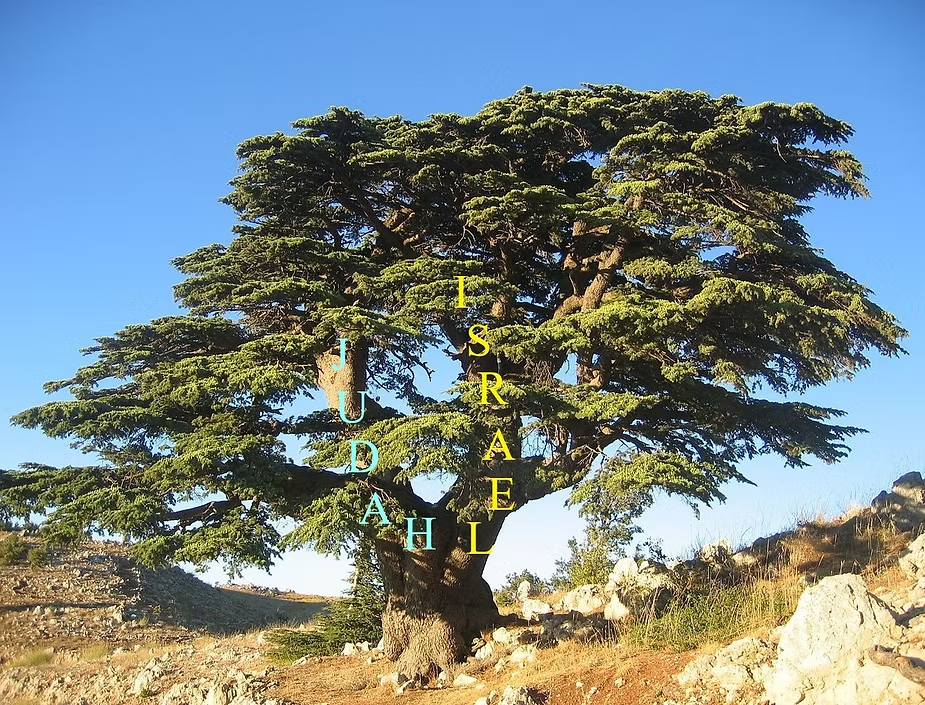
This is an optional Old Testament selection from the Episcopal Lectionary for the Fourth Sunday after Pentecost, Year B 2018. In the numbering system that lists each Sunday in an ordinal fashion, this Sunday is referred to as Proper 6. If chosen, it will next be read aloud in church by a reader on Sunday, June 17, 2018. It is important as a narrowed excerpt from Ezekiel as it shows the metaphor present in the accompanying Gospel reading selection from Mark, where servants of God are compared to plants of the earth and their benefit to the lands where they are found.

This portion of Ezekiel 17 represents the final three verses that in total was a chapter where God spoke to His prophet about the fall of Judah and Jerusalem. The king of Babylon captured Jerusalem and disposed the Judean king, appointing a younger sibling (Zedekiah) to be king, after he signed an agreement to serve Babylon. That young king then went against that agreement, causing Jerusalem to be recaptured by Babylonian soldiers; and that was when Solomon’s Temple was destroyed.

God pointed out to Ezekiel how He had a prior “agreement” with the Israelites (which included the tribes of Judah and Benjamin). Therefore, these last three verses are “riddle” and “parable” [instructions from God to Ezekiel in verse 2] that tell about the reseeding of the land with those who will not have a Covenant of stone, but the Law written on their hearts.

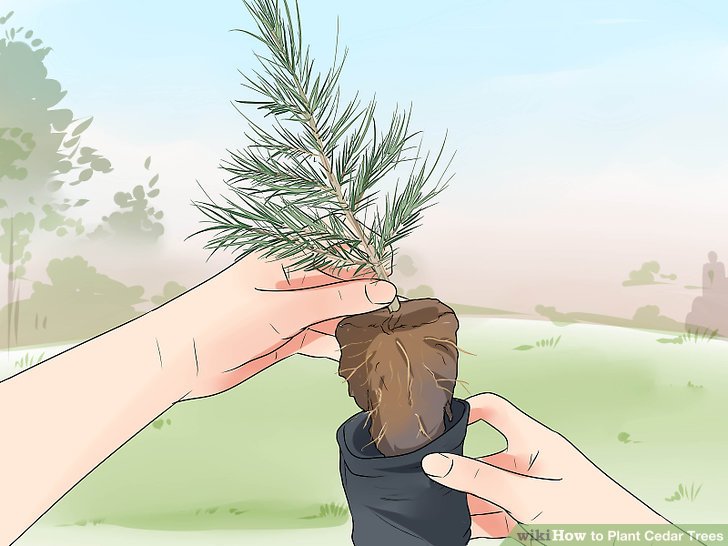
The process of transplanting a cutting of a plant becomes similar to the prophecy found in Isaiah 11:1, which states, “Then a shoot will spring from the stem of Jesse, And a branch from his roots will bear fruit.” The same forecast of a replacement of God’s “chosen people” is made in both Ezekiel’s and Isaiah’s examples of horticultural metaphor. This would not mean a return from exile of the people from Judah, in captivity in Babylon, although their transplanted tree would grow in Babylon and then grow again in what used to be Judah. However, the prophecy is foretelling of Jesus and those who would follow him as Christians.

This parallels the story in Mark’s Gospel, where Jesus spoke of growth stages of grains and that of a mustard seed.  The similarity of this metaphor spoken by God to Ezekiel, where we read, “Under it every kind of bird will live; in the shade of its branches will nest winged creatures of every kind,” is practically identical to Jesus telling how the mighty mustard tree protects birds.
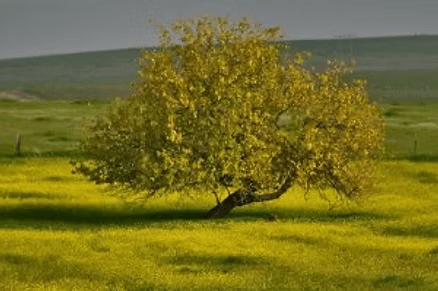

Mustard tree.
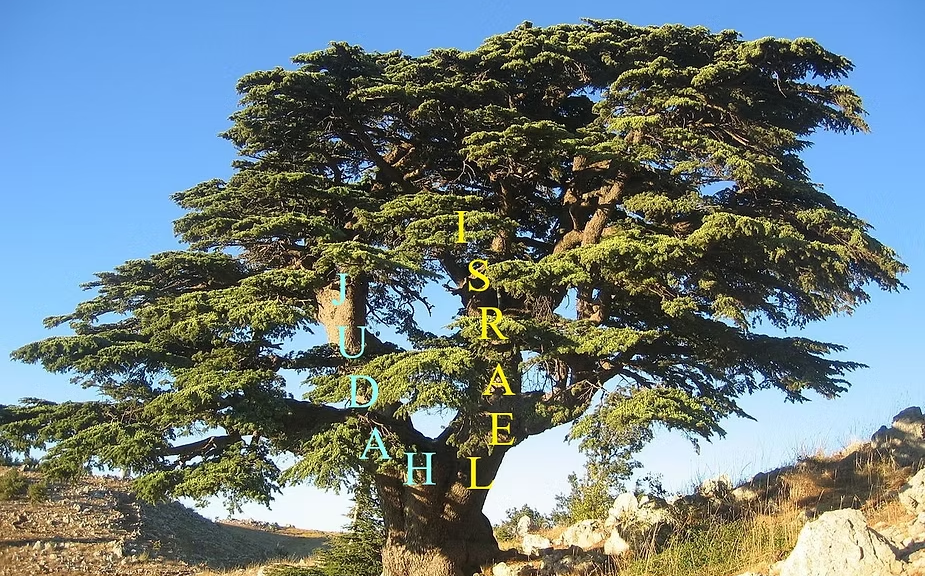
Cedar tree of Lebanon.

I have a cedar tree in my backyard and it is the home for many different birds and squirrels and rabbit have been seen running under its branches for safety also. Still, the points made by Ezekiel and Jesus are about one specific “tree,” one that “All the trees of the field shall know that I am the Lord.”

This means that when God told Ezekiel, “On the mountain height of Israel I will plant it, in order that it may produce boughs and bear fruit, and become a noble cedar,” that “tree” would be the true “religion” – “philosophy” – in a world of many religions and philosophies – that IS Christianity.  Still, “religion” or “philosophy” belittles the truth that is “noble” in that “tree.”

This means one must be able to remove the glasses of mortal being that sees the imagery of this “riddle” and “parable” as plants and birds, and put on the glasses of prophecy. Mortals see bird of many kinds as though all are living equally well under the branches of all large, protective trees. While that may be true in mundane life, it misses the spiritual point made by God stating, “In the shade of its branches will nest winged creatures of every kind.”

Those “winged creatures” are angels of the LORD, which means the “tree of Christianity” will be filled with those who totally serve God, as eternal souls saved. No other “tree’ in the filed can truthfully make that claim.
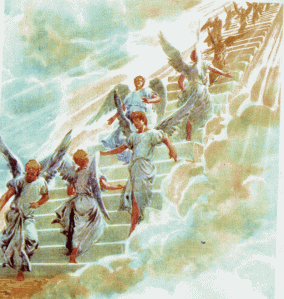
Under the shade of holy branches.

Certainly, in a world of religions, they all make their claims of superiority. Sheer numbers of believers can catapult Christianity, Islam and Hinduism to the top, in that regard. In a world of many different philosophies, where each becomes the guiding principles of a nation (the DNA of countries), the world’s most numerous adherents of central philosophical beliefs (and the laws thereby generated) can indicate the most popular are Democratic Republics, Communist-Socialist Regimes, and Totalitarian Dictatorships. However, the truth of the United States’ declaration that demands a separation of Church and State is that “religion” acts as the ideal, while “government” becomes the reality.

That reality is that nations bow down before themselves, as self-serving egos that scream, “My philosophy is better than yours.”  Never  do governments bow down before the LORD, much less to the gods they profess allegiance to.
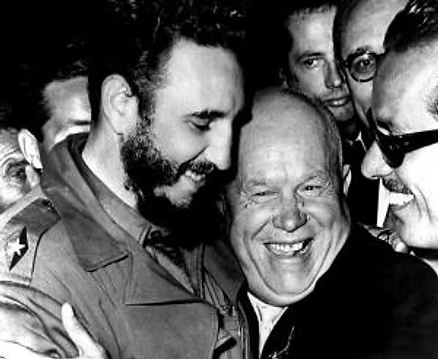
Comrades in arms at a U.N. get-together.

In the hidden “backstory” of Ezekiel 17, we read the ugliness of governments and their attempts to align with other governments, in pacts and treaties that seem mighty and strong. The adage, “The best laid plans of mice and men often go awry” is summed up now as, “I bring low the high tree, I make high the low tree; I dry up the green tree and make the dry tree flourish.”

The “high” trees that exist in the world now are the United States of America, Russia, and China. Others that seek equal status with those are Great Britain, France, Germany, Israel, Iran and others with nuclear capabilities. None of them consider themselves “high” because their total strength is based on their belief and devotion to the One God, but to the lesser god named “Nuclear weaponry.” All are exactly like the rebellious Judeans that God recalled to Ezekiel, who placed all their bets on the sharpness of their spears and the promised support of others who were paid to be in league with them.

Those plans went awry, as is the greatest flaw in humanity.  Alas, it is said, “Those who fail to learn from the mistakes of history are doomed to repeat them.”  And, the world does love reruns.

My two-lettered brother by another mother.

As history always will repeat (similarly) and one plus one will always equal two, the failures of Israel (a nation under one king), as also the failure of Israel and Judah (two nations under two kings), and also the failure of the resuscitated puppet that pretended to return to life – Hebraic Judea and Jerusalem of the Second Temple – those failures project the failures of the United States of America and the re-instituted State of Israel.  Any nation that proposed to have God on its side, but then acts as if there were no God that Saves, is doomed to fall by the hand of the godless.

It is a lesson that keeps on teaching.

That failure does not mean the “low” trees of other religions and governments will rise to the heights of being God’s newly chosen people. Instead, the meaning of “I make high the low tree” and “make the dry tree flourish” projects on individuals, those who refuse to follow the paths set for them by their government.  Governments will always come and go; but there will always remain those who love God so much they barely realize one dominating tyrant has been replaced by another.  Like seeds waiting for the right environment in which to begin new growth, they lay “low” until God commands them.

When this individual aspect is seen, the sprig from the “lofty top of the cedar,” which will be planted “on a high and lofty mountain,” that of “the mountain height of Israel,” IS Jesus of Nazareth.  God planted His Christ child to be the “low tree made high,” when disciples became true Christians – Apostles. Those Saints are the ones who has been truly filled with the Holy Spirit of God and reborn as Jesus Christ.

Each individual Apostle – Saint is then reborn in the name of Jesus Christ so he or she “may produce boughs and bear fruit, and become a noble cedar.” “In the shade of its branches will nest winged creatures of every kind,” which can now be realized as being the talents of the Holy Spirit – the powers of God given to His Son and his fruit.

Under the Tree of God an angel gets her wings.

As an optional selection from the Old Testament for the fourth Sunday after Pentecost, when one’s individual ministry for the LORD should be underway, Ezekiel offers the metaphor of song, as the projection of what one should become in service to God. When one sees the Covenant with God as a written legal document, Satan will send in the lawyers that will offer leeway interpretations about what sins are allowable and what sins are clearly forbidden. When one listens to outside influences, then one will become as uncertain of one’s commitment to God, as have all governments whose people call themselves “Christian.” Christianity is not a club one joins and pays membership dues to a specific institution.
Christianity is ministry to God, in the name of Jesus Christ.

Even as I write these words, I can see many sheep of the political left, those who hate fellow Americans because they feel their neighbors have sinned by allowing the evil creature that is Donald Trump into the White House. Evil creatures are those who are perfect to serve in the capacity of President of a False Prophet nation.  America fits the billing as a “high tree” of self-value that will be made into a “low tree” when one’s individual Judgment Day comes.

The end of the world is when a mortal dies and one’s soul faces judgment for its mortal sins. Hating one’s neighbors (regardless of one’s political persuasion) is not only a sin, as it is a bold statement that says, “I am not in the name of Jesus Christ, because I cannot love my neighbor as myself.”

Paid for by those who sponsors of death of Christianity. A little truth goes a long way towards covering a lie.

In the days of Paul and the other Apostles, ministry was to go out and tell all the scattered remnants of Israel (the Northern Kingdom and the original nation under David) that the Messiah had come. “Jesus was-is the Christ,” they all went out to tell.  God did not promise a Savior to all the other nations of the world.   Instead, God ended that Old agreement with the ancestors of the Jews.

He did not promise a Savior for the nation that was Israel (the Northern Kingdom and the original nation under David). God promised a Savior for the original premise that led to His choosing human beings [all as flawed as the next] to serve Him as His slaves … His ministers … His teachers of self-sufficiency through Jesus Christ.

The spread of Christianity occurred because of ministers going out into the world producing the same miracles as did Jesus of Nazareth, in Judea and Galilee (and beyond).  That spread was deterred when “religion” became a tool of militaristic institutions that sought to control nations by their influence.  That spread ceased when heathens were massacred in “the name of Jesus Christ,” and conversion or death were the options.

Today, especially in this world so devoted to the Internet and technology, there is no need to go out into the world “preaching the Gospel.” First of all, few have any real capability to “preach the truth of the Gospel,” as the world has become overrun with mimickers and false prophets that memorize a few tidbits of Gospel Scripture and sell it to the highest bidder.
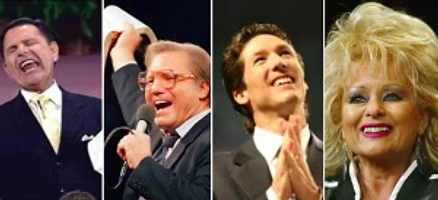
“Money is evil. Give me your money and I will protect you from evil.”

Second, our nation presently has a pastor-missionary under arrest in Turkey, who has been charged with being a spy for the United States of America. The reality of that situation (regardless of the guilt or innocence of that specific “pastor-missionary”) is the United States government (and its evil agencies of intelligence) has used the aspect of “ministry” as a way to get into hard places and subvert foreign regimes.  It becomes reasonable to think that a Christian evangelizing in a Muslim nation is there for the purpose of subversion.

Canadian couple imprisoned in China for spying. Every time something like this happens, it spears the word “Christian” with the stench of government.

Ministry is no longer about telling a world that already has an opinion about what “Christianity” is (real or imagined), as ministry today is about an individual being filled with the Holy spirit and living accordingly. Heal yourself before trying to heal anyone else!

Ministry today is having the world come to an Apostle – Saint, asking, “Why are you smiling in a world of misery?”

Ministry is not about the theatrics of “evangelism” or the solemnity of “ritual.” Ministry is about marriage to God, so His Son can be reborn into a willing sacrifice of self-ego. Ministry does not require a “sheepskin” from a seminary.  It does not require a building that has stained-glass windows, spires, bells, and pews.  Ministry is not an organizational position, as it is an individual commitment to God.

Because Christianity is not one’s decision, but God’s decision based on His knowing the heart of an individual, the growth required for a “sprig” to grow into a “noble cedar” can take decades or minutes. For it to take place quickly, one should expect a traumatic event, such as a near-death-experience, where the limitations of linear time have been overcome by an out of body experience and the future beyond mortal life has been seen.  For it to take decades, this should be understood: A ministry cannot wait long before it is squandered and lost.

Remember, if Israel could fail, so can all moral human beings. Saying one “believes” is as worthless as a signed contract, when a lawyer is always there, willing to tell one how to opt out of a commitment, without lasting repercussions. “Belief” cannot be agreed upon as promise.  Belief can only come from personal experience.  Being Jesus Christ is the only way one can truly believe in him.

The point Ezekiel made was that each servant to the LORD must be the “lofty top of the cedar.”  That means being in direct connection to God, with no “go-betweens.” This is where those in ministry are set into the world by God, so others can find their light. In a dark place, a light can shine a great distance without ever moving.
Ezekiel 17:22-24 – Being the cedar tree

Thus says the Lord God [adonay Yahweh]:

I myself will take a sprig

from the lofty top of a cedar;

I will set it out.

I will break off a tender one

from the topmost of its young twigs;

I myself will plant it

on a high and lofty mountain.

On the mountain height of Israel

I will plant it,

in order that it may produce boughs and bear fruit,

and become a noble cedar.

Under it every kind of bird will live;

in the shade of its branches will nest

winged creatures of every kind.

All the trees of the field shall know

that I am the Lord.

I bring low the high tree,

I make high the low tree;

I dry up the green tree

and make the dry tree flourish.

I the Lord have spoken;

I will accomplish it.

——————–

This is the track 2 Old Testament option that could be read aloud on the third Sunday after Pentecost, Year B, according to the lectionary for the Episcopal Church. If chosen, it will be paired with Psalm 92, which sings: “The righteous shall flourish like a palm tree, and shall spread abroad like a cedar of Lebanon. Those who are planted in the house of the Lord shall flourish in the courts of our God.” They will be followed by an Epistle reading from Second Corinthians, where Paul wrote: “For all of us must appear before the judgment seat of Christ, so that each may receive recompense for what has been done in the body, whether good or evil.” The Gospel reading will then be read from Mark, where it is written: “It is like a mustard seed, which, when sown upon the ground, is the smallest of all the seeds on earth; yet when it is sown it grows up and becomes the greatest of all shrubs, and puts forth large branches, so that the birds of the air can make nests in its shade.”

In this reading selection, the Hebrew of these three verses includes the word “Yahweh,” written three times. In verse 22 is written “adonay Yahweh,”[1] which is translated as “the Lord God.” The two other places [verse 24] where “Yahweh” is written, the NRSV has translated it as “Lord.” The question to the ‘think tank’ translators is this: Which is it: “God” or “Lord,” when both “Yahweh” and “adonay” are two different words translated as “Lord,” yet when “Yahweh” is translated as both “God” and “Lord”?

To translate “adonay Yahweh” as “Lord God” is an error that believes God [Yahweh] tells His prophets to write about “two-word entities.” They do that with “Jesus Christ” [or “Christ Jesus”] and the “Holy Spirit” [or “Spirit Holy”]. That is thinking [always a deadly thing to do] Yahweh needs an additional title added to His name, when simply “Yahweh” says everything needed to be said. Saying Yahweh is a “Lord” is unnecessary redundancy. The same applies to a capitalized [a Greek capability] “Pneuma,” where that cannot come from anyone other than Yahweh, due to the capitalization. If it is accepted to be Spirit that comes from Yahweh, then it is accepted to be “Holy.” The same error applies to “Christ Jesus,” as it gives the impression that “Christ” was the last name of “Jesus,” so both words must be said together. That as if Mr. Christ” [Yahweh the Father?] will be offended if His name is not mentioned.

All of this is the absurdity of English translations, which are all designed to lessen the power of Yahweh [that is the name of a Jewish God], to make authors of divine books be opinion writers. Their translations of this nature remove all thought from simple-speakers-of-English’s minds, as to individual responsibility to serve Yahweh as Jesus reborn. No one is taught that Yahweh has the power to make anyone a “Christ,” because all power to Anoint Spiritually can only come from Yahweh.

This means that every time the two words appear in Old Testament Scripture, saying “adonay Yahweh,” “adonay” refers to the “lord” over the prophet’s soul-body. That follows the marriage of that soul to Yahweh’s Spirit. This means “adonay Yahweh” is reference here to Ezekiel, whose “lord” over his body of flesh was “Yahweh.” As such, every word written by Ezekiel came from Yahweh, his lord. Yahweh is only lord to those souls He has married and are His wives. Calling Yahweh “Lord” does little to make Him become one’s “lord.”

By seeing that, when Ezekiel wrote, “kōh ’ā·mar ’ă·ḏō·nāy Yah·weh” [“thus says lord Yahweh”], Ezekiel was announcing, “I now write as the voice of Yahweh, because He instructs the following words.” The following words become metaphor from Yahweh, with four references to Yahweh being “I” [“’ā·nî”].

In verse 22, the metaphor is placed on “a cedar tree.” This becomes symbolism that should be realized. According to a search of the Internet [Google], using the terms “symbolism of cedar trees,” the following was posted on the website Garden Guides:

“The branches of the cedar tree are wide and grow almost parallel to the ground, making the tree appear to be constructed of successively higher floors made of greenery. In the late 19th century, author John Worcester compared the structure of the cedar tree to the process of attaining successively higher natural and spiritual knowledge, writing, “The spiritual tree also must extend its branches, put forth leaves, and mature its fruit on successively interior planes of the mind.” Worcester further elaborated that the scent of cedar wood indicated the pleasure people find from discovering knowledge and truth.”

This becomes a perfect view of the growth pattern of the branches of a cedar tree. It makes the “highest branches” [“miṣ·ṣam·me·reṯ”] reflect upon those who had reached closest to Yahweh. This then becomes a statement of those who were like Ezekiel, as “adonay Yahweh.” It also is spoken through a prophet of Israel, even though his time as a prophet was served in the southern kingdom, Judah [including captivity in Babylon].

The name “Israel” is a reflection as the “highest branches,” as that is the name taken by Jacob, after his soul married Yahweh. His new name – the name “Israel” – means the soul of Jacob had become “God Is Upright” and “He Retains God.” [Abarim Publications] Thus, the “highest branches of a cedar tree” means those branches of one tree who have married the Spirit of Yahweh, being extensions of Yahweh, still on the physical plane.

As for the “cedar tree” [“hā·’e·rez”], that refers to the children of Israel, led to become a growth of Yahweh on earth, unlike any other “trees” of government or religion. Here, the “cedar tree” is said to symbolize “strength and eternity.” Still, as Ezekiel was a prophet of the mighty tree that was felled, it had once been Israel, but split by lightning and formed into Israel and Judah. That surviving “cedar tree” was then felled by the Babylonians.

This makes this become a prophecy of what Isaiah wrote about as well: “A shoot shall come out from the stump of Jesse, and a branch shall grow out of his roots.” The “stump of Jesse” was the “cedar tree” that had been Israel under David, such that from his being “the highest branches” [everything went downhill from then], the metaphor of the “tender sprig” [“yō·nə·qō·w·ṯāw raḵ”] would be Jesus, whose DNA was implanted in the womb of Mary.

When verse 23 sings, “On the mountain height of Israel I will plant it, in order that it may produce boughs and bear fruit,” here the name meaning of “Israel” [“yiś·rā·’êl”] must be understood. Because Ezekiel was a prophet of Judah, taken in the exile to Babylon, the meaning behind the name is the intent of Yahweh speaking. It has absolutely nothing to do with Yahweh promising to bring back to life a nation that failed, because it worshiped human kings, not Yahweh. Therefore, “the height of Israel” is the meaning that says, “God Strives” [Strong’s] or “He Retains God” – “God Is Upright” [Abarim Publications]. This speaks of all who would be like Ezekiel, married to Yahweh, so the “lord” of their souls would be His Spirit. The “fruit” [“p̄e·rî”] would be Jesus, which would give rise to the great new “cedar tree” called Christianity [still representative of “Israel” – not a nation run by humans, but individual soul married to God].

When verse 23 continues, singing “Under it every kind of bird will live; in the shade of its branches will nest winged creatures of every kind,” the metaphor of “birds” and “winged creatures” is that of angels. In Hebrew, the word “malak” is translated as “angel,” found written in Old Testament scripture a hundred ten times. The word actually means “messenger,” which [along with “ambassador” and “envoys”], so the same spelling shows up in Biblical translation a hundred three other times, with different translations than “angel.” This then leads one to see “apostles” [from the Greek “apostolos”] as having the same essence as “malak,” meaning “a messenger, envoy, delegate, one commissioned by another to represent him in some way, especially a man sent out by Jesus Christ Himself to preach the Gospel; an apostle.” (Strong’s usage)

When one realizes that the meaning of “Israel” implies a divine marriage between soul and Spirit, so one has become “Holy, Sacred, Set apart by God” [the meaning of “Hagion”], it is this union that makes one’s “lord” [“adonay”] be “Yahweh.” Another Old Testament way of making this union be stated is “elohim,” such that Genesis 2 – once the seventh day came and it was deemed “holy” [we live today still in the seventh day] – one finds “Yahweh elohim” written eleven times. An “elohim” of “Yahweh” is then a “god” [“el”] on earth, exactly as is an “adonay Yahweh.” Thus, “elohim” are “winged creatures” [a modification of “kāl- kā·nāp̄,” which literally states “all-winged”] or “birds” [“ṣip·pō·wr”], under the protection of the new “cedar tree” – Jesus [a name meaning “Yah[weh] Will Save].

In verse 24 Ezekiel wrote, “All the trees of the field shall know that I am [Yahweh].” When one realizes the “cedar tree” is the religion of the true priests of Yahweh [His wives in marriage], then “all the trees of the field” become every religion or denomination of a religion that believes in lesser gods. This includes all Christians who refuse to call upon the name Yahweh, preferring to generally state someone unknown [by name]. That lack of personal relationship is what lowers that religion to “all others of the field,” which make up the total scope of religion on earth. This is the difference in the “elohim” of those who worshiped Ba’al and the “elohim” who was himself one, Elijah. Those failed to light an altar fire through prayer alone were the “trees” of religion that had no direct contact to a true Spirit.

This relates to Yahweh saying through Ezekiel’s hand, “I bring low the high tree, I make high the low tree.” One needs to keep in mind here, how the “highest branches” of “Israel” now become the lowest tier of the tree. As such, the roots of the tree are the hidden union with Yahweh, where the Spirit is one with the soul of the tree, so the lowest branches were those of David’s reign, after the Saul branch was pruned and thrown into the fire. Saul was non-productive, producing no fruit. Conversely, the higher branches would be furthest from the roots and therefore less connected to the Spirit, although the highest. The higher branches are too young to produce fruit, but their “tender twigs” contain the code for becoming the Son of man. The wives of Yahweh are the soul produced by the tree of Israel [those in whom “God Is Upright”], not the other trees in the forest.

When the verse then sings, “I dry up the green tree and make the dry tree flourish,” this must be seen as precursor metaphor for Ezekiel’s dream of Yahweh taking his soul to a valley filled with dry bones. [Ezekiel 37] The statement “I dry up the green tree” speaks of the death of mortal existence in a body of flesh. The dead matter that is flesh is only made “green” [from “lāḥ” or “lach,” which actually means “moist, fresh, new”] when the “breath” [ruach] of life brings sinews, muscles and skin around the dryness of dead matter [bones]. This means reincarnation; and, it is the promise of mortality. That says the dream Ezekiel spoke of reincarnation, where now Yahweh says souls come back as “new trees,” after having been “trees” before. However, to make the “dry tree flourish” that means the promise of everlasting life. That was the lesson of Yahweh telling Ezekiel to prophesy to the breath, beyond prophesying to the dry bones.

The final segments of this song say, “I Yahweh have spoken and done.” This should not be read as some brag about the powers of Yahweh. Such truth needs no boasting come forth … from Yahweh. This then means “I Yahweh have spoken” is what we read having been written by Ezekiel. Yahweh speaks through the prophets; so, Ezekiel equates [minimally] to all who wrote divine text of Holy Scripture. Yahweh has spoken the truth every time. His Word becomes the physical roots from which a “cedar tree” grows. No religion claiming Yahweh as the “lord” of the souls who run an organization can use any other text. Even when those souls claim Yahweh is named “Allah” or “the Lord,” they cannot claim that “Yahweh has spoken” through themselves. Therefore, they are not the “cedar tree.” The “cedar tree” is only Jesus resurrected with a soul married to Yahweh and Yahweh alone.

The word translated as “and done” [or “I will accomplish it”] – “wə·‘ā·śî·ṯî” – says the proof is not to see prophecy fulfilled, as that is a lack of faith. The souls who grow from the “cedar tree” of eternal strength will marry Yahweh because they know what has been “done.” That knowledge can only come from personal experience of Yahweh, which means the soul [roots] have merged with the Spirit of Yahweh and the truth courses through one’s flesh. This faith of “done” is the truth of the “blood of Jesus,” whose soul allows one’s mind to know the truth of Yahweh and lead one into His service.

As an optional Old Testament selection to be read aloud on the third Sunday after Pentecost, one should readily see how the verbiage of Ezekiel becomes a match for the metaphor of Mark, where Jesus spoke of seeds growing and bearing fruit. It is vital, if this reading is chosen, to see Israel as a Spirit merged with a soul, creating one in whom “God Is Upright.” One needs to see how the “low” will be made high, not the other way around. Those who think [the deadly curse of mankind] they are high and mighty enough to stop calling Yahweh by His name will find their souls appearing on His doorstep, after their “green tree has been made dry,” only to hear YAHWEH say, “You did not know me, so I do not know you.”

——————–
[1] There are no capital letters in Hebrew. The word written is “יְהוִ֔ה.” Myself and BibleHub [and others, I assume] capitalize the transliteration as “Yahweh,” in the same way that proper names are capitalized. The intent implies capitalization, when in reality there is none. So, “adonay” translates as “lord.”