
Tag Archives: Ezekiel 2:1-5

Ezekiel 2:1-5 – Knowing a prophet has been among them

The Lord said to me: O mortal, stand up on your feet, and I will speak with you. And when he spoke to me, a spirit entered into me and set me on my feet; and I heard him speaking to me. He said to me, Mortal, I am sending you to the people of Israel, to a nation of rebels who have rebelled against me; they and their ancestors have transgressed against me to this very day. The descendants are impudent and stubborn. I am sending you to them, and you shall say to them, “Thus says the Lord God.” Whether they hear or refuse to hear (for they are a rebellious house), they shall know that there has been a prophet among them.

——————————————————————————–

This is an optional Old Testament selection from the Episcopal Lectionary for the Seventh Sunday after Pentecost, Year B 2018. In the numbering system that lists each Sunday in an ordinal fashion, this Sunday is referred to as Proper 9. If chosen, it will next be read aloud in a church by a reader, on Sunday July 8, 2018. It is important because it states the truth that a prophet of God is His creation, through His Holy Spirit.

This short five-verse reading option from Ezekiel is fairly straightforward in the translation above, stating that God filled Ezekiel with His Holy Spirit. Once filled with the wisdom of God, Ezekiel was sent to prophesy before the wayward Judeans, before their exile to Babylon and after.
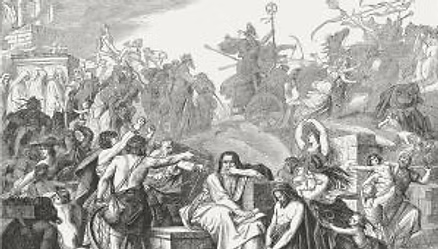
Ezekiel was called Buzzi (beyond being the the son of Buzzi), “because he was despised by the Jews.” (Ezekiel: Wikipedia article footnote: Radak – R. David Kimkhi – in his commentary on Ezekiel 1:3, based on Targum Yerushalmi). The name “Ezekiel” means, “God Strengthens” or “Strengthened By God.” He was of the priestly lineage (Kohen: “a member of the priestly class, having certain rights and duties in the synagogue.”), believed to have been descended from Joshua. The words Ezekiel spoke to the children of Judah, as read in the Book of Ezekiel (regardless of who wrote them onto scrolls of parchment), proves God’s statement, “Whether they hear or refuse to hear (for they are a rebellious house), they shall know that there has been a prophet among them.”

As for a few observations of the actual Hebrew text and the translations English-speaking Christians recognize, whenever Ezekiel is said to hear God speak to him, with a reference to “O mortal,” the reality is Ezekiel wrote, “ben-adam” – “son of man. The translation as a “mortal” human being is relevant to being one of “mankind.” As a male human being, all male human beings are “sons of man.” This means the address is to the physicality of being human, which all human males are.

In the way that Jesus of Nazareth addressed himself as “Son of Man” (such as in Matthew 18:11, but many others) where the capitalization is an application of translation and not what was written (“huios tou anthrōpou” or “υἱός τοῦ ἀνθρώπου”), the assumption that comes from the capitalization is that Jesus addressed himself as the Son of God, in the form of Man. Beyond that, one can assume Jesus (as the Christ Spirit) was the Son of God, whose soul was that of Adam – the Son of God. However, both Ezekiel and Jesus were stating they were both males of mankind, which is ordinary, normal, and typical – not special.

Le Fils de L’Homme (Son of Man) – Magritte

While Jesus was divinely conceived, always to be holy, he was to be born of a woman.  That made him a son of man.  Likewise, Ezekiel was a son of man born into a holy lineage, predestined to become a prophet.  The specialization and uniqueness then comes when ordinary men are transformed by the presence of God’s Holy Spirit; or as Ezekiel wrote: “A spirit entered into me.”

This realization means it is ordinary, normal and typical to read the Holy Bible (or have it read to one) and see Ezekiel like one sees Jesus – as special, as those blessed by God for holiness. It is this failure to see how Ezekiel and Jesus were just like all other men (and women) of the earth. They became special by welcoming the God into their hearts, so they could hear His voice through the Mind of Christ. They became special because of their sacrifice of self (God did not say, “O Ezekiel”) so the Holy Spirit could enter into them. They became special because they heard the voice of God speaking directly to each, such that each responded to what God said (“speaking” = “’ā·mar” = “commanding, advising, designating, and giving an order”).

Normal mortals are like Cain was when his sacrifice to the LORD was not shown favor. Normal human beings often get angry and let their faces become downcast (from Genesis 4:6-7), where “face downcast” or “countenance fallen” is derived from “nā·p̄ə·lūp̄ā·ne·ḵā”.

Those words of Hebrew literally translate to state “lie down before,” where one’s emotional outbursts when things do not go one’s way are like a child throwing a tantrum, lying on the floor and screaming. If children do this ordinarily, normally and typically, so too do mere sons of mankind, no different than Cain did. This is how one should see the statement here by Ezekiel, that God “set me on my feet.”

In the first two verses of this reading selection, we read how God told Ezekiel, “stand up on your feet” (verse 1) and then how God’s Holy Spirit “set me on my feet.” The same word, “amad,” is the root used in the translations “stand” and “set.” It is then important to see how “standing” is the opposite of “lying before,” such that a righteous prophet of the LORD must “rise up” from the ordinary, the normal and the typical and become “upright” before God. Because Ezekiel did this while he was a mere “son of man,” a simple “mortal, then so too can all human beings do the same. However, that requires a willingness to hear the LORD speaking AND it means releasing oneself from the rebelliousness, impudence, and stubbornness that makes life seem so much easier to transgress than to comply with what the LORD says.

In the heritage of Ezekiel, where he was descended from Joshua, who was a true servant of the LORD, as an assistant to Moses and subsequent leader of the Israelites. Joshua also was a prophet of Yahweh, just as was Ezekiel and Jesus. This unique stature was not among mere mortals, as much as it was among the children of God. All gods have their priests and prophets, in the same way that all nations have their kings and presidents, and all humankind has its teachers and guides. Ezekiel, as Joshua and Jesus, stood up among Israelites, Judeans and Jews, because it was those, chosen by God to serve only Him as His priests, who refused to be extraordinary, because they wanted to be ordinary, normal, and typical – like the people of other nations.
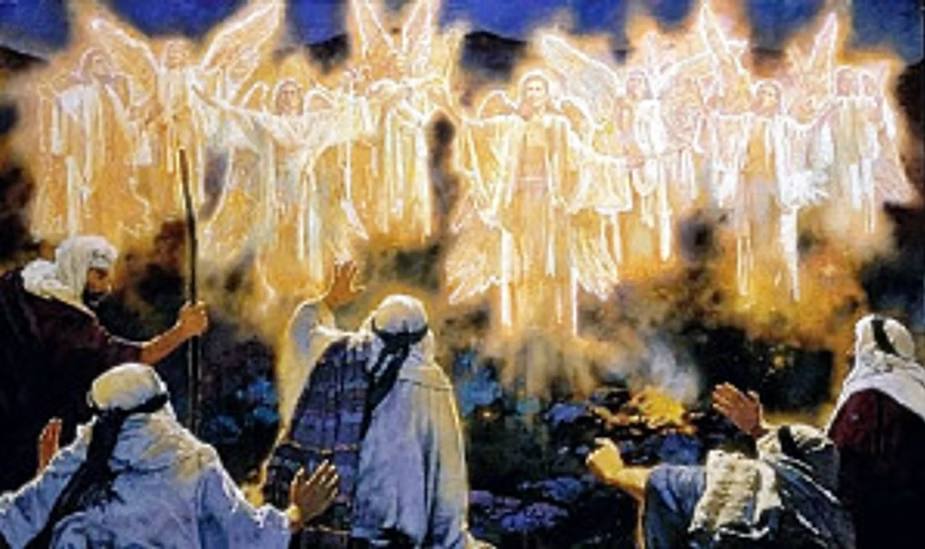
The humble bow down before the righteous.

Ezekiel, as Joshua before and Jesus afterwards, was a prophet that told the warning spoken by the LORD to His chosen priests. The Book of Ezekiel was not lessons of righteousness spoken to the whole of mankind, as it was the Word of God to those who had fallen into the gutter before their LORD. The lessons of the Gospel were likewise not to stories of Jesus being sent to save all the sons of man. He came to warn the Jews that they had also fallen into the gutter before their God. The message was to “Arise! If you want to be a priest of Mine, then you best become like Ezekiel, Joshua and Jesus; or you will become mere sons (and daughters) of man and lose the right for eternal life.”

As an optional reading selection chosen for presentation on the seventh Sunday after Pentecost, in the season of Church time when ministers (prophets) to the LORD should be well along the paths God has sent them to travel, the basic lesson here is to stand tall among mere men and women. A ministry then means being a pillar of strength in a cesspool of worldly beings. One is called by God to rise from that muck and be a standard-bearer of righteousness, so the rebellious, the transgressors, and the impudent can see that hope of salvation remains alive.

The English word “transgression” is defined as, “An act that goes against a law, rule, or code of conduct; an offense.” (Google Dictionary) Seeing this as a legal term, where the Law of Moses came from God to the Israelites, as the Covenant between their service as God’s priests, with the agreed rewards as God’s chosen people being eternal salvation, the prophets of the LORD have always only been sent to warn those who profess belief in the One God, and not anyone else. This means a transgressor is anyone who has sworn allegiance to Yahweh (Jews and Christians), expecting the reward of Heaven for simply believing in that God, but who have laid down with the non-believers, going against the Laws of Moses, the rules of Jesus of Nazareth, and the code of conduct that makes one truly a priest to the One God. Such acts by other sons and daughters of humanity do not constitute breaking those laws and covenants, because they serve the gods of the world – the gods of money, sexual stimulation, war, artificial means of transcendence, and any other worship of the physical, rather than the Spiritual.

This reading then focuses less on being sent into the world to right all the wrongs, as God told Ezekiel, “Whether they hear or refuse to hear (for they are a rebellious house), they shall know that there has been a prophet among them.” This says one who refuses to hear will still know that a prophet of Yahweh has come into the world simply because he or she stands among those who wallow in emotional instability. If one wants to hear what a prophet has to say, then that one will rise to ask questions, like, “What has the LORD said to you?”

This means a ministry today is no different than ministry was for Joshua or Ezekiel, as they had to rise above the level of being sons of man, mere mortals, so they could hear God speak. A minister has put oneself in a position so that the Spirit can enter one’s being and strengthen one’s upright position. Once standing, a minister can hear the voice of God speaking words that explain the meaning of Scripture. A minister then radiates the joy of that enlightenment, so the others of mankind can know that God has come near.

When we read in Ezekiel today, we can apply ancient words to today’s reality. We can see how this Scripture can state: “[God] said to me, [son of man], I am sending you to the people of [faith in the One God], to a [religion] of rebels who have rebelled against me; they and their ancestors have transgressed against me to this very day.” What was truth then is still truth today. Jews who have rejected Jesus as their promised Christ are doing nothing more than pretending to obey the Law are transgressors to this day. Christians who have entered the churches as political activists and apologists for sins against the Law are transgressors to this day.

The Hebrew word “pasha,” which translates as “transgressed” and “rebelled,” also infers “to break away (from just authority).” This means the plethora of denominations and sects of Judaism and Christianity, evolving over the millennia, are by definition “transgressors” of the true purpose of one’s original faith in God. Thus, ministers are sent by God for the purpose of replacing the lost with those found, as beacons that others can see.

This makes a minister be an example of the truth, so those who have fallen, like God came and spoke directly to Cain.  God speaks through His prophets indirectly, so they speak as symbols.  Thus, a minister can make it known that it is possible to do what is right by example, rather than words. The sight of a risen prophet shows the world it is possible to rule over sin, rather than have sin rule over a mere mortal.

#sonofman #Matthew1811 #Ezekiel215 #omortal #Genesis467

Ezekiel 2:1-5 – Taking a message of Yahweh to those who ruin souls

He said to me: O mortal, stand up on your feet, and I will speak with you. And when he spoke to me, a spirit entered into me and set me on my feet; and I heard him speaking to me. He said to me, Mortal, I am sending you to the people of Israel, to a nation of rebels who have rebelled against me; they and their ancestors have transgressed against me to this very day. The descendants are impudent and stubborn. I am sending you to them, and you shall say to them, “Thus says the adonay Yahweh.” Whether they hear or refuse to hear (for they are a rebellious house), they shall know that there has been a prophet among them.

——————–

This is the Track 2 optional Old Testament reading choice for the sixth Sunday after Pentecost [Proper 9], Year B, according to the lectionary for the Episcopal Church. If chosen, then the accompanying “Response” will come from Psalm 123, where David sang, “Have mercy upon us, Yahweh, have mercy, for we have had more than enough of contempt, Too much of the scorn of the indolent rich, and of the derision of the proud.” Both will precede the Epistle reading from Paul’s second letter to the Christians of Corinth, where he wrote: “Three times I appealed to the Lord about this, that it would leave me, but he said to me, “My grace is sufficient for you, for power is made perfect in weakness.” All will accompany a reading from Mark’s Gospel, where it is written: “[Jesus] called the twelve and began to send them out two by two, and gave them authority over the unclean spirits.”

I wrote about this reading and posted my opinions in 2018, the last time this optional reading came up in the lectionary schedule. It is available on this website. The value then still applies today, so I welcome all to read that post. However, in my contemplations of the Track 1 option from Second Samuel, when David became king over both Judah and Israel after Saul was killed and no heirs of his still lived, those new insights I found coming to me have shed new light on the true reason this reading being an optional choice that mirrors that reading; and, that is the direction I will now take with this selection from Ezekiel.

First, let me state that I have made adjustments to the reading above, so the truth of what Ezekiel wrote is no longer covered up by erroneous translations. The first verse says nothing about who the third person speaker is, although it certainly be assumed [correctly so] to be Yahweh, the Husband of Ezekiel’s soul. Rather than inject that direct name, I have replaced the third person as “He said.” In verse four, Ezekiel wrote “adonay Yahweh,” which has been incorrectly translated as “Lord God.” That translation misses the point of Yahweh speaking to Ezekiel, because Ezekiel was one of Yahweh’s “elohim” [“gods” via Spirit possession]. The plural of ‘elohim” [of the singular “el”] is matched by the plural “adonay” [of the singular “adon”], where the “lord” of Ezekiel was the Spirit of Yahweh. Thus, “lords of Yahweh” is the true intent, not “Lord God;” so, I have returned the Hebrew text, rather than allow the error to stand.

In my ‘epiphany’ from discerning the meaning of the Second Samuel reading [2 Samuel 5:1-10], it became apparent that David moved his capital from Hebron to Jerusalem for one specific purpose and one purpose only. The omission of three vital verses makes this purpose more impossible to see, since the inclusion of those verses makes it possible, but still very difficult. It forces one to understand why the Jebusites had not been defeated in battle, after nearly a thousand years of occupation in the Promised Land of Canaan. The reason David moved to the ‘stronghold’ of their position was to replace them as the overseers’ of Israel. David would force all the Israelites to become the equivalent of the Jebusites, as all needed to marry their souls to Yahweh forevermore or become the blind and the lame incapable of retaining that land.

When David died, he had sinned and broken the Covenant with Yahweh. The child of his adulterous relationship with Bathsheba would become his lone heir to take over his kingdom. Solomon would lead Israel and Judah to become idolaters of material wealth and accepting of foreign philosophies, beginning the end promised by David making Jerusalem the capital of the union between Judah and Israel. After Solomon died, the two again split into separate nations. By the time Ezekiel was a prophet whose soul had married to Yahweh, the nation of Israel had already been scattered to the four corners of the earth and Judah had fallen, with only Jerusalem and the Temple of Solomon still fighting against the Babylonians. This is when Yahweh spoke to Ezekiel in this reading.

In verse one, where Yahweh tells Ezekiel, “O mortal, stand up on your feet, and I will speak with you,” the truth of what is written says this: “to me son of man stand on your feet , and I will speak to you”. In that, the Hebrew written says, “ben-’ā·ḏām,” which has been translated as “o mortal.” In reality, Yahweh is making a statement about the soul of Ezekiel being related – “to me” [“’ê·lāy”] – not only as a wife but also as a “son of Adam.”

This should be understood as a statement of divine priesthood, where Adam was the first divine priest of Yahweh sent to earth, such that the soul of Adam was resurrected within Ezekiel’s soul. Jesus was likewise a “son of Adam,” as THE SOUL OF ADAM resurrected in a divinely impregnated child that grew into the “man” Jesus. Ezekiel was a soul in a body of flesh [a “man” – “adam“] that had submitted to Yahweh in holy matrimony, where the presence of Yahweh’s Spirit then allowed the soul of Adam to be joined with the soul of Ezekiel, making Ezekiel an “elohim,” whose “lord” [“adonay”] was Adam.

When we read the command to “stand up on your feet,” it is easy to get the impression that Ezekiel was asleep and dreaming. While that quite probably could be the case, the deeper meaning says the “feet” of Ezekiel was his body of human flesh. As such, “stand” [“‘ă·mōḏ”] means “make a stand” or to be “attentive,” as “a servant.” Therefore, the element of “I will speak to you” says the “attentive servant” [Yahweh’s wife Ezekiel] will take the “stance” that will be whatever Yahweh has His “servant say,” which is what prophets do.

In verse two we then read, “And when he spoke to me, a spirit entered into me and set me on my feet; and I heard him speaking to me.” The word “ruach” is translated as “spirit,” and that must be realized as the divinely possessing Spirit of Yahweh. The Hebrew text begins this verse with “wat·tā·ḇō ḇî rū·aḥ,” which says, “he entered me spiritually.” It was that entrance that was the marriage of Ezekiel’s soul [also “ruach”] with the Holy Spirit. It was this Spirit that “spoke inwardly” to Ezekiel. Thus, it was the soul of Ezekiel that “heard him speaking to me,” after his body of flesh had become “upright in the name of Yahweh.”

At the end of verse two is a “פ” or “pe,” the seventeenth letter of the Hebrew alphabet. This marks the end of a “petuhah,” which akin to marking the end of a paragraph. As such, the first two verses are stating the marriage of Ezekiel’s soul to Yahweh, which made him become a true prophet, beyond the experience of visions he had, described in his first chapter. Chapter one begins by stating Ezekiel was thirty years old when he first had visions. Now, at the beginning of his second chapter, Ezekiel is telling of the marriage of Ezekiel’s soul to Yahweh, after receiving the communications of Yahweh first as a marriage proposal. The “pe” marks that holy union had been accomplished.

Verse three then begins in the same was as does verse one, where Ezekiel wrote, “he said to me son of Adam,” again identifying him as being separated from those he was born of. Ezekiel was the son of a “kohen” or one born into the Aaronic priestly line. It is such priests who Yahweh then told Ezekiel, “I am sending you to the sons of Israel.” Rather than saying the “people of Judah,” when Ezekiel was a Judean and the nation named Israel had long before been overrun by the Assyrians, one should realize that Yahweh was speaking to the soul of Ezekiel as a “son of Adam.” Because of Judah having been lost, with Jerusalem under siege, Ezekiel was needed to be a messenger to the priests of Aaron – the Levite lineage that had brought down the Kingdom of Judah through mismanagement. Ezekiel was chosen because those “sons of Israel” had failed.

This failure is then stated as being because the Judeans [and Israelites] had come “to [be] a nation rebellious that has rebelled against me they and their fathers have transgressed against me to this very day.” That defines Judah as being representative of all Israel, where the name “Israel” means “He Retains God” or “God Is Upright.”

When David destroyed the bronze covenant between Abraham and the Jebusites [the keepers of the gate to Heaven and the Tree of (Eternal) Life], it was up to each individual to become “He (who) Retains God” and “God Is Upright (within one).” Ezekiel had become an example of what that meant when he stood on his feet filled with Yahweh’s Spirit.

After David sinned and died, then the Aaronic priests had totally failed to rebel against bad kings, instead, they were found supporting bad kings against Yahweh. That says they followed in the footsteps of “their fathers,” those who chose to have kings to lead them (to be like other nations of Gentiles). Rather than rebel against those who sought that rebellious spirit, the Temple priests chose to support the elders and leaders who ruled against the Covenant that married their flesh to Yahweh. David was Yahweh’s Anointed King of Israel, who removed the ‘middleman’ Jebusites. Those “elohim” would no longer act as Yahweh’s liaisons, by possessing the Aaronic priestly line and maintaining contact with Yahweh indirectly.

Verse four then begins by explaining, “for sons severe faces and strong souls”. The translation that says “The descendants are impudent and stubborn” is too weak to clearly express what Yahweh told Ezekiel. The Aaronic priestly line – the Cohens – had become the “sons” of rebellion against Yahweh, who not only did not wear the “face” of Yahweh as His priests, they also made Yahweh appear to be a “hard” and “severe” god that made life miserable for them. In addition to that “face” of self worn falsely, they declared themselves [where a “self” is a “soul”] as having the power of God behind them, because they were His “children” and had been given Canaan as theirs. Thus, that strong self-ego was the destructive power created by their own minds that acted like Yahweh against them.

Verse four then concludes with Yahweh telling Ezekiel, “I am sending you to them , and you say thus to them as the voice of Yahweh’s lords by marriage [“adonay Yahweh”].” That to be said to the priests of Judah as what Yahweh had just said, about their destruction being self-caused. Ezekiel was to make it clear to them that everything going wrong was due to them playing gods on earth and not wearing the “face” of Yahweh as one of His priests must.

Verse five then says, “and they , whether they listen , or whether they refuse , for they a house rebellious will know , that a prophet has been among them”. This rather clearly says that Ezekiel will speak to them and their souls will know Yahweh has spoken to them through one of His prophets. That presence of Yahweh would have been felt surrounding Ezekiel, so they would listen to what he says. While listening, they still would refuse to act on what they heard said.

Because they have become a house that is rebellious, they would continue to act in rebellious ways that were against Yahweh [and therefore against the message of Ezekiel]. They would not be able to remove this knowledge from their souls, when their souls would go before Yahweh in judgment. They would then remember everything Ezekiel had said to them, as their personal sins accepted before would become known to be why their own souls would be condemned.

As an alternate reading option for the story of David making Jerusalem the capital of the union between Israel and Judah, which would temporarily bring all under the name Israel, the whole was still under a human king. The ‘defeat’ of the Jebusites was really Yahweh commanding David to negate the ‘middleman’ arrangement, where an external earthly presence [albeit divine] held the responsibility for the souls of Yahweh’s chosen people, this reading from Ezekiel tells how everyone must “stand on their own two feet,” responsible for one’s own soul. Each would then be required to have his or her soul be individually married to Yahweh.

The message sent to the “sons of Israel” is the same message sent today to the churches of Christianity and their “sons of Israel.” In that demand, “Israel” means each true Christian is now held responsible by truly being able to claim of oneself: “He Retains God” and “God Is Upright.” The message is the same, if anyone teaches Yahweh is a hard and stubborn God, who hates to let human beings have their way, then he or she will be punished severely when their Judgment Day arrives.

The same result is always expected from those who have nothing to gain from relinquishing power as a priest of God. When none of them actually wear the face of Yahweh to lead others to do the same, the only power they will ever know is temporal and worldly. They will hear themselves being called out by the prophets, but they will never do as told. They will stay the course of false shepherding, leading more and more away from marriage to Yahweh, helping all nations to rebel against Him.

As a reading on the sixth Sunday after Pentecost, when one’s own personal ministry should be just like that of Ezekiel, the message is short and sweet. Listen to the voice of Yahweh telling your soul it must marry Him and receive His Spirit. Then it will be time to stand on your feet and walk the path of righteousness of a ministry that follows. Anything less is failure and will be judged as such.