Tag Archives: faith

Romans 8:22-27 – Groaning in labor pains

We know that the whole creation has been groaning in labor pains until now; and not only the creation, but we ourselves, who have the first fruits of the Spirit, groan inwardly while we wait for adoption, the redemption of our bodies. For in hope we were saved. Now hope that is seen is not hope. For who hopes for what is seen? But if we hope for what we do not see, we wait for it with patience.

Likewise the Spirit helps us in our weakness; for we do not know how to pray as we ought, but that very Spirit intercedes with sighs too deep for words. And God, who searches the heart, knows what is the mind of the Spirit, because the Spirit intercedes for the saints according to the will of God.

——————————————————————————–

This is the optional Epistle selection from the Episcopal Lectionary for Pentecost Sunday, Year B 2018. It will next be read aloud (if chosen by a priest) in church by a reader on Sunday, May 20, 2018. This is important as it speaks from the perspective of one born of death, who has gained the promise of eternal salvation, through the Holy Spirit. It alludes to the weaknesses that cause dried bones in those born mortals, which can only be brought to life by the love of God, the Mind of Christ, and the Will of God through His Holy Spirit.

The chances are this short reading from Paul will never be read aloud in an Episcopal church, simply because it is in a “pick two out of three,” with one of the three a must pick. That leaves the battle of the Scripture readings to Ezekiel 37 (the dried bones in the valley) and this from Romans 8. Simply from a theatrical perspective, Paul is always good for an audience response that says, “Huh?” That makes it probable that this reading may never be read aloud in church. The reason the probability is not zero is it is short, so some priests might choose it to save printing costs on any accompanying read-along handouts.

Imagine this, a Scripture waiting three years to be chosen for presentation to a congregation, and it never gets picked. If churches were like seminary and tests were required for graduation as a Christian, everyone would fail the test if passing meant writing an essay about the meaning of Romans 8:22-27.

Who remembers this reading?

While some concepts are easy to see here – creation, labor pains, hope, and the Holy Spirit – few would jump and scream, “Romans 8:22-27!!!” … if asked to quote a verse of Scripture that was relative to those concepts.

Maybe I’m wrong and just don’t hang out with enough Pauline scholars?

If it were not for the demand to choose the Acts 2:1-21 reading for Pentecost Sunday – because (after all) what is a Pentecost without the Pentecost story from Acts 2, right? – this reading from Paul’s letter to the Jews of Rome paints a perfect picture of how difficult it is for a bag of dried bones in new flesh (zombie Christians?) to actually move those chest muscles and breathe deep, after being prophesied to the breath.

Begin C.P.R. to open the heart to God.

Out with the dusty air. In with the Holy Spirit.

Out with the egomania. In with the Mind of Christ.

While Ezekiel can be seen as the Holy Spirit in a human Saint prior to Jesus Christ, Paul should be seen as the Holy Spirit in a human Saint after Jesus Christ. Just as God told Ezekiel to prophesy to the dried bones in new bodies, God likewise to Jesus of Nazareth (His Son) said to prophesy to dried bones in new bodies. Now, God is telling Paul to prophesy to those who received the Holy Spirit and eternal life in re-hydrated bodies, while indirectly prophesying to dried bones in new bodies reading his words today. The same God is using multiple righteous bodies (prophets) as His Christ to prophesy to the breath of eternal life.
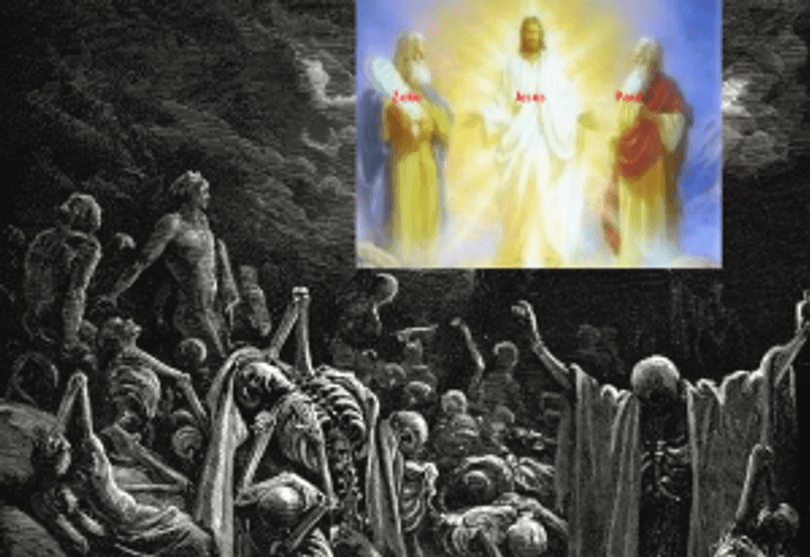
What if the Transfiguration occurred in Ezekiel’s vision and the past, present, and future were prophesying to the breath at the same time?

Paul was told to prophesy to those like him about what “we know” (Greek “oidamen”). This was relative to faith as belief based on personal experience. Paul could make that statement in the plural number because he had witnessed others who had transformed from dried bones in new bodies of flesh, from mortals plodding along like zombies towards certain death to Saints filled with the light of truth and assured eternal life.

For those who know Paul’s story, he was named Saul before he encountered the Spirit of Jesus Christ, was knocked off his mule and blinded for three days. Saul was transformed from Christian-persecuting Pharisee into Saint in the name of Jesus Christ; but that transformation was not a smooth snap of the fingers, presto-change-o, where Jewish Saul became Christian Paul. He went through labor pains, from being born Saul headed towards another dead end, to being reborn as Jesus Christ. To give a name to the new him, he began going by the name Paul.
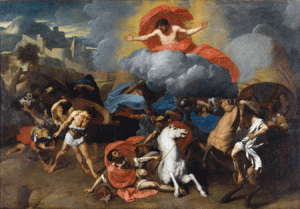
Saul was a creation, who was like all the Apostle-Saints Paul encountered in his travels. They had all been created of matter – bones, sinews, flesh and skin – forming as fetuses in their mother’s wombs, and grown to maturity in a world of evil influences.  The Jews Paul sought were clinging to their Judaism as a way to justify their sins. Saul was one of them, a reflection of their lifeless state.

It has always been a challenge for a soul released into a universe of matter to find its way beyond the veil of deepest, darkest outer space as to the origin that is God. That must be where He lives and watches over us dust mites of His Creation.  The labor pains of finding God, especially for souls locked inside zombie bodies, comes from straining and groaning to reach the highest, widest, deepest outer edges … to where brains think God must be ….

When God has always been within.

For Saints like Paul and his fellow Roman Christian Jews, the receipt of the breath of the Holy Spirit did nothing to ease their pains. To those first fruits of the Spirit, their souls still resided in temporal bodies and they faced the same struggles Ezekiel and Jesus faced – prophesying to dried bones standing before them like zombies.

The first fruits are the earliest harvest of grains, which are then measured by a weight called an “omer.”  As a symbolic gesture, those early grains and fruits were gathered and placed in the Temple on the second day of the Passover Festival. The first fruits were then allowed to become ripe and matured, which began a daily count to when those fruits would be worthy to eat. They were ripe and ready on the Fiftieth Day – Pentecost.

All the Apostles serving the Father in the name of Jesus Christ had “groan inwardly” waiting for their “adoption” as true Christians, just as do everyone who seeks the same gift of eternal life. The redemption of their bodies meant, like first fruits that appear ready for harvest, their egos had to be removed.

In the zombie analogy, the walking dead or the living dead can only truly die when their brains are blown to bits.  I imagine the “death” of a zombie would symbolize eternal damnation, where the soul can no longer find anything earthly to call “home.”  Still, the zombie analogy says the living dead live because of a brain and not because of a soul.  Thus, the first fruits represent the initial receipt of the Spirit of Christ, so the soul begins to retake control over what was a lost cause before.  Life for a zombie consists of destroying life in others; but dried bones without a brain – sacrificed for the Holy Spirit – have life to offer others.

Just as Jesus breathed on his disciples, giving them the first fruits of the Salvation harvest, they needed to be aged to perfection.  The disciples and followers of Jesus would then begin a forty-day test of one’s true readiness to have eternal life.  That education was mandatory and had to be passed. Therefore, the “groan inwardly” is one’s time spent in the Wilderness, where brains cannot find water and food; only angels can keep the body of flesh thriving on heavenly manna and living waters.

When Paul wrote to his brothers in Christ, he stated, “For in hope we were saved.” The Greek word “elpidi” is translated as “hope,” but the word equally means, “expectation, trust, and confidence.” This means an Apostle knows that salvation has come, when one has met the test for “redemption of the body,” because of an inner presence that instills deep trust and confidence in the Holy Spirit, with an expectation of eternal life.

The Apostles were saved as examples of hope that others could sense and feel.  The presence of “hope,” as most mortals know the meaning, is the thrill and excitement that is brought on in anticipation of good things coming.  The righteousness of hope comes by a willingness to serve the LORD, no matter what the earthly consequences might be.

When Paul made the statement and then questioned, “Now hope that is seen is not hope. For who hopes for what is seen?” this is the “hope” that comes from others. When in danger, we are trained to respond – “Call 9-1-1!”  We look for rescue to come to us, in the form of flesh and blood heroes.

Human beings routinely place their hope, expectations, trust and confidence in leaders. The Israelites went to Samuel pleading for a king to lead them, like those who led others nations. They wanted to see a king as holy, rather than take the responsibility of being holy themselves. Individually, one offers little value as hope for others, when one sees oneself, and others see one as well, as an ordinary human being that is lowly and insignificant.  We equate the power of worldly influence as the rays of hope to bow down before.  We look for that which can be seen … not God.

That error is what makes people be born to death, as walking brains on top of dried bones and rotting sinews, flesh and skin.

For the majority of people today who profess belief in Jesus of Nazareth as the Messiah promised by God to the Jews, and said to be “our Christ,” the error comes from placing the body of a dead man on a wooden instrument of death. We look for the “second coming of Christ” as though that is eons down the road of linear time. The error is in making an idol of Jesus to pray to externally, such that the hopes, expectations, trusts and confidence is that Jesus Christ will come down from heaven like a Greek hero and slay evil with his double-edged sword and rapture all Christians up to heaven. All of that “hope” calls for no one talking self-responsibility, no self-sacrifice is necessary, no groaning inwardly has to be experienced, and no fruits need be grown that will be in the name of Jesus Christ.

Paul said, “But if we hope for what we do not see, we wait for it with patience.” We cannot see God, but God wants our hearts to open for Him. God wants dried bones with new sinews, flesh and skin to love Him enough to be wedded to Him. God wants our souls to be in Holy Matrimony with His love.

We cannot see the Holy Spirit, but God wants to wrap His wives in that protective covering. We cannot see the child growing within us that brings the labor pain as we are reborn as the Son of God, Jesus Christ [regardless of one’s human gender]. No one can see the hope of Jesus Christ in us, as we still look like Saul did, before he took the name Paul. No one can see the hope an Apostles breathes upon dried bones, zombie-brained people.

That is why patience is required.

In that period of patience, weakness will come. Once a bag of dried bones, then always a bag of dried bones. It is why priests say at funerals, “Ashes to ashes, dust to dust.” Forget the possessions (land, money, jewelry, etc., etc.), you can’t take your bag of bones with you.  Believe me, the Egyptians tried and we have the dried bones of mummies to prove that.  That means evil influences will pull on dried bones, just as gravity will always make what goes up always come down.

Patience means not over-reacting to that which is normal.  Patience means not becoming disoriented.  Patience means remaining centered in the Holy Spirit.

So, with hope, trust, confidence, and expectations being based on the unseen, influences of evil will always drift by. When you pray to an external God and kneel before a Jesus hanging on a cross on a wall, you find those worldly temptations always wrapping their tentacles around you, choking the mortal life from you. That is why it is so important to receive the breath of prophecy and know the true meaning of faith.

True faith is knowing nothing that comes from a small human brain can bring anything that lasts forever. It is the Holy Spirit that maintains one’s path to eternal life, swatting away the lures of Satan. When you are Jesus Christ reborn, another in the line of Sons of God, you tell Satan to go where the sun don’t shine.

And, he has to obey that command, when he knows it was spoken with confidence.

So much influence of the world, while living in a worldly domain, means fear of failure to withstand it all. As Christians, we believe in the power of prayer. Prayer is indeed a powerful ally.  Reciting serial prayers helps place our hearts in a centered state of reception.  The problem, as stated by Paul, is “we do not know how to pray as we ought.”

The disciples of Jesus raised this issue when they asked Jesus to teach them to pray. From the point that “The Lord’s Prayer” was written on paper and published in books called Holy Bibles, zombies have been repeating the same words without understanding what righteousness was the intent behind those words. It reminds me of the movie Monty Python and the Holy Grail, and the scene at the rope bridge over the great abyss.

There each knight had to answer three questions to get across. Repeating the answers someone else gave did not work out too well.  That is like reading a prayer from a book of prayers for all occasions, when sometimes it is best just to wing it and speak from the heart.

When God is in one’s heart, when the Christ Mind overrides an imperfect brain, and when the soul has been baptized by the Holy Spirit that means prayer is faster that a thought can be verbalized. It is known before a human brain could ever know what to ask for. This is what Paul meant by saying, “God, who searches the heart, knows what is the mind of the Spirit, because the Spirit intercedes for the saints according to the will of God.”

This is how God could ask Ezekiel, “Mortal, can these dried bones live?” and Ezekiel could only answer, “O LORD God, you know.”

If a Saint cannot answer a question posed by God, how can a Saint propose to ask God a question in prayer, without God already knowing the question?

Too often, our prayers are scripted. Too often our prayers are for personal wants and desires. Too often our prayers are public, rather than private and personal. And, too often we visualize what our brain thinks we want to come as an answer to a prayer, ignoring any possibility that the answer has been there before we prayed.

As a too often overlooked reading choice for a Pentecost Sunday service, it should be easy to see now how Paul is an equal to Ezekiel, as both were Saints in service to God. The symbolism of Pentecost is the maturation of the first fruits, where zombies are transformed into righteous examples of the way to be. Saints act like the twelve who were filled with the Holy Spirit, leading others to immediately cease being bags of dried bones in warm flesh and become alive with the Holy Spirit also.

Paul called it as it is, when he wrote to those like him who knew what it was like to be Saints. He wrote, “The Spirit intercedes for the saints according to the will of God,” and Paul and friends were Saints.

The call each week is not to be good, because no one really knows what that means. The call is to stop holding God and Christ at arm’s length, trying to keep you one of the living dead.  The answer is not and can never be endless begging for forgiveness [misuse of prayer] because the brain’s will power slipped yet again. The call is to actually be a Saint – “hagios” in Greek – which means, “set apart by (or for) God, holy, sacred.”

No one is good enough to be that without God’s help.  God knows we need help before we do.

The call then is to open your mouth and breathe in ….  Receive the Spirit.

#zombiesofdriedbones #Pentecostreadings #Faith #Patience #FirstFruits #Saints #Romans82227 #Hope
2 Corinthians 8:7-15 – Eagerness to serve God

As you excel in everything– in faith, in speech, in knowledge, in utmost eagerness, and in our love for you– so we want you to excel also in this generous undertaking.

I do not say this as a command, but I am testing the genuineness of your love against the earnestness of others. For you know the generous act of our Lord Jesus Christ, that though he was rich, yet for your sakes he became poor, so that by his poverty you might become rich. And in this matter I am giving my advice: it is appropriate for you who began last year not only to do something but even to desire to do something– now finish doing it, so that your eagerness may be matched by completing it according to your means. For if the eagerness is there, the gift is acceptable according to what one has– not according to what one does not have. I do not mean that there should be relief for others and pressure on you, but it is a question of a fair balance between your present abundance and their need, so that their abundance may be for your need, in order that there may be a fair balance. As it is written,

“The one who had much did not have too much,
and the one who had little did not have too little.”

——————————————————————————–

This is the Epistle selection from the Episcopal Lectionary for the Sixth Sunday after Pentecost, Year B 2018. In the numbering system that lists each Sunday in an ordinal fashion, this Sunday is referred to as Proper 8. This will next be read aloud in church by a reader on Sunday, July 1, 2018. It is important because Paul delves into the benefits of having received the Holy Spirit and become one with Jesus Christ.

In verse 7, the Greek word translated as “you excel” is “perisseuete.” The root verb, “perisseuó,” more readily states, “I exceed the ordinary (the necessary), abound, overflow; am left over,” which makes “excel” an acceptable substitute. However, “excel” can be read as a form of personal achievement, brought about by natural talents and a devotion to perfect one’s mastering of some desired action; but this personal achievement cannot be read into this word penned by Paul.

To read the intent as Paul stating to the Christians of Corinth as him stating, “You exceed the ordinary in everything,” the explanation is then the gifts that have been allowed them all by God. The level of “excellence” Paul knew the Corinthians displayed was the same as that coming from the talents that God gives to all His Apostles. Therefore, he could list them specifically as 1.) Faith; 2.) Speech; 3.) Knowledge; and 4.) Eagerness (as far as this translation allows one to see).

In the Greek written, the end of this list states, “and in the (ones)  from us to you  love  that also  in this the grace  you should abound.” The presence of marks of pause and reflection (commas) then makes it possible to add to the list: 5.) A brotherhood of Saints; 6.) God’s love; and 7.) The gift of the presence of Jesus Christ.

The Greek word written, “chariti” (like “charity”), means “grace, favor, kindness,” where its use in the New Testament implied such “grace” “as a gift or blessing brought to man by Jesus Christ, (b) favor, (c) gratitude, thanks, (d) a favor, kindness.” It is this “grace” or “favor” that binds one Apostle to all Apostles in the brotherhood of Jesus Christ, where all Apostles (males and females He made them) are reborn Sons of God. The unity that binds is God’slove, and this union is not from practice, desire, or aptitude that is achieved through personal will, as it is only possible as a gift of God. This list of Paul is, therefore, the rewards of one’s soul being married to God through the cleansing of the Holy Spirit, all of which is gained after the dowry of marriage has been paid in full –the sacrifice of one’s self will in obedience and submission to God’s Will.

The next verse does not state that Paul was “testing the genuineness of your love against the eagerness of others,” but instead Paul wrote from afar, with the personal experience of a true Christian. This means he admitted he was not commanding anything of the Corinthians, but simply stating some facts that become apparent through the Mind of Christ. This Mind knew the “eagerness” of all Apostles to please God.  As such, Paul was stating how he knew this love of God within the Christians of Corinth would prove itself as genuine, through their acceptance of new disciples, just as Paul had accepted them. Less than a “testing” by Paul, the presence of Jesus Christ within the Corinthians would be “proving the genuineness of their love” to others.

Paul then stated, “You know indeed the grace of the Lord of us Jesus Christ,” which stated the Christians of Corinth, just like the Christian Paul and his Apostle companions, knew the presence of Jesus Christ was one with their beings, due to “the grace” (“charin”) Jesus Christ brought them as their personal “Lord.” That presence is sent upon all of God’s lovers in marriage, because God will accept no less than perfection in His brides (males and females He marries His brides). That presence of Jesus Christ as the Lord of an Apostle is “for the sake of them,” due to their human actions of devotion and commitment to God.

When we read the translation above that says, “That though [Jesus Christ] was rich, yet for your sakes he became poor,” the meaning is an Apostle, as a human being, is impoverished by sin. To cleanse a soul of sin, one must sacrifice the self-ego, which then leaves a human body with only a soul. The riches of the world have been turned aside, placing one into a vow of poverty. This is the dowry a human being must make in order to accept the proposal of marriage with God. Therefore, when one has become poor, then Jesus Christ comes from the richness of Heaven, entering the soul of the cleansed.

When Paul then finished this thought by writing, “so that by [Jesus Christ’s] poverty you might become rich,” this says that the coming of Jesus Christ within one’s being is so one can “become rich.” These riches are not measured in material means, but in Spiritual gifts: faith, speech, knowledge, eagerness, brotherhood, love, and the presence of Jesus Christ as one’s identity.

Still, Paul added his advice to the Corinthians, about this presence of Jesus Christ within, and how their vows of poverty could be “profitable for you” (“hymin sympherei”). The translation above – “for you who began last year not only to do something but even to desire to do something” – misses the point Paul made about “thelein,” which is a direct statement about the sacrifice made a year ago, which was that of personal “will, wish, desire, intend, and design.” Instead of Paul referencing the Corinthians’ “desire to do something,” as if he made a suggestion to rekindle their personal egos, but he instead advised they “now finish doing it.” The Greek word written, “epitelesate,” means Paul recommended the Corinthians “complete, accomplish, and/or perfect” their submission to God’s Will.

Paul then explained this “completion” by writing, “so even as there was readiness to the will [of God to submit to], so also the [readiness] to complete.” He then continued by saying, “if indeed the readiness is present, as if he might have acceptable, not as not he does not have.” The translation above says this as, “For if the eagerness is there, the gift is acceptable according to what one has– not according to what one does not have.” The meaning is to submit completely to the Will of God, without question and without any personal desire for more gifts of God, seemingly brought on by the eagerness to serve God, but in reality as a personal quest to be ranking higher among the men of God. A total commitment does not keep up with what other talents other Apostles possess. A total commitment to God releases all personal desires and accepts what God allows.

The translation above that states, “I do not mean that there should be relief for others and pressure on you,” the focus is on one feeling pains by not being able to help another, due to the limitations of God’s gifts bestowed. An Apostle is still feeling personal ego pains when they feel such pressure to perform as self, rather than as Jesus Christ reborn. The literal statement coming from the Greek words written by Paul say, “not indeed to others ease, but for you affliction; but of equality,” where “isotētos” means, “equality, equality of treatment, and fairness.” One still bearing the weight of self-ego is equal to the one who has yet to sacrifice his or hers, such that one is attracted to another for the purpose of seeing one’s shortcomings before God, more than being able to see one’s self as God on earth.

This makes the advice of Paul to the Corinthians to be a recommendation to further their commitment to God, rather than as a way to see the inequalities among the Apostles as a measurement of one’s piety before God. One must thank God for all His generosities and see His equal treatment of all His wives (males and females He takes human wives). Anything less than seeing this means more self-sacrifice is required.

This is the purpose behind Paul writing, as translated above, “it is a question of a fair balance between your present abundance and their need, so that their abundance may be for your need, in order that there may be a fair balance.” This is then based on “the present time” (“en tō nyn”) of the epistle’s writing, which is always the “time” of relevance, where one’s personal “abundance” from God, to meet the needs of others, is always relative to the needs of others being to a reflection of one’s own needs, where the equality exposed is in how one retains the sins of the world, rather than release them through completion of sacrifice.

The issue of equality is then found in Paul quoting from Exodus 16:18, stating, “The one who had much did not have too much, and the one who had little did not have too little.” This is relative to the gathering of manna that was sent by God and the instructions given to the Israelites by Moses. This quote by Paul is then reference to the surrounding story in Exodus 16, where we read:

———————————————————————–

“Moses said to them, “It is the bread the Lord has given you to eat. This is what the Lord has commanded: ‘Everyone is to gather as much as they need. Take an omer for each person you have in your tent.’”

The Israelites did as they were told; some gathered much, some little. And when they measured it by the omer, the one who gathered much did not have too much, and the one who gathered little did not have too little. Everyone had gathered just as much as they needed.

Then Moses said to them, “No one is to keep any of it until morning.”

However, some of them paid no attention to Moses; they kept part of it until morning, but it was full of maggots and began to smell. So Moses was angry with them.”  (Exodus 16:15b-20)

———————————————————————-

This then becomes applicable to the talents and gifts of the Holy Spirit, as sent to God’s wives just as God sent manna to the Israelites.

Paul was recommending that the Apostles in Corinth see the value of being given the food of Jesus Christ, which is sent to be gathered in portions and measurements that equate to those who will be fed by it. All that comes through the Holy Spirit is to be used. None can be wasted. The only waste is found in those who still retain self-ego and seek more than needed.

As an epistle selection for the sixth Sunday after Pentecost, when one’s personal ministry for God should be underway, this tells one the talents one should already possess: faith that peaks from personal experience in Jesus Christ; the ability to speak in tongues and explain Scripture; the knowledge that comes from the Christ Mind; the eagerness to serve God as Jesus Christ; the need for a brotherhood of Saints in a true Church of Christ; the love of God that confesses one’s soul has been married to God via the Holy Spirit; and the grace of having become Jesus Christ reborn from above. Those characteristics define all ministers of God, which deems them Apostles and Saints.

Still, this message tells all who have submitted to the Will of God not to retain even the slightest sense of self-worth, as all value one has comes from God. It is not up to oneself to determine what one needs, in order to serve others. One serves God, not others; so God will send you what you need and no more. This means a new minister for God still needs to search one’s soul for how one can give more to serve God.

In a ministry for the LORD, one will attract those who one should feed. The nourishment God gives is the Word of Jesus Christ. The Scriptures then act as the body of Christ and is the manna from Heaven. One gathers what is needed daily, with the day before the Sabbath being the only time more than one’s day’s food is necessary to gather. A minister to the LORD feeds those sent to him or her the meaning of God’s Word, until they are matured and can gather their own manna from Heaven.

A minister sees equality in the sins of the world, not in the talents of the Holy Spirit. This means one cannot pass judgment on sinners, as one is also a sinner without being married to God. Therefore, all who profess to point out sinners in the name of Jesus Christ are those who have gathered too much, with their words full of maggot and stinking to high hell.

A minister for the LORD sees the sins of the world reflected upon his or herself.  That sin is not to be condemned or one condemns one’s marriage to God and the rebirth of Jesus Christ.  One forgives the sins of others by repentance before God and Christ.  This makes ministry for the LORD the service of caring for other Apostles, so they do not mistakenly judge others wrongly.

Luke 17:5-10 – Having faith the size of a mustard seed means servitude to the Lord

The apostles said to the Lord, “Increase our faith!” The Lord replied, “If you had faith the size of a mustard seed, you could say to this mulberry tree, `Be uprooted and planted in the sea,’ and it would obey you.

“Who among you would say to your slave who has just come in from plowing or tending sheep in the field, `Come here at once and take your place at the table’? Would you not rather say to him, `Prepare supper for me, put on your apron and serve me while I eat and drink; later you may eat and drink’? Do you thank the slave for doing what was commanded? So you also, when you have done all that you were ordered to do, say, `We are worthless slaves; we have done only what we ought to have done!'”

——————–

In verse five, it is worthwhile to realize that in verse one Luke wrote (literal English translation), “He Said then to the disciples of him”. In that verse, the Greek word “Eipen” is capitalized, meaning (in the third-person) “he Commanded,” “he Brought Word,” of (simplified) “he Said,” where the capitalization elevated that word to a divine level of meaning, equating to the level of Yahweh, where Jesus “Commanded” Spiritually as a Master of Lord over his “students, disciples, learners. In verse five the verse begins with a capitalized “Kai,” which denotes importance to follow, which leads to the lower-case spelling of “eipan,” which bears the same translation as the word “Eipen,” but without the divine elevation in meaning. Then, that “importantly said” is to “those apostles” (“hoi apostoloi”), which is a word stating the “messengers” of Yahweh. This difference must be realized as a focus set upon only those who would carry the message of Jesus to the world (in his name), which did not include the “disciple” by the name of Judas Iscariot.

In verse five, the prior verses have Jesus warning his disciples that the stumbling blocks of life that cause a soul-flesh to sin are as bad as tying a millstone around one’s neck and jumping in the sea. That would most certainly cause death, which means the divine message being taught to his disciples was to not stumble, because stumbling meant walking a path that is unknown and dangerous. That path is wayward and the stumbling blocks are the influences of Satan to sin. To not stumble and fall (a death sentence for one soul, meaning reincarnation to try again with more dangers in one’s new path) means to be unmarried to Yahweh (He is not one’s Father then) and not possessed by the soul of His Son – Adam-Jesus.

This distinction made between disciples and “apostles” has to be seen in the capitalized word “Kyriō,” which is the dative singular noun that says, “to Lord” or “to Master.” Adding in the dative singular article “,” we find the “apostles” have become directed “to this to Lord.” That means the disciples were learning to get “to this” state of divine union, but the “apostles” had indeed come ‘to this,” where the soul of Jesus had joined with their souls, “to Lord” and “to Master” over them. The difference between a physical “lord” and a spiritual “Lord” is divine possession, coming first from a soul marrying Yahweh and being “Anointed” (be a “Christ”) by His Spirit. At that point of Baptismal cleansing of all past sins, then a soul transforms into a “messenger” of Yahweh, as His Son resurrected within new flesh. That means a soul-body has received a “Lord” to guide them as “messengers,” from having joined divinely with each of those wife-souls.

From this setup, we then hear the “apostles” demanding of their soul-flesh’s “Lord” or “Master” that Jesus was then, “Add to our souls faith !” The capitalized second-person singular Greek word “Prosthes” means “you to put to, add,” implying in usage “you place to” or “you do again,” is elevated to a divine level of meaning that equates with Yahweh. Thus, the “apostles” (“messengers”) were commanding Jesus to “Add” his soul to theirs, which is a demand for his divine possession of their soul-flesh. When the alternate meaning is read as, “you Do Again,” this is a divine statement of multiplicity that comes from a spiritual possession. One’s soul (of the “apostles”) is then joined with the soul of Jesus (“Added” to their souls), which IS the truth of his soul becoming the “Lord” over each of their souls. Jesus’ soul is no longer the “Master” of disciples, as the disciples have transformed spiritually to be the “messengers” of Yahweh. To carry His ”messages” to the world, each of their souls needs the soul of Jesus “Added” to theirs. Because verse five begins with a capitalized “Kai,” this demand is most important to those souls in bodies of flesh that are divine “messengers” of Yahweh; and, it is a necessary command that comes from Yahweh speaking through them.

In this command, the dative plural possessive pronoun “hēmin” is written, which typically translates as “to us.” This can equally translate as “to ourselves,” with the ‘selves” part of that pronoun restates as “soul,” as “our souls.” This transformation of a simple possessive pronoun makes this divine text of Luke be stating that the “souls” of the disciples is what changed, making them become “apostles,” or “messengers” of Yahweh. This is important to grasp, when the command ends with the word “pistin,” meaning the demand was to “Add” within “their souls faith” or “faithfulness.” This must then be seen as an admission of the souls in flesh that were disciples possessed no “faith,” although they were strong ‘believers’ in Jesus and Yahweh, as taught to them in their Jewish upbringing. However, to become the “messengers” of Yahweh, they knew the soul of Jesus within their souls (as “the Lord of their souls”) needed to instill within them “faith.” To understand this short reading, this spiritual growth and development of disciples into “apostles” needs to be seen as incomplete without the soul of Jesus as each “apostle’s Lord in their soul-flesh” becoming the source of the “faith” they never had possessed before.

In verse six, Luke began with a capitalized “Eipen,” which matches the spelling used to begin verse one. The same implication applies here, as this spelling stated a divinely elevated statement is coming; and, that divinity comes from Yahweh (through the Son), as a spiritual “Speaking” to souls, not human ears. This then leads to Luke adding, “now this Lord,” which says the inner voice of Yahweh is His Son’s soul having merged with the souls of “apostles” (not disciples). This is why Jesus said he did not speak for himself, but for the Father. This further explains that “this Lord” is not Jesus the man speaking to his followers, but a soul of Adam – the only Son of Yahweh, made by His hand – which is also the soul of Jesus. This says Jesus was also a soul born into a body of flesh, who was born with the soul of Adam already merged with his soul, whereas the disciples would know sin before they could become learners, led to become “messengers.” Only once in this entire chapter of Luke’s Gospel is the name “Jesus” written (when he healed ten lepers); so, the “Lord” over the soul of Jesus was the same spirit sent by Yahweh to join with his soul, as well as other – at the same time (that is well within the capabilities of Yahweh).

This then led the “Lord” within their souls to say, “If,” where the Greek word “Ei” is capitalized, thus raised to a divine level of meaning, equating with Yahweh. The word translates ordinarily as “forasmuch as, if, that,” mostly implying “if,” which becomes a divine scenario being stated about the souls of the disciples transformed into “apostles.” The big “IF” states that not all souls will be willing to submit totally to Yahweh in divine union, thereby becoming a souls resurrected with the soul of His Son, being reborn as Jesus in the flesh. This would explain to the souls of the “apostles” the reason why Judas Iscariot is still only a disciple. Still, the positive direction “If” takes is it identifies the power of “faith” that does come to “apostles, “ “If” they are to be the “messengers” of Yahweh.

When the “Lord” then “Said,” “your souls possess faith even as a seed of mustard,” this speaks of spiritual “possession,” not physical size as measured in such small things as “mustard seeds.” The Greek word “echete” is the second-person plural form of “echó,” meaning “to have, hold, possess.” The second-person is ordinarily implying “you,” but the plural number transforms this to “yourselves,” or “your souls.” This is important to grasp, as the “apostles” and the “Lord” are not physical entities (like are disciples and their Master), but spiritual, as the souls within their beings. The “possession” is then a spiritual “possession” by Yahweh, which is then compounded when the soul of His Son possesses a soul-body as its “Lord.” This makes the words “even as” state metaphor is the essence of “a seed of mustard.” This says a disciple (or any ordinary soul-body not married to Yahweh) does not possess even one iota of true “faith.” True “faith” can only come from Yahweh.

When this bif “If” is stated as the proof of one’s “faith,” the next series of words must then be seen as using more metaphor. It begins (following a comma mark of separation) with the second-person plural imperfect word “elegete,” meaning “your souls would have commanded.” This word is similar to “eipan,” used earlier in verse five, when the “commanded these apostles to this to Lord.” This now says, “instead of commanding the Lord to Add faith to your souls,” then “your souls would have commanded your soul to be to this to mulberry tree.” This demands one understand the symbolic meaning of a “mulberry tree.”

According to the website The Classroom, writer Samantha Belyeu wrote of the “Mulberry Tree Symbolism”:

“It has been the sign of nature, faith, growth and for some death. … Mulberries do not bud until all danger of frost is past, and so they symbolize calculated patience. When they do produce buds, it happens so quickly that it seems to occur overnight, displaying and thus symbolizing expediency and wisdom. For all these attributes, the ancient Greeks dedicated the plant to the goddess of wisdom, Athena (a.k.a. the Roman goddess Minerva).”

From this, it must be realized that the disciples had transformed into “apostles,” where their “last frost” of sin had passed. Their “calculated patience” was their time spent in the ‘School of Jesus,’ learning from his teachings. The “possession of one see of mustard worth of faith” is then the rapid transformation (“overnight” to a new dawning of light), where “wisdom” was now the result of them each “possessing faith.” This “faith” does not come from a goddess (as did Solomon’s trust in human wisdom), but from Yahweh, as governed by the “Lord” over each of their souls – Adam-Jesus. Therefore, the metaphor of “a mulberry tree” says “If you are a mulberry tree,” then your souls do not command the “Lord” to give “your souls faith,” as all souls married to Yahweh “possess faith” as each being “one seed” – “one iota” – of His Spiritual presence. A “messenger” of Yahweh does not “command this Lord” to do anything, as “this Lord commands” their soul-bodies to go into ministry.

Following a comma mark of separation, the “Lord” then “Commanded the apostles” “your soul must be uprooted,” which is a statement that sedentary lifestyles are a ting of the past. Here, again, the second-person singular must be converted to say “your soul,” rather than just “you” (a physical being). After Luke wrote the word “kai,” which denotes importance to follow, the importance of “being uprooted” is so “your soul must be planted.” This metaphor is relative to the theme of plants, such as a “mulberry tree,” but the symbolism is for “your soul to be set,” where the act of planting and setting is done by the ‘Gardener,’ which is Adam, who tended the Garden of Eden for Yahweh. When the place of this “planting” or “setting” is then seen as “the sea,” this too is metaphor, in the same way David wrote in his Psalms, where “the sea” is metaphor for the “sea” of souls that are lost in the physical world, in need of being led to the light of truth and a burning desire to marry Yahweh and receive His Son within. Thus, Luke had “the Lord” say “your soul must be planted within the sea,” where the Greek word “en” means a ministry that touches the hearts, minds, and souls of others (the part of us all that is “within”).

Following another comma mark of separation, Luke wrote another “kai,” which denotes more importance to follow. In this, “the Lord,” who was earlier “commanded” to “Add faith to their souls,” replied that “If their souls had one iota of faith [from Yahweh], then they would have instead “commanded their souls to enter ministry,” full of “faith.” Thus, their “uprooting” of their souls, so they could enter “within the sea” of lost souls seeking salvation, then (importantly) would have been a “command (that) would have been heard” by Yahweh. There would be no ‘obedience’ coming into play, beyond the obedience a wife-soul swears to Yahweh at the marriage altar. But, a wife-soul asking Yahweh, “send me to do your work among humanity” will find that request (prayer) “answered.”

It is very important to see this view of the reading selection, as verses five and six are the focal point of what Luke wrote next, in verses seven through ten. Everything hangs upon the exchanges that are “commands,” where the “apostles commanded to this to Lord,” which is the servant telling the “Master” what to do. The “Lord” then proposed the “If” scenario, which states a “Command” that would be listened to by Yahweh. The remaining verse then become an example of what was stated in verses five and six.

Verse seven begins with a capitalized “Tis,” which is an indefinite pronoun of the masculine singular. In the Greek of the New Testament, the masculine gender should be read as applying to souls, spirits, angels, and all that is of the spiritual realm. The feminine, likewise, denotes a human soul trapped in a body of flesh, as it is of the worldly realm. The word “tis” ordinarily asks a question, relative to “who, which, what, or why.” The capitalization here elevates the meaning to a level of Yahweh, so “Who?” becomes a confirmation word for the “If” who “have faith one seed of mustard.” Thus, verse seven begins by the “Lord” asking, “Who now from out of of your souls a servant possessing”. This question, like the “If” scenario, is asking those “apostles,” “Who of your souls now has come out from your soul-flesh as its self-master, becoming instead a servant of the Lord who possesses your souls?” The answer is all “apostles” are servants of Yahweh, led by the soul of His Son as their Lord.

Following a comma mark of separation, the Lord then gave examples of this servitude, saying “plowing or shepherding”. This is not to be taken as some ordinary jobs held by the disciples, or by the lowest of Jewish culture, where “a servant” or “slave” is sent to do menial tasks, such as working in the fields producing food or grazing sheep which are used for clothing and occasionally meat. The metaphor of these tasks is then relative to “a mulberry tree uprooted and planted in the sea” of lost souls that seek salvation. The act of “plowing” is then the hard work that loosens the earth (flesh), so it will be prepared to receive the “seeds of faith.” The job of “shepherding” is then the work involved in herding those souls that have been saved into Yahweh’s sheepfold, while seeking those who have become lost, so they will be found and returned to the fold. Both positions are necessary for “apostles” and this related to the “If you would have commanded” self-ministry (an act of faith), they Yahweh would have “listened” and responded favorably.

After these symbolic comparisons to the service provided by the “apostles,” “the Lord” then stated, “who to having entered from out of of this of field,” which says the souls of the “apostles” had “come in to this” service, “from out of this field,” which is a comparative metaphor for the “sea.” While “plowing or shepherding” are tasks done in the “fields” in a physical sense of the world, the spiritual element of souls had the “fields” be relative to the spiritual realm. Thus, the “Lord” said their transformation form disciple to “apostle” was a willing decision that each soul had made, regardless of what their social status had been prior, each soul left their ”field” of work and service to “enter into this field” of service to Yahweh, which included metaphorically “plowing or shepherding.”

Following another comma mark of separation, Luke shows “the Lord” telling the “apostles, “ “he will command to his soul,” with the Greek word “erei” being a third-person future word that continues the theme of “commands.” When the masculine singular possessive pronoun “autō” is seen not as the soul of the “apostle,” but the soul of Jesus – “the Lord” – who “will command to his souls” possessed. This needs to be firmly grasped, as to see the ‘poor, tired soul coming in from a hard day of “plowing or shepherding” and making demands’ is not the direction this reading selection is going.

With this understood, these two word are separated by a comma mark, leading the “Lord” to ask the souls he possesses, “Eutheōs parelthōn , anapese ?” The NRSV translation above has these three words shown as a question that asks, “Come here at once and take your place at the table?” which is confusing. The capitalized word “Eutheōs” is divinely elevated to a level of Yahweh that says, “At Once, Directly, Soon, Immediately.” When any of those are seen connecting to the prior statement that says, “who will command to his souls possessed,” this divine elevation must be seen as how “Recently” the souls of the “apostles” had transformed from disciple to servants of Yahweh. When the word “parelthōn” is then translated properly to “having passed by” or “having come to,” this (especially with the connection to a “pass over” being a spiritual transformation) their only “Soon having passed by,” so their time of service to Yahweh is not long. Thus, the last word of verse seven, the Greek word “aoulind,” is separated by a comma mark to show the true question being, “to fall back,” which is to return to the selfish state of being that keeps souls in flesh from committing to Yahweh through total and complete self-sacrifice to do His Will. This makes the question by “the Lord” to the “apostles” be, “Would you so soon return to being the ruler over your own soul and flesh, because you possess zero faith?”

After posing this question, verse eight begins with “the Lord” stating an exception, where the first segment of words says, “on the other hand not at all will he command his soul , you Prepare what I might have eaten”. Notice that this new ‘sentence’ following a question mark does not begin with a capitalized first word, proving that rule of normal syntax does not apply to divine texts. These two segments of words state “on the contrary” to “falling back” to a state of selfishness (where the Greek word “aoulind” can imply (when dining) a reclining position at a table, which is symbolic of belief (not faith) that one is royalty and is allowed to recline when eating. Certainly, after being a servant to Yahweh and doing the tasks of “plowing or shepherding” all day long, there are no promises made by Yahweh that being His servant comes with a palatial villa near Rome and hired slaves to do one’s bidding after a hard day at the office.

Thus, the way to read this “on the other hand” or the “exception” is to hear “the Lord” (the masculine singular of “eiri,” meaning “will he command”) giving an order to the soul of an “apostle” that is: “you Prepare what I might have eaten”. In that, the capitalized Greek word “Hetoimason” is the second-person singular aorist imperative form of “hetoimazó,” meaning “you make ready” or “you prepare.” As a divinely elevated word that rises to the level of Yahweh, this command from “the Lord” says to the “apostle, “you ready your soul to lead other souls to me, so I can eat their flesh away from controlling their souls and become their Lord also.” The ‘food’ of issue is not physical, as souls need no physical food to live, being eternal spirits. To be assured of eternal life beyond the death of the flesh, a soul must have married Yahweh and become possessed by His Son, who become “the Lord” over that wife-soul and its flesh, ensuring no sins of selfishness ever occur again.

Following a comma mark of separation, Luke then wrote the word “kai,” which denotes importance must be found in the one word that follows, before another comma mark: “perizōsamenos.” This is the masculine singular aorist participle of the word “perizónnumi,” meaning “to gird oneself.” This word can then be seen as implying “the Lord” saying importantly to a soul serving him, “having dressed in readiness,” as the NAS Exhaustive Concordance shows this word’s usage to state. By reading this important statement in this manner, it says the soul “has dressed in readiness” (the capitalized statement leading this verse: “Hetoimason”) by having put on the robes of righteousness provided by Yahweh’s Spirit of Baptism and the presence of His Son as “the Lord” governing one’s soul and flesh. Thus, an ”apostle” is marked by always “having been dressed in readiness” to serve more flesh to Yahweh, as the food of His Son.

Following the comma mark of separation, “the Lord” then tells the soul of the “apostles,” “you minister to my soul until I might eat kai I might drink”. This says the tasks of the “apostles” is “plowing or shepherding,” in the process of bringing souls in the flesh to find a love and devotion to Yahweh and marry Him, becoming where His Son’s soul resurrects and become their Lord. In this process the souls of the lost will do as John had Jesus explain in his sixth chapter, where Jesus was there for his flesh and blood to be eaten and drank. The presence of a “kai” denotes a greater importance coming from the “drinking” aspect, which is metaphor for being filled with the Spirit, preparing for the soul of Adam-Jesus to resurrect and become one with a soul and its flesh. This is the blood of an Anointed (a Christ) flowing through one’s body of flesh, as one with its host soul.

Following a semi-colon mark that denotes a separate statement relative to that just said follows. Here, Luke wrote another “kai,” denoting importance must be found in what “the Lord” said. Those words are: “in company with these your soul will eat kai you will drink your soul”. This becomes a statement that the soul of the “apostles” are each one with the soul of Adam-Jesus, as their “Lord.” This says that where they go to “minister” in his name (or where they go to “wait the table” in preparation of satisfying the needs “the Lord” has), then every time a lost soul is ministered to, in the name of Jesus, it will be “the Lord” eating the body and drinking the blood of a soul being saved, while each soul-body of an “apostle” will be “eating and drinking within their souls” also. This verse then ends with a question mark, which is “the Lord” asking, “Do you not also eat and drink with me?”

In verse nine, the confusion about this example of “faith” is compounded by thinking this is Jesus telling his disciples a parable about a field worker. When it is understood to be an example of “faith” in “apostles,” where “faith” in anything is impossible without direct personal knowledge and experience of that known to be true, the element of “faith” comes immediately once one’s soul-body is possessed by Yahweh in divine marriage and then possessed by the “apostle” being forever transformed by knowing the presence of Yahweh’s Son within one’s being. Thus, verse nine is “the Lord” asking the “apostles” about their having no need to command “Add to our souls faith,” by saying, “not he possesses favor to this to servant (or slave) because he acted these having been arranged ?” This asks, “is not your personal experience of these lost souls having been saved in your presence, in my name, a favor bestowed upon a servant of Yahweh that adds faith to your souls?”

Verse ten begins by “the Lord” saying, “in this way kai your souls,” which is a statement that says all “apostles” comes to be that “in the same way.” This is importantly not a favor of the flesh, but the grace of “faith” upon the soul of each “apostle.” Thus, “the Lord” then added, “whenever you might have acted all these having been arranged to your souls , you each speak because , Servants useless we exist”. These three segments string together to make the point that the “acts of the apostles” done were so “because” lost souls were in need of a saint in the name of “the Lord” to come answer their prayers to Yahweh. Everything spoken in those exchanges were words sent by Yahweh through His Son, into an “apostle’s” body and soul. Even Adam-Jesus is a “Servant” of Yahweh, just like all soul-bodies “the Lord” possesses, so each are in his name. Without being such “Slaves” or “Servants” of Yahweh, all are “useless existences” on earth. This means “useless” is a soul not redeemed and unmarried to Yahweh.

After a semi-colon mark denotes a new, relative statement is to be made, “the Lord” then said, “this we are indebted to do , we have acted .” In this, the “indebtedness” is one’s sins having been erased by the Baptism of Spirit, given as a wedding gift by Yahweh. While a gift of redemption, the repentance of all that has been removed must still be repaid in full. This makes a wife-soul become a “slave” possessed by His Son, who leads the souls of “apostles” into ministry in his name. That word assigned is then the “plowing or shepherding” each is commanded “to do.” To earn eternal salvation means all “apostles” perform the “acts” commanded by “the Lord.”