Tag Archives: Fifteenth Sunday after Pentecost

Proverbs 22:1-2, 8-9, 22-23 – For richer or poorer

A good name is to be chosen rather than great riches,

and favor is better than silver or gold.

The rich and the poor have this in common:

Yahweh is the maker of them all.

Whoever sows injustice will reap calamity,

and the rod of anger will fail.

Those who are generous are blessed,

for they share their bread with the poor.

Do not rob the poor because they are poor,

or crush the afflicted at the gate;

for Yahweh pleads their cause

and despoils of life those who despoil them.

——————–

This is the Track 1 optional Old Testament selection for the fifteenth Sunday after Pentecost [Proper 18], Year B, according to the lectionary for the Episcopal Church. If chosen, it will be paired with Psalm 125, which sings, “The scepter of the wicked shall not hold sway over the land allotted to the just, so that the just shall not put their hands to evil.” This set will be read before the Epistle selection from James, which asks, “What good is it, my brothers and sisters, if you say you have faith but do not have works?” All will accompany the Gospel reading from Mark, where Jesus said, “Let the children be fed first, for it is not fair to take the children’s food and throw it to the dogs.”

I wrote about this in 2018. I stand behind my views then, as they still apply well today. The commentary can be viewed by searching this site. I will not re-interpret these verses; but instead, I will add some additional thoughts about what I see now, which I did not see then.

Reading my posting, I see that I made several references to “Holy Spirit” and “Jesus Christ.” This Ordinary after Pentecost season (and before) I have become more strict in my translations from the Epistles, where those words readily appear. I now see the truth of each being two separate, capitalized words in Greek, meaning each word is vital to grasp separately. First of all, the “Spirit” (some form of “Pneuma”) is the extension of Yahweh into the material plane, when the word is capitalized. There is “spirit,” which is not only a “soul,” but other non-material presences that aid Yahweh’s plan, which makes the physical universe be the playground of eternal “spirits,” where they bring the pretense of life to dead matter.

When the “Spirit” of Yahweh enters into and possesses a soul (a presence that comes from willing commitment and divine marriage), then a soul-flesh entity will act in ways that are “Holy.” In short, it is not the “Spirit” that is “Holy,” but the soul’s flesh acting in ways that please Yahweh, allowed by the soul through divine marriage. The word that translates as “Holy” (Hagios”) means: “sacred (physically, pure, morally blameless or religious, ceremonially, consecrated):–(most) holy (one, thing), saint.” [Bible Tools] Therefore, the same words [“Spirit Holy” or “Pneuma Hagios“] can be read as “Spirit of a Saint.”

As for “Jesus Christ,” reading how often I said that it sounded as if I thought the ‘last name’ of “Jesus” was “Christ.” I no longer use those words together, in the same way I now call what I used to call the “Holy Spirit” the “Spirit of Yahweh.” By understanding “Jesus” and “Christ” are two separate, capitalized words, one can see “Jesus” in the same light as “Spirit.” Because one places focus on that name, one sees how the name means “Yah[weh] Will Save” or “Yah Saves.” I pointed out a similar translation in the article of 2018. However, one must realize the meaning of “Christ” is “Anointed one,” whereas “christo” means “anointed one.” Samuel “anointed” David with physical oil; but it was Yahweh who “Anointed” David with His Spirit, meaning one is physical and one is spiritual. Every Patriarch and Prophet, as well as every Saintly Apostle, is so because of having become an “Anointed one” of Yahweh. The resurrection of the soul of “Jesus,” who was THE Christ, automatically makes the soul-body be transformed into another “Christ.” How ever many souls represent the resurrected “Jesus” is how many “Christs” there are in the world. Therefore, I now see it as wrong to lump two capitalized words of Scripture together, as it gives the wrong impression.

I write this in a commentary about Proverbs 22 because I used those terms in a commentary about this reading in 2018. I wanted to clarify my new views. That does not negate anything I wrote in 2018, as the same essence of “Jesus” and “Spirit” were conveyed, in terms that most people still use, although slightly wrong. Another such wrong use if the written name “Yahweh” being lessened to a translation as “Lord.” While I am sure that the minds of Christians read “Lord” and think “God,” the reality is the Old Testament names the specific God of Israel. The Hebrew letters written are “יְהוָֽה,” which transliterate as “Yah-weh” [the capitalization is not the truth of an alphabet without capital letters, but an honor given to that name]. The problem that I now see in the misuse of “Lord” is anything can be a “lord” over one’s body of flesh. Demon spirits can possess a soul and turn it and its body of flesh into a slave to sin, where such a demonic possession [seen many times in the Gospels and Acts] needs to be cast out. Therefore, to one led by such a “Lord” as Satan, reading the generality of “Lord” can make Scripture seem accepting of such demonic possessions. This means using the proper name, as “Yahweh,” brings a soul closer to the truth that must be known. In the above text, I have restored the name Yahweh, where it was written in two places.

This Proverb is twenty-nine verses long. The Episcopal Church elders (of old) pared this length down to only six of those verses, in three sets of paired verses. This reading, of those specific verses, is only read on this Sunday in the lectionary cycle. In all, Proverbs will only be read eight times in the lectionary cycle, with only six times coming on a set Sunday. To me, this is a statement that the writings of Solomon are not to be leaned heavily on, in order to find one’s faith in Yahweh enhanced. It should be seen that Solomon was not a great priest of Yahweh, because his brain was so large. Still, the truth of Yahweh does shine forth in his writings, even if he was most likely unaware of that presence.

In verse one, it is more likely that Solomon was not writing wisdom about the “good name” of Yahweh. He was probably writing about having been born a prince, whose name he inherited as king. He was of the Davidic lineage and thus more than all the silver and gold that came with any firstborn male, born into a wealthy household of a father of substance and position, Solomon was allowed greater abilities to act, because he became king. By seeing that, verse two’s mention of “Yahweh” says both the “rich and poor” have their social status given to them by Yahweh. More than a statement of praise to the One God of Israel, that acknowledgement should be seen as Solomon saying God made the poor poor and the rich rich, therefore because Solomon was King of Israel, Yahweh had blessed him above all the “common” people.

It is from this first pair of verses that touts Yahweh as the “maker” [from “‘ō·śêh”] that we skip forward to a pair of verses that place focus on “he who sows inequity,” compared with one “who has a generous eye.” The impression given is that the evildoer will be beaten by the “rod” of Yahweh, as the “sorrow” or “shortcoming” [from “’ā·wen”]. Meanwhile, the one with a “giving” disposition will be “blessed” [“yə·ḇō·rāḵ”], such that giving bread to the poor brings a soul redemption. While there is certainly truth to the deeper meaning of these words written, they guide many to think that issuing punishment is only done by the wicked, causing many to idolize the axiom “spare the rod,” where they then think evil deeds can be balanced by good deeds, such as the wealthy giving a small portion of their wealth to others [“alms for the poor”], rather than give their souls completely to Yahweh. Again, in this set of verses, a focus is placed on the rich and the poor, where it appears Yahweh blesses His servants with wealth, so they can rise to govern the people and order the poor be cared for.

In the final pair of verses, the wisdom shared by Solomon says not to “rob” [“tiḡ·zāl”] or “crush” [“tə·ḏak·kê”] the poor, who can then be seen as “afflicted” ones. To the contrary, Solomon says “Yahweh will plead their cause.” This “contention” [from “yā·rîḇ” meaning “strive, contend”] is then projected as a “plundering” [from “qaba”], which says Yahweh is also a “robber,” who steals the souls of the ones who “rob” and “crush” the poor and afflicted. This gives the impression of Yahweh being the one who serves kings like Solomon, who makes the rich the protectors of the poor, by using Yahweh to do their bidding as kings. It projects Yahweh as some knight in service to a human ruler.

The truth that can rise to the top of these words from a large human brain means the “rich and poor” in Solomon’s eyes are reversed in Yahweh’s view. Spiritual wealth comes from souls submitted to Yahweh as His wives [male and female bodies of flesh]. To “rob” one who is materially poor, but spiritually rich, means to take advantage of one who serves Yahweh. It says the “affliction” such a soul-flesh entity has is a refusal to sell its soul for material gains. It is then those who are rich in Spirit that “contend” for “Yahweh,” as His Saints on earth. It is through their presence that those poor in Spirit, yet rich in material wealth, can have their demonically possessed souls be “plundered,” thereby leading them to see the light of truth, after casting out their worldly lusts.

In the years since 2018, I have grown less enjoyment from anything that has to do with Solomon. His wisdom is a reflection of the world’s worship of intelligence, masquerading as divine insight. The reliance on science, when yesterday’s wonders most often become tomorrow’s embarrassments, having to admit a failure of intellect (once again, and again), is worship of a false idol or dead god. I can see how little the lectionary focuses on Solomon; although it is important to see the seeds of evil having been planted into the son, as a necessary reduction of a kingly line for materialistic peoples who were no longer servants of Yahweh by marriage of their souls to His Spirit. One has to comb thoroughly through all the knots of his intellect to find the truth deeply embedded by Yahweh. It is like the work necessary to open an oyster, looking for slimy food, but finding a pearl. It is more work than I enjoy doing, for such little reward.

As an Old Testament possibility for the fifteenth Sunday after Pentecost, when one’s own personal ministry for Yahweh should already be well underway, the lesson here is to see the world through the eyes of the rich and the poor. The common view is like Solomon had, which is to think knowledge (store-bought from some seminary, graduating with a diploma to be a hired hand for some religious organization) makes one the protector of the ignorant, huddled masses. The lesson is to see how poor one is, when all one does is try to figure out how to produce miracles that solve all the world’s problems [in the name of Jesus Christ, presumably]. True Spiritual wealth comes from giving one’s soul to Yahweh out of love and devotion, and Him accepting that soul, knowing it truly submits to His Will. True wisdom comes from getting one’s big brain out of the way and admitting how stupid one is, when one tries to enter ministry with only a brain to guide one. That is the truth of robbing the poor; and, for such actions one’s soul will be self-plundered.


Isaiah 35:4-7a – Leaping like a deer while singing with joy

[4] Say to those who are of a fearful heart,

‘Be strong, do not fear!

Here is elohekem.

He will come with vengeance,

with terrible recompense.

elohim will come and save you.’

[5] Then the eyes of the blind shall be opened,

and the ears of the deaf unstopped;

[6] then the lame shall leap like a deer,

and the tongue of the speechless sing for joy.

For waters shall break forth in the wilderness,

and streams in the desert;

[7a] the burning sand shall become a pool,

and the thirsty ground springs of water;

——————–

This is the Track 2 alternate option for the Old Testament reading for the fifteenth Sunday after Pentecost [Proper 18], Year B, according to the lectionary for the Episcopal Church. If chosen [as a year consistently offering the Track 2 option], it will be paired with Psalm 146, which sings, “Put not your trust in rulers, nor in any child of earth, for there is no help in them. When they breathe their last, they return to earth, and in that day their thoughts perish.” Both will precede the Epistle reading from James, where he wrote, “If a brother or sister is naked and lacks daily food, and one of you says to them, “Go in peace; keep warm and eat your fill,” and yet you do not supply their bodily needs, what is the good of that? So faith by itself, if it has no works, is dead.” All will accompany the Gospel selection from Mark, where Jesus healed a deaf man with a speech impediment, leading to Mark writing, “Then Jesus ordered them to tell no one; but the more he ordered them, the more zealously they proclaimed it. They were astounded beyond measure, saying, “He has done everything well.”

I wrote a commentary about this reading and posted it on my website, back in 2018, the last time this reading came up in the lectionary cycle. At that time, I addressed the two places where forms of “elohim” were written, but translated incorrectly as “God” [in the singular, rather than the plural indicated]. At that time, I was still feeling my way through understanding the insights sent to me about “elohim.” Since then, I have come to a better understanding that means the 2018 writing needs to be slightly tweaked. I stand behind what I wrote three years ago, because my views are still applicable to the words of these verses in Isaiah today. I welcome all to view what I wrote then and compare those words to what I add today. The article can be viewed by searching this site.

The Episcopal Church has chosen not to number the verses, other than list the range of verses in the heading. I have placed the verse numbers in brackets. I will reference the verses by those numbers. The addition of an “a” following the number “7” means the remainder of verse seven is not part of the reading. Therefore, the verse read aloud ends with a semi-colon, not a period mark.

My views on elohim are to see them as souls who have committed to a higher power and become married together, as two in one. The higher power then has complete control over the soul and its flesh. All elohim are the creations of Yahweh, but not all elohim are married to Yahweh’s Spirit. Satan is an eternal angel, which is an elohim of sorts, as a higher power that is able to influence a soul to accept his spirit within. If that happens, then a human being becomes a demonically possessed elohim. The writings of Isaiah here can allude to this danger, which is what I reflected upon in the 2018 commentary. However, in these verses, I now clearly see the call of Isaiah was for one to become a soul married to Yahweh and experience the benefits of that divine marriage and most holy possession.

Not read today is verse two, which says [in part], “They shall see the glory of Yahweh, the majesty of elohenu.” The statement about Yahweh means the elohim forms used subsequently are those who have become the extensions of Yahweh on earth. That can only come from a marriage of their souls (individually) to His Spirit. The form written here, “elohenu” is stating the collective possessive, as “our gods,” but should be seen as the possession of souls by Yahweh, as “us gods of Him.”

This understanding can then be brought forward to verse four, so it literally begins by saying, “say to those fearful-hearted , be strong not do fear ; behold! elohekim vengeance will come”. In that, the Hebrew translated as “fearful-hearted” is “lə·nim·hă·rê-lêḇ,” which more aptly says, “those whose hearts hasten.” The rapid beating of a heart can mean “fear,” but so too does a heart beat fast when one is in love, especially when emotions swell in the young and inexperienced. In such cases, a state of fear can mean feelings experienced, those one has not learned how to deal with. When one realizes the Hebrew word “leb” means “heart,” while also being metaphor for “inner man, mind, and will,” this becomes a love of God, but a fear of what a soul should do next. This can then lead to a true fear of the world, when one does not pursue heartfelt emotions for Yahweh. Therefore, David is singing a recommendation to the young children of Israel to “be strong,” which means enter into a spiritual marriage with the greatest ally possible.

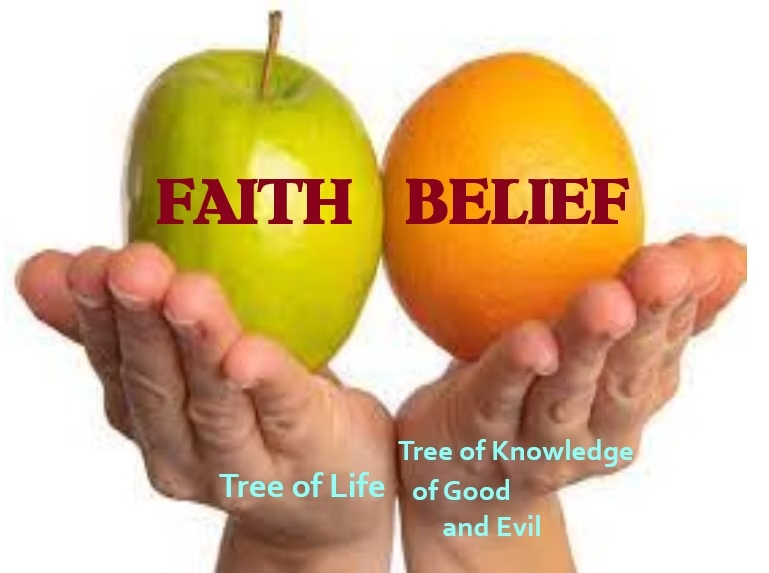
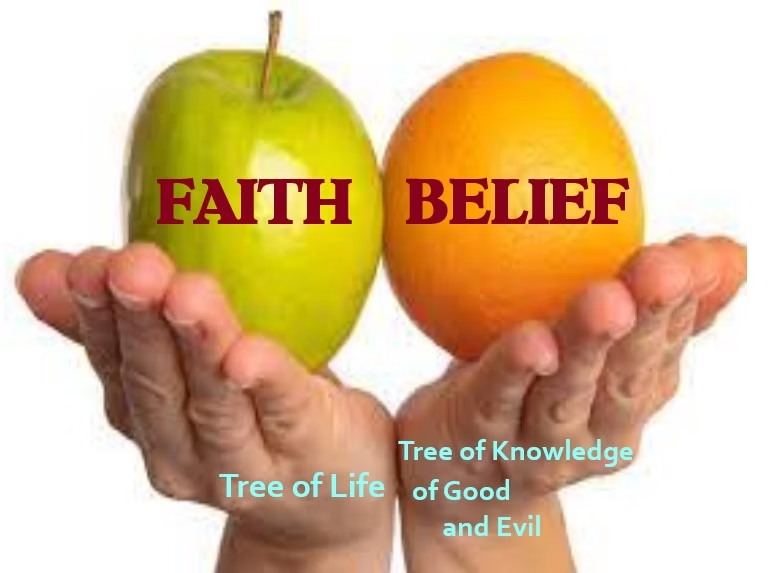
When David then sang out “behold!” (which comes with its own English exclamation point, unwritten in Hebrew), this word must be seen as more than a statement of “seeing.” When it is love of God that is felt by a soul, then there is nothing material to “see” with human eyes. This means the word is a statement of “experience,” which is that step beyond heart-fluttering attraction and the anticipation of what will happen next. In that step, one’s soul becomes embraced by Yahweh’s Spirit, so the young girl’s imaginations of romance [and all human flesh equates to the young girl state of being] are like the definition of “belief,” which immediately rises to a state of “faith,” knowing the wonder, power, grace, and presence of Yahweh. True “faith” is impossible without that Spirit being received within one’s soul.

This then leads to the form of elohim that is “elohekim,” meaning “your gods.” This is the second-person statement of a personal relationship with Yahweh, as one of His elohim; but this relationship is now established as mutually possessive, such that a distant God has become “yours” alone. This is now David stating a divine marriage has bonded his soul with Yahweh forever. While this marriage is one soul’s eternal commitment to become the wife of Yahweh [as the greatest King, He can have an infinite number of wives – human gender not part of a soul, so wives means the souls of male and female humans]. As one of many, a wife becomes addressed as a Yahweh elohim – the gods of Yahweh.

The last word in this string that equates to verse 4a says, “vengeance,” which gives this verse a harsher resonance, to which I gave more attention in my 2018 analysis. The point of “vengeance” in a positive light says the innocence of a soul has been returned by divine marriage with Yahweh. His Spirit will not join with a soul in the flesh, without that soul submitting itself fully and totally to Yahweh’s Will. While I have painted a picture of young love and pure innocence, that can only be attributed to a soul, with nothing about the desires of the flesh, nor the filth that can infest an adult brain being part of this divine union. As such, “vengeance” becomes applicable to the past life a soul has led, as a prisoner of sin in a world of temptations, with the soul’s jailer being Satan and his wiles. From a soul having “beheld” the presence of Yahweh, that evil history will be exorcised.

This view is confirmed when the second half of verse four literally sings, “the recompense elohim , he will come and save you”. The NRSV seems to have taken the words saying “vengeance will come” and intuited that to mean “terrible” forms of “recompense” (a word as a noun meaning “compensation or reward given for loss or harm suffered or effort made”) “will come.” There is nothing written that can translate as “terrible,” meaning the NRSV paraphrase has made that assumption wrongfully. The “benefits” (an alternate translation of “gemul,” or “recompense”) come from being one of Yahweh’s “elohim.” The foremost “recompense” is Salvation and forgiveness of past sins. Therefore “Yahweh will come,” meaning into one’s soul-body, and one’s soul will be saved. The Hebrew transliterated as “wə·yō·ša·‘ă·ḵem” means “to be delivered by him.”

Verse five then sings of this “recompense” or the “benefits” that will enter one’s life. When the verse literally sings, “then shall be opened the eyes of the blind , and the ears of the deaf shall be opened,” this must not be seen as physical eyes and ears. Because the soul has fallen in love with Yahweh and become married with His Spiritual presence, the eyes with which things have been seen were blind before being divinely elevated. The ears that before heard the Torah recited to them in the synagogue will then hear the truth coming forth, like never heard before. This sings praise about being led to understand spiritual matters, which is the only way to begin to act in righteous ways. Obviously, there is nothing “terrible” about having elevated eyes and ears.

Verse six then literally sings out loudly, “then shall leap like a deer the lame , and joyfully sing the tongue of the mute ; when shall burst forth in the wilderness waters , and streams in the desert”.

Again, this must not be taken as physical statements, but as metaphor. Without a soul being married to Yahweh and having the benefits of His Spirit within, one’s soul-body is crippled and unable to walk righteously. To be able to “leap like a deer” means any obstacles the world places before one, impeding the path sent down by Yahweh, the soul now easily springs over them, just like a deer leaping over a fence in a farmer’s field. The “mute” are those who are the rabbis and teachers, who cannot answer to the truth of Scripture. Those silent “tongues” will then be filled with joyful noises that explain the meaning of the Word, for all to hear. This means the dryness of a soul-body is a lack of emotions bursting out from within; but the love of Yahweh that comes from marriage to His Spirit brings forth a flood of spirituality that is uplifting and replenishing. This is like Jesus told the Samaritan woman at the well, “I can give you living water, a spring of water welling up to eternal life.”

The first half of verse seven then literally sings, “and shall become the parched ground a pool , and the thirsty land springs of water”. In this, the focus turns from the body of self and shines on “the ground” and “the land.” This is then singing about the ministry of a saint, whose soul-body has become a fountain of the living waters eternally supplied by Yahweh. When one does see the connection to Jesus telling that he would supply this eternal water, where water is necessary for life on earth, then David was singing as a soul that had been reborn as Jesus, well before the man named Jesus was born. This makes the name “Jesus” be the eternal essence of the man, as the name means “Yah[weh] Saves.” This means the Son of man is, has been, and forever will be the soul born into another soul – a wife of Yahweh – so all who have become the wives of Yahweh will be the resurrections of the Son of God in the flesh.

As an optional Old Testament reading that can be chosen to be read on the fifteenth Sunday after Pentecost, when one’s own ministry for Yahweh should already be well underway, the lesson is to go beyond the girlish infatuation with God and become His Son through marriage. One must become the fountain of truth that waters the world around one. Ministry cannot be where one goes to some well of religion (a church building) and passes out free cups of physical water – the equivalent of a sermon about canned meaning of Scripture (which everyone has heard before and gets nothing more from one than a day’s worth of religious [not quite holy] water). That always leads to thirst returning the next day. Ministry is about touching the souls of others, so they marry Yahweh and become resurrections of Jesus – the living waters of Yahweh’s Spirit.

James 2:1-10, [11-13], 14-17 – Understanding the difference between belief and faith

My brothers and sisters Adelphoi mou, do you with your acts of favoritism really believe in our glorious Lord Jesus Christ? For if a person with gold rings and in fine clothes comes into your assembly, and if a poor person in dirty clothes also comes in, and if you take notice of the one wearing the fine clothes and say, “Have a seat here, please,” while to the one who is poor you say, “Stand there,” or, “Sit at my feet,” have you not made distinctions among yourselves, and become judges with evil thoughts? Listen, my beloved brothers and sisters adelphoi mou agapētoi. Has not God chosen the poor in the world to be rich in faith and to be heirs of the kingdom that he has promised to those who love him? But you have dishonored the poor. Is it not the rich who oppress you? Is it not they who drag you into court? Is it not they who blaspheme the excellent name that was invoked over you?

You do well if you really fulfill the royal law according to the scripture, “You shall love your neighbor as yourself.” But if you show partiality, you commit sin and are convicted by the law as transgressors. For whoever keeps the whole law but fails in one point has become accountable for all of it. [ For the one who said, “You shall not commit adultery,” also said, “You shall not murder.” Now if you do not commit adultery but if you murder, you have become a transgressor of the law. So speak and so act as those who are to be judged by the law of liberty. For judgment will be without mercy to anyone who has shown no mercy; mercy triumphs over judgment.]

What good is it, my brothers and sisters adelphoi mou, if you say you have faith but do not have works? Can faith save you? If a brother or sister is naked and lacks daily food, and one of you says to them, “Go in peace; keep warm and eat your fill,” and yet you do not supply their bodily needs, what is the good of that? So faith by itself, if it has no works, is dead.

——————–

This is the Epistle selection to be read aloud on the fifteenth Sunday after Pentecost [Proper 18], Year B, according to the lectionary for the Episcopal Church. It will be preceded by one of two pairs of Old Testament and Psalm readings, called Tracks 1 and 2. Track 1 places focus on a proverb of Solomon, which credits Yahweh for the creation of both rich and poor. Its Psalm sings praises to Yahweh as coming from those pure of heart. Track 2 places focus on a song of Isaiah, where he sang of fears being replaced by living waters, when a soul weds Yahweh. The Psalm sings of the benefits that come from servitude to Yahweh. All will accompany a Gospel reading from Mark, when Jesus went to Gentile lands and healed a girl with an unclean spirit and made a deaf man hear.

I wrote about this reading and published my views the last time this reading came up in the lectionary cycle, in 2018. That commentary can be read by searching this site. Those observations still apply, so I welcome all to read it and offer comments and suggestions, questions and corrections. For this analysis, I will only focus on a few elements. Please feel free to compare the two.

In my 2018 commentary, I addressed the issue of the NRSV [and the Episcopal Church] having transformed the words written by James – “Adelphoi mou” – into “My brothers and sisters.” The words written clearly translate into “Brothers mine,” or “Brothers of me.” There is absolutely nothing written that says “and sisters.” I want to advance what I wrote in 2018, because I believe this needs to be divinely understood as being Yahweh moving James’ hand to write, not James being gender-phobic.

Last Sunday the Gospel reading from Mark pointed out how Jesus called out the Pharisees and scribes, who came to him complaining that Jesus’ disciples were eating without first washing their hands, as being “hypocrites.” They had made up a general doctrine that was based on the Mosaic laws that were intended solely for the Levitical presence within the Tabernacle. Therefore, Jesus called them “hypocrites,” and then quoted Isaiah to them. The focus of that quote says the failure of a religion is always based on big-headed leaders doing lip-service to Yahweh, while changing the laws to suit their own needs. That practice is now on display by “hypocrites” changing “Brothers mine” into “My brothers and sisters.”

F.Y.I.: “hypocrite” means, “1 : a person who puts on a false appearance of virtue or religion. 2 : a person who acts in contradiction to his or her stated beliefs or feelings.” [Google search]

James was writing to the first ‘Jews for Jesus’ or the first true Christians, all who were born and raised Jews. James was not writing a letter to Gentiles who had been transformed by their souls marrying Yahweh and being filled with His Spirit, then giving birth to the resurrected soul of Jesus, therefore all becoming Yahweh’s Anointed one [i.e.: each a Christ]. While it was true that the society of Jews at that time was one that addressed the menfolk publicly, it was not exclusive of the wives and daughters (even the children). Peter made a point of writing (on occasion) of “sisters,” but only when that difference in human gender needed to be addressed. James, in like manner, was not excluding anyone because of their human sex organs not being that of an adult Jewish male. Reading the Epistles with a brain that seeks human precepts on doctrine will make physicality take precedence over spirituality; and, that should be avoided.

I have consistently, for some time now, explained that souls in bodies of flesh need to marry Yahweh and become His brides. In that way, males and females alike are feminine essence as a neuter soul taking on the gender of the material realm, which is feminine. The feminine receives spirit, as seen in a baby receiving the breath of life at birth. As such, spirit is masculine essence that penetrates the feminine flesh. Yahweh being the Father, as the Creator of all that is spirit and matter, must be seen as the epitome of masculine essence. All human souls are called to submit to Him in divine marriage, as brides-to-be (neuter gender souls in feminine bodies of flesh that are either male or female by physical sex). Just as men wed virgin women, so there is a husband and wife (mother-to-be) resulting, so too does Yahweh seek souls to penetrate and bring forth His Son [no daughters allowed].

This means that a soul in a body of flesh [both genders] is the wife that becomes penetrated by the Husband. It is a rebirth of the soul, similar to the change of state that comes from the breath of life entering flesh at physical birth. This marriage becomes how one can call Yahweh one’s Father [just as a baby has identity with its biological father]. Yahweh is the Father who (through the penetration of His Spirit with a soul) impregnates a soul with a twin soul – that of Jesus. This becomes the rebirth of Jesus, as the resurrection of his soul with the soul of a wife to Yahweh [born (again) from above]. This rebirth makes a wife become Jesus reborn – ALL OF THEM! Therefore, all who are true Christians [reborn Jesuses] are then “Brothers” [not “brothers and sisters], because Yahweh is masculine, as is also the divine soul of His Son Jesus.

The capitalization of “Adelphoi” must be read as an important statement about “Brotherhood.” Capitalization in divine Scripture [New Testament, as Hebrew has no capital letters] means a divine level of meaning must be applied. The divine level of meaning read into “Brothers” is all are the children of God [male Sons in Spirit reborn], so all are related to the same Father. Because Jesus is the Son of man, all human souls who have become reborn as Jesus are also Sons of man [not daughters of man]. Because it is the soul of a wife of Yahweh [in the bodies of males and females they come] joined with the resurrected soul of Jesus [only the masculinity of Yahweh, as His Son] the result is a soul that is no longer neuter gender, but masculine [regardless of what sex organs a body of flesh possesses]. Because Yahweh is ‘God enough’ to do this to many souls in the flesh, and Jesus is ‘soul enough’ to be resurrected wherever the Father says “Go,” the result is who James wrote to.


Therefore, the capitalized word “Brothers” is a statement about divine relationship, when all souls, regardless of their human genders, are reborn as “Brothers” in that Spiritual family. All are the Christ of Yahweh [a soul Anointed by Yahweh’s Spirit] , because they have been deemed worthy bridesmaids, whereby the gift of the Spirit is a Holy Baptism that removes ALL past sins, due to a bridesmaid PROVING a commitment to serve the Husband through deeds of loving submission, for eternity (something only souls can claim). That Spiritual Cleansing by Spirit makes the wife-soul’s flesh transfigure from a dump heap of sin to a Temple in need of a High Priest (and Jesus said, “My kingdom is not of this world.”) This means the resurrection of Jesus’ soul with their soul is to enter purified, sacred, and hallowed ‘ground’ to become the Lord that maintains that forgiveness of sin, by never again allowing that wife-soul to become swayed by the temptations of the flesh. That Anointment (in Greek) means a new presence of “Christ” in the flesh is “Jesus” (a name meaning “YAH Saves”), which is to be “in His name” (of divine union), as the Son reborn from above; and, that is the truth of the name “Christianity.” To truly be Christian means to be one who has Jesus as his or her Lord, where the wife-soul speaks not for the self, but as the Son, who speaks for the Father. Pretenders to this truth are false shepherds.

People who have no personal experience with the presence of Yahweh’s Spirit, because their souls have not done the required testing of their sincerity for such a divine union, think of Scripture in human terms. The changes that always take place in society are then reasons for religious leaders to amend the Word to suit societal norms and acceptances. Priest who do not want to offend the women of their parishes (women are the ones who give the most cash and are more inclined to name churches in their wills) have led to this change in English translations. Therefore, those who recite “brothers and sisters” are standing before their congregations in the same way some Pharisees and scribes stood before Jesus, telling him their “human precepts of doctrine,” which honors themselves, only giving Yahweh lip-service.

Three times in these selected verses James wrote “adelphoi mou.,” In two subsequent presentations it is presented in the lower case spelling. The same interpretation of “brothers” should be seen. This then brings focus to the word for “brothers” three times being immediately followed by the word “mine” or “my.” The Greek possessive pronoun “mou” is rooted in the word “egṓ,” which translates in the first person as “I.” Because a marriage of a soul to Yahweh means one must surrender one’s “ego” or identification as “I,” the “ego” (or the “soul”) becomes possessed by Yahweh. The twin soul of Jesus becomes the replacement “ego,” so each “I” is as him, as the Son of man. This is the genitive case being used, where all “Brothers” are like James, having all given their “egos” or “selves” [mou” can mean “ourselves”] to Yahweh, lowering their faces of “ego,” raising up the face of Yahweh as the face they wear to the world [that face Spiritually looks like Jesus]. This face is equally worn by men and women, whose neuter gender souls have become merged with the masculine Spirit of Yahweh and His Son. In that way, James stated they were “Brothers” by all sharing the common sacrifice of “self” [a “self” is a “soul”] to Yahweh, becoming His possessions, so all are “in His name.” [That is a statement of marriage, where the feminine takes on the name of the masculine in that union.] That name is “Jesus,” which means “Yah[weh] Saves.”

I have added these clarifying remarks because Christianity has been reduced to an image, an icon, or an idol of its origins, which has come because of people pretending to know some things, when they know nothing of value. Yahweh knows all about souls being incarnated in bodies of flesh that demand different sex organs, so the species can be regenerated in the material realm. Yahweh breathes souls into dead matter, allowing dead matter to be animated with a form of life, until that dead matter is no longer able to sustain a residence for a soul. Therefore, Yahweh knows there are males and females that serve Him; but Yahweh led a true Apostle to write “Brothers” for a reason that must be truthfully discerned. However, some panderers of human precepts of doctrine have felt the need to correct Yahweh.

Relative to this awareness is last Sunday’s reading from James, in his first chapter, where he wrote, “If any think they are religious, and do not bridle their tongues but deceive their hearts, their religion is worthless.” Certainly, James was addressing the Jews who had persecuted Jesus to death, as the religion they had been born into was that which had become so degraded centuries earlier that Yahweh sent prophet after prophet, to both the Northern and Southern kingdoms, to tell them they had made so many changes in the meaning of Mosaic Law that they had reduced their religion to a state of worthlessness. Still, because James was writing what Yahweh instructed him to write [as His wife-soul in marriage], the Mind of Yahweh is all-knowing and was then well aware of the degradation that would come to the religion called Christianity. Yahweh knew then what would become now (and beyond). Just like the religion of the nations headed to ruin, and their brothers and sisters who were returned Jews also headed to ruin, the road to ruin is one paved with the worthlessness of human precepts of doctrine that do little more than give Yahweh lip service. Therefore, as the path Christianity is on now is the same path of old, it is surely headed to ruin as well.

When a soul’s call is to marry Yahweh – the simplicity of Moses and the simplicity of Jesus – that call has been reduced by human ideas that reject complete commitment. It welcomes precepts that avoid using the proper name “Yahweh,” preferring to call Yahweh some generic “lord.” Such generic use could just as easily be applied to Satan. Because Satan requires nothing more than a soul to say, “Okay,” rather than “I do,” a soul marrying Satan brings worthlessness. It cannot even teach its members the name of their God, who calls their souls to marry Him: Yahweh. Yahweh is not some demon called “drug addiction,” or “homosexuality,” or “gang murderer.”

[Note: YHWH is what was told Moses, when Moses asked, “Who do I say sent me?” It means, “I AM WHO I AM.” This means Moses was told, “Whoever asks what Authority brings you? You say, “I AM” the Authority as “I AM WHO” you are “WHO” moves his lips as “I AM” speaking. What Jesus repeated about his speaking for the Father, because the Father was in him, is the equivalent of Jesus answering “Who are you?” by saying, “I AM WHO I AM.”]

When “Brothers ourselves” gets reduced to “my brothers and sisters” [a lie, if James was not writing to biological family members], Christianity has no way of being Sons of man [in men and women as married souls of Yahweh], as Jesus reborn. When “Jesus Christ” is seen as some fictional character in heaven, sitting on a throne next to God (with “Christ” being his last name), there is no way the truth of Christianity can ever resurrect. When the Spirit of Yahweh is not seen as the most important addition to one’s soul, as His Spirit that makes one walk a path of righteousness – BE HOLY – calling it instead a “Holy Spirit,” which is like God and Son [a group of ‘three manly mans’], then that Spirit can never be one with one’s soul. Ruin is then neigh.

In verse ten, James is shown [NRSV] to write, “For whoever keeps the whole law but fails in one point has become accountable for all of it.” Sin creates the ‘weakest link’ that leads to infidelity. That is a statement that says, when one’s soul has submitted totally and completely to Yahweh, it is then Yahweh’s Spirit that controls the body of flesh; and, that means the Law is written on one’s heart [soul], so that body of flesh never ventures beyond the directions of Yahweh. Every example James gave of the Jews obviously being self-led sinners says they have absolutely no right to preach good and evil to anyone else. The same conditions exist today. Being a homosexual is a sin. Sinners cannot be saints, because their souls are married to Satan. Those who pander to homosexuals (because they tend to make a lot of money) are likewise sinners. The churches have become dens of sin. No leaders are filled with Yahweh’s Spirit; so, no leaders are leading others to be souls married to Yahweh and stop sinning forevermore. They cannot do that! They don’t know how to teach that.

When a soul is married to Yahweh, one only eats the fruit of the Tree of Life. The knowledge of good and evil comes from the Mind of Christ; but oneself cannot eat that forbidden fruit.

This whole reading comes down to a question of “faith.” There is no “faith” without personal experience. One can believe in Yahweh all day long; but until one’s soul has been penetrated by Yahweh’s Spirit – AND MADE HOLY – one is just talking one’s opinion about what one heard another say. Belief is hearsay. Marriage with Yahweh’s Spirit is faith; and, faith does not come because one is pretty and rich, as if Yahweh wants some of what one has. Marriage, penetration, the rebirth of Yahweh’s Son is not so one can brag about how wonderful one is [“If Jesus was here today, he would agree with my opinion.”]. A soul becomes one with Yahweh [FOREVER] because one is going to be a minister (priest) for Yahweh, which means WORKS. Thus, James wrote [NRSV], “So faith by itself, if it has no works, is dead.”

The aspect of death means a soul has been born into a body of flesh, which is dead. Matter has no life in it, whatsoever, beyond the eternal life a soul brings to dead matter. What James said is a soul that is in dead matter, without the presence of Yahweh’s Spirit [and thereby His Son] is then one only spouting ideas and opinions of belief [“pisits”]. Pistis without Yahweh’s union with one’s soul is simply the breath of life in matter that will die, releasing that breath to return into more dead matter [reincarnation]. The presence of Yahweh’s Spirit leads a soul’s body of flesh to acts (or works) of “faith” [“pistis”]. That means a soul alone in dead matter can have no more than “belief.” So, when that dead matter falls away from that soul, then that soul gets reincarnated [or worse … eternal damnation]. Faith, on the other hand, means salvation for a soul when it is released from its dead flesh.

[Note: When John’s fourteenth chapter tells how Jesus said to his disciples, “I will ask the Father, and he will give you another advocate to help you and be with you forever” (John 14:16, NIV), this does not mean the soul of Jesus would float up to a cloud throne in Heaven, where he would plead, “Daddy, please let my disciples come here.” It is a promise that those souls released by their dead flesh will stand alongside the soul of Jesus before the throne, where Jesus’ presence with that soul eternally will ask “the Father,” I AM WHO I AM have come with your wife-soul to join You with us forever.

When Jesus then said, “the Advocate, the Holy Spirit, whom the Father will send in my name, will teach you all things and will remind you of everything I have said to you” (John 14:26, NIV), this says Jesus will speak for a wife-soul brother, as the Lord (paraclete as a “close beside intercessor” Advocate) sent by “the Father” via “the Spirit to Sacred” (from Pneuma to Hagion – a Cleansed Temple, forgiven of past mistakes), in my name (“Jesus,” meaning “Yahweh Saves” souls from its flesh); so, everything done (the “works” of faith) by a minister in the name of Jesus Spiritually, as a Christ reborn from above, will be I AM WHO I AM speaking through the mouth of a Saint that looks nothing like picture book Jesus (maybe in a female body of flesh!). That becomes the works of faith that speak just as the disciples heard Jesus say, “I speak for the Father who is in me.”]

As the Epistle selection to be read aloud on the fifteenth Sunday after Pentecost, when one’s own personal ministry to Yahweh should already be well underway, the lesson is clear: Stop thinking you know some things, when the only thing known of importance is the presence of Yahweh’s Spirit after divine marriage. All opinions of belief cease at that time. One enters ministry as the hand of God on the earth, which is not meant to teach right from wrong. Knowledge of good and evil is the fruit of death and banishment from heaven. The only point of ministry is to teach others to give their souls to Yahweh and then let Yahweh lead their lives righteously.

Mark 7:24-37 – The children of ministry verses the dogs of ignorance

Jesus set out and went away to the region of Tyre. He entered a house and did not want anyone to know he was there. Yet he could not escape notice, but a woman whose little daughter had an unclean spirit immediately heard about him, and she came and bowed down at his feet. Now the woman was a Gentile, of Syrophoenician origin. She begged him to cast the demon out of her daughter. He said to her, “Let the children be fed first, for it is not fair to take the children’s food and throw it to the dogs.” But she answered him, “Sir, even the dogs under the table eat the children’s crumbs.” Then he said to her, “For saying that, you may go—the demon has left your daughter.” So she went home, found the child lying on the bed, and the demon gone.

Then he returned from the region of Tyre, and went by way of Sidon towards the Sea of Galilee, in the region of the Decapolis. They brought to him a deaf man who had an impediment in his speech; and they begged him to lay his hand on him. He took him aside in private, away from the crowd, and put his fingers into his ears, and he spat and touched his tongue. Then looking up to heaven, he sighed and said to him, “Ephphatha,” that is, “Be opened.” And immediately his ears were opened, his tongue was released, and he spoke plainly. Then Jesus ordered them to tell no one; but the more he ordered them, the more zealously they proclaimed it. They were astounded beyond measure, saying, “He has done everything well; he even makes the deaf to hear and the mute to speak.”

——————–

This is the Gospel selection to be read aloud by a priest on the fifteenth Sunday after Pentecost [Proper 18], Year B, according to the lectionary for the Episcopal Church. It will follow one of two pairings of Old Testament and Psalm readings. The Track 1 option is a reading of Proverbs, which paints a picture of Yahweh creating the rich and the poor. The Track 2 option sings a song of Isaiah that encourages a soul to find the benefit of Yahweh’s salvation. Both Psalms sing praises to Yahweh’s glory. The Epistle reading will come from James, where he said faith without works is dead.

I wrote about this reading in 2018, the last time it came up in the lectionary cycle. It can be found by searching this site. I stand behind the words written then, as they still give needed insight into the meaning of this reading. The amazing beauty of divine Scripture is it can always offer new views and deeper insights, many of which were not seen fully times read before. It is from a fresh perspective that I will now add a few notes of observation to that seen in 2018.

The insight that just came to me is the imagery of the story of “The road to Emmaus,” where pilgrims were returning to their homes, after the Shavuot festival had ended. Just as Cleopas and his wife Mary walked with a stranger [who was Jesus resurrected, not looking like the nephew they had known from birth], the length of a trip and the conversations shared was what I saw could have happened in this event. Walking with pilgrims who sought more than a vacation trip led to Jesus and his disciples walking north with other Jews who lived in that direction. My insight now allows me to see Jesus traveling with someone from Trye, whose soul yearned for the truth; and, after having witnessed Jesus acts and heard his words during the Passover-to-Shavuot season, he and his family invited Jesus to walk further with them, inviting Jesus into their home.

This insight makes this venture beyond Galilee now appear as a parallel to the road to Emmaus story, when Jesus was invited into the home of Cleopas and Mary; and, we know how in that story as Jesus blessed and broke the bread, he then disappeared. It was the soul of Jesus having risen within a stranger, who was left to finish dinner alone, after Cleopas and Mary hurried back to Jerusalem; or, it was a ghost or spirit that was Jesus’ soul [not looking like his physical flesh], which <poof> vanished as soon as Cleopas and Mary realized who it was. That disappearance would then say those two family members received the soul of Jesus within their souls [a divine possession], which sent them scurrying off, back to Jerusalem. This same imagery needs to be how to view these miracles in Tyre [Sidon].

When we read, “[Jesus] entered a house and did not want anyone to know he was there. Yet he could not escape notice,” the impression given and received is Jesus was in hiding. In 2018, I wrote about Jesus having ruffled the feathers of the rulers in Jerusalem, so he was ‘laying low’ so not to be spied on. Prior to these words from verse twenty-four being stated, Mark wrote of Jesus “having risen up,” from “anastas,” which is translated in this reading as “Jesus set out.” This word means more than the simple act of moving. Instead, it reflects on the divine presence of Yahweh in Jesus having been elevated. In that elevation, his divine aura drew followers, one of whom lived in Tyre. Thus, the word translated as “having entered” [“eiselthōn”] is less about Jesus the man physically walking inside a building; it should be read as a statement about the divine Spirit exuding from Jesus spiritually, “coming into” that household and family.

The element of the story now, where readers are told that Jesus “did not want anyone to know he was there,” says Jesus’s soul-spirit had joined with those souls who had opened to receive him. That presence was not for them to proudly boast about, as it was an unseen presence of Jesus reborn within them, which could not be explained by the powers of rational thought. That presence was not intended to be known, but instead be a sense of happiness that is unexplainable. I see it as comparable to a woman first becoming pregnant, but that physical change takes more time for one to be comfortable sharing that new state of being.

When Mark then added, “Yet he could not escape notice,” those souls who had received his soul-spirit knew a new presence had overtaken them, which filled them with joy. There was no mistaking that this newfound sense of well-being came from them becoming friends with Jesus; they just could not explain it so others could understand. This is then the elation Cleopas and Mary felt when Jesus likewise became one with them, causing them to run to the other followers of Jesus. This comparison came to me and made this reading make more sense to me.

By realizing the soul-spirit of Jesus had extended to those souls who sought a closeness with Yahweh, having been led to find Jesus because of their devotion, one sees the household in Tyre was Jewish. This is how the feeding of the five thousand, which took place prior to the recent Passover-to-Shavuot season, was the miracle of Jesus’ soul-spirit having been transferred into his apostles. That exchange began when he commissioned them to go out into ministry as interns, returning to Capernaum shortly before that miracle event. The spreading of that soul-spirit – a possibility quite within the capabilities of Yahweh the Father – was not limited to only those who followed Jesus around. It was spread to all the Jews who came to Jesus – led by their love of Yahweh – so the promised messiah [“mashiach” – the “anointed one”] would be delivered to God’s chosen people. Those who Jesus healed were left with a remembrance that could never be forgotten. That ‘token touch of memory’ was their receipt of Yahweh’s Spirit, passed onto them by Jesus.

The spread of Jesus’ soul-spirit to a Jewish household in the mixed region of Tyre led to that presence being felt by all seekers of truth, which extended beyond the Jews [the scattered remnant of Israel, the fallen Northern Kingdom] to the Gentiles. That presence was soon felt by a “Syrophoenician” woman, a Gentile. She felt the same presence as did the family who had walked the road home from Jerusalem with Jesus [and entourage]. She sought to also know the presence of Jesus and the God offering his soul-spirit to the world.

Realizing she was a seeker of truth, to read that “she begged [Jesus] to cast the demon out of her daughter,” only to read that Jesus said to her, “Let the children be fed first, for it is not fair to take the children’s food and throw it to the dogs.” That comes across as harsh and uncaring. However, that is not the case at all.

What Jesus told this seeker was the “dogs” were the rulers of Jerusalem, whose reach extended into every synagogue in Judea and Galilee. The “dogs” [Greek “kynariois,” meaning “little dog, house dog”] must be seen in the same light as when Jesus told his disciples [and others listening at his ‘synagogue by the sea’], “Give not that which is holy unto dogs.” [Matthew 7:6a] There, the Greek word used was “kysin,” which is more in line with a mongrel or unwanted “dog.” The Hebrew word for “dogs” is “keleb” transliterated as “lak-ke-leḇ,” such that Exodus 22:31 tells what to do with “meat of the field torn [by beasts].” It should be fed to the “dogs.”

This means Jesus was calling a seeker (Gentile as she was) one of the “children” (“tekna”), not one of the “dogs.” That was a statement about the innocence of a seeker, such that the “food” or “bread” (“arton”) she sought was not physical, but spiritual. Having not long ago read from John’s Gospel about Jesus telling the “dogs” who followed him they needed to eat his flesh and drink his blood, Jesus said he was “the bread from heaven.” Jesus was therefore the food for the children who should be fed first; and, that was the ministry of Jesus. He fed spiritual food to all seekers who were led by Yahweh to find him, as they were to be fed first, not the dogs or swine that were the beasts who would turn him into meat in the field torn later.

When the woman replied to Jesus, saying, “Sir, even the dogs under the table eat the children’s crumbs,” she was not referring to herself as a “dog.” Jesus did not hear her say that either. Both of them knew the meaning of “dogs” as being metaphor for those who refused to offer the benefits of their One God to Gentiles. The “dogs under the table” were the Jews who were themselves “children” starving for spiritual food. What “crumbs” of insight the ‘big dogs’ had fall from their muzzles onto the ground (by accident or mistakes taught by the Pharisees, Sadducees, scribes and rabbis). Those nuggets of truth were quickly gobbled up by the other Jewish “dogs” (“kynaria”), so the “children” beyond Judaism, who were seeking spiritual food from the Jews, found nothing was spared for anyone else.

Because this exchange between the Gentile woman and Jesus [a Jew] is not easily seen in this light [thus not routinely preached this way], such that both were saying the same thing in their use of “dogs,” it is important to see the truth come forth when Mark then wrote, “[Jesus] said to her, “For saying that, you may go—the demon has left your daughter.” The daughter was not even there, as the woman had to go home to find out her daughter had indeed been cleansed of a demon spirit. That means “touch” was not necessary.

Jesus was the spiritual bread of life, the bread from heaven. It was his presence that drew seekers of truth to be fed his soul-spirit, so they could drink in the emotion of his holy blood [spiritual, not physical], with Jesus not being meat of the field torn, but a divine transference of soul-spirit into one’s being. The children who would be fed first were those who did not seek physical bread, but those souls who sought to know Yahweh personally. Thus, the bread of heaven was not words preached to be heard, nor was it the sight of Jesus physically to be seen; it was the power of prayer delivered, eaten by those of faith who sought the soul’s freedom from a world that preyed on the faithless.

This non-physical, non-sensitive related presence is then the way Christianity began. It was not passed on by any need to come into the physical presence of Jesus of Nazareth. Just as the vision of Jesus disappeared when his soul merged with the souls of Cleopas and Mary, so too did Jesus stay in the household of the family of Jews in Tyre (Sidon), after his body had left. In the same way, Jesus had spread his soul-spirit into his disciples, so they could heal and preach without his being there in person. It was Jesus’ soul-spirit in his disciples [eleven at least] that fed spiritual food to the five thousand, while Jesus watched from above [on the mount by the sea plain].

The metaphor of this is then shown in the man brought to Jesus, after he and his followers had moved south to Decapolis (a region between Gaulantis and Perea). The man was deaf, but he tried to speak without hearing. His speech was therefore impeded. That man’s story is not fully told, but it can be intuited.

Jesus would not have gone to a place that was not where Jews lived. Not far to the south, from where Jesus regularly preached (when the tourist season was ongoing) at the flood plain on the eastern shoreline of the Sea of Galilee, was the city of Hippos; and Hippos was in the region of Decapolis. It was one of the ‘ten cities’ of that region. It should be noted that the Jews saw anyone with an imperfection, such as being deaf, as being a sinner; so, this man brought to Jesus would not have been allowed inside a proper Jewish synagogue.

Like the lame man Jesus healed by the pool and the lame man Jesus healed outside the Temple, when resurrected within the soul-body of Simon-Peter, it was the responsibility of family to carry such a sinner around, placing his mat down and then setting him on the mat to beg. At the end of the ‘work day,’ they would come and take him back home. Between handling, if their presence demanded them enter a holy place, the family would go ritually clean themselves for having touched a sinner. This was a daily routine that was unavoidable. This deaf man was no exception to that rule; and, his family likewise suffered from their association to someone seen by their neighbors as a sinner.

Because Hippos was an established town and a port on the sea, word of Jesus preaching nearby would have been how some Jews there came to listen to Jesus preach from the mount overlooking the flood plain. Pilgrims from distant places would arrange to live with relatives, so returning pilgrims might have been those who found Jesus and told those in Hippos of his strange ministry [John the Baptist like]. Most likely, a family of Jews in Hippos invited Jesus to come stay with them, whenever he was in town and needed a place to stay. The relatives of the deaf man with a speech impediment would have lived near those who had come to know Jesus; and, when they heard Jesus was in town, that would be when they took the deaf man to Jesus, to be healed.

Such an act would have been as much a healing of the family, as it would be for the deaf man alone. If the man could be restored and no longer be viewed as a sinner, a huge load [the onus of sin] would be lifted off that family’s shoulders. Still, the symbolism of his plight needs to be seen in the light of the Gentile woman who shared with Jesus how the ruling Jews were “dogs,” and therefore all the Jews they led were also of the same “dog” breed. Because the man had been deaf, he could not hear the worthless garbage preached by the “dogs” of the synagogue, had they allowed him inside. Being deaf was in his favor, in that regard. To then see that the deaf man tried to speak, he must have had something he wanted to say. Still, his defect [maybe not from birth] most naturally would mean his impediment was the inability to be taught speech [or be corrected], because he could not hear. His attempts at speech says he had much to say; but he did not know how to say it. In a way, the deaf man was one of the “children” who needed to be fed spiritual food from the presence of Jesus.

When we read Mark write, “[Jesus] took him aside in private, away from the crowd,” the Greek word translated as “private” is “idian.” The word stems from “idios,” which actually means, “one’s own, belonging to one, private, personal.” According to HELPS Word-studies, this word is defined as such: “ídios (a primitive word, NAS dictionary) – properly, uniquely one’s own, peculiar to the individual.” This needs to be understood as Jesus not saying to the gathering, “Excuse us. We’re just going to stand over here without all the noise that could distract this deaf man.” It should be understood as the soul-spirit of Jesus entering the man’s body, so the man was no longer a soul alone with a defected body of flesh. He was then spiritually joined by Jesus. The man became Jesus reborn.

It is at this point when the third-person pronouns used – “his finger, his ears, he spat, and his tongue” – are not to be read as actions taken by Jesus of Nazareth. The ambiguity implies “he” was Jesus, but the spirituality of Mark’s words intentionally allow for “he, him, his” to be both Jesus’s soul and the soul-body of the deaf man. For anyone who was there watching this ‘private’ meeting, for them to tell what happened they probably would have said, “I don’t know what happened. We were all standing there with Jesus and then our deaf family member began putting his fingers in his ears. Then he spat on the ground, and stuck out his tongue and touched it with his finger. The next thing we knew is our family member began talking and hearing us talking to him!” The man had become Jesus; so, the request by the family members for Jesus to lay his hand on him happened without physical touch. Jesus, as the hand of Yahweh, touched the man’s soul when the two became one.

When Mark wrote that Jesus began “looking up to heaven, he sighed and said to him, “Ephphatha,” that is, “Be opened,” this series of words in Greek include “anablepsas, estenaxen, and Dianoichthēti,” in addition to the Aramaic “Ephphatha.” The first two words state, “having looked up” and “groaned (within himself).” While the impression given from this text implies Jesus looked up into the sky, the deeper truth says the deaf man’s soul was enabled to see the divinity of Yahweh, as the Son reborn. The direction of “up” is not physical, but spiritual. It should be read in the same way Mark earlier wrote, “Jesus got up and went to Tyre.” Jesus did not simply “go up” to Tyre, his soul-spirit had become elevated Spiritually. His ministry had been elevated higher than it had been before. Therefore, it was not Jesus who inwardly groaned, but the deaf man, after the deaf man’s soul had “Looked up” Spiritually.

The Greek word “stenazó,” from which “estenaxen” comes, means, “to groan (within oneself).” HELPS Word-studies states: “stenázō (from 4728 /stenós, “compressed, constricted”) – properly, to groan because of pressure of being exerted forward (like the forward pressure of childbirth); (figuratively) to feel pressure from what is coming on – which can be intensely pleasant or anguishing (depending on the context).” They then add as an aside: “This term ‘denotes feeling which is internal and unexpressed.’” This makes it clear (to me) that it was the deaf man making this inner groan, before pushing out his healed new self, giving birth to Jesus’ soul resurrected [before Jesus died physically – possible for Yahweh].

Both “Ephphatha’ and “Dianoichthēti” bear the same meaning, which is “Be opened up.” Because both words are capitalized, they both take on a divine level of meaning, such that it becomes a higher statement about “up” than was a vision of heaven represented by raised eyes. The unseen element in these words is a statement of “Being,” which is saying the soul of the man became “Opened up,” as the Son of man, as Jesus reborn. To be the opposite would to be closed, which rejects the penetration of Yahweh’s Spirit. To “Be Opened Up” means to “Receive the Spirit.” It means to give birth to the new you [that is not you].

Mark then is shown to write, “Then Jesus ordered them to tell no one; but the more he ordered them, the more zealously they proclaimed it.” This gives the impression that Jesus was again trying to lay low and under the radar of the Jerusalem elite, matching the verbiage of verse twenty-four saying, “[he] did not want anyone to know he was there.” That is still not the case.

The Greek word repeated here is “diesteilato,” which has been translated as “he ordered.” In reality, the root word “diastelló” means “to set apart, to distinguish, to charge expressly” (Strong’s Definition). Still, the application of usage means the word says, “I give a commission (instructions), order.” As such, Jesus “commissioned” the family of the formerly deaf man, just as he had “commissioned” his apostles, sending them out in pairs with explicit “instructions” as to what to do. When this is then tied to “no one they should tell,” the same words can also translate as “nothing to speak.” This means the Spirit of Yahweh was within them, as extensions of His hand on earth – as Jesus reborn – so there was nothing they needed to say [from their brains – based on what they had heard before] in order to do the same for others. They had the same powers to bring other souls to “Be Opened!” and they needed no words to make that happen. Yahweh would tell them what to do and say.

When this is followed by Mark writing, “the more he ordered them, the more zealously they proclaimed it,” the same substitution of “commissioned” needs to be seen as Jesus continuing to put his soul-spirit in the others related to the formerly deaf man. They too were filled with the Spirit of Yahweh, reborn as the Sons of man, so the more souls Jesus touched (without words or other sensory abilities) the more were there newly born Christians in the world. They simply had to go forth into the world that they were already in; and, Yahweh would lead them accordingly. They were the first wave of Apostles, following after those who were fed by the sea before the Passover, as the true beginnings of Christianity, before the world knew that name as a religion.

As a Gospel reading selection for the fifteenth Sunday after Pentecost, when one’s own personal ministry for Yahweh should already be well underway, the lesson says to receive the Spirit. Be Opened Up! The only way to be in ministry as Jesus, as a servant of Yahweh on the earth, is to become Jesus reborn. That ministry does not call for one to get a diploma from an educational institution. That ministry does not require one to interview with vestries and church hierarchies, in order to find a paying job with credentials that allow special parking and income tax benefits. That ministry does not even require one go about trying to speak, when one’s tongue has never be taught to do so publicly. Ministry to Yahweh means being His Son and letting Him do the talking and doing.

Psalm 125 – Surrounding a soul with Yahweh to turn aside crooked ways

1 Those who trust in Yahweh are like Mount Zion, *

which cannot be moved, but stands fast forever.

2 The hills stand about Jerusalem; *

so does Yahweh stand round about his people,

from this time forth for evermore.

3 The scepter of the wicked shall not hold sway over the land allotted to the just, *

so that the just shall not put their hands to evil.

4 Show your goodness, Yahweh, to those who are good *

and to those who are true of heart.

5 As for those who turn aside to crooked ways,

Yahweh will lead them away with the evildoers; *

but peace be upon Israel.

——————–

This is the Track 1 accompanying Psalm that will be read aloud in unison or sung by a cantor on the fifteenth Sunday after Pentecost [Proper 18], Year B, according to the lectionary for the Episcopal Church. If Track 1 is chosen, this song of praise will follow a reading from Proverbs, where Solomon wrote, “A good name is to be chosen rather than great riches, and favor is better than silver or gold.” They will precede the Epistle reading from James, where he wrote, “For if a person with gold rings and in fine clothes comes into your assembly, and if a poor person in dirty clothes also comes in, and if you take notice of the one wearing the fine clothes and say, “Have a seat here, please,” while to the one who is poor you say, “Stand there,” or, “Sit at my feet,” have you not made distinctions among yourselves, and become judges with evil thoughts?” All will accompany the Gospel reading from Mark, when Jesus entered a home in Tyre [Sidon] and then told a Gentile woman whose daughter had a demon spirit, “Let the children be fed first, for it is not fair to take the children’s food and throw it to the dogs.”

This is another of David’s “Songs of Ascent,” which means it would have been a ritual song of prayer as Israelites slowly walked up the steps carved into Mount Ophel, in the City of David, going to the Tabernacle to pray or make offerings. In these five verses, David had the Israelites sing the name of their God, writing “יהוה” four times, which transliterates as “Yah-weh.” That Hebrew name, “Yahweh,” does not translated into English as “Lord.” A “Lord” is anything or any spirit that controls a soul and its body of flesh. In the accompanying Gospel reading to this Psalm is the story of Jesus healing a Gentile daughter, one who was possessed by a demon spirit. That demon spirit was the girl’s “lord.” Therefore, that generic term is an insult to Yahweh; and, I have restored that usage in the above English translation.

Verse one literally translates into English as such: “those who trust Yahweh ; like mount Zion cannot be moved , forever dwells .” In this, the root Hebrew word translated as “those who trust” is “batach.” According to Strong’s Exhaustive Concordance, the meaning of this word is: “A primitive root; properly, to hie [an archaic word meaning “quickly go”] for refuge.” This says “those who trust” do more than just see Yahweh as an icon or statue erected in the public square, but know Him by name and experience Him as real, protective, and worthy of complete trust. David then sang this “trust” in Yahweh was “like mount Zion,” which brings two words together, where each must be seen individually as important.

Frist, a “mount” comes from “har,” which can mean a “mountain” or a significant “hill.” This is not specific, but a general state of elevation. From a “mount” one is strategically advantaged, because the high ground offers a greater scope of vision, where movements can be seen in advance of them reaching where one is. Thus, the “trust” establish is “like” being able to see things that commonly would not be seen beforehand, so preparation becomes possible, avoiding the regrets that come from hindsight. Second, David used the word that is translated into “Zion,” which is “tsiyyon.” This is read as the proper name of Mount Zion, which was the “hill” that naturally formed the initial boundary for the City of David. However, that specificity needs closer examination.

The City of David was situated between two rock outcroppings that are called Mounts Ophel [to the north] and Mount Zion [central and to the south].

The word that is most closely related to “zion” (in Hebrew – “sayon”) means “dry place, sign post, or tradition.” However, the name of Zion is thought to have preexisted the Israelites, such that the name of the place is relative to a “fortress,” with the Arabic root (“s-w-n”) meaning “to protect or defend.” [Abarim Publications] This takes one’s mind back to Jerusalem having been named Jebus, ruled by the Jebusites, whose “fortress” was what David took to be his city. It was there that David determined to move the Ark into the Tabernacle placed high upon Mount Ophel. Therefore, David is singing about the “trust” a soul has in Yahweh being the same elevated protection of a “fortress” that has both physical and spiritual elements.

When one recalls the Jebusites were most likely Yahweh elohim chosen to defend the Israelite peoples in the land promised to them by Yahweh, David is now singing about the Israelites having received the same elohim protection through their own souls’ having placed their “trust” in Yahweh – through divine marriage to Him. This is the insight that comes from the word that singularly has meaning – “Zion.” It is the name of holy ground; and the flesh of a soul married to Yahweh becomes holy ground, which is elevated “like a mount.”

When David then sang out this protection “cannot be moved,” this was less about the physical strength and immobility of the specific place Mount Zion is [the City of David], because David took that “fortress” to make it his city. By changing hands it “moved.” The permanence is then more about a soul having united with Yahweh’s Spirit, which last forever; and, that presence cannot be removed from one’s soul, once joined in holy matrimony. This is why every time David sang “lə·‘ō·w·lām” (“olam”) in one of his Psalms [meaning “long duration, antiquity, futurity,” translated as “for ever”], this sings of eternity. Eternity is a statement about Yahweh joined with a soul that has been promised a release from captivity in the physical realm.

In realizing the depth of meaning that comes from the first verse in this Psalm, it should be seen that those who translate the Hebrew text Psalms of David have a tendency to give names to them, which relate to the first verse verbiage. The BibleHub heading identified Psalm 125 as “So Yahweh Surrounds His People” (my restoration of “Yahweh,” replacing “the Lord”). The NRSV calls this song “The Security of Yahweh’s People” (same here, with “Yahweh” replacing “God”) and the NASB calling it “Yahweh Surrounds His People” (ditto as with BibleHub). All of this “security” comes from Yahweh “surrounding” the souls of His wives [animated human flesh], making them be “fortresses” of Yahweh upon the earth.

With these intuited titles seen, verse two then literally sings, “Jerusalem , as the mountains surround so surrounds Yahweh his people , from now until forever .” Here, it can be seen that the focus placed on eternity is repeated (from “‘ō·w·lām”). When the metaphor of verse one was “like a mount,” now it is “as the mountains surround.” This is where some titles reflect this encompassing presence of Yahweh. As for “Jerusalem,” the meaning behind the name says, “In Awe Of Peace, Teaching Peace.” [Abarim Publications] It must be realized that Melchizedek was the King of Salem, who resided in the fortress city of Salem, a word that means “peace” (from “shalom) or “to be or make whole or complete” (from “shalem”). Thus, the segregation of this word, as a one-word statement, says it represents the place that was the City of David, but more importantly the place on the earth where heaven touches, bringing a soul great contentment as where shelter can be found. This protection is enveloping, as the presence of God’s love being one with one’s soul.

Verse three then literally sings in English, “for not shall rest the scepter of wickedness , upon the allotment of righteousness intend not to send the righteous to iniquity their hands .” Here, the Hebrew word “šê·ḇeṭ” (“shebet”) is translated as “scepter,’ when the word can also mean “rod, staff, club, and/or tribe.” The use as “tribe” brings in the divisions of Israel, as the descendants of the different sons of Jacob, where David was a son of a Jesse, from Bethlehem, a town in Judah, a Tribe of Jacob. That lineage made David a Judean tribesman that ascended to be king of both Judah and Israel. As the second King of Judah, David sang that Yahweh’s eternal promise to the children of Israel [meaning the elohim that elevated Jacob from sinner to saint] was only to those who would transform from wickedness to righteousness. Therefore, no ruler of those people could ever be less than Yahweh – His surrounding presence of divinity – or it would become ruled by “wickedness.”

In the second half of this verse, the traditional translation is to intuit “land” into the word “gō·w·ral” (from “goral”), which simply means “a lot (for casting).” The NAS Exhaustive Concordance shows this same word being translated Biblically into these meanings: allotted (2), allotted portion (1), choice (1), land (1), lot (53), lots (15), lots and the lot (1), and territory allotted (2). Only in a few instances is “land” made the focus. The “allotment” is not intended to be placed on property in the material universe, but on “righteousness.” That state of being is opposed to anything less than, which is then “wickedness.” While the twelve tribes of Israel were allotted divisions of land, by casting lots, none of those “tribes” of people were given land by peoples who already lived there. Their presence was allowed (allotted) by Yahweh, because they were the descendants whose soul were elohim and had inherited the name meaning “He Retains God” (“Israel”). Thus, the promise made by Yahweh – through the marriage commitment document – the Covenant – was that to souls, not to bodies of flesh. Those souls descended from the elevated holy ground that ascended from Jacob into Israel were given eternal ‘property’ in heaven, in return for their service as His elohim on earth.

The history of the nations of Israel and Judah is recorded, so we know they would certainly become led by “scepters” of “wickedness.” Those nations and its peoples would be collapsed into ruin, with all lands lost and its peoples exiled and enslaved. This was then prophesied by David, as the voice of Yahweh in song, when he foretold, “intend not to send the righteous to iniquity their hands.” In that, the Hebrew word “lə·ma·‘an” (from “maan”) states the “intent” or “purpose” of placing the children of Israel into a safe area where they could properly develop into priests of Yahweh. Their placement in Canaan was for them to become fully righteous peoples, through marriage to Yahweh. That region was where Salem was, where the Jebusites resided underground; so, the children of God would have elohim assisting their spiritual growth and development. Still, that placement brought forth the intention to prove their merit as God’s children, bringing out “the hands” of Satan, who would tempt (thereby test the children) with lures “to iniquity.” As such, the “purpose” and “intent” was to make Yahweh elohim; but that also allowed for the creation of Satanic elohim, who would evict the peoples drawn “to iniquity” from the lands their impure souls had been sold, thinking a spirit could posses matter [i.e.: land].

By David seeing that threat to the souls of the Israelite peoples under his lead, verse four then sings [literally translated into English]: “do good Yahweh to good ; to be upright in their hearts .” Here, one should be prompted to recall Jesus being addressed by the rich, young Jewish leader, who asked Jesus, “What good shall I do, so that I might have eternal life?” Jesus asked him back, “Why ask me about good?” Jesus then said, “There is only one who is good,” which inferred Yahweh. That answer given by Jesus matches what David wrote here, which says, “do good Yahweh to good.” That says for one to follow the Commandments, then one must have complete “trust” [faith] in Yahweh, through divine union with His Spirit, so one does not act selfishly. Instead, one does the acts commanded by Yahweh, which is His goodness extended upon the earth. This is then the fulfillment of a soul being married to Yahweh, where “uprightness” is “righteousness,” which comes from one’s “inner man” or “soul” [the truth of “heart,” from “libbah”].

The final verse [five] then literally translates into English as saying, “and for those who turn away from crooked ways , shall lead them to walk Yahweh with the workers of iniquity ; peace upon Israel .” In the first segment of words in verse five, David recognizes that evil temptations exist for all human beings on earth. Only those who have married their souls to Yahweh have the power to “turn aside” or “turn away” from the temptations to veer from the straight and narrow path of righteousness and wander aimlessly in “crooked ways.” All will become sinners, due to the inability of a soul to resist temptation alone. The soul must know sin in order to willingly choose to turn away from it.

That then leads to David saying, “shall lead them to walk Yahweh,” which says both the inner voice of Yahweh will “lead them,” while also saying they will become extensions of “Yahweh” who “walk” on the earth. They will “walk” amidst those who are the “workers of iniquity,” not to cast blame on sinners [as would the rulers of Jerusalem who encountered Jesus], but to be examples of righteous living, those who were transformed and then resist evil, regardless of the temptations to wickedness. They would be the truth of “peace” on the earth, as well as the truth of the meaning of the name “Israel” – “He Retains God.”

For this song of praise to end with the word “yiś·rā·’êl,” the tendency is to capitalize it into “Israel” and let readers see glory in the name of a nation of peoples. There can be no truth to the word, other than it to be a divine name given by an angel of Yahweh to one who has defeated the inner man [a soul cannot be feminine, as it has nothing to do with reproductive organs that only pertain to the flesh] in a struggle against “crooked ways” and the path of “righteousness.” Jacob was a sinner. Therefore, the descendants of Jacob the sinner were the “hands of iniquity” whose “scepters” brought ruination upon the people falsely claiming to be “Those Who Retain God.”

None of the descendants of Jacob were given anything [material or spiritual] by Yahweh. They serve Satan; and, that service corrupts their souls. For this reason, the current reproduction of a false nation, led by corrupted souls [Zionists, who are anti-religious], calling itself “Israel” is another curse upon the souls of Jacob’s descendants. All who claim to be Christians also condemn their own souls by supporting the theft of land and the killing of innocent people [bringing the threat of global retribution that will affect all] that goes by the name “Israel.” There is no truth to that name. No nation can have a soul; thus no nation can retain God. Only individuals can make that claim; and then, only those whose souls who have married to Yahweh can make that claim truthfully.

As a companion Psalm to the Proverb reading that paints a picture of Yahweh being a slave to Solomon, who granted him his wish of supreme intelligence, making him be one of the blessed rich people, endowed with the responsibility to institute social programs to care for the poor (while always keeping them poor), the lesson here is to see Solomon as one of those “scepters” who led “wickedly.” The words of Solomon have the touch of Yahweh in them, but only those led by Yahweh can bring that truth to light. David sang this song as a prophecy that his own son would need to pass the test of “iniquity,” in order to prove his “eternal” commitment to Yahweh. Marriage is a total commitment; and, David sang that one’s soul (“heart”) must be fully committed to Yahweh, which is to love God with all one’s heart, all one’s mind, and all one’s soul.

Psalm 146 – Praise Yahweh

1 [Hallelujah!]

Praise Yah

Praise Yahweh, O my soul! *

[2] I will praise Yahweh as long as I live;

I will sing praises to leholay while I have my being.

2 [3] Put not your trust in rulers, nor in any child of earth, *

for there is no help in them.

3 [4] When they breathe their last, they return to earth, *

and in that day their thoughts perish.

4 [5] Happy are they who have se-el of Jacob for their help! *

whose hope is in Yahweh elohaw;

5 [6] Who made heaven and earth, the seas, and all that is in them; *

who keeps his promise for ever;

6 [7] Who gives justice to those who are oppressed, *

and food to those who hunger.

7 Yahweh sets the prisoners free;

[8] Yahweh opens the eyes of the blind; *

Yahweh lifts up those who are bowed down;

8 Yahweh loves the righteous;

[9] Yahweh cares for the stranger; *

he sustains the orphan and widow,

but frustrates the way of the wicked.

9 [10] Yahweh shall reign forever, *

elohayik, O Zion, throughout all generations.

Praise Yah!

[Hallelujah!]

——————–

This is the Track 2 accompanying Psalm that will be read aloud in unison or sung by a cantor on the fifteenth Sunday after Pentecost [Proper 18], Year B, according to the lectionary for the Episcopal Church. If Track 2 is chosen, this song of praise will follow a reading from Isaiah, where the prophet sang, “Then the eyes of the blind shall be opened, and the ears of the deaf unstopped; then the lame shall leap like a deer, and the tongue of the speechless sing for joy.” That will precede the Epistle reading from James, where he wrote, “You do well if you really fulfill the royal law according to the scripture, “You shall love your neighbor as yourself.”’ All will accompany the Gospel reading from Mark, when Jesus healed a deaf man and we are told, “Then looking up to heaven, he sighed and said to him, “Ephphatha,” that is, “Be opened.”

In the above translation into English, it should be noted that eleven times I have entered bold type that states either “Yah” or “Yahweh.” In verses one, four, seven, eight, nine and ten there are eight times the NRSV translator [as well as all others, I’m sure] improperly translated “Yahweh” [the transliteration of the written text – “יהוה”] as “Lord.” The generic use of “Lord” demeans the One God whose name is “Yahweh,” as named by all Old Testament writers of Hebrew. The word for “lord” is “adon,” which is not written; and, any spirit that controls a soul in human flesh is a “lord,” which is never a good entity if it is not Yahweh. In addition to the eight times David wrote “Yahweh,” he wrote “hal·lū-yāh” to begin this song and again to end it. The common English translation is “Halleluiah!” but in reality this is two words hyphenated together, which mean “praise YAH.” “YAH” is a short way of saying “Yahweh” [not “Lor”]. Finally, in three places David wrote a form of the plural Hebrew word that says “gods,” while writing the singular “god” once. These amount to (generally) “elohim” and “el.” I have replaced the translations of “God” to state what was actually written.

Psalm 146 has ten verses. The NRSV shows it as having ten verses; and, the Episcopal lectionary page indicates its translations come from that translation. However, they have combined verses one and two into verse one, making it appear there are only nine verses. I have placed brackets with bold numbers that reflect the true verse numbers; and, all subsequent references to verses by number will be to the truth, not some church creation. As to verses one and ten, the NRSV translates the Hebrew “hal·lū-yāh” as “Praise the Lord,” which the Episcopal Church has published as “Hallelujah!”

The truth of what the first verse says is this [in Hebrew]: “hal·lū- yāh hal·lî nap̄·šî , ’eṯ-Yah-weh .” In that, twice is written “halal” [as “hallu” and “halli”], which Strong’s Exhaustive Concordance says is the verb meaning “make boast self, celebrate, commend, deal, make, foolish glory, give light, be make.” It is properly used as “to shine, to be boastful, to praise, of self-confident boasting, and of glorifying – making one’s boast in.” [Brown-Driver-Briggs] All of this meaning means “praise” is not something demanded by instruction, such as someone yelling out, “Sieg heil!” and a bunch of German-speaking robots stick their right arms in the air and repeat, “Seig heil!” It is self-motivated inspiration, coming from the presence of a bright inner light, so David was not singing out for others to “praise Yah!,” he was himself doing that. The eruption of “praise Yah” must be seen as a statement of personal experience, not some rote command that gets tiresome (when one does not feel the reason to give praise).

A soul praises Yahweh by “Being There” with Him, meaning one doing what He says then praises Him.

By understanding this aspect of “praise” or “shine forth” as a statement that comes from within, the first verse’s first segment of words says, “praise Yah praise my soul.” In this, the Hebrew word “nephesh” means “soul,” but also implies “living being, life, self, person, desire, passion, appetite, and emotion.” (Strong’s) Simply by seeing that a soul is not a set of lips attached to a tongue and a set of lungs, David was expressing his “living being” as the “light” of Yah[weh]. The “praise” was the elation that sprang from a most divine presence that was Yahweh on earth – in David. By being an extension of Yahweh, from His Spirit having been poured out upon David’s “soul,” David was “praise of Yah praise of light.” This is then confirmed by David adding, “’eṯ-Yah-weh” [“אֶת־ יְהוָֽה”], which says “Yahweh is” the union of “Yah and soul.” Therefore, verse one is David singing of his Spiritual marriage to his One God.

Verse two then sings literally, “I will praise Yahweh while I live ; I will sing praises to my elohim as I exist beside .” Here, the element of “living” must be seen as relevant to eternal “life,” which is an elevated state of being from an eternal soul possessing a material body of flesh. The flesh is death in waiting, as no human body can retain a living soul forever. This means David’s first segment places focus on that eternal gift of life that his soul had received from Yahweh [his Anointment], so as long as his flesh sustained breath, then David’s existence would be “praise” of Yahweh on earth. The light would shine as he lived. Thus, the second segment of words sings of his psalms written, which did not come from his brain, but from his being a Yahweh elohim, who was writing the Word of praise through David, for others to sing.

Verse three then literally sings, “not do put your trust in princes ; in a son of man nothing not salvation .” This, following verse two ending with a focus on “my elohim,” where the only way to become one of Yahweh’s elohim is to join with His Spirit, says this divine union cannot be duplicated through human marriages, such as having allegiance with a worldly leader would be. David was a “prince” [intuited translation from “nadib”], when he was ‘adopted’ by Saul. David was “noble” [the truth of “nadib”] as a king. This means that those Israelites who did as David said, because they put trust in him, rather than marry their souls to Yahweh and realize the truth of faith from love of God, would likewise fall from grace when David would later sin and his lineage be condemned.

When David wrote, “bə·ḇen-’ā·ḏām,” as “in son of man,” this is a statement about every human being on earth. All are “sons” because a soul, being an eternal spirit [not physical], is of masculine essence, being breath of life from the Father. This then says all male and female bodies of flesh are “sons of man,” as “children of mankind.” Since all human beings have a soul in flesh, none are eternal, in the sense that all living bodies of flesh are born to eventually die. The point of mortal life is to find eternal “salvation” or “deliverance” [from “tə·šū·‘āh” or “teshuah”]. Therefore, one’s “trust” [“batach”] cannot be placed in anyone or anything that is lesser than Yahweh, because nothing less than Yahweh can yield eternal life [the theme of verse two].

Verse four then sings [literally translated], “leaves his breath he returns to his ground ; in day that destroys his thoughts .” This verse says why one’s soul cannot be led by another mortal being. The reason is no mortal is able to defeat death. As soon as one’s “breath of life leaves” [“tê·ṣê rū·ḥōw”], when one becomes ‘dearly departed,’ the flesh “returns to the ground.” As the saying goes: “ashes to ashes, dust to dust.” The princely ruler, like everyone else, leaves a corpse behind, when its soul “departs.” The “day” [“yom”] of significance is then chiseled into a tombstone, as when one’s life ended; and, from that time on there will be nothing new added to the list of “ideas” or “thoughts” that come from that human’s brain-lips. Those bodily parts of speech are no more.

The literal English translation of verse five is then, “blessed , the god of Jacob for his help , whose hope , in Yahweh his elohim .” In this verse there are both singular and plural forms of “el.” Because the name “Yahweh” is associated with “elohim” [as “’ĕ·lō·hāw” – “his gods”], the words “še·’êl ya·‘ă·qōḇ” are then not talking about an upper-case “God.” This relates to why “Yah-weh” does not translate as “Lord,” because Jacob had his own “god” [“še·’êl” – “whose god”] that was himself [self-worship] or a demonic possession [an unclean spirit as lord]. It is vital to realize that Jacob was a sinner, who cheated, stole, and lied, before his lower-g “god” was wrestled away from him, to be replaced by the divine possession of a Yahweh elohim, when his spiritual name became “Israel” [“He Retains God”]. Therefore, David was singing about how “blessed” Jacob was, by having his worldly “god” be replaced with the “hope” [“seber”] that came from his being renamed “Israel,” as a Yahweh elohim. The same hope of Jacob was given to David’s soul, and the offer of that hope was then extended to all who would thereafter sing this song from their hearts.

Verse six then sings out literally, “who made heaven and earth , the sea and all that is within , who preserves truth forever .” This is an important statement about Genesis 1, where all the scholars who read Moses, him having divinely given instructing to be written “gods created,” where the word “elohim” is written thirty-two times, with nary a mention of “Yah-weh.” Those Yahweh-less souls of scholars, who kneel and worship their “god” intelligence, read “gods” and then correct divine text to say “God.” Because their fleshy brains think there could have been no “gods,” they reduce the omnipotence of Yahweh, with a stroke of their pens. The truth is this: the “elohim” were created by Yahweh. Yahweh is stated in Genesis 1:1a, as “in the beginning created elohim ,” [“bə·rê·šîṯ bā·rā ’ĕ·lō·hîm” from “reshith bara’ elohim”], without His name needing to be mentioned. Who else could have “created elohim“? David is then confirming what was written in the Torah, by says “Yahweh elohaw” [Yahweh’s elohim] as being those divine creations of Yahweh “who made heaven and earth.” That confirms Jacob as another of “his elohim” [“elohaw”], created by Yahweh, in human flesh.

In the second segment of verse six, the “sea” must be seen as a separation from the Genesis theme, with the assumption being wrong to think “all that is within” refers to the fish in the sea. That is not the point here. The use of “sea” [“hay·yām” as “yam”] is not physical, but spiritual; because Yahweh did not create all that was made on the first six days of Creation. His elohim did (by His design). This means the “sea” takes us back to Psalm 104, where verse twenty-five referred to the “sea” [“hay·yām”] and verse twenty-six referred to the Leviathan, which was metaphor for the “sea” of “elohim” Yahweh unleashed upon the world and all that is in it. Therefore, the third segment is David singing about the presence of Yahweh within his soul-being, which gave David access to all truth that is forever preserved.

Verse seven then sings, “who brings justice to the oppressed , who sets bread before the hungry , Yahweh sets free those imprisoned .” Following the use of “lə·‘ō·lām” [from “olam”] at the end of verse six, meaning “forever” or the “long duration, antiquity, futurity” of eternity, the singing of “justice” [from “mishpat”] speaks of Judgment upon death, when a soul is released from its body of flesh. Those who have been “oppressed” in physical life, due to having sinned or having been persecuted from refusing to be influenced by worldly traps, the soul out of a body of flesh is free. This freedom comes to all eternal souls; but that release then leads to “judgment” [the truth of “mishpat”].

By seeing how this release of all souls at death is freedom, the second segment says all souls will be judged on how well they fed upon the “bread set before” them by Yahweh. Those who hunger for spiritual food [which should be all Israelites, including those named Christians] will have been nourished by the “bread of life” and become Yahweh elohim. Those who instead hungered for material “food” will have found that also set before them. This then says Judgment will be based on the type of “bread” hungered for in mortal existence.

The third segment of words in verse seven then sings of the length of “freedom” a soul receives. Those who fed on the “bread of life” will have become Yahweh’s hands on earth, thereby released forever from reincarnation, able to remain one with Yahweh in heaven. Others will not be so fortunate, as they will “those imprisoned” again, as only marriage to “Yahweh sets one free.” The prison is a body of flesh; and, the jailers are the temptations that rattle the cage bars.

In should be easily noted, based on my having restored “Yahweh” in the above English translation in bold type, that the third segment of verse seven begins a barrage of uses of “Yahweh” that are repeated in verse eight, before singular uses are found in verses nine and ten. Three uses of “Yahweh” lead each of three segments of words, which must be seen as the food set before a soul while it is in a body of flesh. Verse eight then literally sings, “Yahweh opens the blind , Yahweh raises those bowed down , Yahweh loves the righteous .” In that, Yahweh allows one to see the truth, which allows one to live according to His Will, thereby gaining the freedom of all souls who bow down before Him in marriage and live righteously from a marriage of “love.”

Verse nine then begins with continuation of this series of “Yahwehs” written, literally singing, “Yahweh preserves the sojourners , the orphan and widow he relieves ; but the journey of the wicked he makes crooked .” In the first segment of words, Yahweh is the preservative [from “šō·mêr” as “shamar”] that gives a soul insights that prevent one from being lured into wicked ways. The use of “gê·rîm,” the plural of “ger,” meaning “immigrants, aliens, strangers,” thereby “travelers,” speaks of an incarnation of a soul in human flesh. Because the flesh is bound to die, it is only a temporary home, such that a soul is a “sojourner” in one’s body. To keep a soul from getting lost ‘in the moment’ and selling a soul for temporary pleasures, Yahweh “keeps watch” for His wives.

In the second segment of words, the metaphor used is that of “orphans,” which can be seen as those who are “fatherless.” Likewise, the “widows” are metaphor for women who have lost their husbands. This means the “relief” that comes from marriage to Yahweh is He becomes the Father of those souls reborn as His Sons [in both male and female bodies of flesh] and the Husband of those souls whose material ‘gods’ are all dead, seeking redemption and eternal salvation through marriage to His Spirit.

In the third segment of words, the element of “crooked” [from “yə·‘aw·wêṯ” or “avath”] speaks not of a mortal life of waywardness, but of the judgment that comes from such an illusionary ‘life.’ The truth of the word is “to be bent,” meaning “bowed” into a U-shape. This then reflects on those souls not married to Yahweh being freed upon death, but then returned to the physical realm [that of death animated], as reincarnated souls. All that had been gained will have then been lost, meaning a soul will have to start all over again. As always, the purpose of reincarnation is to seek Yahweh, find Him, marry one’s soul to Him, and gain eternal freedom in judgment.

The tenth and final verse then sings literally, “shall be king Yahweh forever , your elohim Zion dwelling of all dwellings , praise Yah .” In this, the word “Zion” [“ṣî·yō·wn,” from “tsiyyon”] should be read as the archaic [pre-Israelite] meaning as “fortress.” It should not be given the specificity of a mountain named in Jerusalem. When this is understood, the first segment of words places focus on Yahweh being one’s soul’s “king,” which was what Yahweh told Samuel when the Israelites wanted a human to reign over them (like other nations). Eternal salvation is only possible when Yahweh is one’s “king.” For that to be the truth, then one’s soul marries Yahweh and His throne is within one’s soul-body, as an “elohim fortress” that is a divine “dwelling,” which can not be replaced by other “dwellings,” as would be reincarnated bodies in future lives on earth. For that judgment of freedom, that soul will be like David and “praise Yah.”

As the companion Psalm for Isaiah’s song of salvation and redemption through Yahweh, when the faithful will find all their pains and sufferings soothed, the lesson of Psalm 146 is to listen to David and realize life is only illusionary when a soul is animating a body of flesh. The call is to marry Yahweh and become His wife, giving birth to oneself as His Son [regardless of one’s present human gender]. One has to be elevated to the state of a Yahweh elohim, who are all souls who do the work of Yahweh on the material plane. That means being filled with His Spirit and letting Him lead one’s soul in ministry, which demands one walk a path of righteousness. That path cannot be mimicked or walked alone. Attempting that will lead to the misery of coming back to start all over again.

As a reading for the fifteenth Sunday after Pentecost, when one’s own personal ministry to Yahweh should already be well underway, the lesson is to “praise Yahweh.” One does not do that by memorizing prayers to orate publicly or by reading the latest scholarly insights published, relative to what Scripture means, because all of that work is taking what others have done and using it falsely as one’s own work. One’s own work is selfishness and single, afraid of marriage to Yahweh. To “praise Yahweh,” one must be one with Yahweh, letting one’s self-ego go, in submission to His Will. Then, the only opinion that matters is the truth of Yahweh, which flows from one’s righteous self, without forethought or memorization. To teach others to marry Yahweh, one must have the personal experience of Him. Artists depict that personal experience as a halo around one’s head. The halo takes the place of a human brain. A halo means one is a Saint, which David referred to as Yahweh elohim.