Tag Archives: Fifth Sunday after the Epiphany

Notes on the readings for the Fifth Sunday After the Epiphany

Because my Katrina Pearls website is no longer a place to store notes for Sunday readings, I post these notes here now.  I am placing the reading text, followed by my views on that meaning.  There is no sermon formed from these notes; and the Psalm is not interpreted today – Year A RCL, February 5, 2017.

Matthew 5:13-20

Jesus said, “You are the salt of the earth; but if salt has lost its taste, how can its saltiness be restored? It is no longer good for anything, but is thrown out and trampled under foot.

“You are the light of the world. A city built on a hill cannot be hid. No one after lighting a lamp puts it under the bushel basket, but on the lampstand, and it gives light to all in the house. In the same way, let your light shine before others, so that they may see your good works and give glory to your Father in heaven.

“Do not think that I have come to abolish the law or the prophets; I have come not to abolish but to fulfill. For truly I tell you, until heaven and earth pass away, not one letter, not one stroke of a letter, will pass from the law until all is accomplished. Therefore, whoever breaks one of the least of these commandments, and teaches others to do the same, will be called least in the kingdom of heaven; but whoever does them and teaches them will be called great in the kingdom of heaven. For I tell you, unless your righteousness exceeds that of the scribes and Pharisees, you will never enter the kingdom of heaven.”

———————————————————————————————————-

Salt is a mineral that is mined from the earth. It is the residue of dried seas. Salt is sodium chloride, with salt being formed when an acid and a base are neutralized in a chemical reaction. The evaporation of water results in salt. This makes water act as the “taste” Jesus referred to; and the “taste” is what ocean fish thrive on. Salt without water is what fish are preserved in.  This makes human beings symbolic of fish.

Water is symbolic of life, which means the “taste” of life is rooted in the emotions experienced by humans, as water symbolizes the fluidity of emotions. Life has ups and down, is always changing, never static.  Death is stasis life.  A life that has become tasteless … void of emotions … “is no longer good for anything.”

A life without emotions is a state of death. Like ashes to ashes, dust to dust, so too is salt to earth. Just as water evaporating from seawater leaves salt residue that forms underground, so too does a human body enter a tomb or grave. Dead bodies are “thrown out” by burial and “trampled underfoot” by those who still have a “taste” for life above ground.

Lost “saltiness” is restored by newness of life. A soul returns to a new body that is lit by the water of emotions. Life is then a torch of light for all others (who are lit by life) to witness. A “city” is a collection of torches, which beacons brightly to the world. A “city built on a hill” is an elevation towards heaven, such that the collection of torches join together as a beacon for God.

God is the source of life, where the “taste” of life is for contact with that divine presence. God’s divine presence becomes the source of raised emotions that beacon others to feel God in the same way. One devoted to God is then a lamp for God, who stands tall and “lets one’s light shine before others, so that they may see God’s good works in others and give glory to God the Father in heaven.”

When Jesus then said, “Do not think that I have come to abolish the law or the prophets; I have come not to abolish but to fulfill,” this is a statement of the evolution of life on earth, which not only has the physical laws of nature but also the spiritual “taste” of prophets. This means the “law” is not only those passed on to the Israelites by Moses, but also the rules that have forever existed that govern life. One such “law” states, “Thou doth not achieve a college degree without first taking many courses and passed many exams.” By Jesus saying, “Do not think that I have come to abolish the law,” he meant, “Do not expect a get to heaven free card by simply stating a belief that Jesus was-is-will always be the Son of God.” That, in turn, says, “Do not think that I have come to abolish the prophets” means, “Do not think you get to heaven without graduating with a degree in Sainthood.”

When Jesus said, “Whoever breaks one of the least of these commandments, and teaches others to do the same, will be called least in the kingdom of heaven,” he was speaking directly to Jews, who were the descendants of Abraham, Isaac and Jacob (Israel). This means the laws of Moses were the laws of God, which establish the degree program and criteria for becoming a Saint for God on earth. Those laws allow one to become a shining light to the world, with Jesus telling Saints to gather as one Church that elevates the earthly realm closer to God and heaven. Still, the leaders of the Jewish temple were rewriting laws to suit their needs; and the same errors of brainyism exist to this day. Anyone speaking from self-aggrandizement (academic acclaim) is making up laws to suit one’s needs, making one not a graduate of the Sainthood program, but an utter failure in the eyes of God … the “least in the kingdom of heaven.” Sure, they are part of the kingdom of Jews, but drop-outs as far as being “tastes” of heaven on earth.

In contrast, Jesus saying, “Whoever does them [adherence to the laws of Moses, as written] and teaches them [speaks from the wisdom of the Holy Spirit, not seminary intellect] will be called great in the kingdom of heaven,” means the laws can only be understood perfectly by God. The loss of saltiness found in dead human beings [dead in Spirit] is rejuvenated by the water that is the emotions of the Holy Spirit yielding one the Christ mind. That is life whose taste is elevated to a righteous state [Sainthood].

Just as the scholars of Jerusalem – the scribes and Pharisees – were failing God and changing laws to suit their personal agendas, so too is anyone of the cloth today [including the lamb’s wool worn by wolves and the fine hats and robes worn by scholastic clergy]. Jesus promised then and the promise still holds fast today: “You will never enter the kingdom of heaven” by making up your own laws, as if think you know what God meant way back then. To assume times have changed so drastically, now versus then, that “surely” God meant for me to adjust His Word to fit a modern desire of the flesh, is to assume you will be going to heaven, when you have become tasteless salt, ready to be trampled underfoot.

1 Corinthians 2:1-16

When I came to you, brothers and sisters, I did not come proclaiming the mystery of God to you in lofty words or wisdom. For I decided to know nothing among you except Jesus Christ, and him crucified. And I came to you in weakness and in fear and in much trembling. My speech and my proclamation were not with plausible words of wisdom, but with a demonstration of the Spirit and of power, so that your faith might rest not on human wisdom but on the power of God.

Yet among the mature we do speak wisdom, though it is not a wisdom of this age or of the rulers of this age, who are doomed to perish. But we speak God’s wisdom, secret and hidden, which God decreed before the ages for our glory. None of the rulers of this age understood this; for if they had, they would not have crucified the Lord of glory. But, as it is written,

“What no eye has seen, nor ear heard,
nor the human heart conceived,
what God has prepared for those who love him”—

these things God has revealed to us through the Spirit; for the Spirit searches everything, even the depths of God. For what human being knows what is truly human except the human spirit that is within? So also no one comprehends what is truly God’s except the Spirit of God. Now we have received not the spirit of the world, but the Spirit that is from God, so that we may understand the gifts bestowed on us by God. And we speak of these things in words not taught by human wisdom but taught by the Spirit, interpreting spiritual things to those who are spiritual.

Those who are unspiritual do not receive the gifts of God’s Spirit, for they are foolishness to them, and they are unable to understand them because they are spiritually discerned. Those who are spiritual discern all things, and they are themselves subject to no one else’s scrutiny.

“For who has known the mind of the Lord so as to instruct him?”

But we have the mind of Christ.

———————————————————————————————————-

When Paul said, “I did not come proclaiming the mystery of God to you in lofty words or wisdom,” he was stating his lack of formal training as a temple priest. In modern terms, it means “I do not come speaking detailed history of my religious education at an esteemed university.” By stating, “I decided to know nothing among you except Jesus Christ,” Paul meant he only spoke what the mind of Christ told him. Thus, “him crucified” was not only Jesus, but the man once known as Saul, who also had been executed in order to be resurrected as Christ. As such, Paul spoke the “words of wisdom” that demonstrated his being “of the Spirit and of power” to speak so wisely. Apostles can only speak with that holy power, which has the effect of calling others to the same (as opposed to making them feel inferior in knowledge).

When Paul said, “I came to you in weakness and in fear and in much trembling,” this is exactly how weak a mortal human is without the power of God, no matter how bold or wise one is able to project. Others who are just as weak can be fooled, but Paul transformed the Corinthians to whom he spoke, so that they too became filled with the Holy Spirit and heard his words and understood. Thus, Paul spoke of the “mature” who “speak wisdom” from years of experience, but more so of those who have become “mature of wisdom through the Christ mind.” The mature of age are “doomed to perish” because man without God is mortal. Therefore, an ageless maturity is the soul spending an eternity of life in heaven, with God.

When Paul said, “We speak God’s wisdom, secret and hidden,” this says all who are filled with the Holy Spirit understand the meaning of all they have been taught to learn, but questioned the meaning. The true meaning of God’s wisdom, spoken through the prophets who wrote all the books of the Holy Bible, is understood through the gift of understanding prophesy, via the Holy Spirit. To understand means for the purpose of speaking that meaning to others, so they can have an epiphany of understanding also. This wisdom is secret and hidden from those who call themselves rulers, so they will never be able to understand as long as they aspire for human heights and not eternal life.

When Paul quoted the verse, “What no eye has seen, nor ear heard, nor the human heart conceived, what God has prepared for those who love him,” the quote comes from Isaiah 64:5. Isaiah wrote, “For from days of old they have not heard or perceived by ear, Nor has the eye seen a God besides You, Who acts in behalf of the one who waits for Him.” [NASB] The difference found in the two speaking the same idea is the wisdom of the Holy Spirit in Paul interpreting Isaiah. It is not a failure of his brain to remember Hebrew text.

The Hebrew word “חָכָה” (“chakah”) is the root verb of “לִמְחַכֵּה־” (“lim-ḥak-kêh-”), meaning “to wait,” and fully translated as “in behalf of the one who waits.” While it is clear that “to wait” means to have patience, to tarry, to await, and to desire or long for, the deeper meaning is to serve, as one who waits on the needs of a master or customer. By seeing this, it is easier to see Paul speaking of “the one who waits for God” as “what God has prepared for those who love him.” This means one does not “wait” for God to come serve one’s human wants and desires. Instead, one shows love of God by “acts” of love for God. When “God” is “besides You,” then one becomes one with God, via the Holy Spirit, so God “acts in behalf of one who waits for God.” One’s actions that wait for God are inspired by God within, through love. No human eyes or ears or hearts can experience God without this servitude.

The human eyes, ears and heart cannot see beyond human abilities, but when the Holy Spirit is sent by God to make the waiting (servitude) take one beyond human capabilities, then “the Spirit searches everything, even the depths of God.” A new set of eyes and ears have supernatural powers, with God seated in the heart of the human’s body, which goes beyond the function of a human organ called a heart. That “heart” is the soul, which God breathes into a dusty form, giving it life on the earthly plane. Thus, Paul questioned the Saints of Corinth, “For what human being knows what is truly human except the human spirit that is within?” Without a life soul, the clay of a body is not human at all. This means the soul of God within a human is the heart that must realize a love and devotion for God, from whom the soul comes and to whom all honor and glory should be given, as a human is nothing more than a captive extension of God that should be seeking rescue by God, to return to God again.

When Paul then stated, “So also no one comprehends what is truly God’s except the Spirit of God,” this is the founding principle of atheism and all philosophies that lead souls away from God. Because the soul is unseen, it cannot be comprehended as an extension of God’s. We cover it with flesh that becomes ego. We believe we give life to ourselves. Thus, we search for higher answers to questions that are most difficult to understand, but no human brain can ever produce comprehension … only confusion. This is why Paul’s letters are so difficult for most people to grasp. Only when accompanied by the wisdom of the Holy Spirit can the answers spring forth.

This is the stated by Paul, when he wrote, “Those who are unspiritual do not receive the gifts of God’s Spirit, for they are foolishness to them.” All human beings have the spirit of life, given by God to a body formed in a womb by God, but a soul’s spirit does not make one “spiritual.” Only the Holy Spirit does that, which is begun by Apostle-Saints explaining the words of the books of the Holy Bible (prophesying prophecy), so that seekers can get the taste of spirituality. This is how old salt regains the flavor of eternal life. Still, religion does not fill one with the Holy Spirit, which is when “the gifts of God’s Spirit” makes one a Saint that acts as a torch by whom others can be led to God. The “unspiritual” are then those – pagans and atheists – who see Christianity as “foolishness.”

The difference between spirituality and the lack thereof is the presence of God’s wisdom leading an individual. Just as the eyes, ears, and heart are human organs that serve human needs, the human brain functions as the control center for human activities. The human brain is programmed by the soul, which never sleeps, so the brain controls all of the internal workings of the human body. This means the human brain is the root cause of all strengths and weaknesses possessed by a living human body. Without the soul the body has no reason to think beyond basic human needs: food, shelter, clothing, companionship, etc. It is the human mind that aspires beyond the most immediate needs, as endeavors of problem solving and enhancement of one’s conditions: present and future. However, the mind of Man is as flawed as is the body and organs of a human being: it can only lead to death as the conclusion.

When Paul wrote, “Those who are spiritual discern all things, and they are themselves subject to no one else’s scrutiny,” his reference to the spiritual was the spirituality of the Holy Spirit in a Saint. In this regard, Paul again quoted Isaiah (Isaiah 40:13), who wrote: “Who has directed the Spirit of the LORD, Or as His counselor has informed Him?” Paul wrote, from the Holy Spirit, “For who has known the mind of the Lord so as to instruct him?” This calls the “Spirit of the LORD” (Isaiah) “the mind of the Lord” (Paul). The whole essence of being filled with the Holy Spirit is to receive the same mind that oversaw the being that was Jesus … that was Abraham … that was Adam (et al). The same “instructor” filled all those Patriarchs of the past, just as it filled all the Apostles who followed Jesus, and just as it has filled all Apostle-Saints since. Paul summed it up to Saints who understood: “We have the mind of Christ.” The “mind of Christ” is the rebirth of holiness in a physical body, yielding eyes that see, ears that hear, and a heart that loves God from every cell of one’s being. That holiness serves the One God (YAHWEH) as an evangelist, a minister, and a pastor that opens the eys, ears, and hearts of others who seek eternal reward, realizing there will be gifts to achieve that goal, but hard word and ultimate dedication is required.

The hardest work is sacrificing the ego of You and losing that unspiritual dependency on human organs.

Isaiah 58:1-12

Shout out, do not hold back!
Lift up your voice like a trumpet!
Announce to my people their rebellion,
to the house of Jacob their sins.
Yet day after day they seek me
and delight to know my ways,
as if they were a nation that practiced righteousness
and did not forsake the ordinance of their God;
they ask of me righteous judgments,
they delight to draw near to God.
“Why do we fast, but you do not see?
Why humble ourselves, but you do not notice?”
Look, you serve your own interest on your fast day,
and oppress all your workers.
Look, you fast only to quarrel and to fight
and to strike with a wicked fist.
Such fasting as you do today
will not make your voice heard on high.
Is such the fast that I choose,
a day to humble oneself?
Is it to bow down the head like a bulrush,
and to lie in sackcloth and ashes?
Will you call this a fast,
a day acceptable to the Lord?

Is not this the fast that I choose:
to loose the bonds of injustice,
to undo the thongs of the yoke,
to let the oppressed go free,
and to break every yoke?
Is it not to share your bread with the hungry,
and bring the homeless poor into your house;
when you see the naked, to cover them,
and not to hide yourself from your own kin?
Then your light shall break forth like the dawn,
and your healing shall spring up quickly;
your vindicator shall go before you,
the glory of the Lord shall be your rear guard.
Then you shall call, and the Lord will answer;
you shall cry for help, and he will say, Here I am.

If you remove the yoke from among you,
the pointing of the finger, the speaking of evil,
if you offer your food to the hungry
and satisfy the needs of the afflicted,
then your light shall rise in the darkness
and your gloom be like the noonday.
The Lord will guide you continually,
and satisfy your needs in parched places,
and make your bones strong;
and you shall be like a watered garden,
like a spring of water,
whose waters never fail.
Your ancient ruins shall be rebuilt;
you shall raise up the foundations of many generations;
you shall be called the repairer of the breach,
the restorer of streets to live in.

———————————————————————————————————-

In this song of Isaiah the feel is to question why those who profess belief in the One God (YAHWEH) always seem to moan and groan about life being so unfair and unequal. Fasting does not seem to make things better. Isaiah says what Jesus said in Matthew 5:13-20, as if you follow the ways of the Lord and regain the taste of life from the Holy Spirit, “Then your light shall break forth like the dawn, and your healing shall spring up quickly; your vindicator shall go before you, the glory of the Lord shall be your rear guard.” It fulfills the prophecy of Isaiah’s song when Jesus says, “You are the light of the world.” That state will always be fulfilled when, “You shall call, and the Lord will answer; you shall cry for help, and he will say, Here I am.”

God says, “Here I am,” because YOU have received God within YOU.  Home is where the heart is and God is where the heart desires Him.

For Isaiah to sing: “If you remove the yoke from among you, the pointing of the finger, the speaking of evil, if you offer your food to the hungry and satisfy the needs of the afflicted, then your light shall rise in the darkness and your gloom be like the noonday.” You are the torch of God on earth, just as Jesus was, able to do what Isaiah knew was possible to do … with the power of the Holy Spirit moving YOU beyond simply learning some things and moaning and groaning when nothing changes.

The work of a Saint is ALWAYS hard. It is impossible work without God’s help. Therefore, Isaiah wrote: “The Lord will guide you continually, and satisfy your needs in parched places, and make your bones strong.” Just as God asked Ezekiel, “Mortal, can these dried bones live?” The answer is not from a brain that has died and become tasteless salt. The answer is, “You know,” because YOU ceased trying to know the mind of God with a frail human brain. God has brought YOU from salt to saltwater and new life. Therefore, Isaiah wrote, “you shall be like a watered garden, like a spring of water, whose waters never fail. Your ancient ruins shall be rebuilt; you shall raise up the foundations of many generations; you shall be called the repairer of the breach, the restorer of streets to live in.”

#matureofwisdom #saltoftheearth #youarethelightoftheworld #Isaiah58112 #Isaiah4013 #tastelesssalt #torchesforGod #Isaiah645 #salthaslostitstaste #Matthew51320 #wisdomfromtheSpirit #humaneyesearsandhearts #HereIam #FifthSundayaftertheEpiphany #fulfillingthelaw #unspiritual #mindofChrist #1Corinthians2116


Mark 1:29-39 – Healing, Prayer, and Ministry [Fifth Sunday after the Epiphany]

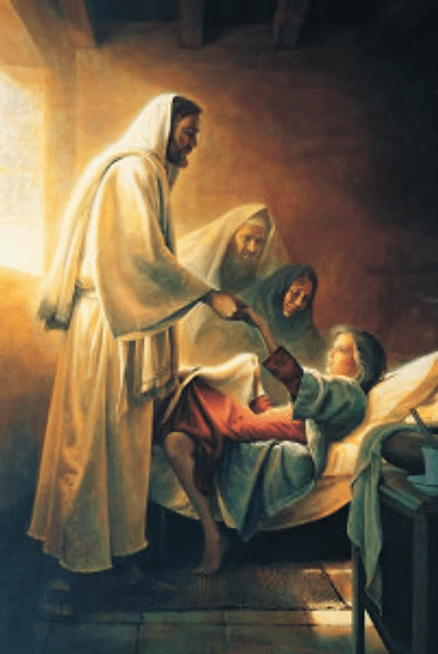
After Jesus and his disciples left the synagogue, they entered the house of Simon and Andrew, with James and John. Now Simon’s mother-in-law was in bed with a fever, and they told him about her at once. He came and took her by the hand and lifted her up. Then the fever left her, and she began to serve them.

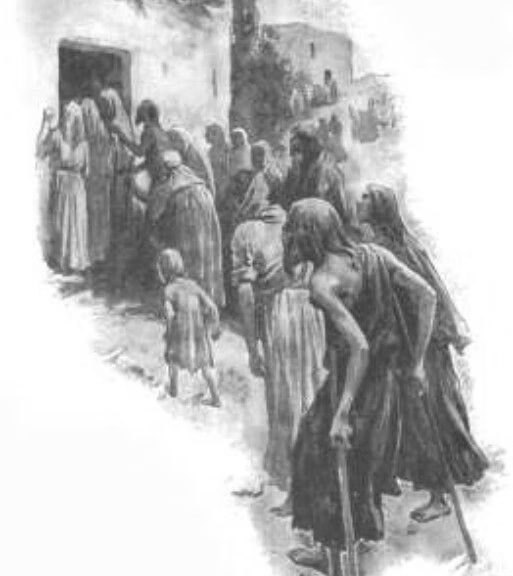
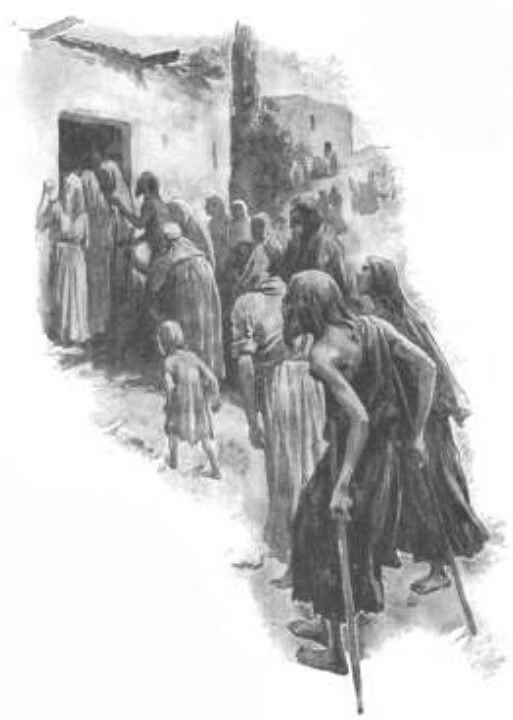
That evening, at sundown, they brought to him all who were sick or possessed with demons. And the whole city was gathered around the door. And he cured many who were sick with various diseases, and cast out many demons; and he would not permit the demons to speak, because they knew him. In the morning, while it was still very dark, he got up and went out to a deserted place, and there he prayed. And Simon and his companions hunted for him. When they found him, they said to him, “Everyone is searching for you.” He answered, “Let us go on to the neighboring towns, so that I may proclaim the message there also; for that is what I came out to do.” And he went throughout Galilee, proclaiming the message in their synagogues and casting out demons.

—————————————————————————————————–

This is the Gospel selection from the Episcopal lectionary for the fifth Sunday after the Epiphany, Year B. It will next be read aloud in church by a priest on Sunday, February 4, 2018. It will be read along with Isaiah 40:21-31, which includes the verse, “[The LORD] gives power to the faint, and strengthens the powerless.”  It will also be read with 1 Corinthians 9:16-23, which says, “[My reward is] that in my proclamation I may make the gospel free of charge, so as not to make full use of my rights in the gospel.”  Thus, this reading from Mark is important as it tells of the powers the Holy Spirit gave Jesus and how that attracted large crowds. It also denounces the concept of a megachurch, because Jesus went throughout Galilee purifying the Jews, not settling into one synagogue.

Because typical Western Christians are prone to think in Western ways, it becomes easy for one to read “left the synagogue” and imagine oneself leaving a Christian church. Likewise, one can read “Sabbath” and think Sunday, not Saturday. This is because Christians have no firm grasp on what it means to be a Jew. Thus, the concept of preparing for the Sabbath on Friday and not traveling more than 0.596 miles (or 112 feet from the city limits) between 6:00 PM Friday and 6:00 PM Saturday does not compute with the typical Christian brain.

The first verses of this reading speak details without directly stating them. When we read, “After Jesus and his disciples left the synagogue,” that says Jesus and his disciple left the synagogue in Capernaum, where Jesus taught and cast out a demon.  The time of their departure would have been around noon (mid-day), because a typical service on the Sabbath is between 9:00 AM and noon.

When we read, “Simon’s mother-in-law was in bed with a fever,” that means Simon Peter was married, and had children most likely. His mother-in-law and wife did not attend the synagogue due to the illness and the mother-in-law would have needed someone there tending to her needs. Therefore, we can see how “they (the disciples and Jesus) entered the house of Simon and Andrew” specifically because of the mother-in-law’s physical state of being.  Simon, Andrew, James and John (of Zebedee) would have led Jesus there.

Once they were in the home, “they told him about her at once,” where “they” means her attendants.  That could means Andrew’s wife also lived in the home, along with his children. The size of the house would indicate how many within a family could live.  As fishermen, the house was probably close to the sea, with some building by which to preserve fish.  All of this possibility reveals a real-life view that can come from the simplicity of Simon Peter’s remembrances, as told to his writer companion, Mark.

In the miracle of Jesus healing the mother-in-law from her fever, we read that Jesus, “came and took her by the hand and lifted her up.” On a mundane level, that says Jesus gave the woman the strength to get up out of bed,” where the Greek word “ēgeiren” means, “he raised up” or “he awoke” or “he aroused.” However, on the spiritual level that word tells us the woman was near death, such that Jesus awakened her from the fever, which was sending her into the sleep of death.

I have written about the parables of Jesus, where sleep is metaphor for death. When Jesus was told to come quick because Lazarus was near death, Jesus said not to worry. He said, “Lazarus was only sleeping,” in the sense that death symbolizes the transition of a soul from one physical life into another, like one goes from one day’s activity in life to another, following a period of sleep. Jesus told his disciples (and others) to stay vigilant, alert, and awake, to avoid the mortal death that leads to reincarnation.  It is the soul that is to receive that instruction to stay awake and not slumber in sin. As such, when Jesus took the hand of the mother-in-law, he then “lifted her up” so her soul returned, alive and awake in her body.

Maybe it is just me, but when I read, “she began to serve them,” my brain thinks this means the woman got up, thanked Jesus, and began to make them some ‘after synagogue lunch’. When I was growing up, Sunday supper was after morning church, before going back to evening church (I was not raised Catholic or Episcopalian). However, Friday is the day of preparation for Jews, where is cooked then.  Only reheating food is allowed (no new fires or boiling) on a Sabbath; so the highest intent of that statement says the mother-in-law did not serve them food.  She had been healed of a near-death fever by God, so she would not do any forbidden work on the day God commanded all should rest.

The Greek word that has been translated as “to serve” is “diēkonei.” The root verb to that is “diakoneó,” which means, “I wait at table (particularly of a slave who waits on guests); I serve (generally).” (Strong’s Concordance) Because one understands the woman got out of her sick bed on the day of rest, we can discount the mundane meaning above and look to the general as the primary intent. That intent can be explained as this: “Caring for the needs of others as the Lord guides in an active, practical way.” (HELPS Word-studies)

In other words, “she contributed support” – to Jesus and to her son-in-law and his brother, and to all the disciples who followed Jesus. For her “to serve,” she had been touched by Jesus and had been filled with the Holy Spirit, knowing the hand of God had just held her hand, raising her from near death. After an experience like that, one does not just get up and start acting like a waitress waiting tables.  One serves the LORD.

It is most important to see this affect that touch had. Jesus often touched, or was touched, but many times no contact was made for people to be healed. Jesus touched with his words vibrating on the bodies of the faithful, such that his disciples felt the power of the Holy Spirit surrounding him.  That charisma he possessed made them willingly serve his needs. The same power was then given by God, through the Holy Spirit, to the Apostles; but the missed element of this transfer of the Holy Spirit is that it went immediately to all those whom Jesus miraculously healed and cured.

One example was the lame beggar at the Temple gate, who o n a Sabbath held out his hand to Peter and John (of Zebedee) for alms. We are told Peter said to the man, “I do not possess silver and gold, but what I do have I give to you: In the name of Jesus Christ the Nazarene– walk!” (Acts 3:6) The man walked without assistance of any kind mentioned. Jesus Christ had been reborn into Peter, allowing Peter – “in the name of Jesus Christ”  – to heal as Jesus the Nazarene had.

In the reading that continues, “Evening” is a statement that the Sabbath had ended. The Jewish clock recognizes twelve hours of “Day,” which begins at 6:00 AM and ends at 6:00 PM. The twelve hours of “Night” is then divided into four “watches,” with the Evening watch beginning at 6:00 PM and lasting until 9:00 PM. Because there is still daylight after 6:00 PM, during the spring and summer months, the statement “at sundown” says that darkness came during the Evening watch period. That would indicate a winter time period, such that “the whole city was gathered around the door” in darkness, meaning there was still plenty of time left before the people would head home, prior to the Midnight watch (9:00 PM to Midnight).

In the fourth Sunday after the Epiphany reading from Mark, Jesus cured a man with an unclean spirit in the synagogue. That was healing on the Sabbath, which the Pharisees said was against the Law.  Jesus then cured Simon’s mother-in-law on a Sabbath too. Many of Jesus’ healings were on the Sabbath, which angered the scribes and Pharisees, especially when Jesus told them, “The Son of Man is Lord of the Sabbath.” (Matthew 12:8) However, at “evening, at sundown,” on the first day of the week (our Sunday) the people of Capernaum were not making Jesus violate any Jewish laws.  Their coming then meant he would be asked to work on the day of rest.

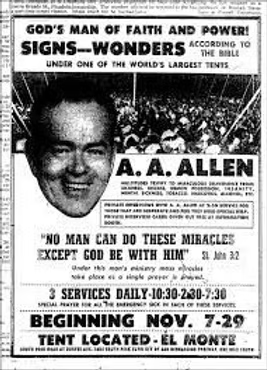
One has to now see the mirror image of Simon’s mother-in-law beginning her “service” to the Lord on a Sabbath, leading to Jesus serving the LORD in the wee evening hours of the first day of the week (a Christian Sunday). For Jesus to individually meet the “whole city [that] was gathered around the door” of Simon’s house, everyone who lived there served the needs of Jesus.  At dark, the disciples would have lit torches for light, formed lines and ushered people to Jesus, much like the organization seen at an Oral Roberts tent revival meeting, especially at the end when the healing service is conducted (mimicry is the greatest flattery, but please do not see that comparison as a statement of piety in Oral Roberts). Such a gathering, where Jesus “cured many who were sick with various diseases, and cast out many demons,” required devoted followers to assist the needs of a most holy Prophet.

When we read that Jesus cast out demons from those of Capernaum, this can be read as a reflection of the one who stood up in the synagogue, who had an unclean spirit possessing him. One has to understand that “the whole of the city” means the Jewish portion, where all were within the .596 mile walking limit allowed on a Sabbath. Realizing that Capernaum also had a Gentile presence, under Roman domination, the Jews had their own “city limits” within that city. Thus, to read, “[Jesus] would not permit the demons to speak, because “they knew him,” they “knew him to be the Christ,” as only Jews would know and believe.

Unlike the confrontation that had occurred in the synagogue, the Jews who willingly went to Jesus felt the guilt of their demons within; and thus they offered no resistance to Jesus, due to his offering to baptize them with the Holy Spirit (as John the baptizer foretold). Jesus would not allow those demons to take control of their host soul’s body and argue or plead to remain. Once freed of their demonic spirit possession, the Jews of Capernaum were touched by the Christ. Just as Simon’s mother-in-law can be seen as filled with the Holy Spirit and given into service of the Lord, those healed in Capernaum were likewise filled. An evil spirit had been replaced with a love of God.

Those who were cured of illness and had evil demons removed were then followers of Jesus the Nazarene. That base of believers and disciples would make the northern shores of the Sea of Galilee a place where Jesus could safely go and find solitude. Even though his followers would continue to increased, to the point of making “alone time” difficult to find, the ones Jesus touched in his three-year ministry would assist the Apostles in the spread of Christianity later.

We are given a sense of this need for Jesus to spend time in prayer when we read, “In the morning, while it was still very dark, [Jesus] got up and went out to a deserted place, and there he prayed.” According to Jewish Law, each Jew is committed to three periods of prayer each day: one in the morning, one in the afternoon, and one in the evening.

The morning prayer is called the Shacharit, which usually takes half an hour’s time. Each Jew is expected to recite a series of prayers and Psalms, specified in steps (5). A prayer book is followed in a Jewish prayer service; and it is most probable that Jesus had everything down to memory. However, remembering how the disciples asked Jesus to teach them how to pray (the source of The Lord’s Prayer), it may be that Jesus sent more personal prayers to his Father (from his heart, not his brain). In any regard, this element of Jesus going in the morning to pray alone says Jesus was devout in his compliance to God’s Law, based on an inner love and not an external demand.

The element “in the morning, while it was still very dark,” is another statement that says (without saying directly), “wintertime,” more than fall time. This is because 6:00 AM ends the Morning watch (3:00 AM to 6:00 AM), with it officially being daytime as six. Because it was “very dark,” there still had been no peek of the sun on the horizon. The hours of daylight are greatly reduced during the winter (less than twelve hours of sunlight), so sunrise then would come significantly after 6:00 AM and sunset would be prior to 6:00 PM (in the Northern Hemisphere, relative to Galilee).

In the dark of morning, Jesus could move to a place of solitude without being noticed, thus  he was free to pray and not have someone approach him about anything. We see this even meant his disciples, as “Simon and his companions hunted for him” (the Greek word “katediōxen” also means “followed after”). One can assume that the family in Simon’s house held their own Shacharit prayer service in the house, since it was still dark and they needed lamps to recite from a prayer book, so they let Jesus be alone for his prayers. While “hunted” makes it seem the disciples did not know where Jesus was exactly, “following” him means they knew the general area where to go looking for him.

When they found Jesus, they exclaimed, “Everyone is searching for you,” which could means the disciples first went to the synagogue for the prayer service there (morning prayer); but it still leans one towards seeing how the Jews (disciples included) had become trained to seek leaders that could make decisions for them. The Jews of Capernaum knew the thoughts of their evil demons, which knew Jesus was the Christ (the Holy One of God), so they rejoiced at the thought that God had sent His Messiah to Capernaum. “Everyone” there sought Jesus so he could tell them what to do, like Elijah and John the Baptist. Still, not only were the common Jews of Capernaum looking for Jesus, so too were the rabbis, scribes and Pharisees there, There certainly was good reason, as well as bad, that Jesus was sought out.

When Jesus heard the word “everyone,” regardless if the intent from the disciples being the people of Capernaum, when Jesus replied, “Let us go on to the neighboring towns, so that I may proclaim the message there also; for that is what I came out to do,” he knew “everyone” meant all Jews.

His message was “the kingdom of God has come near,” and that was what all the descendants of the children of Israel sought. Thus, Jesus was saying his synagogue was to be all synagogues – beginning with those in the neighboring towns of Galilee. As winter had set in and the spring festivals (Passover and Shavuot) were still months away, it was divine wisdom (resulting from prayer) that told Jesus to expand his base then.

Hopefully, I have made this relatively short reading from Mark’s Gospel come to life, in terms that make it easy to see how real the memories of Simon Peter were. They come from one who was raised with faith in God and belief in the laws that had been taught to him. Before Jesus entered the lives of his disciples and began speaking the truth and casting out demons, the Jews had a firm foundation about what was expected of a priest of God. They just did not know how to apply that learning, which was stored in their big brains.

The same can be said of most devoted Christians today.  They go to church and listen to the readings and sermons.  They know some things, but not enough to teach the meaning of those things.  Therefore, they seek leaders who are external to them, who knowledge they revere; but few seek the complete wisdom of God within.

Jesus took the devotion his followers had to God and lit the flame of love for God in their hearts, while removing all the worldly excuses that justified sin as inevitable. Jesus found “everyone” Jewish was seeking someone to give their devotion purpose, such that Jesus was the answer to the ritual prayers of all Jews.

As a personal Epiphany lesson, it is most important to see how Christianity has also become diseased and filled with unclean spirits. It is possessed with the same thought that some external power will come to save us from the sins we hate committing, but have no will to resist. Christianity is running a fever that is in need of the healing touch of Jesus. Being close to death means one without the Holy Spirit will die and be reborn as a wandering soul, brought back in a new human body, just as mortal as the one before. The symbolism of Jesus taking one’s hand is then the entrance of the Holy Spirit within, so we rise and awaken to a new name – Jesus Christ.

Jesus could have fallen in love with the adoration that Capernaum was willing to give. He could have become like a Rick Warren, or like a Joel Osteen, a Joyce Meyer, or any number of the “get rich in Jesus’ name” pretenders.  Jesus could have made that synagogue in Capernaum his megachurch. But, he did not.

Jesus said, “Get behind me Satan.  You serve only God.” (Luke 4:8)

Jesus could have hired workers to transport large tents, with thousands of folding chair and tons of sawdust, and gone from town to town having Judaism revival meetings. Of course, he would have had to hire advertisers to run ahead and pass out flyers and paste up posters: “Jesus the Miracle Worker Coming, in Person!” Jesus could have healed for free, but then passed around the offering plate (or many), while workers suggested ‘love gifts’ for his services. Yet, Jesus did not do that.

Jesus said, “Get behind me Satan.  You are a stumbling block to Me; for you are not setting your mind on God’s interests, but man’s.” (Matthew 16:23)

Jesus affected people on a spiritual level. Yet, throughout his three years of ministry, he never once made alligator tears roll down his cheeks, saying how much money he needed to keep his ministry alive. He never once cried about how much it costs to pay the bills for a megachurch or pay television cameramen and cosmetics applicators. Jesus, above all, never told anyone to worship him, and not God.  We are only to worship God.

Jesus went on the road preaching his message on hillsides, in synagogues, and on the steps of the Temple of Jerusalem (Herod’s Temple), and he healed people miraculously along the way. Jesus had his followers, along with twelve volunteers who were the deacons of the first Church of Christ, to help his mundane needs be met. Jesus never planned or plotted his moves by using his brain to justify his actions. Everything Jesus did was from faith and the love of the Father he was born with.

The Epiphany has to be that each individual must find the need to pray to God for guidance. Each individual must look for the answers to prayers coming in signs.  Each individual must see the need to spread the message that the kingdom of God has come near – in oneself – because God has blessed one with the birth of His Son Jesus within. Each individual must see that selfishness is an unclean spirit that whispers to one, “I know the Christ’s business and you are not worthy of that title. Why not do nothing and let someone else be Jesus?” That demon cannot speak.  It must come out.

The Epiphany has to be oneself going to Jesus at sunset, in the winter of one’s discontent with life, when one’s darkness is most felt. One has to realize one is tired of being controlled by evils and the diseases of sin, seeking salvation. A personal Epiphany is then believing, “That I may proclaim the message … for that is what I have been reborn to do.”

Matthew 5:13-16 – The salt of the earth

“You are the salt of the earth; but if salt has lost its taste, how can its saltiness be restored? It is no longer good for anything, but is thrown out and trampled under foot.

“You are the light of the world. A city built on a hill cannot be hid. No one after lighting a lamp puts it under the bushel basket, but on the lampstand, and it gives light to all in the house. In the same way, let your light shine before others, so that they may see your good works and give glory to your Father in heaven.

——————–

I watched the local Baptist minister do his Sunday sermon last year. The core of his reading addressed was the above. Matthew 5:13-20 is read in Episcopal churches on the fifth Sunday of the season of Epiphany. As the Episcopal-Roman Catholic-Anglican-Lutheran-Methodist (et al) churches have seasons and follow lectionary schedules that have a large heavy spike driven deeply into the ground that is Easter Sunday, from which (working backwards) is the fixed season of Lent (always 40 days), there can be a larger or lesser amount of time between the fixed date of Epiphany (always January 6) and the beginning of Lent. The maximum Sundays in the Epiphany season (the Sundays after the Epiphany) is six, but some years that number can only be four Sundays. So, if a Year A is one of those shorty Epiphanies, then so much for the Salt and the Light reading (at least as far as it being preached by the wafer and wine gang is concerned).

Since Baptists have no such lectionary [that I know of, or care to know of], other than Christmas and Easter are fixed on their schedules, they can preach about this message whenever the mood strikes them. The Baptist minister’s message seemed so familiar, I thought it might be some rebroadcast of an old sermon; but, since he mentioned the COVID19 pandemic in the same breath with Labor Day weekend, I assume it was a new rendition of the same ole same ole – whenever he preaches about this the same words always flow out.

This preacher made a point of telling everyone listening how he had travelled around the world as a missionary seminarian, going to poor countries not like our golden, high-tech America. [I imagine Eastern Europe has no need for missionaries.] He said he went to Haiti. There, he indicated the poor Haitians have no refrigeration, so they know all about the value of salt. While he didn’t say it [I thought about it as he was talking], the implication was Americans are told to stay away from salt. I know my doctor has said that, because I have hypertension. Haitians, on the other hand, salt their fish and meats as a necessary preservative, regardless of what stress that puts on their hearts and arteries.

The minister pointed out how the poor people in undeveloped nations easily understand the messages of Jesus, because when he told parables they were in a language that agricultural societies easily understood. Us Americans [I presume, from his explanation] struggle grasping what Jesus meant when he said, “You are the salt of the earth.”

We have become so spoiled by smart phones and refrigeration that we only know salt is what you put on mashed potatoes, to give potatoes some taste. The Baptist minister added that salt has a taste too.

He also told how salt used to be harder to get back then, so it was valuable. He said soldiers were paid in salt, thus the saying “worth your salt.” The Baptist minister said that Jesus saying “You are the salt of the earth” was a statement of value. Jesus told his listeners [those hanging around the mount by the sea – disciples and pilgrims – all Jews] that they were valuable as a light to the world.

Before the preacher read these four verses from his Bible, he prefaced it by saying, “This comes from the Sermon on the Mount, which is the greatest sermon ever preached.”

I disagree with that assessment. Rather than turn this interpretation into a lesson on how much one human brain can remember from one sermon preached, I will just say three chapters in one book does not one sermon equate.

Regardless, the lesson of the salt follows the stating of the Beatitudes, which in itself is a full plate to take home and continues munching on, just to savor everything said. The lesson of the Salt and Light is a separate sermon, taught to Jesus’ disciples. Sure, the acoustics on the mount to the east of the Sea of Galilee were so good, a crowd of pilgrims down by the shore could hear what Jesus said; but to even begin to understand what that means, there would have to be some context. I believe that context was from the Torah, so more than Jews being told to keep memorizing scrolls of text as salt on tradition that lit the way to being Jews, Jesus was telling his closest followers: “You are the preservative of Christianity and the Light of truth for the world.”

The Baptist preacher was saying things that were right, as he preached. I admired him for doing so. After watching and listening to Episcopalian priests speak nonsense for years, listening to flowery prose that only told me, “I went to school and studied more books than you,” the Baptist method of delivery was refreshing. Episcopalians preach as if someone in the audience is going to send in a report to some place where sermon awards are mulled over. There, only the most elite educated scholars are recognized, with grandiose judges announcing in an awards ceremony: “You’ve been nominated for the Noble Sermon Prize!” So, I can appreciate someone actually explaining Scripture.

Still, the Baptist minister fell short of telling the whole truth and nothing but the truth, so help him God. Because I feel how important it is to make this truth be known commonly, I want to leave his sermon behind and begin my own here now. I thank him for bringing these verses to my conscious forefront.

The use of salt, of course, is metaphor and not to be read literally. The truth about salt is human beings need salt to live. The body uses salts for balancing fluids and for muscles and nerves to properly function. The levels of salt in the body are regulated by the consumption of water and the passing of salts out through the kidneys. Without salts taken in, the body begins to break down. With too much salt the body develops problems. So, salt needs to be balanced by water.

This is symbolic of Jesus posing the known condition, “salt losing its saltiness,” or “salt becoming tasteless” (from “halas mōranthē“). Rather than add a question mark and change what Jesus said to “how can it be made salty again?” Jesus actually just stated “on which salt is sprinkled” (from “en tini halisthēsetai“). When one’s salt level gets low, more salt must be added. The truth of this necessity is why salt had monetary value back in the day. Salt is salt and salt tastes like salt. Too much is bad, too little is bad, just right it the balance that must always be found.

When we read Jesus saying, “It is no longer good for anything, but is thrown out and trampled under foot,” the impression is someone having found some old salt that is no longer salty, so it gets thrown out as dirt, where people walk over it. According to a Google search about “Can salt lose its saltiness?” the immediate answer at the top says, “Salt itself, sodium chloride (NaCl), is extremely stable and cannot lose its flavor.” Realizing this, the translation implying salt getting old and no longer tasty is wrong. Therefore, the translation needs to be seen as saying, “for nothing that is potent any longer , if not being cast out , to be trampled upon under this men .[“eis ouden ischyei eti , ei mēblēthen exō , katapateisthai hypo tōn anthrōpōn .“]

Nothing in that statement mentions salt. It implies that if one’s level of salt gets too low [loss of saltiness, or salinity] then one dies, from a lack of strength [no potency]. If salt is not added to one’s system, then a dead body is cast out for burial. This returns one’s flesh and bones into the ground from which is came, which is as worthless as the dirt men walk upon. That should be the literal implication of what Jesus said; but the metaphor of that needs to then be seen.

This can be seen easier by realizing the Greek word “mōranthē” (translated as “lost its taste” or “become tasteless”) has a basic definition that is “to be foolish.” There are two basic uses that Strong’s points out, being : “(a) I make foolish, turn to foolishness, (b) I taint, and thus: I am tasteless, make useless.”

Seeing this has little to do with salt, the metaphor is relative to Jesus talking to Jews about their religious practices – led by the rulers in the Temple – which had been reduced to “foolishness.” This means his reference to salt becomes weaker as a metaphor for preserving fish and meat, where salt is applied on the outside of flesh, while becoming stronger as the lifeblood of their religion, where Jews reflected how strong or weak Judaism was. The metaphor was not about preservation, as much as it was about remaining alive and vital.

The metaphor is the blood of faith, where belief is like salt mined and distributed to those needing belief in their bodies to keep Judaism alive, but that belief was so void of true saltiness that Judaism was dying because their belief was little more than memorized words, none of which had instilled faith within them. By understanding that metaphor, one can look at how John wrote of Jesus telling those lacking saltiness, “Very truly I tell you, unless you eat the flesh of the Son of Man and drink his blood, you have no life in you.” (John 6:52, NIV) The lifeblood of Judaism, as shown by the Jews arguing with Jesus, knew nothing about the salt of faith in the Torah, Psalms, and Prophets, so they were eating the food of foolishness. None of them had more than some tainted belief in their blood, making them so anemic they had faith-poor blood, which could only be fixed by drinking the blood of Jesus – the blood of true faith.

God had sent Jesus to be the restoration of faith in those who maintained the Law of Moses, without having a clue why that Law was written. Jesus was sent to enlighten the Jews to the meaning of Scripture, as the salt that must be eaten and drank, lest Judaism would surely die and be trampled underfoot.

Now, in the words Jesus taught about this death of religion, if it did not add the necessary salt of life into their bloodstream, is “katapateisthai,” which is translated above as “trampled under.” In this series of teaching presented by Jesus [which the Baptist minister called the greatest sermon ever spoken], in Matthew’s seventh chapter, Jesus gave this instruction: “Do not give dogs what is sacred; do not throw your pearls to pigs. If you do, they may trample them under their feet, and turn and tear you to pieces.” (Matthew 7:6) There is written the Greek word “katapatēsousin,” which translates as “they shall trample upon.” The two verses link together in meaning, relative to faith (or the lack thereof).

The same theme of a lack of salt (as faith being necessary for a religion to stay alive) is present in Jesus saying, “Do not let dogs (animals) run your Temple (sacred). Do not let pigs (filthy animals) be the ones to tell you what Scripture (pearls) says. Because if you do that, then they will destroy the truth (the source of faith) and thereby send your bodies to death (underground where feet walk).” The same concepts of sacred pearls has to be seen as the salt of Christianity (the revitalization of Judaism).

Without turning this into a chemistry lesson (feel free to look it up and go as deep as you wish), salt in water conducts electricity, and electricity will produce light. This conductivity then becomes relative to why salt is necessary for muscles and nerves; but that is a story to be told by biologists. There are a plethora of articles that debunk “Himalayan salt lamps,” but simply from there being discussion about some form of homeopathic treatment involving salt and light, there is reason to see the transition in what Jesus taught here. There is a requirement for the salt of faith for there to be a light generated by that faith.

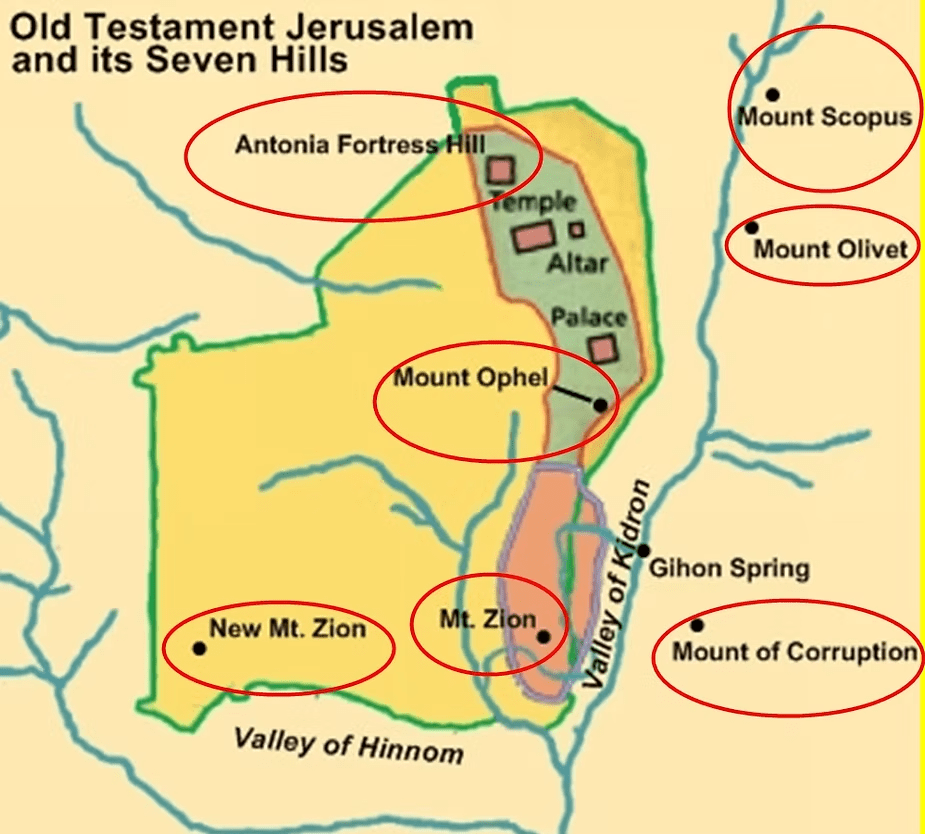
When Jesus added to the verse that says “You are the light of the world,” saying ” A town built on a hill cannot be hidden,” that was a reference to Jerusalem. The Greek word “orous” not only means “hill” but also “mountain.” Jerusalem is a “city” (the true translation of “polis“) that is on and surrounded by hills called mountains: “Jerusalem’s seven hills are Mount Scopus, Mount Olivet and the Mount of Corruption (all three are peaks in a mountain ridge that lies east of the Old City), Mount Ophel, the original Mount Zion, the New Mount Zion and the hill on which the Antonia Fortress was built.” [Wikipedia] This means Jesus was referring directly to the Jews of Judaism being a light of God that must be seen, because God has built that light on a hill for the whole world to see.

When Jesus then said, “No one after lighting a lamp puts it under the bushel basket, but on the lampstand, and it gives light to all in the house,” this cannot be missed as being a reference to a symbol Jews are known by: the menorah.

In that statement, the lampstand is a mainstay in the Temple, which means the “house” is both the Temple of Jerusalem and the Jews who see that “house” as sacred.

When this reading ends with Jesus saying, “In the same way, let your light shine before others, that they may see your good deeds and glorify your Father in heaven,” he said a Jew that does not shine the truth of God’s Word to others, by the way one lives and the way one helps others to live is incapable of good deeds and glorifying God. This is a direct correlation to the amount of true faith that is coursing through one’s body, creating an electrical current that shines the light of truth to the world.

When I first began to write this, it was after Labor Day 2020. I didn’t like the direction I was taking, so I did not complete writing it, leaving it as a draft. I didn’t delete it because I wanted to write about the meaning of Jesus saying “You are the salt of the earth.”

The Baptist minister did not have a lectionary leading him, so he was not presenting this reading during an Episcopalian’s Year A, in the fifth Sunday after the Epiphany [February 9, 2020; February 5, 2023; not read in 2026]. Because of that misdirection, he was not placing any focus on how this reading about what Jesus taught on the hill overlooking the sea had to do with one’s own personal epiphany. Clearly, one has to hear Jesus telling one directly, up close and very personal, “You are the salt of the earth,” meaning you have to have faith transforming you into a lampstand for God’s light of truth. Without that epiphany within one’s soul, one is foolishness waiting to die and come back to try again once more time [reincarnation].

This is where eating the flesh of Jesus brings that pH balance into one’s bloodstream. The flesh of Jesus is Scripture. Still, reading Scripture, memorizing quotes, and listening to preachers make up stuff about what it all means, is never going to put the salt of faith in that blood. That means one must drink the blood of Jesus, which is filled with just the right amount of faith, so one immediately understands what Scripture means. To drink the blood of Jesus means to be reborn in his name. Then one has died of self-ego, but no one is trampling upon your returned to dust bones.

Having an Epiphany means being filled with tasty salt and just the right amount of holy water, so one has become a conductor of Jesus Christ and one’s body has become a lampstand for the light of Christ. One becomes a shining beacon on the hill that leads others to be likewise filled with that Holy Spirit.

I felt it was time to release this to the world.

1 Corinthians 9:16-23 – Why do I do this?

If I proclaim the gospel, this gives me no ground for boasting, for an obligation is laid on me, and woe to me if I do not proclaim the gospel! For if I do this of my own will, I have a reward; but if not of my own will, I am entrusted with a commission. What then is my reward? Just this: that in my proclamation I may make the gospel free of charge, so as not to make full use of my rights in the gospel.

For though I am free with respect to all, I have made myself a slave to all, so that I might win more of them. To the Jews I became as a Jew, in order to win Jews. To those under the law I became as one under the law (though I myself am not under the law) so that I might win those under the law. To those outside the law I became as one outside the law (though I am not free from God’s law but am under Christ’s law) so that I might win those outside the law. To the weak I became weak, so that I might win the weak. I have become all things to all people, that I might by all means save some. I do it all for the sake of the gospel, so that I may share in its blessings.

———-

The thought came to me today, about how long I have written interpretations and insights for others to see, only to find few actually read what I go to the time to write, fewer comment about what I write, and there is nothing reaped, other than costs and debts. It all seems like I am beating my head against a wall. It seems as if nobody cares.

Then, I read Paul telling me he felt the same way; but Paul knew there were people who needed his encouragement. Paul was not writing to a godless void called the “Internet.” Paul was writing to Christians, at a time when Christianity was growing by leaps and bounds. Still, Paul was beating his head against a wall too; but it was because of him not having enough time to write letters to all the Christians in the world.

I read these verses from Paul’s first letter to the Christians in Corinth and I hear him telling me, “Christianity isn’t about saving the world. That is God’s Will, through His Son being reborn in individuals, each saving one soul – one’s own – by becoming Jesus Christ resurrected in the flesh. Even if nobody is listening to you, you are listening to God speaking to you through His Son; and, if God says to tell the world via the Internet, then that is what you must do.”

I hear you talking to me Paul: “If I proclaim the gospel, this gives me no ground for boasting, for an obligation is laid on me, and woe to me if I do not proclaim the gospel!” I gain nothing materially by writing these posts. Therefore, I am nothing by doing so. However, being nothing is better than being condemned for doing nothing!

Paul tells me: “For if I do this of my own will, I have a reward; but if not of my own will, I am entrusted with a commission. What then is my reward? Just this: that in my proclamation I may make the gospel free of charge, so as not to make full use of my rights in the gospel.” I know nothing of value about Scripture on my own. I never paid a dime to enroll in a seminary or theological school of knowledge, so I could pay for the right to proclaim what I have been educated to sell for profit. I never once studied hard and memorized quotes, because I knew there was money to be made in the televangelist market. I know nothing and have no credentials. Therefore, nobody will ever follow behind me like they will follow behind false prophets. My only reward is unseen and unknown; so, I keep on doing what God says do, not stopping to ask, “When do I get paid?”

I write freely, with no one telling me I must do it. “For though I am free with respect to all, I have made myself a slave to all, so that I might win more of them.” As a slave, I will never know who has been won to the Lord. All I know is faith in God will lead me to what I must do next.

Paul wrote to me these words: “To the Jews I became as a Jew, in order to win Jews. To those under the law I became as one under the law (though I myself am not under the law) so that I might win those under the law. To those outside the law I became as one outside the law (though I am not free from God’s law but am under Christ’s law) so that I might win those outside the law. To the weak I became weak, so that I might win the weak. I have become all things to all people, that I might by all means save some.” I preach to Jews, to Christians, to atheists, and to Muslims, telling them all the same things. I stand on no platforms constructed by any of those groups, as there will be no “room” in heaven just for Jews, or just for Christians, or just for Muslims. No organizations will ascend beyond this earthly plane. All members of all groups must stand before God naked and alone, when the time comes for the soul to be judged. I preach to all the same, because all will face the same reckoning.

That is why Paul’s words made so much sense, when he wrote: “I do it all for the sake of the gospel, so that I may share in its blessings.” The gospel is the truth of the Word. God tells me the truth and I marvel in that. My soul delights in the truth coming from words so few can understand. Nobody could ever tell me the meaning the way God tells me. I am sure God told Paul in the same way; and, Paul could never write enough words to describe the truth God reveals to one individually married to His Holy Spirit. Paul wrote for the same reason I write: So I [not anyone else] may marvel in the blessings that come from the truth.

That marvelous feeling is what drives one to want to share that feeling in as many words as are necessary to lead one to listen to the truth himself or herself. How many words does it take to do that?

This reading has been selected as the Epistle reading for the fifth Sunday after the Epiphany, by the Episcopal Church. It will be read aloud by a reader [if the doors of the Episcopal churches are open and people are allowed to come inside to hear words read aloud]; and, possibly some words will be preached by a priest. The question is: Will the message of God be told so individuals will respond?

The lesson is clear to me. It was clear to Paul. Hopefully, the message is clear to the priest, so it can be communicated to those hearing a sermon. The only one who truly knows the glory of the Gospel is the one who hears the voice of God telling it.

Mark 1:29-39 – The ministry of Jesus begins

After Jesus and his disciples left the synagogue, they entered the house of Simon and Andrew, with James and John. Now Simon’s mother-in-law was in bed with a fever, and they told him about her at once. He came and took her by the hand and lifted her up. Then the fever left her, and she began to serve them.

That evening, at sundown, they brought to him all who were sick or possessed with demons. And the whole city was gathered around the door. And he cured many who were sick with various diseases, and cast out many demons; and he would not permit the demons to speak, because they knew him. In the morning, while it was still very dark, he got up and went out to a deserted place, and there he prayed. And Simon and his companions hunted for him. When they found him, they said to him, “Everyone is searching for you.” He answered, “Let us go on to the neighboring towns, so that I may proclaim the message there also; for that is what I came out to do.” And he went throughout Galilee, proclaiming the message in their synagogues and casting out demons.

——————–

This is the Gospel selection for the fifth Sunday after the Epiphany, read during Year B. It is accompanied by an Old Testament reading from a song of Isaiah that sings about God, “[He] does not faint or grow weary” and “He gives power to the faint, and strengthens the powerless.” It is also accompanied by an epistle reading from Paul’s first letter to the Corinthians, which included him reminding true Christians, “I am free with respect to all, I have made myself a slave to all, so that I might win more of them.” These readings should be realized when pondering the meaning of this Gospel selection, as the three have become joined by those whose hearts have allowed their minds to seen the truth of God linking these three separate readings together.

The translation read aloud by a priest (said to be from the New Revised Standard Version Bible [NRSV]) is good in the sense that it gives an impression of Jesus healing the mother-in-law of Simon [aka Peter] early in the day, before going to heal many people later in the evening. This talent displayed by Jesus had many people wanting to see him, so Jesus began a traveling ministry to take the talent to the people. Still, that simplicity of message misses some specificity that is good to be known.

In the NRSV translation, the first word is “After,” which implies a leap in time took place beyond the event of Jesus teaching at the synagogue in Capernaum. That is not what is written as the first word of verse 29. The first word written by Mark is a capitalized “Kai,” which means “And.” I have written regularly about this word not being some meaningless conjunction, which translators can assume it means a subsequent time, place, and event. The word always denotes importance that needs to be noted, with the capitalization being a greater lesson that needs to be paid attention to, in order to grasp the divinity of the written word.

In verses 29-31 there are seven uses of “kai,” with the first one capitalized. The translation above [NRSV] has us read about “Simon and Andrew,” “James and John,” “[Jesus] came and took her by the hand,” and “the fever left her, and she began to serve them.” The way the translation reads, everything is just ho-hum ordinary things happening. When presented that way, the lesson written is missed; and, it is an important lesson to grasp, based on the uses of “kai.”

Because some liberties have been taken in translation to add some “ands” and other things, here is the Greek written [Mark 1:29-31, according to Bible Hub Interlinear], based on the presence of punctuation marks [written or implied by the text translated by the earliest Apostles, thus written later]:

Kai euthys ,

ek tēs synagōgēs ,

exelthontes ,

ēlthon eis tēn oikian Simōnos kai Andreou ,

meta Iakōbou kai Iōannou .

hē de penthera Simōnos katekeito pyressousa .

kai euthys legousin auto peri autēs .

kai proselthōn ,

ēgeiren autēn ,

kratēsas tēs cheiros ,

kai aphēken autēn ho pyretos ,

kai diēkonei autois .

Without showing the literal translation into English, look at how “kai euthys” is repeated, once at the beginning with a capitalized “Kai,” and another time in the lower case. When “kai” is seen only as a marker of importance, the word “euthys” becomes an important word to understand. It literally translates as “at once, directly,” with its usage including “immediately, soon, at once.” (Strong’s Concordance) The word can also be translated as meaning “shortly.” That immediacy is not reflected at the beginning of the NRSV translation, although it does say the state of the mother-in-law was told to Jesus “at once.”

The immediacy is important to see as the exit from the synagogue [“ek tēs synagōgēs”] is followed by the one-word statement that says, “having gone forth” [“exelthontes”]. There is no need to restate an exit, meaning the one-word statement is important to realize as saying Jesus began his ministry at this time, following having cast out an unclean spirit in a leader of the synagogue in Capernaum. It is the ministry that had “gone forth,” or “come out.”

This is where seeing the parallel between leaving a synagogue [a house of worship] and entering the house of Simon and Andrew is a continuation of that ministry. The symbolism says what must be taught in a synagogue (as a natural place of teaching) is no different than what must also be taught at home. Thus, the ministry of Jesus was not content with simply spending a hour or so (less if they worship like Episcopalians) in a house of worship, but they wanted to keep up this presence of worship in a nearby house of family.

When the use of “kai” is found between Simon and Andrew, and also between James and John [of Zebedee], this should be seen as a statement (in one regard) to their relationship as brothers. There are two sets of brother: Simon and Andrew; and, James and John. What is missed (in my opinion) is they all were related by marriage, meaning James and John were brothers of Simon’s wife, whose mother was not only the mother-in-law of Simon, but also the mother of James and John. Thus, when the immediacy leading to the plural pronoun form of the word “legousin” [“they speak”] about the ill mother-in-law [“peri autēs”] says everyone in the house became worried about this woman’s health. That would include any females left to care for her, while the men went to synagogue.

Here, the importance of “kai” says Jesus “came to her” [“proselthōn”] with purpose. From having exited the synagogue, having come out in his new ministry, entering the house of a family where a matriarch was stricken with fever, Jesus had been led there, so “he came to her” assistance.

When the presence of Jesus is understood as the importance of “kai,” there is no need to think Jesus did anything to the woman, beyond being in the same room with her, standing by her bed. When “ēgeiren” is read as “he raised” her, the image of Jesus grabbing her by the hand, or putting his arms under her shoulders and lifting her body out of bed is reading on a simple level of poor belief. Just as Jesus had cast out an unclean spirit within a man [a leader] of the synagogue without any more than a word or command, Jesus’ mere presence near the mother-in-law was uplifting. It was what allowed the woman to awaken from her fever-induced unconsciousness and arise on her own. Just as the leader of the synagogue convulsed on the floor while an unclean spirit left his body, this woman also had the same immediate exit of fever from her body.

When the words “kratēsas tēs cheiros” are translated as “having taken hold of the hand” [or loosely “took her by the hand”], that weakens the depth of meaning that separating those words with commas marks. Prior to the comma mark the woman had already been “raised.” That means following the comma mark she is already standing. As such, “having taken hold” is a word expressing the mother-in-law was similarly effected by the presence of Jesus, just as had been the leader of the synagogue. This means the Holy Spirit is what has “taken hold,” as it was the Holy Spirit that healed both the woman and the man. Therefore, the use of “hand” is less about a hand of a human being and more about a human being held by the “hand” of God, so a human being then becomes a “hand” of God, as a helping “hand”. The leader of the synagogue was also effected in this way.

When this is seen, the next set of words state “left her the fever,” which in simple terms says she no longer had a fever making her ill. However, in deeper terms [those words are led by “kai”], after the fever immediately left her by Jesus coming to her, the words now state she was “sent away” healed, with a “fever” to serve God. The same words say two opposite things.

When this dual meaning is grasped, one should see the deeper reason Mark wrote, “she began to serve them” [NRSV translation]. A better translation allows one to see this duality, when the word “diēkonei” [also preceded by “kai”] is seen to mean “ministered.” Here, one needs to realize that Jesus had been in the synagogue on a Sabbath. Jews prepare food for the Sabbath on Friday (the day of preparation), so to think that everyone was just worried because Sunday dinner [Sabbath for Jews] was not being made and on the table [a Christian view of the Sabbath] is not something done by Jews. Therefore, she was not getting healed to wait on the boys, any more than a minister waits on those needing to be served a Sunday sermon in church does. It says the mother-in-law added fervently to the continuation of discussion of the Torah lesson that Sabbath, in the house where the family lived.

This takes one back to the secondary reason the word “kai” was found between the four disciples. It says each was an important assistant to Jesus, where he was the leader of their own house of worship – a synagogue of family, where everyone related to Jesus and his disciples was a model of how a true “church” [“ekklesia”] is meant to be. All members are equally important and each would eventually be able to call upon Jesus as Apostles, to have his presence allow them to heal others in his name, making these three verses be prophetic of the things at the beginning that would be after Jesus had ascended.

When verse 32 begins by saying “evening,” followed by “sundown,” “evening” is the last quarter of the day, between 3:00 PM and 6:00 PM. At 6:00 PM the Jewish night begins, which is typically not when the sun sinks below the horizon and darkness sets in. The first part of night is the “evening” watch; and, this is the period between 6:00 PM and 9:00 PM, during which the sun does go down completely. Thus, the two parts that begin verse 32 speak of the time when the day has changed from Sabbath to Sunday (the first day of the week – yom rishon), when Jews are allowed to go outside the city limits, further than half a mile. As such, it was after the Sabbath had ended that people who had illnesses, who had heard of Jesus casting out the unclean spirit in the synagogue earlier on the Sabbath, were then permitted by law to travel to where Jesus was known to have gone [this says Simon’s house was within the walking distance, but outside the city of Capernaum proper].

When the verses repeat the use of the words “pollous” and “polla” [meaning “many”], saying that “many” of Capernaum were “sick” or “possessed by demons,” Jesus then healed “many” people. This use does not imply that some were not healed or some demons were not forced out of those possessed. The use of “many” becomes a statement that says the Jews of Capernaum had not been led properly by leaders of synagogues, or rabbis speaking in them, as they did little more than affirm the scribes, as their authorities to speak. It had been that system of weakness that had led to so “many” Jews being “sick” from “diseases” and being “possessed by demons.” All who came to the door at Simon’s and Andrew’s house were healed by seeing Jesus, with that number not being specific, but “many.”

When verse 34 states, “and he would not permit the demons to speak, because they knew him” [NRSV], it should be noted that this begins with the word “kai,” showing importance in the demons being unable to speak. The Greek text actually states:

kai ouk ēphien lalein ta daimonian , hotiēdeisan auton . (Christon einai) .

Notice the parentheses surrounding the last two words. The NRSV does not translate those words, which state the demons knew Jesus commanded them as the Christ. This is a statement about God, who is the power Jesus possessed, as a divine presence within his soul, which was the Holy Spirit [as stated in Mark 1:8 – “Pneumati Hagiō”]. The Greek word “daimonian” is then a parallel, yet opposite to “pneumatic,” as both are spirits, which means they are souls owned by God. The Greek word “psuché” translates as “soul,” with the same link to “breath” and “wind” as has “pneumatic,” with the soul being relative to a human “self.” It is vital to grasp that everyone who came to Jesus possessed a soul in a body of flesh, but those bodies had been possessed by spiritual impurities that allowed “disease” and demonic inhabitation in a body of flesh by souls departed, who rebelled against God’s Judgment.

When that is understood, one can see how it was not the body of flesh named Jesus that these demon spirits knew. Jesus did not command them to be silent as they departed a body they had taken possession of; it was God who spoke to them in ways that no human ear could hear. Verse 34 is thus making the important statement that God possessed Jesus, just as did demons possess the unclean of Capernaum. Being possessed by God not only keeps oneself clean and incapable of being demonically possessed, it allows others who come in contact with one possessed by God to also be cleansed.

In verse 35, where the NRSV states, “In the morning, while it was still very dark,” the Greek states this as: “Kai prōi , ennycha lian , anastas ,” which literally translates as “[Importance] very early , in night still much , having risen up”. Because there is a capitalized “Kai” leading this verse, the word “prōi” [“very early”] takes on a greater meaning than simply “in the morning.” The second segment of words states that, by knowing that “deep into the night” leads one to a point that is “very early,” before the dawn. The “Kai” makes all of this be read as an important statement of the beginning of Jesus’ ministry, as the Christ that was known by demons, where the ministry of light was being sent into a time when darkness surrounded those searching for light. Therefore, more than Jesus waking up early [and that meaning can still be read into these words, as the truth is not limited to only one meaning], we are being told that Jesus arose as that light sent by God.

When we then read that Jesus “went out to a deserted place,” the Greek includes the word “kai” in that it says, “exēlthen kai apēlthen eis erēmon topon” or “he went out kai departed into solitary a place.” This is then two stages of Jesus “going out,” which is again a version of the repeated theme of Jesus “having come out” or “gone forth,” as stated in verse 29. After Jesus healed all the sick and possessed Jews in the town of Capernaum, Jesus’ ministry had further “come out” and Jesus had left behind a time when he would not be in his ministry to others. This was then “a place” no one had gone before, as Jesus was alone in Galilee, which had been “desolated” and “deserted” of good shepherding of souls. This is then where Jesus was “praying” to God to return the light.

When we read, “And Simon and his companions hunted for him” [where the word “kai” is found twice translated as the conjunction “and”], the key term to grasp is “katediōxen,” which has been translated as “hunted for.” When one sees how Jesus did not have to leave the house to pray, as he could have simply been in a deep meditative state of prayer (not outside in the darkness, needing to be searched for), the word “katediōxen” is free to mean “followed closely.” In this sense, the disciples [“Simon kai those with him”], saw Jesus in a trance-like state of prayer – a transcendental state of being – such that “kai heuron” then importantly states the disciples “wanted to discover” what Jesus was doing through prayer. This is then a powerful statement that says the disciples were totally thirsting to become like Jesus, as he represented one like no one before him had been.

By seeing that, when the disciples told Jesus, “Everybody is searching for you,” that becomes the statement that says, “Jews have long sought the Messiah and they need to know the Messiah is you.” They did not search to find Jesus in the darkness outside, to tell him that more people had shown up at the door. The disciples were speaking to Jesus in his prayerful state. They were committed to doing whatever Jesus needed them to do, because Jesus was known to be that important to them and the other Jews.

This means that when Jesus told his disciples, “Let us go on to the neighboring towns, so that I may proclaim the message there also; for that is what I came out to do,” God was speaking to all present. Jesus repeats the theme of his having come out or gone forth. He said his reason and purpose for being in human form was for this ministry that was beginning. The disciples heard God speaking to them through Jesus, just as the demons knew God was the one casting them out, with nothing they could say that would keep them where they were. Thus, the prayer of Jesus was for his ministry and the disciples who were committed in being part of God’s ministry through His Son.

——————–

As a Gospel selection for the Ordinary season following the Epiphany, it is important for the individual to see this reading as directly applying to oneself. To see this as simply Mark recalling the early times of Jesus’ ministry is missing the point of this specific reading being chosen to be read at this particular time of the year [Year B], after the Epiphany. This means one needs to see oneself first as all those of Capernaum who sought Jesus to be cleansed. In this sense, everyone needs to first see oneself as the mother-in-law who is (in essence) laying on one’s deathbed [mortality only ensuring death in the flesh to come], with no way to be healed by one’s own wiles or by the standard practices that are nothing more than darkness. The reader must see himself or herself as the one desperately needing Jesus for salvation.

After one sees the value of this reading is to lead one to Jesus, the next promise is to be committed to serving Jesus as his disciple. One’s own house must become a synagogue or church, where one’s family must also equally be committed to serving God through His Christ. One has to then hunt Jesus down in Scripture, in order to know everything Jesus did, because one wants to become another Jesus for mankind. The body of Christ is consumed through the eyes reading divine text and the mind digesting that which it has been fed – spiritual food. One must eat the body of Christ by being led to insightful meaning, which in turn allows one to be filled with the blood of Christ – enlightenment to prophetic meaning.

This level of commitment might take years of following Jesus through the written word and the insights God sends one though prayer. One then needs to learn how to enter a place of solitude, so all the noises of the world are pushed away and one can intently listen to hear the instructions that come to you from God. They come as whispers of insight, saying, “Look there.” and “Inspect this.” One needs to then act on those instructions.

The ending element of going out to preach in Galilee is then a prophecy of one’s own mission in ministry, while remembering the people are not calling for you to come to them. Just as the people went to Simon’s house, they did not go there for Simon. The people are always crying out for healing and for their evil demons to be cast out; but the lost never know where to go to be found. That can only come from Jesus Christ; and, it is the ministry of an Apostle to take Jesus Christ to the people, speaking the truth of Scripture one is told. Therefore, it is the mission of the disciple of Jesus to become Jesus Christ resurrected, as the rebirth of the Son of God [regardless of one’s human gender] so wherever one goes, so too does Jesus. This is the meaning of being reborn in the name of Jesus Christ; and, it is how one earns the right to call God one’s Father.