
We know that the whole creation has been groaning in labor pains until now; and not only the creation, but we ourselves, who have the first fruits of the Spirit, groan inwardly while we wait for adoption, the redemption of our bodies. For in hope we were saved. Now hope that is seen is not hope. For who hopes for what is seen? But if we hope for what we do not see, we wait for it with patience.
Likewise the Spirit helps us in our weakness; for we do not know how to pray as we ought, but that very Spirit intercedes with sighs too deep for words. And God, who searches the heart, knows what is the mind of the Spirit, because the Spirit intercedes for the saints according to the will of God.
——————————————————————————–
This is the optional Epistle selection from the Episcopal Lectionary for Pentecost Sunday, Year B 2018. It will next be read aloud (if chosen by a priest) in church by a reader on Sunday, May 20, 2018. This is important as it speaks from the perspective of one born of death, who has gained the promise of eternal salvation, through the Holy Spirit. It alludes to the weaknesses that cause dried bones in those born mortals, which can only be brought to life by the love of God, the Mind of Christ, and the Will of God through His Holy Spirit.
The chances are this short reading from Paul will never be read aloud in an Episcopal church, simply because it is in a “pick two out of three,” with one of the three a must pick. That leaves the battle of the Scripture readings to Ezekiel 37 (the dried bones in the valley) and this from Romans 8. Simply from a theatrical perspective, Paul is always good for an audience response that says, “Huh?” That makes it probable that this reading may never be read aloud in church. The reason the probability is not zero is it is short, so some priests might choose it to save printing costs on any accompanying read-along handouts.
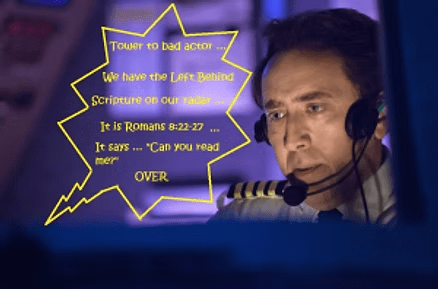
Imagine this, a Scripture waiting three years to be chosen for presentation to a congregation, and it never gets picked. If churches were like seminary and tests were required for graduation as a Christian, everyone would fail the test if passing meant writing an essay about the meaning of Romans 8:22-27.
Who remembers this reading?
While some concepts are easy to see here – creation, labor pains, hope, and the Holy Spirit – few would jump and scream, “Romans 8:22-27!!!” … if asked to quote a verse of Scripture that was relative to those concepts.
Maybe I’m wrong and just don’t hang out with enough Pauline scholars?
If it were not for the demand to choose the Acts 2:1-21 reading for Pentecost Sunday – because (after all) what is a Pentecost without the Pentecost story from Acts 2, right? – this reading from Paul’s letter to the Jews of Rome paints a perfect picture of how difficult it is for a bag of dried bones in new flesh (zombie Christians?) to actually move those chest muscles and breathe deep, after being prophesied to the breath.

Out with the dusty air. In with the Holy Spirit.
Out with the egomania. In with the Mind of Christ.
While Ezekiel can be seen as the Holy Spirit in a human Saint prior to Jesus Christ, Paul should be seen as the Holy Spirit in a human Saint after Jesus Christ. Just as God told Ezekiel to prophesy to the dried bones in new bodies, God likewise to Jesus of Nazareth (His Son) said to prophesy to dried bones in new bodies. Now, God is telling Paul to prophesy to those who received the Holy Spirit and eternal life in re-hydrated bodies, while indirectly prophesying to dried bones in new bodies reading his words today. The same God is using multiple righteous bodies (prophets) as His Christ to prophesy to the breath of eternal life.
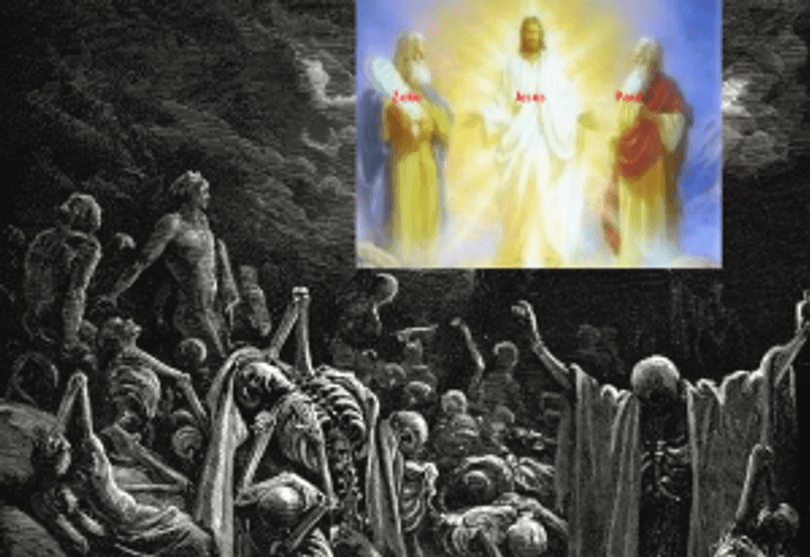
Paul was told to prophesy to those like him about what “we know” (Greek “oidamen”). This was relative to faith as belief based on personal experience. Paul could make that statement in the plural number because he had witnessed others who had transformed from dried bones in new bodies of flesh, from mortals plodding along like zombies towards certain death to Saints filled with the light of truth and assured eternal life.
For those who know Paul’s story, he was named Saul before he encountered the Spirit of Jesus Christ, was knocked off his mule and blinded for three days. Saul was transformed from Christian-persecuting Pharisee into Saint in the name of Jesus Christ; but that transformation was not a smooth snap of the fingers, presto-change-o, where Jewish Saul became Christian Paul. He went through labor pains, from being born Saul headed towards another dead end, to being reborn as Jesus Christ. To give a name to the new him, he began going by the name Paul.
Saul was a creation, who was like all the Apostle-Saints Paul encountered in his travels. They had all been created of matter – bones, sinews, flesh and skin – forming as fetuses in their mother’s wombs, and grown to maturity in a world of evil influences. The Jews Paul sought were clinging to their Judaism as a way to justify their sins. Saul was one of them, a reflection of their lifeless state.
It has always been a challenge for a soul released into a universe of matter to find its way beyond the veil of deepest, darkest outer space as to the origin that is God. That must be where He lives and watches over us dust mites of His Creation. The labor pains of finding God, especially for souls locked inside zombie bodies, comes from straining and groaning to reach the highest, widest, deepest outer edges … to where brains think God must be ….
When God has always been within.
For Saints like Paul and his fellow Roman Christian Jews, the receipt of the breath of the Holy Spirit did nothing to ease their pains. To those first fruits of the Spirit, their souls still resided in temporal bodies and they faced the same struggles Ezekiel and Jesus faced – prophesying to dried bones standing before them like zombies.
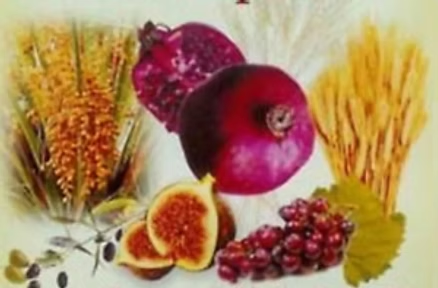
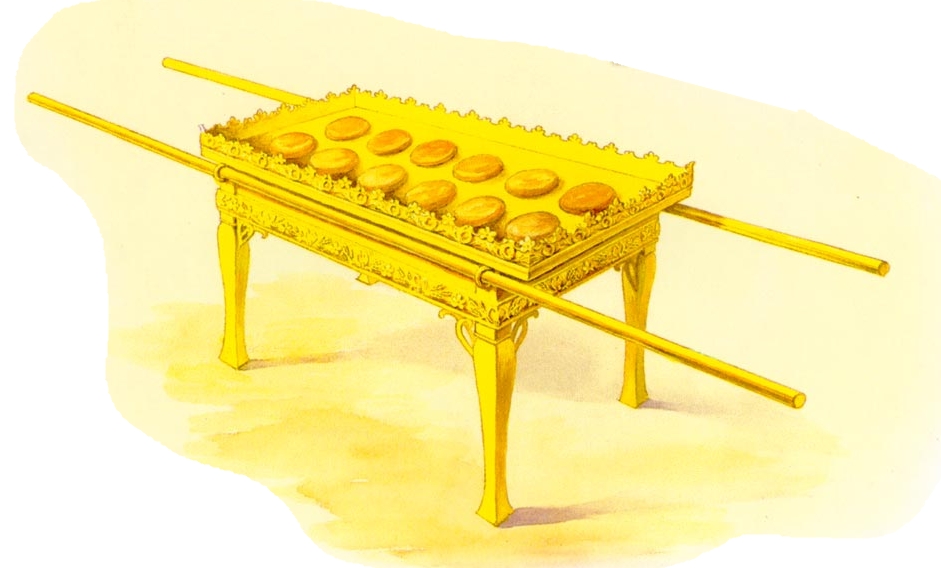
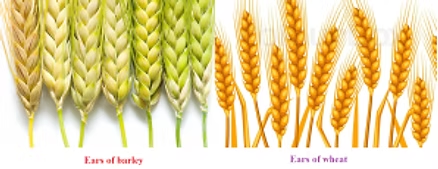
The first fruits are the earliest harvest of grains, which are then measured by a weight called an “omer.” As a symbolic gesture, those early grains and fruits were gathered and placed in the Temple on the second day of the Passover Festival. The first fruits were then allowed to become ripe and matured, which began a daily count to when those fruits would be worthy to eat. They were ripe and ready on the Fiftieth Day – Pentecost.
All the Apostles serving the Father in the name of Jesus Christ had “groan inwardly” waiting for their “adoption” as true Christians, just as do everyone who seeks the same gift of eternal life. The redemption of their bodies meant, like first fruits that appear ready for harvest, their egos had to be removed.
In the zombie analogy, the walking dead or the living dead can only truly die when their brains are blown to bits. I imagine the “death” of a zombie would symbolize eternal damnation, where the soul can no longer find anything earthly to call “home.” Still, the zombie analogy says the living dead live because of a brain and not because of a soul. Thus, the first fruits represent the initial receipt of the Spirit of Christ, so the soul begins to retake control over what was a lost cause before. Life for a zombie consists of destroying life in others; but dried bones without a brain – sacrificed for the Holy Spirit – have life to offer others.
Just as Jesus breathed on his disciples, giving them the first fruits of the Salvation harvest, they needed to be aged to perfection. The disciples and followers of Jesus would then begin a forty-day test of one’s true readiness to have eternal life. That education was mandatory and had to be passed. Therefore, the “groan inwardly” is one’s time spent in the Wilderness, where brains cannot find water and food; only angels can keep the body of flesh thriving on heavenly manna and living waters.
When Paul wrote to his brothers in Christ, he stated, “For in hope we were saved.” The Greek word “elpidi” is translated as “hope,” but the word equally means, “expectation, trust, and confidence.” This means an Apostle knows that salvation has come, when one has met the test for “redemption of the body,” because of an inner presence that instills deep trust and confidence in the Holy Spirit, with an expectation of eternal life.
The Apostles were saved as examples of hope that others could sense and feel. The presence of “hope,” as most mortals know the meaning, is the thrill and excitement that is brought on in anticipation of good things coming. The righteousness of hope comes by a willingness to serve the LORD, no matter what the earthly consequences might be.
When Paul made the statement and then questioned, “Now hope that is seen is not hope. For who hopes for what is seen?” this is the “hope” that comes from others. When in danger, we are trained to respond – “Call 9-1-1!” We look for rescue to come to us, in the form of flesh and blood heroes.

Human beings routinely place their hope, expectations, trust and confidence in leaders. The Israelites went to Samuel pleading for a king to lead them, like those who led others nations. They wanted to see a king as holy, rather than take the responsibility of being holy themselves. Individually, one offers little value as hope for others, when one sees oneself, and others see one as well, as an ordinary human being that is lowly and insignificant. We equate the power of worldly influence as the rays of hope to bow down before. We look for that which can be seen … not God.
That error is what makes people be born to death, as walking brains on top of dried bones and rotting sinews, flesh and skin.
For the majority of people today who profess belief in Jesus of Nazareth as the Messiah promised by God to the Jews, and said to be “our Christ,” the error comes from placing the body of a dead man on a wooden instrument of death. We look for the “second coming of Christ” as though that is eons down the road of linear time. The error is in making an idol of Jesus to pray to externally, such that the hopes, expectations, trusts and confidence is that Jesus Christ will come down from heaven like a Greek hero and slay evil with his double-edged sword and rapture all Christians up to heaven. All of that “hope” calls for no one talking self-responsibility, no self-sacrifice is necessary, no groaning inwardly has to be experienced, and no fruits need be grown that will be in the name of Jesus Christ.
Paul said, “But if we hope for what we do not see, we wait for it with patience.” We cannot see God, but God wants our hearts to open for Him. God wants dried bones with new sinews, flesh and skin to love Him enough to be wedded to Him. God wants our souls to be in Holy Matrimony with His love.
We cannot see the Holy Spirit, but God wants to wrap His wives in that protective covering. We cannot see the child growing within us that brings the labor pain as we are reborn as the Son of God, Jesus Christ [regardless of one’s human gender]. No one can see the hope of Jesus Christ in us, as we still look like Saul did, before he took the name Paul. No one can see the hope an Apostles breathes upon dried bones, zombie-brained people.
That is why patience is required.
In that period of patience, weakness will come. Once a bag of dried bones, then always a bag of dried bones. It is why priests say at funerals, “Ashes to ashes, dust to dust.” Forget the possessions (land, money, jewelry, etc., etc.), you can’t take your bag of bones with you. Believe me, the Egyptians tried and we have the dried bones of mummies to prove that. That means evil influences will pull on dried bones, just as gravity will always make what goes up always come down.
Patience means not over-reacting to that which is normal. Patience means not becoming disoriented. Patience means remaining centered in the Holy Spirit.
So, with hope, trust, confidence, and expectations being based on the unseen, influences of evil will always drift by. When you pray to an external God and kneel before a Jesus hanging on a cross on a wall, you find those worldly temptations always wrapping their tentacles around you, choking the mortal life from you. That is why it is so important to receive the breath of prophecy and know the true meaning of faith.
True faith is knowing nothing that comes from a small human brain can bring anything that lasts forever. It is the Holy Spirit that maintains one’s path to eternal life, swatting away the lures of Satan. When you are Jesus Christ reborn, another in the line of Sons of God, you tell Satan to go where the sun don’t shine.
And, he has to obey that command, when he knows it was spoken with confidence.
So much influence of the world, while living in a worldly domain, means fear of failure to withstand it all. As Christians, we believe in the power of prayer. Prayer is indeed a powerful ally. Reciting serial prayers helps place our hearts in a centered state of reception. The problem, as stated by Paul, is “we do not know how to pray as we ought.”
The disciples of Jesus raised this issue when they asked Jesus to teach them to pray. From the point that “The Lord’s Prayer” was written on paper and published in books called Holy Bibles, zombies have been repeating the same words without understanding what righteousness was the intent behind those words. It reminds me of the movie Monty Python and the Holy Grail, and the scene at the rope bridge over the great abyss.
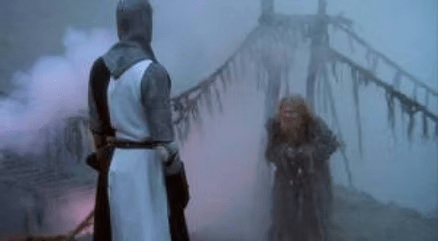
There each knight had to answer three questions to get across. Repeating the answers someone else gave did not work out too well. That is like reading a prayer from a book of prayers for all occasions, when sometimes it is best just to wing it and speak from the heart.
When God is in one’s heart, when the Christ Mind overrides an imperfect brain, and when the soul has been baptized by the Holy Spirit that means prayer is faster that a thought can be verbalized. It is known before a human brain could ever know what to ask for. This is what Paul meant by saying, “God, who searches the heart, knows what is the mind of the Spirit, because the Spirit intercedes for the saints according to the will of God.”
This is how God could ask Ezekiel, “Mortal, can these dried bones live?” and Ezekiel could only answer, “O LORD God, you know.”
If a Saint cannot answer a question posed by God, how can a Saint propose to ask God a question in prayer, without God already knowing the question?
Too often, our prayers are scripted. Too often our prayers are for personal wants and desires. Too often our prayers are public, rather than private and personal. And, too often we visualize what our brain thinks we want to come as an answer to a prayer, ignoring any possibility that the answer has been there before we prayed.
As a too often overlooked reading choice for a Pentecost Sunday service, it should be easy to see now how Paul is an equal to Ezekiel, as both were Saints in service to God. The symbolism of Pentecost is the maturation of the first fruits, where zombies are transformed into righteous examples of the way to be. Saints act like the twelve who were filled with the Holy Spirit, leading others to immediately cease being bags of dried bones in warm flesh and become alive with the Holy Spirit also.
Paul called it as it is, when he wrote to those like him who knew what it was like to be Saints. He wrote, “The Spirit intercedes for the saints according to the will of God,” and Paul and friends were Saints.
The call each week is not to be good, because no one really knows what that means. The call is to stop holding God and Christ at arm’s length, trying to keep you one of the living dead. The answer is not and can never be endless begging for forgiveness [misuse of prayer] because the brain’s will power slipped yet again. The call is to actually be a Saint – “hagios” in Greek – which means, “set apart by (or for) God, holy, sacred.”
No one is good enough to be that without God’s help. God knows we need help before we do.
The call then is to open your mouth and breathe in …. Receive the Spirit.
#zombiesofdriedbones #Pentecostreadings #Faith #Patience #FirstFruits #Saints #Romans82227 #Hope

 Explaining the Readings