Tag Archives: Fourth Sunday after Pentecost

1 Samuel 16:1-13 – Anointed to serve God

This reading begins with 1 Samuel 15:34-35:

Samuel went to Ramah; and Saul went up to his house in Gibeah of Saul. Samuel did not see Saul again until the day of his death, but Samuel grieved over Saul. And the Lord was sorry that he had made Saul king over Israel.

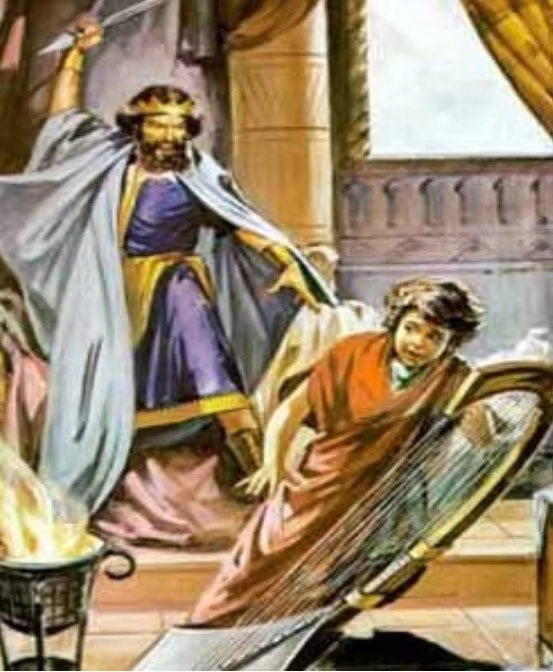
The Lord said to Samuel, “How long will you grieve over Saul? I have rejected him from being king over Israel. Fill your horn with oil and set out; I will send you to Jesse the Bethlehemite, for I have provided for myself a king among his sons.” Samuel said, “How can I go? If Saul hears of it, he will kill me.” And the Lord said, “Take a heifer with you, and say, ‘I have come to sacrifice to the Lord.’ Invite Jesse to the sacrifice, and I will show you what you shall do; and you shall anoint for me the one whom I name to you.” Samuel did what the Lord commanded, and came to Bethlehem. The elders of the city came to meet him trembling, and said, “Do you come peaceably?” He said, “Peaceably; I have come to sacrifice to the Lord; sanctify yourselves and come with me to the sacrifice.” And he sanctified Jesse and his sons and invited them to the sacrifice.

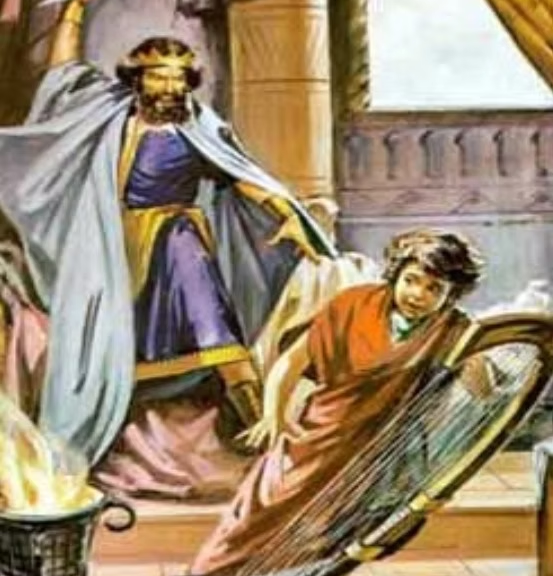
When they came, he looked on Eliab and thought, “Surely the Lord’s anointed is now before the Lord.” But the Lord said to Samuel, “Do not look on his appearance or on the height of his stature, because I have rejected him; for the Lord does not see as mortals see; they look on the outward appearance, but the Lord looks on the heart.” Then Jesse called Abinadab, and made him pass before Samuel. He said, “Neither has the Lord chosen this one.” Then Jesse made Shammah pass by. And he said, “Neither has the Lord chosen this one.” Jesse made seven of his sons pass before Samuel, and Samuel said to Jesse, “The Lord has not chosen any of these.” Samuel said to Jesse, “Are all your sons here?” And he said, “There remains yet the youngest, but he is keeping the sheep.” And Samuel said to Jesse, “Send and bring him; for we will not sit down until he comes here.” He sent and brought him in. Now he was ruddy, and had beautiful eyes, and was handsome. The Lord said, “Rise and anoint him; for this is the one.” Then Samuel took the horn of oil, and anointed him in the presence of his brothers; and the spirit of the Lord came mightily upon David from that day forward. Samuel then set out and went to Ramah.

——————————————————————————–

This is an optional selection from the Old Testament that is offered by the Episcopal Lectionary for the Fourth Sunday after Pentecost, Year B 2018. In the numbering system that lists each Sunday in an ordinal fashion, this Sunday is referred to as Proper 6. If chosen, it will next be read aloud in church by a reader on Sunday, June 17, 2018. It is important as it reflects how a true leader is anointed from within, due to one having been chosen by God to serve Him, because without that inner strength one will be influenced by the people to go against God’s will.

The fifteenth chapter of First Samuel tells the story of Saul as king of Israel, from his being the one anointed by Samuel to his failure to follow the instructions of the LORD, given to him by Samuel. Saul spared Agag, the King of the Amalekites, against the will of God. Saul also allowed his soldiers to keep the livestock of the Amalekites, against the will of God. Every living being was ordered to be destroyed.

When confronted by Samuel, Saul said, “The people took the spoils of livestock.” Wrong answer, as a king rules over the people, not vice versa. Saul had taken Agag as his spoil, rather than kill him as commanded. This failure by Saul caused Samuel to bring the captive Agag before him, to be slaughtered by Samuel’s hand and sword. Thus, when we read here, “Samuel grieved over Saul,” it was due to Samuel knowing that Saul would have to pay for his sins; and that is why Samuel would “not see Saul again until the day of his death.”  Saul was the proverbial “dead man walking.”

In the sixteenth chapter we read, “The Lord said to Samuel, “How long will you grieve over Saul? I have rejected him from being king over Israel. Fill your horn with oil and set out; I will send you to Jesse the Bethlehemite, for I have provided for myself a king among his sons.” This ability to communicate with God IS the true inner strength that a leader of people must have, otherwise one is no better a failure than was Saul. Samuel was able to hear God’s voice from a young apprentice priest, thus the elders of the Twelve Tribes called upon Samuel for guidance. Still, Samuel was then old and had no sons (literal or symbolic) who could fill his shoes and lead Israel as a judge.  This absence of an adult replacement made it necessary for God to provide for himself a king to serve His will over the Israelites.

When we read Samuel’s reaction to God telling him to go anoint a new king, his saying, “If Saul hears of it, he will kill me” was a reflection of how human beings in positions of power will react to threats against their power by striking first and asking questions later.  Samuel would not be the only prophet-priest afraid of crazed rulers, as Elijah would likewise run from Ahab.  Later in Samuel’s story we will see David hiding from Saul’s wrath.

Certainly, God was not asking Samuel to perform a second anointing of a King of Israel, when one was already serving in that capacity. Instead, Samuel would anoint the rightful heir to that throne, in a private ceremony, one between God and Samuel in Bethlehem.

Jesse (whose name means, “Yah[weh] Exists”) the Bethlehemite, was invited to a sacrificial rite that called for for all attendees to be sanctified (through ritual washing). Jesse was an elder in the tribe of Judah.  Other leaders of that town were also invited, along with their sons. In line with the ancient practice of the eldest son being given into priesthood, which had since been restricted to only those firstborn of the Levites, Samuel might have said he came to anoint a son known as special to God. Samuel might then have had several Israelite males of several fathers entering into a large tent, where he walked in front of them all.  Having gone by all, Samuel would then stop in front of Jesse, saying, “God chooses this father’s son.”

Whatever the truth that was told, when we read that the LORD told Samuel, “Take a heifer with you, and say, ‘I have come to sacrifice to the Lord,’” the heifer would have been one of those Saul took from the Amalekites. As can be seen in this map below, the path Samuel would have taken from Ramah to Bethlehem would have gone through Gibeah, where King Saul lived.  Saul would have been advised that Samuel was going south, through town, to anoint someone.

I imagine Samuel did not travel as a judge alone, instead traveling with an entourage of sorts, with priests and wagons that carried cloths and cups, et al, for a sacrifice and anointing.  Probably, there was a wagon for the heifer, to keep it ceremonially clean.  As a procession of vehicles moving through Gilbeah, he would have been stopped and questioned.  Taking a heifer would be key to unopposed passage.
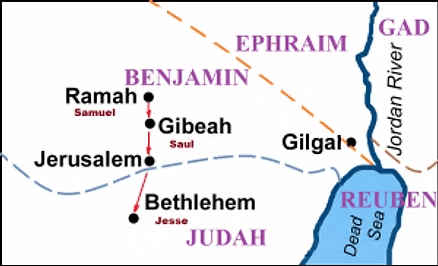
By taking a sacrificial animal that Saul knew guilt over (Amalekite livestock that Saul was ordered to kill, not take as a spoil), and by also knowing how Saul had said that sin was a problem easily solved by sacrificing the forbidden livestock in holy ritual to the LORD, Saul had no reason to halt that caravan.  All Samuel had to say (if asked) would have been, “Just getting rid of some of the king’s falsely obtained animals.”

The truth would have been told in that way. We do know that Samuel would not see Saul “again until the day of his death.” Still, their paths crossed, without them meeting, in each carrying out their respective duties. That would include currier communications, as needed.

When we read, “The elders of [Bethlehem] came to meet [Samuel] trembling, and said, “Do you come peaceably?” one has to recall how we discussed the elders going to Samuel asking him to “appoint” them a “king, to be like other nations.” Besides the fact that over a long “career” as a truly holy man of God, even as an old judge of Israel he was to be taken seriously.  The Israelites knew that when Samuel came to town, they probably had done something wrong and God had sent Samuel to punish them.

In this specific instance, all of Israel would have known that Saul was in big trouble with the LORD (over the Amalekites thing).  Soldiers from every tribe had taken part in that war, and one or two (at least) Bethlehemites had brought back a stolen goat or cow.  The elders were shaking with fear for having told Samuel to anoint Saul, who then disobeyed the LORD and allowed his soldiers to do likewise.  The elders felt that guilt, plus anything else their guilt caused them to tremble over.

When Samuel looked upon Jesse’s eldest son, Eliab, his reaction can be explained by the birth rank and the name. The name Eliab means, “God Is Father,” where the Hebrew word for God is “El.” For Jesse to give that name to his firstborn son, it makes sense to conjecture that Jesse did not claim to be the father of a son given to the LORD. Thus, Eliab might have come wearing a priestly tallit, which could have prompted Samuel to say, “Surely the Lord’s anointed is now before the Lord.”

Eliab was rejected, as God told Samuel, “Do not look on his appearance or on the height of his stature, because I have rejected him; for the Lord does not see as mortals see; they look on the outward appearance, but the Lord looks on the heart.” The Hebrew words translated as “height of his stature” (rooted in “gaboah qomah”) can equally state, “lofty height,” where this is not simply seeing the physical attributes of someone, but seeing the physical dress applied to one’s body. It becomes the basis for the idiom, “clothes make the man.”  This outward appearance will bring personal benefit to those who project special presence (either true or contrived); but God sees the heart of the individual and knows if appearance is pretense or a reflection of the true core being.

Eliab was rejected, as was his brothers Abinadab (whose name means “My Father Is Nobel” – a reflection of Jesse’s elevation to a position of respect in Bethlehem) and Shammah (whose name means “Waste” or “Astonishing Desolation” – a reflection of times of trial in Jesse’s life). Samuel saw seven of Jesse’s sons and all were rejected by God. As Samuel had been told the one to be anointed was a son of Jesse, Samuel asked Jesse, “Are all your sons here?”  That deduction found Jesse had not followed orders.

Jesse had not bothered to bring his youngest son, which means he was still a boy, not yet aged into manhood. The Hebrew word translated as “the youngest” (rooted in “qatan“) actually says “the least.”  That becomes a value statement, based on Israelite culture.

Children were not considered to hold any level of importance in the Israelite social structure, as they were like apprentices to adults. Thus the phrase, “Children should be seen and not heard.”  In ancient writings, children were mentioned generally (seen), but not named (heard).  Jesse did not follow Samuel’s instruction, because he assumed only adult males were invited.  However, that assumption proved the lack of an anointed one; and that omission was another example of how simple instructions (such as what Samuel told Saul about killing ALL of the Amalekites, not just most of them) went into the heads of the elders of Israel, coming out with convoluted changes due to ignorance.

When Samuel said to Jesse, “Send and bring him; for we will not sit down until he comes here,” one has to imagine how at least an hour of time had to have passed after that. Everyone remained standing, as punishment for not having paid attention to the simple instruction, “Bring with you all of your sons.”

A shepherd takes his flock to different pastures, day by day, and one could assume Jesse owned a few good pasture lands. One would presume the second to the youngest of Jesse’s son was sent to run and find David, having been the shepherd before him, and then bring David back. Keep in mind that both the son sent and David would have to be sanctified by water and priestly blessing, before being allowed into the tent when the ceremony was taking place. All that time the honored guests of Samuel stood and did not sit, all because Jesse did the thinking, but did it wrong.

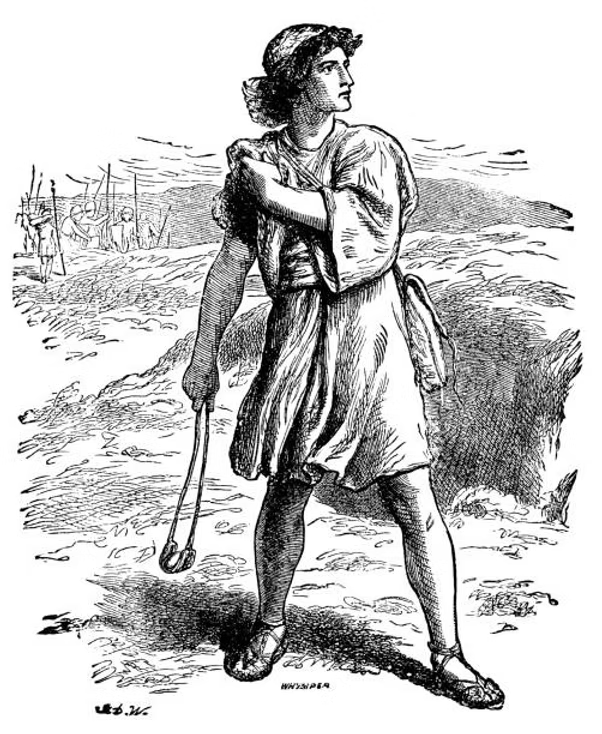
When David finally arrived and was inspected by Samuel, we read, “Now he was ruddy, and had beautiful eyes, and was handsome.” This is an outward appearance that was totally physical, which says the “least” of Jesse’s sons was good stock, as was the eldest, Eliab. Still, this was the appearance of a youth, of one who worked in the sunshine tending sheep. David most likely exercised as most young boys would, alone with his thoughts and imaginations, having no restrictions on how little to wear on a hot day.  So, he was red from sun, as well as fit and trim.

His “beautiful eyes” can be symbolic of his pure view of life, which had yet to become clouded with the pessimism and dissatisfaction of adulthood. As such, the LORD knew the heart of David was pure and devoted to his religious upbringing. That made David be the chosen one of God.

When we read, “Samuel took the horn of oil, and anointed him in the presence of his brothers; and the spirit of the Lord came mightily upon David from that day forward,” this says that the pure innocence of David, as a youth who delighted in knowing the stories of the Israelites and their Patriarchs, made him be chosen to serve the LORD. God knew the heart of Jesse’s youngest son before God came upon him.  Likewise, Samuel, as a youth given to Eli to be a priest, was pure innocence first, before being filled with the Holy Spirit and allowed to hear the voice of God.

The oil poured on the forehead of David was symbolic of his being likewise filled with the Holy Spirit. This is the meaning of “the spirit of the Lord came mightily upon David.” When one has this pure state of devotion first, then the next step is to be anointed with the Holy Spirit. It is not exclusive to Samuel and David.
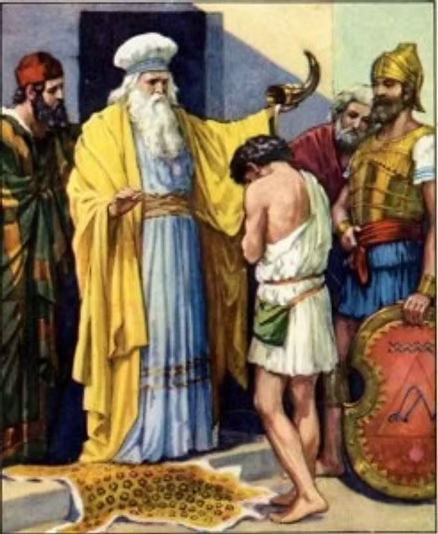
It should be noted that David’s name was not mentioned until after he had been anointed by Samuel. As a youth, in ancient writing etiquette, women and children were not named directly, because they were not deemed as self-sufficient, thus irrelevant. The naming here, as David, should be seen as a God-given name, more than the name given by Jesse to his last-born son. The name “David” is said to mean “Beloved,” but there are many who see the Hebrew root (dwd) as having other potential meanings. Some historians have struggled finding proof of a King David, despite his prominence in Hebrew texts. This might be a statement that “David” is a symbolic name, rather than a literal name, because “Beloved” was the state of being that told of a relationship (a marriage) between God and His wife (a human being), because one’s heart was pure and completely devoted to obedience and servitude to the LORD.

As a potential selection for the fourth Sunday after Pentecost when one’s personal ministry to God should be underway, it should be recognized how those chosen to serve God are pure of heart. An Apostle – Saint is called to be the “Beloved” of the LORD, and one serves God because of love, connecting one to the divine. For as obvious as that might be seen, the reality is how rarly such an anointing takes place.

The symbolism of King Saul is today found in the political-philosophical leaders of the world. In the words of the Billy Crystal character Fernando, on SNL skits, “You look marvelous.”
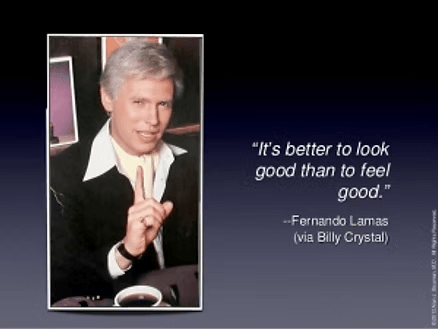
Many people around the world get down on their knees and pray to demigods whose outward appearance says to them, “Surely the Lord’s anointed is now before the Lord.” The word “Lord” is then whatever power they serve, be it a philosophy like Communism, Socialism, or Capitalism, or a religion like Christianity, Judaism, Hinduism, or Islam. The “elders” are those who command large groups that direct their followers to choose flawed leaders.

Since Samuel could not see the hearts of others, depending on the inner voice of God to correct his poor vision, anyone who follows his or her sensory organs in a quest to find a king who serves some principle one holds dear will fail.  We have become societies of lambs being led to the slaughter of negligence, simply by being seen as the spoils of war between evil rulers.  Few of us still have the purity and innocence of a youthful spirit that yearns to please God.  Few act as good shepherds these days.

Each Apostle knows the kingdom one serves is one’s own physical body. That body becomes the temple of the LORD when one’s heart is devoted to God, and made pure and innocent by the Holy Spirit anointing one in marriage to God’s love. Anything short of that will result in the ultimate failure – the recycling of or the loss of one’s soul. Those who fall short will hear the simple instruction to sacrifice their egos and seek marriage to God, only to turn that into convoluted changes due to ignorance. They will keep the spoils as they see fit; and then they will tremble in fear when their judgment time has come.

Ministry to the Lord means never having to ask God, “Do you come peaceably?”

Ezekiel 17:22-24 – A sprig from the lofty top

[The presentation shown on the Episcopal Lectionary site has this selection produced in song verse format. I have reduced that to prose, while maintaining their translation.]

Thus says the Lord God, “I myself will take a sprig from the lofty top of the cedar; I will set it out; I will break off a tender one from the topmost of its young twigs; I myself will plant it on a high and lofty mountain. On the mountain height of Israel I will plant it, in order that it may produce boughs and bear fruit, and become a noble cedar. Under it every kind of bird will live; in the shade of its branches will nest winged creatures of every kind. All the trees of the field shall know that I am the Lord. I bring low the high tree, I make high the low tree; I dry up the green tree and make the dry tree flourish. I the Lord have spoken; I will accomplish it.”

——————————————————————————-

This is an optional Old Testament selection from the Episcopal Lectionary for the Fourth Sunday after Pentecost, Year B 2018. In the numbering system that lists each Sunday in an ordinal fashion, this Sunday is referred to as Proper 6. If chosen, it will next be read aloud in church by a reader on Sunday, June 17, 2018. It is important as a narrowed excerpt from Ezekiel as it shows the metaphor present in the accompanying Gospel reading selection from Mark, where servants of God are compared to plants of the earth and their benefit to the lands where they are found.

This portion of Ezekiel 17 represents the final three verses that in total was a chapter where God spoke to His prophet about the fall of Judah and Jerusalem. The king of Babylon captured Jerusalem and disposed the Judean king, appointing a younger sibling (Zedekiah) to be king, after he signed an agreement to serve Babylon. That young king then went against that agreement, causing Jerusalem to be recaptured by Babylonian soldiers; and that was when Solomon’s Temple was destroyed.

God pointed out to Ezekiel how He had a prior “agreement” with the Israelites (which included the tribes of Judah and Benjamin). Therefore, these last three verses are “riddle” and “parable” [instructions from God to Ezekiel in verse 2] that tell about the reseeding of the land with those who will not have a Covenant of stone, but the Law written on their hearts.

The process of transplanting a cutting of a plant becomes similar to the prophecy found in Isaiah 11:1, which states, “Then a shoot will spring from the stem of Jesse, And a branch from his roots will bear fruit.” The same forecast of a replacement of God’s “chosen people” is made in both Ezekiel’s and Isaiah’s examples of horticultural metaphor. This would not mean a return from exile of the people from Judah, in captivity in Babylon, although their transplanted tree would grow in Babylon and then grow again in what used to be Judah. However, the prophecy is foretelling of Jesus and those who would follow him as Christians.

This parallels the story in Mark’s Gospel, where Jesus spoke of growth stages of grains and that of a mustard seed.  The similarity of this metaphor spoken by God to Ezekiel, where we read, “Under it every kind of bird will live; in the shade of its branches will nest winged creatures of every kind,” is practically identical to Jesus telling how the mighty mustard tree protects birds.

Mustard tree.
Cedar tree of Lebanon.

I have a cedar tree in my backyard and it is the home for many different birds and squirrels and rabbit have been seen running under its branches for safety also. Still, the points made by Ezekiel and Jesus are about one specific “tree,” one that “All the trees of the field shall know that I am the Lord.”

This means that when God told Ezekiel, “On the mountain height of Israel I will plant it, in order that it may produce boughs and bear fruit, and become a noble cedar,” that “tree” would be the true “religion” – “philosophy” – in a world of many religions and philosophies – that IS Christianity.  Still, “religion” or “philosophy” belittles the truth that is “noble” in that “tree.”

This means one must be able to remove the glasses of mortal being that sees the imagery of this “riddle” and “parable” as plants and birds, and put on the glasses of prophecy. Mortals see bird of many kinds as though all are living equally well under the branches of all large, protective trees. While that may be true in mundane life, it misses the spiritual point made by God stating, “In the shade of its branches will nest winged creatures of every kind.”

Those “winged creatures” are angels of the LORD, which means the “tree of Christianity” will be filled with those who totally serve God, as eternal souls saved. No other “tree’ in the filed can truthfully make that claim.

Under the shade of holy branches.

Certainly, in a world of religions, they all make their claims of superiority. Sheer numbers of believers can catapult Christianity, Islam and Hinduism to the top, in that regard. In a world of many different philosophies, where each becomes the guiding principles of a nation (the DNA of countries), the world’s most numerous adherents of central philosophical beliefs (and the laws thereby generated) can indicate the most popular are Democratic Republics, Communist-Socialist Regimes, and Totalitarian Dictatorships. However, the truth of the United States’ declaration that demands a separation of Church and State is that “religion” acts as the ideal, while “government” becomes the reality.

That reality is that nations bow down before themselves, as self-serving egos that scream, “My philosophy is better than yours.”  Never  do governments bow down before the LORD, much less to the gods they profess allegiance to.

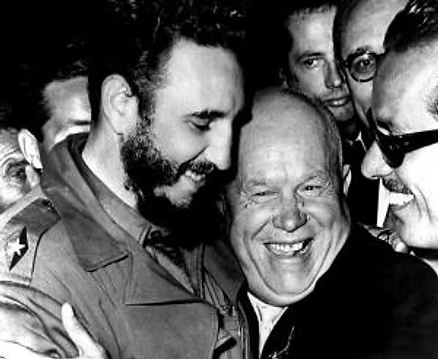
Comrades in arms at a U.N. get-together.

In the hidden “backstory” of Ezekiel 17, we read the ugliness of governments and their attempts to align with other governments, in pacts and treaties that seem mighty and strong. The adage, “The best laid plans of mice and men often go awry” is summed up now as, “I bring low the high tree, I make high the low tree; I dry up the green tree and make the dry tree flourish.”

The “high” trees that exist in the world now are the United States of America, Russia, and China. Others that seek equal status with those are Great Britain, France, Germany, Israel, Iran and others with nuclear capabilities. None of them consider themselves “high” because their total strength is based on their belief and devotion to the One God, but to the lesser god named “Nuclear weaponry.” All are exactly like the rebellious Judeans that God recalled to Ezekiel, who placed all their bets on the sharpness of their spears and the promised support of others who were paid to be in league with them.

Those plans went awry, as is the greatest flaw in humanity.  Alas, it is said, “Those who fail to learn from the mistakes of history are doomed to repeat them.”  And, the world does love reruns.

My two-lettered brother by another mother.

As history always will repeat (similarly) and one plus one will always equal two, the failures of Israel (a nation under one king), as also the failure of Israel and Judah (two nations under two kings), and also the failure of the resuscitated puppet that pretended to return to life – Hebraic Judea and Jerusalem of the Second Temple – those failures project the failures of the United States of America and the re-instituted State of Israel.  Any nation that proposed to have God on its side, but then acts as if there were no God that Saves, is doomed to fall by the hand of the godless.

It is a lesson that keeps on teaching.

That failure does not mean the “low” trees of other religions and governments will rise to the heights of being God’s newly chosen people. Instead, the meaning of “I make high the low tree” and “make the dry tree flourish” projects on individuals, those who refuse to follow the paths set for them by their government.  Governments will always come and go; but there will always remain those who love God so much they barely realize one dominating tyrant has been replaced by another.  Like seeds waiting for the right environment in which to begin new growth, they lay “low” until God commands them.

When this individual aspect is seen, the sprig from the “lofty top of the cedar,” which will be planted “on a high and lofty mountain,” that of “the mountain height of Israel,” IS Jesus of Nazareth.  God planted His Christ child to be the “low tree made high,” when disciples became true Christians – Apostles. Those Saints are the ones who has been truly filled with the Holy Spirit of God and reborn as Jesus Christ.

Each individual Apostle – Saint is then reborn in the name of Jesus Christ so he or she “may produce boughs and bear fruit, and become a noble cedar.” “In the shade of its branches will nest winged creatures of every kind,” which can now be realized as being the talents of the Holy Spirit – the powers of God given to His Son and his fruit.

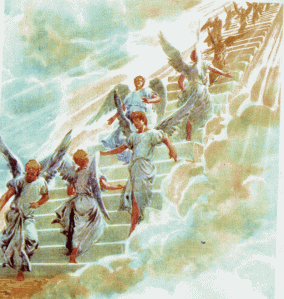
Under the Tree of God an angel gets her wings.

As an optional selection from the Old Testament for the fourth Sunday after Pentecost, when one’s individual ministry for the LORD should be underway, Ezekiel offers the metaphor of song, as the projection of what one should become in service to God. When one sees the Covenant with God as a written legal document, Satan will send in the lawyers that will offer leeway interpretations about what sins are allowable and what sins are clearly forbidden. When one listens to outside influences, then one will become as uncertain of one’s commitment to God, as have all governments whose people call themselves “Christian.” Christianity is not a club one joins and pays membership dues to a specific institution.
Christianity is ministry to God, in the name of Jesus Christ.

Even as I write these words, I can see many sheep of the political left, those who hate fellow Americans because they feel their neighbors have sinned by allowing the evil creature that is Donald Trump into the White House. Evil creatures are those who are perfect to serve in the capacity of President of a False Prophet nation.  America fits the billing as a “high tree” of self-value that will be made into a “low tree” when one’s individual Judgment Day comes.

The end of the world is when a mortal dies and one’s soul faces judgment for its mortal sins. Hating one’s neighbors (regardless of one’s political persuasion) is not only a sin, as it is a bold statement that says, “I am not in the name of Jesus Christ, because I cannot love my neighbor as myself.”

Paid for by those who sponsors of death of Christianity. A little truth goes a long way towards covering a lie.

In the days of Paul and the other Apostles, ministry was to go out and tell all the scattered remnants of Israel (the Northern Kingdom and the original nation under David) that the Messiah had come. “Jesus was-is the Christ,” they all went out to tell.  God did not promise a Savior to all the other nations of the world.   Instead, God ended that Old agreement with the ancestors of the Jews.

He did not promise a Savior for the nation that was Israel (the Northern Kingdom and the original nation under David). God promised a Savior for the original premise that led to His choosing human beings [all as flawed as the next] to serve Him as His slaves … His ministers … His teachers of self-sufficiency through Jesus Christ.

The spread of Christianity occurred because of ministers going out into the world producing the same miracles as did Jesus of Nazareth, in Judea and Galilee (and beyond).  That spread was deterred when “religion” became a tool of militaristic institutions that sought to control nations by their influence.  That spread ceased when heathens were massacred in “the name of Jesus Christ,” and conversion or death were the options.

Today, especially in this world so devoted to the Internet and technology, there is no need to go out into the world “preaching the Gospel.” First of all, few have any real capability to “preach the truth of the Gospel,” as the world has become overrun with mimickers and false prophets that memorize a few tidbits of Gospel Scripture and sell it to the highest bidder.

“Money is evil. Give me your money and I will protect you from evil.”

Second, our nation presently has a pastor-missionary under arrest in Turkey, who has been charged with being a spy for the United States of America. The reality of that situation (regardless of the guilt or innocence of that specific “pastor-missionary”) is the United States government (and its evil agencies of intelligence) has used the aspect of “ministry” as a way to get into hard places and subvert foreign regimes.  It becomes reasonable to think that a Christian evangelizing in a Muslim nation is there for the purpose of subversion.

Canadian couple imprisoned in China for spying. Every time something like this happens, it spears the word “Christian” with the stench of government.

Ministry is no longer about telling a world that already has an opinion about what “Christianity” is (real or imagined), as ministry today is about an individual being filled with the Holy spirit and living accordingly. Heal yourself before trying to heal anyone else!

Ministry today is having the world come to an Apostle – Saint, asking, “Why are you smiling in a world of misery?”

Ministry is not about the theatrics of “evangelism” or the solemnity of “ritual.” Ministry is about marriage to God, so His Son can be reborn into a willing sacrifice of self-ego. Ministry does not require a “sheepskin” from a seminary.  It does not require a building that has stained-glass windows, spires, bells, and pews.  Ministry is not an organizational position, as it is an individual commitment to God.

Because Christianity is not one’s decision, but God’s decision based on His knowing the heart of an individual, the growth required for a “sprig” to grow into a “noble cedar” can take decades or minutes. For it to take place quickly, one should expect a traumatic event, such as a near-death-experience, where the limitations of linear time have been overcome by an out of body experience and the future beyond mortal life has been seen.  For it to take decades, this should be understood: A ministry cannot wait long before it is squandered and lost.

Remember, if Israel could fail, so can all moral human beings. Saying one “believes” is as worthless as a signed contract, when a lawyer is always there, willing to tell one how to opt out of a commitment, without lasting repercussions. “Belief” cannot be agreed upon as promise.  Belief can only come from personal experience.  Being Jesus Christ is the only way one can truly believe in him.

The point Ezekiel made was that each servant to the LORD must be the “lofty top of the cedar.”  That means being in direct connection to God, with no “go-betweens.” This is where those in ministry are set into the world by God, so others can find their light. In a dark place, a light can shine a great distance without ever moving.

2 Corinthians 5:6-10, [11-13], 14-17 – The love of Yahweh urges us on

We are always confident; even though we know that while we are at home in the body we are away from the Lord– for we walk by faith, not by sight. Yes, we do have confidence, and we would rather be away from the body and at home with the Lord. So whether we are at home or away, we make it our aim to please him. For all of us must appear before the judgment seat of Christ, so that each may receive recompense for what has been done in the body, whether good or evil.

Therefore, knowing the fear of the Lord, we try to persuade others; but we ourselves are well known to God, and I hope that we are also well known to your consciences. We are not commending ourselves to you again, but giving you an opportunity to boast about us, so that you may be able to answer those who boast in outward appearance and not in the heart. For if we are beside ourselves, it is for God; if we are in our right mind, it is for you. For the love of Christ urges us on, because we are convinced that one has died for all; therefore all have died. And he died for all, so that those who live might live no longer for themselves, but for him who died and was raised for them. From now on, therefore, we regard no one from a human point of view; even though we once knew Christ from a human point of view, we know him no longer in that way. So if anyone is in Christ, there is a new creation: everything old has passed away; see, everything has become new!

——————————————————————————–

This is the Epistle selection from Episcopal Lectionary for the Fourth Sunday after Pentecost, Year B 2018. In the numbering system that lists each Sunday in an ordinal fashion, this Sunday is referred to as Proper 6. This will next be read aloud in church by a reader on Sunday, June 17, 2018. This is important as Paul makes it clear that Apostles do not know Christ from a human perspective, but from a personal spiritual identification, which allows them to see false shepherds that boast outwardly, without truly knowing Christ.

Omitted from this reading is verse 5, which states, “Now He who prepared us for this very purpose is God, who gave to us the Spirit as a pledge.” The word translated as “pledge” is “arrabōna,” where “a pledge” is like “a down payment,” as is “earnest money.” It is given with the expectation of continued payments, for a continued benefit.

This then leads to Paul stating, “We are always confident,” where such confidence is based on having been given the Holy Spirit of God. The word read as “confident” is used in a context of “boldness” and “good courage” (from “tharreó”). This means God is seated in their hearts of His chosen ones, and it is from that source that “good courage” comes. It is not any form of intellectual “confidence” intended here.

The courage of a lion is heart-centered.

The translation above can seem quite confusing when one reads how Paul said, “we are at home in the body.” It forces one to ask, “How else can one feel about one’s life, other than ‘at home in one’s body’?”

The words actually written in verse 6 are telling of the present tense of being, which is relative to the presence of a soul (spirit) in a body (matter). The Greek word “Tharrountes” (a capitalized first word stating importance via capitalization) means, “Being confident,” more than “we are confident.” As a mate to this present state of being, the Greek word “endēmountes” means, “being at home.” This together (where two commas state the importance of knowing – “eidotes” – that link confidence made aware in a body), Paul is stating the Holy Spirit being at home in the body is where all that confidence comes from.
By Paul writing, “We are away from the Lord,” the meaning is human bodies are separate and apart from the spiritual realm. Still, the Lord is present through the Holy Spirit having become one with the soul that gives life to the body. Thus, “we walk by faith” (where “pisteōs” is another statement of “confidence”), “not by sight” (a sensory mode of the body in the physical realm).

When Paul then wrote, “we make it our aim to please him,” this cannot be seen as an intention of one’s brain, as the word “aim” might imply. That word of translation (“aim”) was not written. Paul simply stated that regardless of being – either in-body (soul baptized by the Holy Spirit) or out of body (soul freed to the heavenly realm, via prayer, meditation, or eventual soul release through death) – the presence of God within one means one’s willing subjection to the Lord. One lives to serve God.  That represents a complete sacrifice of one’s self-ego, as a servant-slave to God. In that sense, the only “aim” is forever to please the Lord.

The translation that says, “For all of us must appear before the judgment seat of Christ” has to be read as furthering this statement of subjection to the Lord. The key word of this statement is actually set apart by commas, where “phanerōthēnai” is read as “must appear,” when it more accurately states, “be revealed.” Rather than a call “to appear” or “show up” as a volunteer, “all” who Paul wrote to (and himself and his own) had to go through a state of transparency before God. This means “all” of the sins brought forth by a soul in a human body “must be revealed” before God, as both confession and plea of repentance. This is one’s appearance “before the judgment seat” of the Lord.

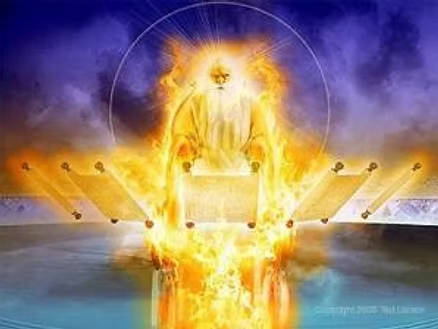
When we read, “the judgment seat of Christ,” it must be realized that God is our ultimate judge. When “Christ” is added, we can grasp in our minds that Jesus Christ sits at the right hand of God and through him all who will be saved must go. However, God sits upon the throne and only those who sit at His right hand are allowed into Heaven; and that means all Apostles-Saints are judged as worthy of becoming the Christ, when before God’s judgment seat in a human state of existence.

This means that the forgiveness of all sins transforms a flawed mortal with a dirty soul into a reproduction of Jesus Christ. To become Christ, one must have all sins expunged by God’s judgment, which is the baptism of the Holy Spirit. This in turn makes the “judgment seat” be one’s heart, where God sits upon the throne of His devoted subject, who is to be reborn as His Son Jesus Christ. This then says that Paul, all the Christians of Corinth, and any other Apostles and Saints forevermore have been and will be the same in spiritual character through God’s judgment; and this is “so that each may receive recompense for what has been done in the body, whether good or evil.”

When Paul then states how Apostles and Saints know “fear of the Lord,” the Greek word “phobon” can translate as “fear, terror, alarm,” but also “reverence” and “respect.” The use of “fear” is more the “sense of awe” that comes from knowing the presence of God within and never wanting that presence to cease.

This means that Paul saying, “we try to persuade others” is not in any way an attempt to talk someone into believing in God and Jesus Christ (through some intellectual attempt to persuade), but instead the Greek word “peithomen” states the “urge” within one to answer any question that others might have about God and Christ, so they can likewise come to know the confidence of an Apostle-Saint, on their own terms. In no way does “fear of the Lord” mean that a disciple should coerce someone to believe in God and/or Christ, by such means as predicting God’s judgment for evil deeds done that may go unforgiven.

God gave Man (males and females they made them) the gift of free will, prior to God sending a Savior to save Man from the sins that will come freely.  Man, therefore has the right to reject God, Christ, and good, as a decision made by the self.  Fear, as an emotion that can become used to enslave mankind by Satan, will never be present in Apostles and Saints as what led them to serve the Lord.  Once they have personally known God within, then a fear of losing that presence is a motivator to remain loyal to God.  Fear of the Lord is no longer a fear of punishment by God, but a fear of losing Salvation that has been gained.

In that regard, Paul wrote, “we ourselves are well known to God, and I hope that we are also well known to your consciences,” as a reminder that none of the Christians in Corinth, who became Apostles after having meeting Paul and his fellow Apostles, were told to be Christian “or else.” Instead of reading “pephanerōmetha” as “ourselves well known” [“to God” is prior in a statement ending with a period and not part of this statement], Paul simply pointed out “we have made ourselves clear.” That “clarity” is then hoped “to have been made clear” in the “consciences” (or “moral judgments”) of those true Christians in Corinth. While Paul and partner(s) did not make a “hard sell” of what to believe, they made sure all the questions the Corinthians had were satisfactorily answered, so those who were seeking the truth could make their own moral decisions regarding God and Jesus.

By Paul writing, “We are not commending ourselves to you again, but giving you an opportunity to boast about us,” he was saying his letter was not intended to make a “follow-up sell,” because Paul knew one who becomes a Saint will not backslide … because of a “fear” of losing redemption and the presence of God within. Instead, his epistle would serve to enhance the faith of those converted, while giving those who are disciples needing more answers an opportunity to hear from Paul, knowing the truth he tells matches the truth told by the Corinthian Christians. The word stating “boasting” (written “kauchēmatos“)is then used in the context of giving glory to God as exultation to be shared joyfully.

This ability to point out how to recognize one who is truly filled with the Holy Spirit, where one is worthy of boasting about, then serves the purpose of separating the truth from the lies. Paul added, “So that you may be able to answer those who boast in outward appearance and not in the heart,” which was a statement of false shepherds as well as those who want to say they are filled with the Holy Spirit but have not yet made a total commitment to God. That totality of commitment is made in the heart, which is the love center of the body. It means only those who have indeed felt the presence of the Lord within them, through marriage to His Holy Spirit, as one’s baptism of the soul, can give a seeker ALL the answers one is seeking to find. Those who have not yet become married to God, as His faithful subjects through self-ego sacrifice, are then unworthy of boasting about, because they can only offer Scripture as the answers, when Scripture becomes the source of the questions.

When Paul then wrote, “For if we are beside ourselves, it is for God,” “beside ourselves” (from the Greek root “existémi”) implies “astonishment.” Still, it has the connotation of “being out of one’s mind, mad” and “removed from a standing position.” In the written text, following the comma after “besides ourselves,” is simply the word “Theō,” which says, “to God.” This means the “astonishment” that comes from the presence of God within one comes from having sacrificed one’s self-ego and then taking a position that is “removed from expressing self concerns.” One becomes “amazed” by the way God leads one to act in ways that were previously unnatural to self (soul in a body of flesh in a world of temptation), because God has one act as His Son, Jesus Christ, absolutely free of sin.

The translation that has Paul offering, “If we are in our right mind, it is for you,” the translation of “sōphronoumen” as “right mind” means, “sober-minded” and “exercising self-control” (as well as “of sound mind”). This, then, becomes an extension of being “removed from a standing [typical human] position,” when Apostles and Saints must exercise self-control” by their marriage to God and the submission of self that demands.

As such, by saying “it is for you,” the only purpose for an Apostle or Saint is to serve others as God’s chosen ones. The can never be any self-glory or self-aggrandizement coming from being God’s chosen people, as all honor and glory is God’s alone, for having sent His Son into the world to save others from their sins. Salvation means the sacrifice of self, in complete and total service to the Lord, for the benefit of others. As Paul was writing to other Apostles and Saints, the purpose of all his epistles were for that purpose; and that is how his letters still serve the Lord today and beyond.

Paul next supported this by stating, “For the love of Christ urges us on, because we are convinced that one has died for all; therefore all have died.” The first part of that says that sacrificing a love of self has brought about the love of God, which is a consummated love that bring the Christ Spirit into one’s being. There is no love lost for having made that sacrifice, because Christ becomes the presence of love that is all motivating. This presence is not an act that convinces one (as the Greek root word “krinó” is better translated as “a good judgment,” whereby the presence of Christ’s Spirit is based on the merit of self-sacrifice, due to love of God), but a foregone “conclusion.” That conclusion is that Jesus Christ died so his spirit could be freed to be duplicated in ALL Apostles and Saints. For that rebirth to occur, ALL who will receive a “love of Christ” must likewise die of self. This is not a physical death, but the cleansing of one’s soul by the baptism of the Holy Spirit. Christ, as the Son of God, cannot be reborn into any selfish (thus sin retaining) soul.

Paul then reinforced this point as he addressed the true Christians of Corinth by saying, “therefore all have died.” Saul died and became Paul. Jacob died and became Israel.  Abram died and became Abraham.  Every Apostle and Saint has equally been changed the same, sacrificing their birth name for that of Christ. Apostles of Christ all understand the truth in those words because they all know the love of Christ. With that they all know the urge to have Jesus Christ be reborn in others, so they serve God in that capacity. Because they have all died of self, they have no one else to serve, nor do they seek to serve anyone other than God.

To advance this universality of dying in self, Paul added, “And he died for all, so that those who live might live no longer for themselves, but for him who died and was raised for them.” This says that all mortals are sinful souls born into temporal bodies, where that flesh will die. Without the soul being cleansed by the Holy Spirit, every soul is born to die and repeat, through reincarnation. God sent His Son into this world for the purpose of giving life (from the Greek word “zōntes”) to that which had previously faced mortal death. Those “who live” will be given life through becoming Jesus Christ (“no longer themselves”). That requires the baptism of the soul by the Holy Spirit and the surrender of the self-ego as the death that allows Jesus Christ “to rise again” (from the use of the Greek word “egerthenti” – “having been raised again”).

This sense of death is then why Paul wrote, “From now on, therefore, we regard no one from a human point of view.” The word translated as “human” is “sarka,” which means “human nature,” but also “flesh” and “body,” alluding to one’s sense of “personality.” This is a confirmation of self-ego, where the body of flesh acts as the “point of view” for the spiritual soul. When the soul has been freed from the limitations of its temporal body, it no longer is “near-sighted” in “regard” (from the Greek word used, “oidamen”) to that body.

This foundation is why Paul then stated, “Even though we once knew Christ from a human point of view, we know him no longer in that way.” The “human point of view” is that Jesus of Nazareth walked the earth of ancient Israel, as a human being, a man born of a woman. Those who followed him then told how he was killed by being hung on a cross, and then buried in a tomb, from which he rose and walked again among his disciples, until he ascended into heaven.

That story of Jesus of Nazareth cannot garner true believers that the man was in fact the Christ, simply because of the same reasons human beings discount ancient stories of gods and heroes. We call such stories mythology; and even though good ideas, principles, and concepts can be gleaned from myth, it still does nothing to lead human beings today to a belief that is based on personal experience.

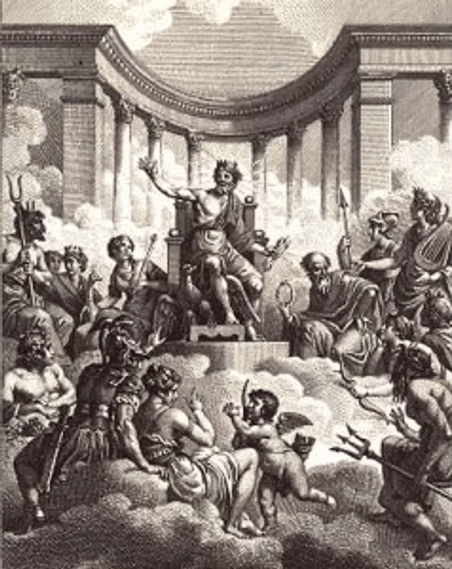
Imagery of some Olympians. prior to the I.O.C. putting them in athletic shorts.)

In the Episcopal Church’s Eucharistic Prayer A, the celebrant leads the congregation with the words, “Therefore we proclaim the mystery of faith,” to which all recite, “Christ has died. Christ is risen. Christ will come again.” This has to be recognized as a statement of faith that is past (“has died”), present (“is risen”), and future (“will come again”). By stating faith in the present tense, “IS risen,” the present says ALL who proclaim that “mystery of faith” ARE the risen Christ. It is not a reflection back to the good ole days when witnesses said they saw dead Jesus of Nazareth walking around, letting disciples feel his wounds, while he ate broiled fish. That would be a proclamation of belief of a past event, as “was raised.”

The Apostles of Jesus Christ, as him reborn in the present time, can then know that “Christ will come again,” as there is no end to that resurrection.  As long as there are Saints with personal experience of “Christ being risen” around to answer all questions posed by seekers of the truth, Apostles and Saints are always present.  To confess “we await his coming in glory” (Episcopalian Eucharistic Prayer B), as if one is stating a belief that Jesus never has returned (not even in the first Apostles, or Paul, or any other Epistle writer), while we believe he is promised to return … some day … at an unknown time in the distant future … maybe … that is a complete misunderstanding of the return of Jesus Christ.  Christ returned at 9:00 AM the day after he Ascended (on Pentecost).  He has remained on earth, through Apostles and Saints, ever since.

When one has this personal experience of Jesus Christ, while one’s soul still resided in human flesh, then one can never return to a time when the historical figure known as Jesus of Nazareth is how one knows he was Jesus Christ. This is how true faith is not a lesson in rote memorization and saying what others have told one to say. Belief can only come from personal experience; and once one has experienced the Holy Spirit and God’s presence within, then one truly knows the resurrection of Jesus Christ.

Paul then stated, “So if anyone is in Christ, there is a new creation.” The words “en Christō” are correctly translated to state “in Christ.” This is a clear statement of the condition (“If”) that “anyone” who is a human being with a soul is “with Christ,” then that one’s soul has been cleansed of sins. That soul then becomes “in Christ,” as a statement of sacrifice and salvation. The old self has then become transformed into a “new creation.”

The use of the Greek word “ktisis,” meaning “creation,” brings out the divinity of all “creation,” as God’s work. Therefore, one is “in Christ” only through the grace of God, and not by self-will; and “in Christ” is the same as “in the name of Jesus Christ,” where Jesus is the human name and Christ is the divine presence that joins the material to the Spiritual … the body to the blood of Christ.

This selection from Paul’s letter then ends by his writing, “Everything old has passed away; see, everything has become new!” The use here of “Everything” is a paraphrase, where the actual text simply says “old things have passed away.” The Greek word “archaia” can be better stated as “the original,” or “the primitive,” which has to be seen less in light of “things” and more as the “old self” that has passed away. This then leads to “the original” having “emerged anew” (the text written – “gegonen kaina”), where the same old soul has been given new life by God’s love.

As a selection presented on the fourth Sunday after Pentecost, when one’s personal ministry to the Lord should be underway, the beauty of Paul’s words go deep into what brings about true ministry. It is the depth of meaning that comes from his words that fill the hearts of Apostles and Saints with the joy of realization: “Yes! Yes! That IS the way it is!”

Such amazement and astonishment can only mean that Paul the human being did not originate these words, but his hand was moved to write the precise words that God called upon him to write. Only one who is equally filled with the insight and wisdom of the Holy Spirit can grasp that beauty and understand completely what his words state.  A true seeker of truth will be called to investigate this depth.  A true Apostle will be called to help others look to see this depth.

This selection states how ministry in Christ is for the benefit of others. It is to provide answers to natural questions, which are more than surface quotes of Scripture. For one to come to the personal decision to forever let one’s self-ego die, to be in the name of Jesus Christ, one has to have the truth be told that will guide them to that decision.

When one who does not have God in one’s heart tries to lure the innocent to an addiction that demands one listen to a false shepherd for guidance, then one will eventually find reason to disbelieve.

That too comes by personal experience. This means an Apostle and Saint will always have God in their hearts, so the truth can be told.

The truth might be told in words that are difficult to make sense of immediately … while standing in front of the speaker; but the truth becomes planted like a seed that grows and grows. Paul’s epistles are then like the mustard seeds of which Jesus spoke in the Gospel of Mark (which this reading accompanies). Paul wrote in spiritual wording, where only tiny particles seem to make sense. However, when planted in fertile ground, his words take root and spreads within one’s flesh, as personal awareness that proves true to the self.  One then grows into a large tree, under whom others will find a home.  A home that has a heart that welcomes questions.

Mark 4:26-34 – Realizing the kingdom of God

Jesus said, “The kingdom of God is as if someone would scatter seed on the ground, and would sleep and rise night and day, and the seed would sprout and grow, he does not know how. The earth produces of itself, first the stalk, then the head, then the full grain in the head. But when the grain is ripe, at once he goes in with his sickle, because the harvest has come.”

He also said, “With what can we compare the kingdom of God, or what parable will we use for it? It is like a mustard seed, which, when sown upon the ground, is the smallest of all the seeds on earth; yet when it is sown it grows up and becomes the greatest of all shrubs, and puts forth large branches, so that the birds of the air can make nests in its shade.”

With many such parables he spoke the word to them, as they were able to hear it; he did not speak to them except in parables, but he explained everything in private to his disciples.

——————————————————————————–

This is the Gospel selection from the Episcopal Lectionary for the Fourth Sunday after Pentecost, Year B 2018. In the numbering system that lists each Sunday in an ordinal fashion, this Sunday is referred to as Proper 6. This will next be read aloud in church by a priest on Sunday, June 17, 2018. This is important because it presents a progression of analogies that use plant growth to explain the kingdom of God. Each of these becomes stages of development in human beings who become individual kingdoms of God, as was Jesus of Nazareth and are all Apostles and Saints.

It has become my belief that the parables told by Jesus were less random than they appear. To read chapters of Matthew and Mark (which both tell of the parable of the mustard seed) one could envision Jesus sitting calmly on a hill overlooking the Sea of Galilee, like a guru, and crowds of people would wander up, just to listen to Jesus speak in parables. The lack of clear verbiage that includes important timing elements (for example, “after a few days,” or “a week later”) causes the reader’s mind to think everything happened back-to-back-to-back, quickly, with little time between each parable told.  One’s sense of timing is thrown off.

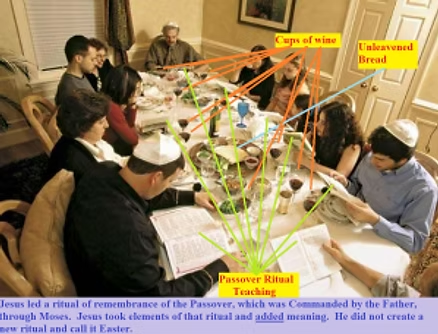
As such, non-Jews read of the Seder meal ritual without a clue about that event.  The Seder ritual (actually on two night, back-to-back, beginning the Passover festival) lasts hours, beginning after 6:00 PM and ending when the men have passed out drunk on Seder wine, late into the night.  That fact being unbeknownst to Gentiles-turned-Christians makes them read the words of the Gospels and think Jesus offered bread and wine in rapid succession. That was not the case.

Matthew and Mark, being Jewish and writing their Gospels primarily for Jews (in their brains), did not have any notion of Gentile Christians drawing wild conclusions about their words of Spiritual inspiration.  Their words (in their brains) would easily be discerned by Jews who accepted Jesus as their Christ, having all experienced Passover Seder meals all their lives.  The assumption would be that time lapses as time lapses, but the words of inspiration focus only on the important parts.  In this way, all the Gospels are written as parables, where full understanding requires more than simply listening to a story being told.

That dawning within my mind then tells me that when we read in Mark 4:1, “Again Jesus began to teach by the lake. The crowd that gathered around him was so large that he got into a boat and sat in it out on the lake, while all the people were along the shore at the water’s edge,” this was on a Sabbath. Jesus (according to Matthew 13:1) was teaching, as a rabbi. By going beside the lake, he was speaking outside the synagogue, but he taught in the same manner. The crowds followed him because pilgrims were gathered (and increasing in numbers) and the synagogues might not have been large enough to accommodate them all. This would mean Jesus went out for the purpose of teaching on a Sabbath, which is why his disciples Matthew and Peter (his story told through Mark) were there to assist his ministry.

When I read one parable after another, the missing link is Scripture from the Torah that would bring about a question requiring a teaching answer.  That answer would be told by Jesus in parable form. To cover readings from different scrolls and different verses of Scripture (like we have the Episcopal Lectionary schedule of readings), then explaining them as a sermon or statement designed to elicit questions, Jesus spoke in confusing words that required deep thought and reflection.  Follow-up questions become automatic when teaching in parables.

Then why would Jesus take their minds away from the lesson just told by going into another riddle to solve? This is how many chapters in Matthew and Mark read – back-to-back parables.  The answer in my mind is to grasp how we are misreading because of a lost sense of timing.  Rather than read everything as happening on the same day, it is possible Jesus would go by the lake each day and teach the meaning of Scripture, which is the case in some chapters.  Still, it makes more sense that Jesus would let each parable settle in by giving a week for the devoted to ponder each lesson – Sabbath-to-Sabbath. Without that clearly stated by the Gospel writers, we are led to assume differently.

In reference to a potential reading (in a synagogue a scroll would be taken from a case of scrolls and read aloud), the holiness of Jesus meant he could recite the scrolls through the Mind of God. Exodus 19:5-6 is then quite possibly the reading recited. It states (verse 6, spoken by God to Moses at Mount Sinai) “’You will be for me a kingdom of priests and a holy nation.’ These are the words you are to speak to the Israelites.” This reading would be why Jesus would begin speaking as a rabbi to a gathering of Jews (Israelites), telling a parable about this “kingdom of God.”

On the Jewish Encyclopedia website, in an article posted by Kaufmann Kohler, entitled “Kingdom of God (Malkuta de-Adonai),” the author made the following comments:

“The Hebrew slave who declares his wish to be a slave for life has his ear pierced, because “he casts off the yoke of God’s Kingdom to bend to the yoke of another sovereignty” (ref.). The yoke of God’s Kingdom—the yoke of the Torah—grants freedom from other yokes (ref.). Especially was it the principle of one party of the Hasidæans, the Zealots, not to recognize as king any one except God (ref.)”

In another article on Jewish Encyclopedia, entitled “Hasidæans” (by two authors), the statement is found that says, “Grätz (ref.) supposes them to have developed out of the Nazarenes[a first century – post Jesus sect, believed to have been headed by the Apostle Paul]. After the Maccabean victories, according to Grätz, they retired into obscurity, being plainly dissatisfied with Judas Maccabeus, and appeared later as the order of the Essenes—a theory which is supported by the similarity in meaning between Ἐσσηνοά or Ἐσσαῖοι (= Syriac stat. absolute , stat. emphat. , “pious”) and “Ḥasidim” (“pious”), and which has as many advocates (refs.) as opponents (refs.).”

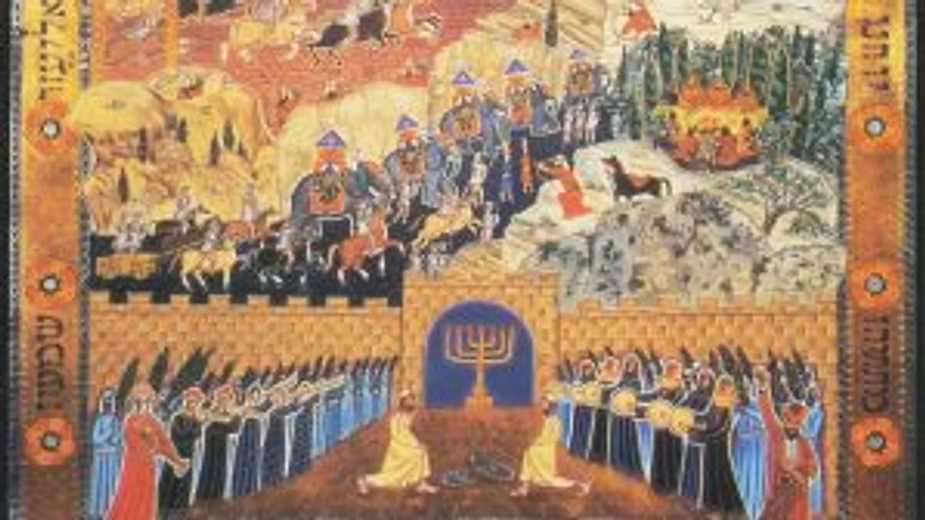
The Feast of Dedication or the Festival of Lights (a.k.a. Hanukkah) was due to the Maccabean revolt.

This points at Jesus (called a Nazarene), who led the Passover Seder with his disciples in the Essenes Quarter of Jerusalem, in an upper room. As Jesus was certainly “Pious” and of a separate sect from the Pharisees and Sadducees (and had a disciple known as Simon the Zealot), one can deduce that the typical Jews would have been very much in the dark about what the Kingdom of God meant, because the Pharisees, Sadducees and Second Temple hierarchy heavily influenced what would be taught in the synagogues. What they did not know, the people knew less about.  Because many questions went unsatisfactorily answered, many seekers were led to seek Jesus for guidance.

It was common to have individual Jews proclaim to have Messianic talents, based on possessing bravery and a willingness to lead a revolution that would overthrow foreign overlords and retake the kingdoms of Israel and Judah. The Jews had rebelled against oppressive rule from Roman emperors and surrogate kings and governors, including the Maccabean revolution. Jesus would then not be one to take a position that God’s “kingdom” would be ruled by anyone other than God, such as one leading a revolt against the Roman Empire, nor the elevation of the Temple’s elite as replacement rulers.

The conflict of being exiles who had returned to their old lands, without the strength of a national military at their disposal, and the history of having lost two lands under native kings who made poor decisions militarily and spiritually was causing seekers to ask, “What does God expect of us Jews in the kingdom of God told to Moses?”  The Israelites had thought Israel was that kingdom – a physical realm – but Moses never set foot in the Promised Land of Canaan.  “Where was the kingdom of God to Moses or what else could it mean if it wasn’t a nation ruled by a king devoted to God?” were a undoubtedly questions posed.

Knowing this background makes it easier to see how a “kingdom” can then be referred to as “seed on the ground.” This equates “the ground” to the Galilee and Judea, where Jews were the “seed” at the time of Jesus, sown amid Persian, Greek, and then Roman weeds.  As such, “the ground” acted as a “nation unto God,” in the sense that it was an area of land that made God the owner, having scattered seed believing in Him. God would certainly cultivate that “kingdom,” so the land will yield fruit and become a worthwhile investment. Otherwise it would be fallow.

In Exodus 19:5, God told Moses, “Now if you obey me fully and keep my covenant, then out of all nations you will be my treasured possession. Although the whole earth is mine.” The seed can then be seen as God’s chosen people, those who maintained the Covenant given to Moses. Since God possessed the whole earth, the most “treasured nation” would be where God’s seed was sown. As God owns all the earth, the treasured nation is anywhere He will spread “a kingdom of priests and a holy nation.”

This then became Jesus speaking of “seed on the ground” as being purposefully placed into the earth, at which point patience is required. This period of wait is then said to be, “sleep and rise night and day.” Again, because one understands that Jesus is speaking in parable (“a simple story used to illustrate a moral or spiritual lesson, synonymous with allegory”), “sleep and wake night and day” must be read as a symbolic statement, more that the simplicity that one plants seeds, then goes to sleep and wakes up to find a plant has sprouted. It immediately evokes a meaning of patience being required, which all farmers know.

Because the topic is the kingdom of God, and because the Covenant through Moses initiated that thought, Jesus was then discussing a lesson that dated back at least fifteen hundred years.  In that regard, “sleep and rise” should be seen as metaphor for reincarnation.

God spread the seeds on the earth that would experience periods of devotion, followed by periods of neglect. The number forty comes up a lot, as the “sleep” that would fall over the chosen people, until they would cry out to the Lord for help. That would be followed by forty years of “rise.”

Those periods can then be seen as times living in the darkness of death (“night”), followed by times of the light of truth guiding them to life (“day”). The symbolism can also reflect on the type of seeds planted, as some had lunar cycles and grow under the soil (root crops), while other seeds are planted to solar cycles, which grow above the soil (grains and vines). God’s nation of priests is then being inferred to be seed that is required to “rise” into the light of “day.”

This means when Jesus said, “the seed would sprout and grow,” that was the history of the Israelites, including the split into two nations, both their falls, the scattered remnants and the exiled Jews, which returned to the lands they had lost. All were the seed that had sprouted and grown, but the totality of that growth was still incomplete. The seed still had not grown fully into a “field” of priests.  The kingdom of God still had not been fulfilled.

When Jesus then said, “he does not know how,” this translation makes it difficult to grasp. As a run-on from “and the seed would sprout and grow,” it is difficult to understand the pronoun “he.” To think “he” is God, as the planter not knowing, it totally confusing because God knows everything.

The solution comes from realizing the Greek word “autos” (translated as “he”) should be read as “it,” referring to the “seed.” The planter sows the land and then patiently waits, which is God. The seed, however, sprouts and grows but does not know how its growth is supposed to be, or when it will reach fruition. The seed does not know if it should grow according to the moon or the sun. The seed does not know it has died and been reincarnated many times over, still little more than a sprout or a stalk.

This is then a statement that reflects on a lack self-ego in the seed of the Lord. Just as a seed does not first develop a brain, from which it plans and maps out its own future development.  It just grows; and so too will all of the seed of God’s kingdom.

In the masculine pronoun translation, “he” becomes the perfect reflection of the ultimate seed growth, which is matured as Jesus of Nazareth.  That seed did not know how, known by Jesus saying “he” did not speak for himself, but for the Father. We do not learn “how” to get to the kingdom of God by the intellect of Jesus; but we see the path “he” took in total sacrifice of will and subjection of self.  His path is the same as ours – where “we do not know how.”

When Jesus then said, “The earth produces of itself,” this is the agricultural truth that good soil makes for better plant growth. Jesus would tell a parable about hard, rocky earth and seeds falling into cracks, as well as weeds trying to choke out good seed; so, the metaphor of the earth is that it represents all that is on the material plane. Our bodies come from dust and our fetuses are growths in our mother’s wombs. Life for plants comes from the nutrients of the ground, the water made available, and the light (and warmth) provided. This means that a kingdom of the earth produces realms that know nothing of spiritual matters or the breath of life from God.

When Jesus then said the plants produced by the earth follow this pattern: “first the stalk, then the head [or ear], then the full grain in the head [or ear],” this says growth comes in phases. As far as the kingdom of God is concerned, the stalk is a commitment to the Law of Moses. It is the state of the student or disciple, where actions become the result of commands. A field of stalks can resemble the spears of soldiers standing in formation, awaiting orders.

This then leads to the development of heads, where the symbolism is the rabbis and other leaders who have memorized rules and procedures. An obedient soldier grows into a leader of other soldiers, while still needing higher commanders before acting. A disciple becomes a rabbi, which need not be more than teaching one’s children as one was taught by a father when a child.

The final stage is then the development of reason that begins to understand the order and structure of things. It becomes the “aha moment” of an epiphany, which then supplies nourishment to others, as well as new seed for new growth in another season. It is when the child asks a question that had always been asked before, but never answered, due to a lack of knowledge. Suddenly, a question causes words to fill one’s mouth with answers never thought possible. The disciple-turned-rabbi has become an Apostle of God.

Still, through these three developmental stages, the plant is not at liberty to remain for long in that ultimate state of existence. That requires death. This is when Jesus said, “When the grain is ripe, at once he [God] goes in with his sickle, because the harvest has come.”

This says how one enters into the kingdom of God. The state of being “ripe” is when a priest of God has evolved from rote memorization and compliance to rules into one who has full ownership of ministry. The sickle then represents the cutting away of the self and one’s dependency on ego for survival in a world that produces of itself, letting one’s soul become the harvest God intended originally and waited patiently for it to come into ripeness, as baptized by the Holy Spirit.  This can be seen as why Jesus commissioned his disciples to go tell the Israelites, “The kingdom of God has come near.” (Matthew 3:2; Matthew 4:17; Mark 1:15)  It was in Jesus, and through him it was in them.

When one sees this explanation of what the kingdom of God means, as being those who have been sown by God and developed into ripe grain (or fruit), the harvest is synonymous with those who may enter God’s kingdom. Even though Moses had been told by God to free the descendants of Israel from slavery in Egypt, so they could become His seed, simply being a seed does not automatically grant entrance for one. The parable leading to the fullness of purpose that the seed has within it – becoming ripe grain – is the harvest God is patient to receive. Stalks and immature heads [or ears] can experience drought, disease, pestilence, or be choked out by weeds and never reach that final state that is worthy of harvest.

While that analogy could be heard and understood as a large field of ripe grain (or a vineyard of grapes), where the harvest was bountiful and plenty, Jesus then quickly offered a comparison. The comparison of the kingdom of God was then not made to a large quantity of grain, but to one tiny mustard seed. The kingdom of God was then compared to the individual and not the collective.

By Jesus then explaining the mustard seed as, “When sown upon the ground, is the smallest of all the seeds on earth; yet when it is sown it grows up and becomes the greatest of all shrubs, and puts forth large branches, so that the birds of the air can make nests in its shade,” this becomes metaphor for himself. The “smallest of all the seeds on earth” is a statement about his lack of pretense and pedigree, in the sense that he was known as a Galilean (a rube, or country commoner), as a Nazarene (from a small town with no prophecies of greatness), and as the son of a carpenter (not a priest, scribe, or prophet of the Temple, and certainly not of royal birth). Still, as Jesus’ ministry was underway, he was producing miracles, teaching the meaning of Scripture as no other rabbis were, and he was drawing larger and larger crowds of Jews wanting his experience what Jesus offered.

When we read, “the birds of the air can make nests in its shade,” this was metaphor about the disciples – the twelve ranking disciples and all the family who knew Jesus and had been touched by his presence. These would be under the protective arms of Jesus the Christ. They would, as well as all who sought the safety of the Jesus branches, become Apostles, touched by the Holy Spirit. This then makes a statement about the difference between “birds of the air” and one mustard seed.

When Jesus compared one mustard seed to the kingdom of God, with his being as that mustard shrub fully grown, the state of Jesus Christ is then the comparison to the kingdom of God. It means that each individual is a seed planted by God on the earth, which is planted in good soil – that which will offer the growing seed the nourishment of teaching that will lead it to seek shelter in Jesus (Christian religious thought, through churches and education). That sprout-stalk will begin to develop an immature Spiritual mind (a human brain), seeking to absorb more knowledge (Bible studies, seminary enrollment, reading books explaining Scripture, etc.). That effort will be seen by God and the seed will develop into one ripe for God to enter into that one’s heart. The result of that marriage is the mustard shrub as become one with harvested fruit, so the kingdom of God is found within, not some distant place far, far away.

When reborn as a mustard shrub, one becomes just like Jesus Christ, as a place for refuge to others. Simply by being filled with the Holy Spirit, willing to welcome all who come to find the truth and to have an effect on the healing of others, Jesus Christ is then working through one’s being. One has sacrificed all selfish desires, as one is like the seed that sprouted but “does not know how.” One comes from a seed planted into the ground, designed to be good fruit; but being good fruit means being harvested (ego death and subservience through marriage to God). The mustard shrub comes by the Holy Spirit baptizing the soul and Jesus Christ replacing one’s outward being. Therefore, the mustard shrub (Jesus Christ) IS the comparison to the kingdom of God.

When this reading ends by stating, “With many such parables [Jesus] spoke the word to them, as they were able to hear it; he did not speak to them except in parables, but he explained everything in private to his disciples,” the pronoun “them” refers the Jews who were not disciples or family of Jesus. This says that Jesus was not sent to earth to spread the explanation of the “word” (“logon”), just as he was not the planter who spread the seeds of Judaism (all who were descendants of Abraham-Isaac-Jacob). Jesus was the good soil that nourished the seeds so they could mature and ripen for harvest.

Thus, Jesus provided the Jews who sought him out with the basic nutrients that had to be processed inwardly, so that complete growth could take place (“and the seed would sprout and grow, he does not know how”). Still, Jesus could not make the individual plants in the field become mature, as that is totally the responsibility of each individual.  This is seen repeatedly in the sick coming to Jesus for healing, only for him to say, “Go. Your faith has made you well.”  The individual acted out of faith to seek Jesus; and in return they had opened their hearts to the Lord and received the Holy Spirit.  As such, parables were attempts to draw the faith out of the people, so their own growth to maturity would be nourished.

When we see how the disciples and family of Jesus were treated differently (“but he explained everything in private to [those]”), this becomes parallel to Jesus the fully grown mustard shrub, where “his disciples” were those who sought shelter under his “large branches.” This makes the mustard shrub become synonymous with the religion of Christianity and all its branches, which would begin by the spread of “nests” made by the “birds of the air”– the Apostles. By Jesus going beyond the parable explanation, when “he explained everything,” this is synonymous with the “speaking in tongues” experienced by those in possession of the Christ Mind. It means that one who ponders the meaning of the parable, certain that it does hold truth, so the answer is still to be sought (like a common believer of the Torah and all that is called Judaism), that path of query will lead one under the mustard shrub of Christ.  There all the answers to the truth are told “in private” – from one’s God-centered heart to one’s Mind of Christ, with the big brain bowing in submission.

As the Gospel reading for the fourth Sunday after Pentecost, when one’s personal ministry should be underway, this Scripture tells you parables that explain the kingdom of God. To be a minister of the Lord, one has to know where that kingdom lies and what path one must take to reach it. It is not an answer that can be told with maps and diagrams, as parable is the only way the Spiritual can be explained.

A minister to God will have become the resurrection of the kingdom of God, as the mustard shrub of Christ that offers the security of Spiritual matters a seeker needs. Still, as that mystical plant, one that is rooted in God, radiating as Christ so that one becomes a beacon of truth for others to seek.  It becomes an order to go out and let the world encounter how “the kingdom of God has come near.”

If one has not yet found the commitment one needs to receive the Spirit and seek the truth, then one should see the stages of development that all Christians must take to reach that point of maturity and harvest. One needs to ask, “Am I a stalk? Do I simply go to church because my parents make me; or do I go because it increases my network base, from where business can be obtained?” Perhaps one is recovering from a tragedy in one’s personal life and religion has been said to be an outlet for hope. Maybe one has found need to hang with a tamer crowd?  In such cases as these, one has sprouted but knows nothing; and a stalk is far from fruition.

One can ask the self, “What is the meaning to the many elements of Christianity that seems to be contrary to one another?”  It is common to ask, “How can people believe blindly, without understanding?” It is more common to have peers who reject religion and will only associate with others of like minds of rejection.  In these cases, one can fall waste by rejecting a religion without reason, because God offers reasonable reasons to have faith and belief.

These are the plights that lay waste to fields of seed these days.  Christianity has so many common believers (just as Judaism had common Jews), when belief does not come from experience.  There are the blind still leading the blind, and false shepherds taking advantage of the weak.  Still, there is reason for the phrase, “Don’t throw the baby out with the bath water.”  Christianity did not grow over two thousand years because of tricks, smoke and mirrors.  It became ripe and was harvested.

A minister of the Lord does not call for the rejection of parables, because that is an admission of oneself denying there is truth. Jesus explained the truth to his disciples, but to others he spoke in parables.  A failure to solve a riddle does not prove the riddle cannot be solved.  If one continues to seek to grow into knowledge, then one has developed a head on one’s stalk.  That progress comes without knowing the truth, but the truth is still sensed as one’s ultimate purpose for growth.

When one stops asking questions, then one is capable of giving answers to others. The “aha moment” of the Holy Spirit is upon one and the Christ Mind answers all questions.  One has grown long enough, so a willing leap of faith is the next step.  This is when ministry is at hand. Still, for one to be freed to become a shrub of refuge, one must be harvested of self, so only the fruit remains. Once harvested, one had found the kingdom of God within; and no matter how one explains that to others, it can only be parable until another has experienced that development personally.

Matthew 10:40-42 – Where is the welcome party these days?

The Gospel reading for Sunday, June 28, 2020 – the Fourth Sunday after Pentecost – is one you will not hear any Episcopal priests preach the truth about. Beware of lies being told by false shepherds. Guard yourselves from being eaten up by wolves in sheep’s wooly vestments.

Jesus said, “Whoever welcomes you [his disciples] welcomes me [Jesus as the Christ], and whoever welcomes me [Jesus Christ again] welcomes the one who sent me [God the Father]. Whoever welcomes a prophet [one who speaks the truth of God] in the name of a prophet [Jesus Christ, meaning being reborn as that prophet] will receive a prophet’s reward [eternal life]; and whoever welcomes a righteous person [a Saint or Apostle] in the name of a righteous person [Jesus Christ again] will receive the reward of the righteous [eternal life again]; and whoever gives even a cup of cold water [some iota of emotional welcoming, even if as cold as a verbal insult of recognition*] to one of these little ones in the name [reborn as Jesus Christ] of a disciple [someone calling himself or herself truly “Christian“] truly I tell you, none of these [aforementioned] will lose their reward [eternal life in Heaven].”

All of the bracketed insertions are mine.  Print this out and take it with you to an Episcopal church [even if not a member … especially if not a member] and check off how many times an Episcopal priest will mention “being in the name of Jesus Christ.”  It will not happen!

Why, you might ask?

Because when my wife died the Episcopal Church had no one filled with the Holy Spirit left within their organizational ‘priest pool’, no one righteous … by far, and no one a Saint … not even close.  And, on top of that, outside of church you can forget about a priest even talking to you [unless you schedule a meeting in his or her church office], because it is Church Canon: Do not stoop as low as the sheeple, because the last thing the Church needs is the sheeple finding out its priests don’t know shit.

This means the whole concept of “welcoming” is a lie, as far as the Episcopal Church is concerned.  Do not listen to any bull about “welcoming the poor immigrants who have not paid a dime in taxes to live off the fat of the land” [white people who work for a living and pay taxes]. The Episcopal Church priests do not have the time of day to offer anyone who calls himself or herself Christian.  They are too busy wearing masks and being afraid their elderly (white mostly) congregations will sue them out of existence, because they went to an Episcopal church and caught COVID19 or some white person brought an assault rifle to church because the priest was marching in some protest that said “I hate everyone in my flock!”

The Episcopal priesthood, circa 2020. They served Pope Fauci.

I urge you to try to be welcomed in the Episcopal Church.  I implore you to schedule time with a priest and demand he or she give you straightforward explanations about Scripture.  I plead with you to stand up in the middle of church and ask loudly, “When did Jesus tell his disciples to devote their lives to forcing social justice, by standing before a rabble screaming, “Do not do what Pontius Pilate or Julius Caesar say to do!” 

Ask them, please, in your most Spiritually raised voice, “When did Jesus say to only love those a priests decides who is worthy of love, when priests say to love those so filthy with sin they need to be left alone … just to keep from getting sin all over oneself?”  Ask how a presiding bishop can openly be an active homosexual, which is an admission of sin and a stance that says, “I love sin too much to give it up!  Screw God’s denouncement of it being an abomination!  Screw Moses!  Screw anyone who will not sell their soul for carnal delights!”

Beg them to answer the question, “When did Jesus say it was God’s Will to preach hate for anyone (much less those like yourselves, who claim to be “Christian”), because of their race?  Wasn’t being Jewish a race?  Did Jesus teach “Hate the Jews!”?

Please, as you file past a priest after his or her having ridiculed himself or herself before God and Christ, in word and deed, on the way out of church say, “You know, neither God nor Christ said you have to be religious.  Free will says do as you wish.  You can break all the Commandments whenever you like.  However, pretending to be a priest when you are not will earn the ‘anti-reward’ – not that “eternal life reward” Matthew wrote that Jesus promised.”

The Episcopal Church has no one with any truth in them, as none of them are led by God and Christ.  In that summation, my disgust it targeting the institution, from top down.  Least are the minions that sparsely sit in pews [in non-pandemic times] and have never done anything righteous, simply from lack of being taught righteousness is expected by God and Christ – nothing less counts.  Still, the whole system is one of enablers, from bottom to the top.  So, all are guilty of sin … like all human beings; so redemption is still within their grasps.  But …. 

For that to happen, someone needs to slap some sense into them.

Jesus called the Episcopal Church out when he said, “You hypocrites!  Woe to you, teachers of [Scripture, no better than] Pharisees.  You shut the door of the kingdom of heaven in people’s faces. You yourselves do not enter, nor will you let those enter who are trying to.”

Can I hear an “Amen!”?

Amen! 

In case you can’t read between the lines … I post religious insight regularly and regularly some people read what I post.  However, not a one has the Christian courage to comment, even if it is a cold splash of water that says, “I hate you for writing that … but it did make some sense.  Still, I hate you!”

P.S.

Don’t get me started about the Epistle reading from Paul’s letter to the Christians of Rome, when he said, “Do not let sin exercise dominion in your mortal bodies, to make you obey their passions. No longer present your members to sin as instruments of wickedness, but present yourselves to God as those who have been brought from death to life, and present your members to God as instruments of righteousness.   For sin will have no dominion over you, since you are not under law but under grace.” (Romans 6:12-14) 

There won’t be anyone preaching the truth of those words either, because no Episcopal priests are under grace!  They might, however, be protesting to free some rioters, flag burners, statue topplers, assaultors, murderers, thieves, arsonists, and faggots.  They love those ‘lost creeps.’

Update Note: 

It seems there is some Episcopal guidance booklet somewhere that knows priests will ask the question, “How the hell am I supposed to preach about the lessons of the Fourth Sunday after Pentecost, without making all the flock run away in fear?”  The booklet says, “Simple son or daughter, just take where Jesus said, “Whoever welcomes” and preach about the hospitality of the Church.

It is sickening to me, but it should be frightening to all you who buy priests who will feed you Pablum [an old brand name of baby food] and place no expectations of piety on your sinful asses.  I read one sermon where the ‘priest’ wrote about the Hospitality Committee at his first church [his first church employer, long since left for greener pastures], where he and his wife were wined and dined by those leading church officials.  That fool complained that they did not maintain that luxurious amenities and accommodations for everyone in that church [including the lesbians who married in that church – I assume he officiated, but he did not fess up to that], as if Jesus said, “Welcome anyone and everyone with open arms.  Spare no expense for the cheap who cannot afford luxury.”   

My wife [a priest] and I were similarly treated.  It is the wealthy of a church who run the church and who interview applicants and offer them jobs [called the Search Committee, the Vestry, and/or the Hospitality Committee … they are the same people recycled].  They do the wining and dining because they want to get to know the priest they selected better [not the spouse].  They want to make sure they chose a puppet wisely, so there will not be power plays later, when the priest’s eyes are open to the labyrinth of wealthy Mammon worshippers he or she has landed amidst.  The “Welcoming Committee” is nothing more than a statement, “We run this church, and don’t you forget it.”

Ever wonder why priests get paid less than minimum wage, full-time Walmart employees and are happy with that position?  It is because: they barely have to work; they get great benefits; and they get to prance around town with a collar that says, “Look at me!  I am holy!”  Do not fall for it.  These days, they are all hired hands and false shepherds, with no intention of leading any flock to God and Christ.

1 Samuel 17: (1a, 4-11, 19-23), 32-49 – Felling Goliath

[The Philistines gathered their armies for battle. And there came out from the camp of the Philistines a champion named Goliath, of Gath, whose height was six cubits and a span. He had a helmet of bronze on his head, and he was armed with a coat of mail; the weight of the coat was five thousand shekels of bronze. He had greaves of bronze on his legs and a javelin of bronze slung between his shoulders. The shaft of his spear was like a weaver’s beam, and his spear’s head weighed six hundred shekels of iron; and his shield-bearer went before him. He stood and shouted to the ranks of Israel, “Why have you come out to draw up for battle? Am I not a Philistine, and are you not servants of Saul? Choose a man for yourselves, and let him come down to me. If he is able to fight with me and kill me, then we will be your servants; but if I prevail against him and kill him, then you shall be our servants and serve us.” And the Philistine said, “Today I defy the ranks of Israel! Give me a man, that we may fight together.” When Saul and all Israel heard these words of the Philistine, they were dismayed and greatly afraid.

Now Saul, and they, and all the men of Israel, were in the valley of Elah, fighting with the Philistines. David rose early in the morning, left the sheep with a keeper, took the provisions, and went as Jesse had commanded him. He came to the encampment as the army was going forth to the battle line, shouting the war cry. Israel and the Philistines drew up for battle, army against army. David left the things in charge of the keeper of the baggage, ran to the ranks, and went and greeted his brothers. As he talked with them, the champion, the Philistine of Gath, Goliath by name, came up out of the ranks of the Philistines, and spoke the same words as before. And David heard him.]

David said to Saul, “Let no one’s heart fail because of him; your servant will go and fight with this Philistine.” Saul said to David, “You are not able to go against this Philistine to fight with him; for you are just a boy, and he has been a warrior from his youth.” But David said to Saul, “Your servant used to keep sheep for his father; and whenever a lion or a bear came, and took a lamb from the flock, I went after it and struck it down, rescuing the lamb from its mouth; and if it turned against me, I would catch it by the jaw, strike it down, and kill it. Your servant has killed both lions and bears; and this uncircumcised Philistine shall be like one of them, since he has defied the armies of the living God.” David said, “The Lord, who saved me from the paw of the lion and from the paw of the bear, will save me from the hand of this Philistine.” So Saul said to David, “Go, and may the Lord be with you!” Saul clothed David with his armor; he put a bronze helmet on his head and clothed him with a coat of mail. David strapped Saul’s sword over the armor, and he tried in vain to walk, for he was not used to them. Then David said to Saul, “I cannot walk with these; for I am not used to them.” So David removed them. Then he took his staff in his hand, and chose five smooth stones from the wadi, and put them in his shepherd’s bag, in the pouch; his sling was in his hand, and he drew near to the Philistine.

The Philistine came on and drew near to David, with his shield-bearer in front of him. When the Philistine looked and saw David, he disdained him, for he was only a youth, ruddy and handsome in appearance. The Philistine said to David, “Am I a dog, that you come to me with sticks?” And the Philistine cursed David by his gods. The Philistine said to David, “Come to me, and I will give your flesh to the birds of the air and to the wild animals of the field.” But David said to the Philistine, “You come to me with sword and spear and javelin; but I come to you in the name of the Lord of hosts, the God of the armies of Israel, whom you have defied. This very day the Lord will deliver you into my hand, and I will strike you down and cut off your head; and I will give the dead bodies of the Philistine army this very day to the birds of the air and to the wild animals of the earth, so that all the earth may know that there is a God in Israel, and that all this assembly may know that the Lord does not save by sword and spear; for the battle is the Lord’s and he will give you into our hand.”

When the Philistine drew nearer to meet David, David ran quickly toward the battle line to meet the Philistine. David put his hand in his bag, took out a stone, slung it, and struck the Philistine on his forehead; the stone sank into his forehead, and he fell face down on the ground.

——————–

This is the track 1 (a) Old Testament optional reading for the fourth Sunday after Pentecost, Year B, according to the lectionary for the Episcopal Church. It will be accompanied by a reading from Psalm 9, which sings: “The ungodly have fallen into the pit they dug, and in the snare they set is their own foot caught.” Those readings will precede the Epistle selection from Second Corinthians, where Paul wrote: “See, now is the acceptable time; see, now is the day of salvation!” All will accompany the Gospel choice from Mark, where we read, “[Jesus] woke up and rebuked the wind, and said to the sea, “Peace! Be still!” Then the wind ceased, and there was a dead calm.”

This is the story of young David coming to face Goliath, as the small versus the giant. It reflects upon all times in human lives when overwhelming odds seem to make defeat imminent, such that one is forced by circumstances to want to surrender, simply to avoid being utterly destroyed. Therefore, the root message in this reading must be seen as trust, confidence and faith being mightier weapons than fear.

There seems to be interest in figuring out if this event is true, by looking for evidence that this battle ever truly took place. While there seems to be a consensus opinion that everything lines up as truth, the fact that there is doubt shines a spotlight at the fear and doubt the army under Saul experienced. The faith that comes from reading divine text as truth, without any need to prove it otherwise, is equivalent of David’s attitude when he arrived and heard the fear in people who claimed to be Israelites. There was never any doubt in David’s soul that Yahweh would prevail over an enemy of His people [all priests of Him, regardless of one’s occupation], as Yahweh was a greater giant that Goliath.

While the dimensions of Goliath are detailed, all we know about David is he was “a boy.” David lived seventy years. He was king for forty years. That means that he was less than thirty when Saul died. While there is no exact time known for Saul’s reign, scholars believe he reigned for at least twenty years. Saul’s son was made king after him, lasting two years. Given the years that David spent living with Saul and then hiding from his wrath, I see David anointed by Samuel when he was eight years of age. I then see his defeat of Goliath taking place when he was ten years old, roughly three years into Saul’s reign. Still, as a ten-year old [which is prepubescent and prior to normal growth spurts in males], one can see that David was physically no match for the size of Goliath.

When David told Saul about his feats as a shepherd, saving lambs from the mouths of lions and bears, both animals being symbols of great strength and ferociousness, one should not jump to a conclusion that David was unusually muscular and strong as a boy [which would have been when he was eight or nine years old]. The only description of David is when Goliath sets eyes on him: “for he is only a youth, ruddy and handsome in appearance.” That is the same description given when Samuel saw David. It says nothing about his being strong and muscular, as “ruddy” means his skin was reddened by the sun [as well as possibly having red hair] and he looked effeminate, rather than manly. That appearance must be seen as at the root for why foreign language [not English] assigning children of both sexes to the neuter gender: they are neither man nor woman until puberty. Therefore, the beauty of a child reflects more on is still be a growth from its mother.

This makes David have the appearance of Jacob, who was much unlike his brother Esau in appearance. Jacob was a ‘momma’s boy.’ This should cause one to reflect back to what Yahweh told Samuel, when Samuel saw Jesse’s eldest [Eliab] and thought surely he must be the one, because he looked kingly. Yahweh told Samuel, “the Lord does not see as mortals see; they look on the outward appearance, but the Lord looks on the heart.” It is in the same way Goliath looked upon David, leading him to refer to David as a “stick.” David must be seen as completely incapable of defeat his own shadow, by looks alone. Still, his “heart” was married to Yahweh [and a “heart” means the “inner man,” or a soul].

In the verses read, David is found wearing heavy armor and trying to carrying heavy weapons, finding out that weight and bulk made it impossible to walk. All of that represents the outer wears reflecting inner fears; even, while the heaviness of armor and weapons shows David did not possess a strong manlike body. It was David’s heart that had others attempt to make him look strong, because of their fears.

When one is afraid of death, one tries everything humanly possible to prevent death. Here, it should be noted that Goliath was no different than any other warrior, where all warriors know death is the name of the game played. The object of warfare is to kill or be killed. Thus, the wearing of armor says Goliath, as large as he was, was still afraid within his soul, unwilling to enter battle without outer protection and carrying weapons that would visibly strike fear in any soldier likewise fearing the loss of life in battle.

We read that David “took his staff in his hand, and chose five smooth stones from the wadi, and put them in his shepherd’s bag, in the pouch; his sling was in his hand, and he drew near to the Philistine.” The Hebrew word translated as “his staff” is “maq·lōw,” which equally says “rod,” but is usually read as a shepherd’s “staff” or “crook.” That is an instrument for stability when walking, while also an instrument for reaching out beyond one’s normal reach. Everything David was ‘armed’ with was the tools of a shepherd; and, it must be realized he entered battle as a shepherd protecting the frightened flock of Saul’s army. He carried a “staff” just like he wrote in Psalm 23: “Your rod and staff they comfort me.” Still, the same word can mean “stick,” which says Goliath saw a boy with a shepherd’s crook coming to meet him in battle. Goliath then reflects a lion or bear, as a threat to the flock. However, it was the lack of readily visible weaponry that led Goliath to curse David, using the names of his “elohim.”

The symbolism of David picking out “five smooth stones” can seem to imply that he took more than one, in case he missed or if one didn’t do the trick. That should not be seen as the deeper reason the number “five” is stated. The number “five” is symbolic of the human realm, where the “elohim” made man in their image, with two arms, two legs, and a head. This becomes the symbol of the five-pointed star, or a pentagram, which would later become the symbol of Jerusalem. The fifth stone is then symbolic of the one stone David loaded into his sling, as it was the fifth stone [taking it out left four] that would target the head [the fifth point of a human] and kill the beast.

The “head” of a human would be destroyed; and, that was where the “elohim” [those named in the curses of David] symbolized the gods of the earth the Philistines worshiped. They were possessed by demonic spirits [“elohim“] that had control over their souls, reigning over their bodies through their brains. Thus, before David slung the fifth stone and struck Goliath between the eyes, sinking it into his head, he said: “I come to you in the name of the Lord of hosts, the God of the armies of Israel, whom you have defied.”

In that, it is most important to realize the truth of what David said. The Hebrew written is this: “wə·’ā·nō·ḵî ḇā-’ê·le·ḵā , bə·šêm Yah-weh ṣə·ḇā·’ō·wṯ,” which says, “but I come , in the name of Yahweh hosts”. When David spoke in the first person, as “I come,” this is not a statement of self – the boy named David – but a statement of Yahweh coming forth, in that physical form on earth. With that said, David specifically named “Yahweh” as the God having “come” to face the ‘midget’ Goliath, who was miniscule before Him.

This was the truth being stated because Yahweh had married the soul of David, when Samuel anointed him privately. The Hebrew word translated as “hosts” can also mean “army” or “angels,” but the use here says it was in Yahweh’s name that all the “elohim” were created [in Genesis 1]. That certainly including the names of the “elohim” that Goliath had used to curse David by, who was Yahweh incarnate. As Yahweh incarnate, David was an “elohim” warrior presence in human form, as a soul married to Yahweh’s Spirit. It was that holy union that made David be greater than any monstrous thing the “elohim” of the Philistines could create. Therefore, David speaking those words, became the truth of Goliath’s coming demise, as justice for one who cursed Yahweh, having not been warned by his “elohim” that David was God incarnate.

[Here, one should recall how Jesus’ entrance into Gerasenes had him come upon a man possessed by many demons, led by Legion. That demon spirit called out to Jesus, saying, “What do you want with me, Jesus, Son of the Most High God? In God’s name don’t torture me!” He begged Jesus not to destroy them, “because there were many,” who were all “elohim” of Satan. Jesus cast them out into pigs, which then ran and jumped off a cliff into the sea, drowning them with the demon spirits. Had Goliath be led by knowing “elohim,” he would have been warned to fear David in the same way.]

This is confirmed when the NRSV translates David as having added, “the God of the armies of Israel, whom you have defied.” In actuality, the Hebrew written states: “’ĕ·lō·hê ma·‘ar·ḵōṯ yiś·rā·’êl , ’ ă·šer ḥê·rap̄·tā”. This literally translates to say, “elohim ranks of Israel , which you have reproached”. This relates the name “Israel” as all who have married their souls to Yahweh [the “ĕ·lō·hê”] and been transformed to “He Retains God” or “God Is Upright.” While Saul led soldiers who paraded around claiming to be the armies of Israel, under a human king named Saul, they shook in their battle sandals from fear of facing a monster creation by the “elohim” of the world, filling Goliath with a demonic spirit or seraph. Goliath had made the fatal mistake of sensing the fear of Saul’s army and then thinking David was a reflection of how small a threat even their greatest warrior [certainly not Saul] would be, coming before his beastly figure. Goliath was totally wrong in his assessment of David.

When David spoke to Goliath, it was not a shepherd boy speaking. It was Yahweh speaking through one of His wives [a divine “elohim”]. When the NRSV shows David saying, “so that all the earth may know that there is a God in Israel, and that all this assembly may know that the Lord does not save by sword and spear; for the battle is the Lord’s and he will give you into our hand,” the translations of “God” and “Lord” are mistranslation. In reality, the words spoken are written, “’ĕ·lō·hîm lə·yiś·rā·’êl,” which defines the truth as being “elohim in Israel.”

Without that marriage of souls to Yahweh, there is no “elohim in Israel.” David stood to prove he was the “elohim in Israel.” The words then spoken say, “not by sword or with spear does save Yahweh , for Yahweh the battle is”. That says weaponry and the instruments of fear does not make Yahweh submissive to one, as the battle is for oneself [a self = a soul] to submit to Yahweh by the release of all fear. Such release of all fear which can only be done through spiritual marriage. The marriage gift is then the faith that comes from knowing one’s soul is saved, as one in union with the divine. The battle is not facing giant brutes in mail with huge spears and shield bearers, as the battle is like that Jacob fought in his darkness, alone with his “elohim.” The daybreak meant when his soul had married Yahweh and he had become an “elohim in Israel.”

The impression given by the NRSV translation that says, “When the Philistine drew nearer to meet David, David ran quickly toward the battle line to meet the Philistine,” is that of two charging one another. That is not what happened, as the Hebrew written about David says, “way·ma·hêr dā·wiḏ , way·yā·rāṣ ham·ma·‘ă·rā·ḵāh liq·raṯ hap·pə·liš·tî,” which literally says, “and hastened David , and moved quickly the ranks [of Israel] to encounter the Philistine.” This does not say David began running, as the implication and intent is to state that as Goliath began moving towards David, while David was calmly allowing Yahweh to hasten his movements [physically and mentally].

David had previously stated that he, as Yahweh incarnate, represented the “ranks of Israel” [from “’ĕ·lō·hê ma·‘ar·ḵōṯ yiś·rā·’êl“], when he said Goliath had “reproached Yahweh.” This David’s mind moved as the “ranks in Israel,” quickly preparing to act in response to Goliath’s first move. One should expect the ‘mountain must come to Yahweh,” because as big as Goliath was, he wanted to get closer to his enemy before striking. Still, the giant did not move that fast, especially when it was convinced it would win this battle with ease.

When the NRSV translates the final element of this encounter as saying: “David put his hand in his bag, took out a stone, slung it, and struck the Philistine on his forehead; the stone sank into his forehead, and he fell face down on the ground,” the repetition here is significant. The stone struck the Philistine in the “forehead” [“miṣ·ḥōw”] and it sank into the “forehead” [“bə·miṣ·ḥōw”], such that the “forehead” is symbolic of where one’s brain is the organ of flesh leads a body of flesh to go. The “fifth stone” was one designed to stop the brain from leading the body, in the same way as the saying goes, “where the mind goes the body will follow.” Thus, the symbolism of “he fell face down on the ground” says the “face” worn by Goliath was one led by the “gods” [“elohim”] of the physical realm [“ground”], not the spiritual realm ruled by Yahweh. With the brain of Goliath incapacitated, the truth of the realm he served came forth: the death brought to all born of the material universe – “face down on the ground.”

As a primary Old Testament reading option [track 1a], this speaks loudly of how all who serve Yahweh do so by their hearts [souls] married to Him, in obedient commitment based on total faith and trust. We are all called to have the trust of a boy [a young child] in his Father, where it is not about how strong one appears outwardly, but how deep one’s love is for Yahweh. The fear felt by those who followed Saul, including the three oldest brothers of David, said they were committed to following a human king, rather than Yahweh; and, Samuel had warned the elders that their sons would be sacrificed in wars, for the laurels of that king. The brothers of David were prepared to die – expecting to die – but because they knew their fathers had made that promise. They were not prepared to die for Yahweh as their king.

This is reflective of how patriotism, faith and commitment to a government or principle of philosophy is wearing a face to the ground. It is not he same as a soul’s marriage to Yahweh, because the brain leads the body, even if the body shakes with fear of death. Not read today, but written in the omitted text, is how David’s eldest brother [whom Samuel thought, “surely this is the one”] became angered [a human emotion like fear], when David was asking others what the reward was for killing Goliath. David was asking, thinking surely someone – anyone married to Yahweh, thus an “elohim in Israel” – would jump at the chance to reap the rewards of faith in Yahweh’s greatness. His brother scolded David for asking such a question, saying David was only there to watch the coming battle and watch men die. Patriotism has that expectation as faith. Being an “elohim in Israel” does not, as Yahweh is one’s King.

As a reading choice for the fourth Sunday after Pentecost, when all should be like David and bravely be ready to begin a ministry for Yahweh, the message to receive here speaks of the fear that keeps one from making that commitment to the true God. The vast majority of Christians in the world are trembling with fear of death, even though they all know fear of death means they have committed to serve lesser kings, rather than marry a soul to Yahweh, the One true King. Many Christians become the Philistines, as they attack those who claim to be “He Retains God,” as true Christians only make the fakers be exposed as the enemies of Yahweh. The giants of religion – Judaism and Islam and others – and the giants of philosophy – Communism and Democracy – all stand at the front lines calling out to the cowards who profess to believe in the unseen, while trembling with fear because they know in their hearts [souls] they do not know Yahweh [they fear even saying His name].

The challenge of this reading is to slay oneself, because one’s own ego is the Goliath that forces one to be a slave to sin. Goliath lay face down in the dirt from which his body was made, after a holy stone [the Covenant] was sunk deep into his brain, incapacitating him. Egos grow so huge when left alone, so they are easy prey to be influenced by the whispers of Satan’s “elohim” – the seraphim or fiery serpents of demonic possession. The child within each of our souls needs to pick out the fifth stone that will fell one’s ego, so the ugly head of Satan’s possession can be chopped off, allowing one’s soul to be free to marry Yahweh and begin ministry.

1 Samuel 17:57-18:5, 10-16 – The brotherly love of souls and the demonic possession of a king

On David’s return from killing the Philistine, Abner took him and brought him before Saul, with the head of the Philistine in his hand. Saul said to him, “Whose son are you, young man?” And David answered, “I am the son of your servant Jesse the Bethlehemite.”

When David had finished speaking to Saul, the soul of Jonathan was bound to the soul of David, and Jonathan loved him as his own soul. Saul took him that day and would not let him return to his father’s house. Then Jonathan made a covenant with David, because he loved him as his own soul. Jonathan stripped himself of the robe that he was wearing, and gave it to David, and his armor, and even his sword and his bow and his belt. David went out and was successful wherever Saul sent him; as a result, Saul set him over the army. And all the people, even the servants of Saul, approved.

The next day an evil spirit from God rushed upon Saul, and he raved within his house, while David was playing the lyre, as he did day by day. Saul had his spear in his hand; and Saul threw the spear, for he thought, “I will pin David to the wall.” But David eluded him twice.

Saul was afraid of David, because the Lord was with him but had departed from Saul. So Saul removed him from his presence, and made him a commander of a thousand; and David marched out and came in, leading the army. David had success in all his undertakings; for the Lord was with him. When Saul saw that he had great success, he stood in awe of him. But all Israel and Judah loved David; for it was he who marched out and came in leading them.

——————–

This is the track 1b optional Old Testament reading for the fourth Sunday after Pentecost, Year B, according to the lectionary for the Episcopal Church. If chosen it will be accompanied by a reading from Psalm 133, where David sang, “Oh, how good and pleasant it is, when brethren live together in unity!” The Epistle reading to follow will come from Paul’s second letter to the Corinthians, where he wrote: “We are putting no obstacle in anyone’s way, so that no fault may be found with our ministry, but as servants of God we have commended ourselves in every way.” That will precede the Gospel reading from Mark, where Jesus asked his disciples, “Why are you afraid? Have you still no faith?”

The first part of this reading is at the end of chapter seventeen, after David had killed Goliath. The omitted verses tell that Goliath moved towards David without his sword drawn. In verse 7 we read that Goliath had a javelin across his shoulders, which means he took it into battle as an extra weapon, not one of first choice in individual combat. This says Goliath approached David as if he planned to tear him to pieces with his bare hands, seeing David as an unworthy opponent, not being armed with more than a “stick” [his “staff” or “rod” of shepherding]. We are also told in the unread verses that it was the stone David slung that killed Goliath; so, when David came up to the corpse, he unsheathed Goliath’s sword and used it to cut off his head. That symbolism needs to be fully grasped.

The tradition of death [regardless of what Muslims might make people think about the necessity of immediate interment for the dead] is that a body is not officially dead until after seventy-two hours [three days dead]. The Jews assign [and pay] watchers to be with a dead body until that time passes, as there is some history of people thought to be dead coming back to life. This makes Jesus raising Lazarus from death a miracle, because he had been dead four days. A beheading, however, ended all need to wait and see if Goliath was ‘only sleeping.’ [Unless you are Saint Denis.] The severed head of Goliath immediately let the Philistines know their champion was dead and not coming back to life. Thus, they ran in fear and the emboldened army of Saul took advantage of their fear and chased after then, wounding many and taking the spoils the Philistines left behind in their hasty retreat.

This means [also unread] when David took the head of Goliath [plus his armor, which David kept as a souvenir] to Jerusalem it was to display the truth of the defeat of the Philistines, without any doubt. With Goliath having been nearly ten feet tall, his head would have been likewise huge and much larger than a normal head, easily known to be that of a giant. Goliath’s head would have been quite heavy too [brain still intact] and look larger in David’s childish hand. Thus, David carrying the head of his quest – “in the name of Yahweh elohim” assisted – let all the people of Jerusalem know this boy of ten years of age was their champion; and, that would have included Saul, his uncle [the leader of Saul’s army] Abner, and Saul’s son, Jonathan. Therefore, the head of Goliath was a sign for all to take notice of this boy who held it.

As I wrote about the defeat of Goliath by David in another commentary, I summarized that Goliath needs to be seen as metaphor for one’s own ego, such that all human beings awaken daily to face an evil champion that strikes fear in one’s soul. The body of flesh has natural desires and it is the brain that must learn right from wrong [eat from the tree of knowledge of good and evil], which comes from whatever religion one is raised to learn – whatever god or God one chooses to serve. When Goliath said to the fearful Israelites, “Surrender and become our slaves,” that is the same demand our bodies of flesh make upon our souls.

The soul trembles in fear, worrying about what would happen if one went out to challenge such an oppressive and seeming insurmountable foe. Souls routinely do surrender to the will of sin and submit themselves to Satan, rather than stand with Yahweh [married soul with Spirit divine] and fight, as did David. Until we hold the head of our egos in our hands, having cut it off with its own sword [a sheathed demon], we become the slaves of a world ruled by Satan [the banished serpent]. Thus, it is important to see this scene of David with the head of Goliath in his hand as the symbolism that tells all readers what one should do to one’s own “head,” that which leads a monstrous beast [a weak soul] that fears the punishment of death’s judgment by God.

In that regard, of self defeating the “elohim” that is the demonic possession of a soul that Goliath represents, the reason individuals tremble in fear and hide at a distance [not boldly come with the knowledge of a soul married to Yahweh, thereby being an “elohim in Israel”] is the ‘safety in numbers’ that is reflected in the influences that always say, “They do it. What makes you better than them?”

This is reflected in the eldest brother of David, Eliab, as well as all the fearful soldiers David spoke to after he arrived at the camp; but more importantly, the characters Abner and Saul surface when the troubles have been overcome. They are who then see David as a potential threat to their control, rather than celebrate a victory by Yahweh that saved Israel. This reflects upon the influence of family, friends, and those who are in leadership positions, as all others who are not souls married to Yahweh become the arms of Satan that come to persecute the righteous who walk with Yahweh.

When the reading turns the page to chapter eighteen, one finds the text speaking of “souls.” Verse 1 is translated by the NRSV to say, “the soul of Jonathan was bound to the soul of David, and Jonathan loved him as his own soul.” This must be understood metaphysically.

The Hebrew word translated as “was bound” is “niq·šə·rāh,” rooted in “qashar.” That root word means, “to bind, league together, conspire,” with the passive participle meaning “to knit together.” (Strong’s) According to Strong’s Exhaustive Concordance, the word describes this intent: “bind up, make a conspiracy join together, knit, stronger, work treason.” While this speaks of the relationship David and Jonathan would have, as two sons of different mothers [and fathers] joining in league to assist one another under Saul’s familial roof, that “bond” goes far beyond their first meeting ever, written of in chapter 18. The use of “soul” [twice] cannot be read as some physical emotion emanating from Jonathan towards David, or vice versa.

The Hebrew word translated as “soul” is “nephesh” [written as “wə·ne·p̄eš” and “bə·ne·p̄eš”], which Strong’s says means “a soul, living being, life, self, person, desire, passion, appetite, emotion.” Here, my assessment that “self” equals “soul” is confirmed; however, one needs to realize that a “soul” is from Yahweh, thus eternal, never dying. It enters a body at birth and then exits the body at death, never ending. To read that the first ever meeting between Jonathan [the princely son of Saul] and David [the common son of Saul’s servant Jesse the Bethlehemite] found their two “souls knit together” speaks loudly of reincarnation. This needs to be fully understood.

There are Goliaths in this world who read of this “love” between Jonathan and David and wallow sinfully by trying to make this “love” be homosexual in nature. Homosexuality is a Goliathan head of self-ego that needs to be chopped off, as it leads a body to sin, while the soul trembles in fear, unwilling and unable to say no to that monster’s bellows. When the NRSV translation states, “and Jonathan loved him as his own soul,” this is stating the two souls instantly knew one another from a past life. It was a prior life where both loved one another; a love that never ceased to be. This bring out the truth of reincarnation, which is also can explain [weakly] the motivation for homosexuality in human beings, as being a brain-body falsely identifying a present incarnation with one past, when one’s gender changes.

As David’s soul was anointed by Yahweh, with Yahweh seeing the “heart” [“soul”] of David to know he was the one for Samuel to pour oil on, that says Yahweh knew the “soul” of David as a “soul” reincarnated from a past life. Yahweh then knew the soul of David when that “soul” had served Yahweh faithfully, as some other name. When “Israel” is seen stated when David told Goliath he was an “elohim in Israel,” that can be seen as a hint that David’s “soul” was the same “soul” of Jacob, as it having reincarnated as David. In the story in Genesis of Jacob, he saw Rachel and fell in love with her beauty, working for Laban for fourteen years to marry her. The two would bring Joseph [and Benjamin] into the world. This means, if David’s soul was the soul of Jacob, then the soul of Rachel was the soul of Jonathan.

It must be realized that in a past incarnation of two souls, who were “soul mates” in the truest sense of that term, the two were then of opposite sex. Now, with Jonathan and David, the two have the same sex later. Because souls are eternal, their only need to reproduce comes when nature demands offspring to provide new bodies for returning souls. When a soul has married with Yahweh, becoming one of His elohim, then a neuter gender soul has become a masculine essence elohim. In those cases, the soul-flesh has no control of the elohim possession, so those souls do not feel immediate love for the purpose of having sex together.

Jacob and Rachel struggled having a child, as it was said Rachel was barren. In the same way, Abram and Sarai were two souls who loved one another deeply, with Sarai likewise barren. Certainly, in both those examples both partners souls were married to Yahweh, as His servants, with that duty coming first and far exceeding any natural call to reproduce and have children. The barrenness of the females is then an indication of the sterility of two of the same gender essence [two masculine elohim]. In a way, the lack of a need to have children says the two souls will forever have one another; but to have a child meant Yahweh would have to act to make that happen.

The souls of David and Jonathan can then be seen as also barren, simply because both their souls knew one another from a prior reincarnation, where both returned with the freedom to stay with Yahweh in heaven. They had not reincarnated because of a failure to marry Yahweh. They reincarnated willingly, to continue serving Him on earth. The two souls then recognized one another instantly, on a soul level [not physical]; and, the impossibility of two of the same sex making babies – the sterility that is the truth of homosexuality – was not close to entering their minds, as they were still elohim.

Because David had been anointed by Yahweh, knowing only what to do by the voice of Yahweh within, he would not entertain any sexual desires for Jonathan. He was only ten years old and would not know the natural calls to reproduce that a body of mature flesh makes upon a soul. Thus, the soul-mate love of two eternal souls simply states an automatic bond where all past, present and future meetings were felt, as shared by two souls always together; and, just as David, Jacob, and Abram were all filled with Yahweh’s Spirit, so too would be their mates in “love.” So, Jonathan was refilled by Yahweh’s Spirit when he first met David. The bond they shared together – called “love” – was God’s “love” in both their souls.

This is then stated in the NRSV translation of verse 3, which shows: “Then Jonathan made a covenant with David, because he loved him as his own soul.” In that, the word “covenant” must be read in the same way that Moses came down with the Covenant that was the marriage agreement between Yahweh and the children of Israel. Moses did not ask if they all agreed to Yahweh’s terms, and when they said, “Yes. We do.” he then said, “Great! Let’s all have sex together because of a covenant!” This verse says Yahweh’s Spirit married the two souls of “Jonathan and David,” through a “covenant” that had both share the same spiritual Father, as divine brothers. Therefore, the “love” shared between Jonathan and David was the same NON-SEXUAL “love” that Jesus shared with his disciples, who would become apostles in his name. Tag, You’re it!

When we next read, “Jonathan stripped himself of the robe that he was wearing, and gave it to David, and his armor, and even his sword and his bow and his belt,” this must be seen in the context that Saul had made the decision “not [to] let [David] return to his father’s house.” That decision made David become the adoptee of the king, as an honored servant in Saul’s household. This says Jonathan saw the dress of a shepherd on David; and, to remain in the king’s house meant wearing nicer clothes.

Jonathan is believed to have been older than David, so the armor given to David would be like hand-me-downs, sized for Jonathan when he was younger and smaller. Seeing how David was only ten and Saul had only been king for three years, Jonathan was most likely fifteen, having been fit for armor when he was just about to reach his growth spurt at puberty. The same can be said for the other clothes and weapons, as David would have been not fully grown at that point and would need smaller sizes to look appropriately dressed.

The element of David playing the lyre [or harp] and singing daily might mean his becoming a guest of Saul afforded him a harp to learn to play. He could have learned at home, and Jesse might have had the harp David played delivered to David, at Saul’s house. The point here is musical talent is a sign of a higher octave thought processes, where David most probably found a certain knack for playing stringed instruments, as his songs were divine insights that began flowing through him after the spirit of Yahweh came upon him. This mention of David being musical says he never ceased giving all honor and praise to Yahweh, even after he was taken in by the King of Israel. ‘Fame and fortune’ never went to David’s head.

The reading selection then skips forward in time. Properly attired as a warrior of princely status, before Saul assigned David to a command, which would not have been when he was ten, David would have entered a military training program. In that, he would come to know the soldiers in the ranks of the army, learning the ways of military life, as well as being seen in Jerusalem by the people, who knew he had brought peace by singlehandedly killing Goliath. While not a true prince of Saul’s blood, David was adopted as a sign of Saul wanting to be seen as showing favor to a son of the people. Thus later, when David began to lead the troops out and lead them back in, he was elevated in rank from a shepherd over a flock of animals, to being a commander over a flock of soldiers [a thousand men]. All of those soldiers would come to know his voice and depend on his presence for safety and protection.

When verse ten then begins by saying, “The next day an evil spirit from God rushed upon Saul,” the use of “mim·mā·ḥo·rāṯ” as “the next day” should not be read as so immediate. The better way to translate this is as “and it came to past another day,” where “morrow” bears the capability of some time in the future. Thus, after Saul had taken David into his house, allowing David to develop a friendship with Saul’s son, them becoming like brothers, allowing David to begin to have authority over men much older than he, with adoration seen by all the common folk, a change came over Saul.

The words that say, “an evil spirit from God rushed upon Saul, and he raved within his house,” need to be more closely inspected. The Hebrew written is this: “rū·aḥ ’ĕ·lō·hîm rā·‘āh ’el- šā·’ūl , way·yiṯ·nab·bê ḇə·ṯō·wḵ- hab·ba·yiṯ,” which literally translates to say, “spirit gods evil possessed Saul , and it prophesied amid that dwelling.” This is telling that Saul’s soul became opened to demonic possession because of his jealousies over the Israelites’ adoration over David. The “morrow” is based on when Saul saw what he had allowed to come to pass, such that “the next day” this “evil spirit” adhered itself to Saul’s soul, making Saul an “elohim” controlled by a seraph. Rather than his “raving,” Saul heard voices “within” his being, such that his brain began to be led by the silent whispers that told him what was going to happen, with all that taking place “amid” his brain’s thoughts.

One must be able to see that Saul was far from being like David, whose soul was married to Yahweh, as an “elohim in Israel,” which was a divine possession. Saul was quite the opposite, such that the “prophesying” was telling Saul that David was the anointed one who would take his place. It was then the voice of Satan in his mind that told him to “smite” David [the meaning of “nakah,” which is translated as “pin”]. The thought that Saul could “pin David to a wall with a spear” would be like having a bug collection, where David would then be some prize addition to place on the wall. Thus, it was this evil influence that caused Saul to attempt to spear David to death.

Reading that “David eluded him twice” does not mean that David was stupid enough to stay around a demonically possessed Saul, long enough to let him throw another spear at him or write off one spear thrown at him as some accident, so he hung around and wrote the first spear off as “He must not have seen me.” David was led by the Mind of Christ [as an Anointed one of Yahweh], so “twice” speaks of David’s spiritual possession.

The Hebrew translated as “David eluded him twice” is this: “way·yis·sōḇ dā·wiḏ mip·pā·nāw pa·‘ă·mā·yim.” That literally says, “but turn about David two faces,” where “panim” is the “face” of Yahweh that was worn along with the “face” of David, due to the marriage of David’s soul to Yahweh’s Spirit. Wearing the face of Yahweh is actually the First Commandment in the marriage agreement read by Moses. In the same way that David defeated Goliath through his strong faith, David had Yahweh watching his back [one face forward, one face to the rear]. So, when Saul threw the spear, David’s soul knew when to move immediately, making the spear miss its target. There would only be one spear thrown, as that action proved Saul was led by an evil spirit.

That is summed up in the statement: “Saul was afraid of David, because the Lord was with him but had departed from Saul.” This is when Saul made David leave his presence, assigning him a thousand soldiers to command. That is when David began to mature with age and show more success, as one led by Yahweh. That was what led Saul to hate and fear David, more than he feared Goliath.

As an optional Old Testament reading selection for the fourth Sunday after Pentecost, the season of ministry should be reflected in these words. The duality of Jonathan and David must be seen as why Jesus sent out the seventy in pairs and why the same paring is found in Peter and John of Zebedee and Paul and Silas, where a pair represents a source of spiritual reinforcement in the physical, which reflects the divine truth of a church – when two come together in Jesus’ name. It says ministry is greatly assisted by a partner also Anointed by Yahweh.

This reading then strongly confirms how ministry requires a divine possession, which can only come when a soul voluntarily seeks marriage with Yahweh, submitting one’s self-will to become a servant of Divine Will. On the opposite end of this spectrum of spiritual possession, Saul becomes a reflection of those who try to ‘go it alone,’ rejecting Yahweh’s marriage proposal. Doing that leads one’s soul to become weak and tired, so the winds can blow in an evil seed of thought, which takes root and grows to overcome one’s soul, possessing the body demonically. This becomes the warning Yahweh made to Cain, whose face became low to the ground [aka dead Goliath becoming face unto the ground], saying “Sin crouches at your door.” Saul let sin come into him, just as did Cain.

Job 38:1-11 – The truth of girding one’s loins

The Lord answered Job out of the whirlwind:

“Who is this that darkens counsel by words without knowledge?

Gird up your loins like a man,

I will question you, and you shall declare to me.

“Where were you when I laid the foundation of the earth?

Tell me, if you have understanding.

Who determined its measurements—surely you know!

Or who stretched the line upon it?

On what were its bases sunk,

or who laid its cornerstone

when the morning stars sang together

and all the heavenly beings shouted for joy?

“Or who shut in the sea with doors

when it burst out from the womb?—

when I made the clouds its garment,

and thick darkness its swaddling band,

and prescribed bounds for it,

and set bars and doors,

and said, ‘Thus far shall you come, and no farther,

and here shall your proud waves be stopped’?”

——————–

This is the third optional Old Testament reading selection possible [I call it track 2] that might be read aloud on the fourth Sunday after Pentecost, Year B, according to the lectionary of the Episcopal Church. This choice will be accompanied by a reading from Psalm 107, which sings, “Then he spoke, and a stormy wind arose, which tossed high the waves of the sea. They mounted up to the heavens and fell back to the depths; their hearts melted because of their peril.” To follow will be a reading from Paul’s second letter to the Christians of Corinth, where he wrote, “We are treated as impostors, and yet are true; as unknown, and yet are well known; as dying, and see– we are alive; as punished, and yet not killed; as sorrowful, yet always rejoicing; as poor, yet making many rich; as having nothing, and yet possessing everything.” All will accompany a Gospel reading from Mark, which says, “A great windstorm arose, and the waves beat into the boat, so that the boat was already being swamped. But [Jesus] was in the stern, asleep on the cushion.”

The context of this reading, as coming in the thirty-eighth chapter of Job, is Yahweh’s first response to the constant prayers and pleas from Job, over a disease he questioned what he had done to warrant it. The story of Job up to this point has been one of staunch faith in God, all while the opinion of others was to forsake Yahweh and curse Him for having not remedied a wrong and His not answering Job’s prayers. This is the first eleven verses of a quite long soliloquy Yahweh spoke to Job. All readers become Job by extension, so Yahweh speaks to those reading as well.

In the first verse, the spoken aloud statement says, “and answered Yahweh to Job, saying.” The words that say “out of a whirlwind” are contained within parentheses, which says there is no physical tornado or circular motion wind blowing. The word translated as “whirlwind” also states “tempest,” which represented the personal “storm” Job had been facing. It is, therefore, this inner mind [soul sourced] turmoil that makes this choice be a perfect match for the Gospel reading from Mark, when Jesus calmed the sea. Thus, the “answer” given by Yahweh must be seen as Jesus’s response to his frightened disciples, where he calmed the winds, but asked them why they had so little faith. That same attitude is found in this answer to Job.

Because Job was identified as an upright man, thus righteous, whose faith never failed him, he did seek the counsel of others. The chapters prior to this one are the advice that counseled Job, as opinions that were from entirely different circumstances than Job’s, as none had ever been unjustly made to suffer physically. The last of these speakers who had come to Job with advice was Elihu, who spoke like he was very wise. This makes the “whirlwind” or the “tempest” be the circular arguments that surrounded Job, chopping the waves of his thought and threatening to sink his ship of faith. Therefore, when the question asked by Yahweh says, “Who is this that darkens counsel by words without knowledge?” it was Yahweh responding to the tricks of Satan, who had argued that Job’s faith could be broken, bringing all Job’s unjust misery full-bore upon him.

When verse three is said to be: “Gird up your loins like a man, I will question you, and you shall declare to me,” the better [literal] translation says, “prepare now like a warrior – the loins [of one’s soul]; and I will question you, and you shall answer me.” This verse needs to be seen in terms of young David entering into battle against Goliath, as he did not need to “gird his loins,” having only the “loins” of a ten-year old [nothing to gird there]. The Hebrew word “ḥă·lā·ṣe·ḵā” [rooted in “chalats”] means “loins,” but figuratively means “the seat of vigor,” as “yourself,” with a “self” equating to a “soul.”

A girded loin is a soul known to be protected by Yahweh, so even girls can have girded loins.

Thus, Yahweh was speaking silently to Job through the marriage that was the soul of Job with the Spirit of Yahweh. The questions and answers would be akin to David having two faces, which allowed him to elude the spear thrown at him by Saul. So, Job was not being asked by Yahweh to realize who Job had always come to depend on, trust, and have absolute faith in. Therefore, “gird your loins” means “protect your soul,” which comes with a renewal of the marriage vows Job had sworn with Yahweh.

The fourth verse then follows with the first question, which is shown to be “Where were you when I laid the foundation of the earth? Tell me, if you have understanding.” In this, it is important to see that a question was followed by a statement: “Where were you?” followed by “Tell me.” This pattern is repeated in the fourth through the seventh verses [four verses], such that a question is followed by a statement, even if the statement is perceived to be another question [rhetorical]. In this presentation, I will point out how the statement pertinent to verse seven is left out by the NRSV, where that omission is well worth realizing.

The realization that one must know, especially by seeing “loins” as a “soul,” is a soul is eternal, with no beginning and no end. Thus the answer to a question asking, “Where were you when I laid the foundation of the earth?” is, “My soul was with you Father. Before I was born, I was part of you, one with the other.” The addition, “Tell me if you have understanding,” then says, when one’s soul is dressed like a warrior wife of Yahweh [and Job was that], then one always has understanding that comes through divine inspiration.

Verse five then shows as this: “Who determined its measurements—surely you know! Or who stretched the line upon it?” In this, there is no exclamation point after “you know.” That ends with a question mark. The second statement does not have a question mark, as it ends with a period mark, denoting an addition to the first, not asked but stated. It is at this point that the Creation story is metaphor for the story of Job’s creation.

The measurement should be seen as a life given, before first breath when a soul enters flesh, until the death of that flesh, when the soul is returned. This makes the “line stretched upon” that life be the path of righteousness that Job’s life had followed since birth. The question as to “surely you know” says a soul foresees its pending lifeline and agrees to face all the challenges built into it, from a love of Yahweh. Job’s soul knew he would face this challenge he was then in; and, his soul had willingly accepted that test, prior to being born into the world.

Verse six is then shown to state: “On what were its bases sunk, or who laid its cornerstone”, with no ending punctuation shown. The translation of the first half question [not indicated by the question mark presented in the Hebrew text] needs one be alerted to the word translated as “bases” being “’ă·ḏā·ne·hā,” rooted in “eden,” meaning “a “pedestal” of solid strength [from “’adown”]. This is then a question that asks, “Upon what foundation can anyone stand upright, without falling?” The additional statement that is not a question says [paraphrasing], “Only those whose cornerstone is Yahweh.”

Verse seven then has Yahweh ask, “when the morning stars sang together and all the heavenly beings shouted for joy?” The Hebrew text here is better translated as the truth that sings through metaphor. The verse actually says, “when sang united , the eternal light of stars bringing forth the day that was reason to shout with joy?” That is a statement of the marriage of a soul to Yahweh, as when that marriage took place a bright light of truth was shone [like a “star”] and the union of a soul with Yahweh’s Spirit brought about the elation of that union and dawning [“morning”] of truth. The question is then, “when is that not reason for celebration?”

It is here that the NRSV had omitted the subsequent important statement that follows this question of divine marriage. The Hebrew text written is this: “kāl-bə·nê ’ĕ·lō·hîm.” That translates as “all sons of the gods,” or “all sons elohim,” where the marriage of a soul to Yahweh’s Spirit creates a “son” that is one of the “elohim” of Yahweh. This defines the plural number of “elohim” as the “sons of God,” where all “gods” come with the masculine essence of the divine realm [of the Father]. All merged souls become godlike through that holy matrimony.

The NRSV omitted these words as a statement, because the presence of “elohim” would have forced them to translate “elohim” as “God,” making it say, “all sons God.” Genesis 1 states the Creation was done by “elohim” [32 times], which now is clarified as not “God,” but “all sons elohim” made everything. Unfortunately, that clarification would mean the scholars would have to present themselves as complete buffoons and idiots for taking a Hebrew word that is clearly “gods” being changed [selectively] into “God.”

Verse eight is then when the pattern changes to a verse of question, followed by a verse of statement, followed by two verses that ends as one question. Verse eight then asks, “Or who shut in the sea with doors when it burst out from the womb?” The word translated as “doors” is better read as “gates.” This is then a question of one’s birth into the world, such that the “sea bursting out of the womb” is a mother’s water breaking before giving birth. The question is now about the metaphor of a soul being poured out into a new body of flesh, as that must be understood by all living creatures. The question is, “What shuts the gates of heaven, once a soul has departed to the physical realm, asking what prohibits it from returning after the death of that new body of flesh?” The answer can only come from the souls who will either and then are led to be married Yahweh in the flesh. Those lost souls will be led to the same proposal of marriage, only to deny Yahweh; and, those souls are those who will close the gates of return on themselves.

Verse nine then offers the statement: “when I made the clouds its garment, and thick darkness its swaddling band.” In this, the “clouds” are the garments of a soul, which are the vapor droplets of eternity that surrounds the form of the flesh. It is the nebulosity of a brain’s ability to control all the functions of a body of flesh, without forethought or consciousness. Still, the “thick darkness” that is a “swaddling band” wraps that soul with an inability to know from where it came, nor where it must return. The darkness is the realm of the physical, which is the body of flesh that pretends to be alive, when it is merely the wrappings of a material existence that keeps a soul from reaching out to Yahweh and knowing where it must return.

Verses ten and eleven then form a long question, which states, “and prescribed bounds for it, and set bars and doors, and said, ‘Thus far shall you come, and no farther, and here shall your proud waves be stopped’?” The segment of words that form verse ten then place focus on the establishment of “limits” a soul is allowed to stray, as there are “bars” placed upon the “gates” of heaven, which prevent a soul’s return. The Hebrew word translated as “prescribed” is “wā·’eš·bōr” [from “shabar”], actually means “to break, break in pieces.” As such, the “prescription” that is the “bounds” or “limits” [“ḥuq·qî”] is the elements that make up the Covenant of marriage, which is the Law sent to the Israelites from Yahweh. The “bars” on the “doors” that prevent a soul from returning to the heavenly realm are those “thou shalt nots” and “thou shall dos” of the Law. This is not an external paper memorized and attempted to follow; but instead, it is an internal commitment, made through marriage of a soul to the Spirit of God, which is always led to do what is right, by the voice of Yahweh. That guidance within is the only way those bars can be removed.

Thus, verse eleven then concludes this question by stating, “’Thus far shall you come, and no farther, and here shall your proud waves be stopped’?” In reality, the question does not include the words that say, “your proud waves.” That becomes an additional statement, with the question posed being, “when I said , even to this far you may come , and no farther
and here must stop?” That says the question is asking, “When did I set a Law that says I only expect the minimum from a soul I marry?” This makes the additional statement say, “redemption is not based on fixed limits, but through the freely gushing Spirit that acts from faith and trust.” That says “pride” [from “biḡ·’ō·wn,” meaning “redemption”] is the joy of Yahweh’s “waves” within one’s soul.

This reading selection, if chosen, is designed to be read on the fourth Sunday after Pentecost because it speaks of the faith and trust in Yahweh that a soul must have, in order to move beyond the Law and enter ministry explaining what the Law means. It should be intuited that the arguments presented to Job by well-intended men were nothing more than advice given by the unknowing. The character Elihu [from the previous chapters of advice and counsel given] becomes symbolic metaphor for the Christian Church and Judaism [and all other religions and philosophies], as anyone who says he or she knows the answers, when in fact he or she has not married his or her soul to Yahweh. They come like Goliath or a whirlwind whipping up the waves of fear, as Satan trying his hardest to sink all souls who have removed the bars from the gates of heaven. Those bars can only be removed by each individual soul, as no one can remove any limits beyond one’s own boundaries of self.

This particular reading gives the impression that Yahweh was angry at Job, for questioning being Job’s unwise counsel, seeming to be His judgment that Job was a darkness upon Yahweh’s Almighty right to do as He pleases. For the first time, now, I saw this as Yahweh offering His full support to Job, because Job was an upright man, unjustly tested by Satan. Yahweh knew the soul of Job and knew he would not sink in the turbulence surrounding him, just as Jesus was not worried that the ship he slept aboard would sink. The patience of Job [as his story is so often called] is really a model of true faith and steadfast trust that Yahweh will save a soul from reincarnation, or worse. No matter what challenges the physical world might bring [and it brings a lot, in hopes of destroying faith], a soul must be married to Yahweh’s Spirit to have the comfort of knowing that no matter how hard life might become, it is only a split second of pain, well worth enduring to receive an eternity of joy.

2 Corinthians 6:1-13 – The expectations for being truly Christian

As we work together with Christ, we urge you also not to accept the grace of God in vain. For he says,

“At an acceptable time I have listened to you,

and on a day of salvation I have helped you.”

See, now is the acceptable time; see, now is the day of salvation! We are putting no obstacle in anyone’s way, so that no fault may be found with our ministry, but as servants of God we have commended ourselves in every way: through great endurance, in afflictions, hardships, calamities, beatings, imprisonments, riots, labors, sleepless nights, hunger; by purity, knowledge, patience, kindness, holiness of spirit, genuine love, truthful speech, and the power of God; with the weapons of righteousness for the right hand and for the left; in honor and dishonor, in ill repute and good repute. We are treated as impostors, and yet are true; as unknown, and yet are well known; as dying, and see– we are alive; as punished, and yet not killed; as sorrowful, yet always rejoicing; as poor, yet making many rich; as having nothing, and yet possessing everything.

We have spoken frankly to you Corinthians; our heart is wide open to you. There is no restriction in our affections, but only in yours. In return– I speak as to children– open wide your hearts also.

——————–

This is the Epistle reading for the fourth Sunday after Pentecost, Year B, according to the lectionary for the Episcopal Church. It will follow one of the three optional choices for the Old Testament and Psalm readings, which are too numerous to quote from each here now. This reading will precede the accompanying Gospel selection for this Sunday, which comes from Mark and says, “When evening had come, Jesus said to his disciples, “Let us go across to the other side.”’

This reading begins innocuous enough by saying Paul wrote, “As we work together with Christ, we urge you also not to accept the grace of God in vain.” It gives the impression of a group of Paul buds “working together” in some modern Christian concept of “Christ” being the last name of Jesus, the only one who could ever be the “Christ.” It then goes on to seem to be Paul urging the Corinthians to believe firmly in “Christ,” because the “grace of God” that comes from simple belief that Jesus Christ died for the sins of every swinging dick in the world should not be taken lightly. Everything about that is false, beginning with Paul not once writing the word “Christos” or “Christ” in this verse.

The Greek of what Paul wrote to begin his sixth chapter to the true Christians of Corinth says, “Synergountes de kai parakaloumen mē eis kenon tēn charin tou Theou dexasthai hymen.” This literally translates to say, “Working together now kai we invite not towards pretentious who favor that of God to accept yourselves.”

In that, the capitalization of “Synergountes” must be seen as spiritually elevating the meaning beyond the ordinary, to the extraordinary of the divine. This means Paul was not attempting to say he and anyone else was “working together,” like in a partnership, like a club or organization. Instead, the capitalization was Paul saying his soul was “Working together” with the Spirit of Yahweh, as a spiritual marriage that placed two spirits in one body of flesh. That experience of Paul was – and must be seen as always – a statement that ALL TRUE CHRISTians had entered into the same state of being, through holy matrimony – two “Working together” as one.

The presence of the marker word “kai” says this “now” state of being is importantly announcing “we invite,” with “we” being the dual soul-Spirit of one true Christian and the “we” of all true Christians alike. It was through ministry that Paul “proposed” to all of belief in Yahweh [“God”] to likewise marry their souls to His Spirit. It is in that invitation they all present – the marriage proposal of Yahweh to those who want to save their souls from judgment of sins – that it must be clear the invitation is not for the pretentious, who have no true beliefs in God and never plan on giving up control of their human bodies of flesh to a divine possession in Spiritual marriage.

In the words that say “favor that of God to accept yourselves,” the NRSV translation as “grace” is too easily taken as some birthright, where nothing needs be done to earn acceptance. The Jews most certainly had such beliefs, which was the pretention that being born a Jew meant all the favor of God was theirs – automatically. In that sense, “grace” just fell in their laps, free of costs.

Christians today fall into the same pretentious trap, as all they think needs to happen to be saved is say, “I believe in Jesus Christ and God; and, I have been baptized by water.” The invitation to divinely marry a soul to Yahweh’s Spirit does not invite such expectations of “favor.” Yahweh will “accept your souls” [a viable substitute in meaning for “yourselves”], but not accept your souls without a total commitment of marriage, which means the submission of “self-will” and “self-ego,” without exception. The marriage agreement is what Moses brought down from Mount Sinai [the Covenant]; and, the first thing in that vow says [paraphrasing a little], “Thou shalt not possess an ego.” Therefore, the condition of “Working together” means Yahweh says “Jump,” and one jumps without question.

It is at this point of understanding that Paul quoted Isaiah 49:8, where the first person singular “I” must be understood as Yahweh speaking. Verse eight begins with the Hebrew, “kōh ’ā·mar Yah-weh,” or “thus says Yahweh.” Paul then quoted what Yahweh said, as “At an acceptable time I have listened to you, and on a day of salvation I have helped you.”

In this, the Greek word “dektō” is written and translated as “acceptable.” The word bears the intent of meaning “what is received favorably (acceptable), describing what is welcomed because pleasing.” The Hebrew word written by Isaiah [“ratson”] means, “goodwill, favor, acceptance, will.” This says the “timing” that brings about Yahweh listening to a soul’s needs are not based on Yahweh granting material or spiritual “favors” to souls first. Instead, everything is based on the timing when a soul has brought upon itself [from actions] the “favor” of Yahweh listening. That day is when salvation comes; and, salvation is only available for the wives of Yahweh; so, the acceptable time is when a soul has submitted itself unto Yahweh in marriage.

When Paul exclaimed, “behold!” [twice], he was saying, “see that the acceptable time of favor” is when one’s soul has become married to Yahweh. He continued by saying, “see that salvation has been granted” through that holy matrimony. The “favor” or “grace” can be thought of as a wedding gift, at that point, akin to a band of gold that forever binds two “together.”

Continuing with the bastardization of Paul’s letter by the NRSV, they say Paul wrote, “We are putting no obstacle in anyone’s way, so that no fault may be found with our ministry.” This gives the impression that Paul and his pals in ministry were in no way trying to make anyone feel guilty for a life of sins. That version goes over very well in the “we forgive all sins in our church” degradation of Christianity to a social club [dues required]. In reality, Paul wrote in Greek: “Mēdemian en mēdeni diodontes proskopēn , hina mē mōmēthē hē diakonia .” This literally translates to say, “Nothing with no one giving a stumbling , in order that not should be slandering this ministry .”

In these two segments of words, where a comma between them separates the two and forces pause, so one can see two separate statements are made; the first begins with the capitalized word “Mēdemian,” which says “Nothing” on a divine level of meaning. To see this more clearly, notice that the third word is a repetition, in a lower-case spelling, as : “Nothing” and “no one” [or “nothing”]. The capitalized word states what one gives to Yahweh, which is “Nothing.” When a soul is “Not one” or “Not even one” that is “with” Yahweh, then “nothing giving” or “no one giving” [thus “no one receives in return”] is the result. There is “nothing” constituting a relationship that is “Working together.” It is then this lack of “giving” one’s soul to Yahweh [who receives “Nothing” of “favor”] that becomes a huge “stumbling block” in one’s path to redemption and salvation.

Following the comma mark, a new statement is made that is relative to that state of “Nothing” being exchanged as vows of marriage. It says “Nothing” relative to the Spirit of Yahweh, nor anything related to explaining Scripture, healing the sick, or casting out demons will be “given” by Yahweh to one undeserving, “in order that” the “ministry” of Apostles, which is a “service” unto God [not for self-embellishment]. This lack of Yahweh giving for “Nothing” is because to “pretend” to be a minister, claiming to be “in the name of Jesus Christ,” one would not be “slandering” Yahweh, but “slandering” one’s own soul. Thus, Yahweh will “find no fault” for the failures of soul to hear the proposal passed on by true priests in divine “ministry,” but woe be it to a liar’s soul that claims a relationship, when there is none. As far as salvation goes, those liars can expect “Nothing,” seen as “no one” in the eyes of Yahweh.

When verse four then states an exception, as “but as servants of God we have commended ourselves in every way, through great endurance, in afflictions, hardships, calamities,” this seems to be Paul trying to convince the recipients of his letter of all the positives of his ministry. Instead, the truth has Paul literally countering his statements about the failures of souls to marry Yahweh, adding the true expectations a wife of God can look forward to. This is stated as: “on the other hand , with all , we are standing together our souls when God’s ministers , with endurance much , with persecution , with necessity , with difficulty”.

This says when Yahweh is married to “all” who are His wives, then this common bond means “all” will be “with” His Spirit and sent out as His “servants” or “ministers.” The aspect of “standing together” then relates back to the capitalized “Working together,” where all are “upright” as righteous, thereby “all are standing together” in the same name of holiness [the name “Israel”]. It is not the flesh that makes this claim, as it can only be “souls” [from “ourselves”] married to Yahweh. It is those souls that have been transformed into “elohim” [David said “elohim in Israel”], as “God’s servants.”

The repetition of the Greek preposition “en” must then be read as “with,” where “all are standing together” as “with God.” As such, when “with God,” a ministry brings about the expectation of it coming “with much endurance,” as the marriage is forever, not temporary. One must then expect the proposal of marriage to others will bring about “persecution,” both by those resisting the message of marriage and those converting, commencing a time “with persecution.” This must be seen as a test of one’s “endurance.” That says the next expectation that comes from “persecution” is such acts come “with necessity,” so one learns to trust Yahweh’s Spirit in all times of trouble. Then, the next expectation says “difficulty” is why one must be married to Yahweh, because times of trouble demand one’s faith be strong. Faith can only be strong through the personal experience of marriage to Yahweh.

Verses five, six and seven then continue this list of expectations, where all still begin with “en,” meaning “with Yahweh,” because withstanding these elements cannot be done alone. To see the word translated as “in,” one must see that also as “in” the name of Yahweh, which is the soul-Spirit marriage. As Paul was writing to those souls who had become just like his soul – married to Yahweh – then, on a secondary level, “with” extends to the other true Christians, who are likewise “with God” and “in the Christ [Anointed by God]” state of being, as His Son Jesus reborn [resurrected “in” them all]. As such, each and every “minister” [“servant-slave”] of Yahweh is His wife [males and females alike], whether or not they ever come together to meet-and-greet and drink coffee and eat little cakes. Ministry to Yahweh is not about ‘going to church,’ as it is about being a traveling tabernacle of Yahweh.

The literal translation of verse five then says, “with wounds , with watchings , with disturbances , with troubles , with sleeplessness , with atoning”. The NRSV makes this list include: “beatings, imprisonments, riots, labors, sleepless nights, and hunger,” which sounds like Paul is dissuading the Corinthians from ever making the career decision to serve Yahweh. This list, as collected in a new verse [there never was a limit to how much Paul could write in one verse], says the expectations of verse four still apply, as one alone with Yahweh. This list is now pointing out the places a minister of Yahweh will be sent, leading a minister to find others to be “with.”

In that regard, these true Christians will encounter those who have been beaten and have wounds, who need healing. While they might also be beaten and receive wounds, that falls under the headings of verse three that were “persecution” and “difficulties.” Thus, they will know of or hear of true Christians being “imprisoned” or being “watched” or “guarded,” and their ministries will take them to assist them in their confinements. Like Paul, there might be times when they are imprisoned as well, which is when their ministry is there.

As for “riots” or “disturbances,” this will be the occasions when oppression of the Jews [as well as Christians] will have overlords, like the Romans, forcing them to comply with pagan rules. A minister of Yahweh will help bring peace and calm to such conditions. As for “labors” and “troubles,” this would be the people they care for being forced to do “works” of slavery. Ministers like Paul will offer them the peace of Yahweh as the strength they need to withstand that pressure.

The aspect of “sleepless nights” is a sign of worries and mental anguish that keep one awake. Still, the metaphor says “sleepless” means always being awake, in the light of day that comes from always being led to the light. By spreading the message of divine marriage to God, all who have worries will cease. Lastly, in this category, the element of “fasting” is for “atonement,” not to satiate “hunger.” The ministers of God will show the hungry how to feed of the manna from heaven and atone for past sins through holy matrimony.

Verse six, according to the NRSV, shows the continuation as: “by purity, knowledge, patience, kindness, holiness of spirit, genuine love”. All of these translations are accurate, but each must be understood to be accompanied by the word “en,” meaning “with.” The impression given by a weaker translation is that the acts done that withstand all the negatives of ministry allow one to call himself or herself all these qualities. The reality is no one can be pure, all-knowing, able to withstand “long-suffering,” or be truly kind, without being “with Yahweh.”

That is where the NRSV errs greatly in its translation, as they write “holiness of spirit,” when what Paul wrote [in Greek] is “en Pneumati Hagiō,” where two capitalized words state, “with Spirit Holy.” That states the marriage of a soul to Yahweh’s “Spirit,” such that the subsequent affect of that union says then one’s being will be made “Holy, Sacred, Set apart by God,” by His “Spirit” being present. That is being an “elohim in Israel” [as David termed it]; and, that is the only way any human being can ever “know love genuinely.”

This last element of “genuine love” makes verse six tell of a minister going into the world to propose marriage to Yahweh and likewise becoming His wife, which is a marriage based on “true love.” It is how one faces all the challenges of ministry happily, as one’s heart [meaning “inner man,” or “soul”] will be filled with joy. One cannot face the Goliath of the world without the inner peace of knowing Yahweh is “with” one; and, no matter how large and seemingly formidable an enemy might seem, it is always miniscule compared to Yahweh. One having “Holiness” on one’s side makes all the odds of failure go away.

Verse seven then is shown to state: “truthful speech, and the power of God; with the weapons of righteousness for the right hand and for the left.” In this, a better translation for “truthful speech” is more accurately stated as “with word of truth.” This must be seen as being that which is then restated as “with power of God,” such that no one will ever be able to convince themselves [their souls] to marry Yahweh and serve Him as His wife, without the Word that is Scripture. No minister of Yahweh is going to sow the seeds of opinion into the world and have them take root. Such words might bring in lots of donation dollars, mailed in by the shut-ins who love being told what they want to hear; but the “word of truth” means explaining Scripture so the truth of intent and meaning shines forth.

One who reads Scripture with a new set of eyes, having been taught how to read the truth for oneself, by a minister of Yahweh, will then see for himself or herself how to discern the truth, as deeper and deeper levels of truth are revealed to one personally – not simply told what to believe truth is there. This exposure of the “truth” is then known to be only possible from “the power of God,” because no human ever known to mankind can be smart enough to build in such truth alone. Exposing how to read Scripture becomes the “power of God” that makes one commit to marrying Yahweh divinely.

It is at this point in verse seven that a semi-colon is placed, which signals a separate statement is then begun, which has the same theme of the “power of God.” Here, this is now focusing on the “weapons of righteousness for the right hand kai left”. This shows the word “kai” between the word “right hand” and the word “left.” The separation says the two are not simply both hands on one body of flesh. The importance of “left” becomes why one needs “weapons of righteousness.”

The simple grasp that “righteousness” means “with approval from God,” with that meaning God lets one know what is “right.” The metaphor and symbolism of “left” is then “evil,” as the opposite of “right.” It is the truth of two trees in a garden, where one offered fruit that allowed one to know what was “good” and what was “evil.” That means what is “right,” so “left” reflects what is “wrong.” In Latin, the word “sinister” bears the meanings: “left , on the left hand; wrong, perverse; unfavorable, adverse.” Therefore, the ability to be “righteous” in a world that loves sin [the “left”] means one needs the “weapons” or “tools” that defeat evil. One uses those weapons as the “right hand” of Yahweh on earth.

Verse eight then lists some opposites that reflect the “right hand” and the “left.” The NRSV displays these as: “in honor and dishonor, in ill repute and good repute. We are treated as impostors, and yet are true”. Here in this verse, the continuing word “en” is replaced by “dia,” meaning “through” or “for the sake of,” to then be replaced by “hos,” meaning “as” or “like as.” Therefore, a literal translation shows Paul writing: “for the sake of honor kai disgrace ,
for the sake of using evil words kai praise ; as deceivers kai truthful”.

These opposites show the options a soul has, whether it has married Yahweh or not. As one of religious beliefs, a soul alone in a world with a body of flesh that is made from the same materials, is constantly pulled to decide: Do I follow the ways of what my religions says is right? or, Do I do what feels right, when I know it is wrong? This is the constant problem when one rejects Yahweh’s guidance, in order to keep one’s self-ego, thinking it is in control and knows what is best. Sometimes, a soul will do what is honorable, but then at other times a body will lead a soul to do something disgraceful. Sometimes a soul will spread gossip and tell lies about someone else; and, then turn around and tell the person talked about how well one appreciates that person’s life. Sometimes a soul will be deceitful to itself and others, while at other times the soul will know the truth of itself, because others will call out a lie when one has been exposed.

The problem with these opposite extremes is they all mean a soul has failed to only do good. The aspect of facing the truth becomes a time of epiphany, when one realizes its soul cannot go on like a yo-yo. This is then continued by Paul in another separate but relative verse, following another semi-colon. The NRSV, however, shows it as a new sentence that says, “We are treated as impostors, and yet are true; as unknown, and yet are well known; as dying, and see– we are alive; as punished, and yet not killed.” In reality, this is the literal translation of what was written: “like as being ignorant , kai being perceptive ; like as dying , kai behold! , we live ; like as being trained children , kai not put to death”.

From being exposed to the “truth” of one’s wayward ways, to accept Yahweh’s proposal and marry with His “Spirit,” becoming steadfast in “righteousness” so one is “Sacred” on earth as God’s “right hand,” Paul then listed what that seems to be “like.” He did that in a series of opposites.

When Paul said being filled with the Spirit of Yahweh is “like being ignorant,” that says one’s brain has stopped leading one’s soul, such that everything one thought before was why one was spinning like a yo-yo, going up and going down, uncontrollably. Being ignorant is then the release of self-knowledge, so one can then receive the divine insights sent by Yahweh. This becomes the “perception” that exposes the truth that had been hidden before. To release one’s self-knowledge, one has to figuratively “die” of self-ego, which is “like as dying.” The aspect of a human body being a place of death for a soul [it is a corpse without a soul] says the illusion of life is animated flesh, when flesh is always destined to return to dust. Thus, when Paul said, “behold! We live,” this speaks of a soul having earned eternal life, beyond the time in the flesh [no reincarnation].

This then led Paul to write [in Greek], “paideuomenoi,” which the NRSV has translated as “punished.” The word’s root [“paideuó”] means, “to train children, to chasten, correct” (Strong’s Definition), while the intent says, “(a) I discipline, educate, train, (b) more severely: I chastise.” (Strong’s Usage) HELPS Word-studies says the proper intent says, “to train up a child, which includes punishment.” This exclusion of being trained to do good or right by punishment, as a training of children [not adults] means it is harder to see how “punishment” can lead to an opposite that says, “yet not killed.” The truth of what Paul wrote can be seen as a child of God being trained to only do good, so one’s soul will not be put to death when the body of flesh ceases to support a soul within it. Learning to do right leads to salvation; and, that means sins bring about the punishment of no eternal life. Only good escapes death; and, only good is possible through a soul’s marriage to Yahweh.

The NRSV then translates verse ten to state: “as sorrowful, yet always rejoicing; as poor, yet making many rich; as having nothing, and yet possessing everything.” In this, the verse transition denotes the changes known after marriage with Yahweh’s Spirit, having received the promise of eternal life. Here, the opposites are stated to be the remembrance of the causes of “sorrow” from past sins done, while also knowing the joy of having been forgiven for past deeds, with a commitment to forevermore do good. It was that past self that was “impoverished” spiritually, due to the debts of sins never being less than whatever profits one made in the material world. The promise of redemption says all past debts have been paid, because one’s soul has become rich from faith. That faith is so plentiful that it can and must be shared with other souls. This says that everything owned in the material world can never be taken into the spiritual world, so the selling of a soul for material gains leaves a soul with nothing [not even its own soul]. However, as Paul wrote “kai panta katechontes,” meaning “kai everything possessing,” this states a divine “possession” by the “Spirit” of Yahweh, making one a “Saint.” That then makes “everything” under God one’s own, through marriage.

Verse eleven is then said to say, “We have spoken frankly to you Corinthians; our heart is wide open to you.” This is wrong, as the first word here is a capitalized “Τὸ,” which means “This,” which must be read as stated in a divinely elevated way. “This” reflects back on the statements in verse ten, which are the transformations that take place in all Apostles and Saints. When “This” is realized in that manner, as Paul saying, “This” is the only way to prevent the punishment of a soul after death, he then literally wrote, “mouth of our souls has spoken freely towards your souls , Corinthians ; this inner self of ours has been broadened”.

In that, the physical elements of “mouth” and “heart” have been raised spiritually, so the “mouth opened” is the voice of Yahweh coming forth. It comes from “souls” married to Yahweh, communicating with other “souls” that have been led to that same arrangement. That which has been “spoken” is the truth of Scripture and the proposal of marriage, agreeing to the Covenant.

The separation by commas and the capitalization of “Corinthians,” gives the impression [the separation is omitted from the NRSV translation] of a group of recipients of a letter in Corinth. The separation and capitalization makes this name have a divine elevation in meaning, more than a plural number of people in the place named Corinth. While there is nothing clearly stated as to what Corinth was named for [its meaning], the prefix, “kar-,” is said to mean “point,” or “peak.” [source]

Due to the position of the place being where the Isthmus of Corinth joins Peloponnese, that geographical aspect means the divine statement says a “Corinthian” is at the “Peak” or the lead “Point” for a collection of souls marrying Yahweh. This is then the model of a community of Christians, indicating there were many who were ‘converted” when Paul went there in his ministry.

That conjecture is then assisted by the following segment of words that refer to the “heart,” where “kardia” means “inner self” or “soul.” This says the ‘lifeblood’ of Christianity pumped through such places, where souls willingly accepted news of a marriage proposal made by Yahweh. This makes Corinth be symbolic of the “heart” of the Church that would truly be “Christian,” as all members were of a like mind – all the wives of Yahweh, all in divine ministry together.

Verse twelve then literally states, “not you are compressed by our souls ; you are made narrow on the other hand with these inner affections of your souls”. In a way, these opposite uses of the Greek word “stenochōreisthe” can be seen as the pumping rhythm of a heart muscle, where it compresses or contracts and then releases, pushing red blood out [arteries], as it draws blue blood in [veins]. Paul was saying their presence that touched those Christians with Yahweh’s love were not owed anything in return. However, once touched, those true Christians knew it was vital to continue ‘beating’ so Christianity thrived and grew. That growth would demand a free flow of Yahweh’s love for others to feel.

The final verse in this reading selection then has Paul writing: “that now the soul reward , like as to children say , loving growth kai your soul.” In this translation, the Greek words “autēn” and “hymeis” have been translated as “soul.” The word “autēn” is rooted in “autos,” which means “self, same.” The word “hymeis” is rooted in “su,” as the second person plural form of “you,” or “yourselves.” Wherever these words are written, the intent is to read a “self” as a soul. Thus, saving a “soul” is the “reward” or “recompense” of service [ministry] to Yahweh. Along that path after divine spiritual marriage, one is renewed, “like to children” being restored, who say what comes into their minds. It is a marriage based on “loving growth” to Yahweh, one’s Husband [regardless of human gender], and that is all important [“kai”] to one’s “soul” or “self.”

As the Epistle selection for the fourth Sunday after Pentecost, when ministry to Yahweh should be underway, this lesson from Paul speaks loudly of what it takes to become a minister and what one should expect afterwards. The whole New Testament, after the four Gospels, is about the “Acts of the Apostles,” such that touching souls to marry Yahweh is the mission one is sent out to do. Writing letters of fellowship and encouragement is continuing part of that ministry. This loudly screams, “BEING A PRIEST IS NOT SOME ALL HOLY JOB THAT KEEPS YOU FROM GOING TO SEE PEOPLE IN NEED, INCLUDING COMMUNICATING WITH ALL YOU HAVE CONVERTED!!!” The problem that exists these days is nobody is pumping the blood of Christianity. It has been hooked up to artificial pumps, meaning it is on life support.

Mark 4:35-41 – Taking a boat ride with Jesus

When evening had come, Jesus said to his disciples, “Let us go across to the other side.” And leaving the crowd behind, they took him with them in the boat, just as he was. Other boats were with him. A great windstorm arose, and the waves beat into the boat, so that the boat was already being swamped. But he was in the stern, asleep on the cushion; and they woke him up and said to him, “Teacher, do you not care that we are perishing?” He woke up and rebuked the wind, and said to the sea, “Peace! Be still!” Then the wind ceased, and there was a dead calm. He said to them, “Why are you afraid? Have you still no faith?” And they were filled with great awe and said to one another, “Who then is this, that even the wind and the sea obey him?”

——————–

This is the Gospel selection for the fourth Sunday after Pentecost [Proper 7], Year B, according to the lectionary for the Episcopal Church. There will be read aloud an Old Testament and Psalm preceding this reading, chosen from three optional pairings. Those are too numerous to quote from now, but they deal with the boy David and Yahweh responding to Job’s pleas for explanation. They will be presented before the Epistle reading from Paul’s second letter to the Corinthians, where he quoted Yahweh speaking to Isaiah, saying, “At an acceptable time I have listened to you, and on a day of salvation I have helped you.”

In this reading from Mark, we have a second Sunday in a row where the Gospel selection comes from Mark’s fourth chapter. Last Sunday I pulled from earlier in Mark 4, where Mark wrote that Jesus spoke to his apostles in parables. He then told the two parables of the seed growing to harvest and the mustard seed growing to become the largest tree in the garden. In between that reading’s ending and this reading’s beginning are these two verses:

“With many such parables he spoke the word to them, as they were able to hear it; he did not speak to them except in parables, but he explained everything in private to his disciples.” (Mark 4:33-34, NRSV)

By seeing that synopsis leading to the first verse in this reading: “When evening had come, Jesus said to his disciples, “Let us go across to the other side.”’ It becomes important to see a positioning of Jesus as his presenting parables from the mountain leading up from the northeastern shoreline of the Sea of Galilee. Jesus had moved to that higher position to preach, after first speaking to the crowd from a boat that had taken him there. He spoke from a boat to keep the crowd from mobbing him; but the ‘sermons from the mount’ indicated Jesus moved to a higher platform from which to preach, so the crowd would not attempt to climb up. Additionally, from that position the acoustics were perfect for a crowd below to clearly hear everything he preached. It was then in the safety of the mountain that Jesus would dismiss the crowd and then privately talk with his disciples. Therefore, “to go across to the other side” has the logistical meaning of sailing via boat from the northeastern shore (where an open floodplain afforded space for a large crowd, when the dry season had come), to the western shore where the docks at Capernaum were and where the boats of the apostles were kept moored.

“Just sit right back and you’ll hear a tale A tale of a fateful trip …”

While this logistical meaning is certainly one true way to read this, it is important to remember that Mark is (as I call him) the Sergeant Friday [Dragnet reference] of the Gospel writers, where he only wrote “just the facts,” with nothing superfluous attempted. This means the first verse, which seems rather tame and scene setting, is adding an element of specificity that should not matter overall. Therefore, it needs to be questioned, as to why Mark saw fit to add this as a “fact.”

That close inspection shows that the first word [omitted by the NRSV] is a capitalized “Kai,” which is the marker word that signals importance to follow, where a capitalized marker word means much importance, more than normal. By looking at the Greek text written, one sees that more of this first verse has been omitted, such that Mark actually wrote: “Kai legei autois en ekeinē tē hēmera , opsias genomenēs , Dielthōmen eis to peran .” This literally translates to state: “Kai he said to them on that one same day , evening having come , Let us pass through into this beyond”. The NRSV includes a translation of the first segment of words, but the Episcopal Church has omitted them from presentation; and, they need to be understood as pertinent.

The great importance that must be seen in this reading is stated in the words “legei autois,” which translates as “he said to them.” “He” is Jesus and “them” are his apostles, but that is on the physical level of understanding. This whole reading needs to be understood on a Spiritual level of meaning.

These exact same words are written by John, when he said Jesus mysteriously appeared in the place where his apostles were holed up. The mystery of that appearance is it was an apparition, as a Soul-Spirit. Thus, when John wrote, “legei autois , Eirēnē hymin,” or “he said to them , Peace to you,” there was nothing orally spoken aloud. [from John 20:19] Everything communicated was telepathic, from one Soul-Spirit to other souls. Therefore, the Greek words “autois” and “hymin” need to be grasped as equally translating as “selves” and “yourselves,” with “selves” being understood as meaning “souls.” Therefore, what Mark says is of great importance as “Jesus spiritually commanded souls on that one same day.”

In that important segment of words, the words that say “same day” [“tē hēmera”], the translation of “” as “same” is allowable, where “the one” becomes an indication of that day when Jesus explained the parable of the mustard seed to them. Still, the element of “day” must be seen as less a time when the sun was shining in the sky, and more as a statement of how Jesus’ explanation of a parable became a light of truth shone in their souls [hearts]. That dawning of “day” meant they had understanding. It says the willingness of the apostles to listen to the truth being exposed to them [their souls] made them become enlightened.

That enlightenment then became symbolic for their “evening having come,” which is metaphor for their last hours of light [evening of day] as human souls led by a human organ of flesh – their brains. In all their lives [however many years they each had lived], the disciples had used their brains to memorize Scripture, but they had never been able to understand the meaning the words of Scripture contained. Jesus explained that meaning in parables, so each who listened would have to ponder the meaning of a comparative story and reach a personal conclusion of the truth. The apostles asked to be told more, in clearer communication; and, Jesus filled them with spiritual insight that expanded their knowledge. Therefore, they had entered into the dwindling time when their souls were controlled by their fleshy brains alone.

In the spiritual command given by Jesus, Mark capitalized the word “Dielthōmen,” which is the second aorist active subjunctive first person plural, meaning Jesus made a suggestion that was relative to the future state of the apostles’ souls. By hearing his say, “Let us pass through into this beyond,” this was him talking to their souls, not their flesh. This is then elevated to a divine level of understanding [the indication of capitalization], such that the suggestion was greater than him orally saying, “let’s get in the boats and sail over to the other side of the sea.”

It becomes Jesus telling his apostles they would begin to intuit what he knew, as one together. As “Us pass through” the separation that existed between their brains and the Mind of Christ that was possessed by Jesus dissipated in a dream or vision. As “Us,” the divine elevation was the souls of the apostles would become one with the Soul of Jesus, so in that Spiritual pairing all would be found “going beyond” that which was ordinary, entering “into the extraordinary” that was divine possession.

When this is seen, the reading takes a higher level of meaning, even as the basic meaning is still the truth of one event in ancient history. This then says the words that say, “And leaving the crowd behind,” or more accurately: “kai having left alone this common people,” this importantly states Jesus and his apostles were no longer one with the world of humanity, but instead one with the Spiritual realm.

At this point, Mark then wrote what is translated to say, “they took him with them in the boat, just as he was.” Again, knowing the physical logistics of the Sea of Galilee and some apostles were fishermen who owned boats, one of which took Jesus to the floodplain where he would preach and teach those who followed him there, this needs to now be seen in a higher spiritual way. In that approach, the Greek text must be realized, such that a literal translation actually has Mark writing: “they received his soul like as it was in this vessel ; kai other vessels he was with of soul”.

As that translation makes this verse be more clearly stated in a spiritual sense, the symbolism of a “boat” must be seen more generally as a “vessel.” In this, one must realize that the church “nave” is shaped like a “boat,” which makes it symbolic of riding in a vessel with Jesus. Rather than be a physical boat, the meaning is a transcendental elevation of the souls of the apostles, so their souls were with the Soul-Spirit of Jesus. Thus, following the semi-colon and the use of “kai,” the importance that needs to be understood is there were “several souls” [intuited from “other vessels”] that were each one – collectively and individually – with Jesus spiritually. They were all in the same Spiritual “boat” together.

With all of the apostles having been [basically] put into a divine trance, where this experience seemed to each as a real event, it must be understood that each element of this imaginary series of threats [storms and waves, impending doom] was a premonition of the future, brought to all of them by Yahweh. To better understand the segments of this ‘dream’ or ‘vision’ is to break down verses 37 to 41 in a literal translation, which differs from the translation offered by the NRSV. That presentation is as such [please read slowly, with thought, while comparing that below with any other English Bible translation]:

37. Kai becomes a whirlwind great breath ,

kai these waves were thrown over into this vessel ,

therefore now at length is being filled up this vessel .

38. kai soul he was on this stern ,

upon this pillow sleeping .

kai they raise up soul kai them saying to soul ,

Master ,

not is it anxiety to you that we perish ?

39. Kai having been aroused completely he warned this breath kai commanded to this sea ,

Silence ,

be muzzled .

kai was stilled this breath ,

kai there became calm great .

40. Kai he brought word to souls ,

Why cowardly are you ?

not yet possess you faith ?

41. Kai they were frightened causing fear great ,

kai were answering towards one another ,

Who therefore here exists ,

because kai this breath kai this sea harken to soul ?

In this presentation, where each segment is presented separately and each use of “kai” is made readily visible as a marker, not a simple conjunction, this makes it easy to see a divine vision being shown to all of the apostles. The “storm” actually translates to “a whirlwind,” which is what Yahweh came from, when he spoke to Job [a possible accompanying Old Testament reading]. It was not a physical tornado or hurricane or squall line of “wind,” but the marriage of a soul to Yahweh’s Spirit. As such, the Greek word meaning “wind” has been modified so it matches the Hebrew word “ruach,” which means “wind, breath, spirit.” This substitution is so the presence of the “whirlwind” brought forth the “great breath” that is eternal life.

The metaphor of “waves” that were filling the “vessel” can then be seen as the verses of Scripture that Jesus had been explaining to his disciples. One after another, Sabbath after Sabbath, the deeper meanings were coming into their souls, which were all part of the Soul-Spirit of Jesus [his vessel]. Because they were on the sea in the ‘ship of Jesus,’ understanding was filling them with Yahweh’s Spirit. It was growing so great it was seeming to be too much, as all-engulfing them, because this absorption of new knowledge was new to them all.

While they were busying taking it all in, Jesus was not leading them. He had left them alone to ponder what he offered, so they could see what he was seeing, on their own. The metaphor of Jesus sleeping says Jesus had died. That becomes prophetic of that “beyond,” which is the future. Jesus was not harmed by this death, as he was comforted by Yahweh – his pillow. Jesus’s death had him positioned in the rear of this most holy vessel of union, which is symbolic of the soul of Jesus being one with the souls of the apostles, where they were “in the name of Jesus,” but not appearing like Jesus physically. The symbolism is their bodies of flesh had become the kingdoms of Jesus, where his soul was merged with their souls; so, the soul of Jesus was resting within their beings. The rebirth of Jesus within their souls meant he was there, but not oppressively commanding their souls to do this or do that. Jesus asleep in the stern says he was there with them all, but they had the responsibility of sailing the vessel that was Christianity [living righteously].

To have their fears [pressures to sin] make Jesus “awaken” says all worldly threats will always bring about the soul of Jesus to raise up and direct the soul of a disciple. In the vision, the apostles all confessed Jesus to be their “Master” and “Teacher,” which says their souls were indeed married to Yahweh’s Spirit. Jesus’ soul was resurrected in each [all at once, individually and collectively] as the consummation of that new Spiritual marriage. The question asking, “Are you not worried that we will perish?” is about the inability of a soul alone to prevent worldly sins, which means death will bring the judgment of recycling a soul [reincarnation]. Still, their asking that question was a sign of doubt, as if Jesus was the only way a sinking ship [one’s soul] could be saved from death [drowning in a world of sin], when their marriage to Yahweh should lead them to never question, especially not from fear, because their souls would have the utmost trust in their Spiritual Husband’s protection.

When there is mention of the “sea,” this must be seen as the metaphor David used in a psalm, where the Leviathan swam. The “sea” is the collection of all souls created by Yahweh, where those that have married Yahweh [His “hands” on earth] will find the Leviathan is the deep swimming possessor that protects those wifely souls, as His Spirit. For lost souls, in need of salvation, those who reject divine union with Yahweh will be possessed by evil spirits, making the Leviathan become a monster.

As such, the great importance of verse 39 is Yahweh coming forth as the fiery serpent of divinity that warns all who question the promise of immortality in His breath of life. Thus, the command to the sea is to the collection of souls promised Salvation, where Yahweh commands, “Silence, be muzzled!” With that command, all worldly fears cease to be perceived as anything to worry about. The souls have “Peace.” It will also be the command given by Yahweh when Peter tried to be important Simon bar Jonas and figure a thing or two out on his own, when he would see Jesus with Moses and Elijah. “Silence” is how Ezekiel responded when Yahweh asked, “Mortal, can these dry bones live?” “You know, Yahweh” is the response of true faith that is “Silently muzzled.”

In verse 40, this is still the voice of Yahweh speaking to souls, even if Jesus spoke to his apostles in the same way, about their same fears of the world. The first question takes a harder translation than simply stating them being “fearful.” The Greek word “deiloi” says, “cowardly, timid, fearful.” This is a question that askes all of Jesus’ apostles souls, “Why would anyone ever fear something lesser than Me, unless one is cheating on Me?” Keep in mind that even the soul of Judas Iscariot had this experience. This says doubt becomes the weakest link in one’s ‘chain of life lessons’ towards true faith; and, Judas was that weakest link. Thus, the follow-up question was asking, “Who will change or leave so faith can be found?”

Verse 41 can then be seen as the collective realizing that a total commitment was demanded to ride in the vessel of Salvation, as each soul was responsible for having complete trust in the Spirit of Yahweh, just as Jesus was demonstrating to them as a physical manifestation. They then turned to each other and questioned who was there who did not have complete faith in Yahweh? There can be no one who exists eternally [a soul, breath, wind], whatsoever, without Yahweh. It is vital to have the breath of eternal life. Therefore, is is important to know becoming a water droplet in the “sea” of lost souls demands that soul “harken,” or be cast out [evaporation into the belly of the Leviathan?].

It is a short and sweet reading like this that has young wet-behind-the-ears priests stand on some rise that is a podium on an alter [even the old grizzled and gray ones too], as if he or she is on the mountainside, preaching down to the ignorant masses below. Never once do they teach the ignorant masses how to become Jesus reborn. Never once do they do any more than appear for thirty minutes at a Bible study class and offer those studious disciples seeking to learn some lame excuse for the meaning of Scripture. Instead of teaching the truth, they say something like, “It is the mystery of Scripture that we find so beautiful. It can mean anything to anyone.” Not once did Jesus feed his apostles such a load of crap. The churches today have all become led by those reborn as Judas Iscariot.

By reading this portion of Mark’s fourth chapter as if Yahweh held the hand of Mark as he wrote these words, intentionally having Mark write words with a duality of meaning – two stories, both true, in one set of words. It becomes a test like verse 41 questions, “Who here exists that can harken to the meaning, because these words are spoken to the soul?” It is as Paul wrote, where two of the talents of the Spirit of Yahweh are prophesying and understanding prophecy. Scripture is prophecy written by the hand of God, demanding another hand of God explain it. That is what Jesus did in his ministry. That is what Jesus does in his continuing ministry, resurrected as a soul alongside a saved soul (the good Leviathan), who has a meaninglessly different body of flesh (one that is either male or female and one that does not look like the Jesus of the children’s church picture books). It is not what anyone else did in synagogues and the Temple. If a priest today cannot see what Mark wrote and explain it for another soul to understand, then that priest does not have his or her soul married to Yahweh. He or she is thus a hired hand or a false shepherd.

This reading selection was purposefully chosen by elders of the Episcopal Church, at a time when some of them were indeed filled with the Spirit of Yahweh and were made Saints who set up the lectionary cycle. In doing so, they decided spiritually that Mark 4:35-41 would be read on the fourth Sunday after Pentecost, because that is when a true ministry that serves Yahweh should be underway. The only reason Saints are not escalating the growth of Christianity today [as it sinks in the muck of being some social club] is because Satanic atheism and political activism wants to kill all religious influence from God that Jesus’ soul reborn into Saints has provided.


The Age of Reason has killed off most Saints, using the weapons of science and philosophy [all worshiping Big Brains; the error of rejecting divine union and eternal commitment to Yahweh]. The Republic has stolen the buildings of worship and replaced Saints with pedophiles and community organizers that condemn the very people who show up to be fed the truth of Jesus. Just like the failures of the Jewish synagogue system, where rabbis danced to the tune of the Temple scribes and political extensions from the Temple (Pharisees and Sadducees like the precursors of Democrats and Republicans), masses of people are leaving the ‘Church,’ seeking some flood plain at the base of an overarching mountain, where the voice of Yahweh will preach the truth of the meaning of Scripture, so each individual soul (be it in a male body or a female body) can be led to a total vow of commitment to Yahweh, with that marriage being consummated by the wife soul giving birth (a virgin birth, having been wiped clean by the Spirit of Baptism) to a newborn Jesus – born again from above. Alas, it is harder to find where Saints preach these days; and, short attention spans make listening to (or reading) the truth seem like a soul has something better to do.

The time has come to stand up for one’s own soul. That can only be done by questioning the true, hidden meaning of Scripture. One needs to see the truth for oneself, with one’s own eyes, processed by one’s own brain. If that does not lead one to read the accompanying Second Corinthians reading and exclaim, “That’s me!” then forget about all the pretense of being saved and going to heaven. If Paul is not speaking to one personally – soul to soul – then it means you hate most other Christians, simply because the blackness of one’s soul is too uncontrollable to keep hidden.