Every high priest chosen from among mortals is put in charge of things pertaining to God on their behalf, to offer gifts and sacrifices for sins. He is able to deal gently with the ignorant and wayward, since he himself is subject to weakness; and because of this he must offer sacrifice for his own sins as well as for those of the people. And one does not presume to take this honor, but takes it only when called by God, just as Aaron was.
So also Christ did not glorify himself in becoming a high priest, but was appointed by the one who said to him,
“You are my Son,
today I have begotten you”;
as he says also in another place,
“You are a priest forever,
according to the order of Melchizedek.”
In the days of his flesh, Jesus offered up prayers and supplications, with loud cries and tears, to the one who was able to save him from death, and he was heard because of his reverent submission. Although he was a Son, he learned obedience through what he suffered; and having been made perfect, he became the source of eternal salvation for all who obey him, having been designated by God a high priest according to the order of Melchizedek.
———————————————————————————————————-
This is the Epistle selection from the Episcopal Lectionary for the Twenty-second Sunday after Pentecost, Year B 2018. In the numbering system that lists each Sunday in an ordinal fashion, this Sunday is referred to as Proper 24. It will next be read aloud in an Episcopal church by a reader on Sunday October 21, 2018. It is important because Paul wrote of a high priest being the designation God gave to Jesus Christ, which is manifest in mortals as Apostles and Saints that have been reborn as that high priest. All become high priests according to the order of Melchizedek.
In this reading one can clearly see how Jesus is a high priest in the order of Melchizedek. The wonder of knowing that is meaningless. If Jesus is a high priest in that order of high priests – where one must assume God was the one who established that order – why do we want to kneel down before a cross nailed to the wall with an icon of dead Jesus hanging from it and pray to a dead and long gone high priest?
“Oh,” you might say, “Jesus didn’t stay dead; he ascended to be with the Father.”
Okay. Then since Melchizedek never died, and always is, like God, why don’t we worship him? Elijah ascended into Heaven without dying, and he appears next to Moses in the Transfiguration. Why don’t we kneel down and pray to Elijah?
Don’t forget Enoch, the son of Jared who fathered Methuselah. He lived for only 365 years, when Enoch “walked with God: and he was no more; for God took him.” That is kinda like Jesus only living 34 years before God took him early in life. Let’s throw some worship towards Enoch too!
Okay, I have been facetious long enough. Jesus is the high priest in the same way that God is the King. God sits on the throne of one’s heart, while His high priest controls the spiritual direction of God’s kingdom (one’s body) as the Christ Mind. Paul wrote of this often; and Paul wrote of this in this reading. If one cannot see this appear from the words Paul wrote (as his spiritual direction from the Christ Mind leading him), then one will never become a Saint in the name of Jesus Christ.
As I have done before and do again now, I have broken down the Greek segments of words (based on pause points), so one can see how each segment should be read as a stand-alone statement that then connects to the next stand-alone statement, and so on. The translations I use are based on the Greek word analysis provided by links in the Bible Hub Interlinear of Hebrews 5.
My translations differ from those set by Bible Hub, which are more inclined to lead one to paraphrase the Greek into seemingly understandable English (American version). However, reading Paul in the manner I have painstakingly prepared makes it easier to see the true intent of his words, rather than some fluffy, warm and fuzzy, misconstrued gobbledygook that is based on preconceived notions of only one can be a high priest in the order of Melchizedek (except the aforementioned others that fit the qualification, not to mention David and Aaron).
Nope. Still not gonna let you kick that ball around.
Here is my literal translation of the Greek segment of words:
1. All for high priest ,
out from among men being laid hold of ,
for the sake of men being put in charge ,
they interfacing with the [one] God so that he should offer gifts not only offerings beyond sinful deeds ,
2. to preserve moderation in the passions empowered ,
to those having no knowledge and being misguided ,
seeing that also the same is surrounding frailty ;
3. and by reason of them he is indebted ,
according to the manner in which about those people [of the Lord] ,
in this manner also about self ,
to make an offering concerning sinful deeds .
4. Namely not upon oneself a certain one takes hold of this honor ,
but instead being name given by the [one] God ,
according to the manner in which also Aaron .
5. Thus also the Christ not himself did bestow value to come about a high priest ,
but one who having spoken referring [to] him :
Son of mine are you ,
I today have begotten you . [Psalm 2:7]
6. Just as also on another he tells :
You [are] a priest for the ages ,
according to the order of Melchizedek . [Psalm 110:4]
7. Whom in those days together body the same ,
entreating both and olive branches of peace ,
towards those who were powerful to rescue him from physical death ,
after outcry vehement and tears having made a sacrifice ,
and having been intently heeded ,
deserting companions godly fear ,
8. although being Son ,
he gained knowledge away from this he suffered ,
those submissiveness ,
9. also having been made perfect ,
he was born to all others obeying him ,
the cause of salvation eternal ,
10. having been addressed by name under authority one God a high priest according to the order of Melchizedek .
Let’s break this down now.
Verse one, basically, says the plan for a human “high priest,” based on the system established by God, through Moses. Those were physical beings of righteous status who allowed entrance into the holy places and were allowed to offer sacrifices to God and communicate with God, all for the children of Israel. They are not to be mistaken as the high priests of pagan gods.
Verse two says the purpose for a “high priest” was to be the source of strength for the weak masses. Because of that common lack of knowledge and general tendency to wander and get lost spiritually, God would offer the people guidance and stability for all, through the wisdom given to their spiritual leader.
Verse three then adds that the presence of a “high priest,” for the benefit of the people of God, leaves all the people in debt to God. This is not all people in the world, but those who believe in Yahweh – the One God of Israel. The debt is oneself, such that each individual should sacrifice their self-identity as an offering for their sins. The ultimate purpose of a “high priest” is to remind the children of God of that debt and personal responsibility for their sins.
Verse four is how one receives the title of “high priest.” In the system of order that Moses set in place, fathers named their children; usually this was some name that devoted a child to service to God. The child did not take credit for a name given to it; but a child was expected to live up to that name. Likewise, the title of “high priest” was a name given by God to His servant, as the ceremonial one who would lead the whole gathering of Israel. As such, the child named Aaron was made “high priest” of Israel by God, the Father. All honor and praise given to that title was due to God.
Verse five then directs this theme of “high priest” to Jesus of Nazareth, who Paul referred to as “the Christ” (or “the Messiah”). Jesus of Nazareth never called himself a “high priest,” because that hat was worn by a rotation of Sanhedrin members (such as Annas and Caiaphas). God made Jesus Christ be a spiritual “high priest,” with Paul using David’s Psalm 2:7 as a prophecy of that anointment. One can then assume that David was also a “high priest” of God in a spiritual sense.
Verse six then has Paul quote another verse from David’s Psalms (Psalms 110:4), where God told David he was a “high priest according to the order of Melchizedek.” There, the Hebrew word translated as “order” (“dibrah”) means, “cause, reason, and manner.” This means it is important to understand that Melchizedek was essentially the physical embodiment of the angel placed at the entrance into the Garden of Eden, after Adam and Eve were banished. That place on earth became known as Salem and/or Zion, where Melchizedek was the King and High Priest. This was also where David was King and spiritual “high priest” of Israel. Thus, Paul compared Jesus Christ to the Holy Spirit that forbids sinners from entrance into Heaven.
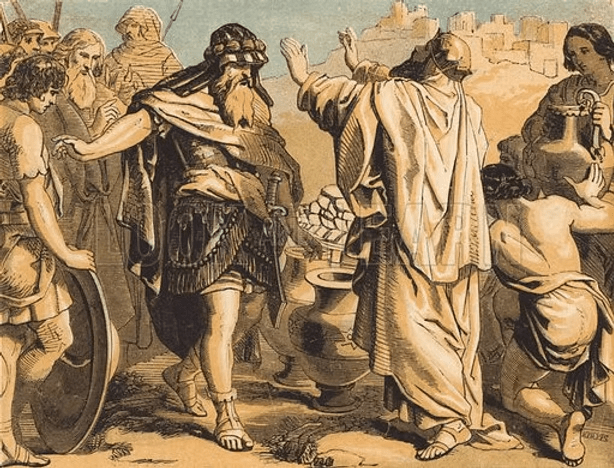
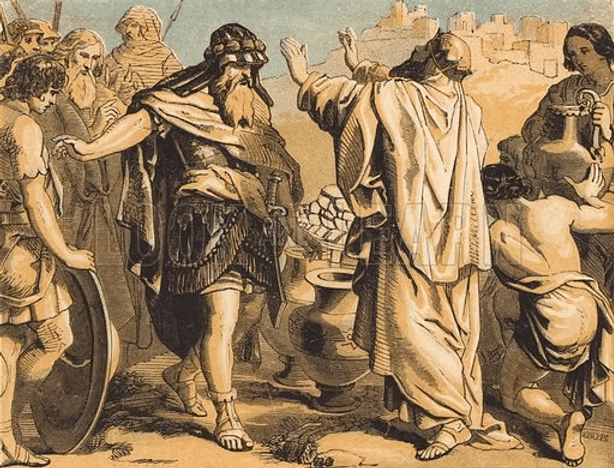
Abram meeting Melchizedek in Salem.
This comparison to Melchizedek should be investigated. The name Melchizedek means “King of Righteousness.” Jesus Christ is also called a King, but he said, “My kingdom is not of this world … but … from another realm.” (John 18:36) That makes Jesus the King of Heaven on Earth, as Melchizedek was the King of Salem, which was the earthly terrain on which Jerusalem was built, but the spirituality underneath that terrain was Eden. Seeing this High Priest title as the one who allows entrance into the Father’s kingdom makes it be how Jesus said, “I am the gate; whoever enters through me will be saved. They will come in and go out, and find pasture.” (John 10:9) That is like the Angel who guards Eden.
Archangel Uriel is said to guard as written: “After he drove the man out, he placed on the east side of the Garden of Eden cherubim and a flaming sword flashing back and forth to guard the way to the tree of life.” (Genesis 3:24)
Verse seven then is Paul explaining how “the order of Melchisedek,” as “high priest” named by God (not an election by men) means a joining together of this Angelic guardian Spirit to the body of a human (as was Jesus of Nazareth joined with the Christ Spirit of God), so both are peacefully as one. This presence is then the promise of eternal life (entrance into Heaven), which is the power that rescues one from mortal death. This does not prevent death of the body; in fact, it promises to bring persecution from those who cry out against such a holy presence, along with the tears offered by those who fear death more than they fear God. Only those who are joined with God’s Holy Spirit can hear His comforting call, fearing nothing but losing that closeness to the Father.
Verse eight then is Paul explaining that even though Jesus of Nazareth was the Son, he was made man. Only by knowing the sufferings of human beings can one gain “high priestly” understanding through the Christ Mind. That spiritual guidance can only be known through complete submission of oneself (self-ego) to God’s Will.
Verse nine says that perfection can only be a result of one’s past sins being erased through baptism of the Holy Spirit, when God sits on the throne within one’s heart-center and the soul has been merged with complete righteousness. Jesus Christ has been born as the “high priest” that must be raised within each of God’s faithful, so only those perfected can return to Eden. All who will be reborn in the name of Jesus Christ will have Jesus Christ as their personal “High Priest.” They will obey his commands, and in return they will be granted eternal life.
Verse ten is then Paul saying that each Apostle and Saint will be addressed by the name of Jesus Christ, which is the title that comes under the authority of God. As such, each Apostle and Saint becomes the embodiment of a “high priest” on the earthly realm. As a “high priest,” one like Paul is another “according to the order of Melchisedek.” This is the ultimate result of “All for high priest.”
As the Epistle selection for the twenty-second Sunday after Pentecost, when one’s own personal ministry for the LORD should be underway – one should have received the high priest Jesus Christ within one’s flesh – the message here is arise to the state of being where God speaks to us individually, telling each and every one of us, “You are My Son, today I have begotten you” as another in the holy order of Melchizedek. Each of us has to be reborn as the Angel that not only guards the stairway to Heaven that Jacob witnessed in a dream, but become the high priest that instructs others what it takes to return to God’s garden.
It is too easy to read Paul’s words here and see Jesus of Nazareth as that very special guy that could put up with the insults, the false claims against him, the scourging, the ridicule as a lowly commoner claiming to be a king, the nails piercing his flesh and bones, the spearing in his side, and the rolling of dice to see who would take possession of a fine robe, too nice to cut into pieces. It is too easy to say, “He was a better man than I (regardless of one’s human gender)” and pretend that Jesus suffered so others could never suffer, while getting the password that gets them past the Angel that forbid Adam from coming back. After all, Adam ate a cookie from the cookie jar after being told not to. Whose sins could ever be greater than that?!?!
The problem with Christianity is having too many people not having a clue what being Christian means. As long as Jesus is the spiritual high priest in Heaven watching over our miserable selves, forgiving all our sins if we believe in the cross of his murder, why should anyone ever try to become Jesus Christ reborn? As long as we let common men stand up on pedestals, proclaiming, “I am the High Priest” (a.k.a. those like Mr. Roman Pope), it is just a matter of paying an indulgence fee and then go out and play. This modern version of Christianity is all about self, with very little being about sacrifice of self to God.
The holy order of Melchisedek has left the building … so to speak. The world had reverted into paganism, where an unknown number of people have posters, icons, and statues made in their likeness. Babies are named after them (when not just randomly chosen letters pulled out of a Scrabble bag arranged in some order).
Those who are given names from the Old Testament (fewer these days) have little idea of the name’s original meaning. Therefore, no one grows into a responsibility to be a servant of God Almighty.
As an accompanying reading to the Gospel reading where James and John of Zebedee asked Jesus to give them the right to be the right hand and left hand of Jesus, when Jesus told them, “You do not know what you are asking. To sit at my right or left is not for me to grant. These places belong to those for whom they have been prepared.”
Newsflash: The preparation was for all the followers of Jesus of Nazareth to be prepared to receive his Holy Spirit and become a high priest.
Maybe the reason is no one is teaching this lesson? Listen carefully to the sermon coming soon to a Christian church near you. See if that message is preached.
 Explaining the Readings