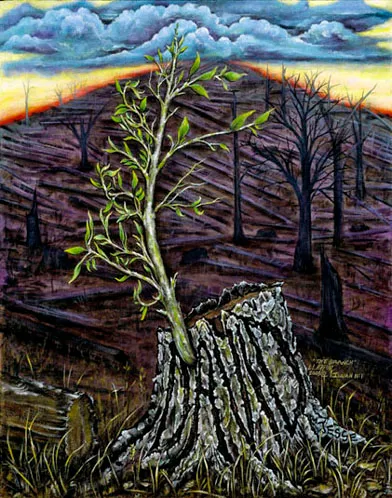
Tag Archives: Isaiah 11:1

Matthew 20:1-16 – The parable of the laborers and humans who refuse to work because it reminds them of slavery never known [Sixteenth Sunday after Pentecost]

“Jesus said, “The kingdom of heaven is like a landowner who went out early in the morning to hire laborers for his vineyard. After agreeing with the laborers for the usual daily wage, he sent them into his vineyard. When he went out about nine o’clock, he saw others standing idle in the marketplace; and he said to them, ‘You also go into the vineyard, and I will pay you whatever is right.’ So they went. When he went out again about noon and about three o’clock, he did the same. And about five o’clock he went out and found others standing around; and he said to them, ‘Why are you standing here idle all day?’ They said to him, ‘Because no one has hired us.’ He said to them, ‘You also go into the vineyard.’ When evening came, the owner of the vineyard said to his manager, ‘Call the laborers and give them their pay, beginning with the last and then going to the first.’ When those hired about five o’clock came, each of them received the usual daily wage. Now when the first came, they thought they would receive more; but each of them also received the usual daily wage. And when they received it, they grumbled against the landowner, saying, ‘These last worked only one hour, and you have made them equal to us who have borne the burden of the day and the scorching heat.’ But he replied to one of them, ‘Friend, I am doing you no wrong; did you not agree with me for the usual daily wage? Take what belongs to you and go; I choose to give to this last the same as I give to you. Am I not allowed to do what I choose with what belongs to me? Or are you envious because I am generous?’ So the last will be first, and the first will be last.”’

——————————————————————————————————

This is the Gospel reading from the Episcopal Lectionary for Proper 20, the sixteenth Sunday after Pentecost. It will next be read aloud by a priest on Sunday, September 24, 2017. It is the parable of the workers in the vineyard, which concludes with the message, “The last will be first, and the first will be last.” (NIV)

This New International Version selection, as shown on the Episcopal Lectionary website, omits the full statement of verse 16 (beyond that conclusion), which says, “For many are called, but few chosen.” As this is a significant clarification to “the last will be first, and the first will be last,” I will interpret this Gospel reading as if the whole statement were to be read (as it is in the King James versions available).

According to the website Greek New Testament (http://www.greeknewtestament.com/B40C020.htm#V16), there are five versions of the Greek text, from which all translations are based. Verse 16 is shown to contain “outwV esontai oi escatoi prwtoi kai oi prwtoi escatoi polloi gar eisin klhtoi oligoi de eklektoi.” That shows in the Stephens 1550 Textus Receptus, the Scrivener 1894 Textus Receptus, and the Byzantine Majority copies. However, only “outwV esontai oi escatoi prwtoi kai oi prwtoi escatoi” is shown for the Alexandrian and the Hort and Westcott copies, omitting “polloi gar eisin klhtoi oligoi de eklektoi.”

The quote from Jesus (“Many are called, however few chosen”) appears in Matthew 22, verse 14, as a stand-alone conclusion to the parable of the wedding banquet. All five of the above copies show verse 14 of Matthew 22 as, “polloi gar eisin klhtoi oligoi de eklektoi.”  It is the same text found in two verses, in two chapters.

As to this stand-alone parable, context may help to understand why Jesus would address “length of service” to the Lord. In Matthew’s seventeenth chapter, Jesus appeared transfigured on Mt. Hermon (in Gaulanitis), before going to Capernaum (Galilee) at the shores of the sea. In chapter 19, Matthew began by telling the readers that Jesus “departed from Galilee and came into the region of Judea beyond the Jordan.” That is where Jesus told this parable of the vineyard laborers.
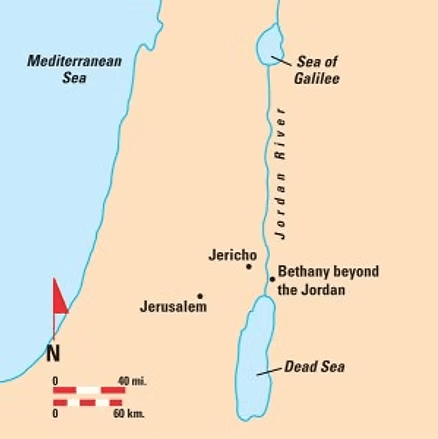
One could then assume that the lessons Matthew remembered Jesus teaching, in chapters 18 and 19, were lessons on different Shabbats, as weeks were passing. In John, we learn that Jesus was in Jerusalem during the winter festival for the Feast of the Dedication (now known as Hanukah, beginning on 25 Kislev, usually in December). Then, after angry Pharisees tried to grab and stone Jesus, he eluded them and went to the other side of the Jordan. This means Jesus is telling this parable probably in January or February, in the dead of winter, quite some time after being in a high mountain that is known for being a ski resort today.

Immediately following this parable of the workers in the vineyard, Matthew wrote that Jesus told his disciples they will soon return to Jerusalem, where he will be arrested, killed, and rise on the third day. That would take place during the time of the Passover, usually in April or May, during the spring. On the eve of that return to Jerusalem, the news of Lazarus being sick reached Jesus while he was beyond the Jordan. During the return to raise Lazarus from death, soon before the Passover festival would begin, Matthew tells of Jesus healing a blind man in Jericho, as the group was returning from beyond the Jordan. This sequence of events recorded allows one to see a timeframe of months passing, which means the parables can be weeks apart. It is my belief that they were all told on Sabbaths, as Jesus was a rabbi for his disciples.
It may be that the reading that led to Jesus telling this parable was from the Songs of Solomon, chapter 8, verses 10-14, as that uses the metaphor of a vineyard and laborers.

10 “I was a wall, and my breasts were like towers;

Then I became in his eyes as one who finds peace.

11 “Solomon had a vineyard at Baal-hamon;
He entrusted the vineyard to caretakers.
Each one was to bring a thousand shekels of silver for its fruit.

12 “My very own vineyard is at my disposal;
The thousand shekels are for you, Solomon,
And two hundred are for those who take care of its fruit.

13 “O you who sit in the gardens,

My companions are listening for your voice—

Let me hear it!”

14 “Hurry, my beloved,

And be like a gazelle or a young stag

On the mountains of spices.”

In this song, reality is not stated, as much as the Songs of Solomon are written as metaphor of the love between a human being and God. Because they appear strongly as human love in a setting of sensuality, there is higher meaning to such physical love.  This makes his songs parables, which require explanation beyond the obvious.

A vineyard represents a productive land, amid a world less cultivated. Baal-hamon (the name of a deity of Carthage & Phoenicia) is representative of the surrounding barren lands, among which Israel was set as a jewel of fertility. This is why the vineyard was so valuable to tenants, who had a need for devoted caretakers of their fruit. Such an explanation by Jesus to his disciples would have raised questions about the loss of that vineyard of Solomon’s and if it still bore fruit. If so, who were the laborers then, in a Roman-dominated Judea and Galilee?

As the time neared when Jesus would return to Jerusalem his final time, such questions would have perfectly been answered as a new parable, remembering how Jesus had already told his disciples, “The harvest is plentiful but the workers are few.” (Matthew 9:37) That statement, which followed Jesus saying that the crowds who followed him “were harassed and helpless, like sheep without a shepherd” (Matthew 9:36).  It was made prior to his saying, “Ask the Lord of the harvest, therefore, to send out workers into his harvest field,” (Matthew 9:38) Both of those truths are reinforced in this parable. With Jesus’ time on earth being ripe for harvest, it was time to have God call for laborers. That urgency is seen in how the landowner went out regularly during the day to hire workers for the harvest.

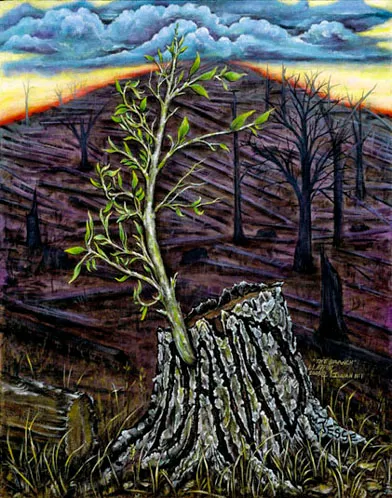
Because this landowner possessed a vineyard, this is metaphor for Jesus being the good vine (“I am the true grapevine, and my Father is the gardener” – John 15:1). As grapevines are cut back after each season, allowing for new growth each year, the roots are those coming from “the stump of Jesse” (Isaiah 11:1 – “A shoot will come up from the stump of Jesse; from his roots a Branch will bear fruit.”) The “landowner” is therefore a metaphor for God, with the “true grapevine” being the source for those feeding on the body and blood of Jesus the Messiah, and the grapes being harvested representing the souls saved. The good workers are thus true Christians, as devoted priests filled with the Holy Spirit, which the disciples would become (as well as all others they would affect). However, not all workers are good.

The various times of day, when the laborers were hired, reflects the history of God choosing people to “take care of his fruit.” They are representing: the Israelites freed from Egypt, who first entered Canaan (led by Joshua and judges) at 9 AM; They are the people of the nations Israel and Judah (led by kings and prophets) at noon; They are the scattered remnants of those fallen nations (led by Pharisees, High Temple Priests, and Scribes) at 3 PM; and, They are the disciples, family and crowds who sought their Messiah (led by John the Baptizer and Jesus of Nazareth), at 5 PM.

The grumbling of the workers, who were all paid the same wages at 6 PM, regardless of how long they had been working (poor babies “who have borne the burden of the day and the scorching heat”), are those made by Jews who believed they were closer to the landowner because they had been hired hands longer. This group can be generalized as the trail of tears so frequently shown by Israelites, Judeans and Jews – The Grumblers.  They easily complain, as if being chosen by God demands their being due more in return than other “mere humans.”

Their bellyaching did not agree with the landowner, as the Covenant was clearly stated from the beginning, at 9 AM (“Did you not agree with me for the usual daily wage?”). Some things never change, as God told Moses, “”I have seen these people,” the LORD said to Moses, “and they are a stiff-necked people.” (Exodus 32:9).

Because the wages were all the same, the metaphor cannot be all getting the same reward of getting to live in the landowner’s palatial estate or heavenly kingdom manor. The agreement was not “work a day and get eternal rest.”  The “usual daily wages” says the reward was limited (“daily” can be read as “most temporal,” not eternal), which means they are physical rewards for physical labors, rather than spiritual rewards for picking a few grapes.

The Jews often take pride in how many are doctors – medical and academic – and lawyers (the highest paid professions in worldly wages), while being known for always giving discounts to other Jews (generosity at the expense of Gentiles). As day laborers, they are not regular employees of the landowner, but they have been “chosen by God” to work for Him. Such an arrangement symbolizes how they (like all human beings) have been born of death, as mortals in new “chosen one” bodies, who then do as they want until they need the LORD to come and bring them some material gain. They hang out in the town square (“standing idle in the marketplace”), doing nothing to harvest the fruit of God, by taking no actions upon themselves (unsolicited) that seek to serve Him.

I hope God chooses me today.

Certainly, the whole world of humankind is just as self-serving, whether or not Gentiles earn more or less physical wealth than Jews. This is why the landowner showed up at the marketplace at 5 PM, asking, “Why are you standing here idle all day?” When “they said to him, ‘Because no one has hired us,’” this is the ignorance of all who have not been led to the LORD.  Rather than be a seeker of higher meaning, many just idly wait for God to come serve them.

When the lateness of the five o’clock hiring’s is seen as work still needing to be done, one can assume that many of the workers hired earlier in the day were slackers, so work was left undone. Perhaps, they were too good to work in the fields of grapevines, especially when the sun was so hot overhead. While there, they probably hung out at the water cooler more than they filled baskets with grapes. They were hired hands who were just there to draw a paycheck at the end of the day. This means they were getting material reward, but doing nothing towards earning spiritual reward.

This is where the continuation of verse 16 is so important. “For many are called, but few chosen” is a statement less about the landowner not having enough laborers, as it is more powerful as a statement that those who call themselves laborers are simply pretending to work.  It becomes an amphibological statement – with double meaning intended.

The Greek word translated as “few” is “oligoi.” The root form, “oligos,” means, “small, brief, few, soon, little,” with the implication, “hence, of time: short, of degree: light, slight, little.” (Strong’s Concordance) This word’s compliment, “many,” is the Greek word “polus,” which also denotes “much, or often.” (Strong’s Concordance)

This means the deeper meaning comes out when read as, “Often does God summon, little however choose.” This has the effect of stating, “The call to serve God is always there for everyone, but those who choose to answer most frequently do little of value.”
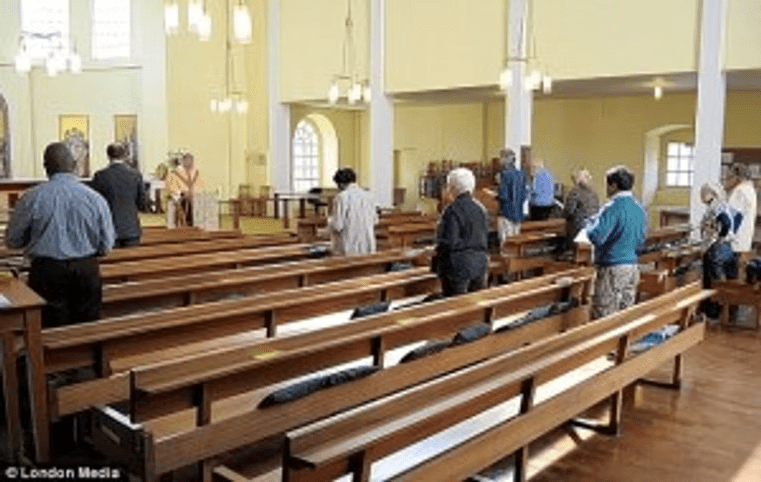
Christians disguised as empty pews

This means the other part of verse 16, “So the last will be first, and the first will be last,” is not a matter of everything about the harvest coming down to the bad planning of God (You should have known there are slackers and starting hiring well in advance of the harvest time), but the unwillingness of human beings to heed the continuous call of God.

A valid literal translation of “So the last will be first, and the first will be last,” is “Thus will be until the end most important, and the principal, extreme.” The Greek word translated as “last” is “eschatoi,” which is the root word (“eschatos”) for “eschatology,” or “the study of the End Times,” more properly defined as, “any system of doctrines concerning last, or final, matters, as death, the Judgment, the future state, etc..” (Dictionary.com) That word being used twice in this verse makes its deeper meaning have more impact as a parable that leads to the end of the day, when wages are paid individually.  It reflects a time when the sun sets on one’s life.

Each human being chooses what is “most important” in his or her life (what comes “first”), until that life reaches its death (what comes “last”). It is a matter of whose “principal” one lives by (God is the “highest,” “the first”). That decision projects to the end of the physical time on earth, when the soul is released.

The “Text Analysis” of this Greek text on BibleHub.com shows a comma separating the last two words, as though necessary for an English translation, as if written: “prōtoi , eschatoi.” A separation indicates each word has equal importance, with one’s meaning preceding the second’s. Thus, the implication becomes one’s “principal” (“first” choice of philosophy) in life then determining the “extreme” (the “final” state) to come upon one’s soul.

As a matter of seeing “So the last will be first, and the first will be last” as some ranking of service to the LORD, or seeing the weak and poor as inheriting the earth being implied here in this parable, that is being misled. Neither is it a statement about having done little all your life for God, but on your death bed you confess all your sins, so you are then allowed to go to heaven. It is more in-line with Jesus being the Alpha and the Omega.

As such, length of service has absolutely nothing to do with this message. As a broad-stroke view, it says anyone, at any time, who has been filled with the Holy Spirit and had the Christ Mind born within him or her, that person will be alive as Jesus – the Alpha and the Omega. Moses worked in the vineyard.  Elijah worked in the vineyard.  Saint Paul worked for God during his day on earth.  All the holy have worked for God, but they have done so alongside some riffraff who were just there for the paycheck.  The point is that time ceases to exist when in the Spirit, as human bodily death represents an awakening to eternal life.

Again, as this parable comes not long before Jesus would head the gang of followers from beyond the Jordan to the vicinity of Jerusalem, for his End Time on earth, Christians today need to see this message as being told by Jesus directly to each reader or listener. Are you one of those who was hanging out at the marketplace at 9 AM, as a baby raised from “cradle to grave” in a church, but still do not know Jesus?  By the time old age comes around at 6 PM, do you grumble at the thought of all those so-called Christians who are Johnny-come-lately’s, calling themselves Born Again Christians and acting like they deserve heaven more than you?

Or, are you one of those who escaped the real heat of being Christian, by acting atheist as long as that was cool and that got you places, only to find some life emergency made praying to an unseen God the only promise of hope still available, meaning you got hired at 3 PM?

The mega importance of this parable is to realize it is now 5 PM and you are still standing idle in the town square, with God once again offering the same employment as always. God says to open your eyes and realize NOW is the time to go to work for God. There are other parables about those fools who thought they could wait a little longer, only to find out that didn’t work out to well for their souls. The ones hired at the last hour of daylight are the ones who sincerely want to serve God with their whole heart.

God is asking you, individually, “Am I not allowed to do what I choose with what belongs to me? Or are you envious because I am generous?” If you are arguing with God about what you think He owes you, then you might want to re-read that contract you agreed to (both Old part and New part).  Prove to God you belong to Him, not by how much you know, but how much you selfishly do. If you do service to the LORD without expectations (letting go of the ego), then you will find out His generosity extends well beyond the wages of one lifetime.

John 15:1-8 – The fruit of the true vine

Jesus said to his disciples, “I am the true vine, and my Father is the vinegrower. He removes every branch in me that bears no fruit. Every branch that bears fruit he prunes to make it bear more fruit. You have already been cleansed by the word that I have spoken to you. Abide in me as I abide in you. Just as the branch cannot bear fruit by itself unless it abides in the vine, neither can you unless you abide in me. I am the vine, you are the branches. Those who abide in me and I in them bear much fruit, because apart from me you can do nothing. Whoever does not abide in me is thrown away like a branch and withers; such branches are gathered, thrown into the fire, and burned. If you abide in me, and my words abide in you, ask for whatever you wish, and it will be done for you. My Father is glorified by this, that you bear much fruit and become my disciples.”

——————————————————————————-

This is the Gospel selection from the Episcopal Lectionary for the Fifth Sunday of Easter, Year B 2018. It will next be read aloud in church by a priest on Sunday, April 29, 2018. This is important as Jesus taught that his disciples must become part of the true vine, required to bear fruit into the world. The symbolism of the vine fits his command to “lift up your stakes and follow me,” as the “cross” that IS oneself is that which raises the vine off the ground and allows the good fruit to come forth.

To grasp the context of this reading, one has to understand that John alone wrote of Jesus teaching the disciples this lesson, which took place during the evening of the Passover Seder meal (commonly called “The Last Supper”). While Matthew and Peter (the writer of Peter’s account of the Gospel is Mark) were present at these lessons given by Jesus, they were busy getting drunk on wine that is part of the Seder ritual (a standard objective into the night).  John, on the other hand, was paying attention to what Jesus had to say.

This is how Jesus could make a reference about “going to my Father’s house to prepare a room for you,” only to have Thomas say, “We do not know where you are going, so how can we know the way?” (John 14:1-5) Thomas was getting drunk, so he was not thinking clearly.  So, Thomas would not recall these lessons. John, however, was a child, so not freely welcomed to drink. Therefore, he stayed alert and listened to Jesus speaking, which was recalled in chapters 14, 15, 16, and 17. This reading then focuses on the second phase of Jesus’ Passover teachings, after the group had left the upstairs room (John 14:31).

In this reading, Jesus said, “I am the true vine,” where the Greek word “ampelos” more specifically means “grapevine.” This statement generates mental imagery, especially in those who have never grown grapes as produce, nor possessed a vineyard, where it is easy to mistake a grapevine as being like power lines and telephone lines along the roadside – seeming to go on endlessly. This concept that lacks a farmer’s mentality leads one away from the power of Jesus’ statement.

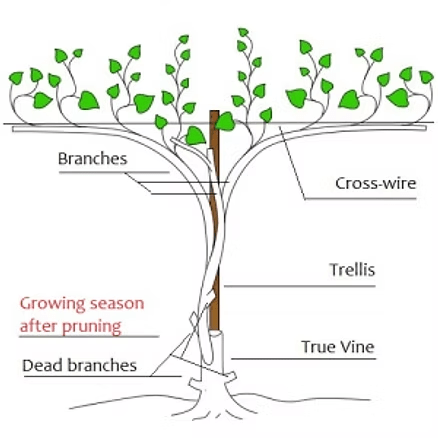
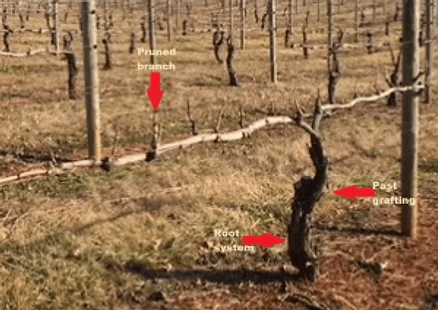
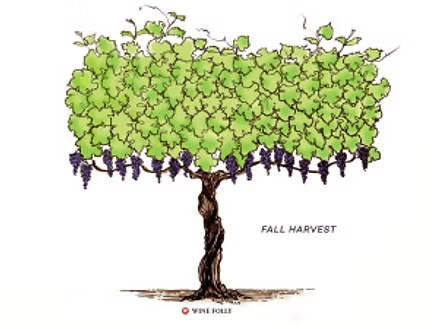
To say he is the “vine” is similar to Jesus saying he is the gate to the sheepfold. Both are self-contained, with limits, where the parameters or boundaries are of optimum value when those limits are full of purpose: a grapevine is full of grapes; and a sheepfold is full of sheep. This view of a “vine” being one (thus the “true vine,” implying others exist that are false), one can see how a vineyard is many grapevines together. Here is a diagram of one grapevine and a picture of a vineyard of grapevines in winter:

This imagery can then be used to see how the books of the Holy Bible tell of the previous harvests of good fruit, from Adam to Noah, from Abraham to Moses, and from David to the Prophets, with all being from the seed of God and the true vine of His Sons. In this reading from John’s Gospel, Jesus told his disciples how Jesus of Nazareth, the promised Messiah, was the true vine of God. He was speaking to the flowers that would soon bud into the branches that would produce his good fruit, the product of the Father. By understanding this terminology properly, everything Jesus told his disciples becomes crystal clear metaphor.

John remembered Jesus saying, “[The Father] removes every branch in me that bears no fruit. Every branch that bears fruit he prunes to make it bear more fruit.” This is routine maintenance of a grapevine that bears good fruit. As such, at the time Jesus said this Judas Iscariot was absent, having gone to betray Jesus. He was a branch that would never bear any fruit in the name of Jesus Christ. Judas would never submit his ego to God and become Jesus Christ reborn. He was pruned the day Judas hung himself from guilt. Still, the branches that would bear the fruit of Jesus of Nazareth – the Apostles – they would all lose their lives so more Apostles could be produced. They were pruned for the good of the true vine.

Here is a branch that was pruned so the vine could bear more fruit.

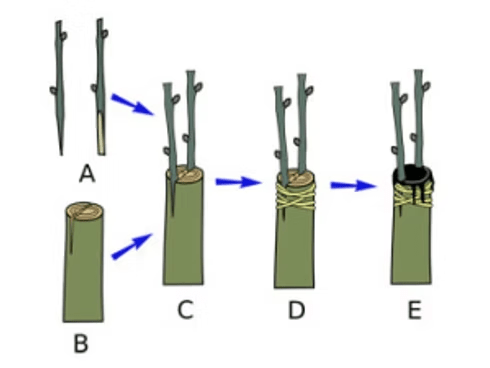
When Jesus then said, “You have already been cleansed by the word that I have spoken to you,” the word “katharoi” was used and translated as “cleansed,” and the word “logon” translated as “word.” This states in two segments, “Already you are pure [or clean]” and “by reason of the word that I have spoken to you.” The element of cleanliness loses focus on the metaphor of vineyard cultivation. The root meaning of “katharos” is “purity,” such that the example of grafting a shoot system (scion) to rootstock (the “true vine”), then the shoot will develop buds based on the root system. This means the “word” is the command of the true vine to regenerate cleanly from the rootstock, not from the root system the shoots were pruned, for the purpose of grafting. Thus, this verse told of Jesus informing his disciples their grafts had taken hold and they were then prepared for producing good fruit in the coming new season.

From common stock to disciples attached to the true vine to branches one with the true vine (Apostles).

“Abide in me as I abide in you” is then a statement that the eleven (and John) were no longer separate, but had become one (each individually) with Jesus. While all the disciples had mortal mothers and fathers, such that the DNA of those mortals was what made them reproductions in the likeness of their parents, they had become spiritually grafted to Jesus, whose Spiritual DNA was from the Father. Because of that linkage, the souls of the disciples were one with the soul of the Son of God, such that the Spirit of Jesus Christ was then within each of them.

Jesus then moved beyond this oneness to explain, “Just as the branch cannot bear fruit by itself unless it abides in the vine, neither can you unless you abide in me. I am the vine, you are the branches.” A branch (scion) that has been cut off from its root system is incapable of bearing fruit by itself. Once it is grafted onto good rootstock, the flow of growth is then passed onto the attached shoot (branch). The ability to bear fruit comes from the root. Since Jesus is the true vine (i.e.: rootstock for Apostles), his disciples were the newly budding branches, which were budding with the holiness of the Father, through the Son. Therefore, Jesus said, “I am the vine, you are the branches,” where each was grafted individually to the true vine.

It is important to grasp the implication of his next two statements. John wrote that Jesus said, “Those who abide in me and I in them bear much fruit, because apart from me you can do nothing. Whoever does not abide in me is thrown away like a branch and withers; such branches are gathered, thrown into the fire, and burned.” Rather than a statement of warning or threat, this was a statement of truth and fact. It goes beyond those who were gathered around Jesus, and well beyond the implication of Judas Iscariot being a discarded, as a withered branch.

These statements of Jesus say that the “true vine” is the only path to heaven and eternal life. Not only were the Jews not abiding in Jesus [as Jesus would soon be arrested by the Jews], neither were the Romans – who had their own religion that worshiped pagan gods. This truth says (without saying overtly) that no religion (as religion was known at that time) abode in Jesus, such that Islam (to come later, after Mohammed), Hinduism, Zoroastrianism, Buddhism, Taoism (or Daoism), Shintoism, etc., etc., and all forms of pagan worshipers all around the globe (monotheistic or polytheistic) are rootstock of death, not eternal life.

Because a religion is defined as “belief in and worship of a superhuman controlling power,” there is no “faith” that defines the process of a grapevine.  Just as Jesus was the “true vine of the Father,” there was no philosophy held by Jesus that defined what Jesus believed.
Jesus taught in parables that require one experience the meaning, rather than learn a set of rules to follow.  Because all ‘religions” fall into the error of belief in dogma, rather than being extensions (as reproductions) of the true vine, no “religion” seeks to become one with God.  As such, no “religion” abides in Jesus, who IS the true vine of God, the Father – the ONE GOD. Therefore, for Jesus to say, “Those who abide in me and I in them bear much fruit,” the whole world was, is, and is destined to be scions of false vines – the philosophical thoughts that act as “religion.”  The misled and misguided branches of philosophies will have to sever their shoots from their rootstock and seek to be grafted onto the Apostles … in order to become extensions of the oneness of true vine.

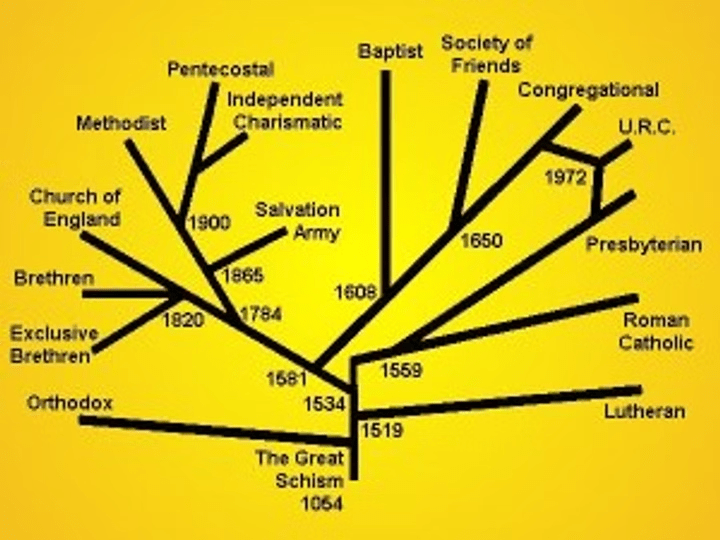
This broad stoke view of what Jesus said to his disciples should then be seen as John remembering a lesson for all who will sit and learn the lessons of Jesus Christ. The vast majority of proclaimed Christians around the world today are far from being branches that are producing the fruit of the true vine. The creation of branches within the “family tree” called “Christianity” (a religion), which veer wildly in many different directions, is not indicative of a grapevine producing fruit that carries the seeds of Sainthood. Instead, the millions who call themselves Christians seem to be at war with each other, more than simply being one with God’s love. It is more like the branches from the true vine have been pruned from truth and grafted onto false vine rootstock, making the present state reflect “Christianity” as weakened varieties of Jesus grapes, with none of them capable of producing good fruit.

Does this shape resemble the grapevine T-cross?

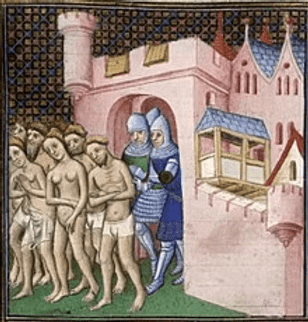
In this regard, I recommend the reader here look up the term “Cathars” and get a grasp of the original concept of true Christian. Much of their history has purposefully been destroyed, due to the hatred held by the leaders of the Roman Catholic Church against the Cathar people. Their name (as a group of people) was not theirs, as if they chose that name to be new branch of Christians. The name comes from the Greek word seen earlier – “katharoi” – which means “pure.”

Others, those who called themselves Christians, came to know these people (who primarily lived in Southwest France between 1,000 and 1230 A.D.) as those who were “pure” in their devotion to God.  They acted as those who were reborn as Jesus Christ, possessing profound knowledge of the word spoken by Jesus. The Roman Catholic Church exercised their first act of genocide to kill the Cathar people, because they would not convert to Roman Catholicism. To justify the first of several crusades known as Inquisitions, the Church called the Cathar people heretics, accusing them of being dualists and Gnostics, whose ways of life were not consistent with those philosophies held dear by the Vatican. In reality (in my opinion), the Cathar people were those who had “already been cleansed by the word that” Jesus had spoken, because they were true vine reproductions of Jesus Christ and knew the deeper meanings of Scripture, unlike typical Catholics.

Look up the Albigensian Crusade (aka Cathar Crusade).

From this awakening, which says true Christians should have more in common with Judaic teachings, where the communal commitment the Cathar people had to one another was similar to that of Jews living separately from Gentiles, the Cathar people were together as a Church of reproductions of Jesus Christ, as those reborn of his Spirit.  Jews, on the other hand, represented those branches growing from the vine of Moses, only to have grown wildly along the ground of the Promised Land, losing the “purity” of the “true vine” that Moses offered the Israelites through Law. Western Christians have likewise become wild grapes, through the ground clutter of philosophies that place more emphasis on the equality of inferior vines and branches, rather than seeking to maintain the “cleanliness of the word of Christ.”  American Christians today live among multicultural people they barely know, where governments force them to accept principals that are contrary to the teachings of Jesus Christ.  Unlike the Cathars, American Christians readily convert to the will of empires, with few willing to die for the way of the true vine.

This destruction of the true vine model can be seen in the statement of Jesus to his disciples, which said, “If you abide in me, and my words abide in you, ask for whatever you wish, and it will be done for you.” The promise that “whatever you wish will be done for you” meant – that night in Jerusalem, following Jesus’ last Seder meal – “whatever miracles you need to be able to perform in my name” – as the good fruit of the true vine – “you will have the power of God the Father available to you.” Modern Christians have mutated this statement into a weakened promise that makes Jesus Christ out to be some magic genie in a lamp, where you make a wish for wealth and it will be granted. All wishes today are selfishly based, with no one trying to heal any of the ills of the world, one Gentile convert at a time. All of this failure is due to no one abiding in Jesus Christ and he in one as Jesus Christ, Without that state of being reached first, all wishes can ONLY BE selfish, thus never granted by the One God.

In the last verse of this reading, John wrote, “My Father is glorified by this, that you bear much fruit and become my disciples.” The literal Greek makes this easier to understand, in terms of having one’s wish come true. The first segment says, “In this is glorified the Father of me.” That clearly says that “In this” abiding in the true vine, so the true vine becomes one’s Spirit leading one’s soul, then God the Father has made all desires for Oneness with God come true. By saying, “the Father is glorified,” where “edoxasthē” (from “doxazó“) is translated as “is glorified,” the reward of that wanted can only come from the sacrifice of self-ego, in “honor” and “praise” of the One God having entered one’s heart (and soul). When Jesus said, “the Father of me,” the intent is for a disciple to feel the power of the LORD within, such that one has to seek to become a rebirth “of me,” via “the Father.” Therefore, all desires cease to be of selfish motivations, only being wishes to serve the LORD’s needs, where “the Father is glorified” by the obedience of His servant.

The second segment can then be read literally as, “that fruit much you should bear.” This means that a branch extending from the true vine will produce grapes filled with the word of the Lord Christ. The succulence of full grapes from the true vine is then due to the holy water that has coursed through the xylem of that vine. From root system to branch to fruit, everything is filled with the word of God. It becomes a repeating of holy water poured out as in the miracle of Cana, which tasted as the finest wine that is usually served first. By keeping in mind how this “living water” that tasted like fine wine was taken from “purification” jugs, one can then see how the wedding guests had been cleansed by the word Jesus had spoken (to fill the jars with water).

The miracle of the purification water tasting like good fruit goes well beyond the physical.  It signifies the fermentation of the soul.  This means the disciples will produce more disciples, all who will become Apostles.  This miracle is opposed to the norm seen in the various denominations of churches gathering. like guests coming to celebrate a would-be marriage.  The norm can only expect a tithing pew sitter, who knows nothing that glorifies the Father, to show success by recruiting another tithing pew sitter, who also will know nothing of the Father.

The reason is a tithing pew sitter is a selfish ego and not one possessed by God’s love, reborn as His Son, Jesus Christ – the true glorification of the Father.  Today’s churches can be said by the master of the banquet to be typical, as the best wine of Jesus in his Apostles was served first, until the world was drunk and unable to notice that poor wine is now pouring freely.  Today’s Christians mistake their drunken state as being the fine wine from good fruit that glorifies the Father, when so much more is expected.

Finally, the last segment says, “and you shall be disciples of me,” where the glorification of the Father comes from “disciples of Jesus Christ.” This does not mean those who ONLY learn of Jesus Christ as pupils are true disciples. It means those whose hearts are afire with learning the power of Scripture, so their minds are filled with the knowledge of God – the Christ Mind – are those who thirst for truth. The purpose of learning is not to forever claim student status, but to graduate and become the teacher. The teacher (rabbi) was and is Jesus, who enlightens his disciples with a desire to become the Christ Resurrected. This is the call to all who seek the promise of eternal salvation, as that reward demands commitment to learn (deeply) and to apply that “education” freely, so others who are seekers of truth can find it alive in other human beings.

As a Gospel reading during the Easter season, a season when all lessons are calling disciples of Jesus to become the Resurrection of the Christ, we must grasp the concept of the grapevine and the branches that come from the “true vine.” In Scripture is the crucial point in time, when Jesus turned to his disciples and said, “If anyone wishes to come after me, he must deny himself, and take up his cross and follow me.” (Matthew 16:24) That command needs to be understood in terms of this reading and the dressing of grapevines.

First, the word translated as “wishes” is the Greek “thelei.” The same root Greek word, “theló,” was written here in John’s Gospel, meaning “wish, will, desire, intend, and design.” The intent of the word is therefore not to offer one a “wish” fulfilled, but to ask one if he or she “seeks” God, as their “desire, will, intent, design, or wish.” This means Jesus told his disciples on the evening of the Passover Seder, “whatever your heart desires, it will be fulfilled.” The result may or may not be God and the Christ Mind – thus the wisdom of “be careful what you wish for, as you just might get it.” When Jesus told his disciple to choose their path, he said, “If you desire to become me, then you must sacrifice your ego [deny oneself] and accept my righteous goals.”

Second, when Jesus told his disciples the path to “follow him” required one “take up his cross,” there are two grapevine elements contained in those words. First, the Greek word “aratō” means, “take away,” but it also means “raise” and “lift up.” It implies “hoisting,” as well as “carrying” and “bearing.” This becomes a demand for the strengthening of a grapevine, where years of growth and the crafting of the vines along a cross-wire create a T-cross that is capable of bearing weight. In terms of Scripture being the word spoken by the Christ Mind, like a tendril of a vine, one should always be close to Scripture and ever-reaching to see its deeper meaning.  That reflects a design to reach the optimum height, so the shoot strives to be uplifted and amplified in strength.  A vine does not reach high due to a philosophy or written plan.  It does so naturally, so it can not only produce branches, but also so it can grow to support the fruit produced. In spiritual terms, being “raised” means to go beyond self (“deny self”) and “[be-]come” Jesus Christ “after” him. This “uplifting” is in soul Spirit, where Christ abides in one and one abides in Christ.

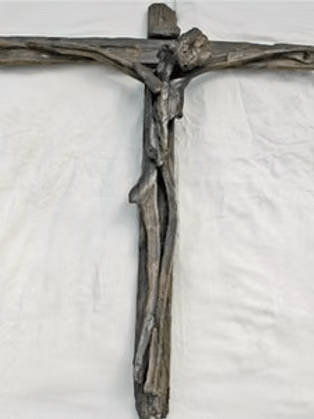
In reference to the Roman Catholic Church and their genocide of the Cathar people, one can see how this can be reduced to a level of symbolic focus. The Church reveres the crucifix and loves to nail the body of dead Jesus to dead wood – not a living vine. The original symbol of Christianity was the fish, which is associated with the astrological sign Pisces. Pisces represents self-sacrifice for a Spiritual reward. Therefore, to read Matthew 16:24 as if Jesus were telling his disciples to foresee his crucifixion as his end and the disciple’s time to follow on without him, that avoids the point of self-sacrifice (which may or may not be death by crucifixion) for a higher soul self (as Jesus reborn).

See how dead driftwood has been fashioned into a symbol that screams “dead branch”?
See the difference in imagery when we have become grafted onto a living cross within?

The second element in “take up his cross” is the word that translates as “cross,” which is “stauron.” It has been the teachings of the Roman Catholic Church that has taken this Greek word and absorbed its meaning into the dead timbers of a crucifix, as though the word solely means the pain and suffering of Jesus of Nazareth. The reality is “stauros” means “stake in the ground that forms a T.” The stake hold the cross-wire, which symbolizes the inner strength the Holy Spirit offers.  A crucifix forms a T, but many other T formations existed long before anyone figured out how to nail human beings to two dead tree trunks hewn and nailed together, in the shape of a cross. People cultivated grapevines into the shape of a T-cross well before the Romans saw that shape was strong enough to bear heavy weights. Thus, Jesus was telling his disciples to form a strong shape, just as he had shown through his strength in supporting his disciples and the Jews who sought him.

In this fifth Sunday in Easter, in the year 2018, this message to become branches of the true vine, as the fruit of the Father’s vineyard, goes along with the reading from Acts, where Philip produced good fruit in the Ethiopian eunuch. He did that be being tested in the wilderness, led by an angel of the Lord, where his strength was proved to bear the weight of Sainthood. It also accompanies the Epistle reading from 1 John, which defines God as love. The fruit of the Father’s true vine is the love of Christ, which is only found in true Saints – the fruit of the true vine.

The Easter call is to heed the word of Jesus and become “clean” and “pure.” One must be washed clean of past sins, in order to be given the reward of eternal salvation. To desire that reward, one must be a living branch of the true vine and produce good fruit. To be a living branch, one must be resurrected as Jesus Christ, so he abides in one, as one abides in him.

The purpose of Jesus dying on a cross was to show his disciples how death is not a permanent state of being, as a soul can never die. The soul will graft itself to another root system and be reborn according to that root-stock. Therefore, the purpose of the seven Sundays in the Easter season is to drive home the point that it is not enough to let Jesus die and be Resurrected, then Ascended. Christians miss the point of the price they too must pay.  If they do not follow that same path to salvation, by being reborn as the fruit of Jesus Christ, they will lose as fruitless branches thrown into the fire.

Ezekiel 17:22-24 – A sprig from the lofty top

[The presentation shown on the Episcopal Lectionary site has this selection produced in song verse format. I have reduced that to prose, while maintaining their translation.]

Thus says the Lord God, “I myself will take a sprig from the lofty top of the cedar; I will set it out; I will break off a tender one from the topmost of its young twigs; I myself will plant it on a high and lofty mountain. On the mountain height of Israel I will plant it, in order that it may produce boughs and bear fruit, and become a noble cedar. Under it every kind of bird will live; in the shade of its branches will nest winged creatures of every kind. All the trees of the field shall know that I am the Lord. I bring low the high tree, I make high the low tree; I dry up the green tree and make the dry tree flourish. I the Lord have spoken; I will accomplish it.”

——————————————————————————-

This is an optional Old Testament selection from the Episcopal Lectionary for the Fourth Sunday after Pentecost, Year B 2018. In the numbering system that lists each Sunday in an ordinal fashion, this Sunday is referred to as Proper 6. If chosen, it will next be read aloud in church by a reader on Sunday, June 17, 2018. It is important as a narrowed excerpt from Ezekiel as it shows the metaphor present in the accompanying Gospel reading selection from Mark, where servants of God are compared to plants of the earth and their benefit to the lands where they are found.

This portion of Ezekiel 17 represents the final three verses that in total was a chapter where God spoke to His prophet about the fall of Judah and Jerusalem. The king of Babylon captured Jerusalem and disposed the Judean king, appointing a younger sibling (Zedekiah) to be king, after he signed an agreement to serve Babylon. That young king then went against that agreement, causing Jerusalem to be recaptured by Babylonian soldiers; and that was when Solomon’s Temple was destroyed.

God pointed out to Ezekiel how He had a prior “agreement” with the Israelites (which included the tribes of Judah and Benjamin). Therefore, these last three verses are “riddle” and “parable” [instructions from God to Ezekiel in verse 2] that tell about the reseeding of the land with those who will not have a Covenant of stone, but the Law written on their hearts.

The process of transplanting a cutting of a plant becomes similar to the prophecy found in Isaiah 11:1, which states, “Then a shoot will spring from the stem of Jesse, And a branch from his roots will bear fruit.” The same forecast of a replacement of God’s “chosen people” is made in both Ezekiel’s and Isaiah’s examples of horticultural metaphor. This would not mean a return from exile of the people from Judah, in captivity in Babylon, although their transplanted tree would grow in Babylon and then grow again in what used to be Judah. However, the prophecy is foretelling of Jesus and those who would follow him as Christians.

This parallels the story in Mark’s Gospel, where Jesus spoke of growth stages of grains and that of a mustard seed.  The similarity of this metaphor spoken by God to Ezekiel, where we read, “Under it every kind of bird will live; in the shade of its branches will nest winged creatures of every kind,” is practically identical to Jesus telling how the mighty mustard tree protects birds.

Mustard tree.
Cedar tree of Lebanon.

I have a cedar tree in my backyard and it is the home for many different birds and squirrels and rabbit have been seen running under its branches for safety also. Still, the points made by Ezekiel and Jesus are about one specific “tree,” one that “All the trees of the field shall know that I am the Lord.”

This means that when God told Ezekiel, “On the mountain height of Israel I will plant it, in order that it may produce boughs and bear fruit, and become a noble cedar,” that “tree” would be the true “religion” – “philosophy” – in a world of many religions and philosophies – that IS Christianity.  Still, “religion” or “philosophy” belittles the truth that is “noble” in that “tree.”

This means one must be able to remove the glasses of mortal being that sees the imagery of this “riddle” and “parable” as plants and birds, and put on the glasses of prophecy. Mortals see bird of many kinds as though all are living equally well under the branches of all large, protective trees. While that may be true in mundane life, it misses the spiritual point made by God stating, “In the shade of its branches will nest winged creatures of every kind.”

Those “winged creatures” are angels of the LORD, which means the “tree of Christianity” will be filled with those who totally serve God, as eternal souls saved. No other “tree’ in the filed can truthfully make that claim.

Under the shade of holy branches.

Certainly, in a world of religions, they all make their claims of superiority. Sheer numbers of believers can catapult Christianity, Islam and Hinduism to the top, in that regard. In a world of many different philosophies, where each becomes the guiding principles of a nation (the DNA of countries), the world’s most numerous adherents of central philosophical beliefs (and the laws thereby generated) can indicate the most popular are Democratic Republics, Communist-Socialist Regimes, and Totalitarian Dictatorships. However, the truth of the United States’ declaration that demands a separation of Church and State is that “religion” acts as the ideal, while “government” becomes the reality.

That reality is that nations bow down before themselves, as self-serving egos that scream, “My philosophy is better than yours.”  Never  do governments bow down before the LORD, much less to the gods they profess allegiance to.

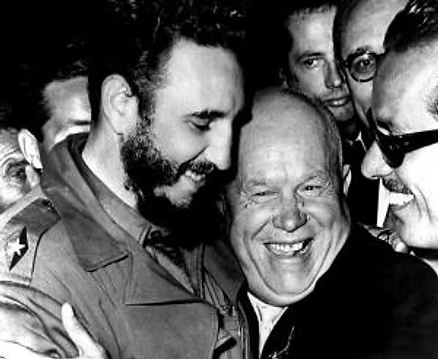
Comrades in arms at a U.N. get-together.

In the hidden “backstory” of Ezekiel 17, we read the ugliness of governments and their attempts to align with other governments, in pacts and treaties that seem mighty and strong. The adage, “The best laid plans of mice and men often go awry” is summed up now as, “I bring low the high tree, I make high the low tree; I dry up the green tree and make the dry tree flourish.”

The “high” trees that exist in the world now are the United States of America, Russia, and China. Others that seek equal status with those are Great Britain, France, Germany, Israel, Iran and others with nuclear capabilities. None of them consider themselves “high” because their total strength is based on their belief and devotion to the One God, but to the lesser god named “Nuclear weaponry.” All are exactly like the rebellious Judeans that God recalled to Ezekiel, who placed all their bets on the sharpness of their spears and the promised support of others who were paid to be in league with them.

Those plans went awry, as is the greatest flaw in humanity.  Alas, it is said, “Those who fail to learn from the mistakes of history are doomed to repeat them.”  And, the world does love reruns.

My two-lettered brother by another mother.

As history always will repeat (similarly) and one plus one will always equal two, the failures of Israel (a nation under one king), as also the failure of Israel and Judah (two nations under two kings), and also the failure of the resuscitated puppet that pretended to return to life – Hebraic Judea and Jerusalem of the Second Temple – those failures project the failures of the United States of America and the re-instituted State of Israel.  Any nation that proposed to have God on its side, but then acts as if there were no God that Saves, is doomed to fall by the hand of the godless.

It is a lesson that keeps on teaching.

That failure does not mean the “low” trees of other religions and governments will rise to the heights of being God’s newly chosen people. Instead, the meaning of “I make high the low tree” and “make the dry tree flourish” projects on individuals, those who refuse to follow the paths set for them by their government.  Governments will always come and go; but there will always remain those who love God so much they barely realize one dominating tyrant has been replaced by another.  Like seeds waiting for the right environment in which to begin new growth, they lay “low” until God commands them.

When this individual aspect is seen, the sprig from the “lofty top of the cedar,” which will be planted “on a high and lofty mountain,” that of “the mountain height of Israel,” IS Jesus of Nazareth.  God planted His Christ child to be the “low tree made high,” when disciples became true Christians – Apostles. Those Saints are the ones who has been truly filled with the Holy Spirit of God and reborn as Jesus Christ.

Each individual Apostle – Saint is then reborn in the name of Jesus Christ so he or she “may produce boughs and bear fruit, and become a noble cedar.” “In the shade of its branches will nest winged creatures of every kind,” which can now be realized as being the talents of the Holy Spirit – the powers of God given to His Son and his fruit.

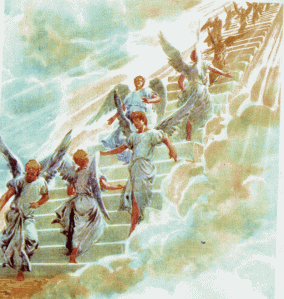
Under the Tree of God an angel gets her wings.

As an optional selection from the Old Testament for the fourth Sunday after Pentecost, when one’s individual ministry for the LORD should be underway, Ezekiel offers the metaphor of song, as the projection of what one should become in service to God. When one sees the Covenant with God as a written legal document, Satan will send in the lawyers that will offer leeway interpretations about what sins are allowable and what sins are clearly forbidden. When one listens to outside influences, then one will become as uncertain of one’s commitment to God, as have all governments whose people call themselves “Christian.” Christianity is not a club one joins and pays membership dues to a specific institution.
Christianity is ministry to God, in the name of Jesus Christ.

Even as I write these words, I can see many sheep of the political left, those who hate fellow Americans because they feel their neighbors have sinned by allowing the evil creature that is Donald Trump into the White House. Evil creatures are those who are perfect to serve in the capacity of President of a False Prophet nation.  America fits the billing as a “high tree” of self-value that will be made into a “low tree” when one’s individual Judgment Day comes.

The end of the world is when a mortal dies and one’s soul faces judgment for its mortal sins. Hating one’s neighbors (regardless of one’s political persuasion) is not only a sin, as it is a bold statement that says, “I am not in the name of Jesus Christ, because I cannot love my neighbor as myself.”

Paid for by those who sponsors of death of Christianity. A little truth goes a long way towards covering a lie.

In the days of Paul and the other Apostles, ministry was to go out and tell all the scattered remnants of Israel (the Northern Kingdom and the original nation under David) that the Messiah had come. “Jesus was-is the Christ,” they all went out to tell.  God did not promise a Savior to all the other nations of the world.   Instead, God ended that Old agreement with the ancestors of the Jews.

He did not promise a Savior for the nation that was Israel (the Northern Kingdom and the original nation under David). God promised a Savior for the original premise that led to His choosing human beings [all as flawed as the next] to serve Him as His slaves … His ministers … His teachers of self-sufficiency through Jesus Christ.

The spread of Christianity occurred because of ministers going out into the world producing the same miracles as did Jesus of Nazareth, in Judea and Galilee (and beyond).  That spread was deterred when “religion” became a tool of militaristic institutions that sought to control nations by their influence.  That spread ceased when heathens were massacred in “the name of Jesus Christ,” and conversion or death were the options.

Today, especially in this world so devoted to the Internet and technology, there is no need to go out into the world “preaching the Gospel.” First of all, few have any real capability to “preach the truth of the Gospel,” as the world has become overrun with mimickers and false prophets that memorize a few tidbits of Gospel Scripture and sell it to the highest bidder.

“Money is evil. Give me your money and I will protect you from evil.”

Second, our nation presently has a pastor-missionary under arrest in Turkey, who has been charged with being a spy for the United States of America. The reality of that situation (regardless of the guilt or innocence of that specific “pastor-missionary”) is the United States government (and its evil agencies of intelligence) has used the aspect of “ministry” as a way to get into hard places and subvert foreign regimes.  It becomes reasonable to think that a Christian evangelizing in a Muslim nation is there for the purpose of subversion.

Canadian couple imprisoned in China for spying. Every time something like this happens, it spears the word “Christian” with the stench of government.

Ministry is no longer about telling a world that already has an opinion about what “Christianity” is (real or imagined), as ministry today is about an individual being filled with the Holy spirit and living accordingly. Heal yourself before trying to heal anyone else!

Ministry today is having the world come to an Apostle – Saint, asking, “Why are you smiling in a world of misery?”

Ministry is not about the theatrics of “evangelism” or the solemnity of “ritual.” Ministry is about marriage to God, so His Son can be reborn into a willing sacrifice of self-ego. Ministry does not require a “sheepskin” from a seminary.  It does not require a building that has stained-glass windows, spires, bells, and pews.  Ministry is not an organizational position, as it is an individual commitment to God.

Because Christianity is not one’s decision, but God’s decision based on His knowing the heart of an individual, the growth required for a “sprig” to grow into a “noble cedar” can take decades or minutes. For it to take place quickly, one should expect a traumatic event, such as a near-death-experience, where the limitations of linear time have been overcome by an out of body experience and the future beyond mortal life has been seen.  For it to take decades, this should be understood: A ministry cannot wait long before it is squandered and lost.

Remember, if Israel could fail, so can all moral human beings. Saying one “believes” is as worthless as a signed contract, when a lawyer is always there, willing to tell one how to opt out of a commitment, without lasting repercussions. “Belief” cannot be agreed upon as promise.  Belief can only come from personal experience.  Being Jesus Christ is the only way one can truly believe in him.

The point Ezekiel made was that each servant to the LORD must be the “lofty top of the cedar.”  That means being in direct connection to God, with no “go-betweens.” This is where those in ministry are set into the world by God, so others can find their light. In a dark place, a light can shine a great distance without ever moving.

2 Samuel 7:1-14a – Letting the spiritual heart lead the Christ Mind

When the king was settled in his house, and the Lord had given him rest from all his enemies around him, the king said to the prophet Nathan, “See now, I am living in a house of cedar, but the ark of God stays in a tent.” Nathan said to the king, “Go, do all that you have in mind; for the Lord is with you.”

But that same night the word of the Lord came to Nathan: Go and tell my servant David: Thus says the Lord: Are you the one to build me a house to live in? I have not lived in a house since the day I brought up the people of Israel from Egypt to this day, but I have been moving about in a tent and a tabernacle. Wherever I have moved about among all the people of Israel, did I ever speak a word with any of the tribal leaders of Israel, whom I commanded to shepherd my people Israel, saying, “Why have you not built me a house of cedar?” Now therefore thus you shall say to my servant David: Thus says the Lord of hosts: I took you from the pasture, from following the sheep to be prince over my people Israel; and I have been with you wherever you went, and have cut off all your enemies from before you; and I will make for you a great name, like the name of the great ones of the earth. And I will appoint a place for my people Israel and will plant them, so that they may live in their own place, and be disturbed no more; and evildoers shall afflict them no more, as formerly, from the time that I appointed judges over my people Israel; and I will give you rest from all your enemies. Moreover the Lord declares to you that the Lord will make you a house. When your days are fulfilled and you lie down with your ancestors, I will raise up your offspring after you, who shall come forth from your body, and I will establish his kingdom. He shall build a house for my name, and I will establish the throne of his kingdom forever. I will be a father to him, and he shall be a son to me.

——————————————————————————–

This is an optional Old Testament selection from the Episcopal Lectionary for the ninth Sunday after Pentecost, Year B 2018. In the numbering system that lists each Sunday in an ordinal fashion, this Sunday is referred to as Proper 11. If chosen, it will next be read aloud in a church by a reader on Sunday July 22, 2018. It is important because it tells how the LORD is not concerned with buildings made of worldly materials, for He is looking for buildings of flesh who will become His servants.

In the first verse where we read, “When the king was settled in his house, and the Lord had given him rest from all his enemies around him,” one can look at this as David and the kingdom of Israel having reached a symbolic Sabbath.

David is now settled into the role of King of Israel. He has overcome all the threats to the safety and security of a nation. He has built a house of cedar in the City of David. All the work of that creation is complete. At that point, “the Lord had given him rest,” which, as the Sabbath was deemed by God to be holy, the “rest” means a focus turned inward, because the outward work is finished.

Seeing that symbolism, look at how David turned to his prophet Nathan, who would be like the court of David’s high priest. One could imagine that the bringing of the ark into Jerusalem called for one to be the man in charge of the tabernacle.  Nathan had that position; thus David called upon Nathan to talk about building a permanent house for the LORD for that purpose.

After decades of Saul having to fiercely fight Philistines, Edomites, Amalekites, Ammonites, Moabites, and the kings of Zobah, a time of peace and tranquility had come by David’s rise as King of Israel.  This became the final phase of hostilities and the beginning of the establishment of the House of David.  That ‘Sabbath time of rest’ can then be seen as holy. David was surely holy, as Nathan said: “The Lord is with you.”

The name “Nathan” means, “Gift, He Will Give, or Given,” which can be hinting at Nathan having the gift of the Holy Spirit, which allowed him to be a prophet. Thus, David speaking with Nathan symbolizes the true nature of a Church of Christ, where two had gathered that the Holy Spirit possessed; and they supported one another as committed to serve God.

With Nathan speaking from the Holy Spirit about David’s relationship with God (he was not simply being a “Yes man” to get in good with the king), we then see how Nathan spoke with God (unsolicited) that night, in a prophetic dream. God told Nathan to remind David that He is a mobile God. Since God freed the Israelites from Egyptian oppression, He had continuously moved with them wherever they had gone. A tent or a tabernacle (a large tent) for which the Ark of the Covenant had been stored meant God was always with the Israelites and not in some place that made moving it quite difficult.

What would happen to God is someone was to overrun Jerusalem and take possession of the city, along with the fixed house of cedar, with the ark inside?

God told Nathan to pass this along to David (paraphrasing): “If you keep Me in a tent or tabernacle, then I will protect Israel just like it was when Joshua and Sampson were sent to judge the people.”  Judges are sent when the people recognize they have sinned against God and thus repented their sins, praying for guidance.  When a judge of God is in place, the people know to obeyed God’s commands, through that judge. David would be enabled to lead the Israelites to righteous ways of living and thus prosperous times.

That would be known as the House of David, which would always be known as a holy nation under the One God.  By the LORD being with David, his Kingdom of Israel would become etched in history as the greatest.  The Star of David would become Israel’s shield of identity.

What can be confusing in what God told Nathan is when we read, “When your days are fulfilled and you lie down with your ancestors, I will raise up your offspring after you, who shall come forth from your body, and I will establish his kingdom. He shall build a house for my name, and I will establish the throne of his kingdom forever.”

This can be mistaken for King Solomon, who was an offspring of David, who did build a house” for God, called Solomon’s Temple However, God was not prophesying to Nathan about that young son of David, who was still decades away from birth, but who David would name, through Nathan, to be his successor.

If God came to Nathan to tell him that He did not want a fixed structure to be placed in, which would be like a prison that locked God from the Israelites, then God wanted to be forever free to move with the people as needed. A fixed house would be like the pagan idols other people worshipped, those of other nations, made to be sold and set upon shelves in various house rooms. A permanent temple would be like the statues and monuments to the many gods, like those Paul saw while in Greece. The Greek and Roman temples to their gods have long fallen into ruin, those gods now related with myth.  Building a place of brick and mortar for God would be like erecting Him a tomb or mausoleum, meaning God would be seen as dead to the Israelites. Only the memory of God would then be kept alive in a building of stone.

Solomon would begin to lay God to rest in the fourth year of his reign, when he laid the foundation for his Temple for God. Seven years later that tomb would be complete.

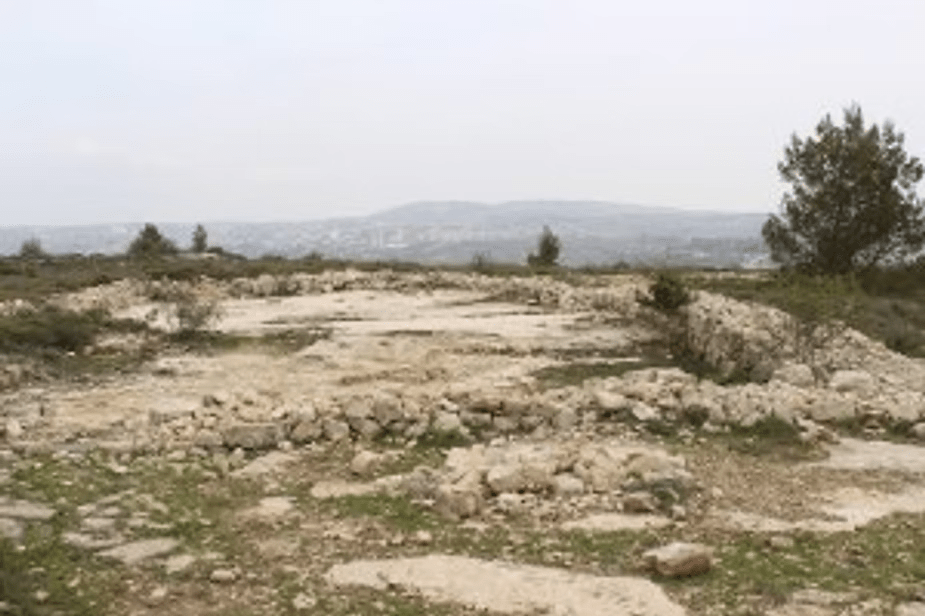
That temple would not be “the throne of his kingdom forever,” as Solomon’s death meant the split of Israel into two kingdoms, with the northern kingdom erecting a duplicate temple in Bethel. That temple would be destroyed by the priests of Baal, while the Temple in Jerusalem would be destroyed by the conquering Babylonians, centuries later.

The ruins of Jeroboam’s temple built in Bethel.

Because of that history, the truth of God’s prophecy to Nathan is He foretold of an “offspring after” David (“from the root of Jesse” – Isaiah 11:01 & 11:10, repeated by Paul in Romans 15:12), which was Jesus of Nazareth (born in Bethlehem). As a descendant of the Tribe of Benjamin, as having a heritage from Bethlehem, and in the line of David, Jesus came “forth from that body.” Jesus Christ would establish “his kingdom” (Christ the King”) on earth and “build a house for God’s name” (Christianity), sent by God to “establish the throne of his kingdom forever.”

The Persians would rebuild a Second Temple in Jerusalem. The Herodians would spend many decades beautifying that building (Herod’s Temple). Then the Romans would destroy that physical building and once again a building made of stone and mortar would prove to be temporary, at best, far from one lasting forever.

Jesus Christ would be killed, buried in a tomb, then resurrected so he could teach his disciples to become him reborn. After Jesus ascended to heaven, to sit at the right hand of God, Jesus Christ was sent back to the earthly realm the next day, being reborn into a new house of God that can never be destroyed. The Holy Spirit breathed the Ark of the Covenant into new tabernacles, who were mobile Apostles.  That spread of the House of God into Apostles has not yet ceased.  This is the truth of what God told Nathan.

Jesus was the temple of the LORD. The Ark of the Covenant, which held the Law of Moses, being placed within an Apostle then fulfills how Jesus said God writes His laws on the hearts of His faithful.  That lost ark no longer sits in a tent, tabernacle, or cedar house, as God rests between the cherubim in the hearts of true Christians. This makes every Apostle-Saint, who have all been reborn as Jesus Christ, be the throne of God that sits inside the covering that is the Holy Spirit, as the everlasting house of God.

As an optional Old Testament selection to be read on the ninth Sunday after Pentecost, when one’s personal ministry should be underway, the message is to be the place where God is enthroned. A true Christian is called to realize that Jesus is not in heaven waiting for all hell to break loose on earth, before he swoops down on a white horse, with fire in his eyes and a double-edged sword to smite all evil coming from his mouth. A true Christian IS JESUS CHRIST, reborn on the earth to serve God, just as Jesus of Nazareth did two thousand years ago. A minister is thus the House of God, not some fixed building on Main Street (a building that is vacant more than it is filled).

A minister reads how Nathan said to David, “Go, do all that you have in mind; for the Lord is with you,” and realizes the “mind” of David was greater than the brain of a smart human being. Long before God sent His Son to be born as Jesus, giving him the Mind of the Christ, God sent the same Mind to all those who judged Israel by setting the standard of righteousness in the land. David had the same Mind of Christ leading his actions, because God was in his heart.

In fact, the Hebrew that has been translated as, “do what you have in mind, because the Lord is with you,” actually says “heart,” rather than “mind.” The Hebrew segment of words, “kōlă·šer bil·ḇā·ḇə·ḵā,” actually state, “all that [is] in your heart.” As the heart goes, the mind will follow.

The brain acts naturally, needing the heart simply for a supply of blood, but the brain acts without any need for emotions. The inner works of the human body are naturally controlled by the base brain lobe (the medulla).  Still, man has a bigger brain that those of animals.  When the spiritual heart controls the brain’s functions, then the mind of the soul amends natural acts. When God is within one’s heart, then the Holy Spirit has joined with one’s soul, meaning the Christ Mind leads one to reject natural acts that are not righteous.

David and Nathan had the same mind, although they were in different physical bodies. God was in both of their hearts, so their brains did not lead their actions. They sacrificed self to the Will of the LORD. Jesus was the same and so were his Apostles, who each were reborn as their Savior.

This is a lesson learned by those who become ministers of the LORD; and it is the lesson taught to seekers of truth. When God is housed in a mobile minister, then the problem of getting the seeker to come to a church is solved. The ark is in the tent of the Holy Spirit, moving as directed by God, so the temple of the LORD can go to the seekers.

#HouseoftheLord #Isaiah1110 #KingdomofGod #Houseofcedar #2Samuel7114 #Isaiah1101 #NathanandDavid #Romans1512

Jeremiah 23:1-6 – The Lord is our righteousness

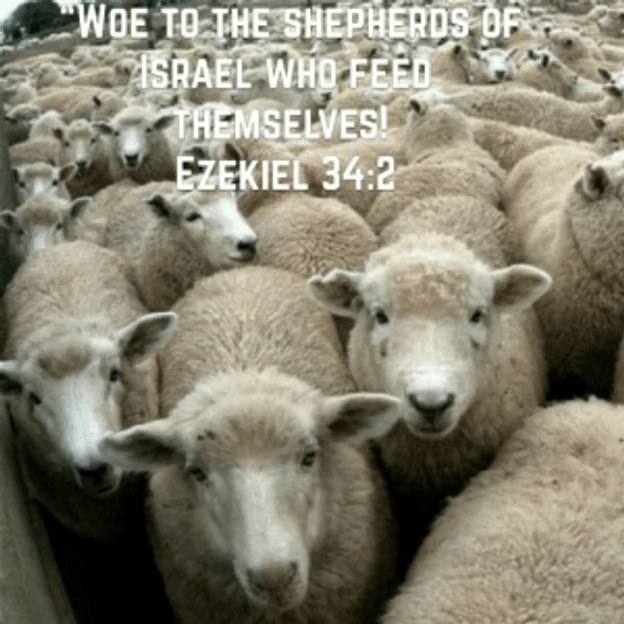
Woe to the shepherds who destroy and scatter the sheep of my pasture! says the Lord. Therefore thus says the Lord, the God of Israel, concerning the shepherds who shepherd my people: It is you who have scattered my flock, and have driven them away, and you have not attended to them. So I will attend to you for your evil doings, says the Lord. Then I myself will gather the remnant of my flock out of all the lands where I have driven them, and I will bring them back to their fold, and they shall be fruitful and multiply. I will raise up shepherds over them who will shepherd them, and they shall not fear any longer, or be dismayed, nor shall any be missing, says the Lord.

The days are surely coming, says the Lord, when I will raise up for David a righteous Branch, and he shall reign as king and deal wisely, and shall execute justice and righteousness in the land. In his days Judah will be saved and Israel will live in safety. And this is the name by which he will be called: “The Lord is our righteousness.”

——————————————————————————–

This is an optional Old Testament selection from the Episcopal Lectionary for the ninth Sunday after Pentecost, Year B 2018. In the numbering system that lists each Sunday in an ordinal fashion, this Sunday is referred to as Proper 11. If chosen, it will next be read aloud in a church by a reader on Sunday July 22, 2018. It is important because it prophesies the coming of Christianity, where Salvation comes when one is led by the true Shepherd.

One should know that Jeremiah was a prophet of Israel, the Northern Kingdom, but the LORD called him to preach about the destruction of Jerusalem and the captivity its people would suffer. He was born into a priestly family; but he went to the people to minister, as he was not welcomed by the temple priests. During his life both Israel and Judah were influenced heavily by Baal worshipers and their priests; and Jeremiah had made them enemies by proclaiming them false prophets. Knowing that history makes it easier to grasp what God was telling Jeremiah in this reading.

In the first verse, “Woe to the shepherds who destroy and scatter the sheep of my pasture,” it is important to know the Hebrew words “ra’ah” (written “rō·‘îm”) – translated as “the shepherds” – and “marith” (written “mar·‘î·ṯî”) offer insight through the similarities of their focus. The word “ra‘ah” accurately states “pastors,” where the word is “figurative of ruler, and teacher, accusative of people, flock.” When one sees that use of metaphor as being who powerful “Woe” (from first word importance – capitalization) will befall, then “sheep” can be read figuratively as “flock” or “multitude, which have been in God’s “pasturing” and “shepherding.”

A whole lotta woe going on!

This figure of speech is then how Judaic priest read this Scripture and it is how God intended Jeremiah to understand His words. God was not irked by little boy shepherds who let their father’s sheep get lost. God was angered at the bad rule of the Israelites by the bad kings of both the Northern and Southern Kingdoms (“Woe be to shepherds”), who let in bad shepherding priests (“who destroy and scatter the sheep”) that did not serve the God of Israel (“of my pasture”).

This means that the Promised Land that had been Canaan was “the pasture” where the flock of Israelites had been placed, to be fed and cared for. In that way, some “sheep” (rams) were raised to “shepherd” status, as they were the “rulers and teachers of the people” (the metaphor of “shepherd”), beginning with Moses and Aaron, passing to Joshua and the series of judges and prophets of Israel, including King David. Those shepherds unified the flock and kept them safe, doing so for the LORD – the figurative owner of the land and the wealth thereof, measured in the number of heads of Israelites.

As a prophecy of God’s actions against the destruction and scattering of His flock, we read, “I myself will gather the remnant of my flock out of all the lands where I have driven them, and I will bring them back to their fold, and they shall be fruitful and multiply. I will raise up shepherds over them who will shepherd them, and they shall not fear any longer, or be dismayed, nor shall any be missing.” The use of the first person here says that God “alone” will keep the evil masters from achieving what they sought: the destruction and the scattering of those who serve the true LORD, YHWH. This even includes all those who sacrificed with their lives at the swords of the wicked, because all God’s chosen souls will be brought “back to their fold.”

It should be grasped that God was speaking to Jeremiah about the faith of those souls destroyed and scattered. Despite all the trauma caused by evil shepherds, they retained their faith.  There were many who held dear to their religious tenets and never surrendered to the influence of those who served other gods. As such, those shepherds that would be raised up by God, “who will shepherd” the lost sheep, were those souls who were unjustly persecuted in human body.  This makes Jeremiah’s words be a prophecy of the Apostles of Jesus Christ, although individual prophets and leaders maintained reason for the Israelites to keep faith.

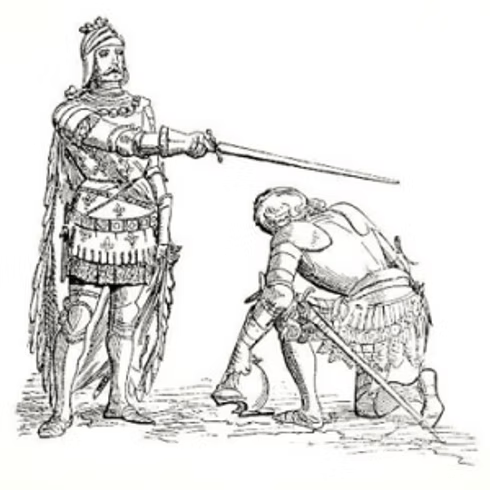
Still, only those shepherds who would be descended from Jesus of Nazareth, through the Holy Spirit, could remove the fears (heartfelt emotions), return courage to their being (strength of heart), and make the lost know they are found. They would place God in the hearts of the faithful by passing on the Holy Spirit, making each a shepherd be raised spiritually by the LORD.  Each Apostle became synonymous with a servant knighted by the Trinity.

Kneel before your sovereign and be renamed Sir, in the name of the Father, the Son, and the Holy Spirit. Rise Sir knight.

Certainly, one could see how God raised up the Persians to overthrow the Babylonians. One could see Cyrus as a shepherd who allowed the scattered Jews to return to Jerusalem. He would rebuild the temple destroyed by the Babylonians; but none of the Persians would return the pasture’s ownership to those lost sheep. The Persians had won the land in battle and deserved the spoils as victors.  Then, the Greeks, and after the Romans would gain the upper hand militarily and become the owners and dominators. This history of empirical rises and falls does not match the prophecy of Jeremiah.  This shows the prophecy has a higher meaning, which is the advent of Christianity; and that requires the fulfillment of Jesus Christ being raised.

God then prophesied this coming to Jeremiah, when He said, “The days are surely coming … when I will raise up for David a righteous Branch, and he shall reign as king and deal wisely, and shall execute justice and righteousness in the land.” By God naming David, whose six-pointed star was the shield of the nation of Israel (all twelve tribes), “a righteous Branch” (where “ṣe·maḥ” is capitalized in translation) means an offshoot of new growth, one stemming from the line that had fallen in destruction. This is how Isaiah (a mentor of Jeremiah) prophesied “a shoot will spring up from the stump of Jesse.” (Isaiah 11:1 and 11:10)

The righteous “stump” (Hebrew “mig-gê-za‘,” meaning “stem, stock, stump”) of David would become known as Judaism, which began in Babylonian captivity and returned to Jerusalem as those who clung to land and a new temple. That branch was severed and then grafted back onto its former shell.  The “righteous Branch” raised would be that religion named after the fulfillment of prophecies of a Messiah. Many would claim to be that raised shepherd, but none (not even Jesus of Nazareth) would be followed in large numbers.  At the time of Jesus’ death, the lives he touched was only a small sample of what Judaism was.  However, the religion that followed the rise of Apostles, in the name of Jesus Christ, as a religion that exists to this day and as a separate Branch of Davidic religion, those who have expresses belief in the One God (YHWH) have far exceeded those of Judaism.

The Jews remain the stem from the stump of David because they are still a lost flock that follows no new Shepherd.  They failed then in their commitment to serve God by living righteously, as priests to YHWH; and by rejecting Jesus as their Messiah, they continue to fail in this regard.  Christians grew into a dominant religion, due to a spread that was human servants (ministers of the LORD) filled with the Holy Spirit.  They, in turn, passed that righteousness to the faithful through their ministries.  However, after centuries of Saints propagating the lands, searching for the lost, Christianity (as a dogmatic organization) also has suffered the same destruction and scattering as that of Israel and Judah.

The true Branch of David is then relative to those who act righteously, not who professes a belief in God.  After 70 A.D., the Jews were again destroyed and scattered to the lands of the world.  Once again, their fate was due to their rejection of Jesus and losing the protection of God, fulfilling this prophecy of Jeremiah.  The Jews became lost sheep again; and that has been their mantra ever since.

Christianity has been become equally scattered into denominations and sects, many of which have hatred in their hearts for each other.  For every new branch (lower case purposefully) created, the flock is further scattered. New leaders pop up for each, claiming to be the new Messiah, while also claiming ownership of all the profits that comes with that new sect’s turf.  All these leaders are no different than the prophets of Baal or the Pharisees of Judea.  They come with desires set on possessing his or her own pasture with the booty of sheep and goats as their own.  The false shepherds still exist.

It is this element of one true divine line (“a Branch”) that makes this prophecy of Jeremiah’s mean Jesus Christ was not simply a shepherd raised by God, one who would lead the flock, remove their fears, give them courage, and show them they have been found by God. Jesus of Nazareth was a Sacrificial Lamb of the flock, in the sense that God sent His Son to be born, then die, resurrect, and ascend back to God.

God is the owner of the flock and they are to be pastured by His Son forevermore.  This means that Jesus Christ is then God incarnate on the earthly plane, as a human being born of a woman, such that Jesus Christ was the “I” stated in this prophecy of Jeremiah that would gather the lost sheep and bring them back to the fold.  However, Jesus is not God in heaven, since he is the Shepherd on earth, which means his death sequence was the beginning of a lineage (“a Branch”) that would place the Holy Spirit of Jesus Christ in countless sheep.

The shepherds who would be raised thereafter would be the replications of Jesus Christ in Apostles. Jesus Christ would “reign as king” over human bodies who made themselves sacrificial lambs unto God. Jesus Christ would “deal wisely” as Apostles filled with the wisdom of the Christ Mind. The flocks “shall execute justice and righteousness in the land” when they have been raised as the Good Shepherd resurrected.

When we then read, “In his days Judah will be saved and Israel will live in safety,” this goes well beyond the names of two fallen nations. It does not foretell of the scattered and destroyed gaining their beloved land back.  They killed that Covenant when they became a stump.  This means Judah and Israel are statements of the characteristics of a shepherd that will be raised, based on the meanings associated with those names.

The name Judah means, “Let Him (God) Be Praised.” Thus, those who praise God (He sits on His throne in their hearts) will be saved. The name “Israel” (while debatable) means “He Will Be Prince With God,” where those who sacrifice self to be reborn as Jesus Christ are the Resurrection of the Son of God, once again raised in the world. When one has allowed the Son of God his earthly kingdom (one’s physical body and spiritual soul), then having “God’s (Vicarious) Governor” (an alternate translation of “Israel”) control one’s being, then one can “live in safety,” assured of everlasting life.  This means God named Judah and Israel as requisites for shepherding His sheep.

Seeing the meaning of the names Judah and Israel, one then reads, “And this is the name by which he will be called: “The Lord is our righteousness.”’ This is then God prophesying the name of Jesus Christ, the Spirit of whom will be resurrected in human beings of faith and devotion.

This name is a translation of the Hebrew “Yah·wehṣiḏ·qê·nū,” which others collectively call “Jehovah Tsidkenu.” “Jehovah Tsidkenu” can be translated as Hebrew, stating “The Lord is our righteousness.”  That is not a name, such that a name should be condensed from those two word, as a combined form new word.  By doing an Internet search of “Lord is our righteousness,” several links appear that offer interpretations of “Jehovah Tsidkenu” (one here); but none of them place a focus on a single name that conveys that message.  None of them take that phrase and show it as a prophesied name to be watchful of, like Judah and Israel are single names that translate as phrases.

This means the key word “ṣiḏ·qê·nū” needs to be understood. The word come from the root “tsedeq,” which is why others analyze the spelling similar to Jeremiah’s – “Tsidkenu.” The word “tsedeq” means, “rightness, righteousness, what is right, just, justice, vindication, and righteous cause.” It is related to the Hebrew word “tsadak” (or “tsadeq),” which has the same meaning, while adding “acquit, acquitted, lead to righteousness, properly restored, and proved righteous.”  That has to be seen as the constant characteristic by which ALL Christians are to be measured.

In the history of names in the Old Testament, this word would become combined as a name that is an indication of this state of righteousness and is relative to Yahweh. In that history there are names that can be listed as possible recreations: Jeshua, Isaiah, Jehozadak, Zadok, and Melchisedek. Those names all imply individual born, who were given names they lived up to, by becoming those whose righteousness or salvation could be due to their service to the LORD. Therefore, all of these names deserve analytic inspection based on this prophecy of Jeremiah.

The name “Jeshua” is the root of the name known as Joshua, where the Hebrew word “yasha‘” is combined with “Yah-,” yielding a name that means “Yah Is Salvation” or “God Is Deliverance.” Of course, the Greek name “Jesus” or “Iēsous” is deemed a variation of “Jeshua.” Thus “Jesus” is a name that means “God Is Salvation.”  Certainly those who interpret “Jehovah Tsidkenu” associate that name with Jesus Christ.

While “Righteousness” is not the same as “Salvation,” righteousness is the path one must take to reach that destination. When Jesus said, “I am the way,” that says the way to salvation is righteousness. In my opinion, “the LORD of our righteousness” comes through the Trinity in each individual, where a marriage to God in one’s heart brings about the cleansing of sins from one soul by the Holy Spirit, and the resurrection of Jesus Christ in one’s body. It is then that presence of “Jeshua” that becomes the “Lord of one’s righteousness.”

The name “Isaiah” represents an instance where the letter “j” is a relatively modern invention, as before the letter “i” was used in place of a “j.” The Hebrew letters YHWH are pronounced in English as “Yahweh,” but in German the “y” is pronounced like a “j.” Additionally, in German a “w’ is pronounced like a “v” in English, so the same YHWH is enunciated as “JeHoVaH.” From this, one can then see how “Isaiah” is a combination of the same root found in Jeshua” – “yasha‘” – with the ending now the abbreviated form of YHWH. This means Isaiah bears the same meaning as Jeshua: Yahweh Is Salvation or Salvation Of The Lord.

The parallel of Isaiah that is Jeshua can then be seen as Isaiah being a resurrection of the spirit of Joshua, who was a righteous judge of Israel. Isaiah was a contemporary of Jeremiah, said to be his mentor, so they were two prophets gathered in God’s name (as a church).  They reflect how all judges and prophets are cases of the Lord raising up shepherds for His flock. The same spirit can then be seen in prophets as was in Jesus Christ, who would come later and also be known as a prophet of Yahweh.

This brings out the commonality of the Christ Mind, where all prophets hear the word of God speaking to them. That word can only be heard by those who are sacrificial lambs, letting the din of self go so the divine word can be heard. This is how the same comes upon Apostles, whose king within brings about the personal identification of “the LORD Of My Righteousness,” which assures one’s salvation.

The name “Jehozadak” is said to be: “Jehozadak is a high priest, a son of Seraiah (1 Chronicles 6:14) and father of Jeshua, both high priests. Jehozadak was among the exiles to Babylon, and his son Jeshua was among the returnees (Ezra 3:2).” (Abarim Publications) This name clearly combines “Jehovah” (YHWH) with the Hebrew word “sadeq,” which is rooted in the Hebrew word “Tsidkenu,” as “tsadeq.” Notice how the history shows this high priest, whose name means “Yahweh Is Justified” or “Yah Is Righteous,” was the father of a son he named Jeshua.

There is more to that than coincidence, when this prophecy of Jeremiah is analyzed. God told Jeremiah, in essence, the new “righteous Branch” will be ruled “by a king [who will] deal wisely” in the same manner as when one high priest was shown to be risen in an offspring. This means an Apostle is like Jeshua, born of Jehozadak, where Jesus of Nazareth is Spiritually the high priest of one Apostle (a Saint), from whom is born another Apostle (also a Saint), with all Apostles reborn as Jesus Christ (the high priest within).

It is important to see how Jehozadak means “the Lord Has Made Just” or “Yahweh Has Justified,” where the name conveys a change of being. For one to be “just” or “justified,” one has to be transformed from a being that was previously “unjust” or “without faith” and “dishonored.” This leads one back to the beginning of this reading, where the LORD said, “Woe to the shepherds who destroy and scatter the sheep of my pasture.” Those who have been destroyed and scattered by the bad shepherds will resort to survival mode and that represents sins.  That wildness is where one finds guilt from their own wretched states of being, from their own misfortune, sorrow and misery as the inner call to repent and seek salvation through righteous ways. Lost sheep call out for salvation.  Still, only the power of God within them can bring about that change.

The name “Zadok,” who might not be well known, was that of a priest of David, who became high priest under Solomon.  David placed the Ark of the Covenant in the care of Zadok during a rebellion, and Zadok anointed Solomon as King of Israel.  This name is not a combined form because “sadeq” is the name.  This name makes a direct statement of “Righteous” or “Just.”

This leads one to analyze the name of the high priest and King of Salem, “Melchisedek.” The same word found combined in Jehozadak, “sadeq,” is found in this name as well. The combinations here are of the Hebrew words “melek” and “sadeq,” where the result is a name that pronounces, “the King of Righteousness.”

This makes the history of Melchisedek important, as he offered bread and wine to Abraham; and David wrote (in Psalm 110:4) how God told him, “You are a priest forever, in the order of Melchizedek.” David was a king, thus a King of Righteousness.” In Paul’s letter to the Hebrews of Rome, he wrote how Jesus Christ is also “a priest forever, in the order of Melchisedek” (Hebrews 7), which matches how God told Jeremiah, “I will raise up for David a righteous Branch, and he shall reign as king.” This equates the Son of God to the Son, as Yahweh, who is truly the “King of our righteousness.”

It is said that Melchisedek (in Hebrews 7:3) was: “Without father or mother, without genealogy, without beginning of days or end of life, resembling the Son of God, he remains a priest forever.” Paul wrote those words with the wisdom of the Christ Mind, meaning he had some “inside knowledge” about this matter.  This then states that Melchisedek is as John wrote in his Gospel, “In the beginning was the Word, and the Word was with God, and the Word was God. He was with God in the beginning.” (John 1:1-2) This language states the permanence of one’s soul, with few who have lived righteously forever.

This is a statement that the human embodiment of God is for the purpose of bearing the Word to mankind. Melchisedek is said to have given Abraham the robes of Adam, thereby blessing Abraham as a priest in the same order, who was at that time childless, but who would become the father of many nations. Jesus was likewise fatherless, as Joseph the human did not sire him.  Again, few souls can claim God as the Father, as His Son.

This means Jesus Christ is a Spiritual king that cannot be recreated, as he is, as always, a most righteous being, as is God. Jesus Christ can pass on the robes of Adam (the Son of God) to those who have successfully passed the test of priesthood in the highest order. Apostles in the name of Jesus Christ wear those kingly robes. They are invisible, as they are worn inwardly, reflecting Christ the King has been reborn.  Therefore, Jeremiah was saying for God, “I will raise up for David a righteous Branch, and he shall reign as king in the order of Melchisedek.”

As an optional Old Testament reading for the ninth Sunday after Pentecost, when one’s ministry to the LORD should be underway – raised up as the Good Shepherd – the message has to be: Shepherd the flock as God wants His people pastured. This means one must be found and be resurrected from the ways that a worldly life tends to destroy religious values and scatter the focus of humans, from One God to many idols. To be a shepherd raised by God, one has to have God “attend to you for your evil doings,” so the Good Shepherd can come forth.

A minister of the LORD is then one who has been brought back to the fold, safe and secure in the presence of Jesus Christ. This then leads one into ministry, as God says an Apostle “shall be fruitful and multiply.” While the simplicity of that message is to marry and have a family that one raises to serve God (just as Jehozadak begat Jeshua), the reality is one’s children are not born without a need to find their own path to righteousness. Therefore, one is fruitful by being of the living Branch of Christ that multiplies by being the food for thought for others to consume.  A minister to the LORD offer the fruit of the Word to those seeking to find redemption from misfortune, sorrow and misery.

Watching over a flock does not mean yelling and screaming “Wolf!” just to see what happens. Flocks need to feel strength shown in presence, not words that cause fear.

A minister of the LORD is one sent to others, so “they shall not fear any longer, or be dismayed, nor shall any be missing.” In this direction, one should realize that a minister of the LORD does not randomly go out into the world preaching to those who find hatred in one speaking of the One God, Yahweh. Muslims do not want to hear such a person speak publicly. It is doubtful that atheists would welcome anyone offering religious talk of any kind. Attempting to “save” a Buddhist or Tibetan monk could become an unending argument in logic, where each response is, “I hear you saying the same thing as I,” with no benefit being the result. Thus, a minister of the LORD is for those who are lost sheep of Judaic-Christian values, but only those who are crying out, “Help me. I am lost.”

In today’s America, there are many who stand up and pretend to be ministers of Jesus Christ, who express sorrow, fear, and misery, preaching that the evil government should be replaced by an equally evil (or compoundingly evil) government, which has nothing to do with saving or justifying any specific individuals. This means we are today suffering in the same ways as was Jeremiah’s corrupted Israel and Judah.

The LORD’s ministers that are raised up to find the lost and gather them again into the fold of righteousness, do not preach hatred or violent upheaval. Hatred is an emotion felt for one’s enemies.  One can only love an enemy by allowing an enemy to hate one by afar.  One does not stand before an enemy and curse it for being evil.  Turn the other cheek by leaving one’s enemies alone.  Take care one those who cry for help, as a shepherd returning lost sheep to the fold.

A minister of the LORD can only establish one-to-one relationships that bear real fruit. Many of those have no need for an exchange of words. Being verbally attacked and not responding in kind may have an unexpected result.  Simply by being an example of quiet acts of love can cause another to be touched by the Holy Spirit and seek the path of righteousness in one’s life.

When the current troubles of our times are factored in, some can read, “shall execute justice and righteousness in the land” and think that means name-calling and threats that are made in social media, by people with religious order collars around their necks. Those people are the puppets at the ends of string that are being pulled by the same equivalents as were the priests of Baal.  They were allowed into the pastures of Israel and Judah by kings who married the harlots of foreign nations, a sign of mixed blood and reduced links to heritage. They are the same as were the temple scribes, Pharisees and Sadducees, none of whom were good shepherds of Judea and Galilee. Anyone who preaches revolution against governments or religions is only seeking to destroy and scatter, not gather and restore. The error in misreading those words comes from overlooking “deal wisely.”

A minister of the LORD has sacrificed the Big Brain of self-importance, such that the Christ Mind brings about the wisdom of God. A Big Brain has it all figured out and sends its emissaries to protest, arm-in-arm with photo-op downtrodden and ‘poster boy’ images of evil-doings.  They are false prophets and bad shepherds, based on having figured out what “Jesus wants.” Rather than utilizing the wisdom of being Jesus Christ reborn, using the “I” word instead of “Jesus says,” they become agitators – those who scatter the flock with fearful messages.

A minister of the LORD, without thought, will see how a kind act without publicity will be noticed by the one looking for signs, causing the first step of positive change.  The media portrays those who think Jesus (who is in heaven) said to do what a minority of the society desires to hear priest of Baal to say.  Like them, priests today stand with women who want the right to abort babies, which is no different than the practice of human sacrifices Jeremiah sought to warn the people against. Those ‘would-be gods’ today are speaking hatred in the name of Jesus, which breaks the Commandment that says, “Do not use the LORD’s name in vain.” That Law says, “Do not act like you know what Jesus wants, before you become Jesus Christ reborn.”

Therefore, the message in this reading says to become one who knows the “LORD is our righteousness.” Our righteousness does not go about pointing out the lack of righteousness in a world owned by wicked people, as the world is not the ultimate goal. Our righteousness is only possible by becoming married to God in our individual hearts, and then becoming a walking, talking reproduction of Jesus of Nazareth.

Hebrews 9:11-14 – Purification of flesh or soul?

When Christ came as a high priest of the good things that have come, then through the greater and perfect tent (not made with hands, that is, not of this creation), he entered once for all into the Holy Place, not with the blood of goats and calves, but with his own blood, thus obtaining eternal redemption. For if the blood of goats and bulls, with the sprinkling of the ashes of a heifer, sanctifies those who have been defiled so that their flesh is purified, how much more will the blood of Christ, who through the eternal Spirit offered himself without blemish to God, purify our conscience from dead works to worship the living God!

———————————————————————————————————-

This is the Epistle selection from the Episcopal Lectionary for the Twenty-fourth Sunday after Pentecost, Year B 2018. In the numbering system that lists each Sunday in an ordinal fashion, this Sunday is referred to as Proper 26. It will next be read aloud in an Episcopal church by a reader on Sunday November 4, 2018. It is important because Paul connected Jesus as the high priest to his willingness to make himself a holy sacrifice. Apostles and Saints have been made possible by the high priest being resurrected in those who are also reborn through self-sacrifice.

This reading selection follows ten verses written by Paul, which focus on the physical tabernacle that was erected in the wilderness. Paul reviewed the entrance of the priests into an earthly place and the order of responsibilities that recognized the tabernacle as holy ground. This history is not a creation in the desert of the Sinai, but a recreation of the sacrifices and gifts each family performed in Egypt, in preparation for the Passover. The priests, high priest, and tabernacle are the microcosm of the overall plan for righteous living by all.

A marked by blood tabernacle, with priests inside? If death passes by, is not eternal life gained?

Once again, we have a translation that is one-dimensional, as it projects the righteousness of Jesus as singularly important, as if God would bless His own Son with the qualification of a high priest, while leaving the masses in awe of an unreachable status. That is not what the multiplicity of meaning states, as the same words written not only point to the truth of the read aloud translation but also point to the same state of holiness being made possible to all God’s servants.

To make this shown, I will present the literal translation possibilities, as made visible by the Bible Hub Interlinear page for Hebrews 9. I recommend all readers see for themselves how the following translation is found. As is my practice, I list the segments of words, which are based on the placement of punctuation marks (real or implied). Please note that capitalized words bear an importance that needs to be understood. In this four-verse selection, there are five capitalized words. Two are “Christ” and two are “God,” where importance is easily grasped. However, the capitalized “If” should be seen as the significance of a condition, such that a “big if” is the intent.

Hebrews 9


11. Christ now  ,

having appeared as high priest all having come good in nature  ,

by the greater and more perfect tabernacle not made by hands  ,

he is  ,

not this those creation  ,


12. not by blood of goats and calves  ,

through on the other hand followers blood  ,

he entered once for all into the sacred ones  ,

eternal redemption having obtained  .


13. If through the blood of goats  ,

and bulls  ,

and ashes of a heifer  ,

sprinkling those who having been defiled  ,

sanctify with this people flesh purification  ,


14. how much more condition blood followers of Christ  ,

those whom by the instrumentality of Spirit eternal  ,

ourselves offered unblemished condition to God  ,

will cleanse those conscience ourselves [ego] from dead works  ,

towards followers to serve God living  !

Verse 11 begins with the capitalized “Christos,” which is the Greek equivalent of the Hebrew “Messiah.” To grasp this meaning here in a vacuum [no lead in verses to aid interpretation], one has to see that Paul did not write Jesus’ name. Alone, “Christ” is that which comes from God, making one be The Anointed One. We know [we profess to know] that Jesus was so Anointed by God; but interpreting “Christ” as Jesus Christ is limiting God’s ability to Anoint any number of Apostles and Saints in the name of Jesus Christ, making them also possess the Christ Spirit.

We heard the blind beggar call out, “Son of David.” Was not David the anointed one by God, through His high priest Samuel?

In verse five, Paul named Aaron as the high priest of the first tabernacle. In verse seven, Paul told of the ritual sacrifices made in the designated area of the tabernacle, by the high priest, for himself and the people’s sins of ignorance. In verse eight, Paul stated that “the Holy Spirit had not yet been manifest into those holy places.” By realizing that lost text, one can then see that verse eleven begins by saying the tabernacle – the holy place erected for the high priest – was “now Christ.” However, the tabernacle is no longer one man-made but human, as “all having come good in nature.” It is in those tabernacles of flesh that “he is.” High priests are not “institutions” or “created beings via ordinance” [ordained holy by men not holy]. All high priests now must be Christ reborn.

Verse 12 then continues this line of thought by saying there can no longer be animal sacrifices for a priest [ordained and/or elevated in rank] or the people to have their sins of ignorance wiped clean. Instead, it is through the followers having sacrificed themselves, becoming filled with the blood of Christ [i.e.: the Holy Spirit, the “blood” relationship to Jesus Christ, as the Son of Man reborn]. Jesus is reborn [“entered into once for all”], so his presence signifies a Saint [“sacred ones”]. This is the only sacrifice that forever offers eternal redemption.

Verse 13 then begins with the capitalized “Ei,” meaning “If, For as much as, That, Whether and/or Suppose.” This is then stating a conditional scenario, which states the circumstances by which a premise is true. It acts as a statement of assumption, in order to determine if some condition is indeed fact. The ‘big If’ is then saying, “If the practices of animal sacrifice did have any effect for sanctifying, then it would only be a purification of flesh, because only flesh has been effected by animal blood being sprinkled or ashes from burned animal carcasses being smeared symbolically on flesh.

One needs to see how such animal sacrifices are common throughout the world, in many cultures that have been isolated from other religious practices and ceremonies. The Christian act of using oil and ashes to make the foreheads of believes on Ash Wednesday falls into this symbolism having zero effect on a spiritual transformation within a human being. Thus, Paul was stating If someone thinks a physical act of ritual has had any effect on the absolution of sins, it is akin to baptism by water, where only the flesh has been changed, for only that day … not eternally.

And the Baptizer said, “I baptize you with water. But one who is more powerful than I will come, the straps of whose sandals I am not worthy to untie. He will baptize you with the Holy Spirit and fire.” (Luke 3:16)

Verse 14 says that spiritual transformation is “so much more” than burnt offerings. The “condition” that was set up by the “If” is now turned to the “blood” of the “followers” of Jesus of Nazareth. They must sacrifice themselves, so their blood is spilled on the altar where “Christ” is the high priest officiating that service. This leads to a “thorough” cleansing [“by the instrumentality of” from “dia”] by the Holy Spirit, which is not a temporal change, but an “eternal” transformation. Rather than Jesus of Nazareth being offered in sacrifice after being found blemish free, it is “ourselves offered,” because that is the “condition of God” [from “ Theō”]. The words translated as “ourselves” are “heauton and hēmōn,”with “hēmōn” a form of “egó,” or the “self.” Neither are limited to only translating as “himself” or “us.” The last two segments then says, “We sacrifice the dead works of mortal selves to become the living servants of God.”

As the Epistle reading selection for the twenty-fourth Sunday after Pentecost, when one’s own personal ministry for the LORD should be underway – one should have sacrificed one’s self-ego on the altar of one’s tabernacle body – the message is to see that the only atonement for one’s sins of ignorance is to be a willing sacrifice for a higher goal, as was Jesus of Nazareth. One does not simply change overnight; so it takes time to convince God one is not trying to pull some wool over His All-seeing Eye.

It is worthwhile to realize the changes that Paul wrote of in the first [unread] ten verses of this chapter. By seeing how Paul [who personally experienced the animal sacrifices of the Temple in Jerusalem] wrote of a significant change, from an accepted practice to one that no longer pleased God, this is not the only example found in the Bible.

In Genesis we find the sons of Adam offering burnt offerings to God. God liked Abel’s sacrifice of the firstborn of the flock, but did not recognize the offering of the first fruits by Cain. That began the ceremonial offering of animal sacrifice. When the story in Genesis gets to Abraham and Isaac the aspect of human sacrifice was introduced. An angel of the Lord stopped that slaughter, because the physical killing was not the desire of God, so a human being could be recognized as one of the lineage of high priests. Finally, the sacrifice of yearling lambs that were blemish free and the smearing of that blood on the doorways of the Israelite families, with the burnt offerings made in the home ovens was the model from which the Passover would arise, with each Israelite deemed a priest who performed such ritual sacrifices. The tabernacle and its high priests were prophetic models of Apostles that would come after Jesus became the sacrificial lamb. That was the pleasing human sacrifice God originally intended.

All within the Tabernacle of Holy Flesh

In the books of the prophets, God said he no longer was pleased by sacrifices of animals and burnt offering. Through Isaiah He said, “The multitude of your sacrifices– what are they to me?” says the LORD. “I have more than enough of burnt offerings, of rams and the fat of fattened animals; I have no pleasure in the blood of bulls and lambs and goats.” (Isaiah 1:11) In Amos was written, “Even though you bring me burnt offerings and grain offerings, I will not accept them. Though you bring choice fellowship offerings, I will have no regard for them.” (Amos 5:22) Even David sang, “You do not delight in sacrifice, or I would bring it; you do not take pleasure in burnt offerings.” (Psalm 51:16) All of this says that God knew His Son would be the last physical sacrifice that would satisfy the desire of God.

This had to have been known to the returning Jews, as they expanded their self-cleansing with water rituals, such that dunking into river water became a rebellious admission of sins of the spirit. The ‘wildcat’ rabbis – like John the Baptizer – made that a man-made sacrifice, in hopes that God would be pleased by those acts of admission of sins. Christians today still see the washing of physical water as a magical protection of the body, where admission of Jesus as the Christ washes away all sins and seals one’s soul for Heaven. This reading from Paul says that all physical acts, even If emotionally moving and in some way believed to be a pact with God, the soul cannot be changed by symbolic rituals of physical elements.

As an accompanying Epistle reading for the Gospel selection from Mark 12, where a scribe and Jesus agreed that the foremost commandment was to love God completely, without reservation, it is that unconditional love of God that prepares one’s body of flesh to be sanctified and holy. This is a heartfelt entrance of God into one’s being, where God is absolute Spiritual. His Holy Spirit must baptize the soul, once and forevermore of sin. This makes the body and soul the holy ground of a tabernacle, in which Jesus Christ performs the sacrifice of an unblemished lamb, upon the altar that is one’s heart. The spiritual blood of Christ then fills the human brain (self-ego then dead) with the Mind of Christ. There is nothing physical that can be perceived in this transformation of one’s soul.

All human beings are born with the only assured end being physical death. The souls, being eternal, returns to another body that will die at some time. It becomes a seemingly endless cycle of birth, life, and death. It is like being on a carousel or merry-go-round, where grabbing the brass ring wins one the right to get off the circular ride of physical life and gain admittance into God’s realm.
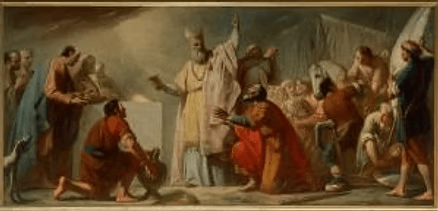
The brass ring then symbolizes one’s devotion to loving God with all one’s heart, soul, and strength.

To even try to reach that goal, one has to ride the galloping steeds on the outer ring of the carousel. Sitting in the bench-seats on the interior keeps one from having a chance.

#Amos522 #Hebrews91114 #Isaiah111 #Psalm5116

Jeremiah 33:14-16 – A righteous branch that is named Yahweh is our righteousness

The days are surely coming, says the Lord, when I will fulfill the promise I made to the house of Israel and the house of Judah. In those days and at that time I will cause a righteous Branch to spring up for David; and he shall execute justice and righteousness in the land. In those days Judah will be saved and Jerusalem will live in safety. And this is the name by which it will be called: “The Lord is our righteousness.”

———————————————————————————————————-

In this chapter of Jeremiah, he has been banished from the temple and sent into the court of the prison. Things were not going well for the split nation of Israel. When we read here of “the promise made” by Yahweh, the Hebrew word translated as “I have promised” is “dib·bar·tî.” The root Hebrew word, “dabar,” more properly means, “to speak.” Therefore, rather than thinking God had promised to give something good to Israel and Judah, which was like a father promising a reward for his children, the reality is God had spoken what would happen in the future [and God knows all].

When the one nation of Israel began its demise under David, and more so under Solomon, when it split into two nations under two kings, one has to recall what God said through Samuel, after the elders of the tribes demanded Samuel anoint them a king to be like other nations. After Samuel said how much sacrifice the people would have to give to a human king, God ended by saying, “When that day comes, you will cry out for relief from the king you have chosen, but the Lord will not answer you in that day.”

The promise spoken is, “You make your bed. Now you have to lie in it.” The ‘reward’ given was their wish to be like other nations had been granted. They had turned away from the One God Yahweh, thus they had no King protecting either nation’s people. Jeremiah was told Israel and Judah had reached the point of being overrun by other nations and would then have to live under foreign domination, or be scattered to the four corners of the earth.

When God then told Jeremiah, “In those [future] days and at that [future] time I will cause a righteous branch to spring up for David,” this was initially prophesying Jesus. It is important to know that Hebrew does not have capital letters, but names (such as the Lord, Israel, Judah, and David) receive that honor as proper names, not simple words.

In this statement by God, the translation has capitalized the Hebrew word “tsemach,” showing it as “Branch.” The capitalization is not necessary, as Jesus was a direct descendant of David. Isaiah said, “A shoot will come up from the stump of Jesse,” (Isaiah 11:1a) which implies the tree of Israel (born of Saul and David) was dead [like the fig tree that bears no fruit].  Jesus began a new tree.

This means the “righteous branch” would be the fruit produced from the Jesus tree, as Isaiah also prophesied: “from his roots a Branch will bear fruit.” (Isaiah 11:1b) The word “tsemach” means, “sprout, growth [especially of a vine], or a bud of a plant.” Jesus would then be new “growth” from the same root of God’s holiness. The fruit of Jesus would be Christianity, which is the Christ Spirit reincarnated in Apostles, all reborn as Jesus Christ.

This is how a “branch” has greater significance as a continuous vine that spreads as it grows. With its roots in Holy soil [God], from which the fruit [Apostles] receives its nutrients, it is the tree or the vine [Jesus] that always grows from the root and always produces new fruit. Israel had failed to be one nation serving that role. Therefore, Jesus would be sent to “execute justice and righteousness in the land.”

The “vine” metaphor, as the “growth, shoot, or branch,” keeps the same root, which is God. The tree metaphor has family branches, but real trees produce fruit that falls from the branches and makes its own roots. Israel and Judah were like a forked tree that died; but Jesus was like a new vine.

When God then told Jeremiah, “In those [future] days Judah will be saved and Jerusalem will live in safety,” this certainly was the case when Jesus was born. Judah was then called Judea, as a province of Rome. The Persians secured that region for the returning exiled Jews, who were the remnant of Judah. The Persians rebuilt the Temple in Jerusalem for them to safely practice their religion. Jesus came after a beautification process had begun on the Temple; and his ministry was during times when there were no Roman hostilities directed at the Jews.
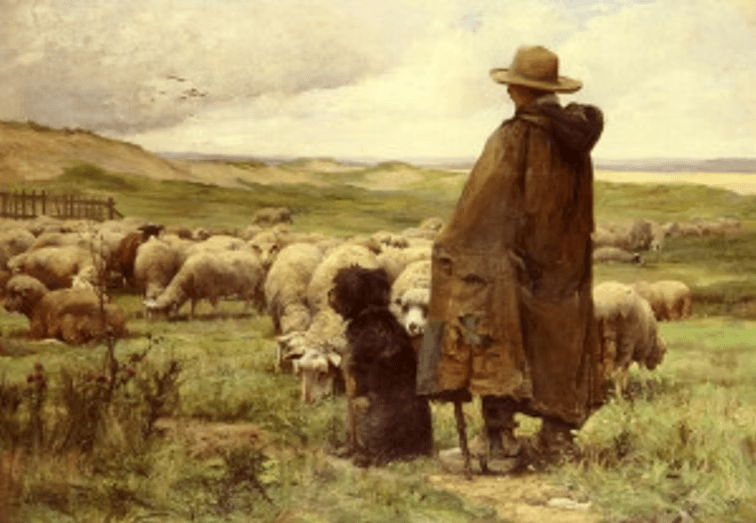
Still, it should be realized that this prophecy has not ceased to be applicable to today’s world. The name “Judah” [Hebrew “yə·hū·ḏāh”] means, “Let Him (God) Be Praised.” Christianity would become the salvation of what Israel had squandered, because it requires all disciples to fall deeply in love with Yahweh, so He will marry His wives and become one with them [individually]. At that point in the future, when Apostles were made, all would praise God. Because Jerusalem’s name means, “Possession Of Peace” or “Foundation Of Peace,” each Apostles becomes representative of Jerusalem, so each will “live in safety,” protected by the Lord.

As the key component of Jerusalem was the Temple, each Apostle is that sanctuary of God, with the heart of each Apostle where the Ark of the Covenant is kept, with Jesus Christ as the High Priest within. Therefore, Jeremiah spoke of the fruit of the vine of Christianity as being Judah and Jerusalem.

This then led to God saying, “And this is the name by which it will be called: “The Lord is our righteousness.” In this name prophesied by Jeremiah, the Hebrew written is “Yahweh [YHWH] ṣiḏ·qê·nū,” where the root word “tsedeq” means “righteousness.” The modification to that then says, “Yahweh is our righteousness,” in the plural number. Certainly, Jesus professed his righteousness was not self-made, but from the Father, meaning he was righteous because he was the Messiah of God. The plural number then means many will share in one name, where all will be like Jesus, proclaiming, “Yahweh has made us righteous through the Christ.”

As the Old Testament reading selection for the first Sunday of Advent, Year C, we are told of the times when Christians will be the extensions of Jesus of Nazareth, all born as the Christ. The association of this reading with Jesus telling his disciples of future times, when the Temple of Jerusalem will be destroyed, is now seen as the future times shown to Jeremiah, when Jerusalem would live in safety. The paradox is that Jerusalem will be both – destroyed and secured by God’s Peace.
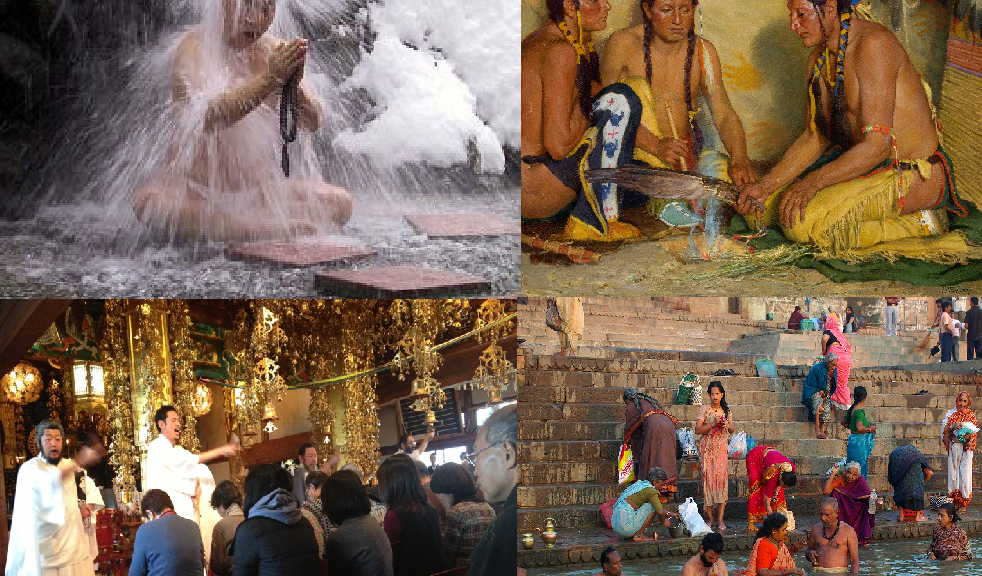
Christians today are that paradox, as some are reflections of a worldly Jerusalem and others are reflections of a spiritual Jerusalem. One professes belief that birthright is all one needs to be blessed. During Jesus’ time on earth, the Jews that saw the worth of a fabulous and splendid building of stone and timber, they would be destroyed just like it. Just like going back to Jerusalem and rebuilding a dead tree on the stump that once was a mighty living tree of God, that dead reconstruction was like the fruitless fig tree Jesus cursed and made to wither and die. Christians that act like Pharisees and resist the teachings of Jesus today are just like a worldly Jerusalem that will face destruction.
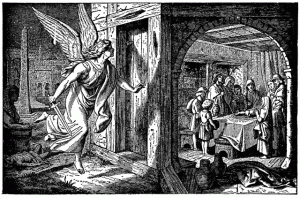
Those Christians who are reflections of a spiritual Jerusalem, where the Law has been written on their hearts by the presence of God, through marriage and being cleansed by His Holy Spirit, they are the salvation of Judah. They praise God for taking their eyes off the worldly, through self-sacrifice, which allows them to be reborn as Jesus Christ – the fruit of the living vine.

This reading supports an End Times theme, meaning one has to see the folly of ignoring the urgency of one’s call to choose between destruction and salvation. Those who will survive must take on the name that identifies with God – Yahweh is my righteousness. Righteousness is impossible without God. Self-righteousness is a death sentence – destruction by mortality. One’s personal End Time is faced once again with divine judgment placed on an immortal soul: reincarnation or eternal damnation?

The promise to Israel and Judah are the promises made by God with all who swear an oath to a Covenant, only to find righteousness without the presence of Father, Son, and Holy Spirit is too much hard work. If a sworn Christian today is demanding to have a king to be like other nations: by having a politician to worship; by having a political party to align with; by thinking one has a birthright to privilege that allows one to sin and write it off as safety in numbers; or if one simply demands a “right to be me, because I am somebody!” then guess what.  Your wish has been granted by God.

Your ‘reward’ is you will become a slave to your addictions; and your addictions will destroy you. The clock is ticking towards a personal End Time, with God only saving those who wear His face.

The decision is up to the individual.