Tag Archives: Isaiah 50:4-9a

Isaiah 50:4-9a – The Lord God and me

The Lord God has given me

the tongue of a teacher,

that I may know how to sustain

the weary with a word.

Morning by morning he wakens–

wakens my ear

to listen as those who are taught.

The Lord God has opened my ear,

and I was not rebellious,

I did not turn backward.

I gave my back to those who struck me,

and my cheeks to those who pulled out the beard;

I did not hide my face

from insult and spitting.

The Lord God helps me;

therefore I have not been disgraced;

therefore I have set my face like flint,

and I know that I shall not be put to shame;

he who vindicates me is near.

Who will contend with me?

Let us stand up together.

Who are my adversaries?

Let them confront me.

It is the Lord God who helps me;

who will declare me guilty?

———————————————————————————————————-

This is an optional Old Testament selection from the Episcopal Lectionary for the Seventeenth Sunday after Pentecost, Year B 2018. In the numbering system that lists each Sunday in an ordinal fashion, this Sunday is referred to as Proper 19. If chosen, it will next be read aloud in an Episcopal church by a reader on Sunday September 16, 2018. It is important because it is the voice of God coming from one of His prophets, projecting the strengths and talents that God gives to His devoted.

In contrast to the Proverbs 1:20-33 reading that is an alternative option to this reading in Isaiah, here it is clear that the giver is God, rather than a feminine power referred to repeatedly by feminine pronouns. Here, Isaiah wrote “adonay Yahweh” (variations thereof) four times in six verses, which says “the lord Lord” (translated as “The Lord God”).

The Hebrew word “adonay” is said to be an emphatic version of “adon,” which means “lord, master, owner, king” and even “husband.” It is used to denote a state of divinity, beyond that of humans. While the Hebrew alphabet has no distinction of upper and lower case, such that translating YHWH implies capitalization as “Yahweh,” the capitalized version, “Adonay” is read as an equivalent name for Yahweh. When combined (as Isaiah wrote) the implication is naming God (Yahweh) as the Supreme deity, which means it clarifies Yahweh elohim (God of gods) as the Lord of lords.

This means that Isaiah is speaking clearly of a masculine deity, one who is the greatest of all gods – God the Father. Solomon’s references to “Wisdom” as a “she” and “her” is placing the concept of human intelligence into the hands of a subordinate “god,” meaning “wisdom” is processed through the human brain from a source that is external to one. This means God is then representative of the elements of human life that teach, which can be formal (i.e.: rabbis and professors) or informal (i.e.: parents and peers).  Their teaching approach is motivated from the heart leading the brain.  Thus, true prophets have learned this method from God.

The dangers of “Wisdom” (the goddess, like Athena) come when one sees the self more godlike, due to being smarter than most of the rest of the human race. It is when humans worship “self-intellect.” “Wisdom” becomes like a protector god that makes humans into heroes, as told in Greek mythology.

This parallels the dangerous course of “mystery schools” of thought (i.e.: Freemasons and Rosicrucians), where the concept of God is relegated to a “Universal Mind,” from which the well-educated can tap into, profiting from the higher knowledge gained. This is then theStar Wars view of God as being the “Force,” into which good (Jedi knights) and evil (Darth Vader and the Dark Side) can access, making God be a slave to human mentality.

And they called him Lord Vader.

This is not what Isaiah wrote of here. Whereas Solomon (who had been given great wisdom as his own – a known characteristic of him) wrote of “Wisdom” belittling the foolish for not embracing “her call,” Isaiah wrote of what God had given him talents, which comes from Isaiah receiving His call. Isaiah wrote, “The Lord God has given me the tongue of a teacher,” which is the Wisdom of Yahweh coming from the mouth of His prophet. This presence must be seen as chosen by Isaiah, welcomed by God, and acknowledged as God speaking through His servant.

This is where reading “adonay” as emphasizing the marriage of God and Isaiah, where Yahweh is the husband and Isaiah the subservient wife. Unlike when one boasts of intelligence and calls it “Wisdom,” where self is proclaimed as having been blessed by God to have a Big Brain, Isaiah left no room for misinterpretation of his source of wisdom. He stated his “husband Yahweh” told him knowledge he had not known before.

By saying, “that I may know how to sustain the weary with a word,” God gave Isaiah the gift of prophecy to uplift others, not self. The message of a prophet is not believable because people recognize one for having always spoken wisely, but because one who had been seen as simple-minded suddenly speaking profoundly.

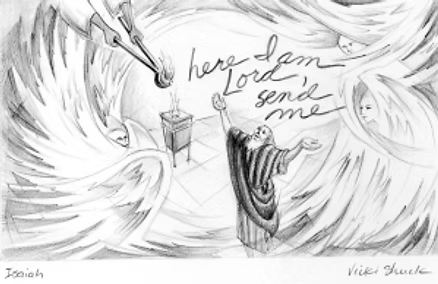
Isaiah was groomed to serve the Temple in Jerusalem as a priest, being from the royal house of Judah; but he saw himself as inadequate, saying in a dream, “Woe to me! I am ruined! For I am a man of unclean lips, and I live among a people of unclean lips, and my eyes have seen the King, the Lord Almighty.” (Isaiah 6:5) For all he had been taught, he knew nothing of value.  Thus, Isaiah volunteered to serve God as His messenger, becoming a prophet, and speaking so others would be led to God.
When Isaiah then wrote, “Morning by morning he wakens — wakens my ear to listen as those who are taught,” it should be realized that Isaiah was not awoken by the voice of God at seven o’clock in the morning. The Hebrew word repeated is “bab·bō·qer,” from the root “boqer,” meaning “morning, dawn, day, and daybreak.” This is metaphor for enlightenment, when the light of truth spoke to Isaiah, showing him the meaning of things previously unnoticed. “Morning” is then Isaiah opening his eyes to signs, as the voice of God’s whispers gave insight that common wisdom would miss and logic would struggle to defend.

This is followed by Isaiah writing, “The Lord God has opened my ear, and I was not rebellious, I did not turn backward.” Again, the use of “ozen,” meaning “ear,” is not about the physical sense of hearing. Isaiah is speaking as did other prophets, including Jesus, who said (in effect), “You have ears but you cannot hear.” Physical sound waves are captured by mature ears and translated by the brain into meaningful thoughts, based on one’s level of education and understanding of thoughts. The metaphorical “ear” is hearing spiritual insights “revealed,” so knowledge is gained without prior learning.

A lack of “rebelliousness” means without question. To question the Lord is to demand one’s brain be filled with explanations and reasoning. To not rebel is to accept silently, understanding that should any need for further explanation arise, then the responding truth will likewise come through holy “revelation.” To “not turn back” (from “achor” meaning “back, backward, away”) means to go forward with that which has been “taught,” as one possessing “the tongue of a teacher.”
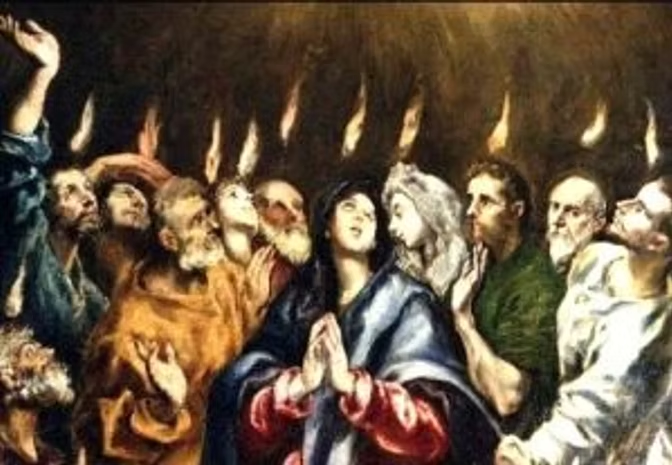
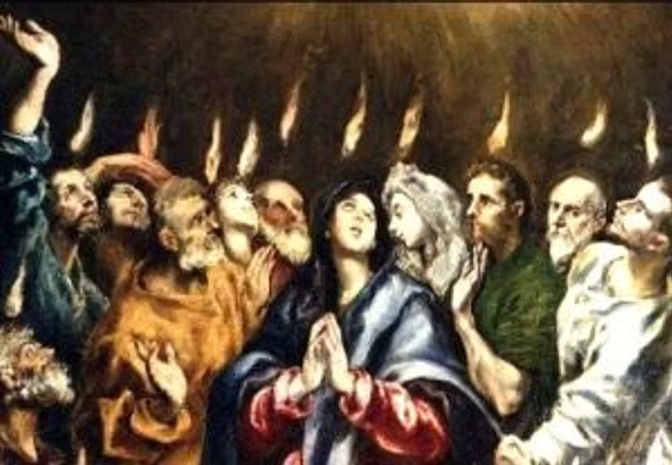
Imagine that … a “teaching tongues” lesson during the Pentecost season.

This, again, is different than common intelligence, where the advent of the scientific method has seemingly called as the voice of Wisdom, leading human beings to believe in the powers of observation and calculable data. When “proof” is invisible, as is an inner voice that demands faith, more than belief, it is easier to see how “Wisdom laughs” at those who rebel against her formulas and statistics. In this regard, Isaiah wrote, “I gave my back to those who struck me, and my cheeks to those who pulled out the beard; I did not hide my face from insult and spitting.”

By understanding the times of Judah, when it faced capture and enslavement by the forces of Babylon, a prophet like Isaiah did not offer any tangible advice that could quell a foreign power. The Jews did not want to know how captivity could be a step towards redemption, when they still could not see how they did anything wrong. The punished Jews blamed God for their loss; which was the selfish voice of wisdom seeking to destroy the fools who would be prophesying repentance.

Isaiah offered his back to the whip, as would Jesus when the Jews turned on him, because a prophet can be seen like a stubborn donkey that will not move on the road of public opinion. He let them pull out the hairs of his beard, when holy men are given points by how long their beards are and how untrimmed the edges are. Isaiah let them show their rejection of his words as so that being bearded became a reflection of how Jews were not being those of God.  Isaiah having his beard yanked was because their rabbis did not have ears that could hear. As a prophet of the Lord, Isaiah wore the face of God, as did Moses, so it would be God the Jews cursed and spat upon, not having eyes that could see spiritually.

Isaiah wrote then, “The Lord God helps me; therefore I have not been disgraced.” Whereas Solomon wrote of “Wisdom” mocking and laughing at “fools” that reject bowing down before external knowledge, Isaiah wrote that Lord Yahweh comforts souls that commit to Him from such abuse. The language that attempts to belittle the simple ones into forced slavery, through condemnations and epitaphs, will have no effect on souls married to the true God. The husband Lord of a wife soul will ensure that only grace (not disgrace) will be.

This state of contentment means Isaiah could sing, “Therefore I have set my face like flint, and I know that I shall not be put to shame; he who vindicates me is near.” There will be no trembling of lips, as the face of God is worn with conviction.
It is a face as hard as granite rock that causes sparks to fly off it when struck by metal. It will not be lowered because no shame can be set upon it. As one with one’s soul, within one body, the self (“me”) then can see all questions of proof are vindicated by the Mind of God (the Christ Mind) that is “near.” The word translated as “near” is “qarob,” which also means “related.” That states the marital relationship to God.

When Isaiah then posed the question, “Who will contend with me?” the call is as a teacher to those who will heed the voice of God through a prophet. Whereas “Wisdom” would be making a call to stand off against one, like two gunslingers in the Wild West, Isaiah is asking, “Who will join me to plead for God?” Thus, he said, “Let us stand up together.”

Contrary to that question and statement, Isaiah then asked, “Who are my adversaries? Let them confront me.” This does not take the approach of Solomon and the goddess Wisdom, where the people were asked how long they would be simple and fools, rejecting the call of wealth and power that worldly knowledge offers. Instead, Isaiah spoke for God asking, “Who follows a greater one than Yahweh the Lord?”

In this regard, the translation of “adversaries” is misleading, as two words in Hebrew are stated: “ḇa‘almishpat.” This literally translates as “owners of judgment” or the “masters of justice.”

The new makers of law are those who serve Baal and pass mishpat.

It uses the lower-case “lord” that is the god many called Baal by name. Another viable translation of the Hebrew can transform the question so that it also asks,” Who are the married ones of destruction?” That is less to insult others, and more to offer a better marriage to Yahweh, the true lord of justice and the only owner of judgment.

When one sees that God was posing the questions through His obedient wife, it is easy to grasp how, “Let them confront me” is still not a threat, but an invitation for marriage. The word “yig·gaš” is translated as “let them confront,” when the root word that comes from is “nagash,” which is another form of the word “near.” It asks, “Who will come closer to me?” or “Who will stand with me?” It is then an invitation for a date with God and potentially the beginning of a lasting romance.

Following that proposal, Isaiah wrote, “It is the Lord God who helps me; who will declare me guilty?” For the fourth time in six verses Isaiah claims Yahweh is his husband and master, the one who is married to his soul and who leads him to seek the wayward and offer them a new hope. There are none among those who will accept the invitation of Yahweh and get to know him that will declare Isaiah as guilty of a sin.

Still, this translation of verse 9a is wrong, as no question is posed. The literal actually states: “Surely  ,  the lord God will help me  ,  who he will condemn me indeed  ,”.   A viable translation of this [a paraphrase] says, “It is assured [to all]  ,  God has helped me  who myself would be condemned as well [if not for the Lord God.].” Isaiah has then furthered the invitation to get to know God, through love in one’s heart, because loving God meaning Salvation.

As an optional Old Testament selection for the seventeenth Sunday after Pentecost, when one’s personal ministry for the LORD should be underway – one should be married to God and gladly facing abuse as His prophet – the message here is to understand the difference between intellectual religion and spiritual faith. It is much easier to take the time and make an effort to learn Scripture than it is to walk up to a “professional” and question his or her knowledge of religion. When one is not married to God, one will hide in the shadows (not shine in the “Mornings”), afraid to ask God’s questions and insulted when one’s personal wisdom is questioned.

While Christians can let the words of Isaiah flow over them as they sit in a church on Sunday and like the sounds of the English translations, few realize Isaiah is talking to them. Christians are those who have figuratively been led away into slavery in Babylon. Isaiah still stands as a prophet of the Lord God who is singing a song about how wonderful it is to be married to God, because He sends me out to sing praises to people like you.

This means it is the Christians now who whip the back of those who stop following the road designed to take believers away from God and stubbornly keep hee-hawing, “You’re going the wrong way.”

It is Christians, not Jews now, who are refusing to grow beards, as the new sign of holy men.  Catholic friars would also cut halos onto their scalps; today women can be priests and pastors, not needing a beard to be allowed to preach. Whenever looks are the way to tell righteousness, it is time to worry.  With the message trusted by simple souls, it is then Christians who insult anyone standing firm against liberalism (changing the laws to suit modern desires), only to be spat upon.

This is not an overnight transformation. It is not a change caused by the youth of the sixties free sex and drug experimentation culture clashing with the ‘fire and brimstone’ ‘old time religion’ that was prominent during the horse and buggy era. It is a change coming since Rome led Crusades against Jews and Arab infidels, while stripping the people of all knowledge of Mosaic Law and refusing translations of Scripture that were not Latin. Christianity was attacked then, just as Judah and Jerusalem were in the times of Isaiah; only the attackers were wearing robes and carrying crosses. Priests have long been taught how not to teach marriage to God [although nuns could marry Jesus].

Certainly, the Church of Rome began a rapid decline in the Twentieth Century, with the rottenness of its core became known, after being covered up for decades. Now there is talk of the Church’s “Holy Father” – supposedly an Apostle who is Jesus Christ reborn – resigning, due to being part of this cover-up. Still, there are cults calling themselves religions that call upon the name of Jesus Christ and branch after branch of Christian denominations that have transformed one true vine bearing good fruit into some wild growth of unkempt shrubbery with poisonous berries. Few can interpret Scripture, and fewer want to try, and even fewer have time to listen to interpretation, much less give thanks to anyone for doing so. Therefore, Isaiah is singing this set of verses to us today, just as his song was heard long ago.

Four times Isaiah refrained, “The Lord God helps me.” That does not say, “The Lord God helps you,” as a promise that believing in God will bring a comfortable living.  That was the “Wisdom” boat set sail by Solomon.  Still, it can mean “The Lord God helps you … if you become a me, like Isaiah.

Every problem the world has today, which has to be at least as many (if not more) than the Jews faced in a land that followed different mores and ate unclean meats on holy days, can be alleviated by one being married to God. A me is a wife of the Lord God (regardless of one’s human gender).  God helps His wives.
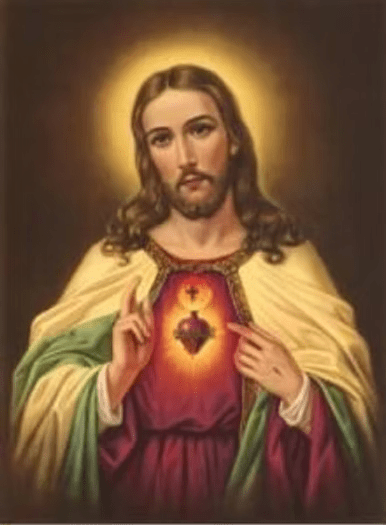
The Lord God lets me help you, as you … so He helps me be you. I have to be reborn in you.

Until you can honestly sing this song of Isaiah from a personal perspective, from being in love with God and knowing His presence – His near relationship as the Father to His Son Jesus Christ – then you will be a servant of “baal mishpat” – one awaiting the judgments of masters that excel in the worldly realm. If you want to find freedom from this earthly bondage, while still being in the chains of slavery, then you need to get out of that spiritual box you are hiding in and make a meaningful commitment.

No prior knowledge is required. Just a heart full of faith allows one to say, “Yes” to God’s proposal.


Isaiah 50:4-9a – The liturgy of adonai Yahweh – God is my lord

The Lord God has given me

the tongue of a teacher,

that I may know how to sustain

the weary with a word.

Morning by morning he wakens–

wakens my ear

to listen as those who are taught.

The Lord God has opened my ear,

and I was not rebellious,

I did not turn backward.

I gave my back to those who struck me,

and my cheeks to those who pulled out the beard;

I did not hide my face

from insult and spitting.

The Lord God helps me;

therefore I have not been disgraced;

therefore I have set my face like flint,

and I know that I shall not be put to shame;

he who vindicates me is near.

Who will contend with me?

Let us stand up together.

Who are my adversaries?

Let them confront me.

It is the Lord God who helps me;

who will declare me guilty?

——————–

This is the Old Testament selection for the indoor service on Palm Sunday, Year B, according to the lectionary for the Episcopal Church. With an outdoor service held first, when palm leaves are passed out to all in attendance (called the Liturgy of the Palm), the congregation is then solemnly led inside, where the regular service is called Liturgy of the Word. This particular selection from Isaiah will be read in all three years of the lectionary cycle (A,B, and C). Due to the length of the Palm Sunday service [aka Passion Sunday] (outdoor and indoor) means nothing will be said about these words from Isaiah at those times. However, these verses will also be read on two other occasions in the church calendar, with it being possible they will be then be explained in a sermon. the best chance for that happening will be during the Ordinary time after Pentecost, Proper 19-B service.

The name of the book this reading comes from is “Isaiah,” but as is the case with religious scholars (it appears), teaching doubt at every turn is best to keep educators employed, always needing someone to teach “church history” and other tricks of dogma. Doubt weakens the faith of seekers. Here, the ones with the larger brains have figured out that this chapter [number 50] falls under the heading “Deutero-Isaiah” The scuttlebutt says Isaiah chapters 40–55 are “the work of an anonymous 6th-century BCE author writing during the Exile.” (Wikipedia) That says, it is the educated guess that should be taken as “gospel” is some prophet [of unknown nomenclature] put his name on a document that preexisted, under the name “Isaiah.” Presumably, he just added more to a book that the real Isaiah had begun.

To move beyond the doubt, where the same source says, “Isaiah was one of the most popular works among Jews in the Second Temple period (c. 515 BCE – 70 CE). In Christian circles, it was held in such high regard as to be called “the Fifth Gospel” (also Wikipedia), I feel the author of all divine Scripture is the same – Yahweh. Because bodies of flesh and bone are temporal and are bound to die, Yahweh uses multiple bodies of His faithful – His prophets – to write His Word.

I also firmly believe that anyone who professes to be a “Christian” must either begin with that belief – God is the author of all within the Holy Bible, thus all are words of truth – or one needs to admit one is not a Christian. If one sees a church as a place to be educated so one can enter ministry, that boat is not longer sailing. Being a prophet like Isaiah [who was trained in the school of prophets, but not well enough to write a book] is no longer a “tag, you’re it” process – the one that made Christianity great. If you think the only way to be a priest for Yahweh is to attend a school offering diplomas, then you put your faith is in scholars, not the One God.

Verse 4 in this reading selection makes a clear statement of one being divinely possessed by Yahweh. The first words that have been translated as “The Lord God” are written in Hebrew as “adonay Yahweh” [no capital letters in Hebrew]. This means “The Lord God” actually states “lord [of me] Yahweh.” [I allow that capitalization.]

The use of “lord” [“adonay”] has to be understood as being a statement about self, where the spiritual self of a body of flesh is the soul. Regardless of external motivations and enticements, the soul is the lord of the body, operating through the human brain. The body does as the soul commands, although the body can become like a crying child, so the soul ends up pampering the body, just to shut it up. This means the word “adonay” alone means a soul as lord over a body.

When the word “adonay leads to “Yahweh,” that then becomes a statement of marriage between Yahweh and a soul in a body of flesh. It is that union that causes the body of flesh’s lord to be Yahweh – His Holy Spirit. Thus, verse 4 is a proclamation that whoever it was going by the name Isaiah [maybe there were several Isaiahs who were prophets?] was filled with the Holy Spirit of Yahweh and led to speak the truth, in Yahweh’s name.

When we read, “given me the tongue of a teacher,” the element of possessing a “gift” of speech is important to realize. Without the presence of Yahweh controlling a body of flesh, then that ability to speak God’s Word would not be possible. That talent is given by one becoming a wife of Yahweh.

The Hebrew word translated as “teacher” is “limmud,” which means “taught.” Of course, we all know that the title “rabbi” means “teacher” [Aramaic “rabbonni”]; but in order to become a “teacher,” one must first be “taught.” Because of possessing the ability to speak [“tongue”] as a “teacher,” that means one has been “given” wisdom, which one received. That is what has been freely given by Yahweh; still, the prophet [Isaiah] was thereby being “taught” while he spoke words that teach others. This verse should then be seen as one foretelling of the “speaking in tongues” that occurred on Pentecost, when disciples became Apostles.

The word “limmund” also implies one is a disciple or student, such that one is “accustomed” to being led to understanding. (Brown-Driver-Briggs) When one enrolls in a school, one expects to go there and willingly accept instructions. The same expectations apply when Yahweh becomes like a school, with only one student in His class.

This then reflects on how an Apostle is not suddenly someone who has learned everything necessary to be learned, in order to go into the business of ministry by oneself. As a priest who presumes to know a lot after graduation from some education institution, the reality of a student of Yahweh is there is a continuation of the learning process. One always remains a disciple, one who has willingly been transformed into a mouthpiece for Yahweh. This means the “tongue” (“lashon”) is not a power coming from an educated brain, but the Word of God coming from the “speech” of a body of flesh, whose “lord” is “Yahweh.” This is why the student Ezekiel answered God’s question, “Can these dry bones live?” by saying, “Lord, you know.”

When verse 4 then continues by stating, “that I may know how to sustain the weary with a word,” this is Yahweh lording over someone named Isaiah – willingly and longingly, through marriage. That says the only reason God speaks through a prophet is so those seeking God’s help can be comforted. Someone who needs assistance, who is weary spiritually, is one who is simply a soul lording over its body of flesh, and going nowhere positive. The weary then cry out in laments to God, so God answers their prayers through His prophets. The prophets are then the messengers who say, “I heard your cry for help.”

Here, it is important to grasp that the educated are not the ones who routinely give comfort to the spiritually weary. If anything, they are the ones who add to the misery, placing blame on their souls for inabilities not to sin anymore. This condition existed after Israel and Judah had been lost, which is when the scholars now are saying this chapter was written after that. They conclude Isaiah 50 (with other chapters) was written after the return from exile in Babylon, back to Jerusalem, inside the new second temple. Thus, the spiritually weary were those misled [already back then] by teachers who did not have Yahweh as their lord.

Then, verse 4 says, “Morning by morning he wakens — wakens my ear to listen as those who are taught.” This mistranslation can give the impression that a prophet of Yahweh wakes up and goes to school to listen to his teachers. The actual Hebrew says, “he awakens my ear to hear as the learned.” This means Yahweh constantly speaks His truth to the disciple wife, so the prophet is always filled with deep faith, trust, and love of that guidance. He [or she] delights in ‘school time’ never ending. Most Episcopalians can barely stand an hour a week being orated to by a priest [which says something about what little is being said too].

At this point, it is worthwhile to realize that verses 5, 7, and 9 all repeat the presence of God, as “adonay Yahweh.” Repetition in divine Scripture is always a signal of a theme that needs to be understood. Thus, it was Isaiah who had once been weary, like so many other Jews [Judeans], but his ear was opened when Yahweh answered his prayers.

Isaiah wrote, “I was not rebellious, I did not turn backward.” This is a statement of wanting to hear the proposal of Yahweh. It says Isaiah heard the call to sacrifice self-control, of his soul over his flesh, and he did not resist that sacrifice. The spiritually weary are often those who rebel and turn their backs on Yahweh, especially if they have made the world their surrogate for Yahweh. Spiritual weariness can be assuaged by material illusions, of power, wealth, and influence over others. People with a lot to sacrifice will quickly rebel.

Because this reading is chosen to accompany the sacrifices Jesus made, at the hand of the Romans, prompted by the Jews of the temple, the words of Isaiah say this abuse is to be expected. The leaders of the second temple likewise did not appreciate prophets telling the educated just how wrong they were. Some things always remain the same. The leaders of the churches today do not like being told they are wrong.

Those words coming from the mouths of the prophets are the voice of God in many bodies of human flesh; but because the educated have never been educated by sacrificing their brains to serve Yahweh, they lash out at the prophet. As Isaiah wrote and as will be read from Mark [Year B], the pretend holy act violently against those speaking as Yahweh: whipping backs, pulling beards, insulting and spitting on them [add purple robes and crowns of thorns]. This mistreatment is to be expected by all wives of Yahweh – those who marry His Holy Spirit and lovingly allow Him to become one’s lord.

Jesus was not the only one. Isaiah was another. There have been many and there [hopefully] will be many more to come. With Yahweh speaking through a prophet’s words, they all become prophetic of Jesus. However, it is the scholars who only see Jesus as the point of Isaiah’s words that are wrong. They mislead from that narrow view of Yahweh. They punish Isaiah further by not giving someone who was married to God the credit of being “the real Isaiah” [a name that means “Yah[weh] Is Salvation]. They spit on that name still to this day, trying to defame him as being “Deutero-Isaiah,” which is akin to calling him a false prophet, someone unknown acting like a prophet.

When Isaiah wrote, “The Lord God helps me,” that says his allowing Yahweh to be the lord of his soul-body was how Isaiah could withstand all the punishment. The same condition within Jesus gave him the same ability to withstand undue punishment. All who make the sacrifice of self in marriage to Yahweh have the same help afforded them, just as did Isaiah and Jesus.

When we then read Isaiah state: “I have not been disgraced; I have set my face like flint, and I shall not be put to shame; he who vindicates me is near,” that says, “no matter how hard one tries to destroy me, my Yahweh is always with me.”

A wife of Yahweh will never be humiliated, because [like the children’s taunt says – “I am rubber, you are glue”] whatever assaults are made on a prophet of Yahweh only damages the soul of the one making the assaults. When a face is set like flint, whoever strikes that face will draw sparks that will set the abuser on fire – the kind eternal hell is made of. No one can shame a wife of Yahweh, because to cast insults and damnations on the saintly brings that shame back upon oneself.

In the questions posed by Isaiah, one must hear the voice of Yahweh speaking:

“Who will contend with me? Let us stand up together.”

“Who are my adversaries? Let them confront me.”

Yahweh is speaking those words, not the prophet himself. It is God Almighty who wants to know who it is that thinks he or she can defeat Yahweh. Those are welcomed to “stand up together” and become wives of Yahweh [Saul did that and changed his name to Paul] or challenge Yahweh himself.

The problem with abusers is they willingly cast stones to kill those who are projections of themselves; but few are willing to use the stone to kill self-ego and submit to the Will of God. A confrontation with Yahweh becomes a desire to know what makes Isaiah tick. In that process of conversation [rather than acts of killing], God will win every heart who hears the truth. The problem there is the educated fear being exposed as idiots, so they avoid direct confrontation [see how the Jews used the Romans to do their dirty work].

This reading ends with Isaiah saying, “It is the Lord God who helps me; who will declare me guilty?” That repeats the theme of “adonay Yahweh” being Yahweh asking all who will be like Isaiah and Jesus and become souls married to Yahweh, a union of soul with Holy Spirit. All who are the wives of Yahweh will receive His blessings. That divine assistance means one’s soul is granted eternal life. Thus, a question of judgment of guilt can only be truthful if one is charged with being holy, sacred, saintly and divinely inspired. Anything short of that simply becomes the judgment of a soul alone projecting one’s own failures onto others, where all true guilt becomes their own burden to bear.

On a day when churches put on pageantry to show the distresses Jesus suffered, at the hands of the unjust, to say nothing about this reading from Isaiah is to act as Jews taking silent delight watching Jesus suffer. A priest who says nothing about the Passion of Jesus [“passion” meaning “suffering”] says one is a soul alone, having no words from Yahweh to share. Imagine how well Pentecost Sunday would have gone, had Peter and the eleven received tongues of fire and then just sat down in some papal chair, letting the events of the previous Passover “speak for themselves.”

Yahweh is a Big Boy. He is much bigger than any educated human brain that has ever been known to mankind. Yahweh knows all and wants to share that knowledge with seekers … those spiritually weary and seeking divine help. The churches of today have become modern models of the Temple of Jerusalem, all fighting against anyone who claims to be the Messiah, always killing the messenger rather than listen. Yet, they demand attention, when one who has never been taught by Yahweh can never teach anything of value about spiritual matters [ask Nicodemus].

The beauty of this message is it does not matter how bad things get, if one has surrendered oneself to Yahweh. Yahweh is big enough to marry every soul in the world and provide loving care for them all. The problem is that open proposal is assaulted and confronted by those who think they have too much to lose if God ever ran the world. They reject the concept of “adonay Yahweh” black-heartedly.

Isaiah 50:4-9a – Lords a leaping

[4] adonay Yahweh has given me

the tongue of a teacher,

that I may know how to sustain

the weary with a word.

Morning by morning he wakens–

wakens my ear

to listen as those who are taught.

[5] adonay Yahweh has opened my ear,

and I was not rebellious,

I did not turn backward.

[6] I gave my back to those who struck me,

and my cheeks to those who pulled out the beard;

I did not hide my face

from insult and spitting.

[7] wadonay Yahweh helps me;

therefore I have not been disgraced;

therefore I have set my face like flint,

and I know that I shall not be put to shame;

[8] he who vindicates me is near.

Who will contend with me?

Let us stand up together.

Who are my adversaries?

Let them confront me.

[9a] It is adonay Yahweh who helps me;

who will declare me guilty?

——————–

This is the Track 2 Old Testament reading that can be chosen for reading on the sixteenth Sunday after Pentecost [Proper 19], Year B, according to the lectionary for the Episcopal Church. If Track 2 is chosen for reading this year, it will be accompanied by a reading from Psalm 116, which sings, “The Lord watches over the innocent; I was brought very low, and he helped me.” That pair will precede the Epistle reading from James, where he wrote, “For all of us make many mistakes. Anyone who makes no mistakes in speaking is perfect, able to keep the whole body in check with a bridle.” All will accompany the Gospel reading from Mark, where Jesus said, “Those who are ashamed of me and of my words in this adulterous and sinful generation, of them the Son of Man will also be ashamed when he comes in the glory of his Father with the holy angels.”

In the above English translation, in four places the NRSV translated “adonay Yahweh” as “the Lord God.” Because this is not the truth of that written, I have restored the Hebrew text in those four places. First of all, the Hebrew word “adon” is the singular number word “lord.” It does not demand capitalization, as Yahweh has no lord, only human beings [i.e.: souls] have “lords.” Because “adonay” is the plural number, as “lords,” with there being only one God [i.e.: Yahweh], the intent is as a statement of that which “lords” over human souls; so, the capitalization need not be applied. As for “Yahweh” being translated as “God,” the Hebrew word for “god” is “el,” which was not written. The proper name “Yah-weh” from “יְהוִה֙,” is specifically for the “One God of Israel,” where “Israel” means “He Retains God.” When one retains God, then “Yahweh” is one’s “lord,” not some generic “lord” or “god.” The plural number word for “gods” is “elohim.”

Also, one will note that the Episcopal Church has made the decision to remove the verse numbering. I have applied the numbers, which appear in bold type, between brackets. In the subsequent analysis of this reading, I will refer to the verses by number. My applying those numbers will make it easier for the interested seekers to follow that analysis. Where I list “9a,” this means the full text of verse nine is not included in this reading. Only the first words will then be read. However, the full verse might need to be examined to make what is in the “a” part make more sense.

The BibleHub Interlinear website lists verses four through eleven [the last verse in this chapter of Isaiah] as being headed: “The Servant’s Obedience.” This is, of course, a matter of opinion that was not written by Isaiah, although the title should reflect verbiage that Isaiah did write. The NRSV [the Episcopal Church references that translator as the source of its text] shows these verses as headed: “The Servant’s Humiliation and Vindication.” Again, this should be seen as reflected in the actual verbiage written by Isaiah.

Verse four literally translates into English as: “adonay Yahweh has given me the tongue of the learned , to know how to speak to the faint , speaks ; he awakens me the break of day coming of daylight , he awakens me my ear to hear as the learned .” While the NRSV translation makes this simple to discern, using words like “teacher” and “taught,” their translation of “The Lord God” doing that to Isaiah gives the impression that anyone can roll out of bed in the morning and begin to teach what God wants taught. Ask anyone how he or she says what Scripture means and he or she can say, “The Lord God” said so. The question is then, “What makes you so special that you have a clue what “The Lord God” means?” The only answer possible is, “Well, Yahweh is my lord, which makes me one of His elohim, or one of His whose “lord” is “Yahweh,” also known as His “adonay.” Only by being able to see that written does it make sense that one of Yahweh’s adonay have been “given the tongue of the learned.”

When this selected reading is seen as an option relative to Proverbs 1, where Solomon waxed intelligently about wisdom, one can expect he was one “of the learned,” if not the most “learned” of all history. Isaiah was most likely a ‘graduate’ of the school of prophets in Jerusalem, thus “learned,” so he had a brain and was able to use it. Still, Solomon was an elohim of worldly wisdom [called a goddess, as a “she”] and Isaiah was an “adonay” [one whose spiritual “lord” was] of “Yahweh.” This says “Yahweh has given me the tongue of the learned” is a higher frame of ‘knowledge’ than anything a fleshy brain can calculate. The “tongue” of Yahweh is what many refer to [without understanding] as “speaking in tongues.” No big brained people can do that, unless they have married Yahweh and become “adonay” of His.

When the second segment of words then says, “to know how to speak to the faint,” the words translated as “to the faint” are “’êṯ.yā·‘êp̄,” from “eth yaeph,” meaning “to the weary or faint.” At this time, Jerusalem had fallen and the Temple destroyed, with all the big brains that caused all that destruction tired of coming up with excuses for why they were not smart enough to see that coming. Yahweh spoke to Isaiah so his “tongue” would be that of a true prophet, who would be able to divinely encourage those who lost everything because of their fleshy brains’ limitations, giving them strength that allowed spiritual wisdom, unlike that possessed by Solomon. Solomon-like wisdom brought about the falls of two nations of peoples; and, such wisdom is the mother of all philosophies and doctrines that reject Yahweh and always lead to ruin.

When Isaiah wrote the same Hebrew word twice, such that it can be translated differently each time, as: “he awakens me the break of day coming,” this “speaks” of the light of insight that is the truth which comes from Yahweh. The truth is a dawning of knowledge that can never be predicted by science or mathematics, but always explained as valid in hindsight. That makes wisdom the fumbling around in darkness, which often leads to very bad conclusions. Thus, Isaiah said “he awakens me my ear to hear as the learned,” which means the whispers that come to those souls married to Yahweh allows them to follow divine leads of insight that take one to the truth, which is always the objective of wisdom.

In the fifth verse is repeated “adonay Yahweh,” where it states literally: “adonay Yahweh has opened my ear , and I not was rebellious ; away not did I turn .” Again, Isaiah is saying that his soul’s marriage to Yahweh allowed him to hear His voice guiding his actions. The word saying “rebellious” [“marah”] becomes a statement of obedience, which is customary for a wife to submit to the will of her husband, as well as a subject to submit his or her will to a king. That says that instead of turning away from Yahweh’s presence, Isaiah welcomed it into his soul. This is a further statement of divine marriage.

The sixth verse then can be shown to state, “my body I gave to those who stuck , and my cheeks to those who pluck the beard ; my face not did I hide , from insult and spitting .” From verse five being seen as a statement of submission to Yahweh, Isaiah next said, “my body I gave” [“gê·wî nā·ṯat·tî,” from “gev nathan”], where “gev” means “the back, midst.” When “midst” is used, such that it implies one’s whole “body,” this is the flesh Isaiah “gave” in submission to Yahweh’s will. While that can then be seen as a “back” that was whipped [not something Isaiah experienced], that mental direction leads away from the deeper truth of divine marriage of a soul to Yahweh, so the flesh became His to use. That then makes “those who struck” [“lə·mak·kîm”] relate to the Judaeans who had been “defeated” and “taken” into captivity.

The metaphor of allowing others to pull out the beard on Isaiah’s face, the truth of the word “marat” is “to make smooth, bare or bald, to scour, polish.” Because the beard was a sign of devotion to Yahweh, to be clean shaven was a sign of having lost that devotion. As such, the “cheeks” or the “jawbone” of Isaiah, as parts of his “body given” to Yahweh, to help those “stricken,” it was his beard of priesthood that was being offered to those whose beards had been “plucked out” by the Babylon dominators. Thus, when Isaiah said, “my face not did I hide” that speaks two ways. First, it says Isaiah did not hide his face as a priest of Yahweh. Second, it says it was not the face of Isaiah that was seen, because he hid his face when he put on the face of Yahweh, when he became an “adonay Yahweh.” That face was the strength that could not be phased by “insults and spitting.”

Verse seven again repeats “adonay Yahweh,” although “adonay” is adjusted in spelling, as “wadonay,” meaning “for adonay Yahweh.” Seeing that, verse seven then literally translates to say in English: “for adonay Yahweh will help me , upon thus not I will be humiliated ; upon thus I have set my face like a flint , and I know that not will I be ashamed .” Here, one should allow the insight of Solomon’s wisdom found in Proverbs 1 as ridicule placed upon those who are simple and love simplicity. Solomon’s soul served a worldly goddess as his “lord,” so he was like the leaders of Judah that had become the “faint” and “clean shaven.” They were unable to keep the face of Yahweh’s servants, with His face in like flint. This, again, leads one to need to see the power of divine presence that is an “adonay Yahweh.”

Because Isaiah was a simple mind that sacrificed his ‘big brain’ to obedience to Yahweh’s Will, there was nothing anyone could do to make his soul ever feel shame. As such, the words that literally translate as “I know that not will I be ashamed” also speaks two ways. First, Isaiah could not feel shame from being a true prophet of Yahweh, who served Him obediently. Second, however, it says Isaiah also knew those who did not serve Yahweh in the same way [Solomon and all his buddies of wisdom], once in captivity they would be filled with the humiliation and shame of having been overthrown by those who served other gods.

Verse eight then literally translates to say in English, “near who makes me righteous , who will contend with me let us stand together ; who my lord my judgment ? let him approach me .” In this, the Hebrew word “qā·rō·wḇ” (“qarob”) begins this verse, while “yig·gaš” (“nagash”) ends it, with both words capable of translating as “near.” The first usage is a statement of Yahweh being one with one’s soul [an adonay Yahweh], so the Spirit is what keep Him “near.” When the second use arises, this is for those who are external, therefore close enough to confront, such that those “come near” or “approach,” while not being within one’s body and soul.

The internal question, which basically asks, “Who is my lord and who casts judgment on me?” is a statement that Isaiah was one of Yahweh’s “lords,” His adonay. When that is seen from those repeated words, one can know this question says Isaiah will only be led by the One God he allows to lead him, no matter who owns his flesh and forces that flesh into service. It is the soul of Isaiah who decides who will truly be his “lord.”

In that, the “nearness” of Yahweh in Isaiah’s soul was how he could be made to be “righteous.” In captivity, when one’s failure to serve Yahweh was why many Jews felt faint, the pretense of family lineage, as birthrights no longer served captive slaves, there was no reason to contend with one another, as if one’s past rank meant anything anymore. As those who had professed service to Yahweh [whether true or not], then was the time to “stand together.” As Jews, all should be making the decision who would be his or her true “lord,” as all should marry their souls to Yahweh and become His adonay. Therefore, “let him approach me” should be the willingness to marry Yahweh and let His Spirit come near, which will mean nobody else could ever bring harm to that soul. So, bring em on!

In verse nine, the last verse of this reading, the whole verse translated literally into English as: “behold! adonay Yahweh will help me , who he will condemn me ; indeed they all like a garment will grow old , the moth will eat them up .” In this, the part “a” is that leading up to the semi-colon. One more time, Isaiah made it clear that the “help” that comes only comes to a soul. That is the surety that a soul “beholds.” The condemnation [from the Hebrew “yar·šî·‘ê·nî”] becomes anyone who leads one’s soul to “wickedness,” which is all external influences [living or dead]. This is then seen to be a statement of oppression, such that being a slave to an owner is nothing more than a fact of life on earth. Oppressors are like matter, as it is always in a state of change. Today’s new is tomorrow’s old. Nothing lasts forever [with “thing” the focus of truth]. A soul last forever; so, to avoid its condemnation, the only “lord” that matters is Yahweh. Therefore, a soul is called by Isaiah to become an “adonay Yahweh.”

As the Track 2 Old Testament reading selection for the sixteenth Sunday after Pentecost, when one’s own personal ministry to Yahweh should already be well underway, the lesson here is to do as Isaiah said and become an adonay Yahweh. That means letting Yahweh be one’s lord, by becoming married to His Spirit, as an elohim. One must become the extension of God’s hand on earth. One is called to be a true prophet, one who is sent into the world in ministry. It is not a job or vocation. It does not come with papers and titles. It is guaranteed no respect and no privilege. It only comes with the promise of eternal life; but to redeem that promissory note, one has to do the deeds of service. That is what an adonay Yahweh does, without question.

Isaiah 50:4-9a – A Passion prerequisite that requires a Teacher of Yahweh to explain

[4] adonay Yahweh has given me

the tongue of a teacher,

that I may know how to sustain

the weary with a word.

Morning by morning he wakens–

wakens my ear

to listen as those who are taught.

[5] adonay Yahweh has opened my ear,

and I was not rebellious,

I did not turn backward.

[6] I gave my back to those who struck me,

and my cheeks to those who pulled out the beard;

I did not hide my face

from insult and spitting.

[7] wadonay Yahweh helps me;

therefore I have not been disgraced;

therefore I have set my face like flint,

and I know that I shall not be put to shame;

he who vindicates me is near.

[8] Who will contend with me?

Let us stand up together.

Who are my adversaries?

Let them confront me.

[9a] It is adonay Yahweh who helps me;

who will declare me guilty?

——————–

This song of Isaiah is read on every Passion Sunday (a.k.a. Palm Sunday), in Years A, B, and C.

September 2018 can be searched here. This is what my observations were, when this reading was part of the Proper 19 readings, for the seventeenth Sunday after Pentecost lessons.

March 2021 can also be searched here. This was what I wrote when this was part of the Passion Sunday Year B service.

August 2021 also in here to be searched. This was when the same reading is presented on the sixteenth Sunday after Pentecost [Proper 19], during Year B.

In my last commentary, I adjusted the text to show “adonay,” “wadonay,” and “Yahweh.” I pointed out how that does not mean “the Lord God.” The word “adon” is the singular number Hebrew word that says “lord” (not capitalized), with the two variations of “adonay” being the plural version, clearly saying “lords.” To then pair that with the fools who translate Hebrew into paraphrased English (besides their changing a plural word into the singular and capitalizing that as a singular “Lord”), they all of a sudden stop translating “Yahweh” as “the Lord,” making Him be a “God.” Of course, they could explain that by saying, “Oh! Our paraphrase switched the order of the words written, so we translated “Yahweh” as “the Lord,” making “adonay” become “God.”’ Still, that ignores the plural number and their lie needing to be translated as “the Lord of lords.” That would actually be more in line with the true meaning of “adonay.”

In the time that has passed since August of 2021 (six months), I have come to realize more clearly that “adonay” is similar to the Hebrew word “elohim,” but with a slightly higher connotation. One of the “elohim” (an “el”) is an ‘angel in the flesh,’ which means a soul in a body of flesh has become married to Yahweh, with His Son’s soul (that of Adam-Jesus) resurrected within that soul hosting flesh, becoming divinely possessed. That divine possession is an “elohim” (one being an “el”). One has to reach that state of existence to become a Saint, one in the name of Jesus, as a Christ. That is the basic statement of divine possession. However, becoming one of the “adonay” (or “adonai,” as an “adon”) is the purpose for Yahweh divinely possessing a soul animating flesh; and, that is to teach.

In verse four, this aspect of teaching (as a Saint) is explained as Isaiah singing, “adonay Yahweh has given me the tongue of a teacher, that I may know how to sustain the weary with a word. Morning by morning he wakens — wakens my ear to listen as those who are taught.” This becomes why the disciples called Jesus their “Teacher, Master, or Lord.” In John 13:13 (when Jesus had washed the feet of his disciples at the Seder meal in the upper room), he said, “you call me This Teacher kai this Lord , kai honorably you say , I am indeed .” This is the truth spoken by Jesus, because his soul in his flesh was not only as a Yahweh elohim (the Son of Yahweh reborn – Adam’s soul returning as one whose name says, “Yah[weh] Saves”), but also as the epitome of an “adon” or “lord,” as a “teacher” of those who sought the truth of Yahweh. Isaiah was another soul in human flesh that was an “elohim,” who was sent out to others, for the purpose of being “a teacher” of Yahweh’s truth.

Verse four states that clearly.

In the rest of these verses, which I have commented on prior (multiple times), it is important to see that an “adonay Yahweh” is a divine “teacher” of truth, where he listens to that told to his possessing soul (Adam-Jesus) by Yahweh [as Jesus said, “For I myself have not spoken, but this having sent me Father the same, me a commandment gave what I should say kai what I should speak.” – (John 12:49)]. These verses from Isaiah 50 reflect that same obedience, as a soul divinely possessed by the Father – Yahweh. Thus, it is important to see how the persecution of others, who direct their anger at anyone who acts righteously, to force them to stop pretending to be ‘holier than thus,’ because they do not believe such righteousness is truly possible. It is not only possible; but Isaiah (and Jesus too) sang how he could withstand the punishment, because he knew his ego had already been sacrificed for a much higher cause. Isaiah (and Jesus too) knew that punishment resulting in death would only release an “elohim” soul to eternal life, having already died as a lord over one’s flesh.

As an Old Testament song sung inside a nave, prior to the reciting of about two chapters of Luke (in Year C), no priest will have the balls – nor any parishioners have the guts – to spend a whole day explaining and listening to explanations (verse by verse), about everything that has been read aloud on what is called “Passion Sunday.” That is a reflection that no one is an “elohim,” no one is a Saint, no one is an “adon” of Yahweh, and (certainly) no one is Jesus reborn, as a Christ. It says Christianity has been reduced to some form of entertainment that is all about the pageantry of show, with no one ever able to become a teacher like Isaiah or Jesus. The only thing anyone gets out of this day is a blade of palm branch … and that is then given back to the church, so they can form them into crosses that will be passed out at another time, before collecting those to be burned for ashes to be added to oil (used on Ash Wednesday – more pageantry).

Aside Note:

In case this is difficult to grasp, it really is not. A soul in a body of flesh is the “lord” (“adon“) of its flesh … the flesh into which Yahweh breathed a soul at birth. As a child that grows, the fleshy brain (the seat of one’s “lord” or “adon“) is taught many things: from the environment, from parents, from friends, and from school teachers. A fleshy brain absorbs knowledge like a sponge (with not all knowledge the truth). When puberty kicks in, the body of flesh (extensions of the fleshy brain) begins to scream out, “Hey! What about me!” The body of flesh slowly becomes the “lord” over the brain, so the brain begins to justify the desires of the body of flesh. This is regardless of what one has been taught to guard against. Then, it takes an innocent soul and enslaves it to follow the whims of the flesh, which is what religion says are sins. While sins are natural, some become addictions. External things of the world … like drugs, sex, money … become influences (gods or elohim) that take total control over a soul and its body of flesh, making it not only sin, but do heinous acts that are criminal. In the Bible are stories of those demonically possessed; and, such demonic possessions are the presence of an evil soul within one’s birth soul. This becomes the “lord” or “adon” one was naturally born with being enslaved by a Satanic or Devilish soul that joins with one’s soul; and, that demonic presence becomes one’s “Lord.” This capitalized “Lord” is why a true Christian does not want to refer to Yahweh as something so general and non-specific. To have evil demons cast out, one needs to seek Yahweh’s help. That leads to an encounter with a Saint, who is a normal soul possessed by Yahweh’s Spirit, reborn with Jesus as his “Lord.” That presence initiates the Spirit, sent by Yahweh’s Son’s soul to enter one’s natural soul, casting out all bad demons. That is Baptism by the Spirit, which cleanses a natural soul, in the marriage of a soul to the Yahweh Spirit. The presence of Jesus’ soul within one’s soul (a good possession of spirit – the resurrection of Jesus within) makes his soul become one’s “Lord” or “Adon.” Jesus rules as “Lord” over one’s natural soul and its flesh. Rule over the natural soul ensures that soul a return to be one with Yahweh, when it leaves its body of flesh. If you would like to read more on this subject, look up Eudaimonia. The root word there is “daímōn,” which is where the word “demon” comes. It actually refers to a “spirit,” which is like a “soul.” One needs to realize there are bad spirits and there are good spirits. The capitalized “Spirit” (“Pneuma“) is the best Spirit to be possessed by. It is the challenge of a soul’s presence in matter. The soul must find the way back to Yahweh. Matter becomes the tomb, as well as the “Lord” to overcome. The antonym is “Disdemona” (from Greek “δυσ + δαίμων), which means “ill-fated, unfortunate.” Any spirit that takes over a body of flesh, enslaving a natural soul to serve it, is a “Lord.” A natural soul cannot defeat any “Lord.” Thus, a soul must surrender itself to Yahweh in divine union, which means His Son Jesus (“Yahweh Saves”) is one’s “Lord,” who defeats all others “gods” or “elohim.”