In the year that King Uzziah died, I saw the Lord sitting on a throne, high and lofty; and the hem of his robe filled the temple. Seraphs were in attendance above him; each had six wings: with two they covered their faces, and with two they covered their feet, and with two they flew. And one called to another and said:
“Holy, holy, holy is the Lord of hosts; the whole earth is full of his glory.”
The pivots on the thresholds shook at the voices of those who called, and the house filled with smoke. And I said: “Woe is me! I am lost, for I am a man of unclean lips, and I live among a people of unclean lips; yet my eyes have seen the King, the Lord of hosts!”
Then one of the seraphs flew to me, holding a live coal that had been taken from the altar with a pair of tongs. The seraph touched my mouth with it and said: “Now that this has touched your lips, your guilt has departed and your sin is blotted out.” Then I heard the voice of the Lord saying, “Whom shall I send, and who will go for us?” And I said, “Here am I; send me!”
——————————————————————————–
This is the Old Testament selection from the Episcopal Lectionary for the First Sunday after Pentecost, Year B 2018. This day in the lectionary schedule is also known as Trinity Sunday. It will next be read aloud in church by a reader on Sunday, May 27, 2018. It is important as Isaiah was a “major prophet” of Judah, who had a vision of God in this story. In the vision, Isaiah was purified by fire and volunteered to serve the LORD as His holy messenger. This is the same purification and commitment that all Saints are called to fulfill, when they serve God in the name of Jesus Christ.
This reading is a holy vision that Isaiah experienced. In the first verse of this reading, Isaiah wrote that the vision is timed as being “the year that King Uzziah died.” This means it is important to understand the history of King Uzziah.
Uzziah’s death came roughly eleven years after he was stricken with leprosy by God. As leprosy was a visible sign of sin to the Israelites of Judah, Uzziah was forced into a house-arrest exile. Still a king, he became an absent co-ruler, with his son Jotham promoted to king to run the affairs of the government. Uzziah’s leprosy was punishment from God, due to his entering the Temple of Solomon to burn incense, which was forbidden to all but the Temple priests. An earthquake occurred, splitting open the Temple walls, where the sunlight came in and struck Uzziah on the face, immediately giving him leprosy.
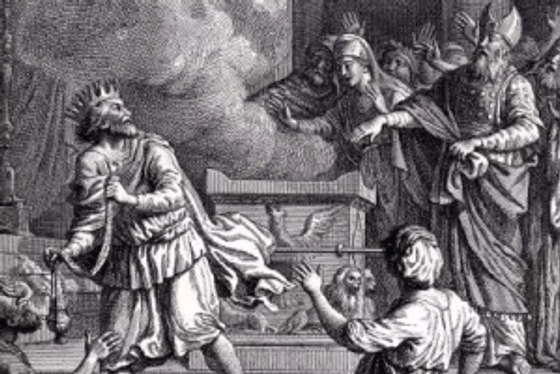
History always likes to apply new standards to old actions. I doubt Uzziah entered the Holy of Holies wearing a crown (as shown) to swing an incense burner (in hand). I believe he tried to light incense on the Golden Altar (depicted with smoke).
The history of Uzziah says that he was one of Judah’s (including unified Israel) greatest kings, as far as bringing prosperity to his nation. The punishment that befell a king says that no human is above the Laws of God. Thus, Uzziah is symbolic of all Israel, in that sense, where the gifts of holiness were plentiful, but one cannot degrade into self-piety, forgetting that God is always the one and only true king, or one will find just how mortal all human beings are.
King Uzziah, when seen in a dream, has to be seen as an extension of the readers (individually a reflection of you and me). Isaiah, himself, had to feel the sin of Uzziah as if they were his own. Thus, we are all mortals who rule over the Kingdom of Self. It is within that temple of self that we can begin to think the possessions having come to us have been by our own doings; so we think we have the right to offer incense that will be burned in our honor, not God’s.
This makes the symbolism of leprosy be less about physical deformities, and more about how it projects the sinful state of one’s soul. The truth of our sins are fully known (even if denied), which causes us to hide our inner beings from public view. Therefore, the dual rulership of Uzziah and Jotham can then be seen as symbolic of the id and the ego, using Jungian terms. “In the year that Uzziah died” is then a statement of the death of the ego, where the soul (the id) finds judgment.
It becomes important to see the personal relationship with God that is demanded in this vision. Rather than seeing it through the eyes of the prophet Isaiah, see it as God presenting a vision to you, through the prophet Isaiah. The purpose is to see the promise of this vision, where sins are forgiven; but to see that, one must understand the mortality and judgment of a king of Judah, one who sat on a throne (shared or alone) for over fifty years, is reflective of one’s own. For Uzziah, forty-plus years of good acts were followed by eleven years of seclusion. He had to see God as the true king. God is who we all must serve; and that is the call of ministry required for the first Sunday after Pentecost.
We read how Isaiah (the reader) “saw the Lord sitting on a throne, high and lofty; and the hem of his robe filled the temple.” God is the true King. His throne is one’s heart. God’s temple is one’s body. God’s holy robe flows over every square inch, each nook and cranny, all cells and vessels of one’s body. This makes God’s robe be symbolic of the Holy Spirit.
If the likes of King Uzziah are not high enough or important enough to claim superiority to God, no mortal can aspire to immortality. Only through God, as His obedient servants, can eternal life be possible. The self-king must die so that God can take control of His realm.
This is where the symbolism of Seraphs (or Seraphim) comes into the vision. They are the attendants of God. While the Hebrew states “seraphim” in the plural, the word following infers the singular, not as “in attendance,” but as “it stood” or simply “standing” (Hebrew: “‘ō·mə·ḏîm”). This “standing,” implying “upright,” is not so much “above” God (who is so “high and lofty” only the “hem of his robe” is clearly seen), but the “Seraphim” is “standing upright,” reaching or aspiring to go “upward” (Hebrew: “mim·ma·‘al”). As such, the “Seraphs” are symbolic of the immortal souls that attend to God’s needs.
The Seraphim are seen as angels in Judaic and Christian theology. These angels are one of several mentioned in holy texts, and some are seen as higher and lower in ranking. The Hebrew word “mal’ákh” is commonly used to identify an “angel,” but the word itself means “messenger,” and can be used in identifying both human and divine entities. While there are some who say a “Malakim” is a separate distinction of angel, with a “Seraphim” being another and an “Elohim” one more (among ten total?), these differences are man-made presumptions and not rock-solid certainties.
On a symbolic level, souls are angelic, with their standing upright and reaching upward being those who are in service to the LORD. Alternately, some angels would sink and strive to shun God (those who serve Satan). This means the day of judgment is when souls are assigned an immortal realm (heaven or hell), or when they are determined to return to the physical plane. Yahweh, the One God, does this judging.
In this vision shown Isaiah, I see the plural of Seraphs as a statement that many souls have been assigned to serve the needs of Yahweh. In that regard, each individual soul will have been baptized by the Holy Spirit, making it purified of all human sins. Purification of a soul makes one of many Seraphs that serve the LORD exclusively. However, the point of Isaiah’s vision is on the rebirth of a soul in its same host body, rather than the soul becoming heavenly.
This means a purified soul is still within a human body. This results in a Saint or Apostle of Christ being born from the ashes of the old. This aligns this reading to the Gospel lesson from John, where Jesus told Nicodemus about such a rebirth. Jesus Christ, as the entity that sits at the right hand of God, is then the highest of all angels who serve the One God. Therefore, a Saint is a messenger of the LORD that comes in the name of Jesus Christ.
This leads to the importance of the number six, which is shown in the number of wings that a Seraph has. The terminology of “wings” can be seen as the instruments of flight, from which elevation is allowed. Seraphs wings are said to be used thus: “With two they covered their faces, and with two they covered their feet, and with two they flew.” This makes their ability to fly be relative only to one-third of their wings.
There can be a parallel made between the seven gifts of the Holy Spirit, where each gift is given by God, relative to the individual’s abilities to receive more than one gift. There are said to be seven gifts of the Holy Spirit: wisdom, intellect, counsel, fortitude, science, piety, and fear of the Lord. As such, the one gift of the Holy Spirit that all human Seraphs is the sainthood of the body, with the other six gifts being additional wings by which one can serve God’s needs. These can then be subdivided into face (wisdom, intellect, piety) and feet (counsel, science, fortitude) uses, where the heart is filled only with fear of the LORD (not wanting to fail Him).
This is not the clear focus of the number of six wings in the vision of Isaiah, but wings should be taken as meaning more than feathery appendages.
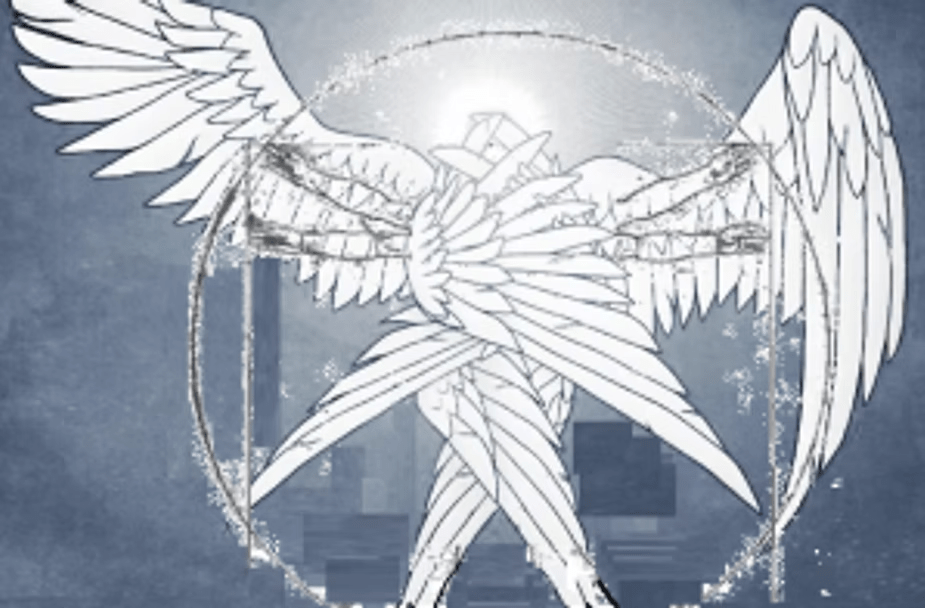
The symmetry of Da Vinci’s Man incorporated into the symmetry of Divine Man.
I invite you to read the insights found on the website linked here, which states several symbolic aspects that are relative to the number six. There are other opinions on the symbolism of this number, but as a perfect number (a mathematical designation) it can be seen as two (duality – left-right; up-down; inside-outside, good-evil, etc.) times three (Trinity – Father, Son, and Holy Ghost). From that perspective, one duality of wings cover the face (the ego of self), while another duality of wings cover the feet (the filth of sin). The covering of human flaws by the gifts of the Holy Spirit then allows the third duality of wings to raise one above both the hindrances to righteousness that emanate from a soul’s the attachment to a physical body and the influences of the earth. Therefore, the perfection of six wings is symbolic of what allows a soul to attend to the needs of God, as His messenger, standing upright among humanity.
In that respect of righteous placement, the Seraphs then sing in unison the song of Sanctus.
Interestingly, in the Interlinear translations of Isaiah 6:3, from the Bible Hub website, shows the triple repeating of “qā·ḏō·wōš” (well-known as “holy, holy, holy”) as “Holy – of Holies holy.” That places the holiness of God above all mortals who are seen as sanctified, as well as any who are divine immortals, as all are of subservient status. This means the song sung by the Seraphs addresses this supreme deity as the one to who all praise should go. The LORD is the King, the ruler of an army (“host”) of messengers, both mortal (Saints) and immortal (heavenly Angels).
When we see how Isaiah did not quite hear the Christian version of the Sanctus being sung, as only the “earth is full of his glory,” that becomes a statement about the Seraphs (Seraphim). They are of the world, so they are singing in unison about God’s glory shining through their whole beings. This is the view painted of heaven, where a sea of souls sing the same praise to God (Revelations 4:8).
It is then because of this awareness of being worldly, yet witnessing the heavenly, that Isaiah said, “Woe is me!” His woe was due to knowing how anyone of the earth that sees the LORD must die (from Exodus 33:18-20). By knowing the history of King Uzziah, we see the posts of the doors (“pivots of the thresholds”) were shaking as a repeating of the earthquake that split open the Temple. The smoke the filled the house is then the incense burned by the mortal Uzziah, which brought God’s punishment upon him. The “woe” Isaiah felt was due to a sin committed in God’s holy Temple.
Isaiah cried out, “I am lost, for I am a man of unclean lips, and I live among a people of unclean lips; yet my eyes have seen the King, the Lord of hosts!” The word “unclean” is representative of the state of leprosy, which was a mark of sin. Just as King Uzziah died as sole King of Judah when he was stricken with leprosy, retreating to his house until his body would die eleven years later, Isaiah was fearful of the death of his ego. Having seen the Lord of hosts, his ego would likewise be too marred to be seen in public. His ego would have to be kept in secret until the death of his body later.
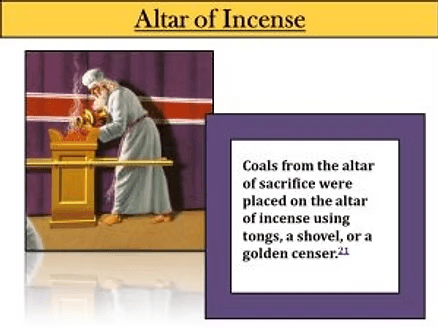
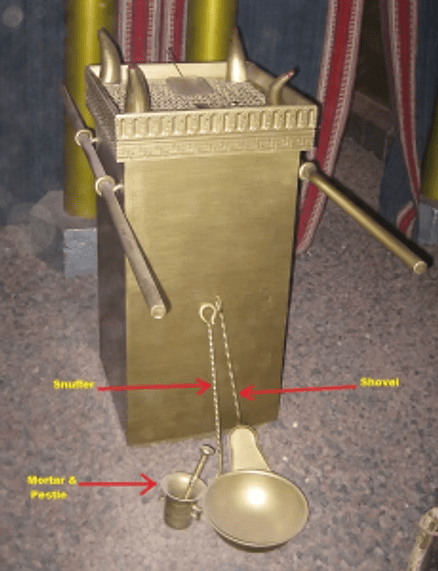
The redemption comes when we next read: “Then one of the seraphs flew to me, holding a live coal that had been taken from the altar with a pair of tongs. “One of the seraphs” should be seen as the divinity of the Holy Spirit, the messenger Angel of God, which is sent to a Saint. The word translated as “tongs” (Hebrew: “bə·mel·qa·ḥa·yim”) is better grasped as an incense “snuffer,” which was an altar tool would be used to extinguish lit candles. One should assume “the altar” is one of two in the Temple of Solomon, most likely from the Golden Altar, or the altar of incense.
Altar of Incense Coals from the altar of sacrifice were placed on the altar of incense using tongs, a shovel, or a golden censer.21.
According to the Wikipedia article on “Altar (Bible),” the Rabbis said this about the burning of incense in the Temple:
“This was the part of the temple service that was most beloved by God (Zohar I 130:A). The burning of the incense was symbolic of the prayer of the people rising up to God (Psalm 141:2; Revelation 5:8; 8:3-4). The offering of incense had to take place after the sacrifice, because only after the atonement could communion with God take place. After the offering of incense, the Kohenim (priests) pronounced the Priestly Blessing upon the people.”
Incense was burned in the Temple every morning and evening. Morning is symbolic of birth. Evening is symbolic of death.
In the vision of Isaiah, the Seraph then removed a “live coal” or red-hot, burning coal from the altar of burnt offering, which would have then been placed in the altar of incense (the Golden Altar) to burn the holy incense. The burning coal, having come from both altars, is then representative of the death of oneself (sacrifice), followed by an atonement of sins. The ember is the result of oneself having been sacrificed to God in order to produce a holy fragrance in the smoking incense. This then makes the “live coal” be one prepared as an “inner sin offering,” done during the Day of Atonement (Yom Kippur).
By understanding the purification of sins that came with the “live coal,” where the aspect of heat is indicative of life, as opposed to a cold coal, without an inner burn that is dead (thus not necessary to pick up with an altar tool) we next read Isaiah report: “The seraph touched my mouth with [the live coal] and said: “Now that this has touched your lips, your guilt has departed and your sin is blotted out.” By Isaiah saying, “sin is blotted out,” that is confirmation of a ceremonious rite of atonement. Still, touching the “lips” must be seen as symbolically stating one’s voice has been made pure.
This becomes a statement of one being a prophet, as a Saint, who can only speak the truth of God. This is itself a prophecy of Jesus Christ, as the Christ Mind could only speak from the Spirit of truth. Still, as the woe felt by Isaiah was stated as, “I am lost, for I am a man of unclean lips, and I live among a people of unclean lips,” the world is a place where sins are projected by the philosophies of mankind. It is necessary to have Saints in the world who can counter the lies told. Jesus said of this, “It is not what enters into the mouth that defiles the man, but what proceeds out of the mouth, this defiles the man.” (Matthew 15:11)
The vision ends with Isaiah writing, “Then I heard the voice of the Lord saying, “Whom shall I send, and who will go for us?” And I said, “Here am I; send me!”’ This is God’s call to all His Saints to prophesy to the breath of truth, so that others can be led to God. Saints follow the same sequence of progressions, from sinner, to fear of guilt, to absolution of sins, to servant of God, which makes one holy. Importantly, the call is not to be atoned of sins, but to go out into ministry for the LORD. When Isaiah heard himself say, “Here am I; send me!” this is the voice of the Messiah, the Son of God, of which Isaiah was one.
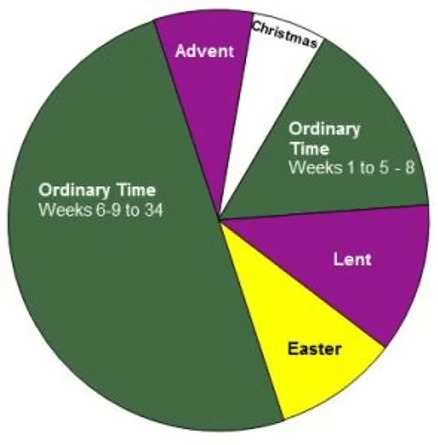
As a reading for the First Sunday after Pentecost, where Pentecost ended the Easter season, this is the beginning of two periods in the Liturgical Calendar known as Ordinary Time.
As this graph clearly shows, Ordinary Time fills the majority of a year’s time. While it may be that this period is named for the word “ordinal,” such that each week is numbered as a series of lessons that follow an event (after the Epiphany or after Pentecost), this Ordinary Time that follows Pentecost should be seen as being most applicable to the Ecclesiastical definition for “ordinary,” where ordination into ministry is the loudest message coming from the readings each Sunday. In this case, the call from God, “Whom shall I send, and who will go for us?” are questions that ask, “Who is prepared to serve Me?” When one answers God’s call by saying, “Here am I; send me!” then one begins to serve the LORD through ministry.
The two separate Ordinary Time periods can be seen as parallel to the Gospel commissions. The first came when Jesus sent his disciples out in the Great Commission, when he was still living. The greatest commission, thus the True Commission, began when disciples morphed into Apostles, when they were reborn as Jesus Christ. The disciples were allowed to do miracles and be messengers that proclaimed, “The kingdom of God has come near.” They did that while Jesus of Nazareth was present in the flesh, as their rabbi and guide. The Apostles were given the gifts of the Holy Spirit, which minimally included the Mind of Christ and the Spirit of truth, where Jesus lives within their being, guiding them spiritually.
The point of those assignments given by God, through His Son, is you must serve the LORD. Before you can serve Him, you must prove your commitment – your marriage to God, receiving His love. Then you have to go places you might be unwelcome and perform some tasks you never knew were possible. However, that is the meaning of faith – you cannot walk on water if you never try. You have to take a leap of faith.
In the year that King Uzziah died, I saw the Lord sitting on a throne, high and lofty; and the hem of his robe filled the temple. Seraphs were in attendance above him; each had six wings: with two they covered their faces, and with two they covered their feet, and with two they flew. And one called to another and said:
“Holy, holy, holy is the Lord of hosts; the whole earth is full of his glory.”
The pivots on the thresholds shook at the voices of those who called, and the house filled with smoke. And I said: “Woe is me! I am lost, for I am a man of unclean lips, and I live among a people of unclean lips; yet my eyes have seen the King, the Lord of hosts!”
Then one of the seraphs flew to me, holding a live coal that had been taken from the altar with a pair of tongs. The seraph touched my mouth with it and said: “Now that this has touched your lips, your guilt has departed and your sin is blotted out.” Then I heard the voice of the Lord saying, “Whom shall I send, and who will go for us?” And I said, “Here am I; send me!
——————–
This is the Old Testament reading selection for Trinity Sunday, Year B, according to the lectionary for the Episcopal Church. This will precede the singing of Psalm 29, which says, “The voice of the Lord is a powerful voice; the voice of the Lord is a voice of splendor.” That will be read before the Epistle selection from Romans, where Paul wrote: “For all who are led by the Spirit of God are children of God.” All will come before the reading from John’s Gospel, where Jesus said, “Very truly, I tell you, no one can see the kingdom of God without being born from above.”
I wrote about this reading selection in 2018. You can read it by searching this site for: Isaiah 6:1-8 – An ordinary leap of faith. I addressed this reading from a different perspective than I will take now. I stand by my insights three years ago; so, please feel free to read both and offer comments.
King Uzziah was said to have been the second greatest King of Judah since Solomon. He was an upright leader for about forty years, but then his ego took hold of him and he tried to burn incense in the Temple, which the Levite priests tried to stop. During the confrontation, a major earthquake occurred that broke open the roof over the Holy of Holies and sunlight shone on Uzziah, immediately causing him to have leprosy. He had to live in a separate house for the remaining eleven years of his life (still a king), with his son Jotham the co-ruler of Judah. Following the death of Uzziah, Jotham’s rule lasted five years. this history of Judah is all downhill after that.
[WARNING: This reading selection involves a divine vision shown to Isaiah. It appears to be a sweet story about him seeing God in all His magnificence and glory, with some kind and gentle seraphim all standing around, forever saying, “Holy Holy Holy.” That does not make sense of the reading. If all were bliss and glorious, then why would Yahweh ask Isaiah, “Who shall I send? Who will go?” I have been led to painstakingly comb through the Hebrew text and see this vision as the horror of religion being overcome by Satan. These verses paint a clear picture of the demonic spirits that have taken over the thrones of Judaism and Christianity, such that there are few left who can answer Yahweh’s question and say, “Here I am! Send me.” Christians today think Isaiah did all the work; so, they can just sit in church pews [if even that is some watery profession of faith] and then go to heaven when they die. I recommend running away now. Do not read further. This was me beginning by praying, “What does this mean?” and being led down a dark path that reflects true wickedness in this world. Just go read some crap somewhere else on the Internet and be thrilled somebody is still keeping faith in Yahweh alive.]
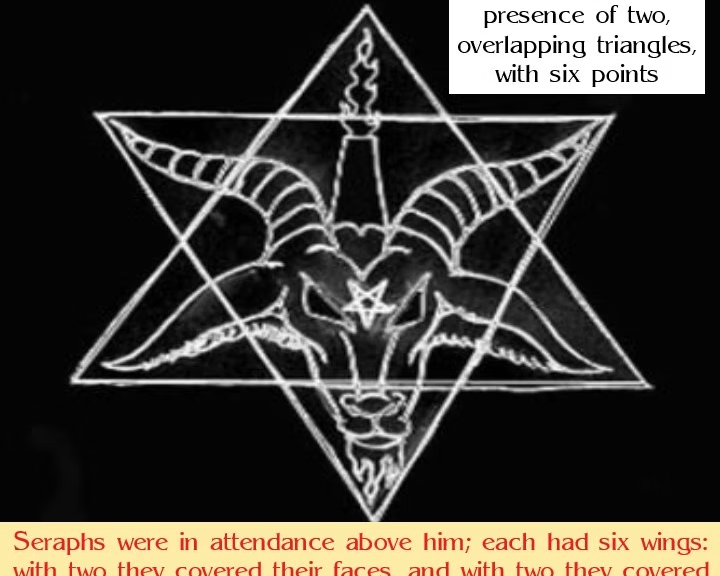
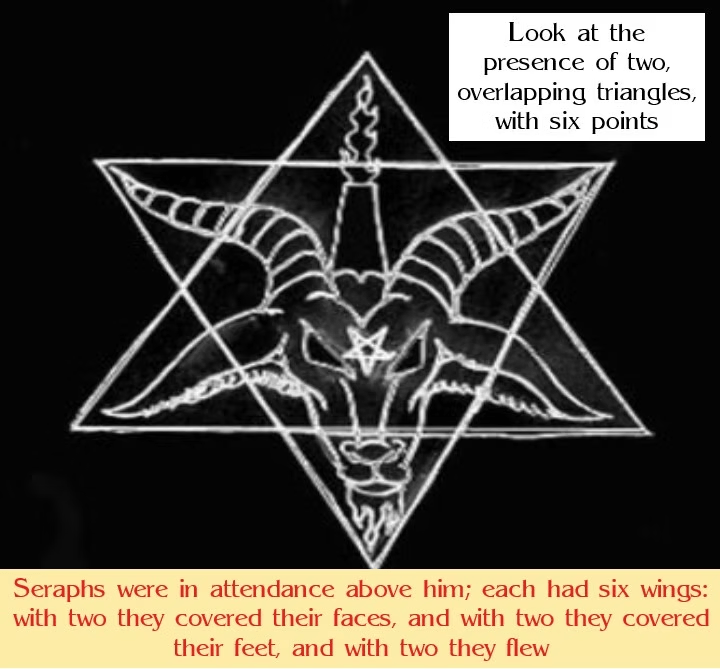
See the Star of David as a seraph that can hide the face of self in service to Yahweh – the leviathan of the sea of Yahweh’s hands. See the Star of David as a seraph that can hide the sins through which the feet have walked – the false prophets. See the Star of David as the presence of darkness that tries to hide the light of Christ – all religions that preach hatred.
——————–
So often when reading Scripture do we disregard something like Isaiah being divinely led to write, “In the year that King Uzziah died.” That is easily assumed to be an ancient historical dating statement, which becomes of no consequence today. We think, “Uzziah died a long, long time ago. That has nothing to do with me.” That attitude says Yahweh leads His prophets to write superfluous crap; and, that is not the case.
I say that as I was about to toss that intro out with yesterday’s garbage, and begin after that tidbit. Then, I was led to ponder the meaning of that history. That led to read the history of Uzziah, which I remembered, but had forgotten his name. The name means “Yah[weh] Is My Strength,” which is important to know [all names in divine Scripture are written with the meaning of the name being the primary intent]. By reading the history of King Uzziah, it dawned on me that Uzziah is a reflection on the whole of Judaism; and, therefore, he is a reflection on the whole of Christianity. Let me explain what I mean.
There is an axiom: As above, so below. That applies here, as King Uzziah’s history becomes a reflection of Christianity today. His history certainly was a reflection of the wrong turn Judah took, leading to its eventual demise. Uzziah is then a perfect example of how the Israelites sought to have a king lead them religiously, so they could go about the usual business of slowly evolving so far away from what Yahweh expected of them that ruin was inevitable. David was not the king the first Israelites chose. They chose an abject failure in Saul. It is a human flaw to always raise the shit of the world into power, to in turn force their subjects to eat shit and die. It is an innate sickness of being born mortal. Even David eventually let down his guard and walked away from Yahweh, proving Yahweh is the only King of merit, because all others will fail to lead the people to salvation.
Like Uzziah, Christianity began with only true Christians, as all were filled with Yahweh’s Spirit and made Saints. Then, someone decided to enter the Holy of Holies and light some incense on the Golden Altar, when that person was not a Saint. Uzziah was an upright king, until his ego took over his body of flesh, making him think he was an equal to Yahweh. Look at this like the system of popes the Roman Catholic Empire created, which led to the extermination [Inquisitions] of anyone who would challenge their rule. After true reproductions of Jesus, all Christs, began a movement that became known as Christianity, someone decided his shit don’t stink and entered the Holy of Holies to burn some incense on the Golden Altar [West]. That form of religion then became stricken with leprosy and forced to live in a house that was separate from Jerusalem: Rome.
The same model then applies to every denomination of Christianity, as all are led by men who were not Saints, because a Saint has no ego and no need to build an organization, with rules and by-laws, and pecking orders, where some are seen as closer to God, usually based on how much wealth they bring into the organization. Christianity has been stricken with leprosy. This whole reading has to begin with the concept that the religions of Christianity have died. They have no usefulness left within their carcasses. To review last week’s First Lesson from Ezekiel: Christianity has become dry bones.
This leads to another sign of Christianity being dead: It is afraid to call Yahweh by that name, thinking [using a brain is always a bad sign] “Yahweh” is the God of Israel, and Roman Catholics most certainly hate Jews, so reduce “Yahweh” to “the Lord.” The problem then comes from not having a way to differentiate “adonay” from “Yah-weh.” This inability raises its ugly head in verse 1. After recognizing that religion was dead, Isaiah is said [NRSV] to write: “I saw the Lord sitting on a throne.” That implies to the ignorant masses of the universal catholic churches that Isaiah saw God. That is not what is written.
The Hebrew of verse 1 states: “wā·’er·’eh ’eṯ-’ă·ḏō·nāy yō·šêḇ ‘al- kis·sê,rām wə·niś·śā,wə·šū·lāw mə·lê·’îm ’eṯ-ha·hê·ḵāl.” That literally translates to say, “and I saw the king sitting on a throne , exalted and lifted up , and his skirt filled the palace .”
When one realizes that “adonay” is not Yahweh [who is specifically named in verse 3], the use of “adonay” reflects back to the death of Uzziah, who was a “king.” Again, from realizing the mention of Uzziah’s death as metaphor for all religions that pretend to serve Yahweh, when they do little more than serve the leaders of those religions, “adonay” is referring to a “lord” [lower case] or a “king” that has subsequently been elevated to fil the vacancy left at the top of an organization.
When I say this, I base it on the regularity that Old Testament books use “adonay Yahweh” together in verses. It is ridiculous to translate that as “Lord Lord.” It says the “lord” of my soul is “Yahweh.” In Christian terms [none Hebrew written], “adonay” is equal to one’s soul having been merged with the soul of Jesus, so Jesus is “the lord” of one’s flesh.
On the level of Christian discipleship, Jesus was the king [who denied the world was his realm of authority] that died. This has led, since the Roman Empire’s collapse into the business of religion, to a hierarchy that built a palace [“ha·hê·ḵāl” can mean both “temple” and “palace,” so what better place does that define than Vatican City?]. None of the Saints that built a religious movement pandered for things opulent, such as thrones and long, trailing gowns or robes. Yahweh never wanted a building of stone to be caged within; and, at three o’clock the day Jesus died, Yahweh left that building. So, it is doubtful that Isaiah was led to a divine vision of Yahweh looking so ‘stately,’ meaning “adonay” does not refer to Him.
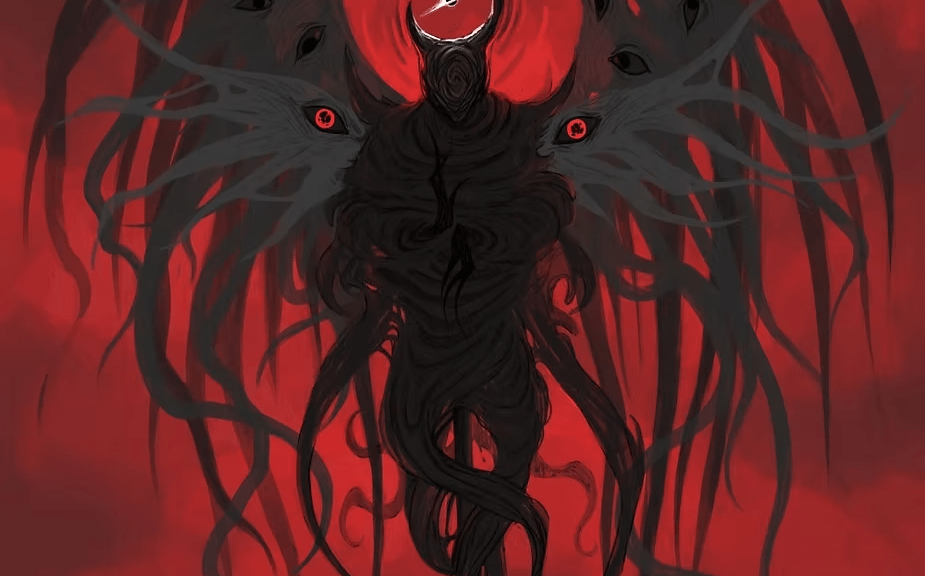
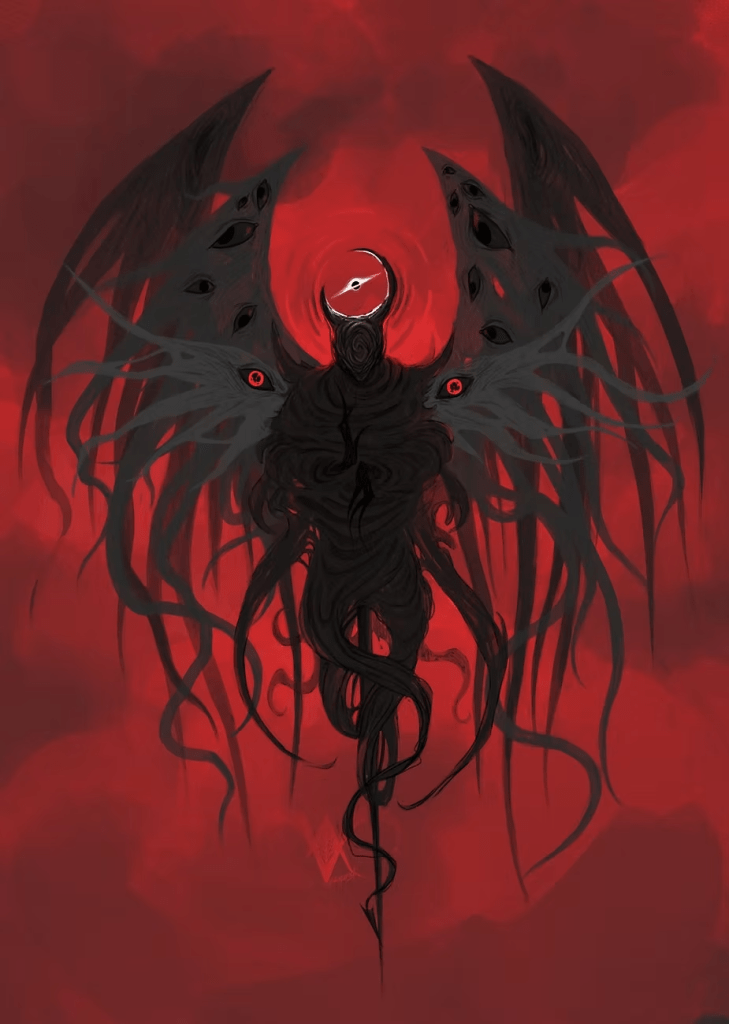
Seeing this, verse two begins with the one-word statement: “śə·rā·p̄îm,” which translates as “seraphim.” That word is followed by a long dash [“—“], isolating it from the following text that then describing this creature. This makes it most important to realize what a “seraphim” is.
According to the Wikipedia article entitled “Seraph” the following is written: “The word saraph/seraphim appears four times in the Book of Isaiah (6:2–6, 14:29, 30:6). In Isaiah 6:2–6 the term is used to describe a type of celestial being or angel. The other uses of the word refer to serpents.” The word “seraph” is defined by Strong’s as “fiery serpent.” The Biblical presence of a serpent is not always associated with leading human beings [or souls] to do the right thing.
After having been led just a couple of days ago to see the “leviathan” as the Spirit of Yahweh that filled the “sea” of souls that had become the “hands” of Yahweh, I saw how that word is equally defined in frightful words: “sea monster, sea serpent, dragon.” In my analysis then, I presented how spiritual possession could be both divine [righteousness of a body of flesh and salvation of a soul] and demonic [sinful wasting of a body and soul]. I feel that the seraphim [multiple seraph] in this vision, seen after Uzziah had died and a “lord” sat stately upon a “throne” (which presumably a king ruling Judah), says the “seraph” Christians revere might not be all that glitters, that a serpent is given credit for.
Following the long dash Is written “ō·mə·ḏîm,” which is followed by a “׀” mark, indicating a statement directly relative to a “seraph.” The “׀” mark I read as a “stop” sign. The Hebrew means “it stood,” with the root verb meaning “to stand, remain, endure, take one’s stand.” Whereas the verb indicating “to stand” implies rising to a divine state of being, such that Job was described as being “upright,” here the addition as a clarifying element of the “seraphim” is “it remains,” to assist the “throne,” following the “death” of Uzziah. Knowing that a “seraphim” is a heavenly creature [spiritual, not material], it is doubtful that elevation is possible in that realm, although religious scholars enjoy determining a ‘pecking order’ for angels, such as “seraphim.”
The “׀” mark, which seems to me to end the combination “seraphim — omedim,” is followed by words that say, “above it” or “upwards it” [from “mim·ma·‘al- lōw”]. These words are separated from the “׀” mark and the words that follow, by a comma mark, making them be a separate statement relative to the seraphim. While that could lead one to see the standing as being relative to an elevated position, the stop bar [the opposite of a long dash] begins a new line of thought. This leads me to see the seraphim as the new king’s source of spirituality, which makes it be less a divine possession like the leviathan. The leviathan was beneath and unseen, not above.
This then leads to the repetition of “six wings,” which the NRSV translation has reduced to only one. The literal translation says, “six wings six wings had one.” In this, the number “six” is significant as the number of days the world or universe was created. That aligns the number “six” with the physical realm, not the spiritual realm, where seven is holy. Additionally, man was created on the sixth day, which makes man represent the number six, rather than the soul of man. Finally, in Revelation 13:18, John wrote the number of the beast was “six hundred, sixty, and six” [“hexakosioi hexēkonta hex”]. That is “six” on three levels of awareness: one, ten, and one hundred. Thus, “six” being repeated is not a positive sign.
As for the Hebrew word “kə·nā·p̄a·yim” [plural number of “kanaph”], the word can mean “wings,” with that being descriptive of a garment, such as it is the “extremities” of a “skirt, corner, or loose flowing end.” [Brown-Driver-Briggs] When the word is used in reference to the earth, “wings” becomes a statement about the ends of the earth. When one recalls Isaiah writing “wə·šū·lāw,” which was translated as the “skirt” of the “king” that “filled the palace,” “wings” can be seen as mirroring that usage.
In the repetition, where there is some flexibility in translation, the words translated as “six wings six wings had one,” the same words can now be read as “six extremities six free-flowing ends in one.” When the directions of the winds are numbered as four: north, south, east, and west; the addition of two more directions would then be above and beneath. However, when the number “six” is seen to keep this in the material realm only, above would be the atmosphere of the earth, with beneath being that within the earth, beneath the surface. This would lean me towards seeing this “seraphim” as akin to Satan, more than Yahweh, where the “six” becomes descriptive of where their power is limited.
The remainder of verse 2 then is divided into three segments that each begin with the words “with two.” In the use of “two,” one cannot see the repetition as disappearing, as three times two equals six. Each use of “two” must be read as a duality being expressed. Man is the duality of flesh and soul – matter and spirit. Still, in regard to Elisha requesting a “double share of Elijah’s spirit,” the Hebrew of “double portion” is “pî-šə·na·yim,” whereas here “with two” is written as “biš·ta·yim,” with both pulling from the same root meaning “two.” The reason I mention this, is the duality can mean a spirit joined with a soul.
Seeing those possibilities, the three segments say: “with two was covered his face,” “with two was covered his feet,” and “with two he flew.” From a duality involving “face” and “feet,” it is easy to see that as being relative to the “face” of Yahweh and those Yahweh sends out into the world (His “feet”). In respect to the “face covered,” it should be remembered that Moses talked with Yahweh in the tent of meeting and afterwards his face shone brightly. The Israelites feared seeing that glow on Moses’ “face,” so they demanded he wear a veil, to “cover his face.” That denotes a halo surrounding the “face” of Yahweh’s wives, which is depicted in art as the Saints of Christianity. Thus, that can be a sign of one joined with Yahweh’s Spirit.
As to the covering of “feet,” this seems to be at odds with symbolism of doing Yahweh’s work. When Jesus sent out the seventy in pairs, he told them to take no purse or sandals, meaning their feet must be uncovered. Still, in the act of washing “feet,” Peter reacted badly to the thought that anyone but him handle them, because “feet” are always dirty from walking. To “cover his feet” is then a sign that one does nothing to become dirty, which can also mean failure to enter ministry as Jesus expected.
In all three where “covered” is found, that word can mean “conceal, hide, and shroud.” When a “face is covered” this can mean a mask is worn over the “face,” to keep the true face underneath “covered,” so the true “face” is not seen. As to the “feet” being “covered,” this can be seen as an anointment or washing, such as Mary Magdalene did to Jesus’ “feet.” When Jesus washed the “feet” of his disciples, he said that was a way of treating each other as equals, where the “feet” were always the dirtiest parts of the body, so it was up to all to keep one another clean. That symbolism goes beyond physical “feet,” to metaphor for keeping one another free from sin. Therefore to “cover his feet” means one of royalty that is protected from getting dirty, while never cleaning anything of anyone else.
The aspect of flying must be seen as something human beings were incapable of, in ancient times. Birds flew with wings, but there is no reason for a human being to be expected to literally fly. Angels have no need to use wings to fly, as they simply appear where needed. As such, the Hebrew word “yə·‘ō·w·p̄êp̄” [from “uwph”] has the figurative definitions: “(by implication of dimness) to faint (from the darkness of swooning): – brandish, be (wax) faint, flee away, fly (away – ).” This means the word “to fly” can mean “to be exhausted, to be dark, or to vanish.”
Because the central theme of verse 2 is the details of the “seraphim,” it must be seen as finding it powers only possible within the earthly realm. All of the duality says it can go either way, as far as spirit possession is concerned. It can be joined with one’s face, so one serves Yahweh, only wearing His face. It can be joined with one’s feet, making it a demonic possession that a serpent is known most for doing. The third ability can go both ways, as the ability to escape the worldly realm by divine possession, or to never see heaven because one always flees the responsibility of commitment to serve Yahweh, instead hiding in darkness.
This view of the “seraphim” then leads to verse three, which immediately begins by stating, “and cried this,” where the Hebrew word “wə·qā·rā” means “to proclaim, to call unto.” The word attached to that [“zeh”] adds, “this, here,” but is relative to “he,” as a statement of “(self) same,” which is a “soul.” As this vision is ethereal, like a dream, the “seraphim” is a Spirit, to which the “soul” of Isaiah “called out to.”
It is then identified that it was the “seraphim” who “said, ‘holy,’” with the first use of “qā·ḏō·wōš” [“holy, sacred”] followed by another “׀” mark, indicating an emphasis on what the soul of Isaiah heard the “seraphim” saying. This then follows with Isaiah writing of the dream: “holy holy,” where the repetition can use different translations, such as “sacred holy,” or “saintly sacred.”
One Hebrew translation site says [of the first two presentations of “qā·ḏō·wōš” [ignoring the stop mark], “holy of holies,” which would revert back to the “palace” as the “temple” of Solomon. If that is allowed [to make one of three uses of “qā·ḏō·wōš” be in the possessive, as “of holy”], then the second and third uses could be “holy of holies,” with the first use [leading to the stop] translate as “sanctuary.” It has been my finding in divine texts, when repetition of one word is found, it is more informative to translate each use with a different [yet viable] translation, rather than simply repeat the same translation multiple times.
Following a comma mark of separation, Isaiah wrote “Yahweh,” which is the name of his One God. After that name, he wrote “ṣə·ḇā·’ō·wṯ,” which is translated as “of hosts.” That second word is rooted in “tsaba,” such that a “host” is defined as “army, war, warfare.” The same word is found in Genesis, referring to all Creation. It is found elsewhere as being relative to the “sun, moon and stars.” According to Strong’s Exhaustive Concordance, the word can mean: “appointed time, army, battle, company, host, service, soldiers, waiting upon.”
As one word following “Yahweh,” this acts as a defining aspect of “Yahweh,” as He is not only the Creator of everything known to mankind [all within the visible universe], but he is also the Creator of Spirits, including “seraphim.” These spirits [Jewish scholars do not classify them as angels, although they are of spiritual essence] are then an “army” of “seraphim” [a plural number of “seraph”] that are created by Yahweh.
This identification has nothing to do with the “seraphim” saying “sanctuary ׀ holy of holies.” It can only be understood that Yahweh is the Most Holy, such that defining Him as “holy” is unnecessary. Only those created by the hand of Yahweh, as those having received His Spirit, can then be termed “holy.” Yahweh’s “army” of “holy” entities implies a “sea of saints,” as that is where David said the leviathan swam.
Following a comma mark that separates “Yahweh of hosts” from the last segment of words is found “mə·lō,” meaning “full, fullness, that which fills.” This needs to be seen as a verb that is now describing the “host” of “Yahweh,” which are “filled” with His Spirit. The remaining words in this segment then say, “all the earth his glory.” In that, the word “kə·ḇō·ḏōw” [from “kabowd”] means “glorious, abundance, riches, dignity of position, honor, reputation, character of a man, and reverence” [Brown-Driver-Briggs], which is like the use of “holy.” Yahweh is exempt from all goodness that He bestows “on the earth.” When united with the verb stating “full,” as having been “filled,” the Spirit of Yahweh is what brings all these qualities into the world.
Verse 5 then begins by stating, “and were shaken the posts of the door.” In that, the Hebrew words “’am·mō·wṯ has·sip·pîm” can also be translated as saying “the cubits of the basin” or “cubits of the goblet” [from the roots “ammah caph”]. It is secondary translations that make this become a statement that makes this segment speak of “a door-base” and “a threshold.” This can further be read as a statement about the “measure” or the “limits” of “doorposts,” which in the Israelite history has to be seen as the blood of the lambs spread over the doorposts in the first Passover. It was that blood that kept the firstborn males from dying.
Now, Isaiah is telling that there came a “trembling, wavering, or quivering,” not of fear, but of a “disturbance” in the past, which has made “to be gone away” all “measures” of “doorposts” still being so covered in sacrificial blood. Relative to the history of King Uzziah, when he entered the Holy of Holies to burn incense on the Golden Altar, an earthquake opened the ceiling and light shone upon him, giving him leprosy. This statement by Isaiah must be seen as metaphor for that change having come upon Judah.
Following a comma mark that separates that statement about a “measure” of change to escaping death [the promise of eternal life], Isaiah wrote of the “voice” or “the sound” of “him who cried out.” This refers one back to verse 3, which began “and cried this” or “called out soul.” That was the “seraphim” that was “proclaiming” everything relative to “holy” and the “host of Yahweh.” Now, “shaken” by the “change of measure” that deems a soul saved, it is the seraphim making proclamations, which are part of this change.
Following a comma mark of separation, we learn that the proclamations of the seraphim have “filled the house with smoke.” Here, the word “yim·mā·lê” becomes a progression of “mə·lō,” where the “measure of the goblet” [a viable translation of “has·sip·pîm,” rather than “threshold”] has changed from “all that is glory on earth” to “the house was filled with smoke.” Whereas this too can make one recall the sinful actions of King Uzziah attempting to burn incense [smoke] in the Golden Altar, the use of “smoke” must be seen as a destructive burning of the House of Israel, including Judah.
This then leads to verse 5, where Isaiah first speaks. The first words say, “so I said woe me for I am destroyed.” In that, the Hebrew word “niḏ·mê·ṯî” [from “damah”] means, “to cease, cause to cease, cut off, destroy.” To translate this as “undone” is mild, to say the least. The implication is “to perish,” which says the “limits” set by the blood of the lamb on the “doorposts,” which spared one from death, has now been removed and Isaiah feared the loss of his soul.
Following a comma mark of separation, Isaiah then wrote the segment of words that stated: “that man of unclean speech I.” In that, the words “ṭə·mê- śə·p̄ā·ṯā·yim” [from “tame saphah”] have been translated as “unclean lips,” but the implication is more about what rolls off the “lips,” as “speech” or “language.” The aspect of “’îš” [“ish”] then becomes a statement of a “man,” not the Word of Yahweh. This then implies that the changes of “measurement” are relative to that “spoken” by the one who replaced King Uzziah, whose regality has (along with self-love) been surrounded by “fiery serpent spirits.” It is that presence that has brought about the destruction of Yahweh “man,” those who had been “glorified” by His Spirit.
The last word in this segment is “’ā·nō·ḵî,” which is a statement of “I” [not a stop bar sign]. When one is truly a leader of Yahweh’s people, one has submitted to His Will, such that the “I” of self has been lost. For this to be the last word in this segment of words about “that man of unclean speech,” the element that makes it “unclean” or “defiled” is “that man” expresses personal opinions, relative to the “I” of self-ego. That means one having turned away from Yahweh, not wearing His “face,” but worshiping “self” as a god. In that way, everything said is “unclean,” with nothing “holy.”
This realization is then furthered by the segment that follows the comma after “I,” which says, “and in the midst of people of unclean lips.” This becomes a statement that says, “As goes the head, so goes the rest.” As a king on a throne, whose skirt reaches in all directions, those under his influence are following the guidance of unholy words. As an extra element, following a comma mark of separation, one finds a one-word statement that repeats “’ā·nō·ḵî,” or “I,” which says that the “people” have all followed the lead of this king, such that none of them serve Yahweh through marriage and submission of their souls. It has become a land where everyone is for himself or herself.
Following the one-word statement of “I” is a semi-colon, denoting a new statement of relative context. It is relative to these “people,” as they are said to “dwell for the king.” Here, the Hebrew word “ham·me·leḵ” [from “melek”] refers one back to verse 1, where “adonay” was the “lord sitting on a throne.” As “king” is now stated, this leader must be seen as the replacement for King Uzziah [on a literal, historical sense], while also representing the one who has become the “leader of the people of unclean lips.” When the “measure” of righteousness, which saves a soul from reincarnation, is the sacrifice of the “I” unto Yahweh, the “king” is now who “the people dwell for.” They “inhabit” the “I” of self, such that none of their souls have been sacrificed unto Yahweh. This is a statement of a great lack of souls who will serve Him as His messengers [Apostles].
Following a comma mark that separates the segment of words ending with “king” comes a segment that begins with the naming (a second time) of “Yahweh.” The two words being presented sequentially, as “king , Yahweh” gives the impression that “Yahweh” has been named as “king,” but the comma prevents that association. The “king” is now claiming to be one of “Yahweh’s hosts,” whose claims of “I” now include, “my eyes have seen Yahweh.” Rather than hear Isaiah saying this, one must hear them stating the sacrilege of a “king,” who is a “man” now claiming to be god on earth, as a human deity – as was the presentation of a Roman emperor’s reason for rule.
This then leads to verse 6 beginning with the words that translate to say, “and flew towards me,” where “’ê·lay” is a form of “el,” meaning a “motion” that is “to, into, towards me.” This implicates Isaiah as a soul then recognized as one of “the people,” such that the seraphim was a spirit that sensed a presence that was not of the “I” teaching. As such, the word “el” acts as a statement of rules or standards being enforced, where “flew” [from “way·yā·‘āp̄”] becomes a presence of “darkness” that surrounded the soul of Isaiah.
Following a comma mark of separation, the next segment of words say, “one from the seraphim,” which says the seraphim were relative to this darkness, all of which has surrounded the “king,” the “people,” and influenced the changes of “measure” of the “goblet” or “threshold.”
At that point comes another comma mark, leading to the next segment of words that say, “and in his hand having a live coal.” Here, the Hebrew word “ū·ḇə·yā·ḏōw” [from “yad”] brings out the human characteristic of “a hand,” when the seraphim had been detailed as having “wings” or “extremities,” which “hid” the “face” and “feet,” with nothing mentioned about “hands.” It is now “in his hand” that the seraphim is “holding a live coal.”
In that, the Hebrew word “riṣ·pāh” [from “ritspah”] means “glowing hot stone,” which is not the same as a piece of burnt wood, reduced to a “hot coal.” When the implication is a “stone,” with the “measure” or “limit” of the “goblet” or “doorpost” being relative to that which would lead Moses to bring down the “stone” tablets with the Covenant, this says the original Covenant had been placed into the Golden Altar to destroy it.
Next, following another comma mark of separation, Isaiah wrote, “with the tongs he had taken from the altar.” This implies that the seraph, which is a spirit and not flesh, so it should not be burnt by physical fires, was not allowed to touch the “stone” that was “red hot.” It says the priests of the Temple had “tongs” that were used for the purpose of removing the charred remains of sacrificial animals, for the purpose of those remains being eaten. Thus, the use of “altar tongs” for the removal of a “glowing hot stone” means the “stone” was sacrificed upon the altar. If the “stone” is the “tablet” of Mosaic Law, that marriage agreement between the Israelites and Yahweh was being sacrificed, with its charred remains intended to be served to the pilgrims who came to worship “I” and consume the burnt offering that had been the Covenant to marriage with Yahweh.
Verse 7 then begins by Isaiah writing, “and he reached over my mouth,” where the Hebrew words “way·yag·ga ‘al-pi” can also be translated to say, “and he touched upon my mouth.” This does not mean there was actual touching, but the implication of that nearness leads to the next separate segment.
That is the single Hebrew word “way·yō·mer” [from “amar”], meaning “said.” This form is in the third person singular vav-consecutive imperfect (hence past tense), which then implies the seraphim spoke; but because this word follows the word “mouth” [“peh”], it can be read as words coming from the “mouth” of Isaiah, as “it said.”
This is then followed by another single-word statement, which is “behold!” [from “hin·nêh”]. This should then be seen as the importance of the words spoken, as they need to be grasped as important.
Following the comma mark at the end of “behold!,” Isaiah wrote, “reached here upon your speech,” where again the Hebrew word “nā·ḡa‘” reflects back on the use as “way·yag·ga,” where “reached, touched, or stricken” can be the implication. Once more, the translation of “lips” can equally mean “speech” or “language.” As words flow from the “mouth,” what rolls off the “lips” becomes “speech.”
Following a comma mark at that point, a new two-word statement is shown as “wə·sār ‘ă·wō·ne·ḵā,” which is translated as “is taken away your inequity.” While this translation gives the impression of the burning of lips becomes an act of purification, that cannot be the case when the “mouth” has “uttered” words worthy of “beholding.” The literal translation of “wə·sār” [from “sur”] is “to turn aside” or “to take away,” as meaning “removed, departed, or put aside.” When that is implied to be the “removal of inequity” from words “spoken,” then the presence of the “stone” had evoked “holy” words to come forth, which were not “sinful.”
This then leads to the last two words of verse 7, which state: “and your sin has been covered over.” Here, the use of “tə·ḵup·pār” [from “kaphar”] refers one back to the two uses of “yə·ḵas·she” [each from “kasah”], where the “extremities” of the “seraphim covered the face” and “covered the feet.” This says the “feet” are the source of “sin” or “iniquity,” so the covering of “sin” is based on words “spoken” that still express the Covenant as having not been destroyed. No matter how hot the altar had been stoked, the Covenant being consumed [as words spoken from it] purified Isaiah’s soul. This has nothing to do with the seraphim [a spirit of both divine and demonic spiritual influence, thus neutral] purifying the lips of Isaiah, as the presence of the “glowing hot stone” or “coal” would elicit the truth of a soul. This becomes symbolic of a test, as to whether one cried out “I” or bowed in submission to Yahweh.
Seeing this playing out over seven verses, verse 8 begins with Isaiah saying, “and I heard the voice of adonay.” This is the second of three uses of “adonay” in this chapter. It matches the three uses of “Yahweh” also found written in his sixth chapter. In the first use, in verse 1, following the announced death of Uzziah, the “lord” was seen sitting on a throne. Because “was seen” [from “wā·’er·’eh”] implies a vision of a “lord” that was external to Isaiah’s soul, that use can be generic for one pretending to rule as god’s extension on earth [see the history of popes]. Now, “I heard” implies an inner voice that is with the soul of Isaiah, rather than a voice projected to him [which would be “I saw” – “he said,” rather than “I heard”]. As such, this second use of “adonay” suggests the covering of Isaiah’s feet, left his face so it projected Yahweh as his “lord.” Thus, what Isaiah “heard” was the “voice” of Yahweh, who his soul had married, making Yahweh be his “lord.” In Christian terms, this “lord” would be the soul of Jesus resurrected within.
Following a comma mark of separation is a one-word statement: “’ō·mêr.” That word is the present participle of “amar,” which was seen in the previous verse, as “way·yō·mer,” as “and it said,” referencing the “mouth” of Isaiah. Now, the “voice of the lord” is “saying,” which means there is significance in what is being said within Isaiah.
What Yahweh was “saying” was two questions, separated by comma marks, although there are no question marks written. The first askes, “whom shall I send”. This is followed by “and who will go to.” In that, the Hebrew word “’eš·laḥ” [from “shalach”] has connotations that says “who shall I grow long” or “shoot (forth),” where the question is relative to a vine or new growth. In that, the implication is the “dead stump of Jesse,” which was the death of Israel and Judah. From that dead tree, there would come few who would speak the Word of the “hot stone” when it was placed near their “mouths.” Thus, the questions are relative to being “sent” by Yahweh into ministry, to keep alive the truth of His Spirit.
To these questions, the soul of Isaiah answered, “behold! Send me.” This becomes the mantra of all priests of Yahweh, who do not enter ministry unprepared, as “men” and “women” “filled with the power of I.” They do not go out to present an agenda demanded by a “man on a throne” above them, not Yahweh. They go out as pure servants of Yahweh, speaking only His Word.
As the first lesson after graduation day – Pentecost Sunday – this reading, known popularly as “the commission of Isaiah,” should be the mantra of all who identify as priests, ministers, pastors, preachers, or rabbis. God has not died and left someone of “man” in charge, speaking what “I” wants for oneself. Ministry for Yahweh must be seen as amid the weeds and vines that grow wild grapes, producing only the good fruit that is filled with the truth of a Covenant. Isaiah’s soul was shown the necessity of keeping alive the true Spirit of Yahweh, because the death of Uzziah ushered in the beginning of the end for Judaism. That same end is now reflected in Christianity, a corrupt version that preaches all the lies and inconsistencies of an “I” agenda.
As a Sunday designated as Trinity Sunday, the aspect of the Trinity has to be known. It is not some flowery word that has no truth to its meaning. The Trinity is the union of the Father with the Son [Yahweh and soul], which the point of union is where the Spirit that makes a soul Holy connects those two. The Holy Spirit is then the presence within of Jesus resurrected. The Ordinary time after Pentecost is when only those in possession of Yahweh – His divine possession in Spirit – enter ministry. Please not that the truth of the Trinity symbol is a cross, where the intersection of vertical [Yahweh] and horizontal [soul-flesh] occurs at one point, which is unseen because if blends the two together. In the picture I have attached to this commentary, one will see the Star of David has two triangles intersecting. The triangle cannot be seen as a symbol for the Trinity, because all sides are separate and equal; and, the son is nothing more than man, without marriage to Yahweh and His Spirit.
[1] In the year that King Uzziah died, I saw adonay sitting on a throne, high and lofty; and the hem of his robe filled the temple. [2] Seraphs were in attendance above him; each had six wings: with two they covered their faces, and with two they covered their feet, and with two they flew. [3] And one called to another and said:
“Holy, holy, holy is Yahweh of hosts; the whole earth is full of his glory.”
[4] The pivots on the thresholds shook at the voices of those who called, and the house filled with smoke. [5] And I said: “Woe is me! I am lost, for I am a man of unclean lips, and I live among a people of unclean lips; yet my eyes have seen the King, Yahweh of hosts!”
[6] Then one of the seraphs flew to me, holding a live coal that had been taken from the altar with a pair of tongs. [7] The seraph touched my mouth with it and said: “Now that this has touched your lips, your guilt has departed and your sin is blotted out.” [8] Then I heard the voice of adonay saying, “Whom shall I send, and who will go for us?” And I said, “Here am I; send me!”
[[9] And he said, “Go and say to this people:
`Keep listening, but do not comprehend;
keep looking, but do not understand.’
[10] Make the mind of this people dull,
and stop their ears,
and shut their eyes,
so that they may not look with their eyes,
and listen with their ears,
and comprehend with their minds,
and turn and be healed.”
[11] Then I said, “How long, adonay?” And he said:
“Until cities lie waste
without inhabitant,
and houses without people,
and the land is utterly desolate;
[12] until Yahweh sends everyone far away,
and vast is the emptiness in the midst of the land.
[13] Even if a tenth part remain in it,
it will be burned again,
like a terebinth or an oak
whose stump remains standing
when it is felled.”
The holy seed is its stump.]
——————–
This is the Old Testament selection to be read aloud on the fifth Sunday after the Epiphany, Year C, according to the lectionary for the Episcopal Church. It will precede a singing of Psalm 138, where David wrote, “Though Yahweh be high, he cares for the lowly; he perceives the haughty from afar. Though I walk in the midst of trouble, you keep me safe; you stretch forth your hand against the fury of my enemies; your right hand shall save me.” That pair will be followed by a reading from Paul’s first letter to the Corinthians, where he wrote: “I handed on to you as of first importance what I in turn had received”. All will accompany a reading from Luke’s Gospel, where the Apostle said, “And they came and filled both boats, so that they began to sink. But when Simon Peter saw it, he fell down at Jesus’ knees, saying, “Go away from me, Lord, for I am a sinful man!”’
In the above translation, it is important to see where I made adjustments in the text. In six places the NRSV [and I assume others as well] had translated two different Hebrew words as having the same meaning, as “Lord.” In those six changes I made above, three times Isaiah wrote the word “adonay” and three times he wrote the word “Yahweh,” which are clearly two different words. The NRSV, however, has seen two different words and presented them all as exactly the same. This is incorrect; thus, I have changed the text to show the truth.
Because this reading is potentially thirteen verses in length, with verses nine through thirteen being optional [the Church’s presentation of translations within brackets], the Church did not number any verses. One is left to assume the bracketed verses are 9 – 13, and the unbracketed verses are 1 – 8. To clarify where the verse break are, I have inserted the verse numbers in bold type, within brackets. This will assist the reader in my interpretation, as seldom do I take the NRSV translations as ‘the Gospel.’ At best, they are paraphrases, which means their translations do little to expose the truth of that written. When they then boldly alter text wrongfully, it becomes vital that seekers of truth never take an English translation as the whole truth.
This reading selection is possible to be read aloud and preached on two different dates in the Episcopal lectionary cycle [three years, A – B – C]. The first date is the first Sunday after Pentecost, in Year B, which is also called “Trinity Sunday.” The second date is the fifth Sunday after the Epiphany, in Year C. On both dates verses one through eight are mandatory reading material. Only on this date after the Epiphany are verses nine through thirteen offered as possible to be read aloud, and-or discussed.
I have written about this reading twice before, both times when the reading came up on Trinity Sunday. In 2018 and 2021, I wrote commentaries and posted those views on my website. The 2021 – Trinity Sunday, Year B, interpretation of Isaiah 6:1-8 can be read by searching this site. The 2018 – Trinity Sunday, Year B, interpretation of the same reading also can be read by searching the name and number of the reading on this site. Neither of these assessments address any of the bracketed [optional] verses that are only made available for reading today – the fifth Sunday after the Epiphany. Today’s commentary will only slightly address the first eight verses, because I have written about them prior, at length. The primary focus of this commentary will be placed on the optional verses. However, I need to address a whole-view opinion about differences that will be found in my two prior commentaries that are linked above.
In 2018, I was reading English translations with a much higher level of acceptance, such that I (like the vast majority of Christians) had been taught to see “the Lord” written in English translations and refer to Yahweh as such. At the end of April 2021, I saw this reading in an entirely new light, one which was quite dark. With that new insight, I still did not bother to adjust the NRSV text to show Yahweh, rather than “the Lord.” This means my observations on this one reading selection can now be seen as reflecting my evolution as a vehicle of Yahweh; and, that, by itself, becomes a reflection of a typical path of ministry, where a servant of Yahweh is allowed to see new insights as one’s commitment is proved, through length of service. All that I have expressed in commentary has been led by insights from a higher Mind than I possess, which says the longer one follows the light of Christ in, then the more one’s mind will become illuminated. Nothing I was shown prior becomes wrong. All I was shown later becomes my eyes adjusting to the obscurity that is divinely placed on Scripture by prophets of Yahweh, with the darkness of poor translations into English more clouds that must be divinely removed.
One thing that I have been led to understand is relative to the use here of “adonay.” This is clearly a Hebrew form of “adon,” which is in the plural number [not singular], where “adon” means “lord,” with “adonay” [or “adonai”] meaning “lords.” Genesis 19:18 can be seen as an example of “adonay” being translated as “my lords.” [“And Lot said to them, “Oh, no, my lords,” when he spoke to the ‘angels’ that came to warn him to leave Sodom and Gomorrah.] Regardless of what Jews say that “adonay” means to them, the truth is it is not the same as “adon.”
In my personal evolution of understanding, “adonay” has been slightly confusing, when seen as so similar to the plural Hebrew word “elohim,” which means “gods.” The singular form of that is “el,” which means “god.” Neither “adonay, adon, elohim, or el” deserve capitalization, because none are direct references to Yahweh. All are the creations of Yahweh; and, all are divine and purely spiritual, such that it was angels who were the “gods” [rather than the translated into English “God”] who carried out Yahweh’s plan for the Creations. Still, when Yahweh created His Son [call him Adam-Man-Jesus], he placed a divine angel [elohim] into flesh, which is the ‘prototype’ named in Genesis 2 & 3, as “Yahweh elohim.” While one is an “el,” all human souls that will marry with Yahweh’s Spirit, to be Anointed by Him [made Christs], will then find their transformations being from natural souls in bodies of flesh to souls divinely married to an angel soul in that flesh. All who are reborn as Yahweh elohim [Jesuses reborn] becomes ministers of Yahweh on earth. Because those ministers are necessary to gather the lost sheep and return those souls to the fold of Yahweh [more souls to marry Yahweh], those leaders – those Yahweh elohim or those in the name of Jesus Christ – are then “lords” of the wayward, as Yahweh adonay.
Now, this is most important to realize, because this reading is Isaiah [a Yahweh elohim servant as a prophet] having a prophetic dream about the other kind of elohim, who are themselves adonay of a different direction. Because being a Yahweh elohim and being a Yahweh adonay demands a divine possession of spirit [and a soul is eternal spirit, trapped in human flesh], that aspect of divine possession means demonic possession is another kind of elohim that can possess natural souls in bodies of flesh. These elohim are those fallen ‘angels’ that are called Lucifer, Satan, or the Devil. In Job we read about Satan being one of the “sons of elohim” [“bene haelohim“], before the celestial battle that condemned a third of the ‘angels’ [elohim] to the earth. In fact, on earth the bad angels are more likely to become the “lords” over human souls in flesh, than human souls in flesh are accepting of Yahweh’s elohim, so one can become a prophet, apostle, or saint. That makes this reading most important to discern truthfully.
In my 2021 commentary, where I pointed this dark element out, I made mention of how those who define Hebrew words define the use of “seraphim” as primarily having an evil connotation, as a fiery serpent, dragon, or monster. Still, with that negative definition, sometimes the “seraphim” can be angels that are most high and serve Yahweh. Christians, especially, hold seraphim in the highest regard, as the angels that protect the throne of Yahweh – with that solely based on a misinterpretation of this selection in Isaiah 6. In that dual definition [mostly bad, some good], the reference to ‘seraphim” being good refers to this reading and this reading only. It makes more sense to adjust that definition to being wholly negative, as this reference shows how souls in human flesh have great difficulty determining just which of the heavenly entities are good angels and which are bad. Isaiah saw fiery serpents, dragons, and monsters here, knowing he was only a soul in a body of flesh, inferior to all angels.
In Genesis 1 the word “elohim” is used thirty-two times, with each translated into English as “God,” implying Yahweh. In reality that usage says Yahweh created many elohim, which were all His angels; and, it was His angels that did all the work of Creation. What view is only read in the apocryphal Book of Enoch, where he told the story of the ‘fallen angels,’ where a third of the elohim battled against Yahweh’s command to serve man on earth. Those which lost that war were then cast into the realm of the Earth and forced to remain there. It is then when a soul is trapped in a body of flesh [that is made of the worldly realm’s matter] that the evil elohim become the “seraphim” that love to lead souls away from marriage to Yahweh. That danger is what Isaiah was shown in this vision.
With that said, I will let all brave-hearted readers to read my commentary posted in 2021, which is entitled: Isaiah 6:1-8 – A view of how wickedness lords over the religions of the people. At this point, I will address only the amended text that appears in the first eight verses, before I begin to analyze the verses beginning at nine.
This divine vision [or dream] begins when Isaiah says King Uzziah has died, with Isaiah writing, “I saw adonay [the lords] dwelling over a throne.” That is a statement that the divinely married soul of Isaiah [a Yahweh elohim] was shown who was in control of Judah [the Southern Kingdom] after Uzziah’s death. Relative to the prepositional use of “over the throne” [from “‘al- kis·sê”], Isaiah then tells the reader that the “adonay”were “seraphim” [“śə·rā·p̄îm”] that “had taken a stance above it” [from “‘ō·mə·ḏîm mim·ma·‘al lōw”]. This says the “seraphim” are the “adonay” he saw in his dream or vision.
When Isaiah then describes the “seraphim” as each having “six wings” [repeated, so “six wings” is stated two times], this is then added to him saying “two” three times, where “two wings” covered a face, covered the feet, and two were used for flying. In all, the number “two” becomes important to see as a statement of divine duality. This is saying the “seraphim” are elohim that are the angels of the earth [the fallen angels and the elohim who serve mankind, as commanded]; but, because they are all elohim created by Yahweh, they all serve Yahweh completely. The division between good and bad is not relative to a seraphim’s love of Yahweh, but instead how one serves mankind, as commanded by Yahweh. These are then those who either possess souls in bodies of flesh, enslaving them to do their will (against Yahweh), or those who assist mankind as guardian angels. They are divided as the testers of faith or the supporters of faith.
When Isaiah then says, “And one called to another and said, ‘Holy, holy, holy is Yahweh of hosts; the whole earth is full of his glory,” this says all of the angels served Yahweh. The repeating of the Hebrew word that means “holy, sacred,” said three times, is symbolic of the initial completion of the world created by the elohim [as commanded by Yahweh]. The proclamation says there is a spiritual presence that has been sent by Yahweh into the material plane, which is a “host” of angels [elohim]. That above joined with that below is two, with the third being those of mankind married to Yahweh – a soul possessed by an angel. Those with the presence of the Yahweh elohim [Isaiah’s soul being a witness as such], means three holies says “Yahweh’s presence is full in the world.”
When this proclamation is made, Isaiah cries out that he is unworthy of being there, seeing himself as a sinner in a body of flesh, among all these divine, eternal entities. When he makes his presence known, one of the “seraphim” comes to him with a coal from the altar fire [using holy tongs] and touches Isaiah’s lips, which purifies his presence among the elohim. It is this that becomes the metaphor of the dream-vision that says the soul of Isaiah has become one with that angel, which is the notification that his soul has divinely married Yahweh, with that “seraph” becoming his inner presence [and that “seraph” can be seen as the soul of Jesus, symbolically]. By purifying his lips, Isaiah is then fit to speak for Yahweh … the purpose of a prophet.
It is then that Isaiah wrote, “Then I heard the voice of adonay saying, “Whom shall I send, and who will go for us?” Here, the use of “adonay” says the inner divine presence is the voice of Yahweh in the mind of Isaiah, speaking to Isaiah as now being one of His elohim. Not only is Isaiah expected to see himself as one of the “Holy of Yahweh,” he is expected to be a teacher – a voice of Yahweh for others to be led – which means Isaiah has joined the ranks of the “lords” of mankind, expected to lead the souls of the lost sheep back to the fold of Yahweh. Thus, it is the inner voice that is Jesus’ soul merged with Isaiah’s soul that says, “I am here” [where “I AM” must be seen as a statement of the presence of Yahweh], so the divine soul of Jesus said, “Send me” [in the flesh of Isaiah].
In verse nine, when Jesus speaks as the “adonay” [singular “adon”] of Isaiah’s soul-body now purified, saying, “go and tell the people here” [translating “haz·zeh” as “here”], “here” must be seen as Judah, where the throne controlled by Uzziah is now lost, so the “people” are those who are led by worldly elohim that have hovered over that “throne,” preparing to lead Judah to ruin. It is because of that bad shepherding by demon spirits achieving leadership positions that the inner voice of Yahweh told Isaiah, (basically) “They have ears that cannot hear and eyes that cannot see.” In other words, Judah was directionally lost; and, Isaiah was now a prophet sent by Yahweh to speak to them and show them how they were going the wrong way.
Verse ten is then the voice of Yahweh (through the soul of Jesus) telling Isaiah to go among the “people” and keep their brains from controlling their thoughts. By speaking the word of Jesus – divine prophecy – the “peoples” would be forced to listen to their souls and hear with their hearts. Simply by the presence of one like them – a human being of flesh and blood – with a divine presence surrounding that flesh – the inner Yahweh elohim – then the “peoples” would be able to understand the warning of going the wrong way.
In verse eleven is found the last presence of the word “adonay,” where this can now be seen as Isaiah asking, “How long should I lead the peoples as a Holy Lord … a Good Shepherd?” The answer is then told as, “Until they have utterly destroyed themselves and everything they hold near and dear to them, of a worldly value, has been lost.” This is Yahweh knowing that Judah will fall in ruin, being overrun by the Babylonians. In other words, Isaiah was told to keep prophesying to the Judeans as long as one still has ears and eyes.
In verse twelve is the last reference to Yahweh, where it is His voice that told Isaiah (through His Son), there were “men” [“hadam”], in great numbers, who are distant, but moving to remove all the Jews and take over their land. The “peoples” will then be enslaved to “men,” not to Yahweh, their God. As long as Isaiah is telling the “peoples” how wrong they were, being in need of changing their ways, to ignore that warning meant the “peoples” preferred to follow the will of “men.” So, if following the will of “men” is what the “peoples” want, then Yahweh will move a great number of foreign “men” to force their will upon the ‘peoples.”
The final verse of this chapter and reading says that Yahweh knows, therefore Isaiah must speak this prophecy to the “peoples,” that utter ruin is coming from the “peoples” allowing their “throne” – which they asked Samuel for a long time prior – to be influenced by demon spirits possessing their leaders, making them become evil “adonay.” The marriage that united the “peoples” with Yahweh, back when Moses led them out of slavery in Egypt [into slavery as the wives of Yahweh – His elohim, like Isaiah], was being broken day by day. If the “peoples” do not listen to the prophets sent by Yahweh [call them divine marriage counselors] and see the error of their ways and change back to the agreements of the Covenant, then the “peoples” [the Jews] can forget about any claims they ever had before, about being ‘God’s chosen “peoples.”’ That tree will be forever cut down and burned to a low stump, so something productive and fruit bearing can grow in its place.
Now, the truth of this reading applies to anyone who thinks he or she has become “God’s chosen people.” God chooses souls to become His wives; not the other way around. Those souls become married to Yahweh’s Spirit, in the same way Isaiah’s soul was purified by the coal from the altar fire – the altar of marriage, where self-will is burned to nothing in that soul’s complete submission to Yahweh – the Holy Husband. In today’s farce of a religion calling itself ‘Christian,’ the reality is the “peoples” are acting exactly the same as were the Jews of Judah … the nation of peoples headed to complete ruin. Everyone who will read this interpretation will treat this warning as if their ears are blocked and their eyes cannot see these words. The same end awaits the tree calling itself “Christianity,” if it is not bearing fruit that gets off its asses and does as Isaiah did.
Ask the question: “How long must I be a servant to Yahweh?”
The answer is this: “As long as it takes for your flesh to turn to dust and release your soul for Judgment.”
If you can’t commit for that long, then expect to reap the rewards of all who fall prey to demonic possession. I hear its pretty dark and hot there.

 Explaining the Readings