
Tag Archives: James 3:13-4:3

James 3:13-4:3, 7-8a – Submit yourselves to God

Who is wise and understanding among you? Show by your good life that your works are done with gentleness born of wisdom. But if you have bitter envy and selfish ambition in your hearts, do not be boastful and false to the truth. Such wisdom does not come down from above, but is earthly, unspiritual, devilish. For where there is envy and selfish ambition, there will also be disorder and wickedness of every kind. But the wisdom from above is first pure, then peaceable, gentle, willing to yield, full of mercy and good fruits, without a trace of partiality or hypocrisy. And a harvest of righteousness is sown in peace for those who make peace.

Those conflicts and disputes among you, where do they come from? Do they not come from your cravings that are at war within you? You want something and do not have it; so you commit murder. And you covet something and cannot obtain it; so you engage in disputes and conflicts. You do not have, because you do not ask. You ask and do not receive, because you ask wrongly, in order to spend what you get on your pleasures.

Submit yourselves therefore to God. Resist the devil, and he will flee from you. Draw near to God, and he will draw near to you.

———————————————————————————————————-

This is the Epistle selection from the Episcopal Lectionary for the Eighteenth Sunday after Pentecost, Year B 2018. In the numbering system that lists each Sunday in an ordinal fashion, this Sunday is referred to as Proper 20. It will next be read aloud in an Episcopal church by a reader on Sunday September 23, 2018. It is important because James wrote of wisdom being divinely born, but also manifesting in “unspiritual” and “devilish” ways. In the change of chapters, James then wrote that the solution of selfish disputes calls for the sacrifice of the self-ego, to be replaced by the submission to God (i.e.: marriage to God).

In verse thirteen, where the translation above states, “Show by your good life that your works are done,” the literal translation shows a separate segment that states: “let him show out of the good conduct the works of him.” This means the acts of one “demonstrate” (from “deiknumi”) one’s “honorable behavior” or “noble manner of life (from “kalēs anastrophēs”). It implies people will display bad character.  The difference is the source of goodness.

When the literal translation from the Greek shows “him” repeated, this is a word for presented in the third person masculine, as a singular personal pronoun.  The dual references to the third person, as “him,” can be mistaken as the same person who acts “good” as being generated by “himself.”  This misses the duality of two that are combined as one.  As such, the implication is exposing two elements of the same one: the one exhibiting such “good life” (“him”) and Him as God within, the inspiration of those righteous acts.

When God is read into that segment, then “gentleness born of wisdom” is from a divine source. This is then contrary to the next verse, where “jealousy” (“bitter envy”) with a “bitter” spirit is the outward acts of inner distress. To have “selfish ambitions” (from “eritheian”) is James way of saying the absence of God within is due to the self-ego pushing Him away, preferring to worship one’s Big Brain. That dependency on intelligence then hardens the heart – the love center. Without the heart leading the mind, one becomes prone to “boast and lie against the truth” (“be boastful and false to the truth”).

The Big Brain is thus the god of self and generates a weaker form of “wisdom,” which “does not come down from above,” as it is not from God. This is the feminine goddess “Wisdom,” which Solomon referenced, such that the femininity is a reflection of the “earthly” (from “epigeios”).


Wisdom is ruled by elohim.
Aliens are assumed to have godlike powers of intelligence, by fools who think the Mind of God can fit into a bony box filled with gray matter.

Because it is of the earth (like science, dependent on observable data) it is “unspiritual” (from “psychikē”).  That root word implies “animal, natural, and sensuous,” as anything “of the earth,” not of the spiritual heaven.  This then leads to a conclusion that earthly wisdom is “devilish.”  However, the word translated as that is “daimoniōdēs,” which implies an “evil spirit.” That translation requires deeper insight.

The Greek word “daimónion” comes from Ancient Greek, meaning most basically “spirit.” This “spirit” can then be said to be divine, as miraculous and extraordinary manifestations on earth. This is rooted in the Greek word “daímōn,” which can mean anything from “a god or goddess, a guardian spirit, or a departed soul.” Their importance is only found in the worldly plane.

The etymology has it rooted in “daíomai,” which means “divide.” As such, Satan is a god that has divided from God (Yahweh) and has been cast into the earth (a goddess’ realm – the feminine), where Satan became an influence for evil, attempting to steal souls that have divided from God (life breath spirit – soul). In a sense, the division is symbolic of divorce, such that Lucifer cheated on his Husband, was caught and banished.  Thus, in humans, an “earthly spirit” is one led by the soul, which is more inclined to be misled by Satan’s evil influences (i.e.: loving sin), acting “devilish.”

From this insight, the translation of “devilish” means being under the influence that keeps one divided from God.  It is designed to lead one away from the reunification of a soul with God.  It is the influences of the world that trick one into turning away from a commitment to one, desiring to try as many delights as possible.

James then repeated the traits of an evil spirit as possessing “envy and selfish ambition,” such that following the thoughts of a brain will one’s life be scattered and ever-changing, lacking order. The Greek word written by James is “akatastasia,” where “disorder” means: “disturbance, upheaval, revolution, almost anarchy, first in the political, and thence in the moral sphere.” It implies a difficulty standing up for what is right, because everything has become unsettled, confused, and in tumult. All this comes from depending on a Big Brain to lead one properly, when the result is always to be deeper into the complexities of a sinful existence.

What have I done this time?!?!

The only escape from this madness is then God, by coming to rely on His “wisdom from above” (where “the from above” comes from “anōthen,” meaning “anew”). This implies being reborn, where the old self dies and God’s divine ego replaces the old. This new wisdom then comes from the Holy Spirit as Jesus Christ being resurrected in a human form.  With this new presence comes the Christ Mind, which leads the human brain to understand all acts that are motivated by the heart first.

To say this new self “is first pure” means one has to first and foremost be cleansed of all past sins that the soul has accumulated, through lives on the earthly realm. This cleansing becomes a baptism by the Holy Spirit, when means the soul has been immersed into a state of spiritual purity. This union with God’s Holy Spirit is then the marriage of one’s soul with God. It is a cleansing brought on by love, meaning the deep desires of one’s heart; the brain have submitted to the Will of God and having no say in this subjection and submersion.

To then have James write, “then peaceable,” this is like when John the Baptist lifted Jesus from the waters of the Jordan and (as Luke wrote) “the Holy Spirit descended in bodily form like a dove upon Him, and a voice came from heaven which said, “You are My beloved Son; in You I am well pleased.”’ (Luke 3:22)

The dove is symbolic of peace, and this is stated in the Greek word “eirēnikē.” That word says “peaceable,” but implies: “God’s gift of wholeness which results from knowing (discerning) the Lord’s will and obeying it.” [HELPS Word-studies]  This says “peace” is the state of one’s being, after marriage to God.

The descriptive terms then written by James, translated as “gentle, willing to yield, full of mercy and good fruits, without a trace of partiality or hypocrisy,” are the new way one is led to act, after being renewed by God. This is the resurrection of Jesus Christ within one’s being.  One being reborn as Jesus Christ then duplicates the lifestyle of Jesus of Nazareth, effortlessly, willingly, and delightfully.  It is not self-willed, but a natural way of being.

These ways, if deemed good by a Big Brain, would be impossible to maintain through self-will. God has to be in love with one’s soul, make it pure for His presence, and then the union of God and soul in a human form will reproduce the Son of God. Only Jesus Christ being reborn into one’s flesh can one achieve a righteous life, as stated by James; as James then stated this as, “A harvest of righteousness is sown in peace for those who make peace.”

The end of chapter three then means a freedom to start new thoughts of divine wisdom, prompting James to question those who are not in a divine state of peace in his fourth chapter. He asked, “Those conflicts and disputes among you, where do they come from? Do they not come from your cravings that are at war within you?”

It should be realized that “you” is less a focus on the collective or a group of people (Jews, to whom James ministered), and more designed to be personal, to all who would read this letter.

The Greek word “hymin” is a form of “su,” which is the second person singular personal pronoun, “you.” The use of “hymōn” twice then repeats this as “of you,” with the word “epithymeite” then pointing out the second person singular form of “to desire, covet, lust, and to set the heart upon.” It is “you” who leads oneself to sin, not anyone else.

The personal pronoun in the singular number says James is now speaking directly to “you” (the reader), asking, What are the causes of your inner disputes?” and “Why are you always at war with the call to find inner peace?”

All of the sins of the world are committed because of these inner conflicts and disputes. The most egregious sins are committed because one does not want to give up self-control and the love of intellect and the sweet nothing it seems to bring. Such selfishness, demonstrated in self-destructive acts, is why James then pointed out the obvious: “You do not have, because you do not ask. You ask and do not receive, because you ask wrongly, in order to spend what you get on your pleasures.”

This cycle of always doing the wrong things and being self-defeating can be summed up by the idiom: “Fool me one, shame of you. Fool me twice, shame on me.” Of course, for every number greater than two times fooled, the same shame still falls on “me,” the one fooled. But, then, some struggle remembering this phrase.

Geo. W. Bush Shame video

After skipping over several verses in this epistle reading, the answer to being fooled is then stated by James as, “Submit yourselves therefore to God.” In that, the plural number of “yourselves” is explained as applicable to all individuals whose self-ego has wrought the weight of pain and suffering on the soul. The answer to all who feel the guilt of worldly sins is to “subject themselves to God.”

The same Greek word written (“Hypotagēte”) means to make a major life change (due to the word being capitalized), from selfishness to submissiveness. Such a change means the death of the ego and the marriage of one’s soul to God.  This demands one take a completely submissive stance, as His wife (where human gender is meaningless).

To “resist the devil” is then a reference back to chapter three, when James wrote that earthly wisdom made one “devilish.” This is then an instruction that subjection to the Lord will mean to take a stance against the influence of worldly sins. In this, one should realize that James is not the source of this instruction, as he has surrendered his self-ego to be married to God.  James, like all other Apostles, is speaking as the voice of God, Jesus Christ. As such, becoming submissive to God’s influence will make it assured that Satan will be resisted.

This means that James writing, “He will flee from you,” means “He” is the influence of the “evil demon” Satan. It is then just as Jesus commanded Satan, who tempted him, saying “Away from me, Satan!” From that command we then read, “Then the devil left [Jesus], and angels came and attended him.” (Matthew 4:10-11)

When Jesus Christ has been resurrected in one whose soul is married to God, then the urges to do wicked deeds will vanish.
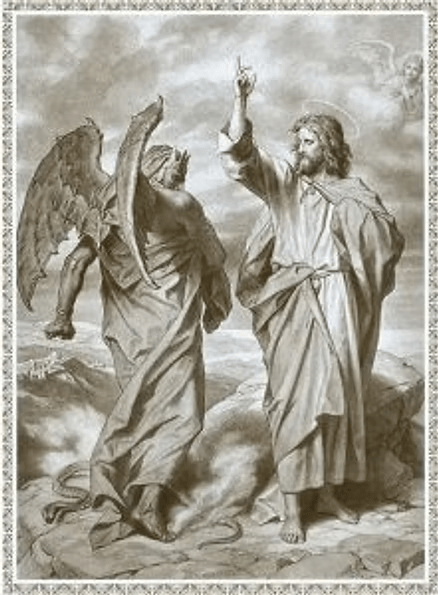
It is then vital to understand the meaning of James writing, “Draw near to God, and he will draw near to you.” The repetition of the Greek word “eggizó” (as “engisate” and “engiei”) doubles the meaning of “extreme closeness, immediate imminence” [HELPS Word-studies], as “to join.” This is a way of stating to become one with God. It means marriage to God is recommended; but because God is the Most Holy Spirit, God does not join directly with human flesh.  So, God will not say “I do” on a physical altar.

God breathes the life of a soul into flesh, which is a soul spirit. That breath is the dividing of God into Him and you.  The marriage that draws near to God, and vice versa, is God’s Holy Spirit becoming one with one’s soul. It is the rejoining of a soul to its source.

This is the first step to a soul rejoining God in Heaven, after the death of physical flesh. Marriage to God means eternal life in Heaven, without the filthiness and guilt of a material body imprisoning a soul divided from God, which is repetition through reincarnation.

As the Epistle selection for the eighteenth Sunday after Pentecost, when one’s personal ministry for the LORD should be underway – one has found wisdom from above through one’s soul being reunited with God – the message here is to stop being fooled by earthly wisdom. Confusion, doubt, guilt and all the self-defeating sins of lust, greed, adultery and murder are erased when the heart is set on fire for Yahweh.

This Epistle reading selection is presented along with other readings that are calling one’s soul to the spiritual altar.  As I looked for pictures that would be symbolic of the title “Submit yourselves to God,” I came upon diagram produced by church organizations that used a series of umbrellas to show this message.  The largest umbrella was either depicted to be “God” or “Jesus Christ.”  Under it were two smaller umbrellas, depicting a “Husband” and a “Wife.”

The message of marriage that is assumed from reading the books of the Holy Bible is human, not Spiritual.  The leaders of churches, synagogues, mosques, and temples around the world, common in all religions, see females as commanded to be subservient to their male husbands.  While this human arrangement is resisted in modern Western societies, it is a reflection of the animal kingdom, which is “devilish.”  Not all animals on earth (humans included) adhere to the principles of marriage being a family, where husband, wife, and children all live happily together.

Just as all animals are naturally led to procreate and raise their young in variations of the family theme, humans also have variations that can be deemed “natural,” even though they differ from the norm.  This is not the point of marriage that comes from the words of Scripture.  God does not demand any life form on earth to submit to His Will.  God allows His breath to be divisions of Himself onto a plane where life forms were free to live according to self.

When animals express self, it is a natural program of survival.  Animals do not possess Big Brains that plot evil deeds.  Still, being predator and being prey is the natural order of that game of life.  Humans, however, do not have the same excuse as lower animals, because God gave them a large piece of flesh that reasons, while finding pleasures sought unnaturally.

To see a human rite of reason become the lone expression of most holy matrimony, where Man gets to pretend itself as god, while the feminine half of the species has to play the role of submissive animal, this is wrong.  It completely misses the point of one’s soul being rejoined with God, on a voluntary basis.  Males and females are expected to choose a marriage to God, in order to be freed from the prison in which their souls have been cast – the human form.  Humans are in the likeness of God because they have all been divided from God.  God is the pure Spirit.  Humans are the impure form.

For church organization to preach a need for good marriage values as the salvation of mankind, where a husband and wife together under God will live happily ever after is missing the most important point.  The institution of human marriage is in shambles because it has been corrupted by Satan.  The youth of today are turning away from traditional marriages and turning to alternative ways of co-existence and co-habitation, with children seen as an unwanted burden upon the world.

The human institution of marriage (as an official Sacrament of a Church is a relatively modern concept) is good, when it is a mutually willing commitment. It is good when it mirrors the oneness of two individual committed to God.  This sacred act is not always upheld, which makes it human, divided from God.  The answer is not to preach the wrongness of marriage born on the physical plane, where God gave souls a vacation from submission to only doing right.  Instead, it is important to preach the reminder: This is only a vacation.  Remember you are expected to go back to Heaven.  Renew your vows to God soon.

What Americans would think of taking a honeymoon in France and not make sure the Passport was in order?

Who says everyone can use a camera?

The eighteenth Sunday after Pentecost is when some wisdom came down from above and some wise men chose “marriage to God” lessons for priests in the name of Jesus Christ to explain to those still under training as disciples.  The heart needs to be softened and the brain needs to be lowered.  God is always offering His hand in marriage; but He will only join with those who prove a desire for Him.  A minister for the LORD will have accepted that proposal, so Jesus Christ can preach, “Let the little children come to me, and do not hinder them, for the kingdom of heaven belongs to such as these.”

That means marriage to God.  Rather than a lustful heart and a ritzy honeymoon, marriage means the love of a child for the Father, in the purest way.


James 3:13-4:3, 7-8a – The wisdom from heaven

Who is wise and understanding among you? Show by your good life that your works are done with gentleness born of wisdom. But if you have bitter envy and selfish ambition in your hearts, do not be boastful and false to the truth. Such wisdom does not come down from above, but is earthly, unspiritual, devilish. For where there is envy and selfish ambition, there will also be disorder and wickedness of every kind. But the wisdom from above is first pure, then peaceable, gentle, willing to yield, full of mercy and good fruits, without a trace of partiality or hypocrisy. And a harvest of righteousness is sown in peace for those who make peace.

Those conflicts and disputes among you, where do they come from? Do they not come from your cravings that are at war within you? You want something and do not have it; so you commit murder. And you covet something and cannot obtain it; so you engage in disputes and conflicts. You do not have, because you do not ask. You ask and do not receive, because you ask wrongly, in order to spend what you get on your pleasures.

Submit yourselves therefore to God. Resist the devil, and he will flee from you. Draw near to God, and he will draw near to you.

——————–

This is the Epistle reading selection for the seventeenth Sunday after Pentecost [Proper 20], Year B, according to the lectionary for the Episcopal Church. It will follow a pair of Old Testament selections, with an accompanying song, based on a church’s path during Year B, either Track 1 or Track 2. If Track 1 is the path, then a reading from Proverbs 31 will be read aloud, which says, “The heart of [a capable wife’s] husband trusts in her, and he will have no lack of gain.” That will be paired with either Psalm 1 or Wisdom 1 -2. Psalm 1 sings, “Therefore the wicked shall not stand upright when judgment comes, nor the sinner in the council of the righteous.” The Wisdom says, “Let us lie in wait for the righteous man, because he is inconvenient to us and opposes our actions; he reproaches us for sins against the law, and accuses us of sins against our training.” If Track 2 is the path, then the Old Testament reading will come from Jeremiah, who said, “And I did not know it was against me that they devised schemes, saying, “Let us destroy the tree with its fruit, let us cut him off from the land of the living, so that his name will no longer be remembered!” All will accompany the Gospel reading from Mark, where Jesus said, “The Son of Man is to be betrayed into human hands, and they will kill him, and three days after being killed, he will rise again.”

I wrote about this reading and published my views the last time it came up in the lectionary cycle, in 2018. That commentary can be read by searching this site. I welcome everyone to read my observations from three years ago, as they are still valid today. However, at this time I will take a different approach and discern James more in a perspective of the other readings that this is read with. Feel free to compare the two articles and offer comments and suggestion, ask questions or point out where corrections need to be made.

In the first question posed here by James – “Who is wise and understanding among you?” – it becomes important to realize that Proverbs 31:10-31 is headed [NRSV] “Ode to A Capable Wife.” That “wife” is his metaphor for the goddess “wisdom,” whom Solomon saw are his divine wife, as if he were a god. That means all the wonders of a human female-woman-wife is not what ‘Mr. Loverboy’ ever looked for. Solomon had seven hundred wives and three hundred concubines, meaning [one can deduce] he never met a human being that could be a wife capable enough for ole Solly to be committed to for long. Thus, every ‘woman’ he wrote poetry or wisdom about was his inner self, which was his lust for being the smartest guy around. So, Solomon would have raised his hand, if he heard James ask this question.

The reason we need to disregard everything Solomon wrote, in particular everything he wrote to make his brain appear to be the biggest the world had ever known, is Solomon would have egotistically read what James wrote incorrectly, just like every average Joe does. In the Greek text of James, it literally translates into English as asking, “Who wise kai
understanding in yourself ?” In that, the word “Tis” is capitalized, which means the word must be elevated to a divine level of meaning, higher than the simple definitions: “who?, which?, what?, why?”

This means the question can be shortened to asking, “Who in your soul?” That means “Who, What, Which” is all a statement of Yahweh’s presence “in yourself,” which means one with one’s soul. Therefore, seeing that means realizing James is asking a rhetorical question to other Saints of Christianity, because Yahweh is their true source of “wisdom and most important [from “kai”] “skillful, experienced, knowing” [the true definitions of “epistémón”]. Solomon saw his personal intelligence as a goddess that belonged solely to him; but James saw the knowledge of the movement that was Christianity as all souls married to Yahweh sharing all the knowledge they needed.

James then followed his question with: “Show by your good life that your works are done with gentleness born of wisdom.” This can literally translate into English as saying, “let him show out of this good conduct these works of same self.” In that, a “self” equals a “soul,” and “same” refers to the marriage of a soul to Yahweh, so the “soul” then acts the “same” as He would have done. When “wisdom” is then that “born” from this divine marriage, the feminine “wife” is then all souls who receive the Spirit of Yahweh. This is then the truth of “a capable wife,” as it is not something determined by Solomon – a human in control of his soul – but by Yahweh. Thus, everything Solomon said about some imaginary “woman, female, wife” [“ishshah”] must be applied to all souls [those of both men and women] who welcome Yahweh into them; and, therein lies the truth of His wisdom, not the smarts of a big brain.

In verse fourteen, James addressed the lady friend of Solomon and his lust for intelligence, by writing [NRSV], “But if you have bitter envy and selfish ambition in your hearts, do not be boastful and false to the truth. Such wisdom does not come down from above, but is earthly, unspiritual, devilish.” This is what I have been led to see of Solomon. It was not Yahweh who offered him a gift for burning incense and making blood sacrifices in holy places, because the impish young king was not approved to enter such places and do such things, not being a priest [which being king does not make]. When Yahweh asked Solomon what punishment he deserved, Solomon requested, “Fruit from the tree of knowledge of good and evil, please; and, more than anyone ever before.” At that point Yahweh told Satan, “He’s all yours.” That made Solomon demonically possessed, probably with him not given the wisdom to realize that.

In verse sixteen, James wrote the Greek word “anōthen,” which means: “from above, from heaven,” and the NRSV translates the verse as: “But the wisdom from above is first pure, then peaceable, gentle, willing to yield, full of mercy and good fruits, without a trace of partiality or hypocrisy.” The implication from that says “wisdom” can come “from below” or “not from heaven,” which must be realized as worldly knowledge. Worldly knowledge is taught in public school and ‘pay-to-play’ colleges and universities. This includes [and this must be seen as the whole point of James’ views, as he was not a ‘secular’ kind of guy] the schools of wisdom that produce priestly-dressed fellows, those who would advise kings in religious matters. Think of James being there to say this verse [had he been there] when Jesus marveled at how Nicodemus taught religious wisdom, while not understanding spiritual matters. Just because someone wears robes on Sunday does not mean they have “wisdom from above.”

Verse seventeen, which is the last verse in chapter three, sums up who has wisdom from heaven,” when he pointed out “fruit.” James specifically said this “fruit” came from a tree or vine that produced “righteousness,” not dogma. When James repeated the word “eiréné” twice, meaning “peace,” he was not speaking like an old hippie from the sixties [which is how many Episcopal priests present the word, as a catchphrase]. The word “peace” should be read as the seeds of righteousness that must be sown, not promoted beforehand, as the acts of an Apostle who truly “walks in peace.” One sows peace without pointing out: “Hey are you watching me? I’m walking in peace. You should try it.”

At this point, the reading jumps into chapter four, going through the first three verses, before skipping on to verse seven, and the first part of verse eight. The BibleHub Interlinear heading for chapter four is “Warning against Pride.” The NRSV header says, “Friendship with the World.” Obviously, the “wisdom” talk is no longer the theme; but, that can still carry over, since Solomon certainly took pride in his main ‘squeeze,’ wifey Wisdom. He was friendly throwing her name about as often as he could find a pen and paper.

The focus of chapter four initially is on arguing and bickering, which has to be James pointing this out in rabbinical circles, especially those who wanted to debate the theology of Jesus being the long awaited “Mashiach.” Everything the ruling elite of Jerusalem did was break every law in the Holy Book of Moses, when they put their big brains together and determined killing Jesus was the way to go. Some, obviously, could argue that they had to break the laws, if Jesus was the one, even if they could not defend doing what they did in that regard. After all, Jesus said he must die; and only the Apostles knew that means his death freed his soul to be resurrected in countless others.

James said the bickering was within each. That would relate back to them saying “Peace, brother” a lot, but never finding true “peace.” Even the Jews who were on the fence, wanting to believe Jesus was the promised Messiah, they were struggling with how to tell and be told what to do. This becomes the problem of still being strongly attached to their love affair with a big brain [like Solomon]. Verse three has James telling them, “You ask and do not receive, because you ask wrongly, in order to spend what you get on your pleasures.” This has to be seen as the ongoing failure of Christianity, especially today; so, this needs to be explained.

For as long as I can remember, being raised in a Christian denomination at the young age that had me watched in a nursery crib in my mother’s church, prayer has been a promotional tool used by religions. Certainly, there is a power of prayer; but James is saying prayers are not answered. He says they are not answered because “you ask wrongly.”

In my mother’s church, the pews had printed forms in slots, along with a pencil, which was titled “Prayer Request.” I imagine, some people might have actually filled out one of those forms and turned it in some place. After that, members of the church would gather in the “prayer room” and pray for the people requesting prayers. I was not old enough to submit a prayer request; but my adult mind tells me there is a chance that is a door-opener to getting names and phone numbers, in order to get new members and new sources of income. That equates to “your pleasures,” more than it does any good knowing what people want prayers for.

My mother’s life was saved by some person who answered the Oral Roberts Prayer Hotline, when she called for prayer when she was having congestive heart failure. The person kept her on the line and called 9-1-1 and reported a medical emergency at my mother’s address. On a Facebook group, Episcopalians regularly ask for prayers, because of one’s illness or tragic accident, dangerous operation or medical procedure, even for someone about to die. It comforts people to think others are helping them pray.

As an Episcopalian, I found they have little use for Bibles in racks on pews; but they make sure many Prayer Books are available. They have prayers pre-written for many possible reasons. The Jews also have many prayers they memorize and recite ritually; so, it is quite possible solicitation of prayers and having ‘canned’ prayers have made prayer requests be like taking a Xanex. However, having books of prayers ready for those who are not souls married to Yahweh seems to be putting the cart before the horse.

Because the focus on prayer is so strong in religions, with Judaism and Christianity not the only ones, this takes one back to the wisdom not from heaven point made by James, in chapter three. The “disputes and quarrels” that can be applied to dogma and ritual, as intellectual approaches to prayer, says it was almost a foregone conclusion that a prayer was not expected to be answered, as it was coming from an intellectual perspective, where prayer was an expectation of duty. To think prayer is demanded of faith, in order for God to see one was making an effort to memorize all the songs and prayers, that is faulty reasoning, as if prayer was done so God could deem who was a ‘good Jew.’ The same can be applied to Christians.

To think God led some to write prayers and put them in books, so all the intellectual work was done ahead of time, saving the dimwits from having to think up words to pray, seems Solomonesque, in my mind. That formalized form of prayer can then be seen as at the root of Jesus’ disciples asking Jesus to teach them to pray. As Jews, having been taught to recite prayers for everything under the sun, their question could then be seen as less about, “What is prayer and how should we go about it?” Instead, it was more like asking, “Does praying help us in any way?”

When Jesus gave his disciples [not the whole wide world] and example of how each soul married to Yahweh should talk to him, beginning by calling Him “Father” [an individual statement applied to twelve disciples (maybe some more followers) means Jesus would say “our,” as a way of specifically speaking to that one group that was more than one], Jesus was not suggesting to them, “Hey guys! You know how you always memorized prayers and that work led you to ask, “How do I pray, so Yahweh hears me?” Well, memorize this one too!”

In that bit of teaching (which seems to be totally overlooked), Jesus said this:

“And whenever you pray, do not be like the hypocrites; for they love to stand and pray in the synagogues and at the street corners, so that they may be seen by others. Truly I tell you, they have received their reward. But whenever you pray, go into your room and shut the door and pray to your Father who is in secret; and your Father who sees in secret will reward you. When you are praying, do not heap up empty phrases as the Gentiles do; for they think that they will be heard because of their many words. Do not be like them, for your Father knows what you need before you ask him.” (Matthew 6:5-8)

Every one of those rules is broken by anyone standing in a church (or synagogue), reciting a prayer from memory or one published in a book. It makes understanding the meaning of “hypocrite,” which is: “a person who puts on a false appearance of virtue or religion.” [Merriam-Webster] In Luke 11, Jesus told them to use less verses like those he said [similar to Matthew], but then he told about a scenario where someone asked them for something. Prayer should be like that example, when a friend comes asking for help ‘after hours.’ Jesus pointed out someone asking for free bread because of a surprise happening – another friend came visiting when the man was not prepared for a visit. Illnesses and accidents, surgeries and deaths come unexpectedly, when one is not prepared to handle it. At those times of need, Jesus said, “Ask and you will receive.” The point is this: Jesus did not tell his disciples to fill out a wish list and give the list to a friend, expecting to have the friend buy them everything they want, without ever having to do squat.

When Jesus said to call Yahweh “Father,” that is a special relationship that everyone in the world cannot truthfully say. It means a love relationship must be developed. The capitalization of “Father” raises it to a divine level of meaning, where Yahweh becomes one’s “Teacher.” This says the disciples were to Jesus the way Jesus was to Yahweh. All were in the same family of love. Jesus was not telling the members of the Sanhedrin to call Yahweh “Father,” because Jesus would have then promoted them lying, knowing their hearts were far from loving Yahweh. Thus, their souls were far from joining Yahweh’s personal family, which means a soul marrying Him and receiving His Spirit.

Next, when Jesus said Yahweh will know your prayer before your brain can even formulate it into a question [“Ask and you will receive”], look at how often people [Gentiles and Jews] came to Jesus out of faith, from having unspoken a prayer for healing. Jesus told them many times, “Go, your faith has healed you.” Their prayers were answered because they did something, based on faith. Without true faith, one’s soul has no personal experience with Yahweh [most don’t even know His name], so “You ask and you do not receive.”

This is where it is good to recall James writing, “Faith without works is dead.” When that is applied to prayer, it says prayers are normal conversations between a soul and Yahweh. Yahweh knows what one needs before one asks; so, the faith that does what Yahweh says to do, without questioning, means prayers will be answered without having to ask. One knows what others need, so one acts towards meeting those needs. When asked for bread late at night, after the doors are closed and locked, that means do the work required to give the bread asked for. One must have faith that Yahweh sent a prayer to you, for you to answer.

To minimally meet the “friend” status, one has to do something to impress Yahweh first. So, when one goes knocking on Yahweh’s door after it has been closed for the night, asking for some bread to serve someone who came visiting unexpectedly, He at least knows who the heck that one soul is. Being a “friend” of Yahweh means being one of His family. Going and sitting on a church pew and reciting some prayers out of a book is not establishing that kind of close, personal relationship Yahweh wants from His “friends.”

As an optional reading selection to be read aloud on the seventeenth Sunday after Pentecost, when one’s own personal ministry for Yahweh should already be well underway, the lesson of James is to stop thinking you own God, so all you have to do to get to heaven is minimal dogma and ritual stuff: give to a church; go a couple of times a year; own a Bible and a Prayer Book; join some Facebook group for Christians; and put a decal on your car window. All of that might be headed in the right direction, but it is still headed down a path of wisdom that is not from heaven. Being a Christian that has a single soul, not married to Yahweh, possessed by His Spirit, is like being a twelve-year old sister of an older sister who is: a.) married; and, b.) pregnant with her second baby. One can watch that all day long and believe it is real; but until one goes through the same, one has absolutely no faith in one being married and one being a mother. Ministry is not about seeing someone else do it and thinking that’s the way it works.