Are any among you suffering? They should pray. Are any cheerful? They should sing songs of praise. Are any among you sick? They should call for the elders of the church and have them pray over them, anointing them with oil in the name of the Lord. The prayer of faith will save the sick, and the Lord will raise them up; and anyone who has committed sins will be forgiven. Therefore confess your sins to one another, and pray for one another, so that you may be healed. The prayer of the righteous is powerful and effective. Elijah was a human being like us, and he prayed fervently that it might not rain, and for three years and six months it did not rain on the earth. Then he prayed again, and the heaven gave rain and the earth yielded its harvest.
My brothers and sisters, if anyone among you wanders from the truth and is brought back by another, you should know that whoever brings back a sinner from wandering will save the sinner’s soul from death and will cover a multitude of sins.
———————————————————————————————————-
This is the Epistle selection from the Episcopal Lectionary for the Nineteenth Sunday after Pentecost, Year B 2018. In the numbering system that lists each Sunday in an ordinal fashion, this Sunday is referred to as Proper 21. It will next be read aloud in an Episcopal church by a reader on Sunday September 30, 2018. It is important because James presents the power of prayer as being magnified within the family of God, when those of the same relationship in the name of Jesus Christ unite to work wonders.
In the first verse above (James 5:13) the Greek word “kakopatheó” is written. This is translated as simply “suffering.” The full meaning is “suffering evil,” “enduring affliction,” where the combined root words come from “pain” [pathos] “of a malicious disposition” [kakós]. Thus, instead of falling off a bicycle and breaking an arm (suffering), the word implies “experiencing painful hardship (suffering) that seems to be a “setback” but really isn’t.” [HELPS Word-studies]
Seen in that light, James was saying that “prayer” was the answer to setbacks that are the result of evil deeds. While prayer can help ease one’s pain from wounds, scrapes and bruises, medical treatment is God’s gift to mankind, knowledge allowed to be used as physical treatments for physical maladies. The mental damage of sins, worries, guilt, and the pressures of life’s hardships, however, makes prayer be the prescribed remedy.
It is also important to read the words, “any among you,” knowing that James was not writing a letter blankly to all humanity. His congregation was Jewish, in particular those who accepted Jesus as their Messiah. They did not accept James as their holy leader, meaning as a subsequence they accepted Jesus within themselves, like James had. Instead, they accepted Jesus Christ into their souls, due to James evangelizing to them, so all were reborn as Jesus Christ, servants of the Lord. This is, therefore, to whom James referred prayer, as all humanity regularly suffers from evil afflictions; but whereas common Jews did not know how to pray properly, those who were in the name of Jesus Christ were being reminded of the power of prayer that was available to them.
Likewise, when James repeated the Greek word “tis,” which means “anyone, someone, or some people,” the word pointed to “certain ones.” As a question to “certain ones,” stated as “Are you cheerful?” that question, like the first question, was directed at those who were filled with the Holy Spirit.
As a question following the suggestion for prayer at times of mental anguish, when prayers are answered and the sufferings of evil are removed, the natural state is cheerfulness. For those whose prayers have been answered, “They should sing songs of praise.” This, of course, is not a generic song from a hymnal of praises, but a specific song from one’s heart, praising God for having answered one’s specific prayer.

This then leads to the question, “Are any among you sick?” where, again, the use of “tis” implies Jews in the name of Jesus Christ. The question says that sickness is a common affliction that occurs in all human bodies. Some viruses and infections can have the effect of removing the soul from the body, simply to separate a soul cleansed of sin from a mortal body in the process of breakdown. This separation can keep the human brain from thinking thoughts of prayer, because the soul is disconnected from the pains of a sickness.
In these cases, the elders (those “certain ones” who lead “certain ones” in gatherings) should be called to pray for the one needing prayer. This is a case where a “church” (“ekklēsias”) was understood to be “an assembly” (gathering) of members, who are all in the name of Jesus Christ.
That is stating the family relationship that comes from all Christians being reborn as the Son of the Father, so they have all taken on the name of Christ as Christians. This is then stated in verse 14 where it says, “anointing them with oil in the name of the Lord.”
While that is a viable translation, the scope of meaning that comes from the literal Greek makes this more powerful when it says, “giving shares of penetrating comfort to impart healing [aleipsantes] themselves [auton] with the indwelling of the Holy Spirit [elaiō] manifesting the character [onomati] of the Lord.” This becomes a viable translation of the intent, based on the words chosen.

This healing is then done by those empowered by the Holy Spirit of God, using prayer as their personal call for divine assistance. This is holy work done by the “elders” (“presbyterous”), who have been reborn as Jesus Christ longer and spread the Holy Spirit to more others more often, thus teaching those taught and healing those who cannot use the Holy Spirit to heal their own bodies. Family does not simply smear oil on the foreheads of Christians and pray a generic prayer book prayer for a soul to return to a healed body.
That would be a prayer of belief, where a book told one what to say and what to believe. That is what an institution or organization does. James, however, said that elders offer a “prayer of faith” (“pisteōs”), which is a prayer “received from God, and never generated by us.” A prayer of belief offers “confidence,” which is from a human perspective – the self-brain. That is, therefore, generated by the one believing in prayer, without true faith. A prayer of faith is a prayer from one who has Jesus Christ speaking through him or her, as an extension of God in an Apostle.
This is why James then added, “A prayer of faith will save the one ailing.” Again, when one is sick and incapacitated, unable to offer prayer, it becomes the one(s) who send collective prayer from the Christ Mind to the Holy Spirit of the sick Apostle. That intercession calls upon God for salvation. James then said, “The Lord will raise them up.”
The Greek word “egerei” is used, which is the future active form of “egeiró,” translated as “will raise up.” It is then important to know that the word is implying strongly (and can be directly translated as) “will wake us.” This is where one needs to realize that the implication of James asking, “Are any among you sick?” the meaning was, “Are any of you dying?”
The word translated as “sick” is “astheneó,” which (if not used to denote one being morally ill, which an Apostle would not be) means in a state of feebleness and weakness. Therefore, “save” and “raise up” have a meaning that intercessory prayers by the elders are to request the Lord to receive the soul of an Apostle in Heaven; but if the soul has more use on the earthly plane, the Lord can reconnect the soul to the body and awaken the body and soul back to life … and back to health.
This aspect says the elders gather (as Apostles in the name of Jesus Christ) and offer prayers that would request God forgive any sins the sick person might have committed prior to his or her illness, because that person might have become unable to plead for forgives personally. This is why James added, “Anyone who has committed sins will be forgiven.”
It is important to realize that James did not give a blanket “Get out of Sins Free card” by those words. They are written about one having fallen gravely ill and in need of fellow Apostles to intercede for that soul and body.
When the translation above has James saying, “Confess your sins to one another,” the Greek written better translates as, “Confess therefore yourselves the sins,” where the Greek word “allēlois” is the dative plural form of “allélón.” That says confession can only bring forgiveness from God. Therefore, all Apostles should admit their sins freely to God. This means James was foremost giving the instruction to keep one’s personal sins at a minimum; but when one does sin, the confession (among all Apostles, each other, one another, themselves) must be to the LORD.
Certainly, it is the presence of the Christ Spirit within one that reminds one of sin, so the shame of guilt should be to confess before Jesus Christ, who is merged with one’s soul. So, that petition is set before God for forgiveness by the Christ Spirit as sincere. To then admit one’s sins to other Apostles should only be to admit the flaws of the human condition and praise the forgiveness that God has shown. Confession to others can only be done by those (giving and receiving) who model the life of Christ, which became the life those have lived in return for God’s forgiveness of sins.
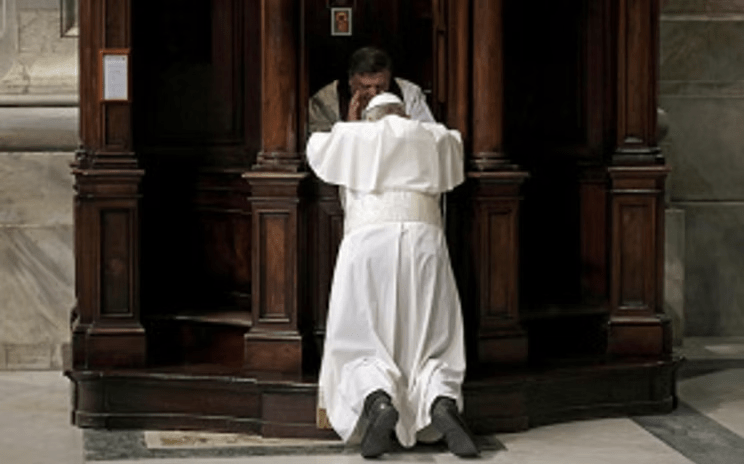
The confessional in a private booth, between one who is not an Apostle and a priest who is, cannot have penitence given by that Apostle. Such confession should bring forth a recommendation that the sinner establish a life that pleases God; as that is the true path to forgiveness. Confession to a priest who is not filled with the Holy Spirit means sinners will not be led toward a life devoted to God.
When James then said to “pray for one another,” this is of course what Apostles do within the gathering of Saints. That is the purpose of a Church (not a building). Still, when the series of segments began with a confession of sins “yourselves” before the Lord, that confession is now being said to be through prayer. Prayer is one taking to God.
Each Apostle is advised to pray often. Since Saints are more often apart than together, confession of sins and daily prayer are developing the Father-Son relationship each needs. This daily communication is part of the training process for an Apostle, as through prayer one develops an ability to see, hear, and touch the answers that come from God as subtle signs and whispers of insight.
When James then added, “so that you may be healed,” the Greek word “iathēte” is a statement about prayer as a routine maintenance for the body. It is a word stated in the conditional voice, where the result is not guaranteed; one understands that. It asks God to protect one from physical disease and spiritual misdirection. God will respond as is necessary for God’s Will to be done.
An Apostle-Saint is a soul sought by Satan, so lures and traps (stumbling blocks) are to be expected, as well as avoided. Prayer enlightens one to steer clear of such pitfalls. Routine prayer is then done to beg for forgiveness for having fallen into one of Satan’s traps and to learn to spot a trap before any damage is done. This two-way communication with God keeps one healthy and able to help lead others to the same healthy relationship with God, reborn as Jesus Christ.

James then made the statement, “The prayer of the righteous is powerful and effective.” The literal translation shows this as, “Much prevails [the] prayer of a righteous [man] being made effective.” There is more to this than might initially meet the eye.
The Greek word “ischyei” comes from “ischuó,” which states an “ability” that is “strong” and “powerful.” The point being made by James is that “prayer” having been fully developed in one becomes the “power” of the “righteous.” Hand-in-hand, “prayer” is the “power” that makes one “righteous.”
The word “energoumenē” is then a form that focuses on the “work” that is associated with “righteousness.” This is (in the present participle of “work”) “being made” in those “righteous,” coming from God. This is the building of one’s relationship with God, such that it strengthens and becomes more powerful over time. The more one acts for God, the more one is “being made effectively” into what deems one “righteous.” Those acts done are led by the influence of God, through the Christ Mind, so one willfully follows. Everything is “powered” by “prayer.”
James then gave the example of Elijah, when he wrote, “Elijah was a human being like us, and he prayed fervently that it might not rain, and for three years and six months it did not rain on the earth.” This begins with a statement that Elijah was not born righteous. He was just like all the Jewish Apostles that James knew, being a man of flesh and blood, alive with a soul breathed from God.
Elijah became righteous because he heard the voice of God and listened. Following that guidance, Elijah developed a powerful ability to call upon the Lord through prayer. That powerful ability effectively made Elijah the most highly revered prophet in Israelite history.
James further explained how Elijah “prayed fervently that it might not rain, and for three years and six months it did not rain on the earth.” Elijah did not cause it not to rain. God answered the prayers of Elijah, which extended over three years and six months. Each day Elijah was praying daily to God.
The word translated as “fervently” comes from “proseuché,” which means “a place for prayer.” Since this was prior to buildings of prayer (synagogues) in Israel, Elijah was himself the place of prayer to God. Therefore he prayed to God daily, more than once a day, wherever he went. Elijah had developed the Father-Son relationship that a prophet must have.
That is the power of prayer. It links God to the servant, making the servant as powerful as God sees His servant needs to be. It should be realized that the Father is the Master and the Son is the willing slave. This does not imply an abusive relationship, but a necessary one between a Teacher and an Apostle. The student must prove an ability to demonstrate what has been taught. Therefore, God saw the righteousness of Elijah’s prayer for drought, and He granted the wish.
The land of Israel had become overrun with wickedness. When we then read that “Then [Elijah] prayed again, and the heaven gave rain and the earth yielded its harvest,” this says the land had seen the error of its wicked ways and turned back to God. The prayers of Elijah were joined with those of others who had been denying God their devotion. Therefore, when we read, “the earth yielded its harvest,” this was more than vegetables growing from the land. The people of Israel had repented and returned to praying to God.

That ending brought by Elijah is then turned by James towards his audience. As male Jews who he addressed, He called them “Brothers of mine,” which is a statement of all Apostles being “Brothers” in the (masculine) name of Jesus Christ, the (masculine) Sons of God. All Jewish females then, those who had been filled with the Holy Spirit and made Apostles, were also included in this address as “Brothers.” James said to them all, “If anyone among you wanders from the truth and is brought back by another, you should know that whoever brings back a sinner from wandering will save the sinner’s soul from death and will cover a multitude of sins.”
That means that just like Elijah brought back all the sinners of Israel by prayer to God, then the same expectations are in themselves, set by God for them. As the embodiment of the resurrected Son of God, each of them had the same powers of prayer as did Elijah. All were as righteous in their paths as was Elijah. All the Apostles were sent forth into Israel (then Judea and Galilee, et al.) to “bring back sinners from wandering,” just as they were once wandering sinners, saved by accepting Jesus Christ as the Messiah within their soul.
Each of the Apostles had been brought back from the death of their self-egos and the potential of losing their souls to hell. They were saved because God forgave them all their sins. They were then expected to be like Elijah and pray to God for the great powers that will lead sinners to penitence. The same expectations exist today.
As the Epistle selection for the nineteenth Sunday after Pentecost, when one’s personal ministry for the LORD should be underway – one has found the value of daily prayer as a way to care for others – the message here is to talk to God as part of developing a life of righteousness. One has to see God as the Father, which is a close personal relationship between the child (Son) and its parent, more than seeing God as the Creator of all and distant through His greatness and invisibility.
It should be realized that James was the brother of Jesus, as the son from Joseph the carpenter’s loins. James was a follower of Jesus, as a family member, but he was not a disciple who saw Jesus as a teacher. The disciples asked Jesus to teach them how to pray, which is an indication that prayer was not taught by the rabbis in the synagogues. Despite being taught the Israelites were the children of God’s choosing, they were not told how to see God as a loving progenitor.
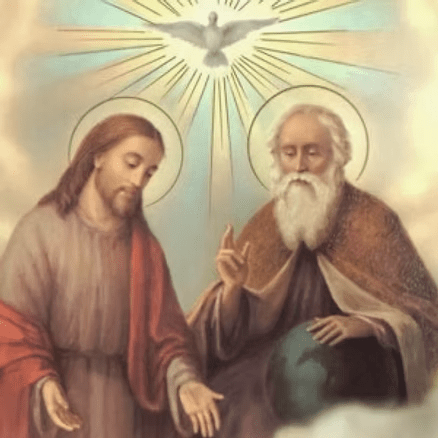
This is why Jesus immediately told his disciples to pray by first identifying the Lord as “Father” (Luke 11) or “Our Father in heaven” (Matthew 6). Today, there is the repetition of a set grouping of words called “The Lord’s Prayer.” This is not what Jesus told his disciples to recite. Rotely repeating the words of Jesus aloud in church is missing the point of Jesus teaching his disciples, using the words recited, that prayer is a son asking his Father for that which is needed.
A Son asks the Father for insight each and every day (daily bread). He asks for forgiveness of his sins done and to release his angers in his heart for other sinners. He asks his Father to keep him from being swayed by the temptations of evil. In this reading from James’ letter, he followed that model without repeating the words of The Lord’s Prayer.
This says that the Jewish Apostles to whom James wrote understood the intent of Jesus’ teaching his disciples how to pray. As those filled with the Holy Spirit and reborn as God’s Son, they all felt in their souls a close personal relationship with God, as each of them was the Son of the Father. This is not the case of Christians in pews, if they do not feel the same closeness with God. Many fail to contact Him daily, so many fail to live righteous lives.
Jesus did not recite “The Lord’s Prayer,” as he was simply giving instructions as to what sons should ask of their Holy Father [not a pope]. After speaking those famous words, few are taught to remember how Jesus then told his disciples the explanation behind those words. Jesus said:
“Ask and it will be given to you; seek and you will find; knock and the door will be opened to you. For everyone who asks receives; the one who seeks finds; and to the one who knocks, the door will be opened.”

Jesus continued: “Which of you fathers, if your son asks for a fish, will give him a snake instead? Or if he asks for an egg, will give him a scorpion? If you then, though you are evil, know how to give good gifts to your children, how much more will your Father in heaven give the Holy Spirit to those who ask him!”” (Luke 11:9-13)
Jesus explained that the way to pray was to speak to God as one’s Father in heaven.
More importantly than an instruction to “say after me,” Jesus told his disciples to pray to God for help – help for strength amid weakness, help for others in need – because the Father listens and will not refuse His Sons. However, if the only prayer one knows how to say is “The Lord’s Prayer,” God listens and then says, “Yada, yada, yada. But what do you want specifically. TALK TO ME!”
[“Yada” is the Hebrew word meaning, “I know.”]
Seeing this relationship – this entrance into the family of God, as His Sons (regardless of human gender) – is where one needs to realize prayer is not for selfish needs. Parents will know how their children quickly learn the word “gimme.” They incessantly repeat that word – “gimme, gimme, gimme, gimme, gimme …” – without really wanting anything specific. They scream for self-satisfactions, which are rewarded whenever parents actually give the child what it screams for, just to make it stop begging.

Humans are like our own children, as we love to see what we can get for nothing. Humans are also like our own parents, as we love to make our kids happy, even if it means doing without personally. This is how we can call God the Father, because God (like dad, more than mom) knows how to turn a deaf ear to the brains of selfishness. Instead, God listens to hear what our hearts desire.
This is why one has to die of self-ego, in order to become married to God the Husband (to all human gender wives) and begat His Son in each – Jesus Christ resurrected. We have to become one of the family. We have been adopted as believers in Jesus as the Christ. We come into the family as the children of God.
The rebirth of God’s Son means a serious growth development in the child, where the asking is not for selfish demands, but petitions for a better world. Prayers submitted through the Christ Mind are for healing purposes and church gathering support. They are not self-serving, but to gain God’s health in the body of Christ – the whole (Church) and the individual (an Apostle-Saint).
True prayer, such as James wrote of in his fifth chapter, is for those who have matured in Christ. It asks God to give an Apostle the strength and stamina to become a reflection of the Father to the little children on earth.


 Explaining the Readings