Tag Archives: Jeremiah 31:31-34

Jeremiah 31:31-34 – I will make a new covenant

31 “The days are coming,” declares the Lord, “when I will make a new covenant with the people of Israel and with the people of Judah.

32 It will not be like the covenant I made with their ancestors when I took them by the hand to lead them out of Egypt, because they broke my covenant, though I was a husband to them,” declares the Lord.

33 “This is the covenant I will make with the people of Israel after that time,” declares the Lord.  “I will put my law in their minds and write it on their hearts.  I will be their God,
and they will be my people.

34 No longer will they teach their neighbor, or say to one another, ‘Know the Lord,’ because they will all know me, from the least of them to the greatest,” declares the Lord. For I will forgive their wickedness and will remember their sins no more.”

———————

This is a reading designated for the fifth Sunday in Lent, Year B, which will next be read aloud in an Episcopal church on Sunday March 21, 2021.  I write about this now because I recently heard the sermon of a Baptist minister (on television) and he referenced this reading while preaching about the prophecy of Malachi 3.  Verse 32 of Jeremiah 31 struck me as important enough to write about now.

For anybody who has read my postings here, most of which are rather long, they will recognize that I have been saying how important it is to marry God.  Marriage to God comes from a devotion and desire to learn from Scripture and prove to God (in some way unique to each individual) that one truly wants to please the Lord.  That proof causes God to propose marriage, making one a bridesmaid (regardless of human gender).  Marriage comes when God’s Holy Spirit merges with one’s soul.  The product of that holy union (the most Holy Matrimony) is the rebirth of God’s Son (the resurrection of Jesus in the flesh of the one marrying God) and the reappearance of the Christ in the world (hopefully one of many).

When Jesus told the parable of the wedding banquet (Matthew 22:1-14), I explained that was God sending His Son out as a messenger to tell the Jews they were invited to finally marry God.  Verse 32 here in Jeremiah 31 says why God the King had to prepare a great feast to celebrate that marriage coming through at long last (when Jesus came).  It was to be the new covenant between God and His chosen people. 

God said through Jeremiah: “It will not be like the covenant I made with their ancestors when I took them by the hand to lead them out of Egypt, because they broke my covenant, though I was a husband to them,” declares the Lord.”

That says it was always the plan for the Israelites to – each and every one – marry God and become His Son.  That includes all the women too.  When God said He was “a husband to them,” that condition of relationship never got tossed away.  It is the only way to have God’s agreement “in their minds and written on their hearts.”

By God saying “I was a husband to them,” that statement says the children of Israel who followed Moses (another messenger of the Lord) were ALL His wives.  The expectation of a marriage to God [the wedding ceremony was at Mt. Sinai, with the honeymoon lasting nearly forty years] is complete submission to His will.  A husband not only takes a wife ‘to have and to hold [possess] from this day forward [forevermore]’ but that commitment means God was equally committed to loving and caring for His wife [males and females].
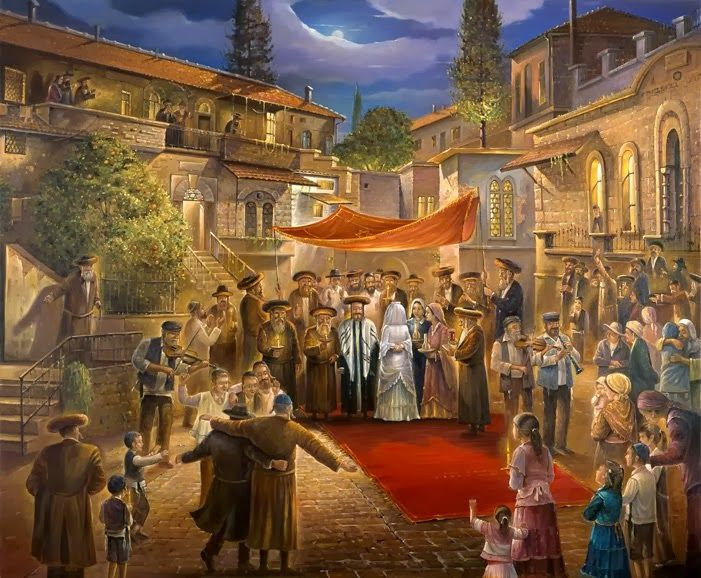
The purpose of marriage is a bond of exclusive togetherness.  The Israelites became God’s chosen people in the same manner a husband says to a bride-to-be, “I choose you.”  Being chosen marks the stomping on the glass, wrapped inside a napkin.  Being chosen means the acceptance of being chose.  Marriage is not about temporary togetherness.  It is about ‘until death do you part,’ but when the marriage is to God it is about dying of self.  Death then symbolizes the beginning that union, with physical death, when a soul is released from a body of flesh, being the time when the soul returns to be one with God.

Alas, since the old marriage agreement ended in adultery, therefore divorce for most of the Israelites and Judeans, God told Jeremiah, “I am a wealthy God.  I am a king.  I can afford many wives.  So tell them I will take them back, but only after they prove their willingness to commit from day one.”

Since then, everyone knows what happened to the Judeans and Israelites of Jeremiah’s day … they left a trail of tears into Assyria and Babylon.  It was collapse and ruin for them both.  The same thing happened to the Jews of Jesus’ day, after they killed the messengers of God – Jesus and his Apostles (just like in the parable of the wedding feast).  That leaves this prophecy still in effect for Christians, but Christians have to hear God speaking to them through Jeremiah, when he wrote: “I will be their God, and they will be my people.”

Christians have to realize what God meant when He said, “It will not be like the covenant I made with their ancestors when I took them by the hand to lead them out of Egypt, because they broke my covenant.”   That means Christians are spawned from the new covenant. They are ‘day one’ brides [males and females].  The covenant is the marriage proposal and acceptance thereof.  The taking by the hand is how an experienced husband takes a young bride and leads her through all the acts of marriage, which took place back then in a tent designed for making love.  A good spiritual wife learns how to please his-her God.  In return, a good husband never leaves His spiritual wives frustrated and wanting.  God took His Israelite brides by the hand and wrote down everything they had to do to please Him. 

Christians are not that naïve.  They have all been around the block before … quite a few times.  With ancestral roots that show family histories that have worshiped every god under the sun known to benefit mankind in some way, they are experienced ‘lovers.’  They heard about the many instructions Yahweh gave to His newbie wife and toss most of them away.  They coo in the ear of God, “Let’s just stick to Ten Commandments sweetheart.  I know what pleases a god.”  However, God has not married any of those like that, even when they are who claim to be having and beholding His Messianic presence.   

Christians – as the name implies – are already filled with God’s Holy Spirit and have given up their self-egos (the required sacrifice a bride makes, in order to take on the name of his-her husband) and been reborn as Jesus Christ.  That makes them “Christians.”  Thus, God said, “No longer will they teach their neighbor, or say to one another, ‘Know the Lord,’ because they will all know me, from the least of them to the greatest.”

A Christian who cannot say, “I know the Lord,” remembering the Biblical meaning of “to know,” means one is not truly a Christian.  To know the Lord is to have knowledge of Him within your flesh (the body of Christ).  It is to feel that holy presence flowing through one’s being (the blood of Christ).  One is a pagan whenever that knowledge is missing, much like is a fallen Jew today.  Pretenders get in the long line of those who refused the invitation of the messenger [i.e.: Jesus], who said, “Hey the king wants to marry you!  Put on your wedding gown and head over to the marriage tent.  There will be food and drink served afterwards!”

Pagans have better things to do (or at least they think so).  Christians only get to hear God whisper into their ears: “I will forgive your wickedness and will remember your sins no more.” 

Who could ask for more? 

God knows you were a filthy harlot before.  God knows you cheated on Him time and time again.  But, God knows a true heart is repentant and desiring a second chance at the total commitment of marriage.  God knows the truth of how much one wants past sins forever washed clean by His Holy Spirit.

That is the new covenant promise.  But, you have to be married to God to get that wedding present.  You have to be a Christian; not one of those sneaking into the feast without a wedding dress on.  Those only get booted out, with a whole lot of weeping and gnashing of teeth going on after that.
Jeremiah 31:31-34 – Sacrificing so a soul can know the Lord

The days are surely coming, says the Lord, when I will make a new covenant with the house of Israel and the house of Judah. It will not be like the covenant that I made with their ancestors when I took them by the hand to bring them out of the land of Egypt—a covenant that they broke, though I was their husband, says the Lord. But this is the covenant that I will make with the house of Israel after those days, says the Lord: I will put my law within them, and I will write it on their hearts; and I will be their God, and they shall be my people. No longer shall they teach one another, or say to each other, “Know the Lord,” for they shall all know me, from the least of them to the greatest, says the Lord; for I will forgive their iniquity, and remember their sin no more.

——————–

This is the Old Testament reading selection for the fifth Sunday in Lent, Year B, according to the lectionary for the Episcopal Church. It precedes Psalm 51, in which David sings, “Have mercy on me, O God, according to your loving-kindness; in your great compassion blot out my offenses.” An optional reading from David comes in Psalm 119, which sings, “Blessed are you, O Lord; instruct me in your statutes. With my lips will I recite all the judgments of your mouth.” It also is accompanied by the Epistle reading from Paul, to the Hebrew speaking Christians [Jews], saying “[Jesus] became the source of eternal salvation for all who obey him, having been designated by God a high priest according to the order of Melchizedek.” Finally, it is presented along with the Gospel reading from John, where Jesus said, “Those who love their life lose it, and those who hate their life in this world will keep it for eternal life.”

In this Year B season of Lent, a theme was developed over the first three Sundays, relative to covenants between Yahweh and Patriarchs: The covenant with Noah; The covenant with Abram; and then, the covenant given to Moses for the Israelites to agree with. Now, after a seeming absence of a covenant presented in the fourth Sunday’s lessons, we read here of a “new covenant” being promised by Yahweh, through the prophet Jeremiah, to “the house of Israel and the house of Judah.” This makes this new covenant expose an unseen and unstated covenant in the fourth Sunday in Lent’s Old Testament reading selection.

In the week four reading from Numbers, the focus was on an attempted divorce from the marriage the Israelites had accepted, by agreeing to the marriage vows called the Ten Commandments. The Israelites felt (after decades in the wilderness) a need to rebel and complain because their commitment was only verbal, not yet written on paper [although etched in stone by the finger of God]. In their saying “We do” to Yahweh, that then required them to consume daily spiritual bread from heaven, which assuaged their doubts and worries as conscripted wives of Yahweh. Their complaints meant a call for divorce; and Yahweh gave them the divorce they wanted, which became a “new covenant” of separation. However, no longer being married to Yahweh made them highly susceptible to the entrapments of death in a mortal realm, with no hope for their souls to find eternal life; and that led them back to the altar of marriage, as a second covenant [a restating of vows] between the Israelites and Yahweh.

Here, in Jeremiah’s prophecy, he becomes a reflection of Noah, Abram, and Moses, as the officiant bearing the proposal of marriage for others to agree to. It becomes important to now realize that the marriage between Yahweh and the Israelites was physical, in the sense that the covenant between a people and God was their promise to follow His Laws [those in stone], in return for God’s promise to deliver them physical land. The Promised Land, in that marriage, did not include the spiritual promise of eternal life; and, that is where the message in Numbers spoke of the first marriage between Yahweh and the souls of Israelites, which promised them to always have spiritual leaders like Moses.

By seeing how the Israelites continually, over hundreds of years, separated from God [divorce pending] and then remarried – to some sense in the physical – by the time Jeremiah was having a meeting with Yahweh, as a descendant of those Israelites who married Yahweh spiritually, little remained but a divorce to be finalized. Jeremiah was one of the exceptions [there were others] who was filled with God’s Holy Spirit; but the two factions of Yahweh’s former physical brides had split into two promised lands, one called Israel and one called Judah. Jeremiah was like a child caught in the middle, wanting the husband and wife to stay together, with the ‘mother lands’ ignoring his views. They had been too busy dividing up of the spoils of marriage, after their divorce from Yahweh; which is why Yahweh had Jeremiah point out, “a covenant that they broke.”

The divorce meant the ex-wives of Yahweh then took others as their husbands physically, such that (as second time around the block wives) they squandered their land titles by handing them over to people who did not know Yahweh as their husband, nor ever care to marry Him. Thus, when all future physical divorces took place, the peoples of Israel and Judah would be left as nothing more than penniless divorcees, in the physical sense. Neither the scattered Israelites nor the exiled Judeans held any rights to claim anything from a past marriage to Yahweh [long before] was still owed to them. That covenant was broken.

To put this in the perspective of the reading from Numbers 21, seeing the rebellious Israelites as divorcees having their way and the freedom to do whatever they pleased, they ran off on God. That act of divorce meant then took on all responsibilities for those ways and deeds.

The Israelites, still in the wilderness with Moses, found out being a divorcee was not all peaches and cream. They experienced pain, suffering and death, without soul salvation, so they saw the evil of those ways and deeds and repented, sincerely. Yahweh took them back, when He told Moses to suspend a seraph on a pole, which acted like an amendment to the Ten Commandments.

That became a repetitious process – divorce, the illusion of freedom, the reality of imprisonment in a world of sin, death, moaning and groaning, realization of guilt, repentance, and Yahweh taking them back. The Book of Judges is then read like a song book, with the same song with different verses, all singing about the short attention spans the Israelite people had towards commitment in marriage to Yahweh. By the time they begged for a king to lead them (rather than a prophet), it was if those people married one of the fiery serpents [seraphim] that guaranteed it was only a matter of time before the promise of eternal death and emotional loss would be realized.

This means that the only reason for a new covenant, “the covenant that [Yahweh] will make with the house of Israel after those days,” is because of those few who [like all the Prophets] had become the “Sons of man” [“liḇ·nê ’ā·ḏām” or “ben adam”], or children of Yahweh. Those Israelites who truly made a spiritual commitment to Yahweh, serving Him totally, had not been part of the divorce decree. Jeremiah was one; and as such they would become the future wives of Yahweh [where He would be “their husband”], therefore the “new covenant” called for wives that would only be saint-like and righteous; obedient and devoted.

This means the “new covenant” would come with no material perks, dowries, or physical gifts exchanged. The only “land” involved would be the individual physical bodies of the bridesmaids of Yahweh [human gender irrelevant]. Those bodies would each become the temples unto the Lord [Yahweh]. Within that temple would be found the ‘Holy of Holies’, which is the heart.

While a physical body requires a physical heart, the spiritual heart becomes the soul. Just as a physical body is dead without a functioning physical heart, the human body is dead without a soul married to Yahweh – where death means the limits of mortality in bodies of flesh [reincarnation]. Therefore, when God had Jeremiah prophesy, “I will put my law within them, and I will write it on their hearts,” this is a promise of God’s Holy Spirit being merged with their souls, many times over.

This becomes the “new covenant,” where the Ten Commandments is recognized as the ‘first’ Covenant, or the ‘old testament.’ It says the “new” marriage agreement will not be like the past, as an external list of things to commit to, memorized with one’s brain [thereby easily forgotten]; but instead, it will be one where the commitment is not physical, but spiritual and thereby permanent. When one sees the “heart” as the soul that leads the flesh through life, when the soul is truly married to Yahweh, then the flesh is led through life righteously and saintly; obediently and devotedly. The body will then be led by a soul that is led by God [not an external judge or prophet, like Moses or Elijah].

When Yahweh then told Jeremiah to prophesy, “I will be their God, and they shall be my people,” this is no longer representative of a group of people that are collectively led by one prophet – like Moses, Samuel, Elijah, or Elisha [et al]. It is when each individual is married to Yahweh, such that many people like that become the people of God, all as His wives, all individually led by God’s Holy Spirit.

This is then how it comes to be that “No longer shall they teach one another, or say to each other, “Know the Lord,” for they shall all know me.”

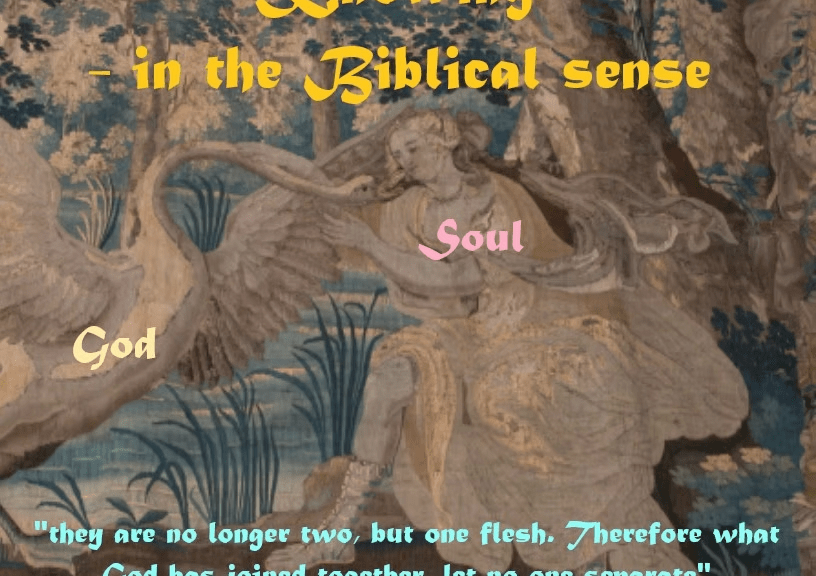
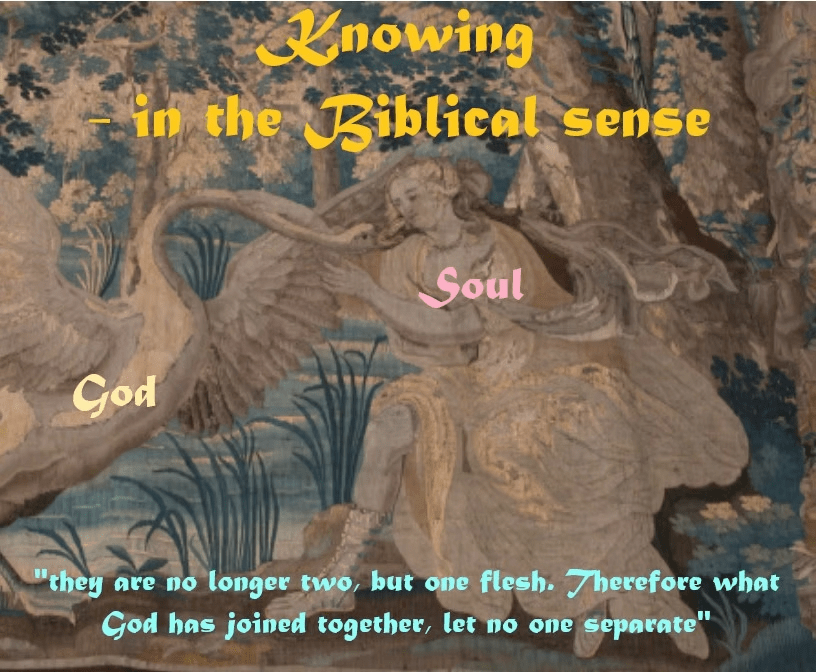
Here, the Hebrew word “yada” [“to know”] implies a learning process, where the Laws are taught by rabbis [teachers]. The element of “teaching” [from “lamad”] means the entire system of Judaism will be eliminated, as unnecessary in this “new covenant.” The reason is clearly stated as “they shall all know me,” where “yada” has to be seen as a personal experience of Yahweh, through spiritual insight and divine perception. In the same way that God spoke to Jeremiah and he was led to prophesy, so too would all those in the future, who would be individually married to God. Therefore, this makes “yada” also take on the ‘Biblical’ meaning of “to know” – “carnally, of sexual intercourse” (Brown-Driver-Briggs) – where the “intercourse” is God’s Holy Spirit penetrating one’s soul.

The difference between belief and faith is the same as that between bridesmaid and wife.

When Jeremiah then wrote of God saying, “from the least of them to the greatest, says the Lord,” this cannot be taken as if God was bragging about Him being greater than all the human wives He takes. By Yahweh saying, “from the least of them to the greatest,” this is a progression within one’s body of flesh, where all are “the least of them” human beings on planet earth. It does not matter which human beings, those not married to Yahweh, seem to be great – as kings, as priests of other gods, as pretty, athletic, and skillfully talented – because they are all the same, as worthless souls in mortal flesh, all bound to die and die repeated through reincarnation. The transformation that takes place in those souls who marry Yahweh is they all become righteous. They become raised in being, to those to be “the greatest.” From understanding this, Jeremiah then stated the reason one will know they are “the greatest” is by they way from their mouths speaks “the Lord” [“Yah-weh”].

When this reading from Jeremiah ends by God saying, “for I will forgive their iniquity, and remember their sin no more,” this is not stated as a promise to forgive sins forevermore. When the Hebrew “ki ’es·laḥ” [focus on “salach”] is translated as saying, “I will forgive,” it makes more sense when seeing “ki” as saying “when,” with the first-person state of being [“I”] following “says Yahweh.” Together, that makes the meaning become Jeremiah having Yahweh say, “when Yahweh … will forgive”.

The gross misunderstanding that Christians have today is God will forevermore forgive our sins, such that the Episcopal Church schedules a confession of sins every service it holds. That gives the impression that God will forgive sinners, forever and ever. That becomes a vital step in a Christian service, when the only ones attending are the bridesmaids of Yahweh, prepared to confess their sins before marriage of the souls to God’s Holy Spirit. That concept is negated when pewples proudly profess, “I am a cradle to grave Episcopalian!” Continuing to sin guarantees the grave part of that prophecy.

The only forgiveness of sins comes when a soul identifies with Yahweh [knows Him] and Yahweh then speaks for that soul forevermore. That means the soul has married God and become a saint. That transformation means all sins ceased when the marriage took place. Thus, all past sins will be forgotten, as wiped clean from the slate; but that means the slate for listing sins also is thrown away and forgotten, unnecessary forevermore.

As a reading selection for the season called Lent, when self-sacrifice is recognized as a necessary step in one’s elevation in the eyes of God, we are once again called to see self-sacrifice in terms of marriage. The “new covenant” is not a promise for forgiveness of sins, but a promise of eternal life for a soul, from having surrendered one’s lusts in the material realm. The killing of self-ego and self-will, so Yahweh can merge with a loving soul, means the beginning of a righteous way of life. A righteous way of life is impossible for a soul alone in a body of flesh because the world is too powerful of a distraction to simply will it away. Lent is a period for testing the strength of that new partnership [the carnal knowledge of faith].

It is important to realize that the “new covenant” became fulfilled through the arrival into the world by Jesus, but to think of Jesus in terms of Moses, who was a leader of a group, that is to revert Jesus’ “new covenant” to be like the old one. Since the old covenant permitted divorce, to think God will never divorce anyone who “believes” in Jesus [as the Christ] is not new. It becomes hypocritical, as well as selfish and egotistical. To be a soul alone in a body of flesh, wearing a silver cross around one’s neck [not married to Yahweh] is like saying out of one side of one’s mouth, “I believe in Jesus,” while telling oneself out of the other side, “I believe Jesus lets me keep doing every sin under the sun, if I repent.”

That is leaving God at the altar. Lent is not about practicing marriage to God, it is about living a life of righteousness, knowing God will always be one’s strength, there within one’s body of flesh, in one’s soul heart to lead you away from sin.