

Grace to you and peace from him who is and who was and who is to come, and from the seven spirits who are before his throne, and from Jesus Christ, the faithful witness, the firstborn of the dead, and the ruler of the kings of the earth.
To him who loves us and freed us from our sins by his blood, and made us to be a kingdom, priests serving his God and Father, to him be glory and dominion forever and ever. Amen.
Look! He is coming with the clouds;
every eye will see him,
even those who pierced him;
and on his account all the tribes of the earth will wail.
So it is to be. Amen.
“I am the Alpha and the Omega,” says the Lord God, who is and who was and who is to come, the Almighty.
———————————————————————————————————-
This is the Epistle selection from the Episcopal Lectionary for the Twenty-seventh Sunday after Pentecost, Year B 2018, which is the Last Sunday after Pentecost. In the numbering system that lists each Sunday in an ordinal fashion, this Sunday would be referred to as Proper 29, but it is called “Christ the King Sunday.” It will next be read aloud in an Episcopal church by a reader on Sunday November 25, 2018. It is important because it is the Apostle John [the Beloved, not of Zebedee] speaking of the coming of Jesus Christ, about to be introduced to the seven churches of Asia. This reading begins a most ominous book that strikes so much fear in Christian ministers that they often refuse to preach about the End Times message this introduction leads to.
First of all, let me remind the reader that this reading selection is the Epistle of John. John was filled with the Holy Spirit, and like all other Epistle writers, wrote in the language of God, which is difficult for simple translators to grasp. This means the reading shown above is a paraphrase of what was actually written and needs a literal translation to accompany it, so one can catch where the translation read aloud becomes misleading. To avert that, I will present this short reading in segmented format, with each segment determined by punctuation marks (real or imagined).
Second, I would like to remind the reader that my abilities in reading holy texts originated when I began to understand the holy prophet Nostradamus. The ‘rules’ that I follow here [in all Biblical readings, but in particular with the Epistles of the Apostles] are based on those I was shown in the writing style of Nostradamus. I mention this now because there is a significant reflection of the presentation of heavenly language [that which appears earthly, but is invisible when paraphrase takes place] that John used in these five verses that is strikingly similar to that used by Nostradamus. I will point that out.

Third, this selected reading begins in the middle of verse four, following a colon mark. A colon [by standards of punctuation that are modern and may not have been standard at the time of original writing – thus imagined rather than real] introduces language that follows that will clarify a previous statement, usually by listing examples or explanation. By separating this selection form the preceding verbiage, some intent is lost in translation. To overcome that confusion, I will make some references to what was written prior to this reading [from John 1:1-4a].
Before I can present the segmented literal translation, based on the Bible Hub Interlinear translation and alternative possibilities of translation, I need to explain the comparison to the writings of Nostradamus. I will say that there is no arguing that the essence of Nostradamus’ The Prophecies and The Apocalypse of John is similar in they both present messages of doom and gloom, which has both classified as having written of the End Times. That general assessment is based on paraphrased translations, which may or may not be accurate.
What most people do not realize about Nostradamus is he wrote two letters that have been included in all books representing The Prophecies following the death of Nostradamus [1566]. One is the “Preface” and the other is his letter to King Henry II of France. Both are “epistles,” and they explain what can be found as the intent for all the poems of prophecy that make up The Prophecies.
In an analysis of both of Nostradamus’ epistles, one finds there are very few period marks, which makes it appear he was very long-winded, writing very confusing “sentences,” filled with many commas and other marks [like colons]. Amid all that length are a great many ampersands (&), which are commonly shown in paraphrase as “and.” Often, a comma will precede an ampersand, as “,&”. This is bad grammar written in a mark and a symbol, where a comma implies the use of “and,” and an ampersand implies the use of “and,” so the result reads as “and and.”
In my segmented translations of the letter of Nostradamus, I have found that an ampersand must be read as a mark of separation, such that the symbol that implies “and” begins a new segmented line. In the cases where Nostradamus would use an ampersand between two words, without a comma present, it was to indicate a symmetry between that stated prior and that stated following. That also acted to join two concepts together as one, but for that union to be understood, one had to first understand each of two parts fully. To do that, one part would end a segment, with the ampersand beginning the next segment, followed by the symmetrical word. This means every ampersand is not simply a shortcut “and,” but rather the symbol for “and” means the reader is signaled to pause and reflect deeply on how to read the verbiage that surrounds an ampersand.

In this reading from John’s Revelation, there are no ampersand symbols. However, there are seventeen uses of the Greek word “kai,” which commonly translates as “and.” When one reads Biblical Scripture, one often finds this repetition, and all the ands are completely overlooked, seen as nothing but just another bullet point on an endless list of things said. We miss the power of one word being repeated, due to our haste; we so desire to get to the point quickly we fail to see the forest for the trees.
Of the seventeen uses of “kai” written in these five verses, eight follow a comma mark. Eight appear amid a segment, joining two words as one, but where symmetry should be given thought. Finally, there is one “kai” following a double-dash [em dash], which should be seen as similar to following a comma. In the segmented literal translation below, I have placed “kai” at the head of a segment of words, either a whole segment or a subset segment. I have not translated “kai” as “and.”
The Strong’s Concordance says the Greek word “kai” is a conjunction, meaning, “and, even, also, namely.” On the same page that links this word to the Bible Hub information, they state that the “NASB” [New American Standard Bible] shows this Greek word’s “translations” as an assortment of viable options. Those are: “accompanied (1), actually (2), after (2), again (1), again* (1), along (4), also (535), although (1), although* (1), besides* (1), both (37), both* (1), certainly (1), continue (1), either (2), else (1), even (132), forty-six* (1), if (1), including (1), indeed (20), indeed* (2), just (3), likewise (1), more* (2), moving about freely* (1), nor (4), now (2), only (2), only* (1), or (11), same (1), so (30), than (2), than* (4), then (105), though (1), though* (6), together (1), too (34), until (1), very (3), well (13), when (7), whether (1), while (1), whose* (1), without* (4), yet (9).” [NAS Exhaustive Concordance of the Bible with Hebrew-Aramaic and Greek Dictionaries]
The numbers in parentheses are the occurrences of that translation. The asterisks are not footnoted, but one can assume there might be debate about those translations. It is important to realize that “kai” is “the most common NT conjunction, used over 9,000 times” [HELPS-Word studies], meaning the most common translation is as “and.” Therefore, the list above shows the exceptions to that common translation.
With that stated, I have not translated “kai” as a word that is limited in translation, denying other possibilities to be realized. Instead, I present it in its Greek spelling, so it is more like a symbol that implies “and” but is more [like Nostradamus used ampersands]. With this option now visible, I welcome you to read these five verses of John’s Revelation, while seeing “kai” as a time to pause and reflect on the importance of what has been said before and how an important transition is being made to that stated next.
Revelation 1
4b. Grace to you
kai peace from him being
kai who was
kai who is coming ,
kai from the seven Spirits that in the presence of the throne of him ,
5. kai from Jesus Christ ,
who witness [martyr] those who faithful ,
those firstborn of the dead
kai one ruler of the kings of the earth .
Followers loving us
kai releasing us from the sins of us through the blood of him —
6. kai he has made us a kingdom ,
priests all God
kai Father of him —
to him this glory ,
kai followers dominion into these ages .
truly .
7. behold! ,
he is coming after this clouds ,
kai will see him every eye ,
kai those who him pierced ,
kai will lament because of him all those races of the earth .
certainly !
truly !
8. I am all Alpha
kai all Omega ,
beginning
kai end ,
says the Lord one God ,
one being ,
kai who was ,
kai who is coming ,
one Almighty .
Before beginning to understand the beginning of this reading, where verse four above is following a lead in from verse four that has been omitted, one should know what context was stated prior. Verse four begins by stating “John” as a one-word statement that identifies the writer of this epistle, but the capitalization is more than stating a proper name.
“John” is the translation of “Ioannes,” which has been adapted to “Joannes.” The meaning of that name is “God Has Been Gracious.” It is then that important Grace that is being told by the angel of Jesus Christ, “To those seven churches to those in all Asia.” This is to whom “Grace” is sent in a letter.
It is worthwhile to realize that verse four-A repeats the word “tais,” with the first one capitalized – the first word after the comma following “Ioannes.” I have translated both words as meaning “to those,” with “To those” having the importance of implying “God Has Been Gracious To those” who had been touched by John’s “Grace” from God. Those of the seven churches were then those who passed the truth of the Holy Spirit onto “all of Asia.” Therefore, “Grace to you” means all true Christians that had spread across the face of Asia, beyond the places in Greek Turkey [its modern name], eastward.
Verse three then plays into this aspect of “John,” who was the Evangelist that served the Lord by ministering to Jews and Gentiles, as an Apostle of Christ. When broken down into segments of words, it reads as such:
3. Blessed followers reading ,
kai those hearing the words of this prophecy ,
kai observing the things in it having been written ;
those because opportunity close .
This says that “Grace to you” is a “Blessing” from God to all “followers” (from “ho”) of Jesus Christ [like John], who walk in the footsteps of Jesus of Nazareth, having been reborn of the Christ. Those with that important “Blessing” will benefit from “reading” this epistle, where the Greek word “anaginōskōn” implies “discernment” (from the root “anaginóskó”) of the words read. That ability to “know certainly” comes from having been “Blessed” with the Christ Mind.
Next, one finds two segments that have been created with a comma leading to the word “kai.” To read “and” at those places lessens one’s ability to see the importance of a symbolic word that says, “and understand this.” One who is “Blessed” is given ears that hear the insight of the Holy Spirit, saying “Look closely here.” Look at how the “truth is being revealed” (from “prophēteias”) Then, look at how one should “observe the [hidden] things [that are] in it having been written.”

The Greek word “tērountes” means “observing,” but it is seeing what has been “kept intact” through a “guarded” way of “preserving” what has been written from being understood by those not “Blessed.” It is “those” (from “ho”) who understand the “opportunity” (from “kairos”) that comes from “close” inspection of the Word that is hidden in the words.
It is important to grasp that insight, especially when one wants to be responsible for a true prophecy of God, sent through Apostles. This is the purpose of God’s “Grace” – to be one of “those” who have seized the “opportunity” [the “time and season”] to be “near” or “close” to God.
Verse four-B then tells that God’s “Grace” bring “peace of mind” to those who have sacrificed their self-egos in subjection to God. This “well-being” comes “from him being” the replacement. This is the Christ Mind, which is born with the birth of Jesus Christ within one’s “being.”
The word translated as “being” is “ōn,” which is derived from “eimi,” meaning “I am, I exist.” While this can mistakenly be read as a statement of what “is,” in the present tense, that overlooks the value of having sacrificed an old state of “being” for what now “is,” through Christ. Jesus of Nazareth is “who was” the Christ alone, in his human flesh; but the sacrifice of that flesh and blood for others is then “who is coming,” where “erchomenos” is the present participle that “is” “coming” into Apostles and Saints.
The segment of words that follows a comma mark and begins with “kai” then places important focus on Jesus Christ being “from the seven Spirits,” where “Spirits” is capitalized. As one entity of two words – “seven Spirits” (from “hepta Pneumatōn”) – this is reference to Isaiah 11:2-3, which states: “The Spirit of the LORD shall rest upon him, the Spirit of wisdom and understanding, the Spirit of counsel and might, the Spirit of knowledge and of the fear of the LORD, and He will delight in the fear of the Lord.”[1] As such, Jesus Christ is:
1. “The Spirit of the LORD,” meaning he is the Christ of God.
2. “the Spirit of wisdom,” means the Mind of Christ.
3. “[the spirit of] understanding,” means having the ability to discern Scripture.
4. “the Spirit of counsel,” meaning the role of a teacher.
5. “[the spirit of] might,” meaning the strength to withstand persecution.
6. “the Spirit of knowledge,” meaning the ability to know the hearts and minds of others.
7. “[the spirit] of the fear of the LORD,” meaning no sins or threats can influence.
All of this is made available to the servants who have been “Blessed” with the “Grace” of God, to be reborn as Jesus Christ. They all kneel before “the throne of him,” whose “presence” is within one’s heart, mind, and soul. That throne belongs to God. Those who have the presences of God in their flesh [as a soul in union with the Holy Spirit] will be at the throne of God as Jesus Christ, the right hand of God resurrected.
Verse five begins with the importance of that rebirth of Jesus Christ. The Greek word “martys” then says an Apostle or Saint becomes a “witness,” as “followers” (from “ho”) who were disciples of Jesus of Nazareth who became Jesus Christ reborn. They are therefore “faithful followers” (from “ho pistos”). Those first Saints were then the “firstborn of the dead,” where “firstborn” (from “prōtotokos”) means they were the “elders” of Christianity. They had been the “first reborn” as the Christ, having sacrificed their self-egos that kept them bonded to a mortal cycle of death. They were the first to break that cycle of reincarnation and sin.
The subset segment is then as symmetrical connection of “firstborn of the dead” AND “the one ruler of the kings.” The implication is the “firstborn” were initially twelve, with all twelve having the same ruler.
The Greek word “archōn” means “ruler, governor, leader, or authority.” It should not be read as “king,” because Jesus Christ is not only the ruler of Apostles [as their “governor” or “prince”], but also the same to the “kings of the earth” [a bloodline of European kings that would surface centuries after].
That last segment ended with the first period mark of this reading. The segments of verse five had focused on Jesus Christ. Now, there is a transition to the “Followers,” where the capitalized Greek word “Tō” is written. “Tō” has the same translation possibilities as “ho,” where “followers” is a viable translation to “the [one].” Either way, the importance conveyed by capitalization refers back to the “kings of the earth,” who will be “loving us,” who are the “firstborn” Christians.
The Greek word “lysanti” is translated as “releasing,” from the root word “luó,” but it is reference to the future when Christianity would be “unbound” from the Middle East and Eastern Europe, as a persecuted minority. Remember, the letter was written to the seven churches of Asia. The “sins” (from “hamartiōn”) being “released” are not wicked things done, but the “faults” seen in them by Eastern Jews. The rejection of Jesus by Jews [their own “blood”] would be soothed by the coming of Christian kings that would rise from the holy blood of Jesus of Nazareth.
The double-dash [also called an “em dash”] is not an often used punctuation in language. It is used today as a replacement for a comma, parentheses, or a colon. Because this extended hyphen ends verse five and a second is found amid verse six, one should see the two as marks that set aside the next two segments and the ensuing subset segment as a large aside [use of parentheses], which would act as a clarification of this element of “us through the blood of him.”
Verse six then makes one realize that the spread of Christianity is the “kingdom” John referred to. This is then where the “blood” (from “haimati”) of Christ is both the human sacrifice of him body and blood, “releasing” his soul so his Spirit could be in the “blood” of his “Followers.” That spiritual “blood” was then guarded by the physical “blood” of kings.
This physical bloodline plainly says Jesus of Nazareth had a child. That child was John the Evangelist [John the Beloved]. John, in turn had a daughter that traveled to Europe with Mary Magdalene, Mary Salome, Mary of Cleopas, and Joseph of Arimathea (see Saintes-Maries-de-la-Mer), which is the stuff of lore known as the Sang Real (Royal Blood).
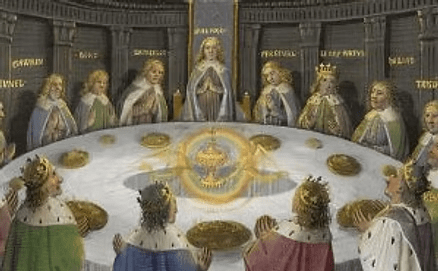
This then leads to another symmetrical arrangement where this “kingdom” of Christianity would be both “priests all God” AND “Father of him [“in Christ”].” While it is easy to read “God and Father of him,” that redundancy really makes little sense. However, when one see how this is a prophecy of future times, when there will be Christian “kings of the earth” and “kingdoms releasing” Christianity to grow, the “priests all God” are the kings of Europe [royalty] and their subjects, AND the “Father in him” is a Roman pope. Remember, John is writing a letter to the seven churches and all Asia, where each church will suffer future failures. Rather than see a limitation in this prophecy of John as just the seven villages in Greek Turkey, one can see the “Father in him” as the failure coming that involves the Church of Rome.
This then says, “to him this glory,” where the Greek word “doxa” not only states the generic state of ‘glory,” but also the “honor” and “renown” that this spiritual and physical bloodline will bring. Europe would become a place known as a bastion of Christianity. Additionally, the European “followers” of Christ would find “dominion” [“power, strength” from “kratos”] as Christian nations. As John was writing around 90 C.E., that coming strength that glorified Jesus Christ would last “towards” (from “eis”) the time when “ages” (from “aiōnas”) meet. The Age of Pisces [Jesus’s age] will last until the Age of Aquarius [age of knowledge and technology], which could come any time now.
As we often end a prayer with the word “amēn,” the word means, “verily” or “truly.” At the end of a verse, it can be read as, “so let it be.” It is important to note that the word follows the second period mark, and also ends with the third period mark, which makes “amen” a stand-alone sentence.
Verse seven begins with the important one-word statement, which in Greek is the capitalized “Idou.” The translation read aloud adds an exclamation point, which is perfectly allowed. Still, this important word is followed by a comma, which cannot replace that mark; it simply highlights how a mark of punctuation is simply a symbol that tells one how to read Scripture. The word itself implying it be spoken emphatically means the comma is separating that word from the next, placing focus on just that. “Idou” says, “Look!” “Behold!” or “See!” Following a one-word statement that says, “So let it be,” the shout is to “Wake up!” “Behold what will be!”
Following verse six telling of the vast spread of Christianity, John’s cry to “See!” he said “he is coming” (from “erchetai” – third person singular future), which indicates Jesus will come into the Apostles that will lead that expansion. This will be “after” (from “meta”) the timing of John’s epistle, as he wrote a prophecy. The Apostles of John’s day (the “firstborn”) will lay the foundation of that which “will be coming after” them.
John’s use of “clouds” is then not a literal descent of Jesus coming in the future from “clouds” (from “nephelōn”), but the emotion of Christianity will fall like rain from the sky, flooding the “kingdoms” with belief. This emotion will lead to Jesus seeing through the eyes of God’s faithful, so the presence of true Christians will allow “every eye” to “see” (remember this verse began with “Behold!”) Jesus Christ in those who have been reborn as him.
[Let me add that it used to be a common mistake to find the astrological sign Aquarius stated to be a Water Sign. This is because Aquarius [in Latin] means “Water-bearer” or “Water-carrier.” Aquarius is actually an Air Sign, such that “clouds” are water vapors in the sky. In terms of “after,” the Age of Aquarius will “be coming after” the Age of Pisces.]
When John wrote, “those who pierced [Jesus],” those were Romans. The soldiers of Rome nailed his hands and feet to a cross. A Roman guard pierced Jesus’ side with a spear, to see if he was dead. The Romans were seen to be the ones who would “Behold!” the emotion of repentance foremost. It will be from their sorrow that the Church of Rome will align with the “kings of the earth” and spread Christianity to “all those races of the earth” that the Holy Roman Empire will spread.

John then emphatically stated, “certainly!” (from “nai,” which also says, “yes!”). That was an emphatic “assurance” this future would come. He then, again, added, “amen,” this time adding another exclamation point. John shouted, “So let it be!” It will “truly” come! And, it has come, as the truth be told.
Verse eight begins with “I am,” which presents the capitalized word “Egō” and the lower-case word “eimi.” In actuality, the word “eimi” alone says, “I am” or “I exist,” as an expression of the Greek infinitive “to be.” The capitalized “Egō” means (importantly) “Myself,” as an emphatic statement of “Me.” However, John is not the true author of this epistle, as he was being told what to write by the Holy Spirit of Jesus Christ. Jesus Christ had thus become the “Ego” of John, with John having sacrificed his self-ego to the Lord. Therefore verse eight begins by saying, “from a most holy Ego am I.”
This is then linked to the simple word “to,” a variation of the Greek word “ho,” which could state “followers,” as has been used prior. That plural indication of one type of people that are associated to “the one” can now appear as one claim for “all” followers of Christ. This means “Alpha” (a capitalized word of importance) becomes a word pointing focus on the “firstborn,” as alpha is the first letter in the Greek alphabet.
John then importantly spoke as a sacrificed self-ego that allowed “all” Christians to become the “Ego” of Jesus Christ, who spoke for God the Father, again in human flesh. One must remember YHWH means, “I Am That I Am.” Such an “Ego” brings the Mind of God as what “I am” Christians say.
The symmetry of “Alpha” AND “Omega” (another capitalized word of importance) is then separated into the focus that will be set on future Christians, who will be the last of a line. Since omega is the last letter of the Greek alphabet, it is then importantly representative of those who will come last. This means it cannot be God who is “Alpha and Omega,” because God has no beginning and no end. God is always, forever and eternal. Jesus Christ is an Age of Man, the one that calls for self-sacrifice for a higher, Spiritual goal.
That Age of Christ then has “beginning” AND “end,” another symmetrical arrangement of principles that must be understood individually. The “beginning” of God’s Christ goes back to God creating His Son, who most know as “Adam.” Adam is thus the “Alpha,” who was the first Son of God, the only Son made as Man. Jesus is then the “Omega,” as the “end” of that line of holy men who would reincarnate as God’s individual servants, sent to lead the children of God. Jesus is not the “end” entity as a human of flesh and bones, because his “end” became the exponential spread of that “last” Son into all who would duplicate that “end.”
All who will be duplicates of Jesus Christ, from “beginning and end,” “say the Lord [is] one God.” That is the commonality of all Christians, as they have within them the “Master” in Christ, who serves only “one God.” This is not done from a perspective of God being external, as determined by one’s self-ego, or human brain. It is known by the Mind of Christ, which comes from “being one” with God, through the marriage of the soul with the Holy Spirit. That sacrifice is possible when one realizes what “one was.” One can then commit to God so a marriage “will be coming.” The marriage is the union of “one” with the “Almighty.”
As the epistle selection for the last Sunday after Pentecost, also known as Christ the King Sunday, when one’s own personal ministry for the LORD should be well underway – one should realize that one is of the Omega class of Christians, nearing the end of an age – the message here is obviously misunderstood by most people. The message is to understand prophecy as a real warning to “Behold!” danger is at hand, because one’s soul is at risk. Stop looking up in the sky for something to happen in the clouds, when the cloud is one’s own confusion and distractions from self-indulgence.
In the Acts of the Apostles says:
You will receive power when the Holy Spirit comes on you; and you will be my witnesses in Jerusalem, and in all Judea and Samaria, and to the ends of the earth.” After he said this, he was taken up before their very eyes, and a cloud hid him from their sight. They were looking intently up into the sky as he was going, when suddenly two men dressed in white stood beside them. “Men of Galilee,” they said, “why do you stand here looking into the sky? This same Jesus, who has been taken from you into heaven, will come back in the same way you have seen him go into heaven.” (Acts 1:8-11)

That same way was disappearing in “a cloud” that “hid him from their sight.” “See!” with your hearts, minds and souls. He has come in the same way, reappearing invisibly in Apostles and Saints. He returned the very next day [Pentecost, which happened to be a Sunday]. He has been here since that “Alpha” day in the “beginning.” “Why do you stand here looking into the sky?”
Who were those “two men dressed in white”? Well, they could have been the appearance of the constellation Gemini, which are the twins Castor and Pollux. That tells one the eve of Pentecost was during the time when the sun traverses Gemini, between late May and mid-June. Still, it could be Moses and Elijah, who Peter, James, and John of Zebedee saw with Jesus on the high mountain.
The point of this reading being public on a day that recognizes Christ the King is it paraphrases Scripture so it places Christians inside a cloud of confusion. God is the King. God is the Christ. Jesus is the Son of God, as God’s right hand reaching down to earth and filling human souls with the desire to please God, as did His Son Jesus Christ. It is now up to each individual to stop looking into the sky for Jesus to come save us. We need to become a cloud of love for God and let the rain of God’s love fall upon our souls.
We fear or are thrilled by the thought [a human ego minimal power] of John telling of the End Times to come. That means people pour over documents, trying to find evidence of when this prophesied end will come … all for personal glory and profit. Others refuse to “Look!” at the Revelation, because it frightens the paying members of a congregation. No one has eyes that can see Jesus has long returned. Had he not, there would be no pews for Christians to sit in.
John’s introduction of a holy prophecy points the loving finger at us today, who claim to be Christian but struggle to know just what that means. We do not read today what each of the seven churches have failed to do, but failure is what all have done. We are at the end of an age of man, when the time of Jesus Christ will collapse, caved in by the trinkets of invention. You probably hold one in your hand now, or it is within easy grabbing distance.
These five verses [six including verse three] are pointing to our responsibility. The time has come to bow down before the throne of God and commit our souls to His service. God must be realized as one’s true King. One’s only hope is to be knighted as the Son of God, the Prince of Peace. We must hear from the clouds of emotion, a most holy voice say, “Rise Sir Christ, and serve your King with honor.”
[1] Some contend that Paul’s seven gifts of the Holy Spirit could be the “seven Spirits,” but the Holy Spirit is one Spirit, not seven.
#Acts1811 #Isaiah1123 #Revelation138


 Explaining the Readings