Tag Archives: Jesus prayed for his disciples

John 17:6-19 – Jesus prayed for his disciples

Jesus prayed for his disciples, “I have made your name known to those whom you gave me from the world. They were yours, and you gave them to me, and they have kept your word. Now they know that everything you have given me is from you; for the words that you gave to me I have given to them, and they have received them and know in truth that I came from you; and they have believed that you sent me. I am asking on their behalf; I am not asking on behalf of the world, but on behalf of those whom you gave me, because they are yours. All mine are yours, and yours are mine; and I have been glorified in them. And now I am no longer in the world, but they are in the world, and I am coming to you. Holy Father, protect them in your name that you have given me, so that they may be one, as we are one. While I was with them, I protected them in your name that you have given me. I guarded them, and not one of them was lost except the one destined to be lost, so that the scripture might be fulfilled. But now I am coming to you, and I speak these things in the world so that they may have my joy made complete in themselves. I have given them your word, and the world has hated them because they do not belong to the world, just as I do not belong to the world. I am not asking you to take them out of the world, but I ask you to protect them from the evil one. They do not belong to the world, just as I do not belong to the world. Sanctify them in the truth; your word is truth. As you have sent me into the world, so I have sent them into the world. And for their sakes I sanctify myself, so that they also may be sanctified in truth.”

——————————————————————————–

This is the Gospel reading selection from the Episcopal Lectionary for the Seventh Sunday of Easter, Year B 2018. It will next be read aloud in church by a priest on Sunday, May 13, 2018. This is important as it is a prayer submitted to the Father, by the Son, for his children to be accepted as his fruit of the vine. This not only applied to the disciples close to Jesus of Nazareth, who would become Saints as Apostles, but to all who would be born of the true vine afterwards.

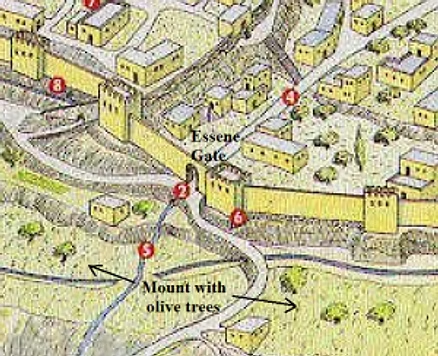
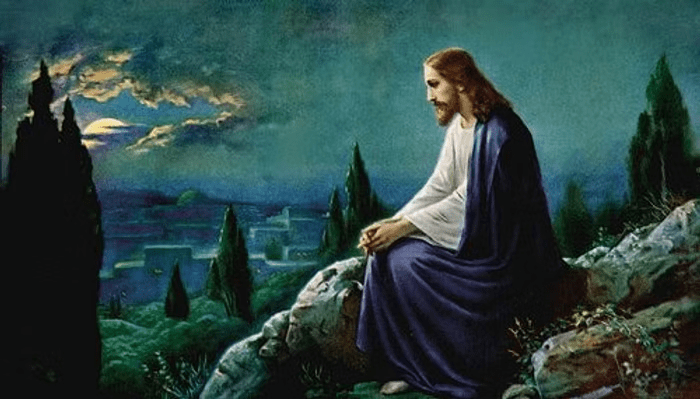
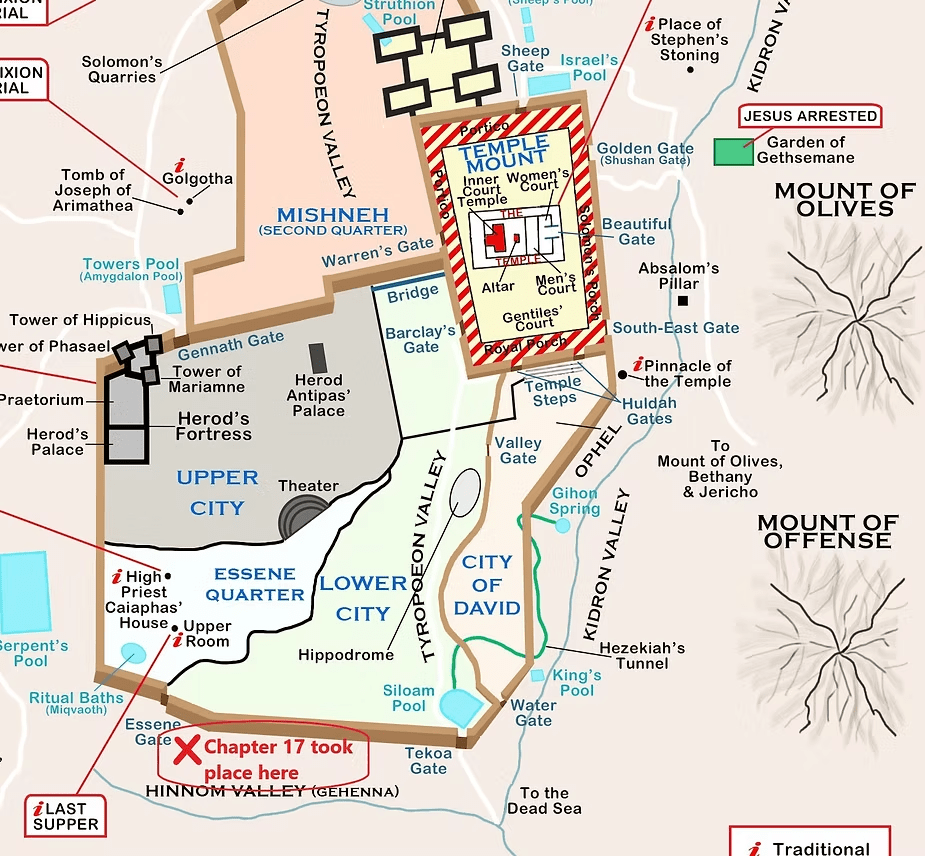
Let me first state that this reading led me to write a companion piece that details the last hours of Jesus’ ministry, prior to his arrest. This prayer that sometimes has the title applied, “Jesus Prayed for His Disciples,” is not stated by John as to where it occurred, although it was after Jesus led his followers out from the upper room, after the Passover Seder meal and ritual was completed. This prayer took place on a hill that had olive trees on it, just outside the Essenes Gate of Jerusalem.
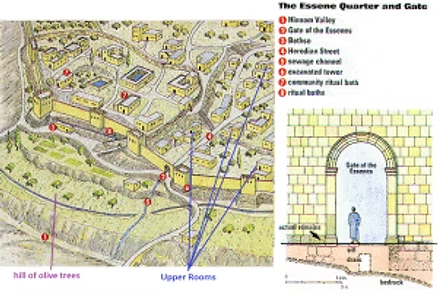
The above graphic has been modified (by me) to show how the known general area of the Upper Room and the easiest exit point from the city of Jerusalem.  The graphic is part of an article on Jerusalem’s Essenes Gate, written by Bargil Pixner and published by Century One Foundation.  With little question about the Upper Room being in the Essenes Quarter, and with the Essenes known to be a sect of devout Jews (along with the Pharisees and Sadducees), it is easy to see how some believe that Jesus was a member of that sect.  The only point I wish to make here, relative to the place where Jesus prayed for his disciples, is Luke, Matthew, and Mark all agree that Jesus left the upstairs room and went to the Mount of Olives (more literally a “hill of Olives”).

This prayer for his disciples was amid prayers for his glorification and for all believers (all of John 17).  Following this, John wrote that Jesus took his disciples to the garden across the Sidron Valley, which was Gethsemane.  This would indicate that John’s account of Jesus praying preceded the prayers of pain and agony that Jesus was witnessed to have prayed in the garden at Gethsemane (by the other three Gospel writers). To get an in-depth perspective of the flow of movement, after the disciples were led away from the Upper Room, please read my account of The last four or five hours that preceded the betrayal and arrest of Jesus of Nazareth if you want to know more about this topic.

Let me also add that John wrote of conversations Jesus had with his disciples, prior to John recording the prayers of Jesus.  From the perspective of the map above, get a mind’s eye view of Jesus and his male followers (including John) leaving the Upper Room and meandering their way through the Essenes Quarter, before exiting at the Essenes Gate.  Because it is not clearly stated, it becomes natural to see the disciples carrying a jug of wine with them (the Seder tradition to drink until you pass out) and drinking as Jesus talked to them (drinking being why they did not recall to write about those lessons).  As the Seder ritual would have been celebrated in the same way, throughout all of Jerusalem, it would seem logical that Jesus and his followers met and shared wine with other Essene Jews who were likewise outside on a spring evening.  After an hour or so milling about, Jesus and John excused themselves to go among the olive trees on the hill that overlooked the Hinnom Valley, so Jesus could offer the prayers John of which John wrote.
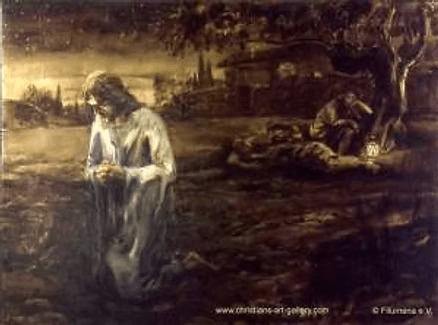
It is important to realize that the entirety of chapter 17 in John’s Gospel tells of Jesus praying. Verses six through nineteen are of Jesus praying for his disciples. The verses prior are for Jesus to be glorified by God, and the verses following are of Jesus praying for all believers. The fact that John dedicated an entire chapter to the prayers of Jesus, whereas the other Gospel writers make mention of Jesus praying on a lesser degree, sets John apart from the other Gospel writers … in more ways than one. I address that in the other article.

In the same way, John wrote chapter 14, which told of lessons given to the disciples that no other Gospel writer wrote of.  It was in that chapter that Jesus said there were many rooms in the Father’s house, and he was going there to reserve one for them.  Philip said (basically), “You never told us where your father lived.”  That was a sign of drunkenness.  At the end of chapter 14, John indicated Jesus said to the disciples, “Come now, let us leave,” (John 14:31d) which meant they either left the Upper Room then, or they left the Essenes Quarter, going outside the Wall of Jerusalem.

Once outside, John wrote chapters 15 and 16 that was Jesus telling his disciples that their future was bright, with nothing to worry about.  Still, because none of the others recorded those pep talks in the other Gospels, the disciples were struggling to think clearly, plus the later it got the sleepier they became.  Outside the Essenes Gate, Jesus could have broken away from the group with ease, leaving them to talk amongst themselves and also relieve themselves of their wine at the sewage channel just off the path.
Here, in chapter 17, John recalled prayers said by Jesus, with none here duplicated in another Gospel.  This omission should not be seen as if John was making things up or remembering things out of sequence.  Rather, John has to be seen as the one follower that was not drunk.  He was not drunk because he was not an adult.  He followed Jesus as a close family relation, who carefully listened to everything Jesus said.  John was excited to be walking with the adults, as part of the Seder late evening experience, while the disciples were falling asleep from drunkenness (or still drinking Seder wine).

In this scope of John’s chapter 17, looking only at his prayer for his disciples, the character that was John is totally removed. The reader has become the one overhearing this prayer, as if one has become John. We are allowed to be close to Jesus at an intimate time of prayer with God.  The reader of this prayer should consider him or herself one of “his disciples,” for whom Jesus prayed, while also seeing oneself as a child of Jesus that thirsts for the knowledge of God that comes from Jesus.

With that in mind, it is important to grasp the first verse. When Jesus said, “I have made your name known to those whom you gave me from the world,” this does not mean Jesus told a group of heathens who the One God is.  When Jesus then stated, “They were yours, and you gave them to me, and they have kept your word,” he clarified that his disciples were ALL Jews (Israelites in good standing), who sought to serve the LORD faithfully, and they had adhered to the laws set forth by Moses.

The disciples were ALL looking for the promised Messiah to serve the LORD through, as the followers of God’s Christ.  God had led Jesus to find those men of devotion. Therefore, the “name” that was God’s “name known” IS the Messiah of God – the Christ.  As the Messiah, Jesus proclaimed the title Son of Man and that was made known to his disciples.  Jesus was the Son of the Father, thus the Son of God, a name made known.  All that Jesus made known to his disciples was through words and deeds – lessons and miracles – assignments given and real encounters witnessed.

At that point in time, as Jesus knew his time of ministry was concluded and he would soon be taken from his disciples, Jesus told God, “Now they know that everything you have given me is from you.” Jesus had repeatedly said that he did not speak for Jesus of Nazareth, but for the Father. The ego of Jesus had been subjected to the Will of God.  Jesus had explained that the Father was in him, just as his human body was the seat of the LORD. The disciples had been told that everything from the Son comes from the Father. This was confirmed by Jesus praying, “For the words that you gave to me I have given to them, and they have received them and know in truth that I came from you; and they have believed that you sent me.”

When Jesus next said, “I am asking on their behalf,” this is the true power of prayer – for specific others. Jesus said he was not praying for the whole world to find benefit from God’s Son sending forth a prayer on such a broad scope. Jesus clearly stated that his prayer was for the disciples “whom God gave Jesus,” because they too were God’s, as the children of Jesus. For Christians today, a prayer of this nature is the cement that bonds the parts of the Church of Christ to that one cornerstone that is Jesus Christ. A child of Jesus Christ’s – as a Son or Daughter of the One God – should pray specifically for others who are also in the name of Jesus Christ.

Selfishness prays for those the ego deems politically correct, just as the Pharisee proudly prayed aloud in the Temple – “Thank you God for making me me and not that loser over there!”  Think about how that applies to priest who pray for the equal rights of everyone in the world – those other than Christians, Christians who need someone praying for them, whose “equal rights” are ignored.  When in the name of Jesus Christ one’s prayers are specifically directed, for specific purposes that fit the Will of God, not the philosophical brains of mankind.

To be able to see the future implications of this prayer (where we today are the focus), Jesus then told God, “All mine are yours, and yours are mine; and I have been glorified in them.” That statement goes far beyond eleven drunken disciples who were most probably sitting on the ground or leaning against the Wall of Jerusalem, arguing about who was more important to Jesus or dozing off from being tired. The Holy Spirit had not yet come upon those who were to be of Jesus, as he was of God. Still, those buds of fruit on the most holy vine (what John remembered Jesus saying in John 15:1-8) would become the glorification of Jesus Christ … as him born again, again and again, to this day onward.

Jesus had told his disciples about the seed (a kernel of wheat) that must die so that its fruit could come forth (John 12:24). Now he confessed to his Father, “I am no longer in the world, but they are in the world, and I am coming to you.” That was an admission that the words given to Jesus, by the Father, were soon to be fulfilled. There was no further ministry on earth for Jesus to command, in the human form that was his body. The disciples would fill that need in the future.

Rather than the world missing one Jesus of Nazareth, there would soon be many Christs following him.  This is as Jesus said, “Holy Father, protect them in your name that you have given me, so that they may be one, as we are one.” That protection would be their duplication – the Resurrection – of Apostles in the name Christ. Just as Jesus of Nazareth had been in the name of Christ, the name given to him by God, so too would God give the Saints of Jesus Christ the same oneness. Their souls would be filled with God’s Holy Spirit and their brains with the Mind of Christ, and true Christians would spread across the face of the world.

Jesus then prayed, “While I was with them, I protected them in your name that you have given me. I guarded them, and not one of them was lost except the one destined to be lost, so that the scripture might be fulfilled.” That says that Jesus in the flesh, as the Son of God incarnate among men, was the protection of the Christ for the disciples and followers of Jesus of Nazareth. That presence guarded the children of Anointment, as would wild beasts protect her young from external threats. Protection comes from love.

Jesus had just earlier said (after they had left the Upper Room) that there was no greater love than could be shown for a friend, such that he would lay down his life for his friends (John 15:13).  That was his commitment to protecting his followers. Jesus would then continue to provide his protection through the love of God and the transformation of disciples into Apostles, all surrounded by the Spirit of Anointment.

The one he had lost was Judas, who was necessary to lose; and the betrayal by Judas was prophesied (Psalm 41:9). Jesus would repeat this statement made in prayer – that the prophets might be fulfilled – upon his arrest that would come.  Recorded by Matthew and Mark … Jesus said, “This has all taken place that the writings of the prophets might be fulfilled.” (Matthew 26:56a)

Jesus then said, “Now I am coming to you, and I speak these things in the world so that they may have my joy made complete in themselves.” This conforms that Jesus is asking the Father to enter the hearts of those who wanted so hard to please God, but had never had someone to show them the way to God’s love. The words “my joy made complete in themselves” means Jesus Christ will be the reborn as a result of the disciples’ marriage to God.

Just as Jesus was married to God, with God’s love filling his heart, Jesus was assured eternal life. God’s gift of complete Salvation was the joy of Christ in the disciples’ souls. That was the promise made to the disciples of Jesus, where not long before he told them, “In My Father’s house are many dwelling places; if it were not so, I would have told you; for I go to prepare a place for you. If I go and prepare a place for you, I will come again and receive you to myself, that where I am, there you may be also.” (John 14:2-3) The promise made, in words in this world, was to be rewarded in Heaven.

When Jesus said, “I have given them your word, and the world has hated them because they do not belong to the world, just as I do not belong to the world,” he was making reference to the training ministry the disciples had been sent out to experience. The “great commission” was an exercise of one’s commitment, to go and tell other Jews (Israelites), “The kingdom of God has come near.” (Matthew 10:7) That meant the disciples were bearing the presence of the Holy Spirit in a world of faithless doubt. Those who proclaimed to know the word and be close to God were hated by those who were stubbornly lost. That natural response was due to a Saint belonging in Heaven, not on earth. It was why Jesus was rejected and soon would be killed (with the Apostles all to face the same fate).

Jesus knew that his disciples would have similar futures. Therefore, he prayed, “I am not asking you to take them out of the world, but I ask you to protect them from the evil one.” That meant there would be no Greek tragedy theatrics, where a angel of god would rush in and save a hero from a terrible end. Likewise, Jesus would not be swept away by his Father, to prevent the Son from crucifixion. That escape would mean no resurrection could be possible, with Heaven not a greater reward than life on earth. The only thing Jesus sought for his disciples (Judas excluded) was for none of them to fall to the temptations of Satan. That test would come in their futures, and God would answer this prayer by having the disciples all become graduates to Sainthood.

When Jesus said, “They do not belong to the world, just as I do not belong to the world,” the reason is their hearts and souls had been purified and glorified by God. They all belonged in Heaven, through eternal salvation. Their souls had been baptized by the Holy Spirit that was Jesus the Anointed one.  They were in the world to bring others to that same state of not belonging in the world. One stops belonging to Satan, when one starts belonging to God, as Jesus reborn.
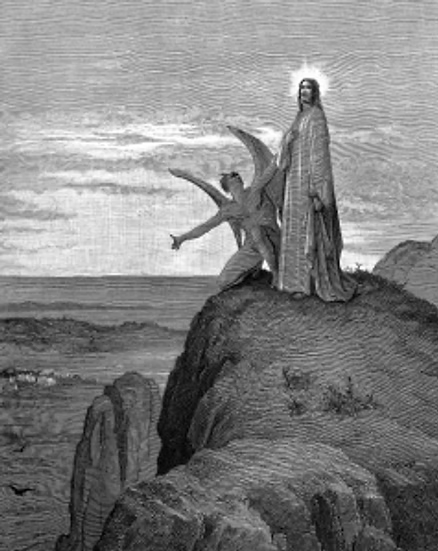
To belong in Heaven is to be pure of soul, with no tarnishing of sin remaining. Jesus prayed to God, “Sanctify them in the truth; your word is truth.” The truth is the Word of God, which is only partially spoken in the Holy Bible. The truth goes beyond the words that can be written, spoken, or thought by human brains. The truth comes from the Godhead, accessed by the Mind of Christ. To reach that state where the truth is available to one, one has to be completely pure. The only human being to have such perfection is Jesus of Nazareth, because he was the Messiah. Thus, all subsequent servants of the LORD must have their souls purified by the Resurrection of Jesus Christ within those souls. It means only souls in the name of Jesus Christ go to Heaven to be with God.

Jesus then ended his prayer for his disciples by saying, “As you have sent me into the world, so I have sent them into the world. And for their sakes I sanctify myself, so that they also may be sanctified in truth.” This states that the model of perfection will forevermore be that of Jesus Christ, whose life would be written of in a New Testament. All true Christians are to become just like Jesus of Nazareth, in the sense that they abide by the Will of God (His Law).

It is impossible to reach that level of perfection when one fails to sacrifice self and ego in a marriage to the LORD that calls for absolute subservience. Anything other than that would equate to “too many chiefs and not any Indians.” This prays that all subsequent disciples of Jesus Christ will understand the soul’s need to be baptized by the Holy Spirit, which brings about sanctification. Sanctification does not mean “a pretty good dude,” “a fine statesman,” or “a big benefactor to a religious organization.” It means obedience to God’s Will … totally and completely.

As one can see, this prayer is in no way spoken by a troubled spirit. There was no worry in Jesus when he prayed to the Father to bless those who would be reborn as Jesus Christ. John wrote this in a sequence of events that preceded Jesus leading the disciples to Gethsemane, the garden across the Kidron Valley. It fits the other Gospels that say Jesus took the disciples to the Mount of Olives, outside the Upper Room.

Jesus would not have made this prayer be overheard by his disciples, as some grandiose public gesture. John witnessed a private moment of prayer.  Jesus’ prayer for his disciples was said in solitude, with only one young boy close enough to hear his words. Unlike this calm and serenity, the prayers coming from Jesus as Gethsemane were troubled and agonizing, for Jesus to be given the strength to withstand his mortal end.  John did not record any troubling prayers from that garden, as he was not close enough to Jesus then to overhear any (unlike John of Zebedee).

As a Gospel reading in the Easter season, when the call is to have Jesus resurrected within oneself, one needs to see oneself as who Jesus was praying for. The call of his prayer asks for you to find God as your protector, such that your heart will open to His love, giving birth to the Christ Spirit within. Without being resurrected as Jesus Christ, one is not sanctified, thus one is still unworthy of Heaven. The call is to become righteous, so one no longer belongs in this world for selfish reasons. The call is to go forth and announce to the world that the kingdom of God has come near … in you.

As the final Sunday in the Easter season, the next step is to be filled with the Holy Spirit. That personal event becomes one’s own Pentecost. Pentecost is the ordination of a priest that serves the One God as Jesus Christ.  Pentecost signals when one’s ministry begins in earnest, just as Moses came down with the Laws that forevermore must be maintained.  Jesus has prayed to God for you. May you be ready to heed the calls.

John 17:1-11 – Shown how to pray

This is the Gospel reading that is the selection for the Seventh Sunday of Easter. It is next scheduled to be read aloud in churches that will be empty because of pandemic fears on Sunday, May 24, 2020.

This is the Sunday known as Ascension Sunday. Many churches recognize the Ascension as being on Thursday (May 20, 2020 this year) because they calculate Thursday is forty days from Easter Sunday (including Easter, I guess, meaning Jesus rose on the Sabbath [Saturday]). It is such flawed reasoning that gives Christianity a bad name (“Liars” being one), which goes hand-in-hand with their thoughts that generated the Easter Bunny and Santa Claus, because Thursday has nothing to do with Acts 1.

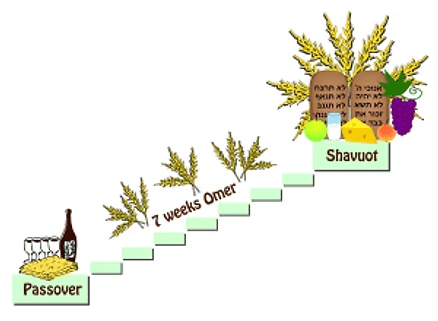
To understand the Ascension, one first needs to understand the Counting of the Omer, which is a God-commanded ritual count (found in Leviticus 23:15–16, and Deuteronomy 16:9-12). That count is for seven weeks (49 days), with the Fiftieth (“Pentecoste”) day beginning the Festival of Weeks, known as Shavuot. This explains to Christians why the Easter season is seven Sundays long.

Now, it is very plain in the Holy Bible that a.) Jesus was taken down from the cross and prepared for burial in the tomb of Joseph of Arimathea on Friday; and, b.) Jesus was discovered not in that tomb on Sunday (the first day of the week), very early on that day. What is not clear at all to Christians is the Counting of the Omer.

Passover is an eight-day event (still in today some places, but it certainly was back in Jesus’ day). That Passover began on 15 Nisan, a Friday evening that officially became a Sabbath [God’s day] and ended on a Sabbath [God’s day], eight days later. The counting of forty-nine days (seven weeks) always begins on 16 Nisan, which is the first full day of the eight-day festival. That week, because the festival began on a Friday at 6:00 PM, the sixteenth was a Sabbath (yom shabbat). The day Jesus was discovered not in the tomb was a week later, when that evening it was the eighth day of the count.

While Jesus did spend forty days preparing his disciples, the forty-day count did not begin on Easter Sunday, but Easter Monday. Forty days later – Guess what? – the forty-ninth day was another Sabbath; and Acts 1:12 confirms that by stating, “Then the apostles returned to Jerusalem from the hill called the Mount of Olives, a Sabbath day’s walk from the city.”

If one has one iota of faith, perhaps one can realize that God is the one setting the timing here. God knew (as did Jesus) that a Passover begun and ended on God’s day would be when His Son would be sacrificed. Jesus’ final Passover Seder [his second that Passover] was on a Sunday (officially) that began at 6:00 PM on the Sabbath [the Jews have two Seder meals during each Passover, the first two nights]. Jesus was arrested early on a Sunday morning. Jesus was raised from death on a Sabbath, another God’s day. Jesus was discovered out of the tomb early on a Sunday morning. Seven weeks after the Counting of the Omer began on 16 Nisan, it was again a Sabbath, meaning Jesus Ascended on a Sabbath that was God’s day. PLEASE GIVE GOD CREDIT for everything about His Son being planned from the beginning of time and not something that hap hazardously happened, requiring a Roman church to figure out myths for its followers to believe.

Now that the matter of when Jesus disappeared from the sight of his disciples, we can realize he did not “ascend.” Acts 1:11 tells how two men dressed in white said, “Why do you stand here looking into the sky? This same Jesus, who has been taken from you into heaven, will come back in the same way you have seen him go into heaven.” That says, “Jesus did not go up in the air. Jesus disappeared from your view and just like he disappeared from your view, he will return so you will see as him.”

It is the translation from the Greek that mislead (us reading English) us that “epērthē” (translated as “he was taken up”) means Jesus floated up into the sky. It is our concept of “a cloud” (the Greek word “nephelē”) that makes us picture in our mind’s eye a fluffy cloud in the sky. However, it is the reason angels came to talk that we realize it did not happen that way: There was no “Ascension.”

Peter, as one who Jesus taught for forty days, leading him (with the others) to pray constantly, heavily implies his words of encouragement to other Apostles to know their sufferings are known by God and Christ. In this way, all Epistles by the Saints are written prayers shared with those who were “joined together” in one mindset, a Mind that demands prayer. Then, John’s seventeenth chapter is all about the prayers of Jesus, prior to his arrest.

The context of John 17 needs to be understood. John 14 ended with Jesus telling his disciples, “Let’s leave from here,” which was an indication to the men to leave the upper room, allowing the women and young children to remain and discuss the Torah together, while drinking wine. John 15 and John 16 tell of Jesus preaching to his disciples, preparing them for a future they knew nothing about. Only John wrote about that teaching, as the disciples were still drinking wine and none were hanging onto the words Jesus spoke [saying John was not an adult or an official disciple]. John 18, which tells of Jesus’ arrest at Gethsemane, begins with John stating, “When he had finished praying, Jesus left with his disciples and crossed the Kidron Valley. On the other side there was a garden, and he and his disciples went into it.” (John 18:1)  Thus, John 17 is about Jesus praying somewhere just outside the Essene Gate, near the place of the upper room.

In that, John wrote the word “eparas,” which is rooted in “epairó,” the same root word written in Acts 1:9, as “epērthē.” Certainly, one can see how the physical definition imagery of “lifting up” and “looking up” pales in comparison to one such as Jesus, the Son of God, thinking he needed to look anywhere other than within to “talk” (from the Greek “eipen”) with the “Father” (the next word of the text written). This is then John stating that Jesus prayed in a spiritual way, not in some demonstrative way designed to draw attention.

After all, Jesus said of the Pharisee who “stood by himself and prayed” loud praises to God for all he had reaped for being a Pharisee, the Pharisee was not closer to God than the tax collector who “stood by himself and prayed,” beating his breast and repenting. In that set of verses (Luke 18:9-14) Jesus said, “For all those who exalt themselves will be humbled, and those who humble themselves will be exalted.”

In that guiding statement, the words “hypsōn” and “hypsōthēsetai” are written, pulling from the same root “hupsoó,” meaning “to lift or raise up, to exalt, uplift.” Thus praying demands the humbling position that does not “look up,” but bows a head in submission and “exalts oneself by being humble.”

When we read in Luke 11:2-4 (a short version of the Lord’s Prayer), this was after Jesus had sent out seventy-two in ministry and they had returned. After one of those disciples witnessed Jesus praying, the disciple said, “Lord, teach us to pray, just as John taught his disciples.” Because this it told by Jesus on two occasions, it points out how such a basic element of faith is not taught, so the typical followers of Judaism had never been taught in their synagogues how to pray.

This makes understanding Matthew 6:5-8 important to recall, in order to fully grasp the prayer of Jesus, found in John 17. Matthew wrote the following:

“And when you pray, do not be like the hypocrites, for they love to pray standing in the synagogues and on the street corners to be seen by others. Truly I tell you, they have received their reward in full.  But when you pray, go into your room, close the door and pray to your Father, who is unseen. Then your Father, who sees what is done in secret, will reward you.  And when you pray, do not keep on babbling like pagans, for they think they will be heard because of their many words.  Do not be like them, for your Father knows what you need before you ask him.” (NIV)

This led to the full version of Jesus’ prayer to the Lord, with the words “as yours is the kingdom, the power and the glory forever and ever. Amen” being added by churchmen after the fact. Rather than see the meaning behind what Jesus taught, what have the churchmen done?

          They stand in the churches as priest, ministers, and pastors saying, “See me as I lead you to say the Lord’s Prayer.”

          They tell the congregations to recite in unison aloud, rather than telling them to go into their place of privacy and speak silently to God.

          They produce a book of prayers and recitals that they offer to the people as what God likes to hear His people say.

          They pretend that God needs to hear the Lord’s Prayer recited, and they insinuate by saying those words nothing more needs be said.

The Lord’s Prayer is something that should be taught to children. Jesus taught that prayer to infants who did not know how to pray. Jesus referred to his disciples as his “little children.” A prayer memorized by a child has more meaning than a prayer memorized by a child being the prayed aloud as an adult.

The Greek word written by Matthew, “hēmōn,” best translates as “of us,” but “us” is then a statement of one with Jesus. The inclusion of Jesus, spiritually as the Son of the Father, is the only way truth can be spoken through a private prayer that begins by saying, “Our Father” or “Father of us.” Rather than Jesus telling a group of Jews, in a mountainside setting of followers, to address God as “the Father of ours” or “Our Father,” the implication seems to make one think God is the Father of everyone everywhere. For as kumbaya as that sounds, Yahweh was not the father of the children of Israel [hint: Jacob was – a.k.a. Israel].

This is where John’s verse nine becomes more important to realize, as Jesus said, “I am not praying for the world, but for those you have given me, for they are yours.” Jesus was not praying for anyone other than those who were to be married to the Father, stated as “they are yours.” Those would then become wives, and as such ‘mothers’ of God’s Son. As wives who consummate their marriage to God in a Spiritual manner (via the Holy Spirit), Jesus Christ is then reborn within the wives-mothers. Once a disciple has been reborn as Jesus Christ, this spiritual union of a soul of God’s life-breath and the Holy Spirit of the Son of God justifies a private prayer that begins with the truth “we are two in one, so our Father is the Father of us two.”

The “world” (or Greek “kosmou”) means all the “inhabitants of the world” (Strong’s usage) are not the brides of Yahweh. The majority of the “world” does not follow or believe in Yahweh, including all Asian religions and philosophies, with Communists not believing in any god at all. The Muslims do not believe in Yahweh as the same God of Israel, but the god of Abraham that they call Allah. While the two might have similarities, neither the Muslims nor the Jews believe Jesus was the Messiah or the Son of God. As such, they have become divorced wives that have no brother relationship whatsoever with Jesus. Finally, the mistake of the vast majority of Christians today is they have not married God and have not borne him a Son, which would justify themselves addressing Yahweh as Father. Therefore, verse nine in John’s seventeenth chapter is a disclaimer for all who do not meet these requirements of lineage.

That is why Jesus then said, “All I have is yours, and all you have is mine. And glory has come to me through them.” To better realize what the Greek of that verse says, read this literal English translation, where one is able to see the importance of the repeated word “and” (“kai“).

10. and  these of mine all  ,
yours are  ;
and  these yours  ,
mine  ;
and  it has been exalted within them.

The three important segments of words begins by saying “and  these disciples of mine all” are those who are still with Jesus. It refers to those waiting not far from where he prayed. Judas Iscariot had left the group earlier, so he was a disciple of Jesus but his willing departure deleted him from the group. He was returned to being part of the world.

The next use of “kai” then leads to the important identification that all the disciples who were given to Jesus by his Father were the brides-to-be of God. God was in possession of their souls, as they had believed God sent Jesus as the Messiah. They had proved their hearts were set to serve God.

The final use of “kai” makes the important statement of that the disciples, under the guidance of Jesus, have been raised to the level of purity that makes them worthy of God’s presence. The double entendre of this statement is that it fits the prior “mine-yours” exchanges, the glorifying of the disciples for God’s presence also foretells of the rebirth of Jesus with them.

Jesus then can be seen to state in verse eleven the following (in the same literal presentation as before):

11. and  no longer I am in the world  ,
and  they in the world are  ,
and I (“kago“)  to you am coming to you  .
Father holy  ,
keep them in the name of you  ,
which you have given me  ,
so that they may be one just as us  .

This says that Jesus had finished his role on earth for God. With his mission accomplished, the disciples would be the next phase of God’s plan. The combination word “kago” is “kai + ego,” importantly states Jesus was an extension of God, so his ego was that of God. With his time on earth about to be transformed, the soul of Jesus the man (Son of Man) would be returning to be one with God. His soul had maintained its purity, as the Father had kept the Son holy.

When Jesus said, “keep them in the name of God,” that is a statement of marriage, where the wife takes on the name of the husband. It says the disciples would marry God. From that marriage, the wives of God would become the rebirth place of Jesus the Christ. When the Christ is reborn into the disciple-wives, each will become a Trinity – Father, Son, and Holy Spirit – in the name of Jesus Christ.

Let me add that the Greek words “Pater hagie” might syntactically translate as “holy Father,” but the lack of capitalization in “hagie” does not translate to Holy Father. The word is defined as translating as “sacred, holy,” with the usage including “set apart by (God).” (Strong’s) The title Holy Father is something bestowed upon popes, as a man to whom other men bow before.  A pope claims to have the authority of God on earth. No one has that authority, as God only works through his Son reborn in Apostles, who are Saints. While the Church of Rome backfilled slots of historic “popes,” all who were deemed Saints by some papal test, Saints rarely served in such a limiting capacity as head of a church in Rome. If God wanted that, He would have made Jesus the Pope of Jerusalem and given him immortality.

The ordering of the words, “Pater hagie,” addresses the Father in the relationship with Jesus the Son. The lower-case says Jesus, who was a subservient wife of God in the flesh, was God-incarnate spiritually. There can be no question that God the Father is holy or sacred, as it is God who makes humans be so endowed. Thus, Jesus’ soul was said to be returning to the “Father” in a “sacred” state.

As the Gospel reading in the Seventh Sunday of Easter, when Christians are called upon to be those who are chosen to be wives of God and reborn as Jesus Christ, the decision has to be made: Does one serve self and be like Judas Iscariot and rejoin the world, divorcing oneself from a relationship with Jesus? Or, does one have one’s heart cleared of self-ego and make room for God as one’s husband (regardless of human gender)?

Next Sunday represents the wedding day, when one graduates from being a student of Jesus and becomes the teacher reborn.

John 17:6-19 – Jesus talking to his Father about you?

Jesus prayed for his disciples, “I have made your name known to those whom you gave me from the world. They were yours, and you gave them to me, and they have kept your word. Now they know that everything you have given me is from you; for the words that you gave to me I have given to them, and they have received them and know in truth that I came from you; and they have believed that you sent me. I am asking on their behalf; I am not asking on behalf of the world, but on behalf of those whom you gave me, because they are yours. All mine are yours, and yours are mine; and I have been glorified in them. And now I am no longer in the world, but they are in the world, and I am coming to you. Holy Father, protect them in your name that you have given me, so that they may be one, as we are one. While I was with them, I protected them in your name that you have given me. I guarded them, and not one of them was lost except the one destined to be lost, so that the scripture might be fulfilled. But now I am coming to you, and I speak these things in the world so that they may have my joy made complete in themselves. I have given them your word, and the world has hated them because they do not belong to the world, just as I do not belong to the world. I am not asking you to take them out of the world, but I ask you to protect them from the evil one. They do not belong to the world, just as I do not belong to the world. Sanctify them in the truth; your word is truth. As you have sent me into the world, so I have sent them into the world. And for their sakes I sanctify myself, so that they also may be sanctified in truth.”

——————–

This is the Gospel selection for the seventh Sunday of Easter, Year B, according to the lectionary for the Episcopal Church. This reading will accompany the mandatory reading from the Acts of the Apostles (this Sunday from chapter 1), where it is written, “In those days Peter stood up among the believers (together the crowd numbered about one hundred twenty persons).” That will be followed by a Psalm 1 reading, which sings: “Their delight is in the law of the Lord, and they meditate on his law day and night.” Last, the Epistle reading will come from First John, where he wrote, “God gave us eternal life, and this life is in his Son. Whoever has the Son has life.”

In all of John’s seventeenth chapter there are zero times the word “disciples” was written. John recorded Jesus saying, “I concerning them pray,” adding, “not concerning this world pray.” So, Jesus talked to Yahweh, such that “prayer” implies asking for special considerations. However, John began chapter seventeen by saying, “These spoke Jesus,” saying his vision had become elevated to the heavenly realm of the Father; and, talking with Yahweh is prayer.

While translators of Scripture place headings over sections of verses to help guide the readers as to what will be presented next, those headings are human testimony and are not part of the text. Such a heading appears over this section of verses, which announces: “Prayer for the disciples” [BibleHub Interlinear]. The NRSV lists the whole chapter as “Jesus prays for his disciples,” when verses 1-5 are called “Prayer for the Son” and verses 20-26 are called “Prayer for all believers” by BibleHub Interlinear. One can assume that young John followed his father to his place of prayer and listened to his father pray aloud to Yahweh; but the essence of what Jesus said is not a plea, as much as it is a statement that summarizes Jesus’ ministry.

While the assumption is that Jesus privately prayed for his disciples, that word [“disciples”] not being used allows for Jesus to also be praying for his followers, both male and female adults, which the accompanying reading from Acts says numbered one hundred twenty. That would have included family members and those outside the family, all of whom were also included in this summary by Jesus. Most importantly, these prayers can include others from distant times, including today. When one reads these words John recorded, one needs to hear Jesus praying to his Father for us too; as Scripture is a living text that never dies or gets old.

It is again important to understand the context of the chapter John presents. These prayers are offered late into the night [Sunday], after Jesus has led his disciples out of the upper room, into the streets of the Essene Quarter of Jerusalem. From there they then go outside the Essene Gate, to the hillside that overlooked the Hinnom Valley. It was in that area that Jesus did a ‘walk and talk,’ while his disciples continued to get drunk on Seder wine. As such, Jesus and John were the only two who were sober then.

Most likely, Jesus led John to a secluded place amid some olive trees, while the disciples were boisterously acting like drunken Jews on a feast night, one that sought that state of being as a sign of faith. As Jerusalem was teeming with Passover pilgrims at that time, all of whom were also doing the Seder ritual, it is likely Jesus’ disciples had plenty of company that kept them distracted, while Jesus went to pray privately. We know this most likely happened not far from the Essene Gate, because John’s eighteenth chapter begins by stating: “After Jesus had spoken these words [the prayers of chapter 17], he went out with his disciples across the Kidron valley to a place where there was a garden, which he and his disciples entered.”

In the Ascension of Jesus, which took place on a Sabbath, the Jews were limited to walking barely further than half a mile beyond the synagogue. Because Gethsemane is beyond that distance and because the Mount of Olives [Mount Olivet] was further, it is important to realize this area outside the Essene Gate, on the ridge overlooking the valley of Hinnom, it too was called a mount of olive trees. This means the place where John recorded Jesus praying would later be the place where he would ascend, not the actual Mount of Olives.

In these selected fourteen verses, there are only five capitalized words. They are:

1. “Ephanerōsa” – I have revealed, made visible, made clear, manifest, made known.

2. “Egō” – I

3. “Pater” – Father

4. “Nyn” – Now, the Present

5. “Ouk” – Not, No

Simply by realizing a capitalized word takes on divine meaning and even though these five words are spread out in fourteen verses [6, 9, 11, 13, and 15], they connect divinely to make the statement, “I have made known I Father Now Not.” That says these prayers are based on Jesus having been made aware that he was about to be arrested, never again to have physical contact with his family, followers, and disciples. Even while he was still free and alive, Jesus knew his time on earth, in a physical body that was his alone, was finished. For readers today, and through all times since John’s Gospel was first published and made commonly available to be read, the same statement [in essence] stands true still. There will be no other physical manifestation of Jesus that will again teach followers how to serve Yahweh, because Jesus would become the Spiritual seed that falls and dies, so that it can grow and spread spiritually through others produced.

In these fourteen verses are found fifteen uses of the word “kai,” which is a marker word that denotes important statements to follow that marker [usually a segment of words]. I will now present each of those segments that are introduced by the word “kai.”

1. [6c] “kai ton logon sou tetērēkan ,

2. [8c] “kai autoi elabon

3. “ kai egnōsan alēthōs hoti para sou exēlthon ;

4. [8d] “kai episteusan hoti sy me apesteilas .

5. [10a] “kai ta ema panta ,

6. [10c] “kai ta sa ,

7. [10e] “kai dedoxasmai en autois .

8. [11a] “kai ouketi eimi en tō kosmō ,

9. [11b] “kai autoi en tō kosmō estin ,

10.[12d] “kai ephylaxa ,

11.[12e] “kai oudeis ex autōn apōleto ,

12.[13b] “kai tauta lalō en tōkosmō ,

13.[14b] “kai ho kosmos emisēsen autous ,

14.[19a] “kai hyper autōn egō hagiazō emauton ,

15.[19c] “kai autoi hēgiasmenoi en alētheia .

Those important statements literally translate as:

1. [6c] “kai that word yours they have watched over ,

2. [8c] “kai they have taken

3. “ kai have understood truly because alongside of yours I have come ;

4. [8d] “kai they had faith because you me sent .

5. [10a] “kai who mine always ,

6. [10c] “kai who yours ,

7. [10e] “kai I have been valued in them .

8. [11a] “kai no further exist in this world ,

9. [11b] “kai they in this world exist ,

10.[12d] “kai I have kept ,

11.[12e] “kai no one from out of them is lost ,

12.[13b] “kai these speak in this world ,

13.[14b] “kai this world has esteemed less them ,

14.[19a] “kai on behalf of them self-identity sanctify myself ,

15.[19c] “kai they sanctified in truth .

Before going over these important statement, I want to point out a couple of ‘contractions’ that incorporate “kai.” One is “kamoi” and the other is “kagō.” The word “kagō” is a contraction of “kai egō,” and “kamoi” is rooted in the word “kagō,” where “moi” is the enclitic dative form of “egō.” There are three of these in these fourteen verses, one presentation of “kamoi” and two of “kagō.” All should be read as equally important verses being marked along with the “I” of Jesus. Those three are as follows:

1. [6b] “kamoi autous edōkas ,

2. [11c] “kagō pros se erchomai ,

3. [18b] “kagō apesteila autous eis ton kosmon ;

Those important statements literally translate as:

1. [6b] “kai myself themselves you gave ,

2. [11c] “kai I with you come ,

3. [18b] “kai I sent them into this world ;

When one looks closely at these important statement, one should be able to see Jesus was not specific to just twelve [eleven without Judas] “disciples. His words are certainly references to them, but globally applicable to all who could forever be deemed as his “disciples.” When the two sets I pointed out above are dovetailed in their order of presentation, the first one [6b] importantly states, “myself themselves.” That has to be seen as statements about “souls,” where a “self” is the life animating a body of flesh. Thus, everything falls from the union that merges the soul of Jesus with each of the souls of the faithful. When Jesus added to that segment, “you [Yahweh] gave,” this means God made it possible for that presence of Jesus’ soul to be within another human being. For that to happen [then, now, forevermore] Yahweh must grant that presence; and, that comes after one’s soul marries Him.

To see all of this [and that not delineated] as being the power of Yahweh, where the Son is sent for this purpose, it should become evident that there would be absolutely no reason or cause for Jesus to “pray for his disciples.” This whole chapter of John tells of a conversation held between the Father and the Son. In that conversation others were mentioned and had focus placed on “them,” but to think that Jesus did not have the complete trust, confidence and faith that God’s plan was playing out … as planned … Jesus was not begging Yahweh for help. He was simply acknowledging the time had come for him to cease being alongside others in the flesh, because his soul was soon to be released, so many others could be filled. The conversation Jesus had with his Father says what Jesus knew what was about to take place.

There is so much that could be written about what John wrote here, about what Jesus said to God. It is written for your benefit, by John, directed by Yahweh. If you would like to see yourself as one with God and Christ, then it is time to put down your handheld play toys and try to see what you need to do to fulfill these traits and characteristics outlined by Jesus. See how Jesus is praying for you.