“Who is this that darkens counsel by words without knowledge?
Gird up your loins like a man,
I will question you, and you shall declare to me.
“Where were you when I laid the foundation of the earth?
Tell me, if you have understanding.
Who determined its measurements—surely you know!
Or who stretched the line upon it?
On what were its bases sunk,
or who laid its cornerstone
when the morning stars sang together
and all the heavenly beings shouted for joy?
[“Can you lift up your voice to the clouds,
so that a flood of waters may cover you?
Can you send forth lightnings, so that they may go
and say to you, ‘Here we are’?
Who has put wisdom in the inward parts,
or given understanding to the mind?
Who has the wisdom to number the clouds?
Or who can tilt the waterskins of the heavens,
when the dust runs into a mass
and the clods cling together?
“Can you hunt the prey for the lion,
or satisfy the appetite of the young lions,
when they crouch in their dens,
or lie in wait in their covert?
Who provides for the raven its prey,
when its young ones cry to God,
and wander about for lack of food?”]
———————————————————————————————————-
This is an optional Old Testament selection from the Episcopal Lectionary for the Twenty-second Sunday after Pentecost, Year B 2018. In the numbering system that lists each Sunday in an ordinal fashion, this Sunday is referred to as Proper 24. If chosen, it will next be read aloud in an Episcopal church by a reader on Sunday October 21, 2018. It is important because God finally responds to Job, not only showing that patience is indeed a virtue but showing why Job was a righteous man that God knew would pass Satan’s test.
The last we read from the Book of Job (the previous Sunday, Proper 23), it was from chapter 23. Now, we have moved ahead to chapter 38. In between three friends came to counsel Job, basically saying no true God would punish the righteous. Then, from out of nowhere, comes this person named Elihu, who rebukes those three, saying there is good reason for the righteous to be punished, because it can prevent sin.
When Elihu spoke, everyone listened.
The character named Elihu is questioned by modern scholars, as possibly a late addition to the book, because Elihu was not mentioned early in Job and he is not mentioned after his monologues cease. Elihu spoke in the last part of chapter 34 and all of chapters 35-37. Here, in chapter 38, is God finally responding to Job … not Elihu.
The name Elihu means “He Is My God.” This means Elihu is not a physical character, but the Holy Spirit within Job. It is the Holy Spirit within Job that has made him a righteous man, as no man alone it capable of withstanding the sufferings of a physical life without the presence and assistance of the Holy Spirit. Elihu is, therefore, the reason God accepted the challenge by Satan, because Satan was right that no ordinary man punished unjustly will remain faithful to God.
In the Gospel reading that this Old Testament reading is associated with, Jesus told James and John of Zebedee that no one can be allowed to sit at the right hand or the left hand of Jesus, to sit in his glory, because Jesus was not the one who could grant such a request. That had to come from God, and then it was only for those who had been prepared to receive His glory – the Holy Spirit. The Holy Spirit does not sit beside one, like Job’s three friends did, but within one, as Elihu did in Job.
Imagine yourself as the Temple-Tabernacle, with the Law written inside the ark in your heart, with the high priest being the Christ Mind that makes offerings at this holy altar inside you.
The Epistle reading that associates with this Old Testament reading is from Paul’s letter to the Hebrew-speaking Jews of Rome, when he told all Apostles there to have Jesus Christ as their high priest. Jesus Christ is not a high priest that is to the right or the left, or above in Heaven. Jesus Christ is one’s high priest when he has been resurrected within one’s being. As such, Elihu was the Christ Spirit within Job, meaning Job was a high priest according to the order of Melchizedek also.
When one sees Elihu as within Job, one can then see how chapter 38 is God’s response to Job, after Elihu had spoken through Job. When one sees how Elihu equates to Jesus Christ, Elihu is then relative to what John wrote at the beginning of his Gospel:
“In the beginning was the Word, and the Word was with God, and the Word was God. He was with God in the beginning. Through him all things were made; without him nothing was made that has been made.” (John 1:1-3)
When one reads this response by God, realizing that Job had “the Word” within him, a whole new light shines. The Hebrew word translated as “darkens” (“maḥ·šîḵ,” rooted in “chashak”) also means “hides, conceals, or obscures.” As such, the first question asked by God is, “Who is this that conceals counsel by words without knowledge?”
The answer is now understood to be:
“The high priest Elihu speaks the Word within thy servant Job, who has no opinion of his own to voice.”
The question that follows, “Where were you when I laid the foundation of the earth?” is now answered by Elihu, who strengthened the man he was within, so the answer would be, “I was with you Father, in the beginning.”
The whole of this reading changes complexion. It ceases to sound like Angry God, who was perturbed that the mortal He knew [God is omniscient] would not succumb to the sores of Satan, unjustly. Job would not lose faith because of Elihu being with Job. God knew that because God sent Elihu to be in Job. The whole of this chapter now sounds like Loving God having a nice chat with His Son, the High Priest in Job.
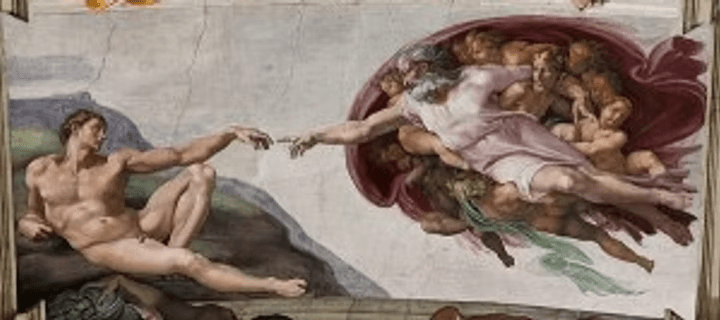
Hey Son. Finger bump!
As an optional Old Testament reading selection for the twenty-second Sunday after Pentecost, when one’s own personal ministry for the LORD should be underway – one has the high priest Jesus Christ within one, bringing with him all the knowledge of God – the message here is to gird up your loins (regardless of one’s human gender) and find the strength of Christ within you.
As I write these interpretations week in and week out, I am able to churn them out regularly because I spend little time looking up what someone thought about this reading or that reading. If I had to depend on what someone else had to say, I would just let someone else say it and save myself a lot of time trying to duplicate what comes from the brains of others. Sometimes I recall a reading and bits of pieces of things I have written before, but I always approach a reading like it is the first time.
In this process (which is not some grand plan or checklist of intelligent things to do), I find myself going back in time, as though I lived the events of the reading. By feeling a part of the past, I am able to understand the past just like I understand the present. Insight whispers to me, saying “Look this up” or “Go over there.” I follow those leads and astonishing revelations come forth. The timing of the Age of Information helps a lot; but … without the Interlinear assistance of Greek translations (Greek is Greek to me), the ability to search ideas and concepts, people, places and thing I previously knew nothing about, God could certainly ask me, “Who is this that conceals counsel by words without knowledge?”
“Not I, Lord,” I would say. “You know that.”
“Lord, you know.”
What I find every time is amazing to me. I write these for my own benefit. It is a joy and a passion. I thank God for letting me use my computer to voice His Word.
[2] “Who is this that darkens counsel by words without knowledge?
[3] Gird up your loins like a man,
I will question you, and you shall declare to me.
[4] “Where were you when I laid the foundation of the earth?
Tell me, if you have understanding.
[5] Who determined its measurements—surely you know!
Or who stretched the line upon it?
[6] On what were its bases sunk,
or who laid its cornerstone
[7] when the morning stars sang together
and all the heavenly beings bene elohim shouted for joy?
[[34] “Can you lift up your voice to the clouds,
so that a flood of waters may cover you?
[35] Can you send forth lightnings, so that they may go
and say to you, ‘Here we are’?
[36] Who has put wisdom in the inward parts,
or given understanding to the mind?
[37] Who has the wisdom to number the clouds?
Or who can tilt the waterskins of the heavens,
[38] when the dust runs into a mass
and the clods cling together?
[39] “Can you hunt the prey for the lion,
or satisfy the appetite of the young lions,
[40] when they crouch in their dens,
or lie in wait in their covert?
[41] Who provides for the raven its prey,
when its young ones cry to el,
and wander about for lack of food?”]
——————–
This is the Track 1 Old Testament reading selection to be read aloud on the twenty-first Sunday after Pentecost [Proper 24], Year B, according to the lectionary for the Episcopal Church. If ta church is on the Track 1 path for Year B, this reading will be accompanied by a singing of Psalm 104, which says, “You wrap yourself with light as with a cloak and spread out the heavens like a curtain.” This pair will precede a reading from Hebrews, where Paul wrote, “So also Christ did not glorify himself in becoming a high priest, but was appointed by the one who said to him, “You are my Son, today I have begotten you.” All will accompany a Gospel reading from Mark, where Jesus told his disciples, “You know that among the Gentiles those whom they recognize as their rulers lord it over them, and their great ones are tyrants over them.”
I wrote about this expanded selection from the thirty-eighth chapter of Job the last time it came up in the lectionary cycle, in 2018. That writing can be viewed by searching this site. I wrote about verses one through eleven, focusing on explaining what “gird your loins” means, with that commentary also available by a search of this site. That was posted in May of 2021, as my assessment of the reading assigned for the Proper 7 Sunday readings [the fourth Sunday after Pentecost, Year B]; so, it is fairly recent. Still, that was an expansion on the commentary I produced in the previous cycle of Year B (2018), when I posted this commentary here. I stand behind all of my prior postings, because there is merit in all that comes from the Word of this reading selection. I welcome all readers to view each of my prior publications and compare them to one another and what I will now add today. As always, I invite your comments, question, suggestions and corrections. Please sign up to comment to the blog, so others can see your opinions.
In the above presentation of the verses to be read, I have attached the verse numbers. I feel it is important to see where the verses are separated from one another, and to know where the leap from verse seven to verse thirty-four comes, rather than make that assumption from the brackets, which mark verses seen as appropriate to be read optionally. Also, in verse one I have restored the name appearing in the text of Job, which is “Yahweh,” replacing the erroneous translation that says “the Lord.” Further, in verse seven I have stricken out the translation that says “heavenly beings,” restoring the Hebrew written – “bene elohim” – which says, “sons gods.” Finally, in verse forty-one, the translation of “God” has been replaced by the Hebrew word written: “el.” It is foolishness, in a dialogue of Yahweh, to have Him refer to Himself [the implication of a capitalized “God”], when Yahweh is much more that the simplicity of an “el.”
Today, I want to address this reading from the perspective of all readers being Job. See it as written to each individual whose soul has married Yahweh, making it possible to long for His voice AND to be able to hear His voice when it speaks. I am reminded of a time when a mentor of religious studies asked the class, “I wonder what the voice of God sounds like, because I have never heard it.” I told him, “It would sound like your voice, as when you speak to yourself in your thoughts.” I want everyone to imagine this response of Yahweh to be to you, as if you have longed to hear the voice of God.
The Hebrew word translated as “whirlwind” is “ca’ar.” The word means “tempest,” which is metaphor for the storms of life. See this as one who has become lost in the speed of the world and the complexities of thoughts that then constantly surround one, all coming from outside sources (family, career, news of the day, etc.), Yahweh’s voice becomes the eye of the storm, where calm can be found. Thus, the voice of Yahweh is centering calm.
When verse two asks, “who here who darkens counsel by words,” this speaks of the mistranslations of English versions of the divine Scripture of the Holy Bible. It is “words” that I have amended above, from the “words” produced by the NRSV and the Episcopal Church. One needs to be “here,” in front of a reading from the Book of Job, trying to figure out how it relates to you, the reader. Your vision of the truth has been darkened, so the truth cannot become a true source of “counsel.”
It is following a comma mark (that the NRSV fails to let you be aware of) that Yahweh says of them, “without knowledge.” Just like all those false shepherds who spoke to Job had no knowledge of Yahweh, so too does any translator of Hebrew into English know Yahweh by divine marriage. They are “without knowledge” of the intent behind the “words.” All they can do is read Hebrew and make things up, because the truth is hidden from the wise and intelligent, only revealed unto Yahweh’s children by marriage.
Verse three is where I have had so many views in the past, with Internet searches being, “What does gird your loins mean?” To see this as a statement by Yahweh to Job, as a ‘man to man talk’, leaves all the women on the sidelines, waiting for the church ladies’ group to talk about Esther or some other female figure. Perhaps it is women without loins that are searching the Internet for answers? The way to read “gird your loins like a man” [from “ezar-na kegeber”] is to see Yahweh speaking to one’s soul, not one’s flesh.
The words written can equally state, “encompass yourself like a man,” where it becomes necessary to realize the Spirit of Yahweh AND all His elohim is masculine in spiritual essence. A human being, as an eternal soul animating a body of dead matter, takes on the essence of femininity (or negativity, or receptivity), such that all males and females [earthlings] are “like mother earth” and not “like a masculine deity.” A “soul” alone is like a neuter-gender child, where its puberty has yet to develop.
There is absolutely nothing that says “loins” in the Hebrew text. The Hebrew word “na” means “I (we) pray, now,” implying “I beseech pray thee you, go to, now, oh.” (Strong’s) It is adjoined to “ezar,” which means “to gird, encompass, equip,” implying “bind compass about, gird up, with.” (Strong’s again) Thus, Yahweh is saying to “bind oneself” [where a self equals a soul] to the Spirit of Yahweh, so one’s soul is a masculine elohim and not some wimpy, whiney human being of either adult gender.
As Job was already a Yahweh elohim, Yahweh was simply telling him, stop crying like a girly man and we can talk, like we used to. That says to you, the reader, if you want to hear the voice of God and know what it sounds like, then “man up.” That means both males and females need to marry their souls to Yahweh and become His elohim through Spiritual growth. Growing up means transforming from the femininity of a soul led by a body of flesh (all genders) to the masculinity of a divine soul married to the Spirit of Yahweh and led to do His Will.
When verse four asks, “where were you when I laid the foundations of the world?” it is vital to see how Job is metaphor for Adam, who was the Son of Yahweh. The soul of Job, as Adam, possessed the soul of Jesus. This makes the statement at the end of the verse – “if you have understanding [of where one was when Yahweh Created]” – that demands one be a Yahweh elohim.
The answer to the question is found in John 1:1, where he wrote, “In the beginning was the Word, and the Word was with God, and God was the Word.” When a soul has been merged with the Spirit of Yahweh, then it gives resurrection to the soul of Jesus, a name that means “Yahweh Saves.” In Genesis 1 is written, “In the beginning created the elohim,” which were the souls-angels-heavenly spirits made by Yahweh. So, as an elohim created by Yahweh, the answer to the question is, “I was sent by you to lay the foundations of the world in the beginning.”
This means verses five, six, and seven all have the same answer. “I did all the work you say, Father, by your direction, with your hand guiding my angelic form.” is a truthful answer by a Yahweh elohim. Thus, verse seven ends by saying, “You did these things as My Sons elohim.” All of this says you, the reader, will also possess knowledge of all times – past, present, and future – through the Godhead (or Christ Mind) – when your soul loves Yahweh so intently that He takes your soul as His bride and impregnates your soul with His Son. You then become the Word, with God from the beginning, doing all things commanded by Yahweh.
When the Episcopal Church decides to leap forward to verse thirty-four, one sees that Yahweh is still asking questions that can only be answered by the “sons elohim,” with “sons” being a confirmation of the command to “encompass yourself like a Yahweh elohim [masculine spirit].” Here, the questioning is focusing on the ethereal being made worldly, from the metaphor of “clouds, lightning, and wisdom, being applied to dust in clumps.” Again, the answer is always the same, as only an elohim of Yahweh have this capability.
Verse thirty four asks, “can you raise dark clouds with a sound that an abundance of water may cover you?” This refers back to the question, “who darkens,” where the “clouds” are the failures of mere mortals to grasp the depth of meaning in Holy Scripture. Yahweh is asking if you, the reader, can make the emotions of truth flow freely from the pages of the Holy Bible, through speaking in divine tongues and explaining from the emotion of divine ecstasy? You can with His help.
Verse thirty-five then asks, “can you send out lightning bolts that they might walk; and say, “behold!”? Imagine the scene from an old Frankenstein movie, where lightning was used to bring life into a corpse. Relive the scene where Doctor Frankenstein shouts, “It’s alive!”
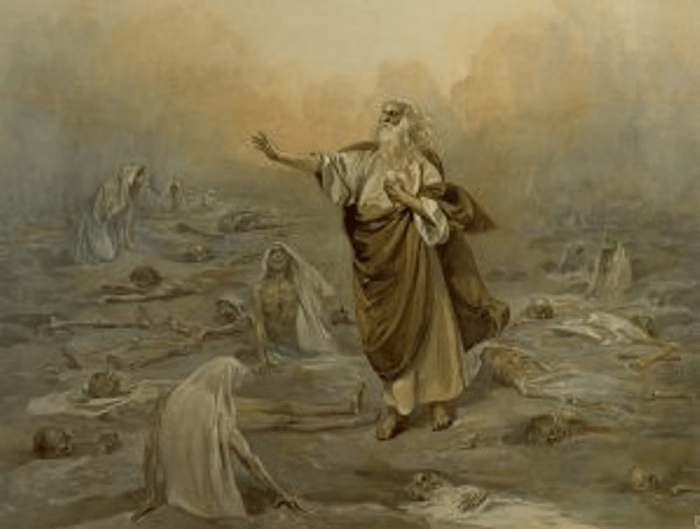
This is Yahweh asking you, the reader, can you jolt life into the dead by explaining Scripture, so dry bones can prophesy? The answer is you can, with God’s help, as His elohim.
Verse thirty-six then asks, “who has set the inward parts of wisdom? Or, who has given one’s soul understanding?” Everything comes from Yahweh, through His bringing the Christ Mind through His Son resurrected within one’s soul. There is no question that cannot be answered. The truth flows forth from all Yahweh’s angels in the flesh.
Verse thirty-seven asks, “who has the wisdom to count dust particles on earth? Or, know how many jars will contain the sky above?” Again, only Yahweh knows these answers; but they are made available to those He creates through divine marriage.
Verse thirty-eight then asks, “when flows the castings and the clods to cling together?” This is a question of who joins souls to flesh [“clods”] and guides the formation of a fetus in the womb? Only Yahweh can make a body and give it life. In the same way that the miracle of life comes into dead matter, the greater miracle is the promise of releasing that soul of life to eternal life, once again with the Father in heaven. This creation comes when a soul has shown love and devotion to Yahweh, so He has made that soul His wife, to become the mother of His Son.
Verse thirty-nine then asks, “can you hunt prey like a lion? Or, give life that satisfies the young lions?” This becomes a question of ministry, where one hunts for souls who are seekers and ready to die of self and become reborn as young lions. This is when the metaphor of C. S. Lewis lion character [Aslan], seen as a Christ [meaning an Anointed one]. A “Christ” is one anointed by the Spirit of Yahweh, as His elohim.
Verse forty states the scenario of “when they crouch in their dens and lurk in their lairs lying in wait.” This becomes the courage of the heart of a lion, which has no fear. When one has married Yahweh, losing that presence is one’s only fear. Thus, the dangers of persecution in the world [which Job knew all so well] does not deter a Yahweh elohim from going into ministry, seeking those who seek to die of self and be reborn as saints.
The final verse is then where the presence of “el” is found. Here the question is, “who provides ravens as game when the children of el cry and wonder about lack of food?” Here, the metaphor is of “eating crow,” which becomes synonymous with the “darkened counsel” of bad translations of Scripture into English. One big “crow” or “raven” is seeing the word “elohim” and translating it one time as “God,” then another time as “gods,” and still another time as “heavenly (sons).” You cannot feed the children so they grow up to be “el” material, seeking to marry their souls to Yahweh, crap that is untrue, misleading, and full of errors.
The word translated as “lack” is “taah,” which actually means “to err.” Only when one is filled with the Spirit of Yahweh, can one then fill one’s “children” with the same heavenly bread. This is how Jesus said, “I am the bread of life,” so to become a Yahweh elohim, one must consume Jesus. One consumes Jesus by being reborn in his name.
As a reading possible for the twenty-first Sunday after Pentecost, when one’s own personal ministry for Yahweh should already be well underway, the lesson is to stop cry babying about a little difficulty here or a little pain and suffering there. Everything in one’s life will have meaning, if one can die of self-ego and be reborn in the name of Jesus, as a Christ. All questions can be answered. All things are possible with Yahweh’s help. Yahweh wants wives who will go forth and multiply on the face of the earth, making more become Jesus reborn. Thus, you, the reader, need to hear this reading as Yahweh talking to your soul.





 Explaining the Readings