
Tag Archives: Joel 2:28-32

Acts 2:1-21 – The Feast of Fifty Days

When the day of Pentecost had come, the disciples were all together in one place. And suddenly from heaven there came a sound like the rush of a violent wind, and it filled the entire house where they were sitting. Divided tongues, as of fire, appeared among them, and a tongue rested on each of them. All of them were filled with the Holy Spirit and began to speak in other languages, as the Spirit gave them ability.

Now there were devout Jews from every nation under heaven living in Jerusalem. And at this sound the crowd gathered and was bewildered, because each one heard them speaking in the native language of each. Amazed and astonished, they asked, “Are not all these who are speaking Galileans? And how is it that we hear, each of us, in our own native language? Parthians, Medes, Elamites, and residents of Mesopotamia, Judea and Cappadocia, Pontus and Asia, Phrygia and Pamphylia, Egypt and the parts of Libya belonging to Cyrene, and visitors from Rome, both Jews and proselytes, Cretans and Arabs– in our own languages we hear them speaking about God’s deeds of power.” All were amazed and perplexed, saying to one another, “What does this mean?” But others sneered and said, “They are filled with new wine.”

But Peter, standing with the eleven, raised his voice and addressed them, “Men of Judea and all who live in Jerusalem, let this be known to you, and listen to what I say. Indeed, these are not drunk, as you suppose, for it is only nine o’clock in the morning. No, this is what was spoken through the prophet Joel:

`In the last days it will be, God declares,

that I will pour out my Spirit upon all flesh,

and your sons and your daughters shall prophesy,

and your young men shall see visions,

and your old men shall dream dreams.

Even upon my slaves, both men and women,

in those days I will pour out my Spirit;

and they shall prophesy.

And I will show portents in the heaven above

and signs on the earth below,

blood, and fire, and smoky mist.

The sun shall be turned to darkness

and the moon to blood,

before the coming of the Lord’s great and glorious day.

Then everyone who calls on the name of the Lord shall be saved.’ ”

——————————————————————————–

This is the fairly fixed reading that can be chosen as either the Old Testament selection or the Epistle selection for Pentecost Sunday, Year B 2018. The full reading is optional in Year A and Year C, making it a fixture reading for Pentecost Sunday.  Either way it may be selected, it would next be read aloud in church by a reader on Sunday, May 20, 2018. It is important as it tells of the disciples’ transformation into Apostles and Saints, when the Holy Spirit flowed strongly through each of them on the first day of the week that was Pentecost (the Fiftieth Day), marking the Festival of Weeks (Shavuot). It is important because it tells how the Saints of Christ do not speak of their own accord, but by the Will of God. The truth spoken by an Apostle is then fulfilled by the prophecy made by Joel, where that prophecy needs closer examination.

I was raised (from nursery cradle to fifteen) in an Assemblies of God church. That denomination is under the general umbrella of Christianity that is called “Pentecostal.” I was into my fifties when I learned that “Pentecost” is Greek, meaning “Fiftieth Day.” My assumption prior to that (as I do not recall ever having “Pentecostal” defined to me) was that “Pentecost” meant “speaking in tongues,” as that was a tenet of the Pentecostal branches of Christianity.

Now, I see my assumption (from being told “Pentecostal” means the belief in “speaking in tongues”) was somewhat of an oxymoron.  It must be, since one of the tongues not spoken appears, quite obviously, to be Greek. Otherwise, that branch of Christianity would be better named if there was no inference to being “Fiftieth Day related,” from “Pentecost-al.”  A more suitable name would be “Glossaipyros-al” (from the Greek “glōssaiand “pyros“), meaning “Tongues of fire related.”

The very first verse in this reading states, “When the day of Pentecost had come.” That demands one understand what the “day of Pentecost” is, as its mere mention states it was a significant day. It demands that one know the Israelites were commanded to forever observe three holy days with feasts (festivals). The three are: Pesach (Passover), Shavuot (Weeks [a.k.a. Pentecost]), and Sukkot (Booths). Each festival attaches a number of days of recognition to each of those specified days.

The Hebrew word “Shavuot” means “Weeks,” such that there were seven full weeks that took place after the Israelites escaped Pharaoh, until Moses came down with the sacred tablets. Forty of those days were spent encamped at the base of Mount Horeb, while Moses was on the mount with God.  The Covenant was then made on the fiftieth day (7X7=49, 49+1=50), after Moses came down with the sacred Tablets.

The festival that denoted the end of that counting of weeks was probably named Pentecost because of Greek rule over Jerusalem (following the Persians, prior to the Romans), as a translation of the statement of “fifty days” in Leviticus 23:16. If not, the Greek came after the Apostles spread into Greece and began writing Gospels and Epistles, where that became the translation for the Aramaic that spoke of the Feast of Fifty Days. Regardless of the etymology of “Pentecost,” there was nothing at all that would have predicted to Peter or the other eleven, “Pentecost is tomorrow, so get ready to start speaking in tongues guys.”

Realizing that, when we next read, “the disciples were all together in one place,” the only certainty of where that “place” was located was in Jerusalem, as stated in verse five (“eis Ierousalēm katoikountes” – “in Jerusalem dwelling”). We can assume that the specific place where they were all together was the same “upper room,” where they had shared the Passover Seder meal with Jesus.

This assumption comes from Acts 1:13, where the disciples had returned after the ascension of Jesus Christ. We read there, (“eisēlthon eis to hyperōon”) “they had entered into the upper room,” which is a statement of the same “upper room” prior.   Due to the influx of pilgrims seeking rooms in and around Jerusalem, for Jesus (after his resurrection) to remain in the Essenes Quarter with his disciples for forty days (most likely in unrecognizable form), the room could be retained and he could teach his disciples the meaning of the future that was coming.  As his Ascension was on a Sabbath, on the hill with olive trees (Mount Olivet) just outside the Essenes Gate, the disciples were within the limits on their walking distance (a Sabbath’s day walk – which is roughly a half-mile outside the city walls).  That evidence implies the disciples went back in the same “house” (from Greek “oikon” in verse two) they had remained in for forty-nine days, then preparing for the Temple ceremony for Shavuot.

When we read, “Now there were devout Jews from every nation under heaven living in Jerusalem” (literally translated as, “in Jerusalem dwelling”), this is a statement of the importance of Shavuot. As a commanded event that was fifty days later than the Passover events (an eight day festival), those pilgrims in Jerusalem were not coming from the airport, having just flown into town. The distances stated by the naming of places the pilgrims had come from says they all came for the Passover and stayed some place near Jerusalem for about two months. After that stay, they could return home.
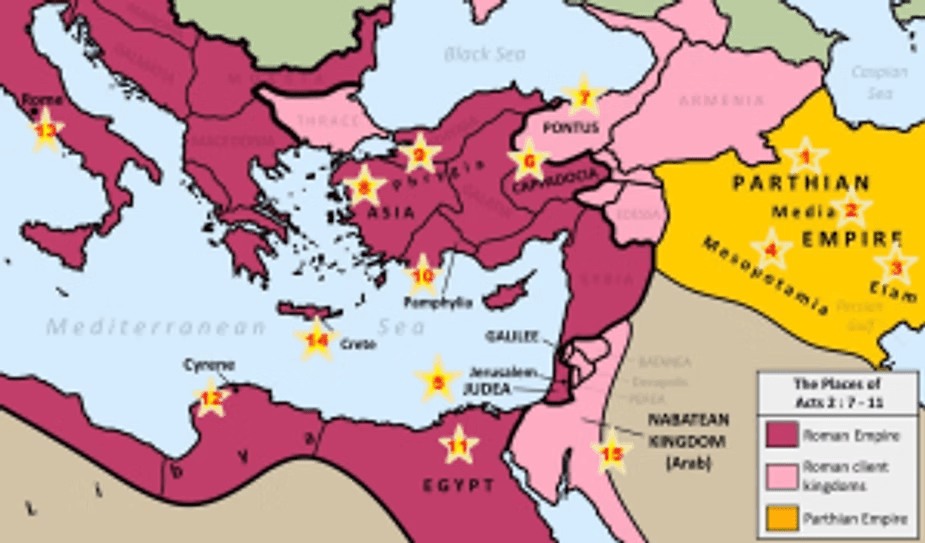
Fourteen places are named, but with twelve Apostles it is probable that a couple of nations shared a common language.

That distance means a traveler would have secured a place to stay (a “dwelling”) while near Jerusalem for two months. This could be “living” with relatives who still lived there, or it could mean staying in inns, or it could mean staying in “travel parks,” where groups of travelers all pitched tents and roped off donkeys and camels, within a reasonable distance from Jerusalem.

Keep in mind that Jesus fed a multitude of five thousand adult males (meaning perhaps a total of as many as eleven thousand, including men, women, and children).  Those were largely pilgrims who were preparing for the Passover Festival (John 6:4 – “The Jewish Passover Festival was near.”). Matthew wrote of Jesus feeding the same five thousand (Matthew 14:13-21), but then wrote of Jesus later feeding four thousand (Matthew 15:29-39).  The implication is the timing of the second miracle was prior to the Pentecost Festival.  That means those “living in Jerusalem” were many, all of whom had been there since prior to the Passover; and this swell of people there took place every year (maybe not with the exact same people), because it was a commanded observance.

It is worthwhile to note that the ritual observances demanded by God, through Moses, as stated in the Torah (Exodus, Leviticus, Deuteronomy, and Numbers), were not maintained over the centuries. Once the Kingdom of Israel divided, the people were not led to understand the reasoning behind their Covenant, such that the fall of Israel and Judah was seen as rooted in this noncompliance. There was not always a Temple with priests to offer sacrifices, and some see the efforts begun while in captivity in Babylon was an attempt by the captive Jews to relearning what rituals had been forgotten.  Because the Law had been forgotten, the exilic Jews (the Levitical priestly descendants) saw adherence to the Law as all important; and that included observing the commanded festivals.

In the reverse view, after the destruction of the Second Temple and the scattering of the Israelite people around the world (mirroring the spread of Christianity), there has again come a disconnect by Jews and Christians, relative to understanding the reasoning behind the Covenant and the new Covenant with Jesus Christ. Jews go through the motions of rituals without realizing the Messiah has come; and Christians have no grasp of the rituals that bring them into a Covenant with God. Everyone has changed the rules to fit their personal needs, rather than feeling the purpose of God demanding ritual feasts forever be maintained by ALL His chosen priests (thus a “New Covenant” that has been added to THE Covenant).

This lost sense of knowing why God wanted His people to observe the Passover and then fifty days later a festival of farmers taking their marked (with reeds) first fruits (grains) of harvest to the Temple for blessing, amid throngs of cheering Jews was the background setting to the story of Acts 2:1-21 (and 22-41). The people from all the nations listed were milling about during the morning of Pentecost, waiting for someone to finish a prayer and a rite, announcing the close of festivities so everyone could go home … finally.

Their devotion had led them there, seeking more; but so many Jews were looking for some greater reward, more than simply being God’s chosen people.  They prayed for something to happen that would make their devotion be more than routine obligation.  The scene of Acts 2 opens with that ripeness for receiving the Spirit.  Rather than grains and fruits (and cheese blintzes) being the reward of the First Fruits, the pilgrims themselves were about to be blessed as a good harvest.

Knowing this setting, all of the streets in Jerusalem would have been packed. All the pilgrims would have flowed in through every gate, as their customary way of ceremoniously renewing their vows to serve Yahweh.  Then, suddenly, “Came a sound like the rush of a violent wind.”

Imagine how people interviewed on the news after a trailer park has been destroyed by a tornado say, “It sounded like a freight train coming.” If they had freight trains back in ancient days, then maybe we would read here, “Came the sound like a freight train.” Not only did the ancients not have freight trains, but they had no machines that made loud noises that would be similar to any man-made noise. It must have sounded like a tornado, but those weather events are rare in the Middle East, including Israel.  Such a loud noise was totally unexpected, because even rain is scarce in the area during May and June each year (the time between Passover and Pentecost).

Still, this was so loud it filled the entire house and the noise spread outside.  It was so noticeable that it made the people in the streets stop and take notice. They all looked at the house where the disciples of Jesus were staying.

“What in the name of God could that loud noise be?” the pilgrims all asked.

Then, once they had stopped in their path, they looked hard and listened intently. They heard many men speaking loudly in many foreign languages (the real meaning of “speaking in tongues”); and everyone in the street heard some strange man speaking his own native language.

Then the men inside the house came outside.  Some might have gone into the street, while some might have gone out on a rooftop-terrace.  Once the men were seen – still speaking fluently in many different languages – they looked like Galileans.  That means they looked somewhat foreign to the big city, as they probably were not in refined dress, not looking dapper.  They might have had on funny hats or had their hair wild and un-braided.  Whatever the case, they certainly were seen as not being men of the world and high culture.

Still, that source of sound coming from the least of Jews was not reason for the pilgrims to return to the din of street movement.  We read that the pilgrims were all “Amazed and astonished.”

It is most important to realize that these foreign visitors to Jerusalem were not “amazed and astonished” because they heard rubes from Galilee saying things like, “Hello. Can you tell me where the hotel is? This is beautiful weather we are having, do you not agree?” as if they were automatically filled with the ability to speak a conversational language learned from Babble, Rosetta Stone, or The Idiot’s Guide to Mastering Foreign Languages.
The new Apostles were not babbling incoherently, using distinguishable languages recognized by the pilgrim Jews. They were preaching the meaning of Scripture (Torah, Psalms, and Prophets), which were lessons heard for the first time, leading the pilgrims to be “amazed and astonished.”  The fact that each pilgrim heard those lessons in his native tongue means there was no language barrier to overcome – no struggles with Hebrew, no need for translation, no idioms, sayings, or slang terms to overcome – as the multinational visitors heard clearly what no rabbi or high priest had ever told them before.

And that was coming from Galileans!

When we read how some said, “In our own languages we hear them speaking about God’s deeds of power,” that speaks of the power of God flowing from the mouths of His servants, explaining the hidden meaning that had never been exposed. That is why they “all were amazed.”  Still, they were also “perplexed.”

That state of wonder (amazement), followed by confusion and doubt (perplexity) means their hearts and minds had opened a crack, towards belief in the Apostles; but then their natural brain-driven reaction was to slam shut a protective shell of disbelief over the chance of human vulnerability.  Something wasn’t right!  They had to slam a harness around those hearts and minds.

We read how they began “saying to one another, ‘What does this mean?’”

Their brains began whirring, thinking about how Galilean fishermen, small town lawyers, former tax collectors, and general riff-raff Jews could be bedazzling and filling those international globetrotters with sudden wonder, speaking the truth so clearly … in foreign languages?

Then we read, “But others sneered and said, ‘They are filled with new wine.’”

This has to be seen as an explanation offered from the crowd, about how simple Jews could be speaking such deep levels of interpretation of Scripture. Being “filled with new wine” meant there were known past examples of how a drunken state could remove inhibitions in the brain, allowing people to utter thoughts freely, with surprising insight. The intent of such an explanation would be akin to thinking they might be speaking good ideas now, but wait until the influence of alcohol wears off and they return to being bumpkins, not remembering what they said while drunk.

Still, to have someone shout out, “They are filled with new wine” is the Holy Spirit already circulating around the crowd, influencing them to receive the messages spoken by Apostles.

Just fifty days earlier, Jesus had offered a prayer of thanks over the third ceremonious cup of Seder wine (the Redemption Cup), saying, “Drink from this, all of you. This is my blood of the covenant, which is poured out for many for the forgiveness of sins.” (Matthew 26:27-28) When Jesus then added, “I tell you, I will not drink from this fruit of the vine from now on until that day when I drink it new with you in my Father’s kingdom,” Jesus spoke prophecy that was then coming true.  It was that day. Jesus Christ had been reborn within his disciples, so they spoke as if “drunk with the new wine” of the Holy Spirit and Jesus was there with them … in the kingdom of Sainthood.

In this regard, Peter did not deny that he and his eleven brothers in Christ were drunk. Instead, he said, “Indeed, these are not drunk, as you suppose.” They were drunk, but in a way that was not imagined by the pilgrims.  They were drunk with the holy blood of Jesus Christ, through HOLY SPIRITS.

New wine (Greek “Gleukous”) is also called sweet wine, which is unfermented grape juice. It is a non-alcoholic beverage in that case, which might have been consumed by the disciples for breakfast. It would be a drink for the whole family to consume, and for adults to drink at any other time, when drinking spirits would be inappropriate. However, new wine can ferment unexpectedly and become alcoholic, causing one to drink it and unexpectedly get drunk. This is why Peter explained, “not … these are drunkards” (“methyousin”), where the denial was they were “not … intoxicated by wine.”

This was then spoken to the crowd by Peter, with the translation reading: “Peter, standing with the eleven, raised his voice and addressed them.” The better translation says, “Peter with the eleven  , lifted up the voice of him and spoke forth to them.”  This says more than Peter just began speaking in a loud voice, as the loud sound that attracted the crowd had come from the wind-like roar of the Apostles speaking loudly in foreign languages.

The Greek word “epēren,” which is translated as “raised” or “lifted up,” should be seen on a deeper level.  Peter and all the other Apostles were speaking loud enough to be clearly heard at some distance, but more importantly their voices were “exalted,” having been “raised” spiritually, as their words were “lifted up” divinely. This means that they all spoke from the Holy Spirit.  With “raised voice” Peter and the other eleven were having the Spirit of the LORD poured out through them. Thus Peter used the example of prophecy, coming from Joel 2:28-32.

It is so important to see how Peter was not simply explaining intellectually, using words that explained what he and the other Apostles were doing. Peter was not speaking from his brain when he implied that he and the gang were fulfilling the prophecy of Joel. That would not be “with raised voice,” but human words of reason.

Instead, Peter quoted Joel because the Father spoke those words for him to recite. It was not rote memorization being accessed within his country-bumpkin brain that Peter (et al) was speaking. Everything Peter and the eleven spoke came from the Mind of Christ, brought upon them by the Holy Spirit, which included the quote from the Prophet Joel.

When Joel was led by the Holy Spirit to write, “In the last days it will be, God declares,” it must be realized that the Greek word “eschatais” (from the root word “eschatos”) means “last, at the last, till the end, and finally.” This is the root word for the theological word “eschatology,” which places focus on “the end of the world or of humankind.” As such, some can read Joel and project what he prophesied is still to come, at that fearsome, grizzly end of the world that always seems just around the corner of present time.

However, as Peter was quoting then, well into the future of Joel’s prophecy, as Peter spoke it was the last days, and God was declaring through ordinary folk.

God then spoke the words of Joel, through Peter: “I will pour out my Spirit upon all flesh, and your sons and your daughters shall prophesy, and your young men shall see visions, and your old men shall dream dreams. Even upon my slaves, both men and women, in those days I will pour out my Spirit; and they shall prophesy.”

Peter and the other eleven Apostles were sons prophesying. They were seeing the truth of Scripture – the visions of Joseph, Solomon, and Daniel, the dreams of Ezekiel and Isaiah, and the slaves that were Ruth and Ester and Amos and Joel. The prophecies of old stories had been fulfilled in the man known as Jesus of Nazareth. The Old Testament’s prophecies were at last revealed. They were exposed as clearly as the light of the day time hours makes seeing possible.

When God then proclaimed through Peter, “And I will show portents in the heaven above and signs on the earth below, blood, and fire, and smoky mist. The sun shall be turned to darkness and the moon to blood, before the coming of the Lord’s great and glorious day,” had not all that just recently been witnessed by those pilgrim who had been in and around Jerusalem, since the Passover Festival that began seven Sabbaths prior?

Had not Jesus produced “portends,” which means “miracles” and “wonders” for the Jews (and others) to witness?

Had the people not questioned if he had been sent from heaven as the Messiah?

Had Jesus not made clear that he had been sent only to the “blood” that was the remnant of the Israelites known as the Jews?

Had Jesus not set a fire under the Jews that both followed him and saw him as a threat?

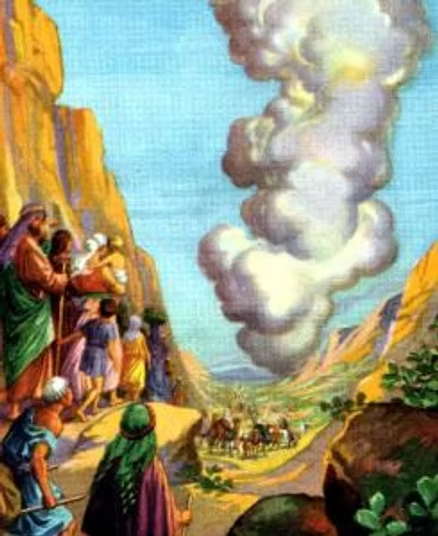
Did Jesus not appear to be the human equivalent to the daytime pillar of smoke that guided the Israelites through the wilderness of the Sinai?
Was not Jesus the proclaimed Son of Man, as the representation of the sun – the light of truth; and had that light not been darkened by his crucifixion? Did the sky not go dark in the middle of the day for three hours, as Jesus of Nazareth hung on a cross dying? Did the ever waxing and waning moon – symbolic of emotions overrunning one’s personality – not stand before Pilate, screaming, “Crucify him” to bloodcurdling levels?

Peter reciting Joel’s line, “Before the coming of the Lord’s great and glorious day,” was God’s way of announcing, “Today is the Lord’s great and glorious day!” God was announcing the return of His Son, Jesus Christ, returned the day after his ascension in all of his followers.

For all who look for the End of the World, as far as Christian theology is concerned, it was delayed coming by the presence of Saints in the name of Jesus Christ on that day of Pentecost. It continues to be averted as long as Jesus Christ exists in the world, via Saints filled with God’s Holy Spirit.

As far as this reading selection goes, Peter ended the prophecy of Joel by God pouring out of his mouth, “Then everyone who calls on the name of the Lord shall be saved.” On a city of Jerusalem street that was filled mostly with Jews, but Roman converts (proselytes) and Arabs as well, the use of the word “everyone” (Greek “pas”) must be seen as the first sign that Saints were called to serve “all,” as messengers of Salvation.

Peter himself did not know he should welcome Gentiles until later; but in the reading that continues (but not read aloud today), we learn that three thousand souls were baptized by the Holy Spirit that Pentecost.  Three thousand souls were then added to the number of Saints in the name of Jesus Christ. Those three thousand would return to their nations and begin a worldwide spread of Christianity.  While not stated, all of the fourteen named nations of peoples had converts that day, all filled with the Holy Spirit, each calling upon the name Yahweh, as Jesus Christ reborn.

As the one reading in the Christian liturgy that is consistently read on Pentecost Sunday, it is vital to have one’s eyes opened to the realization that none of the twelve men speaking in foreign languages that day had any lessons or experiences in learning those languages prior.  Likewise, Ezekiel had no prior experience prophesying to dried bones; but he did as God commanded.  Thus, speaking in tongues, as a miracle of foreign languages, is not the lesson presented in Acts 2.  Neither is the end of the world the lesson to be taken from Joel 2, as if babbling fools can point to some future date as when Jesus will return with vengeance.  The lesson is God speaking universally so all can hear and understand.

There is absolutely no one who is going to have his or her soul baptized by the Holy Spirit and be saved, given eternal life, because they hear someone speaking nonsense, uttering noises that no one can understand. Salvation does not come by learning to fake speaking in foreign tongues or pretending to know what gibberish means.  The brain plays no role in salvation, as it can only hinder that goal.
The miracle of Pentecost was speaking from the Spirit of truth, which Jesus prophesied in the Gospel reading from John 15-16.

The lesson of Pentecost is twofold. One, it is to hear the truth of the texts of the Holy Bible and understand them. Understanding comes from the Holy Spirit, not a book read, a course taken, or someone else’s interpretation that one is incapable of personally owning and defending. Two, it is the beginning of the end times of the old you. The selfish days of ignorance are over – ended forever.

Pentecost represents the end times of the release from bondage, when the Covenant with God is agreed on. It is when time spent learning has reached the point of teaching, such that one can only sit in a pew for so long, before realizing the Lord’s great and glorious day has dawned within oneself. Then it is time to go preach – prophesy to the breath – so that other can have the same chance for a personal experience with Salvation.

The lesson of Joel’s prophecy is not limited to the fulfillment that occurred the day after Jesus ascended into heaven.  The experiences of Peter and brothers in Christ was the beginning of this prophecy’s fulfillment.  It is fulfilled every time a disciple makes this transition.  All of the trials and tribulations from one’s own denial of God, Christ, and the Holy Spirit within oneself points to a new last days, as the end of a sinner’s ways and the beginning of a Saint’s service to God, as Jesus Christ reborn.

In this way Peter was speaking to the readers who would eternally be called to God’s Word.  Just as Joel wrote of all the coming sons and daughters of God, the spirit will always be poured out upon desiring flesh.  Just as Peter passed along the flow of the Spirit of truth, so do all God’s Saints.

#FestivalofWeeks #Matthew141321 #Shavuot #Lordsgreatandgloriousday #tonguesoffire #newwine #pillarofsmoke #Acts2121 #fiftiethday #speakingintongues #Acts113 #Acts22241 #Joel22832 #Matthew152939 #John64
In-Depth Pentecost Sunday Reading Explanations – Part 4 of 5 (John 20:19-23)

The two options for Gospel readings both come from John. One is John 20:19-23 and the other is John 7:37-39. The John 20 reading is also read every year in the three-year cycle on the Second Sunday of Easter, but those readings extend to verse 31 (an additional eight verses). The point of reading these five verses again is to see them in a new light, following forty days of preparation with the risen Jesus. The John 7 reading (only three verses) is important, if for no other reason that these three verses are the only verses scheduled to be read from this chapter, and it is only scheduled for reading on Pentecost Sunday.

Beginning with the first Gospel reading listed (John 20), it is important to realize fear is again an issue. The first verse (19) begins by stating it is “evening,” which means after 3:00 PM, but before 6:00 PM when night’s “evening” begins. For fear to have set in during the sun’s time overhead speaks of how little faith in God the disciples had. Rather than only fear God, we are told they locked the doors “for fear of the Jews.”

For all you self-righteous pseudo-Christians out there in the world, none of whom spent one second with the pre-death Jesus of Nazareth, much less the risen Lord Christ, see yourselves in the fear of being behind a locked door.  That upper room reflects your safe room, your sphere of influence.  More than a protection against others coming into your world – ones you hate and despise with all your heart – you lock the door to keep from having to extend beyond the self-comfort zone.  You are afraid of letting anyone like God make you submit to His Will.

Me thinks thou doth pout too much.

This element of fear was present in the Numbers reading. In the Acts 2 reading about Pentecost Sunday, when Peter told of Joel’s prophecy being fulfilled at that time, verse 31 sings, “The sun shall be turned to darkness and the moon to blood, before the coming of the Lord’s great and glorious day.”

As it was evening of day, here in John’s Gospel reading, “the sun had turned towards nightfall.” As the “moon” is a symbolic statement of “emotions,” “fear” was running through the veins of the followers of Jesus. So, this verse certainly can be joined to that Pentecost reading.

In the Greek of Peter, when he quotes from Joel, “the coming of the Lord’s great and glorious day,” that is divided into two segments of words. Peter spoke (as was recorded by Luke): “formerly that coming day of Lord,” before adding, “this great  and (“kai”)  glorious.”

This means the Prophecy of Joel foresaw the coming of the Messiah – the Christ – who would be called “the Lord.” The Lord would come with the light (“day”) of illumination, and that was what Peter and the eleven were sharing with the Jewish pilgrims on Pentecost morning.

The Hebrew of Joel uses “Yahweh” as the one who comes, which is the truth of “the Lord.” It was God who descended in a mist at the tabernacle. It was God’s Holy Spirit that illuminated seventy elders. It was God who flowed through the Apostles and spoke a new light that shone in the hearts of three thousand pilgrims. Still, in Paul’s epistle, he made it clear that “Jesus is Lord,” only via God’s Holy Spirit, with God being the Holy Spirit that returns JESUS into human flesh. Thus, the “Lord” of one’s flesh is named Jesus Christ, but JESUS comes from Yahweh, just like the cloud of mist that descended on the tabernacle and made seventy elder be illuminated by the light of the “Lord.”

When John wrote that “Jesus came and stood among them,” this is literally two statements: “came this Jesus” “and” (“kai”) “placed himself among the middle.” This indicates Jesus suddenly appeared in between his disciples and others who were in hiding. It does not explain that Jesus, as a ghost, came through a wall or a closed door and stood just inside the room. He suddenly materialized in “the midst” of men and women who knew him as “this Jesus.”

Imagine this event.

Place yourself in any event of gathering you can remember best. The room is crowded with people (perhaps twenty).

Maybe you are holding a conversation with one other person, or a group of three or four. You might even be sitting in a chair, perhaps next to your wife or husband. The mood is somber, like that of a wake, because of a recent death, but the earlier news about women seeing Jesus alive (although he did not look like Jesus) is the focus, simply trying to ward off the fear of being in a locked room. Then, someone is standing beside you, but in a crowded room that is not something to cause you to be alerted. Jesus became one of those milling about, unrecognized once again, but unrecognized because everyone’s fear kept them from focusing on anyone other than themselves, for the most part.

This is when Jesus said, “Peace to you” (“Eirēnē hymin”).

This was an attention getter, but it was more than a greeting. It certainly was not an Episcopalian catch phrase, to be used so often it becomes as meaningless as an old Hippie flashing two fingers and saying, “Peace!”

Meaningless words do nothing of value. They are just words. When Jesus said “Peace, Quietness, Rest” (all translations of “Eirēnē”) the capitalization written by Luke says Jesus’ word immediately gave all in the room “Peace of mind.” With that “Quietness,” fear was dispatched elsewhere.

With that fear gone, the disciples were then able to ponder a body of flesh they had seen (from afar), dead on a cross just two days before (Friday). They had heard it was prepared for burial, which meant men who could tell a live body from a corpse knew Jesus was dead. Now, rather than fear they would be next, they examined Jesus’ body of flesh, which still had the wounds of having been nailed and pierced, along with a crown of thorns scratching his forehead and whip marks on his back. With all that evidence able to be seen by the followers of Jesus, they “Rejoiced” greatly (from the word “Echarēsan” being capitalized in Luke’s writing).

John separated that statement of Happiness and Gladness with another segment of words, which state, “having seen the Lord.” The words “idontes ton Kryion” also say the disciples and others “perceived” or “experienced” their “Master,” who was God incarnate.

This says the disciples were not just real happy that Jesus was not dead, but alive. They were filled with great emotions that sensed God was in their presence. This is like how the sixty-eight elders must have felt when they saw a cloud descending from the sky, surrounding the tabernacle … before they began to prophesy.

Realizing this awareness of God in their midst, in the form of a body that had been dead, known as Jesus, this was their true epiphany.

While words had been spoken previously, when Jesus asked them, “Who do you believe I am?” The response that came divinely from Peter’s mouth, “You are the Messiah, the Son of God” was just that – God speaking through men without big brains of intelligence.

Now, for the first time, having perceived God as the only way a dead body could be standing before them, the disciples and others “Rejoiced,”  Then, Jesus told them once more, “Peace to you.”

Again, this is nothing like an Episcopalian greeting, where one says, “Peace of the Lord” during the break time, when (pre-coronavirus fears) everyone got up and milled about the aisles of a church, shaking hands, smiling, and hugging, before sitting back down (called “the peace”). The repetition here in John’s Gospel means a new form of “Peace” was unfolding.

First, “Peace” calmed the nerves of everyone in the room, but that “Peace to you” was external. When Jesus had let everyone examine his body as that of a dead man, with no earthly reason it could stand and talk, Jesus then said “Peace within you.” That equates true “Peace” as being the presence of God eternally with one’s soul, which is much better than feeling pretty sure God is real and somewhere else.

We realize this is the meaning intended, when John then quoted Jesus’ next statements: “As the Father has sent me, so I send you.” This too needs to be examined more closely.

The Greek text states, “kathōs apestalken me ho Patēr  ,  kagō pempō hymas  .” This literally translates to fully say, “according to the manner in which having been a messenger myself of the Father  ,  I also am permitted to go as you  .

The key root word is relative to “apestalken,” which is “apostelló.” That says Jesus was an Apostle of God the Father, such that the “messenger” (the meaning of “apostle”) of Yahweh is the Son Jesus. The word “kagō” is a combine form word that joins “kai” (“and”) and “egō” (“I”).  That usage means Jesus foretold (importantly) that his disciples would be joined with his “ego,” when they were to become Apostles (“messengers of God,” who would then truly be their Father).

You and me are one pardner, but I’ll do the thinning around here Baba Looey.

That says what Paul was stating in his epistle to the true Christians of Corinth, when he said you condemn your soul if you go around saying you are JESUS, when you are not. A true Christian is one who has surrendered self-ego, to take on the ego of the Christ Mind, thus becoming Jesus Christ reborn … in the name of Jesus Christ. This then becomes the antithesis of the Numbers reading, where the presence of God made seventy His Sons, so they could become His messengers; it was only for that one time. When one is reborn as Jesus Christ, it is the eternal living water that Paul said many members would drink.

When John then wrote the one-word statement – “enephysēsen” – it shows the importance of this one act: “he breathed upon.”

After having just spoke about the disciples going out to do the Father’s Will, just as Jesus of Nazareth had done, all of the disciples and followers had God’s life breath (i.e.: a soul) and it was that which kept their bodies of flesh from being dead. Jesus stood in their midst as dead body of flesh that had been resurrected, meaning his life breath (his soul) had returned to be one with God. However, the dead body of flesh that had been Jesus of Nazareth (born in Bethlehem) stood not because of the breath of life given by God, but by the Holy Spirit. Thus, Jesus had a ‘mind-meld’ with the followers, which is the meaning of “he breathed upon [them]”.

With the disciples knowing the Mind of Christ, just for that moment, they understood that by Jesus saying “Receive the Spirit Holy” it was God speaking to them through His Son.  God was offering, through His Son’s body, for them to have the same powers over mortal death. The capitalization of “Labete” (“Receive”) states the importance of letting go of their self-egos, so their hearts and minds and souls would sacrifice control over mortal flesh and welcome God in with love.

That would be a proposal of marriage; but as a proposal, the disciples had the free will to accept or reject God’s offer of a new Covenant.

This then leads to the final verse in this reading, which is read aloud as: “If you forgive the sins of any, they are forgiven them; if you retain the sins of any, they are retained.”

This is an enigmatic verse that is easily misunderstood. Therefore, it needs to be dissected, according to punctuation and analyzed carefully.

The segments of words written by John are as follows:

an tinōn  ,
aphēte tas hamartias  ,
apheōntai autois  ;
an tinōn kratēte  ,
kekratēntai  .

Without knowing any Greek, careful inspection should allow one to find that the words “an tinōn” are repeated.  Repetition in Scripture is a statement of importance. This means understanding “an tinōn” is an important first step, which is not insignificant.

The Greek word “an” is said by Strong’s to be “usually untranslatable, but generally denoting supposition, wish, possibility or uncertainty.” It is because of that “supposition or uncertainty” that “an” is translated as “if.”  The Greek word “ean” does translate as “if,” but the missing “e” means an unstated proposition made demands a decision.

This means a word of “possibility” should be read in the context of Jesus having repeated his command for “Peace to you,” with the addition of “Receive the Spirit” that makes one of the material world be “Holy” is a marriage proposal. The possibilities are for one to say “yes” or one to say “no.” This must be seen as the purpose behind the conditional word “if” being the translation.

The Greek word “tinōn” is the genitive plural form of “tis,” meaning “of or about some people.” To translate this as “any” misleads as “if” Jesus stood speaking as God speaking to everyone in the whole wide world. He was not. He was speaking to a select group of people who had followed Jesus for at least three years. Therefore, the statement is directed only  to those people, and should be read as: “if any of you here now.”

This translates to our modern times (and all times after John’s gospel was canonized) to “any” of those people who have the Spirit of Jesus Christ in their midst, making the same marriage proposal from God. The possibility is just as valid now as it was then. However, the proposition has absolutely nothing to do with “any” being “all in the world,” as it only is a proposal to those who “might become” the brides of God.  All are welcome, but for a proposal to come, there has to be some dating and flirting and atheists have no room in their hearts for any god but self.

With that grasped, the next segment of words states, “aphēte tas hamartias,” which has been translated as saying “forgive the sins of any,” when “of any” has already been stated separately, prior.

The literal translation states, “you might forgive [a conditional word] the sins.”

The Greek word “aphēte” is the second person subjunctive form of the verb “aphiémi,” which means “to send away, leave alone, permit.” Therefore, the second person subjunctive asks if “you might send away.” It implies one choosing the condition where one is “to let go, release, or to depart,” where “forgive” bears the same meaning of oneself “letting go, releasing, or quitting.”  The word “tas” is the plural feminine of “to,” meaning “the” of “this,” such that “hamartias” is the object one is asked – “sins” – as the question, “will you let go – the sins?”

The Greek word “hamartias” also means “failures, faults, and guilts,” that are part of one’s being, as the excuses one uses as the reasons [big brain talk] one does not walk a righteous path and serve God.  One’s failures are then from not going beyond the ‘dating’ stage, always keeping Him as an external ‘lover’ not a Husband.

This condition states that God knows all His ‘brides-to-be’ come with pasts that are sinful. No one can ‘forgive’ sins other than God, as true “sins” are only known by the faithful, who know the written laws that establish right from wrong. One who does not believe in Yahweh will do the same acts that a Jew calls a “sin,” but they will do it without any sense of guilt or failure.

No human being has ever been able to “forgive the sins of any,” but the Pharisees and Sadducees made a good living wage casting out proclamations of “sinner!” Even if one is filled with God’s Holy Spirit and is Jesus Christ resurrected in the flesh, Jesus Christ is not able to forgive any sins. Only God has that power.

With that rhetorical question stated (a hypothetical “if”), John recalled Jesus saying, “apheōntai autois,” which states, “they will be sent away” or “they will be let go and forgiven.”

Again, this is relative to God’s marriage proposal, sent through His Holy messenger, Jesus resurrected. “If” one of the disciples chose to say, “Yes. I will Receive God as my Husband. Please take my sins away from me,” then the answer is, “Okay. Your sins will be forgiven by God.”

Following a semi-colon, the alternative is stated by Jesus as, “If some [here now among us] wish (the conditional of “an”) to say, No.” then your wish will be granted. The key word here is “kratēte,” the second person subjective form of the verb “krateó,” which means, “to be strong, rule.” (Strong’s definition)

The implication of the usage says “If you should think “I am strong, mighty, hence: I rule, am master, prevail; I obtain, take hold of; I hold, hold fast,” then, by all means, do not marry God and give up a life that enjoys sins. If you choose option two, then “kekratēntai” – “knock yourself out.”  The last word, a one-word statement of importance, says, “You will be retained as you, with no changes made by God.”

Certainly, in the Numbers reading, when Joshua complained about elders (who he probably knew were not as holy as they pretended to be, but they acted the part so they could have all the adulation of their camps) being given the gift of God to speak prophecy, so the common Israelites might be swayed to think they were gods (elohim), Joshua saw that as crazy.  Joshua saw people as always sinners, who needed a strong hand to lead them to be righteous (if only pretending to be so).  Moses laughed it off.

Basically, Moses said, “People will be people. If only they could always speak the truth of God, as wives of the Most Holy Husband. Wouldn’t that be nice Joshua?”

Moses knew the world is the only place where sin can thrive.  Satan thrives on stolen souls of human beings.  God will marry everyone who meets his criteria of marriage (The Covenant).  The reality is then knowing sin will always be the common denominator for ALL WHO REFUSE TO MARRY GOD.

Yahweh does not play games with marriage. He will never appear on an episode of The Bachelor.

In that locked upper room, I doubt there were any takers of option two. I am confident that all of them said yes to the proposal and accepted the conditions of the New Testament offered by Jesus Christ. Unfortunately, two thousand years later, when there are people thinking they can go around saying, “I am a mighty big Christian because I forgive someone’s sins,” the reality is many have said “No” to God.  They do so because it is just so damn gratifying to pretend to be the ruler of Self, the Master of one’s domain, and the Holder of the Biggest Brain humans can claim.

The moral of this story is, “If you want to be a big shot for eighty years [or so] and then suffer for the rest of eternity, then choose you. However, if you are prepared to sacrifice self-ego to do the Will of God the rest of your mortal life, choosing to marry God, then the reward is Heaven forevermore.”

Remember, human beings are ALL feminine, as dust and clay, so God will be the Husband and everyone with a soul of life breath becomes the ‘little woman’, but not the ‘better half’.

Next is Part V.

In-Depth Pentecost Sunday Reading Explanations – Part I of 5 (Episcopal Lectionary & Acts 2:1-21)

I was raised in a religion that is “Pentecostal.” I stopped going to the church of my mother at the age of fifteen, not having a clue what “Pentecostal” meant. I did know that my religion believed in “speaking in tongues,” and I had been trained (minimally) to become tongue-tied to the point of making unintelligible noises, which was viewed by “elders” as “speaking in tongues.” I still had no idea that “Pentecostal” and “speaking in tongues” were related.

Given that background, I became an Episcopalian after the age of fifty, due to that being the church of my wife. For the majority of my time being Episcopalian, and especially after I began writing “sermons” based on my interpretations of the lectionary, I assumed Pentecost Sunday was the beginning of the season that has every Sunday between it and Advent listed as “after Pentecost.” It was only recently (when publishing the book Easter Sermons) that I realized Pentecost Sunday is the last Sunday of the Easter season. That shows how little I know, I guess.

It does make sense, now that I have learned that nuisance, because Pentecost is really neither Easter nor Ordinary (the name of the long season “after Pentecost”). It can be seen as a gate in a wall, as the dividing line between student and professional, apprentice and master, or disciple and rabbi. The seven Sundays of the Easter season are also separate from the wall with a gate that is Easter Sunday. Easter Sunday is neither Lent nor Easter, as Easter Sunday represents a passed entrance exam or accepted application for the seven-week School of Jesus. In order to get into that program of study, one has to first die of self-ego and be told by Jesus to “Come out!” Without the ego getting in the way, one is able to learn what Jesus teaches his disciples.

In the past Fourth Sunday of Easter (only in Year A) was read from John’s tenth chapter, of Jesus saying, “I am the gate; whoever enters through me will be saved. They will come in and go out, and find pasture.” (John 10:9) Pentecost Sunday is the gate Jesus was talking about. To go beyond Pentecost (into the “after Pentecost” season of “Ordinary Time”) one has to have graduated from the forty-day basic training course for egoless plebes, becoming Jesus resurrected via the Holy Spirit – the story of Acts 2:1-21.

The point I want to make about Pentecost Sunday being a gateway to being ordained as a priest of Yahweh [even if “Ordinary” also speaks of a “numbered order” of weeks], is the field changes on Pentecost Sunday.

Ordinary time means time for green to come out. It is like time to lead the sheep to green pastures.

Unlike the field of readings chosen for each of the Sundays of Easter (and before), Pentecost Sunday comes with options, called “Tracks.” Not only does Acts replace the Old Testament selection for the seven weeks prior, as a mandatory reading during the Easter season, but it remains mandatory on Pentecost, with a caveat. It can dislodge an Old Testament reading (option 1) or it can dislodge an Epistle reading (Option 2). This means Pentecost has the possibility of four readings (plus a Psalm), rather than three. [Plus the Gospel reading.]

Once the gateway is passed and one enters the Ordinary season (numbered Sundays “after Pentecost” when priests are ordained into ministry), then the choices become paired: Track 1, being an Old Testament reading with an accompanying Psalm; or, Track 2, another Old Testament reading with its accompanying Psalm. Of this choice option, the Episcopal Lectionary states the following:

“During the long green season after Pentecost, there are two tracks (or strands) each week for Old Testament readings. Within each track, there is a Psalm chosen to accompany the particular lesson. The Revised Common Lectionary allows us to make use of either of these tracks, but once a track has been selected, it should be followed through to the end of the Pentecost season, rather than jumping back and forth between the two strands. The first track of Old Testament readings (“Track 1”) follows major stories and themes, read mostly continuously from week to week. In Year A we begin with Genesis, in Year B we hear some of the great monarchy narratives, and in Year C we read from the later prophets.
A second track of readings (“Track 2”) follows the Roman Catholic tradition of thematically pairing the Old Testament reading with the Gospel reading, often typologically—a sort of foretelling of Jesus Christ’s life and ministry, if you will. This second track is almost identical to our previous Book of Common Prayer lectionary. Within each track there may be additional readings, complementary to the standard reading; these may be used with the standard reading, or in place of it.


(Credit to The Rev Dr. J. Barrington Bates and his bold font)”

This is another thing I have only recently learned. I still have so much to learn. However, in my past days of writing notes and sermons for a three-year lectionary cycle, I chose “all of the above” and made notes on everything, as well as including everything in the sermons I would write.

As far as I am concerned, if the shoe fits wear it. If Scripture fits a theme, why not read something that adheres to the theme. When Track 1 and 2 are only chosen to appear as optional selections on only one Sunday out of a three-year cycle, tell me when one reading will ever be read and/or discussed, if it is always the one not chosen? I say read them all. Preach about them all.

But then, there is the mindset I heard of from one parishioner in my wife’s church who confided in me, “I used to be a different religion, but Sunday was an all-day thing to them. Three hour services of singing and sermons AND then they wanted to do lunch on the grounds until three in the afternoon.” Then he told me why he was Episcopalian: “When I heard a twelve-minute sermon and gone by noon, I said this is the religion for me!”

Now that man was being honest and there can be no blaming him for being the only one with this reason to prefer the Episcopal Church as his Sunday affiliation. I know many who will go to the early church service on Sunday, simply because there is no music or songs sung, so the service (including sermon) is usually no more than forty minutes long. Since I do not sing well or read music, making it worse for me to try and sing along to songs I have never heard before, I will occasionally go to the early service also. However, as far as twelve-minute sermons go, some sermons I have heard are so bad (political or fluff) that twelve minutes is too long.

One of the Facebook memes I saw today said, “God is in our hearts, not a building. We are the church, so there is no need to rush back to a building before it is safe.”

The problem with that is this: No. You are not a church. A “church” is whenever two or three are gathered in the name of Jesus Christ.

If God was in your hearts, then you would be reborn in the name of His Son. Because you do not say, “and Christ is reborn within us,” then you are barren as a lover of God, like a mistress, not a wife. The churches of 2020 are barren because the thought processes of the leaders say, “Our egos are gods to us and we will not submit our self-importance to anyone unseen.”

Today, I watched a bishop of a “Church” speak on a Facebook live video, where he explained “The Holy Eucharist cannot be done by anyone other than a priest, because a priest has the power to consecrate the bread and wine.” That speaks of self-importance, as if a diploma and a job in a “Church” makes one able to make anything “sacred.”

As leaders, you are nothing more than hired hand watching [lording] over flocks. The flocks are do-nothing Episcopalians that cheer “likes” and “hearts” as a bishop talks about why priests [supposed to be Saints] are afraid of catching the COVID19 virus, when Jesus Christ only fears God. That means there is no church other than that which is the collection of buildings called “churches” that are owned by businesses, which pays people called priests to run those businesses.

Each true Christian is a temple unto the Lord and a nation under His Son the King. Thus, there is no need to rush back to a building, to hear crappy twelve-minute orations be given by hired hands wearing masks.

As for the readings for Pentecost Sunday, in addition to the choice between an Old Testament reading (Numbers 11:24-30) or an Epistle reading (1 Corinthians 12:3b-13), there are two Gospel readings to choose from. Both come from John’s Gospel, where one can be either John 20:19-23 (I assume Track 1?) or John 7:37-39 (Track 2?). In my mind, all should be preached, but therein lies the problem.

Episcopalians do not have time for readings or sermons. They come to sing songs and then eat a wafer and wash it down with a sip of wine. They then feel elevated in physical emotion to run out and sin for six days (almost seven full), before they are ready to repeat that special feeling once again. The answer is simple.

The answer comes from Acts 2. Peter and the other eleven (and other followers of Jesus) were in the upper room in the Essene quarter of Jerusalem. They were not in an ‘official synagogue’ (as far as we know), so they certainly were not in any recognized Episcopal church. Because the twelve all stood and spoke while filled with the Holy Spirit, they were all in the name of Jesus Christ, so they were a church [twelve plus satisfies the two or more minimum requirement]. The people who the twelve preached to were pilgrims of many different languages, who heard Galilean rubes [not graduates of some seminary] preach fluently in their languages, so they heard the messages loud and clear … without singing songs and without the promise of wafers and wine passed out later. That means the reading says: Do away with the Churches

Churches only keep paying customers paying hired hands, since none of the attendees of a Church ever stand up and go out with “raised voice” and preach the truth so others can likewise be “raised” or “lifted up.” The ones in the pews do not want to be the wives of God. They don’t want to be the mothers of Jesus reborn. And they don’t want to be filled with the Holy Spirit and take on the responsibility of serving God with all their hearts, all their souls, and all their minds – led by the Jesus Christ Mind. Churches don’t have the time to discuss the Word, which is the foundation of their beliefs. The cornerstone of the Word has been rejected by the builders of those churches, because taking the time to discuss the Word fully will make the paying sheep jump the fence and run away.

Baah, baah, baah.

Overlooked in the Acts 2 reading, which tells of the most important Pentecost in history (the only Pentecost known to Christian churches), is the sermon given. The sermon is this:

“Men of Judea and all who live in Jerusalem, let this be known to you, and listen to what I say. Indeed, these are not drunk, as you suppose, for it is only nine o’clock in the morning. No, this is what was spoken through the prophet Joel:

`In the last days it will be, God declares,
that I will pour out my Spirit upon all flesh,
and your sons and your daughters shall prophesy,
and your young men shall see visions,
and your old men shall dream dreams.
Even upon my slaves, both men and women,
in those days I will pour out my Spirit;
and they shall prophesy.
And I will show portents in the heaven above
and signs on the earth below,
blood, and fire, and smoky mist.
The sun shall be turned to darkness
and the moon to blood,
before the coming of the Lord’s great and glorious day.
Then everyone who calls on the name of the Lord shall be saved.’ “

The sermon was not simply a reading from the Prophet Joel, Joel 2:28-32, but an explanation.

In verse 28, Joel’s words begin by stating, “And it will come to pass afterwards” or literally, “It will come to pass following thus.”  Peter said, “And [from a capitalized “Kai”] it will be in the last days.”

For Jews who had memorized Joel and discussed his prophecy, the concept of the unknown made it impossible to know when “come to pass afterwards” would be. Peter said it means now! “In the last days of the Counting of the Omer, God says it will be.” Pentecost was the Fiftieth and last day of those “days” counted.

How did Peter then prove that was the meaning? He and the other eleven, along with the women and children followers of Jesus who were also ablaze with tongues afire by the Holy Spirit, they were the proof.  Peter must have made a sweeping gesture with his arms, saying symbolically “Look here at these!” He would have done that as his mouth said, “I will pour out the Spirit of me upon all flesh;  and  will prophesy your sons;  and  your daughters;  and  your young men will have visions;  and  your elders will dream dreams.”

That was not simply Peter reciting from memory a quote from Joel, but a statement that all ears who heard his spiritually raised voice took to heart. God’s Holy Spirit had been poured out upon the flesh of Galileans who should know nothing of value; but the twelve had all become Sons of God. That was not only the menfolk but the women as well – the daughters were also Sons of God. They all stood prophesying to the truth of Joel.

Those who listened that were young Jewish males; their eyes began to see the meaning of Joel’s prophecy being fulfilled right before their very eyes. All the elders suddenly had their dreams of living to see this day “come to pass” were able to see their role as God’s servants become their dream of their future.

As Peter continued, he said, “ and  even upon my [male] servants;  and  upon my handmaidens; in the [light of] days those I will pour out my Spirit;  and  they will prophesy.”

That was an allusion to the “slaves” forced to bend to the whims of the Temple elite, who kept everyone in the dark with fear of their legal judgments and banishments. They became useless once the truth was known by those to whom God’s Holy Spirit rested upon. The greatest need in a lost religion was truth; and the truth had long been missing from the former inhabitants of Israel. The truth was then made possible by the most common of Jewish pilgrims.  The truth set the slaves free.

Peter then continued to quote Joel, saying, “ and  I will grant marvels by the spiritual heavens once beyond one’s reach [heavens above];  and  signs upon the inhabitants of regions less [God’s touch];  blood and fire  and  vapors of smoke.”

The pilgrims had all come to Jerusalem for ritual bloodletting – the slaughter of sacrificial animals – who would then be set upon altars of fire, producing the aroma of smoke.  However, those signs would be marking the least among them, as God would be giving the gifts of the Holy Spirit to His new priests.

Of those priests Peter continued what Joel had written, saying, “This sunlight will be turned to darkness;  and  that moon phase into bloodshed;  formerly or coming day of the Lord, the great  and  manifest.”

That spoke loudly this message to the crowd of pilgrims: “The temple elite’s day in the sun has ended. They no longer worship Yahweh but the goddess of the earth and all its riches. They will only cling to heritage, as a bloodline of God. All of their worship of former prophets of God coming to save them with a Messiah, that day has come. That day is today and it is great. The Messiah has been produced in us via the Holy spirit.

As the crowd was praising Yahweh as Peter spoke and they understood, Peter quoted one last line from Joel’s prophecy: “  and  it shall be,  everyone who chooses to call upon the name of the Lord will be saved.”

The promise is made to ALL who will marry God and be reborn as His Son, taking on the name of holiness – Jesus Christ.

Tell me, “When did you last time you heard a sermon like that in an Episcopal church?” While not read today (it was mentioned in the Acts reading of the Third Sunday of Easter), we know that “about three thousand were added to their number [Saints or Apostles] that day” of Shavuot [a.k.a. Pentecost]. (Acts 2:41) Just from reciting a variation of a prophetic reading (Scripture), three thousand (there about) were moved to spend the rest of their lives being led by the Holy Spirit of Jesus Christ!

Why does that not happen today?

Of course, it would be easy to say that these days a sermon like that wouldn’t work out so well, given how high and mighty Christians are these days. Some might even insinuate that Christians already have the Holy Spirit in them and the world has already been saved, so Joel’s prophecy is history, come and gone, finito, or cōnsummātum if you like Latin (from John 19:30 – “It is finished”).  Well, that makes now “the last days” of Christianity.  Perhaps ….

We think again. I am sure that Episcopal priests will see the “last days” as an eerie warning about the COVID19 scare, making us tremble as we listen to their twelve-minute (or less) Facebook presentations. Certainly, they will use every misdirection ploy in their “Homiletics” playbook to avoid anyone getting the expectation that he, she, or it is a son, daughter, young man, elder, male slave or handmaiden who is supposed to be saved by calling upon the name of the Lord. After all, a priest has been given special powers by some educational institution to “call for Jesus” and have him enter the “host,” so all the flock will get their bellies tickled for another week (or less, depending on how often the “sacraments” are served).

I call upon you Jesus Christ … I command you to GET in that box of wafers and bottle of wine … NOW!!!

How often have you heard a sermon that even talked about Peter being in the name of the Lord, along with all the other Epistle writers. I heard a church “elder” ask during Bible Studies one Sunday morning, “Nobody here believes they are Jesus, do they?”

That old timer had been to plenty of Sunday sermons and he is living proof that he had not been told the true meaning of Pentecost Sunday.

Tell me, “When was the last time any priest, minister, pastor or preacher inspired you with words that made you receive the Holy Spirit and accept a lifetime’s commitment to serve God as His wife, giving birth to His Son, so you knew the Lord was in you and you in the Lord, inspired to immediately go into ministry?”

It was probably the last time you heard a priest say, “Damn the Tracks! Today we are going to forego the music and pageantry and discuss the meaning of six readings (including the Psalm)!”

You and I both know when that was.

As I have reached a limit, as far as what simple minds and people with short attention spans can accommodate from a “blog,” I will post this as is. I will then add the “Part II” part of the sermon, where I address all of the readings chosen for Pentecost Sunday, Year A, 2020.

Thus, there will be Parts II, III, IV, and V for your enjoyment.