Tag Archives: John 15:1-8

John 15:1-8 – The fruit of the true vine

Jesus said to his disciples, “I am the true vine, and my Father is the vinegrower. He removes every branch in me that bears no fruit. Every branch that bears fruit he prunes to make it bear more fruit. You have already been cleansed by the word that I have spoken to you. Abide in me as I abide in you. Just as the branch cannot bear fruit by itself unless it abides in the vine, neither can you unless you abide in me. I am the vine, you are the branches. Those who abide in me and I in them bear much fruit, because apart from me you can do nothing. Whoever does not abide in me is thrown away like a branch and withers; such branches are gathered, thrown into the fire, and burned. If you abide in me, and my words abide in you, ask for whatever you wish, and it will be done for you. My Father is glorified by this, that you bear much fruit and become my disciples.”

——————————————————————————-

This is the Gospel selection from the Episcopal Lectionary for the Fifth Sunday of Easter, Year B 2018. It will next be read aloud in church by a priest on Sunday, April 29, 2018. This is important as Jesus taught that his disciples must become part of the true vine, required to bear fruit into the world. The symbolism of the vine fits his command to “lift up your stakes and follow me,” as the “cross” that IS oneself is that which raises the vine off the ground and allows the good fruit to come forth.

To grasp the context of this reading, one has to understand that John alone wrote of Jesus teaching the disciples this lesson, which took place during the evening of the Passover Seder meal (commonly called “The Last Supper”). While Matthew and Peter (the writer of Peter’s account of the Gospel is Mark) were present at these lessons given by Jesus, they were busy getting drunk on wine that is part of the Seder ritual (a standard objective into the night).  John, on the other hand, was paying attention to what Jesus had to say.

This is how Jesus could make a reference about “going to my Father’s house to prepare a room for you,” only to have Thomas say, “We do not know where you are going, so how can we know the way?” (John 14:1-5) Thomas was getting drunk, so he was not thinking clearly.  So, Thomas would not recall these lessons. John, however, was a child, so not freely welcomed to drink. Therefore, he stayed alert and listened to Jesus speaking, which was recalled in chapters 14, 15, 16, and 17. This reading then focuses on the second phase of Jesus’ Passover teachings, after the group had left the upstairs room (John 14:31).

In this reading, Jesus said, “I am the true vine,” where the Greek word “ampelos” more specifically means “grapevine.” This statement generates mental imagery, especially in those who have never grown grapes as produce, nor possessed a vineyard, where it is easy to mistake a grapevine as being like power lines and telephone lines along the roadside – seeming to go on endlessly. This concept that lacks a farmer’s mentality leads one away from the power of Jesus’ statement.

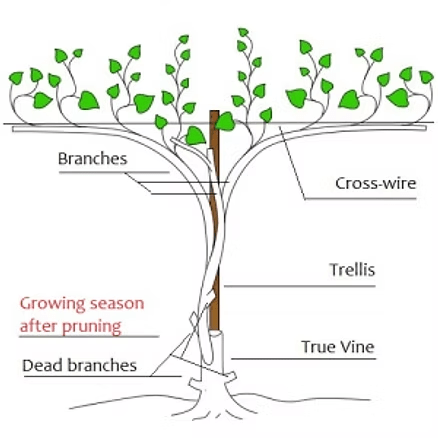
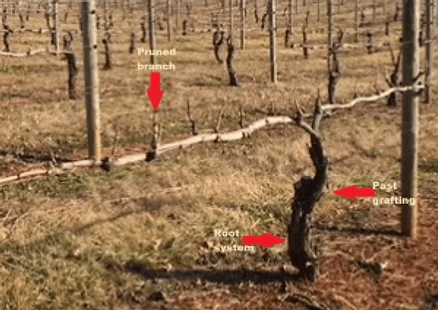
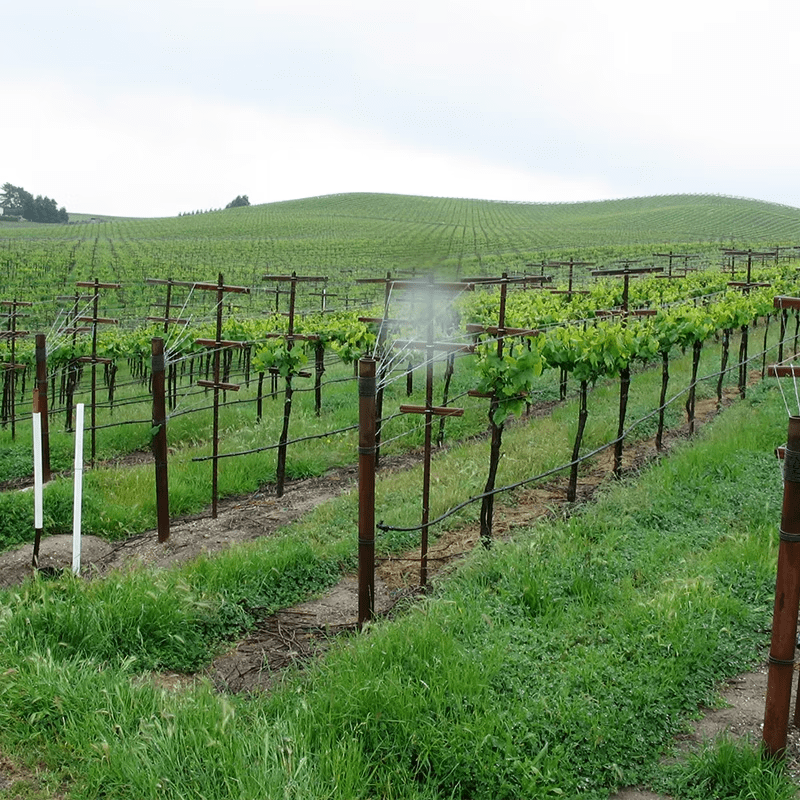
To say he is the “vine” is similar to Jesus saying he is the gate to the sheepfold. Both are self-contained, with limits, where the parameters or boundaries are of optimum value when those limits are full of purpose: a grapevine is full of grapes; and a sheepfold is full of sheep. This view of a “vine” being one (thus the “true vine,” implying others exist that are false), one can see how a vineyard is many grapevines together. Here is a diagram of one grapevine and a picture of a vineyard of grapevines in winter:
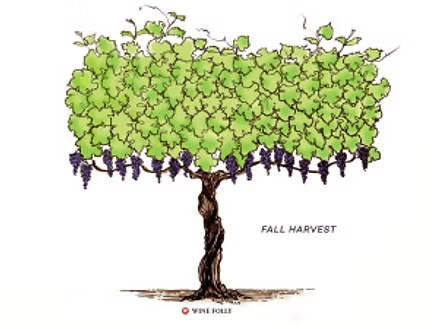
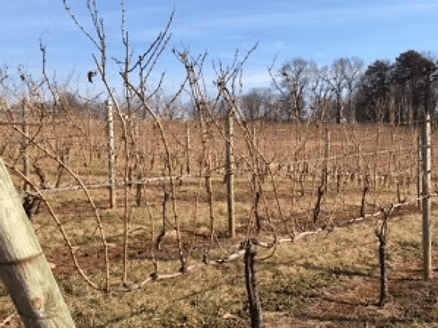
This imagery can then be used to see how the books of the Holy Bible tell of the previous harvests of good fruit, from Adam to Noah, from Abraham to Moses, and from David to the Prophets, with all being from the seed of God and the true vine of His Sons. In this reading from John’s Gospel, Jesus told his disciples how Jesus of Nazareth, the promised Messiah, was the true vine of God. He was speaking to the flowers that would soon bud into the branches that would produce his good fruit, the product of the Father. By understanding this terminology properly, everything Jesus told his disciples becomes crystal clear metaphor.

John remembered Jesus saying, “[The Father] removes every branch in me that bears no fruit. Every branch that bears fruit he prunes to make it bear more fruit.” This is routine maintenance of a grapevine that bears good fruit. As such, at the time Jesus said this Judas Iscariot was absent, having gone to betray Jesus. He was a branch that would never bear any fruit in the name of Jesus Christ. Judas would never submit his ego to God and become Jesus Christ reborn. He was pruned the day Judas hung himself from guilt. Still, the branches that would bear the fruit of Jesus of Nazareth – the Apostles – they would all lose their lives so more Apostles could be produced. They were pruned for the good of the true vine.

Here is a branch that was pruned so the vine could bear more fruit.

When Jesus then said, “You have already been cleansed by the word that I have spoken to you,” the word “katharoi” was used and translated as “cleansed,” and the word “logon” translated as “word.” This states in two segments, “Already you are pure [or clean]” and “by reason of the word that I have spoken to you.” The element of cleanliness loses focus on the metaphor of vineyard cultivation. The root meaning of “katharos” is “purity,” such that the example of grafting a shoot system (scion) to rootstock (the “true vine”), then the shoot will develop buds based on the root system. This means the “word” is the command of the true vine to regenerate cleanly from the rootstock, not from the root system the shoots were pruned, for the purpose of grafting. Thus, this verse told of Jesus informing his disciples their grafts had taken hold and they were then prepared for producing good fruit in the coming new season.
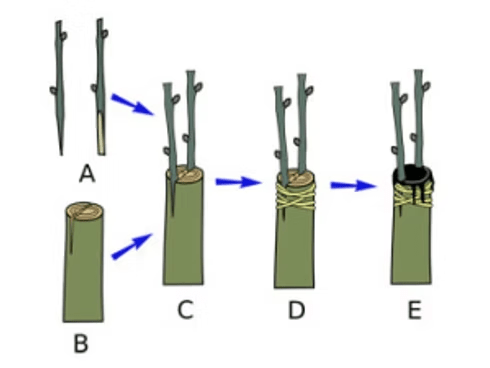
From common stock to disciples attached to the true vine to branches one with the true vine (Apostles).

“Abide in me as I abide in you” is then a statement that the eleven (and John) were no longer separate, but had become one (each individually) with Jesus. While all the disciples had mortal mothers and fathers, such that the DNA of those mortals was what made them reproductions in the likeness of their parents, they had become spiritually grafted to Jesus, whose Spiritual DNA was from the Father. Because of that linkage, the souls of the disciples were one with the soul of the Son of God, such that the Spirit of Jesus Christ was then within each of them.

Jesus then moved beyond this oneness to explain, “Just as the branch cannot bear fruit by itself unless it abides in the vine, neither can you unless you abide in me. I am the vine, you are the branches.” A branch (scion) that has been cut off from its root system is incapable of bearing fruit by itself. Once it is grafted onto good rootstock, the flow of growth is then passed onto the attached shoot (branch). The ability to bear fruit comes from the root. Since Jesus is the true vine (i.e.: rootstock for Apostles), his disciples were the newly budding branches, which were budding with the holiness of the Father, through the Son. Therefore, Jesus said, “I am the vine, you are the branches,” where each was grafted individually to the true vine.

It is important to grasp the implication of his next two statements. John wrote that Jesus said, “Those who abide in me and I in them bear much fruit, because apart from me you can do nothing. Whoever does not abide in me is thrown away like a branch and withers; such branches are gathered, thrown into the fire, and burned.” Rather than a statement of warning or threat, this was a statement of truth and fact. It goes beyond those who were gathered around Jesus, and well beyond the implication of Judas Iscariot being a discarded, as a withered branch.

These statements of Jesus say that the “true vine” is the only path to heaven and eternal life. Not only were the Jews not abiding in Jesus [as Jesus would soon be arrested by the Jews], neither were the Romans – who had their own religion that worshiped pagan gods. This truth says (without saying overtly) that no religion (as religion was known at that time) abode in Jesus, such that Islam (to come later, after Mohammed), Hinduism, Zoroastrianism, Buddhism, Taoism (or Daoism), Shintoism, etc., etc., and all forms of pagan worshipers all around the globe (monotheistic or polytheistic) are rootstock of death, not eternal life.

Because a religion is defined as “belief in and worship of a superhuman controlling power,” there is no “faith” that defines the process of a grapevine.  Just as Jesus was the “true vine of the Father,” there was no philosophy held by Jesus that defined what Jesus believed.
Jesus taught in parables that require one experience the meaning, rather than learn a set of rules to follow.  Because all ‘religions” fall into the error of belief in dogma, rather than being extensions (as reproductions) of the true vine, no “religion” seeks to become one with God.  As such, no “religion” abides in Jesus, who IS the true vine of God, the Father – the ONE GOD. Therefore, for Jesus to say, “Those who abide in me and I in them bear much fruit,” the whole world was, is, and is destined to be scions of false vines – the philosophical thoughts that act as “religion.”  The misled and misguided branches of philosophies will have to sever their shoots from their rootstock and seek to be grafted onto the Apostles … in order to become extensions of the oneness of true vine.

This broad stoke view of what Jesus said to his disciples should then be seen as John remembering a lesson for all who will sit and learn the lessons of Jesus Christ. The vast majority of proclaimed Christians around the world today are far from being branches that are producing the fruit of the true vine. The creation of branches within the “family tree” called “Christianity” (a religion), which veer wildly in many different directions, is not indicative of a grapevine producing fruit that carries the seeds of Sainthood. Instead, the millions who call themselves Christians seem to be at war with each other, more than simply being one with God’s love. It is more like the branches from the true vine have been pruned from truth and grafted onto false vine rootstock, making the present state reflect “Christianity” as weakened varieties of Jesus grapes, with none of them capable of producing good fruit.
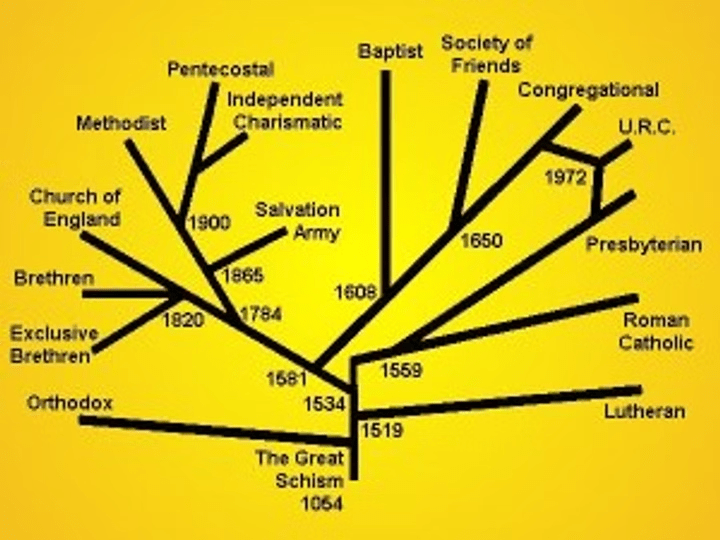
Does this shape resemble the grapevine T-cross?

In this regard, I recommend the reader here look up the term “Cathars” and get a grasp of the original concept of true Christian. Much of their history has purposefully been destroyed, due to the hatred held by the leaders of the Roman Catholic Church against the Cathar people. Their name (as a group of people) was not theirs, as if they chose that name to be new branch of Christians. The name comes from the Greek word seen earlier – “katharoi” – which means “pure.”

Others, those who called themselves Christians, came to know these people (who primarily lived in Southwest France between 1,000 and 1230 A.D.) as those who were “pure” in their devotion to God.  They acted as those who were reborn as Jesus Christ, possessing profound knowledge of the word spoken by Jesus. The Roman Catholic Church exercised their first act of genocide to kill the Cathar people, because they would not convert to Roman Catholicism. To justify the first of several crusades known as Inquisitions, the Church called the Cathar people heretics, accusing them of being dualists and Gnostics, whose ways of life were not consistent with those philosophies held dear by the Vatican. In reality (in my opinion), the Cathar people were those who had “already been cleansed by the word that” Jesus had spoken, because they were true vine reproductions of Jesus Christ and knew the deeper meanings of Scripture, unlike typical Catholics.

Look up the Albigensian Crusade (aka Cathar Crusade).

From this awakening, which says true Christians should have more in common with Judaic teachings, where the communal commitment the Cathar people had to one another was similar to that of Jews living separately from Gentiles, the Cathar people were together as a Church of reproductions of Jesus Christ, as those reborn of his Spirit.  Jews, on the other hand, represented those branches growing from the vine of Moses, only to have grown wildly along the ground of the Promised Land, losing the “purity” of the “true vine” that Moses offered the Israelites through Law. Western Christians have likewise become wild grapes, through the ground clutter of philosophies that place more emphasis on the equality of inferior vines and branches, rather than seeking to maintain the “cleanliness of the word of Christ.”  American Christians today live among multicultural people they barely know, where governments force them to accept principals that are contrary to the teachings of Jesus Christ.  Unlike the Cathars, American Christians readily convert to the will of empires, with few willing to die for the way of the true vine.

This destruction of the true vine model can be seen in the statement of Jesus to his disciples, which said, “If you abide in me, and my words abide in you, ask for whatever you wish, and it will be done for you.” The promise that “whatever you wish will be done for you” meant – that night in Jerusalem, following Jesus’ last Seder meal – “whatever miracles you need to be able to perform in my name” – as the good fruit of the true vine – “you will have the power of God the Father available to you.” Modern Christians have mutated this statement into a weakened promise that makes Jesus Christ out to be some magic genie in a lamp, where you make a wish for wealth and it will be granted. All wishes today are selfishly based, with no one trying to heal any of the ills of the world, one Gentile convert at a time. All of this failure is due to no one abiding in Jesus Christ and he in one as Jesus Christ, Without that state of being reached first, all wishes can ONLY BE selfish, thus never granted by the One God.

In the last verse of this reading, John wrote, “My Father is glorified by this, that you bear much fruit and become my disciples.” The literal Greek makes this easier to understand, in terms of having one’s wish come true. The first segment says, “In this is glorified the Father of me.” That clearly says that “In this” abiding in the true vine, so the true vine becomes one’s Spirit leading one’s soul, then God the Father has made all desires for Oneness with God come true. By saying, “the Father is glorified,” where “edoxasthē” (from “doxazó“) is translated as “is glorified,” the reward of that wanted can only come from the sacrifice of self-ego, in “honor” and “praise” of the One God having entered one’s heart (and soul). When Jesus said, “the Father of me,” the intent is for a disciple to feel the power of the LORD within, such that one has to seek to become a rebirth “of me,” via “the Father.” Therefore, all desires cease to be of selfish motivations, only being wishes to serve the LORD’s needs, where “the Father is glorified” by the obedience of His servant.

The second segment can then be read literally as, “that fruit much you should bear.” This means that a branch extending from the true vine will produce grapes filled with the word of the Lord Christ. The succulence of full grapes from the true vine is then due to the holy water that has coursed through the xylem of that vine. From root system to branch to fruit, everything is filled with the word of God. It becomes a repeating of holy water poured out as in the miracle of Cana, which tasted as the finest wine that is usually served first. By keeping in mind how this “living water” that tasted like fine wine was taken from “purification” jugs, one can then see how the wedding guests had been cleansed by the word Jesus had spoken (to fill the jars with water).

The miracle of the purification water tasting like good fruit goes well beyond the physical.  It signifies the fermentation of the soul.  This means the disciples will produce more disciples, all who will become Apostles.  This miracle is opposed to the norm seen in the various denominations of churches gathering. like guests coming to celebrate a would-be marriage.  The norm can only expect a tithing pew sitter, who knows nothing that glorifies the Father, to show success by recruiting another tithing pew sitter, who also will know nothing of the Father.

The reason is a tithing pew sitter is a selfish ego and not one possessed by God’s love, reborn as His Son, Jesus Christ – the true glorification of the Father.  Today’s churches can be said by the master of the banquet to be typical, as the best wine of Jesus in his Apostles was served first, until the world was drunk and unable to notice that poor wine is now pouring freely.  Today’s Christians mistake their drunken state as being the fine wine from good fruit that glorifies the Father, when so much more is expected.

Finally, the last segment says, “and you shall be disciples of me,” where the glorification of the Father comes from “disciples of Jesus Christ.” This does not mean those who ONLY learn of Jesus Christ as pupils are true disciples. It means those whose hearts are afire with learning the power of Scripture, so their minds are filled with the knowledge of God – the Christ Mind – are those who thirst for truth. The purpose of learning is not to forever claim student status, but to graduate and become the teacher. The teacher (rabbi) was and is Jesus, who enlightens his disciples with a desire to become the Christ Resurrected. This is the call to all who seek the promise of eternal salvation, as that reward demands commitment to learn (deeply) and to apply that “education” freely, so others who are seekers of truth can find it alive in other human beings.

As a Gospel reading during the Easter season, a season when all lessons are calling disciples of Jesus to become the Resurrection of the Christ, we must grasp the concept of the grapevine and the branches that come from the “true vine.” In Scripture is the crucial point in time, when Jesus turned to his disciples and said, “If anyone wishes to come after me, he must deny himself, and take up his cross and follow me.” (Matthew 16:24) That command needs to be understood in terms of this reading and the dressing of grapevines.

First, the word translated as “wishes” is the Greek “thelei.” The same root Greek word, “theló,” was written here in John’s Gospel, meaning “wish, will, desire, intend, and design.” The intent of the word is therefore not to offer one a “wish” fulfilled, but to ask one if he or she “seeks” God, as their “desire, will, intent, design, or wish.” This means Jesus told his disciples on the evening of the Passover Seder, “whatever your heart desires, it will be fulfilled.” The result may or may not be God and the Christ Mind – thus the wisdom of “be careful what you wish for, as you just might get it.” When Jesus told his disciple to choose their path, he said, “If you desire to become me, then you must sacrifice your ego [deny oneself] and accept my righteous goals.”

Second, when Jesus told his disciples the path to “follow him” required one “take up his cross,” there are two grapevine elements contained in those words. First, the Greek word “aratō” means, “take away,” but it also means “raise” and “lift up.” It implies “hoisting,” as well as “carrying” and “bearing.” This becomes a demand for the strengthening of a grapevine, where years of growth and the crafting of the vines along a cross-wire create a T-cross that is capable of bearing weight. In terms of Scripture being the word spoken by the Christ Mind, like a tendril of a vine, one should always be close to Scripture and ever-reaching to see its deeper meaning.  That reflects a design to reach the optimum height, so the shoot strives to be uplifted and amplified in strength.  A vine does not reach high due to a philosophy or written plan.  It does so naturally, so it can not only produce branches, but also so it can grow to support the fruit produced. In spiritual terms, being “raised” means to go beyond self (“deny self”) and “[be-]come” Jesus Christ “after” him. This “uplifting” is in soul Spirit, where Christ abides in one and one abides in Christ.

In reference to the Roman Catholic Church and their genocide of the Cathar people, one can see how this can be reduced to a level of symbolic focus. The Church reveres the crucifix and loves to nail the body of dead Jesus to dead wood – not a living vine. The original symbol of Christianity was the fish, which is associated with the astrological sign Pisces. Pisces represents self-sacrifice for a Spiritual reward. Therefore, to read Matthew 16:24 as if Jesus were telling his disciples to foresee his crucifixion as his end and the disciple’s time to follow on without him, that avoids the point of self-sacrifice (which may or may not be death by crucifixion) for a higher soul self (as Jesus reborn).
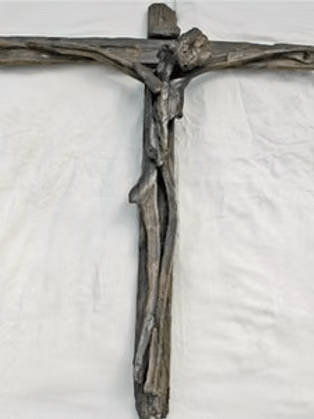

See how dead driftwood has been fashioned into a symbol that screams “dead branch”?
See the difference in imagery when we have become grafted onto a living cross within?

The second element in “take up his cross” is the word that translates as “cross,” which is “stauron.” It has been the teachings of the Roman Catholic Church that has taken this Greek word and absorbed its meaning into the dead timbers of a crucifix, as though the word solely means the pain and suffering of Jesus of Nazareth. The reality is “stauros” means “stake in the ground that forms a T.” The stake hold the cross-wire, which symbolizes the inner strength the Holy Spirit offers.  A crucifix forms a T, but many other T formations existed long before anyone figured out how to nail human beings to two dead tree trunks hewn and nailed together, in the shape of a cross. People cultivated grapevines into the shape of a T-cross well before the Romans saw that shape was strong enough to bear heavy weights. Thus, Jesus was telling his disciples to form a strong shape, just as he had shown through his strength in supporting his disciples and the Jews who sought him.

In this fifth Sunday in Easter, in the year 2018, this message to become branches of the true vine, as the fruit of the Father’s vineyard, goes along with the reading from Acts, where Philip produced good fruit in the Ethiopian eunuch. He did that be being tested in the wilderness, led by an angel of the Lord, where his strength was proved to bear the weight of Sainthood. It also accompanies the Epistle reading from 1 John, which defines God as love. The fruit of the Father’s true vine is the love of Christ, which is only found in true Saints – the fruit of the true vine.

The Easter call is to heed the word of Jesus and become “clean” and “pure.” One must be washed clean of past sins, in order to be given the reward of eternal salvation. To desire that reward, one must be a living branch of the true vine and produce good fruit. To be a living branch, one must be resurrected as Jesus Christ, so he abides in one, as one abides in him.

The purpose of Jesus dying on a cross was to show his disciples how death is not a permanent state of being, as a soul can never die. The soul will graft itself to another root system and be reborn according to that root-stock. Therefore, the purpose of the seven Sundays in the Easter season is to drive home the point that it is not enough to let Jesus die and be Resurrected, then Ascended. Christians miss the point of the price they too must pay.  If they do not follow that same path to salvation, by being reborn as the fruit of Jesus Christ, they will lose as fruitless branches thrown into the fire.
John 17:6-19 – Jesus prayed for his disciples

Jesus prayed for his disciples, “I have made your name known to those whom you gave me from the world. They were yours, and you gave them to me, and they have kept your word. Now they know that everything you have given me is from you; for the words that you gave to me I have given to them, and they have received them and know in truth that I came from you; and they have believed that you sent me. I am asking on their behalf; I am not asking on behalf of the world, but on behalf of those whom you gave me, because they are yours. All mine are yours, and yours are mine; and I have been glorified in them. And now I am no longer in the world, but they are in the world, and I am coming to you. Holy Father, protect them in your name that you have given me, so that they may be one, as we are one. While I was with them, I protected them in your name that you have given me. I guarded them, and not one of them was lost except the one destined to be lost, so that the scripture might be fulfilled. But now I am coming to you, and I speak these things in the world so that they may have my joy made complete in themselves. I have given them your word, and the world has hated them because they do not belong to the world, just as I do not belong to the world. I am not asking you to take them out of the world, but I ask you to protect them from the evil one. They do not belong to the world, just as I do not belong to the world. Sanctify them in the truth; your word is truth. As you have sent me into the world, so I have sent them into the world. And for their sakes I sanctify myself, so that they also may be sanctified in truth.”

——————————————————————————–

This is the Gospel reading selection from the Episcopal Lectionary for the Seventh Sunday of Easter, Year B 2018. It will next be read aloud in church by a priest on Sunday, May 13, 2018. This is important as it is a prayer submitted to the Father, by the Son, for his children to be accepted as his fruit of the vine. This not only applied to the disciples close to Jesus of Nazareth, who would become Saints as Apostles, but to all who would be born of the true vine afterwards.

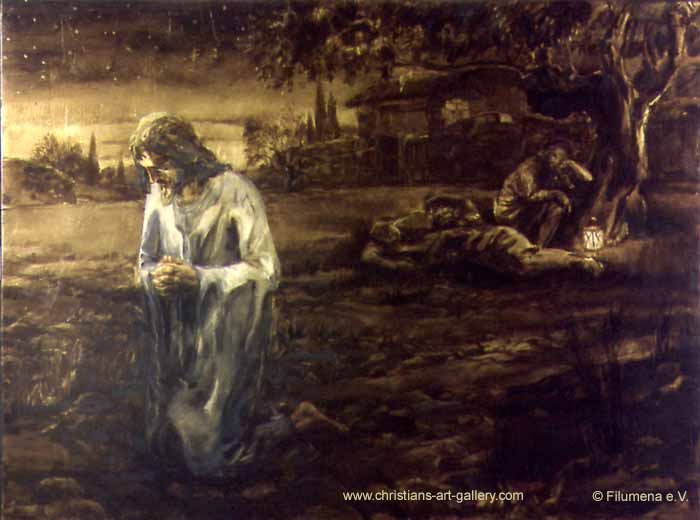
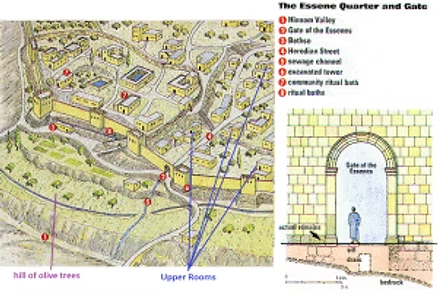
Let me first state that this reading led me to write a companion piece that details the last hours of Jesus’ ministry, prior to his arrest. This prayer that sometimes has the title applied, “Jesus Prayed for His Disciples,” is not stated by John as to where it occurred, although it was after Jesus led his followers out from the upper room, after the Passover Seder meal and ritual was completed. This prayer took place on a hill that had olive trees on it, just outside the Essenes Gate of Jerusalem.

The above graphic has been modified (by me) to show how the known general area of the Upper Room and the easiest exit point from the city of Jerusalem.  The graphic is part of an article on Jerusalem’s Essenes Gate, written by Bargil Pixner and published by Century One Foundation.  With little question about the Upper Room being in the Essenes Quarter, and with the Essenes known to be a sect of devout Jews (along with the Pharisees and Sadducees), it is easy to see how some believe that Jesus was a member of that sect.  The only point I wish to make here, relative to the place where Jesus prayed for his disciples, is Luke, Matthew, and Mark all agree that Jesus left the upstairs room and went to the Mount of Olives (more literally a “hill of Olives”).

This prayer for his disciples was amid prayers for his glorification and for all believers (all of John 17).  Following this, John wrote that Jesus took his disciples to the garden across the Sidron Valley, which was Gethsemane.  This would indicate that John’s account of Jesus praying preceded the prayers of pain and agony that Jesus was witnessed to have prayed in the garden at Gethsemane (by the other three Gospel writers). To get an in-depth perspective of the flow of movement, after the disciples were led away from the Upper Room, please read my account of The last four or five hours that preceded the betrayal and arrest of Jesus of Nazareth if you want to know more about this topic.

Let me also add that John wrote of conversations Jesus had with his disciples, prior to John recording the prayers of Jesus.  From the perspective of the map above, get a mind’s eye view of Jesus and his male followers (including John) leaving the Upper Room and meandering their way through the Essenes Quarter, before exiting at the Essenes Gate.  Because it is not clearly stated, it becomes natural to see the disciples carrying a jug of wine with them (the Seder tradition to drink until you pass out) and drinking as Jesus talked to them (drinking being why they did not recall to write about those lessons).  As the Seder ritual would have been celebrated in the same way, throughout all of Jerusalem, it would seem logical that Jesus and his followers met and shared wine with other Essene Jews who were likewise outside on a spring evening.  After an hour or so milling about, Jesus and John excused themselves to go among the olive trees on the hill that overlooked the Hinnom Valley, so Jesus could offer the prayers John of which John wrote.

It is important to realize that the entirety of chapter 17 in John’s Gospel tells of Jesus praying. Verses six through nineteen are of Jesus praying for his disciples. The verses prior are for Jesus to be glorified by God, and the verses following are of Jesus praying for all believers. The fact that John dedicated an entire chapter to the prayers of Jesus, whereas the other Gospel writers make mention of Jesus praying on a lesser degree, sets John apart from the other Gospel writers … in more ways than one. I address that in the other article.

In the same way, John wrote chapter 14, which told of lessons given to the disciples that no other Gospel writer wrote of.  It was in that chapter that Jesus said there were many rooms in the Father’s house, and he was going there to reserve one for them.  Philip said (basically), “You never told us where your father lived.”  That was a sign of drunkenness.  At the end of chapter 14, John indicated Jesus said to the disciples, “Come now, let us leave,” (John 14:31d) which meant they either left the Upper Room then, or they left the Essenes Quarter, going outside the Wall of Jerusalem.

Once outside, John wrote chapters 15 and 16 that was Jesus telling his disciples that their future was bright, with nothing to worry about.  Still, because none of the others recorded those pep talks in the other Gospels, the disciples were struggling to think clearly, plus the later it got the sleepier they became.  Outside the Essenes Gate, Jesus could have broken away from the group with ease, leaving them to talk amongst themselves and also relieve themselves of their wine at the sewage channel just off the path.

Here, in chapter 17, John recalled prayers said by Jesus, with none here duplicated in another Gospel.  This omission should not be seen as if John was making things up or remembering things out of sequence.  Rather, John has to be seen as the one follower that was not drunk.  He was not drunk because he was not an adult.  He followed Jesus as a close family relation, who carefully listened to everything Jesus said.  John was excited to be walking with the adults, as part of the Seder late evening experience, while the disciples were falling asleep from drunkenness (or still drinking Seder wine).

In this scope of John’s chapter 17, looking only at his prayer for his disciples, the character that was John is totally removed. The reader has become the one overhearing this prayer, as if one has become John. We are allowed to be close to Jesus at an intimate time of prayer with God.  The reader of this prayer should consider him or herself one of “his disciples,” for whom Jesus prayed, while also seeing oneself as a child of Jesus that thirsts for the knowledge of God that comes from Jesus.

With that in mind, it is important to grasp the first verse. When Jesus said, “I have made your name known to those whom you gave me from the world,” this does not mean Jesus told a group of heathens who the One God is.  When Jesus then stated, “They were yours, and you gave them to me, and they have kept your word,” he clarified that his disciples were ALL Jews (Israelites in good standing), who sought to serve the LORD faithfully, and they had adhered to the laws set forth by Moses.

The disciples were ALL looking for the promised Messiah to serve the LORD through, as the followers of God’s Christ.  God had led Jesus to find those men of devotion. Therefore, the “name” that was God’s “name known” IS the Messiah of God – the Christ.  As the Messiah, Jesus proclaimed the title Son of Man and that was made known to his disciples.  Jesus was the Son of the Father, thus the Son of God, a name made known.  All that Jesus made known to his disciples was through words and deeds – lessons and miracles – assignments given and real encounters witnessed.

At that point in time, as Jesus knew his time of ministry was concluded and he would soon be taken from his disciples, Jesus told God, “Now they know that everything you have given me is from you.” Jesus had repeatedly said that he did not speak for Jesus of Nazareth, but for the Father. The ego of Jesus had been subjected to the Will of God.  Jesus had explained that the Father was in him, just as his human body was the seat of the LORD. The disciples had been told that everything from the Son comes from the Father. This was confirmed by Jesus praying, “For the words that you gave to me I have given to them, and they have received them and know in truth that I came from you; and they have believed that you sent me.”

When Jesus next said, “I am asking on their behalf,” this is the true power of prayer – for specific others. Jesus said he was not praying for the whole world to find benefit from God’s Son sending forth a prayer on such a broad scope. Jesus clearly stated that his prayer was for the disciples “whom God gave Jesus,” because they too were God’s, as the children of Jesus. For Christians today, a prayer of this nature is the cement that bonds the parts of the Church of Christ to that one cornerstone that is Jesus Christ. A child of Jesus Christ’s – as a Son or Daughter of the One God – should pray specifically for others who are also in the name of Jesus Christ.

Selfishness prays for those the ego deems politically correct, just as the Pharisee proudly prayed aloud in the Temple – “Thank you God for making me me and not that loser over there!”  Think about how that applies to priest who pray for the equal rights of everyone in the world – those other than Christians, Christians who need someone praying for them, whose “equal rights” are ignored.  When in the name of Jesus Christ one’s prayers are specifically directed, for specific purposes that fit the Will of God, not the philosophical brains of mankind.

To be able to see the future implications of this prayer (where we today are the focus), Jesus then told God, “All mine are yours, and yours are mine; and I have been glorified in them.” That statement goes far beyond eleven drunken disciples who were most probably sitting on the ground or leaning against the Wall of Jerusalem, arguing about who was more important to Jesus or dozing off from being tired. The Holy Spirit had not yet come upon those who were to be of Jesus, as he was of God. Still, those buds of fruit on the most holy vine (what John remembered Jesus saying in John 15:1-8) would become the glorification of Jesus Christ … as him born again, again and again, to this day onward.

Jesus had told his disciples about the seed (a kernel of wheat) that must die so that its fruit could come forth (John 12:24). Now he confessed to his Father, “I am no longer in the world, but they are in the world, and I am coming to you.” That was an admission that the words given to Jesus, by the Father, were soon to be fulfilled. There was no further ministry on earth for Jesus to command, in the human form that was his body. The disciples would fill that need in the future.

Rather than the world missing one Jesus of Nazareth, there would soon be many Christs following him.  This is as Jesus said, “Holy Father, protect them in your name that you have given me, so that they may be one, as we are one.” That protection would be their duplication – the Resurrection – of Apostles in the name Christ. Just as Jesus of Nazareth had been in the name of Christ, the name given to him by God, so too would God give the Saints of Jesus Christ the same oneness. Their souls would be filled with God’s Holy Spirit and their brains with the Mind of Christ, and true Christians would spread across the face of the world.

Jesus then prayed, “While I was with them, I protected them in your name that you have given me. I guarded them, and not one of them was lost except the one destined to be lost, so that the scripture might be fulfilled.” That says that Jesus in the flesh, as the Son of God incarnate among men, was the protection of the Christ for the disciples and followers of Jesus of Nazareth. That presence guarded the children of Anointment, as would wild beasts protect her young from external threats. Protection comes from love.

Jesus had just earlier said (after they had left the Upper Room) that there was no greater love than could be shown for a friend, such that he would lay down his life for his friends (John 15:13).  That was his commitment to protecting his followers. Jesus would then continue to provide his protection through the love of God and the transformation of disciples into Apostles, all surrounded by the Spirit of Anointment.

The one he had lost was Judas, who was necessary to lose; and the betrayal by Judas was prophesied (Psalm 41:9). Jesus would repeat this statement made in prayer – that the prophets might be fulfilled – upon his arrest that would come.  Recorded by Matthew and Mark … Jesus said, “This has all taken place that the writings of the prophets might be fulfilled.” (Matthew 26:56a)

Jesus then said, “Now I am coming to you, and I speak these things in the world so that they may have my joy made complete in themselves.” This conforms that Jesus is asking the Father to enter the hearts of those who wanted so hard to please God, but had never had someone to show them the way to God’s love. The words “my joy made complete in themselves” means Jesus Christ will be the reborn as a result of the disciples’ marriage to God.

Just as Jesus was married to God, with God’s love filling his heart, Jesus was assured eternal life. God’s gift of complete Salvation was the joy of Christ in the disciples’ souls. That was the promise made to the disciples of Jesus, where not long before he told them, “In My Father’s house are many dwelling places; if it were not so, I would have told you; for I go to prepare a place for you. If I go and prepare a place for you, I will come again and receive you to myself, that where I am, there you may be also.” (John 14:2-3) The promise made, in words in this world, was to be rewarded in Heaven.

When Jesus said, “I have given them your word, and the world has hated them because they do not belong to the world, just as I do not belong to the world,” he was making reference to the training ministry the disciples had been sent out to experience. The “great commission” was an exercise of one’s commitment, to go and tell other Jews (Israelites), “The kingdom of God has come near.” (Matthew 10:7) That meant the disciples were bearing the presence of the Holy Spirit in a world of faithless doubt. Those who proclaimed to know the word and be close to God were hated by those who were stubbornly lost. That natural response was due to a Saint belonging in Heaven, not on earth. It was why Jesus was rejected and soon would be killed (with the Apostles all to face the same fate).

Jesus knew that his disciples would have similar futures. Therefore, he prayed, “I am not asking you to take them out of the world, but I ask you to protect them from the evil one.” That meant there would be no Greek tragedy theatrics, where a angel of god would rush in and save a hero from a terrible end. Likewise, Jesus would not be swept away by his Father, to prevent the Son from crucifixion. That escape would mean no resurrection could be possible, with Heaven not a greater reward than life on earth. The only thing Jesus sought for his disciples (Judas excluded) was for none of them to fall to the temptations of Satan. That test would come in their futures, and God would answer this prayer by having the disciples all become graduates to Sainthood.

When Jesus said, “They do not belong to the world, just as I do not belong to the world,” the reason is their hearts and souls had been purified and glorified by God. They all belonged in Heaven, through eternal salvation. Their souls had been baptized by the Holy Spirit that was Jesus the Anointed one.  They were in the world to bring others to that same state of not belonging in the world. One stops belonging to Satan, when one starts belonging to God, as Jesus reborn.

To belong in Heaven is to be pure of soul, with no tarnishing of sin remaining. Jesus prayed to God, “Sanctify them in the truth; your word is truth.” The truth is the Word of God, which is only partially spoken in the Holy Bible. The truth goes beyond the words that can be written, spoken, or thought by human brains. The truth comes from the Godhead, accessed by the Mind of Christ. To reach that state where the truth is available to one, one has to be completely pure. The only human being to have such perfection is Jesus of Nazareth, because he was the Messiah. Thus, all subsequent servants of the LORD must have their souls purified by the Resurrection of Jesus Christ within those souls. It means only souls in the name of Jesus Christ go to Heaven to be with God.

Jesus then ended his prayer for his disciples by saying, “As you have sent me into the world, so I have sent them into the world. And for their sakes I sanctify myself, so that they also may be sanctified in truth.” This states that the model of perfection will forevermore be that of Jesus Christ, whose life would be written of in a New Testament. All true Christians are to become just like Jesus of Nazareth, in the sense that they abide by the Will of God (His Law).

It is impossible to reach that level of perfection when one fails to sacrifice self and ego in a marriage to the LORD that calls for absolute subservience. Anything other than that would equate to “too many chiefs and not any Indians.” This prays that all subsequent disciples of Jesus Christ will understand the soul’s need to be baptized by the Holy Spirit, which brings about sanctification. Sanctification does not mean “a pretty good dude,” “a fine statesman,” or “a big benefactor to a religious organization.” It means obedience to God’s Will … totally and completely.

As one can see, this prayer is in no way spoken by a troubled spirit. There was no worry in Jesus when he prayed to the Father to bless those who would be reborn as Jesus Christ. John wrote this in a sequence of events that preceded Jesus leading the disciples to Gethsemane, the garden across the Kidron Valley. It fits the other Gospels that say Jesus took the disciples to the Mount of Olives, outside the Upper Room.

Jesus would not have made this prayer be overheard by his disciples, as some grandiose public gesture. John witnessed a private moment of prayer.  Jesus’ prayer for his disciples was said in solitude, with only one young boy close enough to hear his words. Unlike this calm and serenity, the prayers coming from Jesus as Gethsemane were troubled and agonizing, for Jesus to be given the strength to withstand his mortal end.  John did not record any troubling prayers from that garden, as he was not close enough to Jesus then to overhear any (unlike John of Zebedee).

As a Gospel reading in the Easter season, when the call is to have Jesus resurrected within oneself, one needs to see oneself as who Jesus was praying for. The call of his prayer asks for you to find God as your protector, such that your heart will open to His love, giving birth to the Christ Spirit within. Without being resurrected as Jesus Christ, one is not sanctified, thus one is still unworthy of Heaven. The call is to become righteous, so one no longer belongs in this world for selfish reasons. The call is to go forth and announce to the world that the kingdom of God has come near … in you.

As the final Sunday in the Easter season, the next step is to be filled with the Holy Spirit. That personal event becomes one’s own Pentecost. Pentecost is the ordination of a priest that serves the One God as Jesus Christ.  Pentecost signals when one’s ministry begins in earnest, just as Moses came down with the Laws that forevermore must be maintained.  Jesus has prayed to God for you. May you be ready to heed the calls.

John 15:1-8 – The fruit of the vine made of truth

Jesus said to his disciples, ”I am the true vine, and my Father is the vinegrower. He removes every branch in me that bears no fruit. Every branch that bears fruit he prunes to make it bear more fruit. You have already been cleansed by the word that I have spoken to you. Abide in me as I abide in you. Just as the branch cannot bear fruit by itself unless it abides in the vine, neither can you unless you abide in me. I am the vine, you are the branches. Those who abide in me and I in them bear much fruit, because apart from me you can do nothing. Whoever does not abide in me is thrown away like a branch and withers; such branches are gathered, thrown into the fire, and burned. If you abide in me, and my words abide in you, ask for whatever you wish, and it will be done for you. My Father is glorified by this, that you bear much fruit and become my disciples.”

——————–

This is the Gospel selection for the fifth Sunday of Easter, Year B, according to the lectionary for the Episcopal Church. This reading will be preceded by the mandatory reading from the Acts of the Apostles [chapter 8], which states: “Then Philip began to speak, and starting with this scripture, he proclaimed to him the good news about Jesus.” That is followed by a selection of verses read from Psalm 22, which sings, “My praise is of him in the great assembly; I will perform my vows in the presence of those who worship him.” Then, the Epistle selection will immediate be read before this, where John wrote in his first letter, “Those who say, “I love God,” and hate their brothers, are liars; for those who do not love a brother whom they have seen, cannot love God whom they have not seen.”

In this reading, it is important to realize the setting. John’s chapter 13 ended with Jesus, his disciples and John leaving the upper room in the Essene Quarter of Jerusalem, where they would then exit the gate and begin a downward trek, towards Gethsemane. The disciples, all being adults, were drunk on Seder wine and some may still be drinking wine taken along with them, because the tradition of the Seder meal is to stay awake as long as possible, while drinking ceremonial wine. This would be why none of the disciples could stay awake at Jesus’ hour of need, later to come. John, however, being a boy still, was not allowed to drink the alcoholic wine, so he was wide awake and listening to everything his father, Jesus, said to him. As such, John wrote four chapters that recite what Jesus said, while neither Matthew or Mark [present as the disciples Matthew and Peter] wrote anything that elaborates what Jesus said to them, between leaving the upper room and the arrest of Jesus.

With that understood, it is the Episcopal Church that has added the words that begin this reading, as John did not write, “Jesus said to his disciples.” While it should be intuited that Jesus spoke in their presence, the fact that the twelve were all ‘drunk as skunks’ says it is more probable that Jesus spoke for John’s benefit, knowing he would record this for prosperity [including his prayers for his disciples, himself and the world]. Therefore, it is misleading to add that introduction, as it implies the disciples were attentive and listening for another lesson from Jesus, when they were not; they were incapacitated at that time and Jesus knew that.

When the NRSV says Jesus spoke, saying “I am the true vine, and my Father is the vinegrower,” this is the simple translation that misleads. While the full truth is openly stated, it becomes missed because of the rules of ordinary language. When one realizes this is divine language written by John, the written Word says something more powerful. This begins by realizing the first word, “Egō,” is capitalized, making it be divinely elevated in meaning. This word clearly states “I,” but when divinely elevated it must be read as Yahweh speaking through His Son, meaning “I.”

By seeing that, the second word, “eimi,” is a word stating “existence,” where “am” is connected to Yahweh’s state of being, as “I am.” Seeing this becomes another identifying statement of Yahweh, who told Moses to tell the Israelites “I AM THAT I AM,” when Moses was sent to set them free. In that sense, it should be realized that Yahweh did not separate Himself from Moses, such that Moses became the manifestation of God on earth, so he could state “I am” is here as “that I am,” meaning the duplication of “I am” says Yahweh is within a human’s flesh, married to the soul attached to that flesh. In that way, Jesus was also like Moses, who said he spoke for the Father, not for himself. That submission of self [the “I am”] means Yahweh was speaking these words, through His Son.

Next, it is syntactical rules that cause English to take the Greek that literally says “vine true” and reverse that so it says “true vine.” What is a “true vine”? That translation weakens the truth, where Yahweh is saying, “I am this vine” [“Egō eimi hē ampelos”], which says Jesus is the vine of Yahweh. It is then that “vine” that is the channel of all “truth,” such that “hē alēthinē” says “this vine” is “this made of truth.” Because Jesus is the manifestation of Yahweh on earth, he is a tendril of “God’s truth” to the world.

While it can be argued that Jesus saying, “I am the true vine” says that [and the simple is still the truth, just not fully realized], the following comma, immediately followed by the word “kai,” says to translate “and” is a mistake. The first segment makes a separate statement that next needs to be importantly emphasized as Yahweh adding, “he Father of me” [from “hoPatēr mou”]. That importantly says Jesus is “this vine made of truth” because he is the Son of Yahweh, who made Jesus for that purpose.

Seeing the word “Patēr” capitalized is evidence of a divine elevation, beyond the simple word “father.” The capitalization allows the reader to know “Father” is a reference to Yahweh [God], which links back to “I am,” but “Father” becomes a necessary statement of the great “Progenitor,” whose spiritual presence has created the Son. Without Yahweh within one, merged with His Holy Spirit, the flesh is simply another human in the world. Simple humans have souls of animation breathed by Yahweh, giving the appearance of life in dead matter; but simple human beings cannot call God their “Father.” That is the lesson Yahweh is teaching through His Son.

Following a comma, the next segment of words says “this Father” is “this vinedresser existence” [from “ho geōrgos estin”]. In that, the word “geōrgos” is defined as “a husbandman” [in addition to “vinedresser”], with its usage implying “a worker of the soil, husbandman, farmer, farm-laborer, vine-dresser.” That says that Yahweh is the worker of “this vine of truth” that is Jesus. The word “estin” is the third person singular form of the verb “eimi” [seen in “I am” – “Egō eimi”], meaning the “existence” of Jesus, as the vine of truth, is due to the “work of the Father.”

The first verse of this reading is vital to fully grasp as Yahweh speaking through the Son, explaining that Yahweh made the “vine” and tends the vine [“the vinedresser”], so the “vine” is “made of truth.” The metaphor of grapevines and a vineyard owner is stated; but it is imperative to understand the reality of Yahweh saying He is the “Father” of all who grow from His “vine made of truth.”

With that understood, verse two then says, “He removes every branch in me that bears no fruit.” This becomes a statement about the “vinedresser,” such that a good “husbandman” tends to the plants so they become most productive. Therefore, “Every branch that bears fruit he prunes to make it bear more fruit” says the Father expects production and nothing less.

In verse 3, Yahweh says through Jesus, “You have already been cleansed by the word that I have spoken to you.” This becomes a statement about the preparation of the disciples, so they will bear fruit. This is an important statement, as the disciples had followed Jesus for three years, absorbing [not learning] the care of the Father, as their “husbandman.” The “vine made of truth” that was Jesus can then be seen as having twelve nodes appearing on him, as about to leaf and bud, as a natural development from divine caretaking. This means “the words that I have spoken to you” is the watering, which is most deeply relative to the flow of truth coming from Yahweh, through the vine, so the nodules are prepared through inner nourishing to burst forth, as fruit.

When verse 4 begins by stating, “Abide in me as I abide in you,” this is again the Father speaking through the Son, so the disciples have the same source of truth within them as Jesus has. This then led Yahweh to say, “Just as the branch cannot bear fruit by itself unless it abides in the vine, neither can you unless you abide in me.” This says all must be alive in Yahweh, as there can be no fruit produced without His presence within. Not having Yahweh within one’s being means one is dead, not living. Death is metaphor for a mortal existence, such that life means one’s soul has become one with Yahweh.

In verse 5 is repeated the words that say, “I am the vine, you are the branches.” Again, “Egōeimi hē ampelos” is written, which restates Yahweh [“I am”] is the source of “this vine.” A semi-colon then begins a relative statement, which says, “you [are] these branches,” which are relative to “the vine” of Yahweh. While it is easy to paint a picture of Jesus speaking to twelve disciples, such that “I” and “you” become limited to those thirteen human beings, the importance comes from understanding Yahweh is the one speaking. When one hears that voice, then one can grasp how His words are speaking to all, at all times subsequent [including today], where Yahweh is the “vine made of truth,” which flows within as the blood of His Son, where one’s soul is cared for and prepared so all who become growths of Yahweh’s “vine” will be His “branches.”

With that understood, Yahweh then continued in verse 5 to say, “Those who abide in me and I in them bear much fruit, because apart from me you can do nothing.” That says all disciples who will be reborn in the name of the Son, as Jesus renewed through the branches, producing “much fruit.” Only those reborn as Jesus will produce the fruit of “the vine made of truth.” By saying “apart from me you can do nothing,” this repeats the prior statement that said, “He removes every branch that bears no fruit.” One is “apart” because one has been “pruned” for being fruitless.

That leads to verse 6 saying, “Whoever does not abide in me is thrown away like a branch and withers.” In that, the Greek word “exēranthē” is translated as “withers,” when a better translation would be “wastes away” or “dries up.” That imagery projects the flow of Yahweh’s “truth” as having been denied or blocked. Without that inner source of life, a branch produces no green growth; therefore it becomes pruned. That leads to the related statement, which says, “such branches are gathered, thrown into the fire, and burned.”

The metaphor of burning must be seen as a judgment of condemnation of a soul. Because the “vine” is Yahweh, there can be no flaw of His perfection that will cause a branch to wither and be pruned. This then says that the branches that become “dried up” and “wasted away” have done so of their own accord. Here, it is important to know that Judas Iscariot [although not present for this analogy spoken] was a branch that had been prepared by the words spoken by Yahweh through His Son. Those words of “truth” fed all who listened to Jesus speak the words of the Father. Still, some denied that flow of truth to bring life to their souls, so their denial of the truth would become their condemnation, where the metaphor of burning of dried plant branches means reincarnation.

This then leads to Yahweh saying through Jesus, “If you abide in me, and my words abide in you, ask for whatever you wish, and it will be done for you.” Here, the element of “made of truth” and “cleansed by the words I have spoken” becomes a way of saying the fluid that flows through the “vine” of Yahweh is His Word. His Word gives life to dead matter. His life produces “much fruit.” This can only come from having consumed the Word and drank the blood of Jesus, becoming a reproduction of the Anointed one of Yahweh. When one has been reborn as the Son, everything one needs will be freely given. That is repeating the care of the “vinedresser.”

This reading then ends with Jesus saying, with the approval of the Father, “My Father is glorified by this, that you bear much fruit and become my disciples.” In that, the Greek word “edoxasthē” is written, which means “is glorified.” This is one of those words that has such nebulosity that everyone hears it or reads it and can only understand it as a good thing, but little more than that.

The root Greek word “doxazó” means, “to render or esteem,” with the implication being “to bestow honor.” The first person applies “is” to this verb,” which needs to be seen as the one receiving the truth of Yahweh is the one “being glorified.” Yahweh, as God Almighty, needs no “glory” given to Him, as He is the source of all “glory.” Thus, the literal Greek text makes this clearer.

Written by John is this: “en toutō edoxasthē ho Patēr mou,” which literally translates to say, “in this is glorified that Father of me.” The word “this” reflects back to one wanting and receiving. That means “in” is the Holy Spirit within one’s being, “in” one’s soul. When that presence is “in,” then one has received what it wanted. That then projects forward to “this is glorified,” where one receiving the Holy Spirit becomes the “honor bestowed” by Yahweh to the recepitent. That glory is the the ability for one to claim Yahweh as “that Father,” because the presence of Yahweh has made the recipient “of me,” reborn as Jesus.

When this says, “you bear much fruit,” this sets the expectation that each of the disciples will become extensions of the “vine made of truth,” which says they will be branches that will be the resurrection of Jesus. Just as a gardener knows the techniques of taking a cutting from a living plant and making it becomes a separate plant, that separate plant will still be the same plant as that from which it was cut. Thus, in the same way that Jesus was a cutting of His “vine made of truth,” so too will each of the disciples, in the same way that he bore the fruit of his devoted followers – all filled with the Word of the Father – also bear the same amount of fruit, or more, individually.

When this ends by Yahweh saying, “kai genēsthe emoi mathētai” or importantly “you will be of me disciples,” that can be confusing, when one hears Jesus telling his disciples that they will be still disciples of his. The truth comes from hearing Yahweh telling the disciples of Jesus, who had been prepared to become each a new “vine” like Jesus, that when they bear fruit they will be just like Jesus resurrected [who, at that point, was still alive, still not even under arrest]. That says Jesus was a “disciple” of Yahweh, as Yahweh was the Master and Jesus was the “pupil,” who always spoke only what the Father told him to speak. Seeing Yahweh telling branches prepared to produce good fruit they would be His “disciples,” says they will all be new ‘cuttings’ of Jesus, planted separately to do the same as he had done.

As the Gospel choice of the fifth Sunday of Easter, a season when preparation for ministry is the point, Jesus was speaking what the Father told him to speak, in preparation for those disciples of his to enter ministry. Entering ministry is when one bears fruit for Yahweh. All of those who stood or sat as drunken Jews, while Yahweh spoke through His Son, had been married to Yahweh when they signed on as students who followed Jesus all around. They had demonstrated their faith, even though they were clueless about everything Jesus said. That ‘watering by the word’ was preparing them to take bloom and produce fruit.

Once a branch has proven capable of producing fruit [on Easter Sunday they received the Spirit], it can then be cut and replanted, again under the care of the “husbandman” Yahweh. That replanting is when they are ready to enter the world as a new Jesus, extending the “vine of truth” so others will develop as “branches” and produce fruit – a continuous cycle of new growth.