Jesus said to his disciples, “When the Advocate comes, whom I will send to you from the Father, the Spirit of truth who comes from the Father, he will testify on my behalf. You also are to testify because you have been with me from the beginning.
“I did not say these things to you from the beginning, because I was with you. But now I am going to him who sent me; yet none of you asks me, ‘Where are you going?’ But because I have said these things to you, sorrow has filled your hearts. Nevertheless I tell you the truth: it is to your advantage that I go away, for if I do not go away, the Advocate will not come to you; but if I go, I will send him to you. And when he comes, he will prove the world wrong about sin and righteousness and judgment: about sin, because they do not believe in me; about righteousness, because I am going to the Father and you will see me no longer; about judgment, because the ruler of this world has been condemned.
“I still have many things to say to you, but you cannot bear them now. When the Spirit of truth comes, he will guide you into all the truth; for he will not speak on his own, but will speak whatever he hears, and he will declare to you the things that are to come. He will glorify me, because he will take what is mine and declare it to you. All that the Father has is mine. For this reason I said that he will take what is mine and declare it to you.
——————————————————————————–
This is the Gospel selection from the Episcopal Lectionary for Pentecost Sunday, Year B 2018. It will next be read aloud in church by a priest on Sunday, May 20, 2018. This is important as it tells how Jesus perfectly prophesied the coming of the Holy Spirit into his devoted disciples, telling them how they would become the extensions of Jesus Christ in this world.
When reading John’s chapters fifteen, sixteen, and seventeen, it is always important to realize that Jesus was addressing his adult male disciples (which included Peter and Matthew). Jesus was addressing them about important matters that were soon to come into their lives, after Jesus had left them; but none of these conversations were recorded by either Mark (Peter’s story) or Matthew. The reason is that their minds were clouded by Seder wine; and as it was late into the night watch, they were too weary to properly focus on what Jesus was saying. John, on the other hand, had nothing impairing his abilities to concentrate on his master’s every word, because John was too young to drink alcoholic beverages. Thus, we read those chapters from John’s Gospel because they are lessons intended for the disciples that would later in history … hundreds and thousands of years later.
All of the flesh and blood disciples of Jesus of Nazareth would come to realize (if not remember) the lessons of that Passover night, recorded by John. They are true words spoken, recalled by John as “the Spirit of truth.” None of the disciples would counter anything written by John, as what John recorded came true. That Spirit is then the Holy Spirit that was prophesied by Jesus to come.
We read in the next-to-last verse of John’s chapter sixteen of the coming of “the Advocate.” In Greek the word written is “Paraklētos,” which is capitalized and may be recognized by some as the Christian term “Paraclete.” That term is sometimes used to name the Holy Spirit. The word being capitalized in Greek gives it a sense of importance, such as a proper name allows. Still, the word means, “(a) an advocate, intercessor, (b) a consoler, comforter, helper.” The Greeks used it as inferring a need for legal assistance. However, the root etymology, from “para-“ and “klē-,” shows the formation of the word intended to say, “a call to the side of” or “to summon support.”

This means Jesus was using this title as a statement that the Holy Spirit was “Invoked by call.” The word’s use implies a special need, such that a Paraclete would not a natural phenomenon that would come to support everyone. Still, as Advocate, where the implication is an external assistant (like a lawyer at trial) allows for the name to become tarnished … as “Devil’s Advocate” … making that choice of translation be somewhat misleading.
While the second segment of words that follow “When the Advocate comes” can indeed translate to say, “whom I will send to you from the Father,” I want you to place on your “Amphibological glasses” on and read that next segments slightly askew. The word “amphibological” means “double meaning,” which is a ploy in language, most often an intent to mislead, such that “amphibological” is a term used in Logic to point to a flaw of reasoning. However, when the Spirit of truth is the language of God, intended “amphibological” language is by design a prompt to see the multiplicity that divine words contain.

The Greek text reads, “hon egō pempsō hymin para tou Patros.” That literally can state, “that ego will send to you from the Father.” There is a double meaning stated here, which is intended, but overlooked. It is overlooked because “egō” is Greek that is properly translated as “I,” being a standard reference to Jesus, in quote. Still, missing the Jungian concept of “ego” as God’s intent, as God speaking through Jesus and John, relates to missing the intent that the “I” of Jesus would become the “ego” of the disciples. It states doubly how the disciples will speak as Jesus, becoming his “egō.”
This statement, when read this way, says “When my ego is sent from the Father,” so it is “when I am sent from the Father,” then “I am the Advocate” called to support you. It might take a couple to times looking at the Greek in English translation to see this appear. However, it is vital to understand that Jesus Christ is the legal assistant called to one’s side, which is not external but internal.
Rather than see the Holy Spirit as an individual and separate entity, the word “hon” is better when not read as “whom,” but as the Nominative relative pronoun “that.” Not only does that translation make “egō” be read as a new definition of “Paraklētos” (“that” just stated), but it eliminates all the masculine pronouns that will follow in translation (where “whom” leads to “he”). All those uses of “he” as an identification of the “Paraclete” are better understood when read as “that” presence.
This means the “ego” sent from the Father then will be the same “ego” as that which filled Jesus of Nazareth, through the Holy Spirit. The ‘ego” of Jesus of Nazareth (the “I” of Jesus) had been subverted so Jesus only spoke for the Father (not self). Thus, the “ego” in Jesus was the Christ Mind. Without the Christ Mind, we are all just egos running hither and yon, going nowhere without a gifted guide leading us. The Christ Mind is then the “summoned support” that the Father sends to all His Saints.
This new “ego” “sent from the Father” is then further identified as “the Spirit of truth,” where the capitalized “Pneuma” can also translate as “Breath.”
On a day in the liturgy when the disciples were filled with the Holy Spirit, it came upon them “like the rush of a violent wind.” Another term that can represent “Pneuma” is “Wind,” where the capitalization shows a higher level of consideration that goes beyond the physical movement that is sensed as “wind.” When Acts says this “Wind” had a “sound like a violent rush,” it was the “sound” of the “Breath” that took total control of the disciples, changing them into Saints. That was indeed the “Breath of truth” that Jesus foretold would come to his disciples.
Again, the use of “he” is misleading when one is assuming “the Advocate” is a male entity sent by Jesus from the Father. The Greek word “ekeînos” actually means “that one” or “that thing,” such that in the first person Nominative it means “that,” as reference to something just stated. As such, reading how “that” comes from “the Father,” this is sent by the male Spirit known as God. God is not the presence of a “he,” but an extension of God – “that thing.” As the “ego” of Jesus Christ being “that thing sent from the Father,” this is how all Christians become the Sons of God, regardless of one’s human gender. Thus, “that” male “ego” of Jesus Christ “will testify on [Jesus’] behalf.” This is then stating Jesus will be reborn in a disciple, whose own “ego” has been sacrificed to the Father. The testimony that will come is from the “Spirit of truth” says there will be a duplication of “that” held by Jesus of Nazareth.
The final segments that make up verse 27 say (literally, in English from the Greek), “and you moreover bear witness , because from the beginning with me you are.” The separation, by comma pause, forces one to see this saying more than, “You also are to testify because you have been with me from the beginning.”
The power comes from seeing Jesus prophesying to his disciples how they would “bear witness” to this presence of a new “ego” that “will be sent from the Father,” which is the Christ Mind, the same Mind that Jesus Christ possessed. It does not come from Jesus, but from God, to those who will testify for God, as did Jesus of Nazareth. The Apostles would testify to that through their Epistles, and through their ministries. This then means that once a new Saint has seen the light of a new “beginning with Jesus” has started, it will be like one has always been in that state. That new” beginning with” Jesus will forevermore define who they are, as their being will no longer be who they were.
That foundation, coming from the last two verses of John’s chapter fifteen must be grasped as a state of being that is understood, prior to the lessons taught to the disciples [you the reader] in chapter sixteen. The change from one chapter to the next must be realized as purposeful, meaning John did not run out of blank page to write on, so he started a new page and numbered it “16.” A chapter break is more significant than a break for pause (comma, semi-colon, colon, double-dash, etc.) and a break concluding a string of thoughts (a period mark).

This break should be seen as movement of the group, after they left the upper room. Chapter fourteen ended with John saying Jesus told them, “Come now, let us leave.” That more than likely meant to leave the upstairs room, to the streets of the Essenes Quarter of Jerusalem, where they mixed and mingled with other Jews doing the same as they did [a tradition of the Seder]. In that setting, Jesus spoke the lessons of chapter fifteen to his disciples, who were too drunk to remember. Therefore, it is likely that the lessons of chapter sixteen took place as the group left the city and exited to the Mount of Olives (which was really a hill with olive trees, overlooking the Hinnom Valley). Outside the Essenes Gate these lessons could have been told, prior to Jesus and John going off alone, when Jesus prayed (John 17).
The beginning of John’s chapter sixteen is a warning given by Jesus, about the coming deaths that all the disciples would face. They would come in the face of persecution and rejection, the same that Jesus had faced. As Jesus ended this prophecy, he used language that is similar to that which ended chapter fifteen, saying, “I did not say these things to you from the beginning, because I was with you.” The intent was Jesus had not forewarned his followers of extreme persecution, because he would be the focus of what the disciples would witness. His intent was his physical presence would protect them; but that physical presence was about to come to an end. However, the words, “to you from the beginning not I spoke” (from Greek “eipon” meaning “to speak, say”) are now used to continue the thought, “from the beginning with me you are.”
When Jesus then told his disciples, “Now I go to the [one] having sent me,” that was a statement that Jesus of Nazareth had been sent the Holy Spirit, which comes from the Father. The Holy Spirit is all that is allowed in heaven, as it is “that thing” surrounding God. Thus, Jesus’ soul was baptized by the Holy Spirit and given eternal life with the Father. Jesus’ “ego” was subservient to the Spirit of truth, which came from God; so Jesus could go to the Father because his soul had been cleansed by the Holy Spirit.
When Jesus then added to his statement about leaving, “And none of you ask me, Where are you going?” this means his disciples knew that Jesus had foretold his death was coming, in a most horrible manner. Still, the reason none of them asked where Jesus was going is none of the disciples had any understanding of heaven and eternal life. They all assumed (as the Pharisees had taught) all souls went to Sheol (a form of Hades – the underworld) – good and bad; or they believed a soul died when the physical body died (as taught by the Sadducees) – there was no eternal afterlife.

Not long before, Jesus had said, “If you had known me, you would have known my Father also; from now on you know Him, and have seen Him.” A drunken Philip replied, “Lord, show us the Father and that will be enough for us.” That response says the only concept of being that was held by the disciples was the here and now. With Jesus telling them he was going to die, there was no reason to ask where his body would be buried. They would see his tomb and know, “Here lies Jesus of Nazareth.” With that as their expectation, none of them asked “Where are you going Jesus?”
It was that prophesied death that Jesus said “sorrow has filled your hearts.” The use of “heart” goes beyond the metaphor of one’s emotional center being weighed down with feelings of remorse and pain (“sorrow”). Instead, Jesus was pointing out how the blood being pumped through their physical bodies, by the physical organ that regulated life in human beings, was infused with “grief” and “affliction.” Rather than the “Spirit of truth” running through them, they had the spirit of uncertainty and doubt. The disciples did not know where Jesus was going, nor care to ask where, because they had not yet drank from the cup of eternal life. That would come and be when their sorrow would be replaced by the happiness and joy that comes from a marriage to the One God. Then, the Holy Spirit would course throughout them.
That happiness would be relative to the presence of the Advocate Jesus had told his disciples about, not long before. By saying, “I tell you the truth,” Jesus repeated how the Spirit of truth was in him, as it would be to come in them. Jesus then said truthfully, “It is to your advantage that I go away, for if I do not go away, the Advocate will not come to you; but if I go, I will send him to you.” Here, Jesus did not repeat the first person singular “egō,” but a form of the verb “pempó” that implied that, as “I will send.”
The verb can also mean, “I will transmit, I will permit to go, and I will put forth.” When the masculine pronoun “him” is not read as the translation of “auton,” this promise projects “the same” or “self,” with the Advocate only capable of coming from God. This means Jesus saying, “If I die” (from Greek “poreuthō”), then “I will permit same (or self) with you.” This does not mean Jesus will give God an order to send one Holy Spirit to one disciple, but the freeing of the Christ Spirit from Jesus would allow that Spirit of truth to be multiplied many times over. Each new Saint would then replicate the Christ Mind of Jesus of Nazareth, replacing an old ego.
Verse 8, again, does not make a specific reference to a male (“he”) that “comes,” but rather states, “Having come.” This is the present participle state that continues the past into the present. Because Jesus was the embodiment of the Holy Spirit and Christ Mind, that Spirit of truth was not awaited, as it had already come. “Having come,” it will never leave again.
A translation that implies “when” makes the future of “coming” conditional, such that there is no certainty as to the circumstances being met for a “coming.” However, “having come,” “that” presence “will convict the world concerning sin.” This was the truth being stated that was the ministry of Jesus of Nazareth, where the Gospels tell how Jesus pointed out the guilt and exposed the sin of those who acted blameless and sin free (the elites of Judaism).
Beyond defining “sin,” Jesus said the Christ Mind would make clear the meaning of “righteousness” and “judgment,” where each are separate phases a soul confronts when on the material plane. Jesus then explained these by saying, “about sin, because they do not believe in me; about righteousness, because I am going to the Father and you will see me no longer; about judgment, because the ruler of this world has been condemned.”
As to “sin” being exposed as the rejection of Jesus, this is certainly a reflection on the ruling Jews, stretching from the Temple’s Sanhedrin, the Sadducees and Pharisees, to the rabbis of synagogues throughout Galilee and Judea. However, to limit “sin” to only those few who did not have faith, trust, or belief on Jesus as the Messiah is wrong. The scope of “sin” is placed on the whole world, a world that would deny Jesus as the Son of God and the “ego” necessary for resisting all “sin.”
The word “peri” is translated as “about,” such that it precedes each of the three categories Jesus said would be exposed. The translation as “about” is weak, as the word also means “concerning.” “Concerning” is a word that evokes the element of “concern” that should be realized. The word “peri” is often used with its intent being to denote “conditions” and “circumstances” that allow something to be seen in a certain light. As such, “sin” is conditional to the intent behind an act, more than the act itself.
This is how the act of killing a human being is not the same as an act of murder, simply because a life was taken. Both acts can be deemed a “sin,” but killing might be justified (based on the circumstances and conditions), whereas murder is always against a Law of God – a “sin.” Therefore, the word “peri” is not a casual word that casts a blanket of generality over “sin, righteousness, and judgment.” It establishes a perimeter of circumstance concerning those distinctions.
This means “concerning righteousness” is conditional on one’s acceptance of Jesus Christ, as he has prophesied he (as “the Advocate”) was coming to his disciples. In the sense of Judaism, Jesus saw that dogmatic religion was the external measure of sinfulness and righteousness, based on how well one observed the Laws of Moses. This is what set the Temple leaders on a level of self-perceived righteousness, simply because they had the power to project sin upon others, while overlooking their own flaws and moral shortcomings.
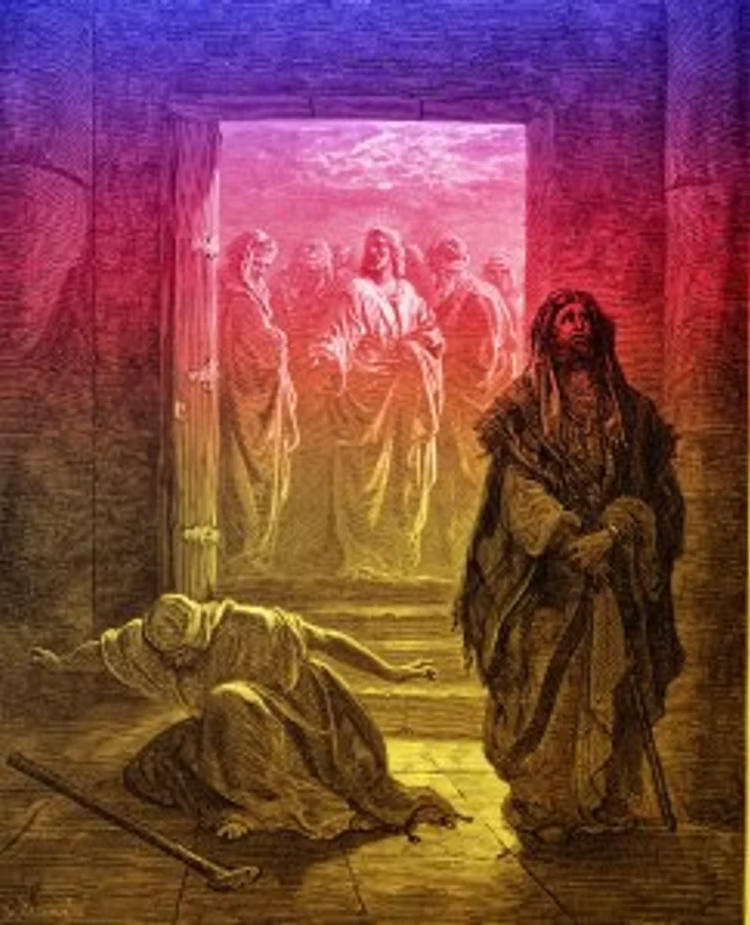
As a rejection of Jesus was done by trying to pin the “sins” of blasphemy (by implying he was the Messiah) and being a law-breaker (by healing on the Sabbath), it was the “sin” of their lies (plotting to murder Jesus of Nazareth) that took their image of “righteousness” and exposed it for what it was. The Spirit of truth showed those leaders as false prophets and bad shepherds, incapable of righteousness. They rejected the Spirit of truth.
Still, it is too easy to just project the title of sinner on the Jews, as the Gentile Romans probably had no qualms about killing someone who had beliefs that differed from theirs. Just like the Temple schemers, the Romans loved to use the pretense of law as justifications for their many acts of sin. Many of the Roman Empire’s acts were sins in the eyes of the LORD, regardless of how legal they were proclaimed, or holy unto their pagan (dead) gods.
This same state of “sin” projects on Americans today, as its multi-cultural mix has pagan Gentiles, Jews, and those professing Christianity as their religion all rejecting Jesus as the Christ. The laws of the land are based on a lack of consistent internal moral values. The point of what Jesus said to his disciples is that “righteousness” can only be found in those who accept the Holy Spirit – the Advocate Christ Mind – and become reborn as Jesus Christ. Therefore, the “legal assistance” needed is a mindset that always, automatically, follows God’s Law, without question.
Seeing this in that light, the perspective of “judgment” falls as a product of one’s designation as either sinner or Saint. Jesus said “judgment” was exposed “because the ruler of this world has been condemned.” That “ruler” is Satan, but the placement of human beings into positions of rule always (over time) leads the development of sinful little mini-devils, the sons and daughters of Lucifer.
In many examples of rulers (Nero, Caligula, Attila the Hun, Napoleon, Hitler, Stalin, Mao, Saddam Hussein, Gadhafi, Putin, Kim Jong Un, Pol Pot, et al etc., on and on, past-present-future), the soul having been sold into eternal damnation produces tyrants of despicable character. The rejection of Jesus as the Son of God within one’s being means taking a position of influence (for personal gain) as a good idea.

The warning then becomes the test of one’s ability to rule over others AND still obey the Will of God, speaking from the Spirit of truth, while others plot your demise. Judgment then becomes the reward of righteousness, where heaven is for Jesus Christ and those reborn as him and hell is for those who serve Evil, with those in between getting recycled back into the worldly process again (reincarnation).
When we next read of Jesus saying to his disciples, “I still have many things to say to you, but you cannot bear them now,” this goes well beyond their mental capacities being lessened by their drunken and tired states. This statement is mirrored in John’s verse in his final chapter (John 21:25), which says, “Jesus did many other things as well. If every one of them were written down, I suppose that even the whole world would not have room for the books that would be written.”
That says the tiny brains that human beings place so much value in are incapable of knowing the Mind of God. The disciples then are like everyone breathing air today, in the sense that it is impossible for someone who has rejected becoming Jesus Christ reborn to know anything more than a brain has been finely tuned to recall (maybe 4.7% of its capacity?). To know the Spirit of truth, one must be in possession of a brain that hides in a recessed corner of one’s being [ego hideout], listening to one’s own mouth speaking righteousness that one’s own brain did not think up … all the while knowing, “That’s Jesus speaking! And I understand his words fully!”
This is what Jesus meant when he said, “When the Spirit of truth comes, that will guide you into all the truth; for you will not speak on your own, but [the Spirit] will speak whatever that hears, and that will declare to you the things that are to come.” This is the meaning of Ezekiel being told by God, “prophesy to the Breath.” It is what Paul wrote to the Roman Jews speaking of, when he wrote, “God, who searches the heart, knows what is the mind of the Spirit, because the Spirit intercedes for the saints according to the will of God.” Paul was a Saint who never personally knew Jesus of Nazareth; but Jesus foresaw Saints walking the earth in his name. Jesus prophesied the coming of Saints like Paul and like his disciples – then and now.
Jesus then said, “That (rather than “He”) will glorify me, because that (rather than “he”) will take what is mine and declare it to you.” Again, the Holy Spirit is God, who is the complete essence of masculinity and maleness, but Jesus did not speak of the Holy Spirit an entity, but an arm of the LORD. The Spirit of truth is a oneness with God that envelops a human and its soul.
This means God touched His Son with His arm, making Jesus of Nazareth righteous. The soul of the Son of Man was baptized by the Holy Spirit and Jesus became God incarnate on the earth plane. God has the power to be incarnated in ALL humanity, but ALL humanity would have to want it, seek it, and prove that desire. In the same way that touch from God is what “glorified” Jesus, as he was “honored” through God, God was “bestowing” His powers into human flesh. That presence was then prophesied as coming upon the disciples of Jesus [you the reader], who would then “take what was his” (the name Jesus Christ) and “declare it to you.” A Saint is then one in the name of Jesus Christ.

Jesus then concluded this part of his lesson to his disciples by saying, “All that the Father has is mine. For this reason I said that he will take what is mine and declare it to you.” This states the union of human being with God being reborn, just as it was the state of Jesus of Nazareth. The two would become inseparable, as one. The unity that binds the ether of God to the matter of flesh is the soul washed clean of sin, which occurs when one is baptized by the Holy Spirit.
As Jesus of Nazareth was a Saint, so too will all who were to be reborn as him, after his holy soul was released to return in others. A Saint is therefore the reality of the Trinity, as Father, Son and Holy Spirit in one being. All Saints will have the same powers made available to them, so that sin will be defeated, righteousness will be gained, and one’s judgment will be life everlasting. One just has to become Jesus Christ reborn.
As the Gospel reading for Pentecost Sunday, the message is to receive the Holy Spirit and serve the LORD as did Jesus of Nazareth. The Day of Pentecost marks the ordination of saintly priests into the world, just as Peter stood on Pentecost with the other eleven Saints and they all spoke the Spirit of truth. They prophesied to the Breath, which overcame them like a sudden rush of sound coming from their tongues.
The call is to see oneself as having been in a drunken stupor so far in life, so that Jesus has always seemed to be speaking these things to others. We sit and listen, but we never hear Scripture as a message to be personally focused. One has not heard the Spirit of truth speaking as a motivation for oneself to act – to receive the Spirit and become Jesus Christ reborn. the reason is sorrow has filled one’s hearts. Sorrow is the affliction of thinking, “I’m not worthy.”
While not read in the selected verses today, the greatest fear is knowing the warning of death that awaits disciples who commit to God. Persecution is the fear of thinking, “What will others say, if I suddenly start acting righteous and more holy?” That fear is typical. It comes from the whispers of Satan, who rules this domain and wants all human beings to remain dried bones, with no holy blood flowing through their veins.
Pentecost is the day when Moses brought down the Law from Mount Sinai. It meant fifty days had passed since the Israelites left Egypt, having that much time to see the miracles God had surrounded and protected His people with. Just as the Israelites were not forced to commit to the Covenant then (quite a few idol worshipers were driven out and killed), there is no hard and fast rule that says, “You must be a Saint.” Just know that refusal means out-casting oneself.
It isn’t even a decision that one can make without God. Eternal salvation is a reward of complete commitment to God.
The comparison I see is that Pentecost is graduation day. Time has gone by and effort has been put forth to reach that point of transition. One goes from being a student to being a worker. Of course, going back to school for more degrees might keep one from actually applying a degree in the real world and actually earning a living; but what happens when all the student debt comes due and one has no way of paying back all the loans?

We all have to “grow up” sometime.
This Gospel reading is like a professor telling a class of graduates, who are all too drunk from celebrating to really pay attention, what their futures will be like. Just like the disciples, who were ready to lay down and go to sleep, forgetting the purpose of staying vigilant was to “watch and pray you do not fall into temptation,” the world has a way of casting a spell over the best intentions and making open eyes close. Work is always the next step, no matter which way one goes. That is why the Gospels lead to “The Acts of the Apostles.
The lesson today will be remember later. It might take years of hard work and experience to realize the lesson, but realize it one will. Realization comes by either recalling what saved one’s life, or by regretting not following good advice given long before. This lesson will be heard.


 Explaining the Readings