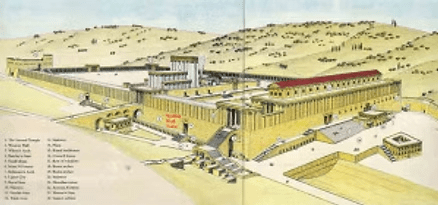
As Jesus came out of the temple, one of his disciples said to him, “Look, Teacher, what large stones and what large buildings!” Then Jesus asked him, “Do you see these great buildings? Not one stone will be left here upon another; all will be thrown down.”
When he was sitting on the Mount of Olives opposite the temple, Peter, James, John, and Andrew asked him privately, “Tell us, when will this be, and what will be the sign that all these things are about to be accomplished?” Then Jesus began to say to them, “Beware that no one leads you astray. Many will come in my name and say, ‘I am he!’ and they will lead many astray. When you hear of wars and rumors of wars, do not be alarmed; this must take place, but the end is still to come. For nation will rise against nation, and kingdom against kingdom; there will be earthquakes in various places; there will be famines. This is but the beginning of the birthpangs.”
———————————————————————————————————-
This is the Gospel selection from the Episcopal Lectionary for the Twenty-sixth Sunday after Pentecost, Year B 2018. In the numbering system that lists each Sunday in an ordinal fashion, this Sunday is referred to as Proper 28. It will next be read aloud in an Episcopal church by a priest on Sunday November 18, 2018. It is important because Jesus foretold of the destruction of Herod’s Temple, telling how nothing man creates – no matter how grandiose – can withstand the tests of time. Only God offers everlasting accomplishments and without God is destruction assured.
When one reads that “one of his disciples said to [Jesus], “Look, Teacher, what large stones and what large buildings!”’ he was marveling over the construction project that gave the Second Temple the nickname “Herod’s Temple.” According to the Wikipedia article on Second Temple, under the sub-heading “Herod’s Temple: Construction,” the following is written:
“Herod’s Temple was one of the larger construction projects of the 1st century BCE. Josephus records that Herod was interested in perpetuating his name through building projects, that his construction programs were extensive and paid for by heavy taxes, but that his masterpiece was the Temple of Jerusalem.”
By the time Jesus was in the final days of his ministry [he was in Jerusalem for his final Passover when this event occurred], the Temple beautification project initiated by King Herod [the Great] was in its forty-ninth year, having begun twenty years before Herod’s death. While much of the outer work might have been basically in place when one of the disciples pointed out the magnitude to Jesus, work on Herod’s Temple would continue until 63 A.D. [ref.], such that the rebuilding process stretched over eighty years. One should calculate that Jesus’ last Passover in Jerusalem [in the body of a living human being] was around 27 A.D., when he was about 33 years of age.
While in Jerusalem during the Passover at the onset of Jesus’ ministry, he had told pilgrims in Jerusalem, “Destroy this temple, and I will raise it again in three days.” (John 2:19) That conversation was not recorded by the disciples of Jesus (neither Matthew nor Mark), but three years later Jesus defined “Destroy this temple” as, “Not one stone will be left here upon another; all will be thrown down.”
This meant not simply the destruction that would be done by the Romans, but the ravages of time after that, especially when the Saracens [Arabians] spread into Palestine, becoming synonymous with Muslims. Stones of the temple ruins would have been utilized in other small building projects over five hundred years of time, and the transformation of the temple mount to the Dome of the Rock [691 A.D.] would be when “all will be thrown down” completely [except part of the Western wall, today called the Wailing Wall].
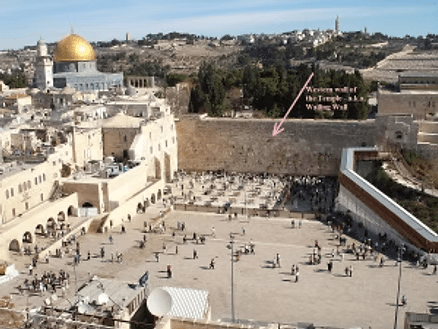
It is important to grasp the history, both the prior and future changes affecting the Second Temple and the two times Jesus spoke of the temple being destroyed. First of all, God never asked for a temple of stone, as He said He preferred to be mobile. That means the destruction of a brick and mortal temple that had become a monument to Herod the Great, not to God, would be replaced by Jesus Christ [the high priest] being reborn in true Christians [each a rebuilt mobile tabernacle]. That transformation would wait until after Jesus had died by execution and was dead for three days before resurrecting. Third, the complete erasure of Herod’s Temple and the rebuilding of a Muslim holy building on that same piece of real estate would simply be God’s way of saying, “I Am That I Am when I am written on the hearts of Apostles and Saints [The Ark of the Covenant within the Tabernacle], which are in the name of Jesus Christ.” God cannot be made a shrine that pilgrims must visit once in a lifetime, as God is limitless, available to all who love Him dearly.
When we read, “When he was sitting on the Mount of Olives opposite the temple,” the Greek written by Mark includes a comma, such that the literal translation says: “And sitting of him upon the mountain the [one] of Olives , opposite the temple”. This is two segments of words, not one. The second segment is then a helpful segment of words that is used to clarify which mountain or hill with olive trees that Peter [through Mark] was talking about.
This story is found also told in Matthew and Luke. Luke does not state where Jesus privately told the disciples when the temple would be destroyed. Matthew wrote that it was on the mount the [one] of Olives, but did not get specific about where that hill was, in comparison to the temple. This means mark’s version adds truth that is helpful to the one carefully paying attention to Scripture.
The reason Mark made this clarification is there were two hills that were known for having olive trees. Only one had an olive oil press [Gethsemane], which was near the base of the Mount of Olives. Simply by capitalizing “Elaiōn” the implication was “Mount of Olives.” Still, there was also a hill outside the Essenes Gate that was known as a “hill of Olive trees.” That was where Jesus would lead his disciples after the Passover meal. However, Mark was making clear that the private discussion Jesus had with his disciples was on the mountain of Olives that was “opposite the temple.”

When Mark then wrote that “Peter, James, John, and Andrew asked him privately,” it should be realized that neither Matthew nor Luke listed anyone specifically. Only Mark [Peter’s Gospel writer] wrote those names. Peter was the brother of Andrew and James and John were the sons of Zebedee. Those were the disciples first chosen by Jesus. Peter was making it clear that the ones who raised the question: “Tell us, when will this be, and what will be the sign that all these things are about to be accomplished?” were the ones who had served Jesus the longest and the ones who thought they were Jesus’ most trusted disciples. Therefore, they felt it was their right to know when to look for the signs of destruction that Jesus knew was coming.
The reading then follows with Mark writing, “Then Jesus began to say to them.” The Greek word “ērxato” is the past tense of “archomai,” meaning “to begin” or “to commence.” It also means Jesus, for the first time, established the “rule” by which the times of Jewish destruction, as a religion meant only for the descendants of Abraham, Isaac and Jacob [a biological subrace of the human race – see “Physiological race”], would occur.
As it was then, the radiance of Herod’s Temple stood as an outward glorification of Judaism. Rather than a simple reproduction financed by the Persian kings Cyrus the Great and Darius I, Herod the Great would enhance the old, so it spoke loudly for his greatness. Still, the grander the temple complex became, the more it projected how a most powerful, singular God, made Israelites [under David primarily] and Jews a select people, amid the vast empirical holdings of those who worshipped many gods, but rose and sank over time: Egyptians, Assyrians, Babylonians, Persians, Greeks, and then Romans. For as lasting as YHWH had proved His capability to keep the children of Israel intact [remnants that they had become], still adherents to Mosaic Law, Jesus began to tell of the destruction that would be the end of that favor.
To best understand the words that then came out of Jesus’ mouth, one must remember that Jesus was not speaking as a favored son of God. That would be how the elite of Judaism saw themselves: the Pharisees, the Sadducees, the temple scribes and high priests. Jesus spoke as THE Son of God, which meant he only spoke the truth, which the Father was speaking through him. Therefore, Jesus then responded to the question posed by his disciples in the voice of God that flowed through him.
It was then God that told Jesus’ disciples, “Beware that no one leads you astray.” In actuality, the capitalized Greek word, “Blepete,” is a one-word statement of importance, separate from the words that follow by a comma [real or implied]. As a form of the root word “blepó,” the impact is placed on “Sight, Perception, Discernment, and Observance.” To “Beware” means to become “Aware,” by being “Watchful.”
Before anything else, Jesus said, “Look!” This is then the importance of Jesus’ parables about “Vigilance” and staying “Awake.” The purpose of staying “Awake” means to not fall asleep, which is the danger of mortal death and the recycling of reincarnation, rather than the wakeful state of eternal life.
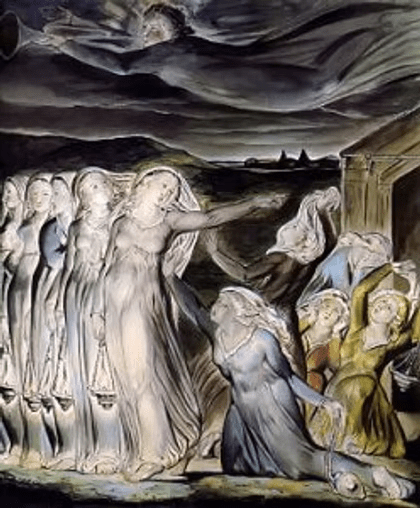
It is then the importance of that state of “Alertness” that has one prepared to wait for the bridegroom’s call [Parable of the Ten Virgins], “lest anyone you mislead.” Being misled is then forgetting to keep oil in one’s lamp, so the light of alertness will shine through the darkness of night [symbolic death]. This translates according to common language as “that no one leads you astray,” but in the same words says one is responsible for not letting others be misled through self-failure of “Being aware.” The “Wakeful” state keeps one from misleading others and being misled. That is parallel to the five bridesmaids who saw they would run out of oil and asked the other five to share their oil. The lamp oil is what keeps one awake and alert, thus it represents personal devotion to the Lord. Each is responsible for preparing one’s soul for a marriage to God.
God then said through His Son, “Many will come in my name and say, ‘I am he!’ and they will lead many astray.” This translation does not capture God as the voice speaking those words. The literal Greek states, “many will come in the name of me , saying then , I am , and many will be misled .” This needs closer inspection.
Jesus then prophesied that “many [lower-case] will come in the name of Jesus Christ [“mou” as “of me.”].” The word “mou” is a form of the Greek word “egó,” which means “I.” That is then a statement that “many will come” who will have sacrificed their “egos” [their “I”s] so they will assume the ego of Jesus Christ, where Jesus of Nazareth is a Son “of God.” Therefore, the Christ is the presence “of God” [“of me”] that “many will become” filled with love from.
This foretold of the advent of Christianity, where those “many” would be “then saying” or “speaking then” the truth of God, just as was Jesus of Nazareth. Rather than one man “speaking then,” who led a relatively small group of Jewish disciples [men and women], “many” would spread the breadth and scope of that Gospel. Those who follow Jesus become reborn as Jesus Christ.
This spread of true Christianity will “then” lead “many” to “say” they are Christian [without the bold type], simply because it seems like the good thing to do. The problem that comes with those who “speak then” but do not tell the truth, is they do not say, “this voice comes from God as Jesus reborn.” Instead, they proclaim, “I am” a Christian, where the Greek word “Egō” is capitalized, showing there has been absolutely no sacrifice of self-ego for God. They proclaim they are gods, rather than acting as wholly subservient slaves of YHWH – “I Am That I Am.”
This is the Big Brain Syndrome that I speak of. People who say, “I am Christian,” often then say, “I am sure, if Jesus were here today, he would say the same things that I am saying. By admitting that I am Christian, I am then allowed to play god.”

God was then advising the disciples of His Son that “namely” [the viable translation of the Greek word “kai,” which commonly means “and”] is as “namely” does. Using the “I” word then identifies those who will number “many,” such that through their claims of “I am” righteous “many will be misled.”
One has to see how God spoke through Jesus saying that the time was coming when the destruction of Judaism would be due to the improper leadership the people had. They would be misled into believing that “I am” was the ego of God’s chosen people. For that heresy, every stone of the renovations done to the Second Temple would be thrown down. Still, the errors of the Jews were foretold by Jesus to be repeated in the far distant future, when the stone foundations of Christianity would likewise come tumbling down. Any time that religious leaders mislead God’s children [false shepherds and false prophets], they will be exposed as liars and overthrown by God.
God then spoke through Jesus, saying “When you hear of wars and rumors of wars, do not be alarmed; this must take place, but the end is still to come.”
When one realizes Jesus spoke to his disciples in 27 A.D. [C.E.] that was still four decades before the Jewish revolt against Rome would begin [67 C.E.]. Prior to that there would be words of war, even rumors would spread that another Messiah had come [a warrior Christ], who would lead the Jews to independence and win the return of Israel into the world. By 70 A.D. [C.E.] that war would be won by Rome, with all the false prophets of Judaism killed and the grandiose temple in Jerusalem razed to the ground. However, even that many years after Jesus would be dead, resurrected, ascended and return in Apostles, “the end is still to come.”
The vision of God stretched well beyond that of ordinary human eyes. That “end,” from the Greek word “telos,” meaning the “conclusion” of the destruction of the religion of the One God Yahweh, that would be after “nation will rise against nation, and kingdom against kingdom; there will be earthquakes in various places; there will be famines.” That too needs closer inspection.
The Greek word “ethnos” is translated as “nation,” but it conveys a meaning of “the heathen world,” that of Gentiles. It is a statement that “race will rise against race.” We live now in a time when “race” is commonly used as a weapon of destruction. There is no longer a clear boundary that keeps the “races” of the world pure. The mixture of “races” dilutes that purity, so the “races” designed by God are forced to mingle, so pure blood become one global blob of humanity. Then, none of the Gentiles stand out for their God-given superiorities. Likewise, the religions of the world have blended into misleading dogmatic rituals of meaningless sayings, because the “people rise against people” whose beliefs are impure [false].
The Greek word “basileia” means “kingdom,” which is different from the Israel under Herod the Great. Judea had a governor that was appointed by an emperor, who reigned from Rome over many lands. The segment of words that say “kingdom against kingdom” is then a vision that extended beyond the fall of the Roman Empire, to a distant time when the lands of Europe would be led by kings [and queens]. Those kings would be believed to have been descended from the holy bloodline of God’s Son, indirectly descended from Jesus of Nazareth. Those European “kingdoms” would then become the resurrection of the anger of brother against brother, or Can against Abel, since royal lines of “kingdoms” made them Apostles [regardless of gender] by holy blood. Eventually, all of those “kingdoms” would be reduced to governments of philosophies that lied to the people as if the will of all would rule a commonly elected few.
For God to state, “there will be earthquakes in various places,” this is a normal occurrence of shifting tectonic plates. Rather than have Jesus seem to state a forecast of common natural events, the Greek word “seismoi” should be understood as many violent “shakings” and “commotions” (from the root word “seismos”) on earth that will crumble the foundations of religious faith. These are then the philosophies of man that will introduce the concepts of democracy, equality among men [not always implying women too], and freedom, giving rise to all kinds of “–isms” that will shake belief in religions to their cores.
The statement, “there will be famines,” has nothing to do with the weather patterns that bring drought and failing crops. It has little to do with having billions of human beings on a limited space of land, where the land cannot produce enough food for that many people to be fed. It has no bearing on the desert environments of the world that have historically produced minimal numbers of plants and animals; and there is no correlation to global warming, pollutants caused by ignorant masses, or the extinctions of flora and fauna caused by an earth teeming with uncaring human beings. The “famine” God spoke of was due to a lack of spiritual food being available for a corrupted mankind to be fed. That lack of religious feeding will be most evident when the “end” time arrives.
Again, the evidence of all those signs stated by the mouth of Jesus are prevalent today. The people rise up against the people. The kingdoms have been reduced to political parties forcing their will upon the meek. The philosophies of the world are shaking religion just as the Romans destroyed the Temple of Jerusalem. The people are famished from lack of spiritual nourishment. Thus, we are ripe for the end coming.
When Jesus then said to his disciples, “This is but the beginning of the birthpangs,” his word “archē” (“beginning”) refers them [and the reader] back to his first statement of explanation, which Mark introduced by saying, “And Jesus began to say to them.” Jesus was telling them that the words of what to look for, which they would see, would only be “the beginning of the birthpangs” of the destruction of Judaism. The “birth” would produce Christianity, but “birthpangs” are always followed by death pains. We are all born mortal, bound to die. Death’s pains occur at the end of life on earth. For that reason, one should be “Awake” when the end time comes.
While this ends the reading selection as chosen, the text of Mark adds one more verse to this section. It repeats the capitalized “Blepete,” or “Take heed,” returning one’s focus to the same important one-word statement. This warning of vigilance was directed at the disciples themselves, where Jesus told them, “You will be handed over to the local councils and flogged in the synagogues. On account of me you will stand before governors and kings as witnesses to them.” (Mark 13:9; NIV) Those signs will indicate the beginning of a new religion of self-sacrifice for devotion wholly to Yahweh. The deaths of the Apostles will bring the birthpangs of true Christianity into being.
As the Gospel selection for the twenty-sixth Sunday after Pentecost, when one’s own personal ministry for the LORD should be underway – one is aware of the signs of the end times – the message here is to not be mesmerized by the wonders of a material world. Everything is in a state of change, which slowly builds up and slowly breaks down; it is often difficult to see how the world is crushing the life out of humanity. We have to know what signs to look for and we need to always be alert to the fact that Satan wants all human beings to be misled.
As American Christians, in a multitude of sects and denominations, just driving around town brings forth a reaction to the grandiosity of buildings of worship. They appear to strive, by design, to beacon to the passerby, “You need to come inside and see more!” This is akin to the disciples telling Jesus, “Look, Teacher, what large stones and what large buildings!” We are easily distracted by bells and whistles, smoke and mirrors.
The problem with palatial buildings is the cost involved. It should lead one to wonder, “To what end?” If there is so much pain and suffering in the world that needs donations and contributions, why is money being put into anything more than a tent with poles, folding chairs and some sawdust?
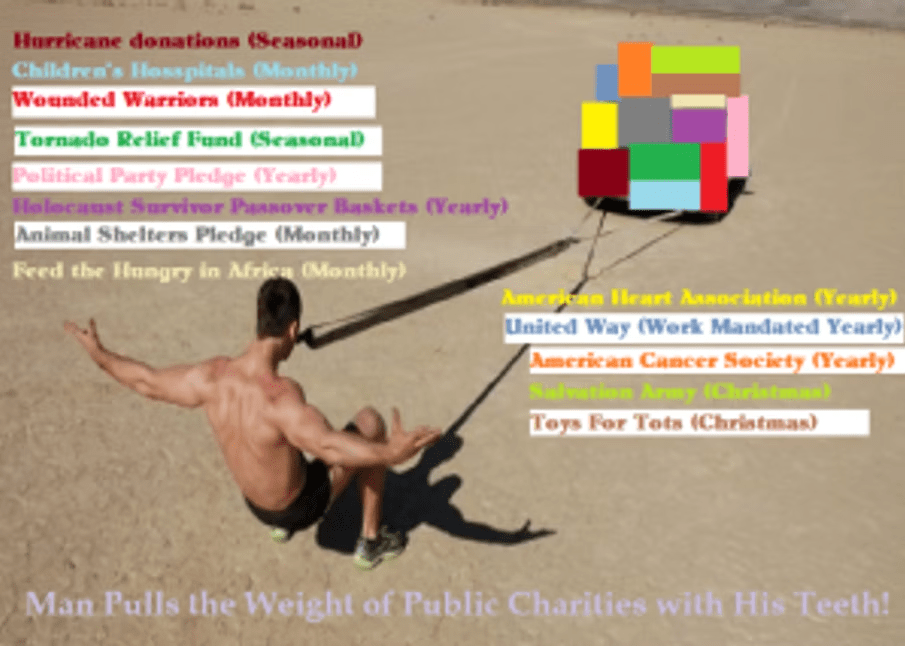
The answer is profit. There has not been an American business man or woman yet that proposes spend a huge sum on freebies. The news in the past couple of years has been how the downtrodden of Houston, after a hurricane hit Texas, found chains put on the doors of Joel Osteen’s megachurch. No public shelter there! It seems he built it with money donated to him (not God) and he invested that money into a profit-making megastructure. After what happened to the inside of the Superdome, following Hurricane Katrina, who can blame him wanting to avoid the renovation costs of being charitable?
[I do not name him specifically as the only one who has followed this model of profiting from selling religion to people willing to pay. He is simply one of “many” – nothing more.]
Jesus replied to his disciples, “Do you see these great buildings? Not one stone will be left here upon another; all will be thrown down.” He was not simply speaking about the beautification project of the Temple of Jerusalem. He was speaking of all who had, all who were, and all who would try to box God into permanent buildings. There has not been built one yet that can last as long as God. They will all find the same end that mortal human beings find – death and destruction of all that had been built over time. The only thing that lasts like God is the soul, but souls cannot return to God if they find a sense of self-pride in a magnificent building.
The private question the disciples asked Jesus – by Peter, James, John, and Andrew – were not much different than that asked by the young, rich ruler. Rather than, “What do I have to do to get to Heaven?” they asked, “When will Heaven come?” Such a question asked privately might mean those four disciples secretly either hoped for the destruction of evil, seen in opulent wealth and material objects of worship cast down, or they were most worried about when they should be careful of their lives, because the destruction of the Temple of Jerusalem would mean a powerful enemy was at hand. Either way, there were inner doubts that they were trying to assuage by trying to get inside information about how much time Jesus was talking about.
It is important to remember that the disciples had not yet been filled with God’s Holy Spirit. They had not yet been given the Christ Mind, in exchange for their own self-egos. They are then the models of all Christians today, who know a thing or two about what Jesus did, but know nothing about the love of God and being adopted as His Son.
One has to imagine one’s own fears rising, as Jesus spoke for the Father about the fall of the religion the disciples had invested so much time and energy into believing. Christians today feel exactly how the disciples felt. We are all still being taught to “Be aware!” “Stay awake!” “Be vigilant!” or be lost.
Jesus taught to his disciples in the same manner that parents teach their young children. They tell a child, “Do not touch the stove top burner, as it will hurt very much if you do.” Children trust their parents and listen to what they say. They do not have to touch the hot stove top to find out the truth, as the vividness of their imagination and having experienced pain and crying is enough to believe a warning from someone they know loves them deeply.

Jesus then told his disciples to always discern the truth. One has to see the truth with one’s own eyes, or belief will never convert into faith. By not testing the words of those who preach from a position of “I am!” humans return to that state of being as a trusting child. Humans do not want to take the time or put in the energy it takes to see a truth with their own eyes: what was really said and what that really means. This is the warning given by Jesus. If one does not test the many that will come and say, “I am speaking for Christ,” then those will be misled, fall asleep and miss the boat to Heaven.
I do not ask anyone to believe what I say. Believing what I say will make one a poor reproduction of me. If questioned about my life, anyone other than myself will turn and run away in fear. I demand that everyone who wants to become Jesus Christ resurrected test what Jesus said, as recorded in the Gospels.
If I am wrong, then tell me where I missed what you see.




 Explaining the Readings