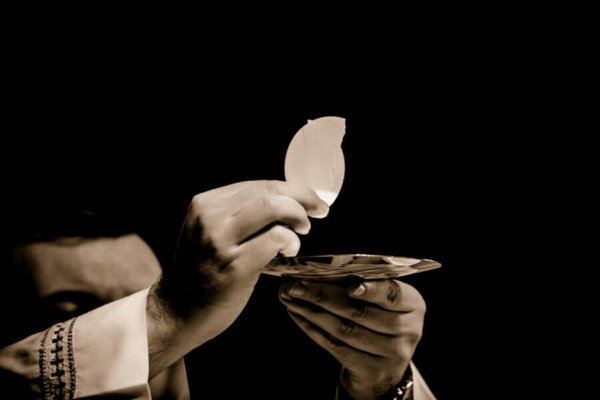
Jesus went to the other side of the Sea of Galilee, also called the Sea of Tiberias. A large crowd kept following him, because they saw the signs that he was doing for the sick. Jesus went up the mountain and sat down there with his disciples. Now the Passover, the festival of the Jews, was near. When he looked up and saw a large crowd coming toward him, Jesus said to Philip, “Where are we to buy bread for these people to eat?” He said this to test him, for he himself knew what he was going to do. Philip answered him, “Six months’ wages would not buy enough bread for each of them to get a little.” One of his disciples, Andrew, Simon Peter’s brother, said to him, “There is a boy here who has five barley loaves and two fish. But what are they among so many people?” Jesus said, “Make the people sit down.” Now there was a great deal of grass in the place; so they sat down, about five thousand in all. Then Jesus took the loaves, and when he had given thanks, he distributed them to those who were seated; so also the fish, as much as they wanted. When they were satisfied, he told his disciples, “Gather up the fragments left over, so that nothing may be lost.” So they gathered them up, and from the fragments of the five barley loaves, left by those who had eaten, they filled twelve baskets. When the people saw the sign that he had done, they began to say, “This is indeed the prophet who is to come into the world.”
When Jesus realized that they were about to come and take him by force to make him king, he withdrew again to the mountain by himself.
When evening came, his disciples went down to the sea, got into a boat, and started across the sea to Capernaum. It was now dark, and Jesus had not yet come to them. The sea became rough because a strong wind was blowing. When they had rowed about three or four miles, they saw Jesus walking on the sea and coming near the boat, and they were terrified. But he said to them, “It is I; do not be afraid.” Then they wanted to take him into the boat, and immediately the boat reached the land toward which they were going.
——————————————————————————–
This is the Gospel selection from the Episcopal Lectionary for the Tenth Sunday after Pentecost, Year B 2018. In the numbering system that lists each Sunday in an ordinal fashion, this Sunday is referred to as Proper 12. It will next be read aloud in an Episcopal church by a priest on Sunday July 29, 2018. It is important because John gives a unique view of the miracles surrounding Jesus feeding the multitude and his walking on the sea.
It is important to know that the feeding of the five thousand is one of only ten events in Jesus’ life that are told by all four Gospel writers. (article) It is the only specific event of Jesus’ ministry all witnessed, prior to his entrance into Jerusalem for his final Passover Festival and the last two weeks of his life. Because each of the four Gospel writers reflect different personal views of the same event, based on relationships with Jesus (as educational teacher and blood relation), this four-sided view creates a solid three-dimensional realization of how this event actually occurred. As each Gospel view is the truth that is told, all differences must then be adjusted to fit the truth, without anything being discounted or changed.
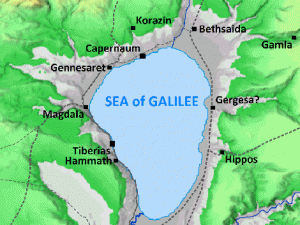
In John’s words we read “Jesus went up the mountain” and “he withdrew again to the mountain by himself.” In both places John wrote the Greek word “oros,” which translates as “mountain,” but also as “hill.” As John also stated, “Jesus went to the other side of the Sea of Galilee,” it is important to realize that the Sea of Galilee is “the lowest freshwater lake on Earth and the second-lowest lake in the world,” due to it being 686 feet below sea level. (Wikipedia) This means that the hills surrounding the bowl in which the sea is formed seem like mountains, when viewed from the sea shore. As all the towns of the Sea of Galilee are basically along the shoreline of the water, the mountains that Jesus went to are those overlooking all the activity of civilization.
This means that by John saying, “Jesus went up the mountain” in verse three, that “mountain” was not necessarily the same “hill” as he stated in verse fifteen. Since the entirety of the Sea of Galilee is overlooked by a rim of hills, going once and “again” to “the mountain” simply means to escape the hubbub of the places where humanity swarms.
Seeing that freedom of motion, John’s Gospel fits snugly into the puzzle that had Jesus go from Capernaum to Bethsaida, as told in Luke’s Gospel. It was then that “Jesus went up the mountain and sat down there with his disciples.” Jesus and his followers, including Mother Mary (the voice of Luke), sought solitude there first, before going to the deserted plain of Bethsaida. They changed locations because, “A large crowd kept following him, because they saw the signs that he was doing for the sick.” They followed him from Capernaum to the mountain above Bethsaida. The crowd was large because, “the Passover, the festival of the Jews, was near,” and new pilgrims were arriving all over Galilee and Judea every day, as the Passover Festival approached.
When we read, “When he looked up and saw a large crowd coming toward him,” this is best read literally, according to the Greek text. By seeing how Jesus, “Having lifted up then the eyes of the (one) Jesus,” the comma’s indication of pause tells of a separation in time having occurred, before reading “and having seen that a great crowd is coming to him.” Those segments of words are telling of two phases of the same event.
First, “having lifted up” means Jesus was raised by the Holy Spirit, so his “eyes” were filled with the Christ Mind. That affirms how Mark wrote (as the voice of Simon-Peter) of Jesus arriving by boat to the dock at the Bethsaida Valley, seeing the lost sheep of Israel in need of a shepherd, so Jesus taught them in a “lifted up mind” way. Second, after having preached to the multitude, Jesus realized the crowd was receiving the Holy Spirit from his lessons. This was due to “having seen that a great crowd was coming to him,” as disciples whose hearts were welcoming the presence of the Holy Spirit within them.
Then John wrote of the following exchanges: “Jesus said to Philip, “Where are we to buy bread for these people to eat?” He said this to test him, for he himself knew what he was going to do. Philip answered him, “Six months’ wages would not buy enough bread for each of them to get a little.” One of his disciples, Andrew, Simon Peter’s brother, said to him, “There is a boy here who has five barley loaves and two fish. But what are they among so many people?”
John named the disciples Philip, Andrew, and Simon-Peter, which means John was present and close enough to hear these exchanges and see those disciples, but not once did Jesus turn and directly ask John the Gospel writer to do anything. John did not once name himself in this narrative (such as, “then Jesus asked the one he loved”). Instead, John heard everything as “a boy who was holding onto five barley loaves and two fish.” He wasn’t a vendor (certainly), so he had to be one of the picnic party.
This means John was “a boy” (actually “a little boy,” as “paidarion” implies). It means John was not a disciple, but a relative accompanying Jesus; and, it means John was carrying the lunch intended to feed those who went by boat to the docks on the plain, where the crowd ran to meet them. Importantly, it strongly implies that John was the son of Jesus of Nazareth, which explains why the voice of John is so different than the other Gospel writers, and why John wrote of personal and private parts of Jesus’ ministry no one else did.
After Jesus told the disciples to get all of the people in the crowd to sit down on the grass of the dry, fertile flood plain, he told that it was “Jesus” who “took the loaves, and when he had given thanks, he distributed them to those who were seated; so also the fish, as much as they wanted.” This says that Jesus personally gave the loaves and fish to five thousand men (said Luke, implying more in all, with any family they had with them not counted). Matthew, Mark, and Luke all say that Jesus gave the bread and the fish to the disciples, to then be handed out. However, this means one should grasp the truth in John’s account.
In the other three Gospels, Jesus had sent out the twelve in ministry, prior to this event. They had just returned to report back to Jesus all the things they had done, in teaching and healing. Upon their return, they heard the news of John the Baptist’s beheading. Jesus then took them to the mountain of Bethsaida to relax from their travels and mourn the passing of John. Young John the Gospel writer was not present to witness that assignment in ministry or the return from ministry or the knowledge of John the Baptist being killed. However, now with the whole gang by the sea, John saw the disciples acting in the name of Jesus, so they went forth in ministry as an extension of Jesus. They then taught the Jews of Galilee as Jesus.
The disciples healed the sick, in their commissioned travels, as Jesus. Thus, they then handed out loaves of barley bread and salted fish as Jesus. In that way, John saw the truth of this miracle story, as the twelve disciples (whose names he knew) became Jesus before a young boy’s eyes, as they fed the five thousand.
This brings one to the gathering of the leftovers, which John said filled “twelve baskets.” All four of the Gospel writers tell of “twelve baskets of fragments (or broken pieces) gathered.” In each of the accounts, that lone use of “baskets” is stated. While it is easy to assume that the boy holding onto five barley loaves and two fish had them in one basket, where did “twelve baskets” come from?

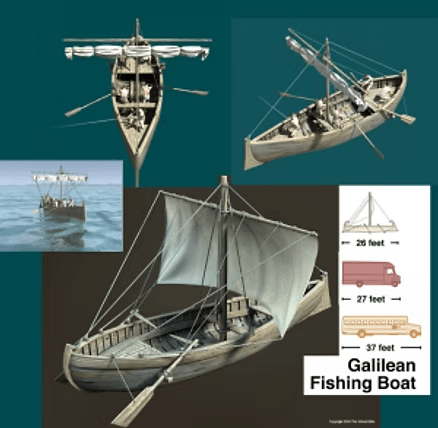
The only possibility that makes any sense is that the baskets were on the fishing boat they arrived in, as those that the fish would be placed in after being hauled up in a net. The baskets of catch would then be how the fish would get from ship to shore. To collect the leftovers, Jesus would have sent for twelve empty baskets from the boat, giving one to each disciple.

Seeing how the “baskets” were those used by fishermen, the “twelve baskets” were the twelve disciples, who were the prophesied “fishers of men” that Jesus promised. As fishermen of freshwater fish, they knew all the ropes and tricks of that trade; but as far as teaching and healing, each of those “fishers of men” had to become the extension of Jesus. Therefore, the disciples (who would become Apostles, sans Judas Iscariot) became the “baskets” that would gather the broken pieces and fragments of those who also sacrificed themselves (like fish willingly caught in nets to feed mankind), in order to also be transformed into Jesus.
This means that when John wrote, “When the people saw the sign that he had done, they began to say, “This is indeed the prophet who is to come into the world.”’ The five thousand (plus) knew that Jesus was the Messiah. The people had “come to Jesus” just as Jesus sensed after preaching to the crowd.
The “sign” they needed for complete conversion was spiritual food (like manna and quail). That was fed to them as soul cleansing nourishment, appearing as a morsel of barley bread and a tad of salted fish; but it was much more than the physical. It was just as Jesus had instructed his disciples when they embarked in ministry, “Tell them the kingdom of God has come near.” The blessed and broken loaves and fish became that kingdom of God consumed.
This means it is worthwhile to see the symbolism of the numbers involved: five loaves; and two fish.
We last discussed the number five in the account in 1 Samuel, where David gathered five smooth stones from the wadi. Then, I mentioned the flatness of smooth stones represented two sides, such that five is the number of laws on each stone table brought down by Moses. The duality of each stone (top and bottom) meant the stone that hit Goliath in the forehead was the Law of Moses, which was the agreement that joined the Israelites and God as one. The laws of the One God slays the Gentile in one and kills all pagan gods lurking in one’s big brain. That same analogy can be used here; but there is a broader meaning that is associated with the number five.
The number five has an ancient connection with love and marriage. In astrology, the fifth house is symbolic of children, which come from relationships of love. The five books of the Torah reflect the Covenant with the Israelites, such that the Commandments were the marriage agreement between two parties in love. As such, each tablet of the Law stated five demands that must be met. As five loaves of bread, which is another way of stating the manna of God, this is then the food for thought that the Torah represents. To consume that food is to show love for God.
Two fish is the representation of the astrological sign Pisces.
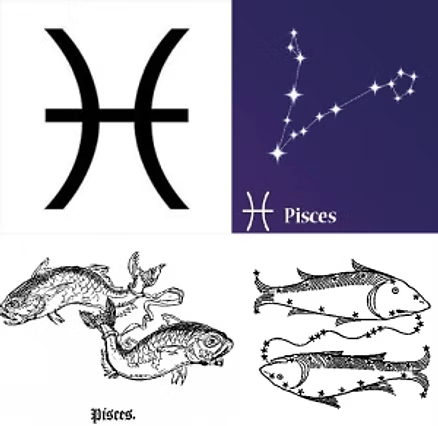
Much can be found on the Internet that explains the nature of people born under the sun sign of Pisces, but the sign itself symbolizes the traits of “selfless, spiritual and very focused on their inner journey.” (ref.) It is the natural sign of the twelfth house [remember “twelve baskets” for “twelve disciples”?], which represents the area of life that is unconscious, where compassion flows freely and spirituality is more natural than physicality. Pisces is traditionally ruled by Jupiter (the ‘big G’ god of the solar system and the zodiac), which also rules over the sign Sagittarius. Both signs ruled by Jupiter focus (in part) on religion, with Sagittarius leaning towards dogma and Pisces being all about faith, dreams, and inner intuitions. In the accompanying interpretation of Paul’s ‘prayer’ for the Ephesians, I wrote about the Age of Pisces, which has been the past two thousand years that Christianity has grown, with the original symbol being the fish.
When this is realized, along with the love and marriage factor of five, where the Law becomes written on the hearts of brides and submission to God’s Will is all about the self-sacrifice associated with Jesus and the sign Pisces, Jesus handing out the spiritual food (the manna and quail) that were loaves of bread and salted fish, as Jesus appearing in the form of disciples in his name, the ‘R.O.I.’ (return on that investment of food) was the creation of five thousand (again that number five, now multiplied a thousand fold, divided into groups of fifty, as five times ten) Apostles, who would all do as Jesus’ disciples had done, being ministers of the Word taught to them by Jesus.
The hearts of those pilgrims had become married to God, doing as Jesus promised his disciples they would do after he was gone: “Very truly I tell you, whoever believes in me will do the works I have been doing, and they will do even greater things than these, because I am going to the Father.” (John 14:12) A pinch of bread and fish returning a handful represents “greater things than these.”
That is the symbolism of twelve fish baskets of broken pieces being gathered, after only one small lunch basket of bread and fish had been passed out. It was as if Jesus recited to each of the five thousand pilgrims just one small piece of Scripture; and then, when through, he asked, “What does that mean to you now?”
Rather than have devoted Jews recite a psalm or a verse they had memorized, they told Jesus all the wonders they had realized from those tiny morsels. They gave back to Jesus more than he had given them. They did so because Jesus gave them a burning heart that opened to God and His Holy Spirit, enlightening their brains with the Mind of Christ.
It was this spiritual uplifting that Jesus fed the pilgrims, where the disciples appeared as twelve representations of Jesus, which is a parallel scene to the Sunday Pentecost story in Acts, when the disciples were touched by the Holy Spirit and made able to speak in tongues of fire. They went outside and began passing out spiritual food to more pilgrims who were standing around outside, in the street and square of the Essenes Quarter.
One can assume that not all the pilgrims sitting in groups of fifty in the grass of the Bethsaida plain spoke the same language, meaning the unspoken amazement of Pentecost (three years later) was duplicated then. The disciples, appearing as Jesus, had to speak fluently in foreign languages as they passed out the loaves and fish. They were speaking with voices spiritually elevated both times; but, in this story of John’s, they quietly spoke in tongues, rather than shout out loudly with raised voices.
This is why John wrote, “When Jesus realized that they were about to come and take him by force to make him king, he withdrew again to the mountain by himself.” No one would make someone a king, just from letting one eat his lunch for free. They were aroused by finding the Messiah was with them … the kingdom of God had indeed come near. It was in them!
I have heard of hypnotists that do stage acts getting volunteers from the audience, who then then place a suggestion in their minds to do something crazy as soon as the “magic word” is said.

No one would try to elect a hypnotist as the leader of a country, simply because he or she was good at tricks. An atheist could argue that Jesus never fed five thousand people (and families) with such a small amount of physical food. That is as impossible as is walking on water. According to John, the disciple Philip agreed with that conclusion. Still, what Jesus did was not an illusion or trick, because everyone present was satisfied they had eaten real food AND had much more than the total amount to begin with left over. That miracle led the crowd to want to sing “Hosanna” and pave the road to Jerusalem with palm branches too early. That is why Jesus disappeared up the mountain alone.
In Matthew and Mark, the Greek word “euthys” is written, which is translated commonly as “immediately. It is used to state that “as soon as” the five thousand had been fed, the disciples departed by boat, leaving Jesus and (minimally) John behind. Both wrote, “Immediately Jesus made his disciples get into the boat and go on ahead of him to Bethsaida, while he dismissed the crowd.” They both then say that Jesus went up the mountain to pray.
John, as one left behind with Jesus, said the disciples left at “evening” time (“opsia”), which implies after 6:00 PM, thus night time. Night means after 6:00 PM, and in April there was most likely still some light available for the disciples to set sail and so the crowd could safely walk back to the towns they came from. This means it took some time for five thousand to be fed spiritually, as Jesus had first taught them (I assume) around noon, before organizing the feeding event.
Because John wrote the Greek word “katebēsan,” meaning “went down” or “descended,” this implies the disciples went up the mountain with Jesus, but allowed him the seclusion to pray alone. The immediacy of them getting in the boat then came when Jesus returned to the disciples and gave them instructions to sail to Capernaum.
One could assume that decision was so Jesus and John could walk the route the pilgrims had taken, to ensure that none of them got lost and needed help. That would be the decision of the Good Shepherd that Jesus was; and it would support Mark’s writing how Jesus saw the crowd as if, “they were like sheep without a shepherd.”
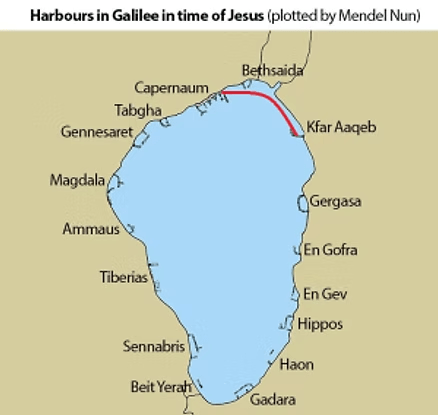
John then wrote how the disciples had struggled against the wind and stormy water, having rowed “twenty five or thirty furlongs,” which calculates to more than three miles, but less than four. From a perspective that overlooked the water, with the boat lit up with lanterns at night, the slow progress and distance could be estimated from shore, whereas on board the boat all attention of rowing and navigating would make such distance impossible to determine in the dark of night. The map below shows that the widest part of the Sea of Galilee is 8 miles, with fragments of that distance also shown.
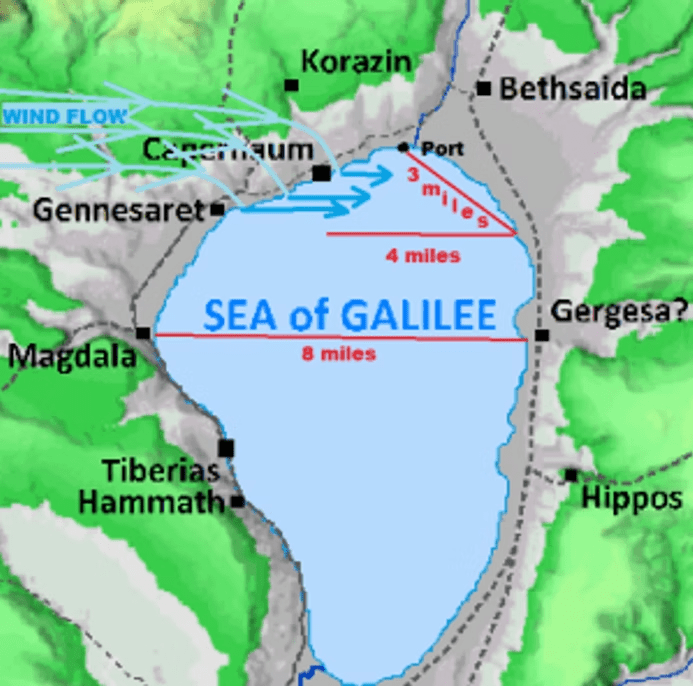
Because Matthew and Mark say they saw Jesus when it was “the fourth watch” (translated as “shortly before dawn”), they had struggled with the boat on the water until after 3:00 AM, when the Dawn Watch of night begins. At that time of night, the warm air at the sea level, meeting the cool winds off the Mediterranean Sea, causes a downdraft from the west, blowing against the boats rowing from the east, over shallow waters that become quickly agitated. The result would be hours of rowing forward (without a sail being useful), while being blown backwards, as the choppy waters would push the boat on an angle to the north.
When we then read, “they saw Jesus walking on the sea and coming near the boat,” the ability to spot Jesus and identify him in the dark says the disciples were close enough to see his features. The Greek word “epi” is written by all the Gospel writers who told of Jesus walking on water, where that word has been commonly translated as “on” or “upon.” However, this preposition is not as fixed to only one translation, as English creates multiple prepositions for all directional values. The word “epi” bears this scope of intent, where its use includes: “2. used of vicinity, i. e. of the place at, near, hard by, which.” (Thayer’s Greek Lexicon, Strong’s NT 1909)
This means John could have intended to state that the disciples (who were struggling against strong winds on a rough sea) “saw Jesus walking,” because Jesus was “at the sea” (in the vicinity of, but on the land surrounding the water). The presence of “and” in the statement actually follows a comma, which makes that segment of seeing Jesus be separate from (when “and” indicates an additional, yet subsequent step) the segment that says, “near the boat coming” (where “engys” means “near, close, nearer”).
This means that after the disciples saw Jesus walking, because the boat was near enough to identify Jesus (who was walking on land or a pier), Jesus then appeared to be coming nearer to the boat, because the boat was coming nearer to Jesus – blown by the wind and moved by the force of the waves.
John then simply stated “they [the disciples] were frightened.” That statement does not mean John could see fear expressed by the disciples; instead, it means he knew this fact by hearing their screams of fear. In Matthew and Mark, they state, ‘“It’s a ghost,” they said, and cried out in fear” (Matthew 14:26b) and “they thought he was a ghost. They cried out,” (Mark 6:49b)
Because the disciples saw Jesus appear as a ghost, but John could not see that reasoning for fear (instead, he must have assumed the weather was causing their fright), this says that John was following behind Jesus (on land or pier), with Jesus illuminated by a torch or lantern that he carried in the darkness, to light his path. Thus, it was a source of light that made Jesus appear to the disciples, who were themselves on the water, as a ghost. Their perspective from the water, based on fear in a storm in the dark, would make the boat’s going closer to shore seem like Jesus (walking on shore or a pier) was walking on the water.
The element of Matthew and Mark seeing Jesus appear as a ghost, while physically explainable, is a powerful symbolic statement. They saw the form of Jesus as spiritually approaching them, as the Holy Ghost. Their fear meant they had yet to be filled with the soul-Spirit of Christ. John, on the other hand, did not see Jesus as a Spirit, as he was with Jesus all along, totally devoted to his father’s guidance.
When they all say Jesus got in the boat and they were immediately at the shore, this says the boat had been blown and rocked to the shore or a pier. Jesus got in the boat to cast off the ropes to John, so the boat could then tied off safely. It was then that everyone got off the boat. The harbor where they saw Jesus was either the one it Bethsaida or the one in Capernaum.
It certainly would have taken Jesus and John less than six hours to walk there from the plain of the Bethsaida Valley. They might have reached that destination well before the disciples made it to land, catching a few winks as they waited. Matthew and Mark gave credit to Jesus for stopping the winds, but John wrote nothing about this. Therefore, when Mark wrote, “[The disciples] had not understood about the loaves; their hearts were hardened,” this was why they had fears.
The presence of Jesus made all their fears go away, which made the wind no longer being a problem seem as if Jesus had ceased the storm. Because their hearts had not been opened by the feeding of the five thousand, Mark then was admitting what John said about Jesus being who fed the pilgrims, as the spiritual extension on the faces of the disciples. While the five thousand men were moved to spiritual transformation, the disciples’ hard hearts had blinded them from that.
As such, they lacked the true faith the pilgrims had gained, which then was reflected in their inability to row a boat across shallow waters without Jesus being with them. The disciples had placed all the blame on acts of nature being against them, rather than open their hearts and let God into their souls. With God’s presence within them, the winds would have been in their favor, not against them.
As the Gospel selection for the tenth Sunday after Pentecost, when one’s personal ministry should be underway, the lesson here is to receive the Spirit by doing more than assist Jesus, so he does all the spiritual work and you just hand out Sunday leaflets, bowls of charity soup, or let someone enter onto the Interstate without making it seem like a theft of space is occurring. A minister of the LORD realizes that Jesus has promised that an Apostle-Saint can do greater feats than he did, as long as you can hear Jesus speaking to you, saying from within, “It is I; do not be afraid.”
A minister of the LORD knows he or she IS the boat that is equipped to fish for the souls of human beings. When powered solely by physical human strengths, such as the self-ego rowing and a cunning brain tossing out the net, nature alone is a greater power. The fishermen catch no fish and then cry like babes when the going gets rough. This is the true meaning behind the ‘bark of St. Peter’, as he, like all Apostles-Saints, are boats fishing for men’s souls (men = both sexes), with divine guidance … not personal will.
Without the presence of God to command the winds and seas, without the Holy Spirit providing the nets and riggings, and without the Son of Man to carry the souls of the fish caught to the market in fish baskets, in order to pay off the mortgage on the boat, the boat will eventually succumb to the waves of nature and sink to the bottom, with all lost to the world. A minister of the LORD draws in an owner (a soul) that will make the boat sail-worthy, so it will attract this holy crew.
Both of these stories told by John involve movements by a fishing vessel. We fail to see how each harbor the boat docked was where it cast out the nets, fishing for souls. The symbolism of the five loaves and two fish is then that of a minister giving a taste of the lessons found in the Holy Bible, just enough to whet the appetite of the seeker. The collection of the broken pieces is the element of two-way communication, which is the questioning: What did you get out of that sampling? What ingredients did you taste? What is missing?
If the seeker is delighted with that offering, he or she will pour forth views and suggestions that go well beyond that told.
The Judaic religion has its rabbis, who are the teachers of the meaning of the Torah. They offer regular classes that are held in synagogues and schools, and they perform customary rituals as well as give private counselling to the assembly of Jews they serve. The duties of a Christian priest or minister are modeled in kind, with ordination of a priest or minister requiring a formal education in the tenets of denominational dogma (with most generally the same). Still, few synagogues or churches pack in five thousand people who want to be inspired with deep knowledge about what they believe in Scripture (even on the most Holy Days); and fewer still seek out deeper education through Bible Studies and special seminars or instructions.
One would wonder if a true Christian, him or herself a resurrection of Jesus Christ, would be rejected for speaking boldly about the meaning of Scripture, without any seminary professor, ordained clergy, or bestselling religious book author able to verify the sources and proofs of what that true Christian said. I imagine he or she would be rudely treated, as was Jesus in Nazareth, causing him to prophesy, “No prophet is accepted in his (or her) hometown.” (Luke 4:24)
It becomes doubtful that Jesus could reappear, looking just like so many people think he will, and be seen as anything other than some dirty hippie-homeless beggar. That is, unless he could prove he could walk on water and easily turn a loaf bread into a holy feast. Without credential from a respected university, he probably would be asked to leave and not come back.
A minister of the LORD is led by a higher mind to speak the truth of the Word, without any plan to do so. Jesus responded to questions with parables and questions in return, which forced those who did not like his message to think about their initial position and find the flaws in their own arguments. After all, faith does not come from being told to believe, but from a personal epiphany about the truth. Therefore, Jesus did not get into Scripture-quote knife fights; but he also did not step down to those whose flaws were keeping the Jews from becoming priests for Yahweh (without an official degree).
A minister of the LORD does not try to force personal opinion onto others, claiming “Jesus meant to do this” or “Jesus said this to Jews, so I’m sure Jesus wants Christians to say that to every Gentile being in the world.” Jesus never ran for any office. He actually denied that his kingdom was of this world; and he never hung up any “Re-elect Caiaphas as high priest” posters around Jerusalem (nor “Free Barabbas” ones either).

To reduce any religion to the gutter state of politics is to turn that religion away from the face of God, which brings about the fears the disciples had when they tried to row against the wind and rough seas, while holding onto hardened hearts for God above. Trying to tell others what Jesus would do, without becoming Jesus reborn, is never going to attract any crowd that will want to elevate that orator to kingly status.
A minister of the Lord sees how the three-dimensional view of John’s story of Jesus feeding the five thousand, such that his recalling: “Jesus said, “Make the people sit down.” Now there was a great deal of grass in the place; so they sat down, about five thousand in all,” was said implying (as the other Gospel writers wrote) the pilgrims sat in one hundred groups of fifty. That means (on average) each disciple appeared to pass out bread and fish to either eight or nine groups (8.33). As John saw that scene, all one hundred groups were met by Jesus and all five thousand returned more than they were given.
That scenario means that each group of fifty men (plus families and one disciple) was a gathering of two or more who were in the name of Jesus Christ. It does not matter who those fifty people were before they ran for five miles to meet Jesus as he landed at the harbor of Kfar Aaqeb (see map of harbors). When John saw Jesus pass out the manna and quail of God (“Jesus took the loaves, and when he had given thanks, he distributed them to those who were seated”), all who received the Spirit became Jesus Christ looking at Jesus Christ in the bodily shape of a disciple. All became a collective of fifty churches on the grass, with Jesus Christ coming to preach a sermon in each church, speaking words that opened all their hearts to receive the Christ Mind.
This is what ministry of the LORD is. If that talent can be found grading research papers in any seminary, then that is like having a finely sculpted and equipped fishing boat in the back yard, getting dry rot. One has to set sail, without fear of rejection or persecution, if one wants to be a fisher of souls.


 Explaining the Readings