
Jesus said, “I am the living bread that came down from heaven. Whoever eats of this bread will live forever; and the bread that I will give for the life of the world is my flesh.”
The Jews then disputed among themselves, saying, “How can this man give us his flesh to eat?” So Jesus said to them, “Very truly, I tell you, unless you eat the flesh of the Son of Man and drink his blood, you have no life in you. Those who eat my flesh and drink my blood have eternal life, and I will raise them up on the last day; for my flesh is true food and my blood is true drink. Those who eat my flesh and drink my blood abide in me, and I in them. Just as the living Father sent me, and I live because of the Father, so whoever eats me will live because of me. This is the bread that came down from heaven, not like that which your ancestors ate, and they died. But the one who eats this bread will live forever.”
———————————————————————————————————-
This is the Gospel selection from the Episcopal Lectionary for the Thirteenth Sunday after Pentecost, Year B 2018. In the numbering system that lists each Sunday in an ordinal fashion, this Sunday is referred to as Proper 15. It will next be read aloud in an Episcopal church by a priest on Sunday August 19, 2018. It is important because one sees Jesus speaking metaphorically about his flesh and blood, which makes it impossible to associate this reading to the physical wafers and wine served at Communion. The body and blood of Jesus are wholly spiritual and in no way intended to be construed as material.
This reading is a continuation of the Proper 14 Gospel reading selection, with verse 51 appearing in both readings – ending last Sunday’s and beginning this Sunday’s. In my interpretation for August 12, 2018, I touched on Jesus being the yeast that gives rise to bread. That living body has to be consumed into the mixture that forms the dough, or one can only produce unleavened bread. This concept needs to be expanded here.
When Jesus said, “Very truly, I tell you, unless you eat the flesh of the Son of Man and drink his blood, you have no life in you,” he spoke the truth symbolically. The Jews speaking to Jesus (and the majority of Jews returned to Judea and Galilee) were unleavened bread. They had no spiritual rise in them, which separated them from any other peoples on earth. God had Moses instruct the Israelites to make unleavened bread the night of the Passover, and then remember that hurried escape from death each year for eternity, because they were to become priests of the LORD, spiritually elevated above all others. The Passover Seder ritual symbolized that they were chosen as souls without life, which God would add to them later. The Jews were totally without the rise of righteousness, by the time God sent His Son as the example of bread (body with yeast) that was risen and full. To eat of Jesus’ body was to add the rise that meant eternal life in them.
This metaphor continues to work when Jesus said, “drink [the Son of Man’s] blood.” Wine is fermented grape juice, where wild yeast on a grape’s skin has to be crushed so it can react with natural sugars, converting that into alcohol.
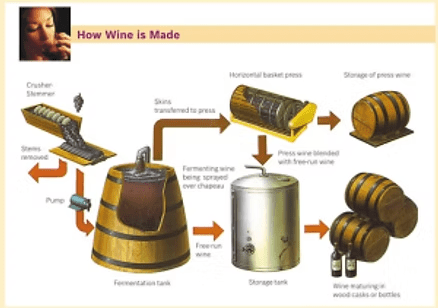
Jesus would raise the third ceremonial cup of wine at his final Seder meal and say, “This is my blood of the covenant, which is poured out for many for the forgiveness of sins.” (Matthew 26:28) So, “drink my blood” is no different than “drink my wine.”
The ceremonial cups of wine at a Seder meal (4) represent a progression of spirits being added into the bloodstream, adding to the individuality of the Israelite history lessons that are symbolized by the matzo. All is a symbolic way to give thanks to God for saving them, through forgiveness and instilling them with holy blood (spiritual, not physical).
Still, one has to understand that “blood” is the fluid of life, which if lost means the threat of death. To put the blood of Jesus Christ within one’s body (only as a spiritual presence) means there is no danger of the soul perishing. That presence that is within – consumed through devotion to God – is what brings eternal life to the soul-body, as Jesus Christ reborn.
When Jesus said, “Those who eat my flesh and drink my blood have eternal life, and I will raise them up on the last day,” the confusion comes from “anastēsō auton tē eschatē hēmera” being translated to say “I will raise them up on the last day.” First of all, “Those” and “them” [the third person plural number] was not stated. Instead, Jesus said, “the [one]” (“ho”) and “him” (“auton”), which is a clearer indication of an individual’s actions towards “eating” and “drinking” Jesus. While the collective is a multiplication of the total number times “one,” without the “one” [as zero] there is no “them.”
Second, when one notices the important aspect of the individual’s responsibility, then one can see how “eschatēhēmera” (“last day”) can only be applied to a grand “end times” when the collective is read. This nebulosity then allows one to project a coming of Christ into a distant future, which may or may not be relevant to the individual’s commitment to God and Christ. However, when one sees the focus on “the [one]” and “him,” then “last day” is reflective of one’s own “end time,” which is assured, from being mortal. The “last day” is always relevant to one’s assured “end time.”

The word “eschatē” actually can translate as, “last, at the last, finally, till the end.” The word “hēmera” can bear the meanings, “day, always, daily, time, year, or daybreak.” When those translation options show the statement as, “I will raise them up till the end daily,” or as “I will raise them up finally daybreak,” the focus turns away from some distant time in the future and points to when one actually “eats the flesh and drinks the blood of Christ.” At that point in one’s life, one is then “raised up” spiritually forever more. The “end” of one’s darkness [sin] comes from the “daybreak” God brings to one, through His Son being resurrected again in flesh and blood, shining light where there was the absence of light.
When Jesus said, “for my flesh is true food and my blood is true drink,” the word “alēthēs” is repeated, meaning “true.” The Bible Hub Interlinear translation shows the word translated in all-caps, as “TRUE.” The basic word can mean, “unconcealed, true, true in fact, worthy of credit, or truthful.”
As a Christian, one knows that Jesus frequently began his statements with the words, “Verily,” or “Truly I say.” By saying his flesh and blood was the truth he meant the TRUTH of God was all that was capable of being said by one who has sacrificed self-ego in service to God. Therefore, all who (individually) eat his flesh and drink his blood will become the resurrection of that TRUTH – a voice of God incarnate. Not only would those “partaking” of Jesus speak the TRUTH, but they could hear it as well [understanding].
As such, Jesus said, “Those who eat my flesh and drink my blood abide in me, and I in them.” This says, “The one who eats and drinks lives in me (the reborn Jesus Christ) and I in him” (“autō” as singular, the one), such that two spirits are in the same body of flesh and blood. One spirit is the one’s soul (cleansed by a Holy Baptism) and one is the Spirit of Jesus Christ, resurrected through the Holy Spirit of God. This says eating the flesh and drinking the blood of the Son of Man makes one unified with the Trinity, as one in three, the same as was Jesus of Nazareth.
Jesus then said, “Just as the living Father sent me, and I live because of the Father, so whoever eats me will live because of me.” The repeated word here is “zōn,” meaning “living, live, alive, or life.”
It is important to see the similarity in Jesus saying, “Just as the living Father” and David (and other prophets of God) regularly having said, “As God lives.” Those are statements of TRUTH spoken by souls that had been purified by God, so God could be one with them, residing in their hearts and leading their minds. Jesus then can be heard saying, “As surely as God sent me and because God is within me, then whoever consumes me also becomes one with God, forever saved.”
By returning to simply referencing the act of eating the flesh of Jesus, where that flesh is again the bread of life from heaven, Jesus differentiated the holy manna from what he represented. Jesus said, “This is the bread that came down from heaven, not like that which your ancestors ate, and they died.”
As I wrote in the interpretation for Proper 14, the “ancestors” of the Jews (the Israelites led into the wilderness by Moses) did not “die” because the manna did not “raise them up” spiritually. They did not “die” because they were mortal human beings of antiquity, such that all human beings face death.

The death experienced by those “ancestors” means Israel fell and collapsed in ruin because they stopped being raised spiritually. They needed to incorporate that holy bread into a race of priests that were the fruit of a holy vine, whose skins were emoting the natural yeast of God’s love. Physical deaths would have caused the breakdown of the natural sugars of their faith, fermenting their blood (lineage) with the elevation of eternal life for their souls. Because that did not happen due to the manna alone, and only served while in the wilderness of the Sinai, could not make the Israelites a multitude of Jesus Christs.
The manna fell before there was the blood of faith [the Son of God] to guide each individual Israelite. Without the blood of faith sustaining each and every one of those who were delivered into the Promised Land they continually stopped worshiping the One God, Yahweh, backsliding into a near-death state. Was it not for judges leading them (externally) to return to the right ways of God, they would have perished completely, before becoming a nation of people. Still, it was the lack of individual faith that led them to desire a king. When David led them towards individual responsibility to God, his sins released all the Israelites to do as they wished (not as God commanded). By the time the Jews stood before Jesus in Capernaum, all the glory of a state of Israel was dead.
It must be understood that without Jesus Christ having been sent into the world by the living God, there was no blood to add to the manna. The bread of the Torah, the Psalms, and the Prophets was all destined to point to the coming of that blood of life, which would be fulfilled by the Messiah of the Jews. It had been the manna that kept the embers of faith still alive at that time. However, Jesus was the bread of life that put new meaning into the words that had been memorized, but never fully understood; and, that flesh being eaten would give rise to a fresh desire to know more, which was the wine of God’s love filling one with desire to serve Him.
As this reading selection ends by Jesus stating the exception to mortal death, he said, “But the one who eats this bread will live forever.” It has to be understood that a body of flesh and physical blood cannot live forever. The body breaks down.
Jesus said to his sleeping disciples at Gethsemane, “The spirit is willing, but the flesh is weak.” (Matthew 26:41) In that same vein of thought, one can see how the spirit is eternal, but the physical body is not designed for everlasting life.
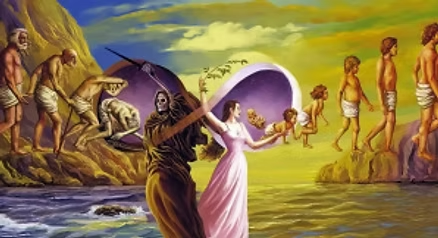
This is evidence for reincarnation, where the eternal soul passes from one temporal body of flesh to another, one life continued multiple times. Each new body of flesh brings about a blank slate of life, which has a soul start over, again and again, with the ultimate purpose being twofold: 1. Do not lose your God-given soul to Satan; and, 2. Gain eternal life with God, finally seeing the end of worldly incarnations and forever experiencing God’s presence as the eternal light of day (“eschatē hēmera”). To reach that gradation day, when one has been raised up to heaven, means all the work of righteousness has been done; and, that means one has eaten the flesh and drank the blood of Jesus Christ, reborn as him.
As the Gospel selection for the thirteenth Sunday after Pentecost, when one’s ministry for the LORD should be underway – one has eaten the flesh and drank the blood of Jesus – the message is to be transformed. One has to stop seeing the world through the eyes of a selfish sinner and see the light of truth.
Because this Gospel reading is scheduled with two other readings that address wisdom as a double-edged sword that can be all brain and little heart or all heart with the Christ Mind, one needs to see the Jews who followed Jesus to Capernaum as those who always represent mankind that is led by Big Brains and not in love with God. The majority of those who had been fed the spiritual food on the plain of Bethsaida (eating the bread and the fish and drinking in the faith of Jesus) – the miracle of Jesus feeding the five thousand (plus) – they had gone out into the world as Apostles. In Capernaum, Jesus was confronted by the twelve percent that followed Jesus there (those served by Judas Iscariot), as those who missed the opportunity others had received.
Those Jews were only looking for a material advantage, not a spiritually uplifting epiphany. Their hearts were closed to God, so this language spoken by Jesus (eat my flesh and drink my blood) could not sink into their Big Brains as metaphor. They were puzzled by the thought of “eating his flesh and drinking his blood.” Their intellectual dependency meant they were those of little faith, full of doubt and denial, never able to understand the Word of God in that ego-driven state of being.
All Scripture read today, two thousand years after the fact and nearly that long since the first writings about Jesus surfaced, is easy to discern, simply because so many have put both Big Brains and heartfelt wisdom into interpreting Scripture. Christians always need to be wary of thinking, “I know where Jesus is going with this, because I have heard it read before.” The trap is to start thinking that you are one of Jesus’ disciples standing behind Jesus as he says “eat my flesh and drink my blood,” saying under your breath, “How stupid can these guys be?”

The trap is to not see oneself as just as dumbfounded at these words of Jesus as were those Jews to whom Jesus spoke. Many Christians fear discussing any Scripture outside of a Sunday school classroom. Few have any depth of knowledge, much less spiritual insight that comes from God, which is based on a continual thirst for the meaning of Scripture. A typical Christian today puts up with religious education, in the right environment, having learned religion and politics are topics not discussed in mixed company. In reality, their lack of consuming Jesus on a daily basis means they have become like the Israelites after they entered the Promised Land … “Oh, manna? No thanks, I used to eat that when I was little, but now I’m all grown up, so I don’t need that anymore.”
Christians who “eat the flesh and drink the blood of Christ” daily are called Apostles and Saints; and they love doing that because of the emotional reward it gives them. They are given spiritual insights, one after another, each of which acts as yet another epiphany experience for them. It is the living bread come to life and the living waters gushing forth within. It is a feeling that makes one want to share it with others.
No one teaches epiphany experiences in seminaries or theological institutions, and few pastors lead small groups of devotees to spiritual awakenings in Sunday schools. The brief sermons that many men and women of the cloth offer up have little to do with the inspirational message of the readings, instead seeming to be lectures that boast of one’s educational acumen or pander as political advocacy. This means Christians today are just as dazed and confused by Scripture as were the Jews in Capernaum. Atheists who read Jesus’ words cry out like them, saying, “Jesus advocated cannibalism!”
What Christians can ably defend Jesus’ words?
A minister of the LORD has no answers prepared for anyone who questions the meaning of Scripture. Most likely, Jesus was not putting the finishing touches on a sermon about eating his flesh and drinking his blood when the Jews came up to Jesus, asking, “Where did you go?” Jesus simply opened his mouth and the words of God flowed out. Words from God are often so difficult to catch hold of the whole meaning the first time heard that they have to be repeated (as Jesus did). This challenges the one who hears the words to find the TRUTH, rather than reject it without reflection.
The whole time Jesus was speaking the TRUTH that came through him from God, Jesus delighted in knowing full-well what all those words meant. It tickled his heart to say them, especially knowing how they were like water on a duck’s back to the Jews listening. This is how God sends His Apostles out into the world – unprepared to speak the TRUTH, but speak the TRUTH they do. That is the difference between believing (the flesh of Jesus) and faith (the blood of Jesus).


 Explaining the Readings