As far as the John 7 reading goes, verse 37 begins by stating, “On the last day of the festival.” The “festival” is identified in verse 2 [not read] as “hē skēnopēgia,” or that “of booths, tents, huts, or tabernacles.” This is known by the Jews as Sukkot; and it takes place in the fall, much like a state fair. In the year 2020 Sukkot will take place between Friday October 2 and Friday October 9. It begins every year on the Jewish date of 15 Tishrei. Tishrei is the first month of the ‘civil year’ but the seventh month of the ‘ecclesiastical year’ in the Hebrew calendar.
In case you have never read the Holy Bible and have never been in a church that preached about John 7, this was the third festival God commanded be forever recognized, following the Passover and Shavuot. At this point in Jesus’ ministry two big followings: those who loved his freebie miracles; and, those who wanted to kill him. With that background, John recalled that it once again came time to head to Jerusalem, but this time Jesus told his brothers, “You guys go on. I’m gonna stay here in Galilee, not going to Jerusalem for this one.”
The “brothers” were the sons of Mary and Joseph, who came naturally after Jesus was ten years old. Any brothers that were of Joseph, prior to his marrying Mary, might also have been in that number. Neither sets got to spend quality time with Jesus, so John wrote, “For even his own brothers did not believe in him.” (John 7:5 – not read aloud on Pentecost]. Still, John said the brothers chided Jesus about (I paraphrase), “You need to go to impress them [the disciples].”
With that kind of familial support, it is easy to understand why there was a group of Jews who wanted to kill Jesus. But, as John repeats in this chapter, Jesus’ “time has not yet fully come.”
I mentioned this chapter from John in an article I posted (Jesus, the Escape Master), because John 7 reads like Jesus appeared in Jerusalem and preached as a hologram. Certainly, that technology was not known to be available back then, but when we are talking about the powers of God, anything is possible. After all, we just finished discussing Jesu suddenly appearing inside a locked upper room, alongside his disciples, none of who saw him come in. Whatever the case, Jesus went to the Sukkot festival after his brothers left. That should be realized as the background for this “last day of the festival.”
Jesus, according to John, had expressed concern about staying away from the temple elite (the Jews) because they were “seeking to kill” Jesus. For all the talk of ‘laying low’, Jesus somehow went to Jerusalem and made a big show during the week-long festival. At one point, John wrote “they were seeking to seize Him; and no man laid his hand on Him.” For the whole week the “officers of the temple” were unable to arrest Jesus and take him before the rulers of Jerusalem. Thus, verse 37 speaks of the final day of the festival.
When John’s words are translated to state, “On the last day of the festival, the great day, while Jesus was standing there,” the word translated as “great day” is “megalē.” The word simply indicates something that is “great,” but because it is the “last day” (“eschatē hēmera”), the word “day” is added to “great.” That one word, relative to the “feast” represents Hoshana Rabbah, or “Great Supplication.”
According to the Wikipedia article entitled “Sukkot,” the following is written about this day.
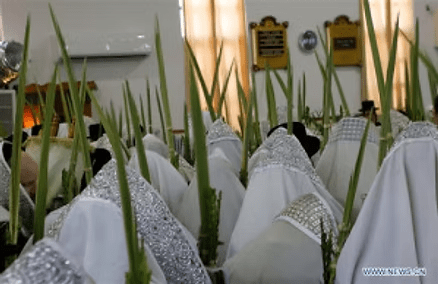
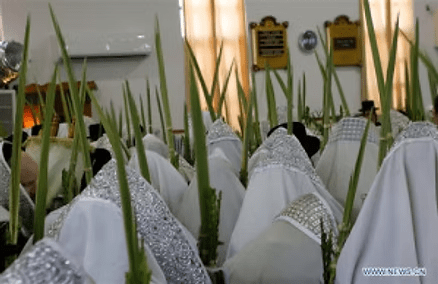
The seventh day of Sukkot is known as Hoshana Rabbah (Great Supplication). This day is marked by a special synagogue service in which seven circuits are made by worshippers holding their Four Species, reciting additional prayers. In addition, a bundle of five willow branches is beaten on the ground.”
The symbolism of the Jews making seven circuits around the Temple is a recreation of making the walls of Jericho fall, where this number of seven circuits occurs on the seventh day. This is designed to make the wall that separates the Father from the Temple fall, so God will be close to His people. Each day of the festival prayers are read, with the last day’s prayer calling for prosperity in the next year, with a call also made for the Messiah to be sent.
To read that Jesus “stood” during this pageantry (John wrote “heistēkei ho Iēsous” – “stood this Jesus”), the Greek word “heistēkei” also means “made a stand,” implying that Jesus “cried out” (from “ekraxen”) to get the attention of those beating willow branches (or palm branches) against the altar as they circled by him.
As to the quote from Scripture, “Out of the believer’s heart shall flow rivers of living water,” there is nothing that directly states this. There is no footnote next to it in translated Scripture that says where this quote can be found. For that reason, I recommend reading this article: Living Waters from the Messiah. That article sites Zechariah 14:8 as the source: “On that day living waters shall flow out from Jerusalem, half of them to the eastern sea and half of them to the western sea; it shall continue in summer as in winter.” It also cites Ezekiel 47:1, which states: “Then he brought me back to the entrance of the temple; there, water was flowing from below the threshold of the temple toward the east (for the temple faced east); and the water was flowing down from below the south end of the threshold of the temple, south of the altar.”
That is reason enough to understand why Jesus “cried out” as he did, in the midst of a commanded festival’s ritual. One can see Jesus suddenly standing out in their midst, just as he would do inside the upper room (in the other John optional reading).
In John’s fourth chapter he told the story of Jesus at the well with a Samaritan woman. There, he told her he could have given her “living water.” This inclines me to see the comparison Jesus made is to Exodus 17:1-7, when God told Moses to strike the rock with his staff and make waters flow to save the people. Jesus was like the rock, from which eternal waters could flow. Thus, Jesus “stood and cried out” that circling a building would do no good, as he was the Messiah of the Israelites. Their prayer had been answered.
The last verse in the reading from John 7 states, “Now he said this about the Spirit, which believers in him were to receive; for as yet there was no Spirit, because Jesus was not yet glorified.”
This makes this short reading a perfect fit for Pentecost and the onset of the Holy Spirit in the Apostles. The “Pneumatos” of John is relative to both the Numbers use of “ruach” [Then the Lord came down in the cloud and spoke with him, and he took some of the power of the Spirit that was on him and put it on the seventy elders. When the Spirit rested on them, they prophesied—but did not do so again.] and 1 Corinthians use of “Pneumati” [“Now about the gifts of the Spirit” and “no one who is speaking by the Spirit of God”]. It matches verse 30 from David’s Psalm 104 [“When you send your Spirit, they are created, and you renew the face of the ground.“].
John interprets what Jesus said in Jerusalem as “living waters” equate to the Holy Spirit. It makes the verses about “the great and wide sea, from which living things too many to number” come with a new insight.
The statement, “which believers in him were to receive” make this a fit to accompany the reading from John 20.
The two options for Gospel readings both come from John. One is John 20:19-23 and the other is John 7:37-39. The John 20 reading is also read every year in the three-year cycle on the Second Sunday of Easter, but those readings extend to verse 31 (an additional eight verses). The point of reading these five verses again is to see them in a new light, following forty days of preparation with the risen Jesus. The John 7 reading (only three verses) is important, if for no other reason that these three verses are the only verses scheduled to be read from this chapter, and it is only scheduled for reading on Pentecost Sunday.
Beginning with the first Gospel reading listed (John 20), it is important to realize fear is again an issue. The first verse (19) begins by stating it is “evening,” which means after 3:00 PM, but before 6:00 PM when night’s “evening” begins. For fear to have set in during the sun’s time overhead speaks of how little faith in God the disciples had. Rather than only fear God, we are told they locked the doors “for fear of the Jews.”
For all you self-righteous pseudo-Christians out there in the world, none of whom spent one second with the pre-death Jesus of Nazareth, much less the risen Lord Christ, see yourselves in the fear of being behind a locked door. That upper room reflects your safe room, your sphere of influence. More than a protection against others coming into your world – ones you hate and despise with all your heart – you lock the door to keep from having to extend beyond the self-comfort zone. You are afraid of letting anyone like God make you submit to His Will.
Me thinks thou doth pout too much.
This element of fear was present in the Numbers reading. In the Acts 2 reading about Pentecost Sunday, when Peter told of Joel’s prophecy being fulfilled at that time, verse 31 sings, “The sun shall be turned to darkness and the moon to blood, before the coming of the Lord’s great and glorious day.”
As it was evening of day, here in John’s Gospel reading, “the sun had turned towards nightfall.” As the “moon” is a symbolic statement of “emotions,” “fear” was running through the veins of the followers of Jesus. So, this verse certainly can be joined to that Pentecost reading.
In the Greek of Peter, when he quotes from Joel, “the coming of the Lord’s great and glorious day,” that is divided into two segments of words. Peter spoke (as was recorded by Luke): “formerly that coming day of Lord,” before adding, “this great and (“kai”) glorious.”
This means the Prophecy of Joel foresaw the coming of the Messiah – the Christ – who would be called “the Lord.” The Lord would come with the light (“day”) of illumination, and that was what Peter and the eleven were sharing with the Jewish pilgrims on Pentecost morning.
The Hebrew of Joel uses “Yahweh” as the one who comes, which is the truth of “the Lord.” It was God who descended in a mist at the tabernacle. It was God’s Holy Spirit that illuminated seventy elders. It was God who flowed through the Apostles and spoke a new light that shone in the hearts of three thousand pilgrims. Still, in Paul’s epistle, he made it clear that “Jesus is Lord,” only via God’s Holy Spirit, with God being the Holy Spirit that returns JESUS into human flesh. Thus, the “Lord” of one’s flesh is named Jesus Christ, but JESUS comes from Yahweh, just like the cloud of mist that descended on the tabernacle and made seventy elder be illuminated by the light of the “Lord.”
When John wrote that “Jesus came and stood among them,” this is literally two statements: “came this Jesus” “and” (“kai”) “placed himself among the middle.” This indicates Jesus suddenly appeared in between his disciples and others who were in hiding. It does not explain that Jesus, as a ghost, came through a wall or a closed door and stood just inside the room. He suddenly materialized in “the midst” of men and women who knew him as “this Jesus.”
Imagine this event.
Place yourself in any event of gathering you can remember best. The room is crowded with people (perhaps twenty).
Maybe you are holding a conversation with one other person, or a group of three or four. You might even be sitting in a chair, perhaps next to your wife or husband. The mood is somber, like that of a wake, because of a recent death, but the earlier news about women seeing Jesus alive (although he did not look like Jesus) is the focus, simply trying to ward off the fear of being in a locked room. Then, someone is standing beside you, but in a crowded room that is not something to cause you to be alerted. Jesus became one of those milling about, unrecognized once again, but unrecognized because everyone’s fear kept them from focusing on anyone other than themselves, for the most part.
This is when Jesus said, “Peace to you” (“Eirēnē hymin”).
This was an attention getter, but it was more than a greeting. It certainly was not an Episcopalian catch phrase, to be used so often it becomes as meaningless as an old Hippie flashing two fingers and saying, “Peace!”
Meaningless words do nothing of value. They are just words. When Jesus said “Peace, Quietness, Rest” (all translations of “Eirēnē”) the capitalization written by Luke says Jesus’ word immediately gave all in the room “Peace of mind.” With that “Quietness,” fear was dispatched elsewhere.
With that fear gone, the disciples were then able to ponder a body of flesh they had seen (from afar), dead on a cross just two days before (Friday). They had heard it was prepared for burial, which meant men who could tell a live body from a corpse knew Jesus was dead. Now, rather than fear they would be next, they examined Jesus’ body of flesh, which still had the wounds of having been nailed and pierced, along with a crown of thorns scratching his forehead and whip marks on his back. With all that evidence able to be seen by the followers of Jesus, they “Rejoiced” greatly (from the word “Echarēsan” being capitalized in Luke’s writing).
John separated that statement of Happiness and Gladness with another segment of words, which state, “having seen the Lord.” The words “idontes ton Kryion” also say the disciples and others “perceived” or “experienced” their “Master,” who was God incarnate.
This says the disciples were not just real happy that Jesus was not dead, but alive. They were filled with great emotions that sensed God was in their presence. This is like how the sixty-eight elders must have felt when they saw a cloud descending from the sky, surrounding the tabernacle … before they began to prophesy.
Realizing this awareness of God in their midst, in the form of a body that had been dead, known as Jesus, this was their true epiphany.
While words had been spoken previously, when Jesus asked them, “Who do you believe I am?” The response that came divinely from Peter’s mouth, “You are the Messiah, the Son of God” was just that – God speaking through men without big brains of intelligence.
Now, for the first time, having perceived God as the only way a dead body could be standing before them, the disciples and others “Rejoiced,” Then, Jesus told them once more, “Peace to you.”
Again, this is nothing like an Episcopalian greeting, where one says, “Peace of the Lord” during the break time, when (pre-coronavirus fears) everyone got up and milled about the aisles of a church, shaking hands, smiling, and hugging, before sitting back down (called “the peace”). The repetition here in John’s Gospel means a new form of “Peace” was unfolding.
First, “Peace” calmed the nerves of everyone in the room, but that “Peace to you” was external. When Jesus had let everyone examine his body as that of a dead man, with no earthly reason it could stand and talk, Jesus then said “Peace within you.” That equates true “Peace” as being the presence of God eternally with one’s soul, which is much better than feeling pretty sure God is real and somewhere else.
We realize this is the meaning intended, when John then quoted Jesus’ next statements: “As the Father has sent me, so I send you.” This too needs to be examined more closely.
The Greek text states, “kathōs apestalken me ho Patēr , kagō pempō hymas .” This literally translates to fully say, “according to the manner in which having been a messenger myself of the Father , I also am permitted to go as you .”
The key root word is relative to “apestalken,” which is “apostelló.” That says Jesus was an Apostle of God the Father, such that the “messenger” (the meaning of “apostle”) of Yahweh is the Son Jesus. The word “kagō” is a combine form word that joins “kai” (“and”) and “egō” (“I”). That usage means Jesus foretold (importantly) that his disciples would be joined with his “ego,” when they were to become Apostles (“messengers of God,” who would then truly be their Father).
You and me are one pardner, but I’ll do the thinning around here Baba Looey.
That says what Paul was stating in his epistle to the true Christians of Corinth, when he said you condemn your soul if you go around saying you are JESUS, when you are not. A true Christian is one who has surrendered self-ego, to take on the ego of the Christ Mind, thus becoming Jesus Christ reborn … in the name of Jesus Christ. This then becomes the antithesis of the Numbers reading, where the presence of God made seventy His Sons, so they could become His messengers; it was only for that one time. When one is reborn as Jesus Christ, it is the eternal living water that Paul said many members would drink.
When John then wrote the one-word statement – “enephysēsen” – it shows the importance of this one act: “he breathed upon.”
After having just spoke about the disciples going out to do the Father’s Will, just as Jesus of Nazareth had done, all of the disciples and followers had God’s life breath (i.e.: a soul) and it was that which kept their bodies of flesh from being dead. Jesus stood in their midst as dead body of flesh that had been resurrected, meaning his life breath (his soul) had returned to be one with God. However, the dead body of flesh that had been Jesus of Nazareth (born in Bethlehem) stood not because of the breath of life given by God, but by the Holy Spirit. Thus, Jesus had a ‘mind-meld’ with the followers, which is the meaning of “he breathed upon [them]”.
With the disciples knowing the Mind of Christ, just for that moment, they understood that by Jesus saying “Receive the Spirit Holy” it was God speaking to them through His Son. God was offering, through His Son’s body, for them to have the same powers over mortal death. The capitalization of “Labete” (“Receive”) states the importance of letting go of their self-egos, so their hearts and minds and souls would sacrifice control over mortal flesh and welcome God in with love.
That would be a proposal of marriage; but as a proposal, the disciples had the free will to accept or reject God’s offer of a new Covenant.
This then leads to the final verse in this reading, which is read aloud as: “If you forgive the sins of any, they are forgiven them; if you retain the sins of any, they are retained.”
This is an enigmatic verse that is easily misunderstood. Therefore, it needs to be dissected, according to punctuation and analyzed carefully.
The segments of words written by John are as follows:
“an tinōn , aphēte tas hamartias , apheōntai autois ; an tinōn kratēte , kekratēntai .”
Without knowing any Greek, careful inspection should allow one to find that the words “an tinōn” are repeated. Repetition in Scripture is a statement of importance. This means understanding “an tinōn” is an important first step, which is not insignificant.
The Greek word “an” is said by Strong’s to be “usually untranslatable, but generally denoting supposition, wish, possibility or uncertainty.” It is because of that “supposition or uncertainty” that “an” is translated as “if.” The Greek word “ean” does translate as “if,” but the missing “e” means an unstated proposition made demands a decision.
This means a word of “possibility” should be read in the context of Jesus having repeated his command for “Peace to you,” with the addition of “Receive the Spirit” that makes one of the material world be “Holy” is a marriage proposal. The possibilities are for one to say “yes” or one to say “no.” This must be seen as the purpose behind the conditional word “if” being the translation.
The Greek word “tinōn” is the genitive plural form of “tis,” meaning “of or about some people.” To translate this as “any” misleads as “if” Jesus stood speaking as God speaking to everyone in the whole wide world. He was not. He was speaking to a select group of people who had followed Jesus for at least three years. Therefore, the statement is directed only to those people, and should be read as: “if any of you here now.”
This translates to our modern times (and all times after John’s gospel was canonized) to “any” of those people who have the Spirit of Jesus Christ in their midst, making the same marriage proposal from God. The possibility is just as valid now as it was then. However, the proposition has absolutely nothing to do with “any” being “all in the world,” as it only is a proposal to those who “might become” the brides of God. All are welcome, but for a proposal to come, there has to be some dating and flirting and atheists have no room in their hearts for any god but self.
With that grasped, the next segment of words states, “aphēte tas hamartias,” which has been translated as saying “forgive the sins of any,” when “of any” has already been stated separately, prior.
The literal translation states, “you might forgive [a conditional word] the sins.”
The Greek word “aphēte” is the second person subjunctive form of the verb “aphiémi,” which means “to send away, leave alone, permit.” Therefore, the second person subjunctive asks if “you might send away.” It implies one choosing the condition where one is “to let go, release, or to depart,” where “forgive” bears the same meaning of oneself “letting go, releasing, or quitting.” The word “tas” is the plural feminine of “to,” meaning “the” of “this,” such that “hamartias” is the object one is asked – “sins” – as the question, “will you let go – the sins?”
The Greek word “hamartias” also means “failures, faults, and guilts,” that are part of one’s being, as the excuses one uses as the reasons [big brain talk] one does not walk a righteous path and serve God. One’s failures are then from not going beyond the ‘dating’ stage, always keeping Him as an external ‘lover’ not a Husband.
This condition states that God knows all His ‘brides-to-be’ come with pasts that are sinful. No one can ‘forgive’ sins other than God, as true “sins” are only known by the faithful, who know the written laws that establish right from wrong. One who does not believe in Yahweh will do the same acts that a Jew calls a “sin,” but they will do it without any sense of guilt or failure.
No human being has ever been able to “forgive the sins of any,” but the Pharisees and Sadducees made a good living wage casting out proclamations of “sinner!” Even if one is filled with God’s Holy Spirit and is Jesus Christ resurrected in the flesh, Jesus Christ is not able to forgive any sins. Only God has that power.
With that rhetorical question stated (a hypothetical “if”), John recalled Jesus saying, “apheōntai autois,” which states, “they will be sent away” or “they will be let go and forgiven.”
Again, this is relative to God’s marriage proposal, sent through His Holy messenger, Jesus resurrected. “If” one of the disciples chose to say, “Yes. I will Receive God as my Husband. Please take my sins away from me,” then the answer is, “Okay. Your sins will be forgiven by God.”
Following a semi-colon, the alternative is stated by Jesus as, “If some [here now among us] wish (the conditional of “an”) to say, No.” then your wish will be granted. The key word here is “kratēte,” the second person subjective form of the verb “krateó,” which means, “to be strong, rule.” (Strong’s definition)
The implication of the usage says “If you should think “I am strong, mighty, hence: I rule, am master, prevail; I obtain, take hold of; I hold, hold fast,” then, by all means, do not marry God and give up a life that enjoys sins. If you choose option two, then “kekratēntai” – “knock yourself out.” The last word, a one-word statement of importance, says, “You will be retained as you, with no changes made by God.”
Certainly, in the Numbers reading, when Joshua complained about elders (who he probably knew were not as holy as they pretended to be, but they acted the part so they could have all the adulation of their camps) being given the gift of God to speak prophecy, so the common Israelites might be swayed to think they were gods (elohim), Joshua saw that as crazy. Joshua saw people as always sinners, who needed a strong hand to lead them to be righteous (if only pretending to be so). Moses laughed it off.
Basically, Moses said, “People will be people. If only they could always speak the truth of God, as wives of the Most Holy Husband. Wouldn’t that be nice Joshua?”
Moses knew the world is the only place where sin can thrive. Satan thrives on stolen souls of human beings. God will marry everyone who meets his criteria of marriage (The Covenant). The reality is then knowing sin will always be the common denominator for ALL WHO REFUSE TO MARRY GOD.
Yahweh does not play games with marriage. He will never appear on an episode of The Bachelor.
In that locked upper room, I doubt there were any takers of option two. I am confident that all of them said yes to the proposal and accepted the conditions of the New Testament offered by Jesus Christ. Unfortunately, two thousand years later, when there are people thinking they can go around saying, “I am a mighty big Christian because I forgive someone’s sins,” the reality is many have said “No” to God. They do so because it is just so damn gratifying to pretend to be the ruler of Self, the Master of one’s domain, and the Holder of the Biggest Brain humans can claim.
The moral of this story is, “If you want to be a big shot for eighty years [or so] and then suffer for the rest of eternity, then choose you. However, if you are prepared to sacrifice self-ego to do the Will of God the rest of your mortal life, choosing to marry God, then the reward is Heaven forevermore.”
Remember, human beings are ALL feminine, as dust and clay, so God will be the Husband and everyone with a soul of life breath becomes the ‘little woman’, but not the ‘better half’.



 Explaining the Readings