Tag Archives: John 8:12

1 Thessalonians 5:1-11 – Stay awake and sober for when the day of the Lord will come [Twenty-fourth Sunday after Pentecost]

Now concerning the times and the seasons, brothers and sisters, you do not need to have anything written to you. For you yourselves know very well that the day of the Lord will come like a thief in the night. When they say, “There is peace and security,” then sudden destruction will come upon them, as labor pains come upon a pregnant woman, and there will be no escape! But you, beloved, are not in darkness, for that day to surprise you like a thief; for you are all children of light and children of the day; we are not of the night or of darkness. So then let us not fall asleep as others do, but let us keep awake and be sober; for those who sleep sleep at night, and those who are drunk get drunk at night. But since we belong to the day, let us be sober, and put on the breastplate of faith and love, and for a helmet the hope of salvation. For God has destined us not for wrath but for obtaining salvation through our Lord Jesus Christ, who died for us, so that whether we are awake or asleep we may live with him. Therefore encourage one another and build up each other, as indeed you are doing.

——————————————————————————————————–

This is the Epistle selection from the Episcopal Lectionary for Year A, Proper 28, the twenty-fourth Sunday after Pentecost. This will next be read aloud in church on Sunday, November 19, 2017. It is important as it echoes the theme of being prepared for everlasting life, as was seen in the parables of the Ten Bridesmaids and the Rich Fool.

The selected reading from the fifth chapter of Paul’s first letter to the Christians of Thessaly begins with the capitalized Greek word “Peri,” followed by the conjunction “de.” This has been translated as, “Now concerning,” which is a reversal of the written words’ order, rather than literally translating, “Concerning now.” Certainly, this translation reflects translation via standard syntax; but standard syntax misses the subtle intent of capitalization, which places a need to focus some importance onto the word “Peri.”

The word “peri” means, “about, concerning,” and “around,” which “denotes place, cause or subject.” Its implied usage infers, “consideration where ‘all the bases are covered.’” As such, the important focus by the capitalization of this states, “Circumstances now” or “Conditions on top of.”

Because 1 Thessalonians 4:18 (reviewed in the Proper 27 lesson) ended chapter four with a plea to continue teaching the value of being in possession of the Holy Spirit, prior to death, chapter five is then referencing that plea and that message.  This beginning is then stating these are the “Conditions on top of” that prior statement. This next chapter is then adding focus on the “Circumstances now,” which were surrounding Apostles who were filled with the Holy Spirit. While that is also reflected in stating, “Now concerning,” there is something lacking in such an, “Oh, by the way” introduction.

This introduction then refers to “the times and the seasons,” which sounds reminiscent of the song found in Ecclesiastes 3:1-8, made popular by The Birds, with their song “Turn, Turn, Turn” (1965).

The two key words her are “chronōn” and “kairōn” (rooted in “chronos” and “kairos”), which can also state, “durations” and “opportunities.” This means the “Circumstances” that are “next” for those in their positions as Apostles is to look at how long (“times”) they have to serve the LORD, with their new purpose being to seek new believers to bring to Christ (the “opportunities”). Thus, this chapter places focus on that “time” and “purpose’ each Apostle has, relative to preaching the Gospel, and does not reflect an estimation of when one’s “time” is up.

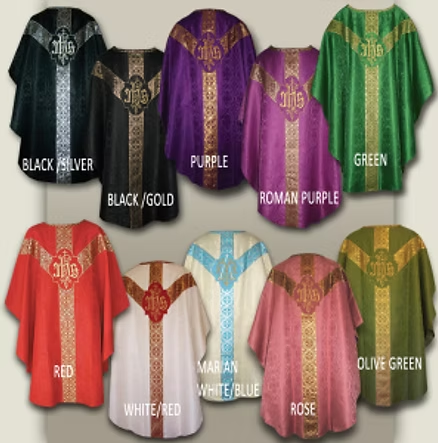
Because Paul then addressed the whole body of Christians in Thessaly as “brothers,” then “the times and the purposes” or “the durations and the opportunities” were those only held by bodies holding the risen Lord (Christ Jesus) within (meaning male and female Thessalonians were “brothers in Christ,” as Jesus reborn). That holy presence, coming with the Christ Mind, means there was “no need to have written” a checklist of “Apostle To-dos” or a schedule for what “times” one should go to church and what “seasons” does a Church recognize, denoted by when it is appropriate to wear robes of green, white, red, purple, black, pink (rose), gold and blue.
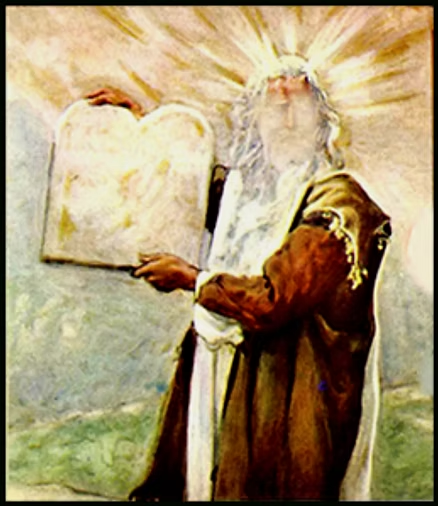
Above all, Paul (via the Holy Spirit) was not indicating the Christian Thessalonians thought someone should tell them when they would die and write that in a letter. The deeper meaning is the written Mosaic Laws are no longer external to them, for them to memorize and forcibly follow. The presence of God in their hearts has written His acceptable ways in their hearts.

The translation, “For you yourselves know very well that the day of the Lord will come like a thief in the night,” is shown to be three segments in the Greek text. The dividing points come after a statement that confirms the presence of the LORD within, such that is states, “Yourselves fully know that day of the LORD.” The love of God and His marriage to them, in their hearts, has become “that day of the Lord,” meaning there is no need to follow “cookbook” rules that will make “that day” be in the future. Thus, following a comma (written or implied) is the statement “as a thief in night.” This becomes read separately, as the day of the LORD being when they had their darkness of night was stolen from them.

The final segment of this verse concludes, “in this way comes.” That “manner” is then the “stealth” in which God transforms one from a mortal born of death (“the night”), to a soul with the promise of eternity that become “known” on “that day of the LORD.”

Of course, the double entendre (dual meaning) speaks of “night” as the “time” of death, which is not foretold “in writing.” The “day of the LORD” becomes the “light” of awareness when the soul meets face-to-face with God, who takes the soul “like a thief.’ The factor of “night” becomes representative of the “time” of death.

In verse 3, where the translation is “When they say, “There is peace and security,” the second segment (in quotation marks) is “Eirēnē kai asphaleia,” where the capitalization leads to those referenced (as “they”) saying, “Peace and security.”The presence of capitalization is important to recognize.

It is also worthwhile to know that “eirēnē” was used as an “invocation of peace [as] a common Jewish farewell, in the Hebraistic sense of the health (welfare) of an individual.” Capitalizing this word then infers someone pronouncing “I am healthy and well.” This becomes similar to the common thoughts of mortals, as stating, “I am so good that God has rewarded me physically, with good health.” The word “asphaleia” then adds to that proclamation of physical health the “reliability, firmness, and safety,” which (again) are thought to be from the good graces of YaHWeH.

For Paul to write that to Christians in Thessaly, who undoubtedly were a mix of former Jews and former Gentiles, such words were understood to be those commonly expressed. They were catchphrases, rather than deep beliefs. People of professed faith, who think they have been blessed by God (due to the comfort of their status and position) can then pretend to be a god with a catchy farewell.  This gives the impression: “As I have peace and security, I give you a pinch of that peace and security to keep as your own.”

The same can be said as happening to this day, especially when an Episcopal service comes to the point of “The Peace.” The priest motions everyone to rise, and says, “May the peace of the Lord be with you,” to which the congregations replies, “And also with you.” I expect we do it today because they did it yesterday.

Now, that is all well and fine, IF everyone knows what that means and means what that says.

Myself, not being a “cradle to grave” Episcopalian, I was not confirmed in the Episcopal Church until the ripe old age of fifty-something. After the ceremonial proceedings, the Bishop spoke with me privately, while the others were leaving the nave. He shook my hand and said, “May the peace of the Lord be with you.”

When I heard that, I was thinking, “Wow. That was so nice of the Bishop to say that … to wish me well.” So, I replied, “Thank you.”

As he was walking up the aisle to leave it struck me, “Idiot, that was an Episcopal catchphrase.” As soon as I realized my mistake, I hollered out to the Bishop, “And also with you!”

He didn’t look back; but he kinda waved his left hand to the side, letting me know he heard. Maybe he didn’t want me to see him trying not to laugh?

That becomes symbolic of what Paul was writing; as people think saying the right things is all they have to do to get to Heaven. However, Paul then wrote, “Then sudden destruction will come upon them, as labor pains come upon a pregnant woman, and there will be no escape!” This says that talking a good game is no replacement for sacrificing your Big Brain for the love of God and the Mind of Christ.

When that self-sacrifice is done, then” you do not need to have anything written to you” to memorize as a farewell.  A catchphrase is an automatic statement that comes without out deep thought and meaning.  “Peace and security” implies “I already have this, which only works when that is the truth.

To follow that up with, “sudden destruction will come” means “ruin, doom, destruction, and death” has just been wished upon oneself, simply from thinking one is prepared to enjoy life because God loves him or her, and not doing the will of the LORD. That meaning of “destruction” comes from the Greek word “olethros,” which also “emphasizes the consequent loss that goes with the complete “undoing.”’ One is thus undoing all of their pleasant thoughts of health and safety by boasting about you being well-to-do.  All the counting of one’s chickens before they have hatched will have been “undone” by having the gall to think God loves you so much that He is your slave.

Now, in the verse where it says, “as labor pains come upon a pregnant woman,” this too is spoken with dual meaning intended. First is the obvious, which is “labor pains” come suddenly, when a “pregnant woman” is due to give birth to a baby. Their onset becomes a ‘drop everything’ mentality, with going into rush mode an immediate response. For a lot of married couples who are pregnant, the parents-to-be practice for that time when action needs to be quick. When it is time to react swiftly, looking up something in a book or calling someone to ask what to do is not the best way to get moving.

Second, which is a deeper meaning, relates to my having said prior that all mortal human beings are called to be the brides of God. God wants to impregnate both males and females with His Holy Spirit; but God is not going to rape anyone that refuses to get engaged and become married to Him (in Spirit). Therefore, the metaphor means the “destruction” of death will come suddenly, because mortal human beings (males and females) became “pregnant” from their own rejections of God and Christ.

There is a vulgar saying that involves a word beginning with “F” and involves “yourself.” Consider that the secret second meaning here.

Still, the Greek words only imply a “pregnant woman,” which is the translation provided by the New American Standard Bible (NASB). The actual Greek text says, “ōdin en gastri echousē.” The closest that comes to “labor pains upon a pregnant woman” is as “the pain of childbirth to her [feminine “the”] in the belly holding.” The actual birth of a baby or child is implied, but not said.

A viable alternate translation can be, “the acute pain to her in the stomach having.” This then becomes a reference to a woman that has not become pregnant, as the sudden announcement from “her belly” that mensuration is about to begin sloughing and unused egg. As metaphor, males can know this “sudden pain in the gut” after eating some bad food.

The point is to not get caught up in looking for ways that, “This cannot be a worry for me,” as Paul was not trying to tell of pregnant women suddenly dying. The comparison is to how the state of “death comes so quickly” that “there can be no escape.”

In verse 4, Paul again refers to the recipients of his letter as “brothers.” The translation as “beloved” recognizes a familial relationship, in the same way that John wrote that Jesus loved Mary Magdalene, Martha, John, and Lazarus. The actual identification as “brothers” says Jesus had been reborn in each and all.  The new persona became their escape from the sudden throes of death.

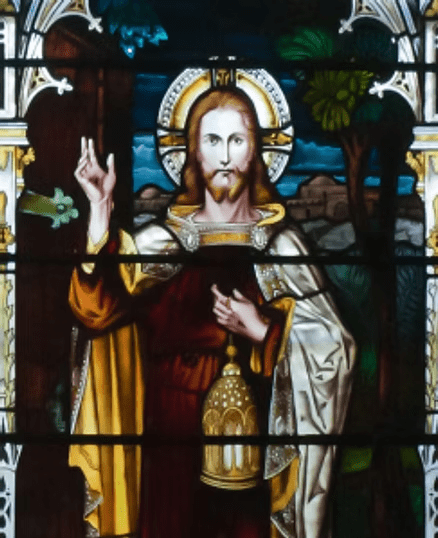
Paul then stated Apostles (males and females) “were not in darkness.” That means they had been elevated from the level of mortal sinner (where darkness always exists) to righteous Saint, where the light of Christ was surrounding them.  This can be seen as the halos depicted above a Saint’s head in art.  This light was brought upon them by God’s Holy Spirit, so that God had snatched away (good translation of “katalabē”), “like a thief,” their souls from Satan.

The presence of this light that removes all possibility of darkness from the Christians of Thessaly is said above to be due to them being “children of light and children of the day.” The actual Greek states, “huioi phōtos” [comma] and “huioi hēmeras.” The word “huioi” is repeated, lending it an importance of identification. Those repeated word are rooted in the singular word “huios,” which properly means “sons.”  The Biblical implication of “huios” as “sons” means it can state (as understood use), “Anyone sharing the same nature as their Father.” (Helps Word Studies for “hyiós“) Certainly, “their Father” has to be understood as God, the LORD.

According to the Helps Word Studies explanation of the Biblical meaning, this word is expanded further by this definition: “For the believer, becoming a son of God begins with being reborn (adopted) by the heavenly Father – through Christ (the work of the eternal Son).” Therefore, while it can be assumed the Christians of Thessaly included men and women, husbands and wives, this use of “sons” clearly identifies them all as the “sons of light” and the “sons of day,” as those embodying the Mind of Christ, Jesus the Son.

By Paul stating “we are” (“esmen”), he was writing as one of those “sons of light,” “sons of day,” so he knew the same as the Christians of Thessaly, because they all were filled with the Mind of Christ as the same Son. Still, “we are” is actually led by the capitalized “Ouk,” meaning “Not.”

The importance of that negative says the voice in Paul’s mind spoke loudly, “Not are we of night nor of darkness.” Paul knew all the writers and addressees had escaped death and the dark night of the soul after death.  They had been saved by each being a reborn Jesus, who said, “I am the light of the world. Whoever follows me will never walk in darkness, but will have the light of life.” (John 8:12) “Follows” means be the next Jesus.
The translation of verse 6, “So then let us not fall asleep as others do,” can seem like Paul was giving a pep talk, urging them not to drift off and die, when they have “light” and “day” on their sides. In reality, the Greek text literally states, “So then not we should sleep like the rest.” The “conditional” form of “katheudó” implies that none will reach death and have a soul lost in darkness because they are “sons of light” and “sons of day.” This conditional form reminds us of verse 1, which said this chapter would address “Conditions on top of” (“Peri”) being tasked to spread the Gospel of Christ.  One condition is Apostles should not sleep like the rest.

Paul then stated the additional responsibilities Apostles have, which is stated where he wrote, “but let us keep awake and be sober.” The word translated as “awake” is “grégoreó,” which is the conditional form of the root word “grēgorōmen.” The proper translation states, “but we should be vigilant.” This is then followed by the word translated as “sober,” which has “néphó” as its root, from the conditional form written– “nēphōmen.” The completion of the statement is then “and we should be free of illusions,” where “not being delusional” is a viable substitute for “sober.” Again, Paul spoke in the conditional form, which maintains the theme set in the introduction of “Conditions on top of” preaching the word of God.

The translation that says, “for those who sleep sleep at night, and those who are drunk get drunk at night” is actually shown in the Greek text for verse 7 as having four segments, with a semi-colon splitting this verse in the middle. Those language ‘road signs’ say pause and reflect on each segment before proceeding to the next. The four segments literally translate as, “those indeed sleeping,” “by night sleep,” [semi-colon] “and those becoming drunk,” “by night get drunk.” Each segment has its own separate idea that needs to be grasped, before one can run and toss everything together in one quick breath of reading.

To begin with, “those indeed sleeping” recognizes the need for an Apostle to remain alert and free of illusions because (“gar” = “indeed,” => “cause”) the rest of humanity is “sleeping,” as mortals born of death. Only those who are alert and awake can rouse those asleep from their slumbering lives. The separate segment that says “by night sleep,” is a focus being placed on the absence of light that night brings. That, in turn, maintains how ‘dead’ humans of normal life sleepwalk towards a dark end. Following a longer pause for reflection on those statements (the intent of a semi-colon), the next segment then continues (“and”) by placing focus on this life of darkness assisting a sleepwalker because mortals born of death have “become drunk.”

This state of “intoxication” is not caused by drinking alcoholic beverages (as if drinking was the only sin of darkness, only done after nightfall).  Instead, it projects all the artificial “highs” and addictive “lows” that one gets from the excesses of the material plane. Excessive drinking can be representative of anything the world has to offer that places the user in an altered state of being, incapable of “seeing the light.” This is then supported in the final segment, “which states “by night get drunk.”

Because “drunk” represents the illusions of life (they used to say drunks saw hallucinations of pink elephants), “sober” is the opposite, where one is “free of illusions.” Paul then encouraged the Thessalonians (in the conditional) to remain “sober,” as those who are led by the light “of day.” That ability to remain focused on helping those who are still in darkness, is then stated as if an Apostle should dress like a ‘Christian soldier’, with a breastplate and helmet.

Halloween – Almost normal
All other days of the year – delusional

That ‘armor’ of protection is then a reference back to the Holy Spirit being the truth of “Peace and safety.” Because a “breastplate” covers the heart area, it becomes the armor of one’s “faith and love” of God. The “helmet,” as the crown of one’s “hope of salvation,” is then the “security” an Apostle receives from the Mind of Christ (with a helmet covering one’s Big Brain of ego).  As visual as the verbiage seems, this armor is invisible and comfortably worn by all Saints.

The translation of verse 9 above (NASB), “For God has destined us not for wrath but for obtaining salvation through our Lord Jesus Christ,” is again set without the pauses Paul indicated. There are four segments here, which literally say, “because not has destined us God to wrath,” followed by “but for obtaining salvation,” and then “through the Lord of us.” The final segment states “Jesus Christ,” which is the entity that true Christians become. “Jesus Christ” becomes the author of our “salvation,” when God changes one’s assignment from mortal born of death to a soul allowed everlasting life in light.

When the translation sums this identity of “Jesus Christ” as, “who died for us,” millions of Christians think: Because Jesus died and went to Heaven, anyone who believes that will also go to Heaven.  This is wrong, because that it an over-simplification of that which was written. The literal Greek says of “Jesus Christ” that he is “the [One] having died for us.”

The word translated as “for” is that word “peri” again, so “Jesus Christ having died” was conditional “(condition on top of”). Further, the singular number of the word “the” (implying “One,” as “the [One]”) is then followed by the plural pronoun “us.” The plural number says “Christ Jesus died so there could be many Jesus Christs.” As One (the singular), Jesus was limited to only being that guy from Nazareth, born in Bethlehem. However, by him “having died,” then “Jesus,” as the “Christ” “could be us.”

Verse 10 then continues in the conditional (not shown in the NASB translation) saying, “that [a reference back to the death of Jesus leading to Christ in us] whether we might watch or we might sleep.” This is saying that by having Christ be one with an Apostle (the same in all Apostles), then the human being that becomes the risen Lord has nothing to worry about in life (“we might be alert and watchful”) or our body’s eventual death (“we might fall into the sleep of death”). We do not have to worry because (the next segment says), “together with him we might live.” The conditional statements then speak of being filled with God’s Holy Spirit, bringing about that ‘living together’ arrangement.

Verse 11 then ends this selected reading with the Greek text showing three segments. The first says, “Therefore encourage each other.” This is what Paul’s letter is doing. It is a statement that Apostles and Saints “console, send for, invite, beg, admonish, and comfort” one another (from “parakaleó”). This is as opposed to Christians glad-handing for five minutes during “the Peace,” and then silently slinking off, never to call upon a fellow Christian otherwise (unless there is money to be made).

The next segment says, “and build up one another,” which says to add strength to the ones who may be older, or sicker, or (in those ancient times) put in jail for being Christian. To “build up one another” is like “encouraging one another,” as it means a compliment here and a handshake there, with going out of one’s way to recognize the works of faith in one other than oneself. It means sharing, because you want others to share with you.  This recommends a fulfillment of the command, “Do unto others as you would have them do unto you.”

Finally, Paul ended with the assurance, “just as you are doing.” The Greek word “poieite” (“you are doing”) is the present infinitive of “poieó.” That is a verb stating “action.” It means “manufacturing, making, constructing, acting and causing.” It is an encouragement to “keep up the good works.” That says Paul knew their “works” and wanted them to know he knew.

This act of kindness, as a written ‘pat on the back’, is what being Christian is all about. If you cannot compliment another Christian for their good deeds, then perhaps some are actually standing in a tunnel of darkness, looking at the light at its end. Depending on how big and bright that light appears, some might still be afraid to step out into that light. Once one does, one will stand with other Saints and Apostles, turning back to the tunnel, so all can be reaching out to someone else who was also lost and afraid.

Come into the light, brother and sister.
Ephesians 4:25-5:2 – Angry for the love of God

Putting away falsehood, let all of us speak the truth to our neighbors, for we are members of one another. Be angry but do not sin; do not let the sun go down on your anger, and do not make room for the devil. Thieves must give up stealing; rather let them labor and work honestly with their own hands, so as to have something to share with the needy. Let no evil talk come out of your mouths, but only what is useful for building up, as there is need, so that your words may give grace to those who hear. And do not grieve the Holy Spirit of God, with which you were marked with a seal for the day of redemption. Put away from you all bitterness and wrath and anger and wrangling and slander, together with all malice, and be kind to one another, tenderhearted, forgiving one another, as God in Christ has forgiven you. Therefore be imitators of God, as beloved children, and live in love, as Christ loved us and gave himself up for us, a fragrant offering and sacrifice to God.

——————————————————————————–

This is the Epistle selection from the Episcopal Lectionary for the Twelfth Sunday after Pentecost, Year B 2018. In the numbering system that lists each Sunday in an ordinal fashion, this Sunday is referred to as Proper 14. It will next be read aloud in an Episcopal church by a reader on Sunday August 12, 2018. It is important because Paul talks of the works of Sainthood, which can only be produced by sacrificing self, in servitude to God.

Once again, reading an English translation of a letter written by Paul leads to some superfluous platitudes that are easier said than lived up to. Of course, Paul did not write such banal statements. Reading Paul and understanding what he wrote requires one be led by the Holy Spirit’s wisdom. This is because the Holy Spirit’s wisdom led Paul to write his words. Therefore, one must learn to read Scripture (based on the writing of the Apostles) word by word, segment by segment, verse by verse, and chapter by chapter – starting small, before gobbling everything up at once.

Certainly good can be obtained by the translation into English above, which will be read aloud in Episcopalian churches. Not lying and telling the truth is a good way to live. Living a life where one is kind, tenderhearted, and forgiving is an ideal the world should strive towards. The problem comes when one addresses the issue of anger, which is a natural emotion that humans must encounter, because (like a volcano) trying to hold in built-up pressures will lead to explosive flows.

By seeing this reading as Paul saying such eruptions are forbidden is wrong; and this is because we must always be angry at the works of Satan. This reading addresses that and it is more clearly seen when one examines the literal Greek text, following the rules of slow digestion of the Word.

Below I offer a valid literal translation of the Greek written by Paul, verse by verse, segmented by the punctuation marks (real or inferred), based on the Interlinear translation of Ephesians 4 and 5, published by Bible Hub. It is best to practice reading these words slowly, looking at the broad scope of translations available.  From that breadth, deeper meaning is found, aided by reflection, contemplation, and prayer.  Practicing this until it becomes second nature shows God one is sincere about one’s faith.

Doing this for oneself can open up more meaning than can be told by someone else. Most Christians have a relationship with a pastor, minister, or priest, who is an external crutch that allows one to lean on the teachings of another (or others), without feeling a need to know more than the teacher.  Self study of Scripture is how a personal relationship with God gets established, by demonstrating a desire to know the truth, more than simply being told what to believe … in the blind.

Before one begins to digest Paul’s reading selection that follows, it is important to know that twenty-four verses of chapter four are skipped over.  Those verses establish the context of the whole chapter. This reading selection then sets one into the middle of a conversation (between God and you, as much as between Paul and the Christians of Ephesus), where the prior context is absent. This can be done with Scripture, for narrow focus intent.  Still, this reading then bleeds over into the first two verses of chapter five, which is the lead-in to another thought set.  It can be applied in this way (two chapter’s verses as one) because the truth told can apply at all times.

The purpose is to see why that is done in this reading selection now.  To find this purpose, one needs to be cognizant of what Paul wrote.  Then, just as the Holy Spirit led Church leaders to choose readings that link in theme, one is enabled to grasp a deeper understanding of the lessons of the prophets.

[Note how the new “sentences” chosen do not start with capitalized Greek letters, other than the first verse (4:25), yet important words are capitalized.  Capitalization has been added to the translation above as a paraphrase, to fit one’s language customs.]

Chapter 4

25 Therefore having put off the [one] falsehood  ,

let speak truth each one with the neighbor of him  ,

because we are one another members  .

Notes: Leading into this first segment, Paul had written about turning away from one’s old ways of living and being corrupted. That was the “old man” of self that was replaced by one following a way of “righteousness and the holiness of truth, … according to God.” Since God is the one of truth, Satan is then the one of falsehood, such that an Apostle repeats as Jesus did, telling Satan, “Away from me, Satan!” (Matthew 4:10)  To “put off the [one] of falsehood,” one has ordered evil influences to get out of that way of “righteousness and the holiness of truth.”

With the influence of corruption out of the way, one can then hear the voice of God speaking the truth. This truth comes from Scripture, more than simple truths that are less helpful to neighbors. A “neighbor” can be a friend, but the use of “plēsion” is more to denote anyone who has yet to come and believe in Jesus as the Christ. For Jews, they would live among other Jews, but many would deny Jesus as their promised Messiah. The truth would help their eyes be opened to that realization. For Gentiles, their neighbors could be a mixture of Jews, Gentiles, and Christians, with Christians falling into the “friend” category and the others being their “neighbors” who seek the truth, but have not yet found it.

When Paul then stated “we are one another members,” the Greek word “melē” is referencing only Christians. Christians are the ones who have found the truth, for the purpose of spreading it around. Spreading it to one’s neighbors makes one come to live in a place where the neighbors are friends of the same religious values. Christians are members in the body of Christ, which means they are the limbs (branches) of the living vine, as extensions of Jesus Christ (reborn). As a vine for Christ, the fruit is the neighbor that buds into a new limb, as the fruit of that vine. This makes the truth become the common blood that flows within those branches.

26 be angry  ,

also not sin  ;

the sun not let set on the basis of the [one] anger of you  ,

Notes: Following a series of words that ended by placing focus on Christians being the “members” (“limbs, organs”), those forming the body of the living vine, where ALL are rooted in the resurrection of Jesus Christ, Paul wrote the one-word statement “orgizesthe.”  That says, “be angry” or “be provoking” and “be irritating.” This is a direct statement that Christians have an obligation to “be angry.”

HELP Word-studies says of the root word (“orgízō”): “be angry, as expressing a “fixed anger” (settled opposition)” and “to show settled-opposition,” which “is positive when inspired by God – and always negative when arising from the flesh.” “Sinful (unnecessary) anger” focuses on punishing the offender rather than the moral content of the offense.”

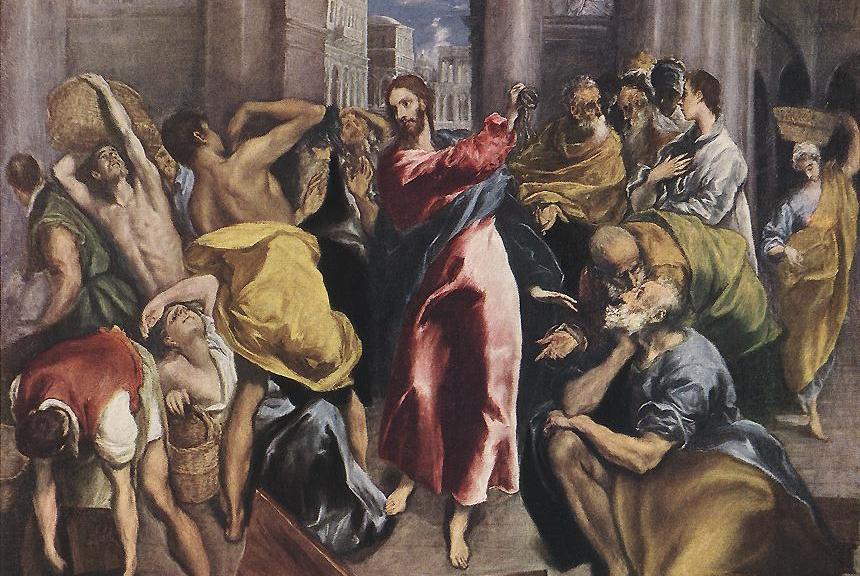
This is how one can read of Jesus commanding Satan to get behind him, his turning over the vendors tables, his calling Peter Satan, and his commanding a fruitless fig tree to wither and die. A true Christian must not compromise to evil, as one’s natural emotional outlet for anger is in opposition to that which opposes God.  The Old Testament is a series of stories that tell of anger of the prophets against the opposition to God’s people.  When those stories began telling of kings of Israel and Judah accepting prophets of lesser gods, they lost their lands and their Covenant.

To “be angry” but then “also not sin” is accomplished by the angels sent by God’s Holy Spirit to control one’s actions based on anger. The Greek word that translates as “sin” is “hamartanete,” which means “having no share in.”  This equates to oneself being apart from all acts that are motivated by the influences of evil. One’s acts out of anger, like those of Jesus, are justified by God.  God-led acts are not something to confess as human frailty, as if one is unable to control one’s actions caused by strong emotions. When one has totally sacrificed self so one can serve God, one’s actions are not based on the sins that arise from the flesh.

This is then confirmed by the use of “hēlios,” where “the sun” also represents “sunlight.” Jesus said, “”I am the light of the world. Whoever follows me will never walk in darkness, but will have the light of life.” (John 8:12) This means that Jesus is like the Sun, which always shines and never sets. It is the actions of the Earth that make it appear as if there is day and night, light and darkness. However, when one is reborn as Jesus Christ, a part of the living vine, with truth flowing through one’s being, no acts of anger can be deemed sins, because the light of Christ is always lit within, causing an act of anger to have a positive effect on those who see that light from their perspective in darkness.

[Note: The Greek god Helios is related to Apollos.  It was Apollo’s chariot that pulled the sun around the earth, giving light to the world.  Apollo was also the god of truth, whose oracle at Delphi could only tell the truth to questions posed.  This mythological symbolism was embodied in Jesus Christ.]

27 not give opportunity to the devil  .

Notes: Here we find confirmation that “the [one] falsehood” is Satan, who acts as “diabolō” – “the devil” – when given the opportunity to cast darkness around a mortal soul. The Greek word “diabolō” properly means, “a slanderer; a false accuser; unjustly criticizing to hurt (malign) and condemn to sever a relationship.” When this is realized in the context of speaking the truth to one’s neighbors, being in the light of Christ prevents words from flowing that will turn a neighbor away from the truth and towards the falsehoods of Satan.

28 the [one] stealing no longer let him steal  ;

rather now let him toil  ,

working with one’s own hands things good  ,

that he might have to share whoever need having  .

Notes: By seeing the element of Satan being opportunistic when one is not protected by God’s Holy Spirit and reborn to speak the truth of Jesus Christ, the act of stealing is less important as a condemnation of a human in need stealing things that assuage personal wants, desires, and needs. The most severe act of theft is Satan stealing one’s soul through the influences that bedevil the unprotected.

This first segment of verse twenty-eight ends with a semi-colon, which separates this statement against stealing from the one that encourages working for one’s gains. While the two are in the same vein of thought, the anger of a Christian expressed to a neighbor, one who has been caught stealing, becomes a valuable lesson that the neighbor needed to hear. More than a simple statement that payment for crimes will always come due, it places focus on the awakening of one’s soul spirit to the lures of Satan. It is instilling valuable lessons that plant the seeds of moral thoughts that are necessary to control evil urges.

Once moral standards are planted, not only must Satan work harder to steal a soul, but one must work harder to save a soul.  In that regard, the Greek word “kopiatō” (“let him toil”) is used, which implies “exhausting labor” and “weariness.” Such hard work leads an unprotected soul to see self as not strong enough to keep Satan at bay, such that one is led through hard labors to cry out for God’s help.

The Greek word “ergazomenos” means “working,” but becomes a continuation of the “exhausting labor” mentioned prior, by now expressing an “acquisition by labor.” This is then a statement about how God watches to see how one will react to the influences of evil and the punishments meted when caught. One’s works of faith earn more rewards of protection by God, whereas one’s lack of good works brings eventual punishments.

This is how anger can be applied according to the sins of the flesh, where punishments received influence sinful acts of revenge and malice. However, through exhausting works by one’s own hands towards things done that are good, then one can find a doorway open in one’s heart for God’s love to enter.

The segment of words that says, “that he might have to share whoever need having,” is then less about two or more people sharing things with those in need, as it is more a statement of God presence in a new Apostle. This goes back to a true Christian expressing anger towards a neighbor that came as words of truth that shared the blessings of the Father to the Son, to one in need of hearing that message. Giving a thief what a thief wants will do nothing towards getting a thief to toil to do good things on his or her own, with his or her own hands. However, a slap of reason given by an Apostle, on the cheek of a misguided neighbor, is sharing one’s desire to save the wayward and to motivate the wayward to seek God for having one’s true needs met.

29 every kind of word unwholesome [corrupt] out of the mouth of you  ,

not let go forth  ,

except  ,

if any good  ,

for edification of the need that it might give grace to those hearing  .

Notes: The Greek word “sapros” is translated as “unwholesome,” but also means “corrupt, rotten, useless, and depraved.” The first segment is a statement that mortal human beings do utter such words, often in anger. It is important to realize that such words do less towards harming anyone to whom such words are aimed, as the deeper harm is to oneself. Those who then utter such language are those who are in need of God’s help; and they are whom the anger of Apostles should be directed, in attempts to share the benefit of God through good works.

The Greek word written by Paul, “ekporeuesthō,” means “let go forth,” or properly, “go out from, emphasizing the outcome (end-impact) of going through a particular process or passage – i.e. the influence on the person (or thing) which comes forth.” [HELPS Word-studies] When the negative “” (“not, lest”) is added, the segment says one cannot “cast out, speak, flow out, burst forth, or spread abroad” anything that will prove oneself unwholesome and drive one who is unwholesome away from the light of truth. One must not speak in corrupt terms to be good, and one cannot lead the wayward to the truth with words that deprave. This is then a statement about the presence or absence of the Holy Spirit, as to what words flow from the mouths of people.

This then leads to a one-word statement, written as “alla.” This conjunction means “but,” but it bears more meaning and insight when translated as “except, nevertheless, on the contrary, on the other hand, and/or otherwise.” As one word of importance, Paul was stating that an Apostle cannot be typical of mortal human beings. One must set the example as an exception, one who is contrary to the ordinary, and one acts otherwise than the usual. One must let wholesome words go forth.

This exception must be so any good influence possible is shared with the one in need. The words spoken sternly to neighbors are for the purpose of building character in others, with one’s own character the goodness that supports the words spoken. This is how one passes on the Holy Spirit to those seeking the way to God, as a seeker will hear the truth and realize that; but any lies will lead a seeker to look elsewhere. This is the conditional “that it might give grace,” such that one builds with the materials supplied, as exemplified by houses built on sand foundations, versus houses built on rock foundations. (Matthew 7:24-27)

This is a stone the builder love. The ones rejected are round, meaning they can be removed so a soul can escape the tomb. Yahweh’s temple is mobile, not fixed.

30 and not grieve the [one] Spirit the [one] Holy the [one] of God  ,

by whom you were sealed for [the] day of redemption  .

Notes: The Greek word “lypeite” translates as “grieve,” but the meaning is best understood as “find pain.” HELPS Word-studies states its usage to mean: “to experience deep, emotional pain (sadness), i.e. severe sorrow (grief),” while also representative of a state that “very intense and hence even used of the pain of childbirth.” This last usage allows one to see how pain and grief from the Holy Spirit of God is the birthing pains that come from the change from worldly (in the womb of the earth) to a soul Spirit that has been washed clean of sin. This is the yielding of the old ways to the new ones that are Holy and righteous. It is the necessary pangs of being reborn as the Son of God, Jesus Christ, regardless of one’s human gender.

In our modern society, we celebrate the physical birth of our children with parties and cakes with candles alit on top, asking for the fire to be blown out to get a wish fulfilled. Those parties turn to recognitions of age and the eventual breakdown of the physical body. The years pass by and turn from happiness to grief. Few mark the days when one’s soul was redeemed, largely because one day cannot express fully the joy of being filled with the Holy Spirit. It is almost like what Nicodemus asked Jesus – “How can someone be born when they are old?” Nicodemus asked. “Surely they cannot enter a second time into their mother’s womb to be born!” (John 3:4) – as the womb of the world has been replaced by the womb of God, when a soul is “sealed for redemption.” Being reborn as Jesus Christ means being in that womb until one dies, when the soul is released (born again) into the heavenly kingdom. That is truly a happy birthday to you.

31 every kind of bitterness  ,

and anger  ,

and wrath  ,

and clamor  ,

and slander  ,

let be removed from you  ,

along with all malice  .

Notes: These segments can be read as the elements of self that must be released for redemption to be sealed. In a reverse view, these can be seen as the pains used against one by Satan, where neighbors who are not seekers begin to see one who is changing with eyes of persecution. One must let go of the devil’s urges to act from bitterness, anger, wrath, clamor, slander, and malice. Likewise, one must forgive those who use those sins against one. When the acts that accompany these mental and emotional states of being have been released from oneself, so one’s ego is no longer calling the shots, God’s Holy Spirit may use one in any and all ways to oppose Satan and those who serve him. An Apostle cannot read this instruction from Paul and assume it is good to capitulate to evil, as enemies give rise to these human reactions and the enemy of the righteous is the sinful. Therefore, when the sinful threaten the members of the body of the living vine, coming to use force against the innocent, it may be God’s Will that leads one to Holy War in response.

32 be moreover to one another kind  ,

tender-hearted  ,

forgiving each other  ,

as also the [one] God in Christ forgave you  .

Notes: This series of segments addresses how Apostles should deal with one another, as opposed to those who are neighbors and enemies. These are who Jesus said to love one another, just as he loved his disciples. The element of forgiveness should not be seen as a proclamation that it is okay to continue to sin, after one has had his or her soul cleansed of sins by the Holy Spirit of God, making one pure enough to be reborn as Jesus Christ. Forgiveness is for past sins (the same ones forgiven by God), prior to becoming an Apostle, who then never sins again – due to the sacrifice of self ego and that brain being replaced by the Christ Mind. That means prior enemies, neighbors, and friends can have past histories of conflict that become forgiven once all are born of the same Spirit.

Chapter 5

1 be therefore imitators those of God  ,

as children beloved  ,

Notes: The transition to a new chapter means a likewise transition to a new line of thought. One must be careful when reading backwards and not paying attention to the road signs, such as a new chapter, book, testament, where all changes have intent and purpose. Still, from the talk of members of the living vine sharing the fluid of truth that is Jesus Christ, it is that truth that one imitates.

The Greek word “mimētai” means both imitator and follower, such that it is the root word for the English “mimic.” Still, this is the truth of Jesus saying, “Whoever wants to be my disciple must deny themselves and take up their cross daily and follow me.” (Luke 9:23) Jesus never intended anyone to pretend to be him, as his statement says all of his disciples are expected to become Jesus in a lineage that will follow his time on earth. In order to achieve that rebirth-resurrection, one’s stake that supports the living vine must be raised, so the fruit does not attract vermin and weeds. An “imitator of God” is one who is exactly like Jesus of Nazareth was – completely subservient to the Father – such that Jesus Christ reborn into Apostles multiplies the presence of God that is incarnated without limits on earth.

2 and walk in love  ,

even as also the [one] Christ loved us  ,

and gave up himself for us  ,

an offering and sacrifice the [one] to God  ,

into an aroma of a sweet smell  .

Notes: The first step towards being filled with the Holy Spirit (when one’s soul is cleansed of sins) is to give one’s heart to God. One has to desire being married to God, such that the union of one’s soul with God means willingly seeking total subservience, as a wife to a husband. This brings the love of God about one’s being, so one “walks in love.” To “walk in love” is to be completely thrilled at the awareness God gives to his wives.

This union in relationship with God then brings about the birth of the Christ Mind in one. As the resurrection of Jesus Christ, one becomes in touch with the love between the Father and the Son, such that Christ loves all who follow in his steps, sacrificing so his Spirit can be resurrected on the material plane. That sacrifice in an Apostle is no different than the sacrifice of Jesus of Nazareth, who had to die so his Spirit could be resurrected countless times in his devotees. All have sacrificed so God’s Will can be done on earth.

The last segment uses the Greek word “euōdias,” which translates as “of a sweet smell.” According to HELPS Word-studies, the figurative meaning is: “our efficiency in which the power of Christ himself is at work is well-pleasing to God.” It means that one does what is pleasing to God; and this is a comparison to the beauty and fragrance of a rose.

As the Epistle selection for the twelfth Sunday after Pentecost – when one’s ministry for the LORD should be underway – the message is to be emotional for God. This is like the letter sent by Jesus, through John of Patmos, to the church of Laodicea, which said, “I know your deeds, that you are neither cold nor hot. I wish you were either one or the other! So, because you are lukewarm—neither hot nor cold—I am about to spit you out of my mouth.” (Revelation 3:15-16) Love for God means anger for those who fail to honor God.

Certainly, when protected by God and given the Great Commission of being Jesus Christ reborn, one wants to please God in any and all ways. A minister of the LORD delights in being shown the truth and seeks those who desire to learn the truth.

Matthew 22:1-14 – The Wedding Banquet

Once more Jesus spoke to the people in parables, saying: “The kingdom of heaven may be compared to a king who gave a wedding banquet for his son. He sent his slaves to call those who had been invited to the wedding banquet, but they would not come. Again he sent other slaves, saying, ‘Tell those who have been invited: Look, I have prepared my dinner, my oxen and my fat calves have been slaughtered, and everything is ready; come to the wedding banquet.’ But they made light of it and went away, one to his farm, another to his business, while the rest seized his slaves, mistreated them, and killed them. The king was enraged. He sent his troops, destroyed those murderers, and burned their city. Then he said to his slaves, ‘The wedding is ready, but those invited were not worthy. Go therefore into the main streets, and invite everyone you find to the wedding banquet.’ Those slaves went out into the streets and gathered all whom they found, both good and bad; so the wedding hall was filled with guests.

“But when the king came in to see the guests, he noticed a man there who was not wearing a wedding robe, and he said to him, ‘Friend, how did you get in here without a wedding robe?’ And he was speechless. Then the king said to the attendants, ‘Bind him hand and foot, and throw him into the outer darkness, where there will be weeping and gnashing of teeth.’ For many are called, but few are chosen.”

——————–

This Gospel reading will be delivered publicly by an Episcopal priest on the Sunday of the Ordinary season after Pentecost that is known as Proper 23. This will next take place on October 11, 2020, the day in the lectionary deemed the nineteenth Sunday after Pentecost.  It was last read aloud on October 15, 2017, which was also the nineteenth Sunday after Pentecost.

This reading comes from the string of parables Jesus taught while in Jerusalem prior to the official beginning of his final Passover attendance in the flesh.  Following Jesus’ return from beyond the Jordan, when he raised Lazarus from death, he spent four days making his presence be known, preaching on  the Temple steps.  This served as his time of inspection as the sacrificial lamb of God, when he would be found to be blemish free.  Matthew 21 told of his first day in this inspection process.  This reading is then an account of the beginning of the second day of Jesus’ inspection in the pubic arena.

It is worthwhile to take note that Luke presents a similar parable, told at a prior time when Jesus used the analogy of a great banquet.  In Luke 14 we read how Jesus went to eat dinner with some Pharisees on a Sabbath, at which point he noticed how the lawyers tried to gain favorable seating at the table.  This led Jesus to privately tell a parable that also told of invited guests refusing to accept an invitation to be freely fed by a man of great wealth.  That scenario is now made public, as Jesus is answering a question about the “kingdom of heaven” on the steps of Herod’s Temple.

When it is realized this is a parable about what the kingdom of heaven is like, it become important to grasp how nothing is stated by Jesus that says this place can be compared to some ethereal realm, such as Sheol. 

Instead, just as Jesus told a parable that was relative to the Pharisees scrambling to find a place of honor at a table inside a high-ranking Temple leader’s house, this parable about the kingdom of heaven is relative to the world we all live in.  It is a worldly comparison, which is both metaphor and symbolic of known reality.  That means the kingdom of heaven does exist in the worldly realm, just as Jesus existed there, while also existing beyond the realm of comprehension a human brain can fathom.

When the word “kingdom” is realized to be the place where a king rules, the realm of heaven is where God (YHWH) rules.  This means the “king” in this parable is God the Father.  When Jesus said his story was about “a king who gave a wedding banquet for his son,” it is easy to see how that metaphor is speaking of God as the king and Jesus as the son.  However, this is not the way to read the intent.

First of all, when Christians identify Jesus as the Son of God, the truth of that identification is Jesus became a vehicle of flesh within whom God spoke.  By realizing that, God was telling the parable through His Son Jesus.  This simple factor makes Jesus become synonymous in the parable Jesus told to a slave or servant, as one who went to invite others to a “wedding feast” (Greek “gamous“).

Second, and most important to realize, when Jesus is realized as the messenger in this parable, that says that when he spoke (as God) to the people, saying the wedding feast was “for his son” (“tō huiō autou  ” – “to son of him”) the metaphor is not about a marriage planned for Jesus (the servant) but to those others wo receive the message.  The invitation for a ‘wedding feast” (or “banquet”) is not to come as a guest, but the invitation is to become married to the king and become his son.  The invitation is a proposal from God to become the “son of him.”

Certainly, in the times of Jesus, men were the only ones of significance.  Women and the feminine pronouns were exempted from Jesus’ words, giving the impression that the message was only for males of importance.  Christians today love to think that having a penis was seen in olden times as a God-given right to rule the world (at least for men to lord over women).  Today, ordination of female priests, as an aftermath of “Women’s Liberation” and “Equal Rights” and as some mighty statement of power to all people, everyone loves to play the exact role as God painted through the words of Jesus (recalled by Matthew).  Nobody wants to hear an invitation to become the “son of [the king]” because all those hearing the invitation are so filled with self-importance that nobody (male or female) wants to submit to being the wife of God – and we all know that being a wife means being completely submissive to the Will of God, at all times.

[Here it is important to realize the tradition, as to who is responsible for throwing a wedding feast, says the father of the bride foots that bill.  Part of that designation is based on the tradition that having a female child is an ongoing expense, until someone takes that responsibility away through marriage.  Thus, a wedding reception is a celebration that a financial liability [a daughter] has been given away!  Seeing this makes it easier to accept the invitation to become a son of the king was metaphor for being a wife.]

The term “tō huiō autou  ” – “to son of him” must be grasped as an offer to become the offspring of God.  Because God is spiritual, God is the creator of all souls.  God is masculine [He is not a goddess], thus all souls are masculine as all that is spiritual is masculine.  All that is flesh is feminine, simply because feminine is the opposite of masculine.  The feminine flesh comes with different body parts that accommodate procreation [called males and females], so human beings like to think they are both masculine and feminine.  The proposal by God, sent via His messenger Jesus, says: “Your soul-flesh needs to marry God in order to become holy.  If you become holy, then you become subservient to God’s Holy Spirit, as the wife of God.  That, in turn, makes God your Father and you [regardless of human gender] His Son.”

Now, the metaphor in the parable told on the Temple steps spoke loudly of the Jews, who were God’s chosen people.  More than delivered to the normal Jews [many of them pilgrims in town for the upcoming Passover], God directed this parable though Jesus to those leaders of the Temple (Pharisees, Sadducees, high priests and the Sanhedrin), saying “they made light of it and went away, one to his farm, another to his business, while the rest seized his slaves, mistreated them, and killed them.”  Not only had those leaders plotted to have Jesus killed (roughly one week later), but they would later persecute the apostles of Jesus (“his slaves” of God reborn as Jesus in the Christ) the same way.  Still, that is the historic bend of this parable, which denies the present historic and all times since Christianity became an exact reflection of the degradation of a religion claiming to be chosen by God.

Christians today make light of the concept of marrying God and becoming His Son Jesus reborn.  Just as the Jews [the remnant leftovers of a fallen Israelite nation] were only special in the sense that God had sent His servant(s) Moses (and Aaron) to invite the children of Israel to begin a learning process that would lead them to complete servitude to Yahweh, all marrying His Holy Spirit and becoming His sons [regardless of them possessing penises or vaginas], they never could fully sacrifice their self-egos and become lowly servants of God.  Likewise, worship of Jesus as an external god [an idol] keeps Jesus on the car dashboard or in a box at the church, so one is free to sin and then kneel before an icon and pray for forgiveness.  Christianity has then become an exact reflection of ancient Judaism, because so few over time had bothered to actually marry God and become Jesus reborn.  It is much easier to pretend righteousness than actually walk that rocky road.

Today, none of the big names of Christianity [called all kinds of prestigious titles] would accept an invitation to give up all the celebrity that comes from being a leader of multitudes, only to serve God as a lowly messenger [sans golden crucifixes and bejeweled crosiers].  It would mean giving up the best seats at the buffet and all the benefits of being known as a cable media contributor, when times come to defend religion.  That is why God spoke through Jesus about one going to a “farm” [the Greek “agron” means “field,” thus an area of interest] and another to a “business” [the Greek word “emporian” means “trade” or “trafficking”].  Today, this should be seen as the invited choosing instead to go to their mega-churches or their major denomination headquarters [be it what it may be], rather than marry God.

Christians seize those who ask questions about seeming inconsistencies in Scripture or what the true meaning is about when Scripture has been twisted so it fits one group’s special political agenda.  Those who speak the truth that comes out from within them, making them minimally become temporary sons of God [regardless of human gender], they become mistreated as outcasts.  While the laws of the land no longer allow for public lynching’s, burnings at a stake, or stoning those deemed sacrilegious to death, the messenger is regularly killed if the messenger does not toe the line as to commonly held beliefs.  Those beliefs are where misguided ideologies have been constructed, themselves taught and worshipped as gods.  Jesus said a prophet is not a prophet in his home town; so, if they will try to kill Jesus, they will certainly try to kill anyone who threatens a safe (and profitable) way of existence.

When God then spoke through His Son Jesus, saying, “The king was enraged. He sent his troops, destroyed those murderers, and burned their city,” this should strike fear in everyone who cannot place their (his or her) hand on a Holy Bible and swear to God, “I have sacrificed my self-ego so my body of flesh can serve the Lord totally as a lowly servant that does nothing but seek others who will receive the Holy Spirit and become likewise Jesus Christ reborn.  I understand that is the truth of being Christian.  So help me God or strike me dead for lying.”

Plenty would stand up and publicly state those words, knowing no lightning bolts will ever come from the sky and kill anyone who says them.  They would have too much to lose by giving up their lifestyles as leaders who profit from religion, knowing the masses will give and keep giving more to follow someone who says he or she is God’s servant, so he or she never has to do anything other than give a few bucks to be saved.  What they do not realize as they would have broken a commandment (using the Lord’s name in vain) and death will surely come to them, as they stand in a body of flesh that breathes air, because their soul will be promised nowhere to go once physical death does overcome that body of flesh [a certainty].  Thus, the king sending troops to destroy murderers and burn cites [remember Sodom and Gomorrah?] is then metaphor for removing all chances of eternal life from those who anger God by rejecting His invitation to marry His Holy Spirit and become His Son reborn.

The troops are not angels flying down from heaven, swinging flaming swords.  They are all dressed like soldiers in the Red Chinese Army.  They are so-called Russians with CCCP t-shirts under their fatigues.  They are any and all Muslim militia ready, willing and able to sacrifice their lives for Allah, just to think that the great Satan in the West can be struck down dead.  The King does not create those who are willing to commit evil deeds in the world.  The troops of evil are created by the lack of God’s sons on earth.

Marriage to God is the only way for a soul to avoid an end that will always find it returning into the world as a body of flesh that has no true life.  Jesus is the model that all true Christians must become, in order to release their souls from that path to death.  Refusing to accept a proposal of marriage to the King means signing one’s own death sentence.  An “incarnation” means “the embodiment of a soul in some earthly form,” so “reincarnation” says a soul failed to marry God and be released from that repetition.  Refusing the proposal says one said, “I believe,” when that was a lie, bringing about one’s own condemnation – always a weak soul controlled by the evils of the flesh.

God then told the crowd that had asked what the kingdom of heaven is like what God the King did next.  He ordered his slaves, saying “The wedding is ready, but those invited were not worthy. Go therefore into the main streets, and invite everyone you find to the wedding banquet.” Then we read that “Those slaves went out into the streets and gathered all whom they found, both good and bad; so the wedding hall was filled with guests.”  Clearly, this is the advent of true Christianity.  The Jews no longer were the special people they thought they were, as simple Jews and Gentiles were invited by the servant apostles to come marry their God.  Those accepting the proposal became true Christians.

As true as that was, the truth is also that the rapid spread of true Christianity became stunted by Constantine beginning to use the separation made from the fallen Temple of Jerusalem and the influx of pagans into gatherings called churches [ekklesia] to create an organization that would be little more than a reproduction of that Temple system destroyed.  This becomes a model of the collapse of Israel and Judah [two nations split from one], falsely resurrected as Jerusalem in Judea.  Early Christianity also split into Eastern and Western ideologies that organized hierarchies that ruled over the people, rather than lead the people to individual marriage with God.  Thus, the “good and the bad” reflects a mix of true Christians (apostles-saints) with pretend Christians [themselves degreed in beliefs], all at the same celebration of marriage for different reasons; that becomes a comparison to Jesus later talking of the sheep and the goats.

It is here that the companion reading from Luke becomes helpful in understanding the collection of “both good and bad.”  After those invited to come to the great banquet came up with one measly excuse after another for not attending, the master of the house instructed his servants to “Go out quickly into the streets and alleys of the town and bring in the poor, the crippled, the blind and the lame.”  The metaphor of “poor, crippled, blind, and lame” says the replacement invitees were those deemed to be sinners because of their physical maladies.  As for the Jews being the invitees, that meant the servants were told to go find the lesser Jews and bring them in the house to be fed.  The same sense of oneness should be applied to the Christians brought to the wedding banquet (or feast), such that “both good and bad” is a poor translation that needs to be closely examined, in order to grasp what God actually told his slaves to find.

The Greek text states the servants of the king brought all they could find, who were “ponērous te  kai  agathous” or “evil both  kai  good in nature.”  The Greek includes the word “kai,” which is a word that makes a statement of importance that should be recognized in that to follow where “kai” is placed.  By realizing that and by knowing these words are separated by comma marks, making them work collectively as one segment of words, the translation actually states, “pain-ridden also  kai  good in nature.” 

When read as one segment of words, the “bad” comes first, but then importantly (“kai“) those have been transformed into “good.”  The word “te” has been translated as “both” (a good translation possibility), but it translates better as “and.”  Because “kai” translates as “and,” “te” is transformed into “both,” simply to avoid saying “and and.”  Because all words are part of one segment, the meaning is the ones called are “both – pain-ridden turned into good.”  Therefore, no one present in the wedding banquet is “evil” or “bad,” although all had prior been “wicked” as sinners, who were pained by those addictions to sin before their marriage to God.

Improper translations need to be addressed at this point, as twice the NRSV & NIV ignore an important element (in particular when realizing the Jewish audience Jesus was speaking to), which is translated as “guests.”  In both cases, forms of the root Greek word “anakeimai” are written (“anakeimenōn” and “anakeimenous“), which translates as “I recline, especially at a dinner-table.” (Strong’s usage)  Certainly, any hired help would not be permitted to recline at a wedding party, implying that any so relaxed would be guests; but the element of reclining at a table to eat and drink offers implications that must be grasped.

In the Passover Seder ritual, the Jews recline while eating that specific dinner.  It is customary for a child to ask his (or her) father, “Why do we always sit to eat, but tonight we recline?”  The father then teaches all in attendance that reclining while eating is something only the rich do.  This says the Israelite race is meant to be poor servants to Yahweh, with the exception allowed being when they honor their commitment to observe the Passover.  It is then symbolically stated through the ritual that it is the sacrifice of themselves to serve only God that makes them rich spiritually.  Thus, at a dinner offering bitter herbs and charred bones of flesh, they are allowed to recline while dining.

The Passover was when the Israelites committed to their God, through the sacrifice of a blemish free yearling lamb, whose flesh was eaten and whose blood was spread over the doorposts of their homes.  It was the presence of that blood that spared them from the physical death of the firstborn males that came when the Lord passed over Egypt that night.  This must be read into this parable told by God through His Son, as it says all who had been wicked but then were good in nature had made themselves sacrificial lambs, so their souls had married God making each of them the son of the king.

By understanding that everyone is wholly good, through that marriage to God the King, it then makes sense when God said through Jesus, “When the king came in to see the one’s reclining, he noticed a man there who was not wearing a wedding robe.”  That translation leads a non-Jew to think, “Well, I guess the Jews back then all dressed in wedding robes and gowns, as some Jewish ritual us Christians don’t have to observe.”  That is wrong to think, as the only ones who dress up fancy in a wedding is the bride and bridesmaids.  That makes knowing what was actually written important.

The Greek text written states, “eiden ekei anthrōpon ouk endedymenon endyma gamou“.  That literally translates to say, “he saw there a man not being dressed in clothes of marriage”.  The last word, “gamou,” can either translate as “marriage” or “wedding,” as it is the root word written throughout this parable, even meaning “wedding feast.”  That makes the word “endyma” (“clothes”) combine to mean the “apparel of marriage” or the “wedding garment.”  This says that “the king” [i.e.: God, who has an all-seeing eye] looked out over everyone present in this metaphorical gathering [for what the “kingdom of heaven is like”] and “saw one of the human race [which can include males and females as “anthrōpon“] not wearing a wedding gown.”

Back when gowns were not so expensive they had to be rented for a day and returned.

Of course, most Christians have seen the movie Wedding Crashers and they know people looking for free food and alcohol at a wedding reception (especially one paid for by wealthy parents of the bride) do not show up dressed like street urchins.  Everyone shows up wearing nice clothes, but none of those clothes hang in their closets afterwards, never to be worn to anything again, other than weddings.  The only “clothes of wedding” are those worn by the ones being married, most particularly the wedding gown of the bride.  Knowing that, God the King saw someone crashing His wedding reception whom He had not married.

God then spoke to the wedding crasher.  He called him “Friend,” through the capitalized Greek word “Hetaire.”  While this importantly (capitalization) makes it seem God is not angry with the wedding crasher, the word should be read accordingly: “hetaíros – properly, a companion (normally an imposter), posing to be a comrade but in reality only has his own interests in mind.” (HELPS Word-studies)  God then called this human being out for what he (or she) truly was: a pretender; one who rejected the proposal of marriage, but then expected to enter God’s kingdom because of a life of pretense.

Knowing this, the capitalization becomes the importance of God the King knowing the heart of the impostor trying to sneak into the kingdom of heaven.  The importance is a statement about the goats Jesus told his disciples would be separated from the sheep when the “son of man” comes in his glory.  The sheep go to the right hand of the king, while the goats go to the left hand.  Both sheep and goats feed in the same fields, but only the sheep are married to God, as “sons of man.”  The sheep are true friends, who help God without their egos allowing them to realize that fact.  Conversely, the goats do nothing to help God and they are too egotistical to realize that failure.  Therefore, the one who is called out in this wedding gathering is a goat and clearly a false friend.

When God asked this human how he came without being dressed as a bride to be married, the impostor was “speechless.”  This act of “silence” becomes proof that there was no love of God that drew in this soul to the wedding party.  All who are married to God, as rebirths of the Son, speak only what the Father tells them.  If the impostor was indeed married to God, he would have spoken the truth.  The truth was then spoken through an inability to speak for the Father.

This failure to be a devoted bride of God became clear when God the King had his servants take this impostor and “Bind him hand and foot, and throw him into the outer darkness, where there will be weeping and gnashing of teeth.”  In that translation is another example of translators reversing the order of what is written.  The Greek text states: “Dēsantes autou podas  kai  cheiras“, where we find another “kai” indicating importance.   

The capitalized first word shows the importance of being “Bound,” by present actions in the past [Greek aorist active participle].  It was the inability to speak the Word of God that cause the human himself (or herself) to find its own actions “having Bound” itself to a state of being that was not a wife to God.  This meant the soul could not walk the path of righteousness – which was symbolized by the wedding dresses all the others had put on.  They had all walked down the aisle of righteousness, clothed in those robes that state commitment through self-sacrifice.  Thus, as Jesus had told his disciples only those who could raise the cross of responsibility and walk the path set by him could follow, this one wedding crasher was a failure in that regard.  That soul in a body of flesh was like Judas Iscariot and unable to walk, due to his own binding of his feet.

Following the use of “kai,” the importance is then placed on “hands” (Greek “cheiras“).  The importance must be read as another self-inflicted binding, where this soul would not sacrifice self-ego in order to serve God fully.  Thus, he (or she) bound its own hands, keeping them from being the hands of a servant.  According to HELPS Word-studies: “xeír – properly, hand; (figuratively) the instrument a person uses to accomplish their purpose (intention, plan).”  The importance says tied hands prevent one from truly becoming a Christian.

When the judgment of the impostor is found to be “throw him into the outer darkness, where there will be weeping and gnashing of teeth,” this should be realized as two phases.  In the Greek text a semicolon is placed, rather than a comma mark.  That punctuation mark makes it clearer to see the two are separate stages of punishment.  First, “the outer darkness” (or “skotos to exōteron” – “darkness about external”) is the opposite of the inner light of life that comes from God, through the Son: “I am the light of the world. Whoever follows me will never walk in darkness, but will have the light of life.” (John 8:12)  God did not throw this soul there, as that soul cast itself into darkness [an absence of light] by not being willing to sacrifice self and serve only God.

Following the semicolon is a series of words that are separated by the word “kai.”  The first half of this segment places focus on the “weeping” or “lamentations.”  This becomes representative of the physical realm, where the plagues of the flesh cause pains and tears to flow.  The Greek word “klauthmos” (“weeping”) becomes a statement that says, “bitter grief that springs from feeling utterly hopeless.” (HELPS Word-studies)  The “wails” are from those who expect God to come to their aid, only to find their “cries” going unheeded, because of their own self-egos. 

Still, following the word marking importance to follow (“kai“), the “gnashing of teeth” symbolizes the true emotional feeling held for God, when He does not reward the goats of the Christian world, because they reap what they have sown.  The importance of this gnashing of teeth is similar to the “speechless” state the soul found.  The eyes of tears and the grinding of teeth are all physical elements surrounding a reincarnated soul, one which cannot be released from a soul’s refusal to serve only God.

Finally, God spoke through Jesus summing all this up by saying, “Many are called, but few are chosen.”  The “Many” (a capitalized “Polloi“) includes both Jews and Gentiles, so the whole world that seeks the truth of Yahweh will hear a call to attention.  The importance of capitalization says there is no human being that cannot find God offering their soul to marry Him and become His Son and letting Him become the Father.  This is the importance of the servants (apostles in the name of Jesus Christ) carrying invitations to more than just the Jews and then to the Gentiles.  Still, the “Many” are those who are seeking God in their lives.

The reality of “few are chosen” is it means “few indeed choose,” where it is up to the individual to self-sacrifice and say, “Yes” to God’s proposal.  When that devotion leads one to commit to God, then God will choose that soul to be His forever. 

Summary

The first words of Matthew 22 are: “Kai  apokritheis“.  This says this parable is most important to realize.  The importance it presents is such that what Jesus would then say  presents an “answering,” God “responding,” and a conversation “replying” to the questions seekers have about what the kingdom of heaven is.  It is a question that not only existed that day, because it is still one needing “answering” today.

The kingdom of heaven is then a marriage between one’s soul and God.  This is the merger of a soul with the Holy Spirit.  Jesus is the prototype of this state of being, such that it is his soul that becomes reborn into all who marry God.  Marriage to God means the death of the self-ego, to be replaced by the Christ Mind.  Thus, the invitation so easily refused asks, “Will you submit your ego to God and become His wife?” – an invitation those stubborn and stiff-necked people refuse to accept.

The moral of this story is the choice is always left to the individual.  God will not force humanity to walk a road of righteousness; but then the world is the only place sin is permitted to exist.  Choosing to not sacrifice self and be willing die of ego, to be resurrected as Jesus Christ, is what most people choose to do.  Only those whose hearts feel the presence of God is near will open those hearts to be penetrated by God’s Holy Spirit.  That is how all spiritual wives receive their husbands.

Matthew 25:1-13 – Virgins of Christ

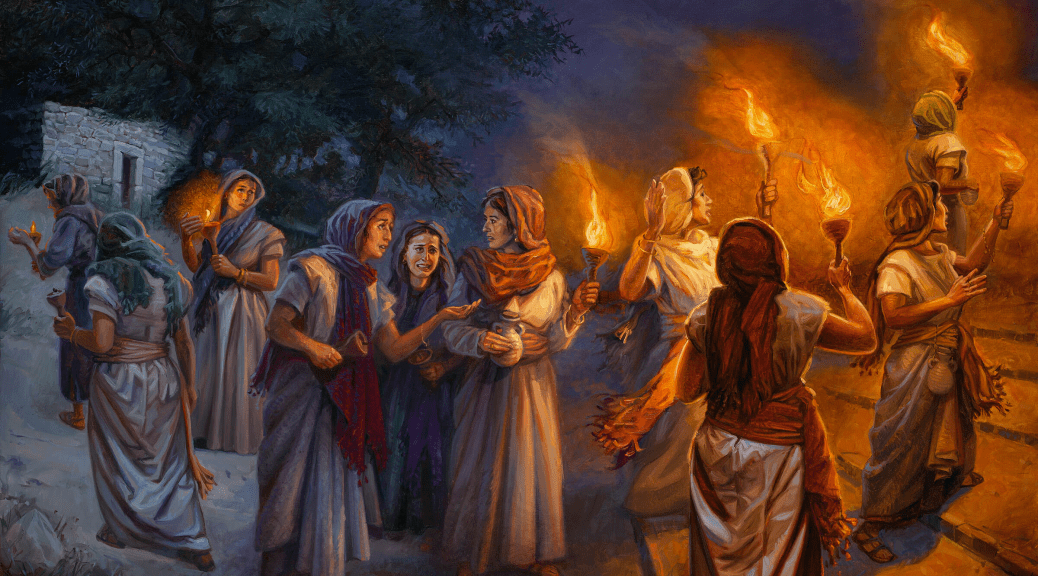
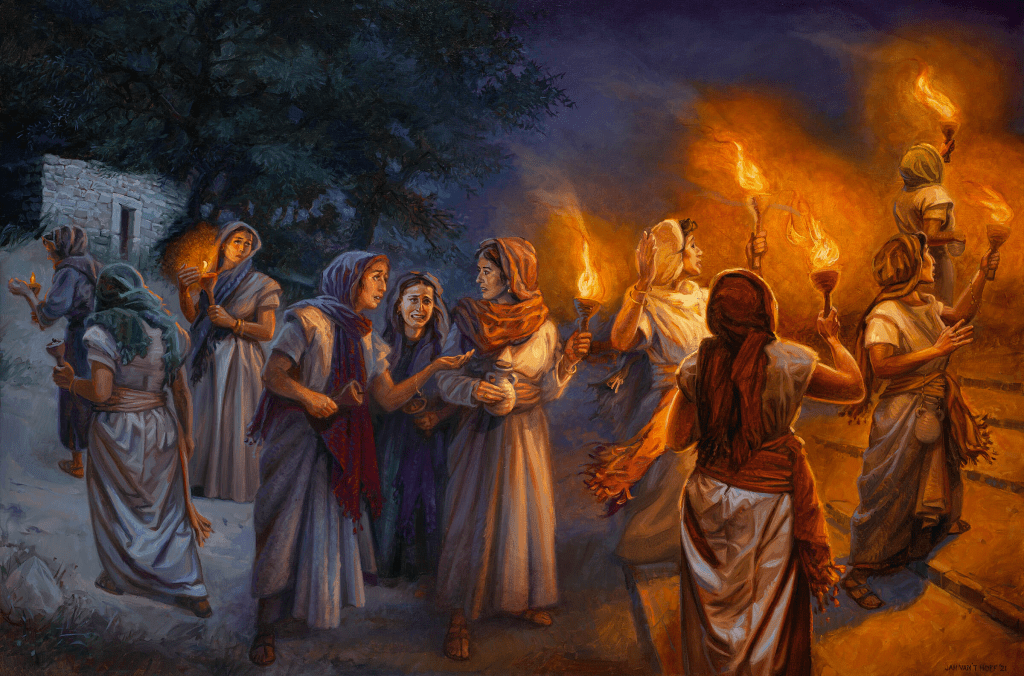
Jesus said, “Then the kingdom of heaven will be like this. Ten bridesmaids took their lamps and went to meet the bridegroom. Five of them were foolish, and five were wise. When the foolish took their lamps, they took no oil with them; but the wise took flasks of oil with their lamps. As the bridegroom was delayed, all of them became drowsy and slept. But at midnight there was a shout, ‘Look! Here is the bridegroom! Come out to meet him.’ Then all those bridesmaids got up and trimmed their lamps. The foolish said to the wise, ‘Give us some of your oil, for our lamps are going out.’ But the wise replied, ‘No! there will not be enough for you and for us; you had better go to the dealers and buy some for yourselves.’ And while they went to buy it, the bridegroom came, and those who were ready went with him into the wedding banquet; and the door was shut. Later the other bridesmaids came also, saying, ‘Lord, lord, open to us.’ But he replied, ‘Truly I tell you, I do not know you.’ Keep awake therefore, for you know neither the day nor the hour.”

——————–

I addressed this reading that is scheduled as the Proper 27, Year A, Gospel reading in my 2017 interpretation.  I stand behind my words then and recommend any who are seekers to read them. 

This reading will next be read aloud in church by an Episcopal priest on Sunday, November 8, 2020.  That will constitute the twenty-third Sunday after Pentecost, the same ordinal number when read in 2017; but in 2014 it represented the twenty-second Sunday numbered after Pentecost.

In my analysis now, I want to focus on just a few aspects presented in this parable; but first I again must point out that Jesus spoke in parable about the proposal of marriage.  That is why this reading if sometimes called the Parable of the Ten Bridesmaids.  The picture I have attached to the heading of this article depicts ten young girls, or virgins, each holding a lamp.  When one reads “bridesmaid” or “virgin,” the first impression is of females.  Because it is parable, that notion should be dismissed.

Think of ten as one, where that is subdivided into two paths one can go towards being ‘engaged’ to marry Yahweh.

Knowing the focus is not set fully upon females, but all human beings, another mistake is commonly made.  The “bridegroom” is not Jesus, as the assumption generally is made.  The “bridegroom” should simply be seen as the complement of “bridesmaid,” such that a “bridegroom” is masculine essence [Spirit], while the “bridesmaid” is feminine essence [a soul in flesh].  Seeing that makes it easier to grasp the Greek word “nymphiou” as representative of the wife-to-be, whose husband-to-be is proposing to take the soul away from the flesh, like a daughter is given away in marriage.  A husband then gives the wife a new name to go by, which is symbolic of a soul having been named mortal but after marriage to God takes on the eternal name of Christ.

Human marriage, as an institution of Holy Matrimony, is all about having children [sorry homosexuals].  The physical act of sex after marriage is meant to bring about a child.  To royalty, a male heir is all important in marriages.  A child is the result of sperm and egg uniting, in a bond that can never be separated.  A new human body of flesh is given a soul by God’s grace.  God is therefore the true officiant of that marriage, as God is the Creator of all life on earth.  Spiritual marriage is all about being reborn as Jesus Christ, where soul and Holy Spirit unite and create an eternal bond that can never be parted.

Getting to that point of the most Holy Matrimony is why Jesus told this parable to his disciples.

In Matthew’s twenty-fourth chapter, the final day of inspection of the Paschal Lamb was completed.  The Sadducees and Pharisees had looked Jesus over closely and found no blemishes.  They made no encounters on the fourth day; so Jesus walked to the Mount of Olives with his followers, where he explained the Temple of Jerusalem would be destroyed.  In Matthew’s twenty-sixth chapter, we read of the plan made by “the chief priests and the elders of the people gathered in the palace of the high priest,” as to the butchering of that sacrificial Lamb of God.  Thus, in between, in Matthew’s twenty-fifth chapter, Jesus was speaking to those who expressed faith in him, with love and devotion. 

The disciples were not those who were clearly opposed to Jesus or completely unknowing of who Jesus was.  Thus, the disciples (who were all males) were like bridesmaids, promised the kingdom of heaven.  A question must have arose about that promise, which is what led Jesus to make a comparison between the two, in a series of parables then told.

In the twenty-fifth chapter of Matthew’s Gospel, Jesus spoke in metaphor.  Here, it was of “bridesmaids” [also known as “virgins”], some “wise” and some “foolish.”  Then, he would speak of a master with slaves that would be given “talents” in differing amounts, with all expected to be used to promote the master’s business [presumably a vineyard?].  Two of those slaves would be deemed “good and trustworthy,” while the third would be called a “wicked and lazy slave.”  Finally, Jesus spoke of the coming of the “son of man” (not capitalized – “huios tou anthrōpou“), when like a shepherd separates the sheep from the goats [which is done in the evening, before dark], so too would be the souls of the faithful be culled by Christ the king.  Then will be set those who “are blessed by my Father” (“the righteous”) at the “right hand” and the rest to the “left hand,” those who would end up being sent “away into eternal punishment.” 

All of what Jesus said to his disciples is read aloud in churches for all who claim to be Christians to hear today.  It is as meaningless to non-Christians today, as it would have been to the Temple leaders back then.  Bridesmaids (or virgins), slaves, and farm animals must be seen as possessions of an owner, where an owner has a special relationship with those he possesses.  One who is not a believer in God will not understand the metaphor in the correct manner.  Thus, Jesus spoke privately to those in relationship to him, to whom he was the master, but a master who loved his followers [like a husband to a wife and vice versa]; conversations he would not have had with anyone else.

All of this means that Christians, who are Jesus’ disciples today, supposedly in a close relationship of mutual love and affection, fall into one of two categories that will become evident when Judgment Day comes.  A Christian is either a wise or foolish bridesmaid, a good and trustworthy or wicked and lazy servant, or one blessed by the Father (a sheep) and promised heaven or one not blessed and destined for eternal damnation (a goat). 

Know that, when you ponder the meaning of these words. 

Realize that as Jesus spoke, Judas Iscariot was listening to them.  Understand that there was a good possibility that Judas did not have a clue that God was speaking through His Son about him, when the metaphor of foolish bridesmaids, wicked and lazy slaves, and selfish goats was spoken.  Judas would then be just like many so-called “Christians” who I know, those thinking their failures to fully commit to God are not failures at all.  They think that because they wear priestly garments or give regularly to a church organization. 

The soapbox of righteousness upon which  many so-called Christians stand can just as easily be toppled, as Judas would find; his noose of sins wrapped tight around his neck when his realization that Jesus was talking about him metaphorically dawned on him.  “What have I done?” snapped him to a dark place.

Jesus did not tell the parables remembered in Matthew 25 to his disciples because he was too naïve to think all his followers were faithful marriage partners.  God knows all and Jesus spoke for the Father, realizing not everyone calling themselves a follower of his was as promised.  “I do” to some means once the fun stops, then its time for ‘talking the talk and not walking the walk’.  God spoke through Jesus knowing that Judas was a lamp without extra oil, a wicked and lazy user of God-given talent that was intended to be used to lead others to God, and therefore a goat destined to be separated into the “Go to Hell” pile.  God knows the world is full of Judases.

If a cold shiver just went down your spine realizing that, then now is the time to hear the call to totally submit to marriage to God [meaning confessions of unfaithfulness cease forevermore].

With that sermon preached, see yourself as a bridesmaid, no matter what sex you are.  If you think because you have a penis you are exempt from that designation, then you just designated your sexless soul to condemnation.  Expect that soul to remain where it is – cast into the outer darkness that can never be a lamp that shines the light of truth into the world of death – destined to be reincarnated over and over, born to grow new teeth that will forever gnash when death comes a calling again.

A “bridesmaid” is a “virgin,” based on the meaning of the Greek word “parthenois.”  According to HELPS Word-studies, the intent of the word is “(figuratively) believers when they are pure (chaste).”  This is the distinction of one’s soul and not relative to anything of human flesh.  Chaste is as chaste does.  Chaste is then the wedding robes worn, which is metaphor for righteousness.

It is vital to realize that one being a “bridesmaid” has nothing to do with how often one has had sexual relations (or lusts thereof), which flow like the waters over Niagara Falls after boys and girls reach the human state of puberty.  Rather than think of a virgin in terms of whether or not one has had sexual relations with another human being, one should think in terms of souls entering flesh [the repetition of reincarnation].  In that sense, one should realize the eternity of a soul means it has ‘had sex’ with one body of flesh after another, ever since first separated from God Almighty to experience the illusion of the material plane.  Reincarnation should make one feel like a prostitute (regardless of human gender), because sexless souls give life to both genders of human beings (over epochs of time).

The ones who think they have been born into the wrong body in this life [who make foolish demands for third-party bathrooms] are simply still attached to their past life gender.  Therefore, being a “bridesmaid” or “virgin” means one has to accept the invitation of the king to attend the wedding banquet, for the first time.  If it is easier to commit under the guise of marrying the king’s son, that will still be a first experience.  In reality, it means marrying God and becoming His Son reborn, which is a Spiritual form of union.  It is a commitment to be chaste, for the purpose of getting off the reincarnation merry-go-round and returning to be one with God again.

When you understand that your soul is the “virgin” state of willingness to sacrifice self for a higher cause, one is then committed to God as a “slave” waiting for the master’s instruction, like a sheep brought into the fold of new shepherd, whose voice one must learn to heed.  One’s body of flesh (regardless of human gender) then becomes marked as “taken.”  That is the metaphor of putting on the wedding robes or carrying a lamp. 

The light produced by a lamp (“lampadas” means “lamp, torch, lantern”) is then akin to taking a talent of wealth and multiplying it (not burying it in the ground, or hiding a lamp under a bushel basket).  When Jesus said, “I am the light of the world. Whoever follows me will never walk in darkness, but will have the light of life,” (John 8:12) he is the light that shines from the lamp of one’s being [a rebirth essential].  Therefore, a true Christian is one who is a lamp of God, which give the light of His Son to the world as an identifying mark of one’s commitment to God through monogamous marriage. 

That commitment to marriage then leads one to wash one’s flesh free of sin [a ritual cleansing or baptism by water].  In Jewish laws, ritual cleansing was often done by women after sloughing off a wasted egg.  A mature woman was deemed a sinner that needed to be washed clean because she lost an egg, one given to her by God for the purpose of His making it a body for a returning soul.  As such, a “virgin” becomes representative of a new egg that is in place and ready to be impregnated by God’s Holy Spirit.  That is what makes a body of flesh be metaphor for an egg that needs to be transformed.  It also reflects how a lost opportunity for a soul in a body of flesh, which does not be an offering to God, is sloughed off through death, washed clean through reincarnation.  Therefore, men and women who fail to marry God during a lifetime both have ‘periods’ that represent failures that needs to be ritually cleansed. 

Because there are many who accept the messenger-delivered invitation to marriage, the parable of the wedding banquet told of one [a man] who arrived without putting on the robes of righteousness, the symbol of commitment to marriage.  Jesus had Judas sitting in his ‘banquet room’ on the hillside of the Mount of Olives who he knew was not dressed appropriately.  Likewise, Christianity has those who pretend to be lamps, but are really not.  Those can be described as false shepherds, hired hands, and those who are filthy with sin but love the idea of having to do nothing more than say “I believe” and get a free ticket to heaven.  They enter the banquet hall with expectations, but it soon becomes obvious they are not truly committed.  When God the king called that one man out, he called him “Friend,” which meant “Pretender.”

This is where the lamp oil comes into play.

According to HELPS Word-studies, the Greek word “elaion,” which typically means “olive oil” (Strong’s definition and usage), means “(figuratively) the indwelling (empowering) of the Holy Spirit.”  The same word literally means a physical oil and metaphorically means a spiritual essence.  It is the dual meaning of one word that makes the foolish bridesmaids be lamps with physical oil, whereas the wise bridesmaids are lamps filled with the Holy Spirit.  It is the duality that separates the wise from the foolish.

This separation (as with the good and trustworthy slaves, versus the wicked and lazy slaves; as well as the helpful sheep and the selfish goats) says the lamps with olive oil were only yielding the light of written words that were memorized: laws, songs, and soundbites of Scripture.  The lamps filled with the Holy Spirit were shining the light of truth: living according to the laws, constantly singing praises to the Lord, and teaching others the deeper meaning of Scripture every chance they had.  One was Big Brain foolish, while the other had the heartfelt wisdom of the love of God.  One group’s light was the flashiness of a con man and pretender (reflected light), while the others’ had the inner glow of Saints (a halo or Moses’ face of God).

Could it be that brides wear a veil to hide the face of God, like Moses did?

In the article I posted in 2017, I placed focus on the coming of the bridegroom in the middle of the night as being metaphor for one’s death and the transition of a soul from a body of flesh.  I will not repeat that here; but know that those lamps filled with God’s Holy Spirit are more than bridesmaids or virgins awaiting marriage, but they are bodies of flesh animated by souls that have already been merged with God, reborn as Jesus Christ – the true meaning of being Christian.  Those who are not so filled at the time of death, thus not already married to God [cue the soundbite of an Evangelical minister telling listeners to wait for the second return of Jesus], well their souls are told, “Honey, you got the wrong god.  I don’t know who you are.  I thought you married the world you live in.  See ya.” [door slam soundbite]

That means the ones who light their lamps with the olive oil of flimsy sermons, prepared by those who kneel at the altar of COVID19 fears and worship in the temple of plotting the demise of hated politicians, they never took the time to get filled with God’s Holy Spirit.  Being filled with the Holy Spirit is not an elective course offered in seminaries.  Being filled with God’s Holy Spirit can seem like the swoon of first love, but that feeling is fleeting, like when an injection of heroin dissipates.  Life has its ups and downs, but being filled with the Holy Spirit, reborn as Jesus Christ, is that something extra that always keeps God’s light of truth shining so others can see.

The Holy Spirit is then the difference of oil used by the lamps of the religious.  Anointing oils are physical (olive oil) and used symbolically, in place of the real thing.  A lamp, lantern, or torch produces physical light that is fueled by physical oil, but a spiritual lamp shines the light of truth that cannot be measured in photons, waves and rays.  The Holy Spirit is the extra fuel, carried in another “vessel” – the soul.  Carrying around a vessel filled with extra olive oil is difficult.  It is like trying to memorize the whole Bible, when it is much easier to just light the lamp on Sunday mornings at 7:00 and then snuff out the flame at noon (game time!).  That saves the physical oil for longer usage on one ‘tank.’

The foolish bridesmaid did not have their spiritual “vessel” (the Greek word “aggeion,” meaning “receptacle, flask” i.e.: body of flesh) with them when it got late into the night.  They did not know that meant their a need to sacrifice their self-egos so God could fill their soul vessels with the high octane Holy Spirit oil.  They oil cans used to store extra oil was left behind or empty [the fools!].  But then they were stuck seeing only the physical solutions to spiritual matters, which is the curse of fools, lazy souls, and those only trying to get more of the world for themselves.

The physical oil American Christians use for light today is petroleum based, as fuel.  American Christians often use their fuel to set ablaze the fire of Scripture.  They enjoy igniting that light as a weapon for sport.  Instead of rays of insight emitted from their human lamps, American Christians shoot flaming arrows of righteous condemnation wickedly at others [like the Pharisees did in Jesus’ time on earth].  It is one thing to run around shooting Biblical arrows at all you hate (friend or foe), proving “I know my Scripture!” (from a library of opinions in your study at home), but to be so free and easy with darts and stingers means you better have the real stuff in you [insight from the Holy Spirit], to back it all up.  Otherwise, when the arrows run out and the enemy [death] is at the doorstep, you best have smeared the blood of Christ over your doorpost or [to use a Lenny Bruce line], “You’re gonna die, kemosabe.”  [See what I said earlier about reincarnation.]

When Jesus told his disciples that the wise virgins told the foolish ones, “You had better go to the dealers and buy some for yourselves,” AND “they went to buy it,” think about that for a moment.  The fools actually went out in the middle of night, looking for someone to sell them spirituality.  They were foolish to the end, never once realizing that “you cannot buy your way into heaven!”  

Of course, the place one goes to buy the written law, the songs that make the toes tap to a melodic beat, and favorite Scriptural quotes is to a church building or to the person who runs one.  That is where some priest, minister, or preacher [rabbis too] will be found whittling down Holy Bible selected readings to a bitesize portions – about as big as a small, thin wafer, easily washed down by a sip of wine.  That sold [usually only available on Sundays] is the message that always says, “Don’t bother yourself with studying Scripture, just place an offering in the tray and go home knowing you are saved.”  Buying more of the watered down version of Christianity [baptisms with water sprinkled onto human babies] still will not get a soul to shine the light of truth.  Marrying a church building-organization-proprietor is not the same as marrying God Almighty.  You get what you pay for.  A vessel that is still empty of truly Holy Oil!  

——————–

Again, I want to say that I wrote about this reading in 2017.  The same meaning then is the same meaning now.  I have tried to add to that here and feel that I have.  However, at this time [2020] I feel a strong need to share this “extra oil” now with any and all who have personally known me, either from having been in the same school, church, or town, able to recognize me on sight, regardless of whether or not you having ever spoken a kind word to me.  

If you know me, then you knew my wife. 

My wife was alive in 2017, but she knew she was going to die from terminal cancer.  As I write this, the first anniversary of her death is approaching.  If you know me, then you know that my wife was an Episcopal priest, who was forced into disability retirement, due to her diagnosis.  My wife and I were married, not only as man and woman, but as souls that were fully and completely devoted to God.  Therefore, my wife and I were … and are still … married to God; our vessels always kept full and nearby.

This reading from Matthew 25:1-13 now sparks my “indwelling (empowering) of the Holy Spirit,” such that I am strongly feeling a need to share that my wife was a wise bridesmaid whose lamp was filled with the oil of the Holy Spirit.  She had an extra vessel that she always kept near her: when she went through discernment, when she went through seminary, when she went through ministry, and when she went through the darkness of impending death – meaning the known coming loss of family and friends [most who had already stayed far away]. 

Her lamp never stopped shining brightly.  When she heard the call, “Look! Here is the bridegroom! Come out to meet him,” I held her hand.  I gave her away to the bridegroom.  Her body has left this world, but her Holy Spirit has remained with me.

My wife’s most divine soul wants me to ask all you who know me, “Why do you think you are gods?” 

She wants to know how much the marketplace sells a “thank you Robert” for these days, because the price must be so high that casual “friends” cannot afford to give those away.  Why would anyone calling himself or herself Christian ever bury the talent of kindness, love, and caring?  Does the Parable of the Talents make you hear the voice of God (the master) calling you wicked and lazy slaves?  

Everyone my wife knew loved her.  They loved her to death, because she so freely gave of her Holy Spirit to ease the pains of others.  The “weak in spirit” flocked to her, to be touched by her light of truth; and she gave to them all as they needed. 

What did you give her in return?  The cancer of rejecting her husband, after her death? 

You are blind to how the cancer she got was because of you.  My wife died so you could have more time to commit to God, just as did Jesus.  “Lord, forgive them for they know not what they do.”  She would have it no other way.  It is what Saints do!

Over the past year, there have been a few who have ventured onto the thin ice of acknowledging that I exist in this world.  I appreciate those gestures of kindness.  It saddens my heart, however, to see these writings that I post here on WordPress, which I share with my wife’s MANY friends [I have only a few] on her Facebook account, rejected. 

I share the insight of the Holy Spirit in her name (with her approval spiritually) and in return we both see an absence of friendly response.  It signifies a silence that loudly screams “We loved your wife, not you!  We can’t stand you!  Kill her Facebook page and let us keep empty vessels, with only physical olive oil in our lamps.”

Kill the messenger is a most human response to a message unwanted.  And Jesus said, “A prophet is not a prophet in his hometown” because no mortal with a vessel empty of God’s Holy Spirit wants to hear anyone speaking as if he or she does have the Holy Spirit.  

Kill the messenger!

Just as my wife did not enter the priesthood to get accolades or to be showered with praises, I do not write interpretations of Scripture to be told how much my words are loved.  My wife and I both always spoke what the Father told us to speak, just as did Jesus.  The Father has us speak the words of truth because Christianity is filled with foolish bridesmaids, wicked and lazy slaves, and goats that do nothing that isn’t self-serving.  God never speaks through humans to make humans be recognized as gods on earth, because most will be crucified with persecution.

My wife presented herself to you as Mary the mother of Jesus; and you called her Mother out of respect for that presence.  Do you reject me because I speak here like an no-nonsense Father, one who knows it is best not to spoil the child? 

I use the rod of truth.  David told God “thy rod comforts me.”  The rod is not made to smash a clay pot that is flawed; but it can do that it need be.  The rod and the staff are tools of shepherding, to save those lost and keep evil wolves away. 

Does the truth of the Gospels hurt your feeling so much it turns your hearts to stone and your brains to hate? 

Are you Judas, planning to sell out anyone who no longer tells you what you want to hear for some pieces of silver?  How much do you sell your favoritism for?  What is the going rate for self-worth?

My wife and I were two sides of the same God.  She wore the smile, as I wear the frown.

God wears many faces.  Be careful which faces you slap, which faces you pity, and which faces you scorn.  Most certainly, lift up the veils that cover the faces of those you love and adore, so you can see the truth that hides underneath.  You never know whose face is hiding God and Jesus Christ beneath, just as you never know who wears the face of Satan. 

The most important face to be determined is yours.  You should wear the face of God, because to wear your own face means you are the god you worship.  That is an empty vessel with no truth of Christ within. 

To wear the face of God is to be truly Christian.  Then, if you reject a fellow Christian, there are protocols that must be taken: one to one; a small group to one; the whole assembly to one.  None of those steps call for silence and backstabbing rejection, first or last.

May the peace of the Lord always be with you, especially when your time of slumber comes; and it will come to all mortals.

#twentythirdSundayafterPentecost #Matthew26 #Matthew25113 #John812 #wiseandfoolishbridesmaids #tenvirginsparable #Matthew24 #Proper27YearA #Matthew25