Tag Archives: John 8:28

Matthew 21:23-32 – The authority to be a reluctant yet obedient son or a liar versed in expected answers [Seventeenth Sunday after Pentecost]

When Jesus entered the temple, the chief priests and the elders of the people came to him as he was teaching, and said, “By what authority are you doing these things, and who gave you this authority?” Jesus said to them, “I will also ask you one question; if you tell me the answer, then I will also tell you by what authority I do these things. Did the baptism of John come from heaven, or was it of human origin?” And they argued with one another, “If we say, ‘From heaven,’ he will say to us, ‘Why then did you not believe him?’ But if we say, ‘Of human origin,’ we are afraid of the crowd; for all regard John as a prophet.” So they answered Jesus, “We do not know.” And he said to them, “Neither will I tell you by what authority I am doing these things.

“What do you think? A man had two sons; he went to the first and said, ‘Son, go and work in the vineyard today.’ He answered, ‘I will not’; but later he changed his mind and went. The father went to the second and said the same; and he answered, ‘I go, sir’; but he did not go. Which of the two did the will of his father?” They said, “The first.” Jesus said to them, “Truly I tell you, the tax collectors and the prostitutes are going into the kingdom of God ahead of you. For John came to you in the way of righteousness and you did not believe him, but the tax collectors and the prostitutes believed him; and even after you saw it, you did not change your minds and believe him.

——————————————————————————————————–

This is the Gospel reading from the Episcopal Lectionary for Year A, Proper 21, the seventeenth Sunday after Pentecost. It will next be read aloud in church by a priest on Sunday, October 1, 2017. This in an important lesson because it addresses who has God’s approval to shepherd His flocks.

This reading reminds me of my experience at a seminary school. I was not a seminarian (my wife was), but I socialized with them at school functions and in the neighborhood housing arrangements. I saw several glaring problems with the whole system of educating priests (too many to get into now), but the statement, “the chief priests and the elders of the people came to [Jesus] as he was teaching, and said, “By what authority are you doing these things?” hit home for me.

I was writing books back then, which explained how to read Nostradamus, so that what he wrote can be understandable. Nostradamus can be seen as John the Baptizer, as “the chief priests and elders of the people” have not believed as I believe – that Nostradamus was a prophet of Jesus Christ. Because I fully believe that, I cannot hold my tongue about that belief.

When asked, “What do you do?” I told seminary students about Nostradamus. I told some teachers about Nostradamus. I even told some invited guest speakers coming to that school (whom I picked up or took back to the major airport nearby) about Nostradamus.

It was like I asked them all, “Do you believe The Apocalypse of John of Patmos is similar to The Prophecies of Nostradamus?”  It was like I posed the question, “Whose authority did those books come from: Prophet of Christ or Charlatan?”

Some wanted to shun me forever; but some were patronizing.  It was as if their minds were calculating, “If we say, ‘Prophet of Christ,’ he will say to us, ‘Why then did you not believe him?’ But if we say, ‘Charlatan,’ we are afraid we might be talking to an unstable, dangerous person.”  They all seemed well-versed in the “smile and nod” reaction to uncertain situations.

My amazing ability to understand Nostradamus was a gift given to me by God. There can be no other explanation for that talent.  I was the last person on earth who I figured would be able to understand Nostradamus; but I was led by a higher power, and not simply to understand his cryptic writings.  I found that I was able to apply the same systems applicable to making sense of Nostradamus to everything in the Holy Bible. That syntax is God’s, as His Holy Language … Speaking in Tongues not taught in schools.  So, it applies to everything He had His people write for Him.

There really are no authorities that grant doctorates or even bachelor’s degrees about the meaning of Nostradamus; so if I am seen teaching about his writings, authority figures have no reason to confront me. They just snicker and poke each other.  However, since I have been allowed to put Nostradamus on the back burner (so to speak), due to carpal tunnel in both wrists from writing so much, I have been encouraged to write Biblical interpretations. That will attract some frowns and questions by the religious elite.

What school did you attend to learn that? What scholastic volumes of books have you read and footnoted, while preparing properly detailed papers and dissertations that have been argued before expert authorities? How many reputable scholars can you quote in support of your views?

I will answer your questions, if you let me ask you one first. If you can answer that, then I will answer your question.

What seminary did Jesus and his Apostles attend? The same one begun by Moses in the wilderness, or a different one?

When Jesus said, “Neither will I tell you by what authority I am doing these things,” we all know he was authorized by God the Father. We know because he said that a few times, as noted in the Gospels.

“Very truly I tell you, the Son can do nothing by himself; he can do only what he sees his Father doing, because whatever the Father does the Son also does.” (John 5:19)  “ Then Jesus said to them, “When you lift up the Son of Man, then you will know that I am He, and that I do nothing of Myself; but as My Father taught Me, I speak these things.” (John 8:28)  “For I did not speak on my own, but the Father who sent me commanded me to say all that I have spoken.” (John 12:49)

The original plan was to have ALL the Israelites be ordained priests for YWHW. When Moses first took them on a 40-year hike, you have to look at the Israelites as babies and infants, because they were incapable of doing anything on their own. Forty years of rote memorization of the laws was priestly training that was more like children’s church on Sunday mornings. They just learned the stories, but the deep meaning escaped them.

When the Israelites were supposed to be priests for YHWH in the Promised Land, they were like teenagers under the Judges – always backsliding and getting into trouble, while having to be bailed out time after time. They entered the rebellious age.  By the age they asked for a king, “to be like other teens,” they were like young adults who no longer lived by the rules of their parents. But, by the time Israel and Judah fell in ruin, led by politicians whose only god was self, they were like twenty-somethings with arrest records. All their promise was washed away.

By the time the Jews had formed from those Israelite ashes and been released from Babylon, they were like thirty-somethings, who were “street smart.”  You could say they had become charismatic, prison ordained street preachers. That was who Jesus ran afoul of in Jerusalem. It was them acting with the know-it-all of young adults – their audacity – that made them the priest police.

In the parable-like question that Jesus posed to those learned men of the Law. both sons sinned against the father. One refused to go at first, but then thought about it and went (to stay out of trouble). The other said he would go, but flat out lied – a sin against his father. However, the one who refused, but then changed his mind, he was easier to forgive.

This lesson is no different than the one Jesus taught when observing the Pharisee and the Publican in the Temple. When Jesus said here, “Truly I tell you, the tax collectors and the prostitutes are going into the kingdom of God ahead of you,” this is not saying the son who lied by saying “No,” but then did “Yes,” is the exact same as a prostitute or tax collector (Publican). Saying “No,” and then thinking about it, before acting, put him in the same boat. Both were sinners, so unless change comes, both are forbidden from heaven.

What Jesus was really saying was, “You Law police fellows are too full of yourselves to ever realize you are going in the opposite direction of heaven.”
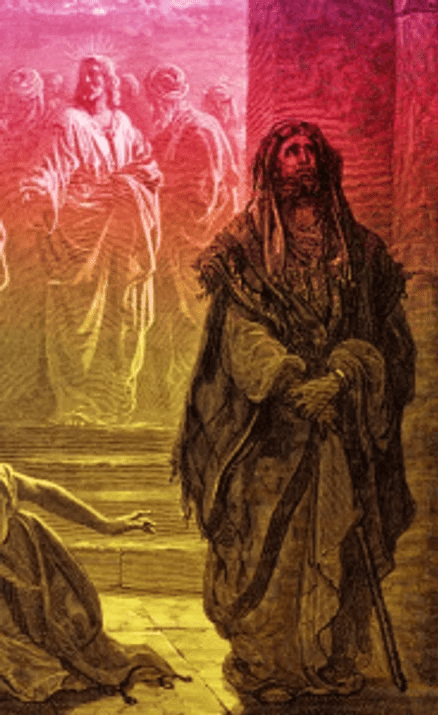
Thank you God for making me holy and not like the riffraff of the world. This is the pretense of a priest who knows nothing of spiritual matters.

At least the tax collectors and prostitutes are aware of their sins. They just can’t see how to stop sinning, in a world that forces sin upon everyone.  That is where a good teacher – such as John the Baptizer and Jesus – can get the losers to stop being a loser and change.

When the Pharisees and high priests see good teachers like that, they want to hurl stones at them. They certainly don’t want to pull up a chair and listen to what good teachers are saying. They might learn something then.  However, whose authority determines who the good teachers are, without a sheepskin to prove one has that approval?

Remember when Jesus said, “Watch out for false prophets. They come to you in sheep’s clothing, but inwardly they are ferocious wolves.” (Matthew 7:15)  That was the Pharisees wearing clerical robes, and what was then has always been and will continue to be.

This is why I see Christianity turning into a cesspool of teachers. It is not that all the sordid pieces and parts of waste in a cesspool were made for that ultimate purpose. Waste is the degradation of value.  What goes in good is split in two: the unseen nourishes, while the residue usually does not pass the smell test.  That gets flushed with good water.  It is just that when you mix the bad in with the good water, the good water has to be purified before it can be good water again.

A couple of years ago, my wife (a priest now) followed a bishop of another diocese on Facebook. She liked a few of his sermons that he posted on his website. He wrote one about the lesson of the Tax Collector and the Publican (Luke 18:9-14), which was uninspiring to me.  It was what I call out of the “puppy mill” of sermons. What priest has stood in the pulpit and looked at the smiling faces of tithers in the pews and not said the message of the Pharisee and the Publican was, “The sinners of the world have hope, because they are closer to heaven than those who think they have it made”? (The same sermon that can be preached about the two sons who disobeyed the father.)

That bishop published a sermon that had nothing new in it. What is the lesson of “being closer to heaven than some other guy,” if the sinners never hear a good teacher tell them how to “get to heaven.” Jesus was giving a sermon that said YOU bishop (and every priest who cannot see him or herself in this story) are the Pharisee in that story.  Forget about the obvious sinners, because it is YOU who Jesus said is farther away from salvation.

Telling those who feel guilt about their sins, “Have hope!  Keep coming here and I will keep telling you to have hope!” they will always come back for more of the same sermons.  But, who wants to stay in a pew when the priest says, “Jesus was pointing out how far away from heaven I am. But hey, who gets to heaven anyway?”

That’s entertainment, not a good shepherd.

A good sermon would be a true Apostle (like were Peter and Paul), who stands in front of a group of attentive sinners, all of whom want to hear how to stop sinning, and admit they too were sinners … sinners who changed.

In a good sermon the priest says, “I was the Pharisee in this story. I was farther away from heaven than you people are now; but I saw myself and felt ashamed. I had lied to the Father when I went into the priesthood. It was all about me being holier than thou. I was young and stupid and thought learning about religion would make me holy.  Therefore, I raised my arms to the sky and thanked God for giving me a sweet job that has so many fringe benefits.

Then I realized all my work had been only for me, even when I made it seem like I was helping others. I was only imagining I was working in the vineyard, when I was simply tasting the wine. I want to apologize for having not made every one of you self-sufficient priests for Yahweh.

I now speak to the LORD every day and He wants me to teach you the real meaning of the Scriptures, so you can understand by the Holy Spirit and go tell others the truth.  Truth comes not from having learned what someone else knows, but from a love of God that thirsts within one for His knowledge.

Please, I invite each and every one of you to join me in Bible Studies and fellowship, so our love of God branches out and produces fruit. Amen”

I made a post on that bishop’s blog, which suggested this alternative view … politely, in different words than here above. While he politely responded to my post, it was another example of people not really hearing what is being said or not being truthful about what they heard. He wrote back something like, “But who would be left in the pews, if I told them that?”

Wasn’t that the point when Moses freed the Israelites from Egypt? At some point the baby has to grow up, the student has to graduate from school and get a job. God didn’t free cradle to grave sons that say, “Yes sir! I’ll be working in that vineyard bright and early!” who then never do.

Did He?
John 18:33-37 – So Jesus is a king?

Pilate entered the headquarters again, summoned Jesus, and asked him, “Are you the King of the Jews?” Jesus answered, “Do you ask this on your own, or did others tell you about me?” Pilate replied, “I am not a Jew, am I? Your own nation and the chief priests have handed you over to me. What have you done?” Jesus answered, “My kingdom is not from this world. If my kingdom were from this world, my followers would be fighting to keep me from being handed over to the Jews. But as it is, my kingdom is not from here.” Pilate asked him, “So you are a king?” Jesus answered, “You say that I am a king. For this I was born, and for this I came into the world, to testify to the truth. Everyone who belongs to the truth listens to my voice.”

———————————————————————————————————-

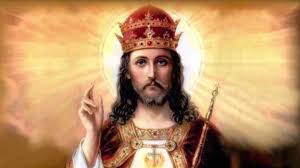
This is the Gospel selection from the Episcopal Lectionary for the Twenty-seventh Sunday after Pentecost, Year B 2018, which is the Last Sunday after Pentecost. In the numbering system that lists each Sunday in an ordinal fashion, this Sunday would be referred to as Proper 29, but it is called “Christ the King Sunday.” It will next be read aloud in an Episcopal church by a priest on Sunday November 25, 2018. It is important because Jesus admitted to Pilate that he was a king, but that admission is left up to the whole world to discern (just like Pilate had difficulty understanding): Where is Jesus’ kingdom, if it is not from this world?

I will preface this reading interpretation with the basic statement that one has to have a firm grasp on the facts of reality, as far as Jesus’ final days are concerned.

1. Jerusalem was packed with Passover Festival pilgrim Israelites, local Jews, Romans and other Gentiles.
2. The Passover Festival in ancient Jerusalem lasted eight days.
3. Jesus had his disciples prepare for the Passover Seder meal [the first of two Seders: the night of 15 Nisan and the night of 16 Nisan] on Friday, 14 Nisan.
4. Jesus was arrested early in the morning of 15 Nisan, which was a most holy Shabbat [Saturday].
5. The written accounts of Jesus’ appearances before a Temple high priest, a Roman provincial governor, a Roman tetrarch [ruler of one quarter of a country] and back to the Roman provincial governor could not possibly happen on the same day and have his body taken down from a cross of death the following Friday.
6. The Romans were good record keepers and little is written of the trial and execution of Jesus of Nazareth, meaning the world did not stand still because of Jesus’ arrest.
7. Biblical records [the four Gospels] are so laser focused on what happened to Jesus that is appears that time stood still, just as it appears that a four-hour Passover Seder ritual meal was over in minutes.
8. The ignorance by Gentiles of the ritual of a Seder meal means the non-Jewish Christian thinks the Yachatz (breaking of the middle matzah) preceded the Beirach (Grace after Meals) and Kos Shlishi (the Third Cup of Wine), as quickly as a Christian priest can hold up a cup of wine and a large wafer, while reciting the Biblical text of Matthew.

With that understood, this reading from John must be seen as taken from the whole, as one part of an eight-day event that was surrounding the life of Jesus; this episode being one witnessed by John, who was not a disciple of Jesus. It is important to know that Mark [Peter’s Gospel writer] wrote of Peter’s disowning Jesus at the end of chapter fourteen. At the beginning of chapter fifteen, Mark wrote of Jesus appearing before Pilate. Matthew wrote of the same order, but he wrote of Judas hanging himself prior to witnessing Jesus before Pilate. Luke, likewise, followed the same order of Peter’s denial, such that Jesus appeared before Pilate later; but Luke [Mother Mary’s Gospel writer] then was the only one to write of Jesus being sent to appear before Herod, followed by Jesus standing before Pilate again.

All four Gospels then create a three-dimensional view of the truth surrounding Jesus before Pilate, such that this account by John is the first time Jesus was seen by the governor of Judea. However, this reading from John is seamlessly attached the account of Pilate offering Barabbas and Jesus to the people to vote on freeing.  That event, as told by Luke, clearly said it was Jesus’ second appearance before Pilate.  For the truth of all to emerge, one needs to be able to see an invisible point of transition appear in John’s words.

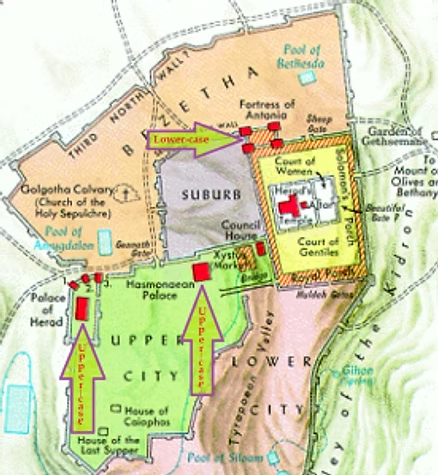
The word translated as “headquarters” is the Greek word “praitōrion.” When capitalized, this word is translated as “Praetorium,” which [in Latin] was the official residence of a governor, but when Herod visited Jerusalem it was his palace. Both Herod and Pilate were in Jerusalem at the time of the Passover Festival.  In Jerusalem there was both a Palace of Herod and a Hasmonean Palace within the temple compound, both of which would justify being identified in the upper-case as “Praetorium.” However, the spelling in John is in the lower-case, which means this can refer to the “praetorian guard,” which were Roman soldiers that were primarily housed in the Antonia Fortress, but also had guard houses surrounding the palaces.

By understanding the intent of the lower-case spelling, this meeting by Pilate with Jesus was not in the palace.  Instead, the Sanhedrin had taken a prisoner to the guards of the fortress, which obviously had holding cells for prisoners.  The presence of Jews bringing in a Jewish prisoner necessitated Pilate be summoned to the fortress, to approve that imprisonment.  The last thing Pilate wanted was a riot ensuing, due to a Jew being falsely imprisoned by Rome, in Jerusalem, during the most holy time of the year when emotions were already high.

John’s verses twenty-eight and twenty-nine state, “Then the Jewish leaders took Jesus from Caiaphas to the palace of the Roman governor. By now it was early morning, and to avoid ceremonial uncleanness they did not enter the palace, because they wanted to be able to eat the Passover. So Pilate came out to them.”

This says it was after sunrise, after Peter had denied Jesus three times, and after Judas hung himself at dawn. The aspect of the elite Jews wanting “to be able to eat the Passover” says it was 15 Nisan, the Sabbath, with evening being when the second Seder would be eaten.  They, like Jesus and his disciples and family, had partaken of the first Seder meal before Jesus was arrested.

By reading that Pilate “again” went into the “praitōrion,” he had been outside talking to the Jewish leaders. That discussion was recorded by John, in verses twenty-nine through thirty-two. He had obviously been inside the first time to give the orders to imprison Jesus, before going outside to talk with the ones making accusations that Jesus was a criminal against Rome. When he returned inside the fortress and went to the holding cell of Jesus, he was “again inside” the fortress.  Pilate then asking “Are you the king of the Jews?” was based on nothing written by John that would indicates that title was expressly stated by the Jewish leaders.

This is why Jesus [who had the mind of the Christ for his insight] asked Pilate in return, “Do you ask this on your own, or did others tell you about me?” Jesus knew the true answer to that question, which means he immediately knew that no one had accused Jesus of claiming to be a king. John wrote they told Pilate, “If he was not doing evil, then we would not have delivered him to you.” (John 18:30) [In that verse, “kakon poiōn” translates as “evil doing,” not “criminal.”]

As far as Rome was concerned, a promised “Messiah” [in Greek a “Christ”] was nothing to worry about. As long as someone was not raising a sword against Rome [something to which they would gladly raise one in return], religious zealots (such as John the Baptizer) were nothing more than a lot of harmless hot air.

Look! Up in the sky! It’s the Messiah!

We then read that Pilate said to Jesus, ““I am not a Jew, am I? Your own nation and the chief priests have handed you over to me. What have you done?”

This is the mantra of all Gentiles, including the Christians of the Western world. The vast majority of Christians, as produced by the Roman Catholic Church, beginning in earnest in the Dark Ages, proclaim, “I am not a Jew, am I?”

As Romanized Christians, rather than Apostles who have been passed the torch of the Holy Spirit, those people act as if they are doing Jesus a favor by picking up what the Jews cast off. Christians of the West say, “Your own nation and the chief priests have handed you over to me.”

Finally, as those who have no bloodline connection to the lineage of Jesus of Nazareth [born in Bethlehem] and having never witnessed any of the miracles that Jesus was said to have performed, Christian Gentiles ask Christ, “What have you done?” Sure, they have been told what to believe, and like good pagans-turned-Christians, they believe.  However, they ask the same question as Pilate, with most muttering under their breath, “for me.”

While it can seem as though Pilate was speaking from a level of ignorance about the Jews, as a Roman citizen appointed as the fifth Perfect over Judea [there had been four Perfects of Judea prior to Pilate, him having succeeded Valerius Gratus], and only in that position for about the same length of time Jesus had been ministering the children of Israel, it is better to see Pilate working Jesus like a cop in an interrogation room. By playing ignorant, he hoped Jesus would begin bragging about all he had done, which would have allowed Pilate to hear for himself if Jesus was doing “wicked deeds” against the Jews of the temple, or against Roman dominion there.

When Jesus then said, “My kingdom is not of this world,” he admitted that he had allowed others, in one way or another, to hear him talk about a kingdom that he possessed. If cable TV and The History Channel had existed back then, and if Pilate had been a fan of Ancient Aliens, undoubtedly he would have been intrigued by Jesus’ answer. He might have wondered what ancient alien theorist would say about an “out of this world kingdom.”

Still, the Greek written by John, “ basileiaemē,” can say, “This authority [or rule] this my own.” The word “kingdom” is not to be understood as a worldly nation of people, but one person. While Pilate could not discern the importance of the capitalization of “” (meaning “This”), one can imagine Jesus gestured with his hands, by sweeping them along the form of his body from chest to waist. By his saying “This” along with that gesture, his word would then show that Jesus himself was where his reign was. By then repeating the word “this,” without gestures, Jesus was then saying [as Seinfeld made a running joke in one episode], “I am the master of this domain that stands before you.”

While Jesus had just admitted Jesus of Nazareth was a kingdom, he then added, “not is of the world this.” In actuality, the Greek of John says, “exists not in this realm” or “is not from here.” The paraphrase assumes that Jesus was not talking of a kingdom on earth, but his words could have been heard by Pilate as saying, “My kingdom is not in Judea.” Pilate’s ears could hear, but they were not geared to think in metaphysical ways. He was deaf to the proposition that the king of the kingdom of Jesus of Nazareth was not material in nature but spiritual.

Think about that for a moment and let that sink in. See if your ears can hear Jesus saying, “This (my body) kingdom this my own (body) [has a King] not from the material realm.”

[tick, tock, tick, tock, tick, tock]

Jesus said, “You will know that I am he and that I do nothing on my own but speak just what the Father has taught me.” (John 8:28) He also said, “I did not speak on my own, but the Father who sent me commanded me to say all that I have spoken.” (John 12:49) Jesus again said, “Don’t you believe that I am in the Father, and that the Father is in me? The words I say to you I do not speak on my own authority. Rather, it is the Father, living in me, who is doing his work.” (John 14:10)

What Jesus said to Pilate was no different than what he had said to others before. This is Jesus being exactly as the Israelites were all supposed to be, as priests to Yahweh. Each was to be a kingdom of which God was the king. When the elders of Israel went to Samuel and said, “Appoint for us a king, to be like other nations,” Samuel said, “God is your king.” Samuel, like Jesus, was a kingdom of God, as human flesh, with the king being the presence of God within them, via the Holy Spirit.

Pilate was having none of that out of this world namby pamby. The investigator in him came out; so we read, “Pilate asked him, “So you are a king?”

He must have missed the hand gesture. All he wanted was a confession. He did not realize that every word coming from Jesus’ mouth was the truth of God. The answer had been given, “Yes, I God am a King, but my Kingdom is Spiritual, which in Jesus of Nazareth stretches as far as the skin can go and inward to the soul.”  To Pilate, Jesus spoke, not Yahweh.

Since God had already answered Pilate’s question prior, He then told Pilate through Jesus’ lips, “You say that I am a king.” Jesus was saying that Pilate was only defining the word “king” in worldly terms. Jesus then said, “You are putting words in my mouth, which I did not say.” Jesus said he had “authority” that was solely his own. He did not say, “I am a king of a kingdom that is not from this land possessed by Rome.”

Jesus had explained to Pilate that, if he were a ruler of land, then he would command soldiers to fight for his release, as kings do. Those soldiers would have given their lives fighting against the tyranny of the Temple rulers, who had arrested Jesus. No soldiers had come to rescue Jesus, so Jesus was a kingdom of one. Only he was there defending himself. No real king would do that.

In this children’s game, the most important piece is the flag. It cannot move. It must have other pieces defend it.

To clarify what Jesus had previously spoken, which Pilate misunderstood, Jesus said, “For this I was born, and for this I came into the world, to testify to the truth.”

Twice Jesus said “touto,” which is again stating his use of “this” prior: “This authority this my own not of the world is this.” The word that was used to express “this kingdom not of this world” was “toutou.” At this time the verbiage was “this kingdom not of this world” was why Jesus was born. He said “this kingdom not of this world” was why Jesus came into the world in “this” body of his, which came with Spiritual authority … like a kingdom.

To be a kingdom of God on earth was the absent purpose that was not in existence in Judaism. All the high priests, all the scribes, all the lawyers and common folk were supposed to be kingdoms of God, but they all had failed God. Because they were not kingdoms of God, God sent Jesus to be the torch that would re-ignite that responsibility in all the children of God.

Jesus then said what his “authority” was. It was that “rule” he had been given by the Father [God] that the leaders of the Temple were mistaking as Jesus saying he was a king. Jesus was sent by God [the King] “to testify to the truth.” While Pilate would question, “What is truth?” [not part of this reading, so it might have been asked when Jesus returned for his judgment], the truth that was missing was the kingdoms of God that each Jew and scattered Israelite [as well as Samaritans and Gentiles later] were supposed to be was not.  They were dead to God in their hearts. Only the truth of Holy Scripture could awaken them from death’s slumber.

Jesus spoke the truth of Holy Scripture by being a living example of that truth.  Thus the truth proclaimed by him and his disciples was, “The kingdom of God has come near.”

Jesus then told Pilate, “Everyone who belongs to the truth listens to my voice.” The truth was then all of God’s people, as His chosen ones. They had been spoken for.  They belonged to God in marriage. They had broken the marriage contract and thus had been divorced; but God would open their hearts again with the truth. Jesus was sent to speak the truth of God, but God needed to release the Holy Spirit of Jesus Christ so that more than one human body of flesh could be the voice of truth.

Pilate, unwittingly, had a divine role to play in that release.  He had never been convinced that truth truly existed.  That was why he asked [not read in this reading]: “What is truth?”  That doubt is why God sent His Son to a world that lacked true Spirituality.

As the Gospel reading selection for the last Sunday after Pentecost, also known as Christ the King Sunday, when one’s own personal ministry for the LORD should be underway – one should be that voice of truth as Jesus Christ resurrected into a new bodily kingdom of God – the message here is to stop being like Pilate, refusing to hear what Jesus said. This does not mean reading the verses that the witnesses of Jesus of Nazareth remembered he said [or having someone read them to one] is the voice of truth.  While the words are always true, they are easily misunderstood [reference Pilate].  Therefore, hearing one’s own voice speaking as the voice of truth that comes from having been reborn as Jesus, through the Christ Spirit, is the only true way to hear Jesus speak.

When one has been reborn as Jesus, one has become the womb from which Jesus could return into the world in Spirit. When one has resurrected the Holy Spirit of Christ and become Jesus again on earth, it is then “to testify to the truth.” The truth is not known by Gentiles, such as Pontius Pilate, as they ask, “What is truth?” Therefore, when one is reborn as the holy duplication of Jesus – an Apostle or Saint – one is tasked to make the truth be known.

While the truth comes from Scripture, which is the Word of God, leading others to facts and figures, those explanations and interpretations are only the essence of truth.  The Word of God comes alive and speaks as the voice of God to those whose hearts are then opened to receive the Spirit.  One has to become one with God the Father, becoming one with the Son, as one’s soul is joined with the Holy Spirit – the right hand of God.

The Trinity is when Heaven and earth meet in you.  The Trinity is Jesus again born into the world so the voice of truth can be witnessed … a holy kingdom, where Jesus Christ is the high priest and God is the King.

The whole concept of “Christ the King Sunday” is then a return to being like Pilate, who asked Jesus, “Are you the King of the Jews?”

To see Jesus of Nazareth as the Christ is missing the point. One is seeing the flesh of life that stands on two feet and talks. One is seeing a human ruler of a religion that has not yet begun. That is the wrong way to see how Christ is the King.

Jesus said he was the kingdom, all by himself. The “authority” that made Jesus of Nazareth [born in Bethlehem] a kingdom was God. God was [and still is] his King. God is always the King who is not from this world of matter. God Created the material world from His Spiritual realm.  Thus, God rules over His kingdoms that have been reborn as Jesus of Nazareth – the prototype of a fully committed wife of God, whose love of God has brought forth the Christ Spirit.

Those potential wives [virgins] not prepared for the coming of the Lord [death] will weep.

The Christ Spirit is the presence of God in a human soul [not of matter], so Jesus of Nazareth [a planned human birth by God the Father of Jesus] was born without a self-ego, being given the Christ Mind from birth. The sacrifice of Jesus of Nazareth, which Pilate was destined to order after inspecting the Lamb of God and finding him without blemish, was so the soul of Jesus Christ could be released from its prison of flesh and then fill countless other souls who sacrifice their self-egos in order to serve the Lord.

This means “Christ the King” is God. To choose Jesus the man to be one’s Christ is to make the same wrong decision Pilate made. Pilate heard what Jesus said and ignored the statement that implied, “God is King, I am the kingdom.” All he heard was, “So you are a king?”

One has to listen to Jesus’ response. Jesus said to Pilate just as he says to all who fail to recognize God is the King that loves his subjects and His subjects love God in return. God IS the Christ.

When Jesus said, “You say that I am a king,” he meant that the reader (just as Pilate) thinks human subjects must kneel before a human being and swear allegiance. To worship Jesus [a man born of a woman, thus made of matter] as king means to sentence that king to crucifixion and let his soul go away from oneself, as Arthur was sent sailing off to Avalon.  Jesus has been exiled by Christians, sent to a magical island that is not of this world.

“Bye bye Jesus my king!” his fans cry. “Watch over my sinful soul and wretched flesh from your new island home, so my soul can sail off to be with you when I die.”

God is the Christ. God is the King. God is Christ the King.

Jesus is the model of what a loyal, loving subject does for one’s King.

Live the truth.