Tag Archives: Last Sunday of Easter Year B

Ezekiel 37:1-14 – Can these bones live?

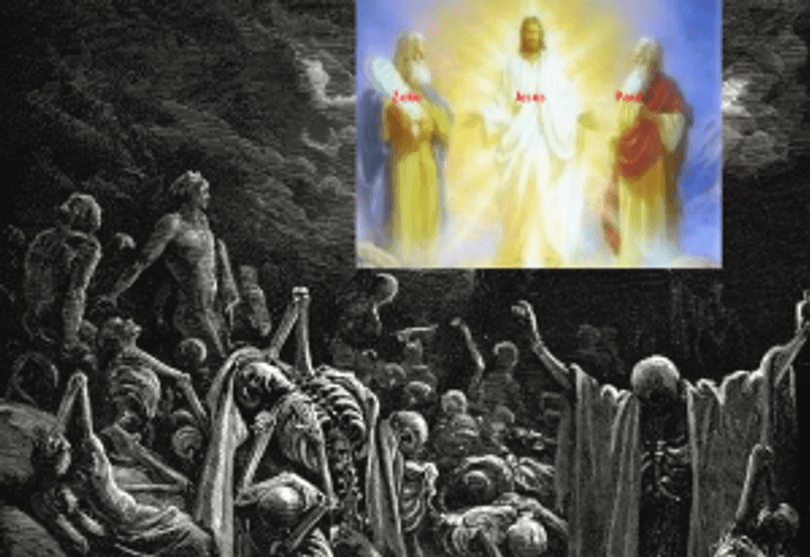
The hand of the Lord came upon me, and he brought me out by the spirit of the Lord and set me down in the middle of a valley; it was full of bones. He led me all around them; there were very many lying in the valley, and they were very dry. He said to me, “Mortal, can these bones live?” I answered, “O Lord God, you know.” Then he said to me, “Prophesy to these bones, and say to them: O dry bones, hear the word of the Lord. Thus says the Lord God to these bones: I will cause breath to enter you, and you shall live. I will lay sinews on you, and will cause flesh to come upon you, and cover you with skin, and put breath in you, and you shall live; and you shall know that I am the Lord.”

So I prophesied as I had been commanded; and as I prophesied, suddenly there was a noise, a rattling, and the bones came together, bone to its bone. I looked, and there were sinews on them, and flesh had come upon them, and skin had covered them; but there was no breath in them. Then he said to me, “Prophesy to the breath, prophesy, mortal, and say to the breath: Thus says the Lord God: Come from the four winds, O breath, and breathe upon these slain, that they may live.” I prophesied as he commanded me, and the breath came into them, and they lived, and stood on their feet, a vast multitude.

Then he said to me, “Mortal, these bones are the whole house of Israel. They say, ‘Our bones are dried up, and our hope is lost; we are cut off completely.’ Therefore prophesy, and say to them, Thus says the Lord God: I am going to open your graves, and bring you up from your graves, O my people; and I will bring you back to the land of Israel. And you shall know that I am the Lord, when I open your graves, and bring you up from your graves, O my people. I will put my spirit within you, and you shall live, and I will place you on your own soil; then you shall know that I, the Lord, have spoken and will act,” says the Lord.

——————————————————————————–

This is the optional Old Testament selection from the Episcopal Lectionary for Pentecost Sunday, Year B 2018. Act 2:1-21 may replace it.  It will next be read aloud (if chosen by the priest) in church by a reader on Sunday, May 20, 2018. It is important as it is the words of the prophet Ezekiel telling how dried lost souls could be reborn to new lives. The glory of God to renew humans born of death, offering them eternal life, is the symbolism of this prophecy.  It foretells how the Holy Spirit would fill the disciples of Christ on Pentecost (also on a Sunday), marking them for eternal salvation.

I published a “bus stop sermon” that placed focus on this reading, the last time it came up in rotation.  That was on May 24, 2015. It was a sermon relative to all the readings of Pentecost Sunday, Year B, with references to Ezekiel’s vision of dried bones made then that are still applicable today. If you want a longer commentary to read, I recommend clicking here [no longer available]. For now, I plan to be shorter, offering only slightly new views that have come to me about this reading.

I don’t think there are too many serious Christians that are unfamiliar with this reading from Ezekiel. It is a favorite of mine, because it offers a classic example of how a prophet answers a question coming from God: “You know LORD.”  As Sergeant Schultz used to say on Hogan’s Heroes, “I know nothing.”  Why try to match one’s tiny brain to the Mind of God?

In a world of simpleton heroes, I cannot see a Nazi POW guard as fitting that bill.

A good Saint has no answers other than the ones God gives him or her.  Apostles are closer to being simpletons than scholars; but having access to the Godhead and being able to fully understand what God shows them (in dreams and visions) makes them be more like savants … without any credentials from prestigious institutions.  After all, when one’s ego has been sacrificed, one’s human brain ceases trying to figure anything out.

That is what faith is all about, be that divinely inspired or blindly misguided.  The brain is useless either way, as one will always counter faith with thoughts of doubt.

In this reading, God told Ezekiel, “Mortal, these bones are the whole house of Israel.”

As a prophet of Judah, driven into exile in Babylon, Ezekiel was shown the future by God. Dried bones filled a valley before Ezekiel, which reflected the past. The Israelites – both Israel and Judah – had lost everything promised to them by God, through Moses, by breaking their commitment to the Covenant. The dried bones symbolized the death that had befallen the priests of the One God.  They received the Promised Land and only their dried bones were left to cash that windfall in.

The whole of the house of Israel was meant to be multitudes of servants to YHWH.  All had failed, save the few prophets God kept sending to warn those priests who worshipped kings and queens … those who worshipped the gods of worldly things.
A well in the ground draws physical water out, which is a necessity for keeping sinews, flesh and skin moist. It only last a while. Then you need to draw more.

The underlying message in this vision shown to Ezekiel appears loud and clear when viewed through the lens of the Pentecost Gospel message of the “Advocate” that will be sent.  That presence will be the “Spirit of truth.”  It is clearer when viewed through the Acts 2 reading of the Holy Spirit rushing upon the disciples, giving them the abilities of that Spirit of truth. It is refined in our eyes by the words of Paul to the Roman Jews (an optional reading that will be omitted if Ezekiel is chosen) that says “the Spirit helps us in our weakness.”  The “breath” God told Ezekiel to prophesy about is all of the above, as it told of the Holy Spirit being the life for the dead.

“The Holy Spirit is coming,” said Ezekiel (paraphrasing).  It came as Jesus of Nazareth.  It has remained ever since in his Apostles in Christ.

A truth is that Man is born to die. This is why mankind is called mortal … from Old French “mort – al,” meaning “characterized by death.” Being born of death mean a soul is constantly in need of new bones, new sinews, and new flesh with new skin, so it can find comfort in a new home. Being born of death always leaves behind dried bones, after the softer tissues have returned to dust. It is the breath of the Holy Spirit that God that brings eternal life to dried bones.

Ezekiel must be seen as alive, amid a scene of death.  As such, Ezekiel was filled with the Holy Spirit. He had been in that valley of death before his exile from Jerusalem by Nebuchadnezzar.  He personally knew the breath of life that comes from complete servitude to God.

God told Ezekiel, “I will cause breath to enter you, and you shall live.” Ezekiel was the living proof of that promise of eternal life from divine breath.  Thus, as a prophet of the LORD, God told Ezekiel, “Prophesy to these bones, and say to them: O dry bones, hear the word of the Lord. Thus says the Lord God to these bones: I will cause breath to enter you, and you shall live.”

Prophecy is better when spoken with conviction, not the probability of prediction.  Ezekiel knew the breath of God.
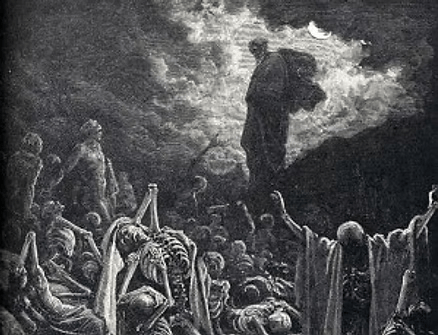
The reincarnation of souls into new bones, new sinews, and new flesh with new skin was why God told the prophet Ezekiel, “Prophesy to the breath, prophesy, mortal, and say to the breath: Thus says the Lord God: Come from the four winds, O breath, and breathe upon these slain, that they may live.”

Dirty (worldly) souls cannot go to the spiritual realm for eternity.  They go temporarily, for judgment and processing for a return to the earthly plane.  They need a new physical body then; but, more importantly, they need someone holy to shine a light on the way to eternal life when they are born anew and grow amidst the influence of sin.

Man needs prophecy.  God sends prophets to meet that need.

The lesson is simple. There are two types of souls: Those blinded by the illusions of a worldly existence; and those baptized by the Holy Spirit. There are two types of mortals: Those living in darkness, destined to death (and repeat); and those living in the light of the Holy Spirit, destined to eternal life.

God gives tarnished souls the gift of the breath of life in new human forms. It is the spirit of mortal life that comes with a baby’s first breath, replacing the amniotic fluids of the embryonic environment of the mother’s womb, whose maternal waters fill the lungs of an embryo that awaits its own soul and its own life. The breath of life in a newborn is the rebirth of an ageless soul into the worldly plane; but it is only a temporary permit. It begins another journey to find the God of life and be born again through the breath of the Holy Spirit.

With each new life a mortal must choose. Do I live for me? Or, do I live for God?

This lesson of Ezekiel is it prophesied the coming of Jesus the Messiah. Ezekiel was shown a vision when new bodies would be offered eternal life. He had a dream of what was to come. Ezekiel was a Saint because he did what God told, without asking questions. God blessed his servant with eternal life, through the Holy Spirit.  He lived a prophecy that could be fulfilled in others; but all have to make a decision that allows them to receive the Spirit.

The lesson is the same one that Christians know of Pentecost.  Just as the Holy Spirit came like a rush of wind into their bodies, dividing their tongues with inspired abilities, it was God saying to Ezekiel, “Come from the four winds, O breath, and breathe upon these slain, that they may live.”  The difference is living for death to come and living so others may live.
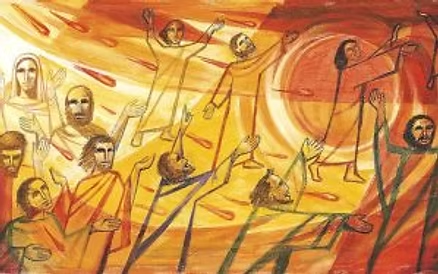
In his vision, Ezekiel then stood as the Messiah, filled with the Christ Mind. He saw the return of the exilic Jews to Jerusalem – to the valleys surrounding that place, where their dried bones had been left. Lost souls were shown to return to the site of their graves and their lost lives, seeking to regain those worldly possessions.

Those lost souls would fill their rejoined bones, their new sinews, and their new flesh and new skin. Jesus would be sent to breathe the Holy Spirit upon those returning Israelites.  Jesus of Nazareth would give those dead men walking another chance at redemption and salvation. Jesus would come saying, “Follow the LORD and find eternal life. Follow me and receive the Spirit.”

The new bodies would fulfill Ezekiel’s prophecy – ‘“I will place you on your own soil; then you shall know that I, the Lord, have spoken and will act,’ says the LORD.”

The Israelites would stand again on the soil that was once Israel and Judah, in a rebuilt Jerusalem, with a new Temple. Like the mortals reborn, so too was the land they once enjoyed.  However, that body of land was inhabited by a Roman spirit, so the Jews were like a possessive spirit cohabiting Galilee and Judea.

Jesus came telling the Jews, “The kingdom of the LORD has come near.” The kingdom of God is not on this soil.  Jesus was Christ the king in a heavenly realm.  He was designated to rule within the minds of God’s priests.  That state of Roman domination made dried spirits seek a warrior Messiah, not a humble rabbi.  The moral of their decision can be seen in the new State of Israel today:  The land is just as godless today, as the world is Satan’s domain.

Some showed interest in Jesus of Nazareth. Some felt threatened by him. Some followed him and received the Spirit. Some refused and became dried bones once again.

The question remains: Do I live for me? Or, do I live for God?

The Day of Pentecost means (from the Greek) “The Fiftieth Day.” That number of days is how long it took the freed Israelites to leave Egypt and receive the Holy Covenant. God breathed His Holy Spirit onto stone tablets; and He sent the Law to mortal beings through His servant Moses (an Ezekiel-Jesus Messianic prototype). The mortals of death that were slaves of the Pharaoh were given the promise of salvation through that breath of life that was-is-will always be The Law.  The Israelites gave an oath of agreement.
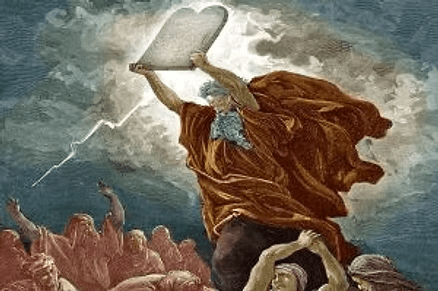
They failed to live up to their end of the bargain.  They lost the gift of land … their seminary to become mentally trained priests that would serve only the One God.  God saw that failure, which he showed to Ezekiel.  Still, God would give the Israelites another Covenant, with a higher reward than soil and dirt.  The same offer is given to all who believe in Jesus Christ, because through receipt of God’s breath of life one has proof of Jesus Christ as Jesus Christ.  The ability to live the Law comes without needing to think about anything.

God says, “Act,” then you act.  You know nothing better than following His instructions.  You live for God’s instructions.

The Easter season has ended.  It stretched over the last seven Sundays.  That span of time is meant to reflect the freedom of Jesus of Nazareth, bound by the original sin born in his soul [Adam].  He was born to serve the LORD, from his inception.  He was given over as the sacrificial lamb of Salvation; and he was returned to be with God forty-nine days later.  Pentecost is the day Jesus Christ returned to serve the LORD in Saints.

Jesus was arrested on a Sabbath, he rose from death on a Sabbath, and he spent five Sabbaths breathing the Holy Spirit into the Saints that he would leave behind (as Him). Seven Sabbaths are forty-nine days. On the Fiftieth Day, as Israelite pilgrims gathered to celebrate their receipt of the broken Covenant, the Messiah of God returned twelve-fold, offering a New Covenant, which was the breath of obedience within … not memorized from writings and oral lessons without.

This means Pentecost is personal. It is when one signs his or her mortal life away in service to the One God, gaining in return the eternal life that comes from becoming the Messiah reborn. The Day of Pentecost signals when one stops living for self and starts living for God, as His Son Jesus Christ. No one is forced to make the decision to live for God. However, be forewarned that living for self will lead to some dried bones being left behind, at the end of another selfish time on earth.


Romans 8:22-27 – Groaning in labor pains

We know that the whole creation has been groaning in labor pains until now; and not only the creation, but we ourselves, who have the first fruits of the Spirit, groan inwardly while we wait for adoption, the redemption of our bodies. For in hope we were saved. Now hope that is seen is not hope. For who hopes for what is seen? But if we hope for what we do not see, we wait for it with patience.

Likewise the Spirit helps us in our weakness; for we do not know how to pray as we ought, but that very Spirit intercedes with sighs too deep for words. And God, who searches the heart, knows what is the mind of the Spirit, because the Spirit intercedes for the saints according to the will of God.

——————————————————————————–

This is the optional Epistle selection from the Episcopal Lectionary for Pentecost Sunday, Year B 2018. It will next be read aloud (if chosen by a priest) in church by a reader on Sunday, May 20, 2018. This is important as it speaks from the perspective of one born of death, who has gained the promise of eternal salvation, through the Holy Spirit. It alludes to the weaknesses that cause dried bones in those born mortals, which can only be brought to life by the love of God, the Mind of Christ, and the Will of God through His Holy Spirit.

The chances are this short reading from Paul will never be read aloud in an Episcopal church, simply because it is in a “pick two out of three,” with one of the three a must pick. That leaves the battle of the Scripture readings to Ezekiel 37 (the dried bones in the valley) and this from Romans 8. Simply from a theatrical perspective, Paul is always good for an audience response that says, “Huh?” That makes it probable that this reading may never be read aloud in church. The reason the probability is not zero is it is short, so some priests might choose it to save printing costs on any accompanying read-along handouts.

Imagine this, a Scripture waiting three years to be chosen for presentation to a congregation, and it never gets picked. If churches were like seminary and tests were required for graduation as a Christian, everyone would fail the test if passing meant writing an essay about the meaning of Romans 8:22-27.

Who remembers this reading?

While some concepts are easy to see here – creation, labor pains, hope, and the Holy Spirit – few would jump and scream, “Romans 8:22-27!!!” … if asked to quote a verse of Scripture that was relative to those concepts.

Maybe I’m wrong and just don’t hang out with enough Pauline scholars?

If it were not for the demand to choose the Acts 2:1-21 reading for Pentecost Sunday – because (after all) what is a Pentecost without the Pentecost story from Acts 2, right? – this reading from Paul’s letter to the Jews of Rome paints a perfect picture of how difficult it is for a bag of dried bones in new flesh (zombie Christians?) to actually move those chest muscles and breathe deep, after being prophesied to the breath.

Begin C.P.R. to open the heart to God.

Out with the dusty air. In with the Holy Spirit.

Out with the egomania. In with the Mind of Christ.

While Ezekiel can be seen as the Holy Spirit in a human Saint prior to Jesus Christ, Paul should be seen as the Holy Spirit in a human Saint after Jesus Christ. Just as God told Ezekiel to prophesy to the dried bones in new bodies, God likewise to Jesus of Nazareth (His Son) said to prophesy to dried bones in new bodies. Now, God is telling Paul to prophesy to those who received the Holy Spirit and eternal life in re-hydrated bodies, while indirectly prophesying to dried bones in new bodies reading his words today. The same God is using multiple righteous bodies (prophets) as His Christ to prophesy to the breath of eternal life.

What if the Transfiguration occurred in Ezekiel’s vision and the past, present, and future were prophesying to the breath at the same time?

Paul was told to prophesy to those like him about what “we know” (Greek “oidamen”). This was relative to faith as belief based on personal experience. Paul could make that statement in the plural number because he had witnessed others who had transformed from dried bones in new bodies of flesh, from mortals plodding along like zombies towards certain death to Saints filled with the light of truth and assured eternal life.

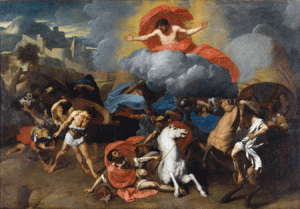
For those who know Paul’s story, he was named Saul before he encountered the Spirit of Jesus Christ, was knocked off his mule and blinded for three days. Saul was transformed from Christian-persecuting Pharisee into Saint in the name of Jesus Christ; but that transformation was not a smooth snap of the fingers, presto-change-o, where Jewish Saul became Christian Paul. He went through labor pains, from being born Saul headed towards another dead end, to being reborn as Jesus Christ. To give a name to the new him, he began going by the name Paul.

Saul was a creation, who was like all the Apostle-Saints Paul encountered in his travels. They had all been created of matter – bones, sinews, flesh and skin – forming as fetuses in their mother’s wombs, and grown to maturity in a world of evil influences.  The Jews Paul sought were clinging to their Judaism as a way to justify their sins. Saul was one of them, a reflection of their lifeless state.

It has always been a challenge for a soul released into a universe of matter to find its way beyond the veil of deepest, darkest outer space as to the origin that is God. That must be where He lives and watches over us dust mites of His Creation.  The labor pains of finding God, especially for souls locked inside zombie bodies, comes from straining and groaning to reach the highest, widest, deepest outer edges … to where brains think God must be ….

When God has always been within.

For Saints like Paul and his fellow Roman Christian Jews, the receipt of the breath of the Holy Spirit did nothing to ease their pains. To those first fruits of the Spirit, their souls still resided in temporal bodies and they faced the same struggles Ezekiel and Jesus faced – prophesying to dried bones standing before them like zombies.

The first fruits are the earliest harvest of grains, which are then measured by a weight called an “omer.”  As a symbolic gesture, those early grains and fruits were gathered and placed in the Temple on the second day of the Passover Festival. The first fruits were then allowed to become ripe and matured, which began a daily count to when those fruits would be worthy to eat. They were ripe and ready on the Fiftieth Day – Pentecost.

All the Apostles serving the Father in the name of Jesus Christ had “groan inwardly” waiting for their “adoption” as true Christians, just as do everyone who seeks the same gift of eternal life. The redemption of their bodies meant, like first fruits that appear ready for harvest, their egos had to be removed.

In the zombie analogy, the walking dead or the living dead can only truly die when their brains are blown to bits.  I imagine the “death” of a zombie would symbolize eternal damnation, where the soul can no longer find anything earthly to call “home.”  Still, the zombie analogy says the living dead live because of a brain and not because of a soul.  Thus, the first fruits represent the initial receipt of the Spirit of Christ, so the soul begins to retake control over what was a lost cause before.  Life for a zombie consists of destroying life in others; but dried bones without a brain – sacrificed for the Holy Spirit – have life to offer others.

Just as Jesus breathed on his disciples, giving them the first fruits of the Salvation harvest, they needed to be aged to perfection.  The disciples and followers of Jesus would then begin a forty-day test of one’s true readiness to have eternal life.  That education was mandatory and had to be passed. Therefore, the “groan inwardly” is one’s time spent in the Wilderness, where brains cannot find water and food; only angels can keep the body of flesh thriving on heavenly manna and living waters.

When Paul wrote to his brothers in Christ, he stated, “For in hope we were saved.” The Greek word “elpidi” is translated as “hope,” but the word equally means, “expectation, trust, and confidence.” This means an Apostle knows that salvation has come, when one has met the test for “redemption of the body,” because of an inner presence that instills deep trust and confidence in the Holy Spirit, with an expectation of eternal life.

The Apostles were saved as examples of hope that others could sense and feel.  The presence of “hope,” as most mortals know the meaning, is the thrill and excitement that is brought on in anticipation of good things coming.  The righteousness of hope comes by a willingness to serve the LORD, no matter what the earthly consequences might be.

When Paul made the statement and then questioned, “Now hope that is seen is not hope. For who hopes for what is seen?” this is the “hope” that comes from others. When in danger, we are trained to respond – “Call 9-1-1!”  We look for rescue to come to us, in the form of flesh and blood heroes.

Human beings routinely place their hope, expectations, trust and confidence in leaders. The Israelites went to Samuel pleading for a king to lead them, like those who led others nations. They wanted to see a king as holy, rather than take the responsibility of being holy themselves. Individually, one offers little value as hope for others, when one sees oneself, and others see one as well, as an ordinary human being that is lowly and insignificant.  We equate the power of worldly influence as the rays of hope to bow down before.  We look for that which can be seen … not God.

That error is what makes people be born to death, as walking brains on top of dried bones and rotting sinews, flesh and skin.

For the majority of people today who profess belief in Jesus of Nazareth as the Messiah promised by God to the Jews, and said to be “our Christ,” the error comes from placing the body of a dead man on a wooden instrument of death. We look for the “second coming of Christ” as though that is eons down the road of linear time. The error is in making an idol of Jesus to pray to externally, such that the hopes, expectations, trusts and confidence is that Jesus Christ will come down from heaven like a Greek hero and slay evil with his double-edged sword and rapture all Christians up to heaven. All of that “hope” calls for no one talking self-responsibility, no self-sacrifice is necessary, no groaning inwardly has to be experienced, and no fruits need be grown that will be in the name of Jesus Christ.

Paul said, “But if we hope for what we do not see, we wait for it with patience.” We cannot see God, but God wants our hearts to open for Him. God wants dried bones with new sinews, flesh and skin to love Him enough to be wedded to Him. God wants our souls to be in Holy Matrimony with His love.

We cannot see the Holy Spirit, but God wants to wrap His wives in that protective covering. We cannot see the child growing within us that brings the labor pain as we are reborn as the Son of God, Jesus Christ [regardless of one’s human gender]. No one can see the hope of Jesus Christ in us, as we still look like Saul did, before he took the name Paul. No one can see the hope an Apostles breathes upon dried bones, zombie-brained people.

That is why patience is required.

In that period of patience, weakness will come. Once a bag of dried bones, then always a bag of dried bones. It is why priests say at funerals, “Ashes to ashes, dust to dust.” Forget the possessions (land, money, jewelry, etc., etc.), you can’t take your bag of bones with you.  Believe me, the Egyptians tried and we have the dried bones of mummies to prove that.  That means evil influences will pull on dried bones, just as gravity will always make what goes up always come down.

Patience means not over-reacting to that which is normal.  Patience means not becoming disoriented.  Patience means remaining centered in the Holy Spirit.

So, with hope, trust, confidence, and expectations being based on the unseen, influences of evil will always drift by. When you pray to an external God and kneel before a Jesus hanging on a cross on a wall, you find those worldly temptations always wrapping their tentacles around you, choking the mortal life from you. That is why it is so important to receive the breath of prophecy and know the true meaning of faith.

True faith is knowing nothing that comes from a small human brain can bring anything that lasts forever. It is the Holy Spirit that maintains one’s path to eternal life, swatting away the lures of Satan. When you are Jesus Christ reborn, another in the line of Sons of God, you tell Satan to go where the sun don’t shine.

And, he has to obey that command, when he knows it was spoken with confidence.

So much influence of the world, while living in a worldly domain, means fear of failure to withstand it all. As Christians, we believe in the power of prayer. Prayer is indeed a powerful ally.  Reciting serial prayers helps place our hearts in a centered state of reception.  The problem, as stated by Paul, is “we do not know how to pray as we ought.”

The disciples of Jesus raised this issue when they asked Jesus to teach them to pray. From the point that “The Lord’s Prayer” was written on paper and published in books called Holy Bibles, zombies have been repeating the same words without understanding what righteousness was the intent behind those words. It reminds me of the movie Monty Python and the Holy Grail, and the scene at the rope bridge over the great abyss.

There each knight had to answer three questions to get across. Repeating the answers someone else gave did not work out too well.  That is like reading a prayer from a book of prayers for all occasions, when sometimes it is best just to wing it and speak from the heart.

When God is in one’s heart, when the Christ Mind overrides an imperfect brain, and when the soul has been baptized by the Holy Spirit that means prayer is faster that a thought can be verbalized. It is known before a human brain could ever know what to ask for. This is what Paul meant by saying, “God, who searches the heart, knows what is the mind of the Spirit, because the Spirit intercedes for the saints according to the will of God.”

This is how God could ask Ezekiel, “Mortal, can these dried bones live?” and Ezekiel could only answer, “O LORD God, you know.”

If a Saint cannot answer a question posed by God, how can a Saint propose to ask God a question in prayer, without God already knowing the question?

Too often, our prayers are scripted. Too often our prayers are for personal wants and desires. Too often our prayers are public, rather than private and personal. And, too often we visualize what our brain thinks we want to come as an answer to a prayer, ignoring any possibility that the answer has been there before we prayed.

As a too often overlooked reading choice for a Pentecost Sunday service, it should be easy to see now how Paul is an equal to Ezekiel, as both were Saints in service to God. The symbolism of Pentecost is the maturation of the first fruits, where zombies are transformed into righteous examples of the way to be. Saints act like the twelve who were filled with the Holy Spirit, leading others to immediately cease being bags of dried bones in warm flesh and become alive with the Holy Spirit also.

Paul called it as it is, when he wrote to those like him who knew what it was like to be Saints. He wrote, “The Spirit intercedes for the saints according to the will of God,” and Paul and friends were Saints.

The call each week is not to be good, because no one really knows what that means. The call is to stop holding God and Christ at arm’s length, trying to keep you one of the living dead.  The answer is not and can never be endless begging for forgiveness [misuse of prayer] because the brain’s will power slipped yet again. The call is to actually be a Saint – “hagios” in Greek – which means, “set apart by (or for) God, holy, sacred.”

No one is good enough to be that without God’s help.  God knows we need help before we do.

The call then is to open your mouth and breathe in ….  Receive the Spirit.

#zombiesofdriedbones #Pentecostreadings #Faith #Patience #FirstFruits #Saints #Romans82227 #Hope

John 15:26-27; John 16:4b-15 – The Spirit of truth brings sainthood

Jesus said to his disciples, “When the Advocate comes, whom I will send to you from the Father, the Spirit of truth who comes from the Father, he will testify on my behalf. You also are to testify because you have been with me from the beginning.

“I did not say these things to you from the beginning, because I was with you. But now I am going to him who sent me; yet none of you asks me, ‘Where are you going?’ But because I have said these things to you, sorrow has filled your hearts. Nevertheless I tell you the truth: it is to your advantage that I go away, for if I do not go away, the Advocate will not come to you; but if I go, I will send him to you. And when he comes, he will prove the world wrong about sin and righteousness and judgment: about sin, because they do not believe in me; about righteousness, because I am going to the Father and you will see me no longer; about judgment, because the ruler of this world has been condemned.

“I still have many things to say to you, but you cannot bear them now. When the Spirit of truth comes, he will guide you into all the truth; for he will not speak on his own, but will speak whatever he hears, and he will declare to you the things that are to come. He will glorify me, because he will take what is mine and declare it to you. All that the Father has is mine. For this reason I said that he will take what is mine and declare it to you.

——————————————————————————–

This is the Gospel selection from the Episcopal Lectionary for Pentecost Sunday, Year B 2018. It will next be read aloud in church by a priest on Sunday, May 20, 2018. This is important as it tells how Jesus perfectly prophesied the coming of the Holy Spirit into his devoted disciples, telling them how they would become the extensions of Jesus Christ in this world.

When reading John’s chapters fifteen, sixteen, and seventeen, it is always important to realize that Jesus was addressing his adult male disciples (which included Peter and Matthew). Jesus was addressing them about important matters that were soon to come into their lives, after Jesus had left them; but none of these conversations were recorded by either Mark (Peter’s story) or Matthew. The reason is that their minds were clouded by Seder wine; and as it was late into the night watch, they were too weary to properly focus on what Jesus was saying. John, on the other hand, had nothing impairing his abilities to concentrate on his master’s every word, because John was too young to drink alcoholic beverages.  Thus, we read those chapters from John’s Gospel because they are lessons intended for the disciples that would later in history … hundreds and thousands of years later.

All of the flesh and blood disciples of Jesus of Nazareth would come to realize (if not remember) the lessons of that Passover night, recorded by John. They are true words spoken, recalled by John as “the Spirit of truth.” None of the disciples would counter anything written by John, as what John recorded came true.  That Spirit is then the Holy Spirit that was prophesied by Jesus to come.

We read in the next-to-last verse of John’s chapter sixteen of the coming of “the Advocate.” In Greek the word written is “Paraklētos,” which is capitalized and may be recognized by some as the Christian term “Paraclete.” That term is sometimes used to name the Holy Spirit.  The word being capitalized in Greek gives it a sense of importance, such as a proper name allows.  Still, the word means, “(a) an advocate, intercessor, (b) a consoler, comforter, helper.” The Greeks used it as inferring a need for legal assistance.  However, the root etymology, from “para-“ and “klē-,” shows the formation of the word intended to say, “a call to the side of” or “to summon support.”

This means Jesus was using this title as a statement that the Holy Spirit was “Invoked by call.”  The word’s use implies a special need, such that a Paraclete would not a natural phenomenon that would come to support everyone.  Still, as Advocate, where the implication is an external assistant (like a lawyer at trial) allows for the name to become tarnished … as “Devil’s Advocate” … making that choice of translation be somewhat misleading.

While the second segment of words that follow “When the Advocate comes” can indeed translate to say, “whom I will send to you from the Father,” I want you to place on your “Amphibological glasses” on and read that next segments slightly askew.  The word “amphibological” means “double meaning,” which is a ploy in language, most often an intent to mislead, such that “amphibological” is a term used in Logic to point to a flaw of reasoning.  However, when the Spirit of truth is the language of God, intended “amphibological” language is by design a prompt to see the multiplicity that divine words contain.

The Greek text reads, “hon egō pempsō hymin para tou Patros.”  That literally can state, “that ego will send to you from the Father.” There is a double meaning stated here, which is intended, but overlooked.  It is overlooked because “egō” is Greek that is properly translated as “I,” being a standard reference to Jesus, in quote.  Still, missing the Jungian concept of “ego” as God’s intent, as God speaking through Jesus and John, relates to missing the intent that the “I” of Jesus would become the “ego” of the disciples.  It states doubly how the disciples will speak as Jesus, becoming his “egō.”

This statement, when read this way, says “When my ego is sent from the Father,” so it is “when I am sent from the Father,” then “I am the Advocate” called to support you.  It might take a couple to times looking at the Greek in English translation to see this appear.  However, it is vital to understand that Jesus Christ is the legal assistant called to one’s side, which is not external but internal.

Rather than see the Holy Spirit as an individual and separate entity, the word “hon” is better when not read as “whom,” but as the Nominative relative pronoun “that.”  Not only does that translation make “egō” be read as a new definition of “Paraklētos” (“that” just stated), but it eliminates all the masculine pronouns that will follow in translation (where “whom” leads to “he”).  All those uses of “he” as an identification of the “Paraclete” are better understood when read as “that” presence.

This means the “ego” sent from the Father then will be the same “ego” as that which filled Jesus of Nazareth, through the Holy Spirit.  The ‘ego” of Jesus of Nazareth (the “I” of Jesus) had been subverted so Jesus only spoke for the Father (not self).  Thus, the “ego” in Jesus was the Christ Mind. Without the Christ Mind, we are all just egos running hither and yon, going nowhere without a gifted guide leading us. The Christ Mind is then the “summoned support” that the Father sends to all His Saints.

This new “ego” “sent from the Father” is then further identified as “the Spirit of truth,” where the capitalized “Pneuma” can also translate as “Breath.”

On a day in the liturgy when the disciples were filled with the Holy Spirit, it came upon them “like the rush of a violent wind.” Another term that can represent “Pneuma” is “Wind,” where the capitalization shows a higher level of consideration that goes beyond the physical movement that is sensed as “wind.” When Acts says this “Wind” had a “sound like a violent rush,” it was the “sound” of the “Breath” that took total control of the disciples, changing them into Saints. That was indeed the “Breath of truth” that Jesus foretold would come to his disciples.

Again, the use of “he” is misleading when one is assuming “the Advocate” is a male entity sent by Jesus from the Father. The Greek word “ekeînos” actually means “that one” or “that thing,” such that in the first person Nominative it means “that,” as reference to something just stated. As such, reading how “that” comes from “the Father,” this is sent by the male Spirit known as God. God is not the presence of a “he,” but an extension of God – “that thing.”  As the “ego” of Jesus Christ being “that thing sent from the Father,” this is how all Christians become the Sons of God, regardless of one’s human gender. Thus, “that” male “ego” of Jesus Christ “will testify on [Jesus’] behalf.”  This is then stating Jesus will be reborn in a disciple, whose own “ego” has been sacrificed to the Father. The testimony that will come is from the “Spirit of truth” says there will be a duplication of “that” held by Jesus of Nazareth.

The final segments that make up verse 27 say (literally, in English from the Greek), “and you moreover bear witness  ,  because from the beginning with me you are.” The separation, by comma pause, forces one to see this saying more than, “You also are to testify because you have been with me from the beginning.”

The power comes from seeing Jesus prophesying to his disciples how they would “bear witness” to this presence of a new “ego” that “will be sent from the Father,” which is the Christ Mind, the same Mind that Jesus Christ possessed. It does not come from Jesus, but from God, to those who will testify for God, as did Jesus of Nazareth. The Apostles would testify to that through their Epistles, and through their ministries. This then means that once a new Saint has seen the light of a new “beginning with Jesus” has started, it will be like one has always been in that state. That new” beginning with” Jesus will forevermore define who they are, as their being will no longer be who they were.

That foundation, coming from the last two verses of John’s chapter fifteen must be grasped as a state of being that is understood, prior to the lessons taught to the disciples [you the reader] in chapter sixteen. The change from one chapter to the next must be realized as purposeful, meaning John did not run out of blank page to write on, so he started a new page and numbered it “16.” A chapter break is more significant than a break for pause (comma, semi-colon, colon, double-dash, etc.) and a break concluding a string of thoughts (a period mark).

This break should be seen as movement of the group, after they left the upper room. Chapter fourteen ended with John saying Jesus told them, “Come now, let us leave.” That more than likely meant to leave the upstairs room, to the streets of the Essenes Quarter of Jerusalem, where they mixed and mingled with other Jews doing the same as they did [a tradition of the Seder]. In that setting, Jesus spoke the lessons of chapter fifteen to his disciples, who were too drunk to remember. Therefore, it is likely that the lessons of chapter sixteen took place as the group left the city and exited to the Mount of Olives (which was really a hill with olive trees, overlooking the Hinnom Valley). Outside the Essenes Gate these lessons could have been told, prior to Jesus and John going off alone, when Jesus prayed (John 17).

The beginning of John’s chapter sixteen is a warning given by Jesus, about the coming deaths that all the disciples would face. They would come in the face of persecution and rejection, the same that Jesus had faced. As Jesus ended this prophecy, he used language that is similar to that which ended chapter fifteen, saying, “I did not say these things to you from the beginning, because I was with you.”   The intent was Jesus had not forewarned his followers of extreme persecution, because he would be the focus of what the disciples would witness. His intent was his physical presence would protect them; but that physical presence was about to come to an end.  However, the words, “to you from the beginning not I spoke” (from Greek “eipon” meaning “to speak, say”) are now used to continue the thought, “from the beginning with me you are.”

When Jesus then told his disciples, “Now I go to the [one] having sent me,” that was a statement that Jesus of Nazareth had been sent the Holy Spirit, which comes from the Father. The Holy Spirit is all that is allowed in heaven, as it is “that thing” surrounding God. Thus, Jesus’ soul was baptized by the Holy Spirit and given eternal life with the Father. Jesus’ “ego” was subservient to the Spirit of truth, which came from God; so Jesus could go to the Father because his soul had been cleansed by the Holy Spirit.

When Jesus then added to his statement about leaving, “And none of you ask me, Where are you going?” this means his disciples knew that Jesus had foretold his death was coming, in a most horrible manner. Still, the reason none of them asked where Jesus was going is none of the disciples had any understanding of heaven and eternal life. They all assumed (as the Pharisees had taught) all souls went to Sheol (a form of Hades – the underworld) – good and bad; or they believed a soul died when the physical body died (as taught by the Sadducees) – there was no eternal afterlife.

Fools! When we die we will go to the great lounge in the underworld, where we will rule like kings.

Not long before, Jesus had said, “If you had known me, you would have known my Father also; from now on you know Him, and have seen Him.” A drunken Philip replied, “Lord, show us the Father and that will be enough for us.” That response says the only concept of being that was held by the disciples was the here and now. With Jesus telling them he was going to die, there was no reason to ask where his body would be buried. They would see his tomb and know, “Here lies Jesus of Nazareth.”  With that as their expectation, none of them asked “Where are you going Jesus?”

It was that prophesied death that Jesus said “sorrow has filled your hearts.” The use of “heart” goes beyond the metaphor of one’s emotional center being weighed down with feelings of remorse and pain (“sorrow”). Instead, Jesus was pointing out how the blood being pumped through their physical bodies, by the physical organ that regulated life in human beings, was infused with “grief” and “affliction.” Rather than the “Spirit of truth” running through them, they had the spirit of uncertainty and doubt.  The disciples did not know where Jesus was going, nor care to ask where, because they had not yet drank from the cup of eternal life.  That would come and be when their sorrow would be replaced by the happiness and joy that comes from a marriage to the One God.  Then, the Holy Spirit would course throughout them.

That happiness would be relative to the presence of the Advocate Jesus had told his disciples about, not long before. By saying, “I tell you the truth,” Jesus repeated how the Spirit of truth was in him, as it would be to come in them. Jesus then said truthfully, “It is to your advantage that I go away, for if I do not go away, the Advocate will not come to you; but if I go, I will send him to you.” Here, Jesus did not repeat the first person singular “egō,” but a form of the verb “pempó” that implied that, as “I will send.”

The verb can also mean, “I will transmit, I will permit to go, and I will put forth.” When the masculine pronoun “him” is not read as the translation of “auton,” this promise projects “the same” or “self,” with the Advocate only capable of coming from God. This means Jesus saying, “If I die” (from Greek “poreuthō”), then “I will permit same (or self) with you.” This does not mean Jesus will give God an order to send one Holy Spirit to one disciple, but the freeing of the Christ Spirit from Jesus would allow that Spirit of truth to be multiplied many times over. Each new Saint would then replicate the Christ Mind of Jesus of Nazareth, replacing an old ego.

Verse 8, again, does not make a specific reference to a male (“he”) that “comes,” but rather states, “Having come.” This is the present participle state that continues the past into the present. Because Jesus was the embodiment of the Holy Spirit and Christ Mind, that Spirit of truth was not awaited, as it had already come. “Having come,” it will never leave again.

A translation that implies “when” makes the future of “coming” conditional, such that there is no certainty as to the circumstances being met for a “coming.” However, “having come,” “that” presence “will convict the world concerning sin.” This was the truth being stated that was the ministry of Jesus of Nazareth, where the Gospels tell how Jesus pointed out the guilt and exposed the sin of those who acted blameless and sin free (the elites of Judaism).

Beyond defining “sin,” Jesus said the Christ Mind would make clear the meaning of “righteousness” and “judgment,” where each are separate phases a soul confronts when on the material plane. Jesus then explained these by saying, “about sin, because they do not believe in me; about righteousness, because I am going to the Father and you will see me no longer; about judgment, because the ruler of this world has been condemned.”

As to “sin” being exposed as the rejection of Jesus, this is certainly a reflection on the ruling Jews, stretching from the Temple’s Sanhedrin, the Sadducees and Pharisees, to the rabbis of synagogues throughout Galilee and Judea. However, to limit “sin” to only those few who did not have faith, trust, or belief on Jesus as the Messiah is wrong. The scope of “sin” is placed on the whole world, a world that would deny Jesus as the Son of God and the “ego” necessary for resisting all “sin.”

The word “peri” is translated as “about,” such that it precedes each of the three categories Jesus said would be exposed. The translation as “about” is weak, as the word also means “concerning.” “Concerning” is a word that evokes the element of “concern” that should be realized. The word “peri” is often used with its intent being to denote “conditions” and “circumstances” that allow something to be seen in a certain light. As such, “sin” is conditional to the intent behind an act, more than the act itself.

This is how the act of killing a human being is not the same as an act of murder, simply because a life was taken. Both acts can be deemed a “sin,” but killing might be justified (based on the circumstances and conditions), whereas murder is always against a Law of God – a “sin.” Therefore, the word “peri” is not a casual word that casts a blanket of generality over “sin, righteousness, and judgment.”  It establishes a perimeter of circumstance concerning those distinctions.

This means “concerning righteousness” is conditional on one’s acceptance of Jesus Christ, as he has prophesied he (as “the Advocate”) was coming to his disciples. In the sense of Judaism, Jesus saw that dogmatic religion was the external measure of sinfulness and righteousness, based on how well one observed the Laws of Moses. This is what set the Temple leaders on a level of self-perceived righteousness, simply because they had the power to project sin upon others, while overlooking their own flaws and moral shortcomings.

Jesus said, “I tell you that this man [publican], rather than the other [Pharisee], went home justified before God. For all those who exalt themselves will be humbled, and those who humble themselves will be exalted.”

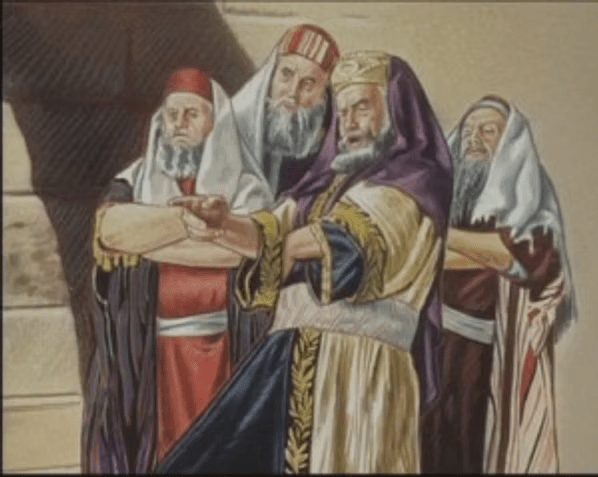
As a rejection of Jesus was done by trying to pin the “sins” of blasphemy (by implying he was the Messiah) and being a law-breaker (by healing on the Sabbath), it was the “sin” of their lies (plotting to murder Jesus of Nazareth) that took their image of “righteousness” and exposed it for what it was. The Spirit of truth showed those leaders as false prophets and bad shepherds, incapable of righteousness.  They rejected the Spirit of truth.

Still, it is too easy to just project the title of sinner on the Jews, as the Gentile Romans probably had no qualms about killing someone who had beliefs that differed from theirs. Just like the Temple schemers, the Romans loved to use the pretense of law as justifications for their many acts of sin. Many of the Roman Empire’s acts were sins in the eyes of the LORD, regardless of how legal they were proclaimed, or holy unto their pagan (dead) gods.

This same state of “sin” projects on Americans today, as its multi-cultural mix has pagan Gentiles, Jews, and those professing Christianity as their religion all rejecting Jesus as the Christ. The laws of the land are based on a lack of consistent internal moral values.  The point of what Jesus said to his disciples is that “righteousness” can only be found in those who accept the Holy Spirit – the Advocate Christ Mind – and become reborn as Jesus Christ.  Therefore, the “legal assistance” needed is a mindset that always, automatically, follows God’s Law, without question.

Seeing this in that light, the perspective of “judgment” falls as a product of one’s designation as either sinner or Saint. Jesus said “judgment” was exposed “because the ruler of this world has been condemned.” That “ruler” is Satan, but the placement of human beings into positions of rule always (over time) leads the development of sinful little mini-devils, the sons and daughters of Lucifer.

In many examples of rulers (Nero, Caligula, Attila the Hun, Napoleon, Hitler, Stalin, Mao, Saddam Hussein, Gadhafi, Putin, Kim Jong Un, Pol Pot, et al etc., on and on, past-present-future), the soul having been sold into eternal damnation produces tyrants of despicable character. The rejection of Jesus as the Son of God within one’s being means taking a position of influence (for personal gain) as a good idea.

When is a job promotion not self-promotion? Didn’t Hitler start out as a failed corporal in the military who had washed out of art school?

The warning then becomes the test of one’s ability to rule over others AND still obey the Will of God, speaking from the Spirit of truth, while others plot your demise. Judgment then becomes the reward of righteousness, where heaven is for Jesus Christ and those reborn as him and hell is for those who serve Evil, with those in between getting recycled back into the worldly process again (reincarnation).

When we next read of Jesus saying to his disciples, “I still have many things to say to you, but you cannot bear them now,” this goes well beyond their mental capacities being lessened by their drunken and tired states. This statement is mirrored in John’s verse in his final chapter (John 21:25), which says, “Jesus did many other things as well. If every one of them were written down, I suppose that even the whole world would not have room for the books that would be written.”

That says the tiny brains that human beings place so much value in are incapable of knowing the Mind of God. The disciples then are like everyone breathing air today, in the sense that it is impossible for someone who has rejected becoming Jesus Christ reborn to know anything more than a brain has been finely tuned to recall (maybe 4.7% of its capacity?). To know the Spirit of truth, one must be in possession of a brain that hides in a recessed corner of one’s being [ego hideout], listening to one’s own mouth speaking righteousness that one’s own brain did not think up … all the while knowing, “That’s Jesus speaking! And I understand his words fully!”

This is what Jesus meant when he said, “When the Spirit of truth comes, that will guide you into all the truth; for you will not speak on your own, but [the Spirit] will speak whatever that hears, and that will declare to you the things that are to come.” This is the meaning of Ezekiel being told by God, “prophesy to the Breath.” It is what Paul wrote to the Roman Jews speaking of, when he wrote, “God, who searches the heart, knows what is the mind of the Spirit, because the Spirit intercedes for the saints according to the will of God.” Paul was a Saint who never personally knew Jesus of Nazareth; but Jesus foresaw Saints walking the earth in his name.  Jesus prophesied the coming of Saints like Paul and like his disciples – then and now.

Jesus then said, “That (rather than “He”) will glorify me, because that (rather than “he”) will take what is mine and declare it to you.” Again, the Holy Spirit is God, who is the complete essence of masculinity and maleness, but Jesus did not speak of the Holy Spirit an entity, but an arm of the LORD. The Spirit of truth is a oneness with God that envelops a human and its soul.

This means God touched His Son with His arm, making Jesus of Nazareth righteous. The soul of the Son of Man was baptized by the Holy Spirit and Jesus became God incarnate on the earth plane. God has the power to be incarnated in ALL humanity, but ALL humanity would have to want it, seek it, and prove that desire.  In the same way that touch from God is what “glorified” Jesus, as he was “honored” through God, God was “bestowing” His powers into human flesh. That presence was then prophesied as coming upon the disciples of Jesus [you the reader], who would then “take what was his” (the name Jesus Christ) and “declare it to you.” A Saint is then one in the name of Jesus Christ.

The tradition of marriage is a wife takes on the name of the husband. Marriage to God means one takes on the name Christ.

Jesus then concluded this part of his lesson to his disciples by saying, “All that the Father has is mine. For this reason I said that he will take what is mine and declare it to you.” This states the union of human being with God being reborn, just as it was the state of Jesus of Nazareth. The two would become inseparable, as one. The unity that binds the ether of God to the matter of flesh is the soul washed clean of sin, which occurs when one is baptized by the Holy Spirit.

As Jesus of Nazareth was a Saint, so too will all who were to be reborn as him, after his holy soul was released to return in others. A Saint is therefore the reality of the Trinity, as Father, Son and Holy Spirit in one being. All Saints will have the same powers made available to them, so that sin will be defeated, righteousness will be gained, and one’s judgment will be life everlasting. One just has to become Jesus Christ reborn.

As the Gospel reading for Pentecost Sunday, the message is to receive the Holy Spirit and serve the LORD as did Jesus of Nazareth. The Day of Pentecost marks the ordination of saintly priests into the world, just as Peter stood on Pentecost with the other eleven Saints and they all spoke the Spirit of truth. They prophesied to the Breath, which overcame them like a sudden rush of sound coming from their tongues.

The call is to see oneself as having been in a drunken stupor so far in life, so that Jesus has always seemed to be speaking these things to others.  We sit and listen, but we never hear Scripture as a message to be personally focused. One has not heard the Spirit of truth speaking as a motivation for oneself to act – to receive the Spirit and become Jesus Christ reborn.  the reason is sorrow has filled one’s hearts. Sorrow is the affliction of thinking, “I’m not worthy.”

While not read in the selected verses today, the greatest fear is knowing the warning of death that awaits disciples who commit to God. Persecution is the fear of thinking, “What will others say, if I suddenly start acting righteous and more holy?” That fear is typical. It comes from the whispers of Satan, who rules this domain and wants all human beings to remain dried bones, with no holy blood flowing through their veins.

Pentecost is the day when Moses brought down the Law from Mount Sinai. It meant fifty days had passed since the Israelites left Egypt, having that much time to see the miracles God had surrounded and protected His people with. Just as the Israelites were not forced to commit to the Covenant then (quite a few idol worshipers were driven out and killed), there is no hard and fast rule that says, “You must be a Saint.” Just know that refusal means out-casting oneself.

It isn’t even a decision that one can make without God.  Eternal salvation is a reward of complete commitment to God.

The comparison I see is that Pentecost is graduation day. Time has gone by and effort has been put forth to reach that point of transition. One goes from being a student to being a worker. Of course, going back to school for more degrees might keep one from actually applying a degree in the real world and actually earning a living; but what happens when all the student debt comes due and one has no way of paying back all the loans?

We all have to “grow up” sometime.

This Gospel reading is like a professor telling a class of graduates, who are all too drunk from celebrating to really pay attention, what their futures will be like. Just like the disciples, who were ready to lay down and go to sleep, forgetting the purpose of staying vigilant was to “watch and pray you do not fall into temptation,” the world has a way of casting a spell over the best intentions and making open eyes close.  Work is always the next step, no matter which way one goes.  That is why the Gospels lead to “The Acts of the Apostles.

The lesson today will be remember later. It might take years of hard work and experience to realize the lesson, but realize it one will. Realization comes by either recalling what saved one’s life, or by regretting not following good advice given long before.  This lesson will be heard.

Acts 2:1-21 – The Feast of Fifty Days

When the day of Pentecost had come, the disciples were all together in one place. And suddenly from heaven there came a sound like the rush of a violent wind, and it filled the entire house where they were sitting. Divided tongues, as of fire, appeared among them, and a tongue rested on each of them. All of them were filled with the Holy Spirit and began to speak in other languages, as the Spirit gave them ability.

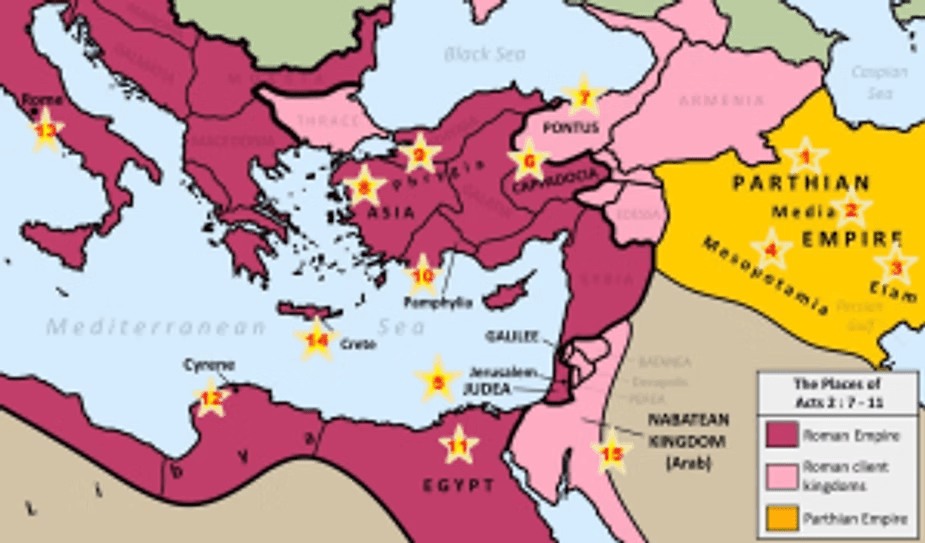
Now there were devout Jews from every nation under heaven living in Jerusalem. And at this sound the crowd gathered and was bewildered, because each one heard them speaking in the native language of each. Amazed and astonished, they asked, “Are not all these who are speaking Galileans? And how is it that we hear, each of us, in our own native language? Parthians, Medes, Elamites, and residents of Mesopotamia, Judea and Cappadocia, Pontus and Asia, Phrygia and Pamphylia, Egypt and the parts of Libya belonging to Cyrene, and visitors from Rome, both Jews and proselytes, Cretans and Arabs– in our own languages we hear them speaking about God’s deeds of power.” All were amazed and perplexed, saying to one another, “What does this mean?” But others sneered and said, “They are filled with new wine.”

But Peter, standing with the eleven, raised his voice and addressed them, “Men of Judea and all who live in Jerusalem, let this be known to you, and listen to what I say. Indeed, these are not drunk, as you suppose, for it is only nine o’clock in the morning. No, this is what was spoken through the prophet Joel:

`In the last days it will be, God declares,

that I will pour out my Spirit upon all flesh,

and your sons and your daughters shall prophesy,

and your young men shall see visions,

and your old men shall dream dreams.

Even upon my slaves, both men and women,

in those days I will pour out my Spirit;

and they shall prophesy.

And I will show portents in the heaven above

and signs on the earth below,

blood, and fire, and smoky mist.

The sun shall be turned to darkness

and the moon to blood,

before the coming of the Lord’s great and glorious day.

Then everyone who calls on the name of the Lord shall be saved.’ ”

——————————————————————————–

This is the fairly fixed reading that can be chosen as either the Old Testament selection or the Epistle selection for Pentecost Sunday, Year B 2018. The full reading is optional in Year A and Year C, making it a fixture reading for Pentecost Sunday.  Either way it may be selected, it would next be read aloud in church by a reader on Sunday, May 20, 2018. It is important as it tells of the disciples’ transformation into Apostles and Saints, when the Holy Spirit flowed strongly through each of them on the first day of the week that was Pentecost (the Fiftieth Day), marking the Festival of Weeks (Shavuot). It is important because it tells how the Saints of Christ do not speak of their own accord, but by the Will of God. The truth spoken by an Apostle is then fulfilled by the prophecy made by Joel, where that prophecy needs closer examination.

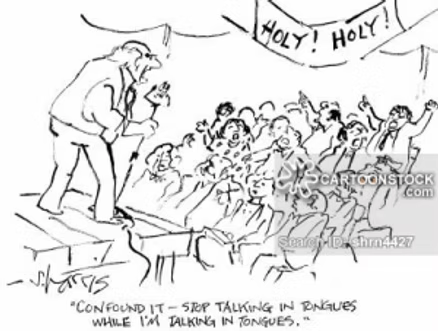
I was raised (from nursery cradle to fifteen) in an Assemblies of God church. That denomination is under the general umbrella of Christianity that is called “Pentecostal.” I was into my fifties when I learned that “Pentecost” is Greek, meaning “Fiftieth Day.” My assumption prior to that (as I do not recall ever having “Pentecostal” defined to me) was that “Pentecost” meant “speaking in tongues,” as that was a tenet of the Pentecostal branches of Christianity.

Now, I see my assumption (from being told “Pentecostal” means the belief in “speaking in tongues”) was somewhat of an oxymoron.  It must be, since one of the tongues not spoken appears, quite obviously, to be Greek. Otherwise, that branch of Christianity would be better named if there was no inference to being “Fiftieth Day related,” from “Pentecost-al.”  A more suitable name would be “Glossaipyros-al” (from the Greek “glōssaiand “pyros“), meaning “Tongues of fire related.”

The very first verse in this reading states, “When the day of Pentecost had come.” That demands one understand what the “day of Pentecost” is, as its mere mention states it was a significant day. It demands that one know the Israelites were commanded to forever observe three holy days with feasts (festivals). The three are: Pesach (Passover), Shavuot (Weeks [a.k.a. Pentecost]), and Sukkot (Booths). Each festival attaches a number of days of recognition to each of those specified days.

The Hebrew word “Shavuot” means “Weeks,” such that there were seven full weeks that took place after the Israelites escaped Pharaoh, until Moses came down with the sacred tablets. Forty of those days were spent encamped at the base of Mount Horeb, while Moses was on the mount with God.  The Covenant was then made on the fiftieth day (7X7=49, 49+1=50), after Moses came down with the sacred Tablets.

The festival that denoted the end of that counting of weeks was probably named Pentecost because of Greek rule over Jerusalem (following the Persians, prior to the Romans), as a translation of the statement of “fifty days” in Leviticus 23:16. If not, the Greek came after the Apostles spread into Greece and began writing Gospels and Epistles, where that became the translation for the Aramaic that spoke of the Feast of Fifty Days. Regardless of the etymology of “Pentecost,” there was nothing at all that would have predicted to Peter or the other eleven, “Pentecost is tomorrow, so get ready to start speaking in tongues guys.”

Realizing that, when we next read, “the disciples were all together in one place,” the only certainty of where that “place” was located was in Jerusalem, as stated in verse five (“eis Ierousalēm katoikountes” – “in Jerusalem dwelling”). We can assume that the specific place where they were all together was the same “upper room,” where they had shared the Passover Seder meal with Jesus.

This assumption comes from Acts 1:13, where the disciples had returned after the ascension of Jesus Christ. We read there, (“eisēlthon eis to hyperōon”) “they had entered into the upper room,” which is a statement of the same “upper room” prior.   Due to the influx of pilgrims seeking rooms in and around Jerusalem, for Jesus (after his resurrection) to remain in the Essenes Quarter with his disciples for forty days (most likely in unrecognizable form), the room could be retained and he could teach his disciples the meaning of the future that was coming.  As his Ascension was on a Sabbath, on the hill with olive trees (Mount Olivet) just outside the Essenes Gate, the disciples were within the limits on their walking distance (a Sabbath’s day walk – which is roughly a half-mile outside the city walls).  That evidence implies the disciples went back in the same “house” (from Greek “oikon” in verse two) they had remained in for forty-nine days, then preparing for the Temple ceremony for Shavuot.

When we read, “Now there were devout Jews from every nation under heaven living in Jerusalem” (literally translated as, “in Jerusalem dwelling”), this is a statement of the importance of Shavuot. As a commanded event that was fifty days later than the Passover events (an eight day festival), those pilgrims in Jerusalem were not coming from the airport, having just flown into town. The distances stated by the naming of places the pilgrims had come from says they all came for the Passover and stayed some place near Jerusalem for about two months. After that stay, they could return home.

Fourteen places are named, but with twelve Apostles it is probable that a couple of nations shared a common language.

That distance means a traveler would have secured a place to stay (a “dwelling”) while near Jerusalem for two months. This could be “living” with relatives who still lived there, or it could mean staying in inns, or it could mean staying in “travel parks,” where groups of travelers all pitched tents and roped off donkeys and camels, within a reasonable distance from Jerusalem.

Keep in mind that Jesus fed a multitude of five thousand adult males (meaning perhaps a total of as many as eleven thousand, including men, women, and children).  Those were largely pilgrims who were preparing for the Passover Festival (John 6:4 – “The Jewish Passover Festival was near.”). Matthew wrote of Jesus feeding the same five thousand (Matthew 14:13-21), but then wrote of Jesus later feeding four thousand (Matthew 15:29-39).  The implication is the timing of the second miracle was prior to the Pentecost Festival.  That means those “living in Jerusalem” were many, all of whom had been there since prior to the Passover; and this swell of people there took place every year (maybe not with the exact same people), because it was a commanded observance.

It is worthwhile to note that the ritual observances demanded by God, through Moses, as stated in the Torah (Exodus, Leviticus, Deuteronomy, and Numbers), were not maintained over the centuries. Once the Kingdom of Israel divided, the people were not led to understand the reasoning behind their Covenant, such that the fall of Israel and Judah was seen as rooted in this noncompliance. There was not always a Temple with priests to offer sacrifices, and some see the efforts begun while in captivity in Babylon was an attempt by the captive Jews to relearning what rituals had been forgotten.  Because the Law had been forgotten, the exilic Jews (the Levitical priestly descendants) saw adherence to the Law as all important; and that included observing the commanded festivals.

In the reverse view, after the destruction of the Second Temple and the scattering of the Israelite people around the world (mirroring the spread of Christianity), there has again come a disconnect by Jews and Christians, relative to understanding the reasoning behind the Covenant and the new Covenant with Jesus Christ. Jews go through the motions of rituals without realizing the Messiah has come; and Christians have no grasp of the rituals that bring them into a Covenant with God. Everyone has changed the rules to fit their personal needs, rather than feeling the purpose of God demanding ritual feasts forever be maintained by ALL His chosen priests (thus a “New Covenant” that has been added to THE Covenant).

This lost sense of knowing why God wanted His people to observe the Passover and then fifty days later a festival of farmers taking their marked (with reeds) first fruits (grains) of harvest to the Temple for blessing, amid throngs of cheering Jews was the background setting to the story of Acts 2:1-21 (and 22-41). The people from all the nations listed were milling about during the morning of Pentecost, waiting for someone to finish a prayer and a rite, announcing the close of festivities so everyone could go home … finally.

Their devotion had led them there, seeking more; but so many Jews were looking for some greater reward, more than simply being God’s chosen people.  They prayed for something to happen that would make their devotion be more than routine obligation.  The scene of Acts 2 opens with that ripeness for receiving the Spirit.  Rather than grains and fruits (and cheese blintzes) being the reward of the First Fruits, the pilgrims themselves were about to be blessed as a good harvest.

Knowing this setting, all of the streets in Jerusalem would have been packed. All the pilgrims would have flowed in through every gate, as their customary way of ceremoniously renewing their vows to serve Yahweh.  Then, suddenly, “Came a sound like the rush of a violent wind.”

Imagine how people interviewed on the news after a trailer park has been destroyed by a tornado say, “It sounded like a freight train coming.” If they had freight trains back in ancient days, then maybe we would read here, “Came the sound like a freight train.” Not only did the ancients not have freight trains, but they had no machines that made loud noises that would be similar to any man-made noise. It must have sounded like a tornado, but those weather events are rare in the Middle East, including Israel.  Such a loud noise was totally unexpected, because even rain is scarce in the area during May and June each year (the time between Passover and Pentecost).

Still, this was so loud it filled the entire house and the noise spread outside.  It was so noticeable that it made the people in the streets stop and take notice. They all looked at the house where the disciples of Jesus were staying.

“What in the name of God could that loud noise be?” the pilgrims all asked.

Then, once they had stopped in their path, they looked hard and listened intently. They heard many men speaking loudly in many foreign languages (the real meaning of “speaking in tongues”); and everyone in the street heard some strange man speaking his own native language.

Then the men inside the house came outside.  Some might have gone into the street, while some might have gone out on a rooftop-terrace.  Once the men were seen – still speaking fluently in many different languages – they looked like Galileans.  That means they looked somewhat foreign to the big city, as they probably were not in refined dress, not looking dapper.  They might have had on funny hats or had their hair wild and un-braided.  Whatever the case, they certainly were seen as not being men of the world and high culture.

Still, that source of sound coming from the least of Jews was not reason for the pilgrims to return to the din of street movement.  We read that the pilgrims were all “Amazed and astonished.”

It is most important to realize that these foreign visitors to Jerusalem were not “amazed and astonished” because they heard rubes from Galilee saying things like, “Hello. Can you tell me where the hotel is? This is beautiful weather we are having, do you not agree?” as if they were automatically filled with the ability to speak a conversational language learned from Babble, Rosetta Stone, or The Idiot’s Guide to Mastering Foreign Languages.

The new Apostles were not babbling incoherently, using distinguishable languages recognized by the pilgrim Jews. They were preaching the meaning of Scripture (Torah, Psalms, and Prophets), which were lessons heard for the first time, leading the pilgrims to be “amazed and astonished.”  The fact that each pilgrim heard those lessons in his native tongue means there was no language barrier to overcome – no struggles with Hebrew, no need for translation, no idioms, sayings, or slang terms to overcome – as the multinational visitors heard clearly what no rabbi or high priest had ever told them before.

And that was coming from Galileans!

When we read how some said, “In our own languages we hear them speaking about God’s deeds of power,” that speaks of the power of God flowing from the mouths of His servants, explaining the hidden meaning that had never been exposed. That is why they “all were amazed.”  Still, they were also “perplexed.”

That state of wonder (amazement), followed by confusion and doubt (perplexity) means their hearts and minds had opened a crack, towards belief in the Apostles; but then their natural brain-driven reaction was to slam shut a protective shell of disbelief over the chance of human vulnerability.  Something wasn’t right!  They had to slam a harness around those hearts and minds.

We read how they began “saying to one another, ‘What does this mean?’”

Their brains began whirring, thinking about how Galilean fishermen, small town lawyers, former tax collectors, and general riff-raff Jews could be bedazzling and filling those international globetrotters with sudden wonder, speaking the truth so clearly … in foreign languages?

Then we read, “But others sneered and said, ‘They are filled with new wine.’”

This has to be seen as an explanation offered from the crowd, about how simple Jews could be speaking such deep levels of interpretation of Scripture. Being “filled with new wine” meant there were known past examples of how a drunken state could remove inhibitions in the brain, allowing people to utter thoughts freely, with surprising insight. The intent of such an explanation would be akin to thinking they might be speaking good ideas now, but wait until the influence of alcohol wears off and they return to being bumpkins, not remembering what they said while drunk.

Still, to have someone shout out, “They are filled with new wine” is the Holy Spirit already circulating around the crowd, influencing them to receive the messages spoken by Apostles.

Just fifty days earlier, Jesus had offered a prayer of thanks over the third ceremonious cup of Seder wine (the Redemption Cup), saying, “Drink from this, all of you. This is my blood of the covenant, which is poured out for many for the forgiveness of sins.” (Matthew 26:27-28) When Jesus then added, “I tell you, I will not drink from this fruit of the vine from now on until that day when I drink it new with you in my Father’s kingdom,” Jesus spoke prophecy that was then coming true.  It was that day. Jesus Christ had been reborn within his disciples, so they spoke as if “drunk with the new wine” of the Holy Spirit and Jesus was there with them … in the kingdom of Sainthood.

In this regard, Peter did not deny that he and his eleven brothers in Christ were drunk. Instead, he said, “Indeed, these are not drunk, as you suppose.” They were drunk, but in a way that was not imagined by the pilgrims.  They were drunk with the holy blood of Jesus Christ, through HOLY SPIRITS.

New wine (Greek “Gleukous”) is also called sweet wine, which is unfermented grape juice. It is a non-alcoholic beverage in that case, which might have been consumed by the disciples for breakfast. It would be a drink for the whole family to consume, and for adults to drink at any other time, when drinking spirits would be inappropriate. However, new wine can ferment unexpectedly and become alcoholic, causing one to drink it and unexpectedly get drunk. This is why Peter explained, “not … these are drunkards” (“methyousin”), where the denial was they were “not … intoxicated by wine.”

This was then spoken to the crowd by Peter, with the translation reading: “Peter, standing with the eleven, raised his voice and addressed them.” The better translation says, “Peter with the eleven  , lifted up the voice of him and spoke forth to them.”  This says more than Peter just began speaking in a loud voice, as the loud sound that attracted the crowd had come from the wind-like roar of the Apostles speaking loudly in foreign languages.

The Greek word “epēren,” which is translated as “raised” or “lifted up,” should be seen on a deeper level.  Peter and all the other Apostles were speaking loud enough to be clearly heard at some distance, but more importantly their voices were “exalted,” having been “raised” spiritually, as their words were “lifted up” divinely. This means that they all spoke from the Holy Spirit.  With “raised voice” Peter and the other eleven were having the Spirit of the LORD poured out through them. Thus Peter used the example of prophecy, coming from Joel 2:28-32.

It is so important to see how Peter was not simply explaining intellectually, using words that explained what he and the other Apostles were doing. Peter was not speaking from his brain when he implied that he and the gang were fulfilling the prophecy of Joel. That would not be “with raised voice,” but human words of reason.

Instead, Peter quoted Joel because the Father spoke those words for him to recite. It was not rote memorization being accessed within his country-bumpkin brain that Peter (et al) was speaking. Everything Peter and the eleven spoke came from the Mind of Christ, brought upon them by the Holy Spirit, which included the quote from the Prophet Joel.

When Joel was led by the Holy Spirit to write, “In the last days it will be, God declares,” it must be realized that the Greek word “eschatais” (from the root word “eschatos”) means “last, at the last, till the end, and finally.” This is the root word for the theological word “eschatology,” which places focus on “the end of the world or of humankind.” As such, some can read Joel and project what he prophesied is still to come, at that fearsome, grizzly end of the world that always seems just around the corner of present time.

However, as Peter was quoting then, well into the future of Joel’s prophecy, as Peter spoke it was the last days, and God was declaring through ordinary folk.

God then spoke the words of Joel, through Peter: “I will pour out my Spirit upon all flesh, and your sons and your daughters shall prophesy, and your young men shall see visions, and your old men shall dream dreams. Even upon my slaves, both men and women, in those days I will pour out my Spirit; and they shall prophesy.”

Peter and the other eleven Apostles were sons prophesying. They were seeing the truth of Scripture – the visions of Joseph, Solomon, and Daniel, the dreams of Ezekiel and Isaiah, and the slaves that were Ruth and Ester and Amos and Joel. The prophecies of old stories had been fulfilled in the man known as Jesus of Nazareth. The Old Testament’s prophecies were at last revealed. They were exposed as clearly as the light of the day time hours makes seeing possible.

When God then proclaimed through Peter, “And I will show portents in the heaven above and signs on the earth below, blood, and fire, and smoky mist. The sun shall be turned to darkness and the moon to blood, before the coming of the Lord’s great and glorious day,” had not all that just recently been witnessed by those pilgrim who had been in and around Jerusalem, since the Passover Festival that began seven Sabbaths prior?

Had not Jesus produced “portends,” which means “miracles” and “wonders” for the Jews (and others) to witness?

Had the people not questioned if he had been sent from heaven as the Messiah?

Had Jesus not made clear that he had been sent only to the “blood” that was the remnant of the Israelites known as the Jews?

Had Jesus not set a fire under the Jews that both followed him and saw him as a threat?

Did Jesus not appear to be the human equivalent to the daytime pillar of smoke that guided the Israelites through the wilderness of the Sinai?

Was not Jesus the proclaimed Son of Man, as the representation of the sun – the light of truth; and had that light not been darkened by his crucifixion? Did the sky not go dark in the middle of the day for three hours, as Jesus of Nazareth hung on a cross dying? Did the ever waxing and waning moon – symbolic of emotions overrunning one’s personality – not stand before Pilate, screaming, “Crucify him” to bloodcurdling levels?

Peter reciting Joel’s line, “Before the coming of the Lord’s great and glorious day,” was God’s way of announcing, “Today is the Lord’s great and glorious day!” God was announcing the return of His Son, Jesus Christ, returned the day after his ascension in all of his followers.

For all who look for the End of the World, as far as Christian theology is concerned, it was delayed coming by the presence of Saints in the name of Jesus Christ on that day of Pentecost. It continues to be averted as long as Jesus Christ exists in the world, via Saints filled with God’s Holy Spirit.

As far as this reading selection goes, Peter ended the prophecy of Joel by God pouring out of his mouth, “Then everyone who calls on the name of the Lord shall be saved.” On a city of Jerusalem street that was filled mostly with Jews, but Roman converts (proselytes) and Arabs as well, the use of the word “everyone” (Greek “pas”) must be seen as the first sign that Saints were called to serve “all,” as messengers of Salvation.

Peter himself did not know he should welcome Gentiles until later; but in the reading that continues (but not read aloud today), we learn that three thousand souls were baptized by the Holy Spirit that Pentecost.  Three thousand souls were then added to the number of Saints in the name of Jesus Christ. Those three thousand would return to their nations and begin a worldwide spread of Christianity.  While not stated, all of the fourteen named nations of peoples had converts that day, all filled with the Holy Spirit, each calling upon the name Yahweh, as Jesus Christ reborn.

As the one reading in the Christian liturgy that is consistently read on Pentecost Sunday, it is vital to have one’s eyes opened to the realization that none of the twelve men speaking in foreign languages that day had any lessons or experiences in learning those languages prior.  Likewise, Ezekiel had no prior experience prophesying to dried bones; but he did as God commanded.  Thus, speaking in tongues, as a miracle of foreign languages, is not the lesson presented in Acts 2.  Neither is the end of the world the lesson to be taken from Joel 2, as if babbling fools can point to some future date as when Jesus will return with vengeance.  The lesson is God speaking universally so all can hear and understand.

There is absolutely no one who is going to have his or her soul baptized by the Holy Spirit and be saved, given eternal life, because they hear someone speaking nonsense, uttering noises that no one can understand. Salvation does not come by learning to fake speaking in foreign tongues or pretending to know what gibberish means.  The brain plays no role in salvation, as it can only hinder that goal.

The miracle of Pentecost was speaking from the Spirit of truth, which Jesus prophesied in the Gospel reading from John 15-16.

The lesson of Pentecost is twofold. One, it is to hear the truth of the texts of the Holy Bible and understand them. Understanding comes from the Holy Spirit, not a book read, a course taken, or someone else’s interpretation that one is incapable of personally owning and defending. Two, it is the beginning of the end times of the old you. The selfish days of ignorance are over – ended forever.

Pentecost represents the end times of the release from bondage, when the Covenant with God is agreed on. It is when time spent learning has reached the point of teaching, such that one can only sit in a pew for so long, before realizing the Lord’s great and glorious day has dawned within oneself. Then it is time to go preach – prophesy to the breath – so that other can have the same chance for a personal experience with Salvation.

The lesson of Joel’s prophecy is not limited to the fulfillment that occurred the day after Jesus ascended into heaven.  The experiences of Peter and brothers in Christ was the beginning of this prophecy’s fulfillment.  It is fulfilled every time a disciple makes this transition.  All of the trials and tribulations from one’s own denial of God, Christ, and the Holy Spirit within oneself points to a new last days, as the end of a sinner’s ways and the beginning of a Saint’s service to God, as Jesus Christ reborn.

In this way Peter was speaking to the readers who would eternally be called to God’s Word.  Just as Joel wrote of all the coming sons and daughters of God, the spirit will always be poured out upon desiring flesh.  Just as Peter passed along the flow of the Spirit of truth, so do all God’s Saints.

#FestivalofWeeks #Matthew141321 #Shavuot #Lordsgreatandgloriousday #tonguesoffire #newwine #pillarofsmoke #Acts2121 #fiftiethday #speakingintongues #Acts113 #Acts22241 #Joel22832 #Matthew152939 #John64