Tag Archives: Last Sunday of Pentecost

Daniel 7:9-10, 13-14 – Watching the wheel turn from Pentecost to Advent (Year B to Year C)

As I watched,

thrones were set in place,

and an Ancient One took his throne,

his clothing was white as snow,

and the hair of his head like pure wool;

his throne was fiery flames,

and its wheels were burning fire.

A stream of fire issued

and flowed out from his presence.

A thousand thousands served him,

and ten thousand times ten thousand stood attending him.

The court sat in judgment,

and the books were opened.

As I watched in the night visions,

I saw one like a human being

coming with the clouds of heaven.

And he came to the Ancient One

and was presented before him.

To him was given dominion

and glory and kingship,

that all peoples, nations, and languages

should serve him.

His dominion is an everlasting dominion

that shall not pass away,

and his kingship is one

that shall never be destroyed.

———————————————————————————————————-

This is an optional Old Testament selection from the Episcopal Lectionary for the Twenty-seventh Sunday after Pentecost, Year B 2018, which is the Last Sunday after Pentecost. In the numbering system that lists each Sunday in an ordinal fashion, this Sunday would be referred to as Proper 29, but it is called “Christ the King Sunday.” If chosen, it will next be read aloud in an Episcopal church by a reader on Sunday November 25, 2018. It is important because Daniel was shown a vision of God as the King, whose throne is within all who serve Him, as kingdoms where the Lord has dominion within those dominions. All who allow God [the Ancient One] to rule are then Sons of Man, through the Christ Mind.

A repeated theme here [including in the unread verse eleven] is “I watched.” As a seer of visions and a dream interpreter, Daniel was given the Mind of Christ by God. As this reading is set up in halves [at the point of omitted verses], each half is begun by the statement “As I watched.” When the second half adds, “in the night” (from “wa·’ă·rū lê·lə·yā” – “behold night”), this aspect of night is symbolic of vision on the earthly plane, where mankind is mortal and born of death. Therefore, the absent of “night” implies heaven, where the light always shines.

The worldly realm is a wheel that turns to the light and then away from the light.

As such, the thrones [plural number] Daniel witnessed are those set for all who have served God on earth, and received the promise of eternal life. As heaven is always lit by the light of God, there is no time there [as humans sense time]. All prophets and priests of YHWH, from all worldly times and eras, have a throne [“The power, dignity, or rank of one who occupies a throne.” – American Heritage® Dictionary of the English Language, Fifth Edition.], including Jesus. All thrones are at the right hand of God, because God’s right hand extends to the earthly domain.

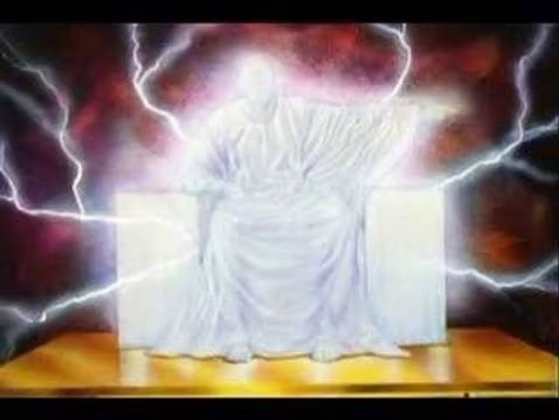
When we are told by Daniel, “The Ancient One took his throne,” this segment of words literally translates as, “The Ancient of Days was seated.” This is the seat of the King, to whom all in Heaven submit.

The white robe symbolizes the purity of God, which means none of God’s servants can be less pure. All who are enthroned also wear white robes. The hair of pure wool is a mistranslation that skips over a period mark.

The statement literally says, “his garment of snow” [an implication of “white,” without needing to state the word]. Following a comma mark, the next segment of words say, “white and the hair on his head like wool.” There is no mention of “pure wool,” but the hair is “white” and like that of “wool.” The reference to “white” is again stating “purity,” while “wool” is then an allusion to God being the owner of a flock of sheep. One can assume those sheep also have white hair.  Following that is the word “pure,” which is referencing “his throne,” a seat of “flame.” The “flame” is then “pure,” which means there is no ash or particles transformed from matter changing states.  In the production of God’s flames, which encircle His throne like a “fiery wheel,” all fire is Spiritual light shining brightly.
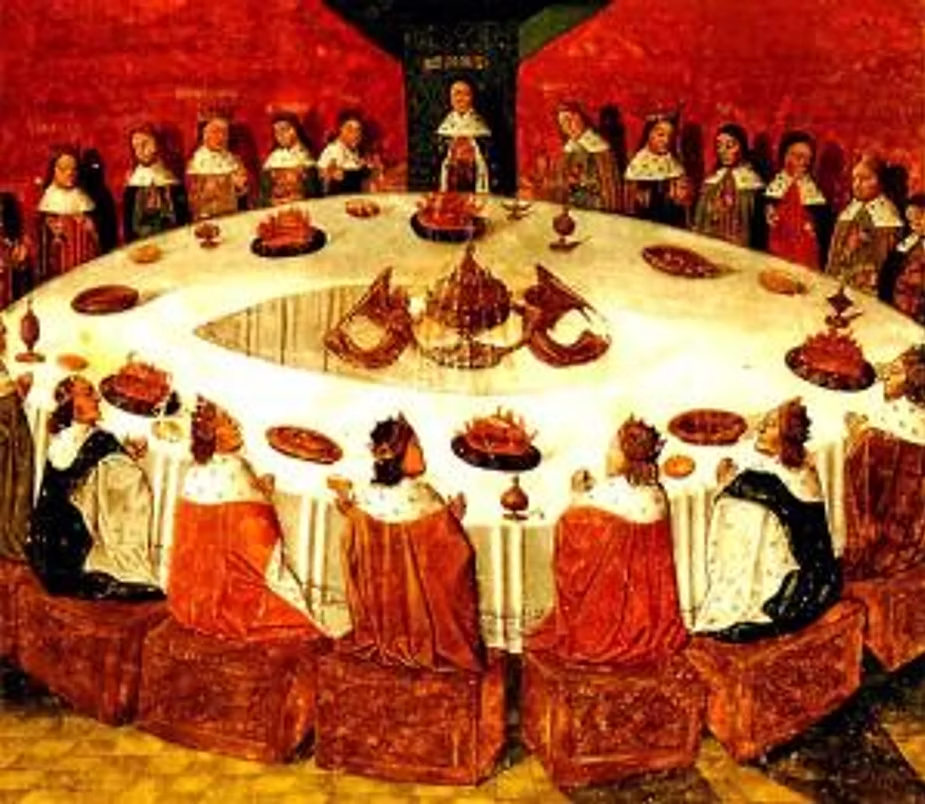
We look for evidence of a human King Arthur, but not a human Ancient of Days?

This also becomes an indication of the other thrones that have been set in place, where all thrones are like “burning wheels.” Nothing of this fire is less than pure flames of the light of truth. There is no smoke of lies or deception or past histories of worldly failure. The “wheels” are like the angels Jacob saw going up and down the ladder to heaven. Those are who Daniel said were “A stream of fire issued and flowed out from his presence.”

This number is then said to be “A thousand thousands served him, and ten thousand times ten thousand stood attending him.” These are the countless numbers of souls who have been sent to the earth by God to guide other souls back to the light of God. All have been listed in the Holy “archives” that were written from the time Adam was sent into the world as the first priest to God.  This is the “book” known of as the Akashic Record, of which Daniel was shown.

Following two omitted verses, Daniel then watched as those pure souls entered the realm of darkness, called “night.” This is where the Holy Spirit was shown to descend, “with clouds of heaven.”  This means the heavenly is unseen, thus obscured from human eyes, as if a cloud of mist surrounded them. Those angels and spirits will each transform a human being into a “son” of God, born into a “man” [or woman, as a Son of God]. This means all who have this Holy Spirit descend upon them will be like Jesus Christ, even if it happened prior to Jesus of Nazareth being born on earth, of a woman.  Jesus Christ is timeless – who was in the beginning, in now, and will always be.

When Daniel said, “And he came to the Ancient One and was presented before him,” the literal states: “like a son of man came; coming even to Ancient of Days – he came and before him they brought him near.” This [because it is a vision “in the night” of the worldly plane] was not anyone being brought before God in Heaven. This was the model of the Christ [Jesus Christ] that is the Son of Man, the Son of the Father [the Ancient of Days], who appears “before him” all who serve the Father as a wife, then becoming the Son. They bring Jesus Christ [“him”] “near,” as one with their souls.

Another “fiery wheel” has turned.

When we then read Daniel saying, “To him was given dominion and glory and kingship,” the Hebrew word “ū·mal·ḵū” means “kingdom.” This is how Jesus told Pilate, “My kingdom is not from here.” A “kingdom” means the Ancient of Days [God] is the King of such a “kingdom.” By a soul within flesh and bones allowing God to have “dominion,” through the presence of the Holy Spirit joining with one’s soul [the purification process], then the “glory” comes, which is the “honor” of God’s Holy presence.

Rise My Son and serve well.

When Daniel saw “that all peoples, nations, and languages should serve him,” this is from having seen the light of eternity in God’s holy realm. To write, “His dominion is an everlasting dominion that shall not pass away,” this is the promise given to all who sacrifice of self-ego to become one with the Lord. By giving God “dominion” over one’s soul [and thus flesh], there is an “everlasting” covenant that redeems a soul, preventing it from being on the wheel of death [reincarnation].

The part of the verse that concludes: “and his [kingdom] is one that shall never be destroyed,” this is the power of God to keep one pure. This purity is what joins the presence of God in Heaven with the human who has submitted himself or herself to God’s dominion. That flesh will never be turned away from God by the forces of evil. The “kingdom” is the soul, so that after the flesh has released the soul it will find a throne set at the right hand of God, as one more in the countless number who have “stood attending him.”

As an optional reading selection from the Old Testament for the last Sunday after Pentecost, also known as Christ the King Sunday, when one’s own personal ministry for the LORD should be well underway – one has felt the cloud upon one’s soul and submitted one’s body, mind, and soul to the dominion of God – the message here is to receive the glory of serving God, so one can become a shining example of how “all peoples, nations, and languages should serve him.”

The world is headed in the wrong direction. It is breaking apart because of individual human beings dividing the world into an “us or them” place of conflict. No world leader can unify the peoples as one nation, where all are speaking the same language of faith. No man who proclaims self so loudly can ever do anything but lead that self and many other selves to ruin and damnation. This is evident by the number of world leaders who make no proclamations of religious beliefs, with those who do giving little evidence that supports those claims.

All hail the kings of the earth, until new kings replace them.

Christ the King Sunday is the last Sunday of a burning wheel that spins the Holy Spirit from Heaven to earth, as it renews when the wheel’s fiery burn returns to God’s throne. Advent should be a time when seasoned Apostles have their first rewards, from passing on the Holy Spirit into those ripe for self-sacrifice to God.

Alas, fewer and fewer are preaching to the throngs of people that are on their knees praying to a national leader for salvation. It is so much easier preaching to the choir. It is even easier still when the blind preach to the blind, breaking into songs of praise that no one understands, but the emotions feel better with song.

We are leaving the after Pentecost [Ordinary Time] season. Everyone is in the Black Friday spend-spend-spend mood. Christmas trees are going up and there is the jingle of cash in the air.

It seems to be the time to sell some stuff and give baby Jesus credit for all the giving we do [more and more to ourselves]. Not many people are accepting God’s gift sent to us – the opportunity to be His Son reborn. If we did, then we could give the gift that keeps on giving – the Holy Spirit – without needing a credit card. We strike God off our Christmas list because we think He is Santa Claus and nobody ever gives ole Santa more than a glass of milk and some cookies.

Again, no souls for me to collect this year.

It is easier to waste some food, than to make a commitment that would give one’s body, mind and soul to God, letting Him have dominion over a sinner.
Revelation 1:4b-8 – The Law of Judgment

Grace to you and peace from him who is and who was and who is to come, and from the seven spirits who are before his throne, and from Jesus Christ, the faithful witness, the firstborn of the dead, and the ruler of the kings of the earth.

To him who loves us and freed us from our sins by his blood, and made us to be a kingdom, priests serving his God and Father, to him be glory and dominion forever and ever. Amen.

Look! He is coming with the clouds; every eye will see him,

even those who pierced him; and on his account all the tribes of the earth will wail.

So it is to be. Amen.

“I am the Alpha and the Omega,” says the Lord God, who is and who was and who is to come, the Almighty.


This is the Epistle selection to be read aloud on the twenty-sixth Sunday after Pentecost, also called the Last Sunday or Christ the King Sunday [Proper 29], Year B, according to the lectionary for the Episcopal Church. It will follow one of two parings of Old Testament and Psalms, either a Track 1 or Track 2 set, depending on the predetermined path an individual church has set upon. The Track 1 course offers a reading from Second Samuel, which is David’s last song. There he wrote, “The el of Israel has spoken, the rock of Israel has said to me: One who rules over people justly, ruling in the fear of elohim”. That will be accompanied by Psalm 132, where he sang, “Yahweh has sworn an oath to David; in truth, he will not break it: “A son, the fruit of your body will I set upon your throne.” The Track 2 pair will present a reading from Daniel, where his vision said, “I saw one like a human being coming with the clouds of heaven. And he came to the Ancient One and was presented before him.” That will be accompanied by a singing of Psalm 93, which sings, “Ever since the world began, your throne has been established; you are from everlasting.” All will accompany the Gospel reading from John, where Jesus told Pilate, “You say that I am a king. For this I was born, and for this I came into the world, to testify to the truth. Everyone who belongs to the truth listens to my voice.”

I have written quite deeply about this reading. I give a basic explanation as how I came to be able to read Scripture and see the truth of that written. I welcome everyone to read my background there, which I will not go into now. That commentary can be found at this link. Because I have discerned these five verses most deeply – segment by segment – I will not repeat those observations at this time. Instead, I will place a broader focus on this selection and show how it fits in with the other readings presented on the last Sunday after Pentecost, the ‘end times’ for Year B’s ordinary season.

One thing that I must point out is the translation that reads “Jesus Christ.” The Greek written is “Iēsou Christou,” which should not be translated as if John wrote the first and last name of Jesus. The Greek form that would say “Christ” is “Christos.” The form “Christou” is the genitive form of Christos, with the genitive case expressing possession. This means John wrote, “Jesus of Christ.” That is a statement that Jesus was possessed by Yahweh, as one “Anointed” divinely. The Greek word “christos” means: “anointed; messiah,” where “messiah” is an English variation of the Hebrew word “mashiach,” which means the exact same thing: “anointed.” The capitalization must then be seen as a divine level of importance placed on “Anointment,” which means by Yahweh. The man named “Jesus” was then “one of” all those souls who had likewise been “Anointed” by Yahweh; and, David was one who was so “Anointed.”

It is also important to point out that the word translated as “spirits” [“seven spirits”] is written “Pneumatōn,” where the capitalization has been erased in translation. Again, the capitalization must be seen and understood as a divinely elevated state of “spirit,” which makes it be the spiritual oil of Anointment, as Yahweh’s “Spirit.” The number “seven” (as I wrote about last week) has to do with the “completion, perfection, and rest” of a cycle. Thus, when the “perfection Spirit” is before the throne of Yahweh, it is importantly [use of “kai”] that which is displayed in Jesus, who was “of the Anointment” by that “perfect Spirit.”

The plural number of “Spirits” must be seen as all who appear before the throne of Yahweh in Judgement. It those are truly reflecting the “completion Spirits,” of those souls united as one with Yahweh, as “perfected Spirits,” those cleansed of all past sins through submission in divine marriage; and those “Spirits able to rest” knowing their service to Yahweh had been done, they all become the souls of the “faithful,” or those who have displayed the “obedience” of union and the “loyalty” of servitude [all uses of “pistos”]. This is because those souls, formerly in bodies of flesh, prior to death, are “witnesses” [from “martys”], where that denotes a personal experience as Jesus reborn within their souls, with all having that presence as the “Christs of” Yahweh.

This then reverts back to the segment that says, “kai from Jesus of the Anointed,” such that the “perfected Spirits” will all have been resurrection of “Jesus” [a name that means “Yah[weh] Will Save”], where that soul possessing one’s own soul [two souls in one body of flesh] is what makes all be “of Anointment” from Yahweh. This presence of the soul of Jesus, in union with one’s own soul [like twins] then makes belief to transform into true “faith,” which obediently allows the soul of Jesus to rule over one’s body of flesh [divine possession], all of which is personally witnessed by the host soul, experiences through the eyes and ears of its flesh.

When John wrote “firstborn of the dead” [“prōtotokos tōn nekrōn”], the use of “firstborn” must be seen as the Passover demands, which Moses said would bring Yahweh as the angel of death, so all firstborn males of families not marked by the blood of the sacrificial lamb would die. The “firstborn” would also be the demand of those so marked, where their firstborn male children were to be dedicated to serve Yahweh as a priest [Samuel is an example of this sacrifice of the “firstborn”]. The element of “dead” must be seen as what a soul in a body of flesh is marked by, as the body of flesh is like the doorway to the soul within. When that body of flesh dies, then the soul is released for Judgement, where it then stands before the throne of Yahweh. To be the “firstborn of the dead,” then one is covered in the blood of Jesus – the sacrificial lamb – so one’s soul is spared the repeat of death, which is Judgment of reincarnation [or worse].

The point I want to make now is the beginning what says, “him who is and who was and who is to come” and the end that says, “who is and who was and who is to come” repeats the eternal way of Judgment. All souls stand before the throne of Yahweh after release from their bodies of flesh. All will be judged as to whether or not those souls married Yahweh, received His Spirit and gave birth to His Son Jesus. The only way to secure Salvation is to follow this path; as it has been this way from the beginning, and will be that way until the end. To see John’s Revelation as a future thing to worry about is wrong. The future is always one’s own pending death and whether or not one has sought Yahweh in marriage, to become Jesus reborn and live a righteous life that earns Salvation.

When this reading is paired with David’s last song before his death, one needs to see that theme of a soul being released for Judgment. In the verse of his song [2 Samuel 23:3] that is translated to say “the rock of Israel,” the “rock” needs to be read as the “cornerstone” that becomes set in place, which ensures “Israel” means one “Who Retains Yahweh,” as one of His elohim. To be a Yahweh elohim is to be a soul married to Yahweh’s Spirit; and, to have the “rock” that makes this stay put, that is being resurrected as Jesus.

In David’s last three verses [5-7], his focus is on those who reject marriage to Yahweh, so their souls have become the “firstborn” who do not escape the Judgment of Yahweh, so they will be made to die again. David’s metaphor for them was “thorns,” which choke the desire to become saved by righteousness out of them and others surrounding them. This echoes the words of John, who wrote, “even those who pierced him; and on his account all the tribes of the earth will wail.”

In the Daniel reading, the first two verses speak of the Judgment Yahweh made against the evil spirits, who were not “seven Spirits,” but instead the elohim of the first six days of Creation. I see those verses as the Judgment against Satan [or Lucifer, or Azael], who was the beast that antagonized mankind, despite the commands of Yahweh. While Satan was cast into the inner darkness of the earth, the other three beasts were stripped of their abilities to attack humanity; but they could lure human souls to desire worldly things, possessing them demonically as being what those souls sought. This, again, matches the piercing and wailing of which John wrote.

As for the last two verses of Daniel, which are clear metaphor of the coming of Jesus, John’s metaphor matches well with this being all souls who stand before the throne of Judgment, after having welcomed the soul of Jesus coming from heaven, becoming a human being again in the flesh of another. It is that new body of flesh that becomes the kingdom of Jesus, the soul of a high priest merged with one obedient to Yahweh’s Will.

When John wrote in his Gospel of Jesus telling Pilate, “My kingdom is not from this world,” that means Jesus is not a king of matter or as a soul itself in a body of flesh. Jesus would die, so his soul stood before the throne of Yahweh and was judged as pure. With that Judgment, the soul of Jesus would be the soul sent to all souls who would receive Salvation, from the beginning to the times of Judgement, to the End Times, with all deaths of humans in flesh being the same repeatedly.

As the Epistle reading to be read aloud on the last Sunday after Pentecost, when one’s own personal ministry for Yahweh should already be well underway, the lesson is to let Jesus be one’s King, which means one’s soul must submit to Yahweh in loving marriage, so Jesus can come into one’s soul, as the Anointment of Yahweh upon His beloved. This is not only a guarantee of Salvation at Judgement, but the day one begins to serve Yahweh as His Son resurrected in the flesh. Ministry is how others are led to Salvation; and, one’s actions in life will be known when one’s soul stands before Yahweh to be judged.

Psalm 93 – Being a witness to the greatness of Yahweh

1 Yahweh is King;

he has put on splendid apparel; *

Yahweh has put on his apparel

and girded himself with strength.

2 [1] He has made the whole world so sure *

that it cannot be moved;

3 [1] Ever since the world began, [2] your throne has been established; *

you are from everlasting.

4 [3] The waters have lifted up, Yahweh,

the waters have lifted up their voice; *

the waters have lifted up their pounding waves.

5 [4] Mightier than the sound of many waters,

mightier than the breakers of the sea, *

mightier is Yahweh who dwells on high.

6 [5] Your testimonies are very sure, *

and holiness adorns your house, Yahweh,

forever and for evermore.

——————–

This is the accompanying psalm to the Track 2 Old Testament selection from Daniel 7, which will be read aloud in unison or sung by a cantor on the last Sunday after Pentecost, also called Christ the King Sunday [Proper 29], Year B, according to the lectionary for the Episcopal Church. If an individual church has predetermined to be on this path, this it will follow verses that include: “As I watched, thrones were set in place, and an Ancient One took his throne.” That pair of readings will precede one from Revelation, where John wrote, “To him who loves us and freed us from our sins by his blood, and made us to be a kingdom, priests serving his God and Father, to him be glory and dominion forever and ever. Amen.” All will accompany the Gospel reading from John, where Jesus told Pilate, “My kingdom is not from this world. If my kingdom were from this world, my followers would be fighting to keep me from being handed over to the Jews. But as it is, my kingdom is not from here.”

This is a five verse song of praise to Yahweh, not six. The Episcopal Church has split the first verse into two full verses and part of verse three. Verse two is the second half of what they show as verse three. That adds a number that is not present in the NRSV source they use. I have adjusted the numbering by placing the appropriate numbers in bold type, within brackets.

Also, according to the BibleHub Interlinear page for Psalm 93, they add the title to this psalm that says, “The Lord Reigns!” The NRSV places this title before Psalm 93: “The Majesty of God’s Rule.” These uses of “Lord” and “God” are paraphrases, as nowhere in this psalm are “lord” of “god” written. Five times, in five verses, David wrote the specific name “Yahweh.” That must be any presumed title for this song of praise: Yahweh Reigns!

This title comes from the first two words written by David [“יְהוָ֣ה מָלָךְ֮”], which transliterate as “Yah·weh mā·lāḵ.” Those words translate into English as stating (literally), “Yahweh reigns.” Because Yahweh is known to be the Father, as the supreme god, He is masculine essence; so, a substitution for “reigns” would be “in king.” In the word written by David that specifically names the one who reigns, as king, it lessen this specific naming to refer to Yahweh as a “lord” or “god.” That is because it says the translator: 1.) Does not personally know Yahweh; and, the translator lumps Yahweh in with all the lesser elohim, who are eternal angels, a.k.a. gods. Yahweh made all the elohim, so He is the Creator; and, that elevates Him to greater than god status. Plus, when Moses asks, “Who should I say sent me?” the answer was not tell them a lower “lord” or one of the many “gods.” He specified “Yahweh” [“יְהוָ֣ה”] and throughout Old Testament Scripture that specific name is written (as seen here in Psalm 93).

Because the NRSV translation is weak and absent of any specific naming of Yahweh, I will now present a literal translation of these five verses. Following each verse, I will then add commentary as to what David meant.

1. “Yahweh reigns is clothed is clothed Yahweh strength encompassing ; also set firm the world , not so it be shaken .

After beginning “Yahweh reigns” or “Yahweh is king,” the word (transliterated) “lā·ḇêš” is repeated, meaning “is clothed is clothed.” Here, one needs to be cognizant that Yahweh can only be understood in human terms, where humans have forms (bodies of flesh), which are so weak (compared to animals) they cannot exist in the climates of the world without wearing clothes (they have no hides, pelts, or fur to speak of). This repetition following a statement about “reign” means “is clothed” first becomes the cloak of presence that human souls who serve Him as king wear. The repetition a second time means this “clothing” is not only relative to the servant, but the master is denoted “king” by those He allows to wear Him. This says “is clothed is clothed” reflects the union of two joined as one (divine marriage). This then is the presence of “Yahweh” on earth, which is the “strength” of His kingdom, while also being the “strength” within each subject that makes up that kingdom. This presence of “Yahweh” is “strength encompassing” all.

Following a semi-colon mark, a separate but aligned to this theme of “reign” makes it clear where Yahweh’s kingdom is. It is “set firm in the world.” In that, “the world” must be seen as where souls fill dead matter that is flesh. The elements of a human body are all from the “earth,” thus physical and material. While “the world” is one of the elements of the Creation, which Yahweh ordered His elohim to make; and, all created in ‘six days’ would become “set firmly” in place, one aspect of His Creation was for “the world” to be where souls (eternal entities) would be released to enjoy “the world,” until death returned the souls to Yahweh for judgment as to where the souls would go next.

The final segment of words in this first verse then says this element of Creation would be “set firm,” “not so it would be shaken.” While that becomes a set-up of life on earth, where souls would be released and returned to “the world” through reincarnation, the advent of religion was a creation of Yahweh, when He made the first man and woman (Adam and Eve) who would be priests, set to teach “the world” about the “reign” of “Yahweh.” Once the seventh day began, Yahweh became the king of a kingdom of two souls in the flesh, which would grow greatly over time. They taught other souls in the flesh how “to be clothed” and how to “clothe others” in the presence of Yahweh as their king; so, the kingdom of Yahweh grew greater and greater. Once a soul marries with Yahweh’s Spirit, that union “not so it would be broken.”

2. “set firm your throne at that time ; from antiquity you .

In this verse the repetition of “set firm” [“tik·kō·wn” in verse 1] is continued in verse two [as “nā·ḵō·wn”]. Now the focus has moved from “the world” to “the throne.” One must realize that “a throne” is where a king sits, thus from where “Yahweh reigns.” The use of “at that time” [“mê·’āz”] is not only when Yahweh ordered His Creation, but when the seventh day was when He personally made man and woman to be where His “reign” would reside. Therefore, “from antiquity” [where Daniel named Yahweh “Ancient of Days”] means from the beginning of religion teaching a soul to serve Yahweh as king, to “you,” who sits reading these words. “You” would know nothing of Yahweh had He not “set firm” His “throne” in souls walking the earth in human flesh.

3. “have carried the rivers Yahweh have lifted the streams their voice ; take up the canals their pounding waves .

In this verse there are three uses of “nə·hā·rō·wṯ, from “nahar,” which means “a stream, river” or alternatively “canal, current,” implying “a flood.” Also repeated three times is “nā·śə·’ū” [once as “yiś·’ū,” all from “nasah”], which means “to lift, carry, take,” while implying “accept, advance, arise, able to, armor, suffer to bearer, up, bring forth.” The use of “voice, sound” [from “kol”] and “pounding waves” all tie together to show the fluidity of Yahweh’s presence, where the outpouring of His Spirit follows the course of His subject, who then become the voice of Yahweh that waters the land and makes it fertile with the knowledge of Yahweh. The “pounding waves” becomes metaphor for the heartbeat that denotes love for Yahweh, by a soul that seeks divine marriage.

4. “from the sound of waters many , more majestic the breakers of the sea ; great height Yahweh .

The element of “voice, sound” [from “qō·w·lām” in verse 3] is then made the focus of verse four [as “miq·qō·lō·wṯ”]. This says the “sound” for Yahweh sings out His name, just as David’s psalms sing praises to Yahweh. This is from the “waters” [“mayim”] that make up the bodies of flesh on the earth. This “sound” then comes from “many.” At the time of David, the “many” were the true Israelites. The meaning of that name [“He Who Retains Yahweh as His elohim”] is then compared in metaphor to the “breaker waves of the sea.” Here, the use of “waves” connect this verse to verse three, where were “lifted up the canals their pounding waves.” The rhythm of Yahweh’s presence is “more magnificent” than even tsunami waves caused by earthquakes under the Mediterranean Sea. As tall as those crashing waves might be raised, they are miniscule in comparison to the heartfelt “waves” of Yahweh’s Spirit upon one’s soul.

5. “your witnesses do confirm abundance , your house befits sacredness ; Yahweh length of day .

In this verse, all the “voice” and “sound” of verses three and four are stated as “your witness,” which can equally be translated as “your testimony.” In that, the pronoun “your” can be seen both from the perspective of Yahweh within His wives and those through from whom Yahweh speaks, from that marriage. The use of “witness” means a personal experience is the source of “testimony,” not hearsay. All who speak of the presence of Yahweh within “confirm” the truth of Him and all the “abundance” that comes with marriage to His Spirit. Therefore, all who give such “testimony” are where Yahweh resides, each a “house of the holy,” as Saints born onto the earth. The final segment of words then becomes a statement both of the eternity of those souls in submission to Yahweh, but also to the fact that His presence become the “length of day,” when only the light of truth shines forever. “Yahweh length of day” says the darkness of death has been overcome, through the promise of salvation; and, it says the remainder of one’s life will be to shed the light of truth to seekers, in ministry to His name.

In this song of praise that accompanies the Daniel reading that tells of the meeting of the elohim, who were all seated on thrones surrounding Yahweh, where judgment would be cast upon Satan and his wayward angels [at the end of the sixth day], this Psalm 93 message places focus on the seventh day, when Yahweh reigns as the king of one’s soul. This makes it important to see the name of this Sunday – Christ the King – as not being a direct reference to Jesus. Just as when Samuel spoke to Yahweh and told him the elders of Israel sought a king (to be like other nations), Yahweh told Samuel, “I am their king.” As such all who sing this song of praise truthfully are confessing to be each a Christ [Anointed by Yahweh’s Spirit], in whose soul Yahweh is their king. In turn, this brings about the resurrection within one’s soul of Yahweh’s elohim who saves each soul – Jesus. The soul of Jesus becomes one’s high priest, within the soul-body that has become the “house of Yahweh,” through divine marriage.

As a song to be sung loudly on the last Sunday after Pentecost, when one’s own personal ministry for Yahweh should already be well underway, the lesson to gain is submission of one’s soul to Yahweh, so one can receive His Spirit and let His presence reign over one’s soul. This is the only way for salvation, with redemption coming through self-sacrifice to His Will. One must serve Yahweh as a minister on earth, bringing other seekers into His realm.