After his baptism, Jesus, full of the Holy Spirit, returned from the Jordan and was led by the Spirit in the wilderness, where for forty days he was tempted by the devil. He ate nothing at all during those days, and when they were over, he was famished. The devil said to him, “If you are the Son of God, command this stone to become a loaf of bread.” Jesus answered him, “It is written, ‘One does not live by bread alone.’”
Then the devil led him up and showed him in an instant all the kingdoms of the world. And the devil said to him, “To you I will give their glory and all this authority; for it has been given over to me, and I give it to anyone I please. If you, then, will worship me, it will all be yours.” Jesus answered him, “It is written,
‘Worship the Lord your God, and serve only him.’”
Then the devil took him to Jerusalem, and placed him on the pinnacle of the temple, saying to him, “If you are the Son of God, throw yourself down from here, for it is written,
‘He will command his angels concerning you, to protect you,’
and
‘On their hands they will bear you up, so that you will not dash your foot against a stone.’”
Jesus answered him, “It is said, ‘Do not put the Lord your God to the test.’” When the devil had finished every test, he departed from him until an opportune time.
———————————————————————————–
Christianity has no idea what the ‘Wilderness experience’ is about. It is not about forty days trying to use will-power to give up some worldly temptation: chocolate, swearing, sex, or anything like that.
The ‘Wilderness experience’ is about self-sacrifice, completely. It is about the death of the ego-driven will, to be reborn of the Mind of Christ. That self-sacrifice brings upon one the Will of God, which cannot be swayed by the illusions of the material world.
We read, “After his baptism, Jesus [was] full of the Holy Spirit.”
That baptism was the cleansing of his soul. The Holy Spirit is what led Jesus into the wilderness. That was not a place, such as the Judean Wilderness, but a state of being. Jesus was led to not be Jesus the man, born of a woman; but to become Jesus Christ, born of Divine Will.
“Forty days” is not a timeframe, such as between Ash Wednesday, March 6, 2019, at 9:00 AM and Palm Sunday, April 14, 2019, at 9:00 AM. Forty days is forty God days, which is forty thousand years, give or take a century. That means “forty days” is an eternity, which encompasses whatever remaining linear years of artificial “time” one has left in the flesh that is draped over one’s soul. “Forty days” is no different than the forty years Moses led the Israelites around in the Sinai wilderness. It was not about place of being; it is all about state of being.
Do you think Noah could jump off the ark and grab whatever delicacies the world had to offer, if he wanted, when it was pouring rain and flood was everywhere? His ‘wilderness’ was all about being willfully within the vessel God told him to build. Jesus was within his ark, which was the vessel of the Holy Spirit being one with his body. Jesus was afloat in the world, without contact to it.
A human being cannot survive forty linear days of ‘time’ without food.
When we read, “[Jesus] ate nothing at all during those days,” it means Jesus did not need worldly sustenance of any kind. The soul of Jesus was nourished completely by spiritual food. Spiritual food, like manna from heaven, is supplied by God, through His angels.
When we read, “and when [the linear lapse of time was] over, he was famished,” the Greek word “epeinasen” (translated as “he was famished”) is better read as “he was hungry.” By Jesus being “hungry,” he was ripe for being tested. Being asked to abstain from something when one is already satiated is no test. One must be hungry first and then told to abstain, if a true test is to be made.
The test of hunger means: One passes the “hunger” test by refusing to be tempted with earthly delights, because the Mind of Christ overrides a brain made of flesh. One fails the “hunger” test by accepting the temptations of Satan, because the gray matter inside a skull lusts for what it has been missing.
“Forty days without chocolate! Maybe forty minutes … maybe.” These are the thoughts of brains that have become addicted to substances. Brains cannot will abstinence when the body is addicted.
Jesus passed the tests because the Father’s Will had replaced that of the body of Jesus.
When Satan tempted Jesus to turn a stone into a loaf of bread, Christians who fail the tests of Lent (everyone?) fail to see the Greek word for “stone” (“lithō”) represents the “tablets of stone” (“luach ebenim”), or the Law of Moses, given by Yahweh to all His priests to adhere to totally. Turning the Law into something soft and deliciously satisfying, where pieces can be easily torn away from the rest and savored as one chews that which is not meant to please the flesh is what Satan recommended to Jesus.
Can you see how often Christians fail to observe the Law? Can you see how that “stone” has been transformed into whatever some false priest, misguided bishop, or antipope (retired or dual in rule) has tempted believers to accept?
“If the stone of the Law and the barrenness of one’s self-imposed ‘wilderness’ is too hard to swallow, try this substitute: (fill in the blank of addiction). It is oh so sweet and tasty. Rather than sacrificing, it is self-serving! Here, take a bite.”
When Jesus was shown by Satan “all the kingdoms of the world,” he was trying to bring his brain back to consciousness. He was trying to awaken Jesus from self-sacrifice, in a Spiritual place that required nothing worldly, and make him see the structures of worldly existence. Instead of the Mind of Christ transforming the body of Jesus into the Kingdom of God, Satan wanted Jesus to see the powers of nations and earthly kingdoms.
The temptation of Satan was to say, “To you I will give their glory and all this authority; for it has been given over to me, and I give it to anyone I please. If you, then, will worship me, it will all be yours.”
Have Christians ever heard a leader of their ‘church’ say, “Let us be political and side with this philosophy of man”? Has anyone ever judged others, based on their opposition to their ‘authority’ to speak for Jesus? Have priests marched in protests wearing the glory of holy robes? Are they not serving Satan’s will, rather than standing pat in Christ? By whose ‘authority’ do they speak, if not for oneself? Satan’s?
How often does Bishop Michael Curry tell Episcopalians, “’Worship the Lord your God, and serve only him”?
I hear him preaching the Gospel of John, Paul, George and Ringo, “All you need is love, love love. Love is all you need.” I see “worship the Lord” as being in that “wilderness experience’, where only Satan projects unattainable commitments as the authority given by the master trickster.
Is not love a will of self? Love of God and serving only Him means everyone else is out of eyesight and out of one’s brainwaves of thought. God’s love led Jesus to reject Satan … to love Satan by telling him, “Get out of my face!”
Finally, Satan tried to make Jesus see the future, when he would be placed high upon the pinnacle of religious buildings … not those sacrificing animals to Yahweh, but cathedrals of Christianity. Satan said to him, “If you are the Son of God, throw yourself down from here.”
Have not many a Christian cleric thrown Jesus down from atop brick and mortar shrines of worldly worship, saying to the people, “Jesus Christ lives among us of faith, so we welcome anyone, regardless of their sins. We have thrown Jesus down so we now speak for Jesus. Because we believe Jesus was the Son of God, our words will be held up by the hands of angels”?
How often are church leaders saying to the world, “It is said, ‘Do not put the Lord your God to the test”?
Not often, because the Christian churches of 2019 are all testing God by failing to be Jesus Christ reborn by the Holy Spirit.
A fancy building cannot be Jesus Christ. The fancier the building the more Satan has had Christians throw Jesus from the pinnacle of their faith.
The ‘wilderness’ is the relationship an individual develops with God. When God speaks to that individual, saying, “This is my Son. In him I am well pleased,” then (regardless of one’s human sex organ) one has been reborn as Jesus Christ (a most Holy male, of the masculine Father). One’s soul has been washed clean of all past sins – FOREVER.
One has then begun an eternity as a servant-slave-subject of God’s Will, with one’s self-ego purged … left behind.
One might remember that the Apostle Philip was also found in the wilderness, when he came upon an Ethiopian eunuch. John the Baptist had his wilderness experience also, prior to his ministry of washing Jews with river water and prior to his presence at the baptism of Jesus by the Holy Spirit. The wilderness experience is a must for salvation. It is what separates wantabe Christians from true Christians – those reborn as Jesus Christ.
A true church is a collection of those who have entered the wilderness and faced temptation; all have passed. Soon after Jesus died, resurrected and ascended, Jesus Christ returned in each of his disciples (sans Judas Iscariot) and the Christian Church was born of those committed souls, who would gather “in the name of Jesus Christ” together.
That selective gathering is no longer as it was. Today, human beings, with their egos still attached and their lusts still leading their hearts, gather in buildings, calling those structures holy. Those human beings are the ones who pretend to sacrifice for forty days, with only one sin being caged up temporarily.
“Don’t worry lust, you will be back out soon.”
Today, more people pay respect to Fat Tuesday than Ash Wednesday. The same trend goes for All-Hallowed’s Eve, rather than All-Hallowed’s Day. Christians love being pagan, more than they love being religious.
That, my friends, is the meaning of us reading in Luke:
“When the devil had finished every test, he departed from him until an opportune time.”
These are most opportune times for Satan to tempt the believers of God.
[1] When you have come into the land that Yahweh eloheka is giving you as an inheritance to possess, and you possess it, and settle in it, [2] you shall take some of the first of all the fruit of the ground, which you harvest from the land that Yahweh eloheka is giving you, and you shall put it in a basket and go to the place that Yahweh eloheka will choose as a dwelling for his name. [3] You shall go to the priest who is in office at that time, and say to him, “Today I declare to Yahweh eloheka that I have come into the land that Yahweh swore to our ancestors to give us.” [4] When the priest takes the basket from your hand and sets it down before the altar of Yahweh eloheka, [5] you shall make this response before Yahweh eloheka: “A wandering Aramean was my ancestor; he went down into Egypt and lived there as an alien, few in number, and there he became a great nation, mighty and populous. [6] When the Egyptians treated us harshly and afflicted us, by imposing hard labor on us, [7] we cried to Yahweh eloheka of our ancestors; Yahweh heard our voice and saw our affliction, our toil, and our oppression. [8] Yahweh brought us out of Egypt with a mighty hand and an outstretched arm, with a terrifying display of power, and with signs and wonders; [9] and he brought us into this place and gave us this land, a land flowing with milk and honey. [10] So now I bring the first of the fruit of the ground that you Yahweh have given me.” You shall set it down before Yahweh eloheka and bow down before Yahweh eloheka. [11] Then you, together with the Levites and the aliens who reside among you, shall celebrate with all the bounty that Yahweh eloheka has given to you and to your house. ס
——————–
This is the Old Testament selection to be read aloud on the first Sunday in Lent, Year C, according to the lectionary for the Episcopal Church. It will precede a singing of verses from Psalm 91, which includes: “For he shall give his angels charge over you, to keep you in all your ways.” That pair will be followed by a reading from Romans, where Paul wrote: “The scripture says, “No one who believes in him will be put to shame.” For there is no distinction between Jew and Greek; the same Lord is Lord of all and is generous to all who call on him.” All will accompany the Gospel selection from Luke, where Jesus was tested in the wilderness. There we read, “[The devil said] to him, “If you are the Son of God, throw yourself down from here, for it is written, ‘He will command his angels concerning you, to protect you,'” leading Jesus to respond, saying “Do not put the Lord your God to the test.”
In the above translation, one will note that in nine places I have restored “Yahweh eloheka” where the NRSV has translated that as “the Lord your God.” That is not the meaning of “eloheka;” and, “your gods” would be more accurate, but the construct that adds “your” means the word “elohim” is being stated in the possessive case, where the “elohim” is possessed by Yahweh. By this being stated TEN times in eleven verses that repetition says it is very important to see the truth and ponder what that means. In addition, there are four single used of “Yahweh” that have been restored, with all namings of “Yahweh” being placed in bold text. Finally, these verse end with a samekh [the 15th letter of the Hebrew alphabet, shown above as “ס“], which is a signal that a section of writing has concluded. That symbol says these verses read aloud are separate from others that appear in this chapter of Deuteronomy.
You will also take note that I have inserted the verse numbers, in bold type, within brackets. This will make it easy for the reader to reference verses, as needed. I needed the numbers to edit so many uses of “Yahweh” and “eloheka.”
This reading selection needs to be seen as its surface meaning, which is rather clear: It states a commandment to recognize the first fruits of the land each year. The specific details to the procedures pertaining to this reading are found in Leviticus 23; and, this gathering of first fruits is related to the Passover festival recognition, leading up to the Festival of Weeks [Shavuot]. To read it as such means those Gentiles who would become today’s Christians find little importance coming out of this surface meaning, as it can then be seen as only pertaining to the Israelites [ergo Jews later]. There are no rules for gathering anything (other than money), to be deposited into church buildings, to be watched by priests, pastors, or ministers. That denigrates Yahweh to the level of some lesser god [the popular Mammon], seen as one who has no clue that all these plans would go to naught, because of lack of interest to come [Christians are the epitome of that lack of interest in first fruit gathering, to be set in holy places].
To see the grander value of this reading selection and to be able to connect it to the concept of Lent (a wholly Christian church theme, Catholic varieties), one must see the repetition of “Yahweh eloheka” as a designation as ALL forever who will be chosen by Yahweh to be His possessions. This means “eloheka” – meaning “your gods” or “those in whom Yahweh lives spiritually, as His angels in the flesh” – the “land” one is given is therefore one’s body of flesh. That eliminates all exclusivity that would make this pertain only to Jews who had (then lost, then stole back) a spot on the earth, as if God told only them to put first fruits there, as if this reading acts as a deed to physical property.Realizing that a body and soul earns the name “Israel” because that flesh’s soul will have wrestled with its worldly demons (ordinary “elohim”) and won, thereby becoming the possession of Yahweh – willingly becoming His spiritual wife – then this reading can apply to any who are truly Yahweh elohim, anywhere on the earth.
Here, it is important to realize that being one of the “Yahweh eloheka“(possessed by His Spirit) means having been reborn with the soul of the Son of Yahweh (called Adam, but reincarnated under the name Jesus – Yah[weh] Saves). Being Jesus reborn comes with the Anointment of Yahweh, which the Greeks call a “Christ” [the Hebrew says “Messiah”], so that pretty much removes all Jews who still reject external (historical) Jesus as part of the aforementioned “inheritance” (in verse 1). That means those Jews no longer need to play with trying to understanding what “first fruits” are. So, that rejection of the Son acts as a deal breaker for all the Spiritual divorcees of Yahweh having any claim to anything written in Deuteronomy.
When that aspect O “Yahweh eloheka” is seen, then the symbolism of the first fruits become more than the early figs, grapes, wheat, and olives picked and put into a basket (an omer size). The first fruits are the “elohim” of Yahweh. This becomes a reenactment of that which follows the first four verses. When the reenactment then requires one to tell where one came from, as the fruit of the Aramean who went into Egypt, that becomes the purpose reflected in fruits gathered.
The Aramean has to be seen as Jacob [a.k.a. the first Israel], who left the Syrian plains due to drought, taking his family (wives, sons, daughter … and livestock) with him. That time spent in Egypt then reflects the maturing of a people, who were then released from bondage. THAT must be seen symbolically as why this ritual of first fruits is commanded. Jacob going to Egypt is metaphor for planting a seed into a womb; and, when the time came for the new growth to come out of the womb, then the fruits of the Aramean were born into the world. They, in turn, were to be likewise planted into the womb of “a land flowing with milk and honey.” Thus, the ritual to do a reenactment every year is to repeat the symbolism of planting a seed and waiting for it to burst forth, producing good fruits. Therefore, by harvesting the first fruits of the land, placing them in a bushel basket and placing those in the ‘womb’ of the Tabernacle, there the high priest can care for the seed until ready to be put to good use. That careful womb watcher is Yahweh, because He watches over all His elohim.
This means that Yahweh never intended for His elohim to only be a place on the earth to call a people’s “inheritance to possess.” The greater “inheritance” is becoming a seed of Yahweh that will be His possession to be replanted into the world, so new fruit can always be coming forth. Just as Jacob’s seed was placed in Egypt, it was not expected to forever be replanted in Egypt. Just as it would be taken by Moses from Egypt to be planted in the land of Canaan, it would be expected to die of outer covering and grow forth, producing new seeds, which would be taken elsewhere to be planted anew. Thus, the ritual of taking first fruits to the place where the high priest would determine the next step becomes a fertility rite for Yahweh elohim.
When this is read on the first Sunday in Lent, one must realize Lent is a forty day period of sacrifice; but it is only sacrifice of the old, in preparation for the new that is to come. It is more a time of patience and waiting. The forty days must be seen as the time of waiting that Noah was in the Ark, waiting for the flood to subside and land could be found. Forty days is the time the Israelites had to wait at the foot of Mount Sinai (as the first fruits taken from Egypt, placed at the Tabernacle) for Moses to come down with the Law (making them the first fruits when they said, “I do” to the Covenant). Moses was the high priest of the Tabernacle and he was who deemed the plan for the first fruits (given to him by Yahweh). Forty days must also be seen as the time Jesus spent in the wilderness, waiting patiently, until being tested by Satan. This says Jesus was placed as the first fruit of the New Covenant, as the Tabernacle of Yahweh’s Spirit and the High Priest of what would become Christianity [with “Christ” meaning an Anointment by Yahweh as His elohim]. The same can then be said of Moses, as the first fruit of the First Covenant, who was the High Priest of what would become Judaism [the Law named for him]. Finally, after Jesus had risen – as the seed covering that died [his body of flesh], so his growth could be raised to produce fruits – his disciples were placed at his feet [the Tabernacle] for forty days. His soul is the High Priest that determines who will become him reborn as good fruit (as happened on Pentecost Sunday, back when).
The forty days is then a test of patience, rather than some ill-conceived sacrifice of something physical. It is a time to grow silently, within. It is a time to let the Spirit of Yahweh – His possessing flow within – nourish the soul and lead it to both establish a firm root (the body that is the Law), as well as reach towards the surface, so a new shoot can come forth (the blood of the Anointed by Yahweh – His Christs). It means Lent is like a time of pregnancy, where one knows a good growth is going on within, which must be born into the world. It cannot be kept in the womb forever. To serve its purpose, the baby (the fruit of the vine) must be born. However, the time of growth in the womb is when the mother (the high priest) determines what the fetus needs, in order to fulfill its purpose.
This means Lent must be celebrated, not mourned. To see the symbolism of the Catholic-style churches, when colors are chosen to mark a somber mood, makes it difficult for people to want to get pregnant or want to welcome the Spirit of Yahweh into their wombs. The only reason to be somber is if one mourns the loss of virginity, from having never had one’s soul penetrated by Yahweh’s Spirit. Sadness then marks the loss of immaturity, where fears of responsibility – that of motherhood and becoming good fruit – keep one crying over a past that will be no more. The only aspect of Lent that is negative are the labor pains, which come when Satan tempts a mother-to-be with taunts that say, “See! Your contractions could have been avoided if you had never gotten pregnant! Abort the fetus now and Yahweh will make you well again.” The test of patience will be rewarded by the newborn that comes in due time; and, all the pains that come with that growth breaking ground will be long forgotten, when Spiritual love replaces physical aches.
1 He who dwells in the shelter of the Most High, *
abides under the shadow of the Almighty.
2 He shall say to Yahweh, “You are my refuge and my stronghold, *
elohay in whom I put my trust.”
—–
9 Because you have made Yahweh your refuge, *
and the Most High your habitation,
10 There shall no evil happen to you, *
neither shall any plague come near your dwelling.
11 For he shall give his angels charge over you, *
to keep you in all your ways.
12 They shall bear you in their hands, *
lest you dash your foot against a stone.
13 You shall tread upon the lion and adder; *
you shall trample the young lion and the serpent under your feet.
14 Because he is bound to me in love, therefore will I deliver him; *
I will protect him, because he knows my Name.
15 He shall call upon me, and I will answer him; *
I am with him in trouble; I will rescue him and bring him to honor.
16 With long life will I satisfy him, *
and show him my salvation.
——————–
This is the Psalm to be read aloud in unison or sung by a cantor on the first Sunday in Lent, Year C, according to the lectionary for the Episcopal Church. It will follow an Old Testament reading from Deuteronomy 26, where Moses instructed the Israelites to harvest the first fruits, writing: “You shall set it down before Yahweh eloheka and bow down before Yahweh eloheka. Then you, together with the Levites and the aliens who reside among you, shall celebrate with all the bounty that Yahweh eloheka has given to you and to your house.” This pair will precede a reading from Paul’s letter to the Jews of Rome, where he wrote, “If you confess with your lips that Jesus is Lord and believe in your heart that God raised him from the dead, you will be saved.” All will accompany the Gospel reading from Luke, where is written: “Jesus, full of the Holy Spirit, returned from the Jordan and was led by the Spirit in the wilderness, where for forty days he was tempted by the devil.”
In these selected verses above, twice I have restored the proper name written by David, which is “Yahweh.” I have placed that name in bold type, to replace the standard (and incorrect) translation as “the Lord.” In addition, I have restored the Hebrew that is “elohay,” which has improperly (although, again a standard) been translated as “my God.” While the addition of “my” is correct, that becomes a construct of the plural form of “el,” which is “elohim.” Because “my” is stating the possessive case of “gods,” the truth of the word is it states “Yahweh” is the possessor of “gods,” which He calls “my gods.” The plural number of “gods” possessed by Yahweh becomes a reference to “Yahweh elohim” (found written eleven times in Genesis 2), where the “elohim” are souls in human flesh that are married to Yahweh – His possessions, His wives. For David to use the word as his possession, he can only claim to be one of the many like him, all of whom are Yahweh elohim; so, David can claim association to those others of the plural number, as his divine family [Christians call “my elohim” “brothers,” all in the name of Jesus, all a Christ].
As a psalm selected for (and pared down to fit) the theme in Lent, the omitted verses all place focus on evil and wickedness, singing of snares and arrows targeting winged creatures, with terrors in the night and darkness about. Those have been parsed away to keep a pleasant focus on the protection of Yahweh. Because this accompanies the Gospel reading in Luke, which tells of Jesus being tested by the devil in the wilderness, the removal of dark verbiage says Lent is not a time to worry or fret. It is a time to know one’s soul is protected by Yahweh, as one of His elohim.
The first verse is shown to sing [NRSV], “He who dwells in the shelter of the Most High, abides under the shadow of the Almighty.” In that, the use of the Hebrew word “elyown” is given capitalized status, as “Most High.” This is due to this word being accepted as a name of God; but this should be seen in the same line of thought that exposes “elohay,” where that word also has received capitalized status (as “God”). This is wrong, because Yahweh is more than a god. This is because Yahweh is the Creator of gods. Yahweh IS, while “elohim” are His creations, none of which elevate to His divine height and status. To call Yahweh “God” is to toss Him into a bucket with all the spiritual entities human beings have no concept of, including those “gods” that take great pride in misleading the souls of humans (like Satan in the wilderness tempting Jesus). Thus, the word “elyown” should be read as a confirmation that the “elohim” (of “elohay”) are Yahweh’s, because they are “gods” of a “higher” level of being (verses the devil, who is not an “elyown”).
The aspect of “dwelling” [from “yō·šêḇ”] must be seen in support of divine possession. There is nothing that can contain Yahweh, because Yahweh is the Creator of all things. The Hebrew word translated as “shelter” [“bə·sê·ṯer”] better means “a covering, hiding place, secrecy,” where that “dwelling” is an inner presence that is hidden from view. This then becomes relative to “the shadow” [“bə·ṣêl”], which says Yahweh is an inner light that cannot be seen, because it is within the place of “dwelling;” so, that inner light is blocked by the flesh without, which casts a “shadow” of that inner presence. See “the shadow” like people depict a “halo.” This concept is confirmed in the Hebrew use of “day,” which has been translated as “the Almighty,” but refers to “land” or “field.” This use places focus on how light makes things grow on the earth. One’s body of flesh (and soul within – another “shadow”) becomes “most high” [“elyown”] when Yahweh has taken possession.
Verse two then makes it clear that “Yahweh” is the one that elevates a soul-body, as David sang [NRSV], “He shall say to Yahweh, “You are my refuge and my stronghold, elohay in whom I put my trust.” This translation is incorrect, as it applies the third person (“he shall say”) when the first person is written in “’ō·mar,” which says, “I will say.” The desire to place the third person keeps Yahweh (the next word written) external, but the first person places Yahweh within, as the “shadow” that “dwells” as one with David. The presence of Yahweh within him means Yahweh speaks through David, as “I,” because Yahweh possesses David’s soul, with David an “elyown” who could then claim “elohay,” saying I am speaking because Yahweh has made me [“my”] one of His “angels in the flesh” [a way of understanding “elohim”].
There, David wrote the word “maḥ·sî,” which is the “shelter” that took the place of “secrecy” in verse one, but also means “refuge.” This means Yahweh within becomes a “secret refuge,” where one’s soul can feel strength. The translation of “ū·mə·ṣū·ḏā·ṯî” as “and my fortress” or “and my stronghold” gives the impression that oneself has strength without Yahweh entering, which is wrong. The root word means “net” or “prey,” which should be read as one’s soul-body having become caught in the “fortress” that is Yahweh. It is then from seeing this helplessness without Yahweh as leading to the word ‘elohay,” which says “my gods.” In that, “my” is repeated in construct, where possession is both a stronghold and that which makes one of Yahweh’s “gods.” All leads back to Yahweh being named, so it is Yahweh that says (of David), “my prey” and “my angel in the flesh.” To then conclude the verse repeating the first person, it is Yahweh who then says, “I will trust in him,” where “him” is David, so David will have the faith of Yahweh as his strength.
In the jump to verse nine, the use of “maḥ·sî” is repeated, where “my refuge” is now explaining “because you Yahweh.” Both verses use the same combination of words – “Yahweh maḥ·sî” – which confirms that Yahweh is David’s “shelter.” Here, it is worthwhile to realize that in all of Psalm 91 there are only two specific references to “Yahweh,” with both linked as being David’s “refuge.” Again, the possessive use of “my” makes this connect to “Yahweh,” so Yahweh is providing “shelter” to one He possesses; and, through that possession that David acknowledges, the addition of “my” says the presence is mutually welcomed. That is then seen confirmed in a repeat of “elyown,” which says that having Yahweh as a “refuge” makes David be one that has been divinely “elevated higher” by that inner presence that secretly covers his being. David called that “your dwelling place” or “your inhabitation,” which was his soul and body.
Verse ten must then be seen as highly relative to the concept Christians have of Lent … being the test of Satan in the wilderness. The NRSV puts this clearly by showing the English translation to state: “There shall no evil happen to you, neither shall any plague come near your dwelling.” In this, the construct “bə·’ā·ho·le·ḵā” [“your dwelling” or “your tent”] matches the word used to end verse nine: “mə·‘ō·w·ne·ḵā” [“your dwelling place”], The difference now is David singing that evil will not enter into a “sanctuary,” which is a “tabernacle.” This becomes David saying the test of the wilderness is secured, when one’s body of flesh (and soul within) has become a Tabernacle of Yahweh. The “tent” has been elevated to “most high” status as saying, “Yahweh resides here.”
When verse eleven is shown to sing [NRSV], “For he shall give his angels charge over you, to keep you in all your ways,” the use of “mal·’ā·ḵāw” (“his angels”) becomes another statement of Yahweh possessing “angels,” where the truth of “malak” says “ his messengers.” In Genesis 1 is written “’ĕ·lō·hîm” thirty-two times [all translated as “God”], which is the truth of “angels.” Angels are divine creations of Yahweh, with some [a third] of those “angels” having fallen. That fall took place after Yahweh created “Yahweh elohim” [eleven times written in Genesis 2] and commanded all angels [elohim] to serve mankind. In the Gospel reading from Luke, Jesus responded to “the devil” as one of those fallen angels, who (like all “angels” and “messengers” created by Yahweh) are sworn to serve Yahweh, telling that eternal spirit “Do not put the Lord your God to the test.” Thus, Jesus successfully completed his forty days in the wilderness; and, according to Matthew 4:11, “angels came kai were ministering to him.”
When verse twelve then is seen as a quote used by Satan to tempt Jesus – “They [the angels] shall bear you in their hands, lest you dash your foot against a stone” – this deflects focus from David having been made an “angel” or “messenger” of Yahweh, due to him being divinely possessed by Yahweh’s Spirit. Being one of the many “elyown” and “eloheka” that are Yahweh’s elohim, David was himself an “angel” that was like all possessed by Yahweh, so they all were “hands” of Yahweh on the earth. When “hands” is understood to be a statement about the servants of Yahweh, it is those “hands” that become “uplifted” by the presence of Yahweh [as “most high – “elyown”], so they do not “strike stones with their feet.” This needs further examination.
In Matthew’s telling of Jesus in the wilderness, Satan told him (basically), “If you are hungry, tell Yahweh to turn these stones into hot, steaming loaves of bread.” Jesus retorted, “One does not live by bread alone, but by every word that comes from the mouth of God.” From that, one should see “dashing your feet on stones” as metaphor for the “stone” tablets that are Mosaic Law. Those “stones demand a soul be “lifted up,” in order to go beyond the surface meaning; and, the words of the Law are “stones” until one transforms them into the spiritual food that they are, Realization of that comes through the mouth of a divine elohim, having been told the deeper meaning of the words in the Law. Thus, to misrepresent any of the Law is the meaning of “striking those stones with one’s feet.” Yahweh’s presence within one of His wives will prevent that from happening.
When the NRSV shows David singing in verse thirteen, “You shall tread upon the lion and adder; you shall trample the young lion and the serpent under your feet,” this needs to first be seen as what one will do with one’s “feet,” when possessed by Yahweh and being elevated to being one of his “angels” or “messengers.” In this, the “lion” needs to be seen as those who use the Law to strike fear in others. They become metaphor for the predators that cause people to run from Yahweh, rather than embrace Him as a spouse – a possessing Husband. To translate “adder” from “wā·p̄e·ṯen” [meaning “a venomous serpent”] means it is easy to overlook the connection of the “serpent” in Eden [outcast into the world, therefore fallen] as Satan, who is always the tempter in the wilderness. Thus “the lion and the adder [or cobra]” becomes metaphor for the attacks Jesus withstood from the devil, who used the Law [and this psalm] in a poisonous or venomous way to try and get Jesus to turn away from Yahweh. Those tests will be “trampled underfoot” by a soul-body being the possession of Yahweh and within His “refuge.”
In verse fourteen, the capitalization of “Name” by the NRSV needs to be seen as their recognition that this “Name” is that of “Yahweh.” The meaning of “šə·mî,” from “shem” [“name”], says the soul of David was married to Yahweh; and, in that marriage David took on the “name” of Yahweh, as His wife [a “Yahweh elohim”]. This is where the Hebrew word “yā·ḏa‘” takes on the ‘Biblical’ meaning of “to know.” To “know” another deeply means to penetrate or be penetrated by; and, this becomes Spiritual knowledge, which has been brought on by “love.” The meaning here, following the threats posed by Satan tempting Yahweh’s servant-wives, is the ability to “trample down” such threats comes from divine marriage, where the love of Yahweh [reciprocated] lifts one exceedingly “high,” so one can “escape” [be “delivered”] all dangers, by being “in the name of Yahweh” [which is “Israel”].
Verse fifteen then sings [NRSV], “He shall call upon me, and I will answer him; I am with him in trouble; I will rescue him and bring him to honor.” This begins with a soul married to Yahweh having an open line of communication, something ordinary human beings lack. Many will call upon Yahweh for help, but few who hear Him respond, knowing that as His voice within their brains. Not being married – soul to Spirit – means not being in His name keeps a clear message from being heard, over the din of Satan’s whispers. When one is able to hear the voice of Yahweh clearly, then one will be led to avoid “trouble,” while also being able to “rescue” others in distress, “honoring” the presence of Yahweh within by reaching out to those who are crying out for help, but unable to hear the voice of Yahweh. As such, David became the “voice” who spoke so others could likewise marry their soul to Yahweh.
When the last verse sings, “With long life will I satisfy him, and show him my salvation,” the word translated as “life” is “yā·mîm,” which means “days.” In that word the element of light becomes synonymous with “life.” Conversely, the word for “night” becomes synonymous with “death” and “darkness.” When the “days” are “long,” this becomes metaphor for “eternal life.” The light of truth forever shines within the soul of those married to Yahweh. By not “seeing” the absence of light, their souls are promised to always be able “to see” the truth that leads one’s path to “salvation.” When the last word is “salvation,” coming from the root word “yeshuah,” this becomes David singing praise to the name that says “Yahweh Saves” – “Jesus.”
As a psalm chosen to be sung on the first Sunday in Lent, there is nothing somber about this song of praise. This signals the confidence that a soul must willingly enter into the testing of commitment one has as a wife of Yahweh. If one enters Lent with some “woe is me” attitude … about something miniscule, such as giving up chocolate or alcohol for little more than a month … then one certainly is not married Spiritually to Yahweh. One totally misunderstands how Lent becomes a statement about one’s own soul being tested as a wife of Yahweh. When one is divinely in union with Yahweh, in His refuge, nothing can harm one. For Lent to be seen as a somber period of self-sacrifice, one is saddened by the loss of self-identity. That sadness alone has one tripping over the stones of Scripture and being ankle bitten by the poison whispered by that wily serpent. Lent then becomes a reflection of how to fail, rather than how to happily prepare to ‘ace a test’ one has studied for, well in advance.
[8b] “The word is near you, on your lips and in your heart” (that is, the word of faith that we proclaim); [9] because if you confess with your lips that Jesus is Lord and believe in your heart that God raised him from the dead, you will be saved. [10] For one believes with the heart and so is justified, and one confesses with the mouth and so is saved. [11] The scripture says, “No one who believes in him will be put to shame.” [12] For there is no distinction between Jew and Greek; the same Lord is Lord of all and is generous to all who call on him. [13] For, “Everyone who calls on the name of the Lord shall be saved.”
——————–
This is the Epistle selection to be read aloud on the first Sunday in Lent, Year C, according to the lectionary for the Episcopal Church. It will follow a reading from Deuteronomy, where Moses gave instructions to remember the gathering of the first fruits each year. There he wrote, “When the priest takes the basket from your hand and sets it down before the altar of Yahweh eloheka, you shall make this response before Yahweh eloheka:” … “Yahweh brought us out of Egypt with a mighty hand and an outstretched arm, with a terrifying display of power, and with signs and wonders; and he brought us into this place and gave us this land, a land flowing with milk and honey.” That will precede a singing of Psalm 91, where David wrote: “He shall say to Yahweh, “You are my refuge and my stronghold, eloheka in whom I put my trust.”’ All will accompany the Gospel reading from Luke, where Jesus was tested in the wilderness. There we read, “Jesus answered [the devil], “It is said, ‘Do not put the Lord your God to the test.'” When the devil had finished every test, he departed from him until an opportune time.”
This short selection for Paul’s letter to the Roman makes many Christians think salvation comes with no sever testing. It makes it seem like pretending to give up one little sinful pleasure for forty days each year will grant one an eternity of bliss in heaven, with God and Jesus. All of this is a misconstrued concept, where these verses written by Paul are translated so preachers can teach that false expectation. The fact that these verses are to be read aloud on the first Sunday in Lent says Paul wrote about what one needs to know, in order to pass that test with flying colors.
Missing from this reading is choice little tidbits that lead up to this selection, such as Paul writing in verse two, “I can testify that they have a zeal for God, but it is not enlightened.” [NRSV] That, certainly, referred to the Jews, especially those of the Temple in Jerusalem, to whom Paul (as Saul) had fallen into that “zeal for God,” which was a drive not inspired by divine wisdom [“epignōsin” means “knowledge, discernment”]. He then said that lack of true understanding what God had told them (through divine Scripture) was “being ignorant of the righteousness that comes from God, and seeking to establish their own, they have not submitted to God’s righteousness.” [verse 3, NRSV] That says that Scripture is written for the purpose of making people become “righteous,” not zealots. When Paul wrote “of God righteousness,” that means “ignorance” is removed by being led to understanding by God; and, that means being divinely possessed by God: a Yahweh elohim, reborn as Jesus. The state of “righteousness” cannot be achieved without that presence of God within one’s tiny brain. When people have not married their souls to Yahweh, they often will bend over backwards trying to make up for their lack of knowledge through overzealous acts of stupidity … in the name of God.
That lead-in needs to be known, before anyone can stand in a pulpit and toss out “Get to Heaven Free” cards. Those ignorant masses then wander into the wilderness, expecting to be passed quickly – like put into some suspended animation capsule in some sic-fi movie, awakened when the devil has already come and gone. The sad reality is: Thinking one is saved by belief that Jesus died for my sins is some slick Willie bamboozlement that leads to broken hearts and souls afire in damnation.
In verse four is a most important statement by Paul. The NRSV translates this as saying, “For Christ is the end of the law so that there may be righteousness for everyone who believes,” but that needs some adjustment in translation. The Greek text is as follows: “telos gar nomou Christos , eis dikaiosynēn panti tō pisteuonti .” That literally translates to state: “the principal purpose indeed of law Christ , into righteousness to all this having faith in .” That needs to be firmly understood.
The only capitalized word in that verse is “Christos,” which is a divinely elevated statement of “Anointment.” This means Yahweh is the one who “Anoints” a soul as His wife-servant [a Yahweh elohim]. The word “Christos” is not the last name of Jesus of Nazareth … although Jesus was certainly “the Christ,” “Anointed” by the Father. Thus, Paul said, “the principal purpose of law” is to be “Anointed” by Yahweh; and, that says the “principal purpose of law” cannot be accomplished, unless one has become a “Christ,” “Anointed” by the Father.
This then leads to the core word found in the six verses selected for reading on the first Sunday in Lent, which is “pisteōs,” which can be read as “faith, belief, trust, confidence; fidelity, faithfulness.” The primary meaning is as “faith,” which is an elevated form of “belief.” The two are not the same thing, as “faith” is from personal knowledge and “belief” is from no experience, other than being told what to believe. Thus, the “principal purpose of law” is to be “Anointed” by Yahweh, and then enter “into” a state of being where “righteousness” is a divinely led personal experience. Once there, “everything” one does is understood to be from “having faith” in the “law,” as guided within through personal “Anointment” by Yahweh.
Now, none of this is read today; but one should be expected to understand how Paul began this by stating, “The word is near you, on your lips and in your heart.” That comes with an aside [within parentheses], saying, “that is, the word of faith that we proclaim.” This needs to be understood, as well.
The NRSV places quotation marks around “The word is near you, on your lips and in your heart.” This is because that is written in Deuteronomy 30, as “Now, the word is very near to you; it is in your mouth and in your heart for you to observe.” (Deuteronomy 30:14, NRSV) In that verse from Moses, twelve times prior to verse fourteen is stated “Yahweh eloheka,” which means “Yahweh your gods” – meaning the elohim possessed by Yahweh. In verse eight, Moses told the Israelites, “and you will come back , and obey the voice Yahweh , and do all this his commandments which I command you today .” This becomes relative to verse fourteen saying, “for near you the word muchness ; in your mouth and in your heart that you may do it .” That demands one realize exactly what Paul wrote in Greek.
Paul capitalized the first word of this quote, by writing “Engys,´which means “Near.” This becomes a divinely elevated word only by realizing this “Nearness” comes from Yahweh’s presence within. When Paul then combined the two words “rhema estin,” which says, “spoken word is,” the meaning of “estin” [“I am, exist”] becomes the “existence” of the “spoken word,” which comes from that Spirit that is “Near.” That then places the “spoken word in your mouth and in your heart.” There, the Greek word “kardia” is metaphor for the “soul,” as the word means “mind, character, inner self, will, intention, center.” Thus, Paul was clarifying what Moses said, as that state of divine possession is what becomes the “principal purpose of law.” It is that inner presence that brings about the “Christ,” so understanding makes a soul have the law written upon its “heart and mind.”
That quote from Moses is a “law,” which then was stated by Paul as being “the word of faith that we proclaim.” That takes the word “pisteōs” and directly connects it to this divine state of “Near,” where “faith” is knowing the presence of Yahweh within, not reading words of law from a scroll (or Christian Bible translated into English). When Paul said “we proclaim” [“kēryssomen”], that means the “preaching” of the meaning of the “spoken word” … as it is meant to be known … is the proof that says one has become “Anointed” by Yahweh (a “Christ,” therefore one of many, who are likewise truly “Christians”). This means Paul identified true ministers and priests of Christianity as being those possessed by Yahweh; and, that was what separated them from the ignorant zealots who liked to wear fancy robes and high hats, while carrying ornate staffs in their hands … hoping no one would ever question their inability to understand Scripture as it was meant to be understood [proof one is not a Christ].
In verse nine, the mention of “Jesus” (a capitalized word), following the word “Christ” (a repeated capitalized word), the NRSV ignores the order of the words written and translates the verse as saying: “because if you confess with your lips that Jesus is Lord and believe in your heart that God raised him from the dead, you will be saved.” This is totally misleading and needs close inspection of the Greek.
Paul wrote, “homologēsēs,” which has been translated as “you confess.” While that can be a valid translation, it makes it appear that one needs to come clean and admit something. The truth of the word’s meaning is this: “to speak the same, to agree.” According to WORDS Help-studies, “homologéō (from 3674 /homoú, “together” and 3004 /légō, “speak to a conclusion”) – properly [means], to voice the same conclusion, i.e. agree (“confess”); to profess (confess) because in full agreement; to align with (endorse).” This says Paul was saying “if you speak the same” … which then says from your “mouth,” which has been “Anointed” by Yahweh … then “you speak the same as Jesus.” This is because the “Nearness” of Yahweh has brought forth within one’s soul the resurrection of His Son, who then takes the place of one’s soul (a lower-case “lord”), to become the divinely elevated “Lord” over one’s soul-body entity. Thus, a soul “Lorded” by “Jesus” will open its “mouth” and “speak the same” as would “Jesus.”
Now, I know there are so-called Christians who would shit themselves over the thought that anyone other than Jesus could ever be Jesus. However, Paul wrote that here in verse nine; and, he quoted Moses reminding the Israelites how they all “spoke the same” as Moses had taught them – to also be married in soul-Spirit to Yahweh, so He spoke through them. Paul was saying this is the way that proves being a Yahweh elohimAND it has always been this way. To be a “Christ” means to be reborn as “Jesus” and let his soul become one’s “Lord.” It is impossible to understand the law otherwise – always was, always is, and always will be.
In verse nine, Paul added that “faith” comes from Jesus being “in the heart of you,” which means one with one’s soul. He wrote, “Theos auton ēgeiren,” which says, “God the same raised,” where “the same” (which also can say “self,” with a “self” always being a “soul”) is the soul of Jesus being “raised.” Paul then added, “from out of dead,” but that needs to be understood as one of those double-edged swords that cuts two ways. It says Jesus’ “dead body” or “corpse” released his soul, so it could be “raised” in another soul-body of flesh. Still, one needs to grasp that being only a soul in a body of flesh means a soul is renting time in what will be a “corpse” one day; so, not being a soul married to Yahweh (giving rebirth to His Son) means one is a “dead” man walking (or woman). So, the resurrection of the soul of Jesus (“the same raised from out of dead”) means the gift of eternal life, given by that “Anointment” by the Father. That is how “one will be saved.” One is saved by Yahweh; and, the name “Jesus” means “Yah[weh] Will Save.”
Verse ten repeats that “having faith” is relative to the presence of “Jesus,” as one’s “Lord,” who must be in one’s “heart” – the “soul.” The name of “Jesus” means “Yah[weh] Will Save,” thus being reborn as “Jesus” in one’s soul means one’s soul “will be saved.” That presence leads a soul-body to live in “righteousness,” and the “spoken word” that comes from one’s “mouth” will be “spoken the same as” Jesus, which will be for the purpose of spreading the message of “salvation.” Thus, verse ten says being Jesus reborn is for the purpose of Yahweh Saving others, just as one has been saved.
Verse eleven then shows Paul quoting another verse of Scripture, as the NRSV states: “The scripture says, “No one who believes in him will be put to shame.” That “scripture” is Isaiah 45:17, which the NRSV translates as this (with my corrections in bold type): “But Israel is saved by Yahweh with everlasting salvation; you shall not be put to shame or confounded to all eternity.” In that, the name “Israel” must be understood as having the divine meaning (as a capitalized word) that identifies one “Who Retains Yahweh as one of His elohim.” The name “Israel” is then stating the “Near” relationship posed by Moses (clarified by Paul with capitalization), which is then the relationship of a soul with Yahweh that “saves with everlasting salvation.” This means “salvation” is the avoidance of “shame,” making Paul’s use of “pisteuōn” say, “no one having faith in him will be put to shame.” The words “having faith in him” are (in Greek): “pisteuōn ep’ autō,” pronounce “in him” so it should be understood as equally implying “upon self.” That, seeing a “self” as a “soul,” says being “Israel” makes one’s soul be “saved by Yahweh,” so one’s “faith” comes from being one with him, “the same.”
Simply by seeing how divine text presents words with so much expanse of meaning (none of which can be shrugged off as unimportant, because the syntax of some human language cannot possibly address all meaning of all words) that one must be joined with the Godhead, just to understand that which is written. It is not a simple matter of translation, as the Jews of Herod’s Temple (the scribes) were quite fluent in Hebrew, while not having one iota of divine insight that allowed their brains to see the truth. Compound that with some scholars (i.e.: scribes) that take Hebrew and Greek and paraphrase that into English; and, one can see how far away from the truth one is led, when walking as a soul alone in a body of flesh, unmarried Spiritually to Yahweh (the source of all the written Word).
In verse twelve, where Paul is shown to write, “For there is no distinction between Jew and Greek; the same Lord is Lord of all and is generous to all who call on him” [NRSV], that says all souls are the same, no matter what religious beliefs their fleshy brains have been taught to believe. Once a soul has been led to the truth of the word, “that spoken the same as Jesus,” then all souls will seek to marry Yahweh and become “Anointed” by His Spiritual presence (which comes with the rebirth of His Son Jesus within one’s soul). Whoever seeks this marriage and resurrection will then sacrifice one’s soul (as the lord over its body of flesh), so the soul of Jesus will become “the same Lord” that walked in the flesh, as Jesus of Nazareth, becoming “the Lord of all” souls who marry the Father, giving rebirth to the Son.
Verse thirteen then ends this selection as Paul saying, “For, “Everyone who calls on the name of the Lord shall be saved.” The general heading of a soul married to Yahweh’s Spirit is “Yahweh elohim.” The “name” given to all “Who Retain Yahweh as one of His elohim” is “Israel.” To be able to “call upon that name” means one’s soul has married Yahweh; but to “call upon the name” Jesus – which means “Yah[weh] Saves – those souls “shall be saved.” It requires having been made a “Christ” – “Anointed” by Yahweh’s Spirit and presence within – so one can then give birth to Jesus (his soul’s resurrection in one’s soul). When Jesus is reborn in one’s soul, the soul of Jesus becomes one’s “Lord.” That holy soul will lead one to live “righteously” – as a Saint – which means teaching the word spoken the same as Jesus, so others can be saved.
When this reading is fully understood, it must now be seen in the light of the first Sunday in Lent. The purpose of the law is to become Anointed, so one’s soul-flesh will continue the ministry of the Son, sent by the Father, so all can be saved. In order to begin that ministry, one must be tested in the wilderness. This test should be one looked forward to, not one feared or seen as too much self-sacrifice to make a soul happy. The test is to make sure one is qualified to preach the word as Jesus. Otherwise, one will stand before a bunch of people saying, “For a few bucks I will say whatever you want me to say,” because one has no true knowledge of Scripture.
After his baptism, Jesus, full of the Holy Spirit, returned from the Jordan and was led by the Spirit in the wilderness, where for forty days he was tempted by the devil. He ate nothing at all during those days, and when they were over, he was famished. The devil said to him, “If you are the Son of God, command this stone to become a loaf of bread.” Jesus answered him, “It is written, ‘One does not live by bread alone.'”
Then the devil led him up and showed him in an instant all the kingdoms of the world. And the devil said to him, “To you I will give their glory and all this authority; for it has been given over to me, and I give it to anyone I please. If you, then, will worship me, it will all be yours.” Jesus answered him, “It is written,
‘Worship the Lord your God, and serve only him.'”
Then the devil took him to Jerusalem, and placed him on the pinnacle of the temple, saying to him, “If you are the Son of God, throw yourself down from here, for it is written,
‘He will command his angels concerning you, to protect you,’ and ‘On their hands they will bear you up, so that you will not dash your foot against a stone.'”
Jesus answered him, “It is said, ‘Do not put the Lord your God to the test.'” When the devil had finished every test, he departed from him until an opportune time.
——————–
This is the Gospel selection that will be read aloud by a priest on the first Sunday in Lent, Year C, according to the lectionary for the Episcopal Church. This will be led by a reading from Deuteronomy 26, where Moses instructed the Israelites to remember the harvesting of the first fruits, writing: “So now I bring the first of the fruit of the ground that you, Yahweh, have given me.” You shall set it down before Yahweh eloheka and bow down before Yahweh eloheka.” A singing of Psalm 91 will follow, which includes the verse that sings: “Because he is bound to me in love, therefore will I deliver him; I will protect him, because he knows my Name.” That set will precede a reading from Paul’s letter to the Jewish-Christians of Rome, where he wrote: “One believes with the heart and so is justified, and one confesses with the mouth and so is saved.”
In the third Sunday after the Epiphany set of readings, the verses from Luke 4 that follow those selected for today were read. In my analysis then, I pointed out the neglect of the Church to state the transitional words that connected the beginning of Jesus’ ministry (followed by his rejection in Nazareth) to this period of temptation in the wilderness. Verse fourteen begins with Luke writing, “Kai hypestrepsen ho Iēsous en tē dynamei tou Pneumatos,” which begins with a capitalized “Kai,” denoting great importance to follow. The transition says it is of great importance to realize “[it] returned this Jesus within this power of the Spirit.” The importance of that statement of transition says it was the “Spirit” that “returned” to the man who was named “Jesus.” By seeing that written (and its great importance), then one can look at this reading selected for the first Sunday in Lent to tell of the departure of the “Spirit” from “Jesus,” to be tested.
When the reading today begins by stating, “After his baptism,” this is a creation of the Episcopal Church, where it is setting the scene by reminding the church-goers what was read from Luke 3:21-22, skipping over the genealogy of Jesus, which fills Luke 3:23-38. There is absolutely nothing stated in Luke’s fourth chapter that speaks of baptism. Simply by adding, “After his baptism,” one is led to believe the assumption that Jesus was baptized by John, when the only baptism of importance is that by Yahweh, through marriage with a soul in His Spirit. Only Yahweh can baptize anyone with Spirit; and, Jesus was born baptized with Spirit. Therefore, the Church admits its inability to read Luke 3:21-22 in a way that says the presence of John and Jesus (two souls born baptized by Spirit) led to the Spiritual baptism of those Jews who came to be cleansed, as seekers of Yahweh.
The Greek text of Luke’s first verse in chapter four needs to be carefully observed. It is as follows: “Iēsous de , plērēs Pneumatos Hagiou , hypestrepsen apo tou Iordanou kai ēgeto en tō Pneumati en tē erēmō .” Before translating that written, one needs to see where the punctuation marks are, as this divides this verse into three segments of words. The third segment is then subdivided by the use of “kai,” which denotes importance in that segment that needs to be realized. Each segment needs to be understood, before connecting that to each of the adjoining segments.
The first segment then states, “Jesus indeed now”. The capitalization of “Jesus” is easily overlooked as just a proper name. Every time it is written, one must see the divine elevation that means the meaning behind the name is being stated; and, that meaning says, “Yahweh Will Save.” More than connecting this statement made in the first segment to a time when Jesus joined John is some river (most likely the Jordan), it would be better to link this beginning to the John’s reading for the second Sunday after the Epiphany, where Jesus was in Cana for a wedding. At that time, Jesus told his mother, “My hour has not yet come.” Reading in Luke 4:1, “Jesus indeed now” says this is his time having come.
The second segment of words then says (separately), “full of Spirit of Sacred”. This rolls off the lips and over the ears easily enough; but the point is to understand what “full” means. Because the Church has purposefully suggested this is “After his baptism,” the assumption is like Jesus pulled up to the John the Baptist ‘filling station,’ rang the bell and told John, “Fill her up!” [Children born after the invention of ‘quickie marts’ will not understand this analogy.] That is not how “full” should be read.
The Greek word “plērēs” means “complete,” such that “full” means a totality, with that then being a statement of wholeness in Jesus that was “of Spirit.” This means one hundred percent of “Jesus” was “indeed now” absent of physical being, as “Jesus indeed now” was “all Spirit;” and, that total state “of Spirit” meant there was nothing present in, on, with, or about this “Spirit” that was not purely “of Sacredness, Holiness, and Saintliness.”
When one comes to the realization that Jesus has become ‘out of body,’ as wholly a soul that is filled with the “Spirit” of Yahweh, his Father, thereby made completely “Holy,” the next segment of words need to be seen as leading to an important aspect to take note of. Here, one finds the exact same word as comes later (in verse fourteen), where “[it] returned” follows a capitalized “Kai” and tells when this separated “Spirit” of “Jesus returned” to his flesh, when he would begin his official ministry. Here, in this usage in verse one, Luke is saying this “Spirit” made “totally Holy” “has returned away from of this Jordan kai [it] was led within this Spirit inside this desolate”. To fully grasp what Luke stated (as divinely inspired insight), this needs to be examined very closely.
We are talking about an out of body experience that took the soul of Jesus “away from” [from “apo“] his body of flesh. To realize this as being a forty day period of linear time, when it is impossible for any human body of flesh to go that long without eating food, this “testing-tempting-trying by the devil” has nothing to do with the physical strengths of a body of flesh. The story of Job was a test of a soul to stay strong, while the body was being unjustly punished. This test of Jesus must be seen as purely Spiritual; such that his body of flesh could continue to live ordinarily, doing mundane things, while his soul was being tested for readiness. To better see this, one needs to look at the capitalized word “Jordan,” followed by the use of “kai” that denotes importance to follow, which leads to the element translated as “wilderness” [“erēmō“].
The word that is the meaning behind the name “Jordan” says “Descender, Descending.” It comes from the verb “yarad,” which means “to descend.” While it is very easy to assume Jesus came from the Jordan River, where John was doing baptisms by water, that is not the divinely elevated purpose [the capitalization] for this word’s use. This makes the first half of this segment of words be pointing to the soul of Jesus having “returned away from” his flesh, such that his soul “Descended” into the realm of the devil. This means that both heaven and hell are not external places, but internal extensions of one’s soul. So, this “Descent” is relative to how we think that Jesus would “descend” into death for three days [after his execution], before he rose again. The forty day test was more of a figurative death of Jesus’ body as the Christ, so his soul could walk as the Christ in Satan’s realm, to prove his mettle.
The use of “kai” then announces the importance of realizing his soul “[it] was led within,” where “en” is a statement of this being an “internal” travel, “led by this Spirit” that was Yahweh married to his soul. This then says the Spiritual being that was the Christ within Jesus was taken “inside” (another translation of “en”) to where there is “barrenness, desolation, and waste,” the true meaning of “erēmō.” This is not a physical “wilderness,” but a visit into the inner realm of a soul that has “deserted” Yahweh and “abandoned” His help. When this is then linked to a lack of food for forty days, because this environment is purely spiritual the meaning is spiritual food – manna from heaven. In other words, Jesus spent forty days without any guidance from or direct communication with Yahweh; so, Jesus’ soul was left to defend itself from all temptations of a spiritual nature.
When verse two begins with the words “hēmeras tesserakonta,” the rules of English syntax say transform that into “forty days.” This becomes a measure of linear time, which is only relative to the material realm, not the spiritual. Since the spiritual real is only filled with eternal souls, there are no time measurements. This means the reality of the Greek written, which must maintain that divine ordering of words, says the English translation should be “days forty.” In that, “days” must be read as only when light is present. There is no ‘night’ in a “day.” So, “days” means the light of truth surrounded the soul-Spirit of Jesus at all time spent in the inner desolation that is the inner realm where souls are tempted. This means the number “forty” must be read symbolically.
The number “forty” is numerologically a “four,” when that if seen as 40 => 4 + 0 = 4. This relates to the basic meaning of a “four,” where “four” is symbolic of a “base” or “foundation,” upon which something is solidly built. Still, the numerological number “forty” relates to the product of “four” times ten, where “ten” reflects an elevated to a higher stage [in a base ten system]. This means “forty” is relative to a divinely elevated state of “foundation.” However, the test of a “forty” brings on the question: “Can this higher [divine] elevation be reduced back to a basic foundation [4]?
This means the soul of Jesus had prepared for the inner depths of testing – into the realm of the devil – by spending “days” absorbing the light of truth that is Yahweh’s presence. That presence elevate his basic soul-body to that of a Spiritual soul – a Yahweh elohim. Therefore, all the temptation of the devil that are listed afterwards are attempts by Satan to reduce Jesus to mere mortal soul status.
Rather than taking the soul-Spirit of Jesus to the top peak of a mountain, Satan took that within his realm – within the earth, like in a cave – where Satan was most “high.” This picture depicts Daniel in the lion’s den; but that can also reflect this test of Jesus’ soul.
In verse two is a second complete ‘sentence,’ beginning after a period mark; and, beginning with a capitalized use of “Kai.” Rather than this capitalization being read as standard syntactical rules of capitalization, this use of “Kai” must be read as a most important statement being made, which is a new statement that relates to “days forty being tempted under authority of the devil” [where ”hypo” means: “properly, under, often meaning “under authority” of someone working directly as a subordinate (under someone/something else). HELPS Word-studies]. The very important thing to know now is: “not he ate nothing in the days at that time which is spoken of , kai [those] of having been accomplished them , he was hungry .”
This most importantly says that the soul-Spirit of Jesus took nothing offered by Satan as ‘food for thought.’ It says that everything offered by Satan amounted to “nothing” of value, which means everything said was a trick or a lie. Here, the Greek word “diabolos” is translated as “the devil,” but the word’s true meaning is “slanderous, accusing falsely,” with it personified as “the Slanderer.” The soul-Spirit of Jesus depended solely on the spiritual food it had been fed during the “days” of preparation – having become ‘fattened’ with truth. It says Jesus retained his “forty” status, as his Spiritually elevated base was sound. Still, after such a steady test of truth, amid all the misdirection and lies used by Satan, Jesus was “earnestly desiring” [from “epeinasen“] a meal of spiritual food from the Father.
When it is seen that the timeframe of “days forty” has already been stated AND then we read that the soul-Spirit of Jesus was “hungry” for spiritual food from the Father, it is then that “the devil” knows of this desire. It is then that the temptations begin coming … as mutations of manna from heaven. This leads Satan to present a series of three temptations that challenge: 1.) the marriage agreement between the soul of Jesus and Yahweh; 2.) the possibility of a divine divorce; and 3.) pointing out the way humanity is always more prone to turn away from Yahweh, rather than towards Him. These proposals were stated as possibilities, where “if” conditions had to be met first.
Satan challenged the marriage commitment that the soul of Jesus had with Yahweh by speaking of “this stone,” when he said, “If you are the Son of God, command this stone to become a loaf of bread.” That begins with a ‘big If,’ written with a capitalized “Ei.” The divinely elevated conditional proposed then related to the soul-Spirit of Jesus being “hungry” for spiritual food that could only come from Yahweh. The “If” proposed that Jesus take the power away from Yahweh, as the “Son existing of this of God” [“Huios ei tou Theos”], who could then make his own “commandments” [“eipe”] on a new “stone” [“lithō”]. Satan suggested the soul-Spirit of Jesus had that power, as the “Son being of this.” Because his soul-Spirit was “of God,” Jesus could act as God. That was Satan making fun of the New Covenant, such that his proposal would tempt Jesus’ soul-Spirit to make his own ‘manna from heaven’ and feed himself the spiritual food he desired so greatly.
To that proposal, Jesus told Satan, “One does not live by bread alone.” [NRSV] This response then becomes the spiritual food Jesus’ soul-Spirit desired, as he quoted from Deuteronomy 8:3. There, Moses had written: “And he humbled you and let you hunger and fed you with manna, which you did not know, nor did your fathers know, that he might make you know that man does not live by bread alone, but man lives by every word that comes from the mouth of Yahweh.” [NRSV, with my adjustment in bold type]
In the actual words written by Luke, he included Jesus’ soul-Spirit adding, “but by every word of god,” with “theos” written in the lower-case AND those words placed in parentheses. The NRSV sees parentheses as an excuse to eliminate what Jesus said, thereby having no need to explain a lower-case “god.” The symbolic use of parentheses makes it deeper than simply being an ‘aside statement.’ The parentheses reflect an inner – soul related – statement, where the words spoken by Moses in Deuteronomy meant the source of words spoken by a lower-case “god” [a Yahweh elohim] is because Yahweh’s Spirit is within one’s soul.
In the Hebrew of Deuteronomy 8:3, the literal English (with one exception) translation of the last segment stated says, “shall live ha-adam that above wholly coming forth from the mouth Yahweh lives ha-adam.” In that, “ha-adam” is written twice and should be see as stating, “shall live the elevated soul of Adam [a Yahweh elohim] so all coming forth from the mouth is spoken by Yahweh, which gives eternal life to the soul of a human.” In this regard, the NRSV translates Jesus saying to Satan, “One does not …,” when the Greek written by Luke has him saying, “not on bread alone shall live this man.” There the operative word written is “anthrōpos,” which matches what is written in Deuteronomy [as “man” or “humanity”]. Seeing that, the lower-case spelling of “theos” is then confirmation that a “god” of Yahweh is one of His elohim. Jesus was confirming that he was the “Son of this of God.”
In verse five, the NRSV begins this by showing, “Then the devil led him up and showed him in an instant …”. In this, Luke again wrote language within parentheses, which has been partially omitted. That written within parentheses is the second segment of words, which literally translate into English as saying, “this slanderer into mountain high”. In that, the Greek word “diabolos” has been read and translated by the NRSV as “the devil.” Every place where “the devil” is the translation, one can substitute “the slanderer,” as everything he said to Jesus’ soul-Spirit slandered anything taking human form. The use of parentheses (again) says this segment of words is within – soul related – not like going to some physical location that was a “mountain high.” The parentheses then also reflect the imagery was within the earth, which would feel like spiritually entering a cave of lair.
In the omission of verse five is the terminology of “mountain high,” which has been depicted in religious art. The use of “eis,” rather than “en,” says to depict Jesus and Satan on top of a “high mountain” is not what was written by Luke. The word “eis” leans strongly to a translation of “into,” where HELPS Word-studies says: “eis (a preposition) – properly, into (unto) – literally, “motion into which” implying penetration (“unto,” “union”) to a particular purpose or result.” As such, Satan, as a fallen angel, was cast “into” the earth; and, a “mountain” is where Satan has prepared ‘lairs.’ Thus, the word “high,” which follows “into mountain,” says that the soul-Spirit of Jesus was taken into a place where Satan was “exalted” and most “high” [from “hypsēlon“].
In an instant, every place in the world where Satan ruled was underground. The surface was where humanity was little more than an animal to Satan. The whole world was the realm of Satan; and, underground was a symbol of the realm of the dead that he ruled over. The offer made to the soul-Spirit of Jesus was to divorce Yahweh and become married to Satan, where that soul would be united with a demonic Spirit. As a demon of Satan, the soul of Jesus would become a Son of his, who could help him reign over the dead – souls in lost bodies of flesh.
To that proposition [a lower-case “if”], Jesus is shown to have said, “Worship the Lord your God, and serve only him.” Here, again, is a quote from Moses, written in Deuteronomy. This comes from Deuteronomy 6:13, where the Hebrew text uses “Yahweh eloheka,” which must be realized as meaning the “gods possessed by Yahweh” or Yahweh elohim. Thus, the answer given says the soul-Spirit of Yahweh [a Yahweh elohim] had been commanded to “worship Yahweh [the Hebrew replacing “the Lord” of Greek], who is one’s Spirit Husband, making one His possession, as an elohim. In that marriage, a wife-servant only “serves Yahweh.”
The twist of Jesus’ soul-Spirit telling this to Satan is that Satan was an elohim of Yahweh [one of His angels], who was told by Yahweh to serve mankind. Satan refused to follow that order, which led to his being cast into the earth, to forever dwell there, never to see Yahweh again. As such, the soul-Spirit of Jesus was telling Satan, through the Law [spiritual food], “If you cannot live up to your commitment to your God, how can anyone ever expect you to live up to your promises?”
Evidence of this comes from a symbol used in the text of Luke, which does not translate into any English. The symbol is called a “left right arrow” [“⇔”], which is placed between the Greek words “Proskynēseis” and “Kyrion” [both capitalized words that must be read as having divinely elevated meanings]. The first word means “You will worship” or “You will do reverence to,” with “Kyrion” meaning “Lord” or “Master.” The “left right arrow” acts as a symbol of truth, where “worship” and “reverence” is equated to who is one’s true “Lord.”
Here, it also needs to be seen that a greater set of ‘double parentheses’ are written, marking off the whole of the segment of words to the right of the arrow. While a parentheses mark will denote a spiritual meaning, or one that is hidden within, not externalized, the double left and double right angle brackets become a whole statement of soul-Spirit in relationship with Yahweh. Thus, for the divinely elevated meaning of “You will worship” or “You will do obeisance to” (to be true) must equate to the whole statement that says, “Master this God of you.” The whole of “Master this God of you” says the ‘soul’ of Satan will show obeisance or worship through following all commands, as if self-ordered, with Yahweh as his “Lord.”
The left right arrow symbol says If one is a lie, then so too is the other. Written in this manner, Luke was pointing out [divinely led to this symbol] Satan only worshiped himself; so, he had no love of Yahweh that made Yahweh his “Lord.” As a liar, the soul-Spirit of Jesus threw that in Satan’s ‘face.’ The quoting of Deuteronomy 6:13 used “Yahweh eloheka,” which means a servant of Yahweh (one of His elohim), where Moses pointed out to the Israelites that all such ‘angels in the flesh’ will “fear” Yahweh and “take an oath” [the Commandments of divine marriage] to always “serve Him.” Satan broke the Covenant of the elohim, thereby divorcing Yahweh of his worship.
Because that reference was understood to say that Satan had been cast down out of his own sense of self-importance, Satan added another ‘big If’ scenario to the soul-Spirit of Jesus. That led Satan to project the human Jesus as the height of religion, symbolized by the Temple in Jerusalem (Judaism, yet Christianity by extension). Rather than take a physical Jesus to some spire high over the Temple [churches have spires, not the Temple of Jerusalem], asking him to trust the angels of Yahweh to catch him, by casting himself down, the entire situation is projecting to a future like the world of Christianity has become today. Jesus has become elevated to god-like status, as an equal to a God Christians refuse to name as Yahweh. To take that position would place Jesus’ soul on the same level as was Satan, when he was cast down. Thus, Satan proposed that Jesus know the same failures of mankind, which he saw as reason to reject a command by Yahweh, for the elohim He created to serve such animals with so easily tricked brains.
To confirm how such a proposal by Satan could be so thought provoking, Jesus today has been cast down by those who worship him as a replacement to God. He has been raised to the pentacle of Christianity, to the point that everyone knows his name, but delegate Yahweh to simple “Lord” status. The leaders of Christianity now openly promote demonic changes in the Law, saying, “IF Jesus were here, he would condone every sin known to mankind.” That was what Satan offered Jesus, as reason to turn away from Yahweh, like did Satan, because mankind is to stubborn to self-sacrifice and marry Yahweh. They will bow down and worship an icon, as long as they have free reign over the sins they love to commit. Thus, Satan knew the only angels that will swoop down and save that projection of Jesus were his fallen angels. That projection proposed to the soul-Spirit of Jesus was Satanic and evil.
To entice the soul-Spirit of Jesus to feed on Scripture as spiritual food to feed his spiritual hunger, Satan then quoted verses eleven and twelve of Psalm 91 [today’s Psalm], which says, “For he shall give his angels charge over you, to keep you in all your ways. They shall bear you in their hands, lest you dash your foot against a stone.” In that, Satan pretended that David was moved by Yahweh to say all sins will be made impossible by guardians sent to right all wrongs. The “stone” is the Covenant brought down by Moses. Satan used David’s words to entice the soul-Spirit of Jesus that he could do as he pleased, as long as angels held him up. Not swayed by those translations, which are misunderstanding the truth of what David sang, the response given to Satan was: “Do not put the Lord your God to the test.”
That quote comes (again) from Moses, in Deuteronomy 6:16. There it is written (literally translated), “not you shall test , this Yahweh elohekem; which you tried in Massah .” The name “Massah” [not truly capitalized in Hebrew] means “Test” or “Proving,” which comes from the root word used earlier – “nasah.” What Satan proposed was the same “test” of Yahweh by those who followed Moses; and, the answer to such “tests” is stated in Deuteronomy 6:12, saying: “you will anger Yahweh eloheka against you and destroy you from the face of the earth.” This answer, again, uses the combination of words “Yahweh eloheka,” such that it says one should realize the soul-Spirit of Jesus was not having a conversation with Satan in Greek [and certainly not bad English].
By that answer being given to Satan, Satan knew he was serving Yahweh as the Tempter. He had done that to job, with Yahweh’s consent [before he became cast down into the earth]. When the soul-Spirit of Jesus threw that threat of destruction upon Satan, Satan knew it was time to end the test and release the soul-Spirit of Jesus. That was when the soul-Spirit of Jesus “returned with the power of the Spirit,” ready to begin his ministry, his mettle proved.
When the last verse says, “When the devil had finished every test, he departed from him until an opportune time [NRSV], it is vital to know that Yahweh is not stupid. Yahweh is omniscient [All-Knowing], so Yahweh the Creator made the elohim, knowing a third would refuse to follow His command to serve mankind. In the story of Job, Satan was one of the angels [“sons of elohim“] who freely came before Yahweh and suggested he torment Job and prove how weak human beings are. It was Yahweh who created the serpent and made him the craftiest of all the animals, who tricked Eve [holy woman], who was then used to tempt Adam [holy man]. Thus, Yahweh made Satan to be His “devil’s advocate,” or His tester of souls, many of which will say, “I love God,” but need to be show just how much they still love themselves. Because Satan serves that purpose for Yahweh, he would be allowed to slink away, to come back another day.
This Gospel selection is obviously chosen for the first Sunday in Lent for the purpose of showing how there is no test that will fail, if one has married one’s soul to Yahweh and become His elohim. It shows that the period of having one’s mettle tested by Satan is an expectation, as the standard trial by fire that proves one’s capability. This is not a physical test of endurance, strength, or will, of a personal nature. One must leave one’s physical body to the side, while one’s soul-Spirit is given all the answers required. When one’s soul has been reborn as Jesus, then the experience one needs to pass the test is built-in. The soul-Spirit of Jesus has already been there, done that, so there is nothing for any other souls to worry about.


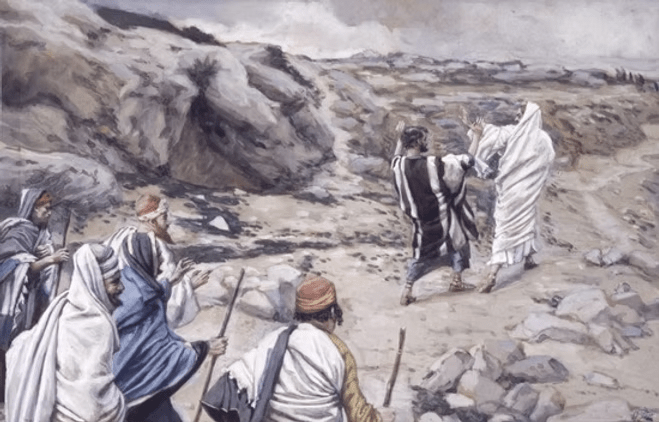






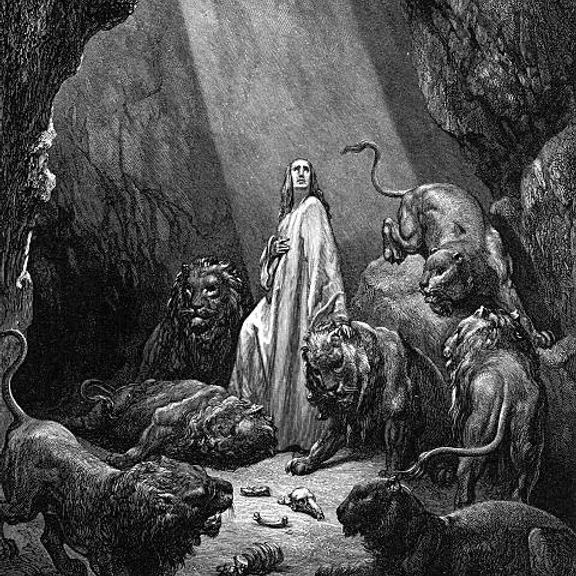
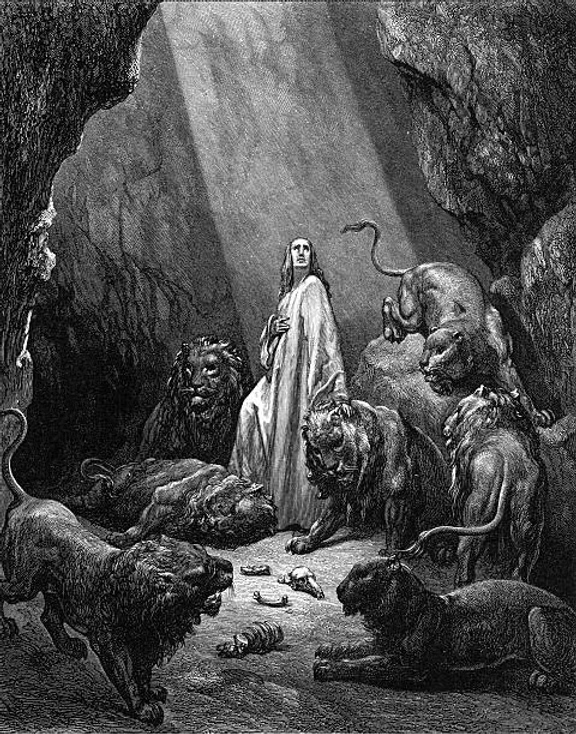
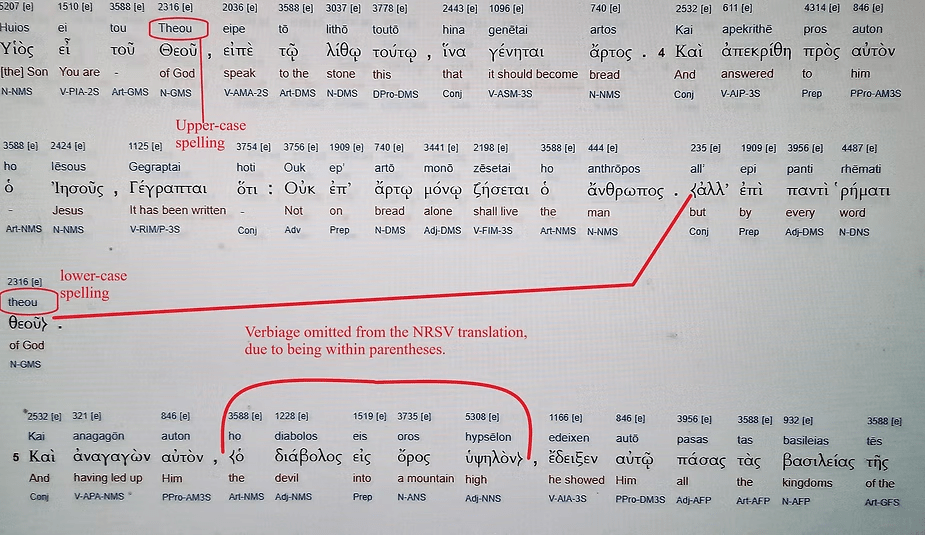
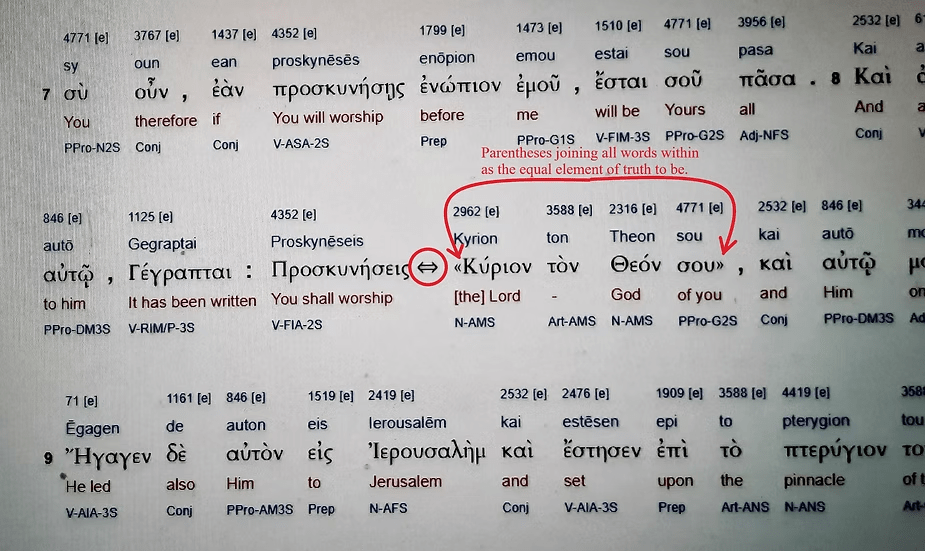
 Explaining the Readings