This is the Old Testament selection to be read aloud on the fifth Sunday in Lent, Year C, according to the lectionary for the Episcopal Church. It will precede a singing of Psalm 126, where David wrote, “Restore our fortunes, Yahweh, like the watercourses of the Negev.” That will be followed by a reading from Philippians, where Paul wrote, “Yet whatever gains I had, these I have come to regard as loss because of Christ.” All will accompany the Gospel selection from John, where is written of Jesus telling Judas Iscariot, when he complained about Mary Magdalene putting expensive perfume on Jesus’ feet: “Leave her alone. She bought it so that she might keep it for the day of my burial. You always have the poor with you, but you do not always have me.”’
In this song of Isaiah, it is worthwhile to know the whole of this chapter. The verses leading to these six verses are Yahweh speaking through Isaiah, explaining the truth of His people. That truth is hidden from plain view; but it says Yahweh is the creator of those who marry their souls to Him. In verse eleven, Isiah wrote, “I I Yahweh ; none besides me savior .” Then, in verse fifteen, Yahweh said through Isaiah, “I Yahweh your sacred one ; the creator of Israel your king . selah .” In verse fourteen, Yahweh said He would not let captivity in Babylon have any effect on His children, as they would rejoice. All of this leads to these verses as Yahweh saying (through Isaiah) His children are Yahweh elohim; and, they will continue on. These six verses are then dealing with that continuance.
I have applied the verse numbers in bold type, set within brackets. In verse sixteen, I have restored the proper name “Yahweh” in bold type, replacing the English translation that generalizes His name as “the Lord.” In Isaiah’s forty-third chapter he named “Yahweh” eight times. This use in verse sixteen is the last of those eight. In verse eleven, where is written, “’ā·nō·ḵî ’ā·nō·ḵî Yahweh” and verse fifteen where it is written, “’ā·nō·ḵî Yahweh,” the uses of “I” and “Yahweh” state the specificity of Yahweh as being greater than any “Lord,” as “Yahweh” is the one who is identified by one possessed by Him; so, one says “I I Yahweh,” because “I” no longer serves lesser lords. It says one’s self-ego has been hidden, lowered in submission to the new “I” that makes one a Son of Yahweh, in His name “Israel.”
When verse fifteen sets up verse sixteen, by singing “I Yahweh your sacred one ; the creator of Israel your king”, this says Isaiah is now identified as “Yahweh” speaking, where it is ridiculous to think Yahweh is “holy” or “sacred.” Only a soul in human flesh can become “holy” or “sacred,” which comes about by the presence of “Yahweh.” Thus, Isaiah is his “creator,” with Isaiah having been transformed into an “Israel,” the name that means “He Retains God.” In the use of “God,” from “el,” Isaiah retains Yahweh as one of His elohim (one “el”). Thus, it is Yahweh having become “the king” of Isaiah’s soul and flesh that leads to verse sixteen singing, “Thus says Yahweh.” Isaiah has become the voice of Yahweh and is speaking for Him, as His prophet.
In verse sixteen, where the translation says “who makes,” the root Hebrew word is “nathan,” which better says, “who gives.” When one sees it is Yahweh’s gift that is “in the sea a road,” this becomes a statement about the parting of the Red Sea. When “the sea” is understood as a dangerous place – an Babylon had proved to be a dangerous swell overtaking Judah – Isaiah now sings of “through the fierce waters a pathway.” This must be seen as explaining the parting of the dangerous sea as the protective envelopment of Yahweh’s children – those who can say, “I Yahweh” – which separates all the ordinary dangers of a sea of humanity and life in a dangerous world away from those who are possessed by Yahweh’s “sacred” Spirit.
Verse seventeen then becomes a clear reference to the threats made to the Israelites following the protective lead of Yahweh, as they crossed through the parted waters of the sea, drawing in the “chariot and horse army of power.” There is no power on earth that can defeat the sea, in the way that Yahweh can fully control all. This makes the Babylonians be the mirror image of the Egyptians. All who rise in power on earth “will together lie down.” They will cease to have the power to “rise up.” Their souls will be led by mortal flesh; and, once that flesh dies, then their souls will be “extinguished, like a wick” that has been clamped by wet fingers.
Verse eighteen then has Yahweh say through Isaiah, “Do not remember the former things, or consider the things of old.” [NRSV] While this can be read as a warning against looking backwards and not focusing on the things to come in the future, the opposite is still being said as a warning. The fall of Judah and Jerusalem, which led to captivity of human beings thought to be the descendants of Yahweh’s ‘chosen people,’ their collapse and failure came about because they did “not remember the former” lessons of their history. As they went forward in their path that rode onward, like horse-drawn chariots into the turbulent sea, they did “not consider their rise [eastern]” and what led to their safety and security. Thus, the collapse of their thoughts (to be all-powerful nation) became like the Egyptians in the middle of a sea, when they realized they had no power to control a great force of nature (the sea). This verse then sings of the ignorance given to Yahweh, which is not only a lack of knowledge possessed by Gentiles; as it also is a refusal to know Yahweh by those who think they possess Him … seeing Him as their “Lord” Goliath.
Verse nineteen then is shown to sing, “I am about to do a new thing; now it springs forth, do you not perceive it? I will make a way in the wilderness” [NRSV], this shows the root cause of failure – self-will. The better view comes from a literal translation that begins with a personal review that says, “I behold! “ or “I look upon!” Here, the future is the promise of Yahweh, when “I will make a new now to spring forth.” That “new” is oneself having submitted to Yahweh as His wife and servant [His possession]. This then led Yahweh to say through Isaiah, “not shall you know it,” as the “new” will not be created by intellect or personal design. Without knowledge – a barren “wilderness” of intelligence – Yahweh “will make a mouth” [“midbar” means both “wilderness” and “mouth”], which will tell of “a manner in the waste that becomes rivers” of insight.
Verse twenty then seems to wander wildly, when shown to sing about “wild animals,” specifically “jackals and ostriches.” Here, the metaphor stands out as those to whom the “mouth” will bring a flood of emotion to. The literal translation of verse twenty has it singing, “will be relatives living on the land , the serpents and daughters of greed ; when I place in the mouth waters , streams in the waste , to cause to drink my people my chosen .” This begins as a statement of the future, which “will be burdensome” to those freed from captivity. That “weight” will be a return to find “relatives” dwelling in the lost lands, those who will have lost their religious focus. They will be the “serpents” [called “jackals”] that speak false wisdom, as the “daughters” of sin. They will join with those who lead others to become “daughters of greed” [called “ostriches”]. The returning Sons of Israel [Yahweh elohim] will have the “waters” of emotion for Yahweh to flow forth upon the “wilderness.” Those “rivers” or “streams” will fill the “waste” that had come over Judah and Jerusalem. Those souls who seek salvation will “drink” of those “waters” and become Yahweh’s “people.” Those who receive His Spirit will have chosen Him in marriage; and, He will have chosen them too.
Verse twenty-one then sings, “the people whom I formed for myself so that they might declare my praise.” [NRSV] The literal translation says, “people who I have fashioned for myself , my song of praise they will relate .” Here, this says “people” are “people,” but those “people who I have formed for myself” are those who are “my people my chosen” (from verse twenty). This is the formation or fashioning of a Yahweh elohim, which is a soul married to Yahweh’s Spirit. The use of “my” states those “people” are divinely possessed by Yahweh (as was Isaiah). To use the first person possessive – “myself” – the “self” is that of each of the “people,” who have become possessed by Yahweh. They each then proclaim “I Yahweh,” rather than “my ego is me.” Like Isaiah (and David, and all the other song writers of Yahweh), the “people” then all “praise Yahweh in song.” This is then the flow of “streams from the mouth in the wilderness” that defeat the serpents and ostriches. The use of “yə·sap·pê·rū” (from “shaphar”) says those who are the wives and servants of Yahweh will all be “related” by their souls singing the same tunes (Spiritual brothers).
As an Old Testament selection to be read aloud on the fifth Sunday in Lent, the period of testing is again focusing on the “wilderness” that is a predicting a return to a lost land. This is the way one should see one’s own soul being tested; as the life one left behind (before being tested) must be seen as where forgetting the lessons of servitude to Yahweh has led to a ruin. The past is oneself that had a life filled with jackals of false shepherds and ostriches that are the daughters who prostitute religion for profit. The world is not as complicated as “people” make it seem. All the complications are ironed away by a total commitment to Yahweh, by becoming His wife and servant. The test is whether or not one’s soul has married Yahweh and become protected in the dangerous sea of life by His Spirit, as His elohim.
7 [6] Those who go out weeping, carrying the seed, *
will come again with joy, shouldering their sheaves.
——————–
This is the Psalm that will be read aloud in unison or sung by a cantor on the fifth Sunday in Lent, Year C, according to the lectionary for the Episcopal Church. It will follow a reading from Isaiah, where Yahweh spoke through him, saying “he wild animals will honor me, the jackals and the ostriches; for I give water in the wilderness, rivers in the desert.” This pair will precede the selection from Philippians, where Paul wrote: “Beloved, I do not consider that I have made it my own; but this one thing I do: forgetting what lies behind and straining forward to what lies ahead, I press on toward the goal for the prize of the heavenly call of God in Christ Jesus.” All readings will accompany the Gospel selection from John, where is written: “Six days before the Passover Jesus came to Bethany, the home of Lazarus, whom he had raised from the dead. There they gave a dinner for him. Martha served, and Lazarus was one of those at the table with him.”
You will notice how I have adjusted the verse numbers to match the verses separated by David. The NRSV agrees with this numbering; but the Episcopal Church has found verse two to be too long for their purposes and changed it into a non-existent verse. The corrected verse numbers are in bold type, within brackets. The commentaries to follow will address that numbering order. Additionally, in four places the NRSV (et al) have taken the proper name of “Yahweh” and replaced it with a generic “Lord.” There are so many “Lords” these days, it is hard to keep up with who the LGBTQ leaders of the Episcopal Church are calling their “god” this week. I have restored the name “Yahweh” in bold type. If that offends anyone, then I doubt you will continue beyond this point.
In verse one and the true verse four, one will find the NRSV translation saying “restored the fortunes” and restore our fortunes.” Because that is so misleading – making listeners or readers think Yahweh cares how much “fortune” a soul has – as commonly measured in material worth – the association with named places (“Zion” and “Negev”) makes this song seem to be about Jews being able to once again lay claim to property. Because that is so wrong, I will comment on literal translations of this text, that are mine, based on the Hebrew-to-English tool I use. [BibleHub Interlinear]
Verse one translates literally to state in English: “a song , of ascents when returned Yahweh the captivity of dryness ; we became like those who dream .” In David’s view of the land he ruled, there had never been a loss of fortune, unless one wants to look at the grand scope of history, where Jacob and his sons moved to Egypt, leaving all the lands he had possessed behind (amid a famine, when property values take a huge tumble). Thus, this verse is singing about the dryness [the meaning behind the name “Zion”] that is a lack of spiritual waters that Egypt had brought. To be “like those who dream” can allude to Joseph – a dreamer of wisdom – who made the move to Egypt inviting. Still, “Zion” is the name applied to the place inhabited by the Jebusites, whose underground tunnels reflected the grave, where death brings on the dreams of sleep. Thus, verse one is singing about reincarnation, which is then a reflection upon a soul’s resurrection to everlasting life.
The return of the Israelites, led by Joshua and the Ark of the Covenant, meant life was given back to the land of Canaan. This revitalization is then said in verse two to say, “at that time was filled with laughter our tongue with singing at that time they said among the people ; grown up Yahweh has made with these .” To translate “ḇag·gō·w·yim” [transliterated form of “goy”] “among the nations” is skipping forward in history, to when King Solomon has prostituted his godlike status “among the nations,” so Solomon was seen as “great.” None of that had happened when David wrote this song. The only nations around knew nothing of “Yahweh,” and none of those saw the land of the Israelites (led by David) as significant. Thus, David is singing about those divinely married souls led by Joshua into the Promised Land as possessing “mouth and tongue” of Yahweh, which impressed many local “peoples” to say, “Those who left five hundred years ago have come back matured in religion. They were elevated in stature because of Yahweh having married their souls.”
Verse three then is David singing, “they grew up Yahweh has made with us , we are glad .” Here is the second use of “hiḡ·dîl” [transliterated from “gadal”], which Strong’s says means “to grow up, become great.” Strong’s Exhaustive Concordance says this word can be found implying “advance, boast, bring up, exceed, excellent, become, do, give,” To place focus of “great things” is then following an incorrect desire to make this song of praise be about all the “fortunes” that comes from claiming to believe in one God. The point being made by David is this “growth” is a spiritual “advance.” It is what takes the normal soul in the flesh and makes it “exceed” and produce “excellent” production. It is a “birth” that has been “given,” thus received, where true Israelites had become what “Yahweh has made with us.” This is a song of praise because David then added, “we are glad.” The presence of Yahweh has brought their soul happiness.
In verse four is a return to a translation that says “restore our fortunes,” when that is not the main focus intended. In verse one is written “šî·ḇaṯ” [transliterated form of “shibah”], which means “captivity” (with some lean to “restoration”). Here, in verse for is the same Hebrew word repeated – “šə·ḇū·ṯê·nū” [transliterated form of “shabuth”] – which means “captivity” or “captives.” In the repetition of this word, the first is placed in brackets, with the second surrounded by parentheses, as: “[šə·ḇū·ṯê·nū] (šə·ḇū·ṯê·nū)”. The placement of brackets implies no need to translate this word, while the parentheses implies an aside that is more of a thought or whisper, than a word of text.
The literal translation of verse four is as such: “return Yahweh this [captivity] (captives) ; as the channels in the parched rolling hills .” Here, the brackets and the parentheses indicate the unseen presence of a soul within a soul, with both being “captives” in a body of flesh. This repetition then speaks of the divine marriage between a soul and Yahweh’s Spirit (the one we now call Jesus). Thus, the verse loudly sings, “return Yahweh this,” which reflects back on the gladness of divine possession stated in verse three. That perceived in verse three as singing about the spiritual growth that Yahweh makes of us is then silently said to be a desired “captivity,” where the soul is held “captive” of that which no longer sins. Thus, the “rivers in the Negev” are unseen, under the “dry, parched” surface [with those words being the meaning behind “negeb”], which forms a series of “rolling hills” that are barren wilderness [the meaning of “Negev”]. It means inner peace withstands all external difficulties, when Yahweh has “returned” a soul to Him.
Verse five then sings literally in English: “those who plant seeds in tears (of weeping) , in joyful shouts will be the reaper .” From seeing the landscape of the Negev at the end of verse four, to see the dismal outlook of anything ever being fruitful and productive becomes the outlook of a hard and resistant world. The pressures of life bring tears (of weeping) that offer prayers to Yahweh as the “seeds planted.” There is nothing about this psalm that seeks “fortune” or some form of material favor from Yahweh. One prays for one’s own soul to be able to produce good fruit for Yahweh. As good fruit, oneself becomes nourishment – manna from heaven – that can sustain others. Thus, when one is found the answer to one’s prayers, it is time to rejoice and give all thanks to Yahweh.
Verse six then literally sings in English: “continually he goes forth and weeping carrying acquisition sowing to come and come rejoicing ; carrying his sheaves .” Here, again but unstated, is “weeping” while planting seeds. This is a “continual” act that must be done in the physical world. The seasons change and that which has “grown up” will be used and returned to a state of need. This then sings about the necessity of ministry, where one’s children and one’s children’s children all become the seeds of the good fruit that must “continuously be put forth” into the world. The world grows tears and those tears need to be answered as prayers returned by Yahweh. Yahweh’s lineage is Spiritual, not physical bloodlines or honored families that amass great wealth in the name of a Lord. The laborers must “come and come,” all must “come rejoicing” in His name. Thus, David sang that the continued Spirit reborn in true Israelites would mean Yahweh always “carrying the sheaves” of spiritual food to His people.
As a Psalm of David to be sung on the fifth Sunday in Lent, when the season of testing is still in one’s own personal wilderness, the lesson must be seen to grow up and mature in Christ – the Anointment of Yahweh’s Spirit upon one’s soul. One needs to see there is no such thing as freedom, like the modern world loves to use to make souls become more addicted to the material realm. If there were true freedom, then one’s soul could leap away from this miserable world and be done with all Satan’s tests. The message of David is to be “returned to captivity,” which is oneness with Yahweh [not some magical Lord]. One need to mature by knowing one’s soul is joined with Yahweh’s Spirit. This inner gladness is how one laughs are the tests of the devil. One is proved ready to sow the seeds of love that plants the thought of divine marriage, where souls can only escape the captivity of the physical realm by becoming good fruit in barren surroundings. David is teaching our souls to rejoice at the test of Lent and be prepared to sow the seeds of Yahweh’s love in ministry, after the test of Lent has been passed.
If anyone else has reason to be confident in the flesh, I have more: circumcised on the eighth day, a member of the people of Israel, of the tribe of Benjamin, a Hebrew born of Hebrews; as to the law, a Pharisee; as to zeal, a persecutor of the church; as to righteousness under the law, blameless.
Yet whatever gains I had, these I have come to regard as loss because of Christ. More than that, I regard everything as loss because of the surpassing value of knowing Christ Jesus my Lord. For his sake I have suffered the loss of all things, and I regard them as rubbish, in order that I may gain Christ and be found in him, not having a righteousness of my own that comes from the law, but one that comes through faith in Christ, the righteousness from God based on faith. I want to know Christ and the power of his resurrection and the sharing of his sufferings by becoming like him in his death, if somehow I may attain the resurrection from the dead.
Not that I have already obtained this or have already reached the goal; but I press on to make it my own, because Christ Jesus has made me his own. Beloved, I do not consider that I have made it my own; but this one thing I do: forgetting what lies behind and straining forward to what lies ahead, I press on toward the goal for the prize of the heavenly call of God in Christ Jesus.
——————–
This is the Epistle selection to be read aloud on the fifth Sunday in Lent, Year B, according to the lectionary for the Episcopal Church. It will follow an Old Testament reading from Isaiah, which tells of Yahweh saying, “I give water in the wilderness, rivers in the desert, to give drink to my chosen people, the people whom I formed for myself so that they might declare my praise.” That will be followed by a singing of Psalm 126, where David wrote: “Those who go out weeping, carrying the seed, will come again with joy, shouldering their sheaves.” All will accompany a Gospel reading from John, where Judas Iscariot asked Jesus, “Why was this perfume not sold for three hundred denarii and the money given to the poor?”
The beginning of this reading takes place in the middle of verse four. That has it lose the context established in the three-plus verses Paul wrote before. When he is shown to say, “circumcised on the eighth day,” this follows his having said, “Beware of the dogs, beware of the evil workers, beware of those who mutilate the flesh! For it is we who are the circumcision, who worship in the Spirit of God”. (Philippians 3:2-3a, NRSV) From having that context, to now read “circumcised on the eighth day” is a statement of the true rite practiced by Jews (descendants of Abraham, Isaac, and Jacob). This is then stated as a contrast for the meaning of the Greek word “katatomēn,” which has been translated as “mutilation of the flesh” in the second verse. Paul then wrote the Greek word “peritomē,” the same word as used in verse four here, which translates as “circumcision.” The element of the “eighth day” must be seen as an incision performed on a newborn infant, by a kohen or priest; and, it is not something done by “dogs” [from “kynas,” used in verse two, meaning those who “mutilate the flesh”], who perform such things as female “mutilation,” to prevent females from having sexual pleasures, done at an older age in life. Thus, Paul stating he was “circumcised on the eighth day” says he was not some heathen or Gentile who had practices that “mutilated,” as he instead was a certifiable Jew.
Is it the eighth day already?
Still, for Paul to say this after saying that “it is we who are the circumcision,” this says Jews who mark their babies by physical incisions – as a member of a religious race-sect-class – is no different than the rites Christians do to their infants (christening). A male Jew being visibly marked as a Jew by circumcisions is not what identifies a soul that is married to Yahweh and serves Him absolutely. Likewise, a Christian anointed with baptismal water – ladled over its forehead by a priest (in the same way a kohen carefully incises a male child’s penis) – does not mark a soul as Yahweh’s. In verse two (which is not read aloud, thus not realized for this reading), Paul was saying only divine “circumcision” did such marking; and, true “circumcision” means those “who in the Spirit of God worshiping kai boasting in Christ Jesus kai not in flesh having put confidence” [Literal translation of the Greek text]. This says the truth of “circumcision” is the permanent (not temporary) marking of a soul as Yahweh’s possession.
This means that the beginning focus that comes, from Paul writing, “If anyone else has reason to be confident in the flesh, I have more,” says there were few who could say they were more Jewish than was Paul. As a physical specimen of Judaism, Paul had checked off all the means by which Jews were measured. He was “circumcised on the eighth day, a member of the people of Israel, of the tribe of Benjamin, a Hebrew born of Hebrews; as to the law, a Pharisee.” That was not Paul bragging that he was more Jewish than any other Jew; it was Paul inferring that some told Gentiles that conversion to Judaism meant a “mutilation” at an adult age of life. Such acts (performed by “dogs”) could do nothing to alter a soul through the flesh. Thus, Paul was born a Jew and had a lineage of blood that made it possible for him (unlike converted Gentiles) to claim he was more a Jew.
In the string of evidence Paul listed, it is important to realize the meaning behind the capitalized words used: Israel, Benjamin, Hebrew-Hebrews, and Pharisee. The word “Israel” should identify one “Who Retains God,” where the “el” of “Israel” does not mean one who believes in Yahweh. The true meaning says a soul has become one of His elohim (which would be “Who Retains Yahweh as one of His elohim. ). Benjamin is a name that states, “Son of the Right Hand” or “Son of the South.” This was the name given to Jacob’s youngest son, as his beloved wife Rachel died after giving birth to Benjamin. Rachel called her son “Son of Sorrow” (“benoni”), but Jacob immediately changed it. Jerusalem would be assigned to the land given to the Tribe of Benjamin, so there is a duality that comes from that center of Judaism: it sorrows Yahweh that His children worship property more than Him; and, the true soul of Israel is found in His Son that is at His Right Hand. That dual nature says the “nation” or “people” of “Israel” is misconstrued as being land (physical or flesh) and not a spirit (soul married to Yahweh). It says a city becomes the crown jewel of a religion and not a collective soul of people who serve Yahweh as His elohim.
When Paul then wrote to the Christians in Philippi, “Hebraios ex Hebraiōn,” or “Hebrew of Hebrews,” this is only read incorrectly as Jews being called “Hebrews.” That name would be because they spoke the language of “Hebrew.” That is the surface meaning, which belies the deeper element that is the truth of capitalization (a divine elevation in meaning). This word means “Passing Over,” which is a word first used to denote Abraham as of divine lineage, relative to Noah. Not everyone related to Noah was divinely elevated to an equal status as Noah. Abraham was one who was said to be a “Hebrew,” because his soul had “Passed Over” as a true descendant spiritually, having come from Noah’s great-grandson (of Shem’s line) “Eber.” Thus, “Hebrew” is relative to the name “Eber.” This name is “connected to the crossing over and the beyond” (Wikipedia), which is soul related … not of the flesh lineage. Thus, for Paul to say, “Hebrew of Hebrews,” this says the man named Saul spoke a language that was taught to Jews to speak; and, the duality says Jews are not given an ability to be “Passed Over” by birth into a body of flesh.
When Paul then said, “according to the law , Pharisee,” that identified the sect of Judaic religion – the philosophy he had held as a Jew – which was that which “Expounded, Divided,” and applied “Science” [the meaning of “Pharisees”] to “the law.” This sect is considered to be of the “Persian School,” which takes an intellectual approach to religion; thus, “Scientists” implies they gain “knowledge through observation.” What you see is what you get; therefore, the Pharisees were literalists when the interpreted the scriptures, especially those of Mosaic Law, which made them only know separate bits of information, without caring how the parts all worked within one grand whole. So, Paul made the claim to the Jewish and Gentile Christians in Philippi that he had been one of the ruling class of Jews – those who (as Herodians) had assumed primary control of the Temple, thus the main philosophy that governed modern (at that time) Judaism.
With that resume stated, Paul then added (in verse six), “as to zeal, a persecutor of the church; as to righteousness under the law, blameless.” That became a waiver from the Temple to judge all Jews within the confines of their “assemblies” or “congregations.” Here, the use of “ekklēsian” gives the wrong impression, when translated as “church.” There was no “Church” (a capitalized phenomenon, like Christianity is known for today), as what Paul was stating he had been given authority to enact was “persecution” of all Jews who gathered together, where the normal place gathered on a Sabbath was in a synagogue, a building designed for such gatherings. In the times of Jesus’ ministry, we commonly read of there being Pharisees in the synagogues where Jesus taught, who would confront him over his philosophies. Saul was then one of the Temple ‘police,’ who had been granted permission to “pursue” anyone not ‘getting with the program’ the Temple carefully crafted. While Paul (as Saul) did that, nothing he did was deemed a sin, based on “the law” being interpreted by “Pharisees.”
When verse seven then shows Paul writing, “Yet whatever gains I had, these I have come to regard as loss because of Christ,” that gives the false impression that someone external to Paul (named “Christ,’ like the nickname of Jesus) came by and changed Saul’s mind about all the things he thought were “gains,” changing his mind to see what should be thought of as “loss.” Here is the first of six uses of “Christ,” with three of those uses “Christou,” meaning “of Christ,” where possession by “Christ” means “Christ” is a state pf self-being, not anything external. The word written by Paul that aligns with “gains” is “hēgēmai,” which means “I have thought, have supposed, have considered,” to the point that Saul’s mind was so set on his “righteousness” being because of his bloodline (his flesh) that his brain “led” him to think it was a “gain” to “persecute” anyone, while thinking himself to be “blameless.” It was the “Anointment” by Yahweh – the truth of the Greek word “Christo” – that had the soul of Paul know his brain was at the root of all his evils. So, just as he had set this up by writing (his unread comments) about the “dogs of mutilation,” as those who are “evil workers,” the “loss” Paul realized through the presence of Yahweh’s Spirit (the onset of “the Christ”) was that Saul was one of those he warned against. Saul changed his name when he saw how evil he had been, because of his becoming a “Christ.”
In verse eight, Paul wrote that his ability to determine everything about himself that he had deemed worthwhile was not because of “surpassing this knowledge” or “rising above this doctrine” [from “hyperechon tēs gnōseōs”] that came over his brain, as “this wisdom of Christ of Jesus of this of Lord of me”. Here, again, there is a series of capitalized words that appear to be names, with “Christ Jesus” read as one name, as if written on some teacher’s roll log, as “Christ, Jesus.” This becomes where a series of words written in the Genitive case need to be seen as important (from capitalization) elevations of divine meaning that states possession.
Paul can then be seen to speak about “this wisdom, knowing, knowledge, doctrine” (from “gnōseōs”) that is “above” (from “hyperechon” means “rise above, hold above, superior”) his prior ability to think (from “hēgēmai”). This divine elevation is “wisdom” comes to him “of Christ,” or due to the possession by Yahweh’s Spirit over his soul – “of Christ.” This ‘wisdom” can then be related to the soul “of Jesus” having been resurrected within Paul’s soul, because Paul’s soul had married Yahweh’s Spirit, making that resurrection possible. When one can then see the presence “of Jesus” in Paul, such that Jesus was likewise “of Christ,” as the “Anointed” Son of Yahweh, the words “Christ Jesus” say (while still being separately important) that Paul was no longer Saul, because “of Christ of Jesus” being reborn in his body of flesh; so, Paul became Jesus reborn spiritually. Thus, it is “of this” combination resurrection-rebirth that the soul of Saul was no longer the ‘lord” over his flesh (which includes his brain); but the soul “of Jesus” had taken over “of this,” becoming “of Lord” over the new Paul. Paul no longer thought how he should act, as he took commands from his new “Lord Jesus,” who is the epitome “of Christ.” Therefore, “of Jesus of this of Lord of me” is how Paul then identified, knowing everything he once valued was now a shame (calling it “refuse” or “rubbish” – “skybala”) that caused him to change names.
When verse nine then is show beginning to say, “and be found in him,” this makes another false misrepresentation, which projects “of Christ of Jesus of this of Lord of me” as an external “him.” While the Greek word “autō” is a masculine, third-person pronoun, it is also in the possessive. It does not need to be translated as “of him,” as the pronoun equally means “self,” as an indication “of the same.” This means that Paul wrote, “kai heurethō autō,” which importantly says, “I should be found within him,” where this says Paul is “within” the presence “of Christ of Jesus of this of Lord of me,” so all are to be “found within [me] the same.” One for all and all for one.
For Paul to then say this inner presence made it clear to him “not having a righteousness of my own,” as that was only possible by having become reborn as Jesus, “of Christ,” that said memorizing quotes from scripture could never bring one “righteousness.” That says no Jews, nor any Christians today, who think they are going to heaven, because they are “blameless” under “the law” are in for a rude awakening; and, that awakening can only come from marrying Yahweh and giving rebirth to His Son. Therefore, Paul said, “that comes through faith in Christ, the righteousness from God based on faith.”
To speak of faith (from “pisteōs”), where the root word means “faith, faithfulness,” while implying “belief, trust, confidence; fidelity,” the truth of faith is stated as being “of Christ” (from “Christou”). When one’s brain has been removed from all sense of superiority, the kind that makes oneself think one is capable of interpreting “the law,” that discarding of intelligence means one’s soul has gained the blind faith of guided wisdom. One then knows without thinking. To lower oneself from faith to belief is the mistake Paul knew Saul suffered from. All who think they know what Jesus would do, if he was to come back as “Jesus Christ,” judging the world, then surely he would see how much belief they had in him, while never once thinking one must be the same reborn. Saul suffered from false beliefs; but Paul was saved by the faith that came “of Christ” – Yahweh’s “Anointment.”
The NRSV translates verse ten this way: “I want to know Christ and the power of his resurrection and the sharing of his sufferings by becoming like him in his death.” This, once more, makes it appear that Paul wanted to “know” an external entity called “Christ,” with all the words speaking of “resurrection” and “death” bringing up images of Easter Sunday, so the “Christ” must be Jesus. Please do not read this verse that way. Here is what Paul wrote: “of this [faith] to know of the same kai this strength of this resurrection of the same , kai [this] fellowship [of this] sufferings of the same , fashioned self according to this death of the same .” In this series of segments, each ends with the Greek word “autou,” which has been translated as “of the same.” Therefore, everything stated by Paul in verse ten must be seen as his identity having become “of the same” as what is known to be “of Jesus.”
In verse ten there are two uses of “kai,” which is a marker word that states importance to follow that word. In the first use, Paul followed a statement about “faith” being relative to being “the same” as Jesus, having become reborn in his name. That then is importantly indicating “this strength” or “this power-ability” to “know faith” comes from the “resurrection” of the soul of Jesus within Paul’s soul. Then, after a comma mark making a pause to reflect on that thought, Paul next importantly stated there was a “fellowship” that incorporated two souls in one body of flesh; and, that made Paul fully aware of all the “sufferings” Jesus felt, while in his own flesh. This must be seen as “the same sufferings,” not some imaginations of what it must have been like (a function of the brain to think), but knowing how Jesus suffered. Then, that knowledge (coming from the wisdom of faith) meant that Saul figuratively became hung on a cross “to die in the same” way. Saul’s “death” meant Jesus could be born again in another body of flesh, which was then renamed Paul, in his honor.
In verse eleven, Paul says it was from his own death of self-ego and self-worth that the soul of Jesus had been “resurrected” in his flesh. The death was not physical, but the removal of his dependency on the flesh – his brain. Once that blockage to divine marriage was removed – the death of Saul – then his soul could experience the outpouring of Yahweh’s Spirit – divine marriage via the “Christ” or “Anointment” – and receive the Spirit of “resurrection,” where the seed of Yahweh’s Son was planted within Paul’s soul. That is the truth behind the translation that says, “if somehow I may attain the resurrection from the dead.” The “if” is the condition of self-sacrifice – “death” – which is “the manner in which” or the “how?” that transformation is possible. Saul had to make the decision. It was not made for him by anyone but himself. His decision was so he “might attain the resurrection” of Jesus’ soul, which was made available for all true Christians by his physical “death,” but for that “resurrection” to meet the preconditions, Saul had to die first, to welcome in the Son of Yahweh.
Verse twelve begins with the capitalized word “Ouch,” which means “Not.” The divine elevation of this word means Paul is stating what is “Not” Yahweh’s purpose in having married with his soul and given rise to His Son in Paul’s soul. The “Not” is then a statement that Paul’s focus on his “already having obtained resurrection” and his “already having been perfected” by the presence of Jesus and the Christ. Once he reached that state of being, the conditional “if” applied to others. Saul would have found such powers brought on by the divine marriage of Yahweh’s Spirit and seen it as reason to flaunt his piety like never before. That was “Not” why Paul was “obtained” and “perfected” by Yahweh. It was for entering ministry so others could seek “to lay hold of that which Paul had laid hold of.” That was why Paul “obtained resurrection” and was “perfected” in the Christ: to lead others to become “of Christ of Jesus.”
In the NRSV socialist translation that begins verse thirteen, they have succumbed to societal pressures and taken the poor old ladies of the world (who men have traumatized … or persecuted as a Soul … for centuries) and transformed divine scripture, so “brothers” now sweetly adds “and sisters.” It comes across so patronizing that it reads as if there should be a footnote that says, “There, there, now ladies. You can see that we speak for Jesus, who (if he were translating the Holy Bible today, then we know he) would say “brothers and sisters.” Now, please remember the Church when you die; so, we will get the bulk of your estate for including you in this erroneous translation.”
To think in terms of men and women is to think in terms of the flesh. Paul, having just said he was in ministry to lead others to be the same as him – dead of self and resurrected in Spirit, reborn as the Son of Yahweh – he was writing to souls in both human sexes that had benefited from Paul’s ministry. Because they had all similarly died of self-will and self-ego, so all had likewise been reborn as Jesus, all “Anointed” by Yahweh as His Sons, the divinely led word that Paul wrote (in Greek) was “adelphoi,” which means “brothers.” Of course, all the flesh loving sinners leading the Churches today want to stroke every penis and every vagina and tell everyone their sins are fine with them, as long as they give to their coffers. When one is wallowing on the plane of fleshy sins, then one disregards the truth of scripture …. as often as possible.
Because Paul addressed all souls who were his “brothers” in “Christ,” all souls led by the masculinity “of Jesus,” Paul then said, “I myself not do consider to have taken hold” [from “egō emauton ou logizomai kateilēphenai”]. That is not Paul speaking, it is Jesus writing those words, which say the “ego” [“I”] and “myself” [where a “self” equals a “soul”] are nothing [“no, not”]. As “brothers” [not boys and girls, ladies and gentlemen, brothers and sisters] each and all must “not consider to have taken hold” of that old lord over one’s body of flesh. If one starts referring to being a “sister,” then one’s own “I myself” has been “considered to have hold” over one’s identity. The “death” that brings about the “resurrection of Jesus” in one’s soul means the “I myself” is “not” to be “considered” anymore.
Where the NRSV translates Paul writing in verse thirteen: “but this one thing I do: forgetting what lies behind and straining forward to what lies ahead,” this too needs an adjustment through a literal translation. The literal says, “one now : they indeed behind overlooking , they now in front of stretching forward .” Here, the first two words say oneness has been achieved, through the sacrifice of a soul in marriage to Yahweh. As two souls (with Jesus resurrected), the souls of those sacrificed (“they”) take a submissive position – “behind” – where the host soul is now “overlooking” the control given to “Lord Jesus,” watching how his presence commands one’s body to act. Then, those souls who have found this position (“they”) wear a face that is different than the one physically displayed by Jesus of Nazareth, so that new face of the flesh is “in front of,” identifying with the control of Jesus making one’s flesh be “stretching forward” or “straining after” all that he commands.
In the last verse of this reading (fourteen), the NRSV shows Paul writing, “I press on toward the goal for the prize of the heavenly call of God in Christ Jesus.” This literally says, “according to mark I pursue towards this prize of this above summoning of this of God within Christ Jesus .” Rather than make this be again externalized, as if Paul heard some “heavenly call of God” out in the distance, which drove him to seek where it was coming from, the truth says Paul is referring to the commands of Jesus within his soul. He was confirming that stated in verse thirteen. So, the “mark aimed for” or the “goal” of Paul was his ever “stretching forward,” to do as he was led to act, with his own soul hoping the desired result (of winning souls to Yahweh) will come. The “prize” is found by those who heed the message Paul took to them, on command of Jesus; so, the “prize achieved (the mark hit) was to whom he wrote in Philippi – more true Christians. Together, all knew the “prize” “of God,” which was “within Christ Jesus.”
As the Epistle selection to be read aloud on the fifth Sunday in Lent, when the test of commitment to Yahweh is ongoing in one’s life, the lesson here has Paul speaking of the dangers of being misled into believing one’s soul is safe and secure, by external religious standards, as measured by philosophers. We are all asked to see ourselves as Saul, who thought he was the best human being possible, when he was a total failure in the eyes of God. The religions of Judaism and Christianity are both fallen far from their target goals, which is to bring lost souls to find the need to marry Yahweh and be saved … as His Son reborn. As the last Sunday in Lent, when one is about to embark on a path of ministry (should one pass the Lenten test), one needs to know self-sacrifice for a higher cause. None of this is about self. It is all about sacrifice of self, so Yahweh can use your body of flesh to resurrect His Son on earth, to seek lost souls to save.
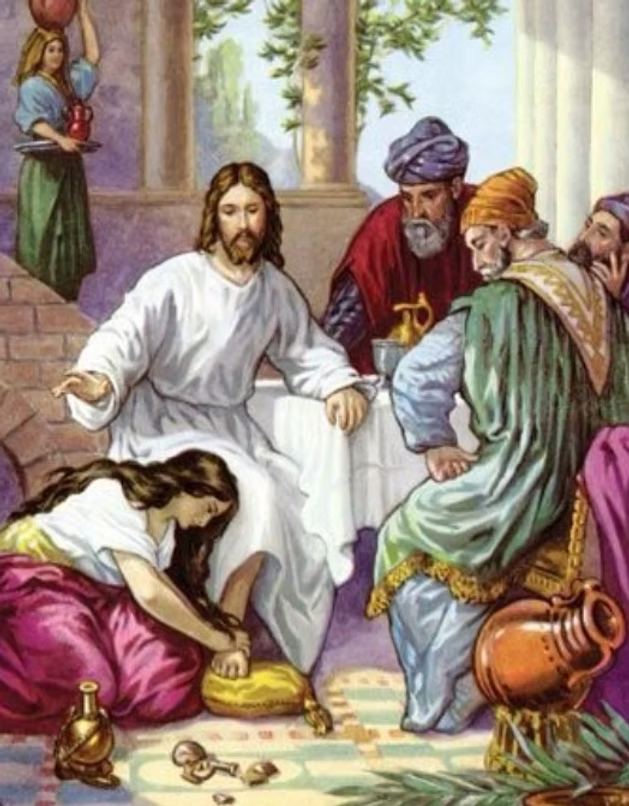
Six days before the Passover Jesus came to Bethany, the home of Lazarus, whom he had raised from the dead. There they gave a dinner for him. Martha served, and Lazarus was one of those at the table with him. Mary took a pound of costly perfume made of pure nard, anointed Jesus’ feet, and wiped them with her hair. The house was filled with the fragrance of the perfume. But Judas Iscariot, one of his disciples (the one who was about to betray him), said, “Why was this perfume not sold for three hundred denarii and the money given to the poor?” (He said this not because he cared about the poor, but because he was a thief; he kept the common purse and used to steal what was put into it.) Jesus said, “Leave her alone. She bought it so that she might keep it for the day of my burial. You always have the poor with you, but you do not always have me.”
——————–
This is the Gospel selection that will be read aloud by a priest on the fifth Sunday in Lent, Year C, according to the lectionary for the Episcopal Church. It will follow an Old Testament reading from Isaiah, where the prophet spoke as Yahweh, saying “Do not remember the former things, or consider the things of old. I am about to do a new thing; now it springs forth, do you not perceive it?” That will be followed by a singing of Psalm 162, where David wrote: “Those who sowed with tears will reap with songs of joy.” The Epistle selection from Paul’s letter to the Philippians will then come next, where he wrote: “I want to know Christ and the power of his resurrection and the sharing of his sufferings by becoming like him in his death, if somehow I may attain the resurrection from the dead.”
In verse one’s first words we have a statement of timing that is important. “Six days before the Passover” not only states the date as being 9 Nisan (with the Passover beginning on 15 Nisan), it says this event took place on Sunday, the first day of the week. Because the Passover would begin at 6:00 P.M. on 14 Nisan (which technically begins 15 Nisan), that “day” known to be a Friday then backs up to the previous Sunday. This can then be dovetailed into the timing that was of Jesus being told (in the region known as Beyond the Jordan) that Lazarus was ill; and, that timing says when Lazarus died, was buried and was then raised by Jesus.
Lazarus fell ill on a Shabbat, which was 1 Nisan (the Hebrew Ecclesiastical New Year’s Day). By Sunday morning early (2 Nisan), two (including John) were sent to where Jesus was camped with his disciples. Taking a donkey and a mule, in order to travel as fast as possible, the two reached Jesus on Sunday evening, giving him the news. When Jesus told everyone “Lazarus is only sleeping,” that says Lazarus had died on Sunday afternoon, after the two left to tell Jesus. The two stayed the night with Jesus and then returned to Bethany, getting back Monday evening (3 Nisan), when they learned Lazarus had died. That says no blame would be placed on Jesus for not immediately leaving for Bethany. When John 11:6b states, “after having heard that Lazarus was ill, [Jesus] stayed two days longer in the place where he was,” that says Jesus stayed Beyond the Jordan Monday and Tuesday, until leaving Wednesday afternoon (5 Nisan). Jesus then stayed the night in Jericho, in the house of Zacchaeus, leaving for Bethany on Thursday morning (6 Nisan). Jesus then arrived in Bethany Thursday afternoon. Lazarus, having died on Sunday afternoon, had been dead for four days (Sunday afternoon to Thursday afternoon). The sealing of his tomb would have been on Wednesday afternoon (5 Nisan), after a wake of three days. Thus, Lazarus’ body would have been sealed in the tomb for one day, before Jesus arrived; and, Jesus raised Lazarus on that Thursday afternoon, after he had been “dead and stinking for four days.” The diner in his honor was then prepared for on Friday (7 Nisan), with nothing done on the Sabbath (8 Nisan). The diner was on Sunday, six days before the Passover, on 9 Nisan.
It is important to realize that none of Jesus’ disciples witnessed Lazarus being raised from the dead. In the return from Jericho, the entourage stopped first at Bethphage, where they established a camp (if not finding buildings to lodge in there). Jesus left his disciples at Bethphage, as he went into Bethany. Because Jesus had said “Lazarus is only sleeping,” there was no danger sensed by the disciples and no urgency to accompany Jesus to his home, shared with Mary, Martha, Lazarus and John. This means Judas Iscariot was unaware of Jesus doing anything more than heal a sick Lazarus, which he had done many other times, rather routinely. Therefore, Judas Iscariot does not acknowledge that Jesus had done any out of the ordinary miracles, even though the talk said, “Jesus raised Lazarus from being dead.”
Because John felt need to write an aside that says Judas was “the one who was about to betray him,” it is the nature of spies and traitors to act unaware, while carefully observing the scene and listening to all valuable information. The talk of why this dinner party (luncheon) would be held on the first day of the week, prepared for on Friday, the day after Jesus raised Lazarus from death, the Sabbath was for giving thanks to Yahweh for the miracle. Sunday was for giving thanks to Jesus. Still, Judas Iscariot would only tell his keepers – those of the Sanhedrin – that “the people were saying Jesus raised his brother-in-law Lazarus from death.” Lazarus would receive that information without letting on that he was interested in that valuable (money in his pocket) news. Instead, Judas Iscariot made a point of being concerned for the poor, which would be to keep all from thinking he was a spy.
The meanings behind the names of the people and places also need to be known.
Bethany means “House Of Answer, Business, Affliction, Singing”.
Martha means “Mistress, Myrrh”.
Lazarus mean “God Has Helped, My God Is Helper”.
Jesus means “Yah[weh] Will Save, Yah[weh] Saves”.
Mary means “Beloved [from Egyptian], Obstinacy, Myrrh”.
Judas means “Praised, Let Him Be Praised”.
Iscariot means “Cities”.
From these meanings behind the names, verse one says the salvation of Yahweh had come to the house of answer, where there was singing for God having helped the affliction of death be lifted.
In that house was the business run by a mistress, whose sister was obstinacy and whose brother was the help of God. All were employed as servants, because life was bitter [myrrh] anywhere else.
The one who praised the salvation of Yahweh, as a son of the cities, was intelligent and crafty, thus he was trusted with the business’ money.
When Judas complained that the strong fragrance of “a pound of costly perfume made of pure nard,” he felt called upon to speak out, as the ‘accountant’ of the ‘business’ that was the ministry of Jesus [salvation]. Certainly, the aside offered by John says, had the nard been sold for “three hundred denarii,” the money would have been placed into the coffer managed by Judas Iscariot. Once in his possession, he would have pilfered much of that for himself, with very little going to the “poor.” In this way, Judas Iscariot should be seen as how every so-called “charitable organization” is today: They take money under the pretense of helping the poor, when they are more concerned with helping those who manage the money (salaries and perks for the executives), with them paid first and the poor second.
The ” house was filled with the fragrance of the perfume.” That says the place of business smelled strongly of death. Death is the stench of failure, when a soul it snatched away from its body of flesh and judged by Yahweh. The sweet smell of strong perfume is then metaphor for a soul having been saved from judgment. Jesus was the reason for all their salvations, thus the man being honored with a diner.
The complaint of Judas Iscariot could have been argued by Jesus (and Martha and Mary) that the expense of the pound of nard was because Lazarus had died; and, because he had been dead for three days before his tomb was sealed, the nard was a necessary expense, to mask the stench of his dead flesh, while his body was watched continuously by shemira (both males and females – shomers and shomerets). Because Jesus addressed the fact that “You always have the poor with you, but you do not always have me,” he was saying to Judas that Judas’ soul would always be spiritually “poor.” Jesus knew what Judas was plotting, in league with the Temple elite; so, he said to Judas (in coded words) how he knew that Judas would soon be in need of his own nard. Without Jesus, the soul of Judas Iscariot would not be saved.
When Jesus said to Judas, “Leave her alone,” this is begun with a capitalized “Aphes,” where the root word “aphiémi” means “to send away, leave alone, permit.” The capitalization must make this word be read with a divinely elevated meaning. Because John did not record Judas making mention of Mary, or the act of smearing nard on the feet of Jesus with her hair, the word being directed at Judas says Jesus knew Judas would be “Left alone.” A divine elevation of meaning says “Left alone” is speaking spiritually, when Judgment would come to all mortals. The following word “autēn,” which is the third-person feminine form of the possessive pronoun translated as “her,” the focus should be coming from reading the word as “her soul” (the core meaning of “herself,” where a “self” is a “soul”), with both Judas and Mary having souls in “the same” sense that both were alive in bodies of flesh. This makes what Jesus said next, following John marking a separation by comma, need to be understood more deeply – as that depth explains why Judas’ soul would be “Left alone.”
The Greek text next written by John literally can translate as saying, “in order that upon this day of this preparation for burial of my soul she may keep the same”. By adjusting one’s eyes to see these words speaking of Mary’s “preparation for burial,” not Jesus’, it was her act with hair, feet, and nard, that Judas was not doing. He was complaining about not having the money that bought the nard; as he was doing nothing that placed his head at the feet of Jesus. Therefore, his soul would be “Left alone” when he died. Mary, on the other hand, served Jesus (like her brother and sister – Martha and Lazarus); so, Mary’s soul would be joined with the soul of Jesus [as an Apostle] before her physical death. As such, she would keep the salvation that comes with being so divinely joined [from having married her soul to Yahweh] and the presence of Jesus’ soul [after his known death to come] coming within hers.
The truth of this meaning can be found told later, as the time when Mary went (with the other women) to anoint the body of Jesus with oils on ‘Easter’ morning. Then, Jesus was already risen and there was no body to anoint. Jesus would have known that future; so, his address was not about Mary using her nard in preparation for his burial (Nicodemus and Joseph of Arimathea took much more nard and perfumes with them to do that). It was about the soul of Judas Iscariot known to be “Left alone,” due to his lack of service to Yahweh (stealing from the ‘business’ and not caring about the boss or his employees, much less “the poor”).
In this account of John telling how Mary Magdalene (his mother) wiped strongly fragrant nard on Jesus’ feet, rubbing it in with her hair, this act is highly symbolic of submission. She would have been kneeling before her husband, in order to have both her hands and her hair be lowered to his feet. Assuming a stool was used to elevate Jesus’ feet, her placing the nard on his feet with her hands and then using her hands to use her hair as a soft brush, to rub the grease or oil all around his feet, the act clearly says Mary was submitting to Jesus as her master (more than as a wife to a husband). In a diner event given in honor of Jesus, because Mary had come to Jesus sobbing deeply over the loss of her brother (when Jesus finally arrived from Beyond the Jordan), this act done by her says she had fully placed herself at his feet as his complete servant. She did it willingly, out of love, and as well as out of thanks; and, she was requesting forgiveness for her not having known Jesus would save her brother from his illness.
Because both Mark and Matthew wrote of this event, as a diner held at Simon the leper’s house in Bethany, they did not say the diner was because Jesus had raised Lazarus from death. Neither Matthew nor Mark identified Mary, both calling her “a woman.” That is based on it having been inappropriate for women and children to be named in written texts (if not directly in relationship with one). Luke, who recorded the personal accounts of Mother Mary, did not write about this event; so, Mother Mary did not attend this diner. Instead, she led Luke to write of another event where another woman did similar with the feet of Jesus. That anointment was in the home of a Pharisee, whom was named also as “Simon.” This means Mary the mother attended another diner with her son, earlier in his ministry. The woman Mary Magdalene would have been known by Simon the leper, as both possessed houses in Bethany. Simon the leper (healed by Jesus, so he could return to be a Pharisee in good standing with the Temple) also knew Mary Magdalen was the wife of Jesus. The woman who is in the story told by Luke is said to have also wiped her tears in with perfume, which came from an alabaster jar. She placed all upon Jesus’ feet, with her hands and hair; and, Simon implied to Jesus that the woman was a prostitute.
This is how some have conjected that Mary Magdalene was a prostitute; but the events are not the same and the women are not the same. Most likely, the woman in Luke’s Gospel was the woman who was about to be stoned to death for adultery, who Jesus saved by telling the men, “Let the one of you who is without sin cast the first stone.” That event took place in Jerusalem in Jesus’ first year of ministry; so, she could have afterwards become a follower of Jesus, and begged Simon the leper (another who talked of having been saved by Jesus) for a position as a servant in his house. Again, her acts with tears, oil, hands and hair were in submission to Jesus, for his having done more than save her from certain death. She submitted to his soul by falling before him, at his feet.
As a Gospel reading selection to be read aloud on the fifth Sunday in Lent, when the season is a test of self-commitment to Yahweh, having been reborn as His Son, the lesson taught here tells of the different ends souls face. To not submit oneself to Yahweh in marriage and become the place where Jesus’ soul is resurrected means one is like Judas Iscariot and more concerned with material gains than salvation of one’s soul. To lower oneself into a position of submission and do the works of servitude means to become like Mary Magdalene did and have one’s soul saved. The questions one needs to answer are, “Do you seek to be Left alone at Judgment? Or, do you want to be found joined with the soul of Jesus at that time?”






 Explaining the Readings