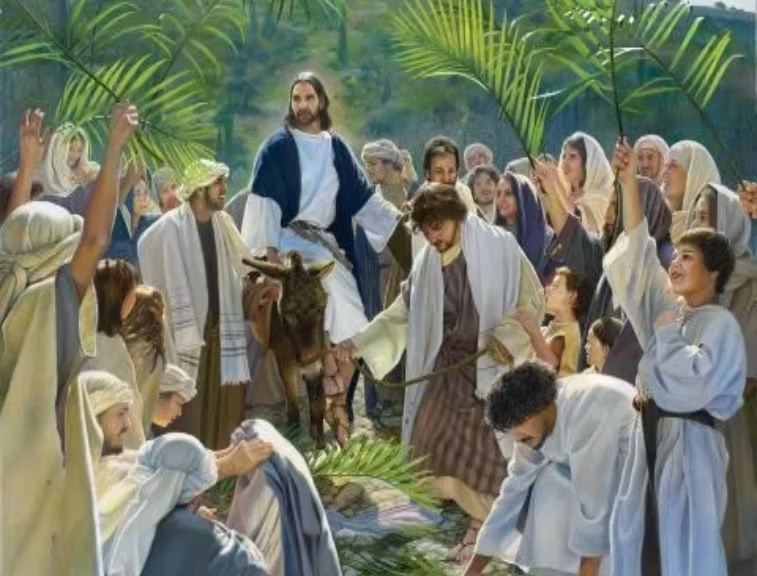
After telling a parable to the crowd at Jericho, Jesus went on ahead, going up to Jerusalem. When he had come near Bethphage and Bethany, at the place called the Mount of Olives, he sent two of the disciples, saying, “Go into the village ahead of you, and as you enter it you will find tied there a colt that has never been ridden. Untie it and bring it here. If anyone asks you, ‘Why are you untying it?’ just say this, ‘The Lord needs it.'” So those who were sent departed and found it as he had told them. As they were untying the colt, its owners asked them, “Why are you untying the colt?” They said, “The Lord needs it.” Then they brought it to Jesus; and after throwing their cloaks on the colt, they set Jesus on it. As he rode along, people kept spreading their cloaks on the road. As he was now approaching the path down from the Mount of Olives, the whole multitude of the disciples began to praise God joyfully with a loud voice for all the deeds of power that they had seen, saying,
“Blessed is the king who comes in the name of the Lord!
Peace in heaven, and glory in the highest heaven!”
Some of the Pharisees in the crowd said to him, “Teacher, order your disciples to stop.” He answered, “I tell you, if these were silent, the stones would shout out.”
——————–
This is the Gospel selection that will be read by a priest (usually outdoors), prior to the main service inside the nave on Palm Sunday, Year C, according to the lectionary for the Episcopal Church. This begins the “Liturgy of the Palms,” which will precede a singing aloud in unison of Psalm 118 verses, as there is a precession into the nave. In that song of praise David wrote, “I will give thanks to you, for you answered me and have become my salvation. The same stone which the builders rejected has become the chief cornerstone.”
In Year A the Gospel reading outside comes from Matthew 21:1-11. In Year B it comes from Mark 11:1-11. This reading from Luke offers some confusion, as to the timing of this event. That confusion can breed doubts of truth being told; so, it is important to explain away all doubts.
It is important to see that Luke tells the story of Mary the mother of Jesus, not the eyewitness accounts of the physician named Luke. The story told in Luke then shows that Mary the mother of Jesus was with him when he stayed in the safety zone that was Beyond the Jordan. Because Jesus was not safe returning to Capernaum, where his mother could be with him there, when Jesus and his disciples went in Perea, Mary went along. Thus, her story tells of the return from there, after Jesus was told of Lazarus being ill (which Mary did not witness, not tell about). That included the story of the blind man healed and the stay with Zacchaeus in Jericho. So, when verse twenty-eight says, “After telling a parable to the crowd at Jericho, Jesus went on ahead, going up to Jerusalem,” that one verse becomes a separation from those verses that follow.
Because Jesus returned with his disciples for the purpose of the Passover coming soon, he came back well prior to his entrance into Jerusalem. His disciples stayed in Bethphage (a house, not a town), while Jesus went into Bethany (a town, as well as a the house of Mary, Martha, and Lazarus), where he raised Lazarus from death. The disciples did not witness that event, so neither Matthew nor Mark wrote about that miracle. Luke also does not write about it; so, that means Mary must have met her brother-in-law Clopas (or Cleopas, brother of Joseph) and his wife Mary, who escorted Mother Mary from Jesus being with the disciples in Bethphage, to Emmaus. Jesus then left Bethphage to raise Lazarus; and, following that was a dinner given in Jesus’ honor at Simon the leper’s house, where Matthew, Mark and John told of Mary Magdalene pouring nard on Jesus’ feet, rubbing the perfume in with her hair. Mother Mary was not a witness to that event; so, Luke did not write about it.
This means that when Luke wrote in verse twenty-nine: “When he had come near Bethphage and Bethany, at the place called the Mount of Olives, he sent two of the disciples,” this is telling of a subsequent time, when Mother Mary (along with Cleopas and wife Mary had returned to meet up with Jesus again, in order to all enter Jerusalem as one large group (with a large group meaning it was safer for Jesus). It is imperative to realize that separation of time, supported by the other Gospel stories, so there is no confusion here, thinking Luke is telling contradictions to the other Gospels.
A while back, most likely when Palm Sunday was in Year B, where the entrance into Jerusalem story is told in Mark 11, I was not writing regular commentaries then; but I read the Liturgy of the Palms then and was moved to investigate that reading. I wrote and published on my WordPress blog this report on Mark 11:1-11. That report has been moved onto my Katrina Pearls website (R. T. Tippett), so it can be found only there. In it, I had a dawning of understanding, as to why archeologists cannot determine where a settlement named Bethphage was located. I realized it was not a town, but a house.
The Hebrew word “bayith,” which becomes transliterated as “bet” or “beth,” when combined with another word. As such, “Bethany” means “House Of Answer, Business, Affliction, Singing,” while “Bethphage” means “House Of Unripe Figs.” Because Bethany is known to be a town (and still is today, called Al-Eizariya – “Place of Lazarus”), but Bethphage is a mystery location, the name explains that it was one of the houses of the vicinity that was the town Bethany, but it was owned by a family who grew figs. This becomes a name of a place that becomes explanatory as to why the disciples would stay there (camp or lodge) and why Mother Mary, Cleopas and Mary would join other family there, before entering Jerusalem.
The dawning came to me that all fruit initially appears in an unripe state. No fruit stays in that state, as all fruit on trees ripens and falls to the ground, where it rots and turns to seed, unless the fruit is picked. Because the Passover festival begins a commanded counting of the gathered produce of the land, fifty days these offerings would be placed in a designated area of the Temple in Jerusalem, where a priest would oversee their maturity (fruits, grains, oils and wines), until declared fit for consumption on Pentecost. All “first fruits” would be gathered in an unripe state; so, there was one estate in Bethany that was known for its fig trees and being where unripe figs would be gathered in omer baskets and ceremoniously taken to the Temple in offering. That harvesting of the unripe figs would be what the disciples did for the time Mother Mary was in Emmaus; but she and her relatives would come to carry baskets of unripe figs to the Temple. Therefore, that explains why this entrance into Jerusalem was not unusual, other than the fact that Jesus knew this would be his final entrance there, before his death; meaning he was the sacrificial lamb being offered, with his disciples being the unripe fruit that would mature on Pentecost.
As for the other detail that Luke writes of, which are mirrored in the accounts of Matthew and Mark, I beg you to read the linked commentary of Mark 11, which is entitled “Understanding Bethphage, a donkey colt, and palm branches.” It is an informative read, one which I will not repeat, knowing this Gospel selection will only be read outside on Palm Sunday, where priests are known to do no sermons of explanation. Instead, I will make a couple of observations that have come to me since I posted my prior commentary.
The first new insight that comes to me is relative to Jesus sending two disciples to a village (on the other side of the peak of Mount Olivet from Bethany), where the Jericho Road split, going to both that village and to Bethany, before joining together again, going down the mount to the Kidron Valley crossing below Solomon’s Temple (the Portico above). Jesus told them to say, if asked why they were untying a colt (and they were asked, so they said what Jesus told them to say), “The Lord needs it.” [NRSV translation] That needs further discussion.
Because Luke’s Gospel (like the other three) is in Greek, there is a disconnect between the Hebrew statement of “Yahweh” and the English translation as “the Lord.” In Greek the word for “Lord” is “Kyrios,” where a slave would call his “master” the lower-case spelling: “kyrios.” This means the capitalization in the Greek scriptures always denotes a divine elevation in meaning, such that “Lord” [“Kyrios”] becomes confused. One is forced to hear Jesus give his disciples a command to say “the Lord needs it,” so it is easy to think “Lord” means Jesus was identifying himself as who needs the colt. Readers think Jesus told his disciples to tell some prearranged friends of Jesus – those who worked for him or followed his commands – “Jesus needs it.” That works until we reach the point of the reading where the people begin singing from Psalm 118 (the accompanying Psalm for this reading).
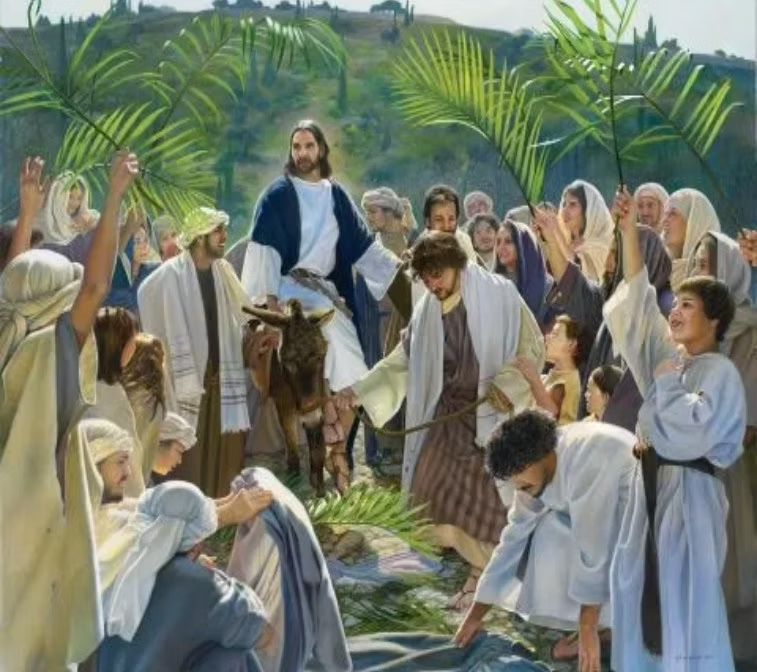
In an idyllic Christian world, where everyone lazes about on pillows, being fed grapes by cherubs, every word of Scripture is spoken by the Biblical characters in English paraphrases. Christians love how ancient Israelites sang songs in a yet invented language – the only one American Christians know. American Christians walk in precession from an outdoors setting, where pieces of palm leaves are passed out and everyone begins reciting Psalm 118 in English. In verse 26 they all recite: “Blessed is he who comes in the name of the Lord; we bless you from the house of the Lord.” American Christians then imagine themselves reenacting that scene in ancient Jerusalem, where everyone said “Lord.”
The reality is Jesus spoke Aramaic, as did all his disciples and family members. When they went down the hill and crossed over to the road that went along the eastern wall, a boundary for the City of David, the words sung by the Jews were in Hebrew, so “Yahweh” was sung, not “Kyrios.” The people all knew Psalm 118 and sang loudly, “bā·rūḵ hab·bā bə·šêm Yah·weh.” When that realization is made, Jesus then told his two disciples to go into the village and untie a colt that had never been ridden, and if anyone asked (and they did), tell them, “Yahweh needs it.” After all, that is the truth. Yahweh had spoken through the prophet Zechariah, which prophesied “your king comes to you … humble and riding on a donkey, on a colt, the foal of a donkey.” So, Jesus had nothing to do with needing a donkey colt. His Father needed it, so Jesus could fulfill prophesy.
In both Matthew and Mark (not Luke or John), after Jesus had entered Jerusalem and left to return home (to Bethany), we are told of Jesus going to a barren fig tree, cursing it, causing it to wither and die. It should bot be seen as disconnected from the meaning of Bethphage. The fig tree must be seen as one of that “House of Unripe Figs.” In the botany of fig trees, those which bear fruit only do so for thirty-five years. Before they mature so they can begin to bear fruit (those species that are fruit bearing), it usually takes five years before a new fig tree gives forth fruit. Knowing this, it should be seen that: a.) the fig tree was not one owned by anyone other than a family who knew Jesus well; b.) the fig tree was not new and should have produced at least one unripe fig that had not been picked for offering; and, 3.) the fig tree was barren, so it was wasting good soil that could be where a new fig tree would be planted.
As a Gospel reading given ‘air time’ in a limited capacity as the liturgy of the palm, it should be realized to bear the fruit of meaning that is still of Lenten value. That value is to realize Lent is not only a testing of self, because other selves are likewise being equally tested at the same time. The test of Lent is to understand passing does not make one king of the world. Instead, it makes one willingly display how humble and lowly one is, in service to Yahweh. When “some Pharisees asked Jesus to make the people stop singing,” it was because everyone knew Jesus was making a mockery of those who ruled over the people. The test of Lent is about one’s commitment to serve Yahweh; so, when comes and says, “Yahweh needs it,” you are tested to believe that is the truth.


 Explaining the Readings