
Jesus said, “Then the kingdom of heaven will be like this. Ten bridesmaids took their lamps and went to meet the bridegroom. Five of them were foolish, and five were wise. When the foolish took their lamps, they took no oil with them; but the wise took flasks of oil with their lamps. As the bridegroom was delayed, all of them became drowsy and slept. But at midnight there was a shout, ‘Look! Here is the bridegroom! Come out to meet him.’ Then all those bridesmaids got up and trimmed their lamps. The foolish said to the wise, ‘Give us some of your oil, for our lamps are going out.’ But the wise replied, ‘No! there will not be enough for you and for us; you had better go to the dealers and buy some for yourselves.’ And while they went to buy it, the bridegroom came, and those who were ready went with him into the wedding banquet; and the door was shut. Later the other bridesmaids came also, saying, ‘Lord, lord, open to us.’ But he replied, ‘Truly I tell you, I do not know you.’ Keep awake therefore, for you know neither the day nor the hour.”
———————————————————————————————————-
This is the Gospel selection from the Episcopal Lectionary for Year A, Proper 27, the twenty-third Sunday after Pentecost. It will next be read aloud in church by a priest on Sunday, November 12, 2017. It is important because of the warning of preparedness, as told in the parable of the ten bridesmaids.
This parable seems quite straightforward, in the sense that it paints a clear picture of being prepared for when the bridegroom comes, which appears to be Jesus in allegory. Of course, nothing is Scripture is that simple, as there is deeper meaning always embedded in the specific verbiage used. Every word coming from Jesus, and remembered by Matthew, came from the All-Knowing Mind of God. Each word of Greek is perfectly chosen.
In fact, one can see such knowledge as allegorically mentioned in this parable, as the oil that the lamps burn for light. Light is metaphor for the truth. One assumes that some oil is already in the lamp, which had been lit in the evening. By there being ten different lamps, this becomes metaphor for ten different ways the same words written in Greek can be made available to “light” one’s way in translation. However, meditation that goes beyond the apparent and ponders the scope of meaning that is possible from the Greek, then that acts as an extra “flask of oil” from which the “light” of truth can shine.
This Gospel reading is presented on the same Sunday as the story I interpreted about Joshua, who in his last year of life told the leaders of the Twelve Tribes, “Choose to serve God, or choose to serve the gods of others.” It also goes along with the first letter Paul sent to the Christians of Thessaly, where he wrote words that were read in church as saying “died,” but in reality three times the word implying death was used, metaphorically saying, “having fallen asleep.”
Can you see how this parable strongly links to those themes, when the bridesmaids have fallen asleep, with half having extra oil, and half only having the oil that was already in their lamps? Can you see how “to become drowsy and sleep” is the same metaphor of death? Can you see Jesus telling a parable that warns to be prepared for that time of death, which all mortals cannot escape?
In the interpretation I wrote referring to 1 Thessalonians 4, I wrote how one only needs to look at the parables that Jesus told and place oneself in the story “as the fools,” rather than as Jesus – the one telling the story. I had not read this Gospel accompaniment at that time; but as I prepared to write this, I saw the word “fool” used. Exactly as I stated prior, one has to ponder, “How am I one of the five bridesmaids that were foolish?”
This brings us back to the point that I have made previously, where we are all called to marry the King (and become his Son), as was the allegory in the parable of the Wedding Banquet. That thought, humanly mistaking the proposal to be to marry Jesus, causes manly men to stand up and pronounce, “That is gay! No man can marry another man!” Meanwhile, all the female Christians (especially Roman Catholic nuns and nuns of other denominations) gleefully proclaim, “I am already wearing the ring of marriage to Jesus Christ!”
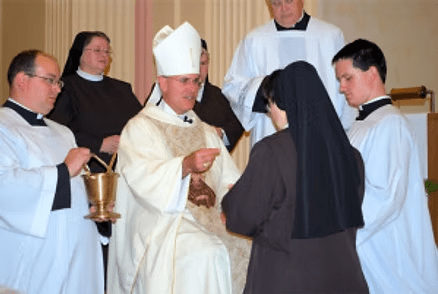
As I have said, sex organs play no role in spiritual matters. When Jesus told Nicodemus that being reborn did not mean finding some physical way to get back into the mother’s womb, he was heard saying, “Truly, truly, I say to you, unless one is born of water and the Spirit he cannot enter into the kingdom of God.” (John 3:5) Jesus was not talking about bridesmaids being exclusively females because sex organs are not “born of water and the Spirit.” That says “water” is symbolic of “love,” and “the Spirit” is the Holy “Spirit.”
Love of God brings the Holy Spirit, as the marriage of the Son to the human being of faith, devotion, and submission – the traits of God’s bridesmaids. That marriage of one’s heart with God – a Holy Union – in turn allows one entrance into the Kingdom of Heaven. That was what Jesus was talking about to Nicodemus – being reborn is what gains entrance into God’s Kingdom (Heaven). Therefore, the bridesmaids are symbolic of Christians that have sacrificed their self-egos, to be married to God.
In this way, anyone who thinks like Nicodemus and wonders how an old man can get back into his momma’s womb (via momma’s sex organ) is as “foolish” as a bridesmaid without extra oil for a lamp. Think of it as some male Christian saying he will marry God and have God’s baby Jesus Christ be born in him, but then that “fool” never gets the extra oil of Scriptural knowledge, to help him through the threshold of death, or “having fallen asleep” like Lazarus (the one Jesus loved) did.
When we read, “When the foolish took their lamps, they took no oil with them,” one can assume they took a lamp that had some oil already in it, so the lamp was able to shine a light for a few hours. All ten bridesmaids have lamps, so the similarity means all ten are led by the light of religion. That religion represents belief in the One God, YaHWeH, the LORD. So, they are either Jewish lamps or Christian lamps today, while Jesus was talking to Jews then.
Simply by having a lamp does nothing for anyone, so being Jewish or Christian in name only (by birth), with no knowledge of what that means as an adult, means one is not deeply committed to God. No holy light leads one’s path through life. One is (figuratively) still “playing the field,” and “keeping one’s options open.” One is a bachelor-bachelorette and not a bridesmaid (remembering that sex organs do not matter).

The oil that is already in the lamps should then be seen as one’s personal knowledge of what one’s religion says to believe. As such, all active Christians carry the knowledge that fuels the light that shines faith in God. Jews carry around lamps that are full of the oil that reflects memorizing 613 commandments, sent from God through Moses. In this way, the extra oil that five of the bridesmaids have with them is the oil of the New Testament, which fuels the light that shines faith in Jesus Christ, as the Son of God. The foolish bridesmaids do not carry that extra oil.
Still, the five foolish bridesmaids can be broken down into five different types of Christians and Jews. These can be compared to the seven churches, to which the Spirit of Jesus told John to write letters (in The Revelation). The Jews that reject Jesus as their Messiah, while remaining devout in their adherence to the laws of Moses, simply do not have that extra oil needed to get them beyond death, into Heaven. This was the reason Jesus preached in parables to such holy Jews in Jerusalem, to no avail. But, Christians who mirror those Jews in Jerusalem today, who maintain devotion to amassing fortunes and things, through a misguided belief that God blesses His believers with things, they are not being filled with God’s Holy Spirit; and that means a “foolish” waste of holy oil.
When the ten had waited so long they had “became drowsy and slept,” this then states symbolically that the “delay” leading to that point of rest was a lifetime of waiting “to meet the bridegroom.” The Greek word that is translated as “slept” is “ekatheudon.” That is rooted in the word “katheudó,” which Thayer’s Greek Lexicon states is used: euphemistically [as], “to be dead,” and metaphorically [as], “to yield to sloth and sin, and be indifferent to one’s salvation.”
This hints at the weights placed upon human beings, as mortals, such that the “drowsiness” is brought on not only by the deterioration of bodily parts, from age, but the weariness that comes from denying oneself the lures of the world (being faithful and true to the bridegroom), as well as succumbing to them (secretly cheating on one’s verbal commitment). It is a lifetime of temptation to worldly things that wears one out and makes one tired.
To then hear Jesus say, “At midnight there was a shout, ‘Look! Here is the bridegroom! Come out to meet him.’ Then all those bridesmaids got up and trimmed their lamps,” the symbolism of “midnight” has to be grasped. The actual Greek words written are “mesēs de nyktos,” which says, “the middle of the night.” That can be simplified as “midnight,” but a viable implication of “nyktos” (from “nux”) can be “midnight,” by itself. As such, the simplification makes one miss the point of the word “mesēs” (form of “mesos”), where “in the middle” becomes less a statement of time of day, and more a statement about being in transition, from life to the afterlife, when “in the middle” means the transition of death.
Seeing “the middle” from that perspective, then one can grasp how death is that period of darkness when an absence of light surrounds one’s soul. This is termed “spiritual dryness,” but St. John of the Cross, OCD, wrote a poem that has been called “The Dark Night of the Soul.” An article on that poem and its topic explains: “The term “dark night (of the soul)” in Roman Catholic spirituality describes a spiritual crisis in the journey toward union with God.” The same “crisis towards union” can be seen in this parable told by Jesus.
Jesus, the teller of this parable, said, “There was a shout, ‘Look! Here is the bridegroom! Come out to meet him,’” which can be read as Jesus Christ making that cry of alert. Seeing that as the voice of the Christ Mind exclaiming, “Good News!” is then confirmed when Jesus said at the end of this story, “Keep awake therefore, for you know neither the day nor the hour.” This is clearer when the Greek text is found to add, “in which the Son of man comes,” (“en hē ho huios tou anthrōpou erchetai“), words with translations omitted, as they have not been included in the NASB translation above.
This parable then projects the future, when Jesus told his followers, while on the other side of the Jordan, about the death experienced by Lazarus. Jesus said, “Our friend Lazarus has fallen asleep; but I go, so that I may awaken him out of sleep.” (John 11:11) That parallels this story that tells allegorically of vigilance. The Lazarus story ended when we read, “There was a shout,” as John wrote, “He cried out with a loud voice, “Lazarus, come forth.’” (John 11:43)
The slumbering bridesmaids were awakened by a shout to “Look!” or “Behold!” or “See with the Mind of Christ!” (which is the intent of “horaó”). In both stories, the command was to “Come out,” which is an invitation to leave the darkness of death, but also the darkness of mortality. That command is to enter the heavenly realm of eternal life.
Kate Bush Video Waking the witch
In the statement, “Then all those bridesmaids got up and trimmed their lamps,” the Greek word “ekosmēsan” is translated as “trimmed.” It is the past tense of the word “kosmeó,” which means “to order, arrange,” implying “I put into order; I decorate, deck, adorn.” The word “trimmed” is then used like “trimming the Christmas tree,” and not like cutting a wick, or pulling the wick of a lamp out, so it can be re-lit. According to Thayer’s Greek Lexicon, this specific usage implies “to put in order,” as well as “to make ready” and “prepare” the lamp for the meeting of the bridegroom. This is where adorning the lamp ceremoniously would mean putting the extra oil into effect, as that was what would make meeting the bridegroom possible.
We know that is the case, because we read how Jesus then said, “The foolish said to the wise, ‘Give us some of your oil, for our lamps are going out.’” Because the “fools” said that, as a command to “Give,” this makes an important point of what makes a “fool” “foolish” and not “wise.” People expect to be given Heaven. They expect to be “placed, allowed, put, bestowed, granted, and permitted” (among other possibilities stemming from “Dote,” rooted in “didómi”), rather than having to do work themselves.
Can you hear St. James saying, “Faith without works is dead”? (James 2:14-26)
One can be given many things, but entrance into Heaven (the Kingdom of God) requires the work of the wise. This means being “wise” comes from being filled with the Holy Spirit, with all the “smarts” of the Christ Mind guiding one’s works. It is that presence of the Christ Mind’s “wisdom” that gives the five “wise bridesmaids” that “flask of oil.” That “oil” anoints them with the talents of the Holy Spirit, to prophesy and to understand prophecy, which is the fuel that “lights” their way to Heaven. It is the Holy Spirit that “adorns” the “lamp” of religion and simple faith.
Matthew 11:25 writes of Jesus saying, “I praise you, Father, Lord of heaven and earth, because you have hidden these things from the wise and learned, and revealed them to little children.” There, “sophōn kai synetōn” says “cleverness importantly intelligence” is the mistake of thinking a Big Brain will be all the ‘oil’ one’s lamp needs to stay awake until the bridegroom comes. God does not come to meet those fools. God does not propose to those who fall in love with convoluted masses of synapses that only serve mortal existence. God proposes to “little children” whose faith is not hindered by the limits a human organ presents one’s soul. Children are those who are neuter gender and not those who have not become limited to love that follows the lead of a sex organ.
In one commentary that I briefly skimmed over, the refusal of the five “wise bridesmaids” to “Give” lamp oil to the five “foolish” ones was seen as selfishness or petty bickering and jealousy. This is not the case at all.

To grasp that, I want you to think now of the story Jesus told about poor Lazarus, who in life sat at the gate of the rich man, begging for the crumbs off his table. In death, it was the rich man who begged Abraham’s Spirit to let Lazarus “Give” his tongue a touch of “cool water.” When Abraham refused, because the chasm between Heaven and Hell was too wide for Lazarus to cross, the rich man still wanted Lazarus to “Give” notice to his still living brothers, so they might change their ways (which were the ways of all rich humans).
In this parable, the five “wise bridesmaids” have to be seen exactly like poor Lazarus is seen, after death. None of them were able to “Give” what was not theirs to “Give.” It was not a matter of selfishness, but the lesson that requires one earn that which one is “Given.” Lazarus earned reward, while the rich man earned punishment.
The translation presented by the New American Standard Bible (NASB) has the “wise” saying, with an exclamation point, “No! there will not be enough for you and for us.” This is not what is written. The capitalized first word of this reply is “Mē¦pote” (root being “mépote”) which means “Lest.” It implies, “Lest at any time” and “Perhaps,” with the connotation of “Not” beginning their reply (without that being exclaimed).
The Greek written literally states the reply to a command to be “Given” the Holy Spirit, in the form of lamp oil. The written words say, “Not cannot no [a triple negative] it is assistance for us and you.” That does not say there is not enough to be shared. It says there is plenty to go around, but they “cannot” “Give” that which the “wisdom” allows them to know: “not is it assistance for me and you.” The statement of reply says, “No cannot [for] it is not to suffice for us and you.” The “wise bridesmaids” knew, through the Christ Mind, that each individual must work for the unlimited shares that God has to Give.
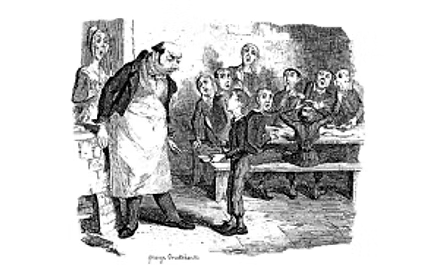
The completion of the “wise bridesmaids’” reply, “you had better go to the dealers and buy some for yourselves,” states this individual responsibility to secure the holy oil necessary, by which one can enter Heaven. The literal translation says this in two segments: “but go rather to those selling,” and then “buy for yourselves.”
When one is hearing an allegory told, it is natural to think in normal, human terms; so when one hears lamp oil needed (a commodity), then it is natural to go to a lamp oil “dealer” to purchase that. In this story, we visualize some stupid girls running in darkness, trying to get an oil shop to open up and sell them some lamp oil. However, the metaphor of “oil” is spiritual oil, or holy oil.
This means the “sellers” and “dealers” of holy oil are churches and synagogues. Therefore, the lack of work done by the “foolish” is being pointed out by those of “wisdom.” The ones who said they were “Giving” away “get to Heaven oil without working for it” I.O.U.’s are those who never “Gave” them the Holy Spirit’s “oil.” They could not give what they did not themselves have; or they refused to give what they selfishly thought they had – scholarly knowledge – not wanting ignorant commoners to be special like them. If you have the extra flask of oil and you are still alive, then you Give it away to those who seek it.
This, certainly, was a slap to the face of the Pharisees, Sadducees, scribes and Temple priests in Jerusalem, as Jesus was speaking allegorically in parable. That was because it pointed the finger of “wisdom” at the lack of spiritual competence in those religious leaders.
Nicodemus, identified by John as “a man of the Pharisees” and “a ruler of the Jews” (John 3:1), was asked by Jesus, “Are you the teacher of Israel and do not understand these things (the spiritual meaning of being reborn)?” (John 3:10) This made Nicodemus one of those getting rich off selling the “oil” of Mosaic Law; but he and his pals never had in stock (as a commodity to sell) “spiritual oil,” the kind that anoints one for entrance into the Kingdom of God.
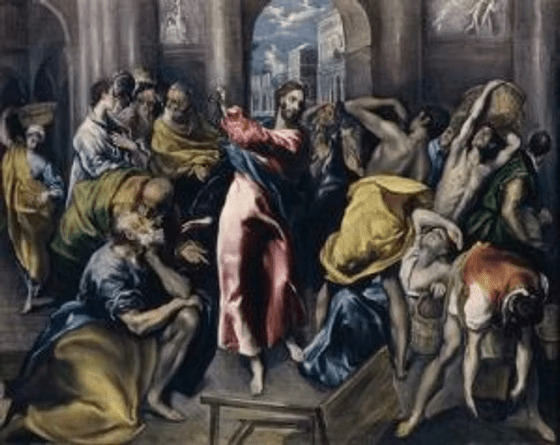
Because the Holy Bible is a Living document, that which was written in ancient times, of ancient people, still applies at all times, to all people. The eternal value of Scripture is as Paul wrote to the Hebrews of Rome: “For the word of God is living and active and sharper than any two-edged sword, and piercing as far as the division of soul and spirit, of both joints and marrow, and able to judge the thoughts and intentions of the heart” (Hebrew 4:12). Therefore, this slap at the leaders of Judaism in Jerusalem, by Jesus speaking in parable, is equally a slap at all religions professing belief in YaHWeH, the One God (the “lamps” of religion) that keep their flocks filled with costly physical “lamp oil” (like the vendors of the marketplace, selling shares of responsibility in the costs of buildings and programs), and do nothing that anoints the believers with the spiritual oil that prepares them to go beyond mortal death.
Those who are “wise” have become so by coming in touch with someone with the Holy Spirit. Jesus passed that onto his Apostles (who became Christ Jesus reborn), and they passed the Holy Spirit onto those they contacted (such as Paul and the Thessalonians). Apostles today have been led to Scripture, by those teaching programs of churches in the denominations of Christianity (readings, sermons, Bible studies, etc.); but the Holy Spirit does not come by trick or by human command.
Individuals have to show God their sincerity in wanting to become His bridesmaids-in-waiting, so that the extra flask of holy oil (the Holy Spirit) will be born within them. That rebirth of Christ Jesus in Apostles sends those Apostles out to “Give” that same opportunity to others. However, all who receive the Holy Spirit have to prove themselves as worthy, through the works of evangelism.
By the time one reaches that point of slumber, ready to meet the bridegroom they have worked so hard to please, there is no place a soul can go and “buy” or “purchase” the Holy Spirit. When Jesus said, “You cannot serve two masters. You cannot serve both God and money” (Luke 16:13), we see now how that means you cannot “purchase” a ticket to Heaven. You cannot reserve a room in the Father’s house with a credit card.
Seeing how the bridesmaids’ slumber is reference to death, after being told to go and “buy for yourselves,” the only place those five “foolish” souls could go was their own funerals.
Their souls would then hover over those grieving their passing, only to find prayers being recited over their physical corpses, as they were being lowered into the ground. Those souls then returned to the place of the wedding banquet, bringing with them the words spoken by priests, ministers, pastors, preachers, and rabbis, asking God to receive them.
Prayers are good. Prayers are helpful to the living. However, prayers for released souls are more for those left remaining in grief, than of any benefit for the dead. A prayer cannot trump the requirement of being in possession of the Holy Spirit.
Reading, “Later the other bridesmaids came also, saying, ‘Lord, lord, open to us.’ But he replied, ‘Truly I tell you, I do not know you,’” that says those “virgins” (actual meaning of the word “parthenoi,” which is translated as “bridesmaids”) had supposedly set themselves apart from other lords, as committed to marry the bridegroom (God). While they promised their hearts to God, and confessed to others that was where their hearts were, the truth exposed (“Amēn legō” – “Truly I say”) is that they never did as promised nor publicly proclaimed.
God did not know those souls intimately. They were still “virgins,” “bridesmaids” with no real, committed relationship with the Lord; AND remember – we are not talking females for marriage. ALL are “virgins” until God consummates a relationship by sending His wives-to-be His Son and His Holy Spirit. The allegory of that is there must be possessed an extra “flask of oil.” Without that to light the lamp to Heaven, God can truly say, “I have not known you (in the Biblical sense).”
You have to be reborn as Christ Jesus to gain entrance into Heaven.
Jesus then said, as the storyteller who spoke for the Father, “Keep awake therefore, for you know neither the day nor the hour.” “Keep awake” means do not die before you have become baby Jesus reborn in the flesh. Do not die before the Holy Spirit has used you as an Apostle, to bring other bridesmaids-in-waiting to the Lord.
Keep awake because you never know when death will make it too late to run to the church and get some Holy Spirit. You need to be prepared beforehand.



 Explaining the Readings