with the fruit of her hands she plants a vineyard.
She girds herself with strength,
and makes her arms strong.
She perceives that her merchandise is profitable.
Her lamp does not go out at night.
She puts her hands to the distaff,
and her hands hold the spindle.
She opens her hand to the poor,
and reaches out her hands to the needy.
She is not afraid for her household when it snows,
for all her household are clothed in crimson.
She makes herself coverings;
her clothing is fine linen and purple.
Her husband is known in the city gates,
taking his seat among the elders of the land.
She makes linen garments and sells them;
she supplies the merchant with sashes.
Strength and dignity are her clothing,
and she laughs at the time to come.
She opens her mouth with wisdom,
and the teaching of kindness is on her tongue.
She looks well to the ways of her household,
and does not eat the bread of idleness.
Her children rise up and call her happy;
her husband too, and he praises her:
“Many women have done excellently,
but you surpass them all.”
Charm is deceitful, and beauty is vain,
but a woman who fears the Lord is to be praised.
Give her a share in the fruit of her hands,
and let her works praise her in the city gates.
———————————————————————————————————-
This is an optional Old Testament selection from the Episcopal Lectionary for the Eighteenth Sunday after Pentecost, Year B 2018. In the numbering system that lists each Sunday in an ordinal fashion, this Sunday is referred to as Proper 20. If chosen, it will next be read aloud in an Episcopal church by a reader on Sunday September 23, 2018. It is important because it uses the feminine pronoun “she” and “her” as metaphor for devout human beings (of both genders) being in a committed relationship with God.
There are twenty-two verses in this selection from Proverbs. There are twenty-two letters in the Hebrew alphabet; each verse is marked by a separate letter, from aleph to tav. As such, this Proverb that has some versions of the Holy Bible identify it as “The Virtues of Noble Woman” or “The Wife of Noble Character” can be seen (somewhat) as the ‘A to Z’ of those virtuous character traits. Still, the letters bear the symbolism of their numerical numbering, from 1 to 22; and in Hebrew each number has its own symbolic meaning, which cannot be overlooked.
I welcome the reader to search the Internet for this symbolic meaning for oneself. Here is a link to one site that offers such opinion on this (Spiritual Meanings of the Hebrew Alphabet Letters). I will not be going into this aspect of this Proverb of Solomon; but it has to be recognized as present and that presence has intended meaning.
As to the summation that Solomon wrote about the qualities possessed by the perfect wife, it is easy to be misled, knowing the attraction that Solomon had to women. Having become known as having had seven hundred wives and princesses, plus three hundred concubines, one could then assume that this Proverb is based on Solomon having gotten to know many wives, concluding these are the best traits. Still, after getting to know one thousand ladies up close and personal, Solomon coming up with only twenty virtues of wives would seem to be based on the most repetitious traits he liked. However, that opinion of the noble character of a wife, or even of the concept of “woman” in general, is not the point of this writing.
One has to see that wise ole Solomon wrote this Proverb, even though he might have been smiling about all the women he knew while writing it, as a vehicle of Yahweh. The true source of this wisdom was from God, flowing through Solomon’s hands as he wrote. These words of Proverbs 31 have a divine origin, with a spiritual meaning intended to be found. There is nothing to be found in the Holy Bible that is mundane human opinion.
In the modern times, when human gender became a matter to protest publicly, there will certainly be women sitting in the pews who scoff at such male chauvinistic views as had Solomon. I doubt female priests will write lengthy sermons about this reading selection, unless driven by personal agendas that would misuse it to promote same-sex marriage between two women. Such views as promoted wives being subservient to their husbands, as is still prevalent in Muslim culture, is now seen in the West as having set womanhood back thousands of years. Still, that is the human opinion of divine writings misunderstood. The true meaning has to do with this writing being about the perfect servant to the Lord, where all the feminine pronoun usage points to Man (which includes woman).
I have written about this repeatedly, where those who want to achieve Heaven must submit to God and become His wife. This has absolutely nothing to do with human gender. No human being is going to know God through his or her sexual organs. God did not care what type of women floated Solomon’s boat; but He made it be known what a true servant of the Lord will do.
This translation is not completely accurate, throughout this long song; so I will not be spending thousands of words correcting those mistakes. To give one example, the translation of “jewels” comes from “mip·pə·nî·nîm,” which could be shown to state “rubies, corals, or pearls.” To read “jewels” then leaves it up to the women who look for their value in huge diamonds placed into fine gold engagement rings. From that speculation, a verse focused on “capability” (from “ḥa·yil,” also read as “virtue”) is reduced to a value that crawls along the material plane, missing the spirituality of this wisdom.
From one example, I am not about to correct all the errors of a translation that begins with a premise (a preconception) that Solomon was giving guys advice on how to find the right girl, and in the process putting the seed of thought into the minds of girls that a good wife dotes on her husband … for trinkets. Everything that leans in that direction is wrong.
I wonder which ones have the Holy Spirit talents in them? No shaking before opening!
This song must be read as God speaking to YOU, whoever YOU are – male, female, or child [neuter gender]. YOU have to know what God requires in His wives, regardless of what sex organs God gave you, and regardless of what other human beings make your sex organ tingle with delight. As such, YOU are “She” and “her.” YOU have to see that.
We call God the Father, despite how many women’s rights freaks try to twist that masculine principle into a misconception that promotes people should think, “God can also be a Mother.” That is false.
“God” means Masculine. “Goddess” means feminine. God is not a goddess, just as man is not a woman. There can still be equality in inequality. Equality is complimentary. As such, the Earth is the goddess who received God as her husband and gave birth to bags of dirt that were filled with souls. God, therefore, is the Father of life on Earth, with all life (as we know it) having Earth as its Mother.*
So it is written:
“I also said to myself, “As for humans, God tests them so that they may see that they are like the animals. Surely the fate of human beings is like that of the animals; the same fate awaits them both: As one dies, so dies the other. All have the same breath; humans have no advantage over animals. Everything is meaningless. All go to the same place; all come from dust, and to dust all return. Who knows if the human spirit rises upward and if the spirit of the animal goes down into the earth?’” (Ecclesiastes 3:18-21)
Nope. Just a bag of dust struck by lightning.
When one realizes how Jesus said, “So they are no longer two, but one flesh. Therefore what God has joined together, let no one separate,” (Matthew 19:6) this means the feminine of the Earth Mother is the flesh of a human body that has become one with God the Father via a soul of life being present in that flesh. It is the human equivalent of DNA, where a child is the combination of two parents that cannot be separated. Simply because of this reasoning, ALL human being bodies of flesh are feminine. Since that means we human beings are all ‘girls’ here, we are all potential “wives” to God.
That is all I have to say. I recommend each reader to go to the Bible Hub Interlinear website (here) and slowly read what was written, and investigate the full breadth of meaning each word contains. See if YOU can see yourself as meeting all these noble characteristics.
Take note that the second verse (the Beith letter verse) speaks of a husband’s heart having full trust in his wife. This is the love one has to have, in order to have a proposal of marriage made and be accepted. Love is the attraction that is essential. Therefore, the beith symbolism is: “The beginning of duality, with the One Creator bringing forth a created world.”
Two have cleaved together to make one, through love.
This is the result.
If one does not have a true love of God in one’s heart, one is not good wife material for Him. If YOU can feel this love, then take the time to see how the wisdom of Solomon used the next twenty verses to spell out what “She” (YOU) does for God.
With love, the work that comes from being in love with God becomes a joy. It is the works of an Apostle.
———-
* Footnote: God – Yahweh – did not create mankind – male and female in His image. God’s elohim created those ‘ordinary’ human beings. Therefore Yahweh is notthe Father of all humanity. Yahweh is the source of all souls. Yahweh is the one who orders souls to control bodies and join egg and sperm and split cells for growth of life-to-be. Souls are elohim. Yahweh is only the Father of holy human beings that are filled with the Holy Spirit of Yahweh and with each transformed from ‘ordinary’ human being into His Son reborn. Only Sons, again, as human gender is meaningless. Sons means the Spiritual association of gender, opposite the material association of gender. Call it positive-negative or external-internal, if you like – opposites. A man and a woman can each be reborn as Jesus Christ (a “Christian”), becoming “brothers and sisters” in the name of Jesus Christ – Sons of God.
In the days when the judges ruled, there was a famine in the land, and a certain man of Bethlehem in Judah went to live in the country of Moab, he and his wife and two sons. The name of the man was Elimelech and the name of his wife Naomi, and the names of his two sons were Mahlon and Chilion; they were Ephrathites from Bethlehem in Judah. They went into the country of Moab and remained there. But Elimelech, the husband of Naomi, died, and she was left with her two sons. These took Moabite wives; the name of the one was Orpah and the name of the other Ruth. When they had lived there about ten years, both Mahlon and Chilion also died, so that the woman was left without her two sons and her husband.
Then she started to return with her daughters-in-law from the country of Moab, for she had heard in the country of Moab that the Lord had considered his people and given them food. So she set out from the place where she had been living, she and her two daughters-in-law, and they went on their way to go back to the land of Judah. But Naomi said to her two daughters-in-law, “Go back each of you to your mother’s house. May the Lord deal kindly with you, as you have dealt with the dead and with me. The Lord grant that you may find security, each of you in the house of your husband.” Then she kissed them, and they wept aloud. They said to her, “No, we will return with you to your people.” But Naomi said, “Turn back, my daughters, why will you go with me? Do I still have sons in my womb that they may become your husbands? Turn back, my daughters, go your way, for I am too old to have a husband. Even if I thought there was hope for me, even if I should have a husband tonight and bear sons, would you then wait until they were grown? Would you then refrain from marrying? No, my daughters, it has been far more bitter for me than for you, because the hand of the Lord has turned against me.” Then they wept aloud again. Orpah kissed her mother-in-law, but Ruth clung to her.
So she said, “See, your sister-in-law has gone back to her people and to her gods; return after your sister-in-law.” But Ruth said,
“Do not press me to leave you or to turn back from following you! Where you go, I will go; Where you lodge, I will lodge; your people shall be my people, and your God my God. Where you die, I will die— there will I be buried. May the Lord do thus and so to me, and more as well,if even death parts me from you!”
When Naomi saw that she was determined to go with her, she said no more to her.
———————————————————————————————————-
This is an optional Old Testament selection from the Episcopal Lectionary for the Twenty-fourth Sunday after Pentecost, Year B 2018. In the numbering system that lists each Sunday in an ordinal fashion, this Sunday is referred to as Proper 26. If chosen, it will next be read aloud in an Episcopal church by a reader on Sunday November 4, 2018. It is important because it tells how all who love God must be as devoted as was Ruth.
I need to be honest here for a moment.
Whenever I hear the name Ruth, my mind immediately goes to The Firesign Theatre [a comedy group from the late 1960’s and early 1970’s … and beyond] and an audio sketch they did on their album How Can You Be in Two Places at Once When You’re Not Anywhere at All. Side two of that record was a mock of a fictitious 1941 radio serial “The Further Adventures of Nick Danger.” As that supposed radio re-broadcast began and the narrator was building up the suspense of the play, he spoke of the bravery of the private detective, Nick Danger. As the narrator boldly spoke, “ruthlessly,” the character muttered, “I wonder where Ruth is.” That comedic line struck me as so funny that I cannot help but remember it whenever someone says, “Ruth.”
Now, the mother of my best neighborhood friend while growing up was named Ruth. I never think of her when the Book of Ruth is mentioned by anyone. I think of that gag from The Firesign Theatre because the only time I hear of the Book of Ruth is when the Revised Common Lectionary devotes two Sundays into optional readings from Ruth, of which the reading above is the first. The Episcopal Church only reads from Ruth during Year B.
While a member of one large Episcopal church, there was a female priest [one of two, with a head priest that was male] who led a women’s Bible Study on Wednesday afternoons. One year the group’s discussions focused on the Book of Ruth. I assume [or heard mentioned] the Book of Ruth was important for women to understand. Being forbidden from attending that study group because I am male, I have no idea why that was.
Personally, I felt that Bible study segregated by gender was wrong, as it shunned the sharing of insight with men. I still feel that way. To have a Bible studies group led by a female priest was certainly not a problem, as gender does not prevent or assist one, as far as having the Holy Spirit’s guidance to understanding Scripture. To have a mid-week study group be led by a woman priest and only teach women made me imagine that women must feel a need to get together and discuss ‘women needs from Scripture’ was from a need to find strength dealing with and maintaining a wife’s subservience to a husband. If it was not that, then I wondered if it were a private revolutionary programming of women, against the male dominated world, in an ever-changing Women’s Power indoctrination. Neither would be a worthwhile agenda for a Bible studies group.
Happily, I did not dwell long on being outcast from that Bible study that focused on the Book of Ruth. I kept saying to myself, “I wonder where Ruth is.”
Still, for all who are familiar with my interpretations that say all true Christians are “brothers,” which means males and females are both reborn as the Sons of God [Jesus Christ] and all who are familiar with my having stated that all true Christians are the wives of God, regardless of human gender, Ruth is likewise meant for both human genders to see as a model of themselves. It is a great flaw in this modern version of Christianity that relegates women as nuns and males as priests. It is not meant for only males to speak for the Father, such that male priests are called “Father,” while female priests are downgraded to “Mother” status [a pagan title that bears importance, more than a designation of a woman who heads a convent]. Alas, women in leadership roles in Christianity are still hard to classify, simply because of self-imposed human gender issues.
Rather than one outhouse, indoor plumbing has created the need to gender identification rooms.
Everybody who reads the Book of Ruth needs to go beyond those gender issues and see him or herself as Ruth, a devoted wife of God. In this beginning to the story of Ruth we are given a background scenario. While all of this should be read as truth and many encouraging elements of this story told can be beneficial to women that struggle for a voice in a male-dominated world, the story has to be raised to a higher level of truth, where metaphor and symbolism must be understood. None of this has anything to do with human sexuality or gender.
The first thing one should be aware of is Scripture is always about YOU. An event that occurred long ago (which scholars may battle over whether or not it actually happened, saying it might have been made up) is meaningless history, unless it has bearing on life today. This is why all the characters of the stories are in some way reflections of what one needs to see in oneself, mostly that which needs to be corrected.
When that set of eyes become focused on this story, one should see how “In the days when the judges ruled” is relative to these days, when the children of Israel [i.e.: Christians today] are not individually led by the Holy Spirit. The “judges” (from the Hebrew “haš·šō·p̄ə·ṭîm”) are those men (and women) who the people [i.e.: Christians] accept as those who graduate from seminaries and are elevated through years of service as the voices of God. Such “judges” today range from popular televangelists, to best-selling book authors and megachurch pastors, to a South American socialist pope and to a rising number of bishops who are known more for their race, gender, and/or sexual preferences than they are known for teaching others to be filled with the Holy Spirit.
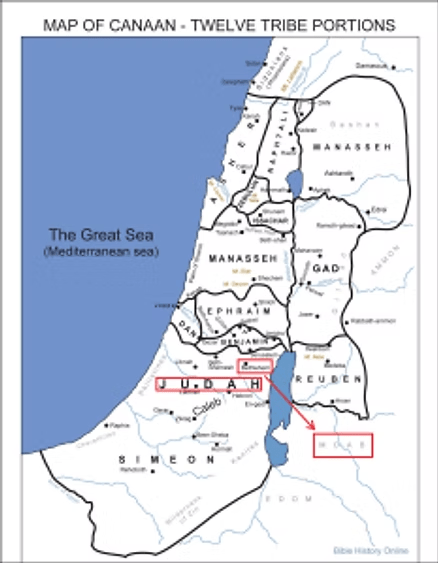
That grasp of current religious trends fits into the times when Canaan was filled with Israelites, in Twelve Tribes, whose religious leaders were spread about to all the nooks and crannies of the land where those people had been dispersed. While the Book of Judges focuses on the series of rescuer judges, there were an untold many who were quite slack in their righteous judgment, so the people invariably backslid into sinful ways. It was the punishment of those sins (by those who despised their land being stolen by foreigners) that kept leading the faithful to their knees, where they cried out to God for mercy and redemption. The Book of Ruth is telling of one of those down periods, when “there was a famine in the land.” There is currently such a “famine” in Christianity; but no one is crying out for redemption, as they are too busy crying out for the blood of their political enemies.
When we read, “a certain man of Bethlehem in Judah went to live in the country of Moab,” it is important to know that “a certain man” is a generic way of identifying a known person, but one who is too young to name. The Hebrew word that is translated as “a certain man” is “’îš,” which is rooted in “ish,” meaning “man.” When one knows “adamah” is another Hebrew word for “man” [actually meaning “red” or “clay,” which is then combined with “ish” – “clay man”], “a certain man of Bethlehem in Judah” is known today as Jesus.
When “Moab” is known to be the land settled by Lot in Genesis and not part of the Promised Land of Abraham, this should be grasped on today’s terms as a land of Gentiles, albeit a land that welcomed Israelites. The United States of America (as well as all nations where Christianity has been accepted) is where Gentiles have welcomed Jesus into their midst. While the religious values of Moab were different than those handed down by Moses to the Israelites [pagan rituals that were rooted in multiple deities], the marriage of Christian rituals with pagan rituals becomes a reflection of the how the Roman Catholic Church won over pagans by adhering Jewish festivals to pagan holy days, creating a new religion that was led by “judges.” Still, that religion is caused by “famine.”
Realizing that, this is where the names of the characters have meanings that perfectly relate to today’s Christians. Here is a list of the players:
Elimelech = God Is King. Naomi = My Delight; Pleasantness of the Lord Mahlon = Great Infirmity; Man of Weakness; Sickly Chilion = Wasting Away; Pining; Consuming Orpah = Mane; Neck Ruth = Beauty
With that known, look at how the story unfolds.
Jesus is given the name that means “God Is King.” Jesus is married to his followers, who were Jews initially, who take on the name that projects the “Pleasantness of the Lord.” The sons that were born of the marriage between Jesus Christ and Apostles – Saints in the name of Jesus Christ – were the synagogues of Judaism that believed Jesus was their Messiah and the churches of Christianity that were created by Gentiles believing that Jesus was the Christ. One religion is then named “Great Infirmity” and the other is named “Wasting Away,” which indicates a weakness seen in both of them by their Father, when they were born.
The “Great Infirmity” in Judaism is it sought to remain one with the Jews, while not being welcoming to Gentiles. The same exclusivity can be seen in the Roman Catholic Church, such that it refuses to recognize non-Catholics as worthy to receive sacramental rites. James, the saintly brother of Jesus, tried to convert Jews, so all would realize the faith of God’s people had been rewarded by Jesus Christ. The Mosaic Law and all the expectations of the remnant of Israel were to be upheld; and, due to the fact that the Christian Church accepted Gentiles, there was little reason to convert Gentiles to Judaism, a form that converted Jews to belief in Christ. The “Sickly” aspect of Judaism was its Zionist branch, which saw the return of national status, through the possession of the Holy Land, as why God chose the children of Israel.
The “Wasting Away” was then Christianity. The strength of Judaism was it being considered a race of bloodline. While its numbers would stay relatively low compared to all in the human race, it would grow in numbers. Its weakness was always having the “Great Infirmity” of works, where their self-imposed restriction to fellow Jews kept their Christian numbers “Sickly” low. Christianity, on the other hand, would grow by leaps and bounds, but then reach an apex that began a slow and steady decline.
“God Is King” saw those ends coming, when he gave his children those names. We are living today in the aftermath of those two children having passed away. Still, Jesus knew his own death would be prior to those deaths.
When the story tells, “But Elimelech, the husband of Naomi, died, and she was left with her two sons,” this is not a reference to Jesus of Nazareth being crucified. There is no death, but a period of transformation and change, where the initial spread of Christianity ended. It says that Jesus Christ would be removed as the husband of Apostles and Saints, which had the effect of stripping the wife, “Pleasantness of the Lord,” from passing on the Holy Spirit directly. At that time, Saints became only recognized through the two religions of Jesus Christ.
When the story says, the two churches “took Moabite wives,” this is a marriage with the pagan Gentiles that took place in Western Europe and the Middle East (including Eastern Europe). This was during the Jewish diaspora from Judea, following the Roman destruction of Jerusalem and the defeat of the Jews in the Jewish–Roman wars (66 – 135 CE).
The wife of “Great Infirmity” was then “Mane” or “Neck,” which traveled the shortest distance. Nearby lands were where the seven churches listed in John’s Apocalypse were. Those people extended into the surrounding areas: Greece, Turkey, Armenia, Syria, Romania, and into Mesopotamia, Persia and lands to the north and east. The husband of the Middle East and Eastern Europe was the Eastern Orthodox Church and all the variations thereof. The Jewish religion became absorbed in that “Neck” of the world.
Could this be the neck with a European head and Asian body?
The wife of “Wasting Away” was then the “Beauty” of Northern and Western Europe. The husband of Northern and Western Europe was then the Roman Catholic Church. The Jewish religion also became absorbed by the “Beauty” of Roman culture and architecture.
In both areas, the people had been cut off from directly being in touch with Jesus Christ, which is the symbolism of that change that came from institutions of ritual. With the destruction of the Temple in Jerusalem (the famine that sent Christianity into the surrounding world), the people were no longer taught to be filled by the Holy Spirit by Apostles and Saints. Following that historic change, the two churches that were already destined to likewise transform and change did so. They both died, as no longer being powers of influence.
When the story tells, “the woman [Naomi – “Pleasantness of the Lord” – the Apostles – Saints] was left without her two sons and her husband,” there was no longer any association with an organized religion promoting access to God’s Holy Spirit. This state of divine “Pleasantness” was then left in the company of Gentile converts to Christianity, but the weaknesses that were inherent in the two churches had failed to elevate the people to Apostle-Saint status. They were merely followers of a religion that promoted belief, without teaching how to be reborn as Jesus Christ – knowing “God Is King.” They had only been taught the laws of Moses as the cornerstone upon which laws should be built.
To then read, “[Pleasantness of the Lord] started to return with her daughters-in-law from the country of Moab, for she had heard in the country of Moab that the Lord had considered his people and given them food,” this means God spoke to His Saints, Apostles, Prophets and Holy Priests saying that the Kingdom of God was theirs. The return to Judah [which is a name that means “Let Him (God) Be Praised”] was the promise of eternal life, with the remainder of one’s time on earth spent as a Church of Christ [Paul’s Tabernacle with its spiritual high priest].
By realizing this singularity of responsibility to please God, we read how the Apostles and Saints said to the Gentile people who had joined their respective churches due to belief and not true faith: “Go back each of you to your mother’s house [motherland]. May the Lord deal kindly with you, as you have dealt with the dead [the collapse of Eastern and Western churches – plus Judaism] and with me [the Apostles and Saints honored by those institutions]. The Lord grant that you may find security, each of you in the house of your husband [the respective church of each, with whom the people married].”
The release of the people of the “Mane” of the Middle East and Eastern Europe was the collapse of the religion due to the rise of Communism. The Russian and Romanian Orthodox churches fell to the atheist governments and the Armenian Christians, Jewish Christians and Arab Christians were slain by Islamic extremism. Like Samson [a judge], the “Mane” was cut, exposing the “Neck,” making Christianity powerless in those places. This was the symbolism of “she kissed them [a goodbye kiss … a kiss of death], and they wept aloud [from knowing the outcome before it happened].”
The release of the people of “Beauty” would come from the beheading of the royalty of France, due to the influence of Zionists in Geneva. Without a bloodline of Jesus being present in the rulers of nations, the moneychangers would then strip the Church of Rome [and all its Reformation derivatives] of any real influence over the people. The “Beauty” created by the power and wealth of a corrupted Church was overturned by the same lusts and greed that had overcome it from within. Instead of a Church offering spiritual promises, philosophical concepts of republics and democracies promised the people freedom through equality. Likewise, there was the goodbye kiss and tears from knowing this change could not be righted.
When the Apostles and Saints [“Pleasantness of the Lord”] said to the people of all Europe and the Middle East, “Turn back, my daughters, why will you go with me? Do I still have sons in my womb that they may become your husbands? Turn back, my daughters, go your way, for I am too old to have a husband. Even if I thought there was hope for me, even if I should have a husband tonight and bear sons, would you then wait until they were grown? Would you then refrain from marrying? No, my daughters, it has been far more bitter for me than for you, because the hand of the Lord has turned against me,” the symbolism needs to be grasped.
Going back to one’s roots is when ministry can be revived or die completely. The question, “Why will you go with me?” is a statement that says, “You cannot go where I am going, because I must go there alone.” The Saints asked them, “Why do you need me, when you have already been shown the way to God?”
When the Saints then asked, “Do I still have sons in my womb that they may become your husbands?” they had been reborn as Jesus Christ. God was their husband. The churches of Jesus Christ had then married the people. However, the death of the churches would not bring about a new Savior from one was a servant to God. The people could marry any number of philosophies and religions, but there would be no new churches in the name of Jesus Christ.
“Turn back, my daughters, go your way, for I am too old to have a husband” says that Apostles of Jesus Christ have now lasted two thousand years [give or take a decade]. That means the end of an Age has come [on the doorstep of the Age of Aquarius]. When the Saints then continued, “Even if I thought there was hope for me, even if I should have a husband tonight and bear sons, would you then wait until they were grown?” The meaning was that a new sacrificial lamb would take centuries to develop a following [become Church relevant], at which time the new Age worship of science and knowledge would mean the rejection of faith-based religion.
The question, “Would you then refrain from marrying?” is then future looking. In an Age of handheld telephones-computers and the impatience of high-speed Internet and Wi-fi plugging all into the worldwide web of information, by satellites revolving in the heavens surrounding earth makes that question rhetorical. Therefore the answer was, “No, my daughters, it has been far more bitter for me than for you, because the hand of the Lord has turned against me.” That says the “hand of the Lord” is the changing of the Ages. The Age of Technology has made Saints persona non grata.
The remainder of this reading says that the people of the West [more so in the United States than Canada, Central America or Western Europe] have refused to give up an ideal, even though they have nothing more than the hopes that come from belief. With their Roman Church dead [including all splinter groups that amount to the blind leading the blind and the Jewish-Christian synagogues] and only knowledge of Apostles and Saints to believe in, Christianity as a religion will still not die.
“Where you die, I will die— there will I be buried” is a statement of the mortality of all human beings. The funeral rites are recognized as a sacrament. Yet, it offers the potential of individual self-sacrifice of ego, to serve God.
“May the Lord do thus and so to me, and more as well” is a prayer that the end of Christianity will not come, but instead return to life. The hope is to be reborn as Jesus Christ.
“If even death parts me from you!” is a promise of commitment, as like a vow in marriage. It swears an oath to defend the memory of Saints, even is mortality takes the lives of the people away, having never known the glory of the Holy Spirit. It is a marriage promising, “Till death do us part.”
When we read that the Saints “saw that she was determined to go with her, she said no more to her,” that indicates that nothing more could be said as the Word of God from “Beauty” was more than enough.
It is a fresh view of Ruth that tells the story in a light that only us today can see. It strips away all the antiquity and exposes Jesus Christ as the high priest from Paul’s letter to the Hebrews. Elimelech [“God Is King”] is the husband Christians must marry to become the tabernacle in which Jesus Christ can sacrifice our brains to save our souls. Ruth promises the “Beauty” of the mind-meld between Jesus and the scribe, when they both knew the foremost commandment was to love God with all one’s heart, all one’s soul, and all one’s strength. The message of Ruth exposed says we must marry a Church to express one’s commitment; but true commitment is shown when Jesus Christ stops being an icon in heaven and the churches have proven incapable of getting anyone into Heaven. Even looking to a Saint brings no reply. The story of Ruth says each soul is responsible for saving it from eternal damnation, by finding the way to righteousness through patient commitment (love of God) and prayerful sacrifice (the high priest within).
As an Old Testament optional reading selection for the twenty-fourth Sunday after Pentecost, when one’s own personal ministry for the LORD should be underway – one should see how one IS Ruth (regardless of one’s human gender) – the message here is to see beyond the stories told in the Holy Bible and see oneself. One is living in most obvious times of religious failure and denial of that fact is expressing how the Church of Jesus Christ is dead and we are all flickering flames of individual soul responsibility.
In this story of Ruth, Elimelech and Naomi left Judah with their two sons and went to Moab. I have presented that place as a generic for all Gentile nations on earth, which it is. Still, the root meaning of “Moab” says it either questions, “Who’s Your Daddy?” or “What’s Your Father?” or it is a statement of “Water Of A Father.” Regardless of the dispute over how “Moab” is interpreted, the certainty places focus on “Father,” which is God. As such, wherever “God Is King” would go, it was a flow [as “Water”] of the Father, through the Son. Without God [YHWH] there is no Christ, just as without Christ being reborn in Apostles there is no Church. Everything then becomes a ministry that searches for those who are famished and asks, “Who Is Your Father?”
By understanding the offspring of Jesus Christ and his Saints as the two churches that would promote the Emotion [Water is the element that symbolizes Emotions] of religion, it is easy to see how institutions are lifeless organizations that are recreations of the failures of Israel and Judah. One is “Sickly” and the other is “Wasting Away.” The same inability [impotence] to teach being filled with God’s Holy Spirit as the only way to serve God, being reborn as one Most Holy means none of the people making up those organizations serve God as true Priests. It is believing Jesus said, “Follow the leader,” when the death of such a leader can only cause all those behind in rank to fall down.
The ‘Big Picture’ that is present today includes the failures of Christian institutions past, just as this story tells of the deaths of Mahlon and Chilion. Christians today are the widowed wives of icons of weakness, although Communism and Islam have severed the head of Orpah, so the Greek Orthodox Church, the Russian Orthodox Church, the Romanian Orthodox Church, Arab Christians, Jewish Christians and Armenians are persecuted and forgotten as was Eastern Europe after World War II. The “Beauty” of Christianity in Western Europe has been reduced to state-owned buildings that were once demanded by Rome to be built by the people. Christianity in Western Europe has become a tourist attraction; it is not where Saints are born.
We are all on our own, which is why I state each time I interpret these readings as it is when one’s own personal ministry for the LORD should be underway. The “Pleasantness of the Lord” has given the instructions to go back to when you came from and take with you whatever good that has been implanted in you by a church of Christianity. The laws of Moses might or might not be vogue in all lands, so it is up to each individual to be righteous without a true Church to assist.
What did your priest do on his or her summer vacation [or sabbatical]? Did he die on the cross for strangers, so a fill-in had to baptize your grandbaby? Why can’t priests give unto Caesar what is Caesr’s and focus on giving their souls to Yahweh, the rightful owner?
As can be seen, today’s churches have become soapboxes for liberalism and socialism, speaking for a Jesus Christ they never knew. The laws are rewritten to accommodate the sins of the present. We glorify politicians as if they were saints. So, as reflections of Moab, the question is “Who Is Your Father?”
It is impossible to worship two lords or masters. The United States of America, as Ruth, wants to cling to the concept of Saints; but the question is, “Who does she serve?”
We are trudging through the end of the Age of Pisces, ruthlessly – a word that is defined as: “Having no compassion or pity; merciless.” [American Heritage® Dictionary of the English Language, Fifth Edition]
Once again it makes me laugh. “I wonder where Ruth is.”










 Explaining the Readings