“Owe no one anything, except to love one another; for the one who loves another has fulfilled the law. The commandments, “You shall not commit adultery; You shall not murder; You shall not steal; You shall not covet”; and any other commandment, are summed up in this word, “Love your neighbor as yourself.” Love does no wrong to a neighbor; therefore, love is the fulfilling of the law.
Besides this, you know what time it is, how it is now the moment for you to wake from sleep. For salvation is nearer to us now than when we became believers; the night is far gone, the day is near. Let us then lay aside the works of darkness and put on the armor of light; let us live honorably as in the day, not in reveling and drunkenness, not in debauchery and licentiousness, not in quarreling and jealousy. Instead, put on the Lord Jesus Christ, and make no provision for the flesh, to gratify its desires.”
——————————————————————————————————-
This is the Epistle reading for Proper 18, the fourteenth Sunday after Pentecost. It will be read aloud in Episcopal churches (and others) on Sunday, September 10, 2017. While a short reading selection, it is a powerful disclaimer message, one worth taking note of.
When Paul said – again, realizing that Paul spoke as did Jesus, “for the Father,” through the Holy Spirit – “Owe no one anything, except to love one another; for the one who loves another has fulfilled the law” means a true Christian (only Saints and Apostles) repays everyone to whom he or she ever associates with love. LOVE (which is grossly misunderstood, but what else is new?) has been given as God’s blessing, making LOVE the only currency that matters. Thus, LOVE is all a true Christian owes in return for receipt of the Holy Spirit.
When Paul wrote, “The one who loves another has fulfilled the law,” the message between that line is: “Jesus Christ is LOVE.” Think back to the encounter Jesus had with the young rich man, who asked Jesus, “How can I be assured of going to Heaven?” When Jesus said, “Of course, there is the Law,” he meant step number one was to LOVE.
The rich man mistook obedience to the Law of Moses as step one, when LOVE is the only way anyone can be so compliant to the demands that include “You shall not commit adultery; You shall not murder; You shall not steal; You shall not covet,” … on and on. We know he mistook what Jesus meant, when Jesus then followed up the young man’s happy acknowledgement of the religious legal maintenance requirements by saying (in essence), “Don’t forget how much you owe!” That means that Jesus telling the young rich man to sell what he owned and give to the poor, was him saying, “The love of the poor made you rich; now go and show your return LOVE, which is you debt that holds you in the material realm.”
That is what Paul was saying as he wrote, “Love does no wrong to a neighbor; therefore, love is the fulfilling of the law.” Paul wrote that after stating the second greatest commandment that Jesus told an “expert of the law” (like a lawyer, only religious), when asked which was the greatest commandment. The first was, “Love the Lord your God with all your heart and with all your soul and with all your strength and with all your mind.” This means Paul was repeating that line of thought, speaking from the same Mind of Christ.
When Paul told the Christians of Rome, “Love your neighbor as yourself,” you have to realize the context. Romans ruled vast regions of the world as the Roman Empire; and they ruled as pagans, in the sense that they believed in many gods. Those Romans certainly did not believe in Jesus of Nazareth as the promised savior of Jews. Just as Jesus had his ministry for the Jews of Judea and Galilee (and the neighboring places where Jews lived), Paul was a Jew of Roman citizenship. Therefore, he wrote to the Jews of Rome, who were Romans. However, they were the lowest class of citizens of Rome, most of whom lived in the slums that Nero would burn, so he could build a more beautiful Rome.
Simply by understanding these logistics, where Roman domination saw Jews as little more than slaves to the State – which was certainly in the minds of most Jews – Rome was the enemy Gentiles that enslaved poor Jews. Jews were then neighbors only to other Jews, because they believed in the same YHWH – the living God, while giving honor to the Law set forth by Moses.
This means a “neighbor” is someone of like kind. Of course, it is normal for human beings to question my views, pondering just who is a “neighbor” in the eyes of Paul and Jesus. Much confusion has come in modern times, since the Christian world (primarily Europe and the Americas) has become so culturally blended. World wars pitted nations against neighboring nations, so perhaps the blending is a grand plan to confuse who neighbors are, with immigration, migration and refugee displacement testing the limits of Christian acceptance of foreign “neighbors.”
According to the various definitions of the word “neighbor,” it commonly is a word used to denote someone who lives next door or in the same general area; but the word also bears a most generalized meaning, as that of “a fellow human.” Non-Christians like to focus on that definition, such that everyone on the planets can be called a “neighbor.”
That, of course, makes it hard to differentiate a family member who lives in the house on the lower 40 acres of the family ranch, and the enemy who hates your guts, who lives near the same town where you buy groceries. That makes subsets of the “neighbor” set, so a “neighbor” is a separate subset that is exclusive of “family” and “enemies.” This means a “neighbor” has to be someone who lives nearby. When geographic areas are widened, so that “near” becomes the same country,” a “neighbor” easily becomes any fellow countrymen.
Because Jesus spoke of love that identified enemies, neighbors, and friends (and by association family), and because Jesus was a Jew, who as a group segregated themselves from those of other religious-cultural values, a “neighbor” was (and still is) clearly a reference to someone who believes in the same God and follows the same moral codes. These are personal and cultural values passed on over great lengths of time, and not government declarations.
As a Christian in the eclectic neighborhoods of the United States of America, a “neighbor” would be other Christians; but they would represent those that one was not in a close personal relationship with. Further, in America, where so many religious backgrounds have relocated that do not worship the same God, but a brotherhood exists as “Americans,” one would want to show the same love that you would expect in return as another American.
Because Paul was a true Christian, Apostle, and Saint, we Christians who truly want to be just like Paul (and just like Jesus) should read “Love your neighbor as yourself” and only think in terms of having the same Christian mindset. There is a commandment to love the rest of the world, so it is okay to differentiate “neighbors” as just being other Christians.
The Jews could truly call someone in their subdivision a “neighbor,” because the Jews lived among those of the same faith and did not mix with Gentiles. We do not have that same arrangement today, especially in the United States of America. We can identify people by race, creed, or national origin, such as “My India Indian neighbor” or “My Facebook Muslim friend” or “My son’s Catholic teacher at the parochial school,” but this is simply a sign that Americans have largely lost their Christian identity. Political correctness requires that everyone must be a friend, regardless of how little one knows about someone’s personal and cultural values. That is quite relative to the newfound inability to properly identify who we are supposed to love like we love ourselves.
Meet the neighbors through children and block parties.
Relative to that dawning, when Paul then wrote, “You know what time it is, how it is now the moment for you to wake from sleep,” he was not referring to “time” as if wrist watches were common in 50 AD. He was referring to the “opportunity” that came with the presence of the Holy Spirit. He meant and other Apostles understood (thus “you know”) that the Holy Spirit made it the “right moment” to “rise up” and help their neighbors, as enlightened disciples. It was a presence that made putting on the armor of light possible: the protection of the Holy Spirit and the knowledge of the Mind of Christ. It was a light that easily identified friends, neighbors, and enemies … with LOVE.
The slumber they had awakened from was their prior state of confusion about the purpose of being a Jew. The Law had been difficult to incorporate into their daily lives and they struggled with the responsibility of be chosen by God, but not knowing what that meant.
Or dreams can become nightmares in the darkness.
The “works of darkness” kept neighbors divided against one another, while their fear of contact with their enemies led to disdain and animosity towards them by Gentiles. However, the presence of the Holy Spirit brought them to that state of understanding love automatically, especially in seeing all who welcomed Christ as their “neighbors.”
The Apostles found their love of God allowed them to “live honorably as in the day,” as shining examples of what God truly chose them to be – ministers of the truth and fishers of men’s souls. The light of day removed all fear of inadequacies and guilt that always surrounded them in a lustful world. As Saints, they could release that worry and realize the Christ Mind made them much closer to “salvation” than they ever thought they would be, when they first believed Jesus was their Christ.
The presence of the Holy Spirit being understood by the Romans to who the letter was addressed is the only explanation for how Paul could write, “Let us then lay aside the works of darkness and put on the armor of light.” The works of darkness are the imaginary dreams and fantasies of those asleep. Thus, being asleep is akin to being a mortal in a world that cannot sustain life eternally. To survive eternally is to awaken from the illusions of the world. That wake state is only possible when one “puts on the Lord Jesus Christ, and make no provision for the flesh, to gratify its desires.” To “put on the clothing of Christ” means to be reborn as him.
A good name is to be chosen rather than great riches,
and favour is better than silver or gold.
The rich and the poor have this in common:
the Lord is the maker of them all.
——-
Whoever sows injustice will reap calamity,
and the rod of anger will fail.
Those who are generous are blessed,
for they share their bread with the poor.
——-
Do not rob the poor because they are poor,
or crush the afflicted at the gate;
for the Lord pleads their cause
and despoils of life those who despoil them.
———————————————————————————————————-
This is an optional Old Testament selection from the Episcopal Lectionary for the Sixteenth Sunday after Pentecost, Year B 2018. In the numbering system that lists each Sunday in an ordinal fashion, this Sunday is referred to as Proper 18. If chosen, it will next be read aloud in an Episcopal church by a reader on Sunday September 9, 2018. It is important because Solomon’s wise mind was prophesying those who would become Apostles and Saints, through Jesus Christ.
The Hebrew Interlinear version of this proverb shows a mark of pause (a comma) in verse one. The Hebrew literally states: rather to be chosen a [good] name riches , than great rather than silver and gold favor loving .”
This can translate into conversational English as, “One should rather have a good reputation and the riches that comes with a good name , rather than be great based on the favor bought with silver and gold .” That is somewhat in alignment with the translation above, but here is a caveat to consider:
God leads wise minds to write what God wants, in the order of wording God KNOWS will be viable in all languages, simply by keeping the words that came from God in God’s order. Each word is then God’s word and each word has purpose that needs to be pondered.
That premise should always be considered when pondering every Holy Scripture. However, verse one’s first word is a classic example of how this works.
The Hebrew word “niḇ·ḥār” translates as “rather to be chosen” (from “bachar”). Before one attaches this word to the following implication of a “[good] name,” the question becomes, “Who chooses who?” The answer is that one should rather be God’s chosen, than to not choose to let God choose one.
The good “name” that comes from being chosen by Yahweh is “Israelite.” One has the good name of Israel, meaning “God Strives,” as well as one “Strives for God.” One expert on Hebrew believes “Is-ra-el” means “He Will Be Prince With God.”
Jesus has a seat saved within all his Apostle-Saints.
This is a viable translation when one sees how each Israelite was supposed to be a priest married to God. That failed until Jesus Christ became that earthly Prince With God, offering himself up so his Apostles could have his [good] name, as Jesus Christ reborn. Therefore, the prophecy of Solomon was (paraphrasing): “It is better to be chosen by God to be reborn as Jesus Christ and reap the riches of the heavenly realm, than to have greatness on earth be chosen to be measured in precious metals.”
When one sees Solomon writing a proverb about Jesus Christ, channeling God (and not even knowing it wasn’t a song modeled after his great fortune), then all the rest falls into place nicely. One has to be chosen by God and that means a proposal of marriage. One has to then choose God by accepting His proposal, with love in one’s heart. That truly makes one a priest for God, such that one acts as the Son of God, speaking for the Father, with no concerns about oneself. One then becomes the resurrection of Jesus Christ.
This is seen in verse eight with the word “‘Av·lah,” which translates as “injustice,” but also “iniquity” and “unrighteousness.” Following the Hebrew word “zō·rê·a‘,” translated as “He who sows,” but equally stating, “He who plants seeds, give birth, or yields.” That word is stating that one has not given birth to the presence of the Christ Spirit within (righteousness), instead giving birth to the opposite. The motivation is then to serve self and not God. The product of unrighteousness is the “calamity” or “sorrow,” as self will always come up short. This is due to the “rod” (also translatable as a shepherd’s “staff”) will turn self-failures against others, to no avail. A bad shepherd will have that staff be the cause of his or her soul’s failure.
The opposite is then one who chooses God and becomes righteous. Rather than seeking to be selfish and demanding of others to give, one who is filled with the Christ Spirit will give and be “generous.” When verse nine states, “share their bread with the poor,” the aspect of “bread” (from “lechem”) is less about sharing morsels of physical bread [remembering the lesson of Jesus feeding the five thousand], but sharing the gifts of the Holy Spirit with those lacking it.
When one recalls the “riches” that come from choosing to serve God, and His having chosen one as His wife, one is not given plenty of extra foodstuffs to share. Certainly, sharing bread is a good deed, but sharing the Holy Spirit turns one from being impoverished spiritually to being another one chosen by God.
This act of sharing the Holy Spirit is furthered in verses twenty-two and twenty-three. When it says “not to rob the poor because they are poor,” it is saying not to keep God’s gift of the Holy Spirit for oneself. God gives it to one to share, so there is plenty to go around. The poor are those seeking to be filled, so to not serve God and give the riches that God has given one to give away, one would then be robbing the poor. Since an Apostle-Saint is oneself poor (without the Holy Spirit of God), to not pass on that gift would mean robbing oneself, returning one to an impoverished state of being.
The world is not through with this one.
When verse twenty-two says to not “crush the afflicted at the gate,” this is the story of poor Lazarus and the rich man (Luke 16:19-31). Jesus told that parable to the Pharisees because their responsibility (as priests and rabbis to Yahweh) was to feed the souls of the poor and the afflicted. Instead, they locked them out and let them die, wanting just the crumbs of bread that fell from the rich men’s tables.
When one shares with the poor and the afflicted, one goes to the one who have been outcast as a healing agent of God. All who God sends an Apostle to (to help) will be helped by God, not the messenger of God.
This is stated when verse twenty-three says, “Yahweh [the Lord] will fight [plead, strive] for their cause [of affliction].” If one has brought an affliction upon oneself, then God will bless that person with an epiphany. He or she can receive the Holy Spirit from realizing their faults and showing sincere penitence before God. Whether or not the affliction is removed [poverty will not be remedied by God giving gold and silver], one will learn to not let the affliction be an affliction upon their soul. Healing comes through salvation given by the Lord.
This is stated in verse twenty-three actually stating, “and plunder them those who plunder the soul of.” The Hebrew word “nephesh” means “soul.” The word translated as “plunder or despoils” is “qaba ,” is actually another form of an act “to rob.” When a “soul” is “robbed,” the only one who can “plunder” a soul is oneself, led by selfish egotism. This repeating of “despoils” twice (“ve·ka·Va’‘et-koe·’ei·Hem) then presents this robbing in two ways.
The body is not the self. The self is the soul within the body.
First, by opening one’s heart to Yahweh, one has to plunder one’s own self-ego [death before resurrection]. No one external to self can harm or remove one’s soul, even if the physical body is placed in jeopardy. This despoiling of soul-self means, second, that God can plunder the evils that have misled one’s soul. Evil influences act in the opposite way as do the holy influences of God. Removing self eliminates the evil influences, so God is willing to give His world to all His wives, but His wives must pay the dowry of sacrifice first.
As an Old Testament selection for the sixteenth Sunday after Pentecost, when one’s own personal ministry for the LORD should be underway – one has chosen to serve God and take on the good name of Christ – the message is to help the poor. To grasp that in the deepest levels of understanding, one has to admit one is poor, as this will help recognizing another who is poor. To be poor, one has to sell everything one possesses and give to the poor, so one can follow in the footsteps of Jesus Christ.
The greatest failure Christianity faces is found in its pride as a charitable institution. Americans boast of being the most giving nation on earth. Unfortunately, donations of money do little more than make the organizations of Mammon rich; taking advantage of poor Christians that are trying to share their bread with the world, while they struggle with that never-ending load to bear. In addition to giving money to the poor, churches pull out the violin of sorrow and remind their congregations of their financial needs.
A true Christians [defined by what Jesus said to the rich, young Pharisee (Luke 18:18-21; Matthew 19:16-30; Mark 10:17-31)] has no things of value, because clinging to earthly possessions is a selfish endeavor. When one gives everything away, one is worldly poor. Of course, God does not plan on making one worthless, as God’s Spiritual riches includes what one needs to get by … and still have a loaf of bread to share with someone who seeks to come ask, “I know you are as poor as me, but how do you always have a smile and time to share with people?”
Being chosen by God means one has chosen to take a leap of faith. God never fails to provide a safety net to those who take that leap to serve Him.
As Jesus was setting out on a journey, a man ran up and knelt before him, and asked him, “Good Teacher, what must I do to inherit eternal life?” Jesus said to him, “Why do you call me good? No one is good but God alone. You know the commandments: ‘You shall not murder; You shall not commit adultery; You shall not steal; You shall not bear false witness; You shall not defraud; Honor your father and mother.’” He said to him, “Teacher, I have kept all these since my youth.” Jesus, looking at him, loved him and said, “You lack one thing; go, sell what you own, and give the money to the poor, and you will have treasure in heaven; then come, follow me.” When he heard this, he was shocked and went away grieving, for he had many possessions.
Then Jesus looked around and said to his disciples, “How hard it will be for those who have wealth to enter the kingdom of God!” And the disciples were perplexed at these words. But Jesus said to them again, “Children, how hard it is to enter the kingdom of God! It is easier for a camel to go through the eye of a needle than for someone who is rich to enter the kingdom of God.” They were greatly astounded and said to one another, “Then who can be saved?” Jesus looked at them and said, “For mortals it is impossible, but not for God; for God all things are possible.”
Peter began to say to him, “Look, we have left everything and followed you.” Jesus said, “Truly I tell you, there is no one who has left house or brothers or sisters or mother or father or children or fields, for my sake and for the sake of the good news, who will not receive a hundredfold now in this age—houses, brothers and sisters, mothers and children, and fields with persecutions—and in the age to come eternal life. But many who are first will be last, and the last will be first.”
———————————————————————————————————-
This is the Gospel selection from the Episcopal Lectionary for the Twenty-first Sunday after Pentecost, Year B 2018. In the numbering system that lists each Sunday in an ordinal fashion, this Sunday is referred to as Proper 23. It will next be read aloud in an Episcopal church by a priest on Sunday October 14, 2018. It is important because Jesus set the standards high for those who want to enter Heaven. He then specifically told his disciples that worldly wealth, possessions and material things are the greatest distractions that will keep those from the eternal reward of rejoining God.
Mark does not make this clear, and neither does Matthew, but Luke’s version of this story identifies the “man” who “ran up and knelt before [Jesus]” as, “a certain person ruler” (from “tis auton archōn”). Because John named Nicodemus as “a ruler of the Jews” (from “archōn tōn Ioudaiōn – John 3:1), using the Greek word “archón” [which means “A ruler, governor, leader, leading man; with the Jews, an official member (a member of the executive) of the assembly of elders”], one can assume this repetition identifies a known character and not a stranger.
I have a strong feeling that it was this wealthy Pharisee Nicodemus that came and knelt before Jesus. Keep in mind, Jesus had gone beyond the Jordan (Bethany Beyond the Jordan) and had not long before been tested by Pharisees about divorce in that place. This encounter would be after that Sabbath (possibly the next), but it means Nicodemus (as a ruler of the Jews) was apprised as to Jesus’ whereabouts and knew where he could find him, outside of Jerusalem. It means this was not a chance encounter.
It is important to realize that the Jewish rulers had varying views on the afterlife. The Sadducees did not believe there was one. They saw studying the Torah and Scriptures as the purpose of a pious life lived, and then you die. The Pharisees believed in Sheol, such that souls left a dead body and congregated in a netherworld, just hanging out until the Messiah came and freed them. I doubt many Pharisees believed in the Messiah as much as they believed in Sheol.
It was Jesus who spoke publicly about “eternal life.” This is why Nicodemus sought out Jesus to question him about that concept.
Jesus was quoted in John, when Jesus was having a confrontation with the rulers of Jerusalem, because he healed a lame man at the pool of Bethesda on a Sabbath. Jesus said (among other things), ‘“Very truly I tell you, whoever hears my word and believes him who sent me has eternal life and will not be judged but has crossed over from death to life.” (John 5:24) This was then something Nicodemus would have heard, quite some time earlier in Jesus’ ministry. Two years later, it is questionable why he felt the need to quiz Jesus about this topic. Therefore, one can assume Nicodemus was trying to trap Jesus into making a statement of heresy.
One thing that supports my belief that it was Nicodemus (a certain man, not an unknown man) is his address to Jesus was similar to that overheard by John, when Nicodemus visited Jesus after night had come. Nicodemus said then, “Rabbi (from “Rhabbi” – Master), we know that you have come from God, a teacher (from “didaskalos” – teacher).” He then said that the proof for his conclusion was seen in the miraculous “signs” Jesus had done, which could only be done by a man of God. Now, we read this certain person ruler” gets on Jesus’ bad side by calling him “Good Teacher” (from “Didaskale”).
The capitalization of “Good” is an error of translation into English, as the Greek shows the address as “Didaskaleagathe,” where “good” is in the lower case. That means there is no importance that is necessary to apply to the word; just the scope of meaning. As such, agathehas two viable uses. One is as a most generic statement of politeness and a the other is intended to be a word that “describes what originates from God and is empowered by Him in [one’s] life, through faith.” That means one word can have very different intentions.
Jesus asked him, “Why do you call me good?” because he wanted the ruler of the Jews to explain his meaning behind his word choice. Jesus knew this man was a leader of the Jews, so “good” should be reserved for comparisons to God. However, Jesus also knew the man was a member of a sect that was his enemy.
Jesus immediately ignored the question about eternal life, because this man was recognized. Jesus knew he was one of the ruling Jews who had tried to charge him with working on a Sabbath and had just recently tried to stone him for blasphemy, after Jesus said he was the good shepherd. At that time, Jesus said, “My sheep listen to my voice; I know them, and they follow me. I give them eternal life, and they shall never perish; no one will snatch them out of my hand.” (John 10:27-28)
By asking about eternal life, Jesus knew the disapproval of Nicodemus, as the opinion of Jesus held by the man questioning him was not “good.” Jesus knew “good” was a generic ploy, used to win favor. As such, the question Jesus asked went unanswered, as it was rhetorical, with Jesus immediately knowing Nicodemus was a wolf in sheep’s clothing trying to entrap him.
Jesus then followed his question by answering it, saying, “No one is good but God alone.”
In one sense, Jesus said, “If you think I am good, then you think I am God incarnate as a human being.” Nicodemus had said to Jesus that the rulers of Jerusalem knew only a man such as Jesus could do the signs of understanding, unless he was from God and God was with him. Still, the answer Jesus gave made a powerful statement that one alone (without being from God and with God) cannot be good.
That statement as the answer to Jesus’ question then both slapped Nicodemus in the face by calling him a hypocrite (where the Greek word hupokritésmeans “actor, pretender”). He was pretending to say Jesus was good, when he thought he was bad; Jesus let Nicodemus know he knew his heart and mind. Then, on the backhand, Jesus slapped him again by telling Nicodemus he was bad, not good, because none of the rulers of Jerusalem were from God or with God.
Hypocrites! Get a real job!
The truth of this statement goes beyond the rulers of Jerusalem to forever fit those who pretend to be “good,” but stand “alone,” not being married to God, and not being one with His Holy Spirit.
The Greek words that translate perfectly as “God alone” are “heishoTheos.” The translation demands one omit the article, “ho,” as unnecessary, so the literal becomes “alone God.” However, the same words can clearly state, “one together God,” meaning the only ones who qualify as being “good,” in the religious sense of the word, are those who are like Jesus, having joined as “one with God.”
Think about that when one analyzes Scripture and fails to see the bad guy as oneself. Everyone is like Nicodemus, and not like Jesus, when they pretend to be “good,” as defined by one who goes to church and says, “Jesus is a good teacher.” No one is like Jesus, unless he or she has sacrificed self-ego to make room for God in one’s heart.
When God is in one’s heart, one is then the wife of God (regardless of human gender), which leads to giving birth to Jesus Christ within. Jesus Christ resurrected within one’s being, with the Holy Spirit merged with one’s soul and one’s brain led by the Mind of Christ, makes one “good” in a religious sense. Otherwise, one stands “alone,” not “one with God.” Therefore, Nicodemus was not the only one of his kind.
At this point, Jesus then began to recite the Ten Commandments, which are the most known of the six hundred thirteen commandments listed in the Torah. Jesus began listing them because he recognized Nicodemus as one who taught the law, which meant he had memorized the laws, as a lawyer.
Being a lawyer had made Nicodemus a rich man, while he was still a young man. He was a ruler of the Jews, while much younger than the older scribes and priests of the Temple. Nicodemus was a ‘fast-tracking’ ruler, an up-and-coming go getter, who was fast making a name for himself.
Jesus was young too and Nicodemus saw himself in Jesus. Nicodemus was young enough to appear as still learning, thus he presented himself as ripe for Jesus to fill him in on some things. His wealth, however, was worn on his skin, in his clothing, which was his way of letting everyone know he was an important man of the law, due the respect of those who made him rich. Nicodemus was attempting to lure Jesus with the thought of powerful donations, as a show of how he wanted to follow Jesus secretly through financial contributions. Jesus was young in years, but eternally wise from the Mind God gave him.
When Jesus said, “You know the commandments,” he used the Greek word “odias,” which focused the second person “you” onto a word that means, “be aware, behold, consider, and perceive.” Jesus did not state that Nicodemus knew the meaning of the Law, but instead he implied that he had memorized the letter of the law, by seeing it with his eyes and thinking about it with his brain. By Jesus reciting six laws, Jesus was slapping Nicodemus around some more, like saying, “Yada, yada, yada, this law that law.” (I know, I know, I know, this law that law.) His mentioning those memorized laws was akin to saying, “You perceive the laws like a little child beholds them.”
Jesus then demonstrated he knew the soul of Nicodemus. He told him the laws as children are taught and Nicodemus exclaimed, “Teacher, I have kept all these since my youth.” That statement was the truth; such that “ephylaxamēn” meant “I have kept my eye on” what I learned as a child.
Not once, since having learned the laws as a “youth,” did Nicodemus ever progress beyond a child’s understanding of that which he was taught. Think about how well that fits Christians today, who prove their distaste for Bible Study by their staunch resistance to attending and participating in an adult discussion of understanding, trying to grasp what the laws mean.
As a young man, he had gotten rich off his child-like understanding of the laws. It is easy to not break any laws when Jewish customs were designed to lead everyone to legally upstanding lives. Nicodemus had followed all the customary rituals, avoiding overt conflict with the Law. Still, he commonly used deceit (as he was then with Jesus). He committed adultery by loving material objects more than God, while calling himself a teacher of the law. Nicodemus regularly stole from Jews, but he felt exonerated by only taking that which was allowed a lawyer. He also made it a practice to bear false witness on those (like Jesus) who did not think like him. As a teacher, he defrauded the Jews who came to him for learning, because he knew nothing about spiritual matters. Finally, he honored his father and mother with trinkets, instead of love. Jesus then named the laws he knew Nicodemus was obviously guilty of breaking.
Think about how people today are just as blindly justifying their acts against the Law as usual and customary, acceptable because others act in the same ways.
We then read how Jesus responded to the child-like glee of Nicodemus, when he exclaimed how he had kept his brain on the laws since his youth (remember, he was still a young man), by reading, “Jesus, looking at him, loved him.” This is a good lesson on the meaning of “love.”
The Greek word “emblepsas” says that Jesus “looked into” Nicodemus, which means he went beyond the surface features and peering deep into his soul spirit. That says Jesus knew the truth about Nicodemus. The next statement, separated by comma as a subsequent step from this insight of Nicodemus, says, “Jesus loved” Nicodemus. Knowing Jesus could not have seen a warm, soft heart within Nicodemus, knowing he was trying to set a trap as an enemy, one needs to realize this is a lesson about how one “loves an enemy,” which is different than loving neighbors and loving family.
The word translated in the past tense of “love,” is “ēgapēsen.” As a form of “agapaó,” Jesus then displayed how “love” is to be read in all the Gospels, where Jesus is remembered by child-like brains as a “love” child of God. The implication is how Jesus “loved” an enemy, as Nicodemus was a wolf in sheep’s clothing.
One does not “love” an enemy by accepting all that is evil about an enemy as one’s own, offering forgiveness of sin. Jesus “loved” Nicodemus by telling him why he was an enemy, in the eyes of God. He “loved him” by telling him how to change [remembering Nicodemus had asked Jesus how he could be guaranteed eternal life], so God would be pleased with his soul. Therefore, Jesus “loved” by telling the truth, as much or as little as that might hurt, because Nicodemus needed the truth be told to him.
This is an important point that needs to be dwelled upon. Everyone who goes around pretending to be speaking for Jesus by saying, “Jesus said to love everyone,” is speaking from a complete lack of understanding of what “love” means. This example of Jesus showing his “love” for a man who obviously was seeped in the sin of self-worth, as projecting from his self-confidence and his rich dress, was not shown by Jesus saying, “I love your coat! Where did you get it? Can you get me a deal on one just like it?” No. Jesus “loved” Nicodemus by telling him the truth about his going nowhere close to eternal life.
The reading continues by stating Jesus said, “You lack one thing.” Actually, the Greek statement was, “Hen sehysterei,” where the capitalized word [capitalization is an indication of a word of importance] “Hen” says “One.” The capitalization says “One” bears a level of importance that needs to be pondered. When the three words together are known to say, “One you lacking,” this makes “One” refer back to Jesus having said, “one with God.”
This means that Nicodemus “falling short” or “lacking,” in life efforts towards a goal of eternal life, was not because of a thing that was lacking, but a statement that he was not One with God. Jesus so “loved” Nicodemus that he told him in his face, “You are lacking a commitment to God.”
This is not too different from Jesus scolding Nicodemus when they first met, by saying, “You call yourself a teacher of Israel and you do not understand spiritual matters?” Nicodemus was lacking that oneness with God (through marriage of his soul to Holy Spirit) then, and now (about three years later) he still lacked being One with God.
Before anyone today starts whooping and hollering, as if standing behind Jesus, hand on his shoulder, saying, “You go guy! Tell him how it is! I just love how Jesus slapped the Pharisees around!” Think about one’s self. Ask yourself, “Am IOne with God?” If one cannot truthfully answer, “Yes,” then one is the common reincarnation of Nicodemus. If so, one needs to listen carefully to what Jesus then said, which is written next.
Jesus said, “Go, sell what you own, and give the money to the poor, and you will have treasure in heaven; then come, follow me.”
This is more involved than first appears [as is all Scripture]. The presence of commas means Jesus gave instructions that are sequential steps that must be taken, if one is to transform a life that is lacking into one that is of abundance. That abundance comes from being One with God.
The first step, as it appears in translation is “Go.” The Greek does not capitalize this word, meaning it is not a statement of an important step that means significantly “leave.” As “go” (in the lower case), one gets the wrong impression that Jesus told Nicodemus to leave him. This is not the case, as the Greek word “hypage” means, “depart, begone, and die.” This means the first step is to “die.” This is not a physical death, as Jesus gave instructions for physical acts must follow. Instead, “die” is a statement that one must “die” of self-ego, of which Nicodemus was full of himself.
Once one has released the brain’s control over one’s actions, such that the soul has been commanded to “Get behind me!”, one is then free to choose to “sell what one owns.” The literal Greek here actually states, “hosaecheispōlēson,” or “as much as you possess exchange.”
While people amass a great many things in a lifetime, with things necessary for life to be maintained, the greatest possession one always has is one’s soul. When one hears talk of “selling one’s soul to the devil,” the meaning implies a barter with Satan for worldly possessions. One then exchanges a spiritual promissory note for materials now.
Jesus was then less concerned with the things Nicodemus had that should be sold, as much as he was instructing Nicodemus to buy back his soul, through breaking his deal with evil. That requires the help of the Father.
When Jesus then said to Nicodemus, “and give to the poor,” the element of giving has absolutely nothing to do with giving things. If it was things that were Nicodemus’ connection to evil, Jesus then could not instruct Nicodemus to give evil to the poor. The cycle of dependency on wealth would just be passed on to others, so the poor become rich by being surrounded by evil things.
The instruction was to share his reclaimed soul’s spiritual wealth with those who were spiritually poor. This is the duty of an Apostle. Jesus was sharing his spirituality with Nicodemus, because, as materially wealthy as he was, Nicodemus was spiritually impoverished. This, again, is how Jesus “loved him.”
When Jesus then said, “and you will have treasure in heaven,” this is the promise of eternal life that Nicodemus first asked about. The promise of a soul going to Heaven is based on first “possessing” (“and you will have”) the “wealth” (“treasure”) that comes from a soul being married to God, through baptism by the Holy Spirit. All of that makes one “a storehouse for precious things” (from “thésauros”), due to the divine (the “heavens” – from “ouranō”) being “in” (from “en”) one’s flesh. This was exactly the same state that was Jesus of Nazareth, being the Son of God. Therefore, Jesus was telling Nicodemus to be like him.
That was the meaning behind the simple statement said in the segment “and come.” After Jesus said to Nicodemus, “go,” he then said, “come,” which means after “dying” of self-ego, then “become” One with God, as was Jesus. It meant to “come forth” with the Christ Mind, which was not limited to only one body of human flesh. While it was limited to ALL who would be just like Jesus the Christ (the Messiah, the Anointed One), Jesus was telling Nicodemus (and ALL who read this Scripture) to “become” him, in duplicate. There is plenty of God to spread around, so ALL can be One with God; but it is up to each individual to choose that arrangement.
This is why Jesus ended his series of instructions with “follow me.” The Greek word “akolouthei” means, “accompany, attend, and follow,” but the English word “follow” is defined as: “To move in the direction of; be guided by,” as well as, “To adhere to; practice” and “To come after in order, time, or position.” [American Heritage® Dictionary of the English Language, Fifth Edition] This means Jesus had no intention of making a disciple out of Nicodemus; but, he encouraged him to become a subsequent Jesus of Nazareth on the face of the earth, as an Apostle of Christ, One with God.
“When [Nicodemus] heard this, he was shocked and went away grieving, for he had many possessions.”
The Greek word “stygnasas” is translated as “shocked,” but it also means his face dropped. Nicodemus took on a “gloomy appearance,” “having a somber countenance.” This change of face, from the happy rich, young ruler of the Jews, who called Jesus “good,” was the same change that came over the face of Cain, when the Lord looked with favor on Abel’s offering, not telling Cain, “Oh, and because I love you too Cain, your offering is peachy-keen.”
The truth hurts, so like Cain, who “was very angry, and his face was downcast,” (Genesis 4:5) one can imagine Nicodemus was not simply saddened by the words of Jesus. He was steaming with anger inside. That would be the changed countenance that would go back to Jerusalem and be fully on board with the plotting and planning of Jesus’ murder. The spirit of Cain had been resurrected within him.
With Nicodemus leaving angry, Jesus was left standing with his disciples. They had heard the conversation with a known Pharisee, one who pretended to be a secret admirer of Jesus. Jesus knew their hearts and minds, saying to them, “How hard it will be for those who have wealth to enter the kingdom of God!” However, that “perplexed” them further.
Jesus then said to them, ““Children, how hard it is to enter the kingdom of God! It is easier for a camel to go through the eye of a needle than for someone who is rich to enter the kingdom of God.”
This was stating the capitalized spelling of “Tekna,” which meant Jesus knew the brains of his disciples were immature. He also knew they were pure and innocent, as the “Children” of God. They had heard Nicodemus ask the question, “How can I be assured of eternal life,” which was little more than seeming hot air, as words spoken only by Jesus. They too wanted to be assured, but then Jesus was saying eternal life in Heaven (God’s kingdom) was “hard to enter!”
Gulp. Ruh roh.
The reference to “the eye of the needle” was not impossibility, but one that was known to demand hard work. That was the name of a gate into Nazareth, which was too small for a fully laden camel to get through. It was a gate where the camel had to be off-loaded outside the gate, and then the wares would have to be hand-carried inside the gate. The camel could then get inside the gate another way, where it could be reloaded in order to get to the merchants in that area of Nazareth. That would demand a lot of effort. Therefore, the reference meant, “Getting to Heaven requires doing all the necessary work, just like the work required to get a camel through “the eye of the needle” gate.”
The reading then continues, stating, “[The disciples] were greatly astounded and said to one another, “Then who can be saved?”’ This says that they were unfamiliar with “the eye of the needle” gate, as they were not suppliers of merchants that used camels. They simply knew camels were large animals and needles had very small eyes. They heard what Jesus said as a completely impossible task (much like children would).
In the Greek, which is translated as “Jesus looked at them,” the capitalized “Emblepsas” is found, which was the same word we heard read about Jesus “looking at” Nicodemus. This is, again, not with physical eyes, but with the All-Seeing Eye of God, as the importance of capitalization would imply. It says that the disciples whispered quietly, so as to not be overheard by Jesus, because asking, “Who can be saved” was a question akin to, “Why are we here?”
They were doing the grunt work for Jesus, thinking that would get them into Heaven. They believed he was a Prophet, greater than John the Baptist. Peter had even spoken in tongues, saying, “You are the Messiah,” but after all their time spent with Jesus there was only hiss word as a promise. Considering all the work they had already done, getting a camel through a needle’s eye was reason to quit and go home.
Because Jesus knew his disciples were talking doubtful language among themselves, he said to them, “For mortals it is impossible, but not for God; for God all things are possible.” This translation only hints at the importance of Jesus’ words.
The Greek states, “Paraanthrōpoisadynaton.” The capitalized first word is then important to realize as “Alongside” or “By the side of.” That is an important statement of one not being One with God, even though a “man” or “human being” stands close to God, as did the rulers of the Jews. Close was not the same as united as One.
Simply by being important “men” that said they were “by the side of” God, the Pharisees and other rulers of the Jews were not capable of entering Heaven. Heaven only was an opening for those who were not excess baggage, like a camel carrying a load on its sides that has to be removed to get inside. The ones doing the work of the righteous are those who are granted entry into Heaven.
That made “men” like Nicodemus be symbolic of the bundles of wares “alongside” a camel, too much width to get through a tiny opening. While they would not understand these words until the disciples had become Apostles, the Greek here says, “Alongside Jesus of Nazareth (a man),” – not one reborn as Jesus Christ in one’s being – entrance into God’s kingdom was “impossible.” No mere “man” is “incapable” of that “power” alone.
This means that when Jesus added, “But not for God; for God all things are possible,” the point was that those who were One with God, entry into God’s kingdom was not only possible, but assured in advance. While the disciples had not yet matured as those who were One with God, they were the Children of God, with Jesus raising them to fulfill that expectation (with the exception being Judas Iscariot). Jesus, thus, stated that exception to his disciples, because the rulers of the Jews were “Alongside men”; the Children were “subservient boys” in the Eye of God.
We then see how Peter again rose up and spoke for the group: “Peter began to say to [Jesus], “Look, we have left everything and followed you.”
A wife’s argument is, “I left everything for you.”
He said this because none of the disciples were getting rich from doing the chores that allowed Jesus to travel in ministry, safely and securely. Peter spoke as an intern at a law firm, where it was understood that grunt work now would pay off later. While none of the disciples ever expected to be rich and powerful like the rulers of Jerusalem, there was some glimpse of possibility that they would be given the talents to do the miracles of Jesus. That ability alone would ensure some ability to gain donations and a reputation of having graduated from the Jesus of Nazareth School of Law.
This is worthy of self-comparison also, as Peter speaking is no different than Nicodemus speaking. Peter spoke for the disciples then, just as he speaks for all Christians that do all the donations of time and money, while serving some capacity in a church organization, and allowing conscience to keep them from turning away from temptations to sin, for the most part. Those times they do backslide and sin, it is usually less than a big law broken and they feel guilt, so they confess their sins to Jesus and ask for forgiveness.
In this way, does a Christian today not ask, “I have given up more than most to serve you Jesus, so why is that not enough to assure myself of getting into Heaven?”
This means Jesus told Peter, the other disciples, and you the reader and listener: “Truly I tell you, there is no one who has left house or brothers or sisters or mother or father or children or fields, for my sake and for the sake of the good news, who will not receive a hundredfold now in this age—houses, brothers and sisters, mothers and children, and fields with persecutions—and in the age to come eternal life.”
Jesus knew who had sacrificed things, as that which is external to oneself – houses, family, property – which would be repaid “a hundredfold” forevermore. The sacrifice of people, places, and things was the destruction of all that built up external support for a self-ego, such that when those things were gone, the will to resist God’s Will would fall down. Submission to God would mean sacrifice now, for reward to come both “in this age and the age to come.” The reference to ages is then summarized as “eternal life.”
That reference then returns the focus to the question by Nicodemus, where the assurance of eternal life was repeated. Sacrifice of self for God brings that assurance. One has to lose the ego to become One with God. Sacrifice means taking a lowered position, in subservience and subjection to a higher power. The disciples had done that. The Pharisees of Jerusalem had not. Thus, Jesus ended the reading by saying, “Many who are first will be last, and the last will be first.”
The point of his words was the sacrifice of things now meant being last. One in that position could be seen as materially poor. However, those who elevated their souls Spiritually would become first in the Eye of God, while those who claimed to have the most worldly wealth and power would be passed over as last in the entrance into Heaven line.
Nicodemus could not make the sacrifice, but the disciples of Jesus could (except Judas).
As the Gospel selection for the twenty-first Sunday after Pentecost, when one’s own personal ministry for the LORD should be underway – one has been assured eternal life through willing sacrifice of the self-ego – the message here is to realize one cannot be Christian wares slung over the back of a camel and expect to get through the demanding requirement of God’s kingdom. One has to see the camel as the church (both as Christian organizations and the physical buildings those organizations own), with the church only having the ability to get one to the doorway, but not inside. Getting inside means hard work.
It is vital to understand this reading. The season called “Ordinary Time,” which amounts to half of every year, from Pentecost Sunday to Christ the King Sunday, is when the sacrifice of self means doing the work of the Lord.
It is when one stops celebrating a “house” of worship and becomes a house of worship. More than dwelling in the dogma of a house of religion, God dwells within one’s being.
Rather than letting blood be thicker than water, so “brothers” are flesh kin that need to be supported, regardless of their sins, one should become filled with the living water of the Holy Spirit, related to all of the same Blood of Christ, as “brothers” reborn as Jesus.
Rather than seeing a “sister” as a wife of Jesus Christ, a nun in some order of women, women must become females who have also been reborn as Jesus Christ (a masculine Spirit). All Christians must become the “mother” of Jesus Christ, as the wives of God. All Christians must become the home of the Father, who teaches the children of God to make the same sacrifices born of love.
Rather than seeing the land as a possession and a symbol of earthly wealth, one needs to see oneself as the fruit of the vine that grows in the fields. One becomes a puller of weeds and a planter of good seed. One works to bring in the harvest of plenty, as fishers of men’s souls.
So many Christians are just like the Pharisee who pretended to speak of Jesus as “good,” when that was nothing more than lip-service. To paraphrase Forrest Gump’s momma, “Good is as good does.”
It is a lie to say one believes in a man who died nearly two thousand years ago, whom one has never seen, simply because one thinks believing in Jesus will bring one great rewards. One can only have faith in Jesus Christ, by being the resurrection of Jesus Christ. True faith can only come from personally experiencing God, knowing His presence within one’s being, not alongside as a side show.
Without that faith, one acts as a spokesman for Christians who only have a child’s understanding of Jesus. That raises questions of doubt, when one tries to walk on water, led only by belief, and one sinks like a stone. Belief has to motivate one to do the necessary work that brings about faith. One has to see the truth of Scripture come alive, as if one was there in the words, seeing the truth unfold, rather than a story in a picture book.
One has to stop trying to be the young, rich ruler and drop down on one’s knees, prostrate before the LORD. One has to have a burning desire to be a servant of God, cherishing the opportunity that comes from being last; knowing an eternity with God is worth a lifetime of hard work.
If you do not desire that end, you will not obtain that goal. One becomes like Nicodemus, with all eggs and baskets checked at the door to Heaven. The heart is the seat of desire and you reap what the heart sows.
Jesus and his disciples came to Jericho. As he and his disciples and a large crowd were leaving Jericho, Bartimaeus son of Timaeus, a blind beggar, was sitting by the roadside. When he heard that it was Jesus of Nazareth, he began to shout out and say, “Jesus, Son of David, have mercy on me!” Many sternly ordered him to be quiet, but he cried out even more loudly, “Son of David, have mercy on me!” Jesus stood still and said, “Call him here.” And they called the blind man, saying to him, “Take heart; get up, he is calling you.” So throwing off his cloak, he sprang up and came to Jesus. Then Jesus said to him, “What do you want me to do for you?” The blind man said to him, “My teacher, let me see again.” Jesus said to him, “Go; your faith has made you well.” Immediately he regained his sight and followed him on the way.
———————————————————————————————————-
This is the Gospel selection from the Episcopal Lectionary for the Twenty-third Sunday after Pentecost, Year B 2018. In the numbering system that lists each Sunday in an ordinal fashion, this Sunday is referred to as Proper 25. It will next be read aloud in an Episcopal church by a priest on Sunday October 28, 2018. It is important because it tells of the healing of a blind beggar, who symbolizes all those who would follow Jesus as Apostles, due to their faith raised in the presence of Jesus, allowing the Holy Spirit to be upon them.
The setting in this reading is Jesus is returning to Bethany (in Judea) from across the Jordan River. The return takes him naturally through Jericho. When we read, “[Jesus] and his disciples and a large crowd were leaving Jericho,” it should be realized that all of the regions surrounding Jerusalem had been filling up with Jewish and Israelite pilgrims, because of the soon approaching Passover festival. Jesus was returning to Bethany because he had received news that Lazarus (his brother-in-law) had become gravely ill.
The crowd that Jesus walked with, for the most part, was not followers of Jesus. Those in Jericho knew of him because Jesus had made himself known as a teacher in the region of Perea, especially in Bethany (beyond the Jordan).
It is also worthwhile to know that Matthew and Luke also wrote about this event that Mark tells. John did not write of it because he was too young to go on an extended trip across the Jordan. He stayed at home in Bethany, with his mother, aunt and uncle, waiting for Jesus to come back. Mother Mary (and her other sons) and the disciples (and their families) did not follow Jesus to Bethany (in Judea), as is seen in the fact that no one other than John would write about Jesus raising Lazarus (his brother-in-law) to life. Lazarus was raised after being dead four days and stinking of death. That event was quite special; so absence is the only reason the others did not write about that miracle. They did not witness it.
In this miracle that was witnessed by three of the Gospel writers, Mark names “Bartimaeus son of Timaeus,” and calls him “a blind beggar.” Matthew says there were “two blind [men],” naming no one. Luke [Mary’s account] writes of “a blind [man] certain,” in the singular number, with “certain (from “tis”) being an indication that a blind man was known, in some way.
The name stated by Mark is redundant (as an aside clarifying the name), such that “Bar-timaeus” means “son of Timaeus.” The name Timaeus is believed to be Greek, meaning “Highly Prized.” This would mean “Bartimaeus” was named by his father as a “Son of Honor.”
Some say that the name could be rooted in Hebrew, because of the redundancy factor yielding no meaning of merit. As such, the Hebrew verb “tame,” when seen as the root, would change the name to meaning Son of Uncleanness or Son of the Unclean One. Since Bartimaeus did not say he had been blind since birth, that history could mean a name with dual meanings, to fit the life he grew into. That view would allow for him being a highly valued baby when born, but due to some later factor (perhaps working in an unclean environment caused cataracts to grow?) he went blind.
If there were indeed two blind beggars in the same place on the side of the Jericho road (as Matthew’s account must be seen as true), then Bartimaeus might be a name generally given to blind beggars, by Peter or others in common, to identify blindness as a sin of unclean living. That was somewhat the opinion the Pharisees had when Jesus healed a blind man from birth (who also begged), putting mud on his eyes on a Sabbath, telling him to wash the mud off in the pool of “Sent.” (John 9) Even when the man was able to see (thus no longer a sinner), the Pharisees threw him out of the Temple for giving credit to Jesus for being able to see. As such, each of two blind beggars could have been referred to a Bartimaeus, which would then be a “certain” term commonly used.
Regardless of the name stated, Mark tells us that when the beggar “heard that it was Jesus of Nazareth,” this was due to a crowd passing being louder than normal, prompting those without eyesight to ask, “What’s going on?” While Matthew is similar to Mark in the generality of what the beggar(s) heard, Luke makes it clear that they asked and were told what Mark said they heard. Still, while being told that “Jesus of Nazareth” was passing by, when he was just one in a “large crowd,” that would only have meaning to those who had heard Jesus give public sermons.
Any healings that Jesus might have done along the Jericho road (where one can assume the blind beggar had been for some time), or in Jericho, were not written of by his disciples. Only through the rumor mill would Bartimaeus have known who Jesus of Nazareth was. It would be wrong to assume that the blind beggar(s) had traveled to Jericho to wait for Jesus, even though a traveler giving alms to the poor might have told him (them), “If a man named Jesus of Nazareth comes by here, then ask him to help. He is a healer.”
When the beggar(s) began shouting, “Jesus, Son of David, have mercy on me!” and again, “Son of David, have mercy on me!” this was not a call that was based on what they were told by bystanders with good eyes. The shout was based on what they “heard” from the Holy Spirit moving through him (them). The shouts were akin to when Peter blurted out, “You are the Messiah, the Son of the living God.” (Matthew 16:16) In other words, God was signaling His Son by those shouts, identifying Jesus as a descendant of the holy Davidic line. That was what Jesus heard.
The Lineage of Jesus
It is important to know that the Greek word hollered by the blind man (men) that is translated as “Son” is “huios,” which is not capitalized. The lower-case spelling means a more accurate translation would be “descendant,” although figuratively the word could state “likeness.” Still, the translation as “son of David” has to be seen as coming from one whose blindness made him be known as a “Son of Uncleanness,” from a man who wanted to be returned to a “Son Highly Prized.” God knew this blind man’s heart and God knew it was time to return eyesight to a man that spoke the words of God, without regard for those rebuking him to doing so.
When Bartimaeus (and another) are said to have twice shouted out, “Have mercy on me (us),” all Gospel writers used the Greek word “eleēson,” which means “to have pity,” or “to show mercy.” The same word can imply the receipt of or the finding of mercy, when directed at someone asking for it.
The root word, “eleéō,” means “to show mercy as God defines it, i.e. as it accords with His truth (covenant) which expresses “God’s covenant-loyalty-mercy” (i.e. acting only on His terms).” [HELPS Word-studies] Thus, Jesus heard his name called, along with recognition of his holy lineage, with a plea that both requested help and stated an inner presence of God’s Holy Spirit in one of the onlookers.
This means that Jesus was not hearing over the loudness of a large crowd the voices of those making selfish requests. One can imagine that a large crowd of pilgrims were walking along with Jesus and his disciples and family (all headed generally towards Jerusalem) generated a parade-like effect, where the people on the sides of the road had heard Jesus speak in the synagogue of Jericho before and recognized him. Like it is when parades are held, recognizable people (celebrities) are asked to ride in convertible cars or fancy floats, simply to wave to the crowd. All the foreign pilgrims walking along with Jesus were just like the high school marching bands, Cub Scout troops, and local public servants in their cars and trucks (with lights flashing), where the bystanders did not know those people. However, some of them recognized Jesus of Nazareth.
One would expect that when one of the known people was spotted, people would call out their names, as a friendly, “Hello!” No one would expect a parade to stop because a bystander recognized a celebrity and asked for an autograph. An obnoxious screamer in the crowd would be told to shut up.
This is how those near the blind beggar(s) rebuked his (their) cries, sternly ordering the man (men) to be quiet. Parade protocol does not allow for requests to be made of the paraders. Because of the din of the traffic was noisy, the people were annoyed at how loud the cries for attention were. The people got angry because the shouts were quite loud and (in their minds) unwarranted; but the common people of Jericho were not filled with the Holy Spirit.
We then read, “Jesus stood still,” where the actual Greek written begins with “Kai stas.” That is a capitalized adverb, joined with an verb, as a two-word statement that importantly states, “Namely stopped.” Before that segment of words identifies with “Jesus,” we need to grasp how the parade, the noise, the hubbub all kept moving along, but the one whose name had been called loudly then “stopped.”
The common conjunction “kai” usually means “and,” but when capitalized it becomes more than an important conjunction. The Thayer’s Greek Lexicon for “kai” states a third usage as such:
“3. It annexes epexegetically both words and sentences (καί epexegetical or ‘explicative’), so that it is equivalent to and indeed, namely.” This is: “A.); equivalent to and indeed, to make a climax, for and besides … our and this, and that, and that too, equivalent to especially,” [Thayer’s Greek Lexicon]
This flexibility of translation (and intent) being attached to what appears to be a new ‘sentence’ beginning with the word “And” is instead detailing the one called “son of David” and bridging to the one named “Jesus.” He was “especially called,” as “indeed” the one among the many, “besides” all the rest, thus “namely” Jesus was indicated. Based on the definition of “namely,” the “son of David” “specifically stopped,” as he was named “Jesus.”
The word “histémi,” from which “stas” is the past historic form, can actually translate as “Namely became a bystander.” It states the importance of “Jesus taking a stand,” rather than moving on by with the rest, ignoring the cries made from the bystanders.
It can be assumed that the large crowd on the same road as Jesus and his disciples (and families) did not come to a halt. They had not been spiritually called to “Stand still.” I imagine Jesus made his way to the side of the road, so those going to Jerusalem would not be blocked by him standing in their way [the parade must go on]. It would have been there that Jesus would instruct his disciples, “Call him here.” In reality, based on the Greek written, Jesus was not quoted. The text states that Jesus “commanded [the blind beggar] be brought to [Jesus].”
Neither Matthew nor Luke include the specifics that Peter recounted to Mark, such that he alone wrote, “They called the blind man, saying to him, “Take heart; get up, he is calling you.” So throwing off his cloak, he sprang up and came to Jesus.”’ This means that Peter was one of the disciples sent to bring the blind beggar(s) to Jesus.
The capitalized Greek word “Tharsei” is written, which is translated as “Take heart.” The root word, “tharseó,” also means “good courage, good cheer, and emboldened.” The substitution of “heart” indicates the emotional plea made by the blind beggar(s) was heard and felt. The capitalization shows the importance given, which shows the strength of the blind beggar(s) cries. Bartimaeus moved Jesus by his heart touching the heart of Jesus, joining them emotionally.
This one-word statement of importance [again, realizing that every word of the Gospels is the Word of God, through an Apostle], is then followed by the command to “get up” or to “rise up.” It should be recalled [from past interpretations that use this word] that the word “egeiró” has more than the mundane meaning to getting up from a sitting position, as it means “wake up” and to “elevate.”
Wake up! It is time to be born again into a new day.
The symbolic aspect of waking makes it a command to rise from death, where sleeping has that double meaning too. Likewise, to become “raised,” in a spiritual sense, means to “rise above” the mundane to the heavenly, as were the Apostles on the day of Pentecost. Therefore, Peter issued a second one-word statement relative to “Courage,” where heartfelt emotions had just elevated a lowly blind beggar (or two), saying, “be risen.”
Mark also is the only Gospel writer to indicate that the blind beggar(s) did anything other than be led to Jesus. Mark wrote (as translated in the reading), “So throwing off his cloak, he sprang up and came to Jesus.” What was written, but untranslated as a word of unspoken value, is the capitalized word “Ho,” which is the article “The.” This is then followed by another unspoken word, “de,” which is routinely not a spoken word, seen in English as “a weak adversative particle, generally placed second in its clause.” [Strong’s Concordance]
One must see how those words were purposefully written by Mark, as directed by God, with the realization that they would not translate in Greek or English, as not having any spoken worth or value. Common people translate in common ways; but those led by God to understand holy Scripture see words that are key to understanding the cloak removal aspect.
Often “ho” is used to identify Jesus or God, such that it indicates “the[one]” who is God or the [one] who is Jesus. It is unnecessary to speak those words in reference to those who are important individuals; set apart by the factor of being “one” of a kind. Still, such words act to indicated “the” important singularity of “one.”
The word “de” is then more than a weak adversative particle, but a statement of conjunction that has joined with “The [one],” and that “having cast away.” As such, “de” makes sense appear from out of nowhere, as “on the other hand,” or “on top of this.” The word that was invisible “The [one] on the other hand having cast away the cloak of him,” says that the hand of God has become one with the blind beggar(s), removing his robe of insignificance.
We then read Mark having stated fully: “The [one] on the other hand having cast away the cloak of him , having risen up , he came to Jesus . ” Those series of word segments allows one to see both the mundane and the Spiritual.
As for the mundane, Jesus was traveling through Jericho before the commanded ritual of spring [Passover], so it might have been chilly in the shade of March [Roman calendar]. That would have required a sedentary beggar wear a cloak or outer robe for warmth. For a beggar (or two), one would expect this to be some rag for warmth, which was too unseemly for those with eyes, but good enough for a blind man (or two). When the blind beggar(s) was called to go to Jesus, his warmth came from within, causing him to toss aside his outer garment.
Even as that reality was witnessed, Peter told Mark that the blind beggar was Spiritually touched by Jesus welcoming him. It was then the hand of God that removed the cloak of invisibility the blind beggar (or two) had been forced to wear, as unclean and unwelcome. God raised him (them) to a higher spiritual state of being. In the truest sense of a “come to Jesus” experience, Bartimaeus went to Jesus.
When the parade has passed you by, the cloak of invisibility keeps the rejected from seeing those who ignore them.
Jesus was indeed quoted, once the blind beggar had been set before him, as he asked, “What do you want me to do for you?”
Here, one needs to remember how Jesus only spoke the truth of the Father. This means God asked, through Jesus, His Son, “Ask and you shall receive.” (Matthew 7:7) God had spoken those words through His Son when he spoke the truth during a sermon on the mount. Now, Jesus was making that promise become true to a blind beggar (or two).
Bartimaeus then said, “My teacher, let me see again.”
In both Matthew and Luke, the address of Jesus was written as “Lord,” (from the capitalized Greek “Kyrie”). Mark [as Peter] recalled the Aramaic word “Rabbouni” being used. That was the same address Mary Magdalene would use at the tomb of Jesus, when she recognized the ‘gardener’ she thought she was speaking to was the risen Jesus. (John 20:16) This has the same meaning as Kyrie, as both say “Master,” but it is a more personal address as “My teacher.”
One needs to see the blind beggar has not been a disciple of Jesus, so he has not been directly taught by his lessons of ministry. Because of the beggar’s affliction to his eyesight, he would not even be allowed into a synagogue to hear Jesus preach the meaning of the Torah. This means he had never been taught by Jesus, so the politeness of that address, as to why the beggar said “My teacher,” is what routinely is understood by Biblical readers. However, there is more to this address that needs to be caught.
First of all, we read of a Pharisee coming to Jesus and calling him “good Teacher,” where Mark wrote the capitalized Greek word “Didaskale,” meaning, “Teacher or Master.” (Mark 10:17) Jesus jumped all over that rich, young ruler about what gave him the idea he could call him “good.” The only reason the man could give, at that point, was, “Sorry. I was just being polite.” So being polite does not carry well here, where a blind beggar called Jesus “My teacher.”
It is then important to see the progression of events, based on the language written, for the second element of this address as “Rabboni.” We have been told to see the connection of the presence of God in the beggar’s heart [“Courage”]. His crying out “son of David” was divinely inspired, which caused Jesus to be “Namely stopped.” Peter told the beggar to be born anew [“awaken”], because God had removed the cloak that made a blind man be one his people had “cast away,” allowing him to be seen as worthy enough to be brought to Jesus. As such, Bartimaeus was reborn as Jesus by being in his presence, in the sense that both men then had the same higher thought. Instead of Bartimaeus’ own brain leading him, the beggar would forevermore depend on Jesus [who possessed the same Christ Mind] to be his Teacher within. Therefore, without having regained his sight, Bartimaeus had been taught Redemption and given Salvation by having become one with the Christ Spirit.
When he said, “let me see again,” or more precisely, “in order that I might regain my eyesight,” this is both a mundane request to see again, but it is also a Spiritual statement that prayed, “let the truth shine within me so I see the way.”
Just as there could have been others crying out for personal gains, with selfish intent, those pleas would have gone unheard by Jesus. God hears all the moans and groans of lament that are offered by the commoners of the world, but His ear is trained on those who pray to be part of His order of priests on earth. When the blind beggar(s) made this request, it was asking for a second chance, to prove a child of high values was named to serve the Lord with a vision for all to share.
Because that was asking Jesus for his permission to serve God, Jesus responded by saying, “Go.”
The capitalized Greek word “Hypage” made an important one-word statement that said, “Lead away under someone’s authority (mission, objective).” [HELPS Word-studies] That authority was God’s, as Bartimaus was sent into a mission of ministry. The root word is “hupagó,” which has a scope of meaning that is “depart, begone, or die,” where the important statement implies, “Be dead as a blind beggar and live as the eyes of God, so that others might see like you.”
Jesus then said to Bartimaeus, “your faith has made you well,” which he said to others that were healed in his presence. Again, the key word is “faith,” which is the translation of the Greek word “pistis.” The word also means, “belief, trust, confidence; fidelity, and faithfulness.” Its use implies that it “is always a gift from God, and never something that can be produced by people.” [HELPS Word-studies] It is a derivative of the word “peithô,” meaning “be persuaded,” such that one has gone beyond simple belief (told to have faith) and become “persuaded” by personal experience to believe with trust and confidence.
As I once had a priest give an explanation of the difference between belief and faith, he said, “I once taught at the university and mentioned that I was a licensed pilot. At the beginning of each semester, I offered students to come and take a flight with me … and some would take me up on the offer. However, I would always remind them of that offer on a most worrisome weather day, when it was windy and stormy outside. I would tell them I was going to fly after class and ask for a show of hands who would like to go flying with me. No hands would ever raise. After a pause, I would look at them intently and say, ‘That is the difference between belief and faith. You believe I can fly. However, flying with me in stormy weather demands you have faith that I will not crash.”’
In the same way, Jesus told Bartimaeus, “You have proved your faith in God. In return, your eyes are no longer blinded.” Mark then wrote, “Immediately he regained his sight and followed him on the way.” Still, it must be realized that Bartimaeus did not simply walk on the Jericho road behind Jesus.
Having the faith to heal his own blindness meant having the faith of Jesus. Bartimaeus had picked up [“elevated”] his cross [“stake” for holding vines above the ground] and followed Jesus as one of his Apostles, filled with the Holy Spirit from having been healed. He became one who was Christ reborn through the Teacher being within, after his uncleanliness had been cast away by the hand of God.
As the Gospel reading selection for the twenty-third Sunday after Pentecost, when one’s own personal ministry for the LORD should be underway – one’s faith should be raised to the point of seeing the truth of Christ being born again – the message here is to be the one crying out for the Son of Man to have mercy on one. Each individual is expected to be like Bartimaeus, as a blind beggar, until one can see the light.
Christianity, that which is prevalent today and not that which began with people filled with the Holy Spirit, reborn as Jesus Christ long ago, has become like the crowd that marches like a parade with Jesus of Nazareth, including those who stand on the sidewalks of the path to Heaven as observers who shush those who might dare cry out for Salvation. While many pour their hearts out to Jesus, saying, “Save me from this sin or that sin,” coming in all forms of maladies and bad predicaments, few make Jesus stop in his tracks, from having heard the Holy Spirit of God crying out from one of faith.
We have plenty of belief still (although that is dwindling), but we have few people that have the faith of Jesus Christ within them. We have become, “the blind leading the blind.”
The cloak that all humanity wears is mortality. All human beings are born with the only preset expectation being to die. We feel cold chills from the thought of death, so we wrap ourselves snugly in the robes of denominational religion, scientific breakthroughs in medicine, and denial that there is anything beyond this material realm. It is in those baskets of knowledge that so many have put all their trust and confidence.
The tattered, hand-me-down, donated robes we put on are what identifies us as “bar timaeus,” as “sons of uncleanness,” which shows others our obvious sins: adultery; theft; greed; envy; pride, wrath, gluttony, and sloth (to name a few). We get angered at anyone crying out loudly, “son of David show mercy on me,” because no one wants a do-gooder making all the rest look bad!
Still, when our mortality day finally comes, we are judged by having failed to wear the holy robes of sainthood, as the brides of God, reborn as Jesus Christ. The moment of death, when judgment is made, is when human failures have to weakly admit to God for having chosen to be adopted as the sons of Satan – the unclean one (human gender irrelevant). There can be no excuses for having rejected sacrifice of self and accepted God’s love. The love of sin was too great to set aside.
America can be called the ‘land of gods’, where the lower-case “g” means every man and woman in this country thinks his or her path is the most important path in the entire history of paths, because so many take care of self, long before some other self gets a handout. Even the ones who regularly proclaim they go to church, give willingly to charities, and try their hardest to do the right things, without the Holy Spirit and the presence of Jesus Christ within their soul and being, find that some sins (often kept secret) cannot be shaken. That keeps them beggars in the eyes of God; but begging becomes a common way of life; just not a way that leads to eternal life.
Bartimaeus is an example of standing out in the crowd. A true Christian has to be willing to serve God, no matter how angry that makes others. One has to be blind to Jesus walking by, because one needs to be in touch with God first. When one can find love for God, despite one’s abnormalities and shortcomings, then one will hear the hubbub of Jesus and begin begging God to show His mercy by letting Jesus Christ stop in one’s soul, to teach one what to do. Then one walks the walk of the path to Heaven, so someone just like that one – another blind man on the side of the road – will be told, “Jesus of Nazareth is walking by.”
The path to Heaven is a circuitous course. What goes around comes around.
As Jesus was setting out on a journey, a man ran up and knelt before him, and asked him, “Good Teacher, what must I do to inherit eternal life?” Jesus said to him, “Why do you call me good? No one is good but God alone. You know the commandments: ‘You shall not murder; You shall not commit adultery; You shall not steal; You shall not bear false witness; You shall not defraud; Honor your father and mother.’” He said to him, “Teacher, I have kept all these since my youth.” Jesus, looking at him, loved him and said, “You lack one thing; go, sell what you own, and give the money to the poor, and you will have treasure in heaven; then come, follow me.” When he heard this, he was shocked and went away grieving, for he had many possessions.
Then Jesus looked around and said to his disciples, “How hard it will be for those who have wealth to enter the kingdom of God!” And the disciples were perplexed at these words. But Jesus said to them again, “Children, how hard it is to enter the kingdom of God! It is easier for a camel to go through the eye of a needle than for someone who is rich to enter the kingdom of God.” They were greatly astounded and said to one another, “Then who can be saved?” Jesus looked at them and said, “For mortals it is impossible, but not for God; for God all things are possible.”
Peter began to say to him, “Look, we have left everything and followed you.” Jesus said, “Truly I tell you, there is no one who has left house or brothers or sisters or mother or father or children or fields, for my sake and for the sake of the good news, who will not receive a hundredfold now in this age—houses, brothers and sisters, mothers and children, and fields with persecutions—and in the age to come eternal life. But many who are first will be last, and the last will be first.”
——————–
This is the Gospel selection to be read aloud by a priest on the twentieth Sunday after Pentecost [Proper 23], Year B, according to the lectionary for the Episcopal Church. This will follow either a pair of Old Testament and Psalm readings designated as Track 1 or Track 2, depending on the course set for an individual church during Year B. The Track 1 course offers a reading from Job 23, where Job responded to Eliphaz, saying, “If I go forward, he is not there; or backward, I cannot perceive him; on the left he hides, and I cannot behold him; I turn to the right, but I cannot see him.” That will go with Psalm 22, where David sang, “All who see me laugh me to scorn; they curl their lips and wag their heads, saying, “He trusted in Yahweh; let him deliver him; let him rescue him, if he delights in him.” The Track 2 offering comes from Amos, where he said, “Seek good and not evil, that you may live.” That is paired with Psalm 90, where David sang, “Make us glad by the measure of the days that you afflicted us and the years in which we suffered adversity.” One of those sets will precede the Epistle reading from Hebrews, where Paul wrote, “For we do not have a high priest who is unable to sympathize with our weaknesses, but we have one who in every respect has been tested as we are, yet without sin. Let us therefore approach the throne of grace with boldness, so that we may receive mercy and find grace to help in time of need.”
I wrote about this reading selection the last time it came up in the lectionary cycle (2018) and posted my views on my website at that time. I went into great depth explaining what needs to be seen in this important reading. I will not repeat that now. Instead, I have made that commentary available by searching this site. I stand behind my views stated then, as they still are valid today. I welcome all to read what I wrote then and compare those observations to those about to be added. As always, I welcome comments and questions, suggestions and correction, via email. Feel free to sign up and post directly to the articles. Now, I will place more focus on how this reading fits in with the other readings that accompany it on this Proper 23 Sunday.
In this reading (as I stated in my 2018 commentary), I believe Nicodemus is the man who “ran up and knelt before” Jesus. In John’s Gospel, after Jesus’ body had been taken down from the cross, Nicodemus carried a large supply of expensive perfumes (“a mixture of myrrh and aloes, about seventy-five pounds” – John 19:39b), along with Joseph of Arimathea, as they planed to prepare the body for temporary burial. One reason for so much perfume would be from knowing the tomb was only temporary, as the body would be removed later; so, masking the stench of death would have been necessary. However, a second reason would be in case Jesus did indeed rise from death (or someone stole the body to make it appear that happened), then a strong presence of perfumes would make for a strong trail of odors to follow.
In a completely sideline piece of evidence, Edgar Cayce (in a trance) was asked about the “Last Supper,” at which time he gave an account of the scene in the upper room. One thing he said was Jesus wore a fine linen tallit that was very expensive, which was given to him by Nicodemus. If that is true, then Jesus wore that on the night of his arrest and it would have been the fine garment the soldiers did not want to tear, so they drew lots to see who would get it. Edgar Cayce was not a highly educated man, so it is doubtful he studied to determine such as he said about the last Seder meal of Jesus. Still, if true, it says Nicodemus gave an expensive gift to Jesus and Jesus accepted it out of love; but Jesus’ garments worn were not a reflection of his seeking gifts through ministry, to either support it or to make it appear he could be trusted because he wore fine clothes.
It should be known that both Nicodemus and Joseph of Arimathea were “secret disciples of Jesus, for fear of the Jewish leaders” (John 19:38b); but I believe Nicodemus was a ‘double agent’ and the one who motivated Judas Iscariot to turn Jesus in. Therefore, this seeming random event (which Luke offers more details to), which follows the story of Pharisees asking Jesus about the legality of divorce, says the same man was part of that questioning. So, the question about “inheriting eternal life” was most likely another attempt to trick Jesus and get evidence against him.
Relative to this opinion of mine, verse seventeen begins with a capitalized “Kai,” which is a word that denotes importance to follow. With the capitalization of the word here (not because it begins a new sentence), that should be seen as denoting divine importance to follow. The first segment of words in verse seventeen (in Greek) states, “Kai ekporeuomenou autou eis hodon”, which appears to simply say, “And going forth here into path.” When the “Kai” is seen as a signal word that marks much importance, the question that should arise is, “Who is this talking about? Who is going forth here into path?”
Because the second segment of words immediately says (literally in English, from the Greek), “having run up one kai having knelt before him,” the statement of “one” (from “heis”), rather than “man” [NRSV translation], implies the one running was “one” known to be sympathetic to Jesus. To then (importantly, from “kai”) add, “having knelt before” Jesus, that says “one” is also a follower, if not a disciple. The elevated meaning of the capitalized “Kai” is then saying the “one” crossing Jesus’ “path” had not been a part of the entourage of disciples accompanying Jesus to the region beyond the Jordan, but “one” who had “gone forth” from Jerusalem, for the purpose of going to where Jesus was known to be (“autou” translated as “here, there”). The divine level of meaning says Jesus knew of this coming encounter, so the “one” who had “knelt before him” as a disciple would be identified as a traitor or conspirator, sent by the Temple elite.
In the question posed to Jesus, which was initially ignored, due to the return question about “good” being a statement that Jesus knew the person and his greeting stank of subversive tactics, the literal translation says, “what shall I do , that life eternal I might inherit ?” This question does not ask about entering the “kingdom of God.” Instead, the use of “klēronomēsō” is rooted in the meaning “to inherit,” implying “I inherit, obtain (possess) by inheritance, acquire.”
That says he asked a question about lineage to God. As a prominent Jew, who was one of the ruling elite (as a young man), the question was leading Jesus to say Jews have nothing guaranteed them by Yahweh. Thus, as an inheritance – something received simply by being one of God’s chosen children (unlike Gentiles) – that asked if eternal life was only available to the living, not the dead. As for “life eternal” (from “zōēn aiōnion”), for a Pharisee (who believed in Sheol as an area to wait until the delivery of the Messiah) the words spoken meant, “I am here alive now, and the Jews are always God’s children.”
Jesus heard that question exactly as it was meant to be asked, which is why he said what he said, “No one good , if not one same God .” That was less a retort of Jesus hearing a trick question, which buttered him us as a “Teacher good” [with “Didaskale” capitalized, making “Teacher” be one of divine insights]. By responding the way he did, Jesus said the only “Teacher” who is “good” is Yahweh, who speaks through “one” that is married to Him [“one same God”]. By saying “no one is good,” Jesus saw the “one” who crossed his “path” [known as he was] as not being “one” whose soul was married to Yahweh. Thus, the foregone conclusion was, “Not you, Nicodemus. As it stands now, you have no inheritance to look forward to.”
By Jesus then saying what he said about the Law and Nicodemus saying he had done all that since a child, what Jesus said about “no one good , if not one same God” is missed. So, when Jesus said, “One to you is lacking,” where the capitalization of “Hen” [“One”] places divine meaning on “One,” he was repeating, “you are not one good” enough to inherit eternal life. Jesus said he “lacked Yahweh” with his being.
When Jesus then said, “go,” that is what Nicodemus lacked. The word written in Greek is “hypage,” which means “depart, go away,” but also means “die.” In that sense, Jesus said for him to “die” of self and “lead away under” a new soul possession, one that has Yahweh married to it. Because Jesus placed importance on “One,” that is all he said to do. “Die of self,” and then it will be possible for you to earn such an inheritance, as a Son of man.
For Jesus to then add other instructions, which are selling everything, giving to the poor, and following him, that all adds up to more than “One.” Thus, the “One” thing – the dying of self – meant all those following things would then naturally take place afterwards. All would be part of his soul earning eternal life, which his [Nicodemus’] was not able to earn at that point in time.
After Nicodemus walked away sad, not about to sell anything he owned and not about to do anything for the poor, we find the disciples as perplexed as they were when Jesus had said divorce was a sign of adultery in one’s heart. The disciples all knew the world revolved around having money and possessing things; so, they could not see how poverty was the way to the kingdom of God. To make sure they were completely confused, Jesus told them it was easier to get a camel through the eye of the needle, than to get a rich man into heaven.
That was when Peter stood (once again) to speak for all the disciples, saying how much all Jesus’ followers had sacrificed, in order to follow Jesus. Here, Jesus did not rebuke Peter, as Peter and the others were recognized for their sacrifices. To that regard, Jesus said everyone who sacrifices will receive one hundred times back what they give up. That was what Jesus had just told Nicodemus, without being so specific with numbers. The aspect of “life eternal” should be seen as the epitome of “a hundredfold” (from “hekatontaplasiona”), but to get that R.O.I. [return on investment], one has to first invest. That first ante is everything you possess. You do that so things no longer possess you.
The story of the “eye of the needle” is this: That was the name of the smallest gate into Jerusalem. It was a gate that was large enough for a camel to walk through, but not with a rider and not with a load of wares. If one’s destination was on the other side of that particular gate, then a merchant would have to offload everything from his camel, lead the camel through the gate, and then carry all the offloaded wares through the gate and put them back on the camel. In other words, to get a camel through the eye of the needle meant more work than most people were willing to do. It was worth it to a merchant, because everything he had would be sold inside that gate, netting him a hundredfold what everything cost him. One has to be prepared to do what it takes to earn (not inherit) such a reward. Simply because one is a merchant does not mean being a merchant makes one deserve to be rich. Therefore, the Jews were not promised physical land and the riches of the material world; they were promised heaven for maintaining the agreements of their marriage vows to Yahweh [the Covenant].
When the ‘moral of this story’ is: “Many who are first will be last, and the last will be first,” that says what Jesus had told his disciples prior, when he said, “Anyone who wants to be first must be the very last, and the servant of all.” (Mark 9:35) The way human beings measure “first and last” is by determining how many ‘things’ one possesses. To be last in possessions does not mean having zero possessions. It means having only what one needs. That which is a necessity will be provided by Yahweh, when one’s soul is married to His Spirit. Being ‘rich in Spirit’ does not mean being ‘poor of things.’ Job was given great wealth after he passed his test by Satan.
Being ‘rich in Spirit’ means Yahweh is the focus of all one’s love, so worldly things are just environmental surroundings, meant to be openly shared. The more one shares, while in total love with Yahweh, the more one receives to share. Sharing this wealth of Spirit is foremost, as that wealth never gets depleted. One’s focus is then pleasing Yahweh and nothing else – maintaining the Law as a natural extension of His Will. Even then, if one becomes rich with ‘things,’ one’s focus is not on how many one has. It means ‘things’ no longer possess one’s soul, because one’s soul has been divinely possessed by Yahweh; so, one’s soul has given rebirth to His Son.
In the story of Job, one needs to see how he was “good,” because he was “not alone,” instead “one with God.” In Job 1 is told how Job lost all his possessions, due to the influence of Satan (in his first attack on Job). The suffering of Job was withstood, as every verse in the reading from Job 23 can be seen as his total commitment to Yahweh through the pains, not seeking anything other than His presence and an ability to talk with Yahweh again. In the end of the Job story, he was rewarded with many more ‘things’ than he had before his faith was tested.
In the reading from Amos, he told the leaders of Israel: “You trample on the poor and take from them levies of grain, you have built houses of hewn stone, but you shall not live in them; you have planted pleasant vineyards, but you shall not drink their wine.” All of that states how wasteful they were in putting themselves first, while making Yahweh the least of their concerns. They measured their success in what they had, not willing to give any of it up for eternal life. In the same way that Nicodemus walked away sad, so too would the leaders of Israel, after the Assyrians had overrun their precious kingdom and laid them all to waste.
In the Hebrews reading, Paul wrote (although this is a poor translation), “The word of God is living and active, sharper than any two-edged sword, piercing until it divides soul from spirit.” The truth of those words written tells of a soul that divides and becomes possessed. A soul can become possessed divinely, like Job was, or a soul can become possessed by unclean spirits, like the leaders who led Israel to ruin were and like Nicodemus secretly was. They were all possessed by the idea of riches – the god Mammon, a son of Ba’al. Their souls were sold into slavery to Satan, who lured them with wealth and pretty ‘things,’ in order to merge his spirit to their souls. When Jesus told Nicodemus to “die,” that meant to be possessed divinely by Yahweh, and die as one possessed by Satan.
The importance of this reading is always great. In the times when Nicodemus led Jerusalem with other Pharisees, he firmly believed he had a birthright to inherit eternal life, as the good life [wealth and status]. He thought his memorization of Mosaic Law made him be blessed by God, so God allowed him to become wildly rich, at the expense of the poor and lesser ranked Jews. Nicodemus should be seen as every well-intentioned Christian today, all of whom believe God is letting them sell their souls, day-by-day, a little bit here and a little bit there, rather than go all-in for Yahweh. The vast majority of Christians today are just like the disciples who were perplexed by Jesus telling the rich man, “go, sell everything you have, give to the poor, then come, follow me.” Nobody sees the “One to you that is lacking” statement. No one is told to give their souls fully to Yahweh and stop worrying about, “How am I going to pay the bills?” That worry is a complete lack of faith.
As the world slowly dissolves away into ruin, America stands today just as did the nation of Israel [the Northern Kingdom], headed to governmental ruin and the total destruction of its peoples’ status as the world’s elite. Amos is coming today to tell our leaders [all parties, all functions of government and all religions that call themselves “Christian”], “Ah, you that turn justice to wormwood, and bring righteousness to the ground!” We all need to hear that warning loudly, because the news is all about “justice to wormwood.”
America is said to be the rich man of the world, who loves to act like he gives to the poor. America has become rich from its worship of Satan, so it indeed is the Great Satan. It is called that by the Satan worshipers, who are the Eliphazes of the world [modeled after the ‘friend’ of Job, who advised him to admit his wickedness and curse god]. America is like Job, covered in the sores from head to toe that are the ruined souls of its leaders. The world sees us by our outer history, which shows us all to be wicked. We scrape that evidence off with potsherds and burn the oozing flesh with hot ash; but then there is always another Joe Biden that will come back and be another boil and sore to scrape off again. He is just one skin cell of the flesh of America that is rooted in the curse of Satan that is political. The leaders of the religions are just as sinful. Only the core soul of America is crying out, “Why doesn’t God answer me.” It is a test; but, unlike Job, America is failing that test!
The lesson of this reading from Mark, which is read on the twentieth Sunday after Pentecost, when one’s own personal ministry for Yahweh should already be well underway, is to be last, rather than first. This country must be seen as unworthy of allowing anyone believe it should come here, thinking America is where getting rich is a way of life. The lesson is to stop being a Great Satan and start being one individual soul that releases all ties to ‘things’ and goes to work serving Yahweh as His Son reborn. That does not mean doing anything outside the realm of one’s home and family. Serve them until they too marry Yahweh and become inheritors of eternal life. It is time to see the poverty of one’s own soul be a disgrace; and, it is time to stop trying to change anyone other than oneself. America needs to do as Jesus said and “die,” because the way it is now headed is to eternal damnation. It needs to die and be reborn in the name of Jesus Christ; but there can be no ‘things’ left to possess one’s life.






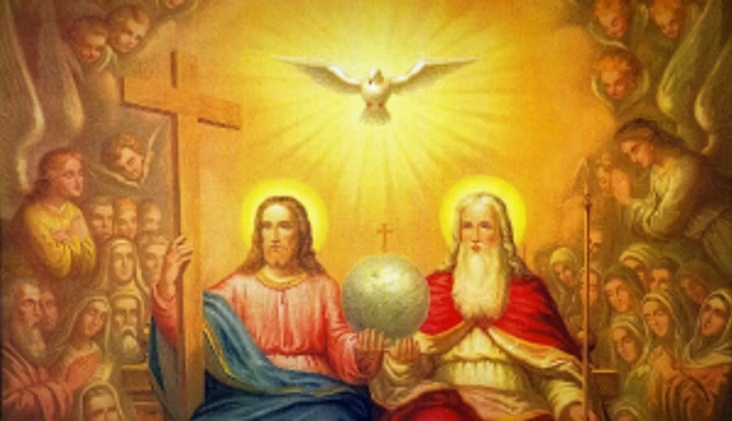








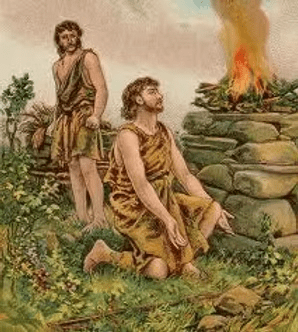
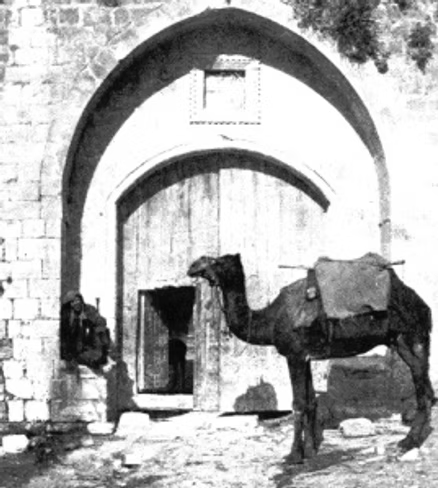




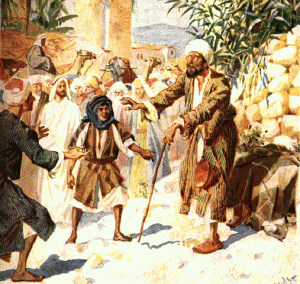
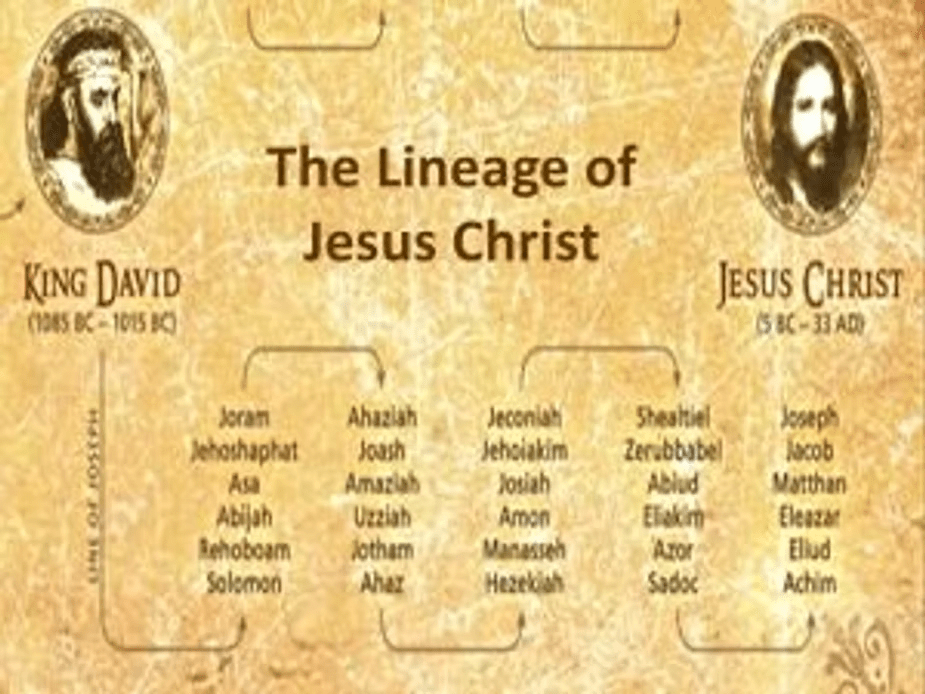








 Explaining the Readings