After John was arrested, Jesus came to Galilee, proclaiming the good news of God, and saying, “The time is fulfilled, and the kingdom of God has come near; repent, and believe in the good news.”
As Jesus passed along the Sea of Galilee, he saw Simon and his brother Andrew casting a net into the sea—for they were fishermen. And Jesus said to them, “Follow me and I will make you fish for people.” And immediately they left their nets and followed him. As he went a little farther, he saw James son of Zebedee and his brother John, who were in their boat mending the nets. Immediately he called them; and they left their father Zebedee in the boat with the hired men, and followed him.
——————————————————————————————————-
This is the Gospel selection for the third Sunday after the Epiphany, Year B. It will next be read aloud in church by a priest on Sunday, January 21, 2018. This is important because Mark recalled the beginning of Jesus’ ministry by his proclamation, “The kingdom of God has come near.” In that beginning, Mark told how Jesus called fishermen away from their boats, to “make them fish for people.”
I have called Mark the “Sergeant Friday” of the Gospels, as his version is short and quick to the facts: “Just the facts ma’am. Just the facts.”
The reality is Mark (who is not named as a disciple) was the name of the writer who told the story of Simon Peter. While scholars originally attributed this anonymous work to Mark the Evangelist, who was the travel companion of Saint Peter, later thought has moved away from that view. Regardless of the proof or lack thereof, the Gospel of Mark has to be seen as the witness of “the Rock,” Simon bar-Jonah, who was a disciple of John the Baptizer before following Jesus. Seeing this reading as the story told by Peter makes elements of this reading make more sense.
First of all, the announcement, “After John was arrested,” is a reflection on the man to whom Simon (named Peter by Jesus) was once a disciple. John, the baptizing prophet of God, was who Peter had followed, as a disciple, thinking John might be the promised Messiah. To say “John was arrested,” Mark was the first to write about that event. Both Matthew and Mark wrote of the death of John, recalling his arrest as attributable to Herod Antipas complying with his brother Philip’s wife, Herodias (Matthew 14:3 and Mark 6:17). However, that makes this statement that “John was arrested” take on a meaning directly relative to Simon Peter.
The Greek of Mark 1:14 says, “Kai meta to paradothēnai ton Iōannēn,” which literally translates to state, “And after the delivering up the [one] John,” where “paradothēnai” can mean “handing over, delivering up, abandoning, or betraying.” The Greek of Mark 6:17 states, “ekratēsen ton Iōannēn,” where “ekratēsen” means “taking hold of, seizing hold of, obtaining, or holding fast.” Matthew wrote (Matthew 14:3) “kratēsas ton Iōanēn,” which translates the same (root being krateó), as “seized hold of.” The difference in tone, from “handing over” and “seizing hold of,” means Mark 1 is less about Herod Antipas “arresting” John than it is more about Peter “abandoning” John, to follow Jesus. Thus, Mark told of Simon Peter remembering the time “After the handing over of his devotion to John, beginning when Jesus came to Galilee proclaiming the good news of God,” with Simon Peter alongside.
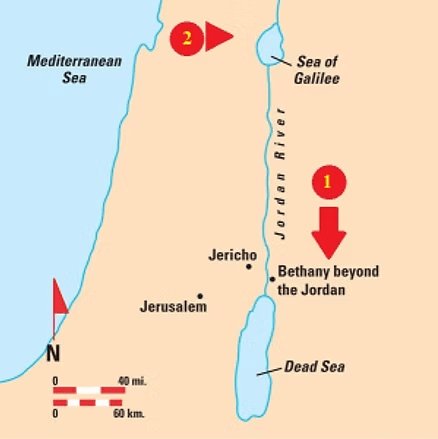
In the Gospel of John, we read of Jesus’ baptism, which took place in the Jordan, close to Bethany beyond the Jordan. Mark jumps from that location to Galilee, which represents a greater gap in time than John presented in his Gospel. John fills in that gap that Mark presents, through its brevity.
One of the gaps is where John wrote of Andrew (a disciple of John). John told how Andrew went and told his brother Simon to come and meet Jesus. Jesus then told Simon he would be called Peter (Képhas). This took place before Jesus “purposed to go into Galilee” (John 1:43). Both Andrew and Simon (called Peter by Jesus) were already committed to follow Jesus; but Jesus obviously told them to go home and go about business as usual, until he was ready to begin his ministry. They had been prepared to await his later call to come and follow him.
This means that in the space between the comma following “arrested” and the “J” of “Jesus came to Galilee,” Jesus, John the Beloved, Andrew, Philip and Simon-Peter walked from Jerusalem to their various homes in Galilee, attended a wedding in Cana, and some possibly accompanied Jesus to the edge of his sojourn in the wilderness (forty days fasting), before returning to Galilee. All that occurred before Jesus moved to Capernaum and began “proclaiming the good news of God, and saying, “The time is fulfilled, and the kingdom of God has come near; repent, and believe in the good news.”’
Thus, when Mark wrote, “As Jesus passed along the Sea of Galilee, he saw Simon and his brother Andrew casting a net into the sea—for they were fishermen. And Jesus said to them, “Follow me and I will make you fish for people.” And immediately they left their nets and followed him,” they were prepared for this call. This was not their first encounter with Jesus. Because Andrew and Simon-Peter were part of the overall family of fishermen in Capernaum, on the Sea of Galilee, they could have prepared James and John, sons of Zebedee that Jesus might call. Still, everything written by John is the truth, with no errors out of sequence, just as Peter told Mark the truth, but without every detail.
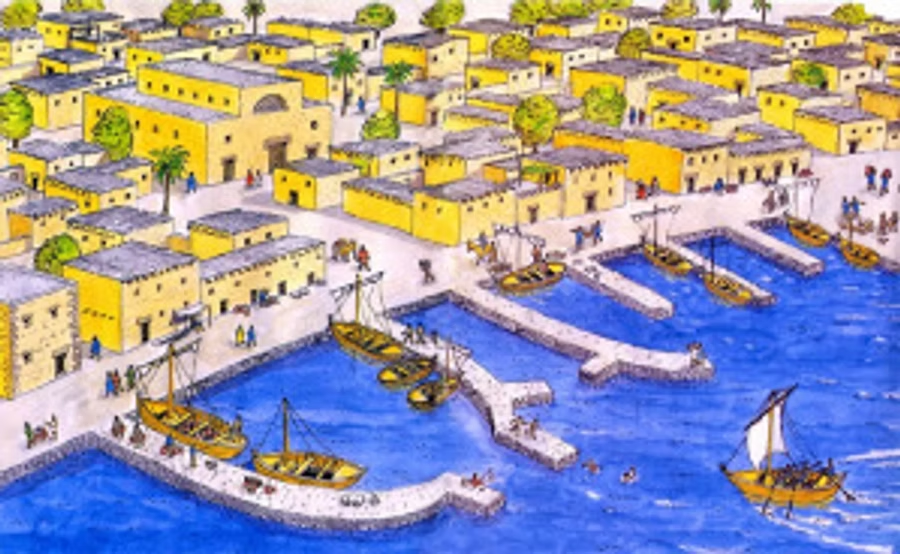
For some reason, modern artists love to think of the fishermen on the Sea of Galilee as backwards people who never came up with the concept of piers. The Romans built them back then.
When one sees Mark telling the story of Simon-Peter, Peter’s identification of himself as Simon says that when he was not in the presence of Jesus, Simon was not “the Rock” Jesus foresaw. The name Simon becomes a confession of his common self, as he and his brother Andrew “were fishermen” as ordinary laborers. As a personal Epiphany lesson, all true Christians are common and ordinary before the presence of the LORD shines within. Just as Simon was Peter’s ordinary name, Peter represented his transformed or elevated self name, one given to him by the Messiah. A Saint loses his or her birth name and becomes transformed in the name of Jesus Christ.
Mark wrote, “As [Jesus] went a little farther, he saw James son of Zebedee and his brother John, who were in their boat mending the nets.” The overlooked element here is the statement “James son of Zebedee and his brother John” is a parallel to the statement “Simon and his brother Andrew.” Beyond those two pairs of brothers, Thaddeus (also called Jude or Lebbeus) was the son of Alpheus (also called Cleopas or Clopas), as was James the Younger (or Lesser). Levi (also called Matthew) is another who is identified as the son of Alpheus, such that if Alpheus is the father of all three, then there are three sets of brothers who followed Jesus.
Cleopas and his wife Mary (who was with Mother Mary and Mary Magdalene at the cross, with John, as Jesus died) were aunt and uncle of Jesus. Cleopas was the brother of Mother Mary (either directly or by marriage to Joseph). Thus, James the Younger, son of Cleopas, is also referred to as the brother of Jesus. John wrote about the brothers of Jesus, saying they did not believe in him (John 7:3-5), which indicates Joseph had sons by a prior marriage and possibly with Mary after Jesus. Do not forget that when Jesus was preaching to the crowd that followed him, and he was told his mother and his brothers were waiting outside for him, Jesus said, “My mother and my brothers are these who hear the word of God and do it” (Luke 8:21; similar in Matthew 12:50 and Mark 3:35).
The point of these observations is they are rooted in why Paul regularly addressed fellow Christians as “adelphoi,” or “brothers.” All Christians are related because they are the sons of God, as Jesus reborn infinitely into human bodies. It is easy (common) to do the work of “hired hands,” mending the nets that are to be thrown out to capture a mortal living; but a hired hand will leave one employer and follow another that offers more material gain. The fathers of family businesses never have enough sons to expand, meaning they are barely able to stay afloat as time wears away all physical investments.
Families used to be big, but then the great era of Industrialization and Technology destroyed the need for growing your own workers.
We can see this now, as Simon abandoned John for one who was said to come after him, the one John baptized with water, and the one John announced to be the Lamb of God. Simon and Andrew likewise “handed over” a job that had them fishing for worldly sustenance. The left a livelihood in exchange for an eternity with God. James and John of Zebedee made the same trade. They were all brothers of earthly fathers, but they became brothers in service to the LORD, the Father. All Christians since have been called to make the same sacrifice, opting out of an earthly, mortal lineage, to be filled with the Holy Spirit as the new body and blood of Jesus Christ, Sons of God.
At such a time the prophecy of Jesus will be fulfilled, as new Christians hear him say, “This is the good news of God! The time is fulfilled again and again, as the kingdom of God has been born anew! You have repented, and believed in the good news, because a good Son always obeys his Father.”
After John was arrested, Jesus came to Galilee, proclaiming the good news of God, and saying, “The time is fulfilled, and the kingdom of God has come near; repent, and believe in the good news.”
As Jesus passed along the Sea of Galilee, he saw Simon and his brother Andrew casting a net into the sea—for they were fishermen. And Jesus said to them, “Follow me and I will make you fish for people.” And immediately they left their nets and followed him. As he went a little farther, he saw James son of Zebedee and his brother John, who were in their boat mending the nets. Immediately he called them; and they left their father Zebedee in the boat with the hired men, and followed him.
———-
In this reading selection, which is the Gospel presentation on the third Sunday after the Epiphany in the Year B, it appears as a puff of cloud in the void of space that is a sheep’s head. It seems as if nothing is written before it or after it. It is the honing of words and the paring of verses, served nicely on a platter for fine dining. Bon appetit!
While it is normal to walk through the line at the cafeteria and point to the sacrificial meat one desires and have the attendant pass you a portion, nobody cares to see the whole of the beast prepared, before it was butchered, then glazed, marinated, battered, baked, or deep fried, before being dumped in a pan or set, waiting on a board to be carved up. One takes a portion without questions of foresight or hindsight.
Mmmmmmm. Yum.
Divine Scripture is food for the soul. It is manna from heaven. It is prepared by the hands of the most high, with the intention being that a very small portion will expand greatly once consumed. It does not feed the stomach or even the brain, as those physical organs cannot digest divinity nor can they ever come to a state of satiation from having spiritual food set before one’s body of flesh. Only a hungry soul will chew on a small portion of Scripture and feel the fullness of all that is both before and after that portion.
This reading begins with the capitalized word “After.” That word is followed by words that state “John was arrested.” While that might feel to the tongue to be a hard, gristly piece of fat, which needs to be discretely spit out into one’s hand, it should be realized that the master chef [God] is smiling as he watches you eat His carefully prepared presentation, waiting to see how well you enjoy His Word.
Good? Yes?
The text prepared by God, written by his assistant Mark [who wrote the story of Simon Peter], actually begins with a capitalized “Kai,” which is then followed by the word “after” (“meta“). The word “kai” – in the lower case – is a mark that alerts the reader that the words to follow that mark are important to pay close attention to. When a capitalized “Kai” is written, the words that follow take on a most important meaning that needs to be understood. Thus, before one should spit out this importance into one’s church napkin, one needs to grasp what “meta to paradothēnai ton Iōannēn” means.
The longest word in that mix is “paradothēnai.” The root verb is “paradidómi .” According to Strong’s, that word states “to hand over, to give or deliver over, to betray.” [definition] The word’s “usage” then denotes “I hand over, pledge, hand down, deliver, commit, commend, betray, abandon.” The form written is a passive aorist infinitive, thus stating what happened in the past. The word, as shown above, then states “was arrested,” but by realizing the capitalized “Kai” is an alert for higher meaning, that realization makes one pause before spitting something out. You suddenly can dissolve the gristle with a quick flip with the tongue, so the flavor is released as “was handed over.”
More than the power of a tetrarch over Galilee and Perea being in play, “Kai” lets one realize God is somehow involved in this change involving John the Baptizer.
Savor this: HELPS Word-studies says of this word, “paradídōmi” it is from pará, meaning “from close-beside” and dídōmi, “give”. The word is then “properly, to give (turn) over; “hand over from,” i.e. to deliver over with a sense of close (personal) involvement.”
This understanding then allows one to elevate a simple meaning [“was arrested’] to a higher level [the capitalization of “Kai“], so one is led into this reading by the realization that John (the baptizer, the cousin of Jesus, the one who would come before Jesus, the one representing the reincarnation of Elijah who would come before the Messiah) has been handed over to the authorities by God, as a most necessary timing element that had to come before Jesus could begin his ministry.
The words of Mark, prior to this important statement, tell of Jesus being tested at the end of his forty days in the wilderness. The test of Satan was like Jesus’ final exam before graduating from seminary, so he was officially ordained to go out into the world and preach the truth of God. However, God did not plan for His Son to be in competition with His other Son, John; so, before Jesus could begin his ministry, John’s ministry had to come to a close.
In Malachi 4:5 is prophesied: ““See, I will send the prophet Elijah to you before that great and dreadful day of the Lord comes.”
For anyone who keeps up with what the four Gospels of the New Testament says, there are several places where a prophecy stated before will be fulfilled by Jesus. One example is found in Matthew 2:15: “[Jesus] stayed [in Egypt] until the death of Herod. so was fulfilled what the Lord had said through the prophet: “Out of Egypt I called my son.”‘ That final quote comes from Hosea 11:1.
Thus “Kai after this handing over who John” [a literal translation of the Greek text] is a major statement of the fulfillment of Jesus (the Messiah) coming after Elijah.
When John said [Matthew 3:11], “after me comes one who is more powerful than I,” that says [reading between the lines] John’s ministry had to end first, in order for the ministry of Jesus to begin. As such, the same Jesus who told his mother [at the wedding in Cana], “My hour has not yet come” (John 2:4), knew he could not begin his ministry until John’s ministry had ended. Therefore, after Jesus had successfully completed his time in the wilderness, he was prepared to enter that practice; but only “After John’s ministry had been handed over to Jesus, by the Will of God.”
When one reads this introductory partial verse that way, it then allows one to see the importance of what followed: “Jesus came to Galilee, proclaiming the good news of God, and saying, “The time is fulfilled.”
The hour of Jesus had arrived; so, “the kingdom of God has come near.”
Just as John had washed the sins off the Jews who were repentant, so too did Jesus say, “repent.”
Here comes the final part of what Mark’s fifteenth verse has Jesus saying. That statement is begun by the lower case spelling of “kai.” That word again marks a point of importance needing to be read into the words that follow. Those words state “believe in the good news,” but can also be translated as “put your trust in the Gospel.”
Now, modern Christians call the four books of Matthew, Mark, Luke and John the “Gospels.” Most adult Christians have heard it said so many times they also know “gospel” means “good news,” thus the translation above affirms that knowledge.
This translation as “gospel” or “good news” comes from the Greek word “euaggelízō,” which is recognizable as the root of the English word “evangelize,” which is commonly defined as meaning: “preach the Christian gospel” (while also being a means to “convert someone to Christianity”). Few know that the Greek word “euaggelízō” is a combined form word, where “eú” means “good, well” and “angellō” means “announce, herald.” Thus, the word literally means “proclaim the good message.” [HELPS Word-studies]
Well, let’s pause and reflect on that for a moment.
<pause, with quiet whispers of reflection>
Raise your hands if everything I proposed about the words “After John was arrested” was something you knew, so everything I wrote above was boring as heck [as if you were reading and saying to yourself, “Come on! We know that already. Get past that!”]?
<look out at a sea of people sitting on their hands>
Okay. That is an example of what “Gospel” truly means. It is not going into work and proclaiming, “I went to a Christian church Sunday, so I believe in Jesus .. <singing> Because the Gospels tell me so.”
When we read Mark 1:15 end by Jesus stating, “believe in the good news,” everyone has to grasp that Jesus was talking about the same words Jews had been memorizing for many centuries, but few had ever figured out what they truly meant, much less how to believe in words that no rabbis could properly explain. Jesus announced, “have faith in the truth of God’s Word.” [Rather than “believe in the Gospel.”]
That has to be grasped; and, it must be understood that every time Jesus began a statement by saying “Truly” he was speaking the truth of what everyone knew was written, but nobody knew what it meant. The same condition is still around today, because God does not allow just anyone to read His Word and know what His Word means. If that were to be the case, then Christians would know only what they read [very little] and atheists would know everything [by reading the Bible just to make fun of ignorant Christians].
That proclamation of Mark says the ministry of Jesus began as a new phase of letting the truth of God’s Word be known. The ministry of John, which had come to an end, was to find out who wanted to know the truth enough to ask John to wash their sins clean, because nobody in the synagogues [or the Temple of Jerusalem] could tell them how to stop sinning. By identifying there were indeed seekers of the truth, Jesus could begin sowing the seeds of truth to those who truly repented and sought a life of righteousness.
Okay, I have written over 1500 Word Count words explaining two of seven verses in this reading. To be perfectly honest, not one sermon on the third Sunday after the Epiphany will focus on Mark 1:14-15. No truth of those verses will be shared. No truth of those verses will be heard; so, nothing inspiring faith will be spoken that will lead a pewple to rise up [become spiritually elevated – one’s soul merged with the Spirit of Christ] and become the next in a lineage of most divine priests [aka Saints]. If anything, sermons will focus on Jesus calling Simon and Andrew, then James and John.
Rather than spoil those orations, let me just point out a few pieces of deduced fact, based on a holographic whole view of what is written, which connects to verses 16 – 20.
First, John wrote about Jesus coming out of the river after being baptized by John, where he met Andrew, who went and got Simon to bring him back to meet Jesus. That was when Jesus said he was going to call Simon “Peter” (“Kēphas“), an Aramaic name meaning “Rock” (“Petros” in Greek). Since John was still baptizing then, that meeting occurred before John was arrested. Therefore, one should realize that when Jesus called to Simon and Andrew, they were already acquainted; so, the call by Jesus was awaited, causing the immediacy of their response.
What is missed in the truth of these verses is the presence of the word “kai” between the names Simon and Andrew. The imagery created makes me see two men holding onto one large net, which they are both about to cast into the water, meaning they were on the sea, not at a dock. That leads one to think Jesus saw the two, making them out at a distance; and, knowing it was the two he knew, Jesus then hollered as loud as he could to get their attention (maybe waving his arms too), with both hearing him at the same time.
The “kai” announces that Andrew was as important as was Simon, the way Jesus “perceived” them. So, Jesus did not “see” them so much with his physical eyes. What Jesus “said” to the pair was heard by their souls, equally, more than their ears.
The translation of what Jesus said, [above shown as] “Follow me and I will make you fish for people,” is not the best translation for the truth to shine forth. The Greek text states, “Deute opisō mou , kai poiēsō hymas genesthai halieis anthrōpōn .” Notice the comma-kai combination in the middle. That separates what Jesus said into two commands, one important by beginning with a capitalized word (“Deute“) and the other important because of the marker word “kai.”
The first command says, “Come after me,” where the word “Come” is important as an imperative command, which can also say “Follow!” When the word “opisō” is seen as a statement of “after,” by having realized the truth of Jesus’ ministry “Coming after” that of John, the command is much more than Jesus saying, “Hey guys! You remember we agreed that you would carry things for me when I begin my ministry?” It is a command that his ministry had begun and they would need to stay close to Jesus, so they could be the next in the lineage as most divine priests.
The second important statement is then best read as, “I will act you to be born fishers of men.” Here, one needs to pause after one word, without a mark written to indicate that need. This makes the word “kai” directly place focus on “poiēsō” alone, which says, “I will act” (in the future active indicative). By reading that one word separately, it becomes a statement that the four Gospels of Matthew, Mark, Luke and John could be dubbed “The Acts of Jesus.” The fifth book of the New Testament being named “The Acts of the Apostles” is then a statement that the disciples of Jesus had all [sans Judas] been born as those who acted like Jesus, all fishing for souls to bring to God.
The word “halieis” translates as “fishers,” but because both Simon and Andrew were fishing by casting nets, the promise of Jesus says each [the individualization of “kai” between Simon and Andrew] will cast nets in the world, where men live as fish out of water. Such a realization also becomes metaphor for a spiritual soul being lost in the material realm. The acts of Jesus would be the model of preaching the truth of God’s Word, which says the nets that will catch the souls of men [and women] are woven by the truth of God’s Word.
An important point in this regard comes from remembering what was written in John 1:39, when Jesus told Simon and Andrew, “Erchesthe kai opsesthe” or “Come kai you will see.” Last week, we read how Philip told Nathaniel, “Erchou kai ide” or “Come kai see.” Today, those commands relate to the importance of being a “Follower” [a Saint] that will have divine insight into the truth, so one who “follows behind” Jesus will be enabled to “Come after” him, doing the acts of true evangelism.
At this point in the reading, the truth of what Jesus had promised Simon and Andrew is brought as proof before their eyes. The reality of Jesus walking along the shore of the Sea of Galilee, where Jesus saw James kai John, might have been what physically took place; so, when Jesus called to them and they immediately came, such a response makes one think the brothers of Zebedee had also made some arrangements with Jesus.
While that might be the case, the truth becomes exposed more easily in the form of metaphor, as new ways to view fishers of men, and their use of nets. This metaphor is then aptly set upon the model of Judaism, where the rabbis were the fishers of Jews, whose nets were woven by the scrolls of Mosaic Law, the Psalms, and the Prophets.
This means the names of James, John, and Zebedee are meaningful and necessary to realize. James is a Greek form of the Hebrew name Jacob, which is a word meaning “Supplanter.” A supplanter is one who takes the place of another, as Jacob would do to Esau. The name John means “Yahweh Is Gracious,” with the male children of Jews seen as God’s blessings upon parents. The name Zebedee means “Yahweh Has Bestowed.” Together, the three names reflect the state of Judaism, where Zebedee is the religion God Bestowed upon Israel, with the sons reflecting a need to replace the Old with the New, by receiving God’s Graciousness and Supplanting Judaism with Christianity.
In this metaphor, we are told James and John “were in their boat mending the nets.” Here, the word “ploiō” can be generalized as a “vessel,” which should be seen as a building for believers, like a nave is both a boat and a church. This means the nets used by synagogues to catch Jews was the Law; but their nets were traps that entangled human beings, rather than freeing them. By using the Law as a battering ram on sinners, that misuse caused many holes to be opened, letting sinners escape punishment the rulers used against Jews. In order to keep the Jews compliant to Law, and thus their rule, that net was always in need of being mended.
This means Jesus “called” out to James and John the truth of the Law, which they heard for the first time. The truth was so attractive to the ones who would Supplant Jesus and become bearers of the Graciousness of Yahweh that they left the synagogue. That identified Zebedee as being left there with “hired hands,” where the Greek word “misthōtōn” implies someone who is only there for selfish reasons, not seeking to help anyone else without pay.
The power that the truth these words of Mark bears says all true Christians are those who hear the voice of truth calling, such that he or she cannot stop from becoming a Follower in the lineage of Jesus. Anyone who is still sitting in a church pew, waiting for Jesus to wander by the shoreline and call out to him or her is out of luck. That ship has sailed.
Jesus has to be reborn in someone that looks more like Simon, Andrew, James or John (and women like Mary too), whose voice sound is inconsequential, because the soul is not listening with ears that hear vibrations of sound, but feeling the truth that is spoken from God. Those souls hearing the truth of God’s Word do not stay in the nave mending nets. They jump out and become Jesus reborn.
This reading from Mark only comes during the third Sunday after the Epiphany. The meaning of Epiphany is echoed in the responses of Jesus, Simon and Andrew, and James and John. Jesus did not have John arrested so his path to priestly stardom was free and clear [there were no lures of high hats and crosiers with golden handles that led him to his wilderness experience]. The disciples of Jesus did not drop their nets and leave their boats simply because Jesus called them in words that made them coo like women listening to their favorite minister preach. The all had Epiphanies that heard the voice of God speaking to their souls, telling them, “You’re next, so get in line.”
When was the last time your pastor, preacher, minister, priest, or rabbi had that effect on anyone?
Hmmmm. Maybe someone needs to tell them the truth.





 Explaining the Readings