Tag Archives: Mark 16:1-8

Mark 16:1-8 – Jesus appears as an angel to tell the women family members to tell Peter to prepare to meet Jesus

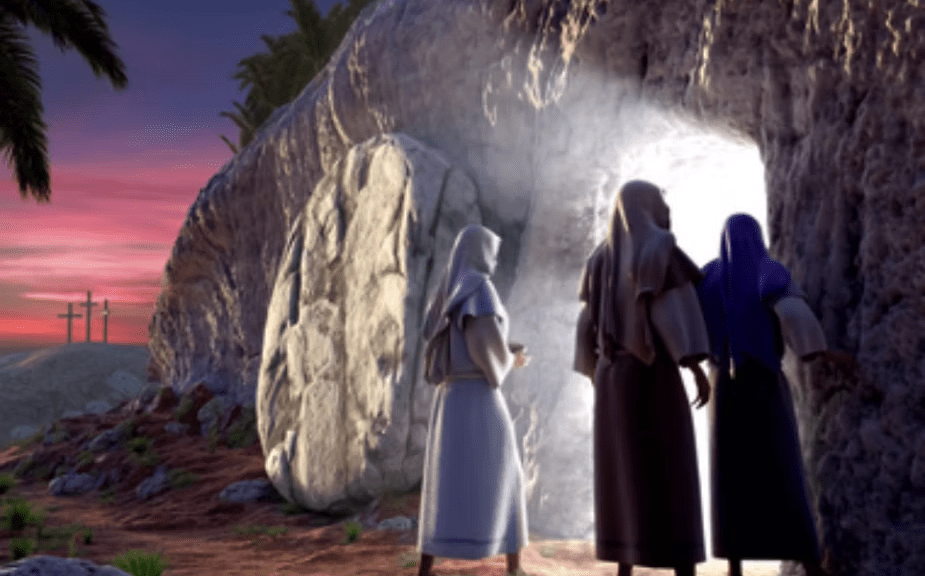
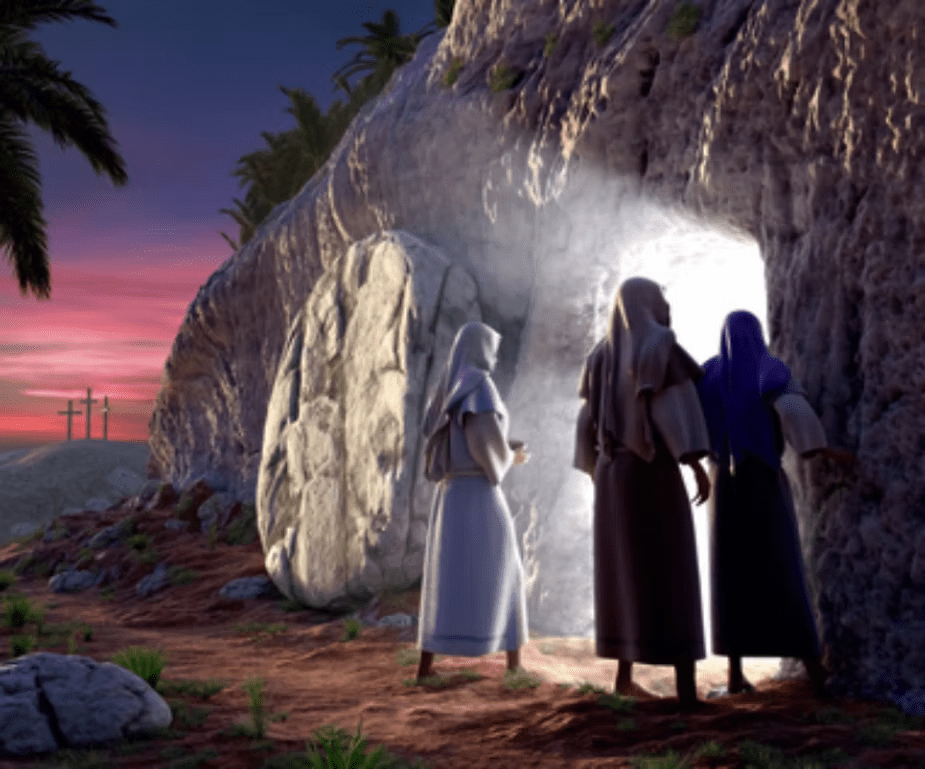
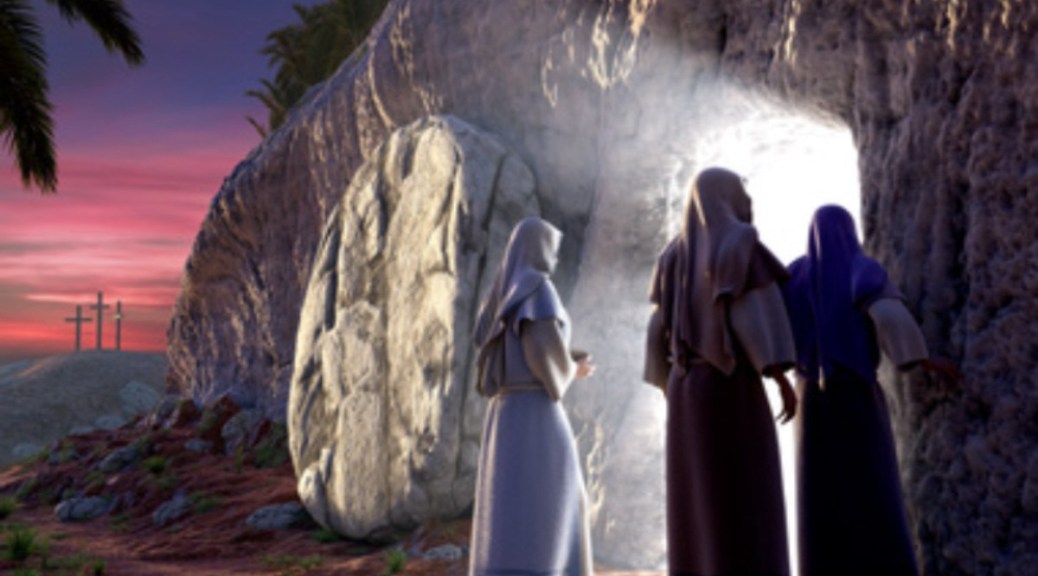
When the sabbath was over, Mary Magdalene, and Mary the mother of James, and Salome bought spices, so that they might go and anoint Jesus. And very early on the first day of the week, when the sun had risen, they went to the tomb. They had been saying to one another, “Who will roll away the stone for us from the entrance to the tomb?” When they looked up, they saw that the stone, which was very large, had already been rolled back. As they entered the tomb, they saw a young man, dressed in a white robe, sitting on the right side; and they were alarmed. But he said to them, “Do not be alarmed; you are looking for Jesus of Nazareth, who was crucified. He has been raised; he is not here. Look, there is the place they laid him. But go, tell his disciples and Peter that he is going ahead of you to Galilee; there you will see him, just as he told you.” So they went out and fled from the tomb, for terror and amazement had seized them; and they said nothing to anyone, for they were afraid.

——————–

This is the second option [Track 2?] for the Gospel selection to be read aloud on Easter Sunday, Year B principal service, according to the lectionary for the Episcopal Church.  In the season of Easter, beginning with Easter Sunday, the Church makes a certain reading from the Book of the Acts of the Apostles be read, either taking the place of an Old Testament reading possibility [the First Lesson] or taking the place of the Epistle reading possibility [the New Testament slot].  In some way, by design or chance, this reading from Mark can be chosen over the first Gospel choice from John.  The John 20:1-18 option is optional to choose in all three years of the lectionary cycle, whereas Year B primary service is the only shot Mark 16:1-8 has to be read aloud and thereby explained in homily.

Assuming this is the second option for the Gospel and it will be read if the mandatory Acts reading takes the place of the second lesson [the New Testament category], that would mean this reading from Mark will be preceded by a reading from Isaiah 25, where the prophet wrote, “Then the Lord God will wipe away the tears from all faces, and the disgrace of his people he will take away from all the earth.”  That will be followed by a selection of verses from Psalm 118, which sings, “The Lord has punished me sorely, but he did not hand me over to death.”  Lastly, the mandatory reading from Acts 10 will be read, which states, “They put him to death by hanging him on a tree; but God raised him on the third day and allowed him to appear.”

Before delving into what Mark wrote about the first Easter Sunday, it is important to realize the Gospel of John recounts this differently.  There certainly are opponents of Christianity who will challenge any seeming inconsistencies as being weaknesses that make the foundation of faith in stories that approach one event from different perspectives crumble.  In this regard, I recommend a true seeker, even an opponent of Christianity read my interpretation of John 20:1-18, because I show how nothing John wrote is contrary to what Mark wrote.  It should be realized that Mark wrote the accounts of Simon Peter, so John’s direct mention of Simon Peter entering the empty tomb does not mean that Mark has to also tell of Simon Peter doing that.  Not telling of something is not evidence that another who told of something was incorrect.

It is now important that I attest to a divine syntax that I have been led to realize and become somewhat fluent in reading, which is necessary for grasping the deeper meaning of what is written.  By reading under a new set of rules of language [by “speaking in tongues”], hidden meaning rises from the surface meaning that is all normal syntax allows one to see.  In this regard, one has to admit the texts of the Holy Bible were written in either Hebrew or Greek, such that English translations [beginning with the King James Version and multiplying like rabbits ever since] have been memorized by Christians and made to seem as if the Biblical characters all spoke English – a language with syntactical rules that differ from the divine language all Scripture is written by [from the Godhead].  The source of all holy text is God [Yahweh] and must be realized as perfection as written, therefore any changes made to that perfection [to suit the needs of translators] weakens the truth that is divinely told.

With that disclaimer stated, this reading has verse 1 begin with the benign phrase, “When the sabbath was over.”  That is not what Mark wrote.  The Greek text shows: “Kai diagenomenou tou sabbatou,” where the first word is a capitalized “Kai.”  The Greek word “kai” is ordinarily a simple conjunction that is translated as “and,” according to the normal rules of Greek and that language being translated into English.  I have found that the divine rules of syntax say see “kai” as a marker word [not “and”] that does not need to be read in English, just noticed that something important will follow that marker word.  In this case, where “Kai” is capitalized, such that another rule of divine language says all words capitalized take on higher meaning, of spiritual essence, this verse beginning with “Kai” [improperly translated as “When”] says the first series of words [to the comma mark] is an important spiritual statement that needs to be seen in that light, above the simple surface meaning that says, “When the sabbath was over.”

A literal translation of the Greek text “Kai diagenomenou tou sabbatou” says, “Kai  having passed this seventh day.”  Because the capitalized “Kai” is seen as a signal to look for higher meaning in those words, “having passed” becomes a divinely inspired statement of time elapsing.  Because the last verse in Mark 15 told about the burial of Jesus [on a Friday], the spiritual meaning of “having passed” is less about the days of the week having gone by, but the timing of Jesus prophesying he would dei and after three days be raised.  Seeing that, “having passed” becomes a divine statement of when those three days were officially over.  By adding to that meaning “this seventh day” [not capitalized, therefore not Sabbath], Mark is making a very important statement [“Kai”] that the timeframe of Jesus’ prophecy was up on the seventh day, which was the day after his burial on Friday.

From seeing that being the deeper intent of Mark writing those words, the rest of verse 1 states, “Mary Magdalene, and Mary the mother of James, and Salome bought spices, so that they might go and anoint Jesus.”  While that seems to be Peter telling the names of three women who went to the tomb to anoint Jesus, one has to slow down and realize in these segments of words are six capitalized ‘names,’ each of them having a root meaning that needs to be understood.  Those root meaning are as follows [all from Abarim Publications]:

  1. Mary – “Beloved”
  2. Magdalene – “Of The Tower”
  3. James – “Supplanter” [or “He Who Closely Follows”]
  4. Salome – “Peace”
  5. Jesus – “Yahweh Saves”

When these root name meanings are seen as divinely raised to the intent behind the names, the rest of verse 1 can be read as: “Beloved Of The Tower, and Beloved the mother of Supplanter, and Peace brought spices, so that they might go anoint Yahweh Saves.”  In this being based on the translations into English and not the literal Greek text, we find with closer inspection that some words have not been translated and the places one find “and” written and where the word “kai” is adding a mark of importance.  Based on that awareness, that written literally translates into English as the following segments:

“this Beloved this Of The Tower”  ,

kai  Beloved this the one of He Who Closely Follows  ,

kai  Peace  ,

purchased perfumes  ,

in order that having come  ,

they might anoint [the dead] him  .

Again, I recommend reading what I interpreted about John having also written (similarly) of “Mary this Magdalene comes early,” where the use of the root names are discussed deeply.  Here, I want to focus more on all name “Mary” are women who are deemed “Beloved.”  The raised essence that must be seen now is “Beloved” means family relation, not just some friend or follower of Jesus.  Because some tend to see Mary Magdalene as some woman Jesus knew, who was a female disciple, this makes it clear that she was related to Jesus [“Of The Tower”] through marriage, as the wife of Jesus.  As the wife “Beloved,” she was first in the list of women responsible for preparing the dead body of her husband for transfer from a loaner tomb, to the ‘family plot’ [the one Lazarus had been buried in].

The second most important “Beloved” is the mother of James, the half-brother of Jesus.  Still, the word “mother” is not written, but implied from an article – “.”  That same word [a letter in Greek – “ἡ”] is written before the first “Maria” and before “Magdalēnē,” at neither time implying “mother.”  The presence of the word “kai” before the second “Beloved” says this woman has greater spiritual importance than the wife, where “kai” becomes the indication of the mother, one who conceived Jesus without physical penetration or intercourse.  This makes “James” become a statement of her having since become a mother who conceived through intercourse with Joseph, her husband, but that couple had more children than just James.  Therefore, the meaning of the name says the “Beloved” mother of Jesus also was one “Who Closely Followed He” who was her divine Son of man.

After seeing that identification of Mother Mary, one finds another use of “kai,” which says “Peace” is another element that must be understood.  The name of the woman Mary Salome is that of an aunt of Jesus, as the wife of a brother of Mary the mother of Jesus, who is believed to have been Zebedee.  This would make Salome the mother of James and John of Zebedee, which says they were cousins of Jesus.  By a third woman being announced as important to know on a spiritual level. “Peace” must be read as the strength that held all three women up, able to do the work they were leaving to do, was Mary Salome.  She was a presence of calm for two women who were most distraught over the death of a husband and son.

The segment that is separated, saying “purchased perfumes” or “bought spices” has to be recognized as a statement of preparation for this day.  Since there would have been no buying nor selling on the Sabbath, these three women had gone on the day of preparation [Friday] and “bought spices” for the purpose of preparing the body of Jesus for transfer, from one tomb to another.  They would have done that separate from Joseph of Arimathea and Nicodemus taking seventy-five pounds of embalming perfumes with them to prepare Jesus’ body for burial.  This segment means Jesus was representative of their Sabbath to recognize, based on prior preparations. 

Most likely, these women did little more than cry and pray on the Sabbath, in preparation for doing what had to be done on Sunday morning.  This becomes the focus of the next segment of words: “in order that having come.”  More than them walking to the tomb as the meaning of “having come,” it was a day prepared for “having come.”  Therefore, the word “hina” is written to connect that which had been bought in preparation follows an order or schedule, such that a day of work had arrived.

The final segment of words places focus on anointing.  The Greek word “aleipsōsin” states the conditions planned in preparation, which were to be apply olive oil scented with fragrances to the face of Jesus.  It is here that one finds the translation that has “Jesus” listed is incorrect, as that name has been applied to the Greek word “auton,” which simply means “him.”  The intuiting of Jesus, a name that means “Yahweh Saves,” says two things.  First, a corpse no longer has a name.  Second, the plan to anoint one who had already been the Anointed One of Yahweh means the conditional (“might anoint [the dead]”) says the women had given up hope that Jesus could not die, having been given eternal life, therefore impossible to ever be dead.

Verse 2 then states, “And very early on the first day of the week, when the sun had risen, they went to the tomb.”  This verse also begins with the word “kai,” although not capitalized.  This says the timing is important to understand. The two word “lian prōi” translate as “very early,” but the importance of “kai” says “lian” must be read as “exceedingly” or “extremely,”  where the “earliness” means the second 6:00 AM ticked off.  Any earlier and it would have still been technically the Sabbath.

When Mark wrote “the first day of the week,” this is the same terminology used by John.  This being stated in verse 2 says the elevated meaning found in verse 1 is correct, as that stated the timing of Jesus resurrection of death, more than identifying it was now the day after the Sabbath, as the first day of the week [Sunday].  This also says it was immediately upon that new day having arrived.

There are two segments of words, set off by comma marks, that make the NRSV translation a paraphrase.  The literal translation into English show those segments as stating: “they come to the tomb  having arisen the sun.”  The order of those segments is important to grasp.  First, “they come to the tomb” is stated in the present inductive, not in the aorist past, meaning the women left before the sun actually rose.  That says sunrise had not yet occurred at 6:00 AM.  However,the aorist active participle of “anateilantos” [“having arisen”] says sunrise occurred after they left to go to the tomb.

Verse 3 then has Peter recall a conversation, one which he personally was not present to hear.  By Mark writing, “They had been saying to one another, “Who will roll away the stone for us from the entrance to the tomb?” this says Peter could have heard the women voice their concerns “among themselves, as one present overhearing them talk.  This past tense use of “were saying” could even have been early in the morning, when the women voiced that concern before leaving to the cemetery. In that case, Peter sat nearby and heard them purposefully talk so he could hear them, as a way of trying to motivate him to volunteer to go with them and do that work.  In that case, Peter knew he had let the women go alone, without offering to go along and possibly help them.

That verse is introduced by the word “kai,” such that the importance becomes this element of them talking among themselves.  As women knowing they were not strong enough to roll away a heavy tomb stone, they also knew it was not their place to do a man’s work.  Therefore, the importance of this becomes a confession by Peter that he knew about this conversation beforehand, rather than after the fact, as hearsay.

Verse 4 then says, “ When they looked up, they saw that the stone, which was very large, had already been rolled back.” Here, again, is a verse begun by the use of “kai,” showing importance needs to be seen in “having looked up they see that” [from “elegon theōrousin hoti”], such that the point of their prior discussion was then found to have been needless worry.  This makes “having looked up” be akin to having a premonition or imaginary vision of them reaching the tomb and seeing a stone in need of being rolled away.  From this, going back to the “bought spices” or “purchased perfumes,” these women had not been to the tomb to watch the interment, as it happened so late in the day Friday, while they were shopping.  Peter most likely had watch that interment [as secretly as a casual bystander could] and knew there would be guards there to help the women.  Thus, he did not offer to go and possibly help, when he knew his help would not be needed and he did not want to be arrested.  The vision the women has conjured from fear of going without a man disappeared when they saw the tomb already opened.
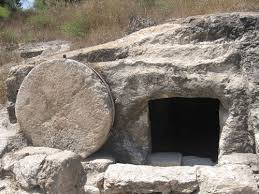
When Mark is shown to have written, “the stone, which was very large,” the separation by comma marks says the stone for the tomb of Joseph of Arimathea was “extremely large,” using the same extremity as was found in the earliness of the hour prior.  This says the imaginations of the women led them to “see” which tomb was his [an act of “perception” beyond personal knowledge from past experience] and that tomb was opened, no longer sealed by a stone greater than they had expected.

When the translation states in verse 5, “As they entered the tomb, they saw a young man, dressed in a white robe, sitting on the right side; and they were alarmed,” this ignores the presence of another capitalized first word that is “Kai.”  This places great importance in understanding “having entered into the tomb” [from “eiselthousai eis to mnēmeion”].  This is where linking John’s story to Marks is important, as John makes it easier to intuit that women and children did not have any rights to enter into tombs.  That was only allowed to adult males.  Therefore, the great importance comes from not thinking three women casually walked into an open tomb, previously where a dead body had been placed, as it has greater power coming from understanding someone [not the women] was evident as “having entered into the tomb,” because it was opened.

From grasping the importance of that statement, rather than thinking women would go into a tomb not owned by either of them, without asking permission first, makes sense that the next segment of words tells of them seeing “a young man,” not inside the tomb, but outside, “sitting on the right.”  This then gives the impression that “a young man” was thought to be “an attendant” [the meaning of “neaniskon”], who was employed by the garden cemetery.  By stating he was “sitting on the right,” this implies the stone had been rolled away, to the left.  A “sitting” position [from “kathēmenon”] can even be a statement of “dwelling” or “residence,” implying the “attendant” was under a canopy, or tabernacle.

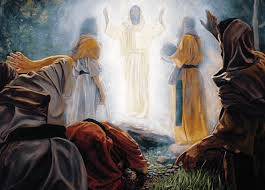
The next segment of words, separated by comma marks, says this “attendant” was “clothed in a robe white.”  Here, the symbolism of “white” needs to be seen as a statement of “purity.”  The Greek word “leukēn” can mean, “bright, brilliant,” implying dazzling white.  When this is combined with the prior statement of “on the right,” where the word “dexiois” equally can translate as “the right hand,” this becomes descriptive of Jesus’s soul, which has ascended to the Father and sitting at the right hand of Yahweh.  Seeing this, the word “sitting” can now be read as “enthroned.”  This makes the reading from John [as explained in my commentary about that] be supported as to when Mary Magdalene was told by Jesus [who she thought was the gardener] being told, “Not me appearance.”
In the NRSV translation that adds, “and they were amazed,” this segment of words is begun by the word “kai,” signifying importance must be seen in what was witnessed.  The “kai” leads to one word in Greek, which is “exethambēthēsan,” which makes the important statement: “they were greatly amazed.”  Here, again, there is a superlative used [embedded in the usage applied normally to the root word “ekthambeó”], which elevates this means the women suddenly felt as if somehow in the presence of God, such that their “amazement” was actually “great fear.” 

In Luke’s version of this event, two angels were said to have been seen, such that he wrote: “In their fright the women bowed down with their faces to the ground.”  While not written here in Mark that they bowed down, one can expect the women felt such a strong presence before them [unnatural and quite holy] that they would have prostrated themselves out of fear.

This state of being is then confirmed when Mark is shown to have written in verse 6, “But he said to them, “Do not be alarmed; you are looking for Jesus of Nazareth, who was crucified. He has been raised; he is not here.  Look, there is the place they laid him.”  Keeping in mind that no words have been exchanged between the women and the “attendant” or “young man,” it is not clear that the one in a robe bright knew the hearts and minds of the women.  From that source of divine knowledge was spoken a series of segments that are missing important signs that keep the reader of the NRSV from taking hold of.

To best grasp this, I will not do as before and break down the segments of words, complete with the correct punctuation, and literally translate the Greek into English.  What was said goes like this:

“Not be terrorized”  .

“Jesus you seek”  ,

“the Nazarene”  ,

“this one having been crucified”  .

“he is risen”  !

“not being here”  !

behold the place where they laid him”  .

Because John wrote of Jesus speaking to Mary Magdalene, one must see this “young man” as the spirit [or soul] of Jesus, as an apparition.  Rather than being a physical body, as would later appear in the upper room, the appearance of a young man makes the soul of Jesus take on the appearance of Adam, the Son of God, made by His hand.  Therefore, just as John wrote that Mary thought Jesus was the gardener [knowing it was Jesus, but not the man], that same entity has just spoken.

In the first segment, the capitalized Greek word “” is written, importantly stating “Not.”  This then leads to the word “ekthambeisthe,” which was similarly stated as how the women felt fear and fell down.  The power of “Not” is then less about being a spoken word, but a presence that spoke to the women, such that the fear they had felt from seeing holiness before them suddenly ceased being.  Because these two words end simply with a period mark, there is no sense of command that should be read into words spoken, but one should see that just as suddenly as the women felt weak and meaningless, they stopped and felt secure enough to stand up or kneel before this presence in white.

The next three segments are broken into important mind-reading steps, such that all three women were thinking the same things, all of which were known by the soul of Jesus, married with the Holy Spirit and therefore one with the Father.  In the segments that says, “Jesus you seek” [from “Iēsoun zēteite”], here is found the capitalization of the name “Jesus.”  Returning to the previous section where I explained several names presented in verse 1, the meaning here now bears the same translation presentation.  Thus, first stated is “Yahweh Will Save you seek.”  That becomes the knowledge of Yahweh reading their hearts and minds, saying they sought salvation through Jesus.

When next is said, “the Nazarene” [from “ton Nazarēnon”], the capitalization of “Nazarene” brings out the name meaning [of a place, Abarim Publications] “One Of The Scattering.”  While this statement can go quite deep in explanation [which I will sidestep for now], the point of this should be seen as knowledge that Jesus was born of Mary [there before this “young man”] in Bethlehem, not Nazareth.  The use of “Nazarene” then speaks of Jesus as human, while also become spiritually elevated as one of Yahweh’s spiritual seeds sown on earth, as the hand of God spreading holy seeds upon Israel.

The next segment then knows the three women stayed vigilantly at the cross upon which Jesus of Nazareth was crucified and taken down dead.  The reason the women had left so early in the morning to get to the cemetery was because they witnessed that death and wanted to care for the corpse.  They wanted to pour olive oil with sweet fragrances only last time upon his face and say prayers of lament for him.

Then, the next segment begins a new line of though, following a period mark.  It ends with an exclamation point.  The word exclaimed is “ēgerthē,” which is the third person aorist passive indicative form of the verb “egeírō,” which is translated as “he is aroused, awakened, risen.”  The third person is assumed to be “he,” but because the soul of Jesus is then the one speaking, and because the first person singular is not used, a better translation would be “it is risen.”  The “it” would be the soul, and the use of “awakened” or “aroused” attests to Jesus saying about Lazarus (on the other side of the Jordan), “Lazarus is only sleeping,” Lazarus likewise was in need of “raising, arousing, awakening” from the sleep that is death.  A body never has life without a soul, thus a body is always asleep; but, a soul never dies, as it is always awake, but in need of a body if not saved from death.

To fully understand the impact of “it is risen,” Jesus was not standing physically before the women.  The brilliance of his “robe” means he was observed in a transmissional state of being, just as Peter, James and John saw Jesus “transfigured” along with Moses and Elijah.  The soul of Jesus spoke to the women, saying “I am risen” to where I am seated at the right hand of God, but you can see me as an apparition now.  Later, you will have my body before you as you wished, when you came early in the morning to here.

This is then confirmed in the next segment of words that state, “not being here,” ended with an exclamation point.  The “being” of all living creatures is the soul in the flesh.  Just as Jesus would ascend in the flesh on the forty-ninth day [day before Pentecost], and just as Elijah ascended in the flesh before Elisha, the “being” [from “estin,” a form of “eimi”] that was recognized as Jesus of Nazareth was not available at that time.

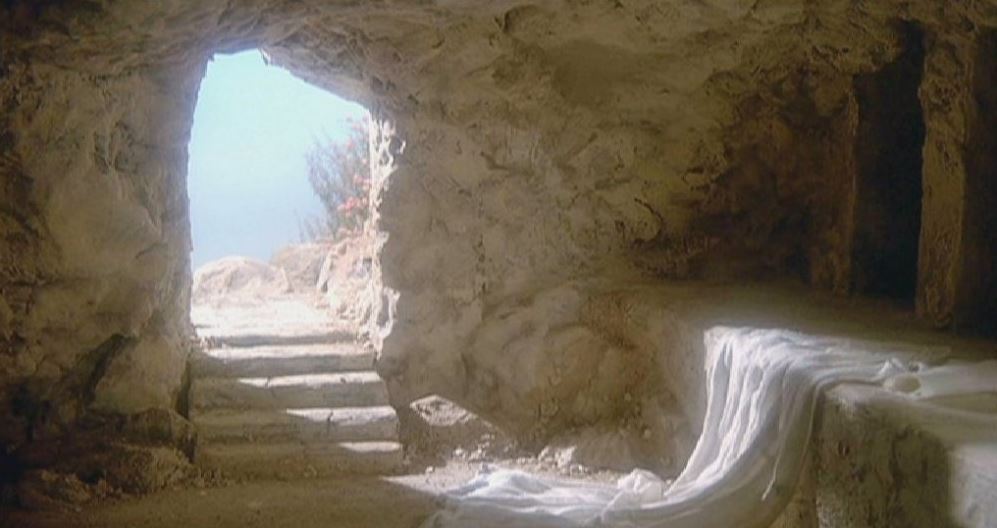
Thus, verse 6 concludes with the soul of Jesus telling the women, “behold the place where they laid him.”  That becomes an invitation to peer into the tomb and see for themselves it was empty [except some linen wrappings and coverings], which acts to inform the reader that none had entered the tomb to look around.

Verse 7 then has the soul of Jesus tell them, “But go, tell his disciples and Peter that he is going ahead of you to Galilee; there you will see him, just as he told you.”  In this, the exception [“but”] says seeing nothing in the tomb means nothing, because the body of Jesus has left the plane of the earth.  This them speaks symbolically to the women [and Peter and John if there by then], saying, “enter your own tombs of self-ego death, so you too can “go” the same place as went Jesus.  It says Jesus will “go” to “tell his disciples” after you “go.”

After a comma mark about telling the disciples, one finds another usage of “kai,” which shows the importance of specifically naming Peter and the place Galilee.  In addition is the capitalization of “Proagei,” which means “It leads forward.”  Again, the presence of capitalized names makes it important to see the root meaning of the name imposed into what was stated.

“Peter” – “Rock” or “Stone”

“Galilee” – “Rolling”

Simply from seeing the two names bring importance to “Stone” and “Rolling,” where the women had just arrived to find a massive stone rolled away, the instruction can now be read as: “this Stone that It leads before you towards these Rolling.”  Amazingly, this statement reflects back on Jesus knowing all about the unwillingness of Peter to come to the tomb, having nothing pertinent to do with talking about Galilee [the region where the disciples lived].  The capitalization of “Proagei” becomes an important statement about “It,” as the third person present indicative, meaning the Holy Spirit.  That becomes the “Leader” that will become the same power “Rolling” away the “Stone” covering their tombs, after they submit them to Yahweh and become Jesus reborn.

The last two segments of verse 7 place focus on “there you will see him, just as he told you.”  The use of “there” seems to mean “Galilee,” but when the name meaning spiritually says “Rolling,” “there” then becomes a place in the future, when the Holy Spirit will allow one’s eyes to open and “see” the truth as Jesus had seen.  That place in the future will then be one prepared in the spiritual realm, as a room within the Father’s house.  It will mean when all the things taught by Jesus will be understood perfectly and a soul will have come to know Yahweh personally.

Finally, verse 8 states, “So they went out and fled from the tomb, for terror and amazement had seized them; and they said nothing to anyone, for they were afraid.”  Here, rather than “So,” this last verse begins with another capitalized “Kai,” signaling it to be most important to grasp properly.  This word leads to one word, “exelthousai,” which has been used similarly twice before, meaning “having gone out” or “having come out.”  This importance is spiritually realized to be the whole experience of a glowing white presence speaking to them telepathically, as if it knew them personally.  That becomes a n impact statement about Jesus having come out of the tomb to greet his relatives and loved ones, not looking like him and making them all fear God, while having their hearts warmed at the same time.

The next segment of word says, “having fled from the tomb.”  This has the dual meaning [minimally] of saying they all ran away from the cemetery, returning to where they stayed quickly, while also saying deep within their souls they all knew they had escaped the fear of death, which is symbolized by the tomb.

The next segment says that before this moment they “had seized for them trembling,” meaning they feared death tremendously.  That past sense of fear had been removed.  Thus, the next word is set out by the use of “kai” internally in this segment of words.  The “kai” states the importance of them having “amazement,” where the deeper meaning of “ekstasis” [the root for ecstatic] says they were overcome by a “trance-like state of being.”  The fears they once let lead them had become disconnected, which was in itself bewildering.

The last two segments then say, “kai  to no one nothing was said  they had reverence for.”  This says none of them had been told to go tell the disciples what they had seen, as they had seen nothing – the absence of what they expected to see.  What the soul of Jesus had told them prior was to speak as the disciples of Jesus had been taught to speak.  There was nothing they could say that Jesus had not already said, preparing them all for this time coming.  Thus, they said nothing to nobody because they revered the experience and had faith everything would be better soon.

As a short Gospel reading selection for Easter Sunday, it should be seen how much can unfold from only eight verses.  The depth of understanding that comes from this selection is tremendous, while on the surface it seems other Gospel selections say more.  The use of names in this selection, just like in that from John, becomes powerful; but few will ever see that or point it out so others can see it.  Few will stand firm and say the three Marys saw Jesus.  Many will be looking for something to happen in Galilee.  This all become capable of being discerned, when one knows a divine system of language is in play, but most people are blinded by the syntax of English and paraphrases dilute the truth, so no one is fluent in the language of God.

As the first Sunday in the Easter season, when it is most important to see the mandatory readings from Acts are telling Christians it is not enough to meekly believe, but one must be prepared for ministry and the works of faith, few have teachers leading the seekers to that goal.  At one time the Church knew this was important, setting up a system that is inspired by Yahweh; but over time that knowledge became lost.  It is time to rekindle that Spirit and be prepared by the Word of Jesus Christ to return Christianity to what it is meant to be.

Easter Sunday Gospel Choices – Our Lord is Risen Indeed

Matthew 28:1-10 (This is the early service reading)

John 20:1-18 (This is an option for the principal service reading)

or

Mark 16:1-8 (This is an option for the principal service reading)

Luke 24:13-49 (This is the evening service reading)

——————————————————————————–

These are the readings that come from the four Gospels, all telling of the Sunday event Christians recognize as “Easter.” The same readings revolve over the three year cycle of the Episcopal Lectionary, Years A, B, and C. The order presented here is for Year B, 2018. These variations on the same theme [Luke’s reading is tailored for an evening service, focusing on that Sunday’s afternoon, rather than the morning’s discovery] will next be read aloud in a church by a priest on Easter Sunday, April 1, 2018. Certainly, all are important as they tell of the miracle of Jesus’ Resurrection from death, as witnessed by those close to Jesus of Nazareth. That return to life fulfilled the promise Jesus had made, which also fulfilled the prophecies of the Old Testament.

In two of these readings (Luke and John), the resurrection of Jesus is referred to as “the first day of the week.” In the other two, the day is identified as “after the sabbath” (Matthew) or “when the Sabbath was over” (Mark), with Matthew adding that it was “the first day of the week.” None of them identified that day as “Sunday,” as the Hebrew equivalent is “yom rishon” (“first day”).

Here is a blank calendar, typically used in English-speaking countries.  One can see how Sunday has been affixed into the position that reflects it as the first day of the week, making Saturday the seventh day (the Sabbath):

While Americans commonly call the combination of Saturday and Sunday a “weekend,” such that Monday feels like the first day of the week, that feeling likewise projects upon Sunday as the end of a week.  One can get a feel that Sunday is the seventh day, thus the Christian sabbath day. However, please note that concept is pagan, as it goes against how God told Moses to order the days, which corresponds with the seven days of Creation.

God never ordered anyone, other than the Israelites, to establish a calendar that denotes a Sabbath day as holy. Thus, if anyone wants to make a “week” longer than seven days, or start a “week” on any day one chooses, while calling a day by any name other than a number, that is one’s freedom … as a pagan. No one is commanded to have a calendar for each year, nor have any special dates marked for remembrance.  Still, it seems other civilized peoples (other than the Israelites) realized marking time was important.

They say Stonehenge is a pagan calendar that marked the movements of celestial bodies, such that “Sun day” is related to that orb of life-giving light, with “Moon day” the same recognition on another day [Monday].  Saturday is devoted to recognition for Saturn, whose pagan characteristics are like those of the Old Testament Yahweh.  Because there are seven astronomical orbs of lights (luminaries and planets), each was given a day of recognition, thus a seven-day week evolved.  Still, with that known, non-pagans (including Christians) will always recognize the seventh day as holy (the Sabbath); and Sunday, likewise, will always be the first day of the week.

By grasping that Jesus was realized risen on the first day of the week, one can realize the New Creation of God’s Covenant with human beings springing to life at that time. The first day of the week means rest is over and there is new work that needs to be done. God’s Covenant with Moses, which does nothing to change His Covenants with Noah and/or Abraham, is not an “Old Testament,” as if “old” translates as “outdated” and “undone.” Instead, the New Covenant is the expansion from the First Testament, as a New Amendment. The new requires more than birthright, as Gentiles are now permitted to play a role in God’s plan (Thanks be to God, from us Gentiles of America) for all mankind to serve God. That new amendment to serve God comes through Jesus Christ, who was first known as the Christ on a Sunday … the first day of the week.

In that vein of thought, serving God through Jesus Christ is demonstrated to be more than simply believing Jesus rose after being dead for three days. In John’s account, Mary Magdalene stood at the open tomb weeping, when the risen Jesus asked her why she was crying. Mary is said not to recognize the man she loved dearly, “supposing him to be the gardener.” That needs to be reflected upon.

If you have ever driven to a cemetery to pay your respects to a deceased loved one, you will notice there is a small staff that manages the grounds, cutting the grass, placing artificial flowers at gravestones, and making sure weeds and leaves are cleared away. One such groundskeeper could be termed a “gardener.” John wrote the word “kēpouros,” which translates as “gardener or garden-keeper,” which by itself implies this tomb site was lush and green; but a tomb carved into rock is not typically surrounded by such flourishing plant life. Supposing the intent of Mary, as told to John (who had already left the scene with Peter), was more than a simple mention of a man thought to be the groundskeeper.  One then needs to see that “Freudian slip,” associated with that failure to see Jesus as Jesus, as a purposeful statement of Jesus appearing as someone else … someone Jesus is like.

Pop Quiz question: Who is the most famous gardener in all the Holy Bible? You have one minute to think about your answer.

<Pause for one minute>

Time’s up. The answer is Adam. [You knew that!]

That reference is then a statement that Jesus had the same soul as the one God breathed into his Son; but the physical Jesus did not look like the physical Adam, from who’s physical DNA Jesus was descended, many times modified over the ages.[1]  That means that Jesus’ claim to be the Son of Man (where the Hebrew word “adam” means “man”) was based on him repeatedly saying, my soul has reincarnated several times since it fell to Earth in the form of Adam, the Son of God. Adam lived in the Garden of Eden, and because of his skills for tending to natural things, Adam was told to till the earth after his fall from Heaven (hint: there are more weeds on earth, than in Heaven).

So, regardless of the double entendre, where Mary literally though Jesus was a groundskeeper, John wrote “gardener” from being in possession of the Mind of Christ, writing the Word of God. As a “gardener,” Jesus was seen in the form of the first Son of God.  That means there are no mistakes and nothing written anywhere in Scripture that cannot become more that it first appears, as “kēpouros” [“gardener”] expands to become further explanation towards understanding the holiness of John’s text.

Of course, Jesus appearing as a gardener was not the only time he appeared in some other form. The optional reading for an evening Easter service comes from Luke, where those particular verses are typically called “The Road to Emmaus.” There, Luke wrote, “Jesus himself came near [to two of the disciples] and went with them, but their eyes were kept from recognizing him.”

The two disciples were not of the eleven principal disciples of Jesus, but followers of Jesus. The Greek written by Luke actually does not refer to “disciples,” but to “two of them.” When one is later named as being Cleopas, who is believed to have been the brother of Joseph, the husband of Mary, the human “father” of Jesus, this would make Cleopas the uncle of Jesus. Because John referred to “Mary of Clopas,” as one of the three Mary’s who stood at the cross of Jesus, this is believed to make her the wife (possibly daughter) of Cleopas. This would then identify the “two of them” as being relatives who knew Jesus very well, “but their eyes were kept from recognizing him.”

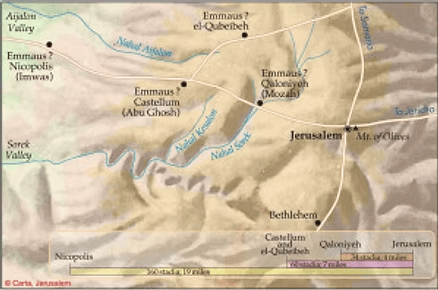
A couple of things need to be grasped about the seven miles to Emmaus (sixty furlongs). First, that was too far to walk on a Sabbath, due to the restrictions on how far one can walk on the day of rest. Cleopas and Mary had been in Jerusalem for the final prayer service of the eight-day Passover festival [a morning prayer, which on that particular ending day was done on a Sabbath morning], meaning they probably stayed in the upstairs room that had been secured for Jesus and his disciples until Sunday morning. While ordinary years would have allowed them to travel back and forth from home, during the week-long event, the arrest, trial, torture and execution of Jesus, followed by his temporary burial in the tomb of Joseph of Arimathea, would have kept them in Jerusalem all of the eight days. Now, with the Passover over, as well as the Sabbath, it was time for them to go home; but as they walked, they were “and talking with each other about all these things that had happened.”

Second, the road to Emmaus was the same road that cut through Jerusalem, with the eastern direction called the Jericho road, with Emmaus being due west.

Cleopas and Mary would not have been the only ones walking this road, as many pilgrims from the west would have traveled the same road. The Roman road would have ended at the Mediterranean Sea, with a road leading to Joppa being a branch off that road headed more northerly. Joppa would have been a place for European pilgrims to find sea passage back home. Still, foreign travelers in Judea for the Passover would have planned to stay until Shavuot [Festival of Weeks, beginning at Pentecost], so the further away from Jerusalem pilgrims walked, the easier it would have been to find rooms for a two-month stay.  Thus, walking and talking with strangers would have been common, if not preferred, simply to find safety in numbers.

Jesus, appearing as some pilgrim headed home after the Passover, came upon Cleopas and Mary as they were discussing the past week and how it played out for their nephew. Jesus acted like he did not know who they were talking about, which led them to explain more. However, that led Jesus to tell his family members, “Oh, how foolish you are, and how slow of heart to believe all that the prophets have declared! Was it not necessary that the Messiah should suffer these things and then enter into his glory?”

Jesus knew he had foretold all that would happen, exactly as it went down, but he was speaking to deaf ears, blind eyes and closed minds. Cleopas and Mary had been there and heard those prophecies, but (like all the other disciples and followers of Jesus) they were slow to take his words to heart, the place in devoted humans where God resides. Thus, no one believed the truth of Jesus’ words, because they preferred to ignore the truth and believe what they wanted to believe (a common flaw in the faithful to this day).

We then read that after Jesus called his relatives “foolish,” “then, beginning with Moses and all the prophets, [Jesus] interpreted to them the things about himself in all the scriptures.” Seven miles they walked as Jesus talked the truth. All the while, the hearts of Cleopas and Mary were burning within them, as Jesus was “opening the scriptures” to them.

When Luke wrote the word “diēnoigen” (translated as “he was opening”), the root word means: Properly: “opening the ears and the eyes, such as to restore hearing and sight. Tropically: “to open the sense of the Scriptures, explain them; to open the mind of one, i. e. cause him to understand a thing; and to open one’s soul, i. e. to rouse in one the faculty of understanding or the desire of learning.”[2] (Thayer’s Greek Lexicon)  Therefore, Jesus (as a stranger to his aunt and uncle) spoke to them as one filled with the Holy Spirit and the gift of interpreting prophecy.  ALL who possess that holy talent speak in the name of Jesus Christ, whether they look like “picture book Jesus” or not.

When Cleopas and Mary came to the place where their home was off the main road, they did not want to leave this stranger who had opened their eyes and hearts so widely.  From desire to know more, they invited unrecognizable Jesus to stay at their place overnight. We then read, “When he was at the table with them, he took bread, blessed and broke it, and gave it to them. Then their eyes were opened, and they recognized him.”

They recognized Jesus because Cleopas and Mary had been present at the Passover Seder meal ten evenings prior, when Jesus presided over the ritual dinner.  They had watched Jesus do the exact same thing then, as he had just done at their dining table.  They had not seen the power of those words then; but with their hearts alive with fire and passion for the the truth of God’s Word, they vividly flashed back to that Passover Seder message forgotten.

This is where bread has to be seen as symbolic of the written Scriptures, which Jesus had just enlightened Cleopas and Mary about: Moses and all the prophets wrote the texts that all Jews were fed from. That bread is unleavened, in the sense that Scripture is written in basic ingredients.  Those words do not give rise, as leavened, until consumed and swollen to full meaning by the “yeast” of the Holy Spirit.  Thus, that bread is blessed by God, as Holy Words, and those Holy Words are broken into books, chapters, verses and individual words – ALL of which have divine meaning the blind eye cannot see.

The man Cleopas and Mary had just walked seven miles with had just made them vividly recall that Passover Seder with Jesus, who was then known to be the Christ.  Before, he was just Mary’s special son, Jesus, a charismatic with a penchant for preaching and a knack for working miracles.  However, for the first time Jesus had opened the minds of his close relatives to Spiritual knowledge, which came by his breaking of the bread of Scripture and presenting it to them to digest.

Luke then wrote, “he vanished from their sight,” where the Greek word “aphantos” means, “disappearing, invisible, hidden.” This was not the first time that Jesus had eluded people, as John wrote about Jesus escaping the hands of his haters in his seventh and tenth chapters. This ability to become invisible or to disappear or to become hidden beyond view is a power from the divine.

This disappearance can be explained as a hallucination shared by Cleopas and Mary, where they actually did walk with a strange pilgrim, but the Holy Spirit made it appear that stranger was talking to them. The hallucination could have then come into their home, due to their heightened belief, while the actual strange pilgrim kept walking on the road to the west. Jesus disappeared simply because he was not in that Emmaus home as a strange pilgrim.  Jesus was there in Spirit, one that was invited by Cleopas and Mary to stay with them.  That presence symbolizes how all whose hearts burn to serve God must welcome God into their hearts.

It is this hallucinatory state that makes this account on the road to Emmaus become parallel to Mary Magdalene speaking with a gardener.  Mary never saw the gardener as Jesus in the flesh.  She heard his words and recognized it was Jesus, in the same way that Cleopas and Mary did.  The hallucinatory state reflects how each disciple of Jesus must seek him first.  Then, when Jesus appears in unrecognizable form to answer our call, a true Christian will recognize the presence of Jesus Christ, by understanding the messenger sent in his name.

Then, Luke tells of Cleopas and Mary hurrying back to Jerusalem and the upstairs room. It was still light outside, but technically night time, close to 8:00 PM by the time they were back in the upstairs room. Thomas, who had been out procuring dinner for the disciples and their companions when Jesus first appeared among them, was back then (he brought back some fish for them to broil). One could imagine the door was locked, due to the fear of the Temple being proud of murdering innocent Jews; but suddenly there was Jesus again standing among them.

Then, as the time earlier, Jesus appeared in a recognizable form, complete with body wounds from having been flogged, crucified and speared. One would imagine Jesus was fully dressed, just as the gardener and the travelling pilgrim would have been, even though the burial preparation would not have clothed Jesus’ body in anything more than shroud, face linen, and prayer shawl (provided by family). This means Jesus wore heavenly clothing, despite appearing earthly natural. One would imagine Jesus opened his robe for Thomas to feel his spear wound.

Before anyone starts to think that Jesus was a hologram or beamed to earth by God, look at how Jesus said he was not a ghost.

Jesus was real, in the flesh, the same flesh that had been prepared for burial the past Friday. He asked for food, which he ate before them so they could see how real he was. He was real when he stood before Mary Magdalene. He was real when he walked with Cleopas and Mary; and he was real standing among his followers in the upstairs room in Jerusalem. However, the most important element of that reality is discerned from Jesus saying (according to Luke), “Thus it is written, that the Messiah is to suffer and to rise from the dead on the third day, and that repentance and forgiveness of sins is to be proclaimed in his name to all nations, beginning from Jerusalem. You are witnesses of these things. And see, I am sending upon you what my Father promised; so stay here in the city until you have been clothed with power from on high.”

The reality of Jesus was the fulfillment of the prophecies that foretold his coming, death, and resurrection. The imaginary of prophecy had become real. While Jesus told the pairs of eyes standing with him at that time, “You are witnesses of these things” … “You are witnesses to this realization of divine prophecy” … Jesus would not be able to produce any new human witnesses to him in the flesh … a real Jesus … after he would Ascend to Heaven. Therefore, when Jesus then said, “See, I am sending upon you what my Father promised” … the Holy Spirit … Jesus meant the Father promised a Messiah that would last an eternity (see Micah 5:2).  Therefore, Jesus would last a lot longer than 33 years, as he has not ever left, through the reality of the Holy Spirit.  That was why Jesus then instructed his followers to stay in Jerusalem “until they had been clothed with power from on high.”

Now, while I allow that last statement of Jesus sink in a little, let me point out that Jesus appearing to his followers in the upstairs room took place in the evening on technical Sunday; but because the Hebrew calendar recognizes that to be the evening of the next day, Jesus gave that command on a Monday. Monday would represent the ninth day in the Counting of the Omer. That means Jesus stayed with his followers and taught them for forty days – from Tuesday, the tenth day of that counting, until the Sabbath, the forty-ninth day.

This means Jesus Ascended on the Sabbath, but returned via the Holy Spirit on Pentecost, the fiftieth day of that count … another Sunday. This means the disciples spoke as Jesus had spoken, because the Holy Spirit clothed those followers with the power of Jesus Christ, from on high, on that day.

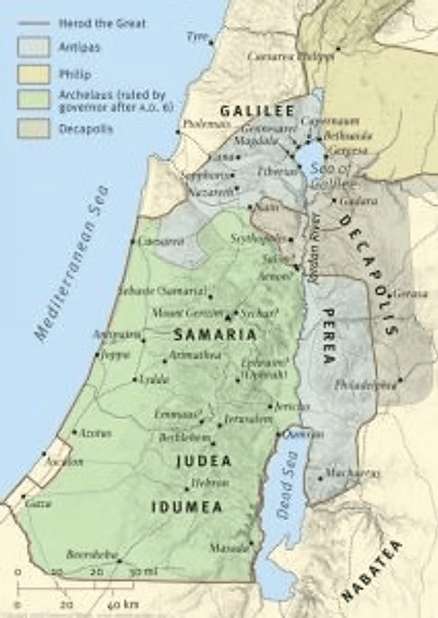
The missing day – Monday – is referred to in John’s Gospel, which was a dream rather than reality. The dream of John had the disciples fishing unsuccessfully on the Sea of Galilee, when Jesus had just told them all to stay in Jerusalem. The dream is confirmed to be that when one realizes that Capernaum was over 100 miles from Jerusalem (ref.), and it would have taken about five days to walk that far.

The symbolism of John’s dream can then be applied to the disciples’ state of mind, which was they were in shock. They had just watched Jesus be tried, tortured, crucified, buried, and then stand before them eating broiled fish, pointing out his still fresh wounds.  They had shook with fear that the Temple Jews would look to kill them next, with Lazarus already on their preferred hit list.  All that happened on Sunday had then left them dazed and confused.  Monday was then a day to take a deep breath and calm down, as basic training for receiving the Holy Spirit would begin the following day.

Still, with all of the readings that are representative of the proof that Jesus resurrected … proof that no Christian living today can swear to, no one can prove to another that resurrection.  No one today can say, “I have seen the risen Lord stand before me in a real human body.” All the witnesses of real Jesus have passed from this world; and that is the deepest meaning of Easter Sunday. Jesus has risen in unrecognizable forms, through the Holy Spirit.

While we all are still eight Sundays from celebrating Christian Pentecost (a wholly symbolic recognition of the Holy Spirit), Jesus suddenly appeared and disappeared on the first day of the week to foretell his coming within true Christians. A true Christian can only be defined as one who has been clothed within as Jesus, with all the power the Christ Mind bestows, from on high.

A true Christian, like Jesus, dies of self and is risen as Jesus Christ. A true Christian is dead to self-serving, as being Jesus Christ demands serving God, through going to help others in Spiritual need. Disciples of Jesus tremble in fear at the ghost of Jesus expecting them to leave the safety and security of a locked door to an upstairs room; but a true Christian hears Jesus say, “Why are you frightened, and why do doubts arise in your hearts?” Jesus reborn within one means “Peace if with me,” and when one can say that, then Jesus is walking the earth once again in unrecognizable form.

The Lord is risen indeed, when the Lord is alive in a true Christian. That is why Easter is much more than one man coming back to life after death. If that were the case, then Lazarus rising from death was an equally important event … one that no church recognizes on the level of Easter.

“Lazarus come out!” must speak to you. You must become Lazarus in order to become Jesus Christ reborn.

While one can say, “Jesus was the magician who was so special he commanded Lazarus to “Come out!” then who was it who commanded Jesus to do the same? The answer is not the power of the Son of Man but the power of God. God gave life back to Lazarus and God gave life back to Jesus. Therefore, Easter stands as the miracle of Moses crossing the Israelites through the Red Sea on dry ground, because God is the one with the power to part physical from spiritual, wet from dry, captivity from freedom … to separate mortal death from life everlasting.

Not much is written about Lazarus after he rose from death. John wrote that he and Jesus had a dinner in their honor on the evening of technical Sunday, prior to Jesus entering Jerusalem on a donkey colt for his final Passover festival. The Eastern Orthodox Church believes that Lazarus fled Judea to Cyprus, where “he was appointed by Paul and Barnabas as the first bishop of Kition (present-day Larnaka).” (Wikipedia)

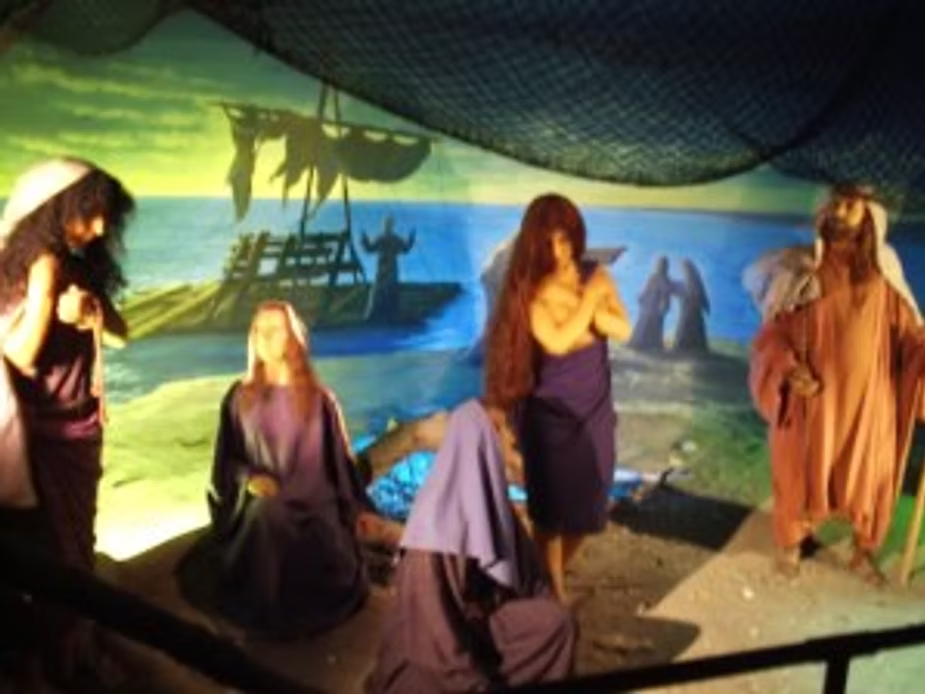
The Western Church believes in the lore of the small town Saintes-Maries-de-la-Mer [Saints-Mary-of-the-Sea], on the Mediterranean coast of France.  There Lazarus arrived, along with three Mary’s (Mary Magdalene, Mary Salome, and Mary of Cleopas).

Wax figures depicting the event in a museum of Provence history.

Lazarus is said to have gone to Marseilles [nearby to the east], where he converted many local pagans to Christianity, being called the Bishop of Marseilles. (Wikipedia, same as above) Supposedly, Lazarus lived for thirty years after he was raised from the dead, never smiling because of having seen the misery of souls in Hades, while he was dead.

Lazarus and Jesus can be seen as a duality, with one human and one divine. Lazarus rose and continued living as a divinely changed man. Jesus rose, taught his disciples for forty days, Ascended, then returned as the divinity that led Lazarus to become like Jesus. Likewise, Jesus returned to be the divinity of Peter and the other ten lead disciples, plus all those companions who witnessed Jesus standing risen among them (Lazarus probably was one also there). Jesus was reborn in 3,000 pilgrims to whom the Apostles opened the Scriptures (in foreign tongues). This makes Easter become a duality with Pentecost, where Easter is human devotion and Pentecost is divine practice (faith and works).

Jesus is the model by which ALL Christians are formed. Humans must conform to that model to receive the Holy Spirit and become divine.  Divinity comes by the love of God [burning hearts married to the LORD] and the birth of Christ in one’s mind. Moses built the model upon which Israel [and Judah] was formed, building human forms of devotion to the One God. Jesus was the duality to Moses, who built the model upon which the devoted received new life from the One God. Thus, one must be devoted to the One God first [the First Covenant] before one can evolve into a human that truly serves the LORD through Christ [the New Covenant].

Easter is the dawning [the Sunrise] of that necessary change.

One has to stop fearing one’s own death of self and give one’s heart and soul over to God’s Will. Easter is then the rebirth of one’s devotion, where one does not pray to an unseen, unfelt, and unknown God, but instead one feels burning in one’s heart, with love of the power of God, which one has seen and heard through opened Scriptures. Easter is then the desire to learn more, from the knowledge of God that comes from the presence of Jesus Christ teaching one the hidden truth that God’s Word holds. Easter is then the absorption of God’s knowledge for the purpose of spilling that knowledge out unto others of devotion [Pentecost Day].

This is how Easter is more than Jesus rising from death. Jesus has to be risen within all Christians for Jesus Christ to be alive in this world today. It is through true Christians that Jesus walks the road of life still, explaining the Scriptures to those who are saddened because they think Jesus is dead and there will not be another Jesus until the end of the world. Jesus is alive today though his gardeners, those who plant the seeds of insight into those who love Jesus, but previously had only wanted to dress, perfume, and decorate his body of death [hold the cross of crucifixion high, rather than the + of life in the Trinity: Father, You, Holy Spirit].

Easter is thus like Spring, when the death of Winter is replaced by the Rebirth the ever-living Vine, budding so that new fruit will come.

——————————————————————————

[1] In case anyone doubts this, I recommend reading Luke’s chapter 3.  The last verse state:, “The son of Enosh, the son of Seth, the son of Adam, the son of God” (Luke 3:38).

[2] Some might note – IF one’s heart is burning – that I write these “articles” in the same sense of “opening the Scriptures” for understanding, as well as to remove the plugs and blinders that have impeded one’s own ability to discern these things.

Mark 16:1-8 – An Easter message that packs a wallop of meaning

When the sabbath was over, Mary Magdalene, and Mary the mother of James, and Salome bought spices, so that they might go and anoint Jesus. And very early on the first day of the week, when the sun had risen, they went to the tomb. They had been saying to one another, “Who will roll away the stone for us from the entrance to the tomb?” When they looked up, they saw that the stone, which was very large, had already been rolled back. As they entered the tomb, they saw a young man, dressed in a white robe, sitting on the right side; and they were alarmed. But he said to them, “Do not be alarmed; you are looking for Jesus of Nazareth, who was crucified. He has been raised; he is not here. Look, there is the place they laid him. But go, tell his disciples and Peter that he is going ahead of you to Galilee; there you will see him, just as he told you.” So they went out and fled from the tomb, for terror and amazement had seized them; and they said nothing to anyone, for they were afraid.

——————–

This is the second option [Track 2?] for the Gospel selection to be read aloud on Easter Sunday, Year B principal service, according to the lectionary for the Episcopal Church. In the season of Easter, beginning with Easter Sunday, the Church makes a certain reading from the Book of the Acts of the Apostles mandatory to be read, either taking the place of an Old Testament reading possibility [the First Lesson] or taking the place of the Epistle reading possibility [the New Testament slot]. In some way, by design or chance, this reading from Mark can be chosen over the first Gospel choice from John. The John 20:1-18 option is optional to choose in all three years of the lectionary cycle, whereas Year B primary service is the only shot Mark 16:1-8 has to be read aloud and thereby be explained in homily.

Knowing this is the second option for the Gospel and assuming it will be read if the mandatory Acts reading takes the place of the second lesson [the New Testament category], that would mean this reading from Mark will be preceded by a reading from Isaiah 25, where the prophet wrote, “Then the Lord God will wipe away the tears from all faces, and the disgrace of his people he will take away from all the earth.” That will be followed by a selection of verses from Psalm 118, which sings, “The Lord has punished me sorely, but he did not hand me over to death.” Lastly, the mandatory reading from Acts 10 will be read, which states, “They put him to death by hanging him on a tree; but God raised him on the third day and allowed him to appear.”

Before delving into what Mark wrote about the first Easter Sunday, it is important to realize the Gospel of John recounts this differently. There certainly are opponents of Christianity who will challenge any seeming inconsistencies as being weaknesses that make the foundation of Christian faith crumble, from stories that approach one event from different perspectives. Different perspectives do not mean contradiction. In this regard, I recommend a true seeker, even an opponent of Christianity, read my interpretation of John 20:1-18 [on this website’s blog], because I show how nothing John wrote is contrary to what Mark wrote. It should be realized that Mark wrote the accounts of Simon Peter, so John’s direct mention of Simon Peter entering the empty tomb does not mean that Mark has to also tell of Simon Peter doing that. Not telling of something is not evidence that another who told of something was incorrect.

It is now important that I attest to a divine syntax that I have been led to realize and become somewhat fluent in reading, over years of practice. This divine syntax is necessary to follow, if one wants to grasp the deeper meaning of what is written. By reading under a new set of rules of language [by “speaking in tongues”], hidden meaning rises from the surface meaning that is all allowed to be seen by normal syntax. In this regard, one has to admit the texts of the Holy Bible were written in either Hebrew or Greek, such that English translations [beginning with the King James Version and multiplying like rabbits ever since] have been memorized by Christians and made to seem as if the Biblical characters all spoke English – a language with syntactical rules that differs from the divine language all Scripture is written by [from the Godhead]. The source of all holy text is God [Yahweh] and must be realized as perfection, as written; therefore, any changes made to that perfection [to suit the needs of translators] weakens the truth that is divinely told.

With that disclaimer stated, this reading has verse 1 begin with the benign phrase, “When the sabbath was over.” That is not what Mark wrote. The Greek text shows: “Kai diagenomenou tou sabbatou,” where the first word is a capitalized “Kai.”

The Greek word “kai” is ordinarily a simple conjunction that is translated as “and,” according to the normal rules of Greek and that language being translated into English. I have found that the divine rules of syntax tell me to see “kai” as a marker word [not “and”], one that does not need to be read in English. The word “kai” should just be noticed, so one realizes something important will follow that marker word. In this case, where “Kai” is capitalized, such that another rule of divine language says all words capitalized take on higher meaning, of spiritual essence. This verse beginning with “Kai” [improperly translated as “When”] says the first series of words [to the comma mark] is an important spiritual statement that needs to be seen in that light, above the simple surface meaning that says, “When the sabbath was over.”

A literal translation of the Greek stating “Kai diagenomenou tou sabbatou” says, “Kai having passed this seventh day.” Because the capitalized “Kai” is seen as a signal to look for higher meaning in those words, “having passed” becomes a divinely inspired statement of time elapsing. Because the last verse in Mark 15 told about the burial of Jesus [on a Friday], the spiritual meaning of “having passed” is less about the days of the week having gone by, but the timing of Jesus prophesying he would die and after three days be raised. Seeing that, “having passed” becomes a divine statement of when those three days were officially over. By adding to that meaning “this seventh day” [not capitalized, therefore not specifically stating the Sabbath], Mark is making a very important statement [“Kai”] that the timeframe of Jesus’ prophecy was up on the seventh day, which was the day after his burial on Friday [the sixth day]. It also [by counting backwards] makes an important statement that Jesus died at 3:00 PM on Wednesday [the fourth day].

From seeing that being the deeper intent of Mark writing those words, the rest of verse 1 states, “Mary Magdalene , and Mary the mother of James , and Salome bought spices, so that they might go and anoint Jesus.” While that seems to be Peter telling the names of three women who went to the tomb to anoint Jesus, one has to slow down and realize in these segments of words are five capitalized ‘names,’ each of them having a root meaning that importantly [capitalization] needs to be understood. Those root meaning are as follows [all sourced from Abarim Publications]:

  1. Mary – “Beloved”
  2. Magdalene – “Of The Tower”
  3. James – “Supplanter” [or “He Who Closely Follows”]
  4. Salome – “Peace”
  5. Jesus – “Yahweh Saves”

When these root name meanings are seen as divinely raised to the intent behind the names, the rest of verse 1 can be read as: “Beloved Of The Tower, and Beloved the mother of Supplanter, and Peace bought spices, so that they might go anoint Yahweh Saves.” In this being based on the translations into English and not the literal Greek text, we find with closer inspection that some words have not been translated and the places one find “and” written and where the word “kai” is adding a mark of importance.

Based on that awareness, that written literally translates into English as the following segments:

“this Beloved this Of The Tower” ,

“kai Beloved this the one of He Who Closely Follows” ,

“kai Peace” ,

“purchased perfumes” ,

“in order that having come” ,

“they might anoint [the dead] him” .

Again, I recommend reading what I interpreted about John having also written (similarly) of “Mary this Magdalene comes early,” where the use of the root names are discussed deeply. Here, I want to focus more on all who are named “Mary” are women who are spiritually deemed “Beloved.” The raised essence that must be seen now is “Beloved” means family relation, not just some friend or follower of Jesus.

Because some tend to see Mary Magdalene as some woman Jesus knew, who was a female disciple, this makes it clear that she was related to Jesus [“Of The Tower”] through marriage, as the wife of Jesus. As the wife “Beloved,” she was first in the list of women responsible for preparing the dead body of her husband for transfer from a loaner tomb, to the ‘family plot’ [the one Lazarus had been buried in].

The second most important “Beloved” is the mother of James, the half-brother of Jesus. Still, the word “mother” is not written, but implied from an article – “.” That same word [a letter in Greek – “ἡ”] is written before the first “Maria” and before “Magdalēnē.” At neither place has a translator seen reason to imply the word “mother” needs to be added. The presence of the word “kai” before the second “Beloved” says this woman has greater spiritual importance than the wife, where “kai” becomes the indication of the mother, one who conceived Jesus without physical penetration or intercourse. This makes “James” become a statement of her having since become a mother who conceived through intercourse with Joseph, her husband; but that couple had more children than just James. Therefore, the meaning of the name says the “Beloved” mother of Jesus also was one “Who Closely Followed He,” making that name become representative of her divine Son of man.

After seeing that identification of Mother Mary, one finds another use of “kai,” which says “Peace” is another element that must be understood. The name of the woman Mary Salome is that of an aunt of Jesus, as the wife of a brother of Mary the mother of Jesus. Her husband is believed to have been Zebedee, making Salome be the mother of James and John of Zebedee, saying they were cousins of Jesus. By a third woman being announced as important to know on a spiritual level, “Peace” must be read as the strength that held all three women up, enabling them to do the work they were leaving to do. Mary Salome became that “Peace” with them. She was a presence of calm for two women who were most distraught over the death of a husband and son.

The following segment is separated by comma marks, saying “purchased perfumes” or “bought spices.” That has to be recognized as a statement of the past, as acts done in preparation for this day. Since there would have been no buying nor selling on the Sabbath, these three women had gone on the day of preparation [Friday] and “bought spices” for the purpose of preparing the body of Jesus for transfer, from one tomb to another. They would have done that separate from Joseph of Arimathea and Nicodemus taking seventy-five pounds of embalming perfumes with them to prepare Jesus’ body for burial. This segment means Jesus was representative of their Sabbath to recognize, based on prior preparations. Their “day of preparation” was for Sunday, the first day of the week, not the Sabbath.

Most likely, these women did little more than cry and pray on the Sabbath, in preparation for doing what had to be done on Sunday morning. This becomes the focus of the next segment of words: “in order that having come.” More than them walking to the tomb as the meaning of “having come,” it was a day prepared for “having come.” Therefore, the word “hina” is written to connect that which had been bought in preparation, so it follows an order or schedule, such that a day of work had arrived.

The final segment of words places focus on anointing. The Greek word “aleipsōsin” states the conditions planned in preparation, which were to be apply olive oil scented with fragrances to the face of Jesus. It is here that one finds the translation that has “Jesus” listed is incorrect, as that name has been applied to the Greek word “auton,” which simply means “him.”

The intuiting of Jesus, a name that means “Yahweh Saves,” says two things. First, a corpse no longer has a name. A male corpse is “him.” Second, the plan to anoint one who had already been the Anointed One of Yahweh means the conditional (“might anoint [the dead]”) says the women had given up hope that Jesus could not die, having assumed he had been given eternal life, therefore impossible to ever be dead.

Verse 2 then states, “And very early on the first day of the week, when the sun had risen, they went to the tomb.” This verse also begins with the word “kai,” although not capitalized. This says the timing is important to understand. The two words “lian prōi” translate as “very early,” but the importance of “kai” says “lian” must be read as “exceedingly” or “extremely,” where the “earliness” means the second 6:00 AM ticked off. Any earlier and it would have still been technically the Sabbath.

When Mark wrote “the first day of the week,” this is the same terminology used by John. This being stated in verse 2 says the elevated meaning found in verse 1 is correct, as that stated the timing of Jesus resurrection of death, more than identifying it was now the day after the Sabbath, as the first day of the week [Sunday]. This also says it was immediately upon that new day having arrived.

There are two segments of words, set off by comma marks, that make the NRSV translation a paraphrase. The literal translation into English shows those segments as stating: “they come to the tomb , having arisen the sun.” The order of those segments is important to grasp.

First, “they come to the tomb” is stated in the present inductive, not in the aorist past, meaning the women left before the sun actually rose. That says sunrise had not yet occurred at 6:00 AM. However, the aorist active participle of “anateilantos” [“having arisen”] says sunrise occurred after they left to go to the tomb. It was then, second, as they were walking that “having risen the sun.”

Verse 3 then has Peter recall a conversation, one which he personally should not have been present to hear. By Mark writing, “They had been saying to one another, “Who will roll away the stone for us from the entrance to the tomb?” this implies the conversation happened at the cemetery. For Peter to tell this to Mark [his writer], it means less in hearsay, but when this is shown to be the past, it says Peter could have heard the women voice their concerns as they were preparing to leave. It makes “among themselves” reflect back to a memory of Peter, as one present overhearing them talk. This past tense use of “were saying” could have been early in the morning, when the women voiced that concern before leaving to the cemetery. In that case, Peter sat nearby and heard them purposefully talk so he could hear them, as a way of them trying to motivate him to volunteer to go with them and do that work [as trying to make him feel guilty]. In that case, Peter knew he had let the women go alone, without offering to go along and possibly help them.

That verse is introduced by the word “kai,” such that the importance becomes this element of them talking among themselves. As women knowing they were not strong enough to roll away a heavy tomb stone, they also knew it was not their place to do a man’s work. Therefore, the importance of this becomes a confession by Peter that he knew about this conversation beforehand, rather than after the fact, as hearsay.

Verse 4 then says, “ When they looked up, they saw that the stone, which was very large, had already been rolled back.” Here, again, is a verse begun by the use of “kai,” showing importance needs to be seen in “having looked up they see that” [from “elegontheōrousin hoti”]. This puts emphasis on that point of their prior discussion, now showing it to be needless worry.

This makes “having looked up” be akin to having a premonition or imaginary vision of them reaching the tomb and seeing a stone in need of being rolled away. From this, going back to the “bought spices” or “purchased perfumes,” these women had not been to the tomb to watch the interment, as it happened so late in the day Friday, while they were shopping. Peter most likely had watched that interment [as secretly as a casual bystander could] and knew there would be guards there to help the women. Thus, he did not offer to go and possibly help, when he knew his help would not be needed and he did not want to be arrested. The vision the women has conjured up [“having looked up”], from fear of going without a man, disappeared when they saw the tomb already opened.

When Mark is shown to have written, “the stone, which was very large,” the separation by comma marks says the stone for the tomb of Joseph of Arimathea was “extremely large,” using the same extremity as was found in the earliness of the hour prior. This says the imaginations of the women led them to “see” which tomb was his [an act of “perception” beyond personal knowledge from past experience] and to realize that tomb was opened, no longer sealed by a stone greater than they had expected.

When the translation states in verse 5, “As they entered the tomb, they saw a young man, dressed in a white robe, sitting on the right side; and they were alarmed,” this ignores the presence of another capitalized first word that is “Kai.” This places great importance in understanding “having entered into the tomb” [from “eiselthousaieis to mnēmeion”].

This is where linking John’s story to Mark’s is important, as John makes it easier to intuit that women and children did not have any rights to enter into tombs. That was only allowed to adult males. Therefore, the great importance comes from not thinking three women casually walked into an open tomb, previously where a dead body had been placed. The presence of a capitalized “Kai” has greater power when seeing the meaning coming from understanding someone [not the women] was evident, as “having entered into the tomb” because it was opened. The divine importance says God was the one “having entered into the tomb,” to retrieve the soul of His Son, who also was another “having entered into the tomb.”

From grasping the importance of that statement, rather than thinking women would go into a tomb not owned by either of them, without asking permission first, makes sense that the next segment of words tells of them seeing “a young man,” not inside the tomb, but outside, “sitting on the right.” This then gives the impression that “a young man” was thought to be “an attendant” [the meaning of “neaniskon”], who was employed by the garden cemetery. By stating he was “sitting on the right,” this implies the stone had been rolled away to the left. A “sitting” position [from “kathēmenon”] can even be a statement of him being in a “dwelling” or “residence,” implying the “attendant” was under a canopy or tabernacle.

The next segment of words, separated by comma marks, says this “attendant” was “clothed in a robe white.” Here, the symbolism of “white” needs to be seen as a statement of “purity.” The Greek word “leukēn” can mean, “bright, brilliant,” implying dazzling white.

When this is combined with the prior statement of “on the right,” where the word “dexiois” equally can translate as “the right hand,” this becomes descriptive of Jesus’s soul, which has ascended to the Father and sitting at the right hand of Yahweh. Seeing this, the word “sitting” can now be read as “enthroned.” This makes the reading from John [as explained in my commentary about that] be supported here, as to when Mary Magdalene was told by Jesus [who she thought was the gardener], “Not me appearance.” Instead of a “young man” actually being outside the tomb, the women saw Jesus there, as an unrecognizable transfiguration.

In the NRSV translation that adds, “and they were amazed,” this segment of words is begun by the word “kai,” signifying importance must be seen in what was witnessed. The “kai” leads to one word in Greek, “exethambēthēsan,” which makes the important statement: “they were greatly amazed.” Here, again, there is a superlative used [embedded in the usage applied normally to the root word “ekthambeó”], which elevates this word so it means the women suddenly felt as if they somehow had come into the presence of God. As such, their “amazement” was actually “great fear.”

In Luke’s version of this event, two angels were said to have been seen, such that he wrote: “In their fright the women bowed down with their faces to the ground.” While not written here in Mark that they bowed down, one can expect the women felt such a strong presence before them [unnatural and quite holy] that they would have prostrated themselves out of a fear of God Almighty.

This state of being is then confirmed when Mark is shown to have written in verse 6, “But he said to them, “Do not be alarmed; you are looking for Jesus of Nazareth, who was crucified. He has been raised; he is not here. Look, there is the place they laid him.”

Keeping in mind that no words have been exchanged between the women and the “attendant” or “young man,” it is now clear that the one in a bright robe knew the hearts and minds of the women. From that source of divine knowledge was spoken a series of segments that are missing important signs that keep the reader of the NRSV from comprehending.

To best grasp this, I will now do as before and break down the segments of words, complete with the correct punctuation, and literally translate the Greek into English. What was said goes like this:

“Not be terrorized” .

“Jesus you seek” ,

“the Nazarene” ,

“this one having been crucified” .

“he is risen” !

“not being here” !

“behold the place where they laid him” .

Because John wrote of Jesus speaking to Mary Magdalene, one must see this “young man” as the spirit [or soul] of Jesus, as an apparition. Rather than being a physical body, as would later seem to appear in the upper room, the appearance of a young man makes the soul of Jesus take on the appearance of Adam, the Son of God, made by His hand. Therefore, just as John wrote that Mary thought Jesus was the gardener [John later knowing it was Jesus, but not the man], that same entity has just spoken to three women in Mark’s Gospel.

In the first segment, the capitalized Greek word “” is written, importantly stating “Not.” This then leads to the word “ekthambeisthe,” which was similarly stated as how the women felt great fear and fell down. The power of “Not” is then less about being a spoken word, but a presence that spoke to the women, such that the fear they had felt from seeing holiness before them suddenly ceased oppressing them. Because these two words end simply with a period mark, there is no sense of command that should be read into words spoken; but one should see that just as suddenly as the women felt weak and meaningless, they stopped and felt secure enough to stand up or kneel before this presence in white.

The next three segments are broken into important mind-reading steps, such that all three women were thinking the same things, all of which were known by the soul of Jesus, because he was married with the Holy Spirit and therefore one with the Father. In the segment that says, “Jesus you seek” [from “Iēsoun zēteite”], here is found the capitalization of the name “Jesus.” Returning to the previous section where I explained several names presented in verse 1, the meaning here now bears the same translation presentation. Thus, first stated is “Yahweh Will Save you seek.” That becomes the knowledge of Yahweh reading their hearts and minds, saying He knew they sought salvation through Jesus.

When next is said “the Nazarene” [from “ton Nazarēnon”], the capitalization of “Nazarene” brings out the name meaning [of a place, Abarim Publications] “One Of The Scattering.” While this statement can go quite deep in explanation [which I will sidestep for now], the point of this should be seen as knowledge that Jesus was born of Mary [there before this “young man”] in Bethlehem, not Nazareth. The use of “Nazarene” then speaks of Jesus as human, while also becoming spiritually elevated, as one of Yahweh’s spiritual seeds sown on earth. Jesus was one of many in the line of Adam’s soul that the hand of God had spread, planting holy seeds upon Israel.

The next segment then knows the three women stayed vigilantly at the cross upon which Jesus of Nazareth was crucified and taken down dead. The reason the women had left so early in the morning to get to the cemetery was because they witnessed that death and wanted to care for the corpse. They wanted to pour olive oil with sweet fragrances one last time upon his face and say prayers of lament for him. As women named “Beloved,” they all wanted to show the respect of love for one they had lost.

Then, the next segment begins a new line of though, following a period mark. It ends with an exclamation point. The word exclaimed is “ēgerthē,” which is the third person aorist passive indicative form of the verb “egeírō,” which is translated as “he is aroused, awakened, risen.” The third person is assumed to be “he,” but because the soul of Jesus is then the one speaking, and because the first person singular is not used, a better translation would be “it is risen.”

The “it” would be the soul; and, the use of “awakened” or “aroused” attests to what Jesus had said about Lazarus (on the other side of the Jordan): “Lazarus is only sleeping.” Lazarus likewise was in need of “raising, arousing, awakening” from the sleep that is death. A body never has life without a soul, thus a body is always asleep; but, a soul never dies, as it is always awake, but in need of a body if not saved from death.

To fully understand the impact of “it is risen,” Jesus was not standing physically before the women. The brilliance of his “robe” means he was observed in a transdimensional state of being, just as Peter, James and John saw Jesus “transfigured” along with Moses and Elijah. The soul of Jesus spoke to the women, saying “I am risen,” meaning his soul was then where he could truthfully say something like, “I am seated at the right hand of God, but you can see me as an apparition now. Later, you will have my body before you as you expected when you came early in the morning to here.”

This is then confirmed in the next segment of words that state, “not being here,” ended with an exclamation point. The “being” of all living creatures is the soul in the flesh. Just as Jesus would ascend in the flesh on the forty-ninth day [day before Pentecost], and just as Elijah ascended in the flesh before Elisha, the “being” [from “estin,” a form of “eimi”] that was recognized as Jesus of Nazareth was not available at that time. Think of this as God having ‘beamed Jesus’ body up to heaven.’

Thus, verse 6 concludes with the soul of Jesus telling the women, “behold the place where they laid him.” That becomes an invitation to peer into the tomb and see for themselves it was empty [except some linen wrappings and coverings], which acts to inform the reader that none had prior entered the tomb to look around.

Verse 7 then has the soul of Jesus tell them, “But go, tell his disciples and Peter that he is going ahead of you to Galilee; there you will see him, just as he told you.” In this, the exception [“but”] says seeing nothing in the tomb means nothing, because the body of Jesus had left the plane of the earth. This then speaks symbolically to the women [and Peter and John if there by then], saying, “enter your own tombs of self-ego death, so you too can “go” to the same place as went Jesus. It says Jesus will “go” to “tell his disciples” after you “go.” In this translation, the use of the third person pronoun “he” becomes confusing and could use clarification.

Clarification comes after a comma mark about telling the disciples, where one finds another usage of “kai.” This shows the importance of specifically naming Peter and the place Galilee. In addition to those two capitalized names is found between them the capitalization of “Proagei,” which means “It leads forward.” Again, the presence of capitalized names makes it important to see the root meaning of the names imposed into what was stated.

“Peter” – “Stone”

“Galilee” – “Rolling”

Simply from seeing the two names brings out importance to “Stone” and “Rolling,” where the women had just arrived to find a massive stone rolled away. By realizing the possibility that names are leading readers away from the hidden meaning, the instruction can now be read as: “this Stone that It leads before you towards these Rolling.”

Amazingly, this statement reflects back on Jesus knowing all about the unwillingness of Peter to come to the tomb, having nothing pertinent to do with talking about Galilee [the region where the disciples lived]. The capitalization of “Proagei” becomes an important statement about “It,” as the third person present indicative, meaning the Holy Spirit. That becomes the “Leader” that will become the same power “Rolling” away the “Stone” covering their tombs, after they submit them to Yahweh and become Jesus reborn. That “Leader” becomes metaphor for the “Christ,” which comes along with the name “Jesus” [Yahweh Saves].

The last two segments of verse 7 place focus on “there you will see him , just as he told you.” The use of “there” seems to mean “Galilee,” but when the name meaning spiritually says “Rolling,” “there” then becomes a place in the future, when the Holy Spirit will allow one’s eyes to open and “see” the truth as Jesus had seen. That place in the future will then be one prepared in the spiritual realm, as a room within the Father’s house. It will mean when all the things taught by Jesus will be understood perfectly and a soul will have come to know Yahweh personally.

Finally, verse 8 states, “So they went out and fled from the tomb, for terror and amazement had seized them; and they said nothing to anyone, for they were afraid.” Here, rather than “So,” this last verse begins with another capitalized “Kai,” signaling it to be most important to grasp properly. This word leads to one word, “exelthousai,” which has been used similarly twice before, meaning “having gone out” or “having come out.” The importance stated is then spiritually realized to be the whole experience of a glowing white presence speaking to them telepathically, as if it knew them personally. That becomes an impact statement about Jesus having come out of the tomb to greet his relatives and loved ones, not looking like himself and making them all fear God, while having their hearts warmed at the same time.

The next segment of words say, “having fled from the tomb.” This has the dual meaning [minimally] of saying they all ran away from the cemetery, returning to where they stayed quickly, while also saying deep within their souls they all knew they had escaped the fear of death, which is symbolized by the tomb. The promise of salvation means escaping the repetition of a dead body of flesh entombing a recycled soul, life after life. That “fleeing from the tomb” means salvation from reincarnation.

The next segment says that before this moment they “had seized for them trembling,” meaning they feared death tremendously. That past sense of fear had been removed. Thus, the next word is set apart by the use of “kai” internally in this segment of words. The “kai” states the importance of them having “amazement,” where the deeper meaning of “ekstasis” [the root for ecstatic] says they were overcome by a “trance-like state of being.” The fears they once let lead them had become disconnected, which was in itself bewildering to them.

The last two segments then say, “kai to no one nothing was said ; they had reverence for.” This says none of them had been told to go tell the disciples what they had seen, as they had seen nothing – the absence of what they expected to see. What the soul of Jesus had told them prior was to speak as the disciples of Jesus had been taught to speak. There was nothing they could say that Jesus had not already said, preparing them all for this time coming. Thus, they said nothing to nobody because they revered the experience of Jesus at the tomb and had faith that everything would be better soon.

As a short Gospel reading selection for Easter Sunday, it should be seen how much can unfold from only eight verses. The depth of understanding that comes from this selection is tremendous, while on the surface it seems other Gospel selections say more. The use of names in this selection, just like in that from John, becomes powerful; but few will ever see that or point it out so others can see it. Few will stand firm and say the three Marys saw Jesus. Many will be looking for something to happen in Galilee. This all becomes capable from true discernment, when one knows a divine system of language is in play; but most people are blinded by the syntax of English and paraphrases that dilute the truth. Therefore, no one is fluent in the language of God, so no one tells anyone the whole story that is written.

As the first Sunday in the Easter season, when it is most important to see how the mandatory readings from Acts are telling Christians it is not enough to meekly believe, but one must be prepared for ministry and the works of faith, few have teachers leading the seekers to that goal. At one time the Church knew this was important, setting up a system that is inspired by Yahweh; but over time that knowledge became lost. It is time to rekindle that Spirit and be prepared by the Word of Jesus Christ to return Christianity to what it is meant to be.